
Genesis 38:5

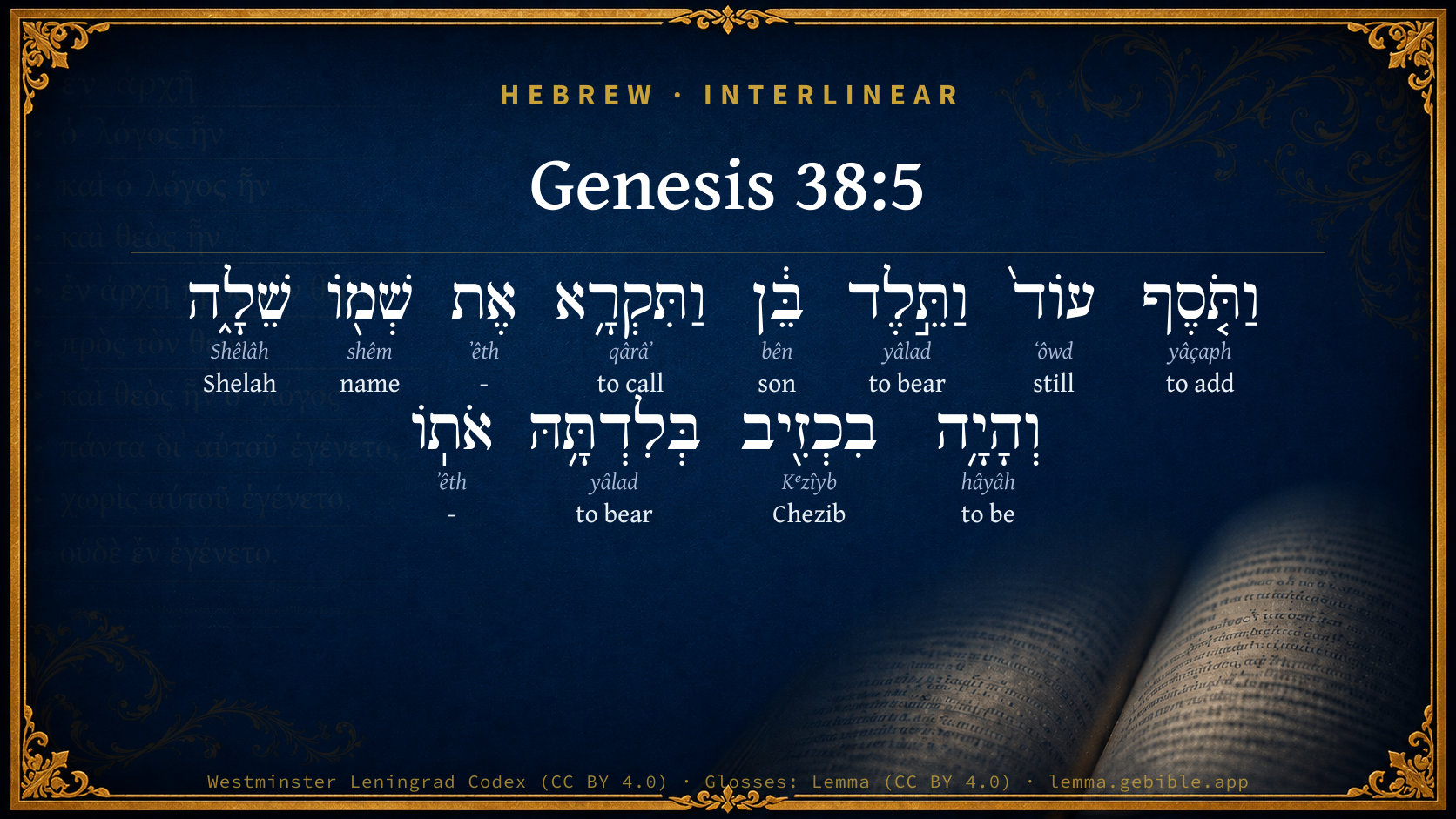
Hebrew (Westminster Leningrad Codex) Genesis 38:5 appears in the Hebrew Old Testament. The text above is from the Westminster Leningrad Codex. Each word links to its Strong’s number, a concise gloss, and parsing drawn from the Open Scriptures Hebrew Bible morphology. Click any word for its full Brown-Driver-Briggs (BDB) entry.
Download image
Cite this verse

Genesis 38:5 (World English Bible). Public Domain. Lemma interlinear Bible study tool, https://lemma.gebible.app/v/genesis/38/5.

Show BibTeX & RIS
BibTeX
RIS
English Translation
She yet again bore a son, and named him Shelah: and he was at Chezib, when she bore him.
World English Bible · Public Domain
Highlights
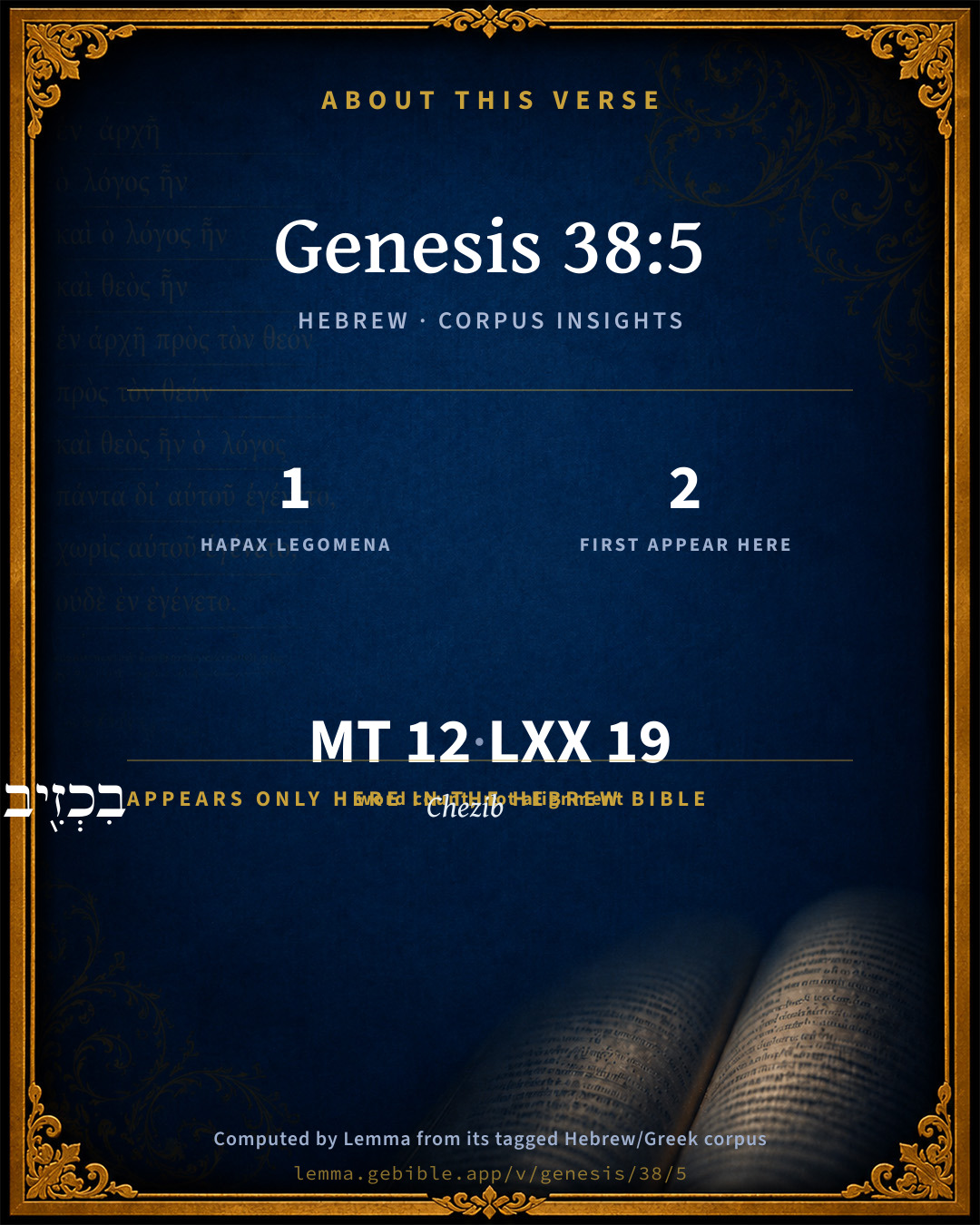
  • 1 hapax legomenon — only here in the Hebrew Bible
  • 2 first appearances in the Hebrew Bible
Full analysis ↓
Download a study sheet

One document with this verse’s original text, its word-by-word gloss line, the meaning frame, cross-references with their text, attributed commentary, and full source and license credits — printable, and it pastes into notes with its structure intact.

This verse Autodidact and up

Study sheet (.html) Plain text (.txt)

A passage Seminary Student

Up to 50 verses in one chapter. A passage sheet keeps up to 6 commentary sources and 12 cross-references per verse, in the order this page ranks them, and says so on the sheet whenever that leaves anything out. Ask for a single verse and you get the Autodidact verse sheet above.

Everything on this page stays free to read, with no account — the sheet is a download of what is already on screen, not access to it.

Want to remove ads? Support Godless Engineer
Compare translations 3

The same verse in 3 English versions, stacked beneath the original-language interlinear above. Click any original word for its lexicon entry.

Each is an independent rendering of the whole verse — the interlinear is not word-aligned to these translations.

Highlighted words mark where these versions differ — a whole-verse word diff, not a word-by-word alignment.

  • World English Bible Public Domain
    She yet again bore a son, and named him Shelah: and he was at Chezib, when she bore him.
  • King James Version Public Domain
    And she yet again conceived, and bare a son; and called his name Shelah: and he was at Chezib, when she bare him.
  • unfoldingWord Literal Text CC BY-SA 4.0
    And she added yet and bore a son, and she called his name Shelah. And he was in Chezib when she bore him.

unfoldingWord Literal Text — © unfoldingWord, licensed CC BY-SA 4.0. Word-aligned USFM3 via Door43 (git.door43.org/unfoldingWord/en_ult).

Versions to compare (up to 4)

3 of 4 selected

Show all 18 translations

Every available English version of this verse, each an independent rendering of the whole verse.

  • World English Bible Public Domain
    She yet again bore a son, and named him Shelah: and he was at Chezib, when she bore him.
  • Berean Standard Bible Public Domain
    Then she gave birth to another son and named him Shelah; it was at Chezib that she gave birth to him.
  • Majority Standard Bible Public Domain
    Then she gave birth to another son and named him Shelah; it was at Chezib that she gave birth to him.
  • King James Version Public Domain
    And she yet again conceived, and bare a son; and called his name Shelah: and he was at Chezib, when she bare him.
  • American Standard Version (1901) Public Domain
    And she yet again bare a son, and called his name Shelah: and he was at Chezib, when she bare him.
  • Revised Version (1885) Public Domain
    And she yet again bare a son, and called his name Shelah: and he was at Chezib, when she bare him.
  • Geneva Bible (1599) Public Domain
    Moreouer she bare yet a sonne, whome she called Shelah: and Iudah was at Chezib when she bare him.
  • Douay-Rheims (1899) Public Domain
    She bore also a third: whom she called Sela. after whose birth, she ceased to bear any more.
  • Young's Literal Translation Public Domain
    and she addeth again, and beareth a son, and calleth his name Shelah; and he was in Chezib in her bearing him.
  • Literal Standard Version CC BY-SA 4.0
    and she adds again, and bears a son, and calls his name Shelah; and he was in Chezib in her bearing him.
  • Unlocked Literal Bible CC BY-SA 4.0
    She again had a son and called his name Shelah. It was at Kezib where she gave birth to him.
  • unfoldingWord Literal Text CC BY-SA 4.0
    And she added yet and bore a son, and she called his name Shelah. And he was in Chezib when she bore him.
  • Darby Bible Public Domain
    And again she bore a son, and she called his name Shelah; and he was at Chezib when she bore him.
  • World Messianic Bible Public Domain
    She yet again bore a son, and named him Shelah. He was at Chezib when she bore him.
  • Webster's Bible Public Domain
    And she yet again conceived, and bore a son; and called his name Shelah: and he was at Chezib, when she bore him.
  • Free Bible Version CC BY-SA 4.0
    Then she had another son she named Shelah who was born in Kezib.
  • Bible in Basic English Public Domain
    Then she had another son, to whom she gave the name Shelah; she was at Chezib when the birth took place.
  • JPS Tanakh (1917) Public Domain
    And she yet again bore a son, and called his name Shelah; and he was at Chezib, when she bore him.

Literal Standard Version (2020), Covenant Press — licensed CC BY-SA 4.0. Text via the HelloAO Bible API (eBible.org). Unlocked Literal Bible (unfoldingWord) — licensed CC BY-SA 4.0. Text via the HelloAO Bible API (eBible.org). unfoldingWord Literal Text — © unfoldingWord, licensed CC BY-SA 4.0. Word-aligned USFM3 via Door43 (git.door43.org/unfoldingWord/en_ult). Free Bible Version, Dr. Jonathan Gallagher — licensed CC BY-SA 4.0. Text via the HelloAO Bible API (eBible.org).

Word by word

More ways to search: Search by grammar → Find every occurrence → Compare this word →

Practice this passage: Drill this verse → Learn its vocabulary →

בִכְזִ֖יב
Kᵉzîyb
H3580
“in/at · Chezib”
Preposition + Noun, Proper
Part of Speech
Preposition + Noun
Type
Proper
Full BDB Definition

Origin: from H3576

TWOT: None

Chezib = "false" - a town in Judah
  1. וַתֹּ֤סֶף yâçaph H3254 “and · to add” Conjunction + Verb, Hiphil, Sequential Imperfect, 3rd Person, Feminine, Singular
  2. עוֹד֙ ʻôwd H5750 “still” Adverb
  3. וַתֵּ֣לֶד yâlad H3205 “and · to bear” Conjunction + Verb, Qal, Sequential Imperfect, 3rd Person, Feminine, Singular
  4. בֵּ֔ן bên H1121 “son” Noun, Common, Masculine, Singular, Absolute
  5. וַתִּקְרָ֥א qârâʼ H7121 “and · to call” Conjunction + Verb, Qal, Sequential Imperfect, 3rd Person, Feminine, Singular
  6. אֶת ʼêth H853 “-” Particle, Direct Object
  7. שְׁמ֖וֹ shêm H8034 “name · his” Noun, Common, Masculine, Singular, Construct + Suffix, Personal, 3rd Person, Masculine, Singular
  8. שֵׁלָ֑ה Shêlâh H7956 “Shelah” Noun, Proper
  9. וְהָיָ֥ה hâyâh H1961 “and · to be” Conjunction + Verb, Qal, Perfect, 3rd Person, Masculine, Singular
  10. בְּלִדְתָּ֥הּ yâlad H3205 “in/at · to bear · her” Preposition + Verb, Qal, Infinitive Construct + Suffix, Personal, 3rd Person, Feminine, Singular
  11. אֹתֽוֹ ʼêth H853 “- · him” Particle, Direct Object + Suffix, Personal, 3rd Person, Masculine, Singular

About this verse

These counts appear in no published source. They are computed here, from the morphology-tagged text and Lemma’s own curated glosses. What Lemma adds →

12
words
10
distinct lemmas
Pentateuch
section

Notable vocabulary

1 hapax legomenon — a word that appears only here in the entire Hebrew Bible:

  • בִכְזִ֖יב Chezib H3580

First appearance in Scripture

These words make their first canonical appearance in the Hebrew Bible here:

  • שֵׁלָ֑ה Shelah H7956
  • בִכְזִ֖יב Chezib H3580

Shared distinctive vocabulary

שֵׁלָ֑ה Shelah H7956 occurs in 8 verses of the Hebrew Bible. Also found in:

Grammatical profile

  • 5 verbs
  • 4 nouns
  • 1 adverb
  • 2 particles

Verb forms

  • וַתֹּ֤סֶף Hiphil · Sequential Imperfect
  • וַתֵּ֣לֶד Qal · Sequential Imperfect
  • וַתִּקְרָ֥א Qal · Sequential Imperfect
  • וְהָיָ֥ה Qal · Perfect
  • בְּלִדְתָּ֥הּ Qal · Infinitive Construct

Repetition

A word recurs within this verse — often emphatic in Hebrew:

  • וַתֵּ֣לֶד to bear H3205 ×2

Hebrew & Septuagint length

In English translation the verse runs 19 words from the Hebrew and 20 from the Septuagint (LXX English) — closely comparable.

A rough comparison of the two English renderings, which tokenize alike — not a word-level alignment.

Word counts can differ between the Hebrew and the Greek without any difference in meaning — e.g. the Hebrew direct-object marker אֵת has no separate Greek word, and Greek often adds the article ὁ.

In the original languages it is 12 Hebrew tokens and 19 Greek tokens — but the two are counted differently (Hebrew bundles its prefixes and suffixes into one token; the Greek is in lemma form), so that isn’t a like-for-like length.

Cross-references

5

Topical passages linked to Genesis 38:5 in the Treasury of Scripture Knowledge — connected by theme and wording, ordered by reader-vote popularity; previews shown in the World English Bible.

  • Numbers 26:20 The sons of Judah after their families were: of Shelah, the family of the Shelanites; of Perez, the family of the Perezites; of Zerah, the family of the Zerahites.
  • Genesis 38:11 Then Judah said to Tamar, his daughter-in-law, "Remain a widow in your father's house, until Shelah, my son, is grown up;" for he said, "Lest he also die, like his brothers." Tamar went and lived in her father's house.
  • Genesis 38:26 Judah acknowledged them, and said, "She is more righteous than I, because I didn't give her to Shelah, my son." He knew her again no more.
  • Genesis 46:12 The sons of Judah: Er, Onan, Shelah, Perez, and Zerah; but Er and Onan died in the land of Canaan. The sons of Perez were Hezron and Hamul.
  • 1 Chronicles 4:21 The sons of Shelah the son of Judah: Er the father of Lecah, and Laadah the father of Mareshah, and the families of the house of those who worked fine linen, of the house of Ashbea;

Cross-references courtesy of OpenBible.info (CC BY 4.0).

Hebrew and Greek witnesses Masoretic Hebrew ↔ Greek Septuagint

The same verse in the two great witnesses to the Old Testament, shown verse-for-verse.

These are two independent witnesses, not word-aligned to each other, and the Septuagint is shown in lemma (dictionary) form.

Hebrew Genesis 38:5 Masoretic · Westminster Leningrad Codex

וַתֹּ֤סֶף עוֹד֙ וַתֵּ֣לֶד בֵּ֔ן וַתִּקְרָ֥א אֶת שְׁמ֖וֹ שֵׁלָ֑ה וְהָיָ֥ה בִכְזִ֖יב בְּלִדְתָּ֥הּ אֹתֽוֹ

She yet again bore a son, and named him Shelah: and he was at Chezib, when she bore him.

World English Bible · Public Domain

Greek LXX Genesis 38:5 Septuagint · lemma form

καί προςτίθημι ἔτι τίκτω υἱός καί καλέω ὁ ὄνομα αὐτός σηλωμ αὐτός δέ εἰμί ἐν χασβι ἡνίκα τίκτω αὐτός

And she again bore a son; and called his name, Selom: and she was in Chasbi when she bore them.

LXX2012 (modern English Septuagint) · Public Domain

Hebrew: Westminster Leningrad Codex (CC BY 4.0). Greek: Septuagint (public domain); English from LXX2012 (modern English Septuagint) (Public Domain). How the Septuagint differs from the Hebrew →

Targum (Aramaic paraphrase)

2

The Targum is the ancient Jewish Aramaic paraphrase of the Hebrew Scriptures — an interpretive translation, not the Hebrew text itself. Onkelos (literal) and Pseudo-Jonathan (expansive) render the Torah, and Jonathan the Prophets. Coverage is partial: where no permissively-licensed English translation exists for a verse, only the Aramaic is shown. This is verse-level text, not a word-by-word alignment to the Hebrew.

  1. Targum Onkelos Torah (Genesis–Deuteronomy)
    וְאוֹסִיפַת עוֹד וִילִידַת בָּר וּקְרַת יָת שְׁמֵהּ שֵׁלָה וַהֲוָה בִכְזִיב כַּד יְלִידַת יָתֵהּ

    (no public-domain English translation for this verse)

    Targum Onkelos — Aramaic: “Onkelos Genesis” (public domain); “Onkelos Exodus” (public domain); “Onkelos Leviticus” (public domain); “Onkelos Numbers” (public domain); “Onkelos Deuteronomy” (public domain). English: “Sefaria Community Translation” (CC0 1.0 (public-domain dedication)); “J.W. Etheridge. The Targums of Onkelos and Jonathan Ben Uzziel on the Pentateuch. London: Longmans, Green, 1862” (public domain). Text via Sefaria.

  2. Targum Pseudo-Jonathan Torah (Genesis–Deuteronomy)
    וְאוֹסִיפַת תּוּב וִילֵידַת בַּר וּקְרַת יַת שְׁמֵיהּ שֵׁלָה אֲרוּם שְׁלִי יָתָהּ בַּעֲלָהּ וַהֲוָה בְּפַסְקַתַ כַּד יְלֵידַת יָתֵיהּ

    And she added, and bare a son, and called his name Shela, because her husband had forgotten her and was in cessation when she bare him.

    Targum Pseudo-Jonathan — Aramaic: “Targum Jonathan on Genesis” (public domain); “Targum Jonathan on Exodus” (public domain); “Targum Jonathan on Leviticus” (public domain); “Targum Jonathan on Numbers” (public domain); “Targum Jonathan on Deuteronomy” (public domain). English: “The Targum of Jonathan ben Uzziel, trans. J. W. Etheridge, London, 1862” (public domain). Text via Sefaria.

Commentary

Notes on Genesis 38:5 from classic Christian and Jewish commentators (each source and its license shown beneath its notes). The classic Christian expositions comment on the surrounding passage and are grouped to its opening verse, so a note may address several verses; the Jewish commentaries on the Tanakh (Rashi and others) are per-verse, so they appear only where the commentator wrote on this verse.

Lemma curates 59 commentaries, every one of them public domain or Creative Commons licensed, each selected and text-cleaned for this edition rather than reprinted as found. About our sources →

Trapp's Complete Commentary

John Trapp

Gen 38:5 And she yet again conceived, and bare a son; and called his name Shelah: and he was at Chezib, when she bare him.

Ver. 5. He was at Chezib.] Called also Achzib. {Mic 1:14} It hath its name from lying.

John Trapp, A Commentary or Exposition upon All the Books of the Old and New Testament (1647–1656) — public domain. Text from a community e-Sword module.

Adam Clarke's Commentary

Verse 5. And he was at Chezib when she bare him.] This town is supposed to be the same with Achzib, which fell to the tribe of Judah, Jos 15:44. "The name," says Ainsworth, "has in Hebrew the signification of lying; and to it the prophet alludes, saying the houses of Achzib shall be (Achzab) a lie to the kings of Israel, Mic 1:14."

Adam Clarke's Commentary on the Bible (1810–1826) — public domain. Text from a community e-Sword/MySword module.

Ellicott's Commentary for English Readers

(5) Chezib.—Mr. Conder has found traces of this place at Ain Kezbeh, near Beit Nettif, a little to the north of Adullam (Handbook, p. 408). In Mic_1:14-15, it is called Achzib, and is there also placed near Adullam.

A Bible Commentary for English Readers, edited by Charles John Ellicott (1878–1897) — public domain. Text from a community e-Sword module.

The Cambridge Bible for Schools and Colleges

gen. ed. J. J. S. Perowne

5. Chezib] The same name as Achzib in Jos_15:44.

The Cambridge Bible for Schools and Colleges (gen. ed. J. J. S. Perowne; Cambridge University Press, 1878–1918) — public domain. Text from a community e-Sword module.

John Gill's Exposition

And Judah took a wife for Er his firstborn,.... Chose one for him, and presented her to him for his liking, whom he approving of married:

whose name was Tamar; which signifies a "palm tree": the Targum of Jonathan says, she was the daughter of Shem; but it is altogether improbable that a daughter of his should be living at this time, and young enough to bear children: it is much more probable that she was daughter of Levi, Judah's brother, as an Arabic writer (o) asserts; but it is more likely still that she was the daughter of a Canaanite, who was living in the same place, though his name is not mentioned, Gen 38:11.

(o) Abulpharag. Hist. Dynast. p. 16.

John Gill's Exposition of the Whole Bible (1746–1763) — public domain (CC PDM 1.0). Text via the HelloAO Bible API.

Haydock's Catholic Bible Commentary

Sela. Juda gave the name of Her to his first-born, as the Hebrew shews. His wife gave names to the two latter. --- Ceased; Hebrew casbi: "she died in bearing him," as Aquila has it. Most commentators take the word for the name of a place mentioned, Josue xv. 44. "He (Juda) was at Casbi when she bare him."

George Leo Haydock (1774–1849), Haydock's Catholic Family Bible and Commentary, 1859 edition — public domain. Excludes Psalms (Douay-Rheims chapter numbering differs from Protestant) and Deuterocanonical books (Catholic canon only).

Matthew Poole's English Annotations

Chezib; a place near Adullam, called also Achzib, Jos 19:29; Mic 1:14.

Matthew Poole's English Annotations on the Holy Bible (1683–1685) — public domain. Text from a community e-Sword/MySword module.

Whedon's Commentary on the Bible

Daniel D. Whedon

5. At Chezib — Probably the same as Achzib, mentioned in Jos_15:44, and Mic_1:14. This was probably at the modern Kusaba, fifteen miles southwest of Beit-jibrin. This mention of her bearing Shelah at Chezib intimates that Er and Onan were born elsewhere. Judah at this time probably led a wandering life, and his being with his brethren at Dothan (Gen_37:26) does not involve, as Keil argues, that he was unmarried at that time.

Daniel D. Whedon (gen. ed.), Commentary on the Old and New Testaments (1874–1909) — public domain. Text from a community e-Sword module.

The Pulpit Commentary

And she yet again conceived (lit., and she added again), and bare a son; and called his name Shelah: (Gesenius), "Peace" (Furst)and he (i.e. Judah) wassc. , absent (Gerlach); or, translating impersonally, it was, i.e. the event happened (Murphy)at Chezib, probably the same as Achzib (Jos_15:44; Mic_1:14, Mic_1:15) and Chezeba, (1Ch_4:22) which in the partitioning of the land fell to the sons of Shelah, and was here mentioned that Shelah"s descendants might know the birthplace of their ancestor (Keil); or the fact of Judah s absence at the birth of his third son may be recorded as the reason of the name, "Peace," "Rest, "Prosperity, which the child received (Gerlach)when she bare him literally, in her bearing of him.

The Pulpit Commentary (1880–1919), ed. H.D.M. Spence-Jones & Joseph S. Exell — public domain. Text from a community e-Sword module.

Rashi

Rabbi Shlomo Yitzchaki (Rashi)

והיה בכזיב AND HE WAS AT CHEZIB — the name of a place. I am of opinion that it was called Chezib because there she ceased bearing. This meaning of the word occurs in (Jeremiah 15:18) “wilt thou indeed be unto me as an (אכזב) a deceiver (one who ceases to keep faith)”, and (Isaiah 58:11) “whose waters do not (יכזבו) fail (cease)". For if this be not so (that it was called Chezib for the reason stated) what is it intended to tell us (what reason is there for telling us where he was at that time)? In Genesis Rabbah (Genesis Rabbah 55:4) I found the following ‘ותקרא את שמו שלה וגו AND SHE CALLED HIS NAME SHELAH [AND HE WAS AT CHEZIB] etc. — פסקת “ceasing”.

Rashi on the Tanakh — English translations: “The Judaica Press complete Tanach with Rashi, translated by A. J. Rosenberg” (CC BY 4.0); “Pentateuch with Rashi's commentary by M. Rosenbaum and A.M. Silbermann, 1929-1934” (public domain); “The Metsudah Tanach series, Lakewood, N.J” (CC BY 4.0); and “The Book of Joshua, Metsudah Publications, 1997” (CC BY 4.0). Text via Sefaria.

Ramban (Nachmanides)

Rabbi Moshe ben Nachman (Ramban / Nachmanides)

AND SHE CALLED HIS NAME SHELAH, AND HE [Judah] WAS AT CHEZIB, WHEN SHE BORE HIM. Rashi wrote: “I am of the opinion that because it was there that she ceased bearing children, the place was called Chezib (deceit). It is similar in expression to the verse, Wilt thou indeed be unto me as a deceitful (‘achzav’) brook. If this be not so, what is the verse teaching us by mentioning that Judah was in Chezib?”Now I do not know why a place should be named for that reason, [i.e., because there she ceased bearing children], there being nothing outstanding in such an event as three sons were sufficient for her. Moreover, at the time she gave birth to the third son it was not yet known whether she had ceased bearing or would give birth afterwards. Only at the time of her demise did it become established [that she had ceased bearing with the third son]. Now some scholars say that it was their custom for the father to name the firstborn, and the mother the second one. It is for this reason that Scripture states concerning the first son, And he called his name, and concerning the second one, And she called. Now concerning the third son, [the naming of whom was the father’s prerogative, Scripture nevertheless] says, And she called, explaining that this was because Judah was in Chezib when she gave birth to him, and he was not there to name him. This interpretation lacks rhyme or reason.In the opinion of Rabbi Abraham ibn Ezra Scripture relates where they were born; the statement, when she bore ‘him,’ is as if it had said ‘them,’ as all three sons were born in one place.In my opinion, the name Shelah is an expression meaning a thing which stops and deceives. Thus, do not ‘thashleh’ (deceive) me, which the Targum there renders as, “Let not your word deceive your handmaid.” Perhaps it is related to the concept of error, for he who commits an error deceives his thinking. Thus Scripture is saying that she called him Shelah, [a word which is traceable to the root of the Hebrew word meaning ‘error,’] because of the name of the place, as he was in Chezib — [a word which means ‘deceive’] — when she bore him. And [the word v’hayah (and he was), although it should really be saying, v’haytha, (and she was), is identical with the expression ‘V’hayah hana’arah’ (And the damsel shall be). in the feminine, except that the word v’haya does not refer to na’arah but to the event itself and is therefore to be understood as: “And it shall come to pass that the damsel, etc.” Here, likewise, it is to be so understood. This is the intent of the saying of the Rabbis in Bereshith Rabbah: “Paskath was the name of the place.”

Ramban (Nachmanides) on the Tanakh — English translation: “Commentary on the Torah by Ramban (Nachmanides). Translated and annotated by Charles B. Chavel. New York, Shilo Pub. House, 1971-1976” (CC BY 4.0). Text via Sefaria.

Lesson kit

Teaching starters — assembled from the data on this page, not authored interpretation. Every prompt links to the verse data it draws on. Edit before teaching.

Genesis, in the Pentateuch, opens this verse with 12 words (10 distinct Hebrew lemmas). Its most distinctive word is Kᵉzîyb (“Chezib”). A historical commentator’s framing appears above. Read the whole chapter for the surrounding context.

Discussion questions

  1. The word Kᵉzîyb carries the sense “Chezib.” How does it shape the verse?
  2. This verse holds 1 word here found nowhere else in the Hebrew Bible. What might the rare word draw attention to?
  3. 2 words here appear for the first time in Scripture. What is being introduced at this debut?
  4. Genesis 38:11 shares the word «Shelah» with this verse. How do the two illuminate each other?
  5. “to bear” occurs 2× in this one verse. What is the effect of the repetition?
  6. These translations render this verse differently; the difference is in the English rendering, not the original. What questions does that raise?
  7. The verb «וַתֹּ֤סֶף» is Hiphil Sequential Imperfect. How does its form color the action?
  8. Reading how Trapp's Complete Commentary and Adam Clarke's Commentary read this verse, where do the two commentators agree and where do they part?

Things to notice

  • 1 word in this verse appears nowhere else in the Hebrew Bible.
  • 2 words make their first canonical appearance in Scripture here.
  • This verse counts 12 Hebrew ↔ 19 Greek words.
  • These translations choose different wording for 8 words in this verse.
  • “to bear” occurs 2× in this single verse.

Reading settings

Reading text

Shown beneath each verse's original-language words.

Old Testament
Old Testament edition

Read the OT as the Masoretic Hebrew (MT) or the Greek Septuagint (LXX).

English shown for the Greek Septuagint (in the Hebrew ↔ Greek comparison).

Comparing translations? Open the Compare panel on any verse page to stack up to four side by side.