Genesis 5:22

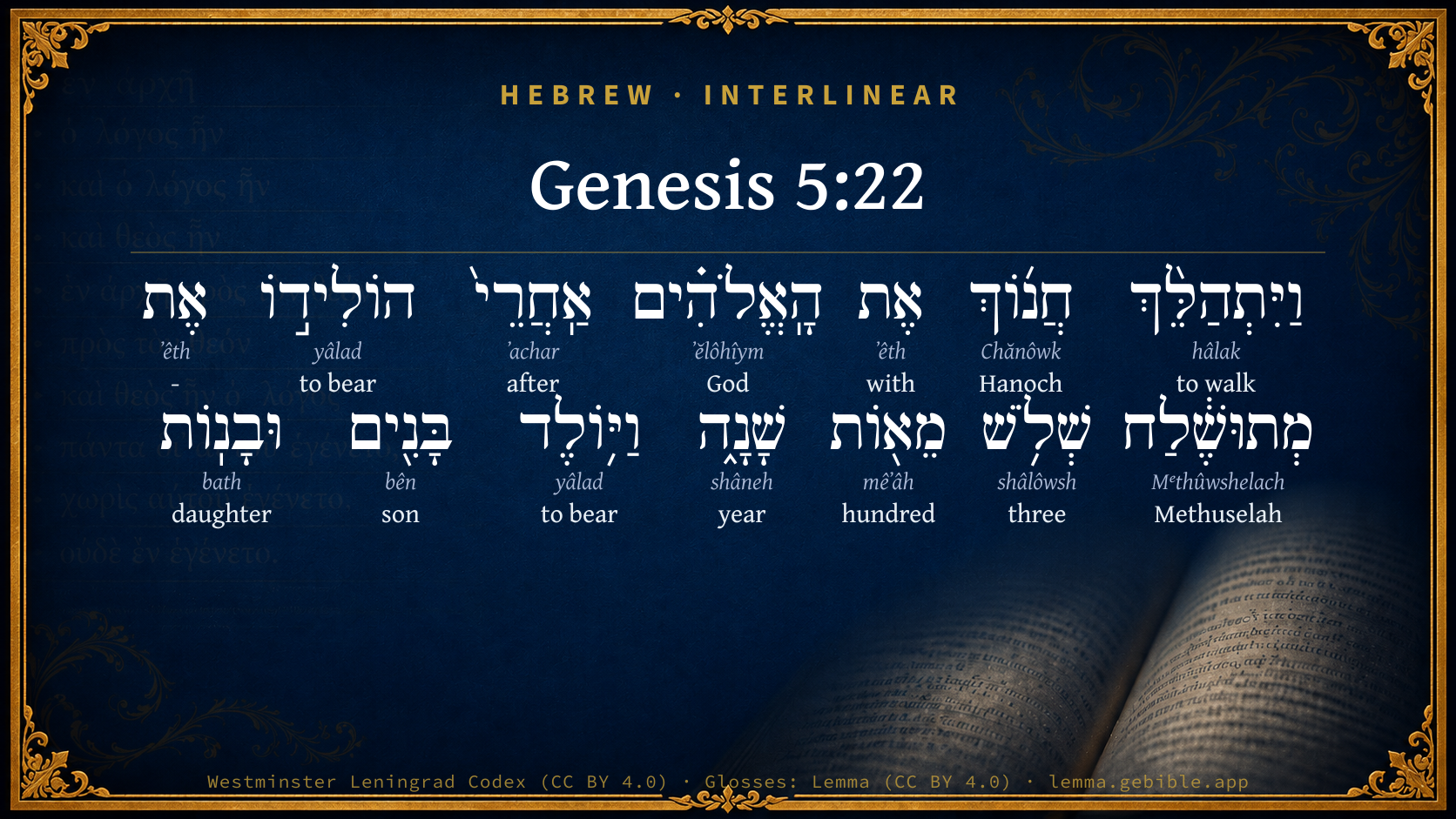
Hebrew (Westminster Leningrad Codex) Genesis 5:22 appears in the Hebrew Old Testament. The text above is from the Westminster Leningrad Codex. Each word links to its Strong’s number, a concise gloss, and parsing drawn from the Open Scriptures Hebrew Bible morphology. Click any word for its full Brown-Driver-Briggs (BDB) entry.
Download image
Cite this verse

Genesis 5:22 (World English Bible). Public Domain. Lemma interlinear Bible study tool, https://lemma.gebible.app/v/genesis/5/22.

Show BibTeX & RIS
BibTeX
RIS
English Translation
Enoch walked with God after he became the father of Methuselah three hundred years, and became the father of sons and daughters.
World English Bible · Public Domain
Highlights
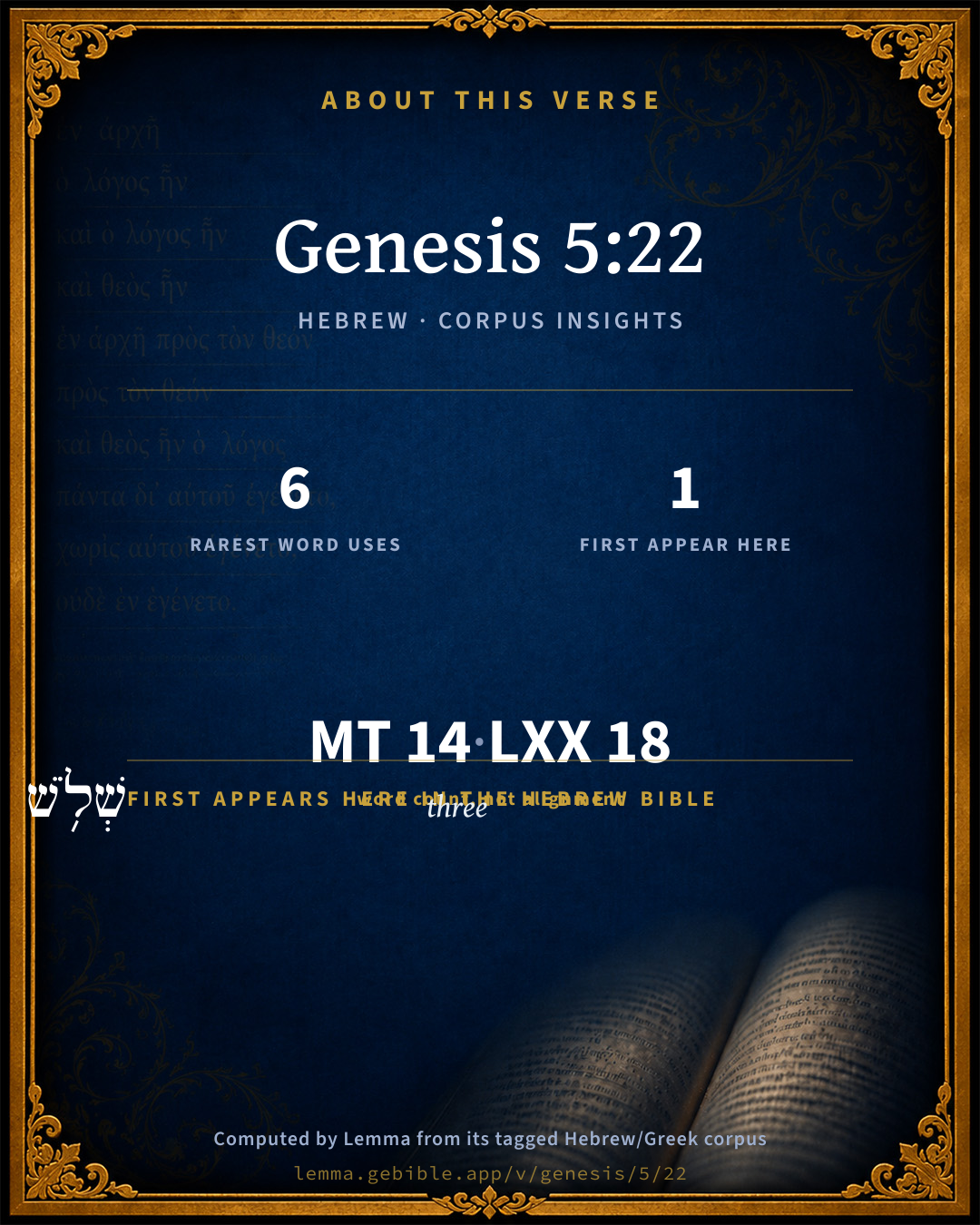
  • 1 first appearance in the Hebrew Bible
Full analysis ↓
Download a study sheet

One document with this verse’s original text, its word-by-word gloss line, the meaning frame, cross-references with their text, attributed commentary, and full source and license credits — printable, and it pastes into notes with its structure intact.

This verse Autodidact and up

Study sheet (.html) Plain text (.txt)

A passage Seminary Student

Up to 50 verses in one chapter. A passage sheet keeps up to 6 commentary sources and 12 cross-references per verse, in the order this page ranks them, and says so on the sheet whenever that leaves anything out. Ask for a single verse and you get the Autodidact verse sheet above.

Everything on this page stays free to read, with no account — the sheet is a download of what is already on screen, not access to it.

Want to remove ads? Support Godless Engineer
Compare translations 3

The same verse in 3 English versions, stacked beneath the original-language interlinear above. Click any original word for its lexicon entry.

Each is an independent rendering of the whole verse — the interlinear is not word-aligned to these translations.

Highlighted words mark where these versions differ — a whole-verse word diff, not a word-by-word alignment.

  • World English Bible Public Domain
    Enoch walked with God after he became the father of Methuselah three hundred years, and became the father of sons and daughters.
  • King James Version Public Domain
    And Enoch walked with God after he begat Methuselah three hundred years, and begat sons and daughters:
  • unfoldingWord Literal Text CC BY-SA 4.0
    Then after he fathered Methuselah, Enoch walked with God 300 years, and he fathered sons and daughters.

unfoldingWord Literal Text — © unfoldingWord, licensed CC BY-SA 4.0. Word-aligned USFM3 via Door43 (git.door43.org/unfoldingWord/en_ult).

Versions to compare (up to 4)

3 of 4 selected

Show all 18 translations

Every available English version of this verse, each an independent rendering of the whole verse.

  • World English Bible Public Domain
    Enoch walked with God after he became the father of Methuselah three hundred years, and became the father of sons and daughters.
  • Berean Standard Bible Public Domain
    And after he had become the father of Methuselah, Enoch walked with God 300 years and had other sons and daughters.
  • Majority Standard Bible Public Domain
    And after he had become the father of Methuselah, Enoch walked with God 300 years and had other sons and daughters.
  • King James Version Public Domain
    And Enoch walked with God after he begat Methuselah three hundred years, and begat sons and daughters:
  • American Standard Version (1901) Public Domain
    and Enoch walked with God after he begat Methuselah three hundred years, and begat sons and daughters:
  • Revised Version (1885) Public Domain
    and Enoch walked with God after he begat Methuselah three hundred years, and begat sons and daughters:
  • Geneva Bible (1599) Public Domain
    And Henoch walked with God, after he begate Methushelah, three hundreth yeeres, and begate sonnes and daughters.
  • Douay-Rheims (1899) Public Domain
    And Henoch walked with God: and lived after he begot Mathusala, three hundred years, and begot sons and daughters.
  • Young's Literal Translation Public Domain
    And Enoch walketh habitually with God after his begetting Methuselah three hundred years, and begetteth sons and daughters.
  • Literal Standard Version CC BY-SA 4.0
    And Enoch habitually walks with God after his begetting Methuselah three hundred years [[or two hundred years]], and begets sons and daughters.
  • Unlocked Literal Bible CC BY-SA 4.0
    Enoch walked with God three hundred years after he became the father of Methuselah. He became the father of more sons and daughters.
  • unfoldingWord Literal Text CC BY-SA 4.0
    Then after he fathered Methuselah, Enoch walked with God 300 years, and he fathered sons and daughters.
  • Darby Bible Public Domain
    And Enoch walked with God after he had begotten Methushelah three hundred years, and begot sons and daughters.
  • World Messianic Bible Public Domain
    After Methuselah’s birth, Enoch walked with God for three hundred years, and became the father of more sons and daughters.
  • Webster's Bible Public Domain
    And Enoch walked with God after he begat Methuselah three hundred years, and begat sons and daughters:
  • Free Bible Version CC BY-SA 4.0
    He had a close relationship with God. After Methuselah was born, Enoch lived another 300 years and had other sons and daughters.
  • Bible in Basic English Public Domain
    And after the birth of Methuselah, Enoch went on in God's ways for three hundred years, and had sons and daughters:
  • JPS Tanakh (1917) Public Domain
    And Enoch walked with God after he begot Methuselah three hundred years, and begot sons and daughters.

Literal Standard Version (2020), Covenant Press — licensed CC BY-SA 4.0. Text via the HelloAO Bible API (eBible.org). Unlocked Literal Bible (unfoldingWord) — licensed CC BY-SA 4.0. Text via the HelloAO Bible API (eBible.org). unfoldingWord Literal Text — © unfoldingWord, licensed CC BY-SA 4.0. Word-aligned USFM3 via Door43 (git.door43.org/unfoldingWord/en_ult). Free Bible Version, Dr. Jonathan Gallagher — licensed CC BY-SA 4.0. Text via the HelloAO Bible API (eBible.org).

Word by word

More ways to search: Search by grammar → Find every occurrence → Compare this word →

Practice this passage: Drill this verse → Learn its vocabulary →

מְתוּשֶׁ֔לַח
Mᵉthûwshelach
H4968
“Methuselah”
Noun, Proper
Part of Speech
Noun
Type
Proper
Full BDB Definition

Origin: from H4962 and H7973

TWOT: None

Methuselah = "man of the dart" - son of Enoch, 6th in descent from Seth, and father of Lamech
  1. וַיִּתְהַלֵּ֨ךְ hâlak H1980 “and · to walk” Conjunction + Verb, Hithpael, Sequential Imperfect, 3rd Person, Masculine, Singular
  2. חֲנ֜וֹךְ Chănôwk H2585 “Hanoch” Noun, Proper
  3. אֶת ʼêth H854 “with” Preposition
  4. הָֽאֱלֹהִ֗ים ʼĕlôhîym H430 “the · God(s)” Particle, Definite Article + Noun, Common, Masculine, Plural, Absolute
  5. אַֽחֲרֵי֙ ʼachar H310 “after” Preposition
  6. הוֹלִיד֣וֹ yâlad H3205 “to bear · him” Verb, Hiphil, Infinitive Construct + Suffix, Personal, 3rd Person, Masculine, Singular
  7. אֶת ʼêth H853 “-” Particle, Direct Object
  8. שְׁלֹ֥שׁ shâlôwsh H7969 “three” Adjective, Cardinal number, Feminine, Singular, Absolute
  9. מֵא֖וֹת mêʼâh H3967 “hundred” Adjective, Cardinal number, Both, Plural, Absolute
  10. שָׁנָ֑ה shâneh H8141 “year” Noun, Common, Feminine, Singular, Absolute
  11. וַיּ֥וֹלֶד yâlad H3205 “and · to bear” Conjunction + Verb, Hiphil, Sequential Imperfect, 3rd Person, Masculine, Singular
  12. בָּנִ֖ים bên H1121 “sons” Noun, Common, Masculine, Plural, Absolute
  13. וּבָנֽוֹת bath H1323 “and · daughters” Conjunction + Noun, Common, Feminine, Plural, Absolute

About this verse

These counts appear in no published source. They are computed here, from the morphology-tagged text and Lemma’s own curated glosses. What Lemma adds →

14
words
13
distinct lemmas
Pentateuch
section

Notable vocabulary

The rarest word here is מְתוּשֶׁ֔לַח Methuselah H4968 — appearing just 6 times in the whole Hebrew Bible.

First appearance in Scripture

This word makes its first canonical appearance in the Hebrew Bible here:

  • שְׁלֹ֥שׁ three H7969

Shared distinctive vocabulary

מְתוּשֶׁ֔לַח Methuselah H4968 occurs in 6 verses of the Hebrew Bible. Also found in:

Grammatical profile

  • 3 verbs
  • 6 nouns
  • 2 adjectives
  • 2 prepositions
  • 1 particle

Verb forms

  • וַיִּתְהַלֵּ֨ךְ Hithpael · Sequential Imperfect
  • הוֹלִיד֣וֹ Hiphil · Infinitive Construct
  • וַיּ֥וֹלֶד Hiphil · Sequential Imperfect

Repetition

A word recurs within this verse — often emphatic in Hebrew:

  • הוֹלִיד֣וֹ to bear H3205 ×2

Hebrew & Septuagint length

In English translation the verse runs 22 words from the Hebrew and 19 from the Septuagint (LXX English) — closely comparable.

A rough comparison of the two English renderings, which tokenize alike — not a word-level alignment.

Word counts can differ between the Hebrew and the Greek without any difference in meaning — e.g. the Hebrew direct-object marker אֵת has no separate Greek word, and Greek often adds the article ὁ.

In the original languages it is 14 Hebrew tokens and 18 Greek tokens — but the two are counted differently (Hebrew bundles its prefixes and suffixes into one token; the Greek is in lemma form), so that isn’t a like-for-like length.

Cross-references

36

Topical passages linked to Genesis 5:22 in the Treasury of Scripture Knowledge — connected by theme and wording, ordered by reader-vote popularity; previews shown in the World English Bible.

  • 1 Thessalonians 2:12 to the end that you should walk worthily of God, who calls you into his own Kingdom and glory.
  • Genesis 17:1 When Abram was ninety-nine years old, Yahweh appeared to Abram, and said to him, "I am God Almighty. Walk before me, and be blameless.
  • Genesis 6:9 This is the history of the generations of Noah. Noah was a righteous man, blameless among the people of his time. Noah walked with God.
  • Malachi 2:6 The law of truth was in his mouth, and unrighteousness was not found in his lips. He walked with me in peace and uprightness, and turned many away from iniquity.
  • Luke 1:6 They were both righteous before God, walking blamelessly in all the commandments and ordinances of the Lord.
  • Psalms 116:9 I will walk before Yahweh in the land of the living.
  • Micah 6:8 He has shown you, O man, what is good. What does Yahweh require of you, but to act justly, To love mercy, and to walk humbly with your God?
  • 1 John 1:7 But if we walk in the light, as he is in the light, we have fellowship with one another, and the blood of Jesus Christ, his Son, cleanses us from all sin.
  • Leviticus 26:12 I will walk among you, and will be your God, and you will be my people.
  • Hebrews 11:5–6 By faith, Enoch was taken away, so that he wouldn't see death, and he was not found, because God translated him. For he has had testimony given to him that before his translation he had been well pleasing to God.
  • Colossians 1:10 that you may walk worthily of the Lord, to please him in all respects, bearing fruit in every good work, and increasing in the knowledge of God;
  • Genesis 24:40 He said to me, 'Yahweh, before whom I walk, will send his angel with you, and prosper your way. You shall take a wife for my son of my relatives, and of my father's house.
  • Genesis 48:15 He blessed Joseph, and said, "The God before whom my fathers Abraham and Isaac did walk, the God who has fed me all my life long to this day,
  • Ephesians 5:15 Therefore watch carefully how you walk, not as unwise, but as wise;
  • 1 Thessalonians 4:1 Finally then, brothers, we beg and exhort you in the Lord Jesus, that as you received from us how you ought to walk and to please God, that you abound more and more.
  • Genesis 5:24 Enoch walked with God, and he was not, for God took him.
  • Exodus 16:4 Then said Yahweh to Moses, "Behold, I will rain bread from the sky for you, and the people shall go out and gather a day's portion every day, that I may test them, whether they will walk in my law, or not.
  • Deuteronomy 5:33 You shall walk in all the way which Yahweh your God has commanded you, that you may live, and that it may be well with you, and that you may prolong your days in the land which you shall possess.
  • Deuteronomy 13:4 You shall walk after Yahweh your God, and fear him, and keep his commandments, and obey his voice, and you shall serve him, and cleave to him.
  • Deuteronomy 28:9 Yahweh will establish you for a holy people to himself, as he has sworn to you; if you shall keep the commandments of Yahweh your God, and walk in his ways.
  • 1 Kings 2:4 That Yahweh may establish his word which he spoke concerning me, saying, If your children take heed to their way, to walk before me in truth with all their heart and with all their soul, there shall not fail you (said he) a man on the throne of Israel.
  • 2 Kings 20:3 Remember now, Yahweh, I beg you, how I have walked before you in truth and with a perfect heart, and have done that which is good in your sight. Hezekiah wept sore.
  • Psalms 16:8 I have set Yahweh always before me. Because he is at my right hand, I shall not be moved.
  • Psalms 26:11 But as for me, I will walk in my integrity. Redeem me, and be merciful to me.
  • Psalms 56:13 For you have delivered my soul from death, And prevented my feet from falling, That I may walk before God in the light of the living.
  • Psalms 86:11 Teach me your way, Yahweh. I will walk in your truth. Make my heart undivided to fear your name.
  • Psalms 128:1 Blessed is everyone who fears Yahweh, Who walks in his ways.
  • Song of Solomon 1:4 Take me away with you. Let us hurry. The king has brought me into his chambers. Friends We will be glad and rejoice in you. We will praise your love more than wine! Beloved They are right to love you.
  • Hosea 14:9 Who is wise, that he may understand these things? Who is prudent, that he may know them? For the ways of Yahweh are right, And the righteous walk in them; But the rebellious stumble in them.
  • Amos 3:3 Do two walk together, Unless they have agreed?
  • Micah 4:5 Indeed all the nations may walk in the name of their gods; But we will walk in the name of Yahweh our God forever and ever.
  • Acts 9:31 So the assemblies throughout all Judea and Galilee and Samaria had peace, and were built up. They were multiplied, walking in the fear of the Lord and in the comfort of the Holy Spirit.
  • Romans 8:1 There is therefore now no condemnation to those who are in Christ Jesus, who don't walk according to the flesh, but according to the Spirit.
  • 2 Corinthians 6:16 What agreement has a temple of God with idols? For you are a temple of the living God. Even as God said, "I will dwell in them, and walk in them; and I will be their God, and they will be my people."
  • Colossians 4:5 Walk in wisdom toward those who are outside, redeeming the time.
  • 1 Corinthians 7:17 Only, as the Lord has distributed to each man, as God has called each, so let him walk. So I command in all the assemblies.

Cross-references courtesy of OpenBible.info (CC BY 4.0).

Hebrew and Greek witnesses Masoretic Hebrew ↔ Greek Septuagint

The same verse in the two great witnesses to the Old Testament, shown verse-for-verse.

These are two independent witnesses, not word-aligned to each other, and the Septuagint is shown in lemma (dictionary) form.

Hebrew Genesis 5:22 Masoretic · Westminster Leningrad Codex

וַיִּתְהַלֵּ֨ךְ חֲנ֜וֹךְ אֶת הָֽאֱלֹהִ֗ים אַֽחֲרֵי֙ הוֹלִיד֣וֹ אֶת מְתוּשֶׁ֔לַח שְׁלֹ֥שׁ מֵא֖וֹת שָׁנָ֑ה וַיּ֥וֹלֶד בָּנִ֖ים וּבָנֽוֹת

Enoch walked with God after he became the father of Methuselah three hundred years, and became the father of sons and daughters.

World English Bible · Public Domain

Greek LXX Genesis 5:22 Septuagint · lemma form

εὐαρεστέω δέ ενωχ ὁ θεός μετά ὁ γεννάω αὐτός ὁ μαθουσαλα διακόσιοι ἔτος καί γεννάω υἱός καί θυγάτηρ

And Enoch was well-pleasing to God after his begetting Mathusala, two hundred years, and he begot sons and daughters.

LXX2012 (modern English Septuagint) · Public Domain

On this verse, The Cambridge Bible for Schools and Colleges discusses the Septuagint’s reading. Read the note in Commentary ↓

Hebrew: Westminster Leningrad Codex (CC BY 4.0). Greek: Septuagint (public domain); English from LXX2012 (modern English Septuagint) (Public Domain). How the Septuagint differs from the Hebrew →

Targum (Aramaic paraphrase)

2

The Targum is the ancient Jewish Aramaic paraphrase of the Hebrew Scriptures — an interpretive translation, not the Hebrew text itself. Onkelos (literal) and Pseudo-Jonathan (expansive) render the Torah, and Jonathan the Prophets. Coverage is partial: where no permissively-licensed English translation exists for a verse, only the Aramaic is shown. This is verse-level text, not a word-by-word alignment to the Hebrew.

  1. Targum Onkelos Torah (Genesis–Deuteronomy)
    וְהַלִּיךְ חֲנוֹךְ בְּדַחַלְתָּא דַּיְיָ בָּתַר דְּאוֹלִיד יָת מְתוּשֶׁלַח תְּלַת מְאָה שְׁנִין וְאוֹלִיד בְּנִין וּבְנָן

    (no public-domain English translation for this verse)

    Targum Onkelos — Aramaic: “Onkelos Genesis” (public domain); “Onkelos Exodus” (public domain); “Onkelos Leviticus” (public domain); “Onkelos Numbers” (public domain); “Onkelos Deuteronomy” (public domain). English: “Sefaria Community Translation” (CC0 1.0 (public-domain dedication)); “J.W. Etheridge. The Targums of Onkelos and Jonathan Ben Uzziel on the Pentateuch. London: Longmans, Green, 1862” (public domain). Text via Sefaria.

  2. Targum Pseudo-Jonathan Torah (Genesis–Deuteronomy)
    וּפְלַח חֲנוֹךְ בִּקְשׁוֹט קֳדָם יְיָ בָּתַר דְאוֹלִיד יַת מְתוּשֶׁלַח תְּלַת מְאָה שְׁנִין וְאוֹלִיד בְּנִין וּבְנָן

    And Hanok worshipped in truth before the Lord after he had begotten Methushelach three hundred years, and begat sons and daughters.

    Targum Pseudo-Jonathan — Aramaic: “Targum Jonathan on Genesis” (public domain); “Targum Jonathan on Exodus” (public domain); “Targum Jonathan on Leviticus” (public domain); “Targum Jonathan on Numbers” (public domain); “Targum Jonathan on Deuteronomy” (public domain). English: “The Targum of Jonathan ben Uzziel, trans. J. W. Etheridge, London, 1862” (public domain). Text via Sefaria.

Commentary

Notes on Genesis 5:22 from classic Christian and Jewish commentators (each source and its license shown beneath its notes). The classic Christian expositions comment on the surrounding passage and are grouped to its opening verse, so a note may address several verses; the Jewish commentaries on the Tanakh (Rashi and others) are per-verse, so they appear only where the commentator wrote on this verse.

Lemma curates 59 commentaries, every one of them public domain or Creative Commons licensed, each selected and text-cleaned for this edition rather than reprinted as found. About our sources →

Trapp's Complete Commentary

John Trapp

Gen 5:22 And Enoch walked with God after he begat Methuselah three hundred years, and begat sons and daughters:

Ver. 22. And Enoch walked with God,] i.e., he walked in the fear of the Lord, as the Chaldee here paraphraseth: and this he did without intermission, not for a time or two, but continually, constantly: he walked with God by a humble familiarity, and a holy conformity; as a man doth with his friend. To walk with God, before God, and after God, are much at one. {See Trapp on "Gen 5:24"}

John Trapp, A Commentary or Exposition upon All the Books of the Old and New Testament (1647–1656) — public domain. Text from a community e-Sword module.

Joseph Benson's Commentary

Gen 5:22. Enoch walked with God — A Scriptural phrase for eminent piety. He set God always before him, and acted as one that considered he was always under his eye. He lived a life of communion and intercourse with God in his ordinances and providences. He made God’s will his rule, and God’s glory his end, in all his actions. He made it his constant care to please God in every thing, and to offend him in nothing, and was a worker together with him. Reader, go thou, and do likewise. He walked with God after he begat Methuselah — Which seems to intimate that he did not begin to be eminent for piety till about that time. And he begat sons and daughters — A state of matrimony, and the cares and duties incumbent on the master of a family, are not inconsistent with the strictest holiness, or with the office of a prophet, or preacher of righteousness. For, according to Jdg 1:14-15, such was Enoch.

Joseph Benson's Commentary on the Old and New Testaments (1811–1818) — public domain. Text from a community e-Sword module.

MacLaren's Expositions of Holy Scripture

Alexander MacLaren

Genesis

WITH, BEFORE, AFTER

‘Enoch walked with God,’- Gen 5:22.

‘Walk before Me.’- Gen 17:1.

‘Ye shall walk after the Lord your God.’- Deu 13:4.

You will have anticipated, I suppose, my purpose in doing what I very seldom do-cutting little snippets out of different verses and putting them together. You see that these three fragments, in their resemblances and in their differences, are equally significant and instructive. They concur in regarding life as a walk-a metaphor which expresses continuity, so that every man’s life is a whole, which expresses progress, which expresses change, and which implies a goal. They agree in saying that God must he brought into a life somehow, and in some aspect, if that life is to be anything else but an aimless wandering, if it is to tend to the point to which every human life should attain. But then they diverge, and, if we put them together, they say to us that there are three different ways in which we ought to bring God into our life. We should ‘walk with Him,’ like Enoch; we should ‘walk before’ Him, as Abraham was bade to do; and we should ‘walk after’ Him, as the command to do was given to all Israel. And these three prepositions, with, before, after, attached to the general idea of life as a walk, give us a triple aspect-which yet is, of course, fundamentally, one-of the way in which life may be ennobled, dignified, calmed, hallowed, focussed, and concentrated by the various relations into which we enter with Him. So I take the three of them.

1. ‘Enoch walked with God.’

That is a sweet, simple, easily intelligible, and yet lofty way of putting the notion which we bring into a more abstract and less impressive shape when we talk about communion with God. Two men travelling along a road keep each other company. ‘How can two walk together except they be agreed?’ The companion is at our side all the same, though the mists may have come down and we cannot see Him. We can hear His voice, we can grasp His hand, we can catch the echoes of His steps. We know He is there, and that is enough. Enoch and God walked together, by the simple exercise of the faith that fills the Invisible with one great, loving Face. By a continuous, definite effort, as we are going through the bustle of daily life, and amid all the pettiness and perplexities and monotonies that make up our often weary and always heavy days, we can realise to ourselves that He is of a truth at our sides, and by purity of life and heart we can bring Him nearer, and can make ourselves more conscious of His nearness. For, brethren, the one thing that parts a man from God, and makes it impossible for a heart to expatiate in the thought of His presence, is the contrariety to His will in our conduct. The slightest invisible film of mist that comes across the blue abyss of the mighty sky will blot out the brightest of the stars, and we may sometimes not be able to see the mist, and only know that it is there because we do not see the planet. So unconscious sin may steal in between us and God, and we shall no longer be able to say, ‘I walk with Him.’

The Roman Catholics talk, in their mechanical way, of bringing down all the spiritual into the material and formal, about the ‘practice of the presence of God.’ It is an ugly phrase, but it means a great thing, that Christian people ought, very much more than they do, to aim, day by day, and amidst their daily duties, at realising that most elementary thought which, like a great many other elementary thoughts, is impotent because we believe it so utterly, that wherever we are, we may have Him with us. It is the secret of blessedness, of tranquillity, of power, of everything good and noble.

‘I am a stranger with Thee, and a sojourner, as all my fathers were,’ said the Psalmist of old. If he had left out these two little words, ‘with Thee,’ he would have been uttering a tragic complaint; but when they come in, all that is painful, all that is solitary, all that is transient, bitterly transient, in the long succession of the generations that have passed across earth’s scene, and have not been kindred to it, is cleared away and changed into gladness. Never mind, though you are a stranger, if you have that companion. Never mind, though you are only a sojourner; if you have Him with you, whatever passes He will not pass; and though we dwell here in a system to which we do not belong, and its transiency and our transiency bring with them many sorrows, when we can say, ‘Lord! Thou hast been our dwelling-place in all generations,’ we are at home, and that eternal home will never pass.

Enoch ‘walked with God,’ and, of course, ‘God took him,’ There was nothing else for it, and there could be no other end, for a life of communion with God here has in it the prophecy and the pledge of a life of eternal union hereafter. So, then, ‘practise the presence of God.’ An old mystic says: ‘If I can tell how many times to-day I have thought about God, I have not thought about Him often enough.’ Walk with Him by faith, by effort, by purity.

2. And now take the other aspect suggested by the other word God spoke to Abraham: ‘I am the Almighty God, walk before Me and be thou perfect.’

That suggests, as I suppose I do not need to point out, the idea not only of communion, which the former phrase brought to our minds, but that of the inspection of our conduct. ‘As ever in the great Taskmaster’s eye,’ says the stern Puritan poet, and although one may object to that word ‘Taskmaster,’ yet the idea conveyed is the correct expansion of the commandment given to Abraham. Observe how ‘walk before Me’ is dovetailed, as it were, between the revelation ‘I am the Almighty God’ and the injunction ‘Be thou perfect.’ The realisation of that presence of the Almighty which is implied in the expression ‘Walk before Me,’ the assurance that we are in His sight, will lead straight to the fulfilment of the injunction that bears upon the moral conduct. The same connection of thought underlies Peter’s injunction, ‘Like as He . . .is holy, so be ye holy in all manner of conversation,’ followed immediately as it is by, ‘If ye call on Him as Father, who without respect of persons judgeth’-as a present estimate-’according to every mail’s work, pass the time of your sojourning here in fear’-that reverential awe which will lead you to be ‘holy even as I am holy.’

This thought that we are in that divine presence, and that there is silently, but most really, a divine opinion being formed of us, consolidated, as it were, moment by moment through our lives, is only tolerable if we have been walking with God. If we are sure, by the power of our communion with Him, of His loving heart as well as of His righteous judgment, then we can spread ourselves out before Him, as a woman will lay out her webs of cloth on the green grass for the sun to blaze down upon them, and bleach the ingrained filth out of them. We must first walk ‘with God’ before the consciousness that we are walking ‘before’ Him becomes one that we can entertain and not go mad. When we are sure of the ‘with’ we can bear the ‘before.’

Did you ever see how on a review day, as each successive battalion and company nears the saluting-point where the General inspecting sits, they straighten themselves up and dress their ranks, and pull themselves together as they pass beneath his critical eye. A master’s eye makes diligent servants. If we, in the strength of God, would only realise, day by day and act by act of our lives, that we are before Him, what a revolution could be effected on our characters and what a transformation on all our conduct!

‘Walk before Me’ and you will be perfect. For the Hebrew words on which I am now commenting may be read, in accordance with the usage of the language, as being not only a commandment but a promise, or, rather, not as two commandments, but a commandment with an appended promise, and so as equivalent to ‘If you will walk before Me you will be perfect.’ And if we realise that we are under ‘the pure eyes and perfect judgment of’ God, we shall thereby be strongly urged and mightily helped to be perfect as He is perfect.

3. Lastly, take the other relation, which is suggested by the third of my texts, where Israel as a whole is commanded to ‘walk after the Lord’ their God.

In harmony with the very frequent expression of the Old Testament about ‘going after idols’ so Israel here is to ‘go after God.’ What does that mean? Communion, the consciousness of being judged by God, will lead on to aspiration and loving, longing effort to get nearer and nearer to Him. ‘My soul followeth hard after Thee,’ said the Psalmist, ‘Thy right hand upholdeth me.’ That element of yearning aspiration, of eager desire to be closer and closer, and liker and liker, to God must be in all true religion. And unless we have it in some measure, it is useless to talk about being Christian people. To press onwards, not as though we had already attained, but following after, if that we may apprehend that for which also we are apprehended, is the attitude of every true follower of Christ. The very crown of the excellence of the Christian life is that it never can reach its goal, and therefore an immortal youth of aspiration and growth is guaranteed to it. Christian people, are you following after God? Are you any nearer to Him than you were ten years ago? ‘Walk with Me, walk before Me, walk after Me.’

I need not do more than remind you of another meaning involved in this same expression. If I walk after God, then I let Him go before me and show me my road. Do you remember how, when the ark was to cross Jordan, the commandment was given to the Israelites to let it go well on in front, so that there should be no mistake about the course, ‘for ye have not passed this way heretofore.’ Do not be in too great a hurry to press upon the heels of God, if I may so say. Do not let your decisions outrun His providence. Keep back the impatience that would hurry on, and wait for His ripening purposes to ripen and His counsels to develop themselves. Walk after God, and be sure you do not go in front of your Guide, or you will lose both your way and your Guide.

I need not say more than a word about the highest aspect which this third of our commandments takes, ‘His sheep follow Him’-’leaving us an example that we should follow in His steps,’ that is the culmination of the walking ‘with,’ and ‘before,’ and ‘after’ God which these Old Testament saints were partially practising. All is gathered into the one great word, ‘He that saith he abideth in Him ought himself also so to walk even as He walked.’

Alexander MacLaren, Expositions of Holy Scripture (1904–1910) — public domain. Text from a community e-Sword module.

Tyndale Open Study Notes

Tyndale Open Resources

5:22 Enoch lived in close fellowship with God (literally Enoch walked with God; also in 5:24): Enoch’s position as seventh from Adam in the genealogy strikes a contrast with Lamech, the seventh from Adam in the line of Cain (see study note on 4:17–5:32).

Tyndale Open Study Notes — © Tyndale Open Resources, licensed CC BY-SA 4.0. Text via the HelloAO Bible API.

Geneva Bible (1599)

Geneva Bible translators

That is, he led an upright and godly life.

Geneva Bible (1599) marginal notes — public domain. Text via Bolls.life.

Adam Clarke's Commentary

Verse 22. And Enoch walked with God - three hundred years] There are several things worthy of our most particular notice in this account:

1. The name of this patriarch; Enoch, from חנך chanack, which signifies to instruct, to initiate, to dedicate. From his subsequent conduct we are authorized to believe he was early instructed in the things of God, initiated into the worship of his Maker, and dedicated to his service. By these means, under the influence of the Divine Spirit, which will ever attend pious parental instructions, his mind got that sacred bias which led him to act a part so distinguished through the course of a long life.

2. His religious conduct. He walked with God; יתהלך yithhallech, he set himself to walk, he was fixedly purposed and determined to live to God. Those who are acquainted with the original will at once see that it has this force. A verb in the conjugation called hithpael signifies a reciprocal act, that which a man does upon himself: here we may consider Enoch receiving a pious education, and the Divine influence through it; in consequence of which he determines to be a worker with God, and therefore takes up the resolution to walk with his Maker, that he might not receive the grace of God in vain.

3. The circumstances in which he was placed. He was a patriarch; the king, the priest, and the prophet of a numerous family, to whom he was to administer justice, among whom he was to perform all the rites and ceremonies of religion, and teach, both by precept and example, the way of truth and righteousness. Add to this, he was a married man, he had a numerous family of his own, independently of the collateral branches over which he was obliged, as patriarch, to preside; he walked three hundred years with God, and begat sons and daughters; therefore marriage is no hinderance even to the perfection of piety; much less inconsistent with it, as some have injudiciously taught.

4. The astonishing height of piety to which he had arrived; being cleansed from all filthiness of the flesh and of the spirit, and having perfected holiness in the fear of God, we find not only his soul but his body purified, so that, without being obliged to visit the empire of death, he was capable of immediate translation to the paradise of God. There are few cases of this kind on record; but probably there might be more, many more, were the followers of God more faithful to the grace they receive.

5. Enoch attained this state of religious and spiritual excellence in a time when, comparatively speaking, there were few helps, and no written revelation. Here then we cannot but see and admire how mighty the grace of God is, and what wonders it works in the behalf of those who are faithful, who set themselves to walk with God. It is not the want of grace nor of the means of grace that is the cause of the decay of this primitive piety, but the want of faithfulness in those who have the light, and yet will not walk as children of the light.

6. If the grace of God could work such a mighty change in those primitive times, when life and immortality were not brought to light by the Gospel, what may we not expect in these times, in which the Son of God tabernacles among men, in which God gives the Holy Spirit to them who ask him, in which all things are possible to him who believes? No man can prove that Enoch had greater spiritual advantages than any of the other patriarchs, though it seems pretty evident that he made a better use of those that were common to all than any of the rest did; and it would be absurd to say that he had greater spiritual helps and advantages than Christians can now expect, for he lived under a dispensation much less perfect than that of the LAW, and yet the law itself was only the shadow of the glorious substance of Gospel blessings and Gospel privileges.

7. It is said that Enoch not only walked with God, setting him always before his eyes, beginning, continuing, and ending every work to his glory, but also that he pleased God, and had the testimony that he did please God, Heb 11:5. Hence we learn that it was then possible to live so as not to offend God, consequently so as not to commit sin against him; and to have the continual evidence or testimony that all that a man did and purposed was pleasing in the sight of Him who searches the heart, and by whom devices are weighed: and if it was possible then, it is surely, through the same grace, possible now; for God, and Christ, and faith, are still the same.

Adam Clarke's Commentary on the Bible (1810–1826) — public domain. Text from a community e-Sword/MySword module.

John Calvin's Commentaries

22. And Enoch walked with God. Undoubtedly Enoch is honored with peculiar praise among the men of his own age, when it is said that he walked with God. Yet both Seth and Enoch, and Cainan, and Mahalaleel, and Jared, were then living, whose piety was celebrated in the former part of the chapter. As that age could not be ruder or barbarous, which had so many most excellent teachers; we hence infer, that the probity of this holy man, whom the Holy Spirit exempted from the common order, was rare and almost singular. Meanwhile, a method is here pointed out of guarding against being carried away by the perverse manners of those with whom we are conversant. For public custom is as a violent tempest; both because we easily suffer ourselves to be led hither and thither by the multitude, and because every one thinks what is commonly received must be right and lawful; just as swine contract an itching from each other; nor is there any contagion worse, and more loathsome than that of evil examples. Hence we ought the more diligently to notice the brief description of a holy life, contained in the words, “Enoch walked with God.” Let those, then, who please, glory in living according to the custom of others; yet the Spirit of God has established a rule of living well and rightly, by which we depart from the examples of men who do not form their life and manners according to the law of God. For he who, pouring contempt upon the word of God, yields himself up to the imitation of the world, must be regarded as living to the devil. Moreover, (as I have just now hinted,) all the rest of the patriarchs are not deprived of the praise of righteousness; but a remarkable example is set before us in the person of one man, who stood firmly in the season of most dreadful dissipation; in order that, if we wish to live rightly and orderly, we may learn to regard God more than men. For the language which Moses uses is of the same force as if he had said, that Enoch, lest he should be drawn aside by the corruptions of men, had respect to God alone; so that with a pure conscience, as under his eyes, he might cultivate uprightness.

John Calvin's Commentaries (1540-1563) — public domain. Text from the Calvin Translation Society English edition (1840s-50s) via the Christian Classics Ethereal Library (ccel.org). Calvin's coverage is partial (roughly two-thirds of the Bible); uncommented books and verses are honest gaps, never fabricated. The 19th-century editor's footnotes and remarks are omitted so the notes are faithfully Calvin's own voice.

The Cambridge Bible for Schools and Colleges

gen. ed. J. J. S. Perowne

22. walked with God] The phrase here, as in Gen_5:24, used of Enoch, has passed into common use to express intimacy of communion with God. It denotes more than either standing in His presence, or walking before Him (Gen_6:9, Gen_17:1), or following after Him. It combines the ideas of fellowship and progress. It is the picture of one who has God with him in all the various scenes of life.

The audacity of the metaphor caused the LXX to render it by a paraphrase; εὐηρέστησε δὲ Ἐνὼχ τῷ θεῷ = “and Enoch was well pleasing unto God,” which is quoted in Heb_11:5. For other paraphrases, see Targ. Onkelos, “walked in the fear of God”; Targ. Palestine, “served in the truth before the Lord.”

The Cambridge Bible for Schools and Colleges (gen. ed. J. J. S. Perowne; Cambridge University Press, 1878–1918) — public domain. Text from a community e-Sword module.

John Gill's Exposition

And Lamech lived an hundred eighty and two years, and begat son. According to the Septuagint version he was an hundred and eighty eight years old; but according to the Samaritan version only fifty three; the name, of his son, begotten by him, is given in the next verse, with the reason of it.

And Lamech lived an hundred eighty and two years, and begat son. According to the Septuagint version he was an hundred and eighty eight years old; but according to the Samaritan version only fifty three; the name, of his son, begotten by him, is given in the next verse, with the reason of it.

Genesis 5:29

gen 5:29

gen 5:29

gen 5:29And he called his name Noah,.... Which signifies rest and comfort; for rest gives comfort, and comfort flows from rest, see Sa2 14:17, where a word from the same root is rendered "comfortable", and agrees with the reason of the name, as follows:

saying, this same shall comfort us, concerning our work and toil of our hands, because of the ground, which the Lord hath cursed; this he spake by a spirit of prophecy, foreseeing what his son would be, and of what advantage to him and his family, and to the world, both in things temporal and spiritual. In things temporal: the earth was cursed for the sin of man immediately after the fall, and continued under it to this time, bringing forth thorns and thistles in great abundance of itself, which occasioned much trouble to root and pluck them up, and nothing else, without digging, and planting, and sowing; and being barren through the curse, it was with great difficulty men got a livelihood: now Noah eased them in a good measure of their toil and trouble, by inventing instruments of ploughing, as Jarchi suggests, which they had not before, but threw up the ground with their hands, and by the use of spades, or such like things, which was very laborious; but now, by the use of the plough, and beasts to draw it, their lives were made much more easy and comfortable; hence he is said to begin to be an "husbandman", or a "man of the earth", that brought agriculture to a greater perfection, having found out an easier and quicker manner of tilling the earth: and as he was the first that is said to plant a vineyard, if he was the inventor of wine, this was another way in which he was an instrument of giving refreshment and comfort to men, that being what cheers the heart of God and men, see Gen 9:20 and if the antediluvians were restrained from eating of flesh, and their diet was confined to the fruits of the earth; Noah, as Dr. Lightfoot (d) observes, would be a comfort in reference to this, because to him, and in him to all the world, God would give liberty to eat flesh; so that they were not obliged to get their whole livelihood with their hands out of the ground: and moreover, as Lamech might be apprised of the flood by the name of his father, and the prediction of his grandfather, he might foresee that he and his family would be saved, and be the restorer of the world, and repeople it, after the destruction of it by the flood. And he may have respect to comfort in spiritual things, either at first taking him to be the promised seed, the Messiah, in whom all comfort is; or however a type of him, and from whom he should spring, who would deliver them from the curse of the law, and from the bondage of it, and from toiling and seeking for a righteousness by the works of it; or he might foresee that he would be a good man, and a preacher of righteousness, and be a public good in his day and generation.

(d) Works, vol. 1. p. 9.

John Gill's Exposition of the Whole Bible (1746–1763) — public domain (CC PDM 1.0). Text via the HelloAO Bible API.

Matthew Poole's English Annotations

i.e. He lived as one whose eye was continually upon God; whose care and constant course and business it was to please God, and to imitate him, and to maintain acquaintance and communion with him; as one devoted to God’s service, and wholly governed by his will. He walked not with the men of that wicked age, or as they walked, but being a prophet and preacher, as may be gathered from Jud 1:14-15, with great zeal and courage he protested and preached against their evil practices, and boldly owned God and his ways in the midst of them. Compare Gen 6:6; Jer 12:3; Mic 6:8.

Begat sons and daughter’s; hence it is undeniably evident that the state and use of matrimony doth very well agree with the severest course of holiness, and with the office of a prophet or preacher.

Matthew Poole's English Annotations on the Holy Bible (1683–1685) — public domain. Text from a community e-Sword/MySword module.

Whedon's Commentary on the Bible

Daniel D. Whedon

22. And Enoch walked with God — ויתהלךְ חנוךְ את האלהיםNot before God, as a messenger, or a workman beneath his eye: nor after him, as a servant; but with him, as a friend. A remarkable expression, occurring but twice in Scripture: in the text as applied to Enoch, and in Gen_6:9, to Noah. In Mal_2:6, it is, in our translation, applied to the faithful priest, but the Hebrew verb in this passage is in Kal, not reaching the high spiritual idea of the text. The verb as applied to Enoch and Noah is in Hithpael implying a voluntary and delightful walk. The passages which speak of walking before God (Gen_24:40, etc.,) and walking after him do not rise to the high conception of this text. The article is here, for the first time, used with Elohim, the one only God. The LXX translates Και ευηρεστησεν ‘Ενωχ τω Θεω, and Enoch pleased God, which version Paul uses in Heb_11:5 : “He had this testimony, that he pleased God.” Intimate and confidential communication, such as exists between the nearest friends, is suggested by this peculiar language. This single example of eminent piety stands forth sublimely solitary in the antediluvian waste. While the patriarchs from Seth to Enoch, and from Enoch to Lamech, are but a series of Hebrew names, we see Enoch’s face as it shines in his godly walk, and hear him, as a prophet, testify against the sin of his age, and proclaim a coming judgment. Jud_1:14-15. The Jews have manifold traditions concerning Enoch, most of which are gathered in the apocryphal Book of Enoch, written, probably, in the last century B.C. There is a heathen tradition of the same wonderful history in the Phrygian legend of Annacus, a pious king, who lived and prophesied three hundred years, predicting the deluge of Deucalion.

Daniel D. Whedon (gen. ed.), Commentary on the Old and New Testaments (1874–1909) — public domain. Text from a community e-Sword module.

The Pulpit Commentary

Vers. 22-24.

Enoch.

I The CHARACTER of his piety.

1. Walking with God.

2. Witnessing for God.

II The EXCELLENCE of his piety.

1. It began in early boyhood.

2. It flourished in evil times.

3. It grew in spite of scanty privileges.

4. It continued to the close of life.

III The REWARD of Enoch"s piety. He was translated that he should not see death.

1. A visible proof of immortality:

2. A solemn confirmation of the gospel.

3. A striking prophecy of Christ"s ascension.

The Pulpit Commentary (1880–1919), ed. H.D.M. Spence-Jones & Joseph S. Exell — public domain. Text from a community e-Sword module.

John Wesley's Explanatory Notes

And Enoch walked with God after he begat Methuselah - To walk with God, is to set God always before us, and to act as those that are always under his eye. It is to live a life of communion with God, both in ordinances and providences; it is to make God's word our rule, and his glory our end, in all our actions; it is to make it our constant care and endeavour in every thing to please God, and in nothing to offend him; it is to comply with his will, to concur with his designs, and to be workers together with him. He walked with God after he begat Methuselah, which intimates, that he did not begin to be eminent for piety 'till about that time.

John Wesley, Explanatory Notes Upon the Whole Bible (1754–1765) — public domain. Text via the GEBible commentary corpus.

Scofield Reference Notes

C. I. Scofield

Enoch

Enoch, "translated that he should not see death" Heb 11:5 before the judgment of the Flood, is a type of those saints who are to be translated before the apocalyptic judgments 1Th 4:14-17. Noah, left on the earth, but preserved through the judgment of the Flood, is a type of the Jewish people, who will be kept through the apocalyptic judgments; Jer 30:5-9; Rev 12:13-16 and brought as an earthly people to the new heaven and new earth; Isa 65:17-19; Isa 66:20-22; Rev 21:1.

The Scofield Reference Bible (1917 edition), notes by C. I. Scofield — public domain. Text from a community e-Sword module.

Sforno

Rabbi Ovadia Sforno

Chanoch walked with Elokim. That is, he emulated His ways by performing acts of lovingkindness and issuing rebuke.

Sforno on the Tanakh — English translation: “Yalkut, Sifsei Chachomim Chumash, Metsudah Publications, 2009” (CC BY 4.0). Text via Sefaria.

Lesson kit

Teaching starters — assembled from the data on this page, not authored interpretation. Every prompt links to the verse data it draws on. Edit before teaching.

Genesis, in the Pentateuch, opens this verse with 14 words (13 distinct Hebrew lemmas). Its most distinctive word is Mᵉthûwshelach (“Methuselah”). A historical commentator’s framing appears above. Read the whole chapter for the surrounding context.

Discussion questions

  1. The word Mᵉthûwshelach carries the sense “Methuselah.” How does it shape the verse?
  2. This is the first place “three” appears in Scripture (first appears here). What does its debut here establish?
  3. How does Genesis 5:21, which shares the word «Methuselah», read alongside this verse?
  4. What does the repetition of “to bear” (2× in this one verse) do in this verse?
  5. These translations render this verse differently. What is at stake in choosing one wording over another?
  6. «וַיִּתְהַלֵּ֨ךְ» is a Hithpael Sequential Imperfect verb. How does that grammatical form shape the action described?
  7. Compare how Trapp's Complete Commentary and Joseph Benson's Commentary read this verse. Where do they agree or differ?

Things to notice

Reading settings

Reading text

Shown beneath each verse's original-language words.

Old Testament
Old Testament edition

Read the OT as the Masoretic Hebrew (MT) or the Greek Septuagint (LXX).

English shown for the Greek Septuagint (in the Hebrew ↔ Greek comparison).

Comparing translations? Open the Compare panel on any verse page to stack up to four side by side.