
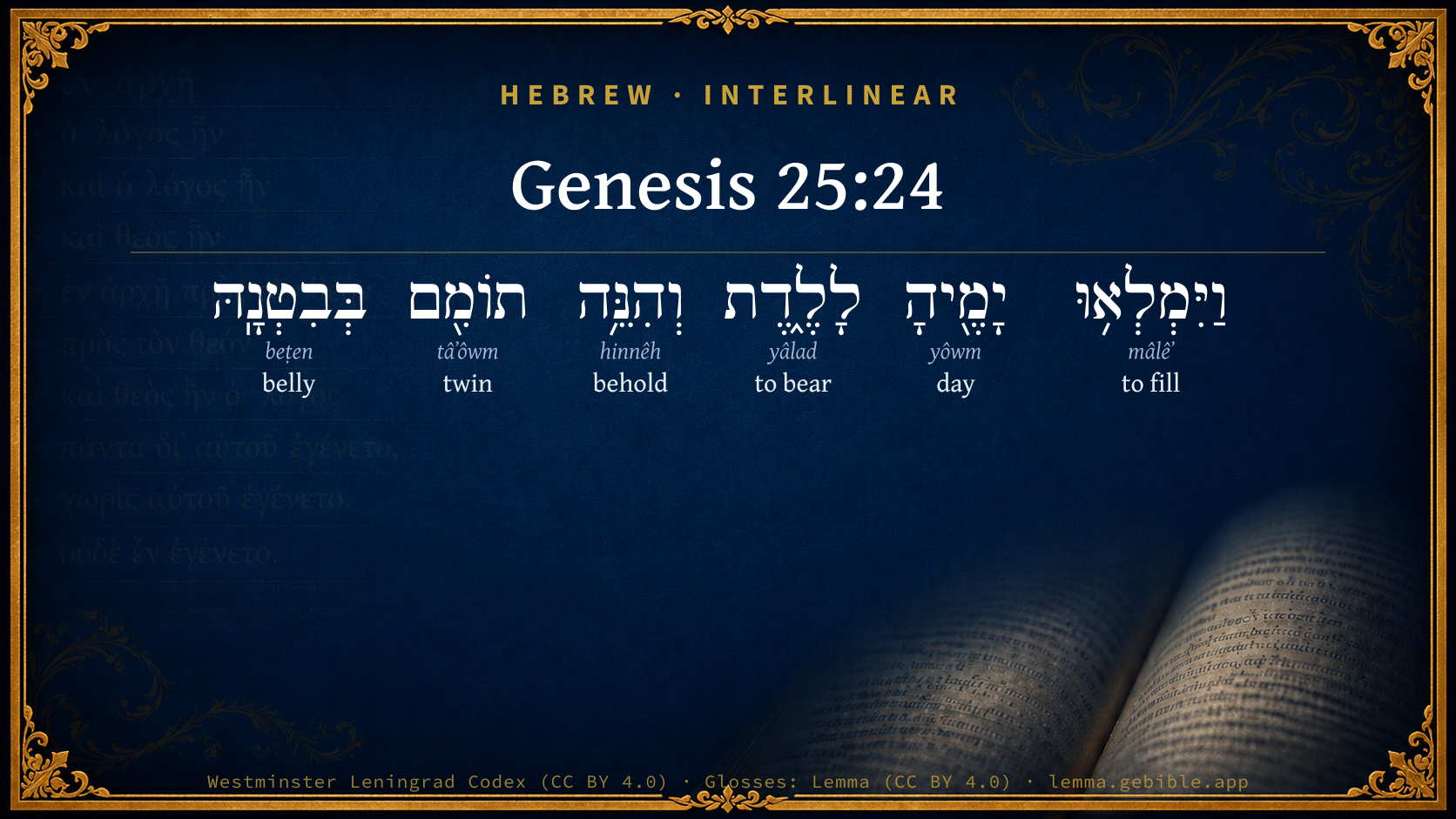
Genesis 25:24

Hebrew (Westminster Leningrad Codex) Genesis 25:24 appears in the Hebrew Old Testament. The text above is from the Westminster Leningrad Codex. Each word links to its Strong’s number, a concise gloss, and parsing drawn from the Open Scriptures Hebrew Bible morphology. Click any word for its full Brown-Driver-Briggs (BDB) entry.
Download image
Cite this verse

Genesis 25:24 (World English Bible). Public Domain. Lemma interlinear Bible study tool, https://lemma.gebible.app/v/genesis/25/24.

Show BibTeX & RIS
BibTeX
RIS
English Translation
When her days to be delivered were fulfilled, behold, there were twins in her womb.
World English Bible · Public Domain
Highlights
  • 1 first appearance in the Hebrew Bible
Full analysis ↓
Download a study sheet

One document with this verse’s original text, its word-by-word gloss line, the meaning frame, cross-references with their text, attributed commentary, and full source and license credits — printable, and it pastes into notes with its structure intact.

This verse Autodidact and up

Study sheet (.html) Plain text (.txt)

A passage Seminary Student

Up to 50 verses in one chapter. A passage sheet keeps up to 6 commentary sources and 12 cross-references per verse, in the order this page ranks them, and says so on the sheet whenever that leaves anything out. Ask for a single verse and you get the Autodidact verse sheet above.

Everything on this page stays free to read, with no account — the sheet is a download of what is already on screen, not access to it.

Want to remove ads? Support Godless Engineer
Compare translations 3

The same verse in 3 English versions, stacked beneath the original-language interlinear above. Click any original word for its lexicon entry.

Each is an independent rendering of the whole verse — the interlinear is not word-aligned to these translations.

Highlighted words mark where these versions differ — a whole-verse word diff, not a word-by-word alignment.

  • World English Bible Public Domain
    When her days to be delivered were fulfilled, behold, there were twins in her womb.
  • King James Version Public Domain
    And when her days to be delivered were fulfilled, behold, there were twins in her womb.
  • unfoldingWord Literal Text CC BY-SA 4.0
    Then her days were fulfilled to deliver, and behold, twins inside her womb.

unfoldingWord Literal Text — © unfoldingWord, licensed CC BY-SA 4.0. Word-aligned USFM3 via Door43 (git.door43.org/unfoldingWord/en_ult).

Versions to compare (up to 4)

3 of 4 selected

Show all 18 translations

Every available English version of this verse, each an independent rendering of the whole verse.

  • World English Bible Public Domain
    When her days to be delivered were fulfilled, behold, there were twins in her womb.
  • Berean Standard Bible Public Domain
    When her time came to give birth, there were indeed twins in her womb.
  • Majority Standard Bible Public Domain
    When her time came to give birth, there were indeed twins in her womb.
  • King James Version Public Domain
    And when her days to be delivered were fulfilled, behold, there were twins in her womb.
  • American Standard Version (1901) Public Domain
    And when her days to be delivered were fulfilled, behold, there were twins in her womb.
  • Revised Version (1885) Public Domain
    And when her days to be delivered were fulfilled, behold, there were twins in her womb.
  • Geneva Bible (1599) Public Domain
    Therefore when her time of deliuerance was fulfilled, behold, twinnes were in her wombe.
  • Douay-Rheims (1899) Public Domain
    And when her time was come to be delivered, behold twins were found in her womb.
  • Young's Literal Translation Public Domain
    And her days to bear are fulfilled, and lo, twins `are' in her womb;
  • Literal Standard Version CC BY-SA 4.0
    And her days to bear are fulfilled, and behold, twins [are] in her womb;
  • Unlocked Literal Bible CC BY-SA 4.0
    When it was time for her to give birth, behold, there were twins in her womb.
  • unfoldingWord Literal Text CC BY-SA 4.0
    Then her days were fulfilled to deliver, and behold, twins inside her womb.
  • Darby Bible Public Domain
    And when her days to be delivered were fulfilled, behold, there were twins in her womb.
  • World Messianic Bible Public Domain
    When her days to be delivered were fulfilled, behold, there were twins in her womb.
  • Webster's Bible Public Domain
    And when her days to be delivered were fulfilled, behold, there were twins in her womb.
  • Free Bible Version CC BY-SA 4.0
    When the time came she gave birth to twins.
  • Bible in Basic English Public Domain
    And when the time came for her to give birth, there were two children in her body.
  • JPS Tanakh (1917) Public Domain
    And when her days to be delivered were fulfilled, behold, there were twins in her womb.

Literal Standard Version (2020), Covenant Press — licensed CC BY-SA 4.0. Text via the HelloAO Bible API (eBible.org). Unlocked Literal Bible (unfoldingWord) — licensed CC BY-SA 4.0. Text via the HelloAO Bible API (eBible.org). unfoldingWord Literal Text — © unfoldingWord, licensed CC BY-SA 4.0. Word-aligned USFM3 via Door43 (git.door43.org/unfoldingWord/en_ult). Free Bible Version, Dr. Jonathan Gallagher — licensed CC BY-SA 4.0. Text via the HelloAO Bible API (eBible.org).

Word by word

More ways to search: Search by grammar → Find every occurrence → Compare this word →

Practice this passage: Drill this verse → Learn its vocabulary →

About this verse

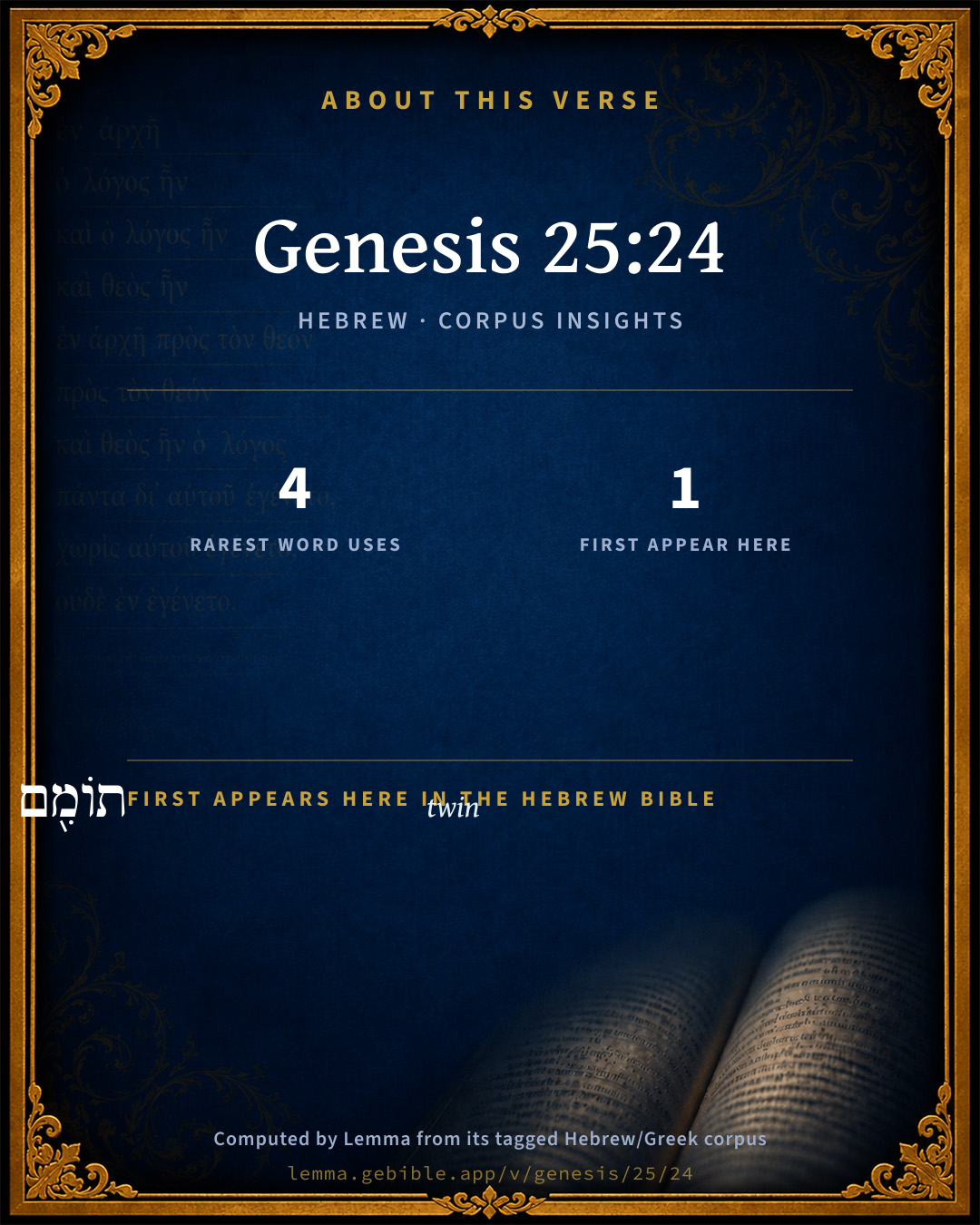
These counts appear in no published source. They are computed here, from the morphology-tagged text and Lemma’s own curated glosses. What Lemma adds →

6
words
6
distinct lemmas
Pentateuch
section

Notable vocabulary

The rarest word here is תוֹמִ֖ם twin H8380 — appearing just 4 times in the whole Hebrew Bible.

First appearance in Scripture

This word makes its first canonical appearance in the Hebrew Bible here:

  • תוֹמִ֖ם twin H8380

Shared distinctive vocabulary

תוֹמִ֖ם twin H8380 occurs in 4 verses of the Hebrew Bible. Also found in:

Grammatical profile

  • 2 verbs
  • 3 nouns
  • 1 particle

Verb forms

  • וַיִּמְלְא֥וּ Qal · Sequential Imperfect
  • לָלֶ֑דֶת Qal · Infinitive Construct

Hebrew & Septuagint length

In English translation the verse runs 15 words from the Hebrew and 17 from the Septuagint (LXX English) — closely comparable.

A rough comparison of the two English renderings, which tokenize alike — not a word-level alignment.

Word counts can differ between the Hebrew and the Greek without any difference in meaning — e.g. the Hebrew direct-object marker אֵת has no separate Greek word, and Greek often adds the article ὁ.

Hebrew and Greek witnesses Masoretic Hebrew ↔ Greek Septuagint

The same verse in the two great witnesses to the Old Testament, shown verse-for-verse.

These are two independent witnesses, not word-aligned to each other, and the Septuagint is shown in lemma (dictionary) form.

Hebrew Genesis 25:24 Masoretic · Westminster Leningrad Codex

וַיִּמְלְא֥וּ יָמֶ֖יהָ לָלֶ֑דֶת וְהִנֵּ֥ה תוֹמִ֖ם בְּבִטְנָֽהּ

When her days to be delivered were fulfilled, behold, there were twins in her womb.

World English Bible · Public Domain

Greek LXX Genesis 25:24 Septuagint · lemma form

καί πληρόω ὁ ἡμέρα ὁ τίκτω αὐτός καί ὅδε εἰμί δίδυμος ἐν ὁ κοιλία αὐτός

And the days were fulfilled that she should be delivered, and she had twins in her womb.

LXX2012 (modern English Septuagint) · Public Domain

On this verse, The Pulpit Commentary discusses the Septuagint’s reading. Read the note in Commentary ↓

Hebrew: Westminster Leningrad Codex (CC BY 4.0). Greek: Septuagint (public domain); English from LXX2012 (modern English Septuagint) (Public Domain). How the Septuagint differs from the Hebrew →

Targum (Aramaic paraphrase)

2

The Targum is the ancient Jewish Aramaic paraphrase of the Hebrew Scriptures — an interpretive translation, not the Hebrew text itself. Onkelos (literal) and Pseudo-Jonathan (expansive) render the Torah, and Jonathan the Prophets. Coverage is partial: where no permissively-licensed English translation exists for a verse, only the Aramaic is shown. This is verse-level text, not a word-by-word alignment to the Hebrew.

  1. Targum Onkelos Torah (Genesis–Deuteronomy)
    וּשְׁלִימוּ יוֹמָהָא לְמֵילָד וְהָא תְיוּמִין בִּמְעָהָא

    (no public-domain English translation for this verse)

    Targum Onkelos — Aramaic: “Onkelos Genesis” (public domain); “Onkelos Exodus” (public domain); “Onkelos Leviticus” (public domain); “Onkelos Numbers” (public domain); “Onkelos Deuteronomy” (public domain). English: “Sefaria Community Translation” (CC0 1.0 (public-domain dedication)); “J.W. Etheridge. The Targums of Onkelos and Jonathan Ben Uzziel on the Pentateuch. London: Longmans, Green, 1862” (public domain). Text via Sefaria.

  2. Targum Pseudo-Jonathan Torah (Genesis–Deuteronomy)
    וּשְׁלִימוּ מָאתָן וְשׁוּבְעִין יוֹמֵי עִבּוּרָהָא לְמֵילַד וְהָא תְיוֹמִין בִּמְעָהָא

    And the two hundred and seventy days of her being with child were completed to bring forth; and, behold, twins were in her womb.

    Targum Pseudo-Jonathan — Aramaic: “Targum Jonathan on Genesis” (public domain); “Targum Jonathan on Exodus” (public domain); “Targum Jonathan on Leviticus” (public domain); “Targum Jonathan on Numbers” (public domain); “Targum Jonathan on Deuteronomy” (public domain). English: “The Targum of Jonathan ben Uzziel, trans. J. W. Etheridge, London, 1862” (public domain). Text via Sefaria.

Commentary

Notes on Genesis 25:24 from classic Christian and Jewish commentators (each source and its license shown beneath its notes). The classic Christian expositions comment on the surrounding passage and are grouped to its opening verse, so a note may address several verses; the Jewish commentaries on the Tanakh (Rashi and others) are per-verse, so they appear only where the commentator wrote on this verse.

Lemma curates 59 commentaries, every one of them public domain or Creative Commons licensed, each selected and text-cleaned for this edition rather than reprinted as found. About our sources →

Trapp's Complete Commentary

John Trapp

Gen 25:24 And when her days to be delivered were fulfilled, behold, [there were] twins in her womb.

Ver. 24. And when her days to be delivered.] Which fell out fifteen years before Abraham’s death, to his great comfort, no doubt. God doth for his, his best at last.

There were twins in her womb.] See Son 4:2,Isa 66:8.

John Trapp, A Commentary or Exposition upon All the Books of the Old and New Testament (1647–1656) — public domain. Text from a community e-Sword module.

The Biblical Illustrator

Joseph S. Exell

Gen_25:24-26

Twins

Birth of Esau and Jacob

I.

THEIR MARKED INDIVIDUALITY.

II. HOW HEREBY IS POINTED OUT THEIR FUTURE DESTINY.

III. HOW THEIR CHARACTERS, SO EARLY DEVELOPED, AFFECTED THE PREFERENCES OF THEIR PARENTS. (T. H. Leale.)

The twins

The children whose birth and destinies were thus predicted, at once gave evidence of a difference even greater than that which will often strike one as existing between two brothers, though rarely between twins. The first was born, all over like a hairy garment, presenting the appearance of being rolled up in a fur cloak or the skin of an animal--an appearance which did not pass away in childhood, but so obstinately adhered to him through life, that an imitation of his hands could be produced with the hairy skin of a kid. This was by his parents considered ominous. The want of the hairy covering which the lower animals have, is one of the signs marking out man as destined for a higher and more refined life than they; and when their son appeared in this guise, they could not but fear it prognosticated his sensual, animal career. So they called him Esau. And so did the younger son from the first show his nature, catching the heel of his brother, as if he were striving to be first-born; and so they called him Jacob, the heel-catcher or supplanter--as Esau afterwards bitterly observed--a name which precisely suited his crafty, plotting nature, shown in his twice over tripping up and overthrowing his elder brother. The name which Esau handed down to his people was, however, not his original name, but one derived from the colour of that for which he sold his birthright. It was in that exclamation of his, Feed me with the same red, that he disclosed his character. (M. Dods, D. D.)

The Biblical Illustrator, edited by Joseph S. Exell (c. 1880s–1900s) — public domain. Text from a community e-Sword module.

The Preacher's Complete Homiletical Commentary

Joseph S. Exell (gen. ed.)

CRITICAL NOTES.—

Gen_25:25. Esau.] Signifies hairy. Some understand the word to be derived from a verb meaning done, or finished, and therefore describing one who was prematurely developed.—

Gen_25:26. Jacob.] This name means he shall hold the heel. (Hos_12:4.) Hence the other meaning follows: to grasp the heel as in wrestling, so as to trip one up—the supplanter. (Gen_27:36.) The boys were born fifteen years before Abraham’s death.—

Gen_25:27. A cunning hunter, a man of the field.] Takes to the field for his occupation, is cunning at catching game, and brave in facing danger. The general idea is, that he was to be a man of wild and lawless habits. Jacob was a plain man. Heb. a perfect, blameless man. The same word which is elsewhere applied to a God-fearing character. His gentleness is set over against Esau’s fierce disposition. Dwelling in tents. Their different habits also indicate a difference of disposition. Jacob was a homely, an orderly, and contented man. Esau was an out of doors man, not caring for social pleasures.—

MAIN HOMILETICS OF THE PARAGRAPH.—Gen_25:24-28

BIRTH OF ESAU AND JACOB

In this account of the birth of these two boys we observe—

I. Their marked individuality. These children were most unlike in their characters and dispositions. They seem as if they belonged to different races altogether. There was an antipathy between their characters even before birth. Tendencies develop themselves even before intelligent consciousness, and before there can be any personal responsibility. Thus there may be dark foreshadowings of a man’s future history, even in the silent womb. In the first germs of man’s physical life lie hid those potentialities which time and circumstance will afterwards develop. Though the individual himself commences a new life, yet he is complicated with the past. “Esau seems to have inherited from his mother the rash, sanguine temperament, but without her nobility of soul; from Isaac he derives a certain fondness for good living—at least of game. Jacob inherited from Isaac the quiet, contemplative manner; from Rebekah, however, a disposition for rapid, prudent, cunning invention. Outwardly regarded, Jacob, on the whole, resembled more the father,—Esau the mother.” (Lange.)

II. How hereby is pointed out their future destiny. Esau comes into the world in a kind of hunter’s skin. (Gen_25:25). Here was the cunning hunter—the man of the field—the dexterous taker of game. Jacob was a smooth man, designed for a gentler kind of life. He was essentially the domestic man, “dwelling in tents.” (Gen_25:27.)

III. How their characters, so early developed, affected the preferences of their parents. (Gen_25:28.) “Isaac loved Esau.” Perhaps because in him the opposite of his own character. Isaac himself was a quiet, contemplative man. Esau, on the other hand, was rash, wild, impulsive, and active. Also, Esau was his first-born son, and this conviction of his pre-eminence in birth may have weighed with his father more than all other claims. He might, too, have supposed that Esau was physically and mentally the most fitted to promote the promised prosperity and to achieve the assured victories of his race. Esau was a strong, bold man, and would therefore be the best fitted to secure Canaan for the family of Abraham. It is true that the oracle, pointing out a different destiny for the brothers, had spoken to Rebekah. But Isaac may have doubted its reality, or explained it away, or interpreted it according to his own temper or wish. We all know how our desires and feelings affect our beliefs. The reason for the father’s preference, however, is given here, “because he did eat of his son’s venison” (Gen_25:28). Esau was like his father, in that he had a fondness for the pleasures of the feast. This matter of the venison may have been only one reason amongst others; it shows a tendency, and altogether points to the fact that the father’s preference was founded on nature, not on grace. “Rebekah loved Jacob.” She believed fully in the oracle which had been given to her. The character of Jacob was well suited to carry out her designs; for though he was a quiet man, he had a certain prudence and cunning.

SUGGESTIVE COMMENTS ON THE VERSES

Gen_25:24-25. The difference is manifest in the outward appearance. The first is red and hairy. These qualities indicate a passionate and precocious nature. He is called Esau the hairy, or the made up, the prematurely developed. His brother is like other children. An act takes place in their very birth, foreshadowing their future history. The second has a hold of his brother’s heel, as if he would trip him up from his very birth. Hence he is called Jacob the wrestler, who takes hold by the heel.—(Murphy.)

Gen_25:26. Brothers unlike, hostile; twins even at enmity, whose physiological unconscious antipathy shows itself already in the womb of the mother—dark forebodings of life not yet existing, bearing witness, however, that the life of man already, in its coming into being, is a germinating seed of a future individuality. This cannot be meant to express a mutual hatred of the embryos. Antipathies however, as well as sympathies may be manifested in the germinating life of man as in the animal and vegetable kingdom.—(Lange.)

Gen_25:27. The boys grew, and it would seem that, as they grew, they were suffered very much to follow the bent of their inclinations in the choice of their respective occupations or modes of life. Their natures were different, and the difference, apparent in their very birth, was significantly indicated in their names. The rough and ruddy aspect of the first-born—more like the coarse robustness of a man than the smooth soft fairness of a child—led to his being called by a name denoting rugged strength, as if he were already full grown and mature; while on the other hand the seemingly accidental circumstance attending his brother’s entrance into the world suggested an appropriate appellation. It is to this appellation, and its import, that Esau afterwards so bitterly alludes in his angry disappointment at the final settlement of the birthright (Gen_27:36). And to the same appellation, for a very different purpose, the prophet Hosea refers, as an instance or emblem of Jacob’s favour with God and his destined superiority, worthy to be cited along with his wrestling with the angel (Hos_12:3-4). With these names, the brothers as they grew up soon began to show that their natures remarkably correspond.—(Candlish.)

Esau’s occupation was, perhaps, determined not only by his disposition, but also by his position in the family. He was the elder son and heir, and seems to have kept that position during his father’s lifetime. The pursuits which he had taken up were of a noble character, and had ever been aspired to by the first-born of the earth. Jacob, on the other hand, seems to have been condemned to the drudgery of domestic service. He really occupied a subordinate place in the household, while his brother assumes the air of a prince and engages in princely sports. Instead of receiving a double portion of the inheritance, Jacob went forth a poor man from his father’s dwelling.

In the dispositions of these two brothers there were

1. Sources of strength. In Esau there were the elements of courage, manly principles, practical power and energy. These might have made a strong character. In Jacob we have all that is quiet, modest, and retiring. These qualities, too, give strength to the religious life.

2. Sources of temptation. Esau was exposed to the danger of becoming coarse and impetuous, rash and ungovernable; while Jacob was likely to degenerate into a character that was timid, sly, and full of low cunning. Strongly marked elements of character may be made a power for good, but they may also become a power for evil.

Gen_25:28. The children please their parents according as they supply what is wanting in themselves. Isaac, himself so sedate, loves the wild, wandering hunter, because he supplies him with pleasures which his own quiet habits do not reach. Rebekah becomes attached to the gentle, industrious shepherd, who satisfies those social and spiritual tendencies in which she is more dependent than Isaac. Esau is destructive of game; Jacob is constructive of cattle.—(Murphy.)

There is “a dead fly in the ointment.” “Isaac loved Esau, but Rebekah loved Jacob.” Alas, that the parents should be so shortsighted! Do they not perceive that a single blemish or mistake may make all their care and toil fruitless? Do they not especially note the quick kindling of the proud eye, or the sudden swelling of the indignant bosom, as the flattery of capricious fondness and the injustice of wanton cruelty and coldness by turns inflame and exasperate the feelings? Set not up, ye Christian parents, one child above another, but set up Christ above all. Let not Isaac love Esau because he “eats of his venison,”—sympathising in his venturous trade, and enjoying the fruits of it. Let not Rebekah love the more peaceful Jacob because, dwelling in tents, he gives her more of his company and fellowship. But let both learn to love their children in the Lord.—(Candlish.)

This preference of the father for Esau was,—

1. A weakness unworthy of such a man.

2. It was the source of many troubles which afterwards arose in his family. Many of the distresses and vexations which embittered the remainder of Isaac’s life are to be traced to this.

3. It kindled the flames of jealousy and resentment between the members of his family.

4. It was contrary to that principle of equity which should guide all conduct. Children of one family should be regarded with equal love.

How humiliating the reason assigned for Isaac’s preference of his elder son! By what grovelling and unworthy motives are wise and good men sometimes actuated. How mortifying a view of human nature to see prudence, justice, and piety controlled by one of the lowest and grossest of our appetites!—(Bush.)

The Preacher's Complete Homiletical Commentary (gen. ed. Joseph S. Exell; Funk & Wagnalls, c. 1892) — public domain (pre-1929). A full-Bible homiletical/sermon-outline anthology covering 65 of 66 books (2 John is absent from the source module). Text from a community e-Sword module.

Tyndale Open Study Notes

Tyndale Open Resources

25:24-26 When the twins were born, the unusual circumstances inspired each boy’s name and hinted at what would happen to them in the future.

Tyndale Open Study Notes — © Tyndale Open Resources, licensed CC BY-SA 4.0. Text via the HelloAO Bible API.

Adam Clarke's Commentary

Verse 24. There were twins] תומם thomim, from which comes Thomas, properly interpreted by the word διδυμος, Didymus, which signifies a twin; so the first person who was called Thomas or Didymus, we may take for granted, had this name from the circumstance of his being a twin.

Adam Clarke's Commentary on the Bible (1810–1826) — public domain. Text from a community e-Sword/MySword module.

John Calvin's Commentaries

24. And when her days to be delivered were fulfilled. Moses shows that the intestine strife in her womb continued to the time of bringing forth; for it was not by mere accident that Jacob seized his brother by the heel and attempted to get out before him. The Lord testified by this sign that the effect of his election does not immediately appear; but rather that the intervening path was strewed with troubles and conflicts. Therefore Esau’s name was allotted to him on account of his asperity; which even from earliest infancy assumed a manly form; but the name Jacob signifies that this giant, vainly striving in his boasted strength, had still been vanquished.

John Calvin's Commentaries (1540-1563) — public domain. Text from the Calvin Translation Society English edition (1840s-50s) via the Christian Classics Ethereal Library (ccel.org). Calvin's coverage is partial (roughly two-thirds of the Bible); uncommented books and verses are honest gaps, never fabricated. The 19th-century editor's footnotes and remarks are omitted so the notes are faithfully Calvin's own voice.

John Gill's Exposition

And when her days to be delivered were fulfilled,.... The nine months were up from the time of her conception; or, as the Targum of Jonathan, when the two hundred and seventy days she went with child were completed:

behold, there were twins in her womb; as was perceived by the midwife; a double mercy was granted, more given than asked for; probably only one child was asked for, but two given.

John Gill's Exposition of the Whole Bible (1746–1763) — public domain (CC PDM 1.0). Text via the HelloAO Bible API.

The Pulpit Commentary

And when her days to be delivered were fulfilled, literally, and were fulfilled her days to bring forth; ejplhrwqhsan aiJ hJmerai tou tekein aujthn. (LXX; cf Luk_1:57 Luk_2:6) Jarchi accounts for the different phrase used of Thamar, (Gen_38:27) who also bore twins, by supposing that she had not completed her days, but gave birth to Pharez and Zarah in the seventh month (vide Rosenm in loco )behold, there were twins in her womb (cf. Gen_38:27, where the full form of the word for twins is given)

The Pulpit Commentary (1880–1919), ed. H.D.M. Spence-Jones & Joseph S. Exell — public domain. Text from a community e-Sword module.

Kretzmann's Popular Commentary

Paul E. Kretzmann

The Two Sons, Esau and Jacob

v. 24. And when her days to be delivered were fulfilled, behold, there were twins in her womb.

v. 25. And the first came out red, all over like an hairy garment; and they called his name Esau. So Esau was the first of the twins to be born, and, in allusion to the reddish, thick growth of hair which even then covered his body like a garment of skins, he was given the name, which means "the hairy one. " Thus early his sensual, hard characteristics, his wildness, became evident.

v. 26. And after that came his brother out, and his hand took hold on Esau’s heel; and his name was called Jacob. The name signifies "the holder of the heel," "the cunning one," because he was supposed to have taken advantage of his brother thus early in life. And Isaac was threescore years old when she bare them.

v. 27. And the boys grew; and Esau was a cunning hunter, a man of the field; and Jacob was a plain man, dwelling in tents. The natural wildness of Esau’s character was soon revealed in the fact that he became skilful in the chase, loved to roam across the country far and wide for the mere love of killing game. Jacob was the very opposite, a quiet young man, opposed to all violence, much preferring to remain in the tents and tend to the matters at home.

v. 28. And Isaac loved Esau because he did eat of his venison, literally, game, the result of the chase, was in his mouth, he was very partial to its wild taste; but Rebekah loved Jacob, partly because she remembered the promise of the Lord, partly because of his love for the quiet life of the home.

Paul E. Kretzmann, Popular Commentary of the Bible (1921–1924) — public domain. Text from a community e-Sword module.

unfoldingWord translationNotes

Door43 World Missions Community

behold, there

"she was surprised to learn that there"

red all over like a hairy garment

Possible meanings are 1) his skin was red and he had a lot of hair on his body or 2) he had a lot of red hair on his body. AT: "red and hairy like a garment made of animal hair" (See: Simile)

Esau

Translators may add a footnote that says "The name Esau sounds like the word 'hairy.'"

grasping Esau's heel

"holding the back part of Esau's foot"

Jacob

Translators may also add a footnote that says "The name Jacob means 'he grasps the heel.'"

sixty years old

"60 years old" (See: Numbers)

translationWords

womb

Esau

Jacob

year

unfoldingWord translationNotes — © Distant Shores Media and the Door43 World Missions Community, licensed CC BY-SA 4.0. Source: git.door43.org/Door43/en_tn.

Rashi

Rabbi Shlomo Yitzchaki (Rashi)

וימלאו ימיה AND WHEN HER DAYS TO BEAR WERE FULL — But in the case of Tamar it is written, (37:27) “And it came to pass at the time of her travail”, for her days were not fulfilled as she gave birth to them (her children) at the end of seven months.

והנה תומם BEHOLD, THERE WERE TWINS — The word for twins is written defective (without א and י) whilst in the case of Tamar it is written תאומים (with א and י); because in the latter case both children proved righteous whilst here one was righteous and the other wicked (Genesis Rabbah 63:8).

Rashi on the Tanakh — English translations: “The Judaica Press complete Tanach with Rashi, translated by A. J. Rosenberg” (CC BY 4.0); “Pentateuch with Rashi's commentary by M. Rosenbaum and A.M. Silbermann, 1929-1934” (public domain); “The Metsudah Tanach series, Lakewood, N.J” (CC BY 4.0); and “The Book of Joshua, Metsudah Publications, 1997” (CC BY 4.0). Text via Sefaria.

Radak

Rabbi David Kimhi (Radak)

וימלאו ימיה, the days of her pregnancy.

והנה תומים בבטנה, the twins in her womb emerged. The word תומים is spelled defective with the letter א of the root, i.e. the middle letter missing. According to an aggadic interpretation the missing letter hints at the fact that only one of these twins would become a righteous Individual (quoted by Rashi).

Radak on the Tanakh — English translations: “Sefaria Community Translation” (CC0 1.0 (public-domain dedication)); “Eliyahu Munk, HaChut Hameshulash” (CC BY 4.0); “Rabbi Mike Feuer, Jerusalem Anthology” (CC BY 4.0); and “R. David Kimhi on the first book of Psalms, Translated by R.G. Finch, London, 1919” (public domain). Text via Sefaria.

Lesson kit

Teaching starters — assembled from the data on this page, not authored interpretation. Every prompt links to the verse data it draws on. Edit before teaching.

Genesis, in the Pentateuch, opens this verse with 6 words (6 distinct Hebrew lemmas). Its most distinctive word is tâʼôwm (“twin”). A historical commentator’s framing appears above. Read the whole chapter for the surrounding context.

Discussion questions

  1. The word tâʼôwm carries the sense “twin.” How does it shape the verse?
  2. This is the first place “twin” appears in Scripture (first appears here). What does its debut here establish?
  3. How does Genesis 38:27, which shares the word «twin», read alongside this verse?
  4. These translations render this verse differently; the difference is in the English rendering, not the original. What questions does that raise?
  5. «וַיִּמְלְא֥וּ» is a Qal Sequential Imperfect verb. How does that grammatical form shape the action described?
  6. Compare how Trapp's Complete Commentary and The Biblical Illustrator read this verse. Where do they agree or differ?

Things to notice

  • 1 word makes its first canonical appearance in Scripture here.
  • These translations choose different wording for 5 words in this verse.
  • 6 distinct Hebrew lemmas span 6 words in this verse.

Reading settings

Reading text

Shown beneath each verse's original-language words.

Old Testament
Old Testament edition

Read the OT as the Masoretic Hebrew (MT) or the Greek Septuagint (LXX).

English shown for the Greek Septuagint (in the Hebrew ↔ Greek comparison).

Comparing translations? Open the Compare panel on any verse page to stack up to four side by side.