Genesis 4:26

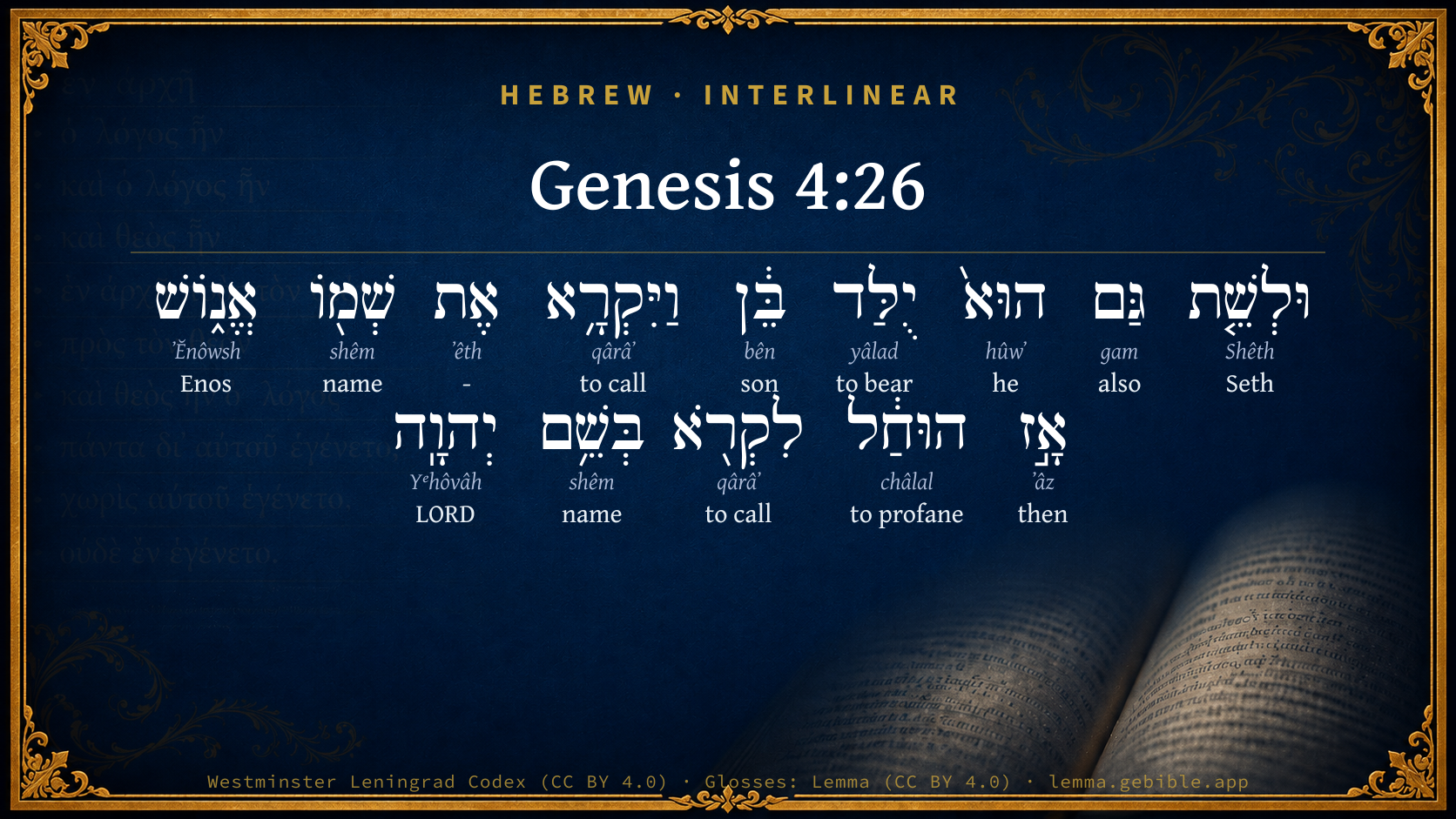
Hebrew (Westminster Leningrad Codex) Genesis 4:26 appears in the Hebrew Old Testament. The text above is from the Westminster Leningrad Codex. Each word links to its Strong’s number, a concise gloss, and parsing drawn from the Open Scriptures Hebrew Bible morphology. Click any word for its full Brown-Driver-Briggs (BDB) entry.
Download image
Cite this verse

Genesis 4:26 (World English Bible). Public Domain. Lemma interlinear Bible study tool, https://lemma.gebible.app/v/genesis/4/26.

Show BibTeX & RIS
BibTeX
RIS
English Translation
There was also born a son to Seth, and he named him Enosh. Then men began to call on Yahweh's name.
World English Bible · Public Domain
Highlights
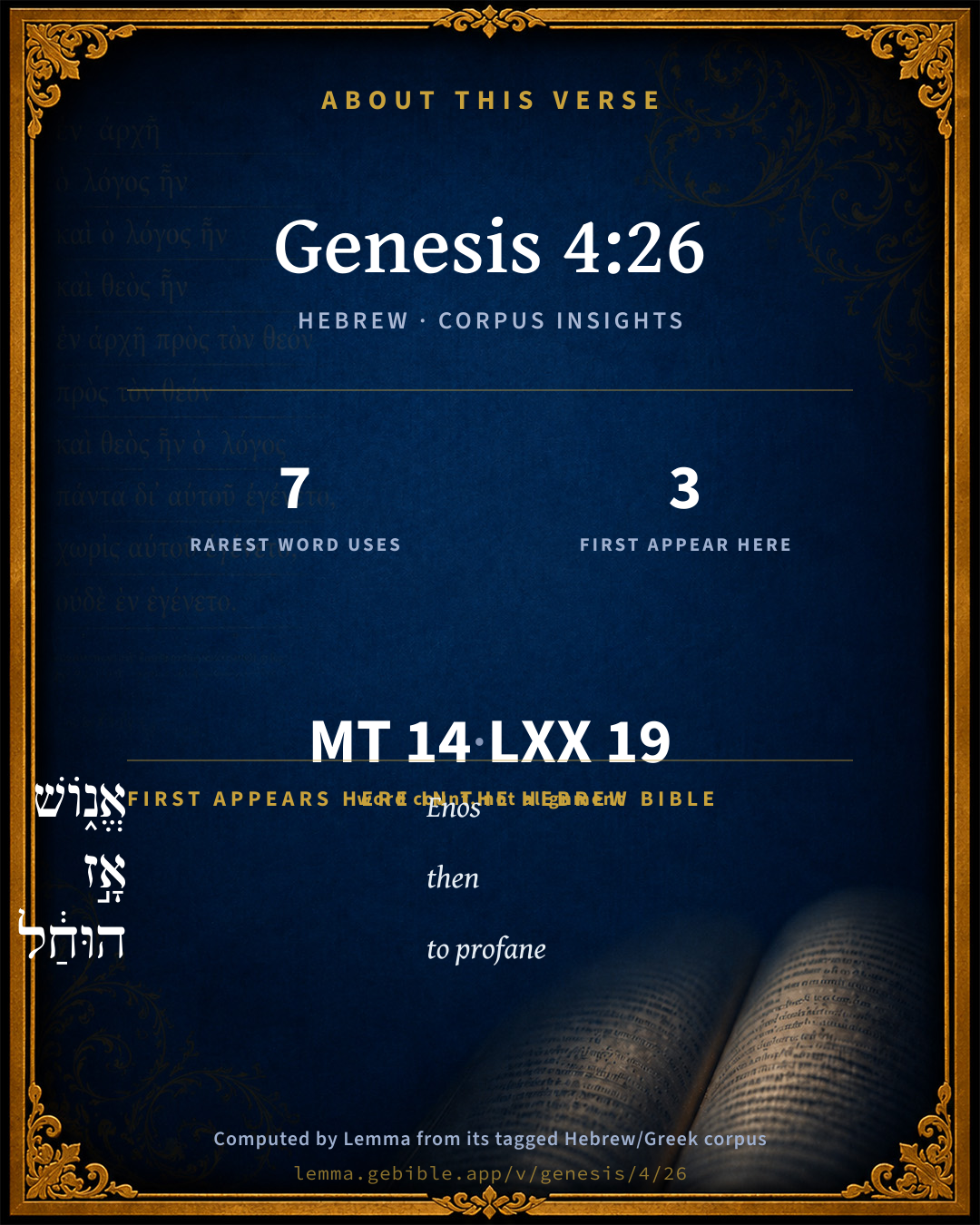
  • 3 first appearances in the Hebrew Bible
Full analysis ↓
Download a study sheet

One document with this verse’s original text, its word-by-word gloss line, the meaning frame, cross-references with their text, attributed commentary, and full source and license credits — printable, and it pastes into notes with its structure intact.

This verse Autodidact and up

Study sheet (.html) Plain text (.txt)

A passage Seminary Student

Up to 50 verses in one chapter. A passage sheet keeps up to 6 commentary sources and 12 cross-references per verse, in the order this page ranks them, and says so on the sheet whenever that leaves anything out. Ask for a single verse and you get the Autodidact verse sheet above.

Everything on this page stays free to read, with no account — the sheet is a download of what is already on screen, not access to it.

Want to remove ads? Support Godless Engineer
Compare translations 3

The same verse in 3 English versions, stacked beneath the original-language interlinear above. Click any original word for its lexicon entry.

Each is an independent rendering of the whole verse — the interlinear is not word-aligned to these translations.

Highlighted words mark where these versions differ — a whole-verse word diff, not a word-by-word alignment.

  • World English Bible Public Domain
    There was also born a son to Seth, and he named him Enosh. Then men began to call on Yahweh's name.
  • King James Version Public Domain
    And to Seth, to him also there was born a son; and he called his name Enos: then began men to call upon the name of the LORD.
  • unfoldingWord Literal Text CC BY-SA 4.0
    And to Seth also a son was born, and he called his name Enosh. Then began to call on the name of Yahweh.

unfoldingWord Literal Text — © unfoldingWord, licensed CC BY-SA 4.0. Word-aligned USFM3 via Door43 (git.door43.org/unfoldingWord/en_ult).

Versions to compare (up to 4)

3 of 4 selected

Show all 18 translations

Every available English version of this verse, each an independent rendering of the whole verse.

  • World English Bible Public Domain
    There was also born a son to Seth, and he named him Enosh. Then men began to call on Yahweh's name.
  • Berean Standard Bible Public Domain
    And to Seth also a son was born, and he called him Enosh. At that time men began to call upon the name of the LORD.
  • Majority Standard Bible Public Domain
    And to Seth also a son was born, and he called him Enosh. At that time men began to call upon the name of the LORD.
  • King James Version Public Domain
    And to Seth, to him also there was born a son; and he called his name Enos: then began men to call upon the name of the LORD.
  • American Standard Version (1901) Public Domain
    And to Seth, to him also there was born a son; and he called his name Enosh. Then began men to call upon the name of Jehovah.
  • Revised Version (1885) Public Domain
    And to Seth, to him also there was born a son; and he called his name Enosh: then began men to call upon the name of the LORD.
  • Geneva Bible (1599) Public Domain
    And to ye same Sheth also there was borne a sonne, and he called his name Enosh. Then beganne men to call vpon the name of the Lord.
  • Douay-Rheims (1899) Public Domain
    But to Seth also was born a son, whom he called Enos; this man began to call upon the name of the Lord.
  • Young's Literal Translation Public Domain
    And to Seth, to him also a son hath been born, and he calleth his name Enos; then a beginning was made of preaching in the name of Jehovah.
  • Literal Standard Version CC BY-SA 4.0
    And to Seth, to him also a son has been born, and he calls his name Enos; then a beginning was made of preaching in the Name of YHWH.
  • Unlocked Literal Bible CC BY-SA 4.0
    A son was born to Seth and he called his name Enosh. At that time people began to call on the name of Yahweh.
  • unfoldingWord Literal Text CC BY-SA 4.0
    And to Seth also a son was born, and he called his name Enosh. Then began to call on the name of Yahweh.
  • Darby Bible Public Domain
    And to Seth, to him also was born a son; and he called his name Enosh. Then people began to call on the name of Jehovah.
  • World Messianic Bible Public Domain
    A son was also born to Seth, and he named him Enosh. At that time men began to call on the LORD’s name.
  • Webster's Bible Public Domain
    And to Seth, to him also there was born a son; and he called his name Enos: then began men to call upon the name of the LORD.
  • Free Bible Version CC BY-SA 4.0
    Later Seth had a son named Enosh, because at that time people began to worship the Lord by name.
  • Bible in Basic English Public Domain
    And Seth had a son, and he gave him the name of Enosh: at this time men first made use of the name of the Lord in worship.
  • JPS Tanakh (1917) Public Domain
    And to Seth, to him also there was born a son; and he called his name Enosh; then began men to call upon the name of the LORD.

Literal Standard Version (2020), Covenant Press — licensed CC BY-SA 4.0. Text via the HelloAO Bible API (eBible.org). Unlocked Literal Bible (unfoldingWord) — licensed CC BY-SA 4.0. Text via the HelloAO Bible API (eBible.org). unfoldingWord Literal Text — © unfoldingWord, licensed CC BY-SA 4.0. Word-aligned USFM3 via Door43 (git.door43.org/unfoldingWord/en_ult). Free Bible Version, Dr. Jonathan Gallagher — licensed CC BY-SA 4.0. Text via the HelloAO Bible API (eBible.org).

Word by word

More ways to search: Search by grammar → Find every occurrence → Compare this word →

Practice this passage: Drill this verse → Learn its vocabulary →

אֱנ֑וֹשׁ
ʼĔnôwsh
H583
“Enos”
Noun, Proper
Part of Speech
Noun
Type
Proper
Full BDB Definition

Origin: the same as H582

TWOT: None

Enos = "man" - son of Seth
  1. וּלְשֵׁ֤ת Shêth H8352 “and · to/for · Seth” Conjunction + Preposition + Noun, Proper
  2. גַּם gam H1571 “also” Particle, Accusative
  3. הוּא֙ hûwʼ H1931 “he” Pronoun, Personal, 3rd Person, Masculine, Singular
  4. יֻלַּד yâlad H3205 “to bear” Verb, Pual, Perfect, 3rd Person, Masculine, Singular
  5. בֵּ֔ן bên H1121 “son” Noun, Common, Masculine, Singular, Absolute
  6. וַיִּקְרָ֥א qârâʼ H7121 “and · to call” Conjunction + Verb, Qal, Sequential Imperfect, 3rd Person, Masculine, Singular
  7. אֶת ʼêth H853 “-” Particle, Direct Object
  8. שְׁמ֖וֹ shêm H8034 “name · his” Noun, Common, Masculine, Singular, Construct + Suffix, Personal, 3rd Person, Masculine, Singular
  9. אָ֣ז ʼâz H227 “then” Adverb
  10. הוּחַ֔ל châlal H2490 “to profane” Verb, Hophal, Perfect, 3rd Person, Masculine, Singular
  11. לִקְרֹ֖א qârâʼ H7121 “to call” Preposition + Verb, Qal, Infinitive Construct
  12. בְּשֵׁ֥ם shêm H8034 “in/at · name of” Preposition + Noun, Common, Masculine, Singular, Construct
  13. יְהוָֽה Yᵉhôvâh H3068 “LORD” Noun, Proper

About this verse

These counts appear in no published source. They are computed here, from the morphology-tagged text and Lemma’s own curated glosses. What Lemma adds →

14
words
12
distinct lemmas
Pentateuch
section

Notable vocabulary

The rarest word here is אֱנ֑וֹשׁ Enos H583 — appearing just 7 times in the whole Hebrew Bible.

First appearance in Scripture

These words make their first canonical appearance in the Hebrew Bible here:

  • אֱנ֑וֹשׁ Enos H583
  • אָ֣ז then H227
  • הוּחַ֔ל to profane H2490

Shared distinctive vocabulary

אֱנ֑וֹשׁ Enos H583 occurs in 7 verses of the Hebrew Bible. Also found in:

Grammatical profile

  • 4 verbs
  • 6 nouns
  • 1 pronoun
  • 1 adverb
  • 2 particles

Verb forms

  • יֻלַּד Pual · Perfect
  • וַיִּקְרָ֥א Qal · Sequential Imperfect
  • הוּחַ֔ל Hophal · Perfect
  • לִקְרֹ֖א Qal · Infinitive Construct

Repetition

Words recur within this verse — often emphatic in Hebrew:

  • וַיִּקְרָ֥א to call H7121 ×2
  • שְׁמ֖וֹ name H8034 ×2

Hebrew & Septuagint length

In English translation the verse runs 21 words from the Hebrew and 22 from the Septuagint (LXX English) — closely comparable.

A rough comparison of the two English renderings, which tokenize alike — not a word-level alignment.

Word counts can differ between the Hebrew and the Greek without any difference in meaning — e.g. the Hebrew direct-object marker אֵת has no separate Greek word, and Greek often adds the article ὁ.

In the original languages it is 14 Hebrew tokens and 19 Greek tokens — but the two are counted differently (Hebrew bundles its prefixes and suffixes into one token; the Greek is in lemma form), so that isn’t a like-for-like length.

Cross-references

17

Topical passages linked to Genesis 4:26 in the Treasury of Scripture Knowledge — connected by theme and wording, ordered by reader-vote popularity; previews shown in the World English Bible.

  • Psalms 116:17 I will offer to you the sacrifice of thanksgiving, And will call on the name of Yahweh.
  • 1 Kings 18:24 You call on the name of your god, and I will call on the name of Yahweh; and the God who answers by fire, let him be God." All the people answered, "It is well said."
  • Joel 2:32 It will happen that whoever will call on the name of Yahweh shall be saved; For in Mount Zion and in Jerusalem there will be those who escape, As Yahweh has said, And among the remnant, those whom Yahweh calls.
  • Zephaniah 3:9 For then I will purify the lips of the peoples, that they may all call on the name of Yahweh, to serve him shoulder to shoulder.
  • Genesis 12:8 He left from there to the mountain on the east of Bethel, and pitched his tent, having Bethel on the west, and Ai on the east. There he built an altar to Yahweh, and called on the name of Yahweh.
  • Genesis 26:25 He built an altar there, and called on the name of Yahweh, and pitched his tent there. There Isaac's servants dug a well.
  • Jeremiah 33:16 In those days shall Judah be saved, and Jerusalem shall dwell safely; and this is [the name] by which she shall be called: Yahweh our righteousness.
  • Luke 3:38 the son of Enos, the son of Seth, the son of Adam, the son of God.
  • Deuteronomy 26:17–18 You have declared Yahweh this day to be your God, and that you would walk in his ways, and keep his statutes, and his commandments, and his ordinances, and listen to his voice:
  • Acts 2:21 It will be, that whoever will call on the name of the Lord will be saved.'
  • Acts 11:26 When he had found him, he brought him to Antioch. It happened, that for a whole year they were gathered together with the assembly, and taught many people. The disciples were first called Christians in Antioch.
  • Romans 10:13 For, "Whoever will call on the name of the Lord will be saved."
  • 1 Corinthians 1:2 to the assembly of God which is at Corinth; those who are sanctified in Christ Jesus, called to be saints, with all who call on the name of our Lord Jesus Christ in every place, both theirs and ours:
  • Isaiah 44:5 One shall say, I am Yahweh's; and another shall call [himself] by the name of Jacob; and another shall subscribe with his hand to Yahweh, and surname [himself] by the name of Israel.
  • Isaiah 48:1 Hear you this, house of Jacob, who are called by the name of Israel, and are come forth out of the waters of Judah; who swear by the name of Yahweh, and make mention of the God of Israel, but not in truth, nor in righteousness
  • Isaiah 63:19 We are become as they over whom you never bear rule, as those who were not called by your name.

Cross-references courtesy of OpenBible.info (CC BY 4.0).

Hebrew and Greek witnesses Masoretic Hebrew ↔ Greek Septuagint

The same verse in the two great witnesses to the Old Testament, shown verse-for-verse.

These are two independent witnesses, not word-aligned to each other, and the Septuagint is shown in lemma (dictionary) form.

Hebrew Genesis 4:26 Masoretic · Westminster Leningrad Codex

וּלְשֵׁ֤ת גַּם הוּא֙ יֻלַּד בֵּ֔ן וַיִּקְרָ֥א אֶת שְׁמ֖וֹ אֱנ֑וֹשׁ אָ֣ז הוּחַ֔ל לִקְרֹ֖א בְּשֵׁ֥ם יְהוָֽה

There was also born a son to Seth, and he named him Enosh. Then men began to call on Yahweh's name.

World English Bible · Public Domain

Greek LXX Genesis 4:26 Septuagint · lemma form

καί ὁ σηθ γίγνομαι υἱός ἐπιὀνομάζω δέ ὁ ὄνομα αὐτός ενως οὗτος ἐλπίζω ἐπικαλέω ὁ ὄνομα κύριος ὁ θεός

And Seth had a son, and he called his name Enos: he hoped to call on the name of the Lord God.

LXX2012 (modern English Septuagint) · Public Domain

Hebrew: Westminster Leningrad Codex (CC BY 4.0). Greek: Septuagint (public domain); English from LXX2012 (modern English Septuagint) (Public Domain). How the Septuagint differs from the Hebrew →

Targum (Aramaic paraphrase)

2

The Targum is the ancient Jewish Aramaic paraphrase of the Hebrew Scriptures — an interpretive translation, not the Hebrew text itself. Onkelos (literal) and Pseudo-Jonathan (expansive) render the Torah, and Jonathan the Prophets. Coverage is partial: where no permissively-licensed English translation exists for a verse, only the Aramaic is shown. This is verse-level text, not a word-by-word alignment to the Hebrew.

  1. Targum Onkelos Torah (Genesis–Deuteronomy)
    וּלְשֵׁת אַף הוּא אִתְיְלִיד בַּר וּקְרָא יָת שְׁמֵהּ אֱנוֹשׁ בְּכֵן בְּיוֹמוֹהִי חָלוּ בְנֵי אֱנָשָׁא מִלְּצַלָּאָה בִּשְׁמָא דַּיְיָ

    (no public-domain English translation for this verse)

    Targum Onkelos — Aramaic: “Onkelos Genesis” (public domain); “Onkelos Exodus” (public domain); “Onkelos Leviticus” (public domain); “Onkelos Numbers” (public domain); “Onkelos Deuteronomy” (public domain). English: “Sefaria Community Translation” (CC0 1.0 (public-domain dedication)); “J.W. Etheridge. The Targums of Onkelos and Jonathan Ben Uzziel on the Pentateuch. London: Longmans, Green, 1862” (public domain). Text via Sefaria.

  2. Targum Pseudo-Jonathan Torah (Genesis–Deuteronomy)
    וּלְשֵׁת אַף הוּא אִתְיִלֵיד בַּר וּקְרָא יַת שְׁמֵיהּ אֱנוֹשׁ הוּא דָרָא דְמִיוֹמוֹהִי שְׁרִיאוּ לְמִטְעֵי וַעֲבָדוּ לְהוֹן טַעֲוָון וּמְכַנִין לְטַעֲוַותְהוֹן בְּשׁוּם מֵימְרָא דַיְיָ

    And to Sheth also was born a son, and he called his name Enosh. That was the generation in whose days they began to err, and to make themselves idols, and surnamed their idols by the name of the Word of the Lord.

    Targum Pseudo-Jonathan — Aramaic: “Targum Jonathan on Genesis” (public domain); “Targum Jonathan on Exodus” (public domain); “Targum Jonathan on Leviticus” (public domain); “Targum Jonathan on Numbers” (public domain); “Targum Jonathan on Deuteronomy” (public domain). English: “The Targum of Jonathan ben Uzziel, trans. J. W. Etheridge, London, 1862” (public domain). Text via Sefaria.

Commentary

Notes on Genesis 4:26 from classic Christian and Jewish commentators (each source and its license shown beneath its notes). The classic Christian expositions comment on the surrounding passage and are grouped to its opening verse, so a note may address several verses; the Jewish commentaries on the Tanakh (Rashi and others) are per-verse, so they appear only where the commentator wrote on this verse.

Lemma curates 59 commentaries, every one of them public domain or Creative Commons licensed, each selected and text-cleaned for this edition rather than reprinted as found. About our sources →

Trapp's Complete Commentary

John Trapp

Gen 4:26 And to Seth, to him also there was born a son; and he called his name Enos: then began men to call upon the name of the LORD.

Ver. 26. Then began men to call upon, &c.] Publicly, and in solemn assemblies to serve the Lord; and to make a bold and wise profession of his name: "shining as lamps" {a} amidst that "perverse" generation of irreligious Cainites, "who said unto God, Depart from us," &c. {Job 22:17} This Job speaks there of these wicked, "which were cut down out of time, their foundation was overflown with the flood." {Job 22:16} The Jews translate it to this day, Then began men to fall from God; as Maimonides, their most learned rabbi, observes.

{a} ως φωστηρες. {Php 2:15}

John Trapp, A Commentary or Exposition upon All the Books of the Old and New Testament (1647–1656) — public domain. Text from a community e-Sword module.

The Biblical Illustrator

Joseph S. Exell

Gen_4:26

Then began men to call upon the name of the Lord

Prayer

Prayer is speaking to God--on any subject, with any object, in any place, and in any way.

I. PRAYER SO REGARDED IS AN INSTINCT. It seems to be natural to man to look upwards and address himself to his God. Even in the depth of lost knowledge and depraved feeling, the instinct of prayer will assert itself. A nation going to war with another nation will call upon its God for success and victory; and an individual man, from the bedside of a dying wife or child, will invoke the aid of One supposed to be mighty, to stay the course of a disease which the earthly physician has pronounced incurable and mortal. Just as the instinct of nature brings the child in distress or hunger to a fathers knee or to a mothers bosom, even so does created man turn in great misery to a faithful Creator, and throw himself upon His compassion and invoke His aid.

II. BUT PRAYER IS A MYSTERY TOO. The mysteriousness of prayer is an argument for its reasonableness. It is not a thing which common men would have thought of or gone after for themselves. The idea of holding a communication with a distant, an unseen, a spiritual being, is an idea too sublime, too ethereal for any but poets or philosophers to have dreamed of, bad it not been made instinctive by the original Designer of our spiritual frame.

III. PRAYER IS ALSO A REVELATION. Many things waited for the coming of Christ to reveal them, but prayer waited not. Piety without knowledge there might be; piety without prayer could not be. And so Christ had no need to teach as a novelty the duty or the privilege of prayer. He was able to assume that all pious men, however ignorant, prayed; and to say therefore only this--When ye pray, say after this manner. (Dean Vaughan.)

The first public revival of religion

I. Consider THE STATE OF THE TIMES HERE REFERRED TO. Then--then began men to call upon the name of the Lord. What was the state of the times, when this revival of religion took place? It was very bad. There were evidently two parties--the children of men and the sons of God--the men of this world and the men not of this world--the faithful in Christ Jesus and the unbelieving and ungodly. And these, it seems--the worldly-minded and corrupt--were growing greatly in boldness and recklessness of crime. They congregated in cities, and so kept each other in countenance; they had their unions for pleasure, for business, for sin; they poured contempt on God and godliness. Meanwhile the godly seed were few and separated. They worshipped God in privacy in their families. They wanted more of union with each other. It was now necessary to make a stand for true religion. What they believed with their heart, it was high time to confess with their lips.

II. Consider THE PUBLIC REVIVAL OF RELIGION WHICH THEN TOOK PLACE. The pious found it necessary and desirable to unite more closely together; and they found their bond of union in the name of the Lord. They began, the margin of our Bible says it may be rendered--they began to call themselves by the name of the Lord. Probably the expression includes both ideas; they began to call themselves by the name of the Lord, and they also began to call upon His name.

1. They called themselves by His name. They owned themselves openly His people. They were not ashamed of Him--of His name, of His truth, of His cause, nor of His people. They knew God in His grace, in the promise of the Messiah, by the help of the Spirit. What they knew, they believed; what they believed, they confessed; they called themselves by the name of the lord.

2. And then they also called upon the name of the Lord. We cannot think that so many years had passed away, and men had not yet begun to pray by themselves in secret, or with their households in family worship. But then men began to call upon the name of the Lord in social, united, and public worship. This probably is the meaning. The enemies of God were publicly united, and the people of God began publicly to unite. Those, for ungodly purposes; these, to promote vital godliness. The former, for profaneness; the latter, for prayer. This was a decided step; when they came out of their family circles and closets, to join together in public worship. Doubtless it attracted much observation, and excited much ridicule. Can you not fancy the ungodly of that day mocking the men of God as they went to their place of worship? disturbing (it may be) the little band when assembled, or following them with their taunts? But in vain. The Spirit of God brought His children to unite as brethren.

III. Consider our OWN INSTRUCTION in this subject. What is the state of our times? Is it good or bad? It is very mixed--much as it was then. Numbers have altogether erroneous views of the way of salvation. Numbers advocate another gospel than that of Jesus Christ. Infidelity also prevails to a fearful extent. But, still, there is a bright side also. There are more than a few now who know and who believe from the heart the promise of the Seed of the woman, and all its glorious fulfilment in the person, in the work, in the doctrine, in the grace of Jesus Christ. These also do call upon the name of the Lord in private. Oh! we are not of their number, if we neglect private prayer. Then, also, most persons of true piety do now call upon God in their families. But would we see religion revived? We must call ourselves after the name of the Lord; confess Christ faithfully before men; be not ashamed of Christian principles. And there must also be revived delight in public worship. This has ever been the case in revivals of true religion. Religion never flourishes without diligent and faithful use of the appointed means of grace. (J. Hambleton, M. A.)

A change in mode of worship

Some change is here intimated in the mode of approaching God in worship. The gist of the sentence, however, does not lie in the name of Jehovah. For this term was not then new in itself, as it was used by Eve at the birth of Cain; nor was it new in this connection, as the phrase now appears for the first time, and Jehovah is the ordinary term employed in it ever afterwards to denote the true God. As a proper name, Jehovah is the fit and customary word to enter into a solemn invocation. It is, as we have seen, highly significant. It speaks of the Self-existent, the Author of all existing things, and in particular of man; the Self-manifest, who has shown Himself merciful and gracious to the returning penitent, and with him keeps promise and covenant. Hence it is the custom itself of calling on the name of Jehovah, of addressing God by His proper name, which is here said to have been commenced. Growing man now comprehends all that is implied in the proper name of God, Jehovah, the Author of being, of promise, and of performance. He finds a tongue, and ventures to express the desires and feelings that have been long pent up in his breast, and are now bursting for utterance. These petitions and confessions are now made in an audible voice, and with a holy urgency and courage rising above the depressing sense of self-abasement to the confidence of peace and gratitude. These adorations are also presented in a social capacity, and thereby acquire a public notoriety. The father, the eider of the house, is the master of words, and he becomes the spokesman of the brotherhood in this new relationship into which they have spontaneously entered with their Father in heaven. The spirit of adoption has prompted the confiding and endearing terms, Abba, Father, and now the winged words ascend to heaven, conveying the adorations and aspirations of the assembled saints. (Prof. J. G. Murphy.)

.

The Biblical Illustrator, edited by Joseph S. Exell (c. 1880s–1900s) — public domain. Text from a community e-Sword module.

Joseph Benson's Commentary

Gen 4:26. And to Seth was born a son called Enos, which is the general name for all men, and speaks the weakness, frailty, and misery of man’s state. Then began men to call upon the name of the Lord — Doubtless God’s name was called upon before: but now, 1st, The worshippers of God began to do more in religion than they had done; perhaps not more than had been done at first, but more than had been done since the defection of Cain. Now men began to worship God, not only in their closets and families, but in public and solemn assemblies. 2nd, The worshippers of God began to distinguish themselves: so the margin reads it. Then began men to be called by the name of the Lord — or, to call themselves by it. Now Cain and those that had deserted religion had built a city, and begun to declare for irreligion, and called themselves the sons of men. Those that adhered to God began to declare for him and his worship, and called themselves the sons of God.

Joseph Benson's Commentary on the Old and New Testaments (1811–1818) — public domain. Text from a community e-Sword module.

Tyndale Open Study Notes

Tyndale Open Resources

4:26 Enosh means “humankind.” In the Old Testament, the term is often used in poetic texts that emphasize human mortality, frailty, and weakness (e.g., Ps 144:3, “mere mortals”). Enosh was born at the time when people began to worship the Lord by name (literally call on the name of the Lord). In Genesis, that meant calling on the name of the Lord through sacrifice and prayer (similar Hebrew terminology is found in Gen 12:8; 13:4; 21:33; 26:25).

Tyndale Open Study Notes — © Tyndale Open Resources, licensed CC BY-SA 4.0. Text via the HelloAO Bible API.

Geneva Bible (1599)

Geneva Bible translators

In these days God began to move the hearts of the godly to restore religion, which a long time by the wicked had been suppressed.

Geneva Bible (1599) marginal notes — public domain. Text via Bolls.life.

Jamieson, Fausset & Brown

Robert Jamieson, A. R. Fausset & David Brown

men began to call upon the name of the Lord--rather, by the name of the Lord. God's people, a name probably applied to them in contempt by the world.

Next: Genesis Chapter 5

Jamieson, Fausset & Brown — Commentary Critical and Explanatory on the Whole Bible (1871) — public domain (CC PDM 1.0). Text via the HelloAO Bible API.

Adam Clarke's Commentary

Verse 26. Then began men to call upon the name of the Lord.] The marginal reading is, Then began men to call themselves by the name of the Lord; which words are supposed to signify that in the time of Enos the true followers of God began to distinguish themselves, and to be distinguished by others, by the appellation of sons of God; those of the other branch of Adam's family, among whom the Divine worship was not observed, being distinguished by the name, children of men. It must not be dissembled that many eminent men have contended that הוחל huchal, which we translate began, should be rendered began profanely, or then profanation began, and from this time they date the origin of idolatry. Most of the Jewish doctors were of this opinion, and Maimonides has discussed it at some length in his Treatise on Idolatry; as this piece is curious, and gives the most probable account of the origin and progress of idolatry, I shall insert it here.

"In the days of Enos the sons of Adam erred with great error, and the counsel of the wise men of that age became brutish, and Enos himself was (one) of them that erred; and their error was this: they said, Forasmuch as God hath created these stars and spheres to govern the world, and set them on high, and imparted honour unto them, and they are ministers that minister before him; it is meet that men should laud, and glorify, and give them honour. For this is the will of God, that we magnify and honour whomsoever he magnifieth and honoureth; even as a king would have them honoured that stand before him, and this is the honour of the king himself. When this thing was come up into their hearts they began to build temples unto the stars, and to offer sacrifice unto them, and to laud and glorify them with words, and to worship before them, that they might in their evil opinion obtain favour of the Creator; and this was the root of idolatry, c. And in process of time there stood up false prophets among the sons of Adam, which said that God had commanded and said unto them, Worship such a star, or all the stars, and do sacrifice unto them thus and thus and build a temple for it, and make an image of it, that all the people, women, and children may worship it. And the false prophet showed them the image which he had feigned out of his own heart, and said it was the image of such a star, which was made known unto him by prophecy. And they began after this manner to make images in temples, and under trees, and on tops of mountains and hills, and assembled together and worshipped them, c. And this thing was spread through all the world, to serve images with services different one from another, and to sacrifice unto and worship them. So, in process of time, the glorious and fearful name (of God) was forgotten out of the mouth of all living, and out of their knowledge, and they acknowledged him not.

And there was found no people on the earth that knew aught, save images of wood and stone, and temples of stone, which they had been trained up from their childhood to worship and serve, and to swear by their names. And the wise men that were among them, as the priests and such like, thought there was no God save the stars and spheres, for whose sake and in whose likeness they had made these images but as for the Rock everlasting, there was no man that acknowledged him or knew him save a few persons in the world, as Enoch, Methuselah, Noah, Sham, and Heber. And in this way did the world walk and converse till that pillar of the world, Abraham our father, was born." Maim. in Mishn, and Ainsworth in loco.

1. WE see here the vast importance of worshipping God according to his own mind; no sincerity, no uprightness of intention, can atone for the neglect of positive commands delivered in Divine revelation, when this revelation is known. He who will bring a eucharistic offering instead of a sacrifice, while a sin-offering lieth at the door, as he copies Cain's conduct, may expect to be treated in the same manner. Reader, remember that thou hast an entrance unto the holiest through the veil, that is to say his flesh; and those who come in this way, God will in nowise cast out.

2. We see the horrible nature of envy: its eye is evil merely because God is good; it easily begets hatred; hatred, deep-settled malice; and malice, murder! Watch against the first appearance of this most destructive passion, the prime characteristic of which is to seek the destruction of the object of its malevolence, and finally to ruin its possessor.

3. Be thankful to God that, as weakness increased and wants became multiplied, God enabled man to find out useful inventions, so as to lessen excessive labour, and provide every thing indispensably necessary for the support of life. He who carefully attends to the dictates of honest, sober industry, is never likely to perish for lack of the necessaries of life.

4. As the followers of God at this early period found it indispensably necessary to separate themselves from all those who were irreligious and profane, and to make a public profession of their attachment to the truth, so it should be now. There are still men of profane minds. whose spirit and conduct are destructive to godliness; and in reference to such the permanent order of God is, Come out from among them, touch not the unclean thing, and I will receive you. He who is not determined to be a Christian at all events, is not far from being an infidel. Those only who confess Christ among men shall be acknowledged before his Father and the angels of God.

Adam Clarke's Commentary on the Bible (1810–1826) — public domain. Text from a community e-Sword/MySword module.

John Calvin's Commentaries

26. Then began men to call upon the name of the Lord. In the verb ‘to call upon,’ there is a synecdochee, for it embraces generally the whole worship of God. But religion is here properly designated by that which forms its principal part. For God prefers this service of piety and faith to all sacrifices, (Psalm 50:14.) Yea, this is the spiritual worship of God which faith produces. This is particularly worthy of notice, because Satan contrives nothing with greater care than to adulterate, with every possible corruption, the pure invocation of God, or to draw us away from the only God to the invocation of creatures. Even from the beginning of the world he has not ceased to move this stone, that miserable men might weary themselves in vain in a preposterous worship of God. But let us know, that the entire pomp of adoration is nothing worth, unless this chief point of worshipping God aright be maintained. Although the passage may be more simply explained to mean, that then the name of God was again celebrated; yet I approve the former sense, because it is more full, contains a useful doctrine, and also agrees with the accustomed phraseology of Scripture. It is a foolish figment, that God then began to be called by other names; since Moses does not here censure depraved superstitions, but commends the piety of one family which worshipped God in purity and holiness, when religions among other people, was polluted or extinct. And there is no doubt, that Adam and Eve, with a few other of their children were themselves true worshippers of God; but closes means, that so great was then the deluge of impiety in the world that religion was rapidly hastening to destruction; because it remained only with a few men, and did not flourish in any one race. We may readily conclude that Seth was an upright and faithful servant of God. And after he begat a son, like himself, and had a rightly constituted family, the face of the Church began distinctly to appear, and that worship of God was set up which might continue to posterity. Such a restoration of religion has been effected also in our time; not that it had been altogether extinct; but there was no certainly defined people who called upon God; and, no sincere profession of faith, no uncorrupted religion could anywhere be discovered. Whence it too evidently appears how great is the propensity of men, either to gross contempt of God, or to superstition; since both evils must then have everywhere prevailed, when Moses relates it as a miracles that there was at that time a single family in which the worship of God arose.

John Calvin's Commentaries (1540-1563) — public domain. Text from the Calvin Translation Society English edition (1840s-50s) via the Christian Classics Ethereal Library (ccel.org). Calvin's coverage is partial (roughly two-thirds of the Bible); uncommented books and verses are honest gaps, never fabricated. The 19th-century editor's footnotes and remarks are omitted so the notes are faithfully Calvin's own voice.

Ellicott's Commentary for English Readers

(26) He called his name Enos.—Heb., Enosh, that is, man. We thus find language growing. Up to this time there had been two names for man: Adam, which also in Assyrian—another Semitic dialect—has the same meaning, as Sir H. Rawlinson has shown: and Ish, a being. (See on Gen_2:23.) We have now Enosh, which, according to Fürst and others, signifies mortal; but of this there is no proof. Most probably it is the generic word for man. and is used as such in the Aramaic dialects. Thus in Syriac and Chaldee our Lord is styled bar-enosh, the son of man: not the son of a mortal, but the son of man absolutely.

Then began men (Heb., then it was begun) to call upon the name of the Lord (Jehovah).—That is, the notion of Divinity began now to be attached to this name, and even in their worship men called upon God as Jehovah. Eve, as we have seen, attached no such idea to it; and when, in Gen_4:3, we read that Cain and Abel brought an offering to Jehovah, these are the words of the narrator, who in the story of the fall had expressly styled the Deity Jehovah-Elohim, that is, Jehovah-God, or more exactly, “the coming God,” in order to show that Elohim and Jehovah are one. Two hundred and thirty-five years had elapsed between the birth of Cain and that of Enos, and men had learned a truer appreciation of the promise given to their primal mother, in Gen_3:15, than she herself had when she supposed that her first child was to win back for her the Paradise. Probably they had no exact doctrinal views about His person and nature; it was the office of prophecy “by divers portions” to give these (Heb_1:1). But they had been taught that “He who should be” was Divine, and to be worshipped. It is the hopeless error of commentators to suppose that Eve, and Enos, and others, knew all that is now known, and all that the inspired narrator knew. They thus do violence to the plainest language of Holy Scripture, and involve its interpretation in utter confusion. Read without these preconceived notions, the sense is plain: that the name Jehovah had now become a title of the Deity, whereas previously no such sacredness had been attached to it. It was long afterwards, in the days of Moses, that it became the personal name of the covenant God of the Jews.

A Bible Commentary for English Readers, edited by Charles John Ellicott (1878–1897) — public domain. Text from a community e-Sword module.

The Cambridge Bible for Schools and Colleges

gen. ed. J. J. S. Perowne

26. Enosh] This word, used in Hebrew poetry, means “man,” and is thus to be compared with Adam.

then began men] In the Hebrew it is impersonal, “then was a beginning made.” The origin of Jehovah worship is here connected with the line of Seth, and is probably intended to be contrasted with the origin of secular callings in the line of Cain.

to call upon] “Properly, as always, to call with, i.e. to use the name in invocations, in the manner of ancient cults, especially at times of sacrifice; cf. Gen_12:8, Gen_13:4, Gen_21:33, Gen_26:25.” (Driver.)

the name of the Lord] i.e. the name of Jehovah. This statement by J, who uses this title by preference, is in conflict with the statement that the name was first revealed to Moses (E), (P), Exo_3:14; Exo_6:2. But in view not only of this text, but also of recent cuneiform decipherments, shewing the probability that a form of the name was known in Babylonia before the time of Moses, it is not unreasonable to suppose that the name belongs, as the tradition of J evidently taught, to prehistoric antiquity.

The Cambridge Bible for Schools and Colleges (gen. ed. J. J. S. Perowne; Cambridge University Press, 1878–1918) — public domain. Text from a community e-Sword module.

Haydock's Catholic Bible Commentary

Began to call upon, &c. Not that Adam and Seth had not called upon God before the birth of Enos, but that Enos used more solemnity in the worship and invocation of God. (Challoner) --- He directed all his thoughts towards heaven, being reminded by his own name, which signifies one afflicted, that he could look for no solid happiness on earth. Seth had brought him up, from his infancy, in these pious sentiments, and his children were so docile to his instructions, that they began to be known in the world for their extraordinary piety, and were even styled the Sons of God, chap. vi. 2. (Haydock) --- Religion was not a human invention, but many ceremonies have been adopted, at different times, to make an impression on the minds of the people. Before Enos, the heads of families had officiated in their own houses; now, perhaps, they met together in places consecrated to the divine service, and sounded forth the praises of the Most High. Enos was probably most conspicuous for his zeal on these occasions: at least, a new degree of fervour manifested itself in his days. On the other hand, "the name of the Lord began to be profaned" about this time, as the Rabbin understand this passage, by the introduction of idolatry; which is a common effect of a dissolute life, which many began now to lead, Wisdom xiv. 12. (Calmet) --- The beginning of fornication is the devising of idols. We have, nevertheless, no certain proof of idols being introduced till many years after the deluge. (Haydock)

George Leo Haydock (1774–1849), Haydock's Catholic Family Bible and Commentary, 1859 edition — public domain. Excludes Psalms (Douay-Rheims chapter numbering differs from Protestant) and Deuterocanonical books (Catholic canon only).

Matthew Poole's English Annotations

Enos properly signifies a miserable man, to note the great wickedness and wretchedness of that generation, which the Hebrew writers generally observe.

To call upon the name of the Lord; to pray unto God, to worship God in a more public and solemn manner; praying being here put for the whole worship of God, as Gen 12:8; 26:25, and in many other places. According to the marginal version, the sense is this: Then when the world was universally corrupt, and had forsaken God and his service, good men grew more valiant and zealous for God, and did more publicly and avowedly own God, and began to distinguish and separate themselves from the ungodly world, and to call themselves and one another by the name of God, i.e. the sons, servants, or worshippers of God as they are expressly called; and that, as it seems, upon this occasion, Gen 6:2. And in this sense this phrase is elsewhere taken, as Isa 43:7; 44:5; 65:1. Some render the place thus, Then began men to profane the name, i.e. the worship, of the Lord, by idolatry or superstition. But this seems neither to agree with the Hebrew phrase, nor to suit with this place, where he speaks of the posterity of Seth; who were the holy seed, and the only church of God then in the world.

Matthew Poole's English Annotations on the Holy Bible (1683–1685) — public domain. Text from a community e-Sword/MySword module.

John Wesley's Explanatory Notes

And to Seth was born a son called Enos, which is the general name for all men, and speaks the weakness, frailty, and misery of man's state. Then began men to call upon the name of the Lord - Doubtless God's name was called upon before, but now,

1. The worshippers of God began to stir up themselves to do more in religion than they had done; perhaps not more than had been done at first, but more than had been done since the defection of Cain. Now men began to worship God, not only in their closets and families, but in public and solemn assemblies.

2. The worshippers of God began to distinguish themselves: so the margin reads it. Then began men to be called by the name of the Lord, or, to call themselves by it. Now Cain and those that had deserted religion had built a city, and begun to declare for irreligion, and called themselves the sons of men. Those that adhered to God began to declare for him and his worship, and called themselves the sons of God.

John Wesley, Explanatory Notes Upon the Whole Bible (1754–1765) — public domain. Text via the GEBible commentary corpus.

Scofield Reference Notes

C. I. Scofield

Enos i.e. mortal.

call upon the name Or, call themselves by the name of Jehovah. Contra. Gen 12:8; Gen 26:25.

The Scofield Reference Bible (1917 edition), notes by C. I. Scofield — public domain. Text from a community e-Sword module.

Rashi

Rabbi Shlomo Yitzchaki (Rashi)

אז הוחל THEN IT WAS BEGUN [TO CALL etc.] — The word הוחל must be connected in meaning with חולין “profane matters “) viz, calling the names of men and the names of idols after the name of the Holy One, blessed be He — making them the objects of idolatrous worship and calling them Deities (Genesis Rabbah 23:7).

Rashi on the Tanakh — English translations: “The Judaica Press complete Tanach with Rashi, translated by A. J. Rosenberg” (CC BY 4.0); “Pentateuch with Rashi's commentary by M. Rosenbaum and A.M. Silbermann, 1929-1934” (public domain); “The Metsudah Tanach series, Lakewood, N.J” (CC BY 4.0); and “The Book of Joshua, Metsudah Publications, 1997” (CC BY 4.0). Text via Sefaria.

Radak

Rabbi David Kimhi (Radak)

ולשת גם הוא, just as Adam had sired a good son, one in his image, so Sheth sired a good son, one in his image.

'אז הוחל לקרא בשם ה, some commentators understand the word הוחל in the sense of חלול, desecrating, profaning. Others, including Rashi understand it in the sense of התחלה, beginning. In Onkelos we find two versions. According to one version, people became lax in worshipping G’d in the days of Enosh; according to the other version of Onkelos, in Enosh’s days people began to proclaim the name of G’d, [i.e. what had been something natural up until then had to be reintroduced as it had become practically extinct. Ed.] If the second interpretation is correct, the decline of religious observance was arrested for the first time in the days of Enosh when people found it necessary to pray to G’d when they found themselves in trouble. Up until that time they had not even thought that prayer could be helpful in affecting their fate on earth. They considered G’d’s decree as irreversible under any circumstances. According to what we have seen in the writings of our sages, (Shabbat 118) and according to the understanding of most people, that idolatry was widespread in the days of Enosh, the meaning of the verse before must be that that in Enosh’s time many people began to look upon the celestial phenomena as deities and address them and worship them as gods. They did so because they considered these phenomena as intermediaries between them and the invisible G’d. Seeing that these phenomena had been appointed by G’d to run the terrestrial part of the universe on His behalf, they considered these forces as capable of bestowing favours on those worshipping them. Gradually, such initial errors spread until most forms of idolatry nowadays are totally devoid of any rationale. In people’s minds natural forces are perceived as competing with each other and possessing overlapping domains, so that unless one worships at least several of them one would arouse the jealousy of the one ignored. The matter has become so grotesque that man made statues that neither see, hear, etc., are credited with being able to influence the lives of intelligent human beings. According to the Targum Yerushalmi [not found in the regular editions. Ed.] only Sheth had a son born to him whom he called Enosh, and in his time people began to worship other forces as deities, i.e. applying G’d’s name to them. When the Targum wrote לחוד, “only,” the meaning is that Enosh was the only one of Sheth’s sons who survived, and all of mankind is descended from Enosh, neither offspring of Kayin or Hevel surviving. It is difficult to understand how an expression such as גם הוא, which suggests something additional, can be interpreted by the Targum as the opposite, i.e. as a restrictive clause.

Radak on the Tanakh — English translations: “Sefaria Community Translation” (CC0 1.0 (public-domain dedication)); “Eliyahu Munk, HaChut Hameshulash” (CC BY 4.0); “Rabbi Mike Feuer, Jerusalem Anthology” (CC BY 4.0); and “R. David Kimhi on the first book of Psalms, Translated by R.G. Finch, London, 1919” (public domain). Text via Sefaria.

Lesson kit

Teaching starters — assembled from the data on this page, not authored interpretation. Every prompt links to the verse data it draws on. Edit before teaching.

Genesis, in the Pentateuch, opens this verse with 14 words (12 distinct Hebrew lemmas). Its most distinctive word is ʼĔnôwsh (“Enos”). A historical commentator’s framing appears above. Read the whole chapter for the surrounding context.

Discussion questions

  1. What does “Enos” (ʼĔnôwsh) contribute to the verse as a whole?
  2. 3 words here appear for the first time in Scripture. What is being introduced at this debut?
  3. Genesis 5:6 shares the word «Enos» with this verse. How do the two illuminate each other?
  4. “to call” occurs 2× in this one verse. What is the effect of the repetition?
  5. The translations on this page render this verse differently — a whole-verse word diff, not a word-by-word alignment. What might account for the different wordings?
  6. The verb «יֻלַּד» is Pual Perfect. How does its form color the action?
  7. Reading how Trapp's Complete Commentary and The Biblical Illustrator read this verse, where do the two commentators agree and where do they part?

Things to notice

Reading settings

Reading text

Shown beneath each verse's original-language words.

Old Testament
Old Testament edition

Read the OT as the Masoretic Hebrew (MT) or the Greek Septuagint (LXX).

English shown for the Greek Septuagint (in the Hebrew ↔ Greek comparison).

Comparing translations? Open the Compare panel on any verse page to stack up to four side by side.