Genesis 10:25

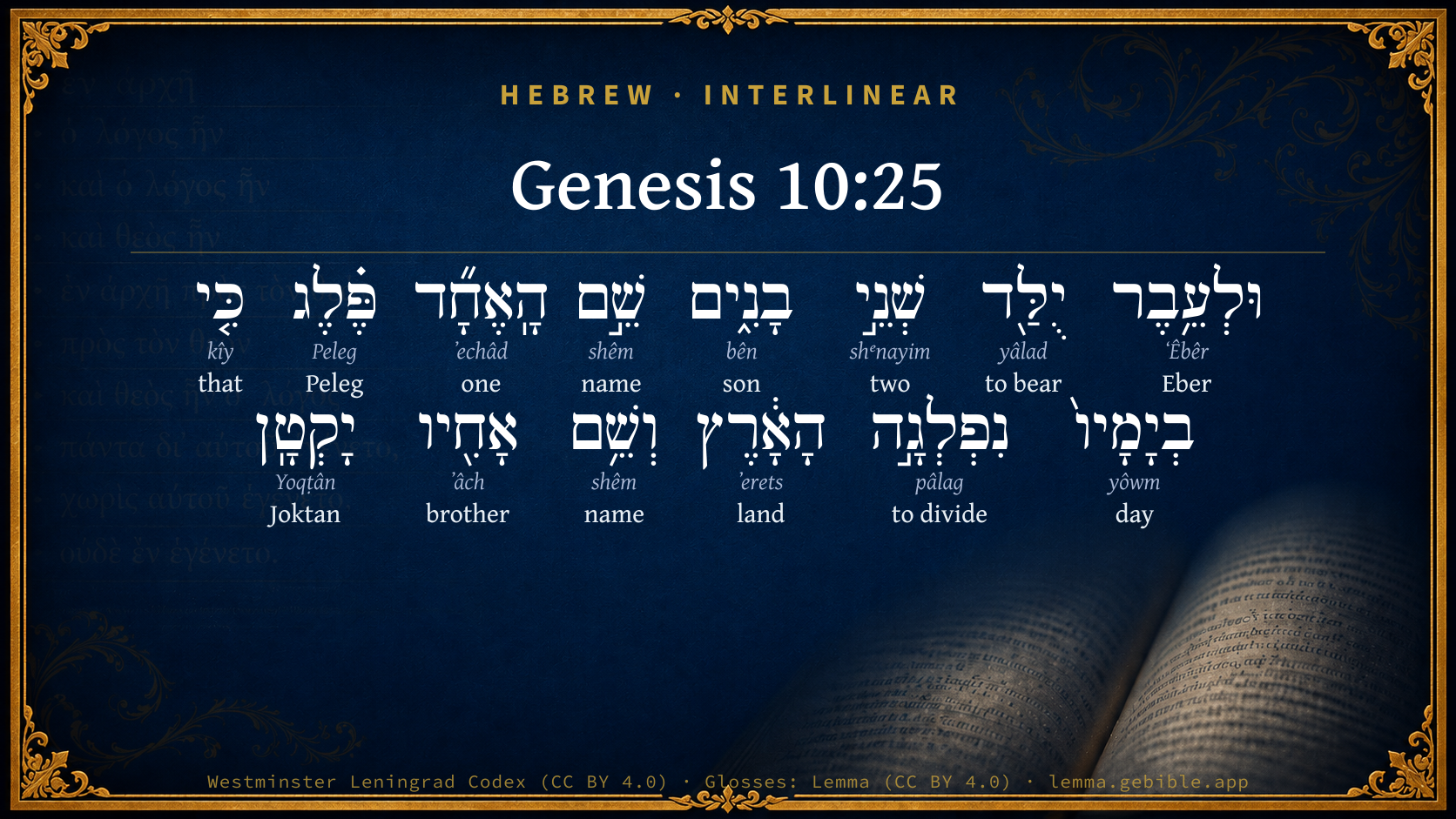
Hebrew (Westminster Leningrad Codex) Genesis 10:25 appears in the Hebrew Old Testament. The text above is from the Westminster Leningrad Codex. Each word links to its Strong’s number, a concise gloss, and parsing drawn from the Open Scriptures Hebrew Bible morphology. Click any word for its full Brown-Driver-Briggs (BDB) entry.
Download image
Cite this verse

Genesis 10:25 (World English Bible). Public Domain. Lemma interlinear Bible study tool, https://lemma.gebible.app/v/genesis/10/25.

Show BibTeX & RIS
BibTeX
RIS
English Translation
To Eber were born two sons. The name of the one was Peleg, for in his days was the earth divided. His brother's name was Joktan.
World English Bible · Public Domain
Highlights
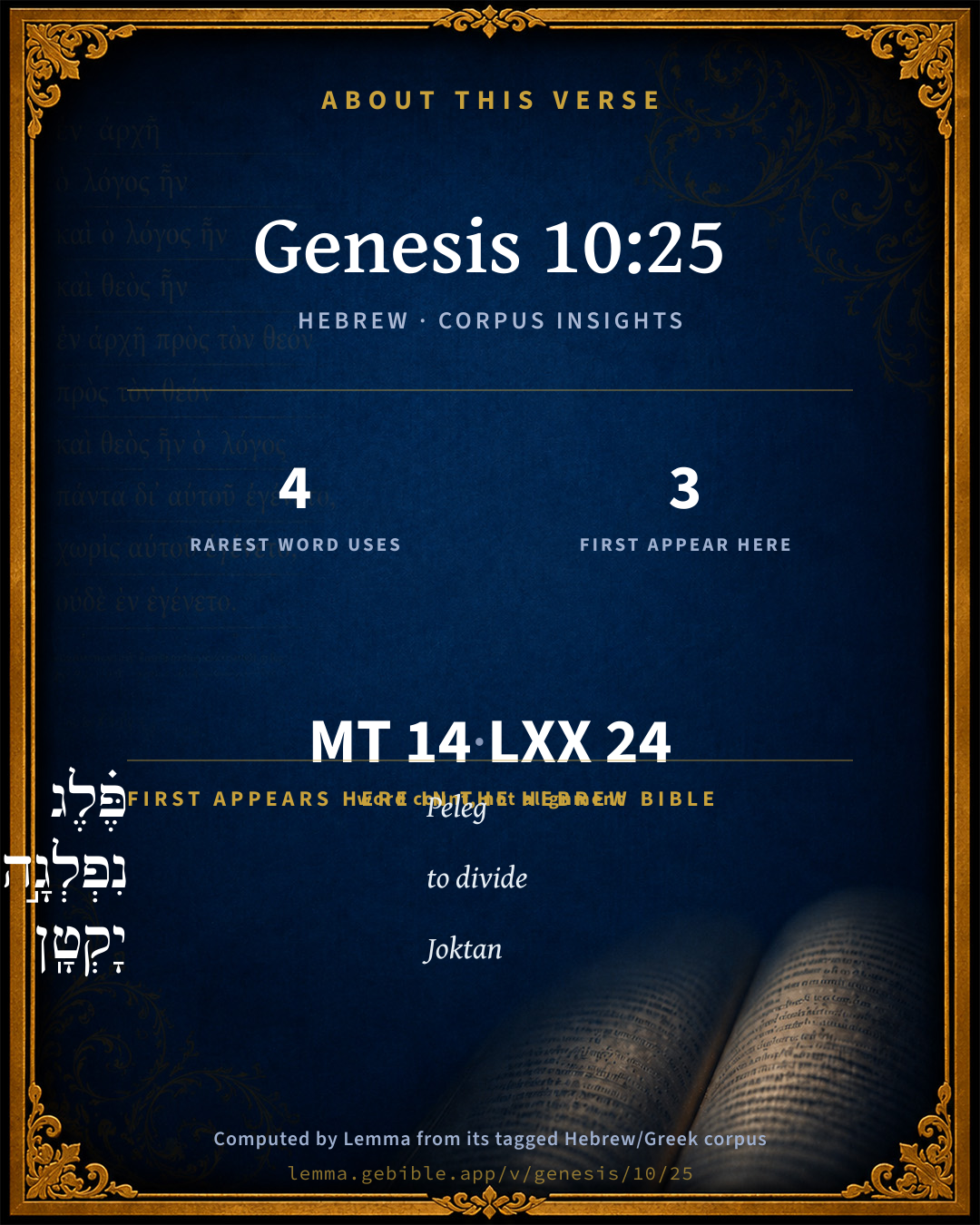
  • 3 first appearances in the Hebrew Bible
Full analysis ↓
Download a study sheet

One document with this verse’s original text, its word-by-word gloss line, the meaning frame, cross-references with their text, attributed commentary, and full source and license credits — printable, and it pastes into notes with its structure intact.

This verse Autodidact and up

Study sheet (.html) Plain text (.txt)

A passage Seminary Student

Up to 50 verses in one chapter. A passage sheet keeps up to 6 commentary sources and 12 cross-references per verse, in the order this page ranks them, and says so on the sheet whenever that leaves anything out. Ask for a single verse and you get the Autodidact verse sheet above.

Everything on this page stays free to read, with no account — the sheet is a download of what is already on screen, not access to it.

Want to remove ads? Support Godless Engineer
Compare translations 3

The same verse in 3 English versions, stacked beneath the original-language interlinear above. Click any original word for its lexicon entry.

Each is an independent rendering of the whole verse — the interlinear is not word-aligned to these translations.

Highlighted words mark where these versions differ — a whole-verse word diff, not a word-by-word alignment.

  • World English Bible Public Domain
    To Eber were born two sons. The name of the one was Peleg, for in his days was the earth divided. His brother's name was Joktan.
  • King James Version Public Domain
    And unto Eber were born two sons: the name of one was Peleg; for in his days was the earth divided; and his brother's name was Joktan.
  • unfoldingWord Literal Text CC BY-SA 4.0
    Then two sons were born to Eber. The name of the one Peleg, because in his days the earth was divided. And the name of his brother Joktan.

unfoldingWord Literal Text — © unfoldingWord, licensed CC BY-SA 4.0. Word-aligned USFM3 via Door43 (git.door43.org/unfoldingWord/en_ult).

Versions to compare (up to 4)

3 of 4 selected

Show all 18 translations

Every available English version of this verse, each an independent rendering of the whole verse.

  • World English Bible Public Domain
    To Eber were born two sons. The name of the one was Peleg, for in his days was the earth divided. His brother's name was Joktan.
  • Berean Standard Bible Public Domain
    Two sons were born to Eber: One was named Peleg, because in his days the earth was divided, and his brother was named Joktan.
  • Majority Standard Bible Public Domain
    Two sons were born to Eber: One was named Peleg, because in his days the earth was divided, and his brother was named Joktan.
  • King James Version Public Domain
    And unto Eber were born two sons: the name of one was Peleg; for in his days was the earth divided; and his brother's name was Joktan.
  • American Standard Version (1901) Public Domain
    And unto Eber were born two sons: The name of the one was Peleg. For in his days was the earth divided. And his brother's name was Joktan.
  • Revised Version (1885) Public Domain
    And unto Eber were born two sons: the name of the one was Peleg; for in his days was the earth divided; and his brother’s name was Joktan.
  • Geneva Bible (1599) Public Domain
    Vnto Eber also were borne two sonnes: the name of the one was Peleg: for in his dayes was the earth diuided: and his brothers name was Ioktan.
  • Douay-Rheims (1899) Public Domain
    And to Heber were born two sons: the name of the one was Phaleg, because in his days the earth was divided: and his brother's name Jectan.
  • Young's Literal Translation Public Domain
    And to Eber have two sons been born; the name of the one `is' Peleg (for in his days hath the earth been divided,) and his brother's name `is' Joktan.
  • Literal Standard Version CC BY-SA 4.0
    And two sons have been born to Eber; the name of the first [is] Peleg (for in his days the earth has been divided), and his brother’s name [is] Joktan.
  • Unlocked Literal Bible CC BY-SA 4.0
    Eber had two sons. The name of the one was Peleg, for in his days the earth was divided. His brother's name was Joktan.
  • unfoldingWord Literal Text CC BY-SA 4.0
    Then two sons were born to Eber. The name of the one Peleg, because in his days the earth was divided. And the name of his brother Joktan.
  • Darby Bible Public Domain
    And to Eber were born two sons: the name of the one was Peleg, for in his days was the earth divided; and his brother's name was Joktan.
  • World Messianic Bible Public Domain
    To Eber were born two sons. The name of the one was Peleg, for in his days the earth was divided. His brother’s name was Joktan.
  • Webster's Bible Public Domain
    And to Eber were born two sons: the name of one was Peleg, for in his days was the earth divided; and his brother's name was Joktan.
  • Free Bible Version CC BY-SA 4.0
    Eber had two sons. One was named Peleg, because in his time the earth was divided; the name of his brother was Joktan.
  • Bible in Basic English Public Domain
    And Eber had two sons: the name of the one was Peleg, because in his time the peoples of the earth became separate; and his brother's name was Joktan.
  • JPS Tanakh (1917) Public Domain
    And unto Eber were born two sons; the name of the one was Peleg; for in his days was the earth divided; and his brother's name was Joktan.

Literal Standard Version (2020), Covenant Press — licensed CC BY-SA 4.0. Text via the HelloAO Bible API (eBible.org). Unlocked Literal Bible (unfoldingWord) — licensed CC BY-SA 4.0. Text via the HelloAO Bible API (eBible.org). unfoldingWord Literal Text — © unfoldingWord, licensed CC BY-SA 4.0. Word-aligned USFM3 via Door43 (git.door43.org/unfoldingWord/en_ult). Free Bible Version, Dr. Jonathan Gallagher — licensed CC BY-SA 4.0. Text via the HelloAO Bible API (eBible.org).

Word by word

More ways to search: Search by grammar → Find every occurrence → Compare this word →

Practice this passage: Drill this verse → Learn its vocabulary →

נִפְלְגָ֣ה
pâlag
H6385
“to divide”
Verb, Niphal, Perfect, 3rd Person, Feminine, Singular
Part of Speech
Verb
Stem
Niphal
Form
Perfect
Person
3rd Person
Gender
Feminine
Number
Singular
Full BDB Definition

Origin: a primitive root

TWOT: 1769

to divide, split - (Niphal) to be split, be divided - (Piel) - to split, cleave - to divide
  1. וּלְעֵ֥בֶר ʻÊbêr H5677 “and · to/for · Eber” Conjunction + Preposition + Noun, Proper
  2. יֻלַּ֖ד yâlad H3205 “to bear” Verb, Pual, Perfect, 3rd Person, Masculine, Singular
  3. שְׁנֵ֣י shᵉnayim H8147 “two” Adjective, Cardinal number, Masculine, Dual, Construct
  4. בָנִ֑ים bên H1121 “sons” Noun, Common, Masculine, Plural, Absolute
  5. שֵׁ֣ם shêm H8034 “name of” Noun, Common, Masculine, Singular, Construct
  6. הָֽאֶחָ֞ד ʼechâd H259 “the · one” Particle, Definite Article + Adjective, Cardinal number, Masculine, Singular, Absolute
  7. פֶּ֗לֶג Peleg H6389 “Peleg” Noun, Proper
  8. כִּ֤י kîy H3588 “that” Conjunction
  9. בְיָמָיו֙ yôwm H3117 “in/at · days · his” Preposition + Noun, Common, Masculine, Plural, Construct + Suffix, Personal, 3rd Person, Masculine, Singular
  10. הָאָ֔רֶץ ʼerets H776 “the · land” Particle, Definite Article + Noun, Common, Both, Singular, Absolute
  11. וְשֵׁ֥ם shêm H8034 “and · name of” Conjunction + Noun, Common, Masculine, Singular, Construct
  12. אָחִ֖יו ʼâch H251 “brother · his” Noun, Common, Masculine, Singular, Construct + Suffix, Personal, 3rd Person, Masculine, Singular
  13. יָקְטָֽן Yoqṭân H3355 “Joktan” Noun, Proper

About this verse

These counts appear in no published source. They are computed here, from the morphology-tagged text and Lemma’s own curated glosses. What Lemma adds →

14
words
13
distinct lemmas
Pentateuch
section

Notable vocabulary

The rarest word here is נִפְלְגָ֣ה to divide H6385 — appearing just 4 times in the whole Hebrew Bible.

First appearance in Scripture

These words make their first canonical appearance in the Hebrew Bible here:

  • פֶּ֗לֶג Peleg H6389
  • נִפְלְגָ֣ה to divide H6385
  • יָקְטָֽן Joktan H3355

Shared distinctive vocabulary

נִפְלְגָ֣ה to divide H6385 occurs in 4 verses of the Hebrew Bible. Also found in:

Grammatical profile

  • 2 verbs
  • 9 nouns
  • 2 adjectives
  • 1 conjunction

Verb forms

  • יֻלַּ֖ד Pual · Perfect
  • נִפְלְגָ֣ה Niphal · Perfect

Repetition

A word recurs within this verse — often emphatic in Hebrew:

  • שֵׁ֣ם name H8034 ×2

Hebrew & Septuagint length

In English translation the verse runs 26 words from the Hebrew and 28 from the Septuagint (LXX English) — closely comparable.

A rough comparison of the two English renderings, which tokenize alike — not a word-level alignment.

Word counts can differ between the Hebrew and the Greek without any difference in meaning — e.g. the Hebrew direct-object marker אֵת has no separate Greek word, and Greek often adds the article ὁ.

In the original languages it is 14 Hebrew tokens and 24 Greek tokens — but the two are counted differently (Hebrew bundles its prefixes and suffixes into one token; the Greek is in lemma form), so that isn’t a like-for-like length.

Cross-references

7

Topical passages linked to Genesis 10:25 in the Treasury of Scripture Knowledge — connected by theme and wording, ordered by reader-vote popularity; previews shown in the World English Bible.

  • 1 Chronicles 1:19 To Eber were born two sons: the name of the one was Peleg; for in his days the earth was divided; and his brother's name was Joktan.
  • Genesis 10:32 These are the families of the sons of Noah, after their generations, in their nations. Of these were the nations divided in the earth after the flood.
  • Deuteronomy 32:8 When the Most High gave to the nations their inheritance, When he separated the children of men, He set the bounds of the peoples According to the number of the children of Israel.
  • Luke 3:35–36 the son of Serug, the son of Reu, the son of Peleg, the son of Eber, the son of Shelah
  • Acts 17:26 He made from one blood every nation of men to dwell on all the surface of the earth, having determined appointed seasons, and the boundaries of their dwellings,
  • Genesis 11:16–19 Eber lived thirty-four years, and became the father of Peleg.
  • Genesis 10:21 To Shem, the father of all the children of Eber, the elder brother of Japheth, to him also were children born.

Cross-references courtesy of OpenBible.info (CC BY 4.0).

Hebrew and Greek witnesses Masoretic Hebrew ↔ Greek Septuagint

The same verse in the two great witnesses to the Old Testament, shown verse-for-verse.

These are two independent witnesses, not word-aligned to each other, and the Septuagint is shown in lemma (dictionary) form.

Hebrew Genesis 10:25 Masoretic · Westminster Leningrad Codex

וּלְעֵ֥בֶר יֻלַּ֖ד שְׁנֵ֣י בָנִ֑ים שֵׁ֣ם הָֽאֶחָ֞ד פֶּ֗לֶג כִּ֤י בְיָמָיו֙ נִפְלְגָ֣ה הָאָ֔רֶץ וְשֵׁ֥ם אָחִ֖יו יָקְטָֽן

To Eber were born two sons. The name of the one was Peleg, for in his days was the earth divided. His brother's name was Joktan.

World English Bible · Public Domain

Greek LXX Genesis 10:25 Septuagint · lemma form

καί ὁ εβερ γίγνομαι δύο υἱός ὄνομα ὁ εἷς φαλεκ ὅτι ἐν ὁ ἡμέρα αὐτός διαμερίζω ὁ γῆ καί ὄνομα ὁ ἀδελφός αὐτός ιεκταν

And to Heber were born two sons, the name of the one, Phaleg, because in his days the earth was divided, and the name of his brother Jektan.

LXX2012 (modern English Septuagint) · Public Domain

On this verse, The Cambridge Bible for Schools and Colleges discusses the Septuagint’s reading. Read the note in Commentary ↓

Hebrew: Westminster Leningrad Codex (CC BY 4.0). Greek: Septuagint (public domain); English from LXX2012 (modern English Septuagint) (Public Domain). How the Septuagint differs from the Hebrew →

Targum (Aramaic paraphrase)

2

The Targum is the ancient Jewish Aramaic paraphrase of the Hebrew Scriptures — an interpretive translation, not the Hebrew text itself. Onkelos (literal) and Pseudo-Jonathan (expansive) render the Torah, and Jonathan the Prophets. Coverage is partial: where no permissively-licensed English translation exists for a verse, only the Aramaic is shown. This is verse-level text, not a word-by-word alignment to the Hebrew.

  1. Targum Onkelos Torah (Genesis–Deuteronomy)
    וּלְעֵבֶר אִתְיְלִידוּ תְּרֵין בְּנִין שׁוּם חַד פֶּלֶג אֲרֵי בְּיוֹמוֹהִי אִתְפְּלִיגַת אַרְעָא וְשׁוּם אֲחוּהִי יָקְטָן

    And to Eber were born two sons: the name of the one was Peleg: because in his day the earth was divided. And the name of his brother was Yoktan.

    Targum Onkelos — Aramaic: “Onkelos Genesis” (public domain); “Onkelos Exodus” (public domain); “Onkelos Leviticus” (public domain); “Onkelos Numbers” (public domain); “Onkelos Deuteronomy” (public domain). English: “Sefaria Community Translation” (CC0 1.0 (public-domain dedication)); “J.W. Etheridge. The Targums of Onkelos and Jonathan Ben Uzziel on the Pentateuch. London: Longmans, Green, 1862” (public domain). Text via Sefaria.

  2. Targum Pseudo-Jonathan Torah (Genesis–Deuteronomy)
    וּלְעֵבֶר אִיתְיְלִידוּ תְּרֵין בְּנִין שׁוּם חַד פֶּלֶג אַרוּם בְּיוֹמוֹי אִתְפְּלִיגַת אַרְעָא וְשׁוּם אָחוֹי יָקְטָן

    And to Eber were born two sons: the name of the one was Peleg, because in his days the earth was divided; and the name of the other Joktan.

    Targum Pseudo-Jonathan — Aramaic: “Targum Jonathan on Genesis” (public domain); “Targum Jonathan on Exodus” (public domain); “Targum Jonathan on Leviticus” (public domain); “Targum Jonathan on Numbers” (public domain); “Targum Jonathan on Deuteronomy” (public domain). English: “The Targum of Jonathan ben Uzziel, trans. J. W. Etheridge, London, 1862” (public domain). Text via Sefaria.

Commentary

Notes on Genesis 10:25 from classic Christian and Jewish commentators (each source and its license shown beneath its notes). The classic Christian expositions comment on the surrounding passage and are grouped to its opening verse, so a note may address several verses; the Jewish commentaries on the Tanakh (Rashi and others) are per-verse, so they appear only where the commentator wrote on this verse.

Lemma curates 59 commentaries, every one of them public domain or Creative Commons licensed, each selected and text-cleaned for this edition rather than reprinted as found. About our sources →

Trapp's Complete Commentary

John Trapp

Gen 10:25 And unto Eber were born two sons: the name of one [was] Peleg; for in his days was the earth divided; and his brother’s name [was] Joktan.

Ver. 25. Peleg, for in his days was the earth divided.] Eber, of whom came the Hebrews or Israelites, {Exo 1:15} that he might have before his eyes a perpetual monument of God’s just displeasure against the ambitious Babel builders, calls his son Peleg, or Division, because in his days was the earth divided. It is good to write the remembrance of God’s worthy works, whether of mercy or justice, upon the names of our children, or otherwise as we can best, to put us in mind of them; for we need all help; such is either our dulness or forgetfulness. What was it else that made David so often to put the thorn to his breast? {Psa 103:1-3} And why would God have the plates of the censers of those sinners against their own souls, to be a covering to the altar, but to be a memorial to the children of Israel, that no stranger come near to offer incense, that he be not as Korah and his company, &c.? {Num 16:38; Num 16:40}

John Trapp, A Commentary or Exposition upon All the Books of the Old and New Testament (1647–1656) — public domain. Text from a community e-Sword module.

Joseph Benson's Commentary

Gen 10:25. In his days the earth was divided — That is, about the time of his birth it was divided among those that were to inhabit it, either when Noah made an orderly distribution of it among his descendants, as Joshua divided the land of Canaan by lot; or when, upon their refusal to comply with that division, God, in justice, divided them by the confusion of tongues.

Joseph Benson's Commentary on the Old and New Testaments (1811–1818) — public domain. Text from a community e-Sword module.

Tyndale Open Study Notes

Tyndale Open Resources

10:25 Peleg means division, anticipating the separation of people into language groups after Babel (11:1-9). Peleg’s line led to Abram (see 11:16-26). • Joktan was the ancestor of the southern Arabian tribes. The Ishmaelite tribes were in northern Arabia (see 25:13-16).

Tyndale Open Study Notes — © Tyndale Open Resources, licensed CC BY-SA 4.0. Text via the HelloAO Bible API.

Geneva Bible (1599)

Geneva Bible translators

This division came by the diversity of languages, as appeareth, Gen. 11:9.

Geneva Bible (1599) marginal notes — public domain. Text via Bolls.life.

Jamieson, Fausset & Brown

Robert Jamieson, A. R. Fausset & David Brown

Peleg; for in his days was the earth divided--After the flood (Gen 11:10-16) the descendants of Noah settled at pleasure and enjoyed the produce of the undivided soil. But according to divine instruction, made probably through Eber, who seems to have been distinguished for piety or a prophetic character, the earth was divided and his son's name, "Peleg," was given in memory of that event (see Deu 32:8; Act 17:26).

Jamieson, Fausset & Brown — Commentary Critical and Explanatory on the Whole Bible (1871) — public domain (CC PDM 1.0). Text via the HelloAO Bible API.

Adam Clarke's Commentary

Verse 25. Peleg] From פלג palag, to divide, because in his days, which is supposed to be about one hundred years after the flood, the earth was divided among the sons of Noah. Though some are of opinion that a physical division, and not a political one, is what is intended here, viz., a separation of continents and islands from the main land; the earthy parts having been united into one great continent previously to the days of Peleg. This opinion appears to me the most likely, for what is said, Ge 10:5, is spoken by way of anticipation.

Adam Clarke's Commentary on the Bible (1810–1826) — public domain. Text from a community e-Sword/MySword module.

Ellicott's Commentary for English Readers

(25) Peleg; for in his days was the earth divided.—This may refer to the breaking up of the race of Shem into separate nations, which severally occupied a distinct region; and so, while Joktan took Arabia, and in course of time expelled the Hamites from that country, Asshur, Aram, and Peleg occupied the regions on the north and north-west. But as Peleg, according to the Tôldôth Shem, was born only 101 years after the flood, Noah’s family could scarcely have multiplied in so short a time to as many as 500 people; and Mr. Cyril Graham considers that the name refers to “the first cutting of some of those canals which are found in such numbers between the Tigris and the Euphrates.” This is made more probable by the fact that Peleg in Hebrew means water-course.

A Bible Commentary for English Readers, edited by Charles John Ellicott (1878–1897) — public domain. Text from a community e-Sword module.

The Cambridge Bible for Schools and Colleges

gen. ed. J. J. S. Perowne

25. Peleg] R.V. marg. That is, Division. His descendants are not recorded. In Gen_11:18-23 (P) Peleg is the father of Reu, the father of Serug, the father of Nahor. Eber’s two sons, Peleg and Joktan, apparently represent the two divisions of Shemites, Peleg the northern or Mesopotamian, Joktan the southern or Arabian.

was the earth divided] The reference is generally assumed to be to the division, or dispersion, of the peoples at the tower of Babel, the words being an anticipation of the story in Gen_11:1-9. “The earth” will then mean “the inhabitants of the earth,” as in Gen_11:1 and Gen_19:31.

Sayce, on the strength of palgu being Assyrian for “canal,” would conjecture “the division of the earth” to signify the introduction of a system of canals into Babylonia during the reign of Hammurabi.

Perhaps, however, the name Peleg may indicate the historic “severance” of the northern Shemites from their southern brethren.

Joktan] The genealogy of Eber’s elder son, Peleg, is here omitted, evidently because the compiler is giving the descendants of Peleg in Gen_11:18 from P; in which passage Joktan’s name is not mentioned.

The thirteen sons of Joktan probably represent tribes in Arabia. The division of the population into tribes, continually warring with each other, has always been a feature of the Arabian Peninsula.

Dillmann suggests that one name has been interpolated; and that, as in the case of Israel, the number of tribes was originally twelve. Obal’s name is omitted in some MSS. of LXX.

Most of their names have been, with more or less reason, identified with places in Arabia, for details of which the student should consult the dictionaries.

Sheleph] The name of a tribe, or region, in the Yemen, or southern Arabia.

The Cambridge Bible for Schools and Colleges (gen. ed. J. J. S. Perowne; Cambridge University Press, 1878–1918) — public domain. Text from a community e-Sword module.

John Gill's Exposition

And unto Eber were born two sons: the name of one was Peleg,.... Bochart (k) thinks, that either Peleg, or one of his posterity, in memory of him, gave the name of Phalga to a town situated on the Euphrates; though the reason of the name, as given by Arrianus, as he himself observes, was because it divided between the two Seleucias, as the reason of Peleg's name was:

for in his days was the earth divided; among the three sons of Noah, and their respective posterities; their language was divided, and that obliged them to divide and separate in bodies which understood one another; hence that age, in which was this event, was usually called by the Jews the age of division; whether this was done about the time of his birth, and so this name was given him to perpetuate the memory of it, or in some after part of his life, and so was given by a spirit of prophecy, is a question: Josephus, Jarchi, and the Jewish writers, generally go the latter way; if it was at the time of his birth, which is the sense of many, then this affair happened in the one hundred and first year after the flood, for in that year Peleg was born, as appears from Gen 11:11.

and his brother's name was Joktan, whom the Arabs call Cahtan, and claim him as their parent, at least, of their principal tribes; and say he was the first that reigned in Yaman, and put a diadem on his head (l); and there is a city in the territory of Mecca, about seven furlongs or a mile to the south of it, and one station from the Red sea, called Baisath Jektan, the seat of Jektan (m), which manifestly retains his name; and there are a people called Catanitae, placed by Ptolemy (n) in Arabia Felix.

(k) Phaleg. l. 2. c. 14. col. 93. (l) Vid. Pocock. Specimen. Arab. Hist. p. 39. 55. (m) Arab. Geograph. apud Bochart. Phaleg: l. 2. c. 15. col. 98. (n) Geograph, l. 6. c. 7.

John Gill's Exposition of the Whole Bible (1746–1763) — public domain (CC PDM 1.0). Text via the HelloAO Bible API.

Matthew Poole's English Annotations

In his days; either,

1. In the time of his birth, whence he was so called. Or,

2. Afterwards in the time of life. So his father gave him this name by the Spirit of prophecy, foreseeing this great event, and the time of it; this being no unusual thing in Scripture, as we shall hereafter see, to give prophetical names to children. And thus there is a longer and more convenient space left for the peopling of the world, and ripening of things for the general dispersion and habitation of the earth.

The earth was divided, first in language, and then in habitations.

Matthew Poole's English Annotations on the Holy Bible (1683–1685) — public domain. Text from a community e-Sword/MySword module.

Whedon's Commentary on the Bible

Daniel D. Whedon

25. Peleg — Division, relating, it is generally thought, to the division of tongues which the narrator immediately proceeds to describe in the next chapter, but Knobel makes it refer to the division in the family of Eber between the brothers Peleg and Joktan. He presents reasons for the view which seem to have weight. It is doubtful if the matter can be decisively settled, but we follow the current opinion. Smith’s Dictionary follows Knobel.

His brother’s name was Joktan — Called in the Arabian genealogies Kahtan, the ancestor of thirteen tribes in South Arabia. The name signifies Little. Niebuhr mentions a town and province Kahtan. Some of these thirteen names following are still found in Arabia, others have become extinct, and others are not as yet identified.

Daniel D. Whedon (gen. ed.), Commentary on the Old and New Testaments (1874–1909) — public domain. Text from a community e-Sword module.

The Pulpit Commentary

And unto Eber were born two sons: the name of one was Peleg. Division," from palg, to divide; cf. pelagov and pela gus, a division of the sea. For in his days was the earth divided. At the confusion of tongues (Bochart, Rosenm Keil, Lange, Murphy); at an earlier separation of the earth"s population (Delitzsch), of which there is no record or trace. And his brother"s name was Joktan. Father of the Arabians, by whom he is called Kachtan.

Peleg, or the division of the people.

I WHEN IT TOOK PLACE. In the fourth generation after the Flood.

II How IT WAS EFFECTED.

1. By the Divine interposition.

2. By the confusion of tongues.

III FOR WHAT IT WAS DESIGNED.

1. To punish sin.

2. To separate the Church.

3. To occupy the earth.

IV BY WHAT IT WAS REMEMBERED. The naming of Eber"s son. Learn

1. To read well the signs of the times.

2. To understand well the cause of God"s judgments.

3. To remember well the gift of God"s mercies. W.

The Pulpit Commentary (1880–1919), ed. H.D.M. Spence-Jones & Joseph S. Exell — public domain. Text from a community e-Sword module.

Keil & Delitzsch

C. F. Keil & F. Delitzsch

Among the descendants of Arphaxad, Eber's eldest son received the name of Peleg, because in his days the earth, i.e., the population of the earth, was divided, in consequence of the building of the tower of Babel (Gen 11:8). His brother Joktan is called Kachtan by the Arabians, and is regarded as the father of all the primitive tribes of Arabia. The names of his sons are given in Gen 10:26-29. There are thirteen of them, some of which are still retained in places and districts of Arabia, whilst others are not yet discovered, or are entirely extinct. Nothing certain has been ascertained about Almodad, Jerah, Diklah, Obal, Abimael, and Jobab. Of the rest, Sheleph is identical with Salif or Sulaf (in Ptl. 6, 7, Σαλαπηνοί), an old Arabian tribe, also a district of Yemen. Hazarmaveth (i.e., forecourt of death) is the Arabian Hadhramaut in South-eastern Arabia on the Indian Ocean, whose name Jauhari is derived from the unhealthiness of the climate. Hadoram: the Ἀδραμῖται of Ptol. 6, 7, Atramitae of Plin. 6, 28, on the southern coast of Arabia. Uzal: one of the most important towns of Yemen, south-west of Mareb. Sheba: the Sabaeans, with the capital Saba or Mareb, Mariaba regia (Plin.), whose connection with the Cushite (Gen 10:7) and Abrahamite Sabaeans (Gen 25:3) is quite in obscurity. Ophir has not yet been discovered in Arabia; it is probably to be sought on the Persian Gulf, even if the Ophir of Solomon was not situated there. Havilah appears to answer to Chaulaw of Edrisi, a district between Sanaa and Mecca. But this district, which lies in the heart of Yemen, does not fit the account in Sa1 15:7, nor the statement in Gen 25:18, that Havilah formed the boundary of the territory of the Ishmaelites. These two passages point rather to Χαυλοταῖοι, a place on the border of Arabia Petraea towards Yemen, between the Nabataeans and Hagrites, which Strabo describes as habitable.

Keil & Delitzsch — Biblical Commentary on the Old Testament (1861–1891) — public domain (CC PDM 1.0). Text via the HelloAO Bible API. (Old Testament only.)

Rashi

Rabbi Shlomo Yitzchaki (Rashi)

נפלגה [THE EARTH] WAS DIVIDED — The languages became confounded and they (the peoples) were scattered abroad from the plain of Shinar, and were dispersed throughout the whole world. We may learn from this that Eber was a prophet, for he gave his son the name פלג, “division” after an event which was to happen in the future (Genesis Rabbah 37:7). For we learn in Seder Olam that it was during the last of his days that they were dispersed abroad. For if you argue that this happened early in his life (and that therefore he was not anticipating the future in so naming his son, but that the name referred to an event that had already happened), behold, his brother Joktan was younger than he and he had begotten many families previous to the dispersion, as it is said (10:26) “And Joktan begot etc.” and only afterwards is it stated “And the whole earth was etc.” (with reference to the dispersion). If, on the other hand, you argue that the dispersal happened in the middle period of his life, then I reply that the verse surely does not intend to refer to the time when the dispersion took place in an indefinite manner, but to state quite definitely when it was. Hence you may learn that it was in the year of Peleg’s death that they were dispersed.

יקטן JOKTAN — He was so called (“the little one”) because he was so humble and thought little (ומקטין) of himself; therefore he merited the privilege of rearing all these families (Genesis Rabbah 37:7).

Rashi on the Tanakh — English translations: “The Judaica Press complete Tanach with Rashi, translated by A. J. Rosenberg” (CC BY 4.0); “Pentateuch with Rashi's commentary by M. Rosenbaum and A.M. Silbermann, 1929-1934” (public domain); “The Metsudah Tanach series, Lakewood, N.J” (CC BY 4.0); and “The Book of Joshua, Metsudah Publications, 1997” (CC BY 4.0). Text via Sefaria.

Sforno

Rabbi Ovadia Sforno

For in his days the earth was dispersed. Eiver named his son in anticipation of the dispersion (palaga) so that later generations would realize why their life expectancy was drastically reduced from Peleg’s time onward. It was in fact a consequence of the dispersion, since rapid changes of climate have a deleterious affect on human health.

Sforno on the Tanakh — English translation: “Yalkut, Sifsei Chachomim Chumash, Metsudah Publications, 2009” (CC BY 4.0). Text via Sefaria.

Radak

Rabbi David Kimhi (Radak)

ולעבר יולד שני בנים, here too the Torah wrote the singular mode yulad, was born, instead of “were born,” as it referred to the general subject of providing progeny, just as in verse 21. We find a parallel construction with Joseph, in Genesis 41,50 וליוסף יולד שני בנים. This does not mean that the people mentioned did not have more than the two sons mentioned, seeing that the Torah specifically mentions (11,15) ויולד בנים ובנות, “he fathered sons and daughters.” The names of the two sons whose births were mentioned here must be understood as being linked to some important experience in the life of their father, who commemorated the event by the way he named these sons.

שם האחד פלג, the Torah immediately supplies the reason for this strange-sounding name, i.e. hardly a good omen, by writing that the split in the unity of mankind when the languages were confused occurred during his lifetime.

ושם אחיו יקטן. In this instance the Torah does not reveal the reason why Ever called his second son Yokton. Our sages surmise that the reason may have been that starting with Yokton, the average lifespan of people became drastically reduced. (Torah Shleymah 59 on our verse) Whereas Ever himself still lived for 464 years, his son Peleg died at 239 years. Not only did he live only a little more than half the number of years his father had enjoyed on earth, but he died while his father was still alive. The names of Ever’s sons are reminders therefore of both the splitting up of a unified mankind into different languages, followed by differing cultures, and into the shorter lifespan which became the order of the day. Apparently, Ever had been aware of this already at the time his sons were born. Clearly, Yokton, even as a baby had been so much smaller than babies had been before his time, that his father had had a premonition that he would not be able to live that long. We had mentioned earlier that the generations that had lived such long lives had also been blessed with much bigger bodies than was the case during subsequent generations. (compare 5,4 and 6,4) According to the view expressed in Seder Olam, and quoted by Rashi, Ever had been a great prophet, equipped with holy spirit, so that he must have predicted all this long before Yokton had been born, seeing that according to the sequence in which matters are reported in our chapter the Tower was built several generations after Yokton had been born already.

Radak on the Tanakh — English translations: “Sefaria Community Translation” (CC0 1.0 (public-domain dedication)); “Eliyahu Munk, HaChut Hameshulash” (CC BY 4.0); “Rabbi Mike Feuer, Jerusalem Anthology” (CC BY 4.0); and “R. David Kimhi on the first book of Psalms, Translated by R.G. Finch, London, 1919” (public domain). Text via Sefaria.

Lesson kit

Teaching starters — assembled from the data on this page, not authored interpretation. Every prompt links to the verse data it draws on. Edit before teaching.

Genesis, in the Pentateuch, opens this verse with 14 words (13 distinct Hebrew lemmas). Its most distinctive word is pâlag (“to divide”). A historical commentator’s framing appears above. Read the whole chapter for the surrounding context.

Discussion questions

  1. The word pâlag carries the sense “to divide.” How does it shape the verse?
  2. 3 words here appear for the first time in Scripture. What is being introduced at this debut?
  3. 1 Chronicles 1:19 shares the word «to divide» with this verse. How do the two illuminate each other?
  4. “name” occurs 2× in this one verse. What is the effect of the repetition?
  5. These translations render this verse differently. What is at stake in choosing one wording over another?
  6. The verb «יֻלַּ֖ד» is Pual Perfect. How does its form color the action?
  7. Reading how Trapp's Complete Commentary and Joseph Benson's Commentary read this verse, where do the two commentators agree and where do they part?

Things to notice

Reading settings

Reading text

Shown beneath each verse's original-language words.

Old Testament
Old Testament edition

Read the OT as the Masoretic Hebrew (MT) or the Greek Septuagint (LXX).

English shown for the Greek Septuagint (in the Hebrew ↔ Greek comparison).

Comparing translations? Open the Compare panel on any verse page to stack up to four side by side.