Genesis 29:35

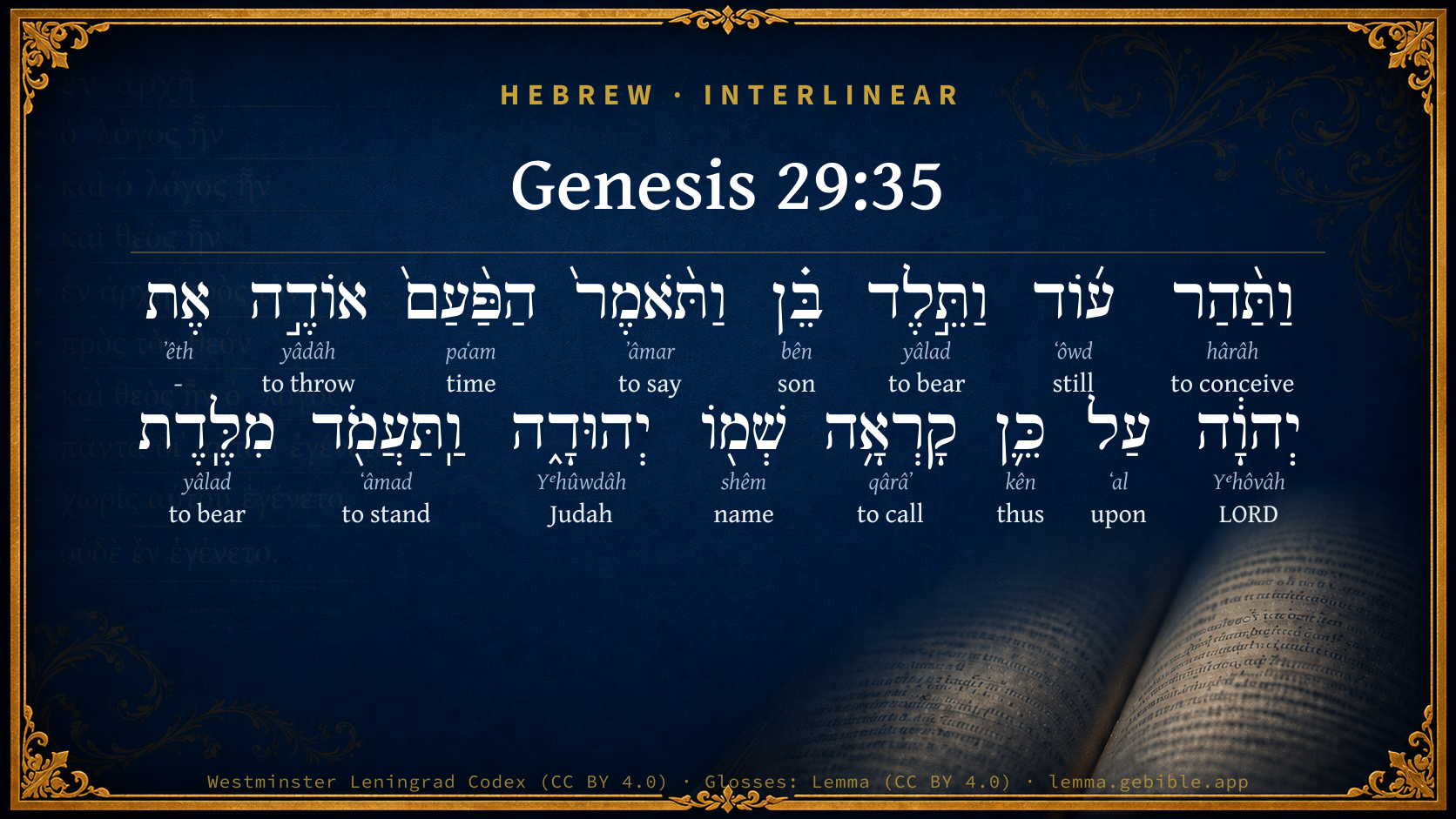
Hebrew (Westminster Leningrad Codex) Genesis 29:35 appears in the Hebrew Old Testament. The text above is from the Westminster Leningrad Codex. Each word links to its Strong’s number, a concise gloss, and parsing drawn from the Open Scriptures Hebrew Bible morphology. Click any word for its full Brown-Driver-Briggs (BDB) entry.
Download image
Cite this verse

Genesis 29:35 (World English Bible). Public Domain. Lemma interlinear Bible study tool, https://lemma.gebible.app/v/genesis/29/35.

Show BibTeX & RIS
BibTeX
RIS
English Translation
She conceived again, and bare a son. She said, "This time will I praise Yahweh." Therefore she named him Judah. Then she stopped bearing.
World English Bible · Public Domain
Highlights
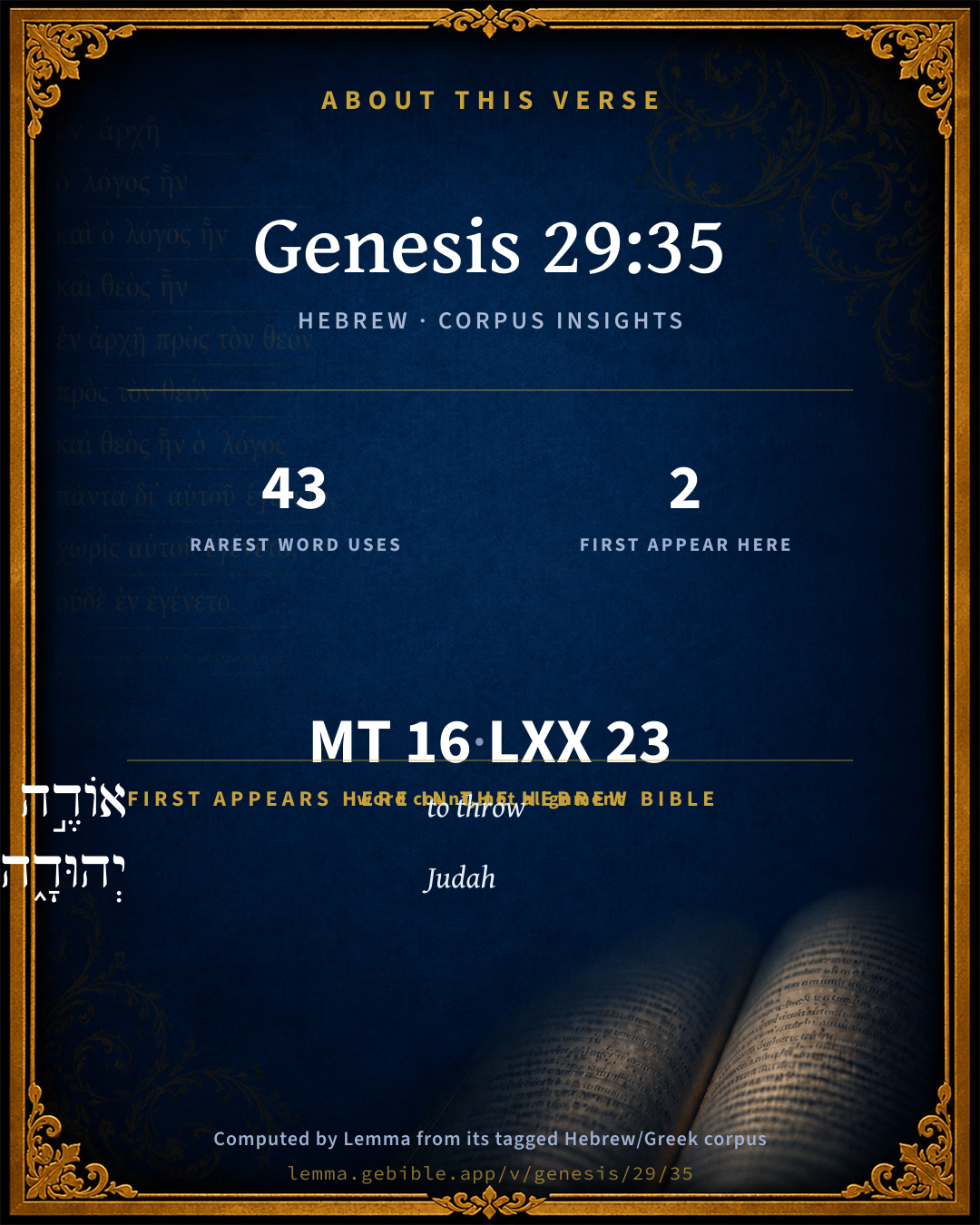
  • 2 first appearances in the Hebrew Bible
Full analysis ↓
Download a study sheet

One document with this verse’s original text, its word-by-word gloss line, the meaning frame, cross-references with their text, attributed commentary, and full source and license credits — printable, and it pastes into notes with its structure intact.

This verse Autodidact and up

Study sheet (.html) Plain text (.txt)

A passage Seminary Student

Up to 50 verses in one chapter. A passage sheet keeps up to 6 commentary sources and 12 cross-references per verse, in the order this page ranks them, and says so on the sheet whenever that leaves anything out. Ask for a single verse and you get the Autodidact verse sheet above.

Everything on this page stays free to read, with no account — the sheet is a download of what is already on screen, not access to it.

Want to remove ads? Support Godless Engineer
Compare translations 3

The same verse in 3 English versions, stacked beneath the original-language interlinear above. Click any original word for its lexicon entry.

Each is an independent rendering of the whole verse — the interlinear is not word-aligned to these translations.

Highlighted words mark where these versions differ — a whole-verse word diff, not a word-by-word alignment.

  • World English Bible Public Domain
    She conceived again, and bare a son. She said, "This time will I praise Yahweh." Therefore she named him Judah. Then she stopped bearing.
  • King James Version Public Domain
    And she conceived again, and bare a son: and she said, Now will I praise the LORD: therefore she called his name Judah; and left bearing.
  • unfoldingWord Literal Text CC BY-SA 4.0
    Then she conceived again and bore a son, and she said, “This time I will praise Yahweh.” For that she called his name Judah. Then she stopped bearing.

unfoldingWord Literal Text — © unfoldingWord, licensed CC BY-SA 4.0. Word-aligned USFM3 via Door43 (git.door43.org/unfoldingWord/en_ult).

Versions to compare (up to 4)

3 of 4 selected

Show all 18 translations

Every available English version of this verse, each an independent rendering of the whole verse.

  • World English Bible Public Domain
    She conceived again, and bare a son. She said, "This time will I praise Yahweh." Therefore she named him Judah. Then she stopped bearing.
  • Berean Standard Bible Public Domain
    And once more she conceived and gave birth to a son and said, “This time I will praise the LORD.” So she named him Judah. Then Leah stopped having children.
  • Majority Standard Bible Public Domain
    And once more she conceived and gave birth to a son and said, “This time I will praise the LORD.” So she named him Judah. Then Leah stopped having children.
  • King James Version Public Domain
    And she conceived again, and bare a son: and she said, Now will I praise the LORD: therefore she called his name Judah; and left bearing.
  • American Standard Version (1901) Public Domain
    And she conceived again, and bare a son. And she said, This time will I praise Jehovah. Therefore she called his name Judah. And she left off bearing.
  • Revised Version (1885) Public Domain
    And she conceived again, and bare a son: and she said, This time will I praise the LORD: therefore she called his name Judah; and she left bearing.
  • Geneva Bible (1599) Public Domain
    Moreouer shee conceiued againe and bare a sonne, saying, Nowe will I prayse the Lord: therefore shee called his name Iudah, and left bearing.
  • Douay-Rheims (1899) Public Domain
    The fourth time she conceived and bore a son, and said: now will I praise the Lord: and for this she called him Juda. And she left bearing.
  • Young's Literal Translation Public Domain
    And she conceiveth again, and beareth a son, and saith this time, `I praise Jehovah;' therefore hath she called his name Judah; and she ceaseth from bearing.
  • Literal Standard Version CC BY-SA 4.0
    And she conceives again and bears a son, and this time says, “I praise YHWH”; therefore has she called his name Judah; and she ceases from bearing.
  • Unlocked Literal Bible CC BY-SA 4.0
    She conceived again and bore a son. She said, “This time I will praise Yahweh.” Therefore she called his name Judah; then she stopped having children.
  • unfoldingWord Literal Text CC BY-SA 4.0
    Then she conceived again and bore a son, and she said, “This time I will praise Yahweh.” For that she called his name Judah. Then she stopped bearing.
  • Darby Bible Public Domain
    And she again conceived, and bore a son, and said, This time will I praise Jehovah; therefore she called his name Judah. And she ceased to bear.
  • World Messianic Bible Public Domain
    She conceived again, and bore a son. She said, “This time I will praise the LORD.” Therefore she named him Judah. Then she stopped bearing.
  • Webster's Bible Public Domain
    And she conceived again, and bore a son: and she said, Now will I praise the LORD: therefore she called his name Judah, and left bearing.
  • Free Bible Version CC BY-SA 4.0
    Once again Leah became pregnant and had another son. She named him Judah, for she said, “Now I can really praise the Lord!” After that she had no more children.
  • Bible in Basic English Public Domain
    And she was with child again, and gave birth to a son: and she said, This time I will give praise to the Lord: so he was named Judah; after this she had no more children for a time.
  • JPS Tanakh (1917) Public Domain
    And she conceived again, and bore a son; and she said: 'This time will I praise the LORD.' Therefore she called his name Judah; and she left off bearing.

Literal Standard Version (2020), Covenant Press — licensed CC BY-SA 4.0. Text via the HelloAO Bible API (eBible.org). Unlocked Literal Bible (unfoldingWord) — licensed CC BY-SA 4.0. Text via the HelloAO Bible API (eBible.org). unfoldingWord Literal Text — © unfoldingWord, licensed CC BY-SA 4.0. Word-aligned USFM3 via Door43 (git.door43.org/unfoldingWord/en_ult). Free Bible Version, Dr. Jonathan Gallagher — licensed CC BY-SA 4.0. Text via the HelloAO Bible API (eBible.org).

Word by word

More ways to search: Search by grammar → Find every occurrence → Compare this word →

Practice this passage: Drill this verse → Learn its vocabulary →

וַתַּ֨הַר
hârâh
H2029
“and · to conceive”
Conjunction + Verb, Qal, Sequential Imperfect, 3rd Person, Feminine, Singular
Part of Speech
Conjunction + Verb
Stem
Qal
Form
Sequential Imperfect
Person
3rd Person
Gender
Feminine
Number
Singular
Full BDB Definition

Origin: a primitive root

TWOT: 515

to conceive, become pregnant, bear, be with child, be conceived, progenitor - (Qal) to conceive, become pregnant - (Pual) to be conceived - (Poel) to conceive, contrive, devise
  1. ע֜וֹד ʻôwd H5750 “still” Adverb
  2. וַתֵּ֣לֶד yâlad H3205 “and · to bear” Conjunction + Verb, Qal, Sequential Imperfect, 3rd Person, Feminine, Singular
  3. בֵּ֗ן bên H1121 “son” Noun, Common, Masculine, Singular, Absolute
  4. וַתֹּ֨אמֶר֙ ʼâmar H559 “and · to say” Conjunction + Verb, Qal, Sequential Imperfect, 3rd Person, Feminine, Singular
  5. הַפַּ֨עַם֙ paʻam H6471 “the · time” Particle, Definite Article + Noun, Common, Feminine, Singular, Absolute
  6. אוֹדֶ֣ה yâdâh H3034 “to throw” Verb, Hiphil, Imperfect, 1st Person, Common, Singular
  7. אֶת ʼêth H853 “-” Particle, Direct Object
  8. יְהוָ֔ה Yᵉhôvâh H3068 “LORD” Noun, Proper
  9. עַל ʻal H5921 “upon” Preposition
  10. כֵּ֛ן kên H3651 “thus” Particle, Demonstrative
  11. קָרְאָ֥ה qârâʼ H7121 “to call” Verb, Qal, Perfect, 3rd Person, Feminine, Singular
  12. שְׁמ֖וֹ shêm H8034 “name · his” Noun, Common, Masculine, Singular, Construct + Suffix, Personal, 3rd Person, Masculine, Singular
  13. יְהוּדָ֑ה Yᵉhûwdâh H3063 “Judah” Noun, Proper
  14. וַֽתַּעֲמֹ֖ד ʻâmad H5975 “and · to stand” Conjunction + Verb, Qal, Sequential Imperfect, 3rd Person, Feminine, Singular
  15. מִלֶּֽדֶת yâlad H3205 “from · to bear” Preposition + Verb, Qal, Infinitive Construct

About this verse

These counts appear in no published source. They are computed here, from the morphology-tagged text and Lemma’s own curated glosses. What Lemma adds →

16
words
15
distinct lemmas
Pentateuch
section

First appearance in Scripture

These words make their first canonical appearance in the Hebrew Bible here:

  • אוֹדֶ֣ה to throw H3034
  • יְהוּדָ֑ה Judah H3063

Shared distinctive vocabulary

וַתַּ֨הַר to conceive H2029 occurs in 42 verses of the Hebrew Bible. Also found in:

Grammatical profile

  • 7 verbs
  • 5 nouns
  • 1 preposition
  • 1 adverb
  • 2 particles

Verb forms

  • וַתַּ֨הַר Qal · Sequential Imperfect
  • וַתֵּ֣לֶד Qal · Sequential Imperfect
  • וַתֹּ֨אמֶר֙ Qal · Sequential Imperfect
  • אוֹדֶ֣ה Hiphil · Imperfect
  • קָרְאָ֥ה Qal · Perfect
  • וַֽתַּעֲמֹ֖ד Qal · Sequential Imperfect
  • מִלֶּֽדֶת Qal · Infinitive Construct

Repetition

A word recurs within this verse — often emphatic in Hebrew:

  • וַתֵּ֣לֶד to bear H3205 ×2

Hebrew & Septuagint length

In English translation the verse runs 24 words from the Hebrew and 32 from the Septuagint (LXX English) — closely comparable.

A rough comparison of the two English renderings, which tokenize alike — not a word-level alignment.

Word counts can differ between the Hebrew and the Greek without any difference in meaning — e.g. the Hebrew direct-object marker אֵת has no separate Greek word, and Greek often adds the article ὁ.

In the original languages it is 16 Hebrew tokens and 23 Greek tokens — but the two are counted differently (Hebrew bundles its prefixes and suffixes into one token; the Greek is in lemma form), so that isn’t a like-for-like length.

Cross-references

9

Topical passages linked to Genesis 29:35 in the Treasury of Scripture Knowledge — connected by theme and wording, ordered by reader-vote popularity; previews shown in the World English Bible.

  • Genesis 49:8–12 "Judah, your brothers will praise you: Your hand will be on the neck of your enemies; Your father's sons will bow down before you.
  • 1 Chronicles 5:2 For Judah prevailed above his brothers, and of him came the prince; but the birthright was Joseph's:)
  • Matthew 1:2 Abraham became the father of Isaac. Isaac became the father of Jacob. Jacob became the father of Judah and his brothers.
  • Genesis 35:26 The sons of Zilpah (Leah's handmaid): Gad and Asher. These are the sons of Jacob, who were born to him in Paddan Aram.
  • Deuteronomy 33:7 This is [the blessing] of Judah: and he said, Hear, Yahweh, the voice of Judah, Bring him in to his people. With his hands he contended for himself; You shall be a help against his adversaries.
  • Genesis 38:1–30 It happened at that time, that Judah went down from his brothers, and visited a certain Adullamite, whose name was Hirah.
  • Genesis 43:8–9 Judah said to Israel, his father, "Send the boy with me, and we will arise and go, so that we may live, and not die, both we, and you, and also our little ones.
  • Genesis 44:18–34 Then Judah came near to him, and said, "Oh, my lord, please let your servant speak a word in my lord's ears, and don't let your anger burn against your servant; for you are even as Pharaoh.
  • Genesis 46:12 The sons of Judah: Er, Onan, Shelah, Perez, and Zerah; but Er and Onan died in the land of Canaan. The sons of Perez were Hezron and Hamul.

Cross-references courtesy of OpenBible.info (CC BY 4.0).

Hebrew and Greek witnesses Masoretic Hebrew ↔ Greek Septuagint

The same verse in the two great witnesses to the Old Testament, shown verse-for-verse.

These are two independent witnesses, not word-aligned to each other, and the Septuagint is shown in lemma (dictionary) form.

Hebrew Genesis 29:35 Masoretic · Westminster Leningrad Codex

וַתַּ֨הַר ע֜וֹד וַתֵּ֣לֶד בֵּ֗ן וַתֹּ֨אמֶר֙ הַפַּ֨עַם֙ אוֹדֶ֣ה אֶת יְהוָ֔ה עַל כֵּ֛ן קָרְאָ֥ה שְׁמ֖וֹ יְהוּדָ֑ה וַֽתַּעֲמֹ֖ד מִלֶּֽדֶת

She conceived again, and bare a son. She said, "This time will I praise Yahweh." Therefore she named him Judah. Then she stopped bearing.

World English Bible · Public Domain

Greek LXX Genesis 29:35 Septuagint · lemma form

καί συνλαμβάνω ἔτι τίκτω υἱός καί εἶπον νῦν ἔτι οὗτος ἐκὁμολογέω κύριος διά οὗτος καλέω ὁ ὄνομα αὐτός ιουδα καί ἵστημι ὁ τίκτω

And having conceived yet again, she bore a son, and said, Now yet again this time will I give thanks to the Lord; therefore she called his name, Juda; and ceased bearing.

LXX2012 (modern English Septuagint) · Public Domain

Hebrew: Westminster Leningrad Codex (CC BY 4.0). Greek: Septuagint (public domain); English from LXX2012 (modern English Septuagint) (Public Domain). How the Septuagint differs from the Hebrew →

Targum (Aramaic paraphrase)

2

The Targum is the ancient Jewish Aramaic paraphrase of the Hebrew Scriptures — an interpretive translation, not the Hebrew text itself. Onkelos (literal) and Pseudo-Jonathan (expansive) render the Torah, and Jonathan the Prophets. Coverage is partial: where no permissively-licensed English translation exists for a verse, only the Aramaic is shown. This is verse-level text, not a word-by-word alignment to the Hebrew.

  1. Targum Onkelos Torah (Genesis–Deuteronomy)
    וְעַדִּיאַת עוֹד וִילִידַת בָּר וַאֲמֶרֶת הָדָא זִמְנָא אוֹדֶה קֳדָם יְיָ עַל כֵּן קְרַת שְׁמֵהּ יְהוּדָה וְקָמַת מִלְּמֵילַד

    (no public-domain English translation for this verse)

    Targum Onkelos — Aramaic: “Onkelos Genesis” (public domain); “Onkelos Exodus” (public domain); “Onkelos Leviticus” (public domain); “Onkelos Numbers” (public domain); “Onkelos Deuteronomy” (public domain). English: “Sefaria Community Translation” (CC0 1.0 (public-domain dedication)); “J.W. Etheridge. The Targums of Onkelos and Jonathan Ben Uzziel on the Pentateuch. London: Longmans, Green, 1862” (public domain). Text via Sefaria.

  2. Targum Pseudo-Jonathan Torah (Genesis–Deuteronomy)
    וְאִתְעַבָּרַת תּוּב וִילֵידַת בַּר וַאֲמָרַת הָדָא זִמְנָא אוֹדֵי קֳדָם יְיָ דְמִן בְּרִי דֵין עָתִיד לְמֵיפַּק מַלְכִין וּמִינֵיהּ יִפּוֹק דָוִד מַלְכָּא דְעָתִיד לְאוֹדוּיֵי קֳדָם יְיָ בְּגִין כֵּן קְרָת שְׁמֵיהּ יְהוּדָה וְקָמַת מִלְמֵילַד

    And she conceived again, and bare a son, and said, This time will I give praise before the Lord; for from this my son kings shall come forth, and from him shall spring David the king, who shall offer praise before the Lord; therefore she called his name Jehudah. And she ceased to bear.

    Targum Pseudo-Jonathan — Aramaic: “Targum Jonathan on Genesis” (public domain); “Targum Jonathan on Exodus” (public domain); “Targum Jonathan on Leviticus” (public domain); “Targum Jonathan on Numbers” (public domain); “Targum Jonathan on Deuteronomy” (public domain). English: “The Targum of Jonathan ben Uzziel, trans. J. W. Etheridge, London, 1862” (public domain). Text via Sefaria.

Commentary

Notes on Genesis 29:35 from classic Christian and Jewish commentators (each source and its license shown beneath its notes). The classic Christian expositions comment on the surrounding passage and are grouped to its opening verse, so a note may address several verses; the Jewish commentaries on the Tanakh (Rashi and others) are per-verse, so they appear only where the commentator wrote on this verse.

Lemma curates 59 commentaries, every one of them public domain or Creative Commons licensed, each selected and text-cleaned for this edition rather than reprinted as found. About our sources →

Trapp's Complete Commentary

John Trapp

Gen 29:35 And she conceived again, and bare a son: and she said, Now will I praise the LORD: therefore she called his name Judah; and left bearing.

Ver. 35. Now will I praise the Lord.] So she had done before, at the birth of her other children: but now she would do it anew, upon the receipt of a new mercy: according to that, "Sing unto the Lord a new song." {Isa 42:10} A good woman she seems to have been; and the better, because not so well beloved of her husband; which she could not but see to be just upon her, for her consenting (with her father) to the sin of deceiving Jacob. Gen 30:1

John Trapp, A Commentary or Exposition upon All the Books of the Old and New Testament (1647–1656) — public domain. Text from a community e-Sword module.

Tyndale Open Study Notes

Tyndale Open Resources

29:35 Leah reconciled herself to the reality that nothing would turn Jacob’s affections toward her. She named her fourth son Judah with the sentiment, “I will praise the Lord.” She seems to have given up on Jacob, taking her consolation from the Lord.

Tyndale Open Study Notes — © Tyndale Open Resources, licensed CC BY-SA 4.0. Text via the HelloAO Bible API.

Geneva Bible (1599)

Geneva Bible translators

Or, confess.

Hebrew, stood from bearing.

Geneva Bible (1599) marginal notes — public domain. Text via Bolls.life.

Adam Clarke's Commentary

Verse 35. She called his name Judah] יהודה yehudah, a confessor; one who acknowledges God, and acknowledges that all good comes from his hands, and gives him the praise due to his grace and mercy. From this patriarch the Jews have their name, and could it be now rightly applied to them, it would intimate that they were a people that confess God, acknowledge his bounty, and praise him for his grace.

Left bearing.] That is, for a time; for she had several children afterwards. Literally translated, the original תעמד מלדת taamod milledeth - she stood still from bearing, certainly does not convey the same meaning as that in our translation; the one appearing to signify that she ceased entirely from having children; the other, that she only desisted for a time, which was probably occasioned by a temporary suspension of Jacob's company, who appears to have deserted the tent of Leah through the jealous management of Rachel.

The intelligent and pious care of the original inhabitants of the world to call their children by those names which were descriptive of some remarkable event in providence, circumstance of their birth, or domestic occurrence, is worthy, not only of respect, but of imitation. As the name itself continually called to the mind, both of the parents and the child, the circumstance from which it originated, it could not fail to be a lasting blessing to both. How widely different is our custom! Unthinking and ungodly, we impose names upon our offspring as we do upon our cattle; and often the dog, the horse, the monkey, and the parrot, share in common with our children the names which are called Christian! Some of our Christian names, so called, are absurd, others are ridiculous, and a third class impious; these last being taken from the demon gods and goddesses of heathenism. May we hope that the rational and pious custom recommended in the Scriptures shall ever be restored, even among those who profess to believe in, fear, and love God!

Adam Clarke's Commentary on the Bible (1810–1826) — public domain. Text from a community e-Sword/MySword module.

The Cambridge Bible for Schools and Colleges

gen. ed. J. J. S. Perowne

35. praise] From the Heb. hôdah.

Judah] Heb. Jehudah. This is the regular form of the name in the O.T. The origin of the name is uncertain; but its sound resembles that of the word for “praise.” On Judah, see notes on chap. 38 and Gen_49:8-12.

The Cambridge Bible for Schools and Colleges (gen. ed. J. J. S. Perowne; Cambridge University Press, 1878–1918) — public domain. Text from a community e-Sword module.

Haydock's Catholic Bible Commentary

Juda, "praise or confession." (Calmet) --- Left bearing for a time. (Haydock) --- In the imposition of these names, Lia testified her gratitude to God. (Tirinus)

George Leo Haydock (1774–1849), Haydock's Catholic Family Bible and Commentary, 1859 edition — public domain. Excludes Psalms (Douay-Rheims chapter numbering differs from Protestant) and Deuterocanonical books (Catholic canon only).

Matthew Poole's English Annotations

Now will I praise the Lord more solemnly and continually; for otherwise she did praise and acknowledge God for the former mercies. cir. 1749

Matthew Poole's English Annotations on the Holy Bible (1683–1685) — public domain. Text from a community e-Sword/MySword module.

Whedon's Commentary on the Bible

Daniel D. Whedon

35. Judah — Which means, one to be praised. Compare Gen_49:8. Thus, in naming these first four sons, Leah breathes the spirit of a pure and noble longing, which fitted her to be the mother of the chosen tribe from which the Christ should spring.

Daniel D. Whedon (gen. ed.), Commentary on the Old and New Testaments (1874–1909) — public domain. Text from a community e-Sword module.

The Pulpit Commentary

And she conceived again, and bare a son (possibly in the fourth year of marriage, and in Jacob"s eighty-eighth year of age, he having been seventy-seven when he arrived in Haran, and eighty-four when he was united to Laban"s daughters): and she said, Now will I praise the Lord. Well she might; for this was the ancestor of the promised seed (Murphy). There cannot be a doubt that her excellence of character as well as eminence of piety eventually wrought a change upon her husband. (vide Gen_31:4, 14 49:31) Therefore she called his name Judah (i.e. Praise); and left bearing. Literally, stood still, i.e. ceased, from bearing. Not altogether; (Gen_30:16) only for a time, "that she might not be unduly lifted up by her good fortune, or attribute to the fruitfulness of her own womb what the faithfulness of Jehovah, the covenant God, had bestowed upon her" (Keil.).

The Pulpit Commentary (1880–1919), ed. H.D.M. Spence-Jones & Joseph S. Exell — public domain. Text from a community e-Sword module.

unfoldingWord translationNotes

Door43 World Missions Community

She conceived again

"Leah became pregnant again"

bore a son

"gave birth to a son"

she called his name Judah

Translators may also add a footnote that says "The name Judah means 'praise.'" (See: How to Translate Names)

translationWords

praise

Yahweh

Judah

unfoldingWord translationNotes — © Distant Shores Media and the Door43 World Missions Community, licensed CC BY-SA 4.0. Source: git.door43.org/Door43/en_tn.

Rashi

Rabbi Shlomo Yitzchaki (Rashi)

הפעם אודה NOW WILL I PRAISE [THE LORD] — because I have assumed more than my share, from now on I should praise God (Genesis Rabbah 71:4).

Rashi on the Tanakh — English translations: “The Judaica Press complete Tanach with Rashi, translated by A. J. Rosenberg” (CC BY 4.0); “Pentateuch with Rashi's commentary by M. Rosenbaum and A.M. Silbermann, 1929-1934” (public domain); “The Metsudah Tanach series, Lakewood, N.J” (CC BY 4.0); and “The Book of Joshua, Metsudah Publications, 1997” (CC BY 4.0). Text via Sefaria.

Radak

Rabbi David Kimhi (Radak)

'ותהר... אודה את ה, I can only continue to thank the Lord and to praise Him, Who has granted me more than I have requested from Him.

ותעמוד מלדת, at this time she stopped conceiving. This was also due to intervention by G’d, Who wanted the servant maids to also have children for Yaakov.

Radak on the Tanakh — English translations: “Sefaria Community Translation” (CC0 1.0 (public-domain dedication)); “Eliyahu Munk, HaChut Hameshulash” (CC BY 4.0); “Rabbi Mike Feuer, Jerusalem Anthology” (CC BY 4.0); and “R. David Kimhi on the first book of Psalms, Translated by R.G. Finch, London, 1919” (public domain). Text via Sefaria.

Ibn Ezra

Rabbi Abraham ibn Ezra

This time I will praise. After having borne four sons. Because Leah was content with this number, she stopped giving birth.

Ibn Ezra on the Tanakh — English translations: “Sefaria Community Translation” (CC0 1.0 (public-domain dedication)); “Yalkut, Sifsei Chachomim Chumash, Metsudah Publications, 2009” (CC BY 4.0); and “Commentary of Ibn Ezra on Isaiah - trans. by M. Friedlander, 1873” (public domain). Text via Sefaria.

Lesson kit

Teaching starters — assembled from the data on this page, not authored interpretation. Every prompt links to the verse data it draws on. Edit before teaching.

Genesis, in the Pentateuch, opens this verse with 16 words (15 distinct Hebrew lemmas). Its most distinctive word is hârâh (“to conceive”). A historical commentator’s framing appears above. Read the whole chapter for the surrounding context.

Discussion questions

  1. What does “to conceive” (hârâh) contribute to the verse as a whole?
  2. 2 words make their first appearance in Scripture here. What does this debut establish?
  3. How does Genesis 4:1, which shares the word «to conceive», read alongside this verse?
  4. What does the repetition of “to bear” (2× in this one verse) do in this verse?
  5. These translations render this verse differently. What is at stake in choosing one wording over another?
  6. «וַתַּ֨הַר» is a Qal Sequential Imperfect verb. How does that grammatical form shape the action described?
  7. Compare how Trapp's Complete Commentary and Tyndale Open Study Notes read this verse. Where do they agree or differ?

Things to notice

Reading settings

Reading text

Shown beneath each verse's original-language words.

Old Testament
Old Testament edition

Read the OT as the Masoretic Hebrew (MT) or the Greek Septuagint (LXX).

English shown for the Greek Septuagint (in the Hebrew ↔ Greek comparison).

Comparing translations? Open the Compare panel on any verse page to stack up to four side by side.