
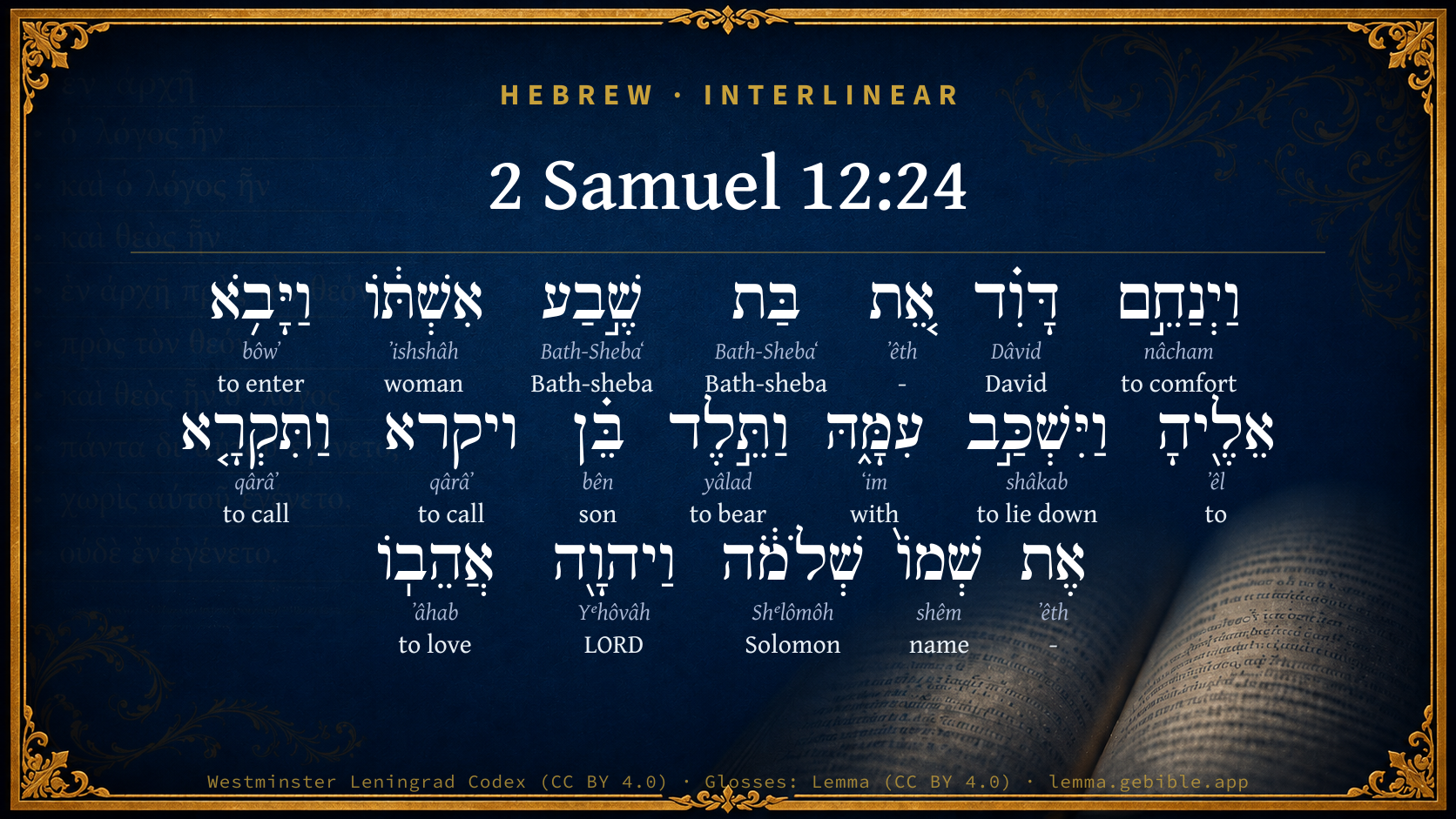
2 Samuel 12:24

Hebrew (Westminster Leningrad Codex) 2 Samuel 12:24 appears in the Hebrew Old Testament. The text above is from the Westminster Leningrad Codex. Each word links to its Strong’s number, a concise gloss, and parsing drawn from the Open Scriptures Hebrew Bible morphology. Click any word for its full Brown-Driver-Briggs (BDB) entry.
Download image
Cite this verse

2 Samuel 12:24 (World English Bible). Public Domain. Lemma interlinear Bible study tool, https://lemma.gebible.app/v/2-samuel/12/24.

Show BibTeX & RIS
BibTeX
RIS
English Translation
David comforted Bathsheba his wife, and went in to her, and lay with her: and she bore a son, and he called his name Solomon. Yahweh loved him;
World English Bible · Public Domain
Download a study sheet

One document with this verse’s original text, its word-by-word gloss line, the meaning frame, cross-references with their text, attributed commentary, and full source and license credits — printable, and it pastes into notes with its structure intact.

This verse Autodidact and up

Study sheet (.html) Plain text (.txt)

A passage Seminary Student

Up to 50 verses in one chapter. A passage sheet keeps up to 6 commentary sources and 12 cross-references per verse, in the order this page ranks them, and says so on the sheet whenever that leaves anything out. Ask for a single verse and you get the Autodidact verse sheet above.

Everything on this page stays free to read, with no account — the sheet is a download of what is already on screen, not access to it.

Want to remove ads? Support Godless Engineer
Compare translations 3

The same verse in 3 English versions, stacked beneath the original-language interlinear above. Click any original word for its lexicon entry.

Each is an independent rendering of the whole verse — the interlinear is not word-aligned to these translations.

Highlighted words mark where these versions differ — a whole-verse word diff, not a word-by-word alignment.

  • World English Bible Public Domain
    David comforted Bathsheba his wife, and went in to her, and lay with her: and she bore a son, and he called his name Solomon. Yahweh loved him;
  • King James Version Public Domain
    And David comforted Bathsheba his wife, and went in unto her, and lay with her: and she bare a son, and he called his name Solomon: and the LORD loved him.
  • unfoldingWord Literal Text CC BY-SA 4.0
    And David consoled Bathsheba his wife, and he came to her and lay with her. And she bore a son, and he called his name Solomon. And Yahweh loved him.

unfoldingWord Literal Text — © unfoldingWord, licensed CC BY-SA 4.0. Word-aligned USFM3 via Door43 (git.door43.org/unfoldingWord/en_ult).

Versions to compare (up to 4)

3 of 4 selected

Show all 18 translations

Every available English version of this verse, each an independent rendering of the whole verse.

  • World English Bible Public Domain
    David comforted Bathsheba his wife, and went in to her, and lay with her: and she bore a son, and he called his name Solomon. Yahweh loved him;
  • Berean Standard Bible Public Domain
    Then David comforted his wife Bathsheba, and he went to her and lay with her. So she gave birth to a son, and they named him Solomon. Now the LORD loved the child
  • Majority Standard Bible Public Domain
    Then David comforted his wife Bathsheba, and he went to her and lay with her. So she gave birth to a son, and they named him Solomon. Now the LORD loved the child
  • King James Version Public Domain
    And David comforted Bathsheba his wife, and went in unto her, and lay with her: and she bare a son, and he called his name Solomon: and the LORD loved him.
  • American Standard Version (1901) Public Domain
    And David comforted Bath-sheba his wife, and went in unto her, and lay with her: and she bare a son, and he called his name Solomon. And Jehovah loved him;
  • Revised Version (1885) Public Domain
    And David comforted Bath-sheba his wife, and went in unto her, and lay with her: and she bare a son, and he called his name Solomon. And the LORD loved him;
  • Geneva Bible (1599) Public Domain
    And Dauid comforted Bath-sheba his wife, and went in vnto her, and lay with her, and she bare a sonne, and he called his name Salomon: also the Lord loued him.
  • Douay-Rheims (1899) Public Domain
    And David comforted Bethsabee his wife, and went in unto her, and slept with her: I and she bore a son, and he called his name Solomon, and the Lord loved him.
  • Young's Literal Translation Public Domain
    And David comforteth Bath-Sheba his wife, and goeth in unto her, and lieth with her, and she beareth a son, and he calleth his name Solomon; and Jehovah hath loved him,
  • Literal Standard Version CC BY-SA 4.0
    And David comforts his wife Bathsheba, and goes in to her, and lies with her, and she bears a son, and he calls his name Solomon; and YHWH has loved him,
  • Unlocked Literal Bible CC BY-SA 4.0
    David comforted Bathsheba his wife, and went in to her, and slept with her. Later she gave birth to a son, and the child was named Solomon. Yahweh loved him
  • unfoldingWord Literal Text CC BY-SA 4.0
    And David consoled Bathsheba his wife, and he came to her and lay with her. And she bore a son, and he called his name Solomon. And Yahweh loved him.
  • Darby Bible Public Domain
    And David comforted Bathsheba his wife, and went in to her and lay with her; and she bore a son, and he called his name Solomon; and Jehovah loved him.
  • World Messianic Bible Public Domain
    David comforted Bathsheba his wife, and went in to her, and lay with her. She bore a son, and he called his name Solomon. The LORD loved him;
  • Webster's Bible Public Domain
    And David comforted Bath-sheba his wife, and went in to her, and lay with her: and she bore a son, and he called his name Solomon: and the LORD loved him.
  • Free Bible Version CC BY-SA 4.0
    David consoled his wife Bathsheba, and he made love to her. She gave birth to a son, and named him Solomon. The Lord loved the child,
  • Bible in Basic English Public Domain
    And David gave comfort to his wife Bath-sheba, and he went in to her and had connection with her: and she had a son to whom she gave the name Solomon. And he was dear to the Lord.
  • JPS Tanakh (1917) Public Domain
    And David comforted Bath-sheba his wife, and went in unto her, and lay with her; and she bore a son, and called his name Solomon. And the LORD loved him;

Literal Standard Version (2020), Covenant Press — licensed CC BY-SA 4.0. Text via the HelloAO Bible API (eBible.org). Unlocked Literal Bible (unfoldingWord) — licensed CC BY-SA 4.0. Text via the HelloAO Bible API (eBible.org). unfoldingWord Literal Text — © unfoldingWord, licensed CC BY-SA 4.0. Word-aligned USFM3 via Door43 (git.door43.org/unfoldingWord/en_ult). Free Bible Version, Dr. Jonathan Gallagher — licensed CC BY-SA 4.0. Text via the HelloAO Bible API (eBible.org).

Word by word

More ways to search: Search by grammar → Find every occurrence → Compare this word →

Practice this passage: Drill this verse → Learn its vocabulary →

בַּת
Bath-Shebaʻ
H1339
“Bath-sheba”
Noun, Proper
Part of Speech
Noun
Type
Proper
Full BDB Definition

Origin: from H1323 and H7651 (in the sense of H7650 )

TWOT: None

Bath-sheba = "daughter of an oath" - the wife of Uriah whom David had murdered, having had adulterous relations with her; subsequently wife of David and mother of Solomon, Shimea, Shobab, and Nathan
  1. וַיְנַחֵ֣ם nâcham H5162 “and · to comfort” Conjunction + Verb, Piel, Sequential Imperfect, 3rd Person, Masculine, Singular
  2. דָּוִ֗ד Dâvid H1732 “David” Noun, Proper
  3. אֵ֚ת ʼêth H853 “-” Particle, Direct Object
  4. שֶׁ֣בַע Bath-Shebaʻ H1339 “Bath-sheba” Adjective, Cardinal number, Feminine, Singular, Absolute
  5. אִשְׁתּ֔וֹ ʼishshâh H802 “woman · his” Noun, Common, Feminine, Singular, Construct + Suffix, Personal, 3rd Person, Masculine, Singular
  6. וַיָּבֹ֥א bôwʼ H935 “and · to enter” Conjunction + Verb, Qal, Sequential Imperfect, 3rd Person, Masculine, Singular
  7. אֵלֶ֖יהָ ʼêl H413 “to · her” Preposition + Suffix, Personal, 3rd Person, Feminine, Singular
  8. וַיִּשְׁכַּ֣ב shâkab H7901 “and · to lie down” Conjunction + Verb, Qal, Sequential Imperfect, 3rd Person, Masculine, Singular
  9. עִמָּ֑הּ ʻim H5973 “with · her” Preposition + Suffix, Personal, 3rd Person, Feminine, Singular
  10. וַתֵּ֣לֶד yâlad H3205 “and · to bear” Conjunction + Verb, Qal, Sequential Imperfect, 3rd Person, Feminine, Singular
  11. בֵּ֗ן bên H1121 “son” Noun, Common, Masculine, Singular, Absolute
  12. ויקרא qârâʼ H7121 “and · to call” Conjunction + Verb, Qal, Sequential Imperfect, 3rd Person, Masculine, Singular
  13. וַתִּקְרָ֤א qârâʼ H7121 “and · to call” Conjunction + Verb, Qal, Sequential Imperfect, 3rd Person, Feminine, Singular
  14. אֶת ʼêth H853 “-” Particle, Direct Object
  15. שְׁמוֹ֙ shêm H8034 “name · his” Noun, Common, Masculine, Singular, Construct + Suffix, Personal, 3rd Person, Masculine, Singular
  16. שְׁלֹמֹ֔ה Shᵉlômôh H8010 “Solomon” Noun, Proper
  17. וַיהוָ֖ה Yᵉhôvâh H3068 “and · LORD” Conjunction + Noun, Proper
  18. אֲהֵבֽוֹ ʼâhab H157 “to love · him” Verb, Qal, Perfect, 3rd Person, Masculine, Singular + Suffix, Personal, 3rd Person, Masculine, Singular

About this verse

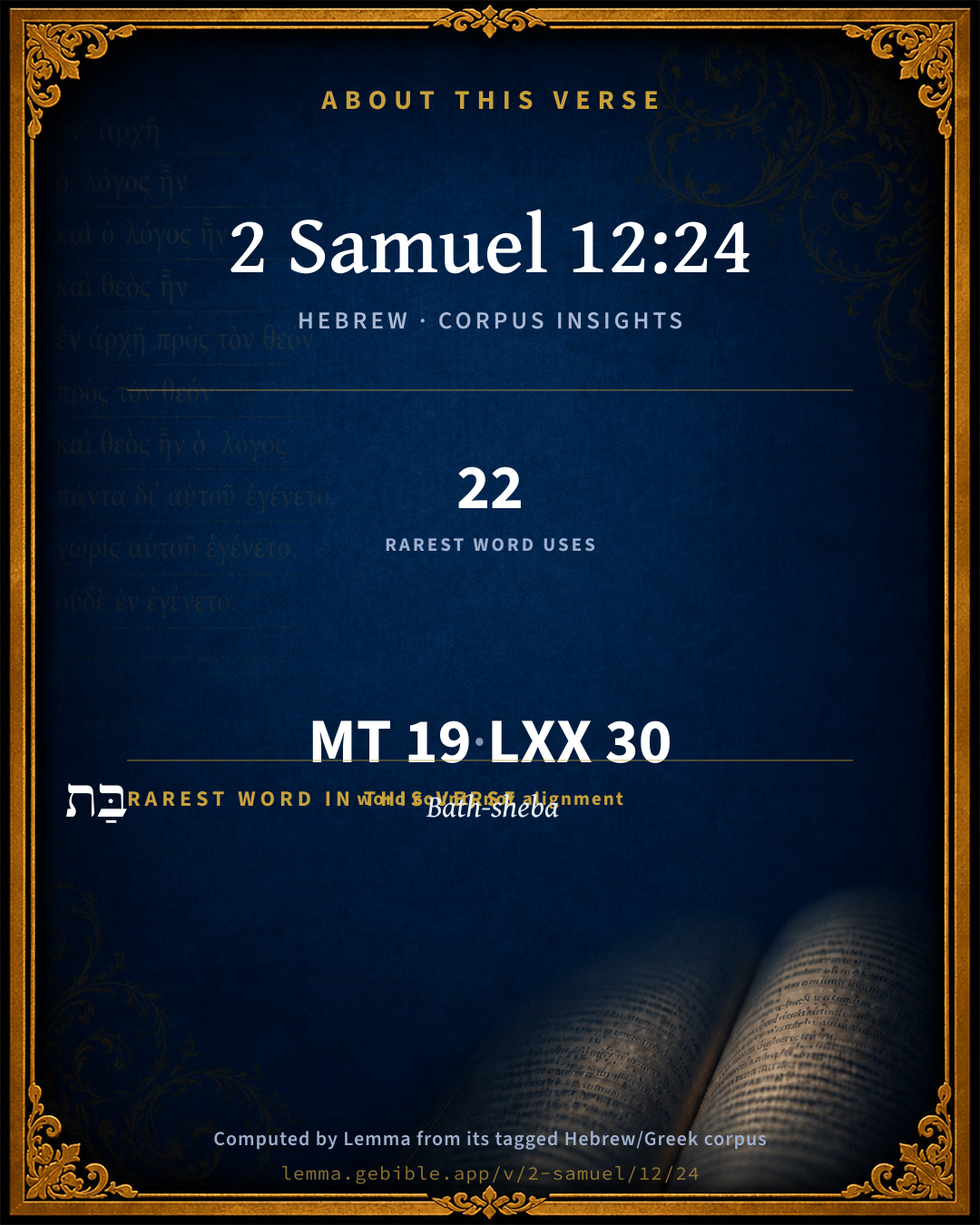
These counts appear in no published source. They are computed here, from the morphology-tagged text and Lemma’s own curated glosses. What Lemma adds →

19
words
16
distinct lemmas
Historical
section

Notable vocabulary

The rarest word here is בַּת Bath-sheba H1339 — appearing just 22 times in the whole Hebrew Bible.

Shared distinctive vocabulary

בַּת Bath-sheba H1339 occurs in 11 verses of the Hebrew Bible. Also found in:

Grammatical profile

  • 7 verbs
  • 7 nouns
  • 1 adjective
  • 2 prepositions
  • 2 particles

Verb forms

  • וַיְנַחֵ֣ם Piel · Sequential Imperfect
  • וַיָּבֹ֥א Qal · Sequential Imperfect
  • וַיִּשְׁכַּ֣ב Qal · Sequential Imperfect
  • וַתֵּ֣לֶד Qal · Sequential Imperfect
  • ויקרא Qal · Sequential Imperfect
  • וַתִּקְרָ֤א Qal · Sequential Imperfect
  • אֲהֵבֽוֹ Qal · Perfect

Repetition

Words recur within this verse — often emphatic in Hebrew:

  • בַּת Bath-sheba H1339 ×2
  • ויקרא to call H7121 ×2

Hebrew & Septuagint length

In English translation the verse runs 28 words from the Hebrew and 34 from the Septuagint (LXX English) — closely comparable.

A rough comparison of the two English renderings, which tokenize alike — not a word-level alignment.

Word counts can differ between the Hebrew and the Greek without any difference in meaning — e.g. the Hebrew direct-object marker אֵת has no separate Greek word, and Greek often adds the article ὁ.

In the original languages it is 19 Hebrew tokens and 30 Greek tokens — but the two are counted differently (Hebrew bundles its prefixes and suffixes into one token; the Greek is in lemma form), so that isn’t a like-for-like length.

Cross-references

6

Topical passages linked to 2 Samuel 12:24 in the Treasury of Scripture Knowledge — connected by theme and wording, ordered by reader-vote popularity; previews shown in the World English Bible.

  • Matthew 1:6 Jesse became the father of David the king. David became the father of Solomon by her who had been the wife of Uriah.
  • 1 Chronicles 28:5–6 Of all my sons (for Yahweh has given me many sons), he has chosen Solomon my son to sit on the throne of the kingdom of Yahweh over Israel.
  • 2 Samuel 7:12 When your days are fulfilled, and you shall sleep with your fathers, I will set up your seed after you, who shall proceed out of your bowels, and I will establish his kingdom.
  • 1 Chronicles 3:5 and these were born to him in Jerusalem: Shimea, and Shobab, and Nathan, and Solomon, four, of Bathshua the daughter of Ammiel;
  • 1 Chronicles 22:9–10 Behold, a son shall be born to you, who shall be a man of rest; and I will give him rest from all his enemies round about; for his name shall be Solomon, and I will give peace and quietness to Israel in his days:
  • 1 Chronicles 29:1 David the king said to all the assembly, Solomon my son, whom alone God has chosen, is yet young and tender, and the work is great; for the palace is not for man, but for Yahweh God.

Cross-references courtesy of OpenBible.info (CC BY 4.0).

Hebrew and Greek witnesses Masoretic Hebrew ↔ Greek Septuagint

The same verse in the two great witnesses to the Old Testament, shown verse-for-verse.

These are two independent witnesses, not word-aligned to each other, and the Septuagint is shown in lemma (dictionary) form.

Hebrew 2 Samuel 12:24 Masoretic · Westminster Leningrad Codex

וַיְנַחֵ֣ם דָּוִ֗ד אֵ֚ת בַּת שֶׁ֣בַע אִשְׁתּ֔וֹ וַיָּבֹ֥א אֵלֶ֖יהָ וַיִּשְׁכַּ֣ב עִמָּ֑הּ וַתֵּ֣לֶד בֵּ֗ן ויקרא וַתִּקְרָ֤א אֶת שְׁמוֹ֙ שְׁלֹמֹ֔ה וַיהוָ֖ה אֲהֵבֽוֹ

David comforted Bathsheba his wife, and went in to her, and lay with her: and she bore a son, and he called his name Solomon. Yahweh loved him;

World English Bible · Public Domain

Greek LXX 2 Samuel 12:24 Septuagint · lemma form

καί παρακαλέω δαυίδ βηρσαβεε ὁ γυνή αὐτός καί εἰςἔρχομαι πρός αὐτός καί κοιμάω μετά αὐτός καί συνλαμβάνω καί τίκτω υἱός καί καλέω ὁ ὄνομα αὐτός σαλωμών καί κύριος ἀγαπάω αὐτός

And David comforted Bersabee his wife, and he went in to her, and lay with her; and she conceived and bore a son, and he called his named Solomon, and the Lord loved him.

LXX2012 (modern English Septuagint) · Public Domain

Hebrew: Westminster Leningrad Codex (CC BY 4.0). Greek: Septuagint (public domain); English from LXX2012 (modern English Septuagint) (Public Domain). How the Septuagint differs from the Hebrew →

Targum (Aramaic paraphrase)

1

The Targum is the ancient Jewish Aramaic paraphrase of the Hebrew Scriptures — an interpretive translation, not the Hebrew text itself. Onkelos (literal) and Pseudo-Jonathan (expansive) render the Torah, and Jonathan the Prophets. Coverage is partial: where no permissively-licensed English translation exists for a verse, only the Aramaic is shown. This is verse-level text, not a word-by-word alignment to the Hebrew.

  1. Targum Jonathan Prophets (Joshua–Malachi)
    וְנָחֵים דָוִד יַת בַּת שֶׁבַע אִתְּתֵיהּ וְעַל לְוָתָהּ וּשְׁכִיב עִמָהּ וִילֵידַת בַּר וּקְרַת יַת שְׁמֵיהּ שְׁלֹמֹה וַיָי רַחְמֵיהּ:

    (no public-domain English translation for this verse)

    Targum Jonathan — Aramaic: “Mikraot Gedolot” (public domain). English: “Sefaria Community Translation” (CC0 1.0 (public-domain dedication)); “London "Chaldee Paraphrase," 1871” (public domain). Text via Sefaria.

Commentary

Notes on 2 Samuel 12:24 from classic Christian and Jewish commentators (each source and its license shown beneath its notes). The classic Christian expositions comment on the surrounding passage and are grouped to its opening verse, so a note may address several verses; the Jewish commentaries on the Tanakh (Rashi and others) are per-verse, so they appear only where the commentator wrote on this verse.

Lemma curates 59 commentaries, every one of them public domain or Creative Commons licensed, each selected and text-cleaned for this edition rather than reprinted as found. About our sources →

Jamieson, Fausset & Brown

Robert Jamieson, A. R. Fausset & David Brown

SOLOMON IS BORN. (Sa2 12:24-25)

Bath-sheba . . . bare a son, and he called his name Solomon--that is, "peaceable." But Nathan gave him the name of Jedediah, by command of God, or perhaps only as an expression of God's love. This love and the noble gifts with which he was endowed, considering the criminality of the marriage from which he sprang, is a remarkable instance of divine goodness and grace.

Jamieson, Fausset & Brown — Commentary Critical and Explanatory on the Whole Bible (1871) — public domain (CC PDM 1.0). Text via the HelloAO Bible API.

Trapp's Complete Commentary

John Trapp

2Sa 12:24 And David comforted Bathsheba his wife, and went in unto her, and lay with her: and she bare a son, and he called his name Solomon: and the LORD loved him.

Ver. 24. And David comforted Bathsheba his wife.] Till now she was called the wife of Uriah: but now that God had pardoned their sin, ratified their marriage, and otherwise sealed up his love to them, she is called David’s wife: and he, as a kind husband, comforteth her with the comforts wherewith himself had been comforted of God, {2Co 1:4} which was doubtless the effect of his seven days fasting: as was also his so patient and peaceable bearing the child’s death, to the admiration of his counsellors, who knew not the power of prayer, nor "the peace of God passing all understanding," that followeth thereupon. {Php 4:6-7} These are riddles to the unsanctified.

And she bare a son.] Yea, sons, and David’s best sons came of Bathsheba because they were the fruit of their humiliation. Nathan, of whom came Christ, {Luk 3:23; Luk 3:31} is ranked before Solomon, {2Sa 5:14 1Ch 3:5; 1Ch 14:4} but Solomon was the elder brother by Bathsheba, and a notable type of Christ, both in his name and in his reign. This may be for comfort to such as have leaped rashly into marriage; yea, have entered into that holy ordinance of God, through the devil’s portal, if for that they be afterwards soundly humbled.

And he called his name Solomon,] i.e., Peaceable: a type of Christ triumphant, as David had been of Christ militant, saith one. {a} The child of adultery died soon, so did not Solomon. This, saith another, {b} shadowed forth the old man which must die in the members of Christ, and the new man which must live unto God.

And the Lord loved him.] This was a high privilege and portion enough: together with God’s love cometh a cornucopia of blessings.

{a} Diod.

{b} Borrh.

John Trapp, A Commentary or Exposition upon All the Books of the Old and New Testament (1647–1656) — public domain. Text from a community e-Sword module.

Joseph Benson's Commentary

2Sa 12:24-25. And David comforted Bath-sheba his wife — Who, no doubt, was deeply afflicted for the loss of her child, and dejected for her sin. It is observable, however, that there is not one word said to her in all this relation, either concerning her guilt or her punishment. She was punished in the calamities that befell David; who enticed her, and not she him, to commit the foul sin of adultery, and was innocent in the murder of Uriah. She bare a son, and he called his name Solomon — Probably his mother, with the consent of David, gave him this name as soon as he was born. And the Lord loved him — That is, the Lord declared to David, probably by Nathan the prophet, that he loved this his son, notwithstanding the just cause which David had given to God to withdraw his love from him and his. Perhaps after his great humiliation, Nathan was sent to comfort him with this good hope, that God would have a peculiar regard for this son, and make him very famous. Such is the wonderful goodness of God to truly penitent sinners, who manifest the sincerity of their repentance by an humble submission to whatsoever punishments God sees fit to inflict upon them, (as David did to the death of the former child,) and thereby induce that goodness to show them still further mercy, He sent — Namely, God did; by Nathan, and he called his name Jedidiah — That is, beloved of Jehovah. Because of the Lord — Either because of the Lord’s love to him, or because the Lord commanded him so to do. This name, however, was merely significative, being only intended to express to the child’s parents what they might expect; for we find him always called Solomon in the Scriptures.

Joseph Benson's Commentary on the Old and New Testaments (1811–1818) — public domain. Text from a community e-Sword module.

Whedon's Commentary on the Bible

Daniel D. Whedon

BIRTH OF SOLOMON, 2Sa_12:24-25.

24. Called his name Solomon — שׁלמה, Shelomoh, the peaceful; so called because his reign was to be a peaceful one, (compare 1Ch_22:9,) and also because, being peculiarly associated in prophecy with “David’s greater Son,” in whom the throne of his kingdom should be established forever, (comp. 2Sa_7:13,) he was to be a figure of that Messiah who is the Prince of Peace.

The Lord loved him — Did not smite him as he did the other child of Bathsheba, but let him live, and bestowed upon him remarkable favour.

Daniel D. Whedon (gen. ed.), Commentary on the Old and New Testaments (1874–1909) — public domain. Text from a community e-Sword module.

Tyndale Open Study Notes

Tyndale Open Resources

12:24 Even after Uriah’s death, Bathsheba was still called Uriah’s wife (12:9; see also Matt 1:6). Only here is she called David’s wife. • Solomon: Pronounced Shelomoh in Hebrew, it probably means “his peace,” from the Hebrew shalom. It might mean “his replacement”; cp. Shelemiah (Jer 36:14, “Yahweh has provided compensation”) and Shelumiel (Num 1:6, “God [is] my compensation”); both contain the root shelem (“replacement, compensation”).

Tyndale Open Study Notes — © Tyndale Open Resources, licensed CC BY-SA 4.0. Text via the HelloAO Bible API.

Geneva Bible (1599)

Geneva Bible translators

To wit, the Lord, 1 Chron. 22:9.

Geneva Bible (1599) marginal notes — public domain. Text via Bolls.life.

Adam Clarke's Commentary

Verse 24. David comforted Bath-sheba] His extraordinary attachment to this beautiful woman was the cause of all his misfortunes.

He called his name Solomon] This name seems to have been given prophetically, for שלמה sholomah signifies peaceable, and there was almost uninterrupted peace during his reign.

Adam Clarke's Commentary on the Bible (1810–1826) — public domain. Text from a community e-Sword/MySword module.

Ellicott's Commentary for English Readers

(24) Called his name Solomon.—The birth of Solomon could hardly have taken place until after the events mentioned in 2Sa_12:26-31, since it is not likely that the siege of Rabbah would have occupied two years. It is without doubt mentioned here (after the custom of Scripture narrative) to close the story of Bath-sheba in its proper connection. The birth of that son who should succeed to the kingdom, and through whom should pass the line to the Messiah, was too important to be overlooked.

A Bible Commentary for English Readers, edited by Charles John Ellicott (1878–1897) — public domain. Text from a community e-Sword module.

The Cambridge Bible for Schools and Colleges

gen. ed. J. J. S. Perowne

24, 25. The birth of Solomon

24. he called his name Solomon] The name was given at the time of circumcision (Luk_1:59; Luk_2:21). The Hebrew form of the name is Shĕlômôh, the Sept. Salômôn, which by the time of the N.T. had become shortened to the familiar Solomon. It signifies peaceable, and was given him in anticipation of the peace and quietness promised to Israel in his reign in contrast to his father’s wars (1Ch_22:9). Solomon’s birth is naturally related as the sequel to the preceding narrative, though in all probability it did not take place until some four or five years afterwards. See Introd. ch. IV. § 3, p. 26, and note on ch. 2Sa_5:14.

The Cambridge Bible for Schools and Colleges (gen. ed. J. J. S. Perowne; Cambridge University Press, 1878–1918) — public domain. Text from a community e-Sword module.

John Gill's Exposition

And he sent by the hand of Nathan the prophet,.... Either David did; he sent by him to Bathsheba, to acquaint her with the name of the child, that it was to be Solomon; which is not so likely: or "he, David, delivered it into the hand of Nathan the prophet"; to educate it, instruct it, and bring it up in the nurture of the Lord; or rather the Lord sent a message by Nathan the prophet to David, that he loved Solomon:

and he called his name Jedidiah, because of the Lord: that is, David also called him by this name, because of the love of the Lord unto him; for Jedidiah signifies "the beloved of the Lord"; a name and character which well agrees with the Messiah, Solomon's antitype, Mat 3:17.

John Gill's Exposition of the Whole Bible (1746–1763) — public domain (CC PDM 1.0). Text via the HelloAO Bible API.

Albert Barnes' Notes on the Bible

Solomon - Or “peaceable,” a name given to him at his circumcision. Compare Luk 1:59. The giving of the name Jedidiah, by the Lord through Nathan, signified God’s favor to the child, as in the cases of Abraham, Sarah, and Israel. The name Jedidiah (which contains the same root as the name David, namely, “to love”) indicated, prophetically, what God’s Providence brought about actually, namely, the succession and glorious reign of Solomon over Israel.

Albert Barnes' Notes on the Bible (1834–1885) — public domain. Text from a community e-Sword/MySword module.

Haydock's Catholic Bible Commentary

Wife. She had partaken in his affliction and repentance. The Jews say that David told her the divine oracle, which is mentioned [in] 3 Kings i. 13, 17., that her next son should succeed to the throne. Salien (the year of the world 3000) supposes that he was conceived in May, two months after the death of Bethsabee’s first-born, and came into the world about he time of the Passover. --- Solomon, "the pacific." See 1 Paralipomenon xxii. 9. (Menochius)

George Leo Haydock (1774–1849), Haydock's Catholic Family Bible and Commentary, 1859 edition — public domain. Excludes Psalms (Douay-Rheims chapter numbering differs from Protestant) and Deuterocanonical books (Catholic canon only).

Matthew Poole's English Annotations

David comforted Bathsheba; who was now much dejected, both for her former sin, which she truly repented of, as may be gathered from Pro 31:1-3, &c., and for the loss of that child which was very dear to her, and which might seem to be the only tie of David’s affection to her; which being now dead, she might think that David would utterly cast her off, and leave her to that shame and punishment which she had deserved. Went in unto her, to wit, into her chamber or bed. The Lord loved him, i.e. the Lord declared to David that he loved his son, notwithstanding the just cause which David had given to God to alienate his affections from him.

Matthew Poole's English Annotations on the Holy Bible (1683–1685) — public domain. Text from a community e-Sword/MySword module.

The Pulpit Commentary

He called his name Solomon. It is rashly assumed that Solomon"s birth followed next in order after that of the deceased child. More probably there was a long interval of time, and son after son was born, with little increase of happiness to the family polluted by Amnon"s sin and troubled by its miserable consequences. While we must not lay too great stress upon Solomon calling himself "a little child" (1Ki_3:7) after his accession, yet it forbids our believing that he was more than just grown up, It was the remarkable ability of Solomon, his goodness and precocious talent, which made him so great a comfort to his parents, and which received Jehovah"s seal of approval in the name Jedidiah. This name would scarcely be given him until his good and great qualities were developing; and as it was a sort of indication that he was the chosen and elect son of David, and therefore the next king, we shall probably be right in believing that this second mission of Nathan, and this mark of Divine favour to David"s youngest child, did not take place until after Absalom"s death, possibly not until Solomon was ten or twelve years of age. The name Solomon means "the peaceful," and answers to the German Friedrich. It was given to the child in recognition that David"s wars were now over, and that the era of quiet had begun, which was to be consecrated to the building of Jehovah"s temple. It was the name given to the infant at his birth, and was a name of hope. Alas! this peace was to be rudely broken by the rebellion of the son whom David, in vain expectation and with all a father"s pride, had named Absalom, "his father"s peace.

Vers. 24, 25. (JERUSALEM.)

The birth of Solomon.

(References: 1Ki 1-11 1Ch 22-29 2Ch 1-9.; Psalm (Pro_1:1; Ecc_1:1; Son_1:1) Where a while ago a dead child lay amidst signs of grief, there now lies a living child amidst signs of gladness. In him David sees a gift of God, an answer to prayer which seemed to be denied, "a pledge of pardon and a sign of hope." In him we see one who was destined to become the wisest of men, the most glorious of monarchs Solomon (whose name occurs only here and (2Sa_5:14, in this book)

The lofty light, endow"d With sapience so profound, if truth be truth, That with a ken of such wide amplitude No second hath arisen. (Dante, "Par.," 10.)

Notice:

1. His parentage. David, Bathsheba; from whom he inherited physical strength and beauty, mental and moral qualities, a piercing insight, large heartedness, skill in ruling, sensuous susceptibilities, etc., royal rank and privileges. "The history of a man"s childhood is the description of his parents" environment" (Carlyle).

2. His birth. After David"s fall, repentance, and forgiveness, and the death of his unnamed infant; (see, however, 1Ch_3:5) when Rabbah had fallen, peace was established, and prosperity abounded. The time was propitious.

3. His name. (1Sa_1:20) "And he called his name Solomon" (equivalent to "the man of peace," "pacific," Friedrich), "because he regarded his birth as a pledge that he should now become a partaker again of the peace of God" (Keil); or perhaps in allusion to the peaceful condition of the kingdom and "from the wish that peace might be allotted him as a gift of God, in contrast with the wars of his father"s life"; (Erdmann 2Sa_7:12; 1Ch_22:9) "And Jehovah loved him," and spared his life, in contrast with that of the dead child. "And he Jehovah sent by the hand through Nathan the prophet; and he Nathan called his name Jedid-jah Jedid equivalent to "David," "darling;" "beloved of Jab," his own name being combined with that of Jehovah, because of the Lord," who loved him; "a practical declaration on the part of Jehovah that the Lord loved Solomon, from which David could and was intended to discern that the Lord had blessed his marriage with Bathsheba. Jedidiah, therefore, was not actually adopted as Solomon"s name" (Keil). "The pious father, in his happiness, entreated the oracle, through Nathan, to confer on the newborn child some name of lofty import, and Solomon, as his parents called him, received through the prophet the glorious additional name of Jedidiah. The sadness of the fate of his first child rendered the omens under which the second stepped into its place the more auspicious; and we can easily understand that of all his sons this one became the dearest" (Ewald).

4. His education; or the influences that went to form his character; of Nathan, to whom it may have been entrusted; of David, during his declining years; of Bathsheba; (2Sa_11:3) of a home and court where polygamy prevailed; of all the learning of the age; of the revolt of Absalom, and other public events. "A shepherd life, like his father"s, furnished, we may believe, a better education for his kingly calling. Born to the purple, there was the inevitable risk of a selfish luxury. Cradled in liturgies, trained to think chiefly of the magnificent "palace" of Jehovah, of which he was to be the builder, there was the danger first of an aesthetic formalism, and then of ultimate indifference" (Smith, "Dict. of the Bible").

5. His prospects, after the death of Absalom, if not even before (2Sa_7:12; 1Ch_22:9; 1Ki_1:13) his accession and eminence.

6. His closing years.

7. His prefigurement, not in personal character but royal office, of "the Prince of Peace" "We must not confine our view to David"s personal life and reign. After we have seen him fallen and suffering for sin, we must see him rising again and reviving in a more glorious reign, in Solomon his son, who began to reign while David his father was still alive, in order that the continuity might be more clearly marked. And above all, we must contemplate him as culminating upward and attaining the climax of his glory, which God had revealed to him, and for which he yearned with devout aspiration, in Christ, the Divine David and the Son of David, the Solomon, the Jedidiab, the Builder of the Church visible on earth and glorified in heaven" (Wordsworth). D.

The Pulpit Commentary (1880–1919), ed. H.D.M. Spence-Jones & Joseph S. Exell — public domain. Text from a community e-Sword module.

John Wesley's Explanatory Notes

His wife - Who was now much dejected, both for her former sin, and for the loss of the child. Loved him - That is, the Lord declared to David, that he loved his son, notwithstanding the just cause David had given to God to alienate his affections from him.

John Wesley, Explanatory Notes Upon the Whole Bible (1754–1765) — public domain. Text via the GEBible commentary corpus.

unfoldingWord translationNotes

Door43 World Missions Community

went in to her, and slept with her

The phrase "went in to her" is a graphic description of David having sex with his wife. These two phrases have the same meaning and are used together to emphasize that they slept together. AT: "slept with her" (See: Parallelism)

he sent word through Nathan the prophet

Here "word" refers to a message that Yahweh told Nathan to tell David. AT: "he sent Nathan to tell him" (See: Metonymy)

Jedidiah

This is another name for David's son Solomon, which Yahweh chose for him. (See: How to Translate Names)

translationWords

comfort

Bathsheba

had relations with

name

Solomon

love

send

word

prophet

unfoldingWord translationNotes — © Distant Shores Media and the Door43 World Missions Community, licensed CC BY-SA 4.0. Source: git.door43.org/Door43/en_tn.

Lesson kit

Teaching starters — assembled from the data on this page, not authored interpretation. Every prompt links to the verse data it draws on. Edit before teaching.

2 Samuel, in the Historical, opens this verse with 19 words (16 distinct Hebrew lemmas). Its most distinctive word is Bath-Shebaʻ (“Bath-sheba”). A historical commentator’s framing appears above. Read the whole chapter for the surrounding context.

Discussion questions

  1. What does “Bath-sheba” (Bath-Shebaʻ) contribute to the verse as a whole?
  2. 2 Samuel 11:3 shares the word «Bath-sheba» with this verse. How do the two illuminate each other?
  3. “Bath-sheba” occurs 2× in this one verse. What is the effect of the repetition?
  4. These translations render this verse differently. What is at stake in choosing one wording over another?
  5. The verb «וַיְנַחֵ֣ם» is Piel Sequential Imperfect. How does its form color the action?
  6. Reading how Jamieson, Fausset & Brown and Trapp's Complete Commentary read this verse, where do the two commentators agree and where do they part?

Things to notice

Reading settings

Reading text

Shown beneath each verse's original-language words.

Old Testament
Old Testament edition

Read the OT as the Masoretic Hebrew (MT) or the Greek Septuagint (LXX).

English shown for the Greek Septuagint (in the Hebrew ↔ Greek comparison).

Comparing translations? Open the Compare panel on any verse page to stack up to four side by side.