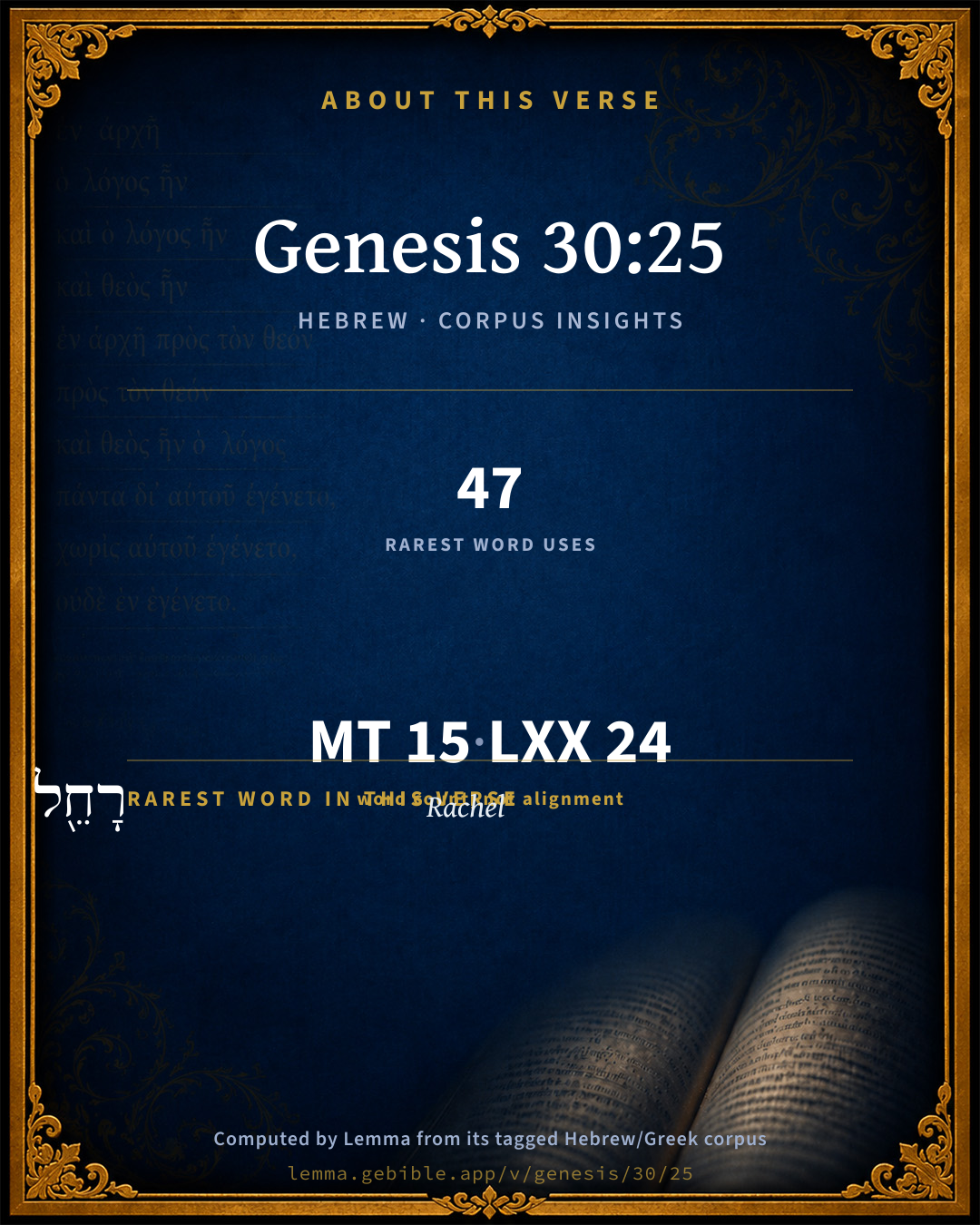
Genesis 30:25

Hebrew (Westminster Leningrad Codex) Genesis 30:25 appears in the Hebrew Old Testament. The text above is from the Westminster Leningrad Codex. Each word links to its Strong’s number, a concise gloss, and parsing drawn from the Open Scriptures Hebrew Bible morphology. Click any word for its full Brown-Driver-Briggs (BDB) entry.
Download image
Cite this verse

Genesis 30:25 (World English Bible). Public Domain. Lemma interlinear Bible study tool, https://lemma.gebible.app/v/genesis/30/25.

Show BibTeX & RIS
BibTeX
RIS
English Translation
It happened, when Rachel had borne Joseph, that Jacob said to Laban, "Send me away, that I may go to my own place, and to my country.
World English Bible · Public Domain
Download a study sheet

One document with this verse’s original text, its word-by-word gloss line, the meaning frame, cross-references with their text, attributed commentary, and full source and license credits — printable, and it pastes into notes with its structure intact.

This verse Autodidact and up

Study sheet (.html) Plain text (.txt)

A passage Seminary Student

Up to 50 verses in one chapter. A passage sheet keeps up to 6 commentary sources and 12 cross-references per verse, in the order this page ranks them, and says so on the sheet whenever that leaves anything out. Ask for a single verse and you get the Autodidact verse sheet above.

Everything on this page stays free to read, with no account — the sheet is a download of what is already on screen, not access to it.

Want to remove ads? Support Godless Engineer
Compare translations 3

The same verse in 3 English versions, stacked beneath the original-language interlinear above. Click any original word for its lexicon entry.

Each is an independent rendering of the whole verse — the interlinear is not word-aligned to these translations.

Highlighted words mark where these versions differ — a whole-verse word diff, not a word-by-word alignment.

  • World English Bible Public Domain
    It happened, when Rachel had borne Joseph, that Jacob said to Laban, "Send me away, that I may go to my own place, and to my country.
  • King James Version Public Domain
    And it came to pass, when Rachel had born Joseph, that Jacob said unto Laban, Send me away, that I may go unto mine own place, and to my country.
  • unfoldingWord Literal Text CC BY-SA 4.0
    Then it happened, after Rachel bore Joseph, then Jacob said to Laban, “Send me off, so that I may go to my place and to my land.

unfoldingWord Literal Text — © unfoldingWord, licensed CC BY-SA 4.0. Word-aligned USFM3 via Door43 (git.door43.org/unfoldingWord/en_ult).

Versions to compare (up to 4)

3 of 4 selected

Show all 18 translations

Every available English version of this verse, each an independent rendering of the whole verse.

  • World English Bible Public Domain
    It happened, when Rachel had borne Joseph, that Jacob said to Laban, "Send me away, that I may go to my own place, and to my country.
  • Berean Standard Bible Public Domain
    Now after Rachel had given birth to Joseph, Jacob said to Laban, “Send me on my way so I can return to my homeland.
  • Majority Standard Bible Public Domain
    Now after Rachel had given birth to Joseph, Jacob said to Laban, “Send me on my way so I can return to my homeland.
  • King James Version Public Domain
    And it came to pass, when Rachel had born Joseph, that Jacob said unto Laban, Send me away, that I may go unto mine own place, and to my country.
  • American Standard Version (1901) Public Domain
    And it came to pass, when Rachel had borne Joseph, that Jacob said unto Laban, Send me away, that I may go unto mine own place, and to my country.
  • Revised Version (1885) Public Domain
    And it came to pass, when Rachel had borne Joseph, that Jacob said unto Laban, Send me away, that I may go unto mine own place, and to my country.
  • Geneva Bible (1599) Public Domain
    And assoone as Rahel had borne Ioseph, Iaakob said to Laban, Sende me away that I may go vnto my place and to my countrey.
  • Douay-Rheims (1899) Public Domain
    And when Joseph was born, Jacob said to his father in law: Send me away that I may return into my country, and to my land.
  • Young's Literal Translation Public Domain
    And it cometh to pass, when Rachel hath borne Joseph, that Jacob saith unto Laban, `Send me away, and I go unto my place, and to my land;
  • Literal Standard Version CC BY-SA 4.0
    And it comes to pass, when Rachel has borne Joseph, that Jacob says to Laban, “Send me away, and I go to my place, and to my land;
  • Unlocked Literal Bible CC BY-SA 4.0
    After Rachel had borne Joseph, Jacob said to Laban, “Send me away, so that I may go to my own home and to my country.
  • unfoldingWord Literal Text CC BY-SA 4.0
    Then it happened, after Rachel bore Joseph, then Jacob said to Laban, “Send me off, so that I may go to my place and to my land.
  • Darby Bible Public Domain
    And it came to pass when Rachel had borne Joseph, that Jacob said to Laban, Send me away, that I may go to my place and to my country.
  • World Messianic Bible Public Domain
    When Rachel had borne Joseph, Jacob said to Laban, “Send me away, that I may go to my own place, and to my country.
  • Webster's Bible Public Domain
    And it came to pass, when Rachel had borne Joseph, that Jacob said to Laban, Send me away, that I may go to my own place, and to my country.
  • Free Bible Version CC BY-SA 4.0
    Once Rachel had given birth to Joseph, Jacob said to Laban, “Let me leave so I can return to my home and my own country.
  • Bible in Basic English Public Domain
    Now after the birth of Joseph, Jacob said to Laban, Let me go away to my place and my country.
  • JPS Tanakh (1917) Public Domain
    And it came to pass, when Rachel had borne Joseph, that Jacob said unto Laban: 'Send me away, that I may go unto mine own place, and to my country.

Literal Standard Version (2020), Covenant Press — licensed CC BY-SA 4.0. Text via the HelloAO Bible API (eBible.org). Unlocked Literal Bible (unfoldingWord) — licensed CC BY-SA 4.0. Text via the HelloAO Bible API (eBible.org). unfoldingWord Literal Text — © unfoldingWord, licensed CC BY-SA 4.0. Word-aligned USFM3 via Door43 (git.door43.org/unfoldingWord/en_ult). Free Bible Version, Dr. Jonathan Gallagher — licensed CC BY-SA 4.0. Text via the HelloAO Bible API (eBible.org).

Word by word

More ways to search: Search by grammar → Find every occurrence → Compare this word →

Practice this passage: Drill this verse → Learn its vocabulary →

רָחֵ֖ל
Râchêl
H7354
“Rachel”
Noun, Proper
Part of Speech
Noun
Type
Proper
Full BDB Definition

Origin: the same as H7353

TWOT: None

Rachel = "ewe" - daughter of Laban, wife of Jacob, and mother of Joseph and Benjamin
  1. וַיְהִ֕י hâyâh H1961 “and · to be” Conjunction + Verb, Qal, Sequential Imperfect, 3rd Person, Masculine, Singular
  2. כַּאֲשֶׁ֛ר ʼăsher H834 “like/as · which” Preposition + Particle, Relative
  3. יָלְדָ֥ה yâlad H3205 “to bear” Verb, Qal, Perfect, 3rd Person, Feminine, Singular
  4. אֶת ʼêth H853 “-” Particle, Direct Object
  5. יוֹסֵ֑ף Yôwçêph H3130 “Joseph” Noun, Proper
  6. וַיֹּ֤אמֶר ʼâmar H559 “and · to say” Conjunction + Verb, Qal, Sequential Imperfect, 3rd Person, Masculine, Singular
  7. יַעֲקֹב֙ Yaʻăqôb H3290 “Jacob” Noun, Proper
  8. אֶל ʼêl H413 “to” Preposition
  9. לָבָ֔ן Lâbân H3837 “Laban” Noun, Proper
  10. שַׁלְּחֵ֨נִי֙ shâlach H7971 “send · me” Verb, Piel, Imperative, 2nd Person, Masculine, Singular + Suffix, Personal, 1st Person, Common, Singular
  11. וְאֵ֣לְכָ֔ה yâlak H3212 “and · to walk” Conjunction + Verb, Qal, Cohortative, 1st Person, Common, Singular
  12. אֶל ʼêl H413 “to” Preposition
  13. מְקוֹמִ֖י mâqôwm H4725 “place · my” Noun, Common, Masculine, Singular, Construct + Suffix, Personal, 1st Person, Common, Singular
  14. וּלְאַרְצִֽי ʼerets H776 “and · to/for · land · my” Conjunction + Preposition + Noun, Common, Both, Singular, Construct + Suffix, Personal, 1st Person, Common, Singular

About this verse

These counts appear in no published source. They are computed here, from the morphology-tagged text and Lemma’s own curated glosses. What Lemma adds →

15
words
14
distinct lemmas
Pentateuch
section

Shared distinctive vocabulary

רָחֵ֖ל Rachel H7354 occurs in 44 verses of the Hebrew Bible. Also found in:

Grammatical profile

  • 5 verbs
  • 6 nouns
  • 2 prepositions
  • 2 particles

Verb forms

  • וַיְהִ֕י Qal · Sequential Imperfect
  • יָלְדָ֥ה Qal · Perfect
  • וַיֹּ֤אמֶר Qal · Sequential Imperfect
  • שַׁלְּחֵ֨נִי֙ Piel · Imperative
  • וְאֵ֣לְכָ֔ה Qal · Cohortative

Repetition

A word recurs within this verse — often emphatic in Hebrew:

  • אֶל to H413 ×2

Hebrew & Septuagint length

In English translation the verse runs 27 words from the Hebrew and 28 from the Septuagint (LXX English) — closely comparable.

A rough comparison of the two English renderings, which tokenize alike — not a word-level alignment.

Word counts can differ between the Hebrew and the Greek without any difference in meaning — e.g. the Hebrew direct-object marker אֵת has no separate Greek word, and Greek often adds the article ὁ.

In the original languages it is 15 Hebrew tokens and 24 Greek tokens — but the two are counted differently (Hebrew bundles its prefixes and suffixes into one token; the Greek is in lemma form), so that isn’t a like-for-like length.

Cross-references

13

Topical passages linked to Genesis 30:25 in the Treasury of Scripture Knowledge — connected by theme and wording, ordered by reader-vote popularity; previews shown in the World English Bible.

  • Genesis 24:54 They ate and drank, he and the men who were with him, and stayed all night. They rose up in the morning, and he said, "Send me away to my master."
  • Genesis 24:56 He said to them, "Don't hinder me, seeing Yahweh has prospered my way. Send me away that I may go to my master."
  • Genesis 18:33 Yahweh went his way, as soon as he had finished communing with Abraham, and Abraham returned to his place.
  • Genesis 24:6–7 Abraham said to him, "Beware that you don't bring my son there again.
  • Genesis 26:3 Sojourn in this land, and I will be with you, and will bless you. For to you, and to your seed, I will give all these lands, and I will establish the oath which I swore to Abraham your father.
  • Genesis 28:13 Behold, Yahweh stood above it, and said, "I am Yahweh, the God of Abraham your father, and the God of Isaac. The land whereon you lie, to you will I give it, and to your seed.
  • Genesis 28:15 Behold, I am with you, and will keep you, wherever you go, and will bring you again into this land. For I will not leave you, until I have done that which I have spoken of to you."
  • Genesis 31:13 I am the God of Bethel, where you anointed a pillar, where you vowed a vow to me. Now arise, get out from this land, and return to the land of your birth."
  • Genesis 31:55 Early in the morning, Laban rose up, and kissed his sons and his daughters, and blessed them. Laban departed and returned to his place.
  • Acts 7:4–5 Then he came out of the land of the Chaldaeans, and lived in Haran. From there, when his father was dead, God moved him into this land, where you are now living.
  • Genesis 27:44–45 Stay with him a few days, until your brother's fury turns away;
  • Hebrews 11:9 By faith, he lived as an alien in the land of promise, as in a land not his own, dwelling in tents, with Isaac and Jacob, the heirs with him of the same promise.
  • Hebrews 11:15–16 If indeed they had been thinking of that country from which they went out, they would have had enough time to return.

Cross-references courtesy of OpenBible.info (CC BY 4.0).

Hebrew and Greek witnesses Masoretic Hebrew ↔ Greek Septuagint

The same verse in the two great witnesses to the Old Testament, shown verse-for-verse.

These are two independent witnesses, not word-aligned to each other, and the Septuagint is shown in lemma (dictionary) form.

Hebrew Genesis 30:25 Masoretic · Westminster Leningrad Codex

וַיְהִ֕י כַּאֲשֶׁ֛ר יָלְדָ֥ה רָחֵ֖ל אֶת יוֹסֵ֑ף וַיֹּ֤אמֶר יַעֲקֹב֙ אֶל לָבָ֔ן שַׁלְּחֵ֨נִי֙ וְאֵ֣לְכָ֔ה אֶל מְקוֹמִ֖י וּלְאַרְצִֽי

It happened, when Rachel had borne Joseph, that Jacob said to Laban, "Send me away, that I may go to my own place, and to my country.

World English Bible · Public Domain

Greek LXX Genesis 30:25 Septuagint · lemma form

γίγνομαι δέ ὡς τίκτω ραχηλ ὁ ιωσηφ εἶπον ἰακώβ ὁ λαβαν ἀποστέλλω ἐγώ ἵνα ἀποἔρχομαι εἰς ὁ τόπος ἐγώ καί εἰς ὁ γῆ ἐγώ

And it came to pass when Rachel had born Joseph, Jacob said to Laban, Send me away, that I may go to my place and to my land.

LXX2012 (modern English Septuagint) · Public Domain

On this verse, Lange's Commentary on the Holy Scriptures discusses the Septuagint’s reading. Read the note in Commentary ↓

Hebrew: Westminster Leningrad Codex (CC BY 4.0). Greek: Septuagint (public domain); English from LXX2012 (modern English Septuagint) (Public Domain). How the Septuagint differs from the Hebrew →

Targum (Aramaic paraphrase)

2

The Targum is the ancient Jewish Aramaic paraphrase of the Hebrew Scriptures — an interpretive translation, not the Hebrew text itself. Onkelos (literal) and Pseudo-Jonathan (expansive) render the Torah, and Jonathan the Prophets. Coverage is partial: where no permissively-licensed English translation exists for a verse, only the Aramaic is shown. This is verse-level text, not a word-by-word alignment to the Hebrew.

  1. Targum Onkelos Torah (Genesis–Deuteronomy)
    וַהֲוָה כַּד יְלִידַת רָחֵל יָת יוֹסֵף וַאֲמַר יַעֲקֹב לְלָבָן שַׁלְּחַנִּי וְאֵיהַךְ לְאַתְרִי וּלְאַרְעִי

    (no public-domain English translation for this verse)

    Targum Onkelos — Aramaic: “Onkelos Genesis” (public domain); “Onkelos Exodus” (public domain); “Onkelos Leviticus” (public domain); “Onkelos Numbers” (public domain); “Onkelos Deuteronomy” (public domain). English: “Sefaria Community Translation” (CC0 1.0 (public-domain dedication)); “J.W. Etheridge. The Targums of Onkelos and Jonathan Ben Uzziel on the Pentateuch. London: Longmans, Green, 1862” (public domain). Text via Sefaria.

  2. Targum Pseudo-Jonathan Torah (Genesis–Deuteronomy)
    וַהֲוָה כְּדִי יְלֵידַת רָחֵל יַת יוֹסֵף וַאֲמַר יַעֲקב בְּרוּחַ קוּדְשָׁא דְבֵית יוֹסֵף עֲתִידִין לְמֶהֱוֵי כְּשַׁלְהוֹבִיתָא לְגַמְרָא יַת דְבֵית עֵשָו אָמַר מִכְּעַן לֵית אֲנָא מִסְתְּפֵי מִן עֵשָו וְלִגְיוֹנוֹ וַאֲמַר לְלָבָן שַׁלְחֵנִי וְאֵיהַךְ לְאַתְרִי וּלְאַרְעִי

    And it was when Rahel had borne Joseph, Jakob said by the Holy Spirit concerning the house of Joseph, They are to be as a flame to consume the house of Esau; and he said, Therefore will I not be afraid of Esau and his legions. And he, said unto Laban, Send me away, and I will go to my place and to my country.

    Targum Pseudo-Jonathan — Aramaic: “Targum Jonathan on Genesis” (public domain); “Targum Jonathan on Exodus” (public domain); “Targum Jonathan on Leviticus” (public domain); “Targum Jonathan on Numbers” (public domain); “Targum Jonathan on Deuteronomy” (public domain). English: “The Targum of Jonathan ben Uzziel, trans. J. W. Etheridge, London, 1862” (public domain). Text via Sefaria.

Commentary

Notes on Genesis 30:25 from classic Christian and Jewish commentators (each source and its license shown beneath its notes). The classic Christian expositions comment on the surrounding passage and are grouped to its opening verse, so a note may address several verses; the Jewish commentaries on the Tanakh (Rashi and others) are per-verse, so they appear only where the commentator wrote on this verse.

Lemma curates 59 commentaries, every one of them public domain or Creative Commons licensed, each selected and text-cleaned for this edition rather than reprinted as found. About our sources →

Matthew Henry's Commentary

We have here,

I. Jacob's thoughts of home. He faithfully served his time out with Laban, even his second apprenticeship, though he was an old man, had a large family to provide for, and it was high time for him to set up for himself. Though Laban's service was hard, and he had cheated him in the first bargain he had made, yet Jacob honestly performs his engagements. Note, A good man, though he swear to his own hurt, will not change. And though others have deceived us this will not justify us in deceiving them. Our rule is to do as we would be done by, not as we are done by. Jacob's term having expired, he begs leave to be gone, Gen 30:25. Observe, 1. He retained his affection for the land of Canaan, not only because it was the land of his nativity, and his father and mother were there, whom he longed to see, but because it was the land of promise; and, in token of his dependence upon the promise of it, though he sojourn in Haran he can by no means think of settling there. Thus should we be affected towards our heavenly country, looking upon ourselves as strangers here, viewing the heavenly country as our home, and longing to be there, as soon as the days of our service upon earth are numbered and finished. We must not think of taking root here, for this is not our place and country, Heb 13:14. 2. He was desirous to go to Canaan, though he had a great family to take with him, and no provision yet made for them. He had got wives and children with Laban, but nothing else; yet he does not solicit Laban to give him either a portion with his wives or the maintenance of some of his children. No, all his request is, Give me my wives and my children, and send me away, Gen 30:25, Gen 30:26. Note, Those that trust in God, in his providence and promise, though they have great families and small incomes, can cheerfully hope that he who sends mouths will send meat. He who feeds the brood of the ravens will not starve the seed of the righteous.

II. Laban's desire of his stay, Gen 30:27. In love to himself, not to Jacob or to his wives or children, Laban endeavours to persuade him to continue his chief shepherd, entreating him, by the regard he bore him, not to leave him: If I have found favour in thy eyes, tarry. Note, Churlish selfish men know how to give good words when it is to serve their own ends. Laban found that his stock had wonderfully increased with Jacob's good management, and he owns it, with very good expressions of respect both to God and Jacob: I have learned by experience that the Lord has blessed me for thy sake. Observe, 1. Laban's learning: I have learned by experience. Note, There is many a profitable good lesson to be learned by experience. We are very unapt scholars if we have not learned by experience the evil of sin, the treachery of our own hearts, the vanity of the world, the goodness of God, the gains of godliness, and the like. 2. Laban's lesson. He owns, (1.) That his prosperity was owing to God's blessing: The Lord has blessed me. Note, worldly men, who choose their portion in this life, are often blessed with an abundance of this world's goods. Common blessings are given plentifully to many that have no title to covenant-blessings. (3.) That Jacob's piety had brought that blessing upon him: The Lord has blessed me, not for my own sake (let not such a man as Laban, that lives without God in the world, think that he shall receive any thing of the Lord, Jam 1:7), but for thy sake. Note, [1.] Good men are blessings to the places where they live, even where they live meanly and obscurely, as Jacob in the field, and Joseph in the prison, Gen 39:23. [2.] God often blesses bad men with outward mercies for the sake of their godly relations, though it is seldom that they have either the wit to see it or the grace to own it, as Laban did here.

III. The new bargain they came upon. Laban's craft and covetousness took advantage of Jacob's plainness, honesty, and good-nature; and, perceiving that Jacob began to be won upon by his fair speeches, instead of making him a generous offer and bidding high, as he ought to have done, all things considered, he puts it upon him to make his demands (Gen 30:28): Appoint me thy wages, knowing he would be very modest in them, and would ask less than he could for shame offer. Jacob accordingly makes a proposal to him, in which,

1. He shows what reason he had to insist upon so much, considering, (1.) That Laban was bound in gratitude to do well for him, because he had served him not only faithfully, but very successfully, Gen 30:30. Yet here observe how he speaks, like himself, very modestly. Laban had said, The Lord has blessed me for thy sake; Jacob will not say so, but, The Lord has blessed thee since my coming. Note, Humble saints take more pleasure in doing good than in hearing of it again. (2.) That he himself was bound in duty to take care of his own family: Now, when shall I provide for my own house also? Note, Faith and charity, though they are excellent things, must not take us off from making necessary provisions for our own support, and the support of our families. We must, like Jacob, trust in the Lord and do good, and yet we must, like him, provide for our own houses also; he that does not the latter is worse than an infidel, Ti1 5:8.

2. He is willing to refer himself to the providence of God, which, he knew, extends itself to the smallest things, even the colour of the cattle; and he will be content to have for his wages the sheep and goats of such and such a colour, speckled, spotted, and brown, which should hereafter be brought forth, Gen 30:32, Gen 30:33. This, he thinks, will be a most effectual way both to prevent Laban's cheating him and to secure himself from being suspected of cheating Laban. Some think he chose this colour because in Canaan it was generally most desired and delighted in; their shepherds in Canaan are called Nekohim (Amo 1:1), the word here used for speckled; and Laban was willing to consent to this bargain because he thought if the few he has that were now speckled and spotted were separated from the rest, which by agreement was to be done immediately, the body of the flock which Jacob was to tend, being of one colour, either all black or all white, would produce few or none of mixed colours, and so he should have Jacob's service for nothing, or next to nothing. According to this bargain, those few that were party-coloured were separated, and put into the hands of Laban's sons, and sent three days' journey off; so great was Laban's jealously lest any of them should mix with the rest of the flock, to the advantage of Jacob. And now a fine bargain Jacob has made for himself! Is this his providing for his own house, to put it upon such an uncertainty? If these cattle bring forth, as usually cattle do, young ones of the same colour with themselves, he must still serve for nothing, and be a drudge and a beggar all the days of his life; but he knows whom he has trusted, and the event showed, (1.) That he took the best way that could be taken with Laban, who otherwise would certainly have been too hard for him. And, (2.) That it was not in vain to rely upon the divine providence, which owns and blesses honest humble diligence. Those that find men whom they deal with unjust and unkind shall not find God so, but, some way or other, he will recompense the injured, and be a good pay-master to those that commit their cause to him.

Matthew Henry's Commentary on the Whole Bible (1708–1710) — public domain (CC PDM 1.0). Text via the HelloAO Bible API.

Jamieson, Fausset & Brown

Robert Jamieson, A. R. Fausset & David Brown

JACOB'S COVENANT WITH LABAN. (Gen. 30:25-43)

when Rachel had born Joseph--Shortly after the birth of this son, Jacob's term of servitude expired, and feeling anxious to establish an independence for his family, he probably, from knowing that Esau was out of the way, announced his intention of returning to Canaan (Heb 13:14). In this resolution the faith of Jacob was remarkable, for as yet he had nothing to rely on but the promise of God (compare Gen 28:15).

Jamieson, Fausset & Brown — Commentary Critical and Explanatory on the Whole Bible (1871) — public domain (CC PDM 1.0). Text via the HelloAO Bible API.

Trapp's Complete Commentary

John Trapp

Gen 30:25 And it came to pass, when Rachel had born Joseph, that Jacob said unto Laban, Send me away, that I may go unto mine own place, and to my country.

Ver. 25. Unto mine own place.] The Promised Land, which he reckoned his own. The promises are good surehold.

John Trapp, A Commentary or Exposition upon All the Books of the Old and New Testament (1647–1656) — public domain. Text from a community e-Sword module.

The Biblical Illustrator

Joseph S. Exell

Gen_30:25

Send me away that I may go unto mine own place, and to my country

The lights of home

There is in Switzerland a hill known as the Heimweh Fluh, or Home-sick Mount.

It is so called because it is usually the last spot visited by the traveller when leaving that part of the country at a time when his thoughts are turned homeward. It commands a glorious view of the whole valley of Interlaken, with its fields and pastures, its villages and lakes, with a back-ground of snow-capped mountains. It is a fair scene, but the heart of the traveller is not there. His thoughts are with his friends and loved ones at home. He looks upon the homesick mount, and seems to murmur with the patriarch Jacob, Send me away, that I may go unto mine own place, and to my country. There are many such homesick mounts, such landmarks, to remind us of home. The sailor on the slippery deck points to some dark towering cliff, and says, We shall soon see the Lizard Light; or, Yonder is Beechy Head! The traveller along the wintry road strains his eyes through the darkness to catch a glimpse of the lights of home. And we, if we have learnt to think of our life here as a pilgrimage, shall often stand, as it were, upon some Heimweh Fluh, some mount of home-sickness, and whilst we gaze on the beauties of this world; we shall feel, This is not my home, I am a stranger and a sojourner, as all my fathers were. We shall press onward through the night of doubt and sorrow, straining our eyes to catch sight of the lights of home. Let us, by Gods grace, try to live and work for Him daily, and when death comes we can say, without fear, Send me away, that I may go to mine own place, and to my country. The dying Baxter, who wrote The Saints Rest, said, I am almost well, and nearly at home! and another dying man exclaimed, I am going home as fast as I can, and I bless God that I have a good home to go to. Yes, that thought of home is a blessed one, both for time and for eternity. During the American Civil War the two rival armies were encamped opposite each other on the banks of the Potomac River. When the federal bands played some national air of the union, the confederate musicians struck up a rival tune, each band trying to out-play and silence the other. Suddenly one of the bands played Home, Sweet Home, and the contest ceased. The musicians of both armies played the same tune, voices from opposite sides of the river joined the chorus, Theres no place like home! So we, the pilgrim band, are bound together by that one strong link--we are going to our own place and our own country, Our feet shall stand within thy gates, O Jerusalem. When that brave soldier of Jesus Christ, Charles Kingsley, lay dying, he was heard to murmur, No more fighting; no more fighting. No one knows the full meaning of those words except one who has fought the good fight, whose life has been one long battle with sin. Those words have no meaning for the coward who yielded himself a prisoner to the enemy, the drunkard who never fought against his besetting sin, the angry man who never wrestled with the demon of his temper. What know they of fighting? (H. J.Wilmot Buxton, M. A.)

The Biblical Illustrator, edited by Joseph S. Exell (c. 1880s–1900s) — public domain. Text from a community e-Sword module.

Whedon's Commentary on the Bible

Daniel D. Whedon

LABAN’S NEW BARGAIN WITH JACOB, Gen_30:25-36.

25. Send me away — Jacob doubtless felt that Laban had been ungenerous and exacting, and, besides deceiving him in the case of Leah, had sought to make the most of all his other advantages to make out of him all he could.

Mine own place… my country — Jacob remembered the promises at Beth-el. Gen_28:13-15.

Daniel D. Whedon (gen. ed.), Commentary on the Old and New Testaments (1874–1909) — public domain. Text from a community e-Sword module.

The Pulpit Commentary

CHAPTER 30:25-43

And it came to pass, when Rachel had born Joseph, either at or about the expiry of the second term of seven years. Jacob"s family now consisted in all of eleven sons and one daughter, unless Dinah"s birth occurred later in the next term of service (Keil). Since these were all born within seven years, the chronological cannot be the order observed by the historian in recording the events of the preceding paragraphs. Rather the births of the children are arranged in connection with the mothers from whom they sprang. Hence the possibility of acquiring so large a family in so short a time. The six sons of Leah might be born in the seven years, allowing one year"s complete cessation from pregnancy, viz., the fifth; Bilhah"s in the third and fourth years; Zilpah"s in the beginning of the sixth and seventh; and Rachel"s toward the end of the seventh, leaving Dinah to be born later (cf. Keil in loco)that Jacob said unto Laban (if not immediately, certainly soon, after Joseph"s birth), Send me away (meaning that Laban should permit him to depart), that I may go (literally, and I will go) unto mine own place, and to my country to Canaan in general, and to that part of it in particular where he had formerly resided. (Gen_18:33 Gen_31:55)

Vers. 25-43.

Jacob and Laban, or craft versus greed.

I JACOB"S RESPECTFUL REQUEST OF LABAN. At the close of fourteen years harsh and exacting service, Jacob desires permission to take his wives and children and return to Canaan. The motives which induced him were probably

1. The termination of his contract, which released him from a servitude both galling and oppressive.

2. The remembrance of God"s covenant, which had assigned him the land of promise as his true inheritance.

3. The joy occasioned by the birth of Rachel"s child, whom he seems to have regarded as the theocratic heir.

4. A desire to pro vide for his now rapidly-increasing household.

II JACOB"S SELFISH HINDRANCE BY LABAN. That Jacob"s uncle and father-in-law was unwilling to acquiesce in his departure and solicitous to retain him was due to

1. His appreciation of Jacob"s qualities as a flock-master. Jacob felt he could appeal to "the service he had done" for the past fourteen years.

2. His discovery of a latent connection between Jacob"s presence and his own augmenting prosperity. Laban, poor enough before his nephew"s arrival, had shrewdly noted that the day of Jacob"s coming had been the day of fortune"s turning in his favor, and that, wherever his clever "brother" went, flocks and herds broke out beside him.

3. His secret hope of effecting easy terms with Jacob. Though ostensibly willing to take him at his own price, he was clearly calculating that he would not have much difficulty in over-reaching the man whom already he had cheated in the matter of his daughters.

III JACOB"S REMARKABLE CONTRACT WITH LABAN. He agrees to serve a third time with Laban on condition of receiving all the speckled and spotted, ringstraked and brown, animals that Laban"s flocks might produce, after all- of those sorts had been previously removed.

1. The proposal of such a singular condition on the part of Jacob was an act not of folly, but of faith, being tantamount to a committal of his cause to God instead of Laban.

2. The acceptance of it on the part of Laban was a pitiful display of greed, and a proof that the bygone years of prosperity had both awakened in his soul the insatiable demon of avarice and extinguished any spark of kindly feeling towards Jacob that may have once existed in his breast.

IV JACOB"S CUNNING STRATAGEM AGAINST LABAN.

1. The nature of it. This was the employment of a triple artifice:

(1) by means of pilled rods to produce parti-colored animals in Laban"s flock;

(2) on securing these, so to use them as to increase their number; and

(3) to direct the animals in such a fashion that the stronger and healthier portion of the flock should be his, and the feebler Laban"s.

2. The success of it. That Jacob"s stratagem did not fail is apparent; but how far it was due to the particular expedient employed cannot be so easily determined. That impressions made upon the minds of sheep at rutting time affect the fetus seems a well-established fact; but the extraordinary rapidity with which brown and speckled animals were produced appears to point to the intervention of a special pro vide nce in Jacob"s behalf.

3. The rightness of it. That in what Jacob did there was nothing fraudulent may be inferred from the fact that he acted under the Divine approval, (Gen_31:12) and made use of nothing but the superior knowledge of the habits of animals which he had acquired through his long experience in keeping sheep.

V JACOB"S ULTIMATE ADVANCEMENT OVER LABAN. This comes out with greater prominence in the ensuing chapter; the present notices his amazing prosperity. "The man increased exceedingly;" and, in spite of Laban"s craft and avarice come blued, eventually eclipsed him in the possession of flocks and herds.

Learn

1. The attractive influence of home, both temporal and spiritual.

2. The danger of material prosperity exemplified in Laban.

3. The wisdom of trusting God in all things, even in secular callings.

4. The value of all kinds of knowledge, but especially of the best.

5. The advantage of having God upon our side in all our bargains notably when dealing with the selfish and mean.

6. The right to use all lawful means to preserve our interests particularly against such as would invade them.

7. The possibility of the last outstripping the first in the Church as well as in the world.

The Pulpit Commentary (1880–1919), ed. H.D.M. Spence-Jones & Joseph S. Exell — public domain. Text from a community e-Sword module.

The Preacher's Complete Homiletical Commentary

Joseph S. Exell (gen. ed.)

CRITICAL NOTES.—

Gen_30:27. I have learned by experience.] This verb is taken from a noun, which means a serpent. It seems to have such a meaning as, “to ascertain by means of a close, subtle, and insidious inspection.” Alford says that the word literally means, “I have used divination, I have learned by consulting omens.”—

Gen_30:33. So shall my righteousness answer for me.] That is, my honesty shall be vindicated.—

Gen_30:37. Pilled white streaks in them.] “He pealed off the bark of different trees which were very white under the bark, so that they would be speckled and ring-streaked.” (Jacobus.)—

Gen_30:40. And Jacob did separate the lambs, etc.] Kalisch translates thus, “And he set the faces of (Laban’s) flocks towards (his own) ring-streaked, and all (his) dark (he set) to the flocks of Laban; and he put his own flocks by themselves, and did not put them to Laban’s cattle.”—

Gen_30:43. And the man increased exceedingly.] Heb. “The man broke forth largely, largely.” On every side he expanded—his prosperity was enlarged.

MAIN HOMILETICS OF THE PARAGRAPH.—Gen_30:25-43

JACOB’S NEW CONTRACT OF SERVICE

I. It was entered upon in opposition to his better feelings and convictions. There were ordinary considerations of self interest which would urge Jacob to leave the service of Laban. He felt now that the time had come when he must make an adequate provision for his own house. (Gen_30:30.) And with Laban’s selfishness there was very little chance of accomplishing this. But in consenting to stay, he had to do violence to better feelings than this of self interest.

1. Natural affection. He longs to see his parents again and to visit the land of his nativity. He had been detained in a strange country for a much longer time than he had expected. The old feelings for home and kindred now grow strong within him. He had to overcome them in consenting—for the present—to stay.

2. Religious faith. Jacob has now reached the age of fourscore years and ten, and as the birthright son he longed to visit the land which God had promised to him and to his seed. He remembered that the land of his sojourning was not the land of his inheritance. He now calls to mind the hereditary hope of his family, the parting benediction of Isaac, the vision at Bethel. He is also full of joy at the birth of Joseph, whom he considered as the Messianic son, and he naturally desires to bring him into the promised land. And if he overcomes these feelings for a time, it was only at the urgent solicitations of Laban, whom he did not like to make his enemy by refusing him. He also wanted to gain some wealth, so that he might not return to his friends in Canaan empty-handed. But his faith grasped the old promise. (Heb_11:9; Heb_13:14.)

II. It was marked by worldly prudence.

1. That prudence which calculates. Jacob hints at the value of his long services, and Laban is ready to acknowledge how much they had contributed to his own prosperity. (Gen_30:26-27.) Jacob agrees to remain for a sufficient consideration. (Gen_30:28-33.) Here was the calculating prudence of a man who was able to survey the whole situation at a glance.

2. The prudence which takes advantage of superior knowledge. Throughout the whole of these long years of Jacob’s service, Laban had been working entirely for his own advantage. He now flatters Jacob, while he is trying all the time to overreach him. When he asks what wages Jacob would require, he makes sure to himself all the time that Jacob’s modesty would dispose him to name a small sum. Laban now thought that he had caught him, but he had to deal with a man of cunning and of deep resources. Jacob took advantage of the superior knowledge, which he had gained from the study and observation of nature, in order to outdo his uncle. (Gen_30:37-43). Here were cunning and sagacity matched against avarice. This kind of cunning, which makes use of superior knowledge, is often the resource of the weak against the strong. Men who are grasping and treacherous without art are often overmatched by men of unsuspected device and skill. There is much both to praise and to blame in Jacob’s conduct.

(1.) He had justice on his side. His claims were righteous. (Gen_30:29-30.) He was now only taking advantage of his superior knowledge of nature as an offset to the disadvantage under which he started. But

(2) he is to be blamed for his want of candour. He lacked that openness and simplicity of character which we expect to see in the righteous man. His plan was successful, but the craft of it is not to be wholly commended. However, if we regard the historical order of development in Revelation, we must not severely consider the conduct of Jacob by the Christian standard.

SUGGESTIVE COMMENTS ON THE VERSES

Gen_30:25. In this declaration there was something more than the mere longing of the natural man for the land of his nativity; we behold in it the strong and influential faith of these ancient patriarchs, believing implicitly the promises of their God, that the land, of which not an acre belonged to them, should, in due time, be wholly theirs; that their seed should be as the stars of heaven, and that from their loins should spring the Saviour of the world. In looking to Canaan, they looked to the heaven which it typified. They saw the promises afar off. (Heb_11:13; Heb_11:16.)

When the close of our services on earth has arrived, and we have done the work which God has given us to do, then we may look for our pure and permanent home in heaven. We may pray, in all meekness and humility, “Lord, send me away, that I may go to the place and to the country” which Thou has prepared for me through Thy Son.

Gen_30:26-27. His greedy kinsman expresses his regret at hearing his departure spoken of. But it is not regret at the thought of parting with his daughters and his grand-children; it is not the tender concern of bidding a long farewell to a near relation and a devoted servant; no, it is regret at losing an instrument of gain. It is the sorrow of a man who loves only himself.—(Bush.)

Men of the world often see that the good and pious are a benefit to them, and they prefer such for servants. They often receive temporal benefits of such pious associations and relationships in life.—(Jacobus.)

Gen_30:28-30. Jacob touches upon the value of his services, perhaps with the tacit feeling that Laban in equity owed him at least the means of returning to his home.—(Murphy.)

Gen_30:31-33. Thou shalt not give me anything. This shows that Jacob had no stock from Laban to begin with. Remove from thence every speckled and spotted sheep, etc. These were rare colours, as in the East the sheep are usually white, and the goats black or dark brown. And such shall be my hire. Such as these uncommon parti-coloured cattle, when they shall appear among the flock already cleared of them; and not those of this description that are now removed. For in this case Laban would have given Jacob something; whereas Jacob was resolved to be entirely dependent on Divine providence for his hire. And my righteousness will answer for me. The colour will determine at once whose the animal is.—(Murphy.)

Jacob was willing to trust to Providence with an artful use of the means which his experience furnished him.—(Jacobus.)

Gen_30:34-36. If Laban had been honest, he would have represented to Jacob, that he would be a great loser by this bargain.—(Lange.)

Gen_30:37-43. In the very shapes and colours of brute creatures there is a Divine hand, which disposeth them to His own ends. Small and unlikely means shall prevail where God intends an effect. Little peeled sticks of hazel or poplar laid in the troughs, shall enrich Jacob with an increase of his spotted flocks, Laban’s sons might have tried the same means and failed. God would have Laban know that He put a difference between Jacob and him; that as for fourteen years He had multiplied Jacob’s charge of cattle to Laban, so now, for the last six years, He would multiply Laban’s flock to Jacob, and if Laban had the more, yet the better were Jacob’s.—(Bishop Hall.)

The attainment of varieties and new species among animals and plants is very ancient, and stands closely connected with civilization and the kingdom of God.—(Lange.)

As regards the morality, however, Jacob seems to have bargained with his secret scheme in view, and consulted only his own interest and avarice, the effect of which was to secure a large portion of the flocks. Laban, discovering this, regarded himself as released from the compact, and changed the terms time after time. This loss to Laban was only a providential punishment for his exaction of Jacob’s service those fourteen years. But Jacob was guilty in relying more upon craft than upon the covenant of God.—(Jacobus.)

The Preacher's Complete Homiletical Commentary (gen. ed. Joseph S. Exell; Funk & Wagnalls, c. 1892) — public domain (pre-1929). A full-Bible homiletical/sermon-outline anthology covering 65 of 66 books (2 John is absent from the source module). Text from a community e-Sword module.

Lange's Commentary on the Holy Scriptures

THIRD SECTION

Jacob’s thought of returning home. New treaty with Laban. His closely calculated proposition (Prelude to the method of acquiring possession of the Egyptian vessels). Laban’s displeasure. God’s command to return

Gen_30:25 to Gen_31:3

25And it came to pass, when Rachel had borne Joseph, that Jacob said unto Laban, Send me away [let me go], that I may go unto mine own place, and to my country. 26Give me my wives and my children, for whom I have served thee, and let me go: for thou knowest my service which I have done thee. 27And Laban said unto him, I pray thee, if I have found favour in thine eyes, tarry; for I have learned by experience3 that the Lord hath blessed me for thy sake. 28And he said, [farther], Appoint me thy 29wages, and I will give it. And [But] he said unto him, Thou knowest how I have 30served thee, and how thy cattle was with me [what thy herds have become under me]. For it was little which thou hadst before I came, and it is now increased unto a multitude; and the Lord hath blessed thee, since my coming4 [after me]: and now when shall I provide for mine own house also? 31And he said, What shall I give thee? And Jacob said, Thou shalt not give me anything [anything peculiar], If thou wilt do this thing for me, I will again feed and keep thy flock [small cattle]: 32I will pass through all thy flock to-day, removing from thence all the speckled and spotted [dappled] cattle [lambs], and all the brown [dark-colored] cattle among the sheep, and the spotted and speckled among the goats: and of such shall be my hire. 33So shall my righteousness [rectitude] answer for me in time to come,5 when it shall come for my hire; before thy face: every one that is not speckled and spotted among the goats, and brown among the sheep, that shall be counted stolen with me. 34And Laban said, Behold, I would it might be according to thy word. 35And he removed that day the he-goats that were ringstreaked [striped] and spotted, and all the she-goats that were speckled and spotted, and every one that had some white in it, and all the brown among the sheep, and gave them into the hands of his sons. 36And he set three days’ journey betwixt himself [the shepherds and flocks of Laban] and Jacob [the flocks of Jacob under his sons]: and Jacob fed the rest [the sifted] of Laban’s flocks.

37And Jacob took him rods of green poplar, [gum] and of the hazel [almond] and chestnut-tree [maple]6; and pilled white streaks in them, and made the white appear which 38 was in the rods. And he laid the rods which he had [striped] pilled before the flocks in the gutters in the watering-troughs7 when the flocks came [to which the flocks must come] to drink, that they should conceive when they came to drink. 39And the flocks conceived before the rods, and brought forth [threw, cast] ringstreaked, speckled and spotted. 40And Jacob did separate the lambs, and set the faces of the flocks toward the ringstraked, and all the brown in the flock of Laban; and he put his own flocks by themselves, and put them not unto Laban’s cattle. 41And it came to pass, whensoever the stronger cattle did conceive, that Jacob laid the rods before the eyes of the cattle in the gutters, that they might conceive among the rods. 42But when the cattle were feeble, 43he put them not in: so the feebler were Laban’s, and the stronger Jacob’s. And the man increased exceedingly, and had much [small] cattle, and maid-servants, and menservants, and camels and asses.

Gen_31:1 And he heard the words of Laban’s sons, saying, Jacob hath taken away all that was our father’s; and of that which was our father’s hath he gotten all this glory [riches]8. 2And Jacob beheld the countenance of Laban, and, behold, it was 3not toward him as before9 [formerly]. And [Then] the Lord said unto Jacob, Return unto the land of thy fathers, and to thy kindred [thy home]; and I will be with thee.

GENERAL PRELIMINARY REMARKS

1. The term בִּגְלָל, Gen_30:27 (comp. Gen_12:13), shows that this section, according to Knobel, is Jehovistic.

2. In consequence of Laban’s deception, Jacob must serve fourteen years for his Rachel. According to Gen_31:41 he served him six years longer, agreeably to the terms of the contract that he had just now concluded with him.

3. The doubtful way in which he now secured his reward leads us to conjecture that he was conscious that he had been defrauded by Laban, and that he was dealing with a selfish man, whose selfishness and power, he thought, could only be countervailed by cunning. Nor is it to be denied that wisdom’s weapon is given to the feeble to protect himself against the harsh and cruel power of the strong. Our narrative comes under the same category with the surreptitious obtaining of the blessing of the first-born by Jacob, and the acquisition of the gold and silver vessels of the Egyptians by the Israelites. The prudence manifested in these cases is the same; but still there was a real deception in the first case (one deception, however, against another); in the present case it was simply an overreaching, while in the third they were only availing themselves of the situation of the Egyptians, i. e., their disposition. In all three cases, however, the artful, or at least wisely-calculated, project, was provoked by a great and gross wrong. Esau proposes to take back the birthright which he had sold to Jacob. Laban caused him to perform a service of fourteen years, and intends to make him still further a prey to his avarice. The Egyptians have indeed consumed the very strength of Israel by their bondage. And if the scale here turns against Jacob because he thus cunningly overreached his father-in-law, it is balanced by Laban’s pressing him again into his service, that he might misuse him anew; nor is the marvellous charm to be left out of view, which lay in his ancient nomadic science and art. Superior minds were never inclined to let their arts and sciences lie dormant.

EXEGETICAL AND CRITICAL

1. Gen_30:25-34. The new contract.—When Rachel.—At Joseph’s birth [which therefore could not have occurred until the fifteenth year of his residence with Laban.—A. G.] a strong feeling comes over Jacob, which leads him to believe that he is to return home without having received a call from thence or a divine command here. It is apparent from what follows that he first of all wished to become independent of Laban, in order to provide for his own. He is, therefore, soon hampered again, since a fair prospect opened to him now and here. Laban’s character now comes into view in every utterance.—May I still grace, etc., lit., If I have found favor, etc. If this expression may be called an aposiopesis, we must still bear in mind that this was a standing form of expression even in the oath. Keil supplies “stay yet.” The optative form already expresses all that is possible. If נחשתי is, according to Delitzsch, a heathen expression, then the phraseology in Laban’s mouth appears more striking still, through the connection of this expression with Jehovah’s name.—Appoint me.—He not only recognizes, almost fawningly, Jacob’s worth to his house, but is even willing to yield unconditionally to his determination—a proof that he did not expect of Jacob too great a demand. But Jacob is not inclined to trust himself to his generosity, and hence his cunningly calculated though seemingly trifling demand. Laban’s consent to his demand, however, breathes in the very expression the joy of selfishness; and it is scarcely sufficient to translate: Behold, I would it might be according to thy word. But Jacob’s proposition seems to point to a very trifling reward, since the sheep in the East are nearly all white, while the goats are generally of a dark color or speckled. For he only demands of Laban’s herds those sheep that have dark spots or specks, or that are entirely black, and those only of the goats that were white-spotted or striped. But he does not only demand the speckled lambs brought forth hereafter, after the present number of such are set aside for Laban (Tuch, Baumg., Kurtz), but the present inspection is to form the first stock of his herds (Knobel, Delitzsch). [The words, “thou shalt not give me anything,” seem to indicate that Jacob had no stock from Laban to begin with, and did not intend to be dependent upon him for any part of his possessions. Those of this description which should appear among the flocks should be his hire. He would depend upon the divine providence and his own skill. He would be no more indebted to Laban than Abraham to the king of Sodom.—A. G.] Afterwards, also, the speckled ones brought forth among Laban’s herds are to be added to his, as is evident from his following arts. Michaelis and Bohlen miss the purport, but it lies in verse 33. For when he invites Laban to muster his herds in time to come, ביום מחר it surely does not mean literally the next day, as Delitzsch supposes, but in time to come (see Gesenius, מחר). As often as Laban came to Jacob’s herds in the future he must regard all the increase in speckled and ringstreaked lambs as Jacob’s property, but if he found a purely white sheep or an entirely black goat, then, and only then, he might regard it as stolen. (As to the sheep and goats of the East, see Bible Dictionaries, the Natural History of the Bible, and Knobel, p. 246.) Moreover, this transaction is not conducted wholly “in the conventional forms of oriental politeness, as in Genesis 23, between Abraham and the Hittites” (Del.). Laban’s language is submissive, while that of Jacob is very frank and bold, as became his invigorated courage and the sense of the injustice which he had suffered.

2. Gen_30:35-36. The separation of the herds.—And he removed.—It surely is not correct, as Rosenmüller, Maurer, Del. and Keil suppose, that Laban is here referred to; that Laban, “to be more certain,” had removed the speckled ones himself and put them under the care of his own sons. In this view everything becomes confused, and Bohlen justly remarks: “The reference here is to Jacob, because he intended to separate the animals (Gen_30:32), as certainly it was proper for the head servant to do, and because there is no mention of Laban’s sons until Gen_31:1, while Jacob’s older children were certainly able to take care of the sheep.” Reuben, at the close of this new term of six years, had probably reached his thirteenth year, Simeon his eleventh. But even if they had not reached these years, the expression he gave them, בּיד־בּניו, could mean: he formed a new family state, or herds, as a possession of his sons, although they were assisted in the management by the mothers, maids, and servants, since he himself had anew become Laban’s servant. Hence it is also possible (Gen_30:36) for him to make a distinction between himself as Laban’s servant, and Jacob as an independent owner, now represented by his sons. It is altogether improbable that Jacob would entrust his herds to Laban’s sons. But it is entirely incomprehensible that Jacob, with his herds, could have taken flight without Laban’s knowledge, and gained three days the start, unless his herds were under the care of his own sons. [This is of course well put and unanswerable on the supposition that the sheep and goats which were removed from the flocks ere Jacob’s stock to begin with, but it has no force if we regard these as Laban’s, and put therefore under the care of his own sons, while Jacob was left to manage the flocks from which the separated were taken.—A. G.]—Three days’ journey betwixt.—Lit., “a space of three days between.” Certainly days’ journeys here are those of the herds and are not to be estimated according to the journeys of men. Again, Jacob is ahead of Laban three days, and yet Laban can overtake him. We may conceive, therefore, of a distance of about twelve hours, or perhaps eighteen miles. By means of this separation Jacob not only gained Laban’s confidence but also his property.

3. Gen_30:37-43. Jacob’s management of Laban’s herds.—Took him rods.—De Wette: Storax, almond-tree, maple. Bunsen: “Gum-tree. The Alexandrians here translate, styrax-tree, but Hos_4:13 poplars. If we look at the Arabic, in which our Hebrew word has been preserved, the explanation of styrax-tree is to be preferred. It is similar to the quince, grows in Syria, Arabia, and Asia Minor, reaches the height of about twelve feet, and furnishes, if incisions are made in the bark, a sweet, fragrant-smelling, and transparent gum, of a light-red color, called styrax. Almond-tree. This signification is uncertain, since the hazelnut-tree may also be referred to. Plane-tree. A splendid tree, frequent even in South Europe, having large boughs, extending to a great distance (hence the Greek name, Platane), and bearing some resemblance to the maple tree.” Jacob of course must select rods from such trees, whose dark external bark produced the greatest contrast with the white one below it. In this respect gum-tree might be better adapted than white poplars, almond-tree or chestnut better than hazelnut, and maple better than plane-tree. Keil: Storax, chestnut, and maple trees, which all have below their, bark a white, dazzling wood. Thus he procured rods of different kinds and pilled white streaks in them.—And he set the rods.—Knobel thinks, he placed the staffs on the watering-troughs, but did not put them in the gutters. But this does not agree with the choice of the verb, nor the fact itself: the animals, by looking into the water for some time, were to receive, as it were, into themselves, the appearance of the rods lying near. They, in a technical sense, “were frightened” at them. The wells were surrounded with watering-troughs, used for the watering of the cattle.—And they conceived.—For the change of the forms here, see Keil, p. 210.—And brought forth cattle.—“This crafty trick was based upon the common experience of the so-called fright of animals, especially of sheep, namely, that the representations of the senses during coition are stamped upon the form of the fœtus (see Boch., Hieroz., i. 618, and Friedreich upon the Bible, i. 37, etc.).” Keil. For details see Knobel, p. 247, and Delitzsch, p. 472—And set the faces of the flock.—Jacob’s second artifice. The speckled animals, it is true, were removed, from time to time, from Laban’s herds, and added to Jacob’s flock, but in the meantime Jacob put the speckled animals in front of the others, so that Laban’s herds had always these spotted or variegated animals before them, and in this manner another impression was produced upon the she-goats and sheep. Bohlen opposes this second artifice, against Rosenmüller, Maurer, and others. The clause in question should be: he sent them to the speckled ones that already belonged to him (פני in the sense of versus). But the general term הַצֹּאן is against this. The separation of the new-born lambs and goats from the old herds could only be gradual.—The stronger cattle.—The third artifice. He so arranged the thing that the stronger cattle fell to him, the feebler to Laban. His first artifice, therefore, produced fully the desired effect. It was owing partly, perhaps, to his sense of equity toward Laban, and partly to his prudence, that he set these limits to his gain; but he still, however, takes the advantage, since he seeks to gain the stronger cattle for himself. Bohlen: “Literally, the bound ones, firmly set, i. e., the strong, just as the covered ones, i. e., the feeble, languid, faint; for the transition is easy from the idea of binding, firmness, to that of strength, and from that of covering, to languishing, or faintness. Some of the old translators refer them to vernal and autumnal lambs (comp. Plin. 8, 47, Columella, De re rust., 8, 3), because the sheep in Palestine and similar climates bear twice in a year (Aristot., Hist. Anim., 6, 18, 19; ‘Problems’, 10, 46; Bochart, Hieroz., i. p. 512), and because those conceived in the Spring or Summer and born in the Autumn are stronger than those conceived in Autumn and born in Spring. But the text does not draw this precise distinction.” The Septuagint only distinguishes between ἐπίσημα and ἄσημα. Luther renders “late” and “early born.”—And the man increased.—With the rich increase in cattle, care was taken at the same time to secure an increase in men-servants and maid-servants, as well as camels and asses. Knobel finds a contradiction in the fact that this rich increase is here ascribed to Jacob’s artifice, whilst it is attributed to the divine blessing in Gen_31:9. But so much only is evident, that Jacob did not act against his conscience, but thought that he might anticipate and assist by human means the fulfilment of those visions in which the rewards of this kind were promised to him.—And he heard. The complete success that Jacob met with excited the envy and jealousy of Laban’s sons, whose existence is indicated first in the plural (Gen_29:27), but whose definite appearance here shows that the selfish disposition peculiar to this family was more fully developed in them than in Laban himself.—The words of Laban’s sons.—According to Delitzsch, they were quite small, not yet fourteen years of age—an assertion, however, which has no sufficient ground.

4. Gen_31:1-3. Jacob’s resolution to return home.—All that was our father’s.—They evidently exaggerate in their hatred, and even accus him of dishonesty by the use of the expression: of that which was our father’s. But Laban shares in the threatening disposition; his countenance had changed remarkably toward Jacob, a fact all the more striking, since he had formerly been extraordinarily friendly. Trouble and dangers similar to those at home now develop themselves here; then comes, at the critical juncture, Jehovah’s command: Return.

DOCTRINAL AND ETHICAL

1. Jacob’s resolution to return home at his own risk, is to be explained from his excessive joy at Joseph’s birth, and from his longing for home and for deliverance from the oppression of Laban. Moreover, he seems to have considered Rachel’s son as the principal Messianic heir, and therefore must hasten to conduct him to the promised land, even at the peril of his life. Besides, he now feels that he must provide for his own house, and with Laban’s selfishness there is very little prospect of his attaining this in Laban’s house. These two circumstances show clearly why he allows himself to be retained by Laban (for he has no assurance of faith that he is now to return), and in the second place, the manner and means by which he turns the contract to his own advantage.

2. We here learn that Laban’s prosperity was not very great before Jacob’s arrival. The blessing first returns to the house with Jacob’s entrance. But this blessing seemed to become to Laban no blessing of faith. His conduct toward the son of his sister and his son-in-law, becomes more and more base. He seizes eagerly, therefore, the terms offered to him by Jacob, because they appear to him most favorable, since the sheep in the East are generally white, while the goats are black. His intention, therefore, is to defraud Jacob, while he is actually overreached by him. Besides, this avails only of the mere form; as to the thing itself, Jacob really had claims to a fair compensation.

3. Just as Jacob’s conduct at the surreptitious obtaining the birthright was preceded by Isaac’s intended cunning, and the injustice of Esau, so also, in many respects, here Laban’s injustice and artifice precedes Jacob’s project (Genesis 31). In this light Jacob’s conduct is to be judged. Hence he afterwards views his real gain as a divine blessing, although he had to atone again for his selfishness and cunning, in the form of the gain, at least, by fears and danger. Moreover, we must still bring into view, as to Jacob’s and Laban’s bargain, the following points: 1. Jacob asks for his wages very modestly and frankly; he asks for his wives and children, as the fruit of his wives, and for his discharge. While Laban wishes to keep him for his own advantage. 2. Jacob speaks frankly, Laban flatters and fawns. 3. Jacob might now expect a paternal treatment and dowry on the part of Laban. Laban, on the contrary, prolongs his servile relation, and asks him to determine his reward, because he expected from Jacob’s modesty the announcement of very small wages. 4. In the proposition made by Jacob, he thought he had caught him.

4. The establishment of his own household, after being married fourteen years, shows that Jacob, in this respect, as well as in the conclusion of his marriage, awaited his time.

5. The so-called impressions of she goats and sheep, a very old observation, which the coöperation of subtle impressions, images, and even imaginations at the formation of the fœtus, and, indeed, the fœtus itself among animals confirms.—The attainment of varieties and new species among animals and plants is very ancient, and stands closely connected with civilization and the kingdom of God.

6. Jacob’s sagacity, his weapon against the strong. But as he stands over against God, he employed different means, especially prayer.

7. The want of candor in Laban’s household, corresponds with the selfishness of the household.

8. In the following chapter we find still further details respecting Jacob’s bargain. In the first place, the selfish Laban broke, in different ways, the firm bargain made with Jacob, in order to change it to his advantage (Gen_31:7). Secondly, Jacob’s morbid sense of justice had been so excited that he received explanation of the state of things in his herds even in his night-visions.

HOMILETICAL AND PRACTICAL

See the Doctrinal and Ethical paragraphs. The present section is, for the most part, fitted for religious, biographical, and psychological contemplations. It is to be treated carefully both with respect to Jacob’s censure as well as his praise.—Jacob’s resolutions to return home: 1. The first: why so vividly formed, but not accomplished; 2. the second: the cause of his assurance (the divine command). Moreover, perils equal to those threatening at home, were now surrounding him.—His longing for home during his service abroad.—The hardships of a severe servitude in Jacob’s life, as well as in the history of his descendants: when blessed?—Laban’s selfishness and Jacob’s sense of right at war with each other.—Prudence as a weapon in life’s batttle: 1. The authority to use this weapon when opposed to a harsh superiority or subtlety; 2. the mighty efficacy of this weapon; 3. the danger of this weapon.—Jacob’s prudence in its right and wrong aspects in our history: 1. The right lies in his just claims; 2. the wrong, in his want of candor, his dissimulation and his self-help.—His natural science, or knowledge of nature, combined with prudence, a great power in life.—The difficulties in the establishment of an household: 1. Their general causes; 2. how they are to be overcome.—Jacob’s prosperity abroad.—Jacob struggling with difficulties all his life long.

Section First, Gen_30:25-34. Starke: (As to the different meanings of נחש, Gen_30:27. Some commentators hold that Laban had superstitiously consulted his teraphim, or idols.)—Bibl. Wirt.: It is customary with covetous people to deal selfishly with their neighbors.

Gen_30:30. By means of my foot. Luther: i. e., I had to hunt and run through thick and thin in order that you might be rich.

Gen_30:34. If Laban had been honest, he could have represented to Jacob, that he would be a great loser by this bargain. God even blesses impious masters on account of their pious servants (1Ti_5:8).—Calwer Handbuch: Jacob 91 years old.—Thus Laban’s covetousness and avarice is punished by the very bargain which he purposed to make for his own advantage.—We are not to apply the criterion of Christianity to Jacob’s conduct.—Schröder: Acts and course of life among strangers. As to Laban. Courtesy together with religion are made serviceable to the attainment of his ends.—Thus, also, in the future, there is only a more definite agreement of master and servant between Jacob and his father-in-law.—(The period of pregnancy with sheep lasts five months; they may therefore lamb twice during the year. Herds were the liveliest and strongest in autumn, after having enjoyed the good pasture during the summer, etc. On the contrary, herds are feeble after having just passed the winter.)

Section Second, Gen_30:35-36. Starke: A Christian is to look for pious men-servants and maid-servants.

Section Third, Gen_30:37-43. Starke: Christian, be warned not to misuse this example to encourage the practice of cunning and deceit with your neighbor.—Cramer: Wages that are earned, but kept back, cry to heaven; hence nature here serves Jacob (Jam_5:4).—Hall: God’s children, even in external things, have evident proofs that his grace over them is greater than over the godless.—Schröder: Luther and Calvin are inclined to excuse Jacob (Gen_31:12).

Section Fourth. Gen_31:1-3. Starke: It is a very great reproach if acquaintances and relatives slander each other.—Hall: As the godless enjoy no peace with God, so also the pious enjoy no peace with godless men.—Cramer: Sin in man is so poisonous that it glitters in the eye, and is sweet to the taste, and pleasant to all the members.—Schröder: Thus the Lord often serves his people more through the jealousy of the godless, than if he suffered them to grow feeble in prosperity.

Gen_30:3. Luther: It probably was an answer to Jacob’s prayer.—The divine command and promise compensates Jacob for the promised message of the mother. Thus his return receives the character of an act of faith (Baumgarten).

Footnotes:

[3]Gen_30:27.—Lit., I have augured, נִחַשׁתִּי; Sept., οἰωνίςομαι; not that Laban was a serpent-worshipper, but that he used divination as the heathen; and thus drew his inferences and auguries.—A. G.

[4]Gen_30:30.—Lit., at my foot—A. G.

[5]Gen_30:33.—Lit., in day to-morrow—the future—at all times, when, etc. Lange renders “when thou shalt come upon or to my wages; i.e., to examine.—A. G.

[6]Gen_30:37.—Heb.,עַרמֹון, plane-tree; so Sept., Vulg. and Syriac—A.G.

[7] וַיֵּחְמְנָת, an unusual archaic form for וַתֵּחַמְנְת. Keil.—A G.

[8] Ch. 31. Ver Gen_31:2.—Lit., weight.—A G.

[9]Gen_30:2.—Lit., as yesterday, the day before.—A. G.

Lange's Commentary on the Holy Scriptures (Critical, Doctrinal, and Homiletical), ed. John Peter Lange, English translation edited by Philip Schaff (1864–1880) — public domain. Text from a community e-Sword module.

Tyndale Open Study Notes

Tyndale Open Resources

30:25-34 After his fourteen years of service, Jacob asked Laban for permission to go home. The two bedouin leaders negotiated politely but remained cautiously on guard. Laban wanted to get more out of Jacob. Jacob wanted to gain his wages by selective breeding.

Tyndale Open Study Notes — © Tyndale Open Resources, licensed CC BY-SA 4.0. Text via the HelloAO Bible API.

Adam Clarke's Commentary

Verse 25. Jacob said unto Laban, Send me away] Having now, as is generally conjectured, fulfilled the fourteen years which he had engaged to serve for Leah and Rachel. See Ge 30:26, and conclusion of Clarke's notes "Ge 31:55".

Adam Clarke's Commentary on the Bible (1810–1826) — public domain. Text from a community e-Sword/MySword module.

John Calvin's Commentaries

25. Send me away, that I may go. Seeing that Jacob had been retained by a proposed reward for his services, it might appear that he was acting craftily in desiring his dismissal from his father-in-law. I cannot, however, doubt that the desire to return had already entered his mind, and that he ingenuously avowed his intention. First; having experienced, in many ways, how unjust, how perfidious, and even cruel, Laban had been, there is no wonder that he should wish to depart from him, as soon as ever the opportunity was afforded. Secondly; since, from the long space of time which had elapsed, he hoped that his brother’s mind would be appeased, he could not but earnestly wish to return to his parents; especially as he had been oppressed by so many troubles, that he could scarcely fear a worse condition in any other place. But the promise of God was the most powerful stimulant of all to excite his desire to return. For he had not rejected the benediction which was dearer to him than his own life. To this point his declaration refers, “I will go to my own place and to my country;” for he does not use this language concerning Canaan, only because he was born there, but because he knew that it had been divinely granted to him. For if he had said that he desired to return, merely because it was his native soil, he might have been exposed to ridicule; since his father had passed a wandering and unsettled life, continually changing his abode. I therefore conclude, that although he might have dwelt commodiously elsewhere, the oracle of God, by which the land of Canaan had been destined for him, was ever fresh in his memory. And although, for a time, he submits to detention, this does not alter his purpose to depart: for necessity, in part, extorted it from him, since he was unable to extricate himself from the snares of his uncle; in part also, he voluntarily gave way, in order that he might acquire something for himself and his family, lest he should return poor and naked to his own country. But here the insane wickedness of Laban is discovered. After he had almost worn out his nephew and son-in-law, by hard and constant toil for fourteen years, he yet offers him no wages for the future. The equity, of which at first he had made such pretensions, had already vanished. For the greater had been the forbearance of Jacob, the more tyrannical license did he usurp over him. So the world abuses the gentleness of the pious; and the more meekly they conduct themselves, the more ferociously does the world assail them. But though, like sheep, we are exposed, in this world, to the violence and injuries of wolves; we must not fear lest they should hurt or devour us, since the Heavenly Shepherd keeps us under his protection.

John Calvin's Commentaries (1540-1563) — public domain. Text from the Calvin Translation Society English edition (1840s-50s) via the Christian Classics Ethereal Library (ccel.org). Calvin's coverage is partial (roughly two-thirds of the Bible); uncommented books and verses are honest gaps, never fabricated. The 19th-century editor's footnotes and remarks are omitted so the notes are faithfully Calvin's own voice.

Ellicott's Commentary for English Readers

JACOB SERVES LABAN SIX YEARS FOR WAGES.

(25) Jacob said unto Laban, Send me away.—After Jacob had served Laban fourteen years for his two daughters, he continued with him for twenty years without any settled hire, receiving merely maintenance for himself and family. During most of this time he would be too encumbered with pregnant wives and young children to wish to take so long a journey. (See “Excursus on Chronology of Jacob’s Life.”) In these thirty-four years of service there would be time for the vast increase of Laban’s wealth referred to in Gen_30:30. But at length Joseph is born, and as his other sons were most of them grown to man’s estate, as soon as Rachel was fit for the journey Jacob desired to return to his father, if for no other reason, yet because now it was time to provide for his children, and at Isaac’s death he was joint heir of his property.

A Bible Commentary for English Readers, edited by Charles John Ellicott (1878–1897) — public domain. Text from a community e-Sword module.

The Cambridge Bible for Schools and Colleges

gen. ed. J. J. S. Perowne

25–43 (J, E). Jacob’s Wages

In this passage and in the following chapter Laban is depicted in the Israelite narrative as the typical Aramaean, a crafty, selfish, grasping man of business. Jacob, however, in spite of Laban’s duplicity, prospers exceedingly. By greater cunning he outwits Laban himself, and God gives him protection and prosperity.

The Cambridge Bible for Schools and Colleges (gen. ed. J. J. S. Perowne; Cambridge University Press, 1878–1918) — public domain. Text from a community e-Sword module.

John Gill's Exposition

And he said, appoint me thy wages, and I will give it. Say what thou wilt have, fix what salary thou thinkest sufficient, and I will agree to it, and punctually pay it: this he craftily said, not choosing to propose anything himself, but leaving it to Jacob, knowing very well the honesty and modesty of Jacob, that he would mention less wages than he could have the face to offer him.

And he said, appoint me thy wages, and I will give it. Say what thou wilt have, fix what salary thou thinkest sufficient, and I will agree to it, and punctually pay it: this he craftily said, not choosing to propose anything himself, but leaving it to Jacob, knowing very well the honesty and modesty of Jacob, that he would mention less wages than he could have the face to offer him.

Genesis 30:29

gen 30:29

gen 30:29

gen 30:29And he said unto him,.... Jacob to Laban:

thou knowest that I have served thee; not only diligently and faithfully, without any salary, excepting for his wives; otherwise he had no wages for his service all this time, which therefore should be considered for the future:

and how thy cattle was with me: always under his care, and he ever watchful of them; spent all his time and labour with them, and had no opportunity of getting anything for himself.

John Gill's Exposition of the Whole Bible (1746–1763) — public domain (CC PDM 1.0). Text via the HelloAO Bible API.

Matthew Poole's English Annotations

Canaan, which he calleth his country, in regard both of his former and long habitation in it, and of the right which he had to it by God’s promise: see Gen 28:13.

Matthew Poole's English Annotations on the Holy Bible (1683–1685) — public domain. Text from a community e-Sword/MySword module.

Keil & Delitzsch

C. F. Keil & F. Delitzsch

New Contract of Service Between Jacob and Laban. - As the second period of seven years terminated about the time of Joseph's birth, Jacob requested Laban to let him return to his own place and country, i.e., to Canaan. Laban, however, entreated him to remain, for he had perceived that Jehovah, Jacob's God, had blessed him for his sake; and told him to fix his wages for further service. The words, "if I have found favour in thine eyes" (Gen 30:27), contain an aposiopesis, sc., then remain. נחשׁתּי "a heathen expression, like augurando cognovi" (Delitzsch). עלי שׂכרך thy wages, which it will be binding upon me to give. Jacob reminded him, on the other hand, what service he had rendered him, how Jehovah's blessing had followed "at his foot," and asked when he should begin to provide for his own house. But when Laban repeated the question, what should he give him, Jacob offered to feed and keep his flock still, upon one condition, which was founded upon the fact, that in the East the goats, as a rule, are black or dark-brown, rarely white or spotted with white, and that the sheep for the most part are white, very seldom black or speckled. Jacob required as wages, namely, all the speckled, spotted, and black among the sheep, and all the speckled, spotted, and white among the goats; and offered "even to-day" to commence separating them, so that "to-morrow" Laban might convince himself of the uprightness of his proceedings. הסר (Gen 30:32) cannot be imperative, because of the preceding אעבר, but must be infinitive: "I will go through the whole flock to-day to remove from thence all...;" and שׂכרי היה signifies "what is removed shall be my wages," but not everything of an abnormal colour that shall hereafter be found in the flock. This was no doubt intended by Jacob, as the further course of the narrative shows, but it is not involved in the words of Gen 30:32. Either the writer has restricted himself to the main fact, and omitted to mention that it was also agreed at the same time that the separation should be repeated at certain regular periods, and that all the sheep of an abnormal colour in Laban's flock should also be set aside as part of Jacob's wages; or this point was probably not mentioned at first, but taken for granted by both parties, since Jacob took measures with that idea to his own advantage, and even Laban, notwithstanding the frequent alteration of the contract with which Jacob charged him (Gen 31:7-8, and Gen 31:41), does not appear to have disputed this right.

Keil & Delitzsch — Biblical Commentary on the Old Testament (1861–1891) — public domain (CC PDM 1.0). Text via the HelloAO Bible API. (Old Testament only.)

Kretzmann's Popular Commentary

Paul E. Kretzmann

The Contract Between Laban and Jacob

v. 25. And it came to pass, when Rachel had born Joseph, that Jacob said unto Laban, Send me away, that I may go unto mine own place and to my country. The fourteen years of Jacob’s service had now come to a close, and, since he did not consider Mesopotamia his home, but a strange country, he longed to go back to his own land, to Canaan. Therefore he asked for his dismissal.

v. 26. Give me my wives and my children, for whom I have served thee, and let me go; for thou knowest my service which I have done thee. Laban had to concede the faithfulness of Jacob in all his work, particularly since he had, till now, had all the better of the bargain.

v. 27. And Laban said unto him, I pray thee, if I have found favor in thine eyes, tarry; for I have learned by experience that the Lord hath blessed me for thy sake. Laban couched his request in the most careful language, although he had only selfish motives in asking Jacob to stay.

v. 28. And he said, Appoint me thy wages, and I will give it. He appears to yield unconditionally to any demand which Jacob might make, but he was really calculating upon Jacob’s willingness and humility.

v. 29. And he said unto him, Thou knowest how I have served thee, and how thy cattle was with me.

v. 30. For it was little which thou hadst before I came, and it is now increased unto a multitude; and the Lord hath blessed thee since my coming, the blessing of Jehovah had, literally, followed Jacob’s feet: and now, when shall I provide for mine own house also? There was really a strong hint in these words, telling Laban that he would do well to set him up in the cattle business for himself. But Laban repeated his question.

v. 31. And he said, What shall I give thee? And Jacob said, Thou shalt not give me anything; if thou wilt do this thing for me, I will again feed and keep thy flock. It was now cunning against cunning, for Jacob declined to trust himself to the generosity of Laban, having learned to read the character of his uncle aright.

v. 32. I will pass through all thy flock today, removing from thence all the speckled and spotted cattle, and all the brown cattle among the sheep, and the spotted and speckled among the goats; and of such shall be my hire. The terms of this contract were based upon the fact that the goats in the Orient are usually black or dark-brown, seldom white or speckled with white, the sheep on the contrary usually white, seldom black or speckled. The proposition, therefore, seemed to be very one-sided in favor of Laban.

v. 33. So shall my righteousness answer for me in time to come, when it shall come for my hire before thy face; every one that is not speckled and spotted among the goats, and brown among the sheep, that shall be counted stolen with me. If Laban should at any time find in his flocks such animals as did not measure up to this description, he was at liberty to accuse Jacob of theft.

v. 34. And Laban said, Behold, I would it might be according to thy word. He was fully satisfied with a plan which promised to be all in his favor.

v. 35. And he removed that day the he-goats that were ring-straked (banded) and spotted, and all the she-goats that were speckled and spotted, and every one that had some white in it, and all the brown among the sheep, and gave them into the hand of his sons. Laban took every precaution that he could think of, personally supervising the elimination of all the dark and spotted among the sheep and the light and spotted among the goats.

v. 36. And he set three days’ journey betwixt himself and Jacob; and Jacob fed the rest of Laban’s flocks. By putting his own sons in charge of his flocks and by placing such a great distance between the two sets of flocks, Laban thought he had effectually curbed Jacob’s ambition. His entire conduct was that of a selfish, covetous man, who made use of every possible means to reduce Jacob’s wages.

Paul E. Kretzmann, Popular Commentary of the Bible (1921–1924) — public domain. Text from a community e-Sword module.

unfoldingWord translationNotes

Door43 World Missions Community

After Rachel had borne Joseph

"After Rachel gave birth to Joseph"

and let me go

"so I can go"

you know the service I have given you

Jacob is reminding Laban of their contract (Genesis Gen 29:27). The abstract noun "service" can be stated as "served." AT: "you know that I have served you long enough" (See: Abstract Nouns)

translationWords

Joseph (OT)

Rachel

Jacob

Laban

servant

unfoldingWord translationNotes — © Distant Shores Media and the Door43 World Missions Community, licensed CC BY-SA 4.0. Source: git.door43.org/Door43/en_tn.

Rashi

Rabbi Shlomo Yitzchaki (Rashi)

כאשר ילדה רחל את יוסף WHEN RACHEL HAD BORN JOSEPH — after the birth of him who was to become Esau’s adversary (Genesis Rabbah 73:7) — as it is said (Obadiah 1:18) “And the house of Jacob shall be a fire, and the house of Joseph a flame and the house of Esau for stubble“. Fire (Jacob) that has no flame (Joseph) has no effect at a distance. Therefore, when Joseph was born Jacob put his trust in the Holy One, blessed be He, and wished to return home (Obadiah 1:18).

Rashi on the Tanakh — English translations: “The Judaica Press complete Tanach with Rashi, translated by A. J. Rosenberg” (CC BY 4.0); “Pentateuch with Rashi's commentary by M. Rosenbaum and A.M. Silbermann, 1929-1934” (public domain); “The Metsudah Tanach series, Lakewood, N.J” (CC BY 4.0); and “The Book of Joshua, Metsudah Publications, 1997” (CC BY 4.0). Text via Sefaria.

Radak

Rabbi David Kimhi (Radak)

ויהי כאשר ילדה, Yaakov told Lavan that now that all his wives and handmaids had born children including Rachel who had been barren, there was no further reason for him to detain Yaakov. There is an aggadic commentary quoted by Rashi according to which now that Joseph had been born Yaakov was reassured about his fear of Esau being able to harm him. He considered Joseph the antidote to such a danger. He had been told in a prophetic vision that the descendants of Esau would fall victim to the descendants of Joseph, and this is why he was prepared to go back now to his father’s house

שלחני, a polite form of asking permission, though in fact none was needed.

Radak on the Tanakh — English translations: “Sefaria Community Translation” (CC0 1.0 (public-domain dedication)); “Eliyahu Munk, HaChut Hameshulash” (CC BY 4.0); “Rabbi Mike Feuer, Jerusalem Anthology” (CC BY 4.0); and “R. David Kimhi on the first book of Psalms, Translated by R.G. Finch, London, 1919” (public domain). Text via Sefaria.

Lesson kit

Teaching starters — assembled from the data on this page, not authored interpretation. Every prompt links to the verse data it draws on. Edit before teaching.

Genesis, in the Pentateuch, opens this verse with 15 words (14 distinct Hebrew lemmas). Its most distinctive word is Râchêl (“Rachel”). A historical commentator’s framing appears above. Read the whole chapter for the surrounding context.

Discussion questions

  1. The word Râchêl carries the sense “Rachel.” How does it shape the verse?
  2. Genesis 29:6 shares the word «Rachel» with this verse. How do the two illuminate each other?
  3. “to” occurs 2× in this one verse. What is the effect of the repetition?
  4. These translations render this verse differently. What is at stake in choosing one wording over another?
  5. The verb «וַיְהִ֕י» is Qal Sequential Imperfect. How does its form color the action?
  6. Reading how Matthew Henry's Commentary and Jamieson, Fausset & Brown read this verse, where do the two commentators agree and where do they part?

Things to notice

Reading settings

Reading text

Shown beneath each verse's original-language words.

Old Testament
Old Testament edition

Read the OT as the Masoretic Hebrew (MT) or the Greek Septuagint (LXX).

English shown for the Greek Septuagint (in the Hebrew ↔ Greek comparison).

Comparing translations? Open the Compare panel on any verse page to stack up to four side by side.