Genesis 25:12

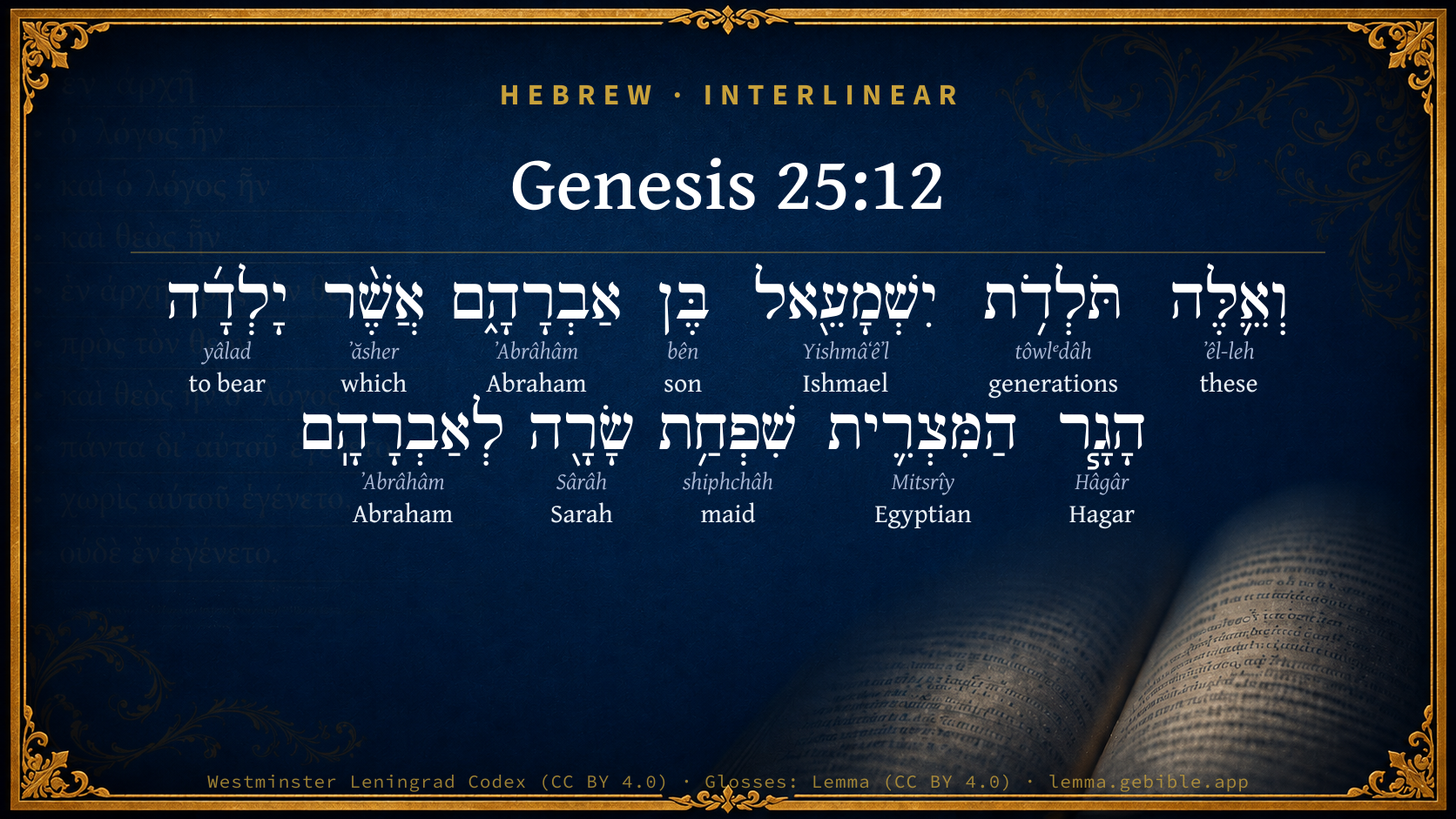
Hebrew (Westminster Leningrad Codex) Genesis 25:12 appears in the Hebrew Old Testament. The text above is from the Westminster Leningrad Codex. Each word links to its Strong’s number, a concise gloss, and parsing drawn from the Open Scriptures Hebrew Bible morphology. Click any word for its full Brown-Driver-Briggs (BDB) entry.
Download image
Cite this verse

Genesis 25:12 (World English Bible). Public Domain. Lemma interlinear Bible study tool, https://lemma.gebible.app/v/genesis/25/12.

Show BibTeX & RIS
BibTeX
RIS
English Translation
Now this is the history of the generations of Ishmael, Abraham's son, whom Hagar the Egyptian, Sarah's handmaid, bore to Abraham.
World English Bible · Public Domain
Download a study sheet

One document with this verse’s original text, its word-by-word gloss line, the meaning frame, cross-references with their text, attributed commentary, and full source and license credits — printable, and it pastes into notes with its structure intact.

This verse Autodidact and up

Study sheet (.html) Plain text (.txt)

A passage Seminary Student

Up to 50 verses in one chapter. A passage sheet keeps up to 6 commentary sources and 12 cross-references per verse, in the order this page ranks them, and says so on the sheet whenever that leaves anything out. Ask for a single verse and you get the Autodidact verse sheet above.

Everything on this page stays free to read, with no account — the sheet is a download of what is already on screen, not access to it.

Want to remove ads? Support Godless Engineer
Compare translations 3

The same verse in 3 English versions, stacked beneath the original-language interlinear above. Click any original word for its lexicon entry.

Each is an independent rendering of the whole verse — the interlinear is not word-aligned to these translations.

Highlighted words mark where these versions differ — a whole-verse word diff, not a word-by-word alignment.

  • World English Bible Public Domain
    Now this is the history of the generations of Ishmael, Abraham's son, whom Hagar the Egyptian, Sarah's handmaid, bore to Abraham.
  • King James Version Public Domain
    Now these are the generations of Ishmael, Abraham's son, whom Hagar the Egyptian, Sarah's handmaid, bare unto Abraham:
  • unfoldingWord Literal Text CC BY-SA 4.0
    Now these the generations of Ishmael the son of Abraham, whom Hagar the Egyptian, the maidservant of Sarah, had born for Abraham.

unfoldingWord Literal Text — © unfoldingWord, licensed CC BY-SA 4.0. Word-aligned USFM3 via Door43 (git.door43.org/unfoldingWord/en_ult).

Versions to compare (up to 4)

3 of 4 selected

Show all 18 translations

Every available English version of this verse, each an independent rendering of the whole verse.

  • World English Bible Public Domain
    Now this is the history of the generations of Ishmael, Abraham's son, whom Hagar the Egyptian, Sarah's handmaid, bore to Abraham.
  • Berean Standard Bible Public Domain
    This is the account of Abraham’s son Ishmael, whom Hagar the Egyptian, Sarah’s maidservant, bore to Abraham.
  • Majority Standard Bible Public Domain
    This is the account of Abraham’s son Ishmael, whom Hagar the Egyptian, Sarah’s maidservant, bore to Abraham.
  • King James Version Public Domain
    Now these are the generations of Ishmael, Abraham's son, whom Hagar the Egyptian, Sarah's handmaid, bare unto Abraham:
  • American Standard Version (1901) Public Domain
    Now these are the generations of Ishmael, Abraham's son, whom Hagar the Egyptian, Sarah's handmaid, bare unto Abraham.
  • Revised Version (1885) Public Domain
    Now these are the generations of Ishmael, Abraham’s son, whom Hagar the Egyptian, Sarah’s handmaid, bare unto Abraham:
  • Geneva Bible (1599) Public Domain
    Nowe these are the generations of Ishmael Abrahams sonne, whome Hagar the Egyptian Sarahs handmayde bare vnto Abraham.
  • Douay-Rheims (1899) Public Domain
    These are the generations of Ismael the son of Abraham, whom Agar the Egyptian, Sara's servant, bore unto him:
  • Young's Literal Translation Public Domain
    And these `are' births of Ishmael, Abraham's son, whom Hagar the Egyptian, Sarah's handmaid, hath borne to Abraham;
  • Literal Standard Version CC BY-SA 4.0
    And these [are] the generations of Ishmael, Abraham’s son, whom Hagar the Egyptian, Sarah’s handmaid, has borne to Abraham;
  • Unlocked Literal Bible CC BY-SA 4.0
    Now these were the descendants of Ishmael, Abraham's son, whom Hagar the Egyptian, Sarah's servant, bore to Abraham.
  • unfoldingWord Literal Text CC BY-SA 4.0
    Now these the generations of Ishmael the son of Abraham, whom Hagar the Egyptian, the maidservant of Sarah, had born for Abraham.
  • Darby Bible Public Domain
    And these are the generations of Ishmael, Abraham's son, whom Hagar the Egyptian, Sarah's bondwoman, bore to Abraham.
  • World Messianic Bible Public Domain
    Now this is the history of the generations of Ishmael, Abraham’s son, whom Hagar the Egyptian, Sarah’s servant, bore to Abraham.
  • Webster's Bible Public Domain
    Now these are the generations of Ishmael, Abraham's son, whom Hagar the Egyptian, Sarah's handmaid, bore to Abraham.
  • Free Bible Version CC BY-SA 4.0
    This is the genealogy of Abraham's son Ishmael. His mother Hagar was Sarah's Egyptian slave.
  • Bible in Basic English Public Domain
    Now these are the generations of Ishmael, the son of Abraham, whose mother was Hagar the Egyptian, the servant of Sarah:
  • JPS Tanakh (1917) Public Domain
    Now these are the generations of Ishmael, Abraham's son, whom Hagar the Egyptian, Sarah's handmaid, bore unto Abraham.

Literal Standard Version (2020), Covenant Press — licensed CC BY-SA 4.0. Text via the HelloAO Bible API (eBible.org). Unlocked Literal Bible (unfoldingWord) — licensed CC BY-SA 4.0. Text via the HelloAO Bible API (eBible.org). unfoldingWord Literal Text — © unfoldingWord, licensed CC BY-SA 4.0. Word-aligned USFM3 via Door43 (git.door43.org/unfoldingWord/en_ult). Free Bible Version, Dr. Jonathan Gallagher — licensed CC BY-SA 4.0. Text via the HelloAO Bible API (eBible.org).

Word by word

More ways to search: Search by grammar → Find every occurrence → Compare this word →

Practice this passage: Drill this verse → Learn its vocabulary →

About this verse

These counts appear in no published source. They are computed here, from the morphology-tagged text and Lemma’s own curated glosses. What Lemma adds →

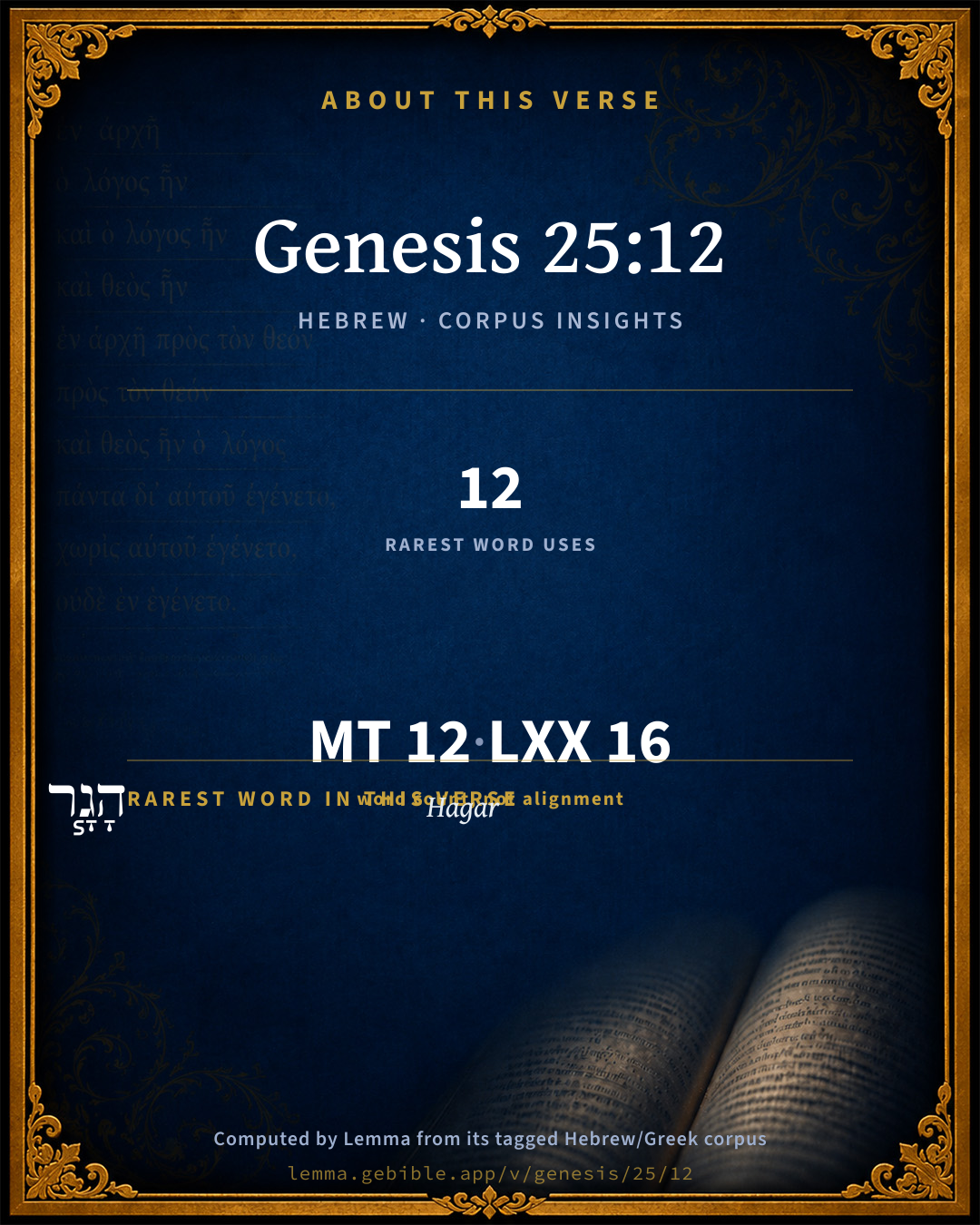
12
words
11
distinct lemmas
Pentateuch
section

Notable vocabulary

The rarest word here is הָגָ֧ר Hagar H1904 — appearing just 12 times in the whole Hebrew Bible.

Shared distinctive vocabulary

הָגָ֧ר Hagar H1904 occurs in 10 verses of the Hebrew Bible. Also found in:

Grammatical profile

  • 1 verb
  • 9 nouns
  • 1 pronoun
  • 1 particle

Verb forms

  • יָלְדָ֜ה Qal · Perfect

Repetition

A word recurs within this verse — often emphatic in Hebrew:

  • אַבְרָהָ֑ם Abraham H85 ×2

Hebrew & Septuagint length

In English translation the verse runs 21 words from the Hebrew and 22 from the Septuagint (LXX English) — closely comparable.

A rough comparison of the two English renderings, which tokenize alike — not a word-level alignment.

Word counts can differ between the Hebrew and the Greek without any difference in meaning — e.g. the Hebrew direct-object marker אֵת has no separate Greek word, and Greek often adds the article ὁ.

In the original languages it is 12 Hebrew tokens and 16 Greek tokens — but the two are counted differently (Hebrew bundles its prefixes and suffixes into one token; the Greek is in lemma form), so that isn’t a like-for-like length.

Cross-references

4

Topical passages linked to Genesis 25:12 in the Treasury of Scripture Knowledge — connected by theme and wording, ordered by reader-vote popularity; previews shown in the World English Bible.

  • Psalms 83:6 The tents of Edom and the Ishmaelites; Moab, and the Hagrites;
  • Genesis 17:20 As for Ishmael, I have heard you. Behold, I have blessed him, and will make him fruitful, and will multiply him exceedingly. He will become the father of twelve princes, and I will make him a great nation.
  • Genesis 21:13 Also of the son of the handmaid will I make a nation, because he is your seed."
  • Genesis 16:10–15 The angel of Yahweh said to her, "I will greatly multiply your seed, that they will not be numbered for multitude."

Cross-references courtesy of OpenBible.info (CC BY 4.0).

Hebrew and Greek witnesses Masoretic Hebrew ↔ Greek Septuagint

The same verse in the two great witnesses to the Old Testament, shown verse-for-verse.

These are two independent witnesses, not word-aligned to each other, and the Septuagint is shown in lemma (dictionary) form.

Hebrew Genesis 25:12 Masoretic · Westminster Leningrad Codex

וְאֵ֛לֶּה תֹּלְדֹ֥ת יִשְׁמָעֵ֖אל בֶּן אַבְרָהָ֑ם אֲשֶׁ֨ר יָלְדָ֜ה הָגָ֧ר הַמִּצְרִ֛ית שִׁפְחַ֥ת שָׂרָ֖ה לְאַבְרָהָֽם

Now this is the history of the generations of Ishmael, Abraham's son, whom Hagar the Egyptian, Sarah's handmaid, bore to Abraham.

World English Bible · Public Domain

Greek LXX Genesis 25:12 Septuagint · lemma form

οὗτος δέ ὁ γένεσις ισμαηλ ὁ υἱός αβρααμ ὅς τίκτω αγαρ ὁ παιδίσκη σαρρα ὁ αβρααμ

And these are the generations of Ismael the son of Abraam, whom Agar the Egyptian the handmaid of Sarrha bore to Abraam.

LXX2012 (modern English Septuagint) · Public Domain

On this verse, Albert Barnes' Notes on the Bible discusses the Septuagint’s reading. Read the note in Commentary ↓

Hebrew: Westminster Leningrad Codex (CC BY 4.0). Greek: Septuagint (public domain); English from LXX2012 (modern English Septuagint) (Public Domain). How the Septuagint differs from the Hebrew →

Targum (Aramaic paraphrase)

2

The Targum is the ancient Jewish Aramaic paraphrase of the Hebrew Scriptures — an interpretive translation, not the Hebrew text itself. Onkelos (literal) and Pseudo-Jonathan (expansive) render the Torah, and Jonathan the Prophets. Coverage is partial: where no permissively-licensed English translation exists for a verse, only the Aramaic is shown. This is verse-level text, not a word-by-word alignment to the Hebrew.

  1. Targum Onkelos Torah (Genesis–Deuteronomy)
    וְאִלֵּין תּוּלְדַת יִשְׁמָעֵאל בַּר אַבְרָהָם דִּי יְלֵידַת הָגָר מִצְרֵתָא אַמְתָא דְשָׂרָה לְאַבְרָהָם

    (no public-domain English translation for this verse)

    Targum Onkelos — Aramaic: “Onkelos Genesis” (public domain); “Onkelos Exodus” (public domain); “Onkelos Leviticus” (public domain); “Onkelos Numbers” (public domain); “Onkelos Deuteronomy” (public domain). English: “Sefaria Community Translation” (CC0 1.0 (public-domain dedication)); “J.W. Etheridge. The Targums of Onkelos and Jonathan Ben Uzziel on the Pentateuch. London: Longmans, Green, 1862” (public domain). Text via Sefaria.

  2. Targum Pseudo-Jonathan Torah (Genesis–Deuteronomy)
    וְאִלֵין תּוּלְדַת יִשְׁמָעֵאל בַּר אַבְרָהָם דִילֵידַת הָגָר מִצְרֵיתָא אַמְתָא דְשָרָה לְאַבְרָהָם

    And these are the generations of Ishmael bar Abraham, whom Hagar the Mizreitha, the handmaid of Sarah, bare unto Abraham.

    Targum Pseudo-Jonathan — Aramaic: “Targum Jonathan on Genesis” (public domain); “Targum Jonathan on Exodus” (public domain); “Targum Jonathan on Leviticus” (public domain); “Targum Jonathan on Numbers” (public domain); “Targum Jonathan on Deuteronomy” (public domain). English: “The Targum of Jonathan ben Uzziel, trans. J. W. Etheridge, London, 1862” (public domain). Text via Sefaria.

Commentary

Notes on Genesis 25:12 from classic Christian and Jewish commentators (each source and its license shown beneath its notes). The classic Christian expositions comment on the surrounding passage and are grouped to its opening verse, so a note may address several verses; the Jewish commentaries on the Tanakh (Rashi and others) are per-verse, so they appear only where the commentator wrote on this verse.

Lemma curates 59 commentaries, every one of them public domain or Creative Commons licensed, each selected and text-cleaned for this edition rather than reprinted as found. About our sources →

Trapp's Complete Commentary

John Trapp

Gen 25:12 Now these [are] the generations of Ishmael, Abraham’s son, whom Hagar the Egyptian, Sarah’s handmaid, bare unto Abraham:

Ver. 12. These are the generations of Ishmael.] Who became the progenitor of twelve princes, according to the promise. {Gen 17:20}

John Trapp, A Commentary or Exposition upon All the Books of the Old and New Testament (1647–1656) — public domain. Text from a community e-Sword module.

Albert Barnes' Notes on the Bible

- Section XI. - Isaac

- LII. History of Ishmael

13. נבית nebāyot, Nebajoth, “heights.” קדר qēdār, Qedar, “black.” אדבאל 'adbe'ēl, Adbeel, “miracle of God?” מבשׂם mı̂bśām Mibsam, “sweet odor.”

14. משׁמע mı̂shma‛, Mishma‘, “hearing.” דוּמה dûmâh, Dumah, “silence.” משׂא maśā', Massa, “burden.”

15. חדר chădar, Chadar, “chamber;” or חדד chădad, Chadad, “sharpness;” תימא tēymā', Tema. יטוּר yeṭûr, Jetur, “enclosure,” akin to טוּר ṭûr, “a wall,” and טירה ṭı̂yrâh, “a wall.” נפישׁ nāpı̂ysh, Naphish, “breathing.” קדמה qēdemâh, Qedemah, “before, eastward.”

16. חצר chātsēr, “court, village, town.”

According to custom, before the history of the principal line is taken up, that of the collateral branch is briefly given. Thus, Cain’s history is closed before Sheth’s is commenced; Japheth and Ham are before Shem; Haran and Nahor before Abram. And so the sons of Keturah are first dismissed from the pages of history, and then Ishmael.

Gen 25:12

The present passage begins with the formula, “and these are the generations,” and forms the eighth document so commencing. The appearance of a document consisting of seven verses is clearly against the supposition that each of these documents is due to a different author. The phrase points to a change of subject, not of author.

Gen 25:13-16

Nebaioth - Isa 60:7 is preserved in the Nabataei inhabiting Arabia Petraea, and extending far toward the East. “Kedar” Isa 21:17 appears in the Cedrei of Pliny (H. N. 5, 12) who dwell east of Petraea. “Adbeel Mibsam,” and “Mishma are otherwise unknown. The last is connected with the Μαισαιμενεῖς Maisaimeneis of Ptol. (v. 7, 21). “Dumah” Isa 21:11 is probably Δούμεθα Doumetha (Ptol. vi. 19, 7) and Domata (Plin. H. N. 6, 32) and Dumat el-Jendel in Nejd and the Syrian desert. “Massa” may be preserved in the Μασανοὶ Masanoi of Ptolemy (v. 19, 2), northeast of Duma. “Hadar” is Hadad in 1Ch 1:30, the Samaritan Pentateuch, Onkelos, perhaps the Septuagint, and many codices. It is supposed to be Χαττηνία Chatteenia (Polyb.), Attene, and to lie between Oman and Bahrein. “Tema” Job 6:19; Isa 21:14; Jer 25:23 lay on the borders of Nejd and the Syrian desert. “Jetur” remains in Ituraea, Jedur, northeast of the sea of Galilee. Some suppose the Druses descended from him. “Naphish” 1Ch 6:19, 1Ch 6:22 lay in the same quarter. “Kedemah” is otherwise unknown. “In their towns and in their castles.” The former are unwalled collections of houses or perhaps tents; the latter, fortified keeps or encampments. “Twelve princes,” one for each tribe, descended from his twelve sons.

Gen 25:17-18

Ishmael dies at the age of a hundred and thirty-seven. “From Havilah,” on the borders of Arabia Petraea and Felix. “Unto Shur,” on the borders of Arabia and Egypt. This was the original seat of the Ishmaelites, from which they wandered far into Arabia. “In the presence of all his brethren” - the descendants of Abraham by Sarah and Keturah, those of Lot, and the Egyptians who were his brethren or near kindred by his mother and wife. “He had fallen” into the lot of his inheritance. Thus was fulfilled the prediction uttered before his birth Gen 16:12.

Albert Barnes' Notes on the Bible (1834–1885) — public domain. Text from a community e-Sword/MySword module.

The Biblical Illustrator

Joseph S. Exell

Gen_25:12-18

These are the generations of Ishmael

I.

The generations of Ishmael

I. THAT THOSE WHO ARE NOT APPOINTED TO THE MOST HONOURABLE PLACE ARE YET CARED FOR BY PROVIDENCE.

II. THAT PROVIDENCE AFFORDS ENCOURAGEMENTS FOR THE SUPPORT OF FAITH AND VIRTUE.

III. THAT THE FAITHFULNESS OF PROVIDENCE MAY BE PROVED ON DIFFERENT LINES. Past and present condition of

(1) Jews,

(2) Ishmaelites. (T. H. Leale.)

The genealogies of the wicked

1. The genealogies of the wicked, God sometimes recorded for His own glory and the sake of the Church (Gen_25:12).

2. God doth by name punctually perform His promise unto His servants, though it be concerning the wicked.

3. God doth vouchsafe a more abundant seed sometimes to the children of the flesh than to the children of the promise. Ishmael hath many sons, it is long till Isaac hath any.

4. Great dignities, commands, and powers below God doth cast upon bondmen in the Church (Gen_25:16). One drachm of grace is above monarchies.

5. A long age may betide an Ishmael, but not a good one.

6. A like death may seem to be both to the righteous and the wicked, but it is not so in truth.

7. The wicked in death are gathered to their people as well as the righteous unto theirs (Gen_25:17).

8. God giveth the lot of habitation, motion and cessation unto the worst of men on earth (Gen_25:18). (G. Hughes, B. D.)

The Biblical Illustrator, edited by Joseph S. Exell (c. 1880s–1900s) — public domain. Text from a community e-Sword module.

Whedon's Commentary on the Bible

Daniel D. Whedon

Generations of Ishmael, Gen_25:12-18.

12. These are the generations — This is the eighth section so beginning. “According to custom,” says Murphy, “before the history of the principal line is taken up, that of the collateral branch is briefly given. Thus Cain’s history is closed before Seth’s is commenced; Japheth and Ham are before Shem; Haran and Nahor before Abram. And so the sons of Keturah are first dismissed from the pages of history, and then Ishmael.”

Daniel D. Whedon (gen. ed.), Commentary on the Old and New Testaments (1874–1909) — public domain. Text from a community e-Sword module.

The Pulpit Commentary

THE GENERATIONS OF ISHMAEL. (Gen_25:12-18)

CHAPTER 25:12-18

Now these are the generations of Ishmael, the opening of a new section, (cf. Gen_2:4) in which the fortunes of Abraham"s eldest son are briefly traced before proceeding with the main current of the history in the line of Isaac (cf. 1Ch_1:29-31) Abraham"s son, because of his relation to Abraham it was that Ishmael attained subsequent historical development and importance (vide Gen_21:13) whom Hagar the Egyptian, Sarah"s handmaid, bare unto Abraham. (vide Gen_16:1, Gen_16:15)

HOMILETICS.

Vers. 12-18.

The generations of Ishmael, or the biography of a prince.

I THE PRINCE"S NAME. Ishmael.

1. The significance of his name. "God hears." It was thus a perpetual reminder to its bearer of a grand religious truth, that God is essentially a hearer of prayer, and that he is never far from any of his intelligent and needy creatures.

2. The occasion of his getting it.

(1) Before his birth, because the Lord had heard the affliction of his mother.

(2) At his birth, because his father believed the report of Hagar concerning the instruction of the angel.

3. The verification of his name. When he lay beneath the shrub God heard the voice of his distressful cry. (Gen_21:17)

II THE PRINCE"S LINEAGE. Abraham"s son. That

(1) Proclaimed his dignity. Though not a prince in the Church, he was a prince in the world, being Abraham"s immediate descendant, Grace runs not in the blood, earthly rank does.

(2) Bespoke his privilege. Jehovah reckoned it a great thing for Ishmael that he was Abraham"s seed. To be the offspring of those who are exalted in earthly station is a special honor, though not so great an honor as to be descended from those who are eminent in grace.

(3) Implied his responsibility. Degrees of rank in society are of God"s ordaining, and involve the recipients thereof in corresponding obligations. (Luk_12:48)

III THE PRINCE"S FAMILY.

1. Princely in rank. This quality they received by birth, being Ishmael s sons.

1. Many in number. They were twelve princes, and as such they developed into large and flourishing tribes and nations. This characteristic was due to

2. grace, God having promised that kings and nations should spring from Hagar"s son.

3. Influential in power. The twelve princes mentioned were powerful chieftains of as many clans.

IV THE PRINCE"S DEATH.

1. The time. At 137 years. The days of all, even of princes, in this life are numbered.

2. The manner. "He expired." "There is no man that hath power over the spirit to retain the spirit" in the day of his death.

3. The result. "He was gathered unto his people," passing to the company of those who were like-minded with himself in the unseen world, as Abraham went to enjoy the society of those who were of kindred spirit with him.

V THE PRINCE"S DOMINIONS. "His lot was cast in the presence of all his brethren," i.e. his empire was

1. Outside of Canaan. He had no part or lot in the inheritance of Isaac. Neither have the world s princes as such any share in the heritage of heaven"s peers.

2. Among the tribes of earth. And so the worldly man"s portion is of the earth, earthy.

See

1. How comparatively unimportant the world"s biographies are in the judgment of the Spirit.

2. How the children of the wicked often outnumber the offspring of the pious.

3. How it is appointed unto all men once to die, though not to all to die alike.

4. How certain it is that the wicked and the good shall be separated after death, since at death both are gathered unto their respective peoples. 5. How clearly and minutely God fulfils the promises he makes to wicked men no less than to good.

THE GENERATIONS OF ISAAC. (Gen 25:19-35:29)

CHAPTER 25:19-26

And these are the generations of Isaac, Abraham"s son. The usual formula for the opening of a new section (cf. Gen_2:4) Abraham begat Isaac. A reiteration in perfect harmony not only with the style of the present narrative, but of ancient historiography in general; in this instance specially designed to connect the subsequent streams of Isaac"s posterity with their original fountain-head in Abraham.

The Pulpit Commentary (1880–1919), ed. H.D.M. Spence-Jones & Joseph S. Exell — public domain. Text from a community e-Sword module.

The Preacher's Complete Homiletical Commentary

Joseph S. Exell (gen. ed.)

CRITICAL NOTES.—

Gen_25:12. These are the generations.] Forms the eighth document so commencing.—

Gen_25:16. By their towns, and by their castles.] “The former are unwalled collections of houses or perhaps tents; the latter fortified keeps or encampments.” (Murphy.) Kalish renders the clause, “By their villages and by their tents.” The Arabs are divided into two classes, the wandering Bedouins, living in tents; and those who dwell in towns and villages.—

Gen_25:17. The years of the life of Ishmael; an hundred and thirty and seven years; and he gave up the ghost and died, and was gathered unto his people.] Ishmael’s death is here recorded by anticipation. It happened forty-eight years after Abraham’s death, and when Isaac was one hundred and twenty-three years old.—

Gen_25:18. He died in the presence of all his brethren.] Heb. He fell, or, it fell to him. The meaning seems to be, he had settled down, or, fallen into the lot of his inheritance, according to the prediction. (Gen_16:12.) He was unsubjugated by his brethren though dwelling beside them.—

MAIN HOMILETICS OF THE PARAGRAPH.—Gen_25:12-18

THE GENERATIONS OF ISHMAEL

This history illustrates the following truths:—

I. That those who are not appointed to the most honourable place are yet cared for by Providence. Ishmael was rejected as heir to the birthright, yet God was providing great things for him in the future. A mighty nation ruled by princes was to spring from him. Their roving and military character, their persistence, in spite of enemies and perpetual wars, is an evidence of their wonderful vitality. The control and the favours of Providence were not confined to the chosen people. God’s dealings with the human race reveal the benevolent equity of Providence.

II. That Providence affords encouragements for the support of faith and virtue. The full accomplishment of the prophecies regarding Ishmael was not yet, for they stretched over long periods of time. But they were in course of being fulfilled. Events were opening up and pointing to the end indicated by prophecy. Already twelve princes, with their sovereignties, had sprung from Ishmael (Gen_25:16). According to the promise made to Hagar, Ishmael died in the presence of all his brethren (Ch. Gen_16:12). Thus the first steps were taken towards the fulfilment of those promises made to his mother to sustain her drooping spirits, and to his father to reconcile him to the casting out of his first-born son (Gen_16:10-12; Gen_21:18; Gen_17:20; Gen_21:13). God fulfils so much of His word as is necessary for the encouragement of his people. They have an earnest of their inheritance, and find that in keeping, as well as after keeping His commandments there is great reward.

III. That the faithfulness of Providence may be proved on different lines. We point to the past and present condition of the Jews as proofs of the truth of the Bible. We have a proof equally strong in the past and present condition of the descendants of Ishmael. The inextinguishable life of this people is a perpetual witness to the faithful word of God. These are converging lines, all pointing to the truth of Revelation.

SUGGESTIVE COMMENTS ON THE VERSES

Gen_25:12. The historian, having adverted to the blessing of God upon Isaac, here pauses before proceeding with the sequel of his history to show how exactly the promises made to Ishmael (Ch. Gen_17:20) were also fulfilled. His descendants, like those of Isaac, branched out into twelve tribes, and constituted the bulk of the population which spread over the Arabian peninsula.—(Bush.)

Gen_25:13-16. Twelve princes, princes of their tribes, as was promised (Gen_17:20). See here what God can do for a poor boy sent out with a bottle of water on his back. God “setteth the solitary in families” (Psa_68:6). “He raiseth the poor out of the dust, and lifteth up the beggar from the dunghill, to set him among princes” (1Sa_2:8).—(Trapp.)

Gen_25:17. Ishmael lived an hundred and thirty-seven years. His death is here recorded by anticipation. It took place forty-eight years after Abraham’s death, and when Isaac was one hundred and twenty-three years old. We may suppose that Ishmael died in the faith of his father Abraham, according to the patriarch’s prayer for him.—(Jacobus.)

Gen_25:18. He had his dwelling and the territory of his descendants alongside of his brethren, and unsubjugated by them.—(Jacobus.)

The Preacher's Complete Homiletical Commentary (gen. ed. Joseph S. Exell; Funk & Wagnalls, c. 1892) — public domain (pre-1929). A full-Bible homiletical/sermon-outline anthology covering 65 of 66 books (2 John is absent from the source module). Text from a community e-Sword module.

The Annotated Bible

Arno C. Gaebelein

VIII. THE GENERATIONS OF ISHMAEL

1. Ishmael and his sons (Gen 25:12-16)

2. The death of Ishmael (Gen 25:17-18)

In chapter 16:12 we find the prediction that Ishmael should dwell in the presence of his brethren. In Gen 25:18 we find the fulfilment. The names we find here may be traced in other Scriptures. For instance in Isaiah 60, the great chapter of the millennial kingdom, we have Nebajoth and Kedar mentioned (Isa 60:7). The number twelve, twelve princes, links Ishmael closely with Israel. When Israel is blest in the future and receives the promised Land for his glorious possession, the posterity of Ishmael will not be forgotten.

Arno C. Gaebelein, The Annotated Bible (1913–1922) — public domain. Text from a community e-Sword module.

Tyndale Open Study Notes

Tyndale Open Resources

25:12-18 This record lists Ishmael’s descendants before tracing Isaac’s (25:19–35:29), which is in keeping with the literary arrangement of Genesis (see Genesis Book Introduction, “Summary”).

Tyndale Open Study Notes — © Tyndale Open Resources, licensed CC BY-SA 4.0. Text via the HelloAO Bible API.

Adam Clarke's Commentary

Verse 12. These are the generations of Ishmael] The object of the inspired writer seems to be to show how the promises of God were fulfilled to both the branches of Abraham's family. Isaac has been already referred to; God blessed him according to the promise. He had also promised to multiply Ishmael, and an account of his generation is introduced to show how exactly the promise had also been fulfilled to him.

Adam Clarke's Commentary on the Bible (1810–1826) — public domain. Text from a community e-Sword/MySword module.

John Calvin's Commentaries

12. Now these are the generations of Ishmael. This narration is not superfluous. In the commencement of the chapter, Moses alludes to what was done for the sons of Keturah. Here he speaks designedly more at large, for the purpose of showing that the promise of God, given in the seventeenth chapter (Genesis 17:1-22,) was confirmed by its manifest accomplishment. In the first place, it was no common gift of God that Ishmael should have twelve sons who should possess rank and authority over as many tribes; but inasmuch as the event corresponded with the promise, we must chiefly consider the veracity of God, as well as the singular benevolence and honor which he manifested towards his servant Abraham, when, even in those benefits which were merely adventitious, he dealt so kindly and liberally with him; for that may rightly be regarded as adventitious which was superadded to the spiritual covenant: therefore Moses, after he has enumerated the towns in which the posterity of Ishmael was distributed, buries that whole race in oblivion, that substantial perpetuity may remain only in the Church, according to the declaration in Psalm 102:28, “the sons of sons shall inhabit.” Further, Moses, as with his finger, shows the wonderful counsel of God, because, in assigning a region distinct from the land of Canaan to the sons of Ishmael, he has both provided for them in future, and kept the inheritance vacant for the sons of Isaac.

John Calvin's Commentaries (1540-1563) — public domain. Text from the Calvin Translation Society English edition (1840s-50s) via the Christian Classics Ethereal Library (ccel.org). Calvin's coverage is partial (roughly two-thirds of the Bible); uncommented books and verses are honest gaps, never fabricated. The 19th-century editor's footnotes and remarks are omitted so the notes are faithfully Calvin's own voice.

Ellicott's Commentary for English Readers

THE TÔLDÔTH ISHMAEL.

(12) These are the generations of Ishmael.—Following the usual rule of this book, Ishmael is not dismissed from the Divine presence without a short record of his history, after which he falls into the background, and the historian proceeds with his main subject, which is the preparation for the forming of that race and nation of whom, according to the flesh, Christ came. These brief notices, moreover, of personages not in the direct line of Christ’s ancestry have their value in God’s great purpose that the Jewish Messiah should be the Redeemer of the Gentiles also (Rom_10:12); and consequently from the first their history was not alien from God’s counsels. (Rom_10:13-15) The sons of Ishmael.—Of the Arabian tribes sprung from Ishmael we read of Nebajoth and Kedar in Isa_60:7 as pastoral tribes, rich in flocks. Dumah is deemed worthy of a special prophecy (Isa_21:11); while the people of Tema are described there in Gen_25:14 as generous and hospitable, and in Job_6:19 they appear as active traders. (See also Jer_25:23.) Jetur, Naphish, and other Hagarite tribes, were conquered by Reuben and his allies (1Ch_5:19), and Jetur became the Iturea of Luk_3:1. For the occasional references made to these and other sons of Ishmael in classical writers, the reader may consult Smith’s Dictionary of the Bible, or similar works. The abode of the twelve tribes sprung from Ishmael was the northern part of Arabia, whence gradually they extended their influence, and apparently soon absorbed the Joktanites (Gen_10:26-30), themselves a kindred Semitic race. These genealogies would be inexplicable if we did not remember that successive waves of people occupied these lands, and that while the old names remained, the dominant race was new. So the rapid growth of individuals into tribes (as of Midian, Gen_25:2) was the result of races of higher civilisation and greater energy subduing feeble and less highly-developed tribes. Hence in Gen_25:16 the sons of Ishmael are called “princes.” We gather from this that Ishmael had gathered round him a body of men of the Semitic race, of whom large numbers were constantly on the move towards Egypt (Gen_12:15), and by their aid had established his rule in Paran, and handed it on to his sons.

A Bible Commentary for English Readers, edited by Charles John Ellicott (1878–1897) — public domain. Text from a community e-Sword module.

The Cambridge Bible for Schools and Colleges

gen. ed. J. J. S. Perowne

12. Now these are the generations] Cf. Gen_5:1, Gen_6:9, Gen_10:1, Gen_11:10; Gen_11:27 (P).

12–18 (P). The Descendants of Ishmael

The genealogy of Ishmael is thus disposed of, before the narrative resumes the history of the Chosen Family in the generations of Isaac (Gen_25:19). It is to be noticed that the sons of Ishmael are twelve in number, like the sons of Nahor (Gen_22:21-24) and of Jacob.

The Cambridge Bible for Schools and Colleges (gen. ed. J. J. S. Perowne; Cambridge University Press, 1878–1918) — public domain. Text from a community e-Sword module.

John Gill's Exposition

Now these are the generations of Ishmael, Abraham's son,.... Or the genealogy of his posterity; and which is given to show that the Lord was not unmindful of his promise made to Abraham, concerning the multiplication of his seed, Gen 16:10,

whom Hagar the Egyptian, Sarah's handmaid, bare unto Abraham; see Gen 16:1.

John Gill's Exposition of the Whole Bible (1746–1763) — public domain (CC PDM 1.0). Text via the HelloAO Bible API.

Matthew Poole's English Annotations

They are here recorded as an evidence of God’s faithfulness in fulfilling his promise made to Abraham, Gen 16:10; 17:20. cir. 1800

Matthew Poole's English Annotations on the Holy Bible (1683–1685) — public domain. Text from a community e-Sword/MySword module.

Keil & Delitzsch

C. F. Keil & F. Delitzsch

To show that the promises of God, which had been made to Ishmael (Gen 16:10. and Gen 17:20), were fulfilled, a short account is given of his descendants; and according to the settled plan of Genesis, this account precedes the history of Isaac. This is evidently the intention of the list which follows of the twelve sons of Ishmael, who are given as princes of the tribes which sprang from them. Nebajoth and Kedar are mentioned in Isa 60:7 as rich possessors of flocks, and, according to the current opinion which Wetzstein disputes, are the Nabataei et Cedrei of Pliny (h. n. 5, 12). The Nabataeans held possession of Arabia Petraea, with Petra as their capital, and subsequently extended toward the south and north-east, probably as far as Babylon; so that the name was afterwards transferred to all the tribes to the east of the Jordan, and in the Nabataean writings became a common name for Chaldeans (ancient Babylonians), Syrians, Canaanites, and others. The Kedarenes are mentioned in Isa 21:17 as good bowmen. They dwelt in the desert between Arabia Petraea and Babylon (Isa 42:11; Psa 120:5). According to Wetzstein, they are to be found in the nomad tribes of Arabia Petraea up to Harra. The name Dumah, Δούμεθα Αουμαίθα (Ptol. v. 19, 7, Steph. Byz.), Domata (Plin. 6, 32), has been retained in the modern Dumat el Jendel in Nejd, the Arabian highland, four days' journey to the north of Taima. - Tema: a trading people (Job 6:19; Isa 21:14; mentioned in Jer 25:23, between Dedan and Bus) in the land of Taima, on the border of Nejd and the Syrian desert. According to Wetzstein, Dma and Tma are still two important places in Eastern Hauran, three-quarters of an hour apart. Jetur and Naphish were neighbours of the tribes of Israel to the east of the Jordan (Ch1 5:19), who made war upon them along with the Hagrites, the Αγραῖοι of Ptol. and Strabo. From Jetur sprang the Ituraeans, who lived, according to Strabo, near the Trachonians in an almost inaccessible, mountainous, and cavernous country; according to Wetzstein, in the mountains of the Druses in the centre of the Hauran, possibly the forefathers of the modern Druses. The other names are not yet satisfactorily determined. For Adbeel, Mibsam, and Kedma, the Arabian legends give no corresponding names. Mishma is associated by Knobel with the Μαισαιμανείς of Ptol. vi. 7, 21, to the N.E. of Medina; Massa with the Μασανοί on the N.E. of Duma; Hadad (the proper reading for Hadar, according to Ch1 1:30, the lxx, Sam., Masor., and most MSS) with the Arabian coast land, Chathth, between Oman and Bahrein, a district renowned for its lancers (Χαττηνία, Polyb.; Attene, Plin.).

Gen 25:16

These are the Ishmaelites "in their villages and encampments, twelve princes according to their tribes." חצר: premises hedged round, then a village without a wall in contrast with a walled town (Lev 25:31). טירה: a circular encampment of tents, the tent village of the Dur of the Bedouins. אמּות, here and Num 25:15, is not used of nations, but of the tribe-divisions or single tribes of the Ishmaelites and Midianites, for which the word had apparently become a technical term among them.

Gen 25:17-18

Ishmael died at the age of 137, and his descendants dwelt in Havilah - i.e., according to Gen 10:29, the country of the Chaulotaeans, on the borders of Arabia Petraea and Felix - as far as Shur (the desert of Jifar, Gen 16:7) to the east of Egypt, "in the direction of Assyria." Havilah and Shur therefore formed the south-eastern and south-western boundaries of the territories of the Ishmaelites, from which they extended their nomadic excursions towards the N.E. as far as the districts under Assyrian rule, i.e., to the lands of the Euphrates, traversing the whole of the desert of Arabia, or (as Josephus says, Ant. i. 12, 4) dwelling from the Euphrates to the Red Sea. Thus, according to the announcement of the angel, Ishmael "encamped in the presence of all his brethren." נפל, to throw one's self, to settle down, with the subordinate idea of keeping by force the place you have taken (Jdg 7:12). Luther wavers between corruit, vel cecidit, vel fixit tabernaculum.

Keil & Delitzsch — Biblical Commentary on the Old Testament (1861–1891) — public domain (CC PDM 1.0). Text via the HelloAO Bible API. (Old Testament only.)

Kretzmann's Popular Commentary

Paul E. Kretzmann

The Generations of Ishmael

v. 12. Now these are the generations of Ishmael, Abraham’s son, whom Hagar, the Egyptian, Sarah’s handmaid, bare unto Abraham. We have here the final account of Ishmael and a short summary of his family’s history.

v. 13. And these are the names of the sons of Ishmael by their names, according to their generations: the first-born of Ishmael, Nebajoth; and Kedar, and Adbeel, and Mibsam,

v. 14. and Mishma, and Dumah, and Massa,

v. 15. Hadar, and Tema, Jetur, Naphish, and Kedemah.

v. 16. These are the sons of Ishmael, and these are their names by their towns and by their castles; twelve princes according to their nations. As the Lord had promised Hagar, so it came to pass: twelve princes were begotten of her son Ishmael, twelve mighty sheiks of powerful tribes, the names of some of which were preserved for many centuries. Thus the descendants of Nebajoth and Kedar lived in Arabia Petraea, on the Peninsula of Sinai, and beyond, Isa 60:7, the Kadarenes afterward extending toward the east in the direction of Babylonia, Isa 42:11; Psa 120:5. The other Iahmaelitic tribes do not seem to have been so large and mighty, still there are references, also in Scripture, which place them into the great country on the east side of Jordan. Twelve princes they were in their tribes, governing and representing twelve tribes, with their permanent, walled camps, or cities, and their temporary encampments, with their fixed and movable habitations.

v. 17. And these are the years of the life of Ishmael, an hundred and thirty and seven years; and he gave up the ghost and died; and was gathered unto his people. Although Ishmael, the son of the slave woman, is represented in Scriptures as a type of the fleshly, the Spirit of God finally gained and kept the ascendancy in him. He also died in the faith and was added to the number of those that trusted in the Messiah and His salvation.

v. 18. And they dwelt from Havilah unto Shur, that is before Egypt, as thou goest toward Assyria; and he died in the presence of all his brethren. That was the extent of the Ishmaelites’ territory in later years, from the stream of Egypt on the southwest and Havilah in Arabia Deserta on the southeast to the Euphrates on the northeast. So Ishmael, in his descendants, fell upon, settled, took possession of, this country, in the presence of, next to his brethren, on the boundary of the Promised Land.

Paul E. Kretzmann, Popular Commentary of the Bible (1921–1924) — public domain. Text from a community e-Sword module.

unfoldingWord translationNotes

Door43 World Missions Community

Now

This word is used in English to introduce a new part of the story and information about Ishmael.

translationWords

descend

Ishmael

Hagar

Egypt

servant

unfoldingWord translationNotes — © Distant Shores Media and the Door43 World Missions Community, licensed CC BY-SA 4.0. Source: git.door43.org/Door43/en_tn.

Radak

Rabbi David Kimhi (Radak)

ואלה תלדות ישמעאל, the Torah mentions Ishmael’s descendants as a tribute to his father Avraham, seeing he had been Avraham’s firstborn son. The Torah also wanted to inform us that Ishmael produced 12 princes in accordance with the promise made to Avraham by G’d.

The repetition of the fact that אשר ילדה הגר, was to emphasise that although Ishmael had been the son of a slave-woman, he rose to such eminence. Avraham loved him because he was his firstborn son, and G’d blessed him on account of Avraham, and this was why He made him so successful. (compare 21,20)

Radak on the Tanakh — English translations: “Sefaria Community Translation” (CC0 1.0 (public-domain dedication)); “Eliyahu Munk, HaChut Hameshulash” (CC BY 4.0); “Rabbi Mike Feuer, Jerusalem Anthology” (CC BY 4.0); and “R. David Kimhi on the first book of Psalms, Translated by R.G. Finch, London, 1919” (public domain). Text via Sefaria.

Lesson kit

Teaching starters — assembled from the data on this page, not authored interpretation. Every prompt links to the verse data it draws on. Edit before teaching.

Genesis, in the Pentateuch, opens this verse with 12 words (11 distinct Hebrew lemmas). Its most distinctive word is Hâgâr (“Hagar”). A historical commentator’s framing appears above. Read the whole chapter for the surrounding context.

Discussion questions

  1. The word Hâgâr carries the sense “Hagar.” How does it shape the verse?
  2. Genesis 16:1 shares the word «Hagar» with this verse. How do the two illuminate each other?
  3. “Abraham” occurs 2× in this one verse. What is the effect of the repetition?
  4. The translations on this page render this verse differently — a whole-verse word diff, not a word-by-word alignment. What might account for the different wordings?
  5. The verb «יָלְדָ֜ה» is Qal Perfect. How does its form color the action?
  6. Reading how Trapp's Complete Commentary and Albert Barnes' Notes on the Bible read this verse, where do the two commentators agree and where do they part?

Things to notice

Reading settings

Reading text

Shown beneath each verse's original-language words.

Old Testament
Old Testament edition

Read the OT as the Masoretic Hebrew (MT) or the Greek Septuagint (LXX).

English shown for the Greek Septuagint (in the Hebrew ↔ Greek comparison).

Comparing translations? Open the Compare panel on any verse page to stack up to four side by side.