2 Samuel 3:2

Hebrew (Westminster Leningrad Codex) 2 Samuel 3:2 appears in the Hebrew Old Testament. The text above is from the Westminster Leningrad Codex. Each word links to its Strong’s number, a concise gloss, and parsing drawn from the Open Scriptures Hebrew Bible morphology. Click any word for its full Brown-Driver-Briggs (BDB) entry.
Download image
Cite this verse

2 Samuel 3:2 (World English Bible). Public Domain. Lemma interlinear Bible study tool, https://lemma.gebible.app/v/2-samuel/3/2.

Show BibTeX & RIS
BibTeX
RIS
English Translation
To David were sons born in Hebron: and his firstborn was Amnon, of Ahinoam the Jezreelitess;
World English Bible · Public Domain
Highlights
  • 1 first appearance in the Hebrew Bible
Full analysis ↓
Download a study sheet

One document with this verse’s original text, its word-by-word gloss line, the meaning frame, cross-references with their text, attributed commentary, and full source and license credits — printable, and it pastes into notes with its structure intact.

This verse Autodidact and up

Study sheet (.html) Plain text (.txt)

A passage Seminary Student

Up to 50 verses in one chapter. A passage sheet keeps up to 6 commentary sources and 12 cross-references per verse, in the order this page ranks them, and says so on the sheet whenever that leaves anything out. Ask for a single verse and you get the Autodidact verse sheet above.

Everything on this page stays free to read, with no account — the sheet is a download of what is already on screen, not access to it.

Want to remove ads? Support Godless Engineer
Compare translations 3

The same verse in 3 English versions, stacked beneath the original-language interlinear above. Click any original word for its lexicon entry.

Each is an independent rendering of the whole verse — the interlinear is not word-aligned to these translations.

Highlighted words mark where these versions differ — a whole-verse word diff, not a word-by-word alignment.

  • World English Bible Public Domain
    To David were sons born in Hebron: and his firstborn was Amnon, of Ahinoam the Jezreelitess;
  • King James Version Public Domain
    And unto David were sons born in Hebron: and his firstborn was Amnon, of Ahinoam the Jezreelitess;
  • unfoldingWord Literal Text CC BY-SA 4.0
    Now sons were born to David in Hebron. And his firstborn was Amnon, to Ahinoam the Jezreelitess.

unfoldingWord Literal Text — © unfoldingWord, licensed CC BY-SA 4.0. Word-aligned USFM3 via Door43 (git.door43.org/unfoldingWord/en_ult).

Versions to compare (up to 4)

3 of 4 selected

Show all 18 translations

Every available English version of this verse, each an independent rendering of the whole verse.

  • World English Bible Public Domain
    To David were sons born in Hebron: and his firstborn was Amnon, of Ahinoam the Jezreelitess;
  • Berean Standard Bible Public Domain
    And sons were born to David in Hebron: His firstborn was Amnon, by Ahinoam of Jezreel;
  • Majority Standard Bible Public Domain
    And sons were born to David in Hebron: His firstborn was Amnon, by Ahinoam of Jezreel;
  • King James Version Public Domain
    And unto David were sons born in Hebron: and his firstborn was Amnon, of Ahinoam the Jezreelitess;
  • American Standard Version (1901) Public Domain
    And unto David were sons born in Hebron: and his first-born was Amnon, of Ahinoam the Jezreelitess;
  • Revised Version (1885) Public Domain
    And unto David were sons born in Hebron: and his firstborn was Amnon, of Ahinoam the Jezreelitess;
  • Geneva Bible (1599) Public Domain
    And vnto Dauid were children borne in Hebron: and his eldest sonne was Amnon of Ahinoam the Izreelite,
  • Douay-Rheims (1899) Public Domain
    And sons were born to David in Hebron: and his firstborn was Amnon of Achinoam the Jezrahelitess:
  • Young's Literal Translation Public Domain
    And there are born to David sons in Hebron, and his first-born is Amnon, of Ahinoam the Jezreelitess,
  • Literal Standard Version CC BY-SA 4.0
    And there are sons born to David in Hebron, and his firstborn is Amnon, of Ahinoam the Jezreelitess,
  • Unlocked Literal Bible CC BY-SA 4.0
    Sons were born to David in Hebron. His firstborn was Amnon, by Ahinoam from Jezreel.
  • unfoldingWord Literal Text CC BY-SA 4.0
    Now sons were born to David in Hebron. And his firstborn was Amnon, to Ahinoam the Jezreelitess.
  • Darby Bible Public Domain
    And to David were sons born in Hebron: his firstborn was Amnon, of Ahinoam the Jizreelitess;
  • World Messianic Bible Public Domain
    Sons were born to David in Hebron. His firstborn was Amnon, of Ahinoam the Jezreelitess;
  • Webster's Bible Public Domain
    And to David were sons born in Hebron: and his first-born was Amnon, of Ahinoam the Jezreelitess;
  • Free Bible Version CC BY-SA 4.0
    David's sons born at Hebron were: Amnon (firstborn), by Ahinoam from Jezreel;
  • Bible in Basic English Public Domain
    While David was in Hebron he became the father of sons: the oldest was Amnon, son of Ahinoam of Jezreel;
  • JPS Tanakh (1917) Public Domain
    And unto David were sons born in Hebron; and his first-born was Amnon, of Ahinoam the Jezreelitess;

Literal Standard Version (2020), Covenant Press — licensed CC BY-SA 4.0. Text via the HelloAO Bible API (eBible.org). Unlocked Literal Bible (unfoldingWord) — licensed CC BY-SA 4.0. Text via the HelloAO Bible API (eBible.org). unfoldingWord Literal Text — © unfoldingWord, licensed CC BY-SA 4.0. Word-aligned USFM3 via Door43 (git.door43.org/unfoldingWord/en_ult). Free Bible Version, Dr. Jonathan Gallagher — licensed CC BY-SA 4.0. Text via the HelloAO Bible API (eBible.org).

Word by word

More ways to search: Search by grammar → Find every occurrence → Compare this word →

Practice this passage: Drill this verse → Learn its vocabulary →

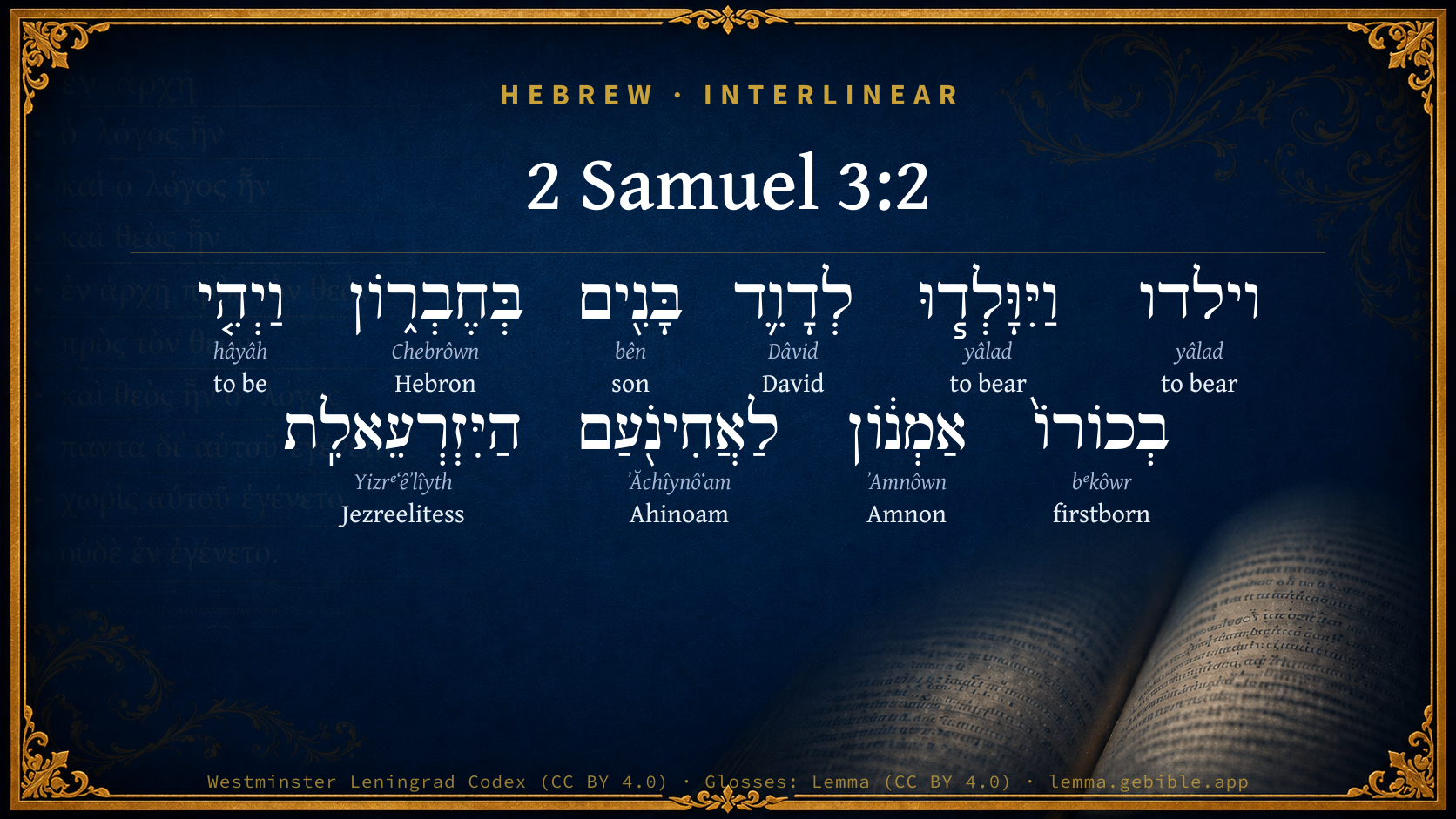
הַיִּזְרְעֵאלִֽת
Yizrᵉʻêʼlîyth
H3159
“the · Jezreelitess”
Particle, Definite Article + Noun, Gentilic, Feminine, Singular, Absolute
Part of Speech
Particle + Noun
Type
Gentilic
Gender
Feminine
Number
Singular
State
Absolute
Full BDB Definition

Origin: from H3158

TWOT: None

Jezreelitess = see Jezreel " sown of God" - a female inhabitant of Jezreel - used only of Ahinoam, a wife of David
  1. וילדו yâlad H3205 “and · to bear” Conjunction + Verb, Qal, Sequential Imperfect, 3rd Person, Masculine, Plural
  2. וַיִּוָּלְד֧וּ yâlad H3205 “and · to bear” Conjunction + Verb, Niphal, Sequential Imperfect, 3rd Person, Masculine, Plural
  3. לְדָוִ֛ד Dâvid H1732 “to/for · David” Preposition + Noun, Proper
  4. בָּנִ֖ים bên H1121 “sons” Noun, Common, Masculine, Plural, Absolute
  5. בְּחֶבְר֑וֹן Chebrôwn H2275 “in/at · Hebron” Preposition + Noun, Proper
  6. וַיְהִ֤י hâyâh H1961 “and · to be” Conjunction + Verb, Qal, Sequential Imperfect, 3rd Person, Masculine, Singular
  7. בְכוֹרוֹ֙ bᵉkôwr H1060 “firstborn · his” Noun, Common, Masculine, Singular, Construct + Suffix, Personal, 3rd Person, Masculine, Singular
  8. אַמְנ֔וֹן ʼAmnôwn H550 “Amnon” Noun, Proper
  9. לַאֲחִינֹ֖עַם ʼĂchîynôʻam H293 “to/for · Ahinoam” Preposition + Noun, Proper

About this verse

These counts appear in no published source. They are computed here, from the morphology-tagged text and Lemma’s own curated glosses. What Lemma adds →

10
words
9
distinct lemmas
Historical
section

Notable vocabulary

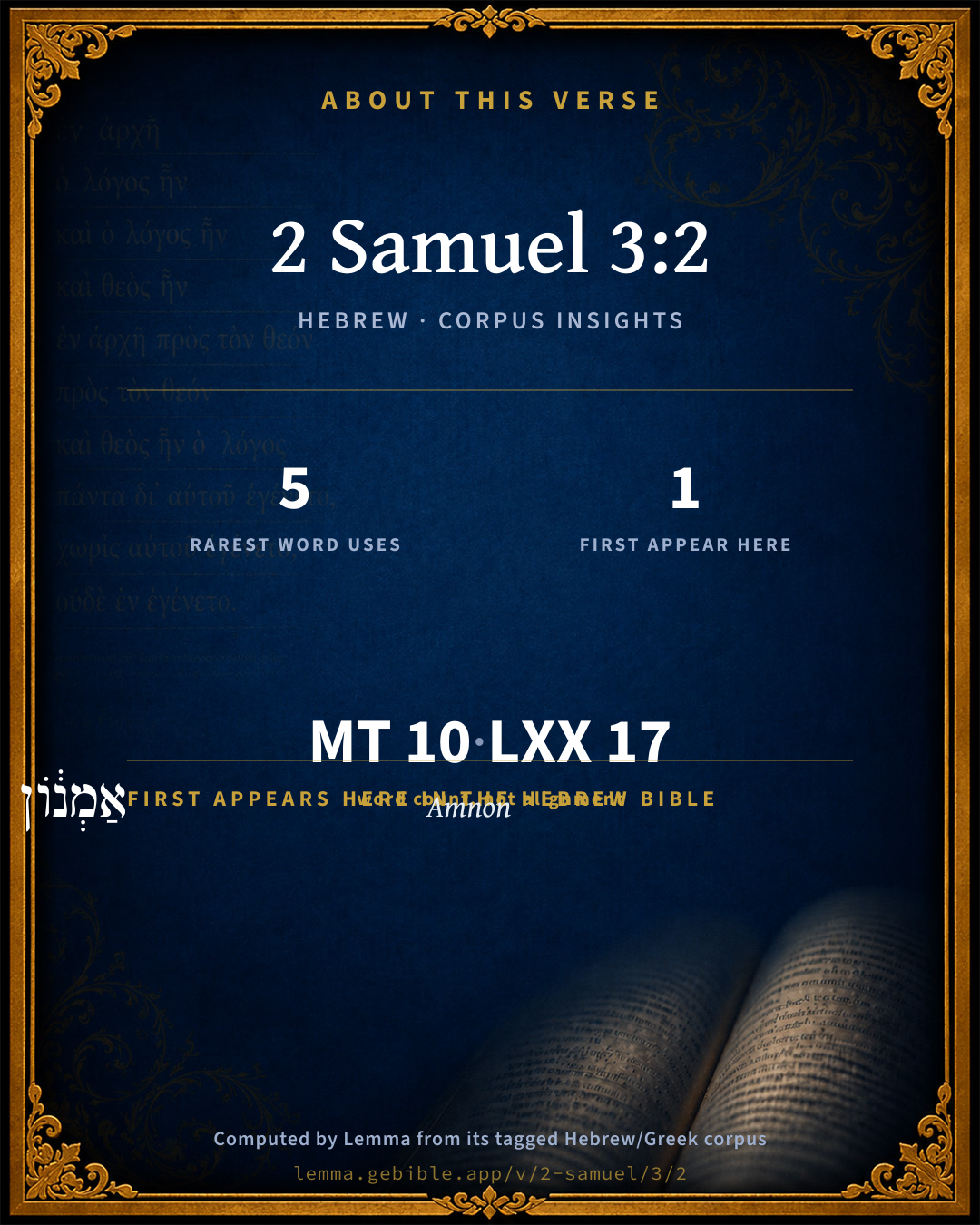
The rarest word here is הַיִּזְרְעֵאלִֽת Jezreelitess H3159 — appearing just 5 times in the whole Hebrew Bible.

First appearance in Scripture

This word makes its first canonical appearance in the Hebrew Bible here:

  • אַמְנ֔וֹן Amnon H550

Shared distinctive vocabulary

הַיִּזְרְעֵאלִֽת Jezreelitess H3159 occurs in 5 verses of the Hebrew Bible. Also found in:

Grammatical profile

  • 3 verbs
  • 7 nouns

Verb forms

  • וילדו Qal · Sequential Imperfect
  • וַיִּוָּלְד֧וּ Niphal · Sequential Imperfect
  • וַיְהִ֤י Qal · Sequential Imperfect

Repetition

A word recurs within this verse — often emphatic in Hebrew:

  • וילדו to bear H3205 ×2

Hebrew & Septuagint length

In English translation the verse runs 16 words from the Hebrew and 19 from the Septuagint (LXX English) — closely comparable.

A rough comparison of the two English renderings, which tokenize alike — not a word-level alignment.

Word counts can differ between the Hebrew and the Greek without any difference in meaning — e.g. the Hebrew direct-object marker אֵת has no separate Greek word, and Greek often adds the article ὁ.

In the original languages it is 10 Hebrew tokens and 17 Greek tokens — but the two are counted differently (Hebrew bundles its prefixes and suffixes into one token; the Greek is in lemma form), so that isn’t a like-for-like length.

Cross-references

4

Topical passages linked to 2 Samuel 3:2 in the Treasury of Scripture Knowledge — connected by theme and wording, ordered by reader-vote popularity; previews shown in the World English Bible.

  • 1 Chronicles 3:1–4 Now these were the sons of David, who were born to him in Hebron: the firstborn, Amnon, of Ahinoam the Jezreelitess; the second, Daniel, of Abigail the Carmelitess;
  • Genesis 49:3–4 "Reuben, you are my firstborn, my might, and the beginning of my strength; The pre-eminence of dignity, and the pre-eminence of power.
  • 1 Samuel 25:42–43 Abigail hurried, and arose, and rode on a donkey, with five ladies of hers who followed her; and she went after the messengers of David, and became his wife.
  • 2 Samuel 13:1–29 It happened after this, that Absalom the son of David had a beautiful sister, whose name was Tamar; and Amnon the son of David loved her.

Cross-references courtesy of OpenBible.info (CC BY 4.0).

Hebrew and Greek witnesses Masoretic Hebrew ↔ Greek Septuagint

The same verse in the two great witnesses to the Old Testament, shown verse-for-verse.

These are two independent witnesses, not word-aligned to each other, and the Septuagint is shown in lemma (dictionary) form.

Hebrew 2 Samuel 3:2 Masoretic · Westminster Leningrad Codex

וילדו וַיִּוָּלְד֧וּ לְדָוִ֛ד בָּנִ֖ים בְּחֶבְר֑וֹן וַיְהִ֤י בְכוֹרוֹ֙ אַמְנ֔וֹן לַאֲחִינֹ֖עַם הַיִּזְרְעֵאלִֽת

To David were sons born in Hebron: and his firstborn was Amnon, of Ahinoam the Jezreelitess;

World English Bible · Public Domain

Greek LXX 2 Samuel 3:2 Septuagint · lemma form

καί τίκτω ὁ δαυίδ υἱός ἐν χεβρων καί εἰμί ὁ πρωτότοκος αὐτός αμνων ὁ αχινοομ ὁ ἰεζραηλῖτις

And sons were born to David in Chebron: and his firstborn was Ammon the son of Achinoom the Jezraelitess.

LXX2012 (modern English Septuagint) · Public Domain

Hebrew: Westminster Leningrad Codex (CC BY 4.0). Greek: Septuagint (public domain); English from LXX2012 (modern English Septuagint) (Public Domain). How the Septuagint differs from the Hebrew →

Targum (Aramaic paraphrase)

1

The Targum is the ancient Jewish Aramaic paraphrase of the Hebrew Scriptures — an interpretive translation, not the Hebrew text itself. Onkelos (literal) and Pseudo-Jonathan (expansive) render the Torah, and Jonathan the Prophets. Coverage is partial: where no permissively-licensed English translation exists for a verse, only the Aramaic is shown. This is verse-level text, not a word-by-word alignment to the Hebrew.

  1. Targum Jonathan Prophets (Joshua–Malachi)
    וְאִתְיְלִידוּ לְדָוִד בְּנִין בְּחֶבְרוֹן וַהֲוָה בוּכְרֵיהּ אַמְנוֹן לַאֲחִינוֹעַם דְמִיִזְרְעֶאל:

    (no public-domain English translation for this verse)

    Targum Jonathan — Aramaic: “Mikraot Gedolot” (public domain). English: “Sefaria Community Translation” (CC0 1.0 (public-domain dedication)); “London "Chaldee Paraphrase," 1871” (public domain). Text via Sefaria.

Commentary

Notes on 2 Samuel 3:2 from classic Christian and Jewish commentators (each source and its license shown beneath its notes). The classic Christian expositions comment on the surrounding passage and are grouped to its opening verse, so a note may address several verses; the Jewish commentaries on the Tanakh (Rashi and others) are per-verse, so they appear only where the commentator wrote on this verse.

Lemma curates 59 commentaries, every one of them public domain or Creative Commons licensed, each selected and text-cleaned for this edition rather than reprinted as found. About our sources →

Trapp's Complete Commentary

John Trapp

2Sa 3:2 And unto David were sons born in Hebron: and his firstborn was Amnon, of Ahinoam the Jezreelitess;

Ver. 2. And unto David were sons born in Hebron.] None born during his exile: a sweet providence.

And his firstborn was Amnon.] Who was none of the best; as was neither Absalom, Adoniah, &c. Heroum filii noxae. The white halcyons hatch black young ones.

John Trapp, A Commentary or Exposition upon All the Books of the Old and New Testament (1647–1656) — public domain. Text from a community e-Sword module.

Joseph Benson's Commentary

2Sa 3:2-3. Unto David sons were born of Ahinoam — He had no children, it seems, by this wife during his exile; or if he had, they were daughters. The daughter of Talmai, king of Geshur — A part of Syria, northward from the land of Israel. How David came by this wife it is not easy to say. Perhaps he married her out of policy, that he might have a powerful friend and ally in her father, to assist him against Ish-bosheth’s party in the north, while himself opposed them in the south. But if so, he paid dear for making piety give place to policy, as the history of Absalom, whom he had by her, shows.

Joseph Benson's Commentary on the Old and New Testaments (1811–1818) — public domain. Text from a community e-Sword module.

Tyndale Open Study Notes

Tyndale Open Resources

3:2-5 One way David “became stronger and stronger” (3:1) was by taking more wives and having a son through each. Three of David’s Hebron-born sons died violent deaths, two during David’s reign (Amnon, Absalom), and one shortly after his death (Adonijah).

Tyndale Open Study Notes — © Tyndale Open Resources, licensed CC BY-SA 4.0. Text via the HelloAO Bible API.

Jamieson, Fausset & Brown

Robert Jamieson, A. R. Fausset & David Brown

unto David were sons born in Hebron--The six sons mentioned had all different mothers.

Jamieson, Fausset & Brown — Commentary Critical and Explanatory on the Whole Bible (1871) — public domain (CC PDM 1.0). Text via the HelloAO Bible API.

Ellicott's Commentary for English Readers

(2-5) And unto David.—The list of David’s sons born during his seven and a half years’ reign in Hebron rather interrupts the continuity of the narrative, but is quite in accordance with the habit of the sacred historians to insert at the beginning or at some turning point in each reign statistics about the house or family of the king. (See 1Sa_14:49-51; 2Sa_5:13; 1Ki_3:1; 1Ki_14:21; 1Ki_15:2; 1Ki_15:9, &c.)

Amnon.—Written “Aminon” in 2Sa_13:20. His great crime and miserable end are related in 2 Samuel 13.

Chileab.—Called “Daniel” in 1Ch_3:1. None of the attempts to explain these as two forms of the same name have been successful. Either, therefore, “Chileab” is an error of the scribe (all but the first letter being the same as the first three letters of the following word), or, more probably, Chileab had a double name. Nothing further is known of him, and as he does not appear in the subsequent troubles, it is supposed that he died early. These two sons were born of the wives whom David had taken while an outlaw.

Absalom.—His history, rebellion, and death are narrated in 2 Samuel 13-18. His mother was “the daughter of Talmai, king of Geshur,” a petty province north-east of Bashan. How David was brought into connection with him, and whether this alliance had any political object or not, we are not told, but the fact that Absalom in his exile naturally sought refuge with his maternal grandmother (2Sa_13:37) may have had a connection with David’s subsequent campaigns in that region.

Adonijah.—After the death of his three elder brothers, Adonijah considered himself the rightful heir to the throne, and embittered the last days of his father by a rebellion (1 Kings 1). He was at last put to death by Solomon (1Ki_2:25).

Of the other two sons, Shephatiah and Ithream, and of the mothers of the last three, nothing is known, although there is an absurd Jewish tradition that “Eglah” was another name for “Michal.”

A Bible Commentary for English Readers, edited by Charles John Ellicott (1878–1897) — public domain. Text from a community e-Sword module.

John Gill's Exposition

And unto David were sons born in Hebron,.... He was married before he came there, had wives in his state of exile, but had no children by them there, at least no sons; if any, only daughters:

and his firstborn was Amnon, of Ahinoam the Jezreelitess; who being mentioned first, and her son his firstborn, seems to have been his wife before be took Abigail; he had not much comfort of this firstborn son of his; see Sa2 13:1.

John Gill's Exposition of the Whole Bible (1746–1763) — public domain (CC PDM 1.0). Text via the HelloAO Bible API.

Haydock's Catholic Bible Commentary

Amnon, who was murdered by Absalom, for his incest, chap. xiii. 32. (Menochius)

George Leo Haydock (1774–1849), Haydock's Catholic Family Bible and Commentary, 1859 edition — public domain. Excludes Psalms (Douay-Rheims chapter numbering differs from Protestant) and Deuterocanonical books (Catholic canon only).

Whedon's Commentary on the Bible

Daniel D. Whedon

2. Unto David were sons born — This was one important way in which the house of David was made stronger, and to show this is manifestly the purpose of the writer in introducing here this list of David’s sons. Compare the list in 1Ch_3:1-4.

Daniel D. Whedon (gen. ed.), Commentary on the Old and New Testaments (1874–1909) — public domain. Text from a community e-Sword module.

The Pulpit Commentary

Unto David were sons born. This increase of his wives is mentioned as a proof of David"s prosperity. For though contrary to the, (Deu_17:17) it was yet looked upon as part of the state of a king, and as such had been practised by Gideon, (Jud_1:8:30) who approached more nearly to the royal dignity than any other of the judges. But it is the rule of the Books of Samuel that they generally abstain alike from praise and "blame, and allow facts to speak for themselves. But never did a history more clearly deserve the title of "A Vindication of the Justice of God." Alike in Eli, in Saul, and in David, their sufferings were the result of their sins, and to the polygamy and lust of the last are due both the crimes which stained his character and the distress of the last twenty years of his life. (For Amnon, his first born, see ch. 13.)

The Pulpit Commentary (1880–1919), ed. H.D.M. Spence-Jones & Joseph S. Exell — public domain. Text from a community e-Sword module.

Keil & Delitzsch

C. F. Keil & F. Delitzsch

Growth of the House of David. - Proof of the advance of the house of David is furnished by the multiplication of his family at Hebron. The account of the sons who were born to David at Hebron does not break the thread, as Clericus, Thenius, and others suppose, but is very appropriately introduced here, as a practical proof of the strengthening of the house of David, in harmony with the custom of beginning the history of the reign of every king with certain notices concerning his family (vid., Sa2 5:13.; Kg1 3:1; Kg1 14:21; Kg1 15:2, Kg1 15:9, etc.). We have a similar list of the sons of David in Ch1 3:1-4. The first two sons were born to him from the two wives whom he had brought with him to Hebron (Sa1 25:42-43). The Chethibh וילדו is probably only a copyist's error for ויּוּלדוּ, which is the reading in many Codices. From Ahinoam - the first-born, Amnon (called Aminon in Sa2 13:20); from Abigail - the second, Chileab. The latter is also called Daniel in Ch1 3:1, and therefore had probably two names. The lamed before Ahinoam and the following names serves as a periphrasis for the genitive, like the German von, in consequence of the word son being omitted (vid., Ewald, 292, a.). The other four were by wives whom he had married in Hebron: Absalom by Maachah, the daughter of Talmai king of Geshur, a small kingdom in the north-east of Bashan (see at Deu 3:14); Adonijah by Haggith; Shephatiah by Abital; and Ithream by Eglah. The origin of the last three wives is unknown. The clause appended to Eglah's name, viz., "David's wife," merely serves as a fitting conclusion to the whole list (Bertheau on Ch1 3:3), and is not added to show that Eglah was David's principal wife, which would necessitate the conclusion drawn by the Rabbins, that Michal was the wife intended.

Keil & Delitzsch — Biblical Commentary on the Old Testament (1861–1891) — public domain (CC PDM 1.0). Text via the HelloAO Bible API. (Old Testament only.)

unfoldingWord translationNotes

Door43 World Missions Community

Sons were born to David

This can be stated in active form. AT: "David's wives gave birth to six sons" (See: Active or Passive)

firstborn ... second son ... third

This is the numerical order of David's sons. (See: Numbers)

Ahinoam ... Abigail ... Maacah

These are women's names. They are the wives of David. (See: How to Translate Names)

Kileab ... Nabal ... Talmai

These are men's names. (See: How to Translate Names)

translationWords

son

Hebron

firstborn

Amnon

Jezreel

Carmel

Absalom

king

Geshur

unfoldingWord translationNotes — © Distant Shores Media and the Door43 World Missions Community, licensed CC BY-SA 4.0. Source: git.door43.org/Door43/en_tn.

Lesson kit

Teaching starters — assembled from the data on this page, not authored interpretation. Every prompt links to the verse data it draws on. Edit before teaching.

2 Samuel, in the Historical, opens this verse with 10 words (9 distinct Hebrew lemmas). Its most distinctive word is Yizrᵉʻêʼlîyth (“Jezreelitess”). A historical commentator’s framing appears above. Read the whole chapter for the surrounding context.

Discussion questions

  1. How does “Jezreelitess” (Yizrᵉʻêʼlîyth) shape what this verse is saying?
  2. The word “Amnon” first appears here in Scripture. What is being introduced at this debut?
  3. 1 Samuel 27:3 shares the word «Jezreelitess» with this verse. How do the two illuminate each other?
  4. “to bear” occurs 2× in this one verse. What is the effect of the repetition?
  5. The translations on this page render this verse differently — a whole-verse word diff, not a word-by-word alignment. What might account for the different wordings?
  6. The verb «וילדו» is Qal Sequential Imperfect. How does its form color the action?
  7. Reading how Trapp's Complete Commentary and Joseph Benson's Commentary read this verse, where do the two commentators agree and where do they part?

Things to notice

Reading settings

Reading text

Shown beneath each verse's original-language words.

Old Testament
Old Testament edition

Read the OT as the Masoretic Hebrew (MT) or the Greek Septuagint (LXX).

English shown for the Greek Septuagint (in the Hebrew ↔ Greek comparison).

Comparing translations? Open the Compare panel on any verse page to stack up to four side by side.