
Numbers 11:12

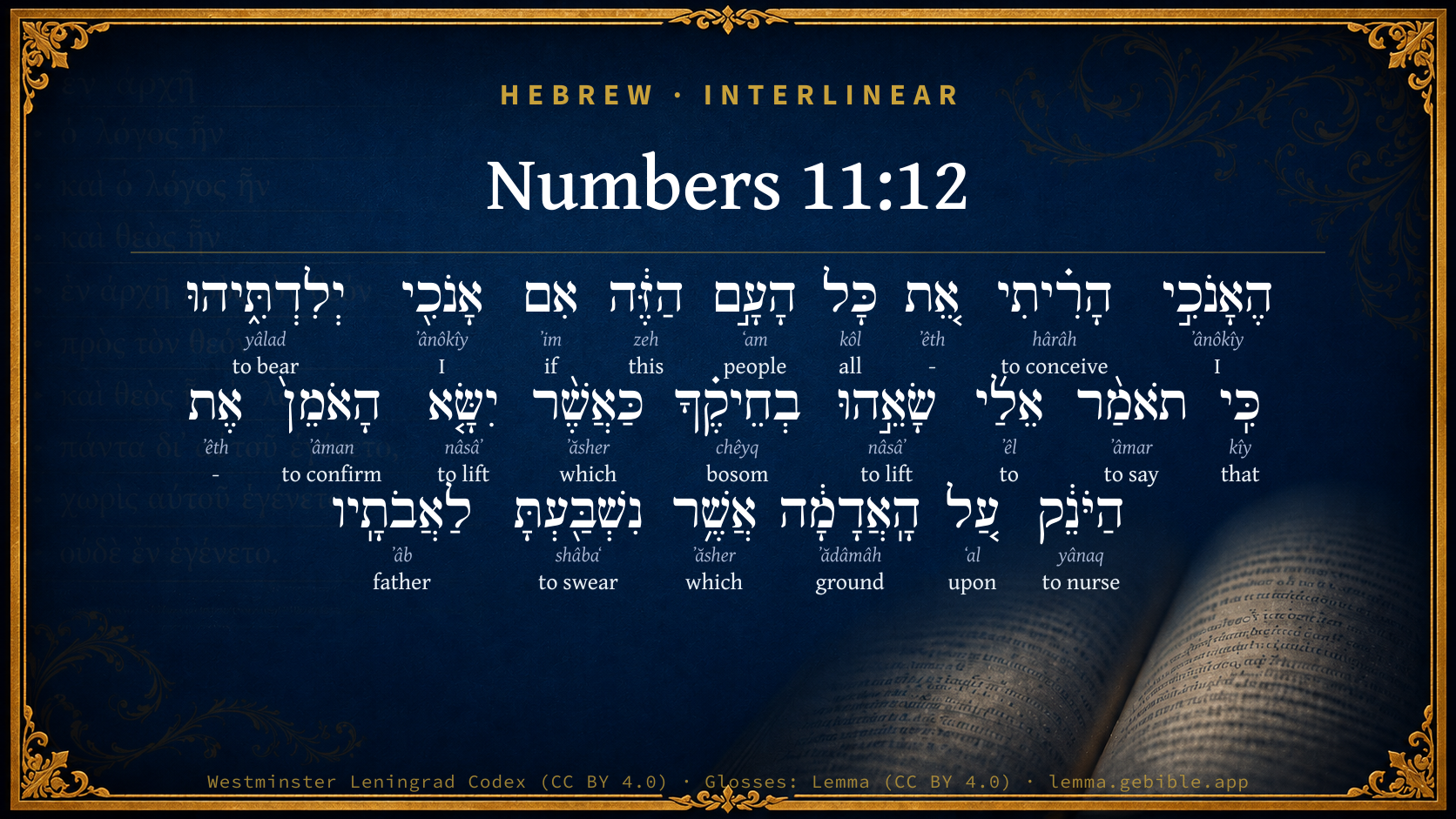
Hebrew (Westminster Leningrad Codex) Numbers 11:12 appears in the Hebrew Old Testament. The text above is from the Westminster Leningrad Codex. Each word links to its Strong’s number, a concise gloss, and parsing drawn from the Open Scriptures Hebrew Bible morphology. Click any word for its full Brown-Driver-Briggs (BDB) entry.
Download image
Cite this verse

Numbers 11:12 (World English Bible). Public Domain. Lemma interlinear Bible study tool, https://lemma.gebible.app/v/numbers/11/12.

Show BibTeX & RIS
BibTeX
RIS
English Translation
Have I conceived all this people? have I brought them forth, that you should tell me, Carry them in your bosom, as a nursing-father carries the sucking child, to the land which you swore to their fathers?
World English Bible · Public Domain
Download a study sheet

One document with this verse’s original text, its word-by-word gloss line, the meaning frame, cross-references with their text, attributed commentary, and full source and license credits — printable, and it pastes into notes with its structure intact.

This verse Autodidact and up

Study sheet (.html) Plain text (.txt)

A passage Seminary Student

Up to 50 verses in one chapter. A passage sheet keeps up to 6 commentary sources and 12 cross-references per verse, in the order this page ranks them, and says so on the sheet whenever that leaves anything out. Ask for a single verse and you get the Autodidact verse sheet above.

Everything on this page stays free to read, with no account — the sheet is a download of what is already on screen, not access to it.

Want to remove ads? Support Godless Engineer
Compare translations 3

The same verse in 3 English versions, stacked beneath the original-language interlinear above. Click any original word for its lexicon entry.

Each is an independent rendering of the whole verse — the interlinear is not word-aligned to these translations.

Highlighted words mark where these versions differ — a whole-verse word diff, not a word-by-word alignment.

  • World English Bible Public Domain
    Have I conceived all this people? have I brought them forth, that you should tell me, Carry them in your bosom, as a nursing-father carries the sucking child, to the land which you swore to their fathers?
  • King James Version Public Domain
    Have I conceived all this people? have I begotten them, that thou shouldest say unto me, Carry them in thy bosom, as a nursing father beareth the sucking child, unto the land which thou swarest unto their fathers?
  • unfoldingWord Literal Text CC BY-SA 4.0
    Did I, I conceive all this people? Or did I, I bear him, that you say to me, ‘Carry him in your bosom just as the one nursing carries the one sucking,’ over the ground that you swore to his fathers?

unfoldingWord Literal Text — © unfoldingWord, licensed CC BY-SA 4.0. Word-aligned USFM3 via Door43 (git.door43.org/unfoldingWord/en_ult).

Versions to compare (up to 4)

3 of 4 selected

Show all 18 translations

Every available English version of this verse, each an independent rendering of the whole verse.

  • World English Bible Public Domain
    Have I conceived all this people? have I brought them forth, that you should tell me, Carry them in your bosom, as a nursing-father carries the sucking child, to the land which you swore to their fathers?
  • Berean Standard Bible Public Domain
    Did I conceive all these people? Did I give them birth, so that You should tell me, ‘Carry them in your bosom, as a nurse carries an infant,’ to the land that You swore to give their fathers?
  • Majority Standard Bible Public Domain
    Did I conceive all these people? Did I give them birth, so that You should tell me, ‘Carry them in your bosom, as a nurse carries an infant,’ to the land that You swore to give their fathers?
  • King James Version Public Domain
    Have I conceived all this people? have I begotten them, that thou shouldest say unto me, Carry them in thy bosom, as a nursing father beareth the sucking child, unto the land which thou swarest unto their fathers?
  • American Standard Version (1901) Public Domain
    Have I conceived all this people? have I brought them forth, that thou shouldest say unto me, Carry them in thy bosom, as a nursing-father carrieth the sucking child, unto the land which thou swarest unto their fathers?
  • Revised Version (1885) Public Domain
    Have I conceived all this people? have I brought them forth, that thou shouldest say unto me, Carry them in thy bosom, as a nursing-father carrieth the sucking child, unto the land which thou swarest unto their fathers?
  • Geneva Bible (1599) Public Domain
    Haue I conceiued al this people? or haue I begotte them, that thou shouldest say vnto me, Cary them in thy bosome (as a nurse beareth the sucking childe) vnto the lande, for the which thou swarest vnto their fathers?
  • Douay-Rheims (1899) Public Domain
    Have I conceived all this multitude, or begotten them, that thou shouldst say to me: Carry them in thy bosom as the nurse is wont to carry the little infant, and bear them into the land, for which thou hast sworn to their fathers?
  • Young's Literal Translation Public Domain
    I -- have I conceived all this people? I -- have I begotten it, that Thou sayest unto me, Carry it in thy bosom as the nursing father beareth the suckling, unto the ground which Thou hast sworn to its fathers?
  • Literal Standard Version CC BY-SA 4.0
    I—have I conceived all this people? I—have I begotten it, that You say to me, Carry it in your bosom, as the one supporting carries the nursing suckling, to the ground which You have sworn to its fathers?
  • Unlocked Literal Bible CC BY-SA 4.0
    Did I conceive all these people? Have I given them birth so that you should say to me, 'Carry them closely to your chest as a father carries a baby?' Should I carry them to the land that you swore to their ancestors to give them?
  • unfoldingWord Literal Text CC BY-SA 4.0
    Did I, I conceive all this people? Or did I, I bear him, that you say to me, ‘Carry him in your bosom just as the one nursing carries the one sucking,’ over the ground that you swore to his fathers?
  • Darby Bible Public Domain
    Have I conceived all this people, have I brought them forth, that thou sayest to me, Carry them in thy bosom, as the nursing-father beareth the suckling, unto the land which thou didst swear unto their fathers?
  • World Messianic Bible Public Domain
    Have I conceived all this people? Have I brought them out, that you should tell me, ‘Carry them in your bosom, as a nurse carries a nursing infant, to the land which you swore to their fathers’?
  • Webster's Bible Public Domain
    Have I conceived all this people? have I begotten them, that thou shouldest say to me, Carry them in thy bosom, as a nursing-father beareth the sucking child, to the land which thou sworest to their fathers?
  • Free Bible Version CC BY-SA 4.0
    Are they my children? Did I give birth to them, so you could tell me, ‘Hold them close to your chest like a nurse carrying a baby’ and take them to the land you promised to give to their forefathers?
  • Bible in Basic English Public Domain
    Am I the father of all this people? have I given them birth, that you say to me, Take them in your arms, like a child at the breast, to the land which you gave by an oath to their fathers?
  • JPS Tanakh (1917) Public Domain
    Have I conceived all this people? have I brought them forth, that Thou shouldest say unto me: Carry them in thy bosom, as a nursing-father carrieth the sucking child, unto the land which Thou didst swear unto their fathers?

Literal Standard Version (2020), Covenant Press — licensed CC BY-SA 4.0. Text via the HelloAO Bible API (eBible.org). Unlocked Literal Bible (unfoldingWord) — licensed CC BY-SA 4.0. Text via the HelloAO Bible API (eBible.org). unfoldingWord Literal Text — © unfoldingWord, licensed CC BY-SA 4.0. Word-aligned USFM3 via Door43 (git.door43.org/unfoldingWord/en_ult). Free Bible Version, Dr. Jonathan Gallagher — licensed CC BY-SA 4.0. Text via the HelloAO Bible API (eBible.org).

Word by word

More ways to search: Search by grammar → Find every occurrence → Compare this word →

Practice this passage: Drill this verse → Learn its vocabulary →

הַיֹּנֵ֔ק
yânaq
H3243
“the · nursing”
Particle, Definite Article + Verb, Qal, Participle Active, Masculine, Singular, Absolute
Part of Speech
Particle + Verb
Stem
Qal
Form
Participle Active
Gender
Masculine
Number
Singular
State
Absolute
Full BDB Definition

Origin: a primitive root

TWOT: 874

to suckle, nurse, suck - (Qal) - to suck - suckling, babe (substantive) - (Hiphil) - to give suck to, nurse - nursing, nursing woman, nurse (participle)
  1. הֶאָנֹכִ֣י ʼânôkîy H595 “I” Particle, Interrogative + Pronoun, Personal, 1st Person, Common, Singular
  2. הָרִ֗יתִי hârâh H2029 “to conceive” Verb, Qal, Perfect, 1st Person, Common, Singular
  3. אֵ֚ת ʼêth H853 “-” Particle, Direct Object
  4. כָּל kôl H3605 “all of” Noun, Common, Masculine, Singular, Construct
  5. הָעָ֣ם ʻam H5971 “the · people” Particle, Definite Article + Noun, Common, Masculine, Singular, Absolute
  6. הַזֶּ֔ה zeh H2088 “the · this” Particle, Definite Article + Pronoun, Demonstrative, Masculine, Singular
  7. אִם ʼim H518 “if” Conjunction
  8. אָנֹכִ֖י ʼânôkîy H595 “I” Pronoun, Personal, 1st Person, Common, Singular
  9. יְלִדְתִּ֑יהוּ yâlad H3205 “to bear · him” Verb, Qal, Perfect, 1st Person, Common, Singular + Suffix, Personal, 3rd Person, Masculine, Singular
  10. כִּֽי kîy H3588 “that” Conjunction
  11. תֹאמַ֨ר ʼâmar H559 “to say” Verb, Qal, Imperfect, 2nd Person, Masculine, Singular
  12. אֵלַ֜י ʼêl H413 “to · me” Preposition + Suffix, Personal, 1st Person, Common, Singular
  13. שָׂאֵ֣הוּ nâsâʼ H5375 “lift · him” Verb, Qal, Imperative, 2nd Person, Masculine, Singular + Suffix, Personal, 3rd Person, Masculine, Singular
  14. בְחֵיקֶ֗ךָ chêyq H2436 “in/at · bosom · your” Preposition + Noun, Common, Masculine, Singular, Construct + Suffix, Personal, 2nd Person, Masculine, Singular
  15. כַּאֲשֶׁ֨ר ʼăsher H834 “like/as · which” Preposition + Particle, Relative
  16. יִשָּׂ֤א nâsâʼ H5375 “to lift” Verb, Qal, Imperfect, 3rd Person, Masculine, Singular
  17. הָאֹמֵן֙ ʼâman H539 “the · confirming” Particle, Definite Article + Verb, Qal, Participle Active, Masculine, Singular, Absolute
  18. אֶת ʼêth H853 “-” Particle, Direct Object
  19. עַ֚ל ʻal H5921 “upon” Preposition
  20. הָֽאֲדָמָ֔ה ʼădâmâh H127 “the · ground” Particle, Definite Article + Noun, Common, Feminine, Singular, Absolute
  21. אֲשֶׁ֥ר ʼăsher H834 “which” Particle, Relative
  22. נִשְׁבַּ֖עְתָּ shâbaʻ H7650 “to swear” Verb, Niphal, Perfect, 2nd Person, Masculine, Singular
  23. לַאֲבֹתָֽיו ʼâb H1 “to/for · fathers · his” Preposition + Noun, Common, Masculine, Plural, Construct + Suffix, Personal, 3rd Person, Masculine, Singular

About this verse

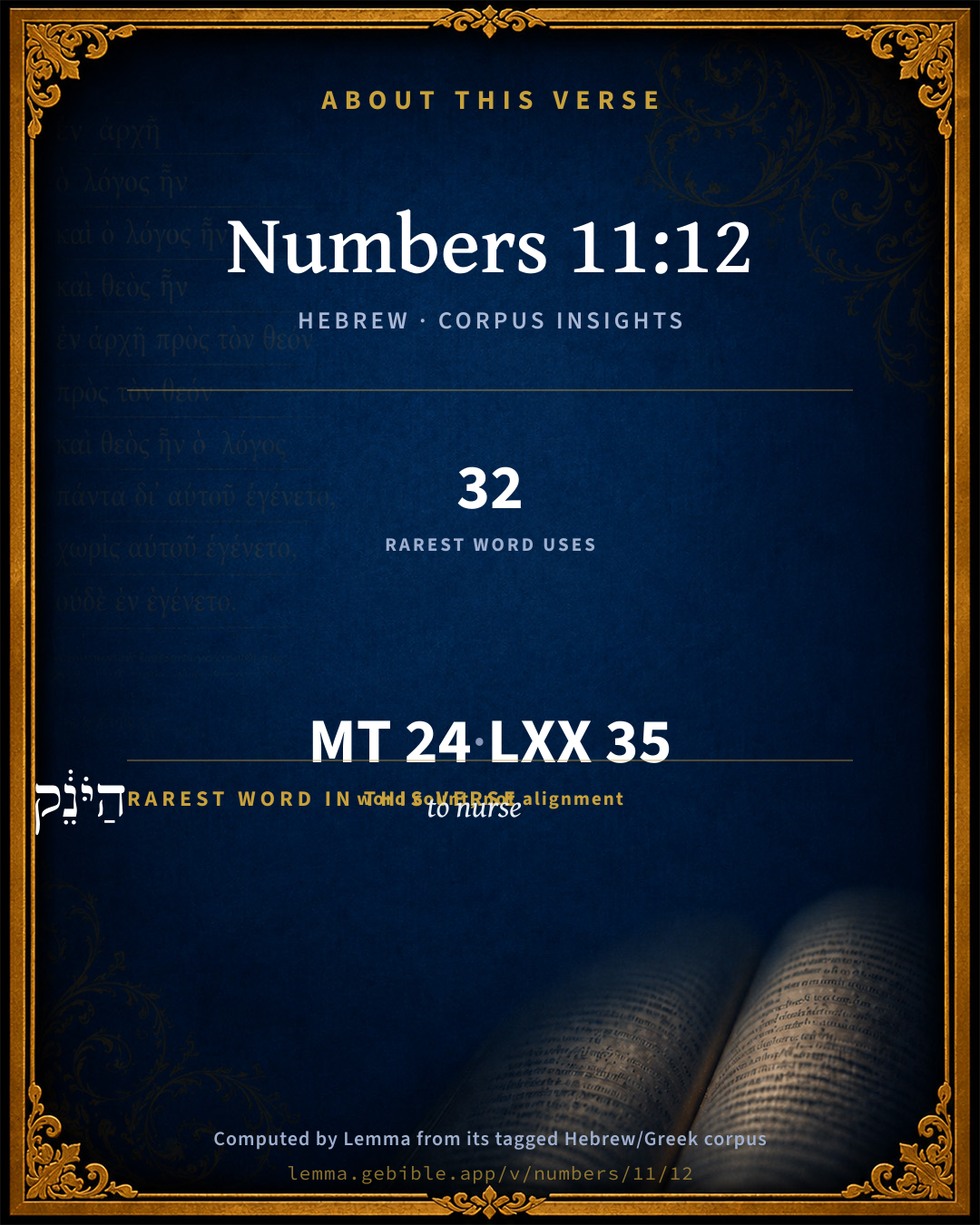
These counts appear in no published source. They are computed here, from the morphology-tagged text and Lemma’s own curated glosses. What Lemma adds →

24
words
20
distinct lemmas
Pentateuch
section

Shared distinctive vocabulary

הַיֹּנֵ֔ק to nurse H3243 occurs in 30 verses of the Hebrew Bible. Also found in:

Grammatical profile

  • 8 verbs
  • 5 nouns
  • 3 pronouns
  • 2 prepositions
  • 2 conjunctions
  • 4 particles

Verb forms

  • הָרִ֗יתִי Qal · Perfect
  • יְלִדְתִּ֑יהוּ Qal · Perfect
  • תֹאמַ֨ר Qal · Imperfect
  • שָׂאֵ֣הוּ Qal · Imperative
  • יִשָּׂ֤א Qal · Imperfect
  • הָאֹמֵן֙ Qal · Participle Active
  • הַיֹּנֵ֔ק Qal · Participle Active
  • נִשְׁבַּ֖עְתָּ Niphal · Perfect

Repetition

Words recur within this verse — often emphatic in Hebrew:

  • שָׂאֵ֣הוּ to lift H5375 ×2
  • הֶאָנֹכִ֣י I H595 ×2
  • כַּאֲשֶׁ֨ר which H834 ×2

Hebrew & Septuagint length

In English translation the verse runs 37 words from the Hebrew and 37 from the Septuagint (LXX English) — the same length.

A rough comparison of the two English renderings, which tokenize alike — not a word-level alignment.

Word counts can differ between the Hebrew and the Greek without any difference in meaning — e.g. the Hebrew direct-object marker אֵת has no separate Greek word, and Greek often adds the article ὁ.

In the original languages it is 24 Hebrew tokens and 35 Greek tokens — but the two are counted differently (Hebrew bundles its prefixes and suffixes into one token; the Greek is in lemma form), so that isn’t a like-for-like length.

Cross-references

12

Topical passages linked to Numbers 11:12 in the Treasury of Scripture Knowledge — connected by theme and wording, ordered by reader-vote popularity; previews shown in the World English Bible.

  • Isaiah 40:11 He will feed his flock like a shepherd, he will gather the lambs in his arm, and carry them in his bosom, [and] will gently lead those who have their young.
  • Isaiah 49:23 Kings shall be your nursing fathers, and their queens your nursing mothers: they shall bow down to you with their faces to the earth, and lick the dust of your feet; and you shall know that I am Yahweh; and those who wait for me shall not be disappointed.
  • Exodus 13:5 It shall be, when Yahweh shall bring you into the land of the Canaanite, and the Hittite, and the Amorite, and the Hivite, and the Jebusite, which he swore to your fathers to give you, a land flowing with milk and honey, that you shall keep this service in this month.
  • 1 Thessalonians 2:7 But we were gentle among of you, as when a nurse cherishes her own children.
  • Genesis 26:3 Sojourn in this land, and I will be with you, and will bless you. For to you, and to your seed, I will give all these lands, and I will establish the oath which I swore to Abraham your father.
  • Genesis 50:24 Joseph said to his brothers, "I am dying, but God will surely visit you, and bring you up out of this land to the land which he swore to Abraham, to Isaac, and to Jacob."
  • Genesis 22:16–17 and said, "I have sworn by myself, says Yahweh, because you have done this thing, and have not withheld your son, your only son,
  • Isaiah 49:15 Can a woman forget her sucking child, that she should not have compassion on the son of her womb? yes, these may forget, yet I will not forget you.
  • Ezekiel 34:23 I will set up one shepherd over them, and he shall feed them, even my servant David; he shall feed them, and he shall be their shepherd.
  • John 10:11 I am the good shepherd. The good shepherd lays down his life for the sheep.
  • Galatians 4:19 My little children, of whom I am again in travail until Christ is formed in you--
  • Genesis 13:15 for all the land which you see, I will give to you, and to your offspring forever.

Cross-references courtesy of OpenBible.info (CC BY 4.0).

Hebrew and Greek witnesses Masoretic Hebrew ↔ Greek Septuagint

The same verse in the two great witnesses to the Old Testament, shown verse-for-verse.

These are two independent witnesses, not word-aligned to each other, and the Septuagint is shown in lemma (dictionary) form.

Hebrew Numbers 11:12 Masoretic · Westminster Leningrad Codex

הֶאָנֹכִ֣י הָרִ֗יתִי אֵ֚ת כָּל הָעָ֣ם הַזֶּ֔ה אִם אָנֹכִ֖י יְלִדְתִּ֑יהוּ כִּֽי תֹאמַ֨ר אֵלַ֜י שָׂאֵ֣הוּ בְחֵיקֶ֗ךָ כַּאֲשֶׁ֨ר יִשָּׂ֤א הָאֹמֵן֙ אֶת הַיֹּנֵ֔ק עַ֚ל הָֽאֲדָמָ֔ה אֲשֶׁ֥ר נִשְׁבַּ֖עְתָּ לַאֲבֹתָֽיו

Have I conceived all this people? have I brought them forth, that you should tell me, Carry them in your bosom, as a nursing-father carries the sucking child, to the land which you swore to their fathers?

World English Bible · Public Domain

Greek LXX Numbers 11:12 Septuagint · lemma form

μή ἐγώ ἐν γαστήρ λαμβάνω πᾶς ὁ λαός οὗτος ἤ ἐγώ τίκτω αὐτός ὅτι λέγω ἐγώ λαμβάνω αὐτός εἰς ὁ κόλπος σύ ὡσεί αἴρω τιθηνός ὁ θηλάζω εἰς ὁ γῆ ὅς ὄμνυμι ὁ πατήρ αὐτός

Have I conceived all this people, or have I born them? that you say to me, Take them into your bosom, as a nurse would take her suckling, into the land which you swore to their fathers?

LXX2012 (modern English Septuagint) · Public Domain

Hebrew: Westminster Leningrad Codex (CC BY 4.0). Greek: Septuagint (public domain); English from LXX2012 (modern English Septuagint) (Public Domain). How the Septuagint differs from the Hebrew →

Targum (Aramaic paraphrase)

2

The Targum is the ancient Jewish Aramaic paraphrase of the Hebrew Scriptures — an interpretive translation, not the Hebrew text itself. Onkelos (literal) and Pseudo-Jonathan (expansive) render the Torah, and Jonathan the Prophets. Coverage is partial: where no permissively-licensed English translation exists for a verse, only the Aramaic is shown. This is verse-level text, not a word-by-word alignment to the Hebrew.

  1. Targum Onkelos Torah (Genesis–Deuteronomy)
    הֲאַב אֲנָא לְכָל עַמָא הָדֵין אִם בְּנַי אִנוּן דְאָמְרֵתּ לִי סוֹבַרְהִי בְתוּקְפָךְ כְּמָא דִמְסוֹבַר תֻּרְבְּיָנָא יָת יַנְקָא עַל אַרְעָא דִי קַיֵמְתָּא לַאֲבָהָתוֹהִי

    (no public-domain English translation for this verse)

    Targum Onkelos — Aramaic: “Onkelos Genesis” (public domain); “Onkelos Exodus” (public domain); “Onkelos Leviticus” (public domain); “Onkelos Numbers” (public domain); “Onkelos Deuteronomy” (public domain). English: “Sefaria Community Translation” (CC0 1.0 (public-domain dedication)); “J.W. Etheridge. The Targums of Onkelos and Jonathan Ben Uzziel on the Pentateuch. London: Longmans, Green, 1862” (public domain). Text via Sefaria.

  2. Targum Pseudo-Jonathan Torah (Genesis–Deuteronomy)
    הָאֲנָא עַבְרִית וְחַשְׁחָשִׁית בִּמְעַיַי יַת כָּל עַמָא הָדֵין אִין בָּנַיי הִינוּן דְאַמַרְתְּ לִי בְּמִצְרַיִם טָעוֹן טוּרְחַנְהוֹן בְּחֵילָךְ הֵיכְמָא דְטָעַן פַּדְגוֹגָא לִמְיַנִיקָא עַד זְמַן דְיִמְטוּן לְאַרְעָא דִקְיֵימְתָּא לְאַבְהַתְהוֹן

    Have I made or borne all this people as from the womb? are they my children, that Thou saidst to me in Mizraim, Bear the toil of them with thy strength, as the instructor of youth beareth, until they be carried into the land which Thou hast sworn unto their fathers?

    Targum Pseudo-Jonathan — Aramaic: “Targum Jonathan on Genesis” (public domain); “Targum Jonathan on Exodus” (public domain); “Targum Jonathan on Leviticus” (public domain); “Targum Jonathan on Numbers” (public domain); “Targum Jonathan on Deuteronomy” (public domain). English: “The Targum of Jonathan ben Uzziel, trans. J. W. Etheridge, London, 1862” (public domain). Text via Sefaria.

Commentary

Notes on Numbers 11:12 from classic Christian and Jewish commentators (each source and its license shown beneath its notes). The classic Christian expositions comment on the surrounding passage and are grouped to its opening verse, so a note may address several verses; the Jewish commentaries on the Tanakh (Rashi and others) are per-verse, so they appear only where the commentator wrote on this verse.

Lemma curates 59 commentaries, every one of them public domain or Creative Commons licensed, each selected and text-cleaned for this edition rather than reprinted as found. About our sources →

Trapp's Complete Commentary

John Trapp

Num 11:12 Have I conceived all this people? have I begotten them, that thou shouldest say unto me, Carry them in thy bosom, as a nursing father beareth the sucking child, unto the land which thou swarest unto their fathers?

Ver. 12. As a nursing father beareth, &c.] Lovingly, mildly, gently. A magistrate should carry himself as a pater patriae. Queen Elizabeth would many times say, That she could believe nothing of her people that parents would not believe of their children. {a}

{a} Camden’s Elisab.

John Trapp, A Commentary or Exposition upon All the Books of the Old and New Testament (1647–1656) — public domain. Text from a community e-Sword module.

Geneva Bible (1599)

Geneva Bible translators

Of Canaan promised by an oath to our fathers.

Am I their father, that none may have the charge of them but I?

Geneva Bible (1599) marginal notes — public domain. Text via Bolls.life.

Ellicott's Commentary for English Readers

(12) Have I conceived . .?—The personal pronoun is emphatic in this and the following clause: Is it I who have conceived all this people? Is it I who have brought them forth? (or, begotten them), as in Gen_4:18; Gen_10:8.

A Bible Commentary for English Readers, edited by Charles John Ellicott (1878–1897) — public domain. Text from a community e-Sword module.

The Cambridge Bible for Schools and Colleges

gen. ed. J. J. S. Perowne

12. Was it I that conceived … was it I that gave them birth] Israel was brought into being by God and not by Moses.

a nursing-father] i.e. a foster-father who brings up a child instead of its own parent. Cf. 2Ki_10:1; 2Ki_10:5, and figuratively Isa_49:23.

(I) 13. The continuation of Num_11:10. The words ‘And Moses said unto Jehovah’ must be supplied. See prelim. note.

(II) 15. kill me … out of hand] A good equivalent for the Heb. idiom. Kill me at once and have done with it. His cry in Exo_32:32 has the same meaning.

Cf. Elijah’s despair, 1Ki_19:4. Both Moses and Elijah received the encouragement that they needed; and both were destined for a peculiar privilege (Mar_9:4).

let me not experience my trouble] Let me no longer have to face my trouble.

(III) 16, 17a. The beginning of the account of the seventy elders.

The Cambridge Bible for Schools and Colleges (gen. ed. J. J. S. Perowne; Cambridge University Press, 1878–1918) — public domain. Text from a community e-Sword module.

John Gill's Exposition

Have I conceived all this people? have I begotten them?.... Conceived them as a mother, or begotten them as a father? am I a parent of either sort to them, in a literal sense, that I should have the like care of them as parents of their children? but though this was not the case, yet, in a civil and political sense, he was their parent, as every king and governor of a country is, or should be, the father of it, and should have a paternal affection for his subjects, and a tender care of them, and a hearty concern for their good and welfare: this, in a spiritual sense, may denote the weakness of the law of Moses, as Ainsworth observes, which has no concern in the regeneration of the spiritual Israel of God; who are born not of blood, nor of the will of men, nor of the will of the flesh, but of God; he only does and can regenerate men by his Spirit and grace; and though ministers of the word are instruments, yet it is not through the law, but through the Gospel that they beget souls to Christ, even by the word of truth, the Gospel of salvation, by that word which lives and abides for ever; it is not through the doctrine of the law, but through the doctrine of faith, that the Spirit, as a spirit of regeneration and sanctification, is received; faith, hope, and love, and every other grace, come the same way; see Co1 4:15,

that thou shouldest say unto me; as in Exo 32:34; "go, lead the people unto the place", &c. which words, Jarchi thinks, are here referred to:

carry them in thy bosom as a nursing father beareth the sucking child,

unto the land which thou swarest to their fathers? the land of Canaan: kings should be nursing fathers; civil governors should rule with gentleness and mildness; such are most beloved, and most cheerfully obeyed by their people: the Targums of Jonathan and Jerusalem interpret the word for "nursing father", by "pedagogue", which is the same word the apostle uses of the law, Gal 3:24; that indeed was a severe schoolmaster, that menaced, whipped, and scourged for every fault, and not a tender nursing father; there is not one kind tender word in the law; it accuses of sin, pronounces guilty of it, curses and condemns for it; but the Gospel ministry, and ministers of it, use men gently; the apostles of Christ were gentle, as a nurse cherisheth her children, Th1 2:7; fed men as they were able to bear it; and when they delivered out their charges, it was in a kind manner, and even their reproofs were in love; and especially Christ himself was so, by whose meekness and gentleness the Apostle Paul beseeches men, Co1 10:1; who gathers the lambs in his arms, carries them in his bosom, and gently leads those that are with young; and supplies them with food, and brings them all safely to Canaan's land, the heavenly glory, where the law and the deeds of it will never bring men, Isa 40:11.

John Gill's Exposition of the Whole Bible (1746–1763) — public domain (CC PDM 1.0). Text via the HelloAO Bible API.

Haydock's Catholic Bible Commentary

Nurse. We often read of men nursing or watching over others. (4 Kings x. 5; Esther ii. 11.) Thus kings shall nurse the Church, Isaias xlix. 23. (Calmet) --- All who have authority should treat their subjects with love. (Menochius)

George Leo Haydock (1774–1849), Haydock's Catholic Family Bible and Commentary, 1859 edition — public domain. Excludes Psalms (Douay-Rheims chapter numbering differs from Protestant) and Deuterocanonical books (Catholic canon only).

Matthew Poole's English Annotations

Have I begotten them; are they my children, that I should be obliged to provide food and all things for their necessity and desire?

As a nursing-father beareth the sucking-child; which expression shows the tender care and affection that governors by the command of God ought to have towards their people.

Matthew Poole's English Annotations on the Holy Bible (1683–1685) — public domain. Text from a community e-Sword/MySword module.

Whedon's Commentary on the Bible

Daniel D. Whedon

12. Have I conceived all this people — Moses does not throw off all care for the people, but he rather devolves on Jehovah that burden as the Creator and Father of Israel, (Exo_4:22,) more in despair than in unbelief. For unbelief complains, but does not pray. The Holy Ghost has declared that “Moses was faithful in all his house.” Heb_3:2. He was, in the language of the New Testament, a perfect man, inasmuch as the bent of his will, the outgoing of his affections, the drift of his whole being was toward God; yet this verse unveils the infirmities which were still marring his character. The holiest man, in times of great distress, may momentarily lose heart through forgetfulness of the fact that God is a great burden-bearer, as Moses forgot that Israel was but a feather’s weight upon the divine shoulders. How honestly does Moses draw aside the veil which might have concealed his own weakness, and which an uninspired historian would have left undrawn!

Carry them in thy bosom — Moses here seems to disclose some past charge given to him by the Lord. It is in striking consonance with the character of the great Shepherd of Israel: “He shall gather the lambs in his arms, and carry them in his bosom.” Isa_40:11; Joh_10:11-14, notes.

As a nursing father — Moses’s ideal of a ruler is here beautifully expressed: not a stern despot wielding a sceptre, but a kind and loving father bearing his infant babe in his arms. St. Paul, as a spiritual ruler of the Church of Christ, realized this ideal. 1Th_2:7; 1Th_2:11. The Palestinian Targum, instead of “nursing father” has “pedagogue” — child leader — the term which describes the office of the law in Gal_3:24.

Daniel D. Whedon (gen. ed.), Commentary on the Old and New Testaments (1874–1909) — public domain. Text from a community e-Sword module.

The Pulpit Commentary

Carry them in thy bosom, as a nursing father. Probably he meant to say that this was the part and the duty of God himself as the Creator and Father of Israel. Compare the reading, which is perhaps the correct one, in Act_13:18: Tessarakontaeth cronon etrofoorhsen autoumw .

The Pulpit Commentary (1880–1919), ed. H.D.M. Spence-Jones & Joseph S. Exell — public domain. Text from a community e-Sword module.

John Wesley's Explanatory Notes

Have I begotten them? - Are they my children, that I should be obliged to provide food and all things for their necessity and desire?

John Wesley, Explanatory Notes Upon the Whole Bible (1754–1765) — public domain. Text via the GEBible commentary corpus.

Rashi

Rabbi Shlomo Yitzchaki (Rashi)

כי תאמר אלי means, [HAVE I CONCEIVED ALL THIS PEOPLE] THAT THOU SHOULDST always SAY UNTO ME, “Carry them in thy bosom!?” And where did He speak thus to him? When He said to him, (Exodus 32:34) “Go, lead the people”; and it further states, (Exodus 6:13) “[And the Lord spoke unto Moses and unto Aaron] and gave them a charge concerning the children of Israel” saying unto them: “Take charge of them even under the risk (lit., under the condition) that they may stone you or at least insult you” (Sifrei Bamidbar 91; cf. Rashi on that verse).

על האדמה אשר נשבעת לאבתיו UNTO THE LAND WHICH THOU SWAREST UNTO THEIR FATHERS hast Thou bidden me to carry them in my bosom.

Rashi on the Tanakh — English translations: “The Judaica Press complete Tanach with Rashi, translated by A. J. Rosenberg” (CC BY 4.0); “Pentateuch with Rashi's commentary by M. Rosenbaum and A.M. Silbermann, 1929-1934” (public domain); “The Metsudah Tanach series, Lakewood, N.J” (CC BY 4.0); and “The Book of Joshua, Metsudah Publications, 1997” (CC BY 4.0). Text via Sefaria.

Ramban (Nachmanides)

Rabbi Moshe ben Nachman (Ramban / Nachmanides)

DID I ‘HARITHI’ ALL THIS PEOPLE? In the opinion of Onkelos [who rendered it: “Am I ‘the father’ of all this people?” the word harithi] is like [the expression] beyond the blessing of ‘horai’ (my progenitors), for a father is called horeh [of the root haroh, “to conceive” or “become pregnant”] because it is he who causes conception and brings about the pregnancy [of the mother]. Thus Moses is saying: “Am I their father [who has caused their conception], or am I their mother who has given birth to them?” — is thus explained as referring to the separate functions of father and mother. But the masters of the plain meaning of Scripture. interpreted the verse in the opposite manner: “Am I their mother who was pregnant with them and gave birth to them?” Similarly, ‘Vatahar’ eth Miriam v’eth Shammai means “she was pregnant with them and gave birth to them.” “Or am I their father who begot them?” [the word y’lidetihu being] like: ‘vayoled Noach’ (and Noah begot); thy father that ‘y’ladecha’ (begot thee), and other similar expressions. And Moses said, as ‘ha’omein’ carrieth the sucking child, [the word ha’omein] being a reference to the [nursing-] father or mother. In my opinion the whole verse is a figurative reference to the mother, and the meaning thereof is as follows: “Have I conceived all this people and have I given birth to them?” Moses mentioned it in this way [speaking as the mother] because it is the woman who suffers the pain of raising children, remembering what she suffered for them from birth, pregnancy, and conception. But Moses said omein [in the masculine] since he is speaking of himself as a nursing-father, since he is not an omeneth (a nursing-mother).

Ramban (Nachmanides) on the Tanakh — English translation: “Commentary on the Torah by Ramban (Nachmanides). Translated and annotated by Charles B. Chavel. New York, Shilo Pub. House, 1971-1976” (CC BY 4.0). Text via Sefaria.

Lesson kit

Teaching starters — assembled from the data on this page, not authored interpretation. Every prompt links to the verse data it draws on. Edit before teaching.

Numbers, in the Pentateuch, opens this verse with 24 words (20 distinct Hebrew lemmas). Its most distinctive word is yânaq (“to nurse”). A historical commentator’s framing appears above. Read the whole chapter for the surrounding context.

Discussion questions

  1. What does “to nurse” (yânaq) contribute to the verse as a whole?
  2. How does Genesis 21:7, which shares the word «to nurse», read alongside this verse?
  3. What does the repetition of “to lift” (2× in this one verse) do in this verse?
  4. These translations render this verse differently. What is at stake in choosing one wording over another?
  5. «הָרִ֗יתִי» is a Qal Perfect verb. How does that grammatical form shape the action described?
  6. Compare how Trapp's Complete Commentary and Geneva Bible (1599) read this verse. Where do they agree or differ?

Things to notice

Reading settings

Reading text

Shown beneath each verse's original-language words.

Old Testament
Old Testament edition

Read the OT as the Masoretic Hebrew (MT) or the Greek Septuagint (LXX).

English shown for the Greek Septuagint (in the Hebrew ↔ Greek comparison).

Comparing translations? Open the Compare panel on any verse page to stack up to four side by side.