
Numbers 1:18

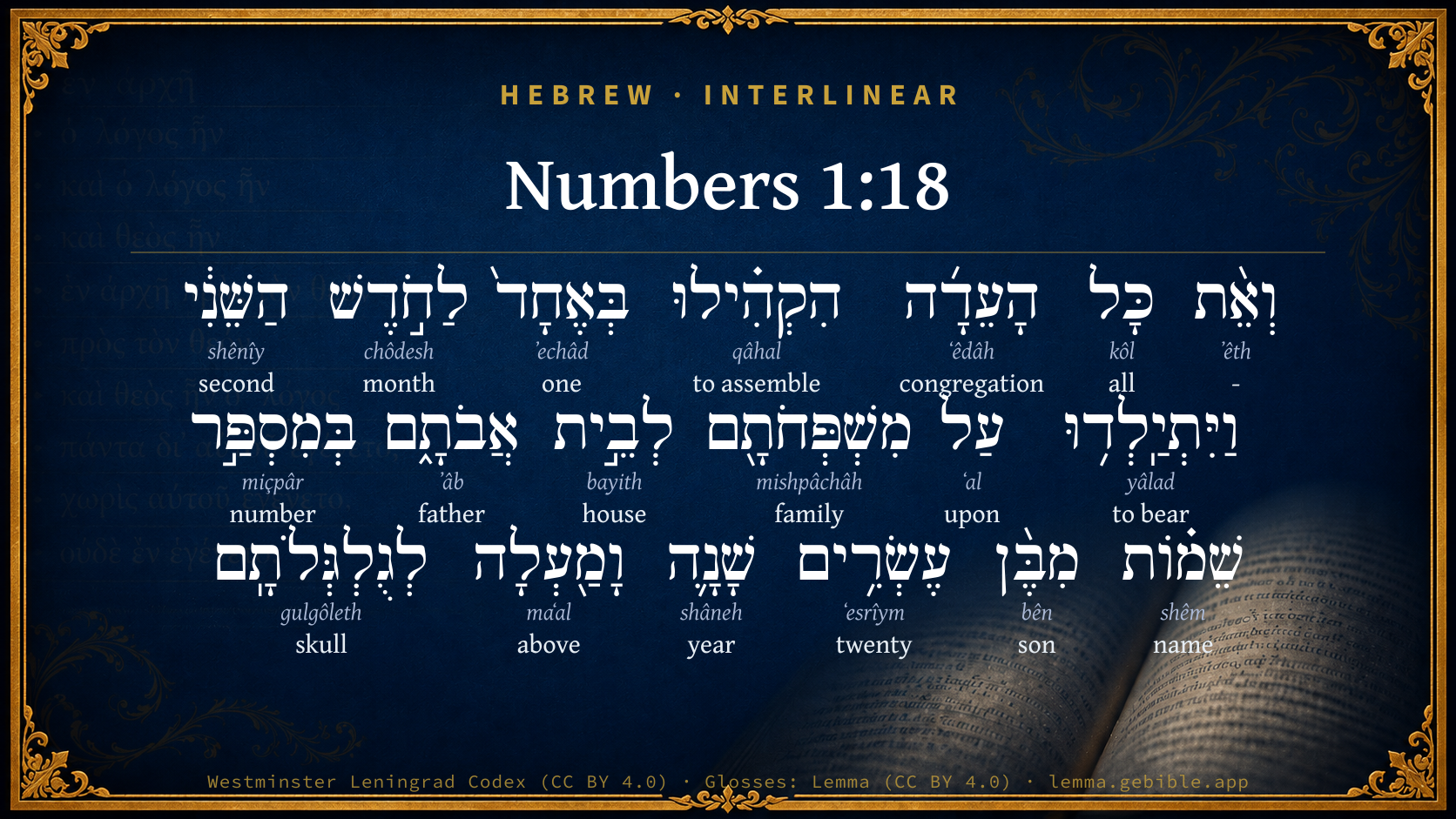
Hebrew (Westminster Leningrad Codex) Numbers 1:18 appears in the Hebrew Old Testament. The text above is from the Westminster Leningrad Codex. Each word links to its Strong’s number, a concise gloss, and parsing drawn from the Open Scriptures Hebrew Bible morphology. Click any word for its full Brown-Driver-Briggs (BDB) entry.
Download image
Cite this verse

Numbers 1:18 (World English Bible). Public Domain. Lemma interlinear Bible study tool, https://lemma.gebible.app/v/numbers/1/18.

Show BibTeX & RIS
BibTeX
RIS
English Translation
They assembled all the congregation together on the first day of the second month; and they declared their ancestry by their families, by their fathers' houses, according to the number of the names, from twenty years old and upward, one by one.
World English Bible · Public Domain
Download a study sheet

One document with this verse’s original text, its word-by-word gloss line, the meaning frame, cross-references with their text, attributed commentary, and full source and license credits — printable, and it pastes into notes with its structure intact.

This verse Autodidact and up

Study sheet (.html) Plain text (.txt)

A passage Seminary Student

Up to 50 verses in one chapter. A passage sheet keeps up to 6 commentary sources and 12 cross-references per verse, in the order this page ranks them, and says so on the sheet whenever that leaves anything out. Ask for a single verse and you get the Autodidact verse sheet above.

Everything on this page stays free to read, with no account — the sheet is a download of what is already on screen, not access to it.

Want to remove ads? Support Godless Engineer
Compare translations 3

The same verse in 3 English versions, stacked beneath the original-language interlinear above. Click any original word for its lexicon entry.

Each is an independent rendering of the whole verse — the interlinear is not word-aligned to these translations.

Highlighted words mark where these versions differ — a whole-verse word diff, not a word-by-word alignment.

  • World English Bible Public Domain
    They assembled all the congregation together on the first day of the second month; and they declared their ancestry by their families, by their fathers' houses, according to the number of the names, from twenty years old and upward, one by one.
  • King James Version Public Domain
    And they assembled all the congregation together on the first day of the second month, and they declared their pedigrees after their families, by the house of their fathers, according to the number of the names, from twenty years old and upward, by their polls.
  • unfoldingWord Literal Text CC BY-SA 4.0
    And they assembled all the congregation on one of the second month. And they recorded their ancestry in accordance with their clans, according to the house of their fathers, by the number of the names, from a son of 20 years and upward, according to their skulls,

unfoldingWord Literal Text — © unfoldingWord, licensed CC BY-SA 4.0. Word-aligned USFM3 via Door43 (git.door43.org/unfoldingWord/en_ult).

Versions to compare (up to 4)

3 of 4 selected

Show all 18 translations

Every available English version of this verse, each an independent rendering of the whole verse.

  • World English Bible Public Domain
    They assembled all the congregation together on the first day of the second month; and they declared their ancestry by their families, by their fathers' houses, according to the number of the names, from twenty years old and upward, one by one.
  • Berean Standard Bible Public Domain
    and on the first day of the second month they assembled the whole congregation and recorded their ancestry by clans and families, counting one by one the names of those twenty years of age or older,
  • Majority Standard Bible Public Domain
    and on the first day of the second month they assembled the whole congregation and recorded their ancestry by clans and families, counting one by one the names of those twenty years of age or older,
  • King James Version Public Domain
    And they assembled all the congregation together on the first day of the second month, and they declared their pedigrees after their families, by the house of their fathers, according to the number of the names, from twenty years old and upward, by their polls.
  • American Standard Version (1901) Public Domain
    And they assembled all the congregation together on the first day of the second month; and they declared their pedigrees after their families, by their fathers' houses, according to the number of the names, from twenty years old and upward, by their polls.
  • Revised Version (1885) Public Domain
    And they assembled all the congregation together on the first day of the second month, and they declared their pedigrees after their families, by their fathers’ houses, according to the number of the names, from twenty years old and upward, by their polls.
  • Geneva Bible (1599) Public Domain
    And they called all the Congregation together, in the first day of the second moneth, who declared their kindreds by their families, and by the houses of their fathers, according to the nomber of their names, from twentie yere olde and aboue, man by man.
  • Douay-Rheims (1899) Public Domain
    And assembled them on the first day of the second month, reckoning them up by the kindreds, and houses, and families, and heads, and names of every one from twenty years old and upward,
  • Young's Literal Translation Public Domain
    and all the company they assembled on the first of the second month, and they declare their births, by their families, by the house of their fathers, in the number of names from a son of twenty years and upward, by their polls,
  • Literal Standard Version CC BY-SA 4.0
    and they assembled all the congregation on the first of the second month, and they declare their births, by their families, by the house of their fathers, in the number of names from a son of twenty years and upward, by their counted heads,
  • Unlocked Literal Bible CC BY-SA 4.0
    and along with these men they assembled all the men of Israel on the first day of the second month. Then each man twenty years old and older identified his ancestry. He had to name the clans and families descended from his ancestors.
  • unfoldingWord Literal Text CC BY-SA 4.0
    And they assembled all the congregation on one of the second month. And they recorded their ancestry in accordance with their clans, according to the house of their fathers, by the number of the names, from a son of 20 years and upward, according to their skulls,
  • Darby Bible Public Domain
    and gathered the whole assembly together on the first of the second month. And they declared their pedigrees after their families, according to their fathers' houses, by the number of the names, from twenty years old and upward, according to their polls.
  • World Messianic Bible Public Domain
    They assembled all the congregation together on the first day of the second month; and they declared their ancestry by their families, by their fathers’ houses, according to the number of the names, from twenty years old and upward, one by one.
  • Webster's Bible Public Domain
    And they assembled all the congregation on the first day of the second month, and they declared their pedigrees after their families, by the house of their fathers, according to the number of the names, from twenty years old and upward, by their polls.
  • Free Bible Version CC BY-SA 4.0
    They had all the Israelites gather together on the first day of the second month, and recorded the people's genealogy according to their tribe and family, and counted up the names of all those aged twenty or older,
  • Bible in Basic English Public Domain
    And they got together all the people on the first day of the second month; and everyone made clear his family and his father's house, by the number of the names, from twenty years old and over.
  • JPS Tanakh (1917) Public Domain
    And they assembled all the congregation together on the first day of the second month, and they declared their pedigrees after their families, by their fathers' houses, according to the number of names, from twenty years old and upward, by their polls.

Literal Standard Version (2020), Covenant Press — licensed CC BY-SA 4.0. Text via the HelloAO Bible API (eBible.org). Unlocked Literal Bible (unfoldingWord) — licensed CC BY-SA 4.0. Text via the HelloAO Bible API (eBible.org). unfoldingWord Literal Text — © unfoldingWord, licensed CC BY-SA 4.0. Word-aligned USFM3 via Door43 (git.door43.org/unfoldingWord/en_ult). Free Bible Version, Dr. Jonathan Gallagher — licensed CC BY-SA 4.0. Text via the HelloAO Bible API (eBible.org).

Word by word

More ways to search: Search by grammar → Find every occurrence → Compare this word →

Practice this passage: Drill this verse → Learn its vocabulary →

לְגֻלְגְּלֹתָֽם
gulgôleth
H1538
“to/for · skulls · their”
Preposition + Noun, Common, Feminine, Plural, Construct + Suffix, Personal, 3rd Person, Masculine, Plural
Part of Speech
Preposition + Noun
Type
Common
Gender
Feminine
Number
Plural
State
Construct
Full BDB Definition

Origin: by reduplication from H1556

TWOT: 353l

head, poll, skull - skull - head, poll (of census)
  1. וְאֵ֨ת ʼêth H853 “and · -” Conjunction + Particle, Direct Object
  2. כָּל kôl H3605 “all of” Noun, Common, Masculine, Singular, Construct
  3. הָעֵדָ֜ה ʻêdâh H5712 “the · congregation” Particle, Definite Article + Noun, Common, Feminine, Singular, Absolute
  4. הִקְהִ֗ילוּ qâhal H6950 “to assemble” Verb, Hiphil, Perfect, 3rd Person, Common, Plural
  5. בְּאֶחָד֙ ʼechâd H259 “in/at · one” Preposition + Adjective, Cardinal number, Masculine, Singular, Absolute
  6. לַחֹ֣דֶשׁ chôdesh H2320 “to/for the · month” Preposition, Determined + Noun, Common, Masculine, Singular, Absolute
  7. הַשֵּׁנִ֔י shênîy H8145 “the · second” Particle, Definite Article + Adjective, Ordinal number, Masculine, Singular, Absolute
  8. וַיִּתְיַֽלְד֥וּ yâlad H3205 “and · to bear” Conjunction + Verb, Hithpael, Sequential Imperfect, 3rd Person, Masculine, Plural
  9. עַל ʻal H5921 “upon” Preposition
  10. מִשְׁפְּחֹתָ֖ם mishpâchâh H4940 “families · their” Noun, Common, Feminine, Plural, Construct + Suffix, Personal, 3rd Person, Masculine, Plural
  11. לְבֵ֣ית bayith H1004 “to/for · house of” Preposition + Noun, Common, Masculine, Singular, Construct
  12. אֲבֹתָ֑ם ʼâb H1 “fathers · their” Noun, Common, Masculine, Plural, Construct + Suffix, Personal, 3rd Person, Masculine, Plural
  13. בְּמִסְפַּ֣ר miçpâr H4557 “in/at · number of” Preposition + Noun, Common, Masculine, Singular, Construct
  14. שֵׁמ֗וֹת shêm H8034 “names” Noun, Common, Masculine, Plural, Absolute
  15. מִבֶּ֨ן bên H1121 “from · son of” Preposition + Noun, Common, Masculine, Singular, Construct
  16. עֶשְׂרִ֥ים ʻesrîym H6242 “twenty” Adjective, Cardinal number, Both, Plural, Absolute
  17. שָׁנָ֛ה shâneh H8141 “year” Noun, Common, Feminine, Singular, Absolute
  18. וָמַ֖עְלָה maʻal H4605 “and · above · toward” Conjunction + Adverb + Suffix, Demonstrative

About this verse

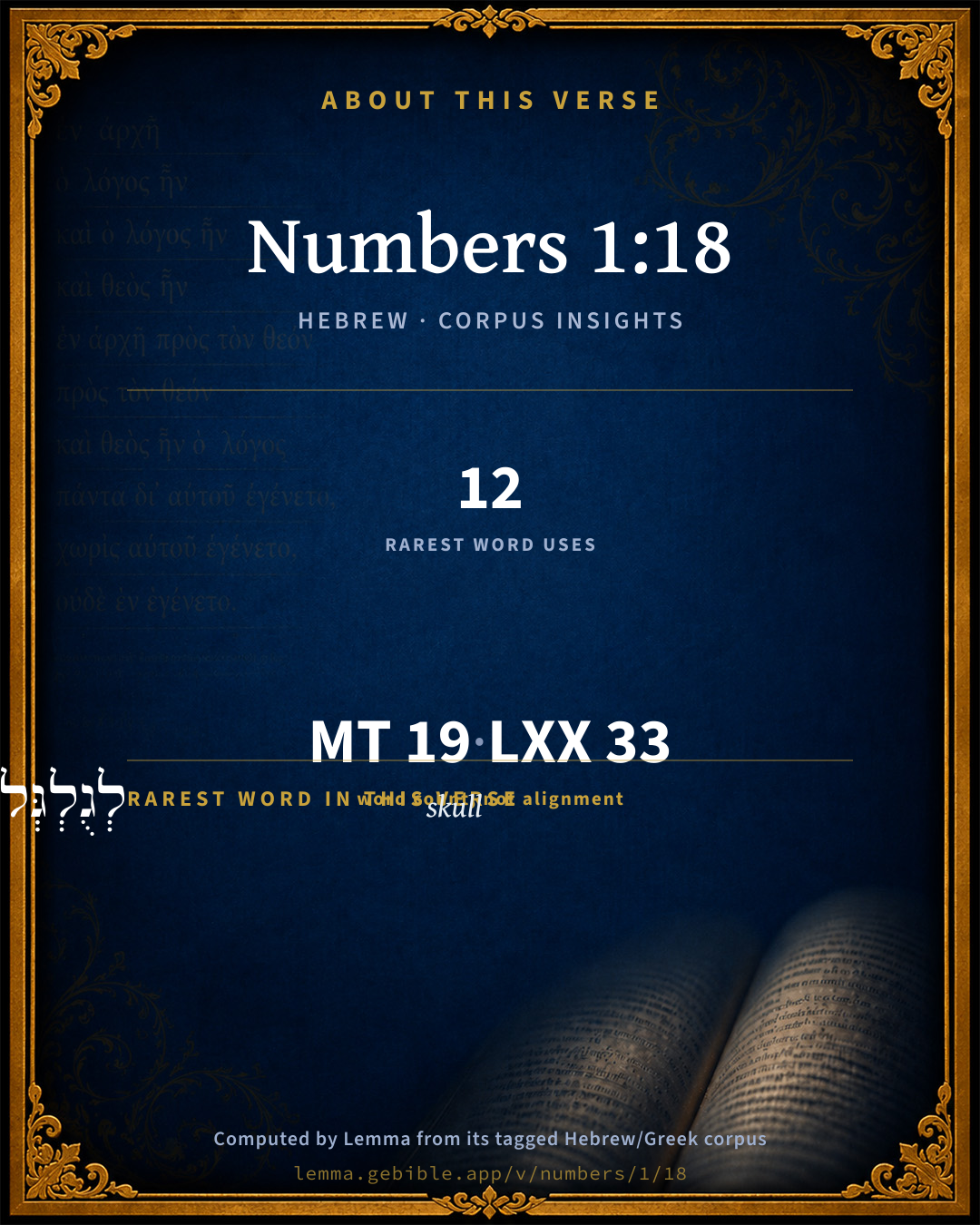
These counts appear in no published source. They are computed here, from the morphology-tagged text and Lemma’s own curated glosses. What Lemma adds →

19
words
19
distinct lemmas
Pentateuch
section

Notable vocabulary

The rarest word here is לְגֻלְגְּלֹתָֽם skull H1538 — appearing just 12 times in the whole Hebrew Bible.

Shared distinctive vocabulary

לְגֻלְגְּלֹתָֽם skull H1538 occurs in 12 verses of the Hebrew Bible. Also found in:

Grammatical profile

  • 2 verbs
  • 11 nouns
  • 3 adjectives
  • 1 preposition
  • 1 adverb
  • 1 particle

Verb forms

  • הִקְהִ֗ילוּ Hiphil · Perfect
  • וַיִּתְיַֽלְד֥וּ Hithpael · Sequential Imperfect

Hebrew & Septuagint length

In English translation the verse runs 42 words from the Hebrew and 45 from the Septuagint (LXX English) — closely comparable.

A rough comparison of the two English renderings, which tokenize alike — not a word-level alignment.

Word counts can differ between the Hebrew and the Greek without any difference in meaning — e.g. the Hebrew direct-object marker אֵת has no separate Greek word, and Greek often adds the article ὁ.

In the original languages it is 19 Hebrew tokens and 33 Greek tokens — but the two are counted differently (Hebrew bundles its prefixes and suffixes into one token; the Greek is in lemma form), so that isn’t a like-for-like length.

Cross-references

5

Topical passages linked to Numbers 1:18 in the Treasury of Scripture Knowledge — connected by theme and wording, ordered by reader-vote popularity; previews shown in the World English Bible.

  • Ezra 2:59 These were those who went up from Tel-melah, Tel Harsha, Cherub, Addan, [and] Immer; but they could not show their fathers' houses, and their seed, whether they were of Israel:
  • Nehemiah 7:61 These were those who went up from Tel-melah, Tel Harsha, Cherub, Addon, and Immer; but they could not show their fathers' houses, nor their seed, whether they were of Israel:
  • Hebrews 7:3 without father, without mother, without genealogy, having neither beginning of days nor end of life, but made like the Son of God), remains a priest continually.
  • Numbers 1:1 Yahweh spoke to Moses in the wilderness of Sinai, in the Tent of Meeting, on the first day of the second month, in the second year after they had come out of the land of Egypt, saying,
  • Hebrews 7:6 but he whose genealogy is not counted from them has taken tithes of Abraham, and has blessed him who has the promises.

Cross-references courtesy of OpenBible.info (CC BY 4.0).

Hebrew and Greek witnesses Masoretic Hebrew ↔ Greek Septuagint

The same verse in the two great witnesses to the Old Testament, shown verse-for-verse.

These are two independent witnesses, not word-aligned to each other, and the Septuagint is shown in lemma (dictionary) form.

Hebrew Numbers 1:18 Masoretic · Westminster Leningrad Codex

וְאֵ֨ת כָּל הָעֵדָ֜ה הִקְהִ֗ילוּ בְּאֶחָד֙ לַחֹ֣דֶשׁ הַשֵּׁנִ֔י וַיִּתְיַֽלְד֥וּ עַל מִשְׁפְּחֹתָ֖ם לְבֵ֣ית אֲבֹתָ֑ם בְּמִסְפַּ֣ר שֵׁמ֗וֹת מִבֶּ֨ן עֶשְׂרִ֥ים שָׁנָ֛ה וָמַ֖עְלָה לְגֻלְגְּלֹתָֽם

They assembled all the congregation together on the first day of the second month; and they declared their ancestry by their families, by their fathers' houses, according to the number of the names, from twenty years old and upward, one by one.

World English Bible · Public Domain

Greek LXX Numbers 1:18 Septuagint · lemma form

καί πᾶς ὁ συναγωγή συνἄγω ἐν εἷς ὁ μήν ὁ δεύτερος ἔτος καί ἐπαξονέω κατά γένεσις αὐτός κατά πατριά αὐτός κατά ἀριθμός ὄνομα αὐτός ἀπό εἰκοσαετής καί ἐπάνω πᾶς ἀρσενικός κατά κεφαλή αὐτός

And they assembled all the congregation on the first day of the month in the second year; and they registered them after their lineage, after their families, after the number of their names, from twenty years old and upwards, every male according to their number:

LXX2012 (modern English Septuagint) · Public Domain

On this verse, Whedon's Commentary on the Bible discusses the Septuagint’s reading. Read the note in Commentary ↓

Hebrew: Westminster Leningrad Codex (CC BY 4.0). Greek: Septuagint (public domain); English from LXX2012 (modern English Septuagint) (Public Domain). How the Septuagint differs from the Hebrew →

Targum (Aramaic paraphrase)

2

The Targum is the ancient Jewish Aramaic paraphrase of the Hebrew Scriptures — an interpretive translation, not the Hebrew text itself. Onkelos (literal) and Pseudo-Jonathan (expansive) render the Torah, and Jonathan the Prophets. Coverage is partial: where no permissively-licensed English translation exists for a verse, only the Aramaic is shown. This is verse-level text, not a word-by-word alignment to the Hebrew.

  1. Targum Onkelos Torah (Genesis–Deuteronomy)
    וְיָת כָּל כְּנִשְׁתָּא אַכְנָשׁוּ בְּחַד לְיַרְחָא תִנְיָנָא וְאִתְיַחֲסוּ עַל זַרְעֲיַתְהוֹן לְבֵית אֲבָהַתְהוֹן בְּמִנְיַן שְׁמָהָן מִבַּר עַשְׂרִין שְׁנִין וּלְעֵלָא לְגֻלְגְלַתְהוֹן

    (no public-domain English translation for this verse)

    Targum Onkelos — Aramaic: “Onkelos Genesis” (public domain); “Onkelos Exodus” (public domain); “Onkelos Leviticus” (public domain); “Onkelos Numbers” (public domain); “Onkelos Deuteronomy” (public domain). English: “Sefaria Community Translation” (CC0 1.0 (public-domain dedication)); “J.W. Etheridge. The Targums of Onkelos and Jonathan Ben Uzziel on the Pentateuch. London: Longmans, Green, 1862” (public domain). Text via Sefaria.

  2. Targum Pseudo-Jonathan Torah (Genesis–Deuteronomy)
    וְיַת כָּל כְּנִישְׁתָּא כְּנָשׁוּ בְּחַד יוֹמָא לְיַרְחָא דְאִיָיר הוּא יַרְחָא תִּנְיָינָא וְאִתְיַיחְסוּ עַל זַרְעֲיַתְהוֹן לְבֵית אַבְהַתְהוֹן בְּמִנְיַן שְׁמָהָן מִבַּר עַשְרִין שְׁנִין וּלְעֵילָא לְגוּלְגְלַתְהוֹן

    and they assembled all the congregation on the first day of the month Ijar, which is the second month, and recensed them by the families of their fathers' house, by the number of their names, from twenty years old and upward by their capitations.

    Targum Pseudo-Jonathan — Aramaic: “Targum Jonathan on Genesis” (public domain); “Targum Jonathan on Exodus” (public domain); “Targum Jonathan on Leviticus” (public domain); “Targum Jonathan on Numbers” (public domain); “Targum Jonathan on Deuteronomy” (public domain). English: “The Targum of Jonathan ben Uzziel, trans. J. W. Etheridge, London, 1862” (public domain). Text via Sefaria.

Commentary

Notes on Numbers 1:18 from classic Christian and Jewish commentators (each source and its license shown beneath its notes). The classic Christian expositions comment on the surrounding passage and are grouped to its opening verse, so a note may address several verses; the Jewish commentaries on the Tanakh (Rashi and others) are per-verse, so they appear only where the commentator wrote on this verse.

Lemma curates 59 commentaries, every one of them public domain or Creative Commons licensed, each selected and text-cleaned for this edition rather than reprinted as found. About our sources →

Trapp's Complete Commentary

John Trapp

Num 1:18 And they assembled all the congregation together on the first [day] of the second month, and they declared their pedigrees after their families, by the house of their fathers, according to the number of the names, from twenty years old and upward, by their polls.

Ver. 18. And they declared their pedigrees.] Which those that could not do, {Ezr 2:62} were cut out of the roll, capite diminuti, cashiered.

John Trapp, A Commentary or Exposition upon All the Books of the Old and New Testament (1647–1656) — public domain. Text from a community e-Sword module.

Geneva Bible (1599)

Geneva Bible translators

In showing every man his tribe, and his ancestors.

Geneva Bible (1599) marginal notes — public domain. Text via Bolls.life.

Jamieson, Fausset & Brown

Robert Jamieson, A. R. Fausset & David Brown

by their polls--individually, one by one.

Jamieson, Fausset & Brown — Commentary Critical and Explanatory on the Whole Bible (1871) — public domain (CC PDM 1.0). Text via the HelloAO Bible API.

Ellicott's Commentary for English Readers

(18) Declared their pedigrees.—More literally, announced themselves as having been born—i.e., caused themselves to be enrolled. The people appear to have been enrolled by their polls, i.e., individually, under three heads—(1) according to the tribe to which they belonged; (2) according to the mishpahah, or family, which, as it appears from Num_3:22, included in some cases two or three thousand persons; and (3) according to their father’s house. The importance of this enrolment, as affording the means of tracing the genealogy of Christ, must not be overlooked.

According to the number of the names.—The words are the same as in Num_1:2, and should be rendered in the same manner.

A Bible Commentary for English Readers, edited by Charles John Ellicott (1878–1897) — public domain. Text from a community e-Sword module.

John Gill's Exposition

And they assembled all the congregation together on the first day of the second month,.... The month Ijar, as the Targum of Jonathan, answering to part of April and May: this was done on the selfsame day the Lord spake unto Moses about this affair, Num 1:1; so expeditious were he and Aaron in doing the will of God:

and they declared their pedigrees; either Moses and Aaron, according to Aben Ezra, who inquired when they were born, because of the computation of twenty years; and then their birth was wrote down, as he says; or rather the people declared their pedigrees, of what tribe, family, and house they were, who their parents, when born, and so, of course, how old they were; Jarchi interprets it, they brought the books of their genealogies, and witnesses to confirm the birth of everyone of them, to show their genealogy according to their tribe; nor is it at all unlikely that every family and house, or master thereof, kept a register of those born to him in it, whereby their age could be ascertained as well as pedigree:

after their famines, by the house of their fathers, according to the number of their names, from twenty years old and upwards, by their poll: that is, every tribe gave an account of the families in it, every family what houses were in it, and every house what number of males were in it, and of what age; and such were numbered who were twenty years old and upward.

John Gill's Exposition of the Whole Bible (1746–1763) — public domain (CC PDM 1.0). Text via the HelloAO Bible API.

Whedon's Commentary on the Bible

Daniel D. Whedon

18. Assembled all the congregation — Here literalists like Colenso find a difficulty so insuperable as to impeach the veracity of Moses. The whole congregation, adults and children, male and female, could not have been less than two million four hundred thousand. These could not be assembled in one place for the transaction of business. Nor was there any need of such an assembly. A representative of each group of families already enrolled for the atonement money could carry his register to the census board and make his report. Or there might have been a polling place in each tribe, like city ward balloting places. The journeying of Joseph and Mary to Bethlehem, the city of David, for enrolment, might have been in accordance with the practice begun in the wilderness, of each person gathering to his own tribal centre for registration. The system of appointing a head man in each tribe, charged with the preservation of the pedigrees of the families, corresponds with the practice of the Arabs at the present day.

Assembled on the first — Thus on the very day the order was given the people begin to obey it.

True obedience is always prompt and unquestioning. Pedigrees, families, and house of their fathers indicate more than four generations in Egypt.

According to the number of their names — This oft-recurring phrase in this census implies a previous enumeration. See note on Num_1:2.

By their polls — Hebrew, By their skulls. Septuagint, Head by head. That is, the census is to be individual as well as family and tribal. It was not to be after the manner in which Xerxes counted his army on the plain of Doriscus, where an enclosure was made containing ten thousand men when closely packed, and filled one hundred and seventy times, showing that his army was not three times as large as that with which Moses marched through the wilderness.

Daniel D. Whedon (gen. ed.), Commentary on the Old and New Testaments (1874–1909) — public domain. Text from a community e-Sword module.

The Pulpit Commentary

On the first day of the second month. The natural meaning is that the census was completed in one day. If so, the "census papers," the pedigrees and family lists, must have been ready beforehand. Notice had in fact been given more than a month before, and the lists made up, when the poll-tax was paid.

The Pulpit Commentary (1880–1919), ed. H.D.M. Spence-Jones & Joseph S. Exell — public domain. Text from a community e-Sword module.

Rashi

Rabbi Shlomo Yitzchaki (Rashi)

ויתילדו על משפחותם THEY DECLARED THEIR PEDIGREES AFTER THEIR FAMILIES — They brought the records of their pedigree and witnesses to confirm the prevalent presumption regarding their parentage, so that each might establish his pedigree with regard to the particular tribe (cf. Yalkut Shimoni on Torah 684).

Rashi on the Tanakh — English translations: “The Judaica Press complete Tanach with Rashi, translated by A. J. Rosenberg” (CC BY 4.0); “Pentateuch with Rashi's commentary by M. Rosenbaum and A.M. Silbermann, 1929-1934” (public domain); “The Metsudah Tanach series, Lakewood, N.J” (CC BY 4.0); and “The Book of Joshua, Metsudah Publications, 1997” (CC BY 4.0). Text via Sefaria.

Ramban (Nachmanides)

Rabbi Moshe ben Nachman (Ramban / Nachmanides)

AND THEY ASSEMBLED ALL THE CONGREGATION TOGETHER ON THE FIRST DAY OF THE SECOND MONTH. Scripture mentions [the date although it is already stated in Verse 1 above, to indicate] the zeal of our teacher Moses in [fulfilling] the command of G-d for on the very day of the communication [that he was to take a census of the people] he took the princes of the tribes and assembled all the congregation and began to count them. The count, however, was not completed in one day, and therefore He states again, so did he number them in the wilderness of Sinai, in order to inform [us] that the counting was all done in that place, but was not all [finished] on that day.

VA’YITHYALDU’ (AND THEY DECLARED THEIR PEDIGREES) AFTER THEIR FAMILIES. “They brought the documents of their genealogy and witnesses confirming the birth of each of them, so as to prove their descent from their [respective] tribes.” This is Rashi’s language. But it does not appear [correct to say] that they should have to bring genealogical documents and witnesses with regard to belonging to a [particular] tribe. Rather, va’yithyaldu means that they were counted by their generations, by their families, by their fathers’ houses, the sense thereof being to state that the whole congregation assembled, as Moses had commanded them by the order of the Holy One, blessed be He, at the door of the Tent of Meeting, except for the mixed multitude who were not of the children of Israel, for they were recognizable amongst them from the day that they had gone out of Egypt. Thus each man in the congregation brought his [half-] shekel and said to Moses and the princes: “I so-and-so was born to such-and-such a person of such-and-such a family, which is of the tribe of Reuben,” or some other tribe, and Moses put the shekels of each particular tribe in a special place [to be counted later], so that he would know the sum of [each] individual [tribe] and of all the tribes together. And the proof for this means merely that they declared to which family and tribe they belonged, is that etc. is that at the second census [taken when they were about to enter the Land of Israel] where the families [of each tribe] are mentioned, it does not say va’yithyaldu, nor does it mention according to the number of names, by their polls, [as it says here in Verse 19]. This is because ever since the tribes had pitched by their standards, they were separated from each other and it was clearly known to which tribe each family belonged; thus they only had to know how many families there were in each tribe, and each family counted its men by their polls, but not according to the number of names. means, as Rashi explained that they were to produce their genealogical documents, the question arises why was that not required at the second census? According to Ramban, however, who explains that va’yithyaldu means that they each declared to which family and which tribe they belonged, we can understand why va’yithyaldu is not mentioned at the second census. For once they pitched by their standards, each person’s place would indicate to which tribe he belonged, and the families themselves counted their own numbers, whilst Moses counted the numbers of all the families. Hence it was no longer necessary to declare to which family and which tribe one belonged. Therefore the princes of the tribes did not have to be present [with Moses] at that [second] census [as was stipulated at the first census — in Verse 4 — since the princes of the tribes were only needed in order to identify which families belonged to which tribe, and this was already known at the time of the second census]. And Rabbi Abraham ibn Ezra explains that va’yithyaldu means that they were asked when they were born, in order to ascertain whether they were [over] twenty years of age.

Ramban (Nachmanides) on the Tanakh — English translation: “Commentary on the Torah by Ramban (Nachmanides). Translated and annotated by Charles B. Chavel. New York, Shilo Pub. House, 1971-1976” (CC BY 4.0). Text via Sefaria.

Sforno

Rabbi Ovadia Sforno

And they were registered by family ancestry. Because this counting was so they would be enlisted into an army of war the intention was to guard their lineage, for the merit of their forefathers would assist them in war. The Sages already said about this (Mishnayos, Kiddushin 4:5), “We do not examine someone who was listed in the king’s list.” This is because the Divine Presence only dwells with the families of lineage in the people of Israel, as the Sages said.

Sforno on the Tanakh — English translation: “Yalkut, Sifsei Chachomim Chumash, Metsudah Publications, 2009” (CC BY 4.0). Text via Sefaria.

Ibn Ezra

Rabbi Abraham ibn Ezra

And they were registered. They were asked about their birth-date to clarify who was twenty years old, and then their lineage was written.

Ibn Ezra on the Tanakh — English translations: “Sefaria Community Translation” (CC0 1.0 (public-domain dedication)); “Yalkut, Sifsei Chachomim Chumash, Metsudah Publications, 2009” (CC BY 4.0); and “Commentary of Ibn Ezra on Isaiah - trans. by M. Friedlander, 1873” (public domain). Text via Sefaria.

Lesson kit

Teaching starters — assembled from the data on this page, not authored interpretation. Every prompt links to the verse data it draws on. Edit before teaching.

Numbers, in the Pentateuch, opens this verse with 19 words (19 distinct Hebrew lemmas). Its most distinctive word is gulgôleth (“skull”). A historical commentator’s framing appears above. Read the whole chapter for the surrounding context.

Discussion questions

  1. The word gulgôleth carries the sense “skull.” How does it shape the verse?
  2. Exodus 16:16 shares the word «skull» with this verse. How do the two illuminate each other?
  3. These translations render this verse differently; the difference is in the English rendering, not the original. What questions does that raise?
  4. The verb «הִקְהִ֗ילוּ» is Hiphil Perfect. How does its form color the action?
  5. Reading how Trapp's Complete Commentary and Geneva Bible (1599) read this verse, where do the two commentators agree and where do they part?

Things to notice

Reading settings

Reading text

Shown beneath each verse's original-language words.

Old Testament
Old Testament edition

Read the OT as the Masoretic Hebrew (MT) or the Greek Septuagint (LXX).

English shown for the Greek Septuagint (in the Hebrew ↔ Greek comparison).

Comparing translations? Open the Compare panel on any verse page to stack up to four side by side.