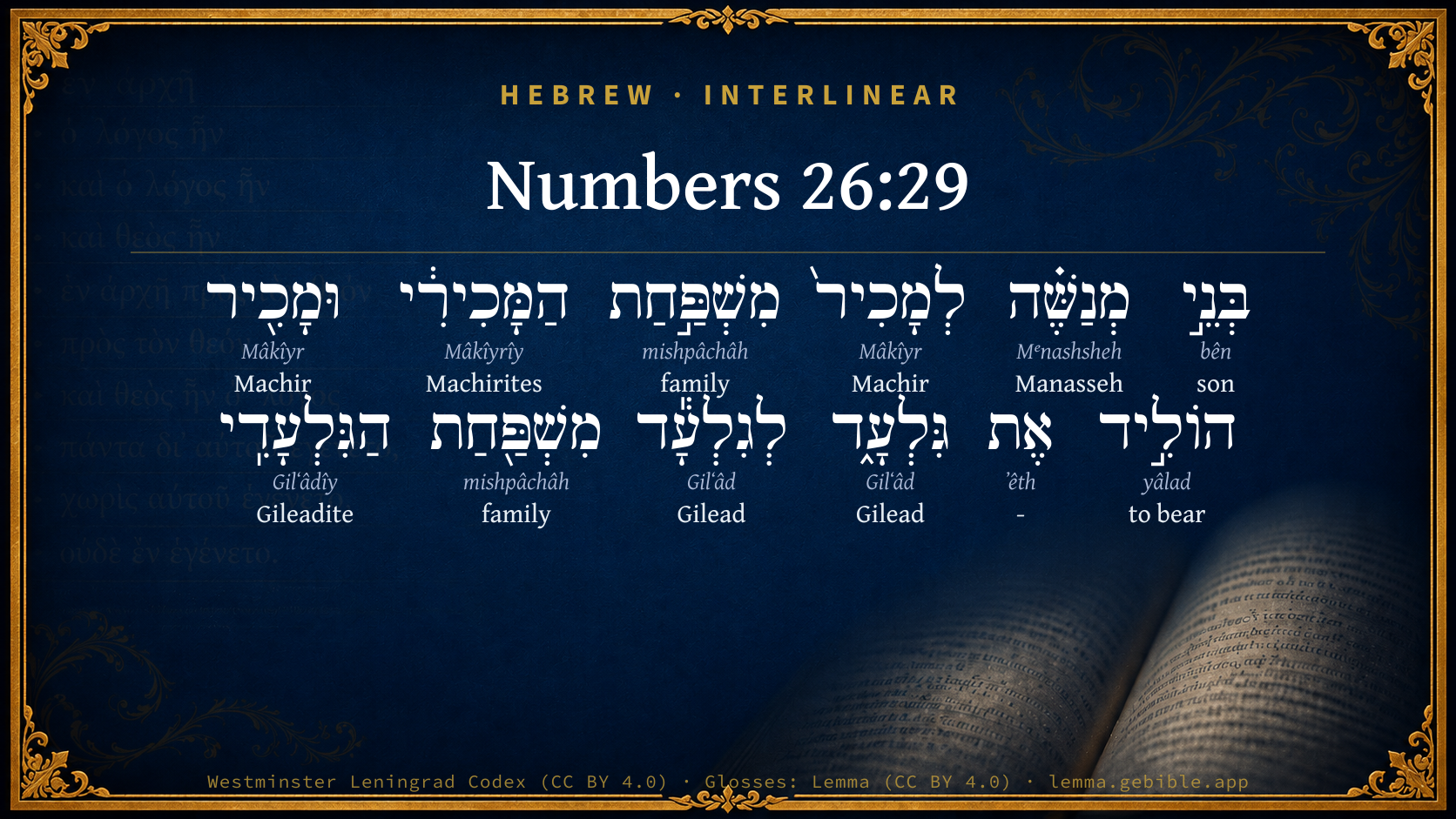
Numbers 26:29

Hebrew (Westminster Leningrad Codex) Numbers 26:29 appears in the Hebrew Old Testament. The text above is from the Westminster Leningrad Codex. Each word links to its Strong’s number, a concise gloss, and parsing drawn from the Open Scriptures Hebrew Bible morphology. Click any word for its full Brown-Driver-Briggs (BDB) entry.
Download image
Cite this verse

Numbers 26:29 (World English Bible). Public Domain. Lemma interlinear Bible study tool, https://lemma.gebible.app/v/numbers/26/29.

Show BibTeX & RIS
BibTeX
RIS
English Translation
The sons of Manasseh: of Machir, the family of the Machirites; and Machir became the father of Gilead; of Gilead, the family of the Gileadites.
World English Bible · Public Domain
Highlights Full analysis ↓
Download a study sheet

One document with this verse’s original text, its word-by-word gloss line, the meaning frame, cross-references with their text, attributed commentary, and full source and license credits — printable, and it pastes into notes with its structure intact.

This verse Autodidact and up

Study sheet (.html) Plain text (.txt)

A passage Seminary Student

Up to 50 verses in one chapter. A passage sheet keeps up to 6 commentary sources and 12 cross-references per verse, in the order this page ranks them, and says so on the sheet whenever that leaves anything out. Ask for a single verse and you get the Autodidact verse sheet above.

Everything on this page stays free to read, with no account — the sheet is a download of what is already on screen, not access to it.

Want to remove ads? Support Godless Engineer
Compare translations 3

The same verse in 3 English versions, stacked beneath the original-language interlinear above. Click any original word for its lexicon entry.

Each is an independent rendering of the whole verse — the interlinear is not word-aligned to these translations.

Highlighted words mark where these versions differ — a whole-verse word diff, not a word-by-word alignment.

  • World English Bible Public Domain
    The sons of Manasseh: of Machir, the family of the Machirites; and Machir became the father of Gilead; of Gilead, the family of the Gileadites.
  • King James Version Public Domain
    Of the sons of Manasseh: of Machir, the family of the Machirites: and Machir begat Gilead: of Gilead come the family of the Gileadites.
  • unfoldingWord Literal Text CC BY-SA 4.0
    The sons of Manasseh: of Makir, the clan of the Makirite (and Makir fathered Gilead); of Gilead, the clan of the Gileadite.

unfoldingWord Literal Text — © unfoldingWord, licensed CC BY-SA 4.0. Word-aligned USFM3 via Door43 (git.door43.org/unfoldingWord/en_ult).

Versions to compare (up to 4)

3 of 4 selected

Show all 18 translations

Every available English version of this verse, each an independent rendering of the whole verse.

  • World English Bible Public Domain
    The sons of Manasseh: of Machir, the family of the Machirites; and Machir became the father of Gilead; of Gilead, the family of the Gileadites.
  • Berean Standard Bible Public Domain
    These were the descendants of Manasseh: The Machirite clan from Machir, the father of Gilead, and the Gileadite clan from Gilead.
  • Majority Standard Bible Public Domain
    These were the descendants of Manasseh: The Machirite clan from Machir, the father of Gilead, and the Gileadite clan from Gilead.
  • King James Version Public Domain
    Of the sons of Manasseh: of Machir, the family of the Machirites: and Machir begat Gilead: of Gilead come the family of the Gileadites.
  • American Standard Version (1901) Public Domain
    The sons of Manasseh: of Machir, the family of the Machirites; and Machir begat Gilead; of Gilead, the family of the Gileadites.
  • Revised Version (1885) Public Domain
    The sons of Manasseh: of Machir, the family of the Machirites: and Machir begat Gilead: of Gilead, the family of the Gileadites.
  • Geneva Bible (1599) Public Domain
    The sonnes of Manasseh were: of Machir, the familie of the Machirites: and Machir begate Gilead: of Gilead came the familie of the Gileadites.
  • Douay-Rheims (1899) Public Domain
    Of Manasses was born Machir, of whom is the family of the Machirites. Machir beget Galaad, of whom is the family of the Galaadites.
  • Young's Literal Translation Public Domain
    Sons of Manasseh: of Machir `is' the family of the Machirite; and Machir hath begotten Gilead; of Gilead `is' the family of the Gileadite.
  • Literal Standard Version CC BY-SA 4.0
    Sons of Manasseh: of Machir [is] the family of the Machirite; and Machir has begotten Gilead; of Gilead [is] the family of the Gileadite.
  • Unlocked Literal Bible CC BY-SA 4.0
    The descendants of Manasseh were these: through Makir, the clan of the Makirites (Makir was Gilead's father), through Gilead, the clan of the Gileadites.
  • unfoldingWord Literal Text CC BY-SA 4.0
    The sons of Manasseh: of Makir, the clan of the Makirite (and Makir fathered Gilead); of Gilead, the clan of the Gileadite.
  • Darby Bible Public Domain
    The sons of Manasseh: of Machir, the family of the Machirites (and Machir begot Gilead); of Gilead, the family of the Gileadites.
  • World Messianic Bible Public Domain
    The sons of Manasseh: of Machir, the family of the Machirites; and Machir became the father of Gilead; of Gilead, the family of the Gileadites.
  • Webster's Bible Public Domain
    Of the sons of Manasseh: of Machir, the family of the Machirites: and Machir begat Gilead: of Gilead come the family of the Gileadites.
  • Free Bible Version CC BY-SA 4.0
    The descendants of Manasseh: Machir (he was the father of Gilead), ancestor of the Machirite family; and Gilead, ancestor of the Gileadite family.
  • Bible in Basic English Public Domain
    The sons of Manasseh: of Machir, the family of the Machirites: and Machir was the father of Gilead: of Gilead, the family of the Gileadites.
  • JPS Tanakh (1917) Public Domain
    The sons of Manasseh: of Machir, the family of the Machirites — and Machir begot Gilead; of Gilead, the family of the Gileadites.

Literal Standard Version (2020), Covenant Press — licensed CC BY-SA 4.0. Text via the HelloAO Bible API (eBible.org). Unlocked Literal Bible (unfoldingWord) — licensed CC BY-SA 4.0. Text via the HelloAO Bible API (eBible.org). unfoldingWord Literal Text — © unfoldingWord, licensed CC BY-SA 4.0. Word-aligned USFM3 via Door43 (git.door43.org/unfoldingWord/en_ult). Free Bible Version, Dr. Jonathan Gallagher — licensed CC BY-SA 4.0. Text via the HelloAO Bible API (eBible.org).

Word by word

More ways to search: Search by grammar → Find every occurrence → Compare this word →

Practice this passage: Drill this verse → Learn its vocabulary →

הַמָּכִירִ֔י
Mâkîyrîy
H4354
“the · Machirites”
Particle, Definite Article + Noun, Gentilic, Masculine, Singular, Absolute
Part of Speech
Particle + Noun
Type
Gentilic
Gender
Masculine
Number
Singular
State
Absolute
Full BDB Definition

Origin: patronymical from H4353

TWOT: None

Machirites = "a salesman" - the descendants of Machir the father of Gilead
  1. בְּנֵ֣י bên H1121 “sons of” Noun, Common, Masculine, Plural, Construct
  2. מְנַשֶּׁ֗ה Mᵉnashsheh H4519 “Manasseh” Noun, Proper
  3. לְמָכִיר֙ Mâkîyr H4353 “to/for · Machir” Preposition + Noun, Proper
  4. מִשְׁפַּ֣חַת mishpâchâh H4940 “family of” Noun, Common, Feminine, Singular, Construct
  5. וּמָכִ֖יר Mâkîyr H4353 “and · Machir” Conjunction + Noun, Proper
  6. הוֹלִ֣יד yâlad H3205 “to bear” Verb, Hiphil, Perfect, 3rd Person, Masculine, Singular
  7. אֶת ʼêth H853 “-” Particle, Direct Object
  8. גִּלְעָ֑ד Gilʻâd H1568 “Gilead” Noun, Proper
  9. לְגִלְעָ֕ד Gilʻâd H1568 “to/for · Gilead” Preposition + Noun, Proper
  10. מִשְׁפַּ֖חַת mishpâchâh H4940 “family of” Noun, Common, Feminine, Singular, Construct
  11. הַגִּלְעָדִֽי Gilʻâdîy H1569 “the · Gileadite” Particle, Definite Article + Noun, Gentilic, Masculine, Singular, Absolute

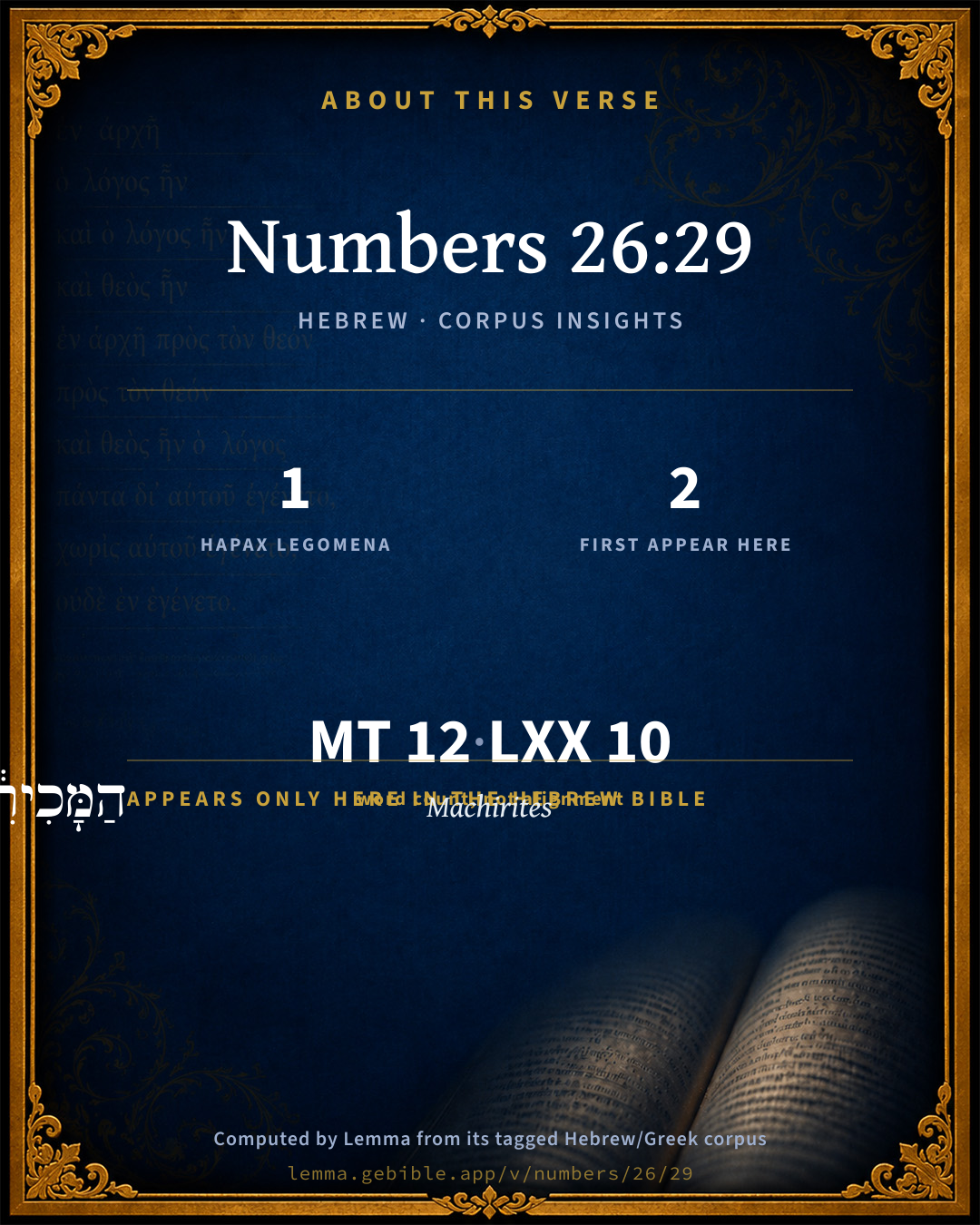
About this verse

These counts appear in no published source. They are computed here, from the morphology-tagged text and Lemma’s own curated glosses. What Lemma adds →

12
words
9
distinct lemmas
Pentateuch
section

Notable vocabulary

1 hapax legomenon — a word that appears only here in the entire Hebrew Bible:

  • הַמָּכִירִ֔י Machirites H4354

First appearance in Scripture

These words make their first canonical appearance in the Hebrew Bible here:

  • הַמָּכִירִ֔י Machirites H4354
  • הַגִּלְעָדִֽי Gileadite H1569

Shared distinctive vocabulary

הַגִּלְעָדִֽי Gileadite H1569 occurs in 11 verses of the Hebrew Bible. Also found in:

Grammatical profile

  • 1 verb
  • 10 nouns
  • 1 particle

Verb forms

  • הוֹלִ֣יד Hiphil · Perfect

Repetition

Words recur within this verse — often emphatic in Hebrew:

  • לְמָכִיר֙ Machir H4353 ×2
  • מִשְׁפַּ֣חַת family H4940 ×2
  • גִּלְעָ֑ד Gilead H1568 ×2

Hebrew & Septuagint length

In English translation the verse runs 25 words from the Hebrew and 14 from the Septuagint (LXX English) — the Septuagint runs noticeably shorter here. See the side-by-side →

A rough comparison of the two English renderings, which tokenize alike — not a word-level alignment.

Word counts can differ between the Hebrew and the Greek without any difference in meaning — e.g. the Hebrew direct-object marker אֵת has no separate Greek word, and Greek often adds the article ὁ.

In the original languages it is 12 Hebrew tokens and 10 Greek tokens — but the two are counted differently (Hebrew bundles its prefixes and suffixes into one token; the Greek is in lemma form), so that isn’t a like-for-like length.

Cross-references

7

Topical passages linked to Numbers 26:29 in the Treasury of Scripture Knowledge — connected by theme and wording, ordered by reader-vote popularity; previews shown in the World English Bible.

  • Joshua 17:1 [This] was the lot for the tribe of Manasseh; for he was the firstborn of Joseph. As for Machir the firstborn of Manasseh, the father of Gilead, because he was a man of war, therefore he had Gilead and Bashan.
  • Numbers 36:1 The heads of the fathers' [houses] of the family of the children of Gilead, the son of Machir, the son of Manasseh, of the families of the sons of Joseph, came near, and spoke before Moses, and before the princes, the heads of the fathers' [houses] of the children of Israel:
  • 1 Chronicles 7:14–19 The sons of Manasseh: Asriel, whom his concubine the Aramitess bore: she bore Machir the father of Gilead:
  • Genesis 48:14 Israel stretched out his right hand, and laid it on Ephraim's head, who was the younger, and his left hand on Manasseh's head, guiding his hands knowingly, for Manasseh was the firstborn.
  • Numbers 32:39–40 The children of Machir the son of Manasseh went to Gilead, and took it, and dispossessed the Amorites who were therein.
  • Deuteronomy 3:15 I gave Gilead to Machir.
  • Judges 5:14 Out of Ephraim [came down] they whose root is in Amalek; After you, Benjamin, among your peoples; Out of Machir came down governors, Out of Zebulun those who handle the marshal's staff.

Cross-references courtesy of OpenBible.info (CC BY 4.0).

Hebrew and Greek witnesses Masoretic Hebrew ↔ Greek Septuagint

The same verse in the two great witnesses to the Old Testament, shown verse-for-verse.

Here the Septuagint runs noticeably shorter than the Hebrew — LXX2012 (modern English Septuagint) 14 words vs World English Bible 25. A rough length comparison of the two English translations, not a word-level alignment — read both below.

These are two independent witnesses, not word-aligned to each other, and the Septuagint is shown in lemma (dictionary) form.

Hebrew Numbers 26:29 Masoretic · Westminster Leningrad Codex

בְּנֵ֣י מְנַשֶּׁ֗ה לְמָכִיר֙ מִשְׁפַּ֣חַת הַמָּכִירִ֔י וּמָכִ֖יר הוֹלִ֣יד אֶת גִּלְעָ֑ד לְגִלְעָ֕ד מִשְׁפַּ֖חַת הַגִּלְעָדִֽי

The sons of Manasseh: of Machir, the family of the Machirites; and Machir became the father of Gilead; of Gilead, the family of the Gileadites.

World English Bible · Public Domain

Greek LXX Numbers 26:29 Septuagint · lemma form

ὁ χοβερ δῆμος ὁ χοβερι ὁ μελχιηλ δῆμος ὁ μελχιηλι

To Chober, the family of the Choberites; to Melchiel, the family of the Melchielites.

LXX2012 (modern English Septuagint) · Public Domain

On this verse, Ellicott's Commentary for English Readers discusses the Septuagint’s reading. Read the note in Commentary ↓

Hebrew: Westminster Leningrad Codex (CC BY 4.0). Greek: Septuagint (public domain); English from LXX2012 (modern English Septuagint) (Public Domain). How the Septuagint differs from the Hebrew →

Targum (Aramaic paraphrase)

2

The Targum is the ancient Jewish Aramaic paraphrase of the Hebrew Scriptures — an interpretive translation, not the Hebrew text itself. Onkelos (literal) and Pseudo-Jonathan (expansive) render the Torah, and Jonathan the Prophets. Coverage is partial: where no permissively-licensed English translation exists for a verse, only the Aramaic is shown. This is verse-level text, not a word-by-word alignment to the Hebrew.

  1. Targum Onkelos Torah (Genesis–Deuteronomy)
    בְּנֵי מְנַשֶׁה לְמָכִיר זַרְעִית מָכִיר וּמָכִיר אוֹלִיד יַת גִלְעָד לְגִלְעָד זַרְעִית גִלְעָד

    (no public-domain English translation for this verse)

    Targum Onkelos — Aramaic: “Onkelos Genesis” (public domain); “Onkelos Exodus” (public domain); “Onkelos Leviticus” (public domain); “Onkelos Numbers” (public domain); “Onkelos Deuteronomy” (public domain). English: “Sefaria Community Translation” (CC0 1.0 (public-domain dedication)); “J.W. Etheridge. The Targums of Onkelos and Jonathan Ben Uzziel on the Pentateuch. London: Longmans, Green, 1862” (public domain). Text via Sefaria.

  2. Targum Pseudo-Jonathan Torah (Genesis–Deuteronomy)
    בְּנוֹי דִמְנַשֶׁה לְמָכִיר גְנִיסַת מָכִיר וּמָכִיר אוֹלִיד יַת גִלְעָד לְגִלְעָד גְנִיסַת גִלְעָד

    the Beni Menasheh, of Makir, the family of Makir, and Makir begat Gilead; of Gilead, the family of Gilead.

    Targum Pseudo-Jonathan — Aramaic: “Targum Jonathan on Genesis” (public domain); “Targum Jonathan on Exodus” (public domain); “Targum Jonathan on Leviticus” (public domain); “Targum Jonathan on Numbers” (public domain); “Targum Jonathan on Deuteronomy” (public domain). English: “The Targum of Jonathan ben Uzziel, trans. J. W. Etheridge, London, 1862” (public domain). Text via Sefaria.

Commentary

Notes on Numbers 26:29 from classic Christian and Jewish commentators (each source and its license shown beneath its notes). The classic Christian expositions comment on the surrounding passage and are grouped to its opening verse, so a note may address several verses; the Jewish commentaries on the Tanakh (Rashi and others) are per-verse, so they appear only where the commentator wrote on this verse.

Lemma curates 59 commentaries, every one of them public domain or Creative Commons licensed, each selected and text-cleaned for this edition rather than reprinted as found. About our sources →

Ellicott's Commentary for English Readers

(29) Machir begat Gilead.—It is stated in 1Ch_7:14, and in the LXX. of Gen_46:20, that Machir’s mother was an Aramitess. This may account for the name which was given to his son, Gilead, the border land between Syria and Canaan, and that in which Laban overtook Jacob (Gen_31:25).

A Bible Commentary for English Readers, edited by Charles John Ellicott (1878–1897) — public domain. Text from a community e-Sword module.

Haydock's Catholic Bible Commentary

Machir: 1 Paralipomenon vii. 20, we find Ezriel also mentioned. See chap. xxxi. 39.

George Leo Haydock (1774–1849), Haydock's Catholic Family Bible and Commentary, 1859 edition — public domain. Excludes Psalms (Douay-Rheims chapter numbering differs from Protestant) and Deuterocanonical books (Catholic canon only).

Matthew Poole's English Annotations

Gilead is here mentioned as Machir’s only son, and therefore some conceive that the family of the Machirites, and of the Gileadites, are one and the same family, only called by two names; first Machirites, but afterwards Gileadites. Others make them distinct families, because Machir had other children, Gen 1:23; 1Ch 7:14-16, which are called by their father’s name, Machirites, whereas the children of his eldest son Gilead are called by his name, Gileadites. But though Machir had other children, it seems they and their posterity were extinct at this time, and that Machir alone was left and his posterity, as may be gathered by comparing this and the following verses with Jos 17:1-3; 1Ch 7:14-19.

Matthew Poole's English Annotations on the Holy Bible (1683–1685) — public domain. Text from a community e-Sword/MySword module.

Whedon's Commentary on the Bible

Daniel D. Whedon

29. The sons of Manasseh — This genealogy harmonizes fully with Num_27:1; Num_36:1, and Jos_17:1-6, except that the contracted form of Jeezer (Num_26:30) is fully written Abiezer by Joshua.

Daniel D. Whedon (gen. ed.), Commentary on the Old and New Testaments (1874–1909) — public domain. Text from a community e-Sword module.

The Pulpit Commentary

The sons of Manasseh. There is considerable difficulty about the families of this tribe, because they are not recorded in Genesis, while the details preserved in 1Ch_7:14-17 are so obscure and fragmentary as to be extremely perplexing. According to the present enumeration there were eight families in Manasseh, one named after his son Machir, one after his grandson Gilead, and the rest after his great-grandsons. The list given in Jos_17:1, 2 agrees with this, except that the Machirites and the Gileadites are apparently identified. It appears from the genealogy in 1Ch 7 that the mother of Machir was a stranger from Aram, the country of Laban. This may perhaps account for the fact that Machir"s son received the name of Gilead, for Gilead was the border land between Aram and Canaan; it more probably explains the subsequent allotment of territory in that direction to the Machirites. (Num_32:40) Gilead appears again as a proper name in Jud_1:11:2.

The Pulpit Commentary (1880–1919), ed. H.D.M. Spence-Jones & Joseph S. Exell — public domain. Text from a community e-Sword module.

Lesson kit

Teaching starters — assembled from the data on this page, not authored interpretation. Every prompt links to the verse data it draws on. Edit before teaching.

Numbers, in the Pentateuch, opens this verse with 12 words (9 distinct Hebrew lemmas). Its most distinctive word is Mâkîyrîy (“Machirites”). The Greek Septuagint runs shorter here. A historical commentator’s framing appears above. Read the whole chapter for the surrounding context.

Discussion questions

  1. The word Mâkîyrîy carries the sense “Machirites.” How does it shape the verse?
  2. 1 word here appears nowhere else in the Hebrew Bible. Why might the author reach for such rare wording?
  3. 2 words make their first appearance in Scripture here. What does this debut establish?
  4. How does Judges 10:3, which shares the word «Gileadite», read alongside this verse?
  5. What does the repetition of “Machir” (2× in this one verse) do in this verse?
  6. The Septuagint runs shorter here than the Hebrew. What might account for the difference?
  7. These translations render this verse differently. What is at stake in choosing one wording over another?
  8. «הוֹלִ֣יד» is a Hiphil Perfect verb. How does that grammatical form shape the action described?

Things to notice

  • 1 word in this verse appears nowhere else in the Hebrew Bible.
  • 2 words make their first canonical appearance in Scripture here.
  • This verse counts 12 Hebrew ↔ 10 Greek words.
  • These translations choose different wording for 13 words in this verse.
  • “Machir” occurs 2× in this single verse.

Reading settings

Reading text

Shown beneath each verse's original-language words.

Old Testament
Old Testament edition

Read the OT as the Masoretic Hebrew (MT) or the Greek Septuagint (LXX).

English shown for the Greek Septuagint (in the Hebrew ↔ Greek comparison).

Comparing translations? Open the Compare panel on any verse page to stack up to four side by side.