
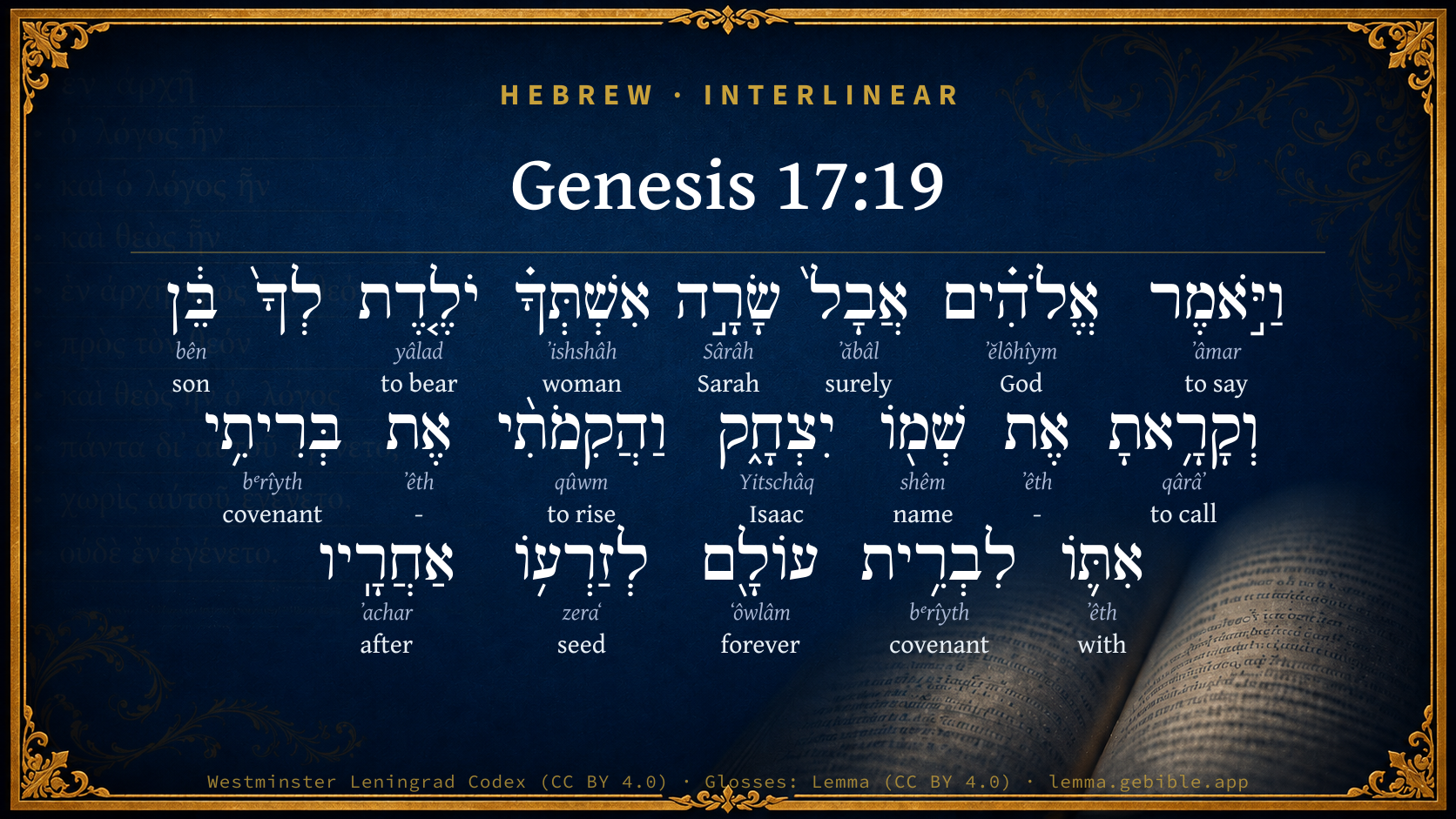
Genesis 17:19

Hebrew (Westminster Leningrad Codex) Genesis 17:19 appears in the Hebrew Old Testament. The text above is from the Westminster Leningrad Codex. Each word links to its Strong’s number, a concise gloss, and parsing drawn from the Open Scriptures Hebrew Bible morphology. Click any word for its full Brown-Driver-Briggs (BDB) entry.
Download image
Cite this verse

Genesis 17:19 (World English Bible). Public Domain. Lemma interlinear Bible study tool, https://lemma.gebible.app/v/genesis/17/19.

Show BibTeX & RIS
BibTeX
RIS
English Translation
God said, "No, but Sarah, your wife, will bear you a son. You shall call his name Isaac. I will establish my covenant with him for an everlasting covenant for his seed after him.
World English Bible · Public Domain
Highlights
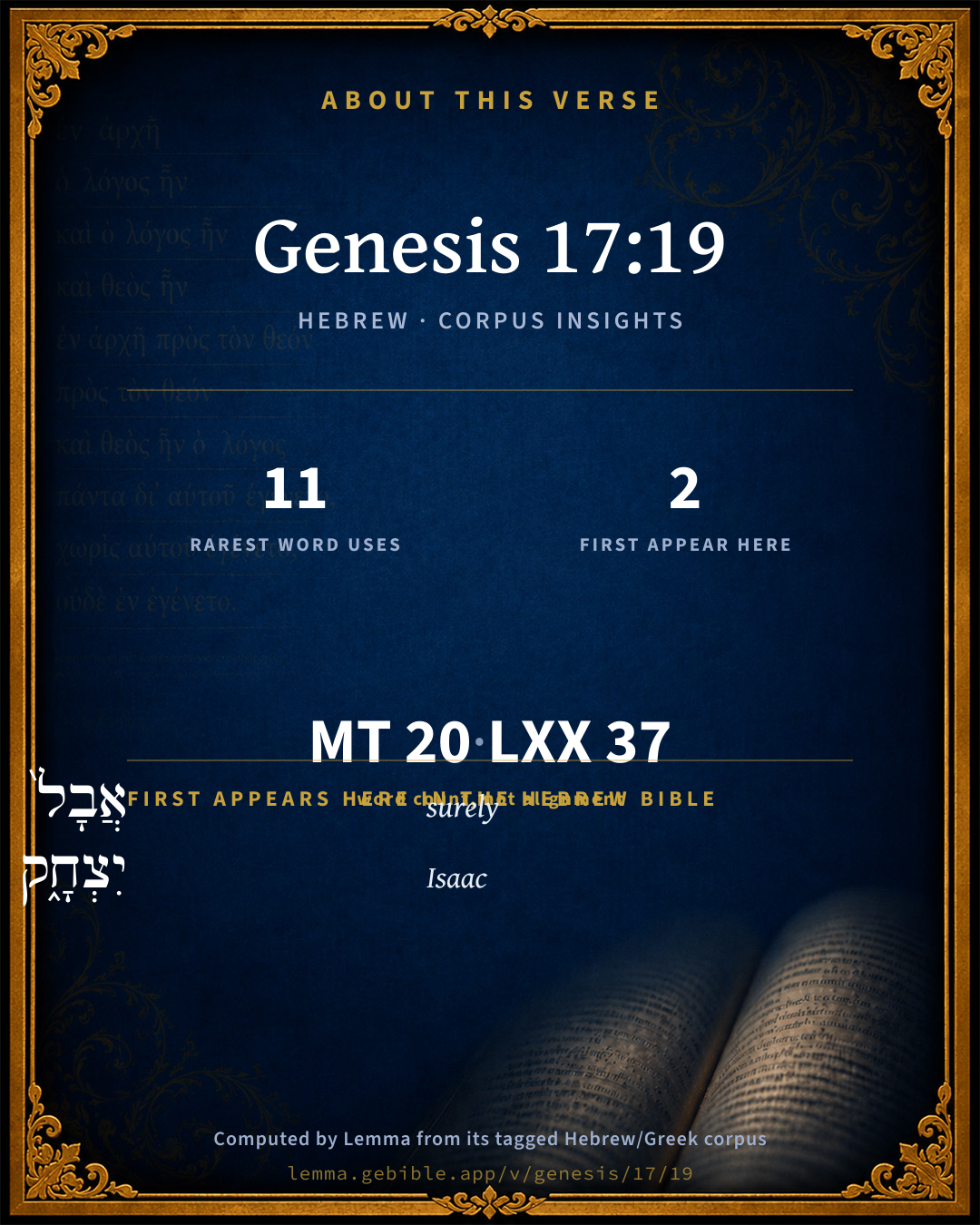
  • 2 first appearances in the Hebrew Bible
Full analysis ↓
Download a study sheet

One document with this verse’s original text, its word-by-word gloss line, the meaning frame, cross-references with their text, attributed commentary, and full source and license credits — printable, and it pastes into notes with its structure intact.

This verse Autodidact and up

Study sheet (.html) Plain text (.txt)

A passage Seminary Student

Up to 50 verses in one chapter. A passage sheet keeps up to 6 commentary sources and 12 cross-references per verse, in the order this page ranks them, and says so on the sheet whenever that leaves anything out. Ask for a single verse and you get the Autodidact verse sheet above.

Everything on this page stays free to read, with no account — the sheet is a download of what is already on screen, not access to it.

Want to remove ads? Support Godless Engineer
Compare translations 3

The same verse in 3 English versions, stacked beneath the original-language interlinear above. Click any original word for its lexicon entry.

Each is an independent rendering of the whole verse — the interlinear is not word-aligned to these translations.

Highlighted words mark where these versions differ — a whole-verse word diff, not a word-by-word alignment.

  • World English Bible Public Domain
    God said, "No, but Sarah, your wife, will bear you a son. You shall call his name Isaac. I will establish my covenant with him for an everlasting covenant for his seed after him.
  • King James Version Public Domain
    And God said, Sarah thy wife shall bear thee a son indeed; and thou shalt call his name Isaac: and I will establish my covenant with him for an everlasting covenant, and with his seed after him.
  • unfoldingWord Literal Text CC BY-SA 4.0
    Then God said, “No, Sarah your wife is bearing a son for you, and you will call his name Isaac. And I will establish my covenant with him as an eternal covenant for his offspring after him.

unfoldingWord Literal Text — © unfoldingWord, licensed CC BY-SA 4.0. Word-aligned USFM3 via Door43 (git.door43.org/unfoldingWord/en_ult).

Versions to compare (up to 4)

3 of 4 selected

Show all 18 translations

Every available English version of this verse, each an independent rendering of the whole verse.

  • World English Bible Public Domain
    God said, "No, but Sarah, your wife, will bear you a son. You shall call his name Isaac. I will establish my covenant with him for an everlasting covenant for his seed after him.
  • Berean Standard Bible Public Domain
    But God replied, “Your wife Sarah will indeed bear you a son, and you are to name him Isaac. I will establish My covenant with him as an everlasting covenant for his descendants after him.
  • Majority Standard Bible Public Domain
    But God replied, “Your wife Sarah will indeed bear you a son, and you are to name him Isaac. I will establish My covenant with him as an everlasting covenant for his descendants after him.
  • King James Version Public Domain
    And God said, Sarah thy wife shall bear thee a son indeed; and thou shalt call his name Isaac: and I will establish my covenant with him for an everlasting covenant, and with his seed after him.
  • American Standard Version (1901) Public Domain
    And God said, Nay, but Sarah thy wife shall bear thee a son; and thou shalt call his name Isaac: and I will establish my covenant with him for an everlasting covenant for his seed after him.
  • Revised Version (1885) Public Domain
    And God said, Nay, but Sarah thy wife shall bear thee a son; and thou shalt call his name Isaac: and I will establish my covenant with him for an everlasting covenant for his seed after him.
  • Geneva Bible (1599) Public Domain
    Then God saide, Sarah thy wife shall beare thee a sonne in deede, and thou shalt call his name Izhak: and I will establish my couenant with him for an euerlasting couenant, and with his seede after him.
  • Douay-Rheims (1899) Public Domain
    And God said to Abraham: Sara thy wife shall bear thee a son, and thou shalt call his name Isaac, and I will establish my covenant with him for a perpetual covenant, and with his seed after him.
  • Young's Literal Translation Public Domain
    and God saith, `Sarah thy wife is certainly bearing a son to thee, and thou hast called his name Isaac, and I have established My covenant with him, for a covenant age-during, to his seed after him.
  • Literal Standard Version CC BY-SA 4.0
    and God says, “Your wife Sarah is certainly bearing a son to you, and you have called his name Isaac, and I have established My covenant with him, for a perpetual covenant, to his seed after him.
  • Unlocked Literal Bible CC BY-SA 4.0
    God said, “No, but Sarah your wife will bear you a son, and you must name him Isaac. I will establish my covenant with him as an everlasting covenant with his descendants after him.
  • unfoldingWord Literal Text CC BY-SA 4.0
    Then God said, “No, Sarah your wife is bearing a son for you, and you will call his name Isaac. And I will establish my covenant with him as an eternal covenant for his offspring after him.
  • Darby Bible Public Domain
    And God said, Sarah thy wife shall indeed bear thee a son; and thou shalt call his name Isaac; and I will establish my covenant with him, for an everlasting covenant for his seed after him.
  • World Messianic Bible Public Domain
    God said, “No, but Sarah, your wife, will bear you a son. You shall call his name Isaac. I will establish my covenant with him for an everlasting covenant for his offspring after him.
  • Webster's Bible Public Domain
    And God said, Sarah thy wife shall bear thee a son indeed; and thou shalt call his name Isaac: and I will establish my covenant with him for an everlasting covenant, and with his seed after him.
  • Free Bible Version CC BY-SA 4.0
    “No, it's your wife Sarah who is going to have a son for you!” God replied. “You are to call him Isaac. I will keep my agreement with him and his descendants as an eternal agreement.
  • Bible in Basic English Public Domain
    And God said, Not so; but Sarah, your wife, will have a son, and you will give him the name Isaac, and I will make my agreement with him for ever and with his seed after him.
  • JPS Tanakh (1917) Public Domain
    And God said: 'Nay, but Sarah thy wife shall bear thee a son; and thou shalt call his name Isaac; and I will establish My covenant with him for an everlasting covenant for his seed after him.

Literal Standard Version (2020), Covenant Press — licensed CC BY-SA 4.0. Text via the HelloAO Bible API (eBible.org). Unlocked Literal Bible (unfoldingWord) — licensed CC BY-SA 4.0. Text via the HelloAO Bible API (eBible.org). unfoldingWord Literal Text — © unfoldingWord, licensed CC BY-SA 4.0. Word-aligned USFM3 via Door43 (git.door43.org/unfoldingWord/en_ult). Free Bible Version, Dr. Jonathan Gallagher — licensed CC BY-SA 4.0. Text via the HelloAO Bible API (eBible.org).

Word by word

More ways to search: Search by grammar → Find every occurrence → Compare this word →

Practice this passage: Drill this verse → Learn its vocabulary →

אֲבָל֙
ʼăbâl
H61
“surely”
Adverb
Part of Speech
Adverb
Full BDB Definition

Origin: apparently from H56 through the idea of negation

TWOT: 8

truly, verily, surely - but, however, howbeit - contrariwise, nay rather (negative)
  1. וַיֹּ֣אמֶר ʼâmar H559 “and · to say” Conjunction + Verb, Qal, Sequential Imperfect, 3rd Person, Masculine, Singular
  2. אֱלֹהִ֗ים ʼĕlôhîym H430 “God(s)” Noun, Common, Masculine, Plural, Absolute
  3. שָׂרָ֣ה Sârâh H8283 “Sarah” Noun, Proper
  4. אִשְׁתְּךָ֗ ʼishshâh H802 “woman · your” Noun, Common, Feminine, Singular, Construct + Suffix, Personal, 2nd Person, Masculine, Singular
  5. יֹלֶ֤דֶת yâlad H3205 “bearing” Verb, Qal, Participle Active, Feminine, Singular, Absolute
  6. בֵּ֔ן bên H1121 “son” Noun, Common, Masculine, Singular, Absolute
  7. וְקָרָ֥אתָ qârâʼ H7121 “and · to call” Conjunction + Verb, Qal, Sequential Perfect, 2nd Person, Masculine, Singular
  8. אֶת ʼêth H853 “-” Particle, Direct Object
  9. שְׁמ֖וֹ shêm H8034 “name · his” Noun, Common, Masculine, Singular, Construct + Suffix, Personal, 3rd Person, Masculine, Singular
  10. יִצְחָ֑ק Yitschâq H3327 “Isaac” Noun, Proper
  11. וַהֲקִמֹתִ֨י qûwm H6965 “and · to rise” Conjunction + Verb, Hiphil, Sequential Perfect, 1st Person, Common, Singular
  12. אֶת ʼêth H853 “-” Particle, Direct Object
  13. בְּרִיתִ֥י bᵉrîyth H1285 “covenant · my” Noun, Common, Feminine, Singular, Construct + Suffix, Personal, 1st Person, Common, Singular
  14. אִתּ֛וֹ ʼêth H854 “with · him” Preposition + Suffix, Personal, 3rd Person, Masculine, Singular
  15. לִבְרִ֥ית bᵉrîyth H1285 “to/for · covenant of” Preposition + Noun, Common, Feminine, Singular, Construct
  16. עוֹלָ֖ם ʻôwlâm H5769 “forever” Noun, Common, Masculine, Singular, Absolute
  17. לְזַרְע֥וֹ zeraʻ H2233 “to/for · seed · his” Preposition + Noun, Common, Masculine, Singular, Construct + Suffix, Personal, 3rd Person, Masculine, Singular
  18. אַחֲרָֽיו ʼachar H310 “after · him” Preposition + Suffix, Personal, 3rd Person, Masculine, Singular

About this verse

These counts appear in no published source. They are computed here, from the morphology-tagged text and Lemma’s own curated glosses. What Lemma adds →

20
words
17
distinct lemmas
Pentateuch
section

Notable vocabulary

The rarest word here is אֲבָל֙ surely H61 — appearing just 11 times in the whole Hebrew Bible.

First appearance in Scripture

These words make their first canonical appearance in the Hebrew Bible here:

  • אֲבָל֙ surely H61
  • יִצְחָ֑ק Isaac H3327

Shared distinctive vocabulary

אֲבָל֙ surely H61 occurs in 11 verses of the Hebrew Bible. Also found in:

Grammatical profile

  • 4 verbs
  • 10 nouns
  • 3 prepositions
  • 1 adverb
  • 2 particles

Verb forms

  • וַיֹּ֣אמֶר Qal · Sequential Imperfect
  • יֹלֶ֤דֶת Qal · Participle Active
  • וְקָרָ֥אתָ Qal · Sequential Perfect
  • וַהֲקִמֹתִ֨י Hiphil · Sequential Perfect

Repetition

A word recurs within this verse — often emphatic in Hebrew:

  • בְּרִיתִ֥י covenant H1285 ×2

Hebrew & Septuagint length

In English translation the verse runs 34 words from the Hebrew and 46 from the Septuagint (LXX English) — closely comparable.

A rough comparison of the two English renderings, which tokenize alike — not a word-level alignment.

Word counts can differ between the Hebrew and the Greek without any difference in meaning — e.g. the Hebrew direct-object marker אֵת has no separate Greek word, and Greek often adds the article ὁ.

In the original languages it is 20 Hebrew tokens and 37 Greek tokens — but the two are counted differently (Hebrew bundles its prefixes and suffixes into one token; the Greek is in lemma form), so that isn’t a like-for-like length.

Cross-references

9

Topical passages linked to Genesis 17:19 in the Treasury of Scripture Knowledge — connected by theme and wording, ordered by reader-vote popularity; previews shown in the World English Bible.

  • Genesis 18:10–14 He said, "I will certainly return to you when the season comes round. Behold, Sarah your wife will have a son." Sarah heard in the tent door, which was behind him.
  • Genesis 21:2–3 Sarah conceived, and bore Abraham a son in his old age, at the set time of which God had spoken to him.
  • Luke 1:13–20 But the angel said to him, "Don't be afraid, Zacharias, because your request has been heard, and your wife, Elizabeth, will bear you a son, and you shall call his name John.
  • Genesis 21:6 Sarah said, "God has made me laugh. Everyone who hears will laugh with me."
  • 2 Kings 4:16–17 He said, At this season, when the time comes round, you shall embrace a son. She said, No, my lord, you man of God, do not lie to your handmaid.
  • Galatians 4:28–31 Now we, brothers, as Isaac was, are children of promise.
  • Romans 9:6–9 But it is not as though the word of God has come to nothing. For they are not all Israel, that are of Israel.
  • Genesis 17:21 But my covenant I establish with Isaac, whom Sarah will bear to you at this set time in the next year."
  • Genesis 26:3 Sojourn in this land, and I will be with you, and will bless you. For to you, and to your seed, I will give all these lands, and I will establish the oath which I swore to Abraham your father.

Cross-references courtesy of OpenBible.info (CC BY 4.0).

Hebrew and Greek witnesses Masoretic Hebrew ↔ Greek Septuagint

The same verse in the two great witnesses to the Old Testament, shown verse-for-verse.

These are two independent witnesses, not word-aligned to each other, and the Septuagint is shown in lemma (dictionary) form.

Hebrew Genesis 17:19 Masoretic · Westminster Leningrad Codex

וַיֹּ֣אמֶר אֱלֹהִ֗ים אֲבָל֙ שָׂרָ֣ה אִשְׁתְּךָ֗ יֹלֶ֤דֶת לְךָ֙ בֵּ֔ן וְקָרָ֥אתָ אֶת שְׁמ֖וֹ יִצְחָ֑ק וַהֲקִמֹתִ֨י אֶת בְּרִיתִ֥י אִתּ֛וֹ לִבְרִ֥ית עוֹלָ֖ם לְזַרְע֥וֹ אַחֲרָֽיו

God said, "No, but Sarah, your wife, will bear you a son. You shall call his name Isaac. I will establish my covenant with him for an everlasting covenant for his seed after him.

World English Bible · Public Domain

Greek LXX Genesis 17:19 Septuagint · lemma form

εἶπον δέ ὁ θεός ὁ αβρααμ ναί ἰδού σαρρα ὁ γυνή σύ τίκτω σύ υἱός καί καλέω ὁ ὄνομα αὐτός ισαακ καί ἵστημι ὁ διαθήκη ἐγώ πρός αὐτός εἰς διαθήκη αἰώνιος καί ὁ σπέρμα αὐτός μετά αὐτός

And God said to Abraam, Yes, behold, Sarrha your wife shall bear you a son, and you shall call his name Isaac; and I will establish my covenant with him, for an everlasting covenant, to be a God to him and to his seed after him.

LXX2012 (modern English Septuagint) · Public Domain

Hebrew: Westminster Leningrad Codex (CC BY 4.0). Greek: Septuagint (public domain); English from LXX2012 (modern English Septuagint) (Public Domain). How the Septuagint differs from the Hebrew →

Targum (Aramaic paraphrase)

2

The Targum is the ancient Jewish Aramaic paraphrase of the Hebrew Scriptures — an interpretive translation, not the Hebrew text itself. Onkelos (literal) and Pseudo-Jonathan (expansive) render the Torah, and Jonathan the Prophets. Coverage is partial: where no permissively-licensed English translation exists for a verse, only the Aramaic is shown. This is verse-level text, not a word-by-word alignment to the Hebrew.

  1. Targum Onkelos Torah (Genesis–Deuteronomy)
    וַאֲמַר יְיָ בְּקוּשְׁטָא שָׂרָה אִתְּתָךְ תְּלִיד לָךְ בָּר וְתִקְרֵי יָת שְׁמֵהּ יִצְחָק וַאֲקִים יָת קְיָמִי עִמֵּהּ לִקְיָם עָלָם לִבְנוֹהִי בַּתְרוֹהִי

    (no public-domain English translation for this verse)

    Targum Onkelos — Aramaic: “Onkelos Genesis” (public domain); “Onkelos Exodus” (public domain); “Onkelos Leviticus” (public domain); “Onkelos Numbers” (public domain); “Onkelos Deuteronomy” (public domain). English: “Sefaria Community Translation” (CC0 1.0 (public-domain dedication)); “J.W. Etheridge. The Targums of Onkelos and Jonathan Ben Uzziel on the Pentateuch. London: Longmans, Green, 1862” (public domain). Text via Sefaria.

  2. Targum Pseudo-Jonathan Torah (Genesis–Deuteronomy)
    וַאֲמַר יְיָ בְּקוּשְׁטָא שָרָה אִנְתְּתָךְ תְּלִיד לָךְ בַּר וְתִקְרֵי יַת שְׁמֵיהּ יִצְחָק וְאָקִים יַת קְיָימִי עִמֵיהּ לִקְיַים עֲלָם לִבְנוֹי בַתְרוֹי

    And the Lord said, In truth Sarah thy wife shall bear thee a son, and thou shalt call his name Izhak; and with him I will confirm My covenant for an everlasting covenant to his sons after him.

    Targum Pseudo-Jonathan — Aramaic: “Targum Jonathan on Genesis” (public domain); “Targum Jonathan on Exodus” (public domain); “Targum Jonathan on Leviticus” (public domain); “Targum Jonathan on Numbers” (public domain); “Targum Jonathan on Deuteronomy” (public domain). English: “The Targum of Jonathan ben Uzziel, trans. J. W. Etheridge, London, 1862” (public domain). Text via Sefaria.

Commentary

Notes on Genesis 17:19 from classic Christian and Jewish commentators (each source and its license shown beneath its notes). The classic Christian expositions comment on the surrounding passage and are grouped to its opening verse, so a note may address several verses; the Jewish commentaries on the Tanakh (Rashi and others) are per-verse, so they appear only where the commentator wrote on this verse.

Lemma curates 59 commentaries, every one of them public domain or Creative Commons licensed, each selected and text-cleaned for this edition rather than reprinted as found. About our sources →

Trapp's Complete Commentary

John Trapp

Gen 17:19 And God said, Sarah thy wife shall bear thee a son indeed; and thou shalt call his name Isaac: and I will establish my covenant with him for an everlasting covenant, [and] with his seed after him.

Ver. 19. I will establish my covenant with him.] This was a far greater favour than that bestowed on Ishmael in the next verse, "Twelve princes shall he beget." Nothing so ennobleth as Christ, graces, being in the covenant, &c. {Isa 19:25} "Assyria" is "the work of" God’s "hands," but "Israel" his "inheritance."

John Trapp, A Commentary or Exposition upon All the Books of the Old and New Testament (1647–1656) — public domain. Text from a community e-Sword module.

Tyndale Open Study Notes

Tyndale Open Resources

17:19 The name Isaac (Hebrew yitskhaq, “he laughs”) would constantly recall Abraham’s disbelieving laughter when he heard the promise. It was also a reminder of God’s favor and his pleasure in the birth (cp. 21:6).

Tyndale Open Study Notes — © Tyndale Open Resources, licensed CC BY-SA 4.0. Text via the HelloAO Bible API.

Rashi

Rabbi Shlomo Yitzchaki (Rashi)

אבל VERILY — This word implies confirmation of a statement, just as (Genesis 42:21) “Verily (אבל) we are guilty”, and (2 Kings 4:14) “Verily (אבל) she has no son”.

וקראת את שמו יצחק AND THOU SHALL CALL HIS NAME ISAAC — with reference to his laughter. Some say the name has reference to the ten (י) trials, the ninety (צ) years of Sarah’s age, the eight (ח) days of the circumcision and the hundred (ק) years of Abraham’s age (Genesis Rabbah 53:7).

והקמתי את בריתי AND I WILL ESTABLISH MY COVENANT WITH HIM — Why is this stated? Is it not already written (Genesis 17:9) “as for thee, thou shalt keep My Covenant, thou and thy seed etc.”? But since is said, (Genesis 17:7) and I will establish My Covenant between Me and thee and thy seed after thee in their generations”, it might be inferred that the children of Ishmael and the children of Keturah (who are all descendants of Abraham) are included in this promise of the establishment of the Covenant, therefore it states here (Genesis 17:19) “And I will establish My Covenant with him (Isaac), not with the others” (cf. Sanhedrin 59b). If so, why is there a repetition of the statement that the covenant will be established with Isaac in the words (Genesis 17:21) ואת בריתי אקים את יצחק “but My Covenant will I establish with Isaac”? But it is repeated in order to add the words אשר תלד so as to teach that he was holy from his birth (Shabbat 137b). Another explanation of why 5:21 is repeated is: R. Aba said, “from here Scripture draws a logical conclusion regarding the son of the Mistress (Sarah) from what is said regarding the son of the handmaid (Hagar): It is written (Genesis 17:20) “Behold I have blessed him and will make him fruitful”, and this refers to Ishmael: Surely then, it follows logically that “I must establish my covenant (of blessing) with Isaac also!” (Genesis Rabbah 47:5).

את בריתי [I WILL ESTABLISH] MY COVENANT — The Covenant of circumcision shall be transmitted only to the descendants of Isaac.

Rashi on the Tanakh — English translations: “The Judaica Press complete Tanach with Rashi, translated by A. J. Rosenberg” (CC BY 4.0); “Pentateuch with Rashi's commentary by M. Rosenbaum and A.M. Silbermann, 1929-1934” (public domain); “The Metsudah Tanach series, Lakewood, N.J” (CC BY 4.0); and “The Book of Joshua, Metsudah Publications, 1997” (CC BY 4.0). Text via Sefaria.

Geneva Bible (1599)

Geneva Bible translators

The everlasting Covenant is made with the children of the Spirit: and with the children of the flesh is made the temporal promise, as was promised to Ishmael.

Geneva Bible (1599) marginal notes — public domain. Text via Bolls.life.

Jamieson, Fausset & Brown

Robert Jamieson, A. R. Fausset & David Brown

The blessings of the covenant are reserved for Isaac, but common blessings were abundantly promised to Ishmael; and though the visible Church did not descend from his family, yet personally he might, and it is to be hoped did, enjoy its benefits.

Next: Genesis Chapter 18

Jamieson, Fausset & Brown — Commentary Critical and Explanatory on the Whole Bible (1871) — public domain (CC PDM 1.0). Text via the HelloAO Bible API.

John Calvin's Commentaries

19. Sarah thy wife shall bear thee a son indeed Some take the adverb אבל (abal,) to mean ‘Truly.’ Others, however, more rightly suppose it to be used for increasing the force of the expression. For God rouses the slumbering mind of his servant; as if he would say, ‘The sight of one favor prevents thee from raising thyself higher; and thus it happens that thou dost confine thy thoughts within too narrow limits. Now, therefore, enlarge thy mind, to receive also what I promise concerning Sarah. For the door of hope ought to be sufficiently open to admit the word in its full magnitude.’

And I will establish my covenant with him He confines the spiritual covenant to one family, in order that Abraham may hence learn to hope for the blessing before promised; for since he had framed for himself a false hope, not founded on the word of God, it was necessary that this false hope should first be dislodged from his heart, in order that he might now the more fully rely upon the heavenly oracles, and might fix the anchor of his faith, which before had wavered in a fallacious imagination, on the firm truth of God. He calls the covenant everlasting, in the sense which we have previously explained. He then declares that it shall not be bound to one person only, but shall be common to his whole race, that it may, by continual succession, descend to his posterity. Yet it may seem absurd, that God should command Ishmael, whom he deprives of his grace, to be circumcised. I answer; although the Lord constitutes Isaac the firstborn and the head, from whom he intends the covenant of salvation to flow, he still does not entirely exclude Ishmael, but rather, in adopting the whole family of Abraham, joins Ishmael to his brother Isaac as an inferior member, until Ishmael cut himself off from his father’s house, and his brother’s society. Therefore his circumcision was not useless, until he apostatized from the covenant: for although it was not deposited with him, he might, nevertheless, participate in it, with his brother Isaac. In short, the Lord intends nothing else, by these words, than that Isaac should be the legitimate heir of the promised benediction.

John Calvin's Commentaries (1540-1563) — public domain. Text from the Calvin Translation Society English edition (1840s-50s) via the Christian Classics Ethereal Library (ccel.org). Calvin's coverage is partial (roughly two-thirds of the Bible); uncommented books and verses are honest gaps, never fabricated. The 19th-century editor's footnotes and remarks are omitted so the notes are faithfully Calvin's own voice.

Ellicott's Commentary for English Readers

(19) Indeed.—In the Hebrew this word comes first, and is intended to remove all doubt or desire for any other turn of affairs. It should be rendered, “And God said, For a certainty Sarah thy wife shall bear thee a son.”

Thou shalt call his name Isaac.—That is, he laughs. The name was to be a perpetual memorial that Isaac’s birth was naturally such an impossibility as to excite ridicule.

A Bible Commentary for English Readers, edited by Charles John Ellicott (1878–1897) — public domain. Text from a community e-Sword module.

The Cambridge Bible for Schools and Colleges

gen. ed. J. J. S. Perowne

19. Sarah thy wife] God’s answer in this verse is made to the utterance of Abraham’s heart (Gen_17:17), and not of his lips (Gen_17:18).

thou shalt call his name Isaac] R.V. marg. “From the Heb. word meaning to laugh.” See Gen_21:3. The name Isaac is here, and in 18 and 21, associated with “laughter.” The word “he laughed,” used in Gen_17:17, has the same root letters (ṣḥq) as the name “Isaac.” The name “laughter” will thus commemorate the involuntary doubt of Abraham (Gen_17:17) to which St Paul refers (Rom_4:19), “without being weakened in faith he considered his own body now as good as dead (he being about a hundred years old) and the deadness of Sarah’s womb.”

Note that the father is commanded to give the name; see note on Gen_5:3 (P).

The Cambridge Bible for Schools and Colleges (gen. ed. J. J. S. Perowne; Cambridge University Press, 1878–1918) — public domain. Text from a community e-Sword module.

John Gill's Exposition

And God said, Sarah thy wife shall bear thee a son indeed,.... This is repeated for the confirmation of it, and thus expressed to remove all doubt about it, if any there were, that hung upon Abraham's mind; as well as to let him know that the promise of a son by Sarah was not to be superseded by his prayer for Ishmael, for whom he might have a greater flow of natural affection than for his unborn son, in whom his seed should be called:

and thou shall call his name Isaac; which signifies "laughter"; and which name was given him from the laughter of Abraham at the promise of him, and not from the laughter of Sarah, which as yet was not; wherefore Josephus (p) is wrong when he suggests, that Isaac had this name from Sarah's laughing at God's saying, that she should bear a son: though his birth was matter of laughter and joy to both, as it was to all good people that heard of it, Gen 21:8. So Polyhistor (q) from Melo, an Heathen writer, speaking of Abraham, says, that of his married or lawful wife one son was born to him, whose name in Greek is "Gelos", that is, laughter. Isaac is one of those the Jews (r) observe had his name given him before he was born; see Gill on Gen 16:11,

and I will establish my covenant with him, for an everlasting covenant, and with his seed after him; the covenant of circumcision just made with Abraham, the promise of the land of Canaan to him and his posterity, and of the Messiah that should spring from him, until whose coming this covenant would continue, and therefore called everlasting.

(p) Antiqu. l. 1. c. 12. sect. 2. (q) Apud Euseb. Evangel. Praepar. l. 9. c. 19. p. 421. (r) Pirke Eliezer, c. 32. Shalshalet Hakabala, fol. 2. 1.

John Gill's Exposition of the Whole Bible (1746–1763) — public domain (CC PDM 1.0). Text via the HelloAO Bible API.

Haydock's Catholic Bible Commentary

Isaac, "laughter," alluding to the exultation of Abraham, more than to the laughter of Sara, which deserved some reprehension, chap. xxi. 6.

George Leo Haydock (1774–1849), Haydock's Catholic Family Bible and Commentary, 1859 edition — public domain. Excludes Psalms (Douay-Rheims chapter numbering differs from Protestant) and Deuterocanonical books (Catholic canon only).

Matthew Poole's English Annotations

Isaac signifies laughter, not from Sarah’s laughter, which as yet had not happened, but from Abraham’s past laughter, Gen 17:17, and future joy in his son.

Matthew Poole's English Annotations on the Holy Bible (1683–1685) — public domain. Text from a community e-Sword/MySword module.

Whedon's Commentary on the Bible

Daniel D. Whedon

19. Call his name Isaac — Which means, he shall laugh. A memorial of Abraham’s joyful emotion and wonder here recorded.

Daniel D. Whedon (gen. ed.), Commentary on the Old and New Testaments (1874–1909) — public domain. Text from a community e-Sword module.

The Pulpit Commentary

And God said, Sarah thy wife shall bear thee a son indeed; and thou shalt call his name Isaac. "Laughter," or "he laughs (the third person future (yitsak) being frequently employed in personal designations; cf. Jacob, Jair, Jabin, &c.), with obvious reference to Abraham"s laughter (vide Ver. 17). Cf. on naming before birth Gen_16:11. ;And I will establish my covenant with him for an everlasting covenant, and with his seed after him.

The Pulpit Commentary (1880–1919), ed. H.D.M. Spence-Jones & Joseph S. Exell — public domain. Text from a community e-Sword module.

unfoldingWord translationNotes

Door43 World Missions Community

No, but Sarah your wife will bear

God said this to correct Abraham's belief that Sarah could not have a son.

you must name him

The word "you" refers to Abraham.

As for Ishmael

The words "As for" show that God is switching from talking about the baby that would be born to talking about Ishmael.

Behold

"Look" or "Listen" or "Pay attention to what I am about to tell you"

will make him fruitful

This is an idiom that means "will cause him to have many children." (See: Idiom)

will multiply him abundantly

"I will cause him to have many descendants"

leaders of tribes

"chiefs" or "rulers." These leaders are not the twelve sons and grandsons of Jacob that will lead the twelve tribes of Israel.

But my covenant I will establish with Isaac

God returns to talking about his covenant with Abraham and emphasizes that he would fulfill his promise with Isaac, not with Ishmael.

translationWords

Sarah

Isaac

eternity

covenant

descend

Ishmael

tribe

nation

unfoldingWord translationNotes — © Distant Shores Media and the Door43 World Missions Community, licensed CC BY-SA 4.0. Source: git.door43.org/Door43/en_tn.

Ramban (Nachmanides)

Rabbi Moshe ben Nachman (Ramban / Nachmanides)

‘AVAL’ SARAH THY WIFE. This is like the verse, “Aval” she has no son, the word aval meaning “only.” He thus said: “Only the son of whom I informed you, your wife Sarah will give birth to, and with him will I establish My covenant forever and with his seed after him; and Ishmael I will bless by making his children numerous, but this will not be because of My covenant with him.”

Ramban (Nachmanides) on the Tanakh — English translation: “Commentary on the Torah by Ramban (Nachmanides). Translated and annotated by Charles B. Chavel. New York, Shilo Pub. House, 1971-1976” (CC BY 4.0). Text via Sefaria.

Radak

Rabbi David Kimhi (Radak)

ויאמר... אבל שרה אשתך, Ishmael will not remain your only son, but also Sarah will bear a son for you and you are to call his name Yitzchok, as a reminder that you laughed happily when you heard Me inform you of this.

לברית עולם לזרעו אחריו, the covenant I made with you will be perpetuated through Yitzchok's seed.

Radak on the Tanakh — English translations: “Sefaria Community Translation” (CC0 1.0 (public-domain dedication)); “Eliyahu Munk, HaChut Hameshulash” (CC BY 4.0); “Rabbi Mike Feuer, Jerusalem Anthology” (CC BY 4.0); and “R. David Kimhi on the first book of Psalms, Translated by R.G. Finch, London, 1919” (public domain). Text via Sefaria.

Lesson kit

Teaching starters — assembled from the data on this page, not authored interpretation. Every prompt links to the verse data it draws on. Edit before teaching.

Genesis, in the Pentateuch, opens this verse with 20 words (17 distinct Hebrew lemmas). Its most distinctive word is ʼăbâl (“surely”). A historical commentator’s framing appears above. Read the whole chapter for the surrounding context.

Discussion questions

  1. How does “surely” (ʼăbâl) shape what this verse is saying?
  2. 2 words here appear for the first time in Scripture. What is being introduced at this debut?
  3. Genesis 42:21 shares the word «surely» with this verse. How do the two illuminate each other?
  4. “covenant” occurs 2× in this one verse. What is the effect of the repetition?
  5. These translations render this verse differently. What is at stake in choosing one wording over another?
  6. The verb «וַיֹּ֣אמֶר» is Qal Sequential Imperfect. How does its form color the action?
  7. Reading how Trapp's Complete Commentary and Tyndale Open Study Notes read this verse, where do the two commentators agree and where do they part?

Things to notice

Reading settings

Reading text

Shown beneath each verse's original-language words.

Old Testament
Old Testament edition

Read the OT as the Masoretic Hebrew (MT) or the Greek Septuagint (LXX).

English shown for the Greek Septuagint (in the Hebrew ↔ Greek comparison).

Comparing translations? Open the Compare panel on any verse page to stack up to four side by side.