2 Samuel 14:27

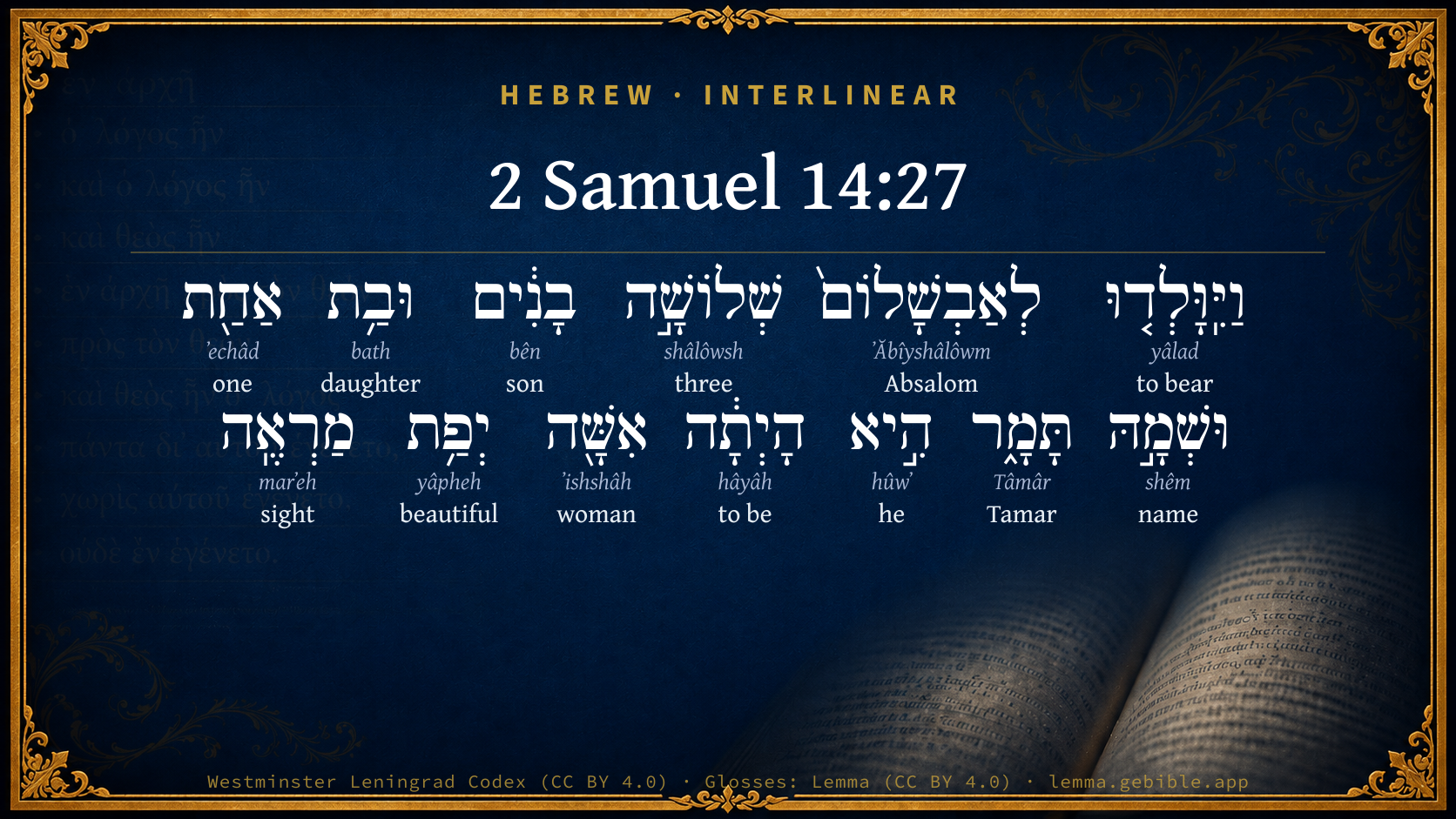
Hebrew (Westminster Leningrad Codex) 2 Samuel 14:27 appears in the Hebrew Old Testament. The text above is from the Westminster Leningrad Codex. Each word links to its Strong’s number, a concise gloss, and parsing drawn from the Open Scriptures Hebrew Bible morphology. Click any word for its full Brown-Driver-Briggs (BDB) entry.
Download image
Cite this verse

2 Samuel 14:27 (World English Bible). Public Domain. Lemma interlinear Bible study tool, https://lemma.gebible.app/v/2-samuel/14/27.

Show BibTeX & RIS
BibTeX
RIS
English Translation
To Absalom there were born three sons, and one daughter, whose name was Tamar: she was a woman of a beautiful face.
World English Bible · Public Domain
Download a study sheet

One document with this verse’s original text, its word-by-word gloss line, the meaning frame, cross-references with their text, attributed commentary, and full source and license credits — printable, and it pastes into notes with its structure intact.

This verse Autodidact and up

Study sheet (.html) Plain text (.txt)

A passage Seminary Student

Up to 50 verses in one chapter. A passage sheet keeps up to 6 commentary sources and 12 cross-references per verse, in the order this page ranks them, and says so on the sheet whenever that leaves anything out. Ask for a single verse and you get the Autodidact verse sheet above.

Everything on this page stays free to read, with no account — the sheet is a download of what is already on screen, not access to it.

Want to remove ads? Support Godless Engineer
Compare translations 3

The same verse in 3 English versions, stacked beneath the original-language interlinear above. Click any original word for its lexicon entry.

Each is an independent rendering of the whole verse — the interlinear is not word-aligned to these translations.

Highlighted words mark where these versions differ — a whole-verse word diff, not a word-by-word alignment.

  • World English Bible Public Domain
    To Absalom there were born three sons, and one daughter, whose name was Tamar: she was a woman of a beautiful face.
  • King James Version Public Domain
    And unto Absalom there were born three sons, and one daughter, whose name was Tamar: she was a woman of a fair countenance.
  • unfoldingWord Literal Text CC BY-SA 4.0
    And to Absalom were born three sons and one daughter, and her name Tamar. She was a woman beautiful of appearance.

unfoldingWord Literal Text — © unfoldingWord, licensed CC BY-SA 4.0. Word-aligned USFM3 via Door43 (git.door43.org/unfoldingWord/en_ult).

Versions to compare (up to 4)

3 of 4 selected

Show all 18 translations

Every available English version of this verse, each an independent rendering of the whole verse.

  • World English Bible Public Domain
    To Absalom there were born three sons, and one daughter, whose name was Tamar: she was a woman of a beautiful face.
  • Berean Standard Bible Public Domain
    Three sons were born to Absalom, and a daughter named Tamar, who was a beautiful woman.
  • Majority Standard Bible Public Domain
    Three sons were born to Absalom, and a daughter named Tamar, who was a beautiful woman.
  • King James Version Public Domain
    And unto Absalom there were born three sons, and one daughter, whose name was Tamar: she was a woman of a fair countenance.
  • American Standard Version (1901) Public Domain
    And unto Absalom there were born three sons, and one daughter, whose name was Tamar: she was a woman of a fair countenance.
  • Revised Version (1885) Public Domain
    And unto Absalom there were born three sons, and one daughter, whose name was Tamar: she was a woman of a fair countenance.
  • Geneva Bible (1599) Public Domain
    And Absalom had three sonnes, and one daughter named Tamar, which was a fayre woman to looke vpon.
  • Douay-Rheims (1899) Public Domain
    And there were born to Absalom three sons: and one daughter, whose, name was Thamar, and she was very beautiful.
  • Young's Literal Translation Public Domain
    And there are born to Absalom three sons, and one daughter, and her name `is' Tamar; she was a woman of a fair appearance.
  • Literal Standard Version CC BY-SA 4.0
    And there are born to Absalom three sons and one daughter, and her name [is] Tamar; she was a woman of beautiful appearance.
  • Unlocked Literal Bible CC BY-SA 4.0
    To Absalom were born three sons and one daughter, whose name was Tamar. She was a beautiful woman.
  • unfoldingWord Literal Text CC BY-SA 4.0
    And to Absalom were born three sons and one daughter, and her name Tamar. She was a woman beautiful of appearance.
  • Darby Bible Public Domain
    And to Absalom there were born three sons, and one daughter, whose name was Tamar: she was a woman of a beautiful countenance.
  • World Messianic Bible Public Domain
    Three sons were born to Absalom, and one daughter, whose name was Tamar. She was a woman with a beautiful face.
  • Webster's Bible Public Domain
    And to Absalom there were born three sons, and one daughter, whose name was Tamar: she was a woman of a fair countenance.
  • Free Bible Version CC BY-SA 4.0
    He had three sons, and a daughter named Tamar—a very beautiful woman.
  • Bible in Basic English Public Domain
    And Absalom was the father of three sons and of one daughter named Tamar, who was very beautiful.
  • JPS Tanakh (1917) Public Domain
    And unto Absalom there were born three sons, and one daughter, whose name was Tamar; she was a woman of a fair countenance.

Literal Standard Version (2020), Covenant Press — licensed CC BY-SA 4.0. Text via the HelloAO Bible API (eBible.org). Unlocked Literal Bible (unfoldingWord) — licensed CC BY-SA 4.0. Text via the HelloAO Bible API (eBible.org). unfoldingWord Literal Text — © unfoldingWord, licensed CC BY-SA 4.0. Word-aligned USFM3 via Door43 (git.door43.org/unfoldingWord/en_ult). Free Bible Version, Dr. Jonathan Gallagher — licensed CC BY-SA 4.0. Text via the HelloAO Bible API (eBible.org).

Word by word

More ways to search: Search by grammar → Find every occurrence → Compare this word →

Practice this passage: Drill this verse → Learn its vocabulary →

תָּמָ֑ר
Tâmâr
H8559
“Tamar”
Noun, Proper
Part of Speech
Noun
Type
Proper
Full BDB Definition

Origin: the same as H8558

TWOT: None

Tamar = "palm-tree" - widow of Er, the son of Judah; fiancee of Shelah, another son of Judah; wife of Judah and mother of Pharez and Zerah (noun proper feminine) - daughter of David by Maacah, sister of Absalom, and rape victim of Amnon her half brother, another son of David (noun proper feminine) - daughter of Absalom (noun proper feminine) - a place on the southern border of Gad (noun proper locative)
  1. וַיִּֽוָּלְד֤וּ yâlad H3205 “and · to bear” Conjunction + Verb, Niphal, Sequential Imperfect, 3rd Person, Masculine, Plural
  2. לְאַבְשָׁלוֹם֙ ʼĂbîyshâlôwm H53 “to/for · Absalom” Preposition + Noun, Proper
  3. שְׁלוֹשָׁ֣ה shâlôwsh H7969 “three” Adjective, Cardinal number, Masculine, Singular, Absolute
  4. בָנִ֔ים bên H1121 “sons” Noun, Common, Masculine, Plural, Absolute
  5. וּבַ֥ת bath H1323 “and · daughter” Conjunction + Noun, Common, Feminine, Singular, Absolute
  6. אַחַ֖ת ʼechâd H259 “one” Adjective, Cardinal number, Feminine, Singular, Absolute
  7. וּשְׁמָ֣הּ shêm H8034 “and · name · her” Conjunction + Noun, Common, Masculine, Singular, Construct + Suffix, Personal, 3rd Person, Feminine, Singular
  8. הִ֣יא hûwʼ H1931 “he” Pronoun, Personal, 3rd Person, Feminine, Singular
  9. הָיְתָ֔ה hâyâh H1961 “to be” Verb, Qal, Perfect, 3rd Person, Feminine, Singular
  10. אִשָּׁ֖ה ʼishshâh H802 “woman” Noun, Common, Feminine, Singular, Absolute
  11. יְפַ֥ת yâpheh H3303 “beautiful of” Adjective, Adjective, Feminine, Singular, Construct
  12. מַרְאֶֽה marʼeh H4758 “sight” Noun, Common, Masculine, Singular, Absolute

About this verse

These counts appear in no published source. They are computed here, from the morphology-tagged text and Lemma’s own curated glosses. What Lemma adds →

13
words
13
distinct lemmas
Historical
section

Notable vocabulary

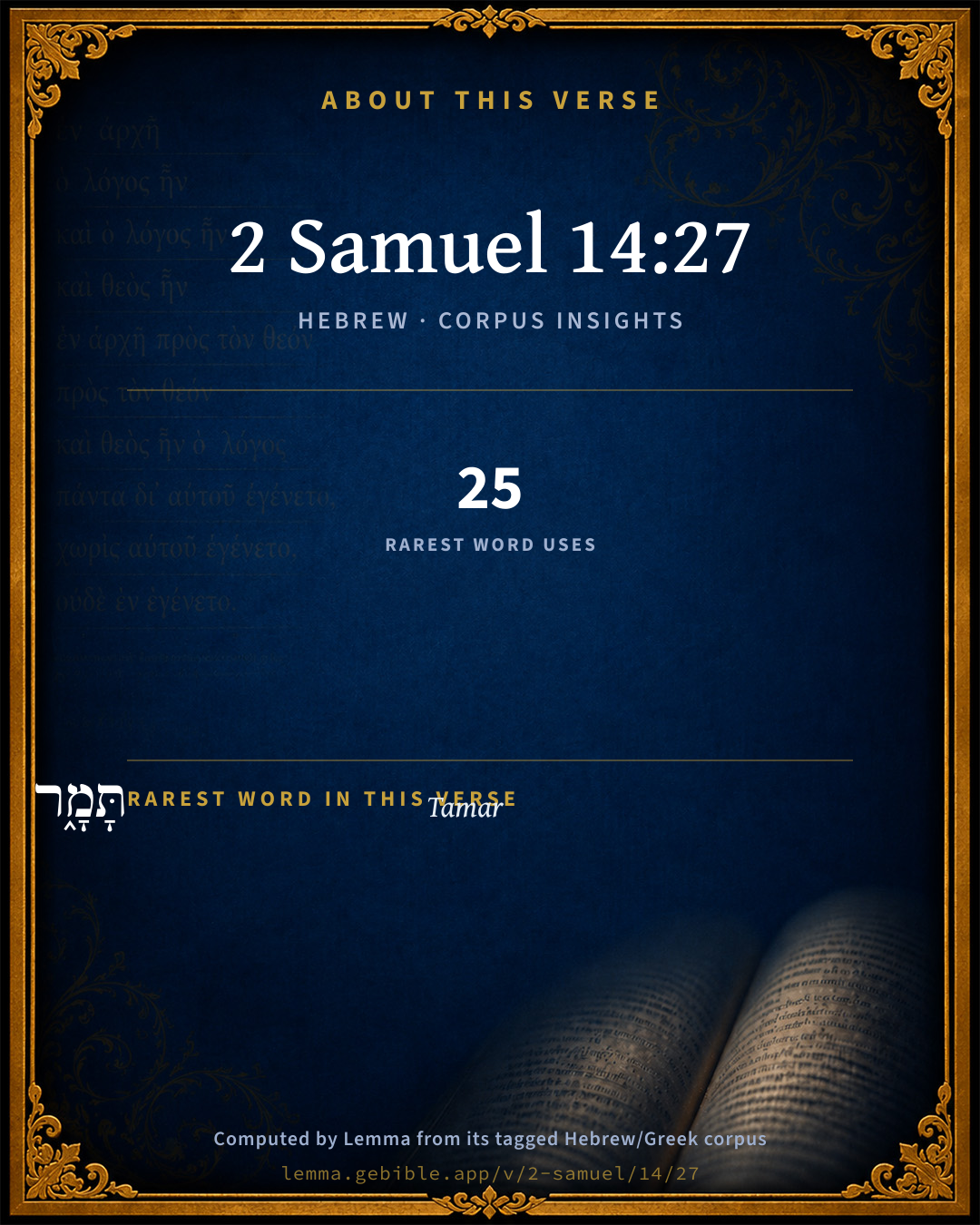
The rarest word here is תָּמָ֑ר Tamar H8559 — appearing just 25 times in the whole Hebrew Bible.

Shared distinctive vocabulary

תָּמָ֑ר Tamar H8559 occurs in 23 verses of the Hebrew Bible. Also found in:

Grammatical profile

  • 2 verbs
  • 7 nouns
  • 3 adjectives
  • 1 pronoun

Verb forms

  • וַיִּֽוָּלְד֤וּ Niphal · Sequential Imperfect
  • הָיְתָ֔ה Qal · Perfect

Hebrew & Septuagint length

In English translation the verse runs 22 words from the Hebrew and 38 from the Septuagint (LXX English) — the Septuagint runs noticeably longer here. See the side-by-side →

A rough comparison of the two English renderings, which tokenize alike — not a word-level alignment.

Word counts can differ between the Hebrew and the Greek without any difference in meaning — e.g. the Hebrew direct-object marker אֵת has no separate Greek word, and Greek often adds the article ὁ.

Cross-references

5

Topical passages linked to 2 Samuel 14:27 in the Treasury of Scripture Knowledge — connected by theme and wording, ordered by reader-vote popularity; previews shown in the World English Bible.

  • 2 Samuel 18:18 Now Absalom in his lifetime had taken and reared up for himself the pillar, which is in the king's dale; for he said, I have no son to keep my name in memory: and he called the pillar after his own name; and it is called Absalom's monument, to this day.
  • 2 Samuel 13:1 It happened after this, that Absalom the son of David had a beautiful sister, whose name was Tamar; and Amnon the son of David loved her.
  • Job 18:16–19 His roots shall be dried up beneath, Above shall his branch be cut off.
  • Isaiah 14:22 I will rise up against them, says Yahweh of Hosts, and cut off from Babylon name and remnant, and son and son's son, says Yahweh.
  • Jeremiah 22:30 Thus says Yahweh, Write you this man childless, a man who shall not prosper in his days; for no more shall a man of his seed prosper, sitting on the throne of David, and ruling in Judah.

Cross-references courtesy of OpenBible.info (CC BY 4.0).

Hebrew and Greek witnesses Masoretic Hebrew ↔ Greek Septuagint

The same verse in the two great witnesses to the Old Testament, shown verse-for-verse.

Here the Septuagint runs noticeably longer than the Hebrew — LXX2012 (modern English Septuagint) 38 words vs World English Bible 22. A rough length comparison of the two English translations, not a word-level alignment — read both below.

These are two independent witnesses, not word-aligned to each other, and the Septuagint is shown in lemma (dictionary) form.

Hebrew 2 Samuel 14:27 Masoretic · Westminster Leningrad Codex

וַיִּֽוָּלְד֤וּ לְאַבְשָׁלוֹם֙ שְׁלוֹשָׁ֣ה בָנִ֔ים וּבַ֥ת אַחַ֖ת וּשְׁמָ֣הּ תָּמָ֑ר הִ֣יא הָיְתָ֔ה אִשָּׁ֖ה יְפַ֥ת מַרְאֶֽה

To Absalom there were born three sons, and one daughter, whose name was Tamar: she was a woman of a beautiful face.

World English Bible · Public Domain

Greek LXX 2 Samuel 14:27 Septuagint · lemma form

καί τίκτω ὁ αβεσσαλωμ τρεῖς υἱός καί θυγάτηρ εἷς καί ὄνομα αὐτός θημαρ οὗτος εἰμί γυνή καλός σφόδρα καί γίγνομαι γυνή ὁ ροβοαμ υἱός σαλωμών καί τίκτω αὐτός ὁ αβια

And there were born to Abessalom three sons and one daughter, and her name was Themar: she was a very beautiful woman, and she becomes the wife of Roboam son of Solomon, and she bears to him Abia.

LXX2012 (modern English Septuagint) · Public Domain

On this verse, Adam Clarke's Commentary discusses the Septuagint’s reading. Read the note in Commentary ↓

Hebrew: Westminster Leningrad Codex (CC BY 4.0). Greek: Septuagint (public domain); English from LXX2012 (modern English Septuagint) (Public Domain). How the Septuagint differs from the Hebrew →

Targum (Aramaic paraphrase)

1

The Targum is the ancient Jewish Aramaic paraphrase of the Hebrew Scriptures — an interpretive translation, not the Hebrew text itself. Onkelos (literal) and Pseudo-Jonathan (expansive) render the Torah, and Jonathan the Prophets. Coverage is partial: where no permissively-licensed English translation exists for a verse, only the Aramaic is shown. This is verse-level text, not a word-by-word alignment to the Hebrew.

  1. Targum Jonathan Prophets (Joshua–Malachi)
    וְאִתְיְלִידוּ לְאַבְשָׁלוֹם תְּלָתָא בְנִין וּבְרַתָּא חֲדָא וּשְׁמָהּ תָּמָר הִיא הֲוַת אִתְּתָא שַׁפִּירַת חֵיזוּ:

    (no public-domain English translation for this verse)

    Targum Jonathan — Aramaic: “Mikraot Gedolot” (public domain). English: “Sefaria Community Translation” (CC0 1.0 (public-domain dedication)); “London "Chaldee Paraphrase," 1871” (public domain). Text via Sefaria.

Commentary

Notes on 2 Samuel 14:27 from classic Christian and Jewish commentators (each source and its license shown beneath its notes). The classic Christian expositions comment on the surrounding passage and are grouped to its opening verse, so a note may address several verses; the Jewish commentaries on the Tanakh (Rashi and others) are per-verse, so they appear only where the commentator wrote on this verse.

Lemma curates 59 commentaries, every one of them public domain or Creative Commons licensed, each selected and text-cleaned for this edition rather than reprinted as found. About our sources →

Trapp's Complete Commentary

John Trapp

2Sa 14:27 And unto Absalom there were born three sons, and one daughter, whose name [was] Tamar: she was a woman of a fair countenance.

Ver. 27. And unto Absalom there were born three sons, and one daughter.] This was but luctuosa faecunditas; for they all died before their father, {2Sa 18:18} wherein God made way for Solomon’s more peaceable enjoyment of the crown after David’s decease.

Whose name was Tamar.] After the name of her fair aunt deflowered by Amnon.

John Trapp, A Commentary or Exposition upon All the Books of the Old and New Testament (1647–1656) — public domain. Text from a community e-Sword module.

Tyndale Open Study Notes

Tyndale Open Resources

14:27 Absalom’s three sons apparently died before he did (see 18:18). • Absalom named his daughter Tamar after his sister, and she too was very beautiful (13:1).

Tyndale Open Study Notes — © Tyndale Open Resources, licensed CC BY-SA 4.0. Text via the HelloAO Bible API.

Adam Clarke's Commentary

Verse 27. Unto Absalom there were born] These children did not survive him; see 2Sa 18:18.

Tamar] The Septuagint adds, And she became the wife of Roboam, the son of Solomon, and bare to him Abia; see Mt 1:7. Josephus says the same. This addition is not found in the other versions.

Adam Clarke's Commentary on the Bible (1810–1826) — public domain. Text from a community e-Sword/MySword module.

Ellicott's Commentary for English Readers

(27) Three sons.—Their names are not given, from which it might be supposed that they died in infancy, and this is made sure by 2Sa_18:18, where Absalom is reported as saying, “I have no son to keep my name in remembrance.”

One daughter.—This daughter bore the name of Absalom’s sister, Tamar, and shared her beauty. The LXX. here inserts the statement that she “became the wife of Roboam, the son of Solomon, and bore him a son, Abia.” But this is evidently a confused gloss, founded upon 1Ki_15:2; 2Ch_11:20-22. We are there told that Rehoboam’s favourite wife was Maachah, the daughter of Absalom, and mother of Abijah; but this must mean that Maachah was his granddaughter through Tamar, since in 2Ch_13:2 Abijah is called the son of Michaiah, the daughter of Uriel. Tamar then married Uriel, and her daughter became the mother of a line of kings.

A Bible Commentary for English Readers, edited by Charles John Ellicott (1878–1897) — public domain. Text from a community e-Sword module.

The Cambridge Bible for Schools and Colleges

gen. ed. J. J. S. Perowne

27. three sons] Who are not named, because none of them lived to grow up. See ch. 2Sa_18:18.

Tamar] Who inherited the beauty as well as the name of her aunt. The Sept. adds, “and she became the wife of Roboam the son of Solomon, and bare him Abia.” This however does not agree with the books of Kings and Chronicles. From 1Ki_15:2 we learn that Maachah the daughter of Abishalom was the wife of Rehoboam and mother of Abijam: from 2Ch_13:2 that Abijah’s mother’s name was Michaiah the daughter of Uriel of Gibeah (cp. 2Ch_11:20-22). The natural inference is that Michaiah is an alternative name or a textual error for Maachah, and that Maachah was the daughter or Uriel and Tamar, and granddaughter of Absalom, named after her great-grandmother.

The Cambridge Bible for Schools and Colleges (gen. ed. J. J. S. Perowne; Cambridge University Press, 1878–1918) — public domain. Text from a community e-Sword module.

John Gill's Exposition

And unto Absalom there were born three sons,.... Who very probably died young; and the rather it may be thought so, since their names are not given, and more especially since it is said that Absalom had no sons, and therefore erected a pillar to keep up the remembrance of his name; unless it can be thought that that was set up before he had any sons, which is not so likely; see Sa2 18:18,

and one daughter, whose name was Tamar; and whom he named after his sister Tamar, who was ravished by Amnon; the Septuagint version in some copies adds,"and she became the wife of Rehoboam, the son of Solomon, and bore to him Abia;''and so says Josephus (b); see Kg1 15:22,

she was a woman of a fair countenance; as was her aunt, after whom she was named, Sa2 13:1; by this it appears that she lived to a woman's estate, though the sons of Absalom died young.

(b) Ut supra. (Antiqu. l. 7. c. 8. sect. 5.)

John Gill's Exposition of the Whole Bible (1746–1763) — public domain (CC PDM 1.0). Text via the HelloAO Bible API.

Albert Barnes' Notes on the Bible

Three sons - These probably died in infancy (see the marginal reference). From Tamar must have been born Maachah, the mother of Abijah, and the favorite wife of Rehoboam 1Ki 15:2; 2Ch 11:20-22.

Albert Barnes' Notes on the Bible (1834–1885) — public domain. Text from a community e-Sword/MySword module.

Haydock's Catholic Bible Commentary

Sons, who all died before their father, chap. xviii. 18. --- Thamar, in memory of his sister; (Abulensis) or this Thamar received the name from her aunt, who resided with Absalom. (Menochius) --- Some Greek and Latin copies add, that she was married to Roboam, the son of Solomon, by whom he had Abias. But this addition is of no authority, and can hardly be reconciled with chronology. We read that Roboam espoused Maaca, the daughter of Absalom; (2 Paralipomenon xi. 20.) but she might be only his grand-daughter, by Thamar. (Calmet) --- Josephus had adopted this addition. (Haydock)

George Leo Haydock (1774–1849), Haydock's Catholic Family Bible and Commentary, 1859 edition — public domain. Excludes Psalms (Douay-Rheims chapter numbering differs from Protestant) and Deuterocanonical books (Catholic canon only).

Matthew Poole's English Annotations

Three sons; all which died not long after they were born, as may be gathered from 2Sa 18:18, where it is said that Absalom had no son. Tamar; so called from her aunt, 2Sa 13:1.

Matthew Poole's English Annotations on the Holy Bible (1683–1685) — public domain. Text from a community e-Sword/MySword module.

Whedon's Commentary on the Bible

Daniel D. Whedon

27. Whose name was Tamar — After her aunt. 2Sa_13:1. Why are not his son’s names given? Probably because they died in infancy, and so he erected a pillar to perpetuate his name. 2Sa_18:18.

Daniel D. Whedon (gen. ed.), Commentary on the Old and New Testaments (1874–1909) — public domain. Text from a community e-Sword module.

The Pulpit Commentary

Three sons. Their names are not given, because they died early. (see 2Sa_18:18) Of his daughter Tamar, named after her aunt, and, like her, possessed of great beauty, the Septuagint adds that she became the wife of Rehoboam, and mother of Abijah. In 1Ki_15:2 we are told that Abijah"s mother was "Maachah the daughter of Abishalom;" and in 2Ch_13:2 that her name was "Michaiah the daughter of Uriel of Gibeah." We thus gather that Tamar married Uriel, and that it was the granddaughter of Absalom who became Rehoboam"s queen. It is strictly in accordance with Hebrew custom to call Absalom"s granddaughter his daughter, and, as Uriel was a man of no political importance, he is passed over, as the narrator"s object was to show that Abijah"s mother was sprung from the handsome and notorious son of David. (see also 2Ch_11:20, 2Ch_11:21)

The Pulpit Commentary (1880–1919), ed. H.D.M. Spence-Jones & Joseph S. Exell — public domain. Text from a community e-Sword module.

John Wesley's Explanatory Notes

Sons - All which died not long after they were born, as may be gathered from chap. xviii, 18, where it is said, that Absalom had no son.

John Wesley, Explanatory Notes Upon the Whole Bible (1754–1765) — public domain. Text via the GEBible commentary corpus.

Scofield Reference Notes

C. I. Scofield

sons

(See Scofield "2Sa 18:18").

The Scofield Reference Bible (1917 edition), notes by C. I. Scofield — public domain. Text from a community e-Sword module.

Lesson kit

Teaching starters — assembled from the data on this page, not authored interpretation. Every prompt links to the verse data it draws on. Edit before teaching.

2 Samuel, in the Historical, opens this verse with 13 words (13 distinct Hebrew lemmas). Its most distinctive word is Tâmâr (“Tamar”). The Greek Septuagint runs longer here. A historical commentator’s framing appears above. Read the whole chapter for the surrounding context.

Discussion questions

  1. The word Tâmâr carries the sense “Tamar.” How does it shape the verse?
  2. How does Genesis 38:6, which shares the word «Tamar», read alongside this verse?
  3. The Septuagint runs longer here than the Hebrew. What might account for the difference?
  4. These translations render this verse differently; the difference is in the English rendering, not the original. What questions does that raise?
  5. «וַיִּֽוָּלְד֤וּ» is a Niphal Sequential Imperfect verb. How does that grammatical form shape the action described?
  6. Compare how Trapp's Complete Commentary and Tyndale Open Study Notes read this verse. Where do they agree or differ?

Things to notice

Reading settings

Reading text

Shown beneath each verse's original-language words.

Old Testament
Old Testament edition

Read the OT as the Masoretic Hebrew (MT) or the Greek Septuagint (LXX).

English shown for the Greek Septuagint (in the Hebrew ↔ Greek comparison).

Comparing translations? Open the Compare panel on any verse page to stack up to four side by side.