Genesis 4:22

Hebrew (Westminster Leningrad Codex) Genesis 4:22 appears in the Hebrew Old Testament. The text above is from the Westminster Leningrad Codex. Each word links to its Strong’s number, a concise gloss, and parsing drawn from the Open Scriptures Hebrew Bible morphology. Click any word for its full Brown-Driver-Briggs (BDB) entry.
Download image
Cite this verse

Genesis 4:22 (World English Bible). Public Domain. Lemma interlinear Bible study tool, https://lemma.gebible.app/v/genesis/4/22.

Show BibTeX & RIS
BibTeX
RIS
English Translation
Zillah also gave birth to Tubal Cain, the forger of every cutting instrument of brass and iron. Tubal Cain's sister was Naamah.
World English Bible · Public Domain
Highlights
  • 7 first appearances in the Hebrew Bible
Full analysis ↓
Download a study sheet

One document with this verse’s original text, its word-by-word gloss line, the meaning frame, cross-references with their text, attributed commentary, and full source and license credits — printable, and it pastes into notes with its structure intact.

This verse Autodidact and up

Study sheet (.html) Plain text (.txt)

A passage Seminary Student

Up to 50 verses in one chapter. A passage sheet keeps up to 6 commentary sources and 12 cross-references per verse, in the order this page ranks them, and says so on the sheet whenever that leaves anything out. Ask for a single verse and you get the Autodidact verse sheet above.

Everything on this page stays free to read, with no account — the sheet is a download of what is already on screen, not access to it.

Want to remove ads? Support Godless Engineer
Compare translations 3

The same verse in 3 English versions, stacked beneath the original-language interlinear above. Click any original word for its lexicon entry.

Each is an independent rendering of the whole verse — the interlinear is not word-aligned to these translations.

Highlighted words mark where these versions differ — a whole-verse word diff, not a word-by-word alignment.

  • World English Bible Public Domain
    Zillah also gave birth to Tubal Cain, the forger of every cutting instrument of brass and iron. Tubal Cain's sister was Naamah.
  • King James Version Public Domain
    And Zillah, she also bare Tubalcain, an instructer of every artificer in brass and iron: and the sister of Tubalcain was Naamah.
  • unfoldingWord Literal Text CC BY-SA 4.0
    And Zillah also bore Tubal Cain, who forged all of tools out of bronze and iron. And the sister of Tubal Cain Naamah.

unfoldingWord Literal Text — © unfoldingWord, licensed CC BY-SA 4.0. Word-aligned USFM3 via Door43 (git.door43.org/unfoldingWord/en_ult).

Versions to compare (up to 4)

3 of 4 selected

Show all 18 translations

Every available English version of this verse, each an independent rendering of the whole verse.

  • World English Bible Public Domain
    Zillah also gave birth to Tubal Cain, the forger of every cutting instrument of brass and iron. Tubal Cain's sister was Naamah.
  • Berean Standard Bible Public Domain
    And Zillah gave birth to Tubal-cain, a forger of every implement of bronze and iron. And the sister of Tubal-cain was Naamah.
  • Majority Standard Bible Public Domain
    And Zillah gave birth to Tubal-cain, a forger of every implement of bronze and iron. And the sister of Tubal-cain was Naamah.
  • King James Version Public Domain
    And Zillah, she also bare Tubalcain, an instructer of every artificer in brass and iron: and the sister of Tubalcain was Naamah.
  • American Standard Version (1901) Public Domain
    And Zillah, she also bare Tubal-cain, the forger of every cutting instrument of brass and iron: and the sister of Tubal-cain was Naamah.
  • Revised Version (1885) Public Domain
    And Zillah, she also bare Tubal-cain, the forger of every cutting instrument of brass and iron: and the sister of Tubal-cain was Naamah.
  • Geneva Bible (1599) Public Domain
    And Zillah also bare Tubal-kain, who wrought cunningly euery craft of brasse and of yron: and the sister of Tubal-kain was Naamah.
  • Douay-Rheims (1899) Public Domain
    Sella also brought forth Tubalcain, who was a hammerer and artificer in every work of brass and iron. And the sister of Tubalcain was Noema.
  • Young's Literal Translation Public Domain
    And Zillah she also bare Tubal-Cain, an instructor of every artificer in brass and iron; and a sister of Tubal-Cain `is' Naamah.
  • Literal Standard Version CC BY-SA 4.0
    And Zillah, she also bears Tubal-Cain, an instructor of every craftsman in bronze and iron; and a sister of Tubal-Cain [is] Naamah.
  • Unlocked Literal Bible CC BY-SA 4.0
    As for Zillah, she bore Tubal-Cain, the forger of tools of bronze and iron. The sister of Tubal-Cain was Naamah.
  • unfoldingWord Literal Text CC BY-SA 4.0
    And Zillah also bore Tubal Cain, who forged all of tools out of bronze and iron. And the sister of Tubal Cain Naamah.
  • Darby Bible Public Domain
    And Zillah, she also bore Tubal-Cain, the forger of every kind of tool of brass and iron. And the sister of Tubal-Cain was Naamah.
  • World Messianic Bible Public Domain
    Zillah also gave birth to Tubal Cain, the forger of every cutting instrument of bronze and iron. Tubal Cain’s sister was Naamah.
  • Webster's Bible Public Domain
    And Zillah, she also bore Tubalcain, an instructor of every artificer in brass and iron: and the sister of Tubalcain was Naamah.
  • Free Bible Version CC BY-SA 4.0
    Zillah also had a son. He was named Tubal-cain and he was a blacksmith, making different kinds of tools out of bronze and iron. Tubal-cain's sister was named Naamah.
  • Bible in Basic English Public Domain
    And Zillah gave birth to Tubal-cain, who is the father of every maker of cutting instruments of brass and iron: and the sister of Tubal-cain was Naamah.
  • JPS Tanakh (1917) Public Domain
    And Zillah, she also bore Tubal-cain, the forger of every cutting instrument of brass and iron; and the sister of Tubal-cain was Naamah.

Literal Standard Version (2020), Covenant Press — licensed CC BY-SA 4.0. Text via the HelloAO Bible API (eBible.org). Unlocked Literal Bible (unfoldingWord) — licensed CC BY-SA 4.0. Text via the HelloAO Bible API (eBible.org). unfoldingWord Literal Text — © unfoldingWord, licensed CC BY-SA 4.0. Word-aligned USFM3 via Door43 (git.door43.org/unfoldingWord/en_ult). Free Bible Version, Dr. Jonathan Gallagher — licensed CC BY-SA 4.0. Text via the HelloAO Bible API (eBible.org).

Word by word

More ways to search: Search by grammar → Find every occurrence → Compare this word →

Practice this passage: Drill this verse → Learn its vocabulary →

חֹרֵ֥שׁ
chôrêsh
H2794
“metalworker”
Verb, Qal, Participle Active, Masculine, Singular, Construct
Part of Speech
Verb
Stem
Qal
Form
Participle Active
Gender
Masculine
Number
Singular
State
Construct
Full BDB Definition

Origin: act. participle of H2790

TWOT: 763a ?

metal craftsman
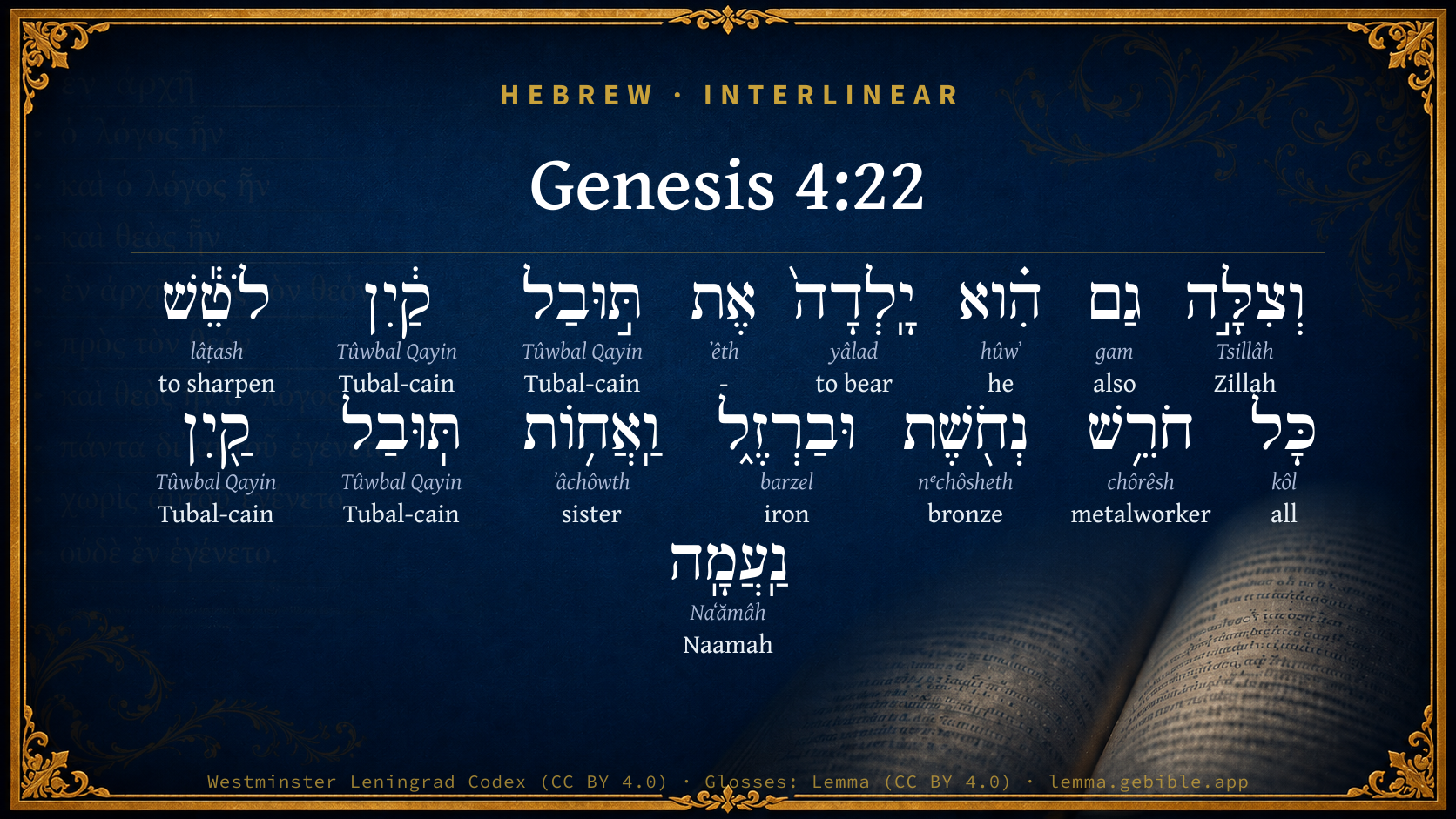
  1. וְצִלָּ֣ה Tsillâh H6741 “and · Zillah” Conjunction + Noun, Proper
  2. גַם gam H1571 “also” Adverb
  3. הִ֗וא hûwʼ H1931 “he” Pronoun, Personal, 3rd Person, Feminine, Singular
  4. יָֽלְדָה֙ yâlad H3205 “to bear” Verb, Qal, Perfect, 3rd Person, Feminine, Singular
  5. אֶת ʼêth H853 “-” Particle, Direct Object
  6. תּ֣וּבַל Tûwbal Qayin H8423 “Tubal-cain” Noun, Proper
  7. קַ֔יִן Tûwbal Qayin H8423 “Tubal-cain” Noun, Proper
  8. לֹטֵ֕שׁ lâṭash H3913 “sharpening” Verb, Qal, Participle Active, Masculine, Singular, Construct
  9. כָּל kôl H3605 “all of” Noun, Common, Masculine, Singular, Construct
  10. נְחֹ֖שֶׁת nᵉchôsheth H5178 “bronze” Noun, Common, Feminine, Singular, Absolute
  11. וּבַרְזֶ֑ל barzel H1270 “and · iron” Conjunction + Noun, Common, Masculine, Singular, Absolute
  12. וַֽאֲח֥וֹת ʼâchôwth H269 “and · sister of” Conjunction + Noun, Common, Feminine, Singular, Construct
  13. תּֽוּבַל Tûwbal Qayin H8423 “Tubal-cain” Noun, Proper
  14. קַ֖יִן Tûwbal Qayin H8423 “Tubal-cain” Noun, Proper
  15. נַֽעֲמָֽה Naʻămâh H5279 “Naamah” Noun, Proper

About this verse

These counts appear in no published source. They are computed here, from the morphology-tagged text and Lemma’s own curated glosses. What Lemma adds →

16
words
13
distinct lemmas
Pentateuch
section

Notable vocabulary

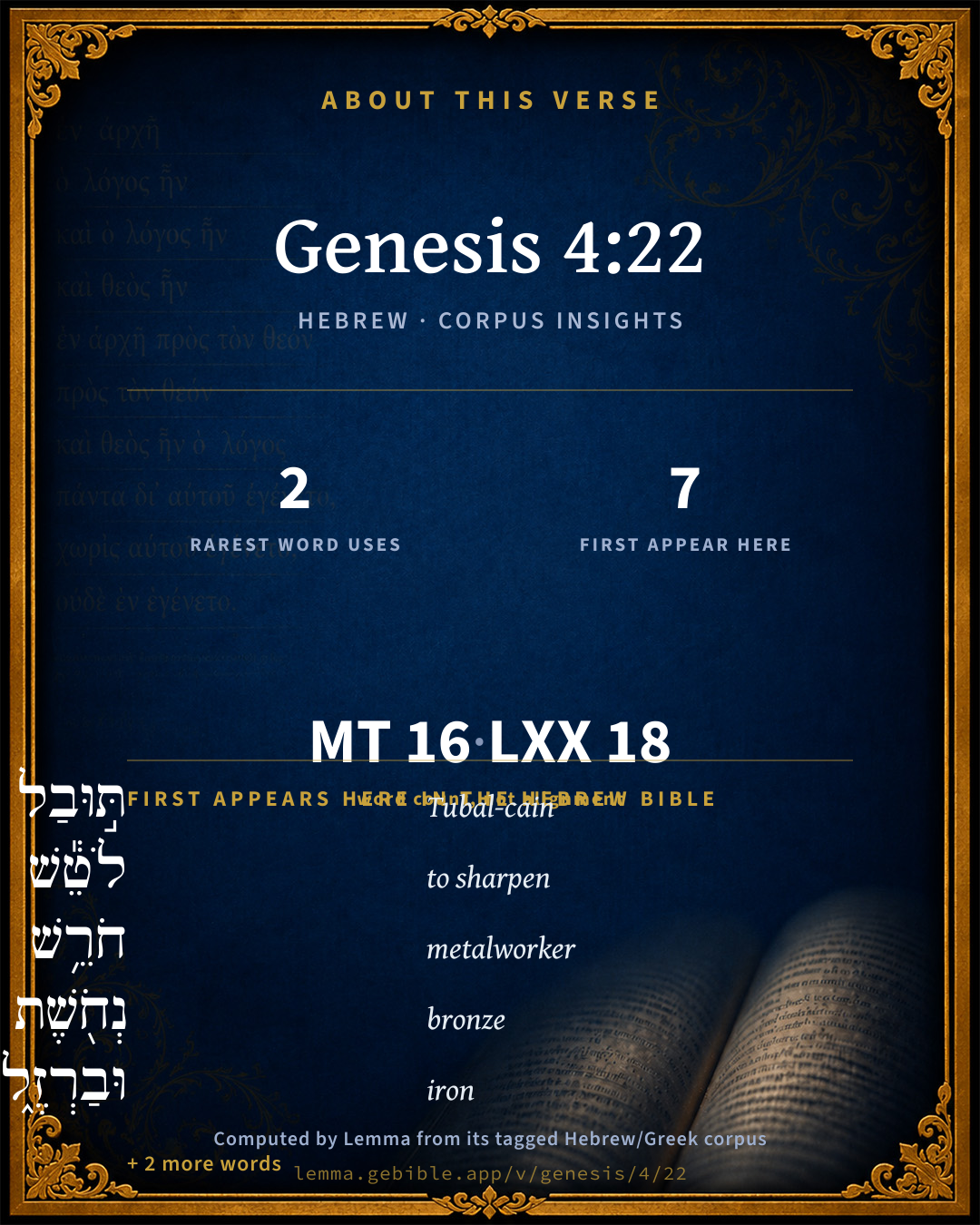
The rarest word here is חֹרֵ֥שׁ metalworker H2794 — appearing just 2 times in the whole Hebrew Bible.

First appearance in Scripture

These words make their first canonical appearance in the Hebrew Bible here:

  • תּ֣וּבַל Tubal-cain H8423
  • לֹטֵ֕שׁ to sharpen H3913
  • חֹרֵ֥שׁ metalworker H2794
  • נְחֹ֖שֶׁת bronze H5178
  • וּבַרְזֶ֑ל iron H1270
  • וַֽאֲח֥וֹת sister H269
  • נַֽעֲמָֽה Naamah H5279

Shared distinctive vocabulary

חֹרֵ֥שׁ metalworker H2794 occurs in 2 verses of the Hebrew Bible. Also found in:

Grammatical profile

  • 3 verbs
  • 10 nouns
  • 1 pronoun
  • 1 adverb
  • 1 particle

Verb forms

  • יָֽלְדָה֙ Qal · Perfect
  • לֹטֵ֕שׁ Qal · Participle Active
  • חֹרֵ֥שׁ Qal · Participle Active

Repetition

A word recurs within this verse — often emphatic in Hebrew:

  • תּ֣וּבַל Tubal-cain H8423 ×4

Hebrew & Septuagint length

In English translation the verse runs 22 words from the Hebrew and 23 from the Septuagint (LXX English) — closely comparable.

A rough comparison of the two English renderings, which tokenize alike — not a word-level alignment.

Word counts can differ between the Hebrew and the Greek without any difference in meaning — e.g. the Hebrew direct-object marker אֵת has no separate Greek word, and Greek often adds the article ὁ.

In the original languages it is 16 Hebrew tokens and 18 Greek tokens — but the two are counted differently (Hebrew bundles its prefixes and suffixes into one token; the Greek is in lemma form), so that isn’t a like-for-like length.

Cross-references

5

Topical passages linked to Genesis 4:22 in the Treasury of Scripture Knowledge — connected by theme and wording, ordered by reader-vote popularity; previews shown in the World English Bible.

  • Exodus 25:3 This is the offering which you shall take from them: gold, silver, brass,
  • Numbers 31:22 however the gold, and the silver, the brass, the iron, the tin, and the lead,
  • Deuteronomy 8:9 a land in which you shall eat bread without scarceness, you shall not lack anything in it; a land whose stones are iron, and out of whose hills you may dig copper.
  • Deuteronomy 33:25 Your bars shall be iron and brass; As your days, so shall your strength be.
  • 2 Chronicles 2:7 Now therefore send me a man skillful to work in gold, and in silver, and in brass, and in iron, and in purple, and crimson, and blue, and who knows how to engrave [all manner of] engravings, [to be] with the skillful men who are with me in Judah and in Jerusalem, whom David my father did provide.

Cross-references courtesy of OpenBible.info (CC BY 4.0).

Hebrew and Greek witnesses Masoretic Hebrew ↔ Greek Septuagint

The same verse in the two great witnesses to the Old Testament, shown verse-for-verse.

These are two independent witnesses, not word-aligned to each other, and the Septuagint is shown in lemma (dictionary) form.

Hebrew Genesis 4:22 Masoretic · Westminster Leningrad Codex

וְצִלָּ֣ה גַם הִ֗וא יָֽלְדָה֙ אֶת תּ֣וּבַל קַ֔יִן לֹטֵ֕שׁ כָּל חֹרֵ֥שׁ נְחֹ֖שֶׁת וּבַרְזֶ֑ל וַֽאֲח֥וֹת תּֽוּבַל קַ֖יִן נַֽעֲמָֽה

Zillah also gave birth to Tubal Cain, the forger of every cutting instrument of brass and iron. Tubal Cain's sister was Naamah.

World English Bible · Public Domain

Greek LXX Genesis 4:22 Septuagint · lemma form

σελλα δέ τίκτω καί αὐτός ὁ θοβελ καί εἰμί σφυροκόπος χαλκεύς χαλκός καί σίδηρος ἀδελφή δέ θοβελ νοεμα

And Sella also bore Thobel; he was a smith, a manufacturer both of brass and iron; and the sister of Thobel was Noema.

LXX2012 (modern English Septuagint) · Public Domain

On this verse, The Cambridge Bible for Schools and Colleges discusses the Septuagint’s reading. Read the note in Commentary ↓

Hebrew: Westminster Leningrad Codex (CC BY 4.0). Greek: Septuagint (public domain); English from LXX2012 (modern English Septuagint) (Public Domain). How the Septuagint differs from the Hebrew →

Targum (Aramaic paraphrase)

2

The Targum is the ancient Jewish Aramaic paraphrase of the Hebrew Scriptures — an interpretive translation, not the Hebrew text itself. Onkelos (literal) and Pseudo-Jonathan (expansive) render the Torah, and Jonathan the Prophets. Coverage is partial: where no permissively-licensed English translation exists for a verse, only the Aramaic is shown. This is verse-level text, not a word-by-word alignment to the Hebrew.

  1. Targum Onkelos Torah (Genesis–Deuteronomy)
    וְצִלָּה אַף הִיא יְלֵידַת יָת תּוּבַל קַיִן רַבְּהוֹן דְכָל דְּיָדְעֵי עִיבִידַת נְחָשָׁא וּפַרְזְלָא וַאֲחָתֵהּ דְתוּבַל קַיִן נַעֲמָה

    (no public-domain English translation for this verse)

    Targum Onkelos — Aramaic: “Onkelos Genesis” (public domain); “Onkelos Exodus” (public domain); “Onkelos Leviticus” (public domain); “Onkelos Numbers” (public domain); “Onkelos Deuteronomy” (public domain). English: “Sefaria Community Translation” (CC0 1.0 (public-domain dedication)); “J.W. Etheridge. The Targums of Onkelos and Jonathan Ben Uzziel on the Pentateuch. London: Longmans, Green, 1862” (public domain). Text via Sefaria.

  2. Targum Pseudo-Jonathan Torah (Genesis–Deuteronomy)
    וְצִלָה אַף הִיא יְלֵידַת יַת תּוּבָל קַיִן רַב לְכָל אוּמַן דִידַע בַּעֲבִידַת נְחָשָׁא וּפַרְזְלָא וְאַחְתֵיהּ דְתוּבַל קַיִן נַעֲמָה הִיא הֲוַת מָרַת קִינִין וְזִמְרִין

    And Zillah bare also Tuvalkain, the chief (rab) of all artificers who know the workmanship of brass and iron. And the sister of Tuvalkain was Naama; she was mistress of elegies and songs.

    Targum Pseudo-Jonathan — Aramaic: “Targum Jonathan on Genesis” (public domain); “Targum Jonathan on Exodus” (public domain); “Targum Jonathan on Leviticus” (public domain); “Targum Jonathan on Numbers” (public domain); “Targum Jonathan on Deuteronomy” (public domain). English: “The Targum of Jonathan ben Uzziel, trans. J. W. Etheridge, London, 1862” (public domain). Text via Sefaria.

Commentary

Notes on Genesis 4:22 from classic Christian and Jewish commentators (each source and its license shown beneath its notes). The classic Christian expositions comment on the surrounding passage and are grouped to its opening verse, so a note may address several verses; the Jewish commentaries on the Tanakh (Rashi and others) are per-verse, so they appear only where the commentator wrote on this verse.

Lemma curates 59 commentaries, every one of them public domain or Creative Commons licensed, each selected and text-cleaned for this edition rather than reprinted as found. About our sources →

Trapp's Complete Commentary

John Trapp

Gen 4:22 And Zillah, she also bare Tubalcain, an instructer of every artificer in brass and iron: and the sister of Tubalcain [was] Naamah.

Ver. 22. And Zillah bare Tubal-cain.] Perhaps the same that the poets call Vulcan. He was a cunning artificer in brass and iron. Tools they had before, and instruments of iron: how else could they have ploughed the accursed earth? But this man, artem iam inventam excoluit ornavitque , saith Junius; and is therefore called, a whetter or polisher of every artificer in brass and iron. They had the art of it before: but he added to their skill by his invention; he sharply and wittily taught smith’s craft; and is therefore by the heathens feigned to be the god of smiths, says another interpreter. {a}

{a} Vide Natal. com. Mythol., lib. ii., cap. 5.

John Trapp, A Commentary or Exposition upon All the Books of the Old and New Testament (1647–1656) — public domain. Text from a community e-Sword module.

Adam Clarke's Commentary

Verse 22. Tubal-cain] The first smith on record, who taught how to make warlike instruments and domestic utensils out of brass and iron. Agricultural instruments must have been in use long before, for Cain was a tiller of the ground, and so was Adam, and they could not have cultivated the ground without spades, hooks, c. Some of these arts were useless to man while innocent and upright, but after his fall they became necessary. Thus is the saying verified: God made man upright, but they have sought out many inventions. As the power to get wealth is from God, so also is the invention of useful arts.

M. De Lavaur, in his Conference de la Fable avec l'Histoire Sainte, supposes that the Greeks and Romans took their smith-god Vulcan from Tubal-cain, the son of Lamech. The probability of this will appear,

1. From the name, which, by the omission of the Tu and turning the b into v, a change frequently made among the Hebrews, Greeks, and Romans, makes Vulcain or Vulcan.

2. From his occupation he was an artificer, a master smith in brass and iron.

3. He thinks this farther probable from the names and sounds in this verse. The melting metals in the fire, and hammering them, bears a near resemblance to the hissing sound of צלה tsillah, the mother of Tubal-cain and צלל tsalal signifies to tinkle or make a sound like a bell, 1Sa 3:11; 2Kg 21:12.

4. Vulcan is said to have been lame; M. De Lavaur thinks that this notion was taken from the noun צלא tsela, which signifies a halting or lameness.

5. Vulcan had to wife Venus, the goddess of beauty; Naamah, the sister of Tubal-cain, he thinks, may have given rise to this part of the fable, as her name in Hebrew signifies beautiful or gracious.

6. Vulcan is reported to have been jealous of his wife, and to have forged nets in which he took Mars and her, and exposed them to the view of the whole celestial court: this idea he thinks was derived from the literal import of the name Tubal-cain; תבל tebel signifies an incestuous mixture of relatives, Le 20:12; and קנא kana, to burn with jealousy; from these and concomitant circumstances the case of the detected adultery of Mars and Venus might be easily deduced. He is of opinion that a tradition of this kind might have readily found its way from the Egyptians to the Greeks, as the former had frequent intercourse with the Hebrews.

Of Naamah nothing more is spoken in the Scriptures; but the Targum of Jonathan ben Uzziel makes her the inventress of funeral songs and lamentations. R. S. Jarchi says she was the wife of Noah, and quotes Bereshith Rabba in support of the opinion. Some of the Jewish doctors say her name is recorded in Scripture because she was an upright and chaste woman; but others affirm that the whole world wandered after her, and that of her evil spirits were born into the world. This latter opinion gives some countenance to that of M. De Lavaur.

Adam Clarke's Commentary on the Bible (1810–1826) — public domain. Text from a community e-Sword/MySword module.

The Cambridge Bible for Schools and Colleges

gen. ed. J. J. S. Perowne

22. Tubal-cain] The double name is strange, and presumably means “Tubal of the family of Cain.” Tubal is traditionally supposed to have given his name to the people mentioned in Gen_10:2 (see note). “Tubal” in Eze_27:13; Eze_32:26; Eze_38:2; Eze_39:1 is associated with Javan and Meshech as a community whose traffic included “vessels of brass.” The Assyrian inscriptions record a people called “Tabal,” apparently living to the S.E. of the Black Sea.

the forger] Heb. “the sharpener.” The expression is intended to denote the first smelter of metals. LXX τὸν Θόβελ, καὶ ἦν σφυροκόπος χαλκεὺς χαλκοῦ καὶ σιδήρου. Lat. Tubalcain qui fuit malleator et faber in cuncta opera aeris et ferri.

The R.V. marg. = A.V. “an instructor of every artificer,” is a conjectural rendering of an obscure passage, and does not follow the original.

22. brass] Better than copper. The metal, like the Gr. χαλκός, was probably our “bronze,” for which “brass” was the equivalent in all early English literature. “Brass” is an alloy of copper and zinc; “bronze” of copper and tin. Copper-mining (not “brass”) is referred to in Deu_8:9; Job_28:2. Our English word “bronze” is derived from “Brundusium.”

It should be noticed here (1) that Hebrew tradition realizes how important an epoch in the progress of civilization is marked by the discovery of the use of metals; (2) that in this verse the mention of bronze precedes that of iron; (3) that no knowledge is shewn of a stone age, which archaeology has demonstrated to have preceded.

Naamah] meaning “pleasant.” The mention of her name, concerning whom nothing else is recorded, implies the existence of legends or traditions which have disappeared. Perhaps she symbolized luxury, as Jubal symbolized art and Tubal-Cain industry. The juxtaposition of Naamah and Tubal-Cain reminds us of Venus and Vulcan, more especially as Naamah is said to have been the Phoenician title of the Semitic goddess Istar. It is the name borne by the mother of Rehoboam, an Ammonitess (1Ki_14:31).

The Cambridge Bible for Schools and Colleges (gen. ed. J. J. S. Perowne; Cambridge University Press, 1878–1918) — public domain. Text from a community e-Sword module.

John Gill's Exposition

And Lamech said unto his wives, Adah and Zillah,.... Confessing what he had done, or boasting what he would do should he be attacked; or in order to make his wives easy, who might fear from his fierceness and cruelty; and the murders he had committed, or on account of Abel's murder, Gen 4:15 that either the judgments of God would fall upon him and them, or some man or other would dispatch him and his; wherefore calling them together, he thus bespeaks them:

hear my voice, ye wives of Lamech, hearken unto my speech; this he said in an imperious manner to them, demanding their attention and regard, and as glorying in, instead of being ashamed of his polygamy, and in a blustering way, as neither fearing God nor man; or rather speaking comfortably to them, to remove their fears:

for I have slain a man to my wounding, and a young man to my hurt; which, as some say, were his great-grandfather Cain, and his son Tubalcain: according to a tradition of the Jews (i), it was after this manner; Cain being old, and blind, and weary, sat in a thicket among the trees to rest himself; when Lamech, who was blind also, and led by Tubalcain hunting, who seeing Cain, and taking him for a wild beast, bid Lamech draw his bow, which he did, and killed him; but coming nearer, and finding it was Cain, was wroth and angry, and slew the young man: the Arabic writers (k) tell the story with a little variation, and"Lamech being in a wood with one of his sons, and hearing a noise in it, supposing it to be a wild beast, cast a stone, which fell upon Cain, and killed him ignorantly; and the lad that led him said, what hast thou done? thou hast killed Cain; at which being very sorrowful after the manner of penitents, he smote his hands together, and the lad standing before him, he struck his head with both his hands, and killed him unawares; and coming to his wives, Adah and Zillah, said to them, hear my word, he that slew Abel shall be avenged sevenfold, but Lamech seventy times seven, who killed a man with a cast of a stone, and a young man by clapping of his hands.''And our version, and others, imply, that he killed both a man, and a young man, or some one person or more, and that he was sorry for it, made confession of it; it was to the wounding and grief of his soul, which does not so well agree with one of the wicked race of Cain: wherefore the words may be rendered, "though I have slain a man" (l), that is nothing to you, you are not accountable for it, nor have any thing to fear coming upon you by reason of that; it is to my own wounding, damage, and hurt, if to any, and not to you. Some versions render it, "I would slay a man", &c. (m) any man, young or old, that should attack me; I fear no man: if any man wounds me, or offers to do me any hurt, I would slay him at once; I doubt not but I should be more than a match for him, be he who he will that shall set upon me, and kill him; though I might receive some slight wound, or some little hurt in the engagement, and therefore you need not be afraid of any man's hurting me. The Arabic version reads interrogatively, "have I killed a man &c.?" and so some others (n), I have not; with which agree the Targums of Onkelos and Jonathan,"I have not killed a man;''for which he or his posterity should be punished, as they interpreted it; and therefore his wives had no need to fear any ill should befall him or them, or that the murder of Abel should be avenged on them, this being the seventh generation in which it was to be avenged, Gen 4:15 wherefore it follows,

(i) R. Gedaliah, Shalshaleth Hakabala, fol. 74. 2. Jarchi in loc. (k) Elmacinus, p. 7. apud Hottinger. Smegma Oriental. l. 1. c. 8. p. 224, 225. (l) So the particle is sometimes used; see Nold. Part. Ebr. Concord. p. 399. (m) "interficerem", Vatablus; "certe ausim interficere", Piscator; "sane occiderem, ant occiderim", Muis, Rivet. (n) "An virum inferfeci?" De Dieu.

John Gill's Exposition of the Whole Bible (1746–1763) — public domain (CC PDM 1.0). Text via the HelloAO Bible API.

Haydock's Catholic Bible Commentary

Noema, who is supposed to have invented the art of spinning. (Calmet) --- All these worthy people were distinguished for their proficiency in the arts, while they neglected the study of religion and virtue. (Haydock) --- The inventors of arts among the Greeks lived mostly after the siege of Troy. (Calmet)

George Leo Haydock (1774–1849), Haydock's Catholic Family Bible and Commentary, 1859 edition — public domain. Excludes Psalms (Douay-Rheims chapter numbering differs from Protestant) and Deuterocanonical books (Catholic canon only).

Matthew Poole's English Annotations

Tubal-cain, whom (as the learned conceive, and the agreement of the name and function makes probable) the heathens worshipped by the name of Vulcan, the god of smiths; and his sister Naamah, by the name of Venus. He first taught men how to make arms, and other instruments of iron.

Naamah; so called from her beauty, which her name signifies.

Matthew Poole's English Annotations on the Holy Bible (1683–1685) — public domain. Text from a community e-Sword/MySword module.

Whedon's Commentary on the Bible

Daniel D. Whedon

22. Tubal-cain — It is quite natural to compare this name and character with the Vulcan of Roman mythology, but the names have no necessary connexion.

Instructor of every artificer — Rather, a forger of all that cuts brass and iron. The invention of metal instruments marks an advancing civilization, but is no evidence in itself that the previous times were barbarous or savage. Their wants were fewer, but increasing population, pursuing new arts and enterprises, furnishes the conditions of many inventions.

Naamah — This name of Tubal-cain’s sister, which means the lovely, or the beautiful, is apparently introduced as further showing the worldly spirit and tastes of the Cainites. According to the Targum of Jonathan, she was the mistress of sounds and songs — a poetess.

Daniel D. Whedon (gen. ed.), Commentary on the Old and New Testaments (1874–1909) — public domain. Text from a community e-Sword module.

The Pulpit Commentary

And Zillah, she also bare Tubal-cain. Worker in brass or iron; related to Persian, tupal, iron dross (Gesenius, Rodiger, Delitzsch). Keil and Furst think this Persian root cannot be regarded as the proper explanation of the name. Furst suggests that the tribe may have been originally named Tubal, and known as inventors of smith-work and agricultural implements, and that Cain may have been afterwards added to them to identify them as Cainites (vide "Lex. sub hem."). The name Tubal, like the previous names Jabal and Jubal, is connected with the root yabal, to flow, and probably was indicative of the general prosperity of the race. Their ancestor was specially distinguished as an instructor (literally, a whetter) of every artificer (instrument, Lxx,vulgate, Kalisch) in brass (more correctly copper) and iron lz,rB, according to Gesenius a quadrilateral from the Genesis rB, to transfix, with l appended; according to Furst out of Lz,b; from lzB; to be hard, by resolving the dagesh into r. And the sister of Tubal-cain was Naamah the lovely.

Considering. the general significance of names, we shall scarcely go astray if with Kalisch we find in the name of the sister of Tubal-cain, "the beautiful," as compared with that of Adam"s wife, "the living," a growing symptom of the degeneracy of the times. Beauty, rather than helpfulness, was now become the chief attraction in woman. Men selected wives for their lovely forms and faces rather than for their loving and pious hearts. The reason for the introduction of Naamah s name into the narrative commentators generally are at a loss to discover. Ingiis with much ingenuity connects it with the tragedy which some see in the lines that follow.

The Pulpit Commentary (1880–1919), ed. H.D.M. Spence-Jones & Joseph S. Exell — public domain. Text from a community e-Sword module.

John Wesley's Explanatory Notes

From Tubal-Cain, probably the Heathen Vulcan came. Why Naamah is particularly named, we know not: probably they did, who lived when Moses wrote.

John Wesley, Explanatory Notes Upon the Whole Bible (1754–1765) — public domain. Text via the GEBible commentary corpus.

Rashi

Rabbi Shlomo Yitzchaki (Rashi)

תובל קין TUBAL-CAIN — He refined Cain’s handicraft. The word תובל is connected in meaning with תבלין (spices which give a refined and improved taste to food); he refined and improved the work of Cain by providing weapons for murderers (Genesis Rabbah 23:3).

לטש כל חרש נחשת וברזל THE FORGER OF EVERY CUTTING INSTRUMENT OF BRASS AND IRON — He sharpened tools used in brass and iron work; לוטש has the some meaning as (Job 16:9) ילטוש “He sharpeneth his eye upon me.” The word חרש is not of the form פעל (a noun like אֹכֶל, אֹהֶל etc.), but of the form פועל (a participle), for it has the vowel קמץ קטן (what we term צירה) and its accent is on the last syllabic (whereas the noun form has the accent on the first syllable, and the second has a Segol, like קדש), and the meaning is that he sharpened and polished all cutting implements (כל חרש) used in work of brass and iron.

נעמה NAAMAH — She was Noah’s wife (Genesis Rabbah 23:3).

Rashi on the Tanakh — English translations: “The Judaica Press complete Tanach with Rashi, translated by A. J. Rosenberg” (CC BY 4.0); “Pentateuch with Rashi's commentary by M. Rosenbaum and A.M. Silbermann, 1929-1934” (public domain); “The Metsudah Tanach series, Lakewood, N.J” (CC BY 4.0); and “The Book of Joshua, Metsudah Publications, 1997” (CC BY 4.0). Text via Sefaria.

Ramban (Nachmanides)

Rabbi Moshe ben Nachman (Ramban / Nachmanides)

FORGER OF EVERY CUTTING INSTRUMENT OF BRASS AND IRON. He was a forger and cutter of all brass and iron. Scripture thus states that he was a forger and cutter in all works of brass and iron. A similar [usage in transposing a word is found in the verse]: Forgive all iniquity, and accept that which is good. In the opinion of Onkelos, however, this is connected with the first verses, meaning he was the father of every forger and cutter in brass and iron.

AND THE SISTER OF TUBAL-CAIN WAS NAAMAH. This is as if Scripture would say: “and a sister was born to him and her name was Naamah.” A similar sense is found in the verses: And Lotan’s sister was Timnah; And Miriam their sister; His sister’s name was Maacah. In Bereshith Rabbah there are some Rabbis who say that Naamah was Noah’s wife. “And why did they call her Naamah [which means lovely]? Because her deeds were lovely and pleasant.” By this the Rabbis meant to say that she was famous in those generations because she was a righteous woman and she gave birth to righteous children. This was why Scripture mentioned her. If so, a small remembrance of Cain was left in the world. However, if we say that she was not the woman from whom Noah begot his three sons, there is no reason for Scripture mentioning her. However, our Rabbis have another Midrash concerning her which states that she was the very beautiful woman in whom the bnei ha’elohim erred. This is hinted in the verse, And the ‘bnei ha’elohim’ saw the daughters of men, Verse 2. as mentioned in Pirkei d’Rabbi Eliezer. But other sources have it that Naamah was the wife of Shamdon, the mother of Ashmedai, and it is from her that the demons were born for her name is indeed found in the writings of “the use of the demons.” Scripture hints and deals briefly with such hidden matters.

Ramban (Nachmanides) on the Tanakh — English translation: “Commentary on the Torah by Ramban (Nachmanides). Translated and annotated by Charles B. Chavel. New York, Shilo Pub. House, 1971-1976” (CC BY 4.0). Text via Sefaria.

Radak

Rabbi David Kimhi (Radak)

וצלה גם היא, the word גם relates to the sons of Adah, both of whom had acquired special skills. Tzilah, contrary to her function, to be decorative, also acquired another skill, giving birth to a son or sons. The son mentioned here is mentioned by name because he too excelled in a new skill, becoming a coppersmith. The reason why he was given a dual name, Tuval Kayin, might be that when born he was simply called Tuval. When Kayin died, this name was added to his original name to provide a memorial of sorts to his ancestor Kayin.

לוטש כל חרש נחשת וברזל, sharpener of copper and ironcraft; this description by the Torah, as opposed to the previous introduction of artisans as אבי, “father of, i.e. inventor of or discoverer of, maybe that his predecessors had already worked with these metals and had fashioned tools and vessels out of them. Tuval Kayin’s contribution may have been that he learned how to sharpen these tools so that they did not have to be replaced by new ones all the time. The word לטישה in this sense occurs in Samuel I 13,20. During the period described in Samuel, the Israelites had to travel to the land of the Philistines to have their agricultural tools sharpened, as they were not allowed to have weapons made of metal. The word חרש אבן is found in Exodus 31,6 where it describes the parallel art of working with stone. (compare Samuel I 15,15 and Joshua 8,7 where the word תפש appears in a related manner)

ואחות תובל קין נעמה. The reason the Torah mentions this is to inform us that Tuval Kayin did not have a brother, as opposed to his half-brother יבל, but that the sibling he did have, i.e. a sister, was called נעמה According to Bereshit Rabbah 23,3 this Naamah became the wife of Noach, being the only surviving individual of the offspring of Kayin. She was called נעמה in recognition of her good character. Other scholars in the same Midrash do not agree that the Naamah who became Noach’s wife was the one mentioned here. They attribute the name Naamah here to this woman’s ability to play music on these instruments.

Radak on the Tanakh — English translations: “Sefaria Community Translation” (CC0 1.0 (public-domain dedication)); “Eliyahu Munk, HaChut Hameshulash” (CC BY 4.0); “Rabbi Mike Feuer, Jerusalem Anthology” (CC BY 4.0); and “R. David Kimhi on the first book of Psalms, Translated by R.G. Finch, London, 1919” (public domain). Text via Sefaria.

Lesson kit

Teaching starters — assembled from the data on this page, not authored interpretation. Every prompt links to the verse data it draws on. Edit before teaching.

Genesis, in the Pentateuch, opens this verse with 16 words (13 distinct Hebrew lemmas). Its most distinctive word is chôrêsh (“metalworker”). A historical commentator’s framing appears above. Read the whole chapter for the surrounding context.

Discussion questions

  1. The word chôrêsh carries the sense “metalworker.” How does it shape the verse?
  2. 7 words here appear for the first time in Scripture. What is being introduced at this debut?
  3. 1 Kings 7:14 shares the word «metalworker» with this verse. How do the two illuminate each other?
  4. “Tubal-cain” occurs 4× in this one verse. What is the effect of the repetition?
  5. These translations render this verse differently; the difference is in the English rendering, not the original. What questions does that raise?
  6. The verb «יָֽלְדָה֙» is Qal Perfect. How does its form color the action?
  7. Reading how Trapp's Complete Commentary and Adam Clarke's Commentary read this verse, where do the two commentators agree and where do they part?

Things to notice

Reading settings

Reading text

Shown beneath each verse's original-language words.

Old Testament
Old Testament edition

Read the OT as the Masoretic Hebrew (MT) or the Greek Septuagint (LXX).

English shown for the Greek Septuagint (in the Hebrew ↔ Greek comparison).

Comparing translations? Open the Compare panel on any verse page to stack up to four side by side.