
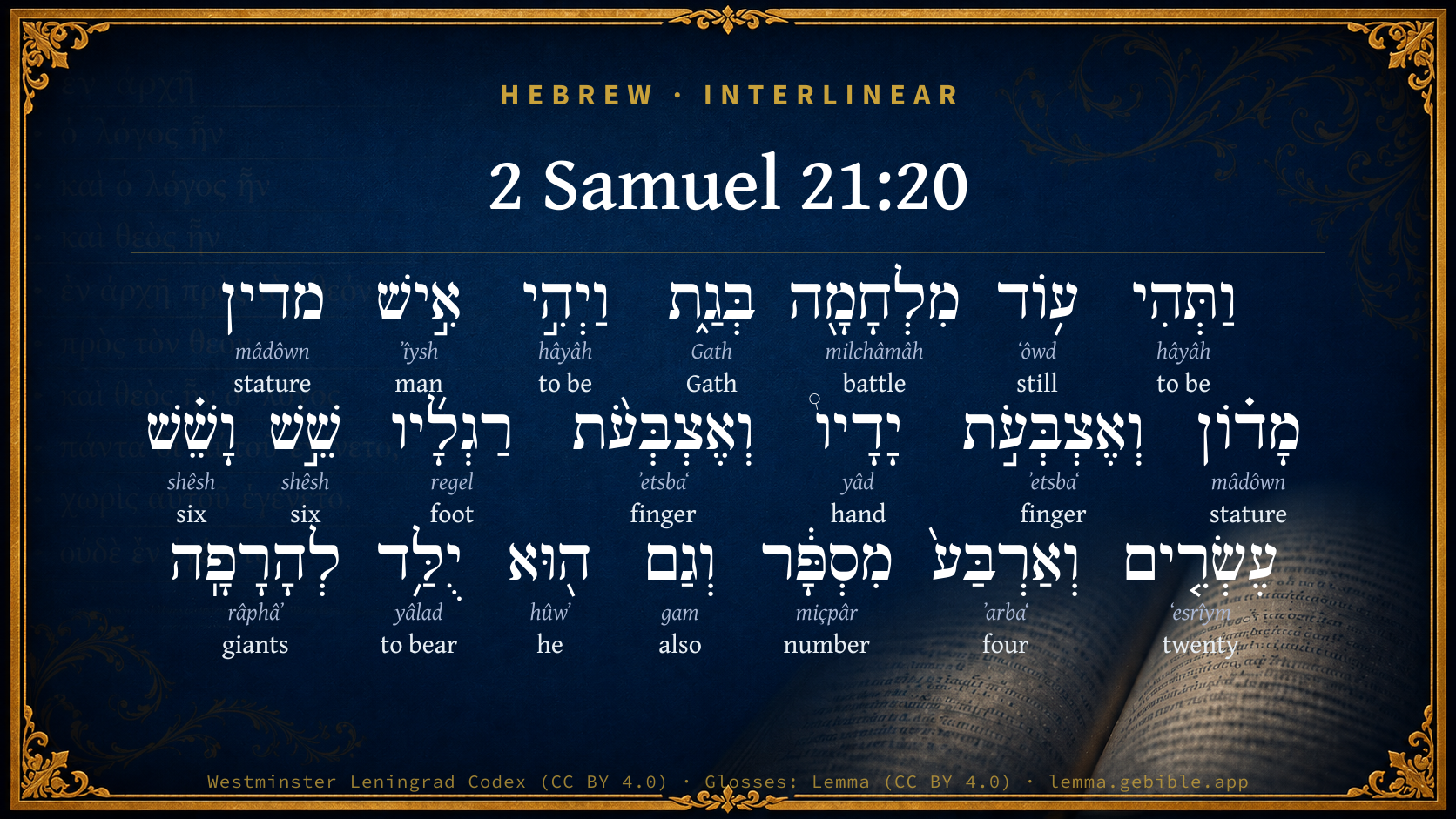
2 Samuel 21:20

Hebrew (Westminster Leningrad Codex) 2 Samuel 21:20 appears in the Hebrew Old Testament. The text above is from the Westminster Leningrad Codex. Each word links to its Strong’s number, a concise gloss, and parsing drawn from the Open Scriptures Hebrew Bible morphology. Click any word for its full Brown-Driver-Briggs (BDB) entry.
Download image
Cite this verse

2 Samuel 21:20 (World English Bible). Public Domain. Lemma interlinear Bible study tool, https://lemma.gebible.app/v/2-samuel/21/20.

Show BibTeX & RIS
BibTeX
RIS
English Translation
There was again war at Gath, where was a man of great stature, who had on every hand six fingers, and on every foot six toes, four and twenty in number; and he also was born to the giant.
World English Bible · Public Domain
Highlights
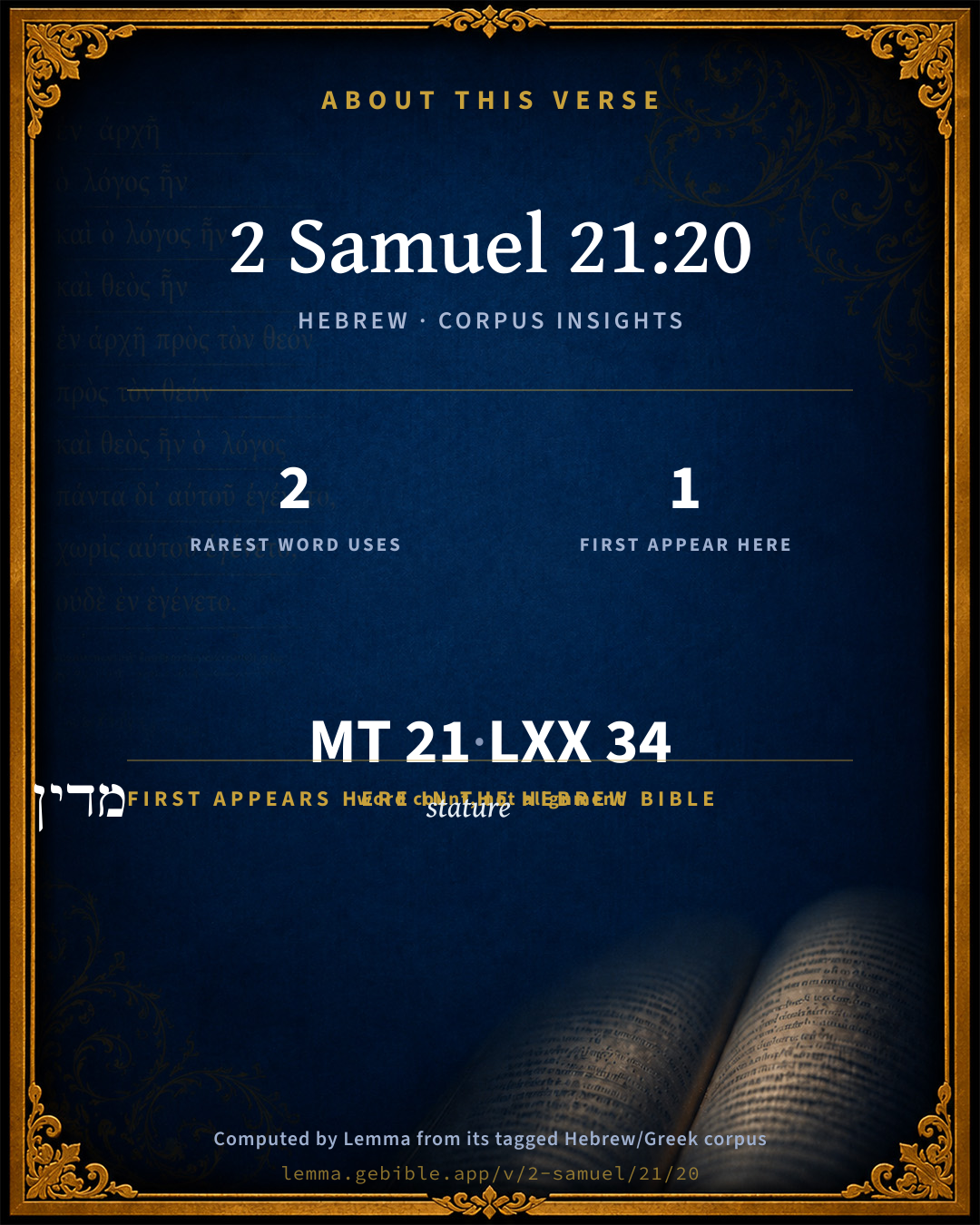
  • 1 first appearance in the Hebrew Bible
Full analysis ↓
Download a study sheet

One document with this verse’s original text, its word-by-word gloss line, the meaning frame, cross-references with their text, attributed commentary, and full source and license credits — printable, and it pastes into notes with its structure intact.

This verse Autodidact and up

Study sheet (.html) Plain text (.txt)

A passage Seminary Student

Up to 50 verses in one chapter. A passage sheet keeps up to 6 commentary sources and 12 cross-references per verse, in the order this page ranks them, and says so on the sheet whenever that leaves anything out. Ask for a single verse and you get the Autodidact verse sheet above.

Everything on this page stays free to read, with no account — the sheet is a download of what is already on screen, not access to it.

Want to remove ads? Support Godless Engineer
Compare translations 3

The same verse in 3 English versions, stacked beneath the original-language interlinear above. Click any original word for its lexicon entry.

Each is an independent rendering of the whole verse — the interlinear is not word-aligned to these translations.

Highlighted words mark where these versions differ — a whole-verse word diff, not a word-by-word alignment.

  • World English Bible Public Domain
    There was again war at Gath, where was a man of great stature, who had on every hand six fingers, and on every foot six toes, four and twenty in number; and he also was born to the giant.
  • King James Version Public Domain
    And there was yet a battle in Gath, where was a man of great stature, that had on every hand six fingers, and on every foot six toes, four and twenty in number; and he also was born to the giant.
  • unfoldingWord Literal Text CC BY-SA 4.0
    And was battle again at Gath, and was a man of stature, and the digits of his hands and the digits of his feet six and six, 24 number. And he also was born to Rapha.

unfoldingWord Literal Text — © unfoldingWord, licensed CC BY-SA 4.0. Word-aligned USFM3 via Door43 (git.door43.org/unfoldingWord/en_ult).

Versions to compare (up to 4)

3 of 4 selected

Show all 18 translations

Every available English version of this verse, each an independent rendering of the whole verse.

  • World English Bible Public Domain
    There was again war at Gath, where was a man of great stature, who had on every hand six fingers, and on every foot six toes, four and twenty in number; and he also was born to the giant.
  • Berean Standard Bible Public Domain
    And there was still another battle at Gath, where there was a man of great stature with six fingers on each hand and six toes on each foot—twenty-four in all. He too was descended from Rapha,
  • Majority Standard Bible Public Domain
    And there was also a battle at Gath, where there was a man of great stature with six fingers on each hand and six toes on each foot—twenty-four in all. He too was descended from Rapha,
  • King James Version Public Domain
    And there was yet a battle in Gath, where was a man of great stature, that had on every hand six fingers, and on every foot six toes, four and twenty in number; and he also was born to the giant.
  • American Standard Version (1901) Public Domain
    And there was again war at Gath, where was a man of great stature, that had on every hand six fingers, and on every foot six toes, four and twenty in number; and he also was born to the giant.
  • Revised Version (1885) Public Domain
    And there was again war at Gath, where was a man of great stature, that had on every hand six fingers, and on every foot six toes, four and twenty in number; and he also was born to the giant.
  • Geneva Bible (1599) Public Domain
    Afterward there was also a battel in Gath, where was a man of a great stature, and had on euerie hand sixe fingers, and on euerie foote sixe toes, foure and twentie in nomber: who was also the sonne of Haraphah.
  • Douay-Rheims (1899) Public Domain
    A fourth battle was in Geth. where there was a man of great stature, that had six fingers on each hand, and six toes on each foot, four and twenty in all, and he was of the race of Arapha.
  • Young's Literal Translation Public Domain
    And the battle is again in Gath, and there is a man of stature, and the fingers of his hands `are' six, and the toes of his feet `are' six, twenty and four in number, and he also hath been born to the giant,
  • Literal Standard Version CC BY-SA 4.0
    And the battle is again in Gath, and there is a man of [great] stature, and the fingers of his hands [are] six, and the toes of his feet [are] six—twenty-four in number, and he has also been born to the giant,
  • Unlocked Literal Bible CC BY-SA 4.0
    It came about in another battle at Gath that there was a man of great height who had six fingers on each hand and six toes on each foot, twenty-four in number. He also was descended from the Rephaim.
  • unfoldingWord Literal Text CC BY-SA 4.0
    And was battle again at Gath, and was a man of stature, and the digits of his hands and the digits of his feet six and six, 24 number. And he also was born to Rapha.
  • Darby Bible Public Domain
    And there was again a battle, at Gath; and there was a man [there] of great stature, that had on each hand six fingers, and on each foot six toes, four and twenty in number; and he also was born to Raphah.
  • World Messianic Bible Public Domain
    There was again war at Gath, where there was a man of great stature, who had six fingers on every hand and six toes on every foot, twenty-four in number, and he also was born to the giant.
  • Webster's Bible Public Domain
    And there was yet a battle in Gath, where was a man of great stature, that had on every hand six fingers, and on every foot six toes, four and twenty in number; and he also was born to the giant.
  • Free Bible Version CC BY-SA 4.0
    In yet another battle at Gath, there was a gigantic man, who had six fingers on each hand and six toes on each foot, making twenty-four in all. He too was descended from the giants.
  • Bible in Basic English Public Domain
    And again there was war at Gath, where there was a very tall man, who had twenty-four fingers and toes, six fingers on his hands and six toes on his feet; he was one of the offspring of the Rephaim.
  • JPS Tanakh (1917) Public Domain
    And there was again war at Gath, where was a champion, that had on every hand six fingers, and on every foot six toes, four and twenty in number; and he also was born to the giant.

Literal Standard Version (2020), Covenant Press — licensed CC BY-SA 4.0. Text via the HelloAO Bible API (eBible.org). Unlocked Literal Bible (unfoldingWord) — licensed CC BY-SA 4.0. Text via the HelloAO Bible API (eBible.org). unfoldingWord Literal Text — © unfoldingWord, licensed CC BY-SA 4.0. Word-aligned USFM3 via Door43 (git.door43.org/unfoldingWord/en_ult). Free Bible Version, Dr. Jonathan Gallagher — licensed CC BY-SA 4.0. Text via the HelloAO Bible API (eBible.org).

Word by word

More ways to search: Search by grammar → Find every occurrence → Compare this word →

Practice this passage: Drill this verse → Learn its vocabulary →

מדין
mâdôwn
H4067
“stature”
Noun, Common, Masculine, Singular, Absolute
Part of Speech
Noun
Type
Common
Gender
Masculine
Number
Singular
State
Absolute
Full BDB Definition

Origin: from the same as H4063

TWOT: 1146d

stature, size
  1. וַתְּהִי hâyâh H1961 “and · to be” Conjunction + Verb, Qal, Sequential Imperfect, 3rd Person, Feminine, Singular
  2. ע֥וֹד ʻôwd H5750 “still” Adverb
  3. מִלְחָמָ֖ה milchâmâh H4421 “battle” Noun, Common, Feminine, Singular, Absolute
  4. בְּגַ֑ת Gath H1661 “in/at · Gath” Preposition + Noun, Proper
  5. וַיְהִ֣י hâyâh H1961 “and · to be” Conjunction + Verb, Qal, Sequential Imperfect, 3rd Person, Masculine, Singular
  6. אִ֣ישׁ ʼîysh H376 “man of” Noun, Common, Masculine, Singular, Construct
  7. מָד֗וֹן mâdôwn H4067 “stature” Noun, Common, Masculine, Singular, Absolute
  8. וְאֶצְבְּעֹ֣ת ʼetsbaʻ H676 “and · fingers of” Conjunction + Noun, Common, Feminine, Plural, Construct
  9. יָדָיו֩ yâd H3027 “hands · his” Noun, Common, Both, Dual, Construct + Suffix, Personal, 3rd Person, Masculine, Singular
  10. וְאֶצְבְּעֹ֨ת ʼetsbaʻ H676 “and · fingers of” Conjunction + Noun, Common, Feminine, Plural, Construct
  11. רַגְלָ֜יו regel H7272 “feet · his” Noun, Common, Feminine, Dual, Construct + Suffix, Personal, 3rd Person, Masculine, Singular
  12. שֵׁ֣שׁ shêsh H8337 “six” Adjective, Cardinal number, Feminine, Singular, Absolute
  13. וָשֵׁ֗שׁ shêsh H8337 “and · six” Conjunction + Adjective, Cardinal number, Feminine, Singular, Absolute
  14. עֶשְׂרִ֤ים ʻesrîym H6242 “twenty” Adjective, Cardinal number, Both, Plural, Absolute
  15. וְאַרְבַּע֙ ʼarbaʻ H702 “and · four” Conjunction + Adjective, Cardinal number, Feminine, Singular, Absolute
  16. מִסְפָּ֔ר miçpâr H4557 “number” Noun, Common, Masculine, Singular, Absolute
  17. וְגַם gam H1571 “and · also” Conjunction + Particle, Accusative
  18. ה֖וּא hûwʼ H1931 “he” Pronoun, Personal, 3rd Person, Masculine, Singular
  19. יֻלַּ֥ד yâlad H3205 “to bear” Verb, Pual, Perfect, 3rd Person, Masculine, Singular
  20. לְהָרָפָֽה râphâʼ H7497 “to/for · the · giants” Preposition + Particle, Definite Article + Noun, Gentilic, Masculine, Singular, Absolute

About this verse

These counts appear in no published source. They are computed here, from the morphology-tagged text and Lemma’s own curated glosses. What Lemma adds →

21
words
17
distinct lemmas
Historical
section

Notable vocabulary

The rarest word here is מדין stature H4067 — appearing just 2 times in the whole Hebrew Bible.

First appearance in Scripture

This word makes its first canonical appearance in the Hebrew Bible here:

Grammatical profile

  • 3 verbs
  • 11 nouns
  • 4 adjectives
  • 1 pronoun
  • 1 adverb
  • 1 particle

Verb forms

  • וַתְּהִי Qal · Sequential Imperfect
  • וַיְהִ֣י Qal · Sequential Imperfect
  • יֻלַּ֥ד Pual · Perfect

Repetition

Words recur within this verse — often emphatic in Hebrew:

  • וַתְּהִי to be H1961 ×2
  • מדין stature H4067 ×2
  • וְאֶצְבְּעֹ֣ת finger H676 ×2
  • שֵׁ֣שׁ six H8337 ×2

Hebrew & Septuagint length

In English translation the verse runs 39 words from the Hebrew and 43 from the Septuagint (LXX English) — closely comparable.

A rough comparison of the two English renderings, which tokenize alike — not a word-level alignment.

Word counts can differ between the Hebrew and the Greek without any difference in meaning — e.g. the Hebrew direct-object marker אֵת has no separate Greek word, and Greek often adds the article ὁ.

In the original languages it is 21 Hebrew tokens and 34 Greek tokens — but the two are counted differently (Hebrew bundles its prefixes and suffixes into one token; the Greek is in lemma form), so that isn’t a like-for-like length.

Cross-references

3

Topical passages linked to 2 Samuel 21:20 in the Treasury of Scripture Knowledge — connected by theme and wording, ordered by reader-vote popularity; previews shown in the World English Bible.

  • 2 Samuel 21:16 and Ishbibenob, who was of the sons of the giant, the weight of whose spear was three hundred [shekels] of brass in weight, he being girded with a new [sword], thought to have slain David.
  • 2 Samuel 21:18 It came to pass after this, that there was again war with the Philistines at Gob: then Sibbecai the Hushathite killed Saph, who was of the sons of the giant.
  • 1 Chronicles 20:6 There was again war at Gath, where was a man of great stature, whose fingers and toes were twenty-four, six [on each hand], and six [on each foot]; and he also was born to the giant.

Cross-references courtesy of OpenBible.info (CC BY 4.0).

Hebrew and Greek witnesses Masoretic Hebrew ↔ Greek Septuagint

The same verse in the two great witnesses to the Old Testament, shown verse-for-verse.

These are two independent witnesses, not word-aligned to each other, and the Septuagint is shown in lemma (dictionary) form.

Hebrew 2 Samuel 21:20 Masoretic · Westminster Leningrad Codex

וַתְּהִי ע֥וֹד מִלְחָמָ֖ה בְּגַ֑ת וַיְהִ֣י אִ֣ישׁ מדין מָד֗וֹן וְאֶצְבְּעֹ֣ת יָדָיו֩ וְאֶצְבְּעֹ֨ת רַגְלָ֜יו שֵׁ֣שׁ וָשֵׁ֗שׁ עֶשְׂרִ֤ים וְאַרְבַּע֙ מִסְפָּ֔ר וְגַם ה֖וּא יֻלַּ֥ד לְהָרָפָֽה

There was again war at Gath, where was a man of great stature, who had on every hand six fingers, and on every foot six toes, four and twenty in number; and he also was born to the giant.

World English Bible · Public Domain

Greek LXX 2 Samuel 21:20 Septuagint · lemma form

καί γίγνομαι ἔτι πόλεμος ἐν γεθ καί εἰμί ἀνήρ μαδων καί ὁ δάκτυλος ὁ χείρ αὐτός καί ὁ δάκτυλος ὁ πούς αὐτός ἕξ καί ἕξ εἴκοσι τέσσαρες ἀριθμός καί γέ αὐτός τίκτω ὁ ραφα

And there was yet a battle in Geth: and there was a man of stature, and the fingers of his hands and the toes of his feet were six on each, four and twenty in number: and he also was born to Rapha.

LXX2012 (modern English Septuagint) · Public Domain

On this verse, Haydock's Catholic Bible Commentary discusses the Septuagint’s reading. Read the note in Commentary ↓

Hebrew: Westminster Leningrad Codex (CC BY 4.0). Greek: Septuagint (public domain); English from LXX2012 (modern English Septuagint) (Public Domain). How the Septuagint differs from the Hebrew →

Targum (Aramaic paraphrase)

1

The Targum is the ancient Jewish Aramaic paraphrase of the Hebrew Scriptures — an interpretive translation, not the Hebrew text itself. Onkelos (literal) and Pseudo-Jonathan (expansive) render the Torah, and Jonathan the Prophets. Coverage is partial: where no permissively-licensed English translation exists for a verse, only the Aramaic is shown. This is verse-level text, not a word-by-word alignment to the Hebrew.

  1. Targum Jonathan Prophets (Joshua–Malachi)
    וַהֲוַת עוֹד קְרָבָא בְּגַת וַהֲוָה גְבַר דְמִשְׁחָן וְאֶצְבְּעַת יְדוֹהִי וְאֶצְבְּעַת רִגְלוֹהִי שִׁית וָשִׁית עַשְׂרִין וְאַרְבַּע בְּמִנְיַן וְאַף הוּא אִתְיְלִיד בְּגִבָּרָא:

    (no public-domain English translation for this verse)

    Targum Jonathan — Aramaic: “Mikraot Gedolot” (public domain). English: “Sefaria Community Translation” (CC0 1.0 (public-domain dedication)); “London "Chaldee Paraphrase," 1871” (public domain). Text via Sefaria.

Commentary

Notes on 2 Samuel 21:20 from classic Christian and Jewish commentators (each source and its license shown beneath its notes). The classic Christian expositions comment on the surrounding passage and are grouped to its opening verse, so a note may address several verses; the Jewish commentaries on the Tanakh (Rashi and others) are per-verse, so they appear only where the commentator wrote on this verse.

Lemma curates 59 commentaries, every one of them public domain or Creative Commons licensed, each selected and text-cleaned for this edition rather than reprinted as found. About our sources →

Trapp's Complete Commentary

John Trapp

2Sa 21:20 And there was yet a battle in Gath, where was a man of [great] stature, that had on every hand six fingers, and on every foot six toes, four and twenty in number; and he also was born to the giant.

Ver. 20. A man of treat stature.] Yet not so great, likely, as he of whom Pliny writeth, that he was found in Crete, in the opening of a monument by an earthquake, to have been forty-six cubits long. Fides sit penes Authorem.

John Trapp, A Commentary or Exposition upon All the Books of the Old and New Testament (1647–1656) — public domain. Text from a community e-Sword module.

Joseph Benson's Commentary

2Sa 21:20-22. There was yet a battle in Gath — That is, in the territory of that city; which circumstance intimates, that this, and consequently the other battles here described, were fought before David had taken Gath out of the hands of the Philistines, which he did many years before this, 2Sa 8:1, compared with 1Ch 18:1; and therefore not in the last days of David, as some conceive, from the mention of them in this place. A man of great stature — Or, a man of Medin, or Madon, as the Seventy render it; so called from the place of his birth, as Goliath is said to be of Gath for the same reason. Who had on every hand six fingers, &c. — Tavernier, in his relation of the grand seignior’s seraglio, p. 95, says, that the eldest son of the emperor of Java, who reigned in the year 1648, when he was in that island, had six fingers on each hand, and as many toes on each foot, all of equal length. These four fell by the hand of David — That is, by his conduct and counsel, or concurrence. Indeed he contributed by his hand to the death of one of them; while maintaining a fight with him, he gave Abishai the easier opportunity of killing him. But what is done by the inferior commanders is commonly ascribed to the general, both in sacred and profane authors.

Joseph Benson's Commentary on the Old and New Testaments (1811–1818) — public domain. Text from a community e-Sword module.

Adam Clarke's Commentary

Verse 20. On every hand six fingers] This is not a solitary instance: Tavernier informs us that the eldest son of the emperor of Java, who reigned in 1648, had six fingers on each hand, and six toes on each foot. And Maupertuis, in his seventeenth letter, says that he met with two families near Berlin, where sedigitism was equally transmitted on both sides of father and mother. I saw once a young girl, in the county of Londonderry, in Ireland, who had six fingers on each hand, and six toes on each foot, but her stature had nothing gigantic in it. The daughters of Caius Horatius, of patrician dignity, were called sedigitae, because they had six fingers on each hand. Volcatius, a poet, was called sedigitus for the same reason. See Pliny's Hist. Nat., lib. xi., cap. 43.

THERE are evidently many places in this chapter in which the text has suffered much from the ignorance or carelessness of transcribers; and indeed I suspect the whole has suffered so materially as to distort, if not misrepresent the principal facts. It seems as if a Gibeonite has had something to do with the copies that are come down to us, or that the first fourteen verses have been inserted from a less authentic document than the rest of the book. I shall notice some of the most unaccountable, and apparently exceptionable particulars: -

1. The famine, 2Sa 21:1, is not spoken of anywhere else, nor at all referred to in the books of Kings or Chronicles; and, being of three years' duration, it was too remarkable to be omitted in the history of David.

2. The circumstance of Saul's attempt to exterminate the Gibeonites is nowhere else mentioned; and, had it taken place, it is not likely it would have been passed over in the history of Saul's transgressions. Indeed, it would have been such a breach of the good faith by which the whole nation was bound to this people, that an attempt of the kind could scarcely have failed to raise an insurrection through all Israel.

3. The wish of David that the Gibeonites, little better than a heathenish people, should bless the inheritance of the Lord, is unconstitutional and unlikely.

4. That God should leave the choice of the atonement to such a people, or indeed to any people, seems contrary to his established laws and particular providence.

5. That he should require seven innocent men to be hung up in place of their offending father, in whose iniquity they most likely never had a share, seems inconsistent with justice and mercy.

6. In 2Sa 21:8, there is mention made of five sons of Michal, which she bore (ילדה yaledah) unto Adriel. Now, 1. Michal was never the wife of Adriel, but of David and Phaltiel. 2. She never appears to have had any children, see 2Sa 6:23; this I have been obliged to correct in the preceding notes by putting Merab in the place of Michal.

7. The seven sons of Saul, mentioned here, are represented as a sacrifice required by God, to make an atonement for the sin of Saul. Does God in any case require human blood for sacrifice? And is it not such a sacrifice that is represented here? Dr. Delaney and others imagine that these seven sons were principal agents in the execution of their father's purpose; but of this there is no proof. Mephibosheth, the son of Jonathan, certainly had no hand in this projected massacre, he was ever lame, and could not be so employed; and yet he would have been one of the seven had it not been for the covenant made before with his father: But the king spared Mephibosheth the son of Jonathan - because of the Lord's oath that was between them, 2Sa 21:7.

8. The circumstance of Rizpah's watching the bodies of those victims, upon a rock, and probably in the open air, both day and night, from March to October, or even for a much less period, is, as it is here related, very extraordinary and improbable.

9. The hanging the bodies so long was against an express law of God, which ordained that those who were hanged on a tree should be taken down before sunset, and buried the same day, lest the land should be defiled, (De 21:22-23). Therefore, 1. God did not command a breach of his own law. 2. David was too exact an observer of that law to require it. 3. The people could not have endured it; for, in that sultry season, the land would indeed have been defiled by the putrefaction of the dead bodies; and this would, in all likelihood, have added pestilence to famine.

10. The story of collecting and burying the bones of Saul and Jonathan is not very likely, considering that the men of Jabesh-gilead had burned their bodies, and buried the remaining bones under a tree at Jabesh, 1Sa 31:12-13; yet still it is possible.

11. Josephus takes as much of this story as he thinks proper, but says not one word about Rizpah, and her long watching over her slaughtered sons.

12. Even the facts in this chapter, which are mentioned in other places, (see 1Ch 20:4, c.,) are greatly distorted and corrupted for we have already seen that Elhanan is made here to kill Goliath the Gittite, whom it is well known David slew; and it is only by means of the parallel place above that we can restore this to historical truth.

That there have been attempts to remove some of these objections, I know; and I know also that these attempts have been in general without success.

Till I get farther light on the subject, I am led to conclude that the whole chapter is not now what it would be, coming from the pen of an inspired writer; and that this part of the Jewish records has suffered much from rabbinical glosses, alterations, and additions. The law, the prophets, and the hagiographa, including Psalms, Proverbs, Ecclesiastes, c., have been ever considered as possessing the highest title to Divine inspiration and therefore have been most carefully preserved and transcribed; but the historical books, especially Samuel, Kings, and Chronicles, have not ranked so high, have been less carefully preserved, and have been the subjects of frequent alteration and corruption. Yet still the great foundation of God standeth sure and is sufficiently attested by his own broad seal of consistency, truth, and holiness.

Adam Clarke's Commentary on the Bible (1810–1826) — public domain. Text from a community e-Sword/MySword module.

The Cambridge Bible for Schools and Colleges

gen. ed. J. J. S. Perowne

20. six fingers … six toes] Pliny mentions such a peculiarity (Hist. Nat. 11:43), and it is not unknown in modern times.

The Cambridge Bible for Schools and Colleges (gen. ed. J. J. S. Perowne; Cambridge University Press, 1878–1918) — public domain. Text from a community e-Sword module.

John Gill's Exposition

And when he defied Israel,.... The armies of Israel, as Goliath had done some years ago, Sa1 17:10,

Jonathan the son of Shimea the brother of David slew him; this brother of David is called Shammah, Sa1 16:9; and Shimma, Ch1 2:13; this son of his is another man from Jonadab his son, who was famous for his subtlety as this was for his valour, Sa2 13:3. The Jews say (d) this was Nathan the prophet, a son of Shammah.

(d) Hieron. Trad. Heb. fol. 76. D.

John Gill's Exposition of the Whole Bible (1746–1763) — public domain (CC PDM 1.0). Text via the HelloAO Bible API.

Haydock's Catholic Bible Commentary

Fourth. Josephus says this was the last war with the Philistines; and Tostat supposes, that they wished to retake the city of Geth. (Salien) --- Statute, or "of contradiction." (Aquila) --- Hebrew Madon. Septuagint leave it as the proper name of a place, "Madon," specified [in] Josue xi. 1., and xii. 19. Capel would read, "a man of Madian." --- Six. Such people were styled Sedigiti, among the Romans. The daughters of Horatius were thus distinguished, as well as the poet Volcatius. (Pliny, [Natural History?] xi. 43.)

George Leo Haydock (1774–1849), Haydock's Catholic Family Bible and Commentary, 1859 edition — public domain. Excludes Psalms (Douay-Rheims chapter numbering differs from Protestant) and Deuterocanonical books (Catholic canon only).

Matthew Poole's English Annotations

In Gath, i. e. in the territory of the city of Gath; which circumstance intimates that this, and consequently the other battles here described, were fought before David had taken Gath out of the hands of the Philistines, which he did 2Sa 8:1, compared with 1Ch 18:1, and therefore not in the last days of David, as some conceive from their mention in this place.

A man of great stature, or, a man of Middin or Madon, as the LXX. render it; so called from the place of his birth, as Goliath is said to be of Gath for the same reason.

Matthew Poole's English Annotations on the Holy Bible (1683–1685) — public domain. Text from a community e-Sword/MySword module.

Whedon's Commentary on the Bible

Daniel D. Whedon

20. Six fingers… six toes — Persons thus abnormal have been elsewhere met with. “Tavernier informs us that the eldest son of the emperor of Java, who reigned in 1648, had six fingers on each hand, and six toes on each foot. Maupertius, in his seventeenth letter, says that he met with two families near Berlin, in which sedigitism was equally transmitted on both the father’s and mother’s side. I once saw a young girl in the county of Loudonderry, in Ireland, who had six fingers on each hand and six toes on each foot, but her stature had nothing gigantic in it. The daughters of Caius Horatius, of patrician dignity, were called sedigitae because they had six fingers on each hand.” — Clarke.

Daniel D. Whedon (gen. ed.), Commentary on the Old and New Testaments (1874–1909) — public domain. Text from a community e-Sword module.

unfoldingWord translationNotes

Door43 World Missions Community

twenty-four in number

"24 fingers and toes altogether" (See: Numbers)

Rephaim

This people group was known for its giant warriors. (See: How to Translate Names)

Jonathan son of Shimeah

These are names of men. Shimeah was David's brother. (See: How to Translate Names)

they were killed by the hand of David and by the hand of his soldiers

Here "by the hand of" means "through" or "by." This can be stated in active form. AT: "David and his soldiers killed them" (See: Idiom and Active or Passive)

translationWords

Gath

hand

unfoldingWord translationNotes — © Distant Shores Media and the Door43 World Missions Community, licensed CC BY-SA 4.0. Source: git.door43.org/Door43/en_tn.

Rashi

Rabbi Shlomo Yitzchaki (Rashi)

A giant man. As [Yonoson] translated, "A man of [great] measure," the root [portion] of the word are the letters מ and ד. We find [similarly] from the word שאון [roar] the root letters are ש and א and from the word הָמוֹן the root letters are ה and מ. In Divrei Hayomim it is written, "A man of measure" i.e., a very tall man who had people measuring his height.

Numbered six each etc. Our Rabbis explained in Maseches Bechoros that the verse had to tell us "twenty-four" in order that you should not say that the fingers of his two hands only came to a total of six and that the toes of his [two] feet only came to a total of six that is why it is written, "twenty-four." If it had written in our verse only 'twenty-four" and not had said "six each," I would have [mistakeingly] said, there were seven on one [hand or foot] and five on the other. And what is the verse trying to indicate by the word "number"? That all these digital extremities could be counted in the normal arrangement of fingers on a hand.

Rashi on the Tanakh — English translations: “The Judaica Press complete Tanach with Rashi, translated by A. J. Rosenberg” (CC BY 4.0); “Pentateuch with Rashi's commentary by M. Rosenbaum and A.M. Silbermann, 1929-1934” (public domain); “The Metsudah Tanach series, Lakewood, N.J” (CC BY 4.0); and “The Book of Joshua, Metsudah Publications, 1997” (CC BY 4.0). Text via Sefaria.

Lesson kit

Teaching starters — assembled from the data on this page, not authored interpretation. Every prompt links to the verse data it draws on. Edit before teaching.

2 Samuel, in the Historical, opens this verse with 21 words (17 distinct Hebrew lemmas). Its most distinctive word is mâdôwn (“stature”). A historical commentator’s framing appears above. Read the whole chapter for the surrounding context.

Discussion questions

  1. What does “stature” (mâdôwn) contribute to the verse as a whole?
  2. The word “stature” first appears here in Scripture. What is being introduced at this debut?
  3. 2 Samuel 21:16 shares this passage’s theme. How do the two illuminate each other?
  4. “to be” occurs 2× in this one verse. What is the effect of the repetition?
  5. These translations render this verse differently. What is at stake in choosing one wording over another?
  6. The verb «וַתְּהִי» is Qal Sequential Imperfect. How does its form color the action?
  7. Reading how Trapp's Complete Commentary and Joseph Benson's Commentary read this verse, where do the two commentators agree and where do they part?

Things to notice

Reading settings

Reading text

Shown beneath each verse's original-language words.

Old Testament
Old Testament edition

Read the OT as the Masoretic Hebrew (MT) or the Greek Septuagint (LXX).

English shown for the Greek Septuagint (in the Hebrew ↔ Greek comparison).

Comparing translations? Open the Compare panel on any verse page to stack up to four side by side.