Genesis 36:5

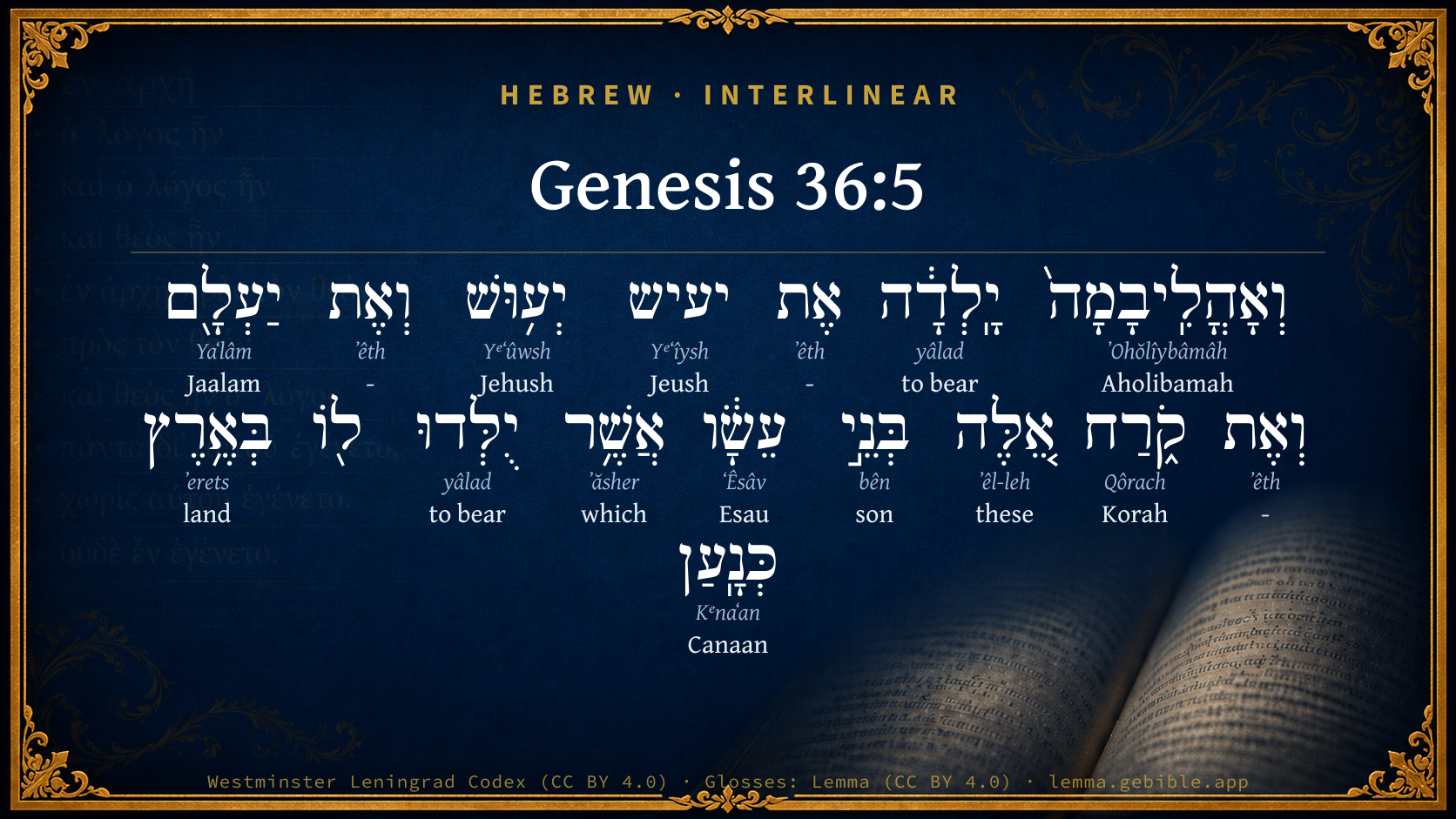
Hebrew (Westminster Leningrad Codex) Genesis 36:5 appears in the Hebrew Old Testament. The text above is from the Westminster Leningrad Codex. Each word links to its Strong’s number, a concise gloss, and parsing drawn from the Open Scriptures Hebrew Bible morphology. Click any word for its full Brown-Driver-Briggs (BDB) entry.
Download image
Cite this verse

Genesis 36:5 (World English Bible). Public Domain. Lemma interlinear Bible study tool, https://lemma.gebible.app/v/genesis/36/5.

Show BibTeX & RIS
BibTeX
RIS
English Translation
Oholibamah bore Jeush, Jalam, and Korah. These are the sons of Esau, who were born to him in the land of Canaan.
World English Bible · Public Domain
Highlights
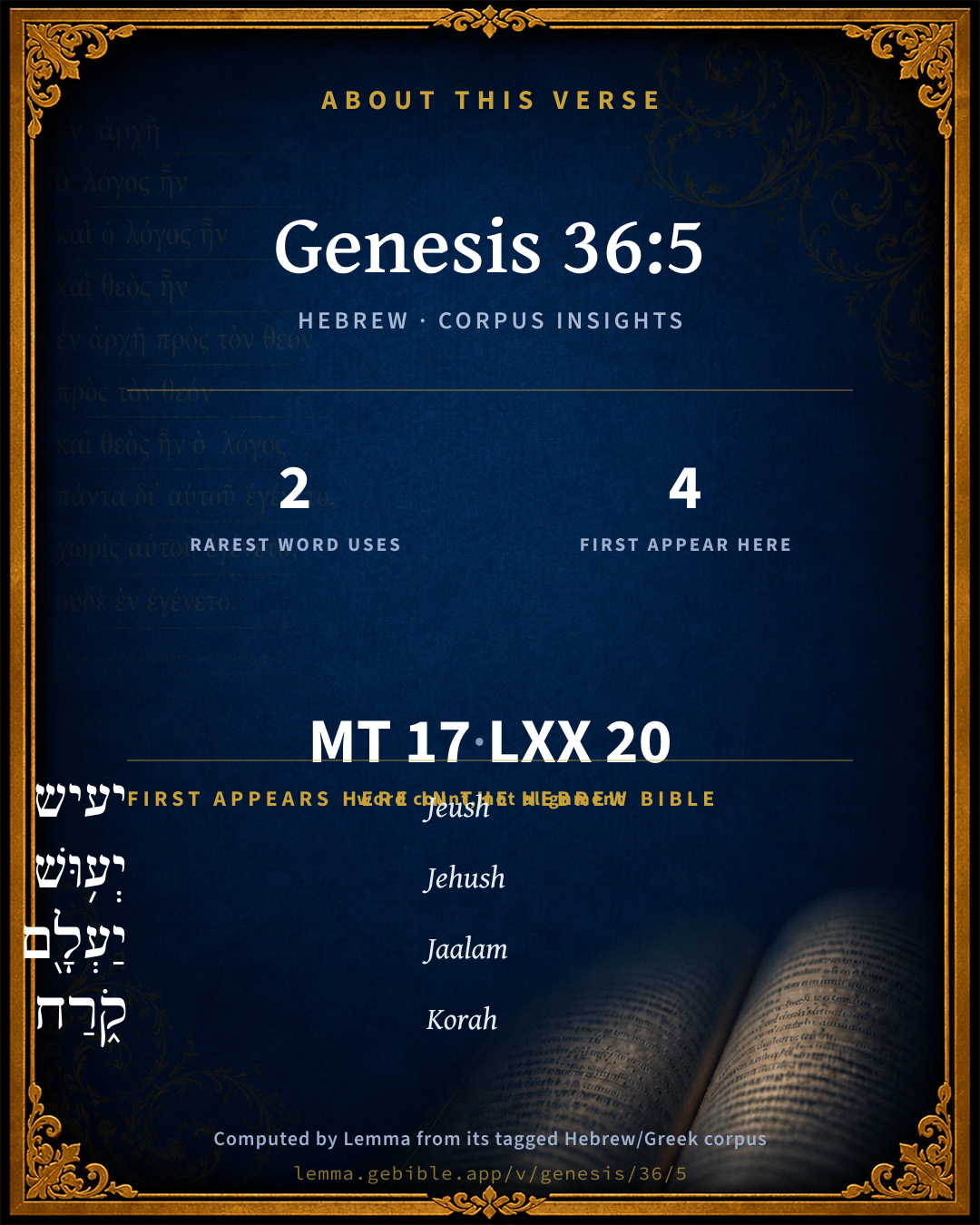
  • 4 first appearances in the Hebrew Bible
Full analysis ↓
Download a study sheet

One document with this verse’s original text, its word-by-word gloss line, the meaning frame, cross-references with their text, attributed commentary, and full source and license credits — printable, and it pastes into notes with its structure intact.

This verse Autodidact and up

Study sheet (.html) Plain text (.txt)

A passage Seminary Student

Up to 50 verses in one chapter. A passage sheet keeps up to 6 commentary sources and 12 cross-references per verse, in the order this page ranks them, and says so on the sheet whenever that leaves anything out. Ask for a single verse and you get the Autodidact verse sheet above.

Everything on this page stays free to read, with no account — the sheet is a download of what is already on screen, not access to it.

Want to remove ads? Support Godless Engineer
Compare translations 3

The same verse in 3 English versions, stacked beneath the original-language interlinear above. Click any original word for its lexicon entry.

Each is an independent rendering of the whole verse — the interlinear is not word-aligned to these translations.

Highlighted words mark where these versions differ — a whole-verse word diff, not a word-by-word alignment.

  • World English Bible Public Domain
    Oholibamah bore Jeush, Jalam, and Korah. These are the sons of Esau, who were born to him in the land of Canaan.
  • King James Version Public Domain
    And Aholibamah bare Jeush, and Jaalam, and Korah: these are the sons of Esau, which were born unto him in the land of Canaan.
  • unfoldingWord Literal Text CC BY-SA 4.0
    and Oholibamah bore Jeush and Jalam and Korah. Those the sons of Esau who were born for him in the land of Canaan.

unfoldingWord Literal Text — © unfoldingWord, licensed CC BY-SA 4.0. Word-aligned USFM3 via Door43 (git.door43.org/unfoldingWord/en_ult).

Versions to compare (up to 4)

3 of 4 selected

Show all 18 translations

Every available English version of this verse, each an independent rendering of the whole verse.

  • World English Bible Public Domain
    Oholibamah bore Jeush, Jalam, and Korah. These are the sons of Esau, who were born to him in the land of Canaan.
  • Berean Standard Bible Public Domain
    and Oholibamah gave birth to Jeush, Jalam, and Korah. These were the sons of Esau, who were born to him in the land of Canaan.
  • Majority Standard Bible Public Domain
    and Oholibamah gave birth to Jeush, Jalam, and Korah. These were the sons of Esau, who were born to him in the land of Canaan.
  • King James Version Public Domain
    And Aholibamah bare Jeush, and Jaalam, and Korah: these are the sons of Esau, which were born unto him in the land of Canaan.
  • American Standard Version (1901) Public Domain
    and Oholibamah bare Jeush, and Jalam, and Korah: these are the sons of Esau, that were born unto him in the land of Canaan.
  • Revised Version (1885) Public Domain
    and Oholibamah bare Jeush, and Jalam, and Korah: these are the sons of Esau, which were born unto him in the land of Canaan.
  • Geneva Bible (1599) Public Domain
    Also Aholibamah bare Ieush, and Iaalam, and Korah: these are the sonnes of Esau which were borne to him in the land of Canaan.
  • Douay-Rheims (1899) Public Domain
    Oolibama bore Jehus and Ihelon and Core. These are the sons of Esau, that were born to him in the land of Chanaan.
  • Young's Literal Translation Public Domain
    and Aholibamah hath born Jeush, and Jaalam, and Korah. These `are' sons of Esau, who were born to him in the land of Canaan.
  • Literal Standard Version CC BY-SA 4.0
    and Aholibamah has borne Jeush, and Jaalam, and Korah. These [are] sons of Esau, who were born to him in the land of Canaan.
  • Unlocked Literal Bible CC BY-SA 4.0
    Oholibamah bore Jeush, Jalam, and Korah. These were the sons of Esau who were born to him in the land of Canaan.
  • unfoldingWord Literal Text CC BY-SA 4.0
    and Oholibamah bore Jeush and Jalam and Korah. Those the sons of Esau who were born for him in the land of Canaan.
  • Darby Bible Public Domain
    And Oholibamah bore Jeush and Jaalam and Korah. These are the sons of Esau that were born to him in the land of Canaan.
  • World Messianic Bible Public Domain
    Oholibamah bore Jeush, Jalam, and Korah. These are the sons of Esau, who were born to him in the land of Canaan.
  • Webster's Bible Public Domain
    And Aholibamah bore Jeush, and Jaalam, and Korah: These are the sons of Esau, who were born to him in the land of Canaan.
  • Free Bible Version CC BY-SA 4.0
    Oholibamah had Jeush, Jalam, and Korah. These were the sons of Esau, who were born to him in Canaan.
  • Bible in Basic English Public Domain
    Oholibamah was the mother of Jeush, Jalam, and Korah; these are the sons of Esau, whose birth took place in the land of Canaan.
  • JPS Tanakh (1917) Public Domain
    and Oholibamah bore Jeush, and Jalam, and Korah. These are the sons of Esau, that were born unto him in the land of Canaan.

Literal Standard Version (2020), Covenant Press — licensed CC BY-SA 4.0. Text via the HelloAO Bible API (eBible.org). Unlocked Literal Bible (unfoldingWord) — licensed CC BY-SA 4.0. Text via the HelloAO Bible API (eBible.org). unfoldingWord Literal Text — © unfoldingWord, licensed CC BY-SA 4.0. Word-aligned USFM3 via Door43 (git.door43.org/unfoldingWord/en_ult). Free Bible Version, Dr. Jonathan Gallagher — licensed CC BY-SA 4.0. Text via the HelloAO Bible API (eBible.org).

Word by word

More ways to search: Search by grammar → Find every occurrence → Compare this word →

Practice this passage: Drill this verse → Learn its vocabulary →

יעיש
Yᵉʻîysh
H3274
“Jeush”
Noun, Proper
Part of Speech
Noun
Type
Proper
Full BDB Definition

Origin: from H5789

TWOT: None

Jeush = "assembler" - son of Esau by Aholibamah the daughter of Anah, son of Zibeon the Hivite - a Benjamite, son of Bilhan
  1. וְאָהֳלִֽיבָמָה֙ ʼOhŏlîybâmâh H173 “and · Aholibamah” Conjunction + Noun, Proper
  2. יָֽלְדָ֔ה yâlad H3205 “to bear” Verb, Qal, Perfect, 3rd Person, Feminine, Singular
  3. אֶת ʼêth H853 “-” Particle, Direct Object
  4. יְע֥וּשׁ Yᵉʻûwsh H3266 “Jehush” Noun, Proper
  5. וְאֶת ʼêth H853 “and · -” Conjunction + Particle, Direct Object
  6. יַעְלָ֖ם Yaʻlâm H3281 “Jaalam” Noun, Proper
  7. וְאֶת ʼêth H853 “and · -” Conjunction + Particle, Direct Object
  8. קֹ֑רַח Qôrach H7141 “Korah” Noun, Proper
  9. אֵ֚לֶּה ʼêl-leh H428 “these” Pronoun, Demonstrative, Common, Plural
  10. בְּנֵ֣י bên H1121 “sons of” Noun, Common, Masculine, Plural, Construct
  11. עֵשָׂ֔ו ʻÊsâv H6215 “Esau” Noun, Proper
  12. אֲשֶׁ֥ר ʼăsher H834 “which” Particle, Relative
  13. יֻלְּדוּ yâlad H3205 “to bear” Verb, Pual, Perfect, 3rd Person, Common, Plural
  14. בְּאֶ֥רֶץ ʼerets H776 “in/at · land of” Preposition + Noun, Common, Both, Singular, Construct
  15. כְּנָֽעַן Kᵉnaʻan H3667 “Canaan” Noun, Proper

About this verse

These counts appear in no published source. They are computed here, from the morphology-tagged text and Lemma’s own curated glosses. What Lemma adds →

17
words
13
distinct lemmas
Pentateuch
section

Notable vocabulary

The rarest word here is יעיש Jeush H3274 — appearing just 2 times in the whole Hebrew Bible.

First appearance in Scripture

These words make their first canonical appearance in the Hebrew Bible here:

  • יעיש Jeush H3274
  • יְע֥וּשׁ Jehush H3266
  • יַעְלָ֖ם Jaalam H3281
  • קֹ֑רַח Korah H7141

Shared distinctive vocabulary

יעיש Jeush H3274 occurs in 2 verses of the Hebrew Bible. Also found in:

Grammatical profile

  • 2 verbs
  • 9 nouns
  • 1 pronoun
  • 1 preposition
  • 4 particles

Verb forms

  • יָֽלְדָ֔ה Qal · Perfect
  • יֻלְּדוּ Pual · Perfect

Repetition

A word recurs within this verse — often emphatic in Hebrew:

  • יָֽלְדָ֔ה to bear H3205 ×2

Hebrew & Septuagint length

In English translation the verse runs 22 words from the Hebrew and 24 from the Septuagint (LXX English) — closely comparable.

A rough comparison of the two English renderings, which tokenize alike — not a word-level alignment.

Word counts can differ between the Hebrew and the Greek without any difference in meaning — e.g. the Hebrew direct-object marker אֵת has no separate Greek word, and Greek often adds the article ὁ.

In the original languages it is 17 Hebrew tokens and 20 Greek tokens — but the two are counted differently (Hebrew bundles its prefixes and suffixes into one token; the Greek is in lemma form), so that isn’t a like-for-like length.

Cross-references

1

Topical passages linked to Genesis 36:5 in the Treasury of Scripture Knowledge — connected by theme and wording, ordered by reader-vote popularity; previews shown in the World English Bible.

  • Genesis 35:29 Isaac gave up the spirit, and died, and was gathered to his people, old and full of days. Esau and Jacob, his sons, buried him.

Cross-references courtesy of OpenBible.info (CC BY 4.0).

Hebrew and Greek witnesses Masoretic Hebrew ↔ Greek Septuagint

The same verse in the two great witnesses to the Old Testament, shown verse-for-verse.

These are two independent witnesses, not word-aligned to each other, and the Septuagint is shown in lemma (dictionary) form.

Hebrew Genesis 36:5 Masoretic · Westminster Leningrad Codex

וְאָהֳלִֽיבָמָה֙ יָֽלְדָ֔ה אֶת יעיש יְע֥וּשׁ וְאֶת יַעְלָ֖ם וְאֶת קֹ֑רַח אֵ֚לֶּה בְּנֵ֣י עֵשָׂ֔ו אֲשֶׁ֥ר יֻלְּדוּ ל֖וֹ בְּאֶ֥רֶץ כְּנָֽעַן

Oholibamah bore Jeush, Jalam, and Korah. These are the sons of Esau, who were born to him in the land of Canaan.

World English Bible · Public Domain

Greek LXX Genesis 36:5 Septuagint · lemma form

καί ελιβεμα τίκτω ὁ ιεους καί ὁ ιεγλομ καί ὁ κορε οὗτος υἱός ησαυ ὅς γίγνομαι αὐτός ἐν γῆ χανααν

And Olibema bore Jeus, and Jeglom, and Core; these are the sons of Esau, which were born to him in the land of Chanaan.

LXX2012 (modern English Septuagint) · Public Domain

On this verse, John Gill's Exposition discusses the Septuagint’s reading. Read the note in Commentary ↓

Hebrew: Westminster Leningrad Codex (CC BY 4.0). Greek: Septuagint (public domain); English from LXX2012 (modern English Septuagint) (Public Domain). How the Septuagint differs from the Hebrew →

Targum (Aramaic paraphrase)

2

The Targum is the ancient Jewish Aramaic paraphrase of the Hebrew Scriptures — an interpretive translation, not the Hebrew text itself. Onkelos (literal) and Pseudo-Jonathan (expansive) render the Torah, and Jonathan the Prophets. Coverage is partial: where no permissively-licensed English translation exists for a verse, only the Aramaic is shown. This is verse-level text, not a word-by-word alignment to the Hebrew.

  1. Targum Onkelos Torah (Genesis–Deuteronomy)
    וְאָהֳלִיבָמָה יְלִידַת יָת יְעוּשׁ וְיָת יַעְלָם וְיָת קֹרַח אִלֵּין בְּנֵי עֵשָׂו דִי אִתְיְלִידוּ לֵהּ בְּאַרְעָא דִכְנָעַן

    (no public-domain English translation for this verse)

    Targum Onkelos — Aramaic: “Onkelos Genesis” (public domain); “Onkelos Exodus” (public domain); “Onkelos Leviticus” (public domain); “Onkelos Numbers” (public domain); “Onkelos Deuteronomy” (public domain). English: “Sefaria Community Translation” (CC0 1.0 (public-domain dedication)); “J.W. Etheridge. The Targums of Onkelos and Jonathan Ben Uzziel on the Pentateuch. London: Longmans, Green, 1862” (public domain). Text via Sefaria.

  2. Targum Pseudo-Jonathan Torah (Genesis–Deuteronomy)
    וְאָהֳלִיבָמָה יְלֵידַת יַת יְעוּשׁ וְיַת יַעֲלָם וְיַת קרַח אִלֵין בְּנוֹי דְעֵשָו דִי אִיתְיְלִידוּ לֵיהּ בְּאַרְעָא דִכְנָעַן

    And Ahalibama, bare to Esau Jehus, and Jaalam, and Korach. These are the sons of Esau who were born to him in the land of Kenaan.

    Targum Pseudo-Jonathan — Aramaic: “Targum Jonathan on Genesis” (public domain); “Targum Jonathan on Exodus” (public domain); “Targum Jonathan on Leviticus” (public domain); “Targum Jonathan on Numbers” (public domain); “Targum Jonathan on Deuteronomy” (public domain). English: “The Targum of Jonathan ben Uzziel, trans. J. W. Etheridge, London, 1862” (public domain). Text via Sefaria.

Commentary

Notes on Genesis 36:5 from classic Christian and Jewish commentators (each source and its license shown beneath its notes). The classic Christian expositions comment on the surrounding passage and are grouped to its opening verse, so a note may address several verses; the Jewish commentaries on the Tanakh (Rashi and others) are per-verse, so they appear only where the commentator wrote on this verse.

Lemma curates 59 commentaries, every one of them public domain or Creative Commons licensed, each selected and text-cleaned for this edition rather than reprinted as found. About our sources →

Ellicott's Commentary for English Readers

(5) In the land of Canaan.—We find Esau with a band of armed men in Seir on Jacob’s return from Padan-aram, but he still had his home at Hebron with his father until Isaac’s death, twenty-two years afterwards. Evidently he had taken Aholibamah home thither, and she had borne him three sons. After Isaac’s death the land of Seir had so great attractions for him that he migrated thither with his share of Isaac’s wealth, and left Hebron to Jacob, who now moved down thither from the town of Eder, and took possession of the homestead of his fathers. And thus the inheritance of the birthright came finally to Jacob by. Esau’s own act, and would doubtless have so come to him; only his father’s blessing and the transference to him of the Abrahamic promises would have been given him, not at the time of Isaac’s temporary illness, but on his deathbed.

A Bible Commentary for English Readers, edited by Charles John Ellicott (1878–1897) — public domain. Text from a community e-Sword module.

John Gill's Exposition

And Esau took his wives, and his sons, and his daughters,.... The names of his wives and sons are before given; but what were the names of his daughters, or their number, is not said:

and all the persons of his house: his menservants and maidservants that were born in his house, or bought with his money; the word for "persons" signifies "souls" (o), and is sometimes used for slaves that are bought and sold, see Eze 27:13,

and his cattle, and all his beasts; his sheep and oxen, camels and asses:

and all his substance which he had got in the land of Canaan: before he went to Seir the first time, part of which he might leave behind in Canaan, with servants to improve it; and also that part of his father's personal estate which fell to him at his death, as well as what he might further acquire after his death, during his stay in Canaan:

and went into the country from the face of his brother Jacob; not into another part of the same country; but into another country, as the Targums of Onkelos and Jonathan supply it, and so the Arabic version, even unto Seir, as appears by what follows; and whither he had been before, and had obtained large possessions, and now having got all he could at his father's death, and collecting together all his other substance, thought fit to retire from thence to Seir, which he liked better, and for a reason afterwards given; God thus disposing his mind, and making the circumstances of things necessary, that he should remove in order to make way for Jacob, and his posterity, to dwell in a land which was designed for them: and so the Samaritan and Septuagint versions read it, "and he went out of the land of Canaan": and the Syriac version is, "and he went to the land of Seir". Some render the words to this sense, that he went thither "before the coming of Jacob" (p); and it is true that he did go thither before his brother came again into Canaan; but of this the text speaks not, for what follows will not agree with it; others better, "because of Jacob" (q); not for fear of him, as the Targum of Jonathan, which paraphrases the words,"for the terror of his brother Jacob was cast upon him;''but because he knew, by the blessing of his father, and the oracle of God, and his concurring providence in all things, that the land of Canaan belonged to him, and also for a reason that follows.

(o) "animus", Pagninus, Montanus, &c. (p) "ante adventum", Jahakobi, Junius & Tremellius. (q) "Propter Jacobum", Piscarat.

John Gill's Exposition of the Whole Bible (1746–1763) — public domain (CC PDM 1.0). Text via the HelloAO Bible API.

Matthew Poole's English Annotations

He had also daughters, Gen 36:6, though their names be not here mentioned.

Matthew Poole's English Annotations on the Holy Bible (1683–1685) — public domain. Text from a community e-Sword/MySword module.

Rashi

Rabbi Shlomo Yitzchaki (Rashi)

ואהליבמה ילדה וגו׳ AND OHOLIBAMAH BARE etc. — This Korah was an illegitimate child for he was the son of Eliphaz (cf. vv. 15, 16, 18) who had taken his father’s wife — Oholibamah, the wife of Esau — for he is enumerated also amongst the chiefs of Eliphaz at the end of this section (Genesis Rabbah 82:12).

Rashi on the Tanakh — English translations: “The Judaica Press complete Tanach with Rashi, translated by A. J. Rosenberg” (CC BY 4.0); “Pentateuch with Rashi's commentary by M. Rosenbaum and A.M. Silbermann, 1929-1934” (public domain); “The Metsudah Tanach series, Lakewood, N.J” (CC BY 4.0); and “The Book of Joshua, Metsudah Publications, 1997” (CC BY 4.0). Text via Sefaria.

Lesson kit

Teaching starters — assembled from the data on this page, not authored interpretation. Every prompt links to the verse data it draws on. Edit before teaching.

Genesis, in the Pentateuch, opens this verse with 17 words (13 distinct Hebrew lemmas). Its most distinctive word is Yᵉʻîysh (“Jeush”). A historical commentator’s framing appears above. Read the whole chapter for the surrounding context.

Discussion questions

  1. How does “Jeush” (Yᵉʻîysh) shape what this verse is saying?
  2. 4 words here appear for the first time in Scripture. What is being introduced at this debut?
  3. Genesis 36:14 shares the word «Jeush» with this verse. How do the two illuminate each other?
  4. “to bear” occurs 2× in this one verse. What is the effect of the repetition?
  5. These translations render this verse differently; the difference is in the English rendering, not the original. What questions does that raise?
  6. The verb «יָֽלְדָ֔ה» is Qal Perfect. How does its form color the action?
  7. Reading how Ellicott's Commentary for English Readers and John Gill's Exposition read this verse, where do the two commentators agree and where do they part?

Things to notice

Reading settings

Reading text

Shown beneath each verse's original-language words.

Old Testament
Old Testament edition

Read the OT as the Masoretic Hebrew (MT) or the Greek Septuagint (LXX).

English shown for the Greek Septuagint (in the Hebrew ↔ Greek comparison).

Comparing translations? Open the Compare panel on any verse page to stack up to four side by side.