1 Samuel 1:20

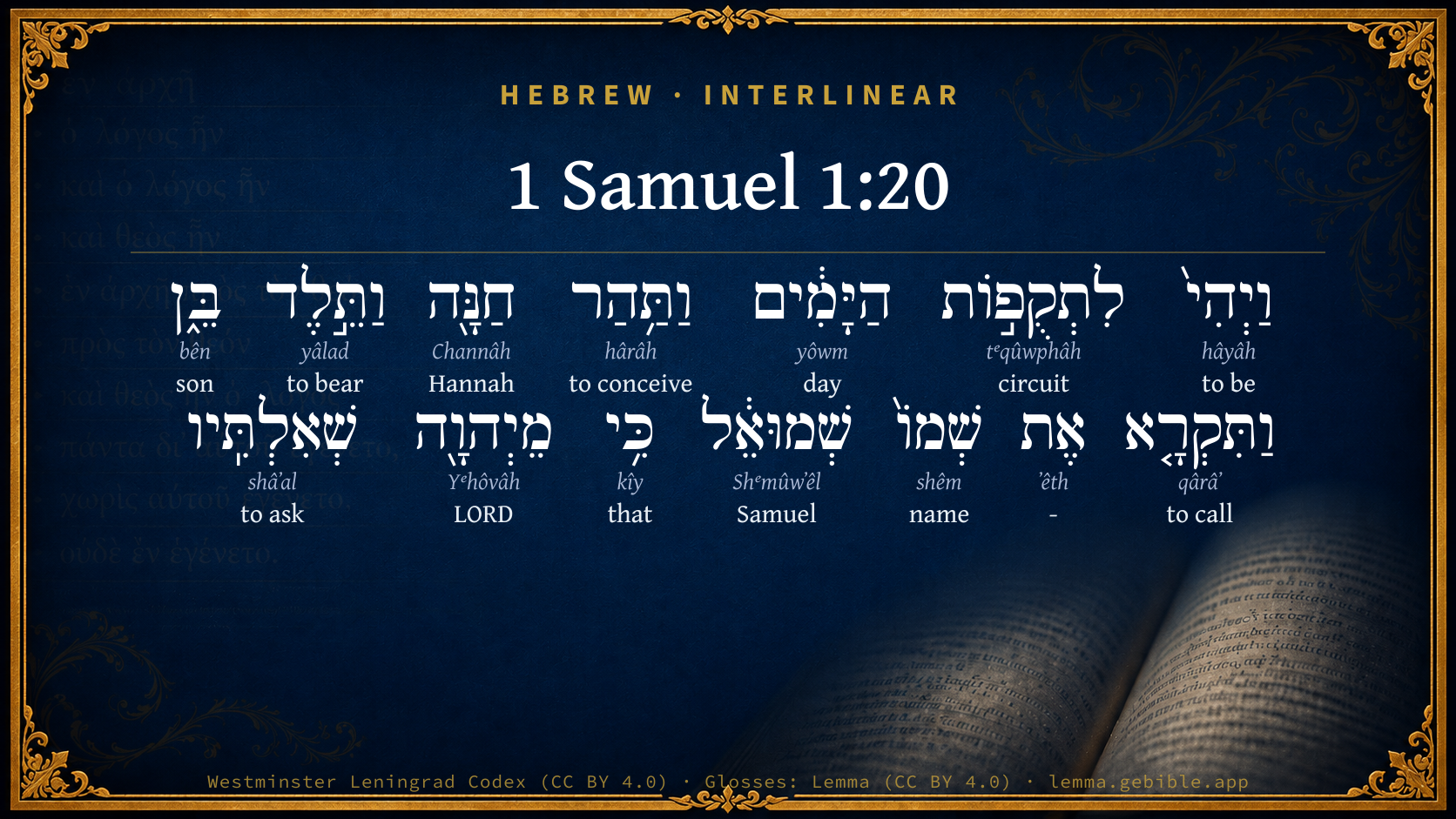
Hebrew (Westminster Leningrad Codex) 1 Samuel 1:20 appears in the Hebrew Old Testament. The text above is from the Westminster Leningrad Codex. Each word links to its Strong’s number, a concise gloss, and parsing drawn from the Open Scriptures Hebrew Bible morphology. Click any word for its full Brown-Driver-Briggs (BDB) entry.
Download image
Cite this verse

1 Samuel 1:20 (World English Bible). Public Domain. Lemma interlinear Bible study tool, https://lemma.gebible.app/v/1-samuel/1/20.

Show BibTeX & RIS
BibTeX
RIS
English Translation
It happened, when the time was come about, that Hannah conceived, and bore a son; and she named him Samuel, [saying], Because I have asked him of Yahweh.
World English Bible · Public Domain
Download a study sheet

One document with this verse’s original text, its word-by-word gloss line, the meaning frame, cross-references with their text, attributed commentary, and full source and license credits — printable, and it pastes into notes with its structure intact.

This verse Autodidact and up

Study sheet (.html) Plain text (.txt)

A passage Seminary Student

Up to 50 verses in one chapter. A passage sheet keeps up to 6 commentary sources and 12 cross-references per verse, in the order this page ranks them, and says so on the sheet whenever that leaves anything out. Ask for a single verse and you get the Autodidact verse sheet above.

Everything on this page stays free to read, with no account — the sheet is a download of what is already on screen, not access to it.

Want to remove ads? Support Godless Engineer
Compare translations 3

The same verse in 3 English versions, stacked beneath the original-language interlinear above. Click any original word for its lexicon entry.

Each is an independent rendering of the whole verse — the interlinear is not word-aligned to these translations.

Highlighted words mark where these versions differ — a whole-verse word diff, not a word-by-word alignment.

  • World English Bible Public Domain
    It happened, when the time was come about, that Hannah conceived, and bore a son; and she named him Samuel, [saying], Because I have asked him of Yahweh.
  • King James Version Public Domain
    Wherefore it came to pass, when the time was come about after Hannah had conceived, that she bare a son, and called his name Samuel, saying, Because I have asked him of the LORD.
  • unfoldingWord Literal Text CC BY-SA 4.0
    And it happened, in the turning of the days, that Hannah conceived and bore a son. And she called his name Samuel, for “I requested him from Yahweh.”

unfoldingWord Literal Text — © unfoldingWord, licensed CC BY-SA 4.0. Word-aligned USFM3 via Door43 (git.door43.org/unfoldingWord/en_ult).

Versions to compare (up to 4)

3 of 4 selected

Show all 18 translations

Every available English version of this verse, each an independent rendering of the whole verse.

  • World English Bible Public Domain
    It happened, when the time was come about, that Hannah conceived, and bore a son; and she named him Samuel, [saying], Because I have asked him of Yahweh.
  • Berean Standard Bible Public Domain
    So in the course of time, Hannah conceived and gave birth to a son. She named him Samuel, saying, “Because I have asked for him from the LORD.”
  • Majority Standard Bible Public Domain
    So in the course of time, Hannah conceived and gave birth to a son. She named him Samuel, saying, “Because I have asked for him from the LORD.”
  • King James Version Public Domain
    Wherefore it came to pass, when the time was come about after Hannah had conceived, that she bare a son, and called his name Samuel, saying, Because I have asked him of the LORD.
  • American Standard Version (1901) Public Domain
    And it came to pass, when the time was come about, that Hannah conceived, and bare a son; and she called his name Samuel, `saying', Because I have asked him of Jehovah.
  • Revised Version (1885) Public Domain
    And it came to pass, when the time was come about, that Hannah conceived, and bare a son; and she called his name Samuel, saying, Because I have asked him of the LORD.
  • Geneva Bible (1599) Public Domain
    For in processe of time Hannah conceiued, and bare a sonne, and she called his name Samuel, Because, said she, I haue asked him of the Lord.
  • Douay-Rheims (1899) Public Domain
    And it came to pass when the time was come about, Anna conceived and bore a son, and called his name Samuel: because she had asked him of the Lord.
  • Young's Literal Translation Public Domain
    and it cometh to pass, at the revolution of the days, that Hannah conceiveth, and beareth a son, and calleth his name Samuel, `for, from Jehovah I have asked him.'
  • Literal Standard Version CC BY-SA 4.0
    and it comes to pass, at the revolution of the days, that Hannah conceives, and bears a son, and calls his name Samuel, for, “I have asked for him from YHWH.”
  • Unlocked Literal Bible CC BY-SA 4.0
    When the time came, Hannah conceived and gave birth to a son. She called his name Samuel, saying, “Because I have asked for him from Yahweh.”
  • unfoldingWord Literal Text CC BY-SA 4.0
    And it happened, in the turning of the days, that Hannah conceived and bore a son. And she called his name Samuel, for “I requested him from Yahweh.”
  • Darby Bible Public Domain
    And it came to pass when the time was come about after Hannah had conceived, that she bore a son, and called his name Samuel, [saying,] Because I have asked him of Jehovah.
  • World Messianic Bible Public Domain
    When the time had come, Hannah conceived, and bore a son; and she named him Samuel, saying, “Because I have asked him of the LORD.”
  • Webster's Bible Public Domain
    Wherefore it came to pass, when the time had arrived, after Hannah had conceived, that she bore a son, and called his name Samuel, saying, Because I have asked him of the LORD.
  • Free Bible Version CC BY-SA 4.0
    In due course she became pregnant and gave birth to a son. She named him Samuel, saying, “Because I asked the Lord for him.”
  • Bible in Basic English Public Domain
    Now the time came when Hannah, being with child, gave birth to a son; and she gave him the name Samuel, Because, she said, I made a prayer to the Lord for him.
  • JPS Tanakh (1917) Public Domain
    And it came to pass, when the time was come about, that Hannah conceived, and bore a son; and she called his name Samuel: 'because I have asked him of the LORD.'

Literal Standard Version (2020), Covenant Press — licensed CC BY-SA 4.0. Text via the HelloAO Bible API (eBible.org). Unlocked Literal Bible (unfoldingWord) — licensed CC BY-SA 4.0. Text via the HelloAO Bible API (eBible.org). unfoldingWord Literal Text — © unfoldingWord, licensed CC BY-SA 4.0. Word-aligned USFM3 via Door43 (git.door43.org/unfoldingWord/en_ult). Free Bible Version, Dr. Jonathan Gallagher — licensed CC BY-SA 4.0. Text via the HelloAO Bible API (eBible.org).

Word by word

More ways to search: Search by grammar → Find every occurrence → Compare this word →

Practice this passage: Drill this verse → Learn its vocabulary →

לִתְקֻפ֣וֹת
tᵉqûwphâh
H8622
“to/for · circuits of”
Preposition + Noun, Common, Feminine, Plural, Construct
Part of Speech
Preposition + Noun
Type
Common
Gender
Feminine
Number
Plural
State
Construct
Full BDB Definition

Origin: from H5362

TWOT: 2001a

coming round, circuit of time or space, a turning, circuit - at the circuit (as adverb)
  1. וַיְהִי֙ hâyâh H1961 “and · to be” Conjunction + Verb, Qal, Sequential Imperfect, 3rd Person, Masculine, Singular
  2. הַיָּמִ֔ים yôwm H3117 “the · days” Particle, Definite Article + Noun, Common, Masculine, Plural, Absolute
  3. וַתַּ֥הַר hârâh H2029 “and · to conceive” Conjunction + Verb, Qal, Sequential Imperfect, 3rd Person, Feminine, Singular
  4. חַנָּ֖ה Channâh H2584 “Hannah” Noun, Proper
  5. וַתֵּ֣לֶד yâlad H3205 “and · to bear” Conjunction + Verb, Qal, Sequential Imperfect, 3rd Person, Feminine, Singular
  6. בֵּ֑ן bên H1121 “son” Noun, Common, Masculine, Singular, Absolute
  7. וַתִּקְרָ֤א qârâʼ H7121 “and · to call” Conjunction + Verb, Qal, Sequential Imperfect, 3rd Person, Feminine, Singular
  8. אֶת ʼêth H853 “-” Particle, Direct Object
  9. שְׁמוֹ֙ shêm H8034 “name · his” Noun, Common, Masculine, Singular, Construct + Suffix, Personal, 3rd Person, Masculine, Singular
  10. שְׁמוּאֵ֔ל Shᵉmûwʼêl H8050 “Samuel” Noun, Proper
  11. כִּ֥י kîy H3588 “that” Conjunction
  12. מֵיְהוָ֖ה Yᵉhôvâh H3068 “from · LORD” Preposition + Noun, Proper
  13. שְׁאִלְתִּֽיו shâʼal H7592 “to ask · him” Verb, Qal, Perfect, 1st Person, Common, Singular + Suffix, Personal, 3rd Person, Masculine, Singular

About this verse

These counts appear in no published source. They are computed here, from the morphology-tagged text and Lemma’s own curated glosses. What Lemma adds →

14
words
14
distinct lemmas
Historical
section

Notable vocabulary

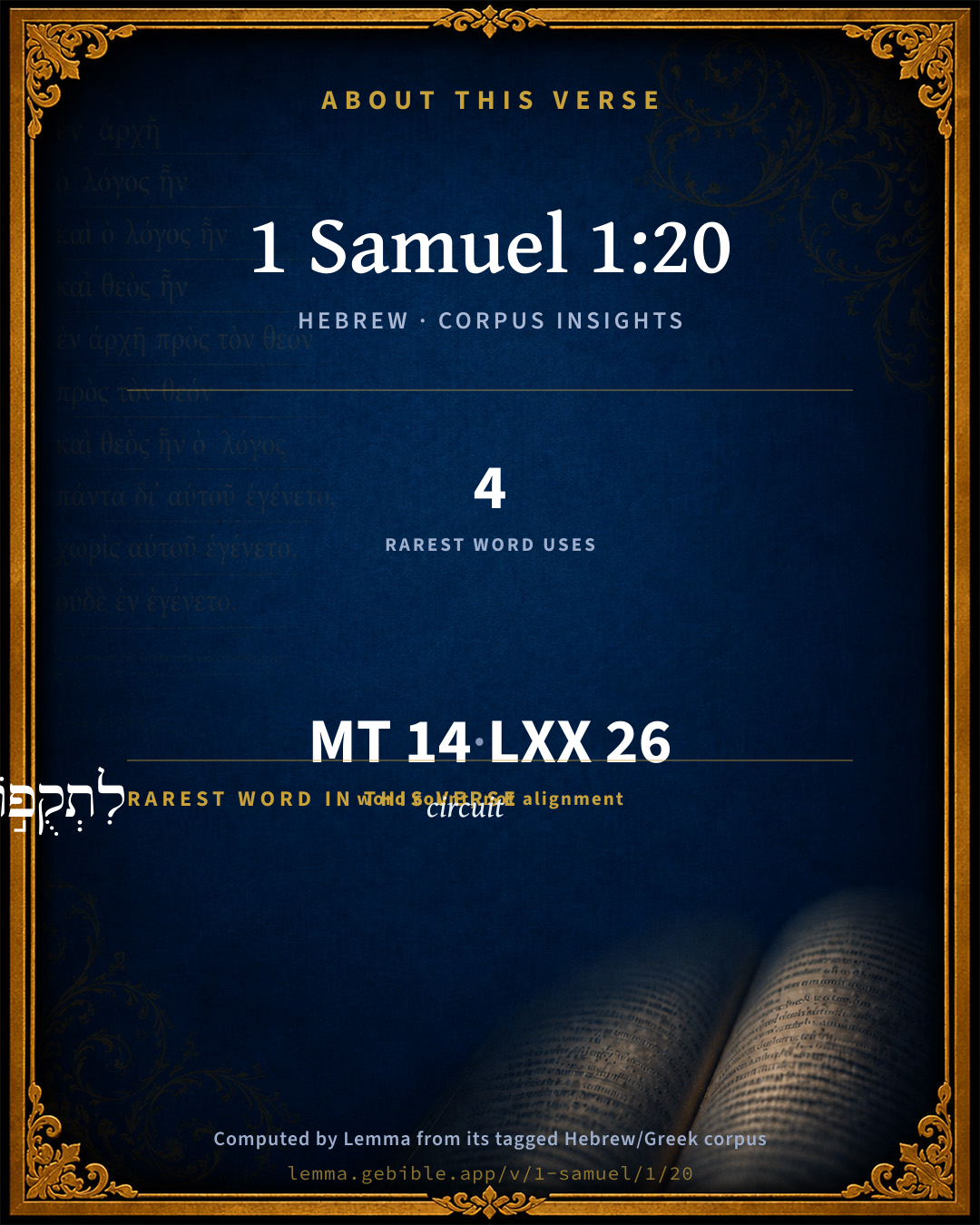
The rarest word here is לִתְקֻפ֣וֹת circuit H8622 — appearing just 4 times in the whole Hebrew Bible.

Shared distinctive vocabulary

לִתְקֻפ֣וֹת circuit H8622 occurs in 4 verses of the Hebrew Bible. Also found in:

Grammatical profile

  • 5 verbs
  • 7 nouns
  • 1 conjunction
  • 1 particle

Verb forms

  • וַיְהִי֙ Qal · Sequential Imperfect
  • וַתַּ֥הַר Qal · Sequential Imperfect
  • וַתֵּ֣לֶד Qal · Sequential Imperfect
  • וַתִּקְרָ֤א Qal · Sequential Imperfect
  • שְׁאִלְתִּֽיו Qal · Perfect

Hebrew & Septuagint length

In English translation the verse runs 28 words from the Hebrew and 33 from the Septuagint (LXX English) — closely comparable.

A rough comparison of the two English renderings, which tokenize alike — not a word-level alignment.

Word counts can differ between the Hebrew and the Greek without any difference in meaning — e.g. the Hebrew direct-object marker אֵת has no separate Greek word, and Greek often adds the article ὁ.

In the original languages it is 14 Hebrew tokens and 26 Greek tokens — but the two are counted differently (Hebrew bundles its prefixes and suffixes into one token; the Greek is in lemma form), so that isn’t a like-for-like length.

Cross-references

9

Topical passages linked to 1 Samuel 1:20 in the Treasury of Scripture Knowledge — connected by theme and wording, ordered by reader-vote popularity; previews shown in the World English Bible.

  • Genesis 41:51–52 Joseph called the name of the firstborn Manasseh, "For," he said, "God has made me forget all my toil, and all my father's house."
  • Exodus 2:10 The child grew, and she brought him to Pharaoh's daughter, and he became her son. She named him Moses, and said, "Because I drew him out of the water."
  • Matthew 1:21 She shall bring forth a son. You shall call his name Jesus, for it is he who shall save his people from their sins."
  • Exodus 2:22 She bore a son, and he named him Gershom, for he said, "I have lived as a foreigner in a foreign land."
  • Genesis 16:11 The angel of Yahweh said to her, "Behold, you are with child, and will bear a son. You shall call his name Ishmael, because Yahweh has heard your affliction.
  • Genesis 29:32–35 Leah conceived, and bore a son, and she named him Reuben. For she said, "Because Yahweh has looked at my affliction. For now my husband will love me."
  • Genesis 30:6–21 Rachel said, "God has judged me, and has also heard my voice, and has given me a son." Therefore called she his name Dan.
  • Genesis 5:29 and he named him Noah, saying, "This same will comfort us in our work and in the toil of our hands, because of the ground which Yahweh has cursed."
  • Genesis 4:25 Adam knew his wife again. She gave birth to a son, and named him Seth. For, she said, "God has appointed me another child instead of Abel, for Cain killed him."

Cross-references courtesy of OpenBible.info (CC BY 4.0).

Hebrew and Greek witnesses Masoretic Hebrew ↔ Greek Septuagint

The same verse in the two great witnesses to the Old Testament, shown verse-for-verse.

These are two independent witnesses, not word-aligned to each other, and the Septuagint is shown in lemma (dictionary) form.

Hebrew 1 Samuel 1:20 Masoretic · Westminster Leningrad Codex

וַיְהִי֙ לִתְקֻפ֣וֹת הַיָּמִ֔ים וַתַּ֥הַר חַנָּ֖ה וַתֵּ֣לֶד בֵּ֑ן וַתִּקְרָ֤א אֶת שְׁמוֹ֙ שְׁמוּאֵ֔ל כִּ֥י מֵיְהוָ֖ה שְׁאִלְתִּֽיו

It happened, when the time was come about, that Hannah conceived, and bore a son; and she named him Samuel, [saying], Because I have asked him of Yahweh.

World English Bible · Public Domain

Greek LXX 1 Samuel 1:20 Septuagint · lemma form

καί συνλαμβάνω καί γίγνομαι ὁ καιρός ὁ ἡμέρα καί τίκτω υἱός καί καλέω ὁ ὄνομα αὐτός σαμουηλ καί εἶπον ὅτι παρά κύριος θεός σαβαωθ αἰτέω αὐτός

And it came to pass when the time was come, that she brought forth a son, and called his name Samuel, and said, Because I asked him of the Lord God of Sabaoth.

LXX2012 (modern English Septuagint) · Public Domain

Hebrew: Westminster Leningrad Codex (CC BY 4.0). Greek: Septuagint (public domain); English from LXX2012 (modern English Septuagint) (Public Domain). How the Septuagint differs from the Hebrew →

Targum (Aramaic paraphrase)

1

The Targum is the ancient Jewish Aramaic paraphrase of the Hebrew Scriptures — an interpretive translation, not the Hebrew text itself. Onkelos (literal) and Pseudo-Jonathan (expansive) render the Torah, and Jonathan the Prophets. Coverage is partial: where no permissively-licensed English translation exists for a verse, only the Aramaic is shown. This is verse-level text, not a word-by-word alignment to the Hebrew.

  1. Targum Jonathan Prophets (Joshua–Malachi)
    וַהֲוָה לִזְמַן מִשְׁלַם יוֹמַיָא וְעַדִיאַת חַנָה וִילִידַת בַּר וּקְרַת יַת שְׁמֵיהּ שְׁמוּאֵל אֲרֵי אֲמָרַת מִן קֳדָם יְיָ שְׁאִלְתֵּיה:

    (no public-domain English translation for this verse)

    Targum Jonathan — Aramaic: “Mikraot Gedolot” (public domain). English: “Sefaria Community Translation” (CC0 1.0 (public-domain dedication)); “London "Chaldee Paraphrase," 1871” (public domain). Text via Sefaria.

Commentary

Notes on 1 Samuel 1:20 from classic Christian and Jewish commentators (each source and its license shown beneath its notes). The classic Christian expositions comment on the surrounding passage and are grouped to its opening verse, so a note may address several verses; the Jewish commentaries on the Tanakh (Rashi and others) are per-verse, so they appear only where the commentator wrote on this verse.

Lemma curates 59 commentaries, every one of them public domain or Creative Commons licensed, each selected and text-cleaned for this edition rather than reprinted as found. About our sources →

Jamieson, Fausset & Brown

Robert Jamieson, A. R. Fausset & David Brown

SAMUEL BORN. (Sa1 1:20)

called his name Samuel--doubtless with her husband's consent. The names of children were given sometimes by the fathers, and sometimes by the mothers (see Gen 4:1, Gen 4:26; Gen 5:29; Gen 19:37; Gen 21:3); and among the early Hebrews, they were commonly compound names, one part including the name of God.

Jamieson, Fausset & Brown — Commentary Critical and Explanatory on the Whole Bible (1871) — public domain (CC PDM 1.0). Text via the HelloAO Bible API.

Trapp's Complete Commentary

John Trapp

1Sa 1:20 Wherefore it came to pass, when the time was come about after Hannah had conceived, that she bare a son, and called his name Samuel, [saying], Because I have asked him of the LORD.

Ver. 20. That she bare a son.] A singular son, Quem Deus immortalis nasci voluit ut esset in quo virtus per omnes numeros hominibus efficaciter se ostenderet, {a} whom God would have [to be] born for a pattern of piety.

And called his name Samuel,] i.e., Asked of God; sent me as a return of prayer, and therefore the more dear unto me: -

“ Quoniam charissima semper

Munera sunt, Author quae preciosa facit. ”

{a} Sic de Scipione, Val. Max.

John Trapp, A Commentary or Exposition upon All the Books of the Old and New Testament (1647–1656) — public domain. Text from a community e-Sword module.

Adam Clarke's Commentary

Verse 20. Called his name Samuel] As she gave this name to her son because she had asked him of the Lord, the word שמואל Shemuel must be here considerably contracted; if it express this sentiment, the component parts of it are the following: שאול מאל shaul meEl, "asked of God.' This name would put both the mother and the son in continual remembrance of the Divine interposition at his birth. See on 1Sa 1:28.

Adam Clarke's Commentary on the Bible (1810–1826) — public domain. Text from a community e-Sword/MySword module.

Ellicott's Commentary for English Readers

(20) And called his name Samuel.—The words translated “because I have asked him of the Lord,” do not explain the meaning of the name “Samuel ” they simply give the reason for his mother so calling him. The name Sh’muel (Samuel) is formed from the Hebrew words Sh’mua El (a Deo exauditus), “heard of God.”

A Bible Commentary for English Readers, edited by Charles John Ellicott (1878–1897) — public domain. Text from a community e-Sword module.

The Cambridge Bible for Schools and Colleges

gen. ed. J. J. S. Perowne

20. Wherefore] Simply And.

to Ramah] See note on Ramathaim-Zophim in 1Sa_1:1.

Samuel] This name, in Hebrew Shemuel, is familiar to us only in its Latin dress. It was borne by two other persons in the O. T. (Num_34:20; 1Ch_7:2). Three explanations of it are proposed: (a) “Name of God”: (b) “Asked of God”: (c) “Heard of God”: of which the last is the most probable; compare Ishmael = “God heareth.” Hannah gives the child a name which will be a continual memorial of God’s answer to her prayer. It found a subsequent appropriateness in the fervency and efficacy of his own prayers.

The Cambridge Bible for Schools and Colleges (gen. ed. J. J. S. Perowne; Cambridge University Press, 1878–1918) — public domain. Text from a community e-Sword module.

John Gill's Exposition

Wherefore it came to pass, when the time was come about, after Hannah had conceived,.... Or, "at the revolutions of days" (b); at the end of a year, of a complete year, as Ben Melech, from their return from Shiloh; for it might be some time after their return that she conceived; or rather the sense is, that at nine months' end, the usual time of a woman's going with child from her conception, which is the date here given:

that she bare a son: was brought to bed of a son:

and called his name Samuel, saying, because I have asked him of the Lord; one would think rather his name should have been Saul, for the reason given; but, as Ben Gersom observes, givers of names are not always grammatically strict and critical in them, or in the etymology of them, as in the names of Reuben and Noah, in which he instances; and this may be the rather overlooked in a woman, than in a man of learning. According to Kimchi, it is as if it was Saulmeel; that is, "asked of God", and by contraction Samuel; but Hillerus (c) gives a better account of this name, and takes it to be composed of Saul-mul-el, "asked before God", "in the sight of God", "before the ark of God". This name Hannah gave her son (for sometimes the father, and sometimes the mother, gave the name) in memory of the wonderful favour and goodness of God in granting her request; and to impress her own mind with a sense of the obligation she lay under, to perform her vow, and to engage her son the more readily to give up himself to the service of God, when he reflected on his name, and the reason of it.

(b) "in revolutionibus dierum", Montanus; so Piscator. (c) Onomastic. Sacr. p. 418, 419, 487.

John Gill's Exposition of the Whole Bible (1746–1763) — public domain (CC PDM 1.0). Text via the HelloAO Bible API.

Albert Barnes' Notes on the Bible

Samuel - i. e. heard of God, because given in answer to prayer. The names “Ishmael” and “Elishama” have the same etymology.

Albert Barnes' Notes on the Bible (1834–1885) — public domain. Text from a community e-Sword/MySword module.

Haydock's Catholic Bible Commentary

About, at the expiration of the year, which term the ancients frequently allowed between the conception and the nativity, Genesis xviii. 10. --- Samuel. This name imports, asked of God. (Challoner) --- Some letters are omitted for the easier pronunciation, as the Hebrews would now write it, Saul-meel; (Calmet) or it may signigy, "God placed him," sum-hal. (Tirinus) --- Shaal means, "to ask." But Vatable thinks that Anna retained only the first letter. (Menochius)

George Leo Haydock (1774–1849), Haydock's Catholic Family Bible and Commentary, 1859 edition — public domain. Excludes Psalms (Douay-Rheims chapter numbering differs from Protestant) and Deuterocanonical books (Catholic canon only).

Matthew Poole's English Annotations

So the sense is, When the usual time from the conception to the birth was past, she brought forth her son. Heb. in or after the revolution, or expiration of some days, Hannah conceived, and in due time

bare a son. So the meaning is, That although her husband knew her conjugally at his return, and God was minded of her, and intended in his time to give her his blessing, yet she did not conceive at first, but after some days or time afterwards.

And called, i.e. she called, not doubting of her husband’s consent to the name. The names of children were given to them sometimes by their fathers, and sometime by the mothers. See Gen 4:1,26; 5:29; 21:3; 19:37,38, &c.

Matthew Poole's English Annotations on the Holy Bible (1683–1685) — public domain. Text from a community e-Sword/MySword module.

Whedon's Commentary on the Bible

Daniel D. Whedon

20. Called his name Samuel — This name (שׁמואל) is a contraction of שׁמוע אל, heard of God, and alludes to the fact that God heard Hannah’s prayer for a child. Some derive the name from שׁם אל, name of God, which etymology, though possible, does not well agree with the comment of the immediate context. The derivation from שׁאול מאל, asked of God, though agreeing well with the comment of the context, is too artificial and farfetched. “The words Because I have asked him of the Lord are not an etymological explanation of the name, but an exposition founded upon facts. Because Hannah had asked him of Jehovah, she named him the God-heard, as a memorial of the hearing of her prayer.” — Keil. “His name,” says Smith, (Old Testament History,) “is expressive of the leading feature of his whole history, the power of prayer. Himself the child of prayer, he gained all his triumphs by prayer; he is placed at the head of those ‘who called upon Jehovah and he answered them.’”

Daniel D. Whedon (gen. ed.), Commentary on the Old and New Testaments (1874–1909) — public domain. Text from a community e-Sword module.

John Wesley's Explanatory Notes

Samuel - That is, Asked of God.

John Wesley, Explanatory Notes Upon the Whole Bible (1754–1765) — public domain. Text via the GEBible commentary corpus.

Rashi

Rabbi Shlomo Yitzchaki (Rashi)

And as the seasons and days passed. The minimum of seasons [תְּקוּפוֹת] is two, and the minimum of days [יָמִים] is two. Hence, [she gave birth] after six months [=two seasons] and two days. From here [we learn] that a woman who gives birth in her seventh month of pregnancy, can give birth after entering part of the seventh month.

Shmuel. After the Name of God [א־ל], and in reference to the incident he was so called, for I requested [שָׁאַל] him of הַשֵׁם[=מא־ל].

Rashi on the Tanakh — English translations: “The Judaica Press complete Tanach with Rashi, translated by A. J. Rosenberg” (CC BY 4.0); “Pentateuch with Rashi's commentary by M. Rosenbaum and A.M. Silbermann, 1929-1934” (public domain); “The Metsudah Tanach series, Lakewood, N.J” (CC BY 4.0); and “The Book of Joshua, Metsudah Publications, 1997” (CC BY 4.0). Text via Sefaria.

Radak

Rabbi David Kimhi (Radak)

As the cycles and days passed: The days of her pregnancy - like its translation [in Targum Yonatan], "at the time of the completion of the days." And the explanation of, "and Channah conceived," is that she had already conceived. For when they returned from Shiloh, Elkanah, her husband, knew her intimately; and she conceived - as it is written [in the previous verse], "and the Lord remembered her." "The cycles and days" - that is when the days of pregnancy were completed, she gave birth to a son. And there are [instances of the letter,] vav [such as at the beginning of this verse] like this, indicating the past - like (Isaiah 64:4), "indeed, You were angry and we sinned" (the vav here changes the second phrase from being future to being past); (Exodus 14:21) "and the waters were split" (the vav here too changing the future to past); and those similar to them. And our Rabbis, may their memory be blessed, said that the days of her pregnancy were six months and two days - the minimum of "cycles" is two, and the minimum of "days" is two; and a cycle is three months. And we learn from this [that] a woman who gives birth in her seventh month can give birth with cut off (partial) [months].

Shmuel: This word is constructed for this reason from, "I requested him from the Lord." As there are the letters of, shaul (requested), in Shmuel, and there are also the letters of, me'El (from God). It as is if she said, "Requested from God."

For I requested him from the Lord: It is lacking the word, said. Meaning to say, why did she call his name Shmuel? Because she said, "I requested him from the Lord." And it is like the Targum Yonatan, "For I said, 'I requested him before the Lord.'"

Radak on the Tanakh — English translations: “Sefaria Community Translation” (CC0 1.0 (public-domain dedication)); “Eliyahu Munk, HaChut Hameshulash” (CC BY 4.0); “Rabbi Mike Feuer, Jerusalem Anthology” (CC BY 4.0); and “R. David Kimhi on the first book of Psalms, Translated by R.G. Finch, London, 1919” (public domain). Text via Sefaria.

Lesson kit

Teaching starters — assembled from the data on this page, not authored interpretation. Every prompt links to the verse data it draws on. Edit before teaching.

1 Samuel, in the Historical, opens this verse with 14 words (14 distinct Hebrew lemmas). Its most distinctive word is tᵉqûwphâh (“circuit”). A historical commentator’s framing appears above. Read the whole chapter for the surrounding context.

Discussion questions

  1. The word tᵉqûwphâh carries the sense “circuit.” How does it shape the verse?
  2. How does Exodus 34:22, which shares the word «circuit», read alongside this verse?
  3. These translations render this verse differently; the difference is in the English rendering, not the original. What questions does that raise?
  4. «וַיְהִי֙» is a Qal Sequential Imperfect verb. How does that grammatical form shape the action described?
  5. Compare how Jamieson, Fausset & Brown and Trapp's Complete Commentary read this verse. Where do they agree or differ?

Things to notice

Reading settings

Reading text

Shown beneath each verse's original-language words.

Old Testament
Old Testament edition

Read the OT as the Masoretic Hebrew (MT) or the Greek Septuagint (LXX).

English shown for the Greek Septuagint (in the Hebrew ↔ Greek comparison).

Comparing translations? Open the Compare panel on any verse page to stack up to four side by side.