Exodus 2:22

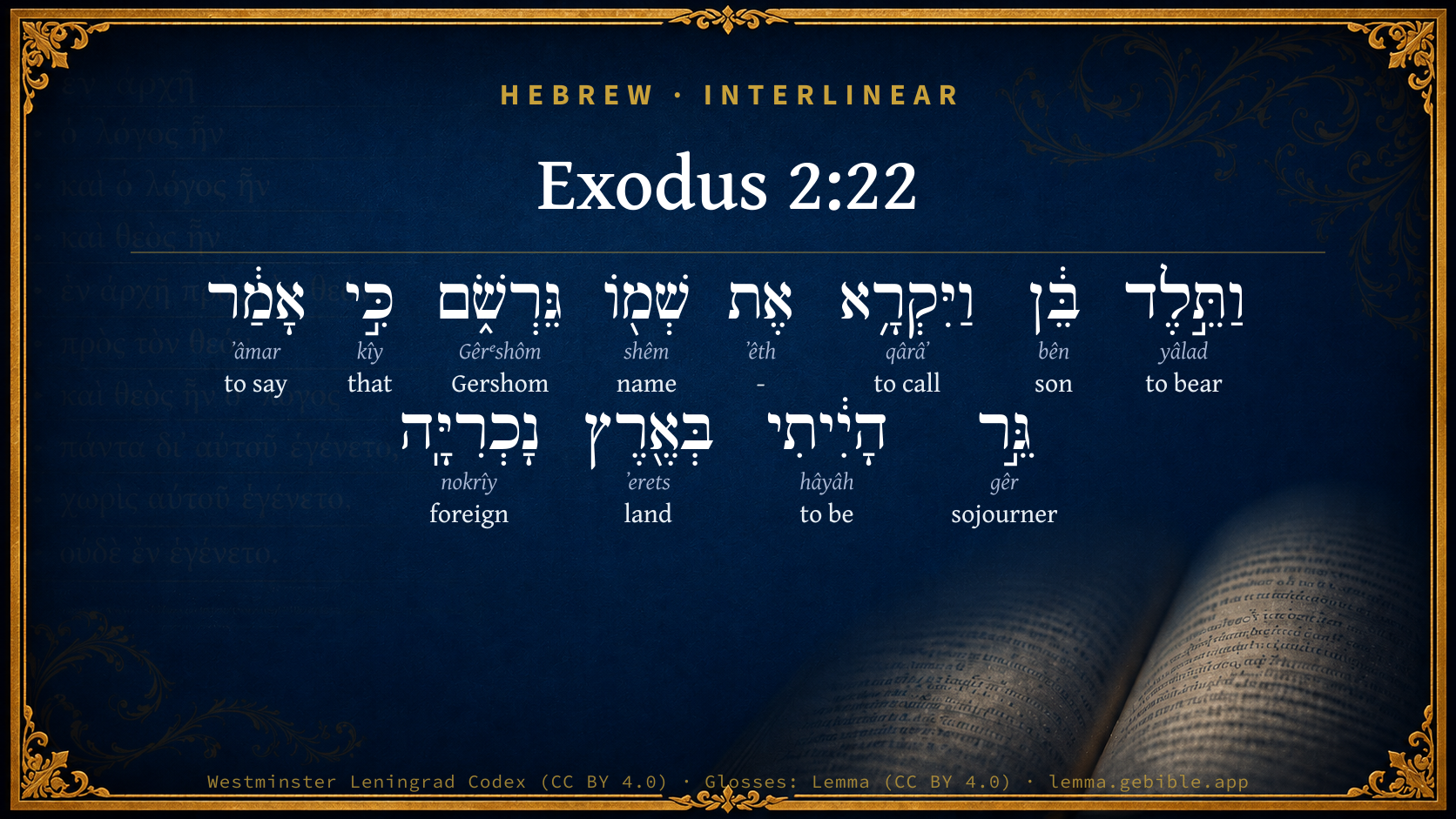
Hebrew (Westminster Leningrad Codex) Exodus 2:22 appears in the Hebrew Old Testament. The text above is from the Westminster Leningrad Codex. Each word links to its Strong’s number, a concise gloss, and parsing drawn from the Open Scriptures Hebrew Bible morphology. Click any word for its full Brown-Driver-Briggs (BDB) entry.
Download image
Cite this verse

Exodus 2:22 (World English Bible). Public Domain. Lemma interlinear Bible study tool, https://lemma.gebible.app/v/exodus/2/22.

Show BibTeX & RIS
BibTeX
RIS
English Translation
She bore a son, and he named him Gershom, for he said, "I have lived as a foreigner in a foreign land."
World English Bible · Public Domain
Highlights
  • 1 first appearance in the Hebrew Bible
Full analysis ↓
Download a study sheet

One document with this verse’s original text, its word-by-word gloss line, the meaning frame, cross-references with their text, attributed commentary, and full source and license credits — printable, and it pastes into notes with its structure intact.

This verse Autodidact and up

Study sheet (.html) Plain text (.txt)

A passage Seminary Student

Up to 50 verses in one chapter. A passage sheet keeps up to 6 commentary sources and 12 cross-references per verse, in the order this page ranks them, and says so on the sheet whenever that leaves anything out. Ask for a single verse and you get the Autodidact verse sheet above.

Everything on this page stays free to read, with no account — the sheet is a download of what is already on screen, not access to it.

Want to remove ads? Support Godless Engineer
Compare translations 3

The same verse in 3 English versions, stacked beneath the original-language interlinear above. Click any original word for its lexicon entry.

Each is an independent rendering of the whole verse — the interlinear is not word-aligned to these translations.

Highlighted words mark where these versions differ — a whole-verse word diff, not a word-by-word alignment.

  • World English Bible Public Domain
    She bore a son, and he named him Gershom, for he said, "I have lived as a foreigner in a foreign land."
  • King James Version Public Domain
    And she bare him a son, and he called his name Gershom: for he said, I have been a stranger in a strange land.
  • unfoldingWord Literal Text CC BY-SA 4.0
    And she birthed a son, and he called his name Gershom; for he said, “I have become a foreigner in a foreign land.”

unfoldingWord Literal Text — © unfoldingWord, licensed CC BY-SA 4.0. Word-aligned USFM3 via Door43 (git.door43.org/unfoldingWord/en_ult).

Versions to compare (up to 4)

3 of 4 selected

Show all 18 translations

Every available English version of this verse, each an independent rendering of the whole verse.

  • World English Bible Public Domain
    She bore a son, and he named him Gershom, for he said, "I have lived as a foreigner in a foreign land."
  • Berean Standard Bible Public Domain
    And she gave birth to a son, and Moses named him Gershom, saying, “I have become a foreigner in a foreign land.”
  • Majority Standard Bible Public Domain
    And she gave birth to a son, and Moses named him Gershom, saying, “I have become a foreigner in a foreign land.”
  • King James Version Public Domain
    And she bare him a son, and he called his name Gershom: for he said, I have been a stranger in a strange land.
  • American Standard Version (1901) Public Domain
    And she bare a son, and he called his name Gershom; for he said, I have been a sojourner in a foreign land.
  • Revised Version (1885) Public Domain
    And she bare a son, and he called his name Gershom: for he said, I have been a sojourner in a strange land.
  • Geneva Bible (1599) Public Domain
    And she bare a sonne, whose name he called Gershom: for he said, I haue bene a stranger in a strange lande.
  • Douay-Rheims (1899) Public Domain
    And she bore him a son, whom he called Gersam, saying: I have been a stranger in a foreign country. And she bore another, whom he called Eliezer, saying: For the God of my father, my helper hath delivered me out of the hand of Pharao.
  • Young's Literal Translation Public Domain
    and she beareth a son, and he calleth his name Gershom, for he said, `A sojourner I have been in a strange land.'
  • Literal Standard Version CC BY-SA 4.0
    and she bears a son, and he calls his name Gershom, for he said, “I have been a sojourner in a strange land.”
  • Unlocked Literal Bible CC BY-SA 4.0
    She bore a son, and Moses called his name Gershom; he said, “I have been a resident in a foreign land.”
  • unfoldingWord Literal Text CC BY-SA 4.0
    And she birthed a son, and he called his name Gershom; for he said, “I have become a foreigner in a foreign land.”
  • Darby Bible Public Domain
    And she bore a son, and he called his name Gershom; for he said, I have been a sojourner in a foreign land.
  • World Messianic Bible Public Domain
    She bore a son, and he named him Gershom, for he said, “I have lived as a foreigner in a foreign land.”
  • Webster's Bible Public Domain
    And she bore him a son, and he called his name Gershom: for he said, I have been a stranger in a strange land.
  • Free Bible Version CC BY-SA 4.0
    She had a son, and Moses named him Gershom, for he said, “I'm an exile living in a foreign country.”
  • Bible in Basic English Public Domain
    And she gave birth to a son, to whom he gave the name Gershom: for he said, I have been living in a strange land.
  • JPS Tanakh (1917) Public Domain
    And she bore a son, and he called his name Gershom; for he said: 'I have been a stranger in a strange land.'

Literal Standard Version (2020), Covenant Press — licensed CC BY-SA 4.0. Text via the HelloAO Bible API (eBible.org). Unlocked Literal Bible (unfoldingWord) — licensed CC BY-SA 4.0. Text via the HelloAO Bible API (eBible.org). unfoldingWord Literal Text — © unfoldingWord, licensed CC BY-SA 4.0. Word-aligned USFM3 via Door43 (git.door43.org/unfoldingWord/en_ult). Free Bible Version, Dr. Jonathan Gallagher — licensed CC BY-SA 4.0. Text via the HelloAO Bible API (eBible.org).

Word by word

More ways to search: Search by grammar → Find every occurrence → Compare this word →

Practice this passage: Drill this verse → Learn its vocabulary →

גֵּרְשֹׁ֑ם
Gêrᵉshôm
H1647
“Gershom”
Noun, Proper
Part of Speech
Noun
Type
Proper
Full BDB Definition

Origin: for H1648

TWOT: None

Gershom = "foreigner" - firstborn son of Moses and Zipporah - firstborn son of Levi - a son of the priestly family of Phinehas who returned from exile with Ezra
  1. וַתֵּ֣לֶד yâlad H3205 “and · to bear” Conjunction + Verb, Qal, Sequential Imperfect, 3rd Person, Feminine, Singular
  2. בֵּ֔ן bên H1121 “son” Noun, Common, Masculine, Singular, Absolute
  3. וַיִּקְרָ֥א qârâʼ H7121 “and · to call” Conjunction + Verb, Qal, Sequential Imperfect, 3rd Person, Masculine, Singular
  4. אֶת ʼêth H853 “-” Particle, Direct Object
  5. שְׁמ֖וֹ shêm H8034 “name · his” Noun, Common, Masculine, Singular, Construct + Suffix, Personal, 3rd Person, Masculine, Singular
  6. כִּ֣י kîy H3588 “that” Conjunction
  7. אָמַ֔ר ʼâmar H559 “to say” Verb, Qal, Perfect, 3rd Person, Masculine, Singular
  8. גֵּ֣ר gêr H1616 “sojourner” Noun, Common, Masculine, Singular, Absolute
  9. הָיִ֔יתִי hâyâh H1961 “to be” Verb, Qal, Perfect, 1st Person, Common, Singular
  10. בְּאֶ֖רֶץ ʼerets H776 “in/at · land” Preposition + Noun, Common, Both, Singular, Absolute
  11. נָכְרִיָּֽה nokrîy H5237 “foreign” Adjective, Adjective, Feminine, Singular, Absolute

About this verse

These counts appear in no published source. They are computed here, from the morphology-tagged text and Lemma’s own curated glosses. What Lemma adds →

12
words
12
distinct lemmas
Pentateuch
section

Notable vocabulary

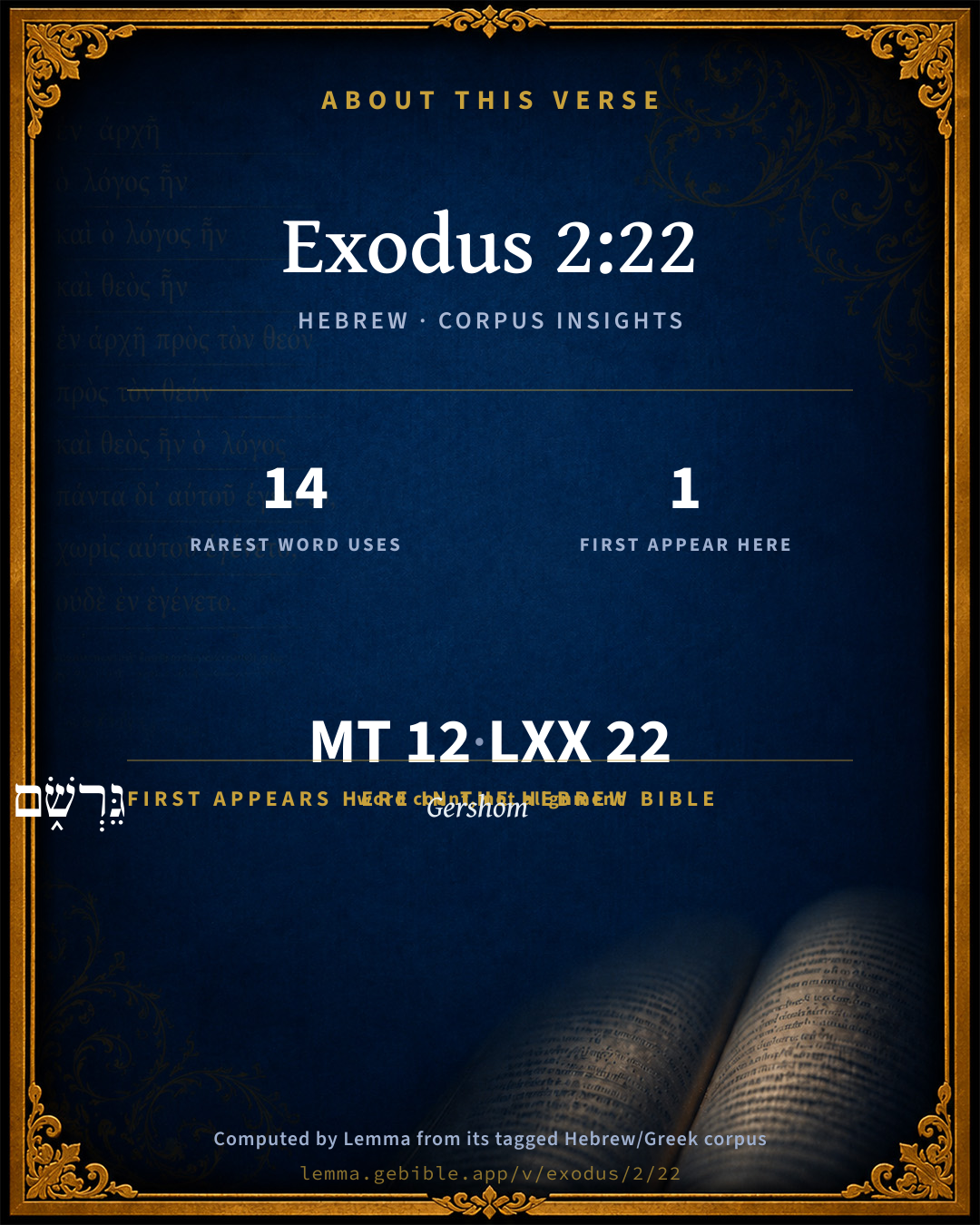
The rarest word here is גֵּרְשֹׁ֑ם Gershom H1647 — appearing just 14 times in the whole Hebrew Bible.

First appearance in Scripture

This word makes its first canonical appearance in the Hebrew Bible here:

  • גֵּרְשֹׁ֑ם Gershom H1647

Shared distinctive vocabulary

גֵּרְשֹׁ֑ם Gershom H1647 occurs in 14 verses of the Hebrew Bible. Also found in:

Grammatical profile

  • 4 verbs
  • 5 nouns
  • 1 adjective
  • 1 conjunction
  • 1 particle

Verb forms

  • וַתֵּ֣לֶד Qal · Sequential Imperfect
  • וַיִּקְרָ֥א Qal · Sequential Imperfect
  • אָמַ֔ר Qal · Perfect
  • הָיִ֔יתִי Qal · Perfect

Hebrew & Septuagint length

In English translation the verse runs 22 words from the Hebrew and 23 from the Septuagint (LXX English) — closely comparable.

A rough comparison of the two English renderings, which tokenize alike — not a word-level alignment.

Word counts can differ between the Hebrew and the Greek without any difference in meaning — e.g. the Hebrew direct-object marker אֵת has no separate Greek word, and Greek often adds the article ὁ.

In the original languages it is 12 Hebrew tokens and 22 Greek tokens — but the two are counted differently (Hebrew bundles its prefixes and suffixes into one token; the Greek is in lemma form), so that isn’t a like-for-like length.

Cross-references

9

Topical passages linked to Exodus 2:22 in the Treasury of Scripture Knowledge — connected by theme and wording, ordered by reader-vote popularity; previews shown in the World English Bible.

  • Acts 7:29 Moses fled at this saying, and became a stranger in the land of Midian, where he became the father of two sons.
  • Hebrews 11:13–14 These all died in faith, not having received the promises, but having seen them and embraced them from afar, and having confessed that they were strangers and pilgrims on the earth.
  • Exodus 22:21 "You shall not wrong an alien, neither shall you oppress him, for you were aliens in the land of Egypt.
  • 1 Chronicles 16:20 They went about from nation to nation, From one kingdom to another people.
  • 1 Chronicles 29:15 For we are strangers before you, and foreigners, as all our fathers were: our days on the earth are as a shadow, and there is no abiding.
  • Psalms 39:12 "Hear my prayer, Yahweh, and give ear to my cry. Don't be silent at my tears. For I am a stranger with you, A foreigner, as all my fathers were.
  • Psalms 119:19 I am a stranger on the earth. Don't hide your commandments from me.
  • Exodus 18:3–4 and her two sons. The name of one son was Gershom, for Moses said, "I have lived as a foreigner in a foreign land".

Cross-references courtesy of OpenBible.info (CC BY 4.0).

Hebrew and Greek witnesses Masoretic Hebrew ↔ Greek Septuagint

The same verse in the two great witnesses to the Old Testament, shown verse-for-verse.

These are two independent witnesses, not word-aligned to each other, and the Septuagint is shown in lemma (dictionary) form.

Hebrew Exodus 2:22 Masoretic · Westminster Leningrad Codex

וַתֵּ֣לֶד בֵּ֔ן וַיִּקְרָ֥א אֶת שְׁמ֖וֹ גֵּרְשֹׁ֑ם כִּ֣י אָמַ֔ר גֵּ֣ר הָיִ֔יתִי בְּאֶ֖רֶץ נָכְרִיָּֽה

She bore a son, and he named him Gershom, for he said, "I have lived as a foreigner in a foreign land."

World English Bible · Public Domain

Greek LXX Exodus 2:22 Septuagint · lemma form

ἐν γαστήρ δέ λαμβάνω ὁ γυνή τίκτω υἱός καί ἐπιὀνομάζω μωυσῆς ὁ ὄνομα αὐτός γηρσαμ λέγω ὅτι πάροικος εἰμί ἐν γῆ ἀλλότριος

And the woman conceived and bore a son, and Moses called his name Gersam, saying, I am a sojourner in a strange land.

LXX2012 (modern English Septuagint) · Public Domain

On this verse, Adam Clarke's Commentary discusses the Septuagint’s reading. Read the note in Commentary ↓

Hebrew: Westminster Leningrad Codex (CC BY 4.0). Greek: Septuagint (public domain); English from LXX2012 (modern English Septuagint) (Public Domain). How the Septuagint differs from the Hebrew →

Targum (Aramaic paraphrase)

2

The Targum is the ancient Jewish Aramaic paraphrase of the Hebrew Scriptures — an interpretive translation, not the Hebrew text itself. Onkelos (literal) and Pseudo-Jonathan (expansive) render the Torah, and Jonathan the Prophets. Coverage is partial: where no permissively-licensed English translation exists for a verse, only the Aramaic is shown. This is verse-level text, not a word-by-word alignment to the Hebrew.

  1. Targum Onkelos Torah (Genesis–Deuteronomy)
    וִילֵדַת בַּר וּקְרָא יָת שְׁמֵהּ גֵרְשֹׁם אֲרֵי אֲמַר דַיָר הֲוֵיתִי בְּאַרַע נוּכְרָאָה:

    (no public-domain English translation for this verse)

    Targum Onkelos — Aramaic: “Onkelos Genesis” (public domain); “Onkelos Exodus” (public domain); “Onkelos Leviticus” (public domain); “Onkelos Numbers” (public domain); “Onkelos Deuteronomy” (public domain). English: “Sefaria Community Translation” (CC0 1.0 (public-domain dedication)); “J.W. Etheridge. The Targums of Onkelos and Jonathan Ben Uzziel on the Pentateuch. London: Longmans, Green, 1862” (public domain). Text via Sefaria.

  2. Targum Pseudo-Jonathan Torah (Genesis–Deuteronomy)
    וִילֵידַת בִּיר דְכַר וּקְרָא שְׁמֵיהּ גֵרְשׁוֹם אֲרוּם אָמַר דַיָר הֲוֵיתִי בְּאַרְעָא נוּכְרַיָיא דְלָא דִידִי

    And she bare him a male child, and he called his name Gershom, Because, said he, a sojourner have I been in a strange land which is not mine.

    Targum Pseudo-Jonathan — Aramaic: “Targum Jonathan on Genesis” (public domain); “Targum Jonathan on Exodus” (public domain); “Targum Jonathan on Leviticus” (public domain); “Targum Jonathan on Numbers” (public domain); “Targum Jonathan on Deuteronomy” (public domain). English: “The Targum of Jonathan ben Uzziel, trans. J. W. Etheridge, London, 1862” (public domain). Text via Sefaria.

Commentary

Notes on Exodus 2:22 from classic Christian and Jewish commentators (each source and its license shown beneath its notes). The classic Christian expositions comment on the surrounding passage and are grouped to its opening verse, so a note may address several verses; the Jewish commentaries on the Tanakh (Rashi and others) are per-verse, so they appear only where the commentator wrote on this verse.

Lemma curates 59 commentaries, every one of them public domain or Creative Commons licensed, each selected and text-cleaned for this edition rather than reprinted as found. About our sources →

Trapp's Complete Commentary

John Trapp

Exo 2:22 And she bare [him] a son, and he called his name Gershom: for he said, I have been a stranger in a strange land.

Ver. 22. I have been a stranger.] So we are all, while here. Our own place is paradise; haste to it.

John Trapp, A Commentary or Exposition upon All the Books of the Old and New Testament (1647–1656) — public domain. Text from a community e-Sword module.

Joseph Benson's Commentary

Exo 2:22. Gershom — That is, A stranger there. Now this settlement of Moses in Midian was designed by Providence to shelter him for the present; God will find hiding-places for his people in the day of their distress. It was also designed to prepare him for the services he was to be called to. His manner of life in Midian, where he kept the flock of his father-in-law, would inure him to hardship and fatigue, and to contemplation and devotion. Egypt accomplished him for a scholar, a gentleman, a statesman, a soldier; all which accomplishments would be afterward of use to him; but yet lacked he one thing, in which the court of Egypt could not befriend him. He who was to do all by divine revelation, must know what it was to live a life of communion with God, and in this he would be greatly furthered by the retirement of a shepherd’s life in Midian. By the former he was prepared to rule in Jeshurun, but by the latter he was prepared to converse with God in mount Horeb. Those that know what it is to be alone with God, are acquainted with better delights than ever Moses tasted in the court of Pharaoh.

Joseph Benson's Commentary on the Old and New Testaments (1811–1818) — public domain. Text from a community e-Sword module.

The Pulpit Commentary

Gershom. An Egyptian etymology has been assigned to this name ("Speaker"s Commentary," vol. 1., p. 488); but Moses in the text clearly indicates that his own intention was to give his child a name significant in Hebrew. "He called his name Gershom, for he said, a stranger (ger) have I been," etc. The only question is, what the second element of the name, shom, means. This appears to be correctly explained by Kalisch and others as equivalent to sham "there so that the entire word would mean "(I was) a stranger therei.e. in the country where this son was born to me.

Gershom.

1. The good man in this world is often lonely at heart.

1. When violence reigns unchecked.

2. When God"s cause is in a depressed condition.

3. When repulsed in efforts to do good.

4. When severed from scenes of former labour.

5. When his outward lot is uncongenial.

6. When deprived of suitable companionships, and when he can find few to sympathise with him.

2. God sends to the good man alleviations of his loneliness. We may hope that Zipporah, if not without faults, formed a kind and helpful wife to Moses. Then, sons were born to him the first, the Gershom of this text.

These were consolations. A wife"s affection, the prattle and innocence of children have sweetened the lot of many all exile. Bunyan and his blind daughter. J.O.

HOMILIES BY H.T. ROBJOHNS Ver. 22. Life and its moods.

called his name Gershom," etc., (Exo_2:22) compared with the name of the other was Eliezer," etc.. (Exo_18:4) Note the isolation and misery of the earlier time, and the mercy of the later each begetting its own tone and mood of mind; and further, the desirability of living above the mood of the passing day. Rev. O. Kingsley says ("Life," 1:82): "Let us watch against tones. They are unsafe things. The tone of a man or woman"s mind ought to be that of thoughtful reverence and love; but neither joy or sorrow, or activity or passiveness, or any other animal tone, ought to be habitual," etc. R.

The Pulpit Commentary (1880–1919), ed. H.D.M. Spence-Jones & Joseph S. Exell — public domain. Text from a community e-Sword module.

Adam Clarke's Commentary

Verse 22. Called his name Gershom] Literally, a stranger; the reason of which Moses immediately adds, for I have been an ALIEN in a strange land.

The Vulgate, the Septuagint, as it stands in the Complutensian Polyglot, and in several MSS., the Syriac, the Coptic, and the Arabic, add the following words to this verse: And the name of the second he called Eliezer, for the God of my father has been my help, and delivered me from the hand of Pharaoh. These words are found in Ex 18:4, but they are certainly necessary here, for it is very likely that these two sons were born within a short space of each other; for in Ex 4:20, it is said, Moses took his wife and his SONS, by which it is plain that he had both Gershom and Eliezer at that time. Houbigant introduces this addition in his Latin version, and contends that this is its most proper place. Notwithstanding the authority of the above versions, the clause is found in no copy, printed or MS., of the Hebrew text.

Adam Clarke's Commentary on the Bible (1810–1826) — public domain. Text from a community e-Sword/MySword module.

Ellicott's Commentary for English Readers

(22) Gershom.—Almost certainly from ger, “a stranger,” and shâm, “there.” So Jerome, who translates it advena ibi. (Comp. Josephus and the LXX., who write the name Gersam.)

A Bible Commentary for English Readers, edited by Charles John Ellicott (1878–1897) — public domain. Text from a community e-Sword module.

The Cambridge Bible for Schools and Colleges

gen. ed. J. J. S. Perowne

22. Gershom] The name might conceivably be derived from גרש, and mean expulsion. The writer, however, thinking, as in v. 10, of an assonance, rather than of an etymology, explains it as though it were equivalent to gêr shâm, ‘a sojourner there.’ It was through a descendant of this Gershom that the priests of Dan claimed in later days descent from Moses (Jdg_18:30).

in a foreign land] This was the meaning of ‘strange’ (from Lat. extraneus), when the AV. was made in 1611; and the old rendering has been often retained in RV. But ‘strange’ has changed its meaning now, and is no longer a sufficiently clear and unambiguous rendering of the Heb. For other cases of ‘strange’ in the same now obsolete sense of ‘foreign,’ see Exo_21:8 ‘a strange people’; 1Ki_11:1; 1Ki_11:8, Ezr_10:2; Ezr_10:10 al. ‘strange women or wives’; Gen_35:2; Gen_35:4, Psa_81:9 b al. ‘strange gods’; Psa_137:4 ‘a strange land,’ as here. Cf. the passage in the Homilies (cited by Aldis Wright), which speaks of ‘a certain strange philosopher,’ meaning, not an eccentric one, but a foreign one. ‘Stranger’ also often occurs in EVV. in the same sense (see on ch. Exo_12:43). Comp. the writer’s note on Mal_2:11 in the Century Bible; and see also DB. s.v.

The Cambridge Bible for Schools and Colleges (gen. ed. J. J. S. Perowne; Cambridge University Press, 1878–1918) — public domain. Text from a community e-Sword module.

John Gill's Exposition

And she bare him a son, and he called his name Gershom,.... Which signifies a "desolate stranger"; partly on his own account, he being in a foreign country, a stranger and sojourner; but not by way of complaint, but rather of thankfulness to God for providing so well for him in it; and partly on his son's account, that when he came to years of maturity and knowledge, he might learn, and in which Moses no doubt instructed him, that he was not to look upon Midian as his proper country, but that he was to be heir of the land of Canaan, and which he might be reminded of by his name:

for he said, I have been a stranger in a strange land; so Midian was to him, who was born in Egypt, and being an Hebrew, was entitled to the land of Canaan; this looks as if he had been at this time some years in Midian.

John Gill's Exposition of the Whole Bible (1746–1763) — public domain (CC PDM 1.0). Text via the HelloAO Bible API.

Albert Barnes' Notes on the Bible

Gershom - The first syllable “Ger” is common to Hebrew and Egyptian, and means “sojourner.” The second syllable “Shom” answers exactly to the Coptic “Shemmo,” which means “a foreign or strange land.”

Albert Barnes' Notes on the Bible (1834–1885) — public domain. Text from a community e-Sword/MySword module.

Haydock's Catholic Bible Commentary

CHAPTER II.

Gersam, or Gershom. This name signifies, a stranger there: as Eliezer signifies the help of God. (Challoner) --- And she, &c., is wanting both in Hebrew and Chaldean, but found in the Complutensian edition of the Septuagint. It occurs (chap. xviii. 4,) and we might naturally expect to find it in this place. (Calmet)

George Leo Haydock (1774–1849), Haydock's Catholic Family Bible and Commentary, 1859 edition — public domain. Excludes Psalms (Douay-Rheims chapter numbering differs from Protestant) and Deuterocanonical books (Catholic canon only).

John Wesley's Explanatory Notes

Gershom - That is, A stranger there. Now this settlement of Moses in Midian was designed by Providence. To shelter him for the present; God will find hiding places for his people in the day of their distress. It was also designed to prepare him for the services he was farther designed to. His manner of life in Midian, where he kept the flock of his father-in-law would be of use to him, to inure him to hardship and poverty; and to inure him to contemplation and devotion. Egypt accomplished him for a scholar, a gentleman, a statesman, a soldier, all which accomplishments would be afterwards of use to him; but yet lacketh he one thing, in which the court of Egypt could not befriend him. He that was to do all by divine Revelation must know, what it was to live a life of communion with God, and in this he would be greatly furthered by the retirement of a shepherd's life in Midian. By the former he was prepared to rule in Jeshurun, but by the latter he was prepared to converse with God in Mount Horeb. Those that know what it is to be alone with God, are acquainted with better delights than ever Moses tasted in the court of Pharaoh.

John Wesley, Explanatory Notes Upon the Whole Bible (1754–1765) — public domain. Text via the GEBible commentary corpus.

Lesson kit

Teaching starters — assembled from the data on this page, not authored interpretation. Every prompt links to the verse data it draws on. Edit before teaching.

Exodus, in the Pentateuch, opens this verse with 12 words (12 distinct Hebrew lemmas). Its most distinctive word is Gêrᵉshôm (“Gershom”). A historical commentator’s framing appears above. Read the whole chapter for the surrounding context.

Discussion questions

  1. How does “Gershom” (Gêrᵉshôm) shape what this verse is saying?
  2. The word “Gershom” first appears here in Scripture. What is being introduced at this debut?
  3. Exodus 18:3 shares the word «Gershom» with this verse. How do the two illuminate each other?
  4. These translations render this verse differently; the difference is in the English rendering, not the original. What questions does that raise?
  5. The verb «וַתֵּ֣לֶד» is Qal Sequential Imperfect. How does its form color the action?
  6. Reading how Trapp's Complete Commentary and Joseph Benson's Commentary read this verse, where do the two commentators agree and where do they part?

Things to notice

Reading settings

Reading text

Shown beneath each verse's original-language words.

Old Testament
Old Testament edition

Read the OT as the Masoretic Hebrew (MT) or the Greek Septuagint (LXX).

English shown for the Greek Septuagint (in the Hebrew ↔ Greek comparison).

Comparing translations? Open the Compare panel on any verse page to stack up to four side by side.