
2 Samuel 11:27

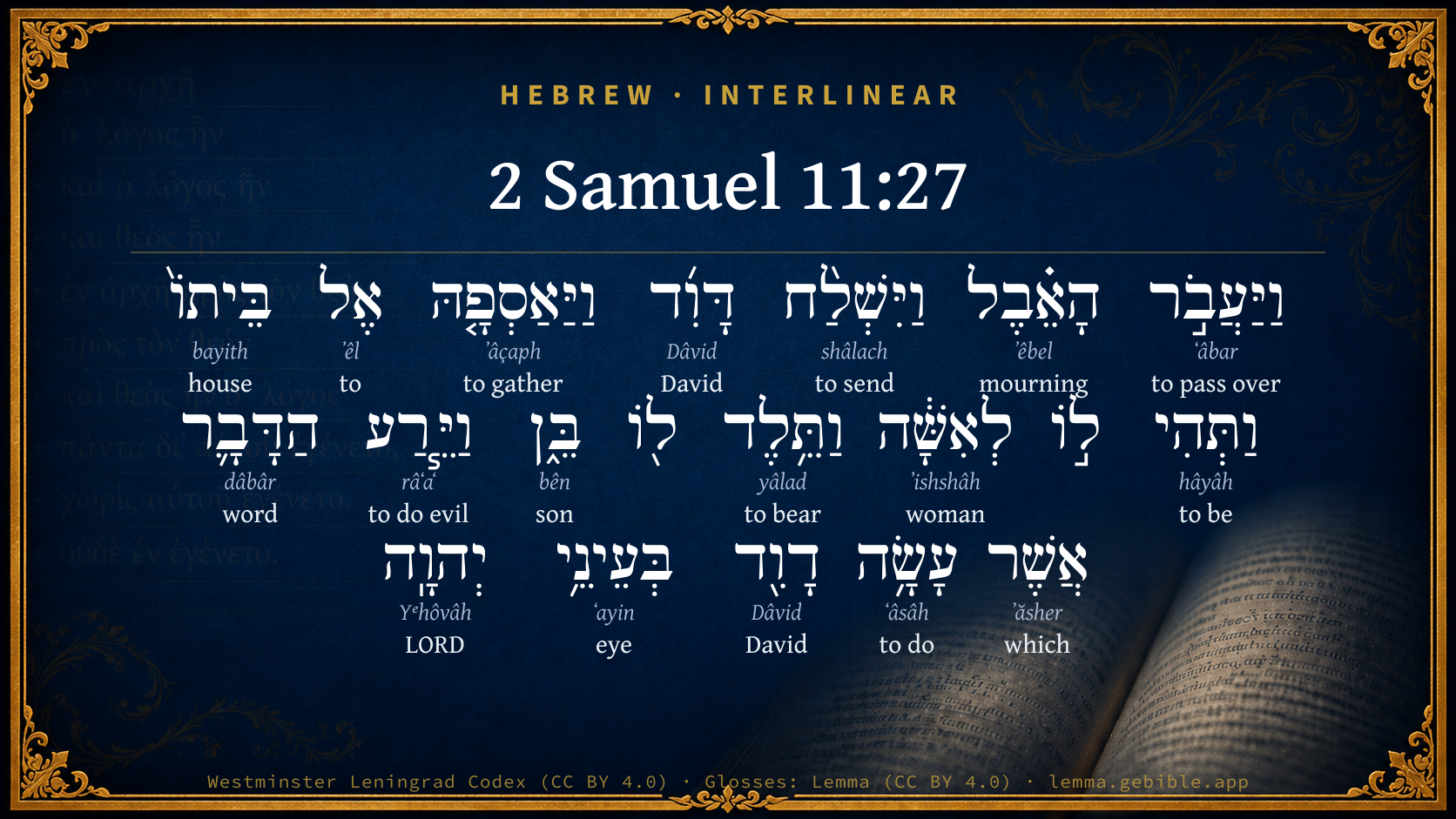
Hebrew (Westminster Leningrad Codex) 2 Samuel 11:27 appears in the Hebrew Old Testament. The text above is from the Westminster Leningrad Codex. Each word links to its Strong’s number, a concise gloss, and parsing drawn from the Open Scriptures Hebrew Bible morphology. Click any word for its full Brown-Driver-Briggs (BDB) entry.
Download image
Cite this verse

2 Samuel 11:27 (World English Bible). Public Domain. Lemma interlinear Bible study tool, https://lemma.gebible.app/v/2-samuel/11/27.

Show BibTeX & RIS
BibTeX
RIS
English Translation
When the mourning was past, David sent and took her home to his house, and she became his wife, and bore him a son. But the thing that David had done displeased Yahweh.
World English Bible · Public Domain
Download a study sheet

One document with this verse’s original text, its word-by-word gloss line, the meaning frame, cross-references with their text, attributed commentary, and full source and license credits — printable, and it pastes into notes with its structure intact.

This verse Autodidact and up

Study sheet (.html) Plain text (.txt)

A passage Seminary Student

Up to 50 verses in one chapter. A passage sheet keeps up to 6 commentary sources and 12 cross-references per verse, in the order this page ranks them, and says so on the sheet whenever that leaves anything out. Ask for a single verse and you get the Autodidact verse sheet above.

Everything on this page stays free to read, with no account — the sheet is a download of what is already on screen, not access to it.

Want to remove ads? Support Godless Engineer
Compare translations 3

The same verse in 3 English versions, stacked beneath the original-language interlinear above. Click any original word for its lexicon entry.

Each is an independent rendering of the whole verse — the interlinear is not word-aligned to these translations.

Highlighted words mark where these versions differ — a whole-verse word diff, not a word-by-word alignment.

  • World English Bible Public Domain
    When the mourning was past, David sent and took her home to his house, and she became his wife, and bore him a son. But the thing that David had done displeased Yahweh.
  • King James Version Public Domain
    And when the mourning was past, David sent and fetched her to his house, and she became his wife, and bare him a son. But the thing that David had done displeased the LORD.
  • unfoldingWord Literal Text CC BY-SA 4.0
    And the mourning passed, and David sent and gathered her to his house, and she became a wife to him, and she bore a son to him. But the thing that David had done was bad in the eyes of Yahweh.

unfoldingWord Literal Text — © unfoldingWord, licensed CC BY-SA 4.0. Word-aligned USFM3 via Door43 (git.door43.org/unfoldingWord/en_ult).

Versions to compare (up to 4)

3 of 4 selected

Show all 18 translations

Every available English version of this verse, each an independent rendering of the whole verse.

  • World English Bible Public Domain
    When the mourning was past, David sent and took her home to his house, and she became his wife, and bore him a son. But the thing that David had done displeased Yahweh.
  • Berean Standard Bible Public Domain
    And when the time of mourning was over, David had her brought to his house, and she became his wife and bore him a son. But the thing that David had done was evil in the sight of the LORD.
  • Majority Standard Bible Public Domain
    And when the time of mourning was over, David had her brought to his house, and she became his wife and bore him a son. But the thing that David had done was evil in the sight of the LORD.
  • King James Version Public Domain
    And when the mourning was past, David sent and fetched her to his house, and she became his wife, and bare him a son. But the thing that David had done displeased the LORD.
  • American Standard Version (1901) Public Domain
    And when the mourning was past, David sent and took her home to his house, and she became his wife, and bare him a son. But the thing that David had done displeased Jehovah.
  • Revised Version (1885) Public Domain
    And when the mourning was past, David sent and took her home to his house, and she became his wife, and bare him a son. But the thing that David had done displeased the LORD.
  • Geneva Bible (1599) Public Domain
    So when the mourning was past, Dauid sent and tooke her into his house, and shee became his wife, and bare him a sonne: but ye thing that Dauid had done, displeased the Lord.
  • Douay-Rheims (1899) Public Domain
    And the mourning being over, David sent and brought her into his house, and she became his wife, and she bore him a son: and this thing which David had done, was displeasing to the Lord.
  • Young's Literal Translation Public Domain
    and the mourning passeth by, and David sendeth and gathereth her unto his house, and she is to him for a wife, and beareth to him a son; and the thing which David hath done is evil in the eyes of Jehovah.
  • Literal Standard Version CC BY-SA 4.0
    and the mourning passes by, and David sends and gathers her to his house, and she is to him for a wife, and bears a son to him; and the thing which David has done is evil in the eyes of YHWH.
  • Unlocked Literal Bible CC BY-SA 4.0
    When her sorrow passed, David sent and took her home to his palace, and she became his wife and bore him a son. But what David had done displeased Yahweh.
  • unfoldingWord Literal Text CC BY-SA 4.0
    And the mourning passed, and David sent and gathered her to his house, and she became a wife to him, and she bore a son to him. But the thing that David had done was bad in the eyes of Yahweh.
  • Darby Bible Public Domain
    And when the mourning was past, David sent and fetched her to his house, and she became his wife, and bore him a son. But the thing that David had done was evil in the sight of Jehovah.
  • World Messianic Bible Public Domain
    When the mourning was past, David sent and took her home to his house, and she became his wife and bore him a son. But the thing that David had done displeased the LORD.
  • Webster's Bible Public Domain
    And when the mourning was past, David sent and brought her to his house, and she became his wife, and bore him a son. But the thing that David had done displeased the LORD.
  • Free Bible Version CC BY-SA 4.0
    Once the period of mourning was over, David sent for her to be brought to his palace, and she became his wife and bore him a son. But what David had done was evil in the Lord's sight.
  • Bible in Basic English Public Domain
    And when the days of weeping were past, David sent for her, and took her into his house, and she became his wife and gave him a son. But the Lord was not pleased with the thing David had done.
  • JPS Tanakh (1917) Public Domain
    And when the mourning was past, David sent and took her home to his house, and she became his wife, and bore him a son. But the thing that David had done displeased the LORD.

Literal Standard Version (2020), Covenant Press — licensed CC BY-SA 4.0. Text via the HelloAO Bible API (eBible.org). Unlocked Literal Bible (unfoldingWord) — licensed CC BY-SA 4.0. Text via the HelloAO Bible API (eBible.org). unfoldingWord Literal Text — © unfoldingWord, licensed CC BY-SA 4.0. Word-aligned USFM3 via Door43 (git.door43.org/unfoldingWord/en_ult). Free Bible Version, Dr. Jonathan Gallagher — licensed CC BY-SA 4.0. Text via the HelloAO Bible API (eBible.org).

Word by word

More ways to search: Search by grammar → Find every occurrence → Compare this word →

Practice this passage: Drill this verse → Learn its vocabulary →

הָאֵ֗בֶל
ʼêbel
H60
“the · mourning”
Particle, Definite Article + Noun, Common, Masculine, Singular, Absolute
Part of Speech
Particle + Noun
Type
Common
Gender
Masculine
Number
Singular
State
Absolute
Full BDB Definition

Origin: from H56

TWOT: 6a

mourning - for the dead - for rites of mourning (metaphorically) - mourning garb - period of mourning
  1. וַיַּעֲבֹ֣ר ʻâbar H5674 “and · to pass over” Conjunction + Verb, Qal, Sequential Imperfect, 3rd Person, Masculine, Singular
  2. וַיִּשְׁלַ֨ח shâlach H7971 “and · to send” Conjunction + Verb, Qal, Sequential Imperfect, 3rd Person, Masculine, Singular
  3. דָּוִ֜ד Dâvid H1732 “David” Noun, Proper
  4. וַיַּאַסְפָ֤הּ ʼâçaph H622 “and · to gather · her” Conjunction + Verb, Qal, Sequential Imperfect, 3rd Person, Masculine, Singular + Suffix, Personal, 3rd Person, Feminine, Singular
  5. אֶל ʼêl H413 “to” Preposition
  6. בֵּיתוֹ֙ bayith H1004 “house · his” Noun, Common, Masculine, Singular, Construct + Suffix, Personal, 3rd Person, Masculine, Singular
  7. וַתְּהִי hâyâh H1961 “and · to be” Conjunction + Verb, Qal, Sequential Imperfect, 3rd Person, Feminine, Singular
  8. לְאִשָּׁ֔ה ʼishshâh H802 “to/for · woman” Preposition + Noun, Common, Feminine, Singular, Absolute
  9. וַתֵּ֥לֶד yâlad H3205 “and · to bear” Conjunction + Verb, Qal, Sequential Imperfect, 3rd Person, Feminine, Singular
  10. בֵּ֑ן bên H1121 “son” Noun, Common, Masculine, Singular, Absolute
  11. וַיֵּ֧רַע râʻaʻ H7489 “and · to do evil” Conjunction + Verb, Qal, Sequential Imperfect, 3rd Person, Masculine, Singular
  12. הַדָּבָ֛ר dâbâr H1697 “the · word” Particle, Definite Article + Noun, Common, Masculine, Singular, Absolute
  13. אֲשֶׁר ʼăsher H834 “which” Particle, Relative
  14. עָשָׂ֥ה ʻâsâh H6213 “to do” Verb, Qal, Perfect, 3rd Person, Masculine, Singular
  15. דָוִ֖ד Dâvid H1732 “David” Noun, Proper
  16. בְּעֵינֵ֥י ʻayin H5869 “in/at · eyes of” Preposition + Noun, Common, Both, Dual, Construct
  17. יְהוָֽה Yᵉhôvâh H3068 “LORD” Noun, Proper

About this verse

These counts appear in no published source. They are computed here, from the morphology-tagged text and Lemma’s own curated glosses. What Lemma adds →

20
words
17
distinct lemmas
Historical
section

Notable vocabulary

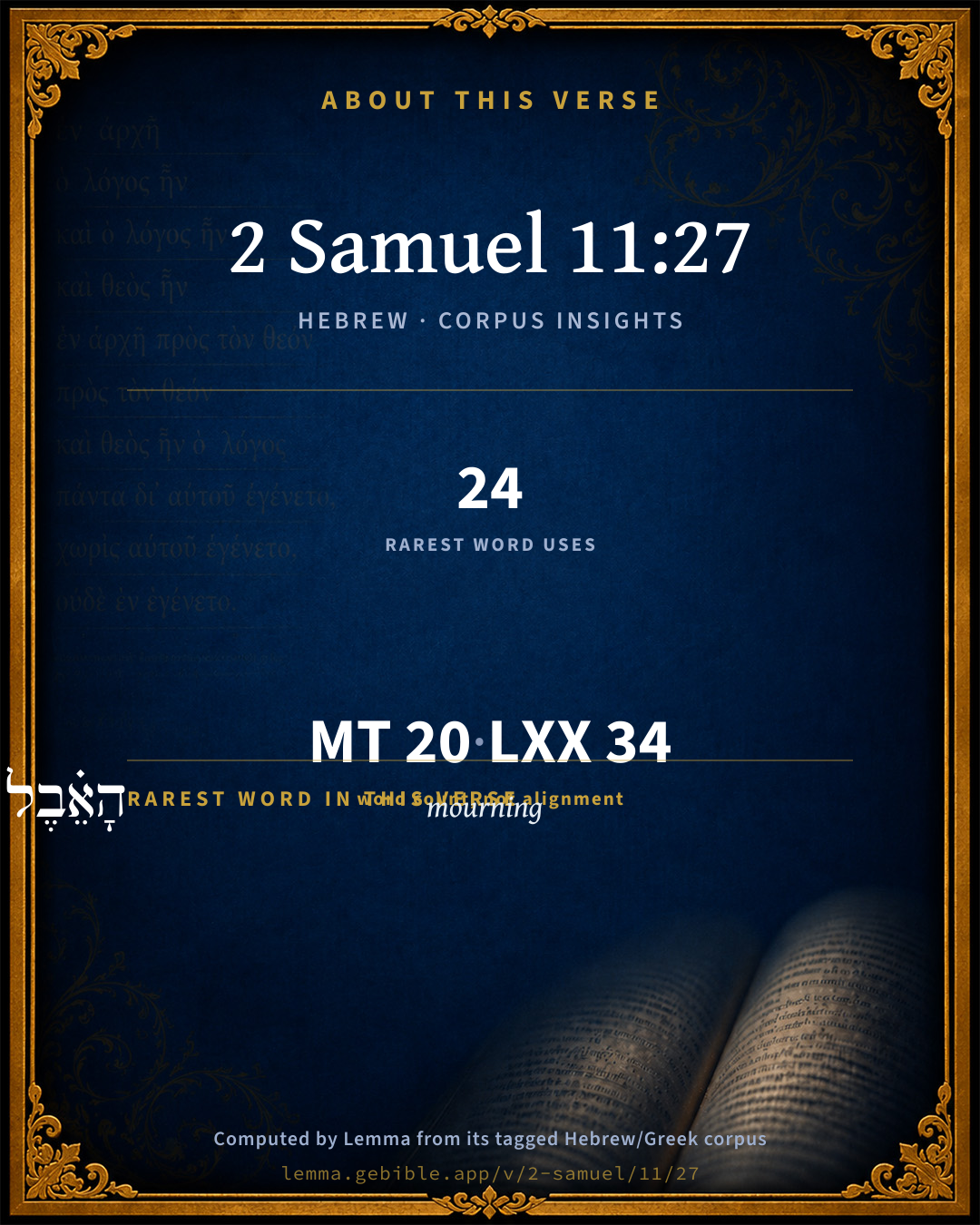
The rarest word here is הָאֵ֗בֶל mourning H60 — appearing just 24 times in the whole Hebrew Bible.

Shared distinctive vocabulary

הָאֵ֗בֶל mourning H60 occurs in 22 verses of the Hebrew Bible. Also found in:

Grammatical profile

  • 7 verbs
  • 9 nouns
  • 3 prepositions
  • 1 particle

Verb forms

  • וַיַּעֲבֹ֣ר Qal · Sequential Imperfect
  • וַיִּשְׁלַ֨ח Qal · Sequential Imperfect
  • וַיַּאַסְפָ֤הּ Qal · Sequential Imperfect
  • וַתְּהִי Qal · Sequential Imperfect
  • וַתֵּ֥לֶד Qal · Sequential Imperfect
  • וַיֵּ֧רַע Qal · Sequential Imperfect
  • עָשָׂ֥ה Qal · Perfect

Repetition

A word recurs within this verse — often emphatic in Hebrew:

  • דָּוִ֜ד David H1732 ×2

Hebrew & Septuagint length

In English translation the verse runs 33 words from the Hebrew and 39 from the Septuagint (LXX English) — closely comparable.

A rough comparison of the two English renderings, which tokenize alike — not a word-level alignment.

Word counts can differ between the Hebrew and the Greek without any difference in meaning — e.g. the Hebrew direct-object marker אֵת has no separate Greek word, and Greek often adds the article ὁ.

In the original languages it is 20 Hebrew tokens and 34 Greek tokens — but the two are counted differently (Hebrew bundles its prefixes and suffixes into one token; the Greek is in lemma form), so that isn’t a like-for-like length.

Cross-references

9

Topical passages linked to 2 Samuel 11:27 in the Treasury of Scripture Knowledge — connected by theme and wording, ordered by reader-vote popularity; previews shown in the World English Bible.

  • 2 Samuel 12:9 Why have you despised the word of Yahweh, to do that which is evil in his sight? You have struck Uriah the Hittite with the sword, and have taken his wife to be your wife, and have slain him with the sword of the children of Ammon.
  • Psalms 51:4–5 Against you, and you only, have I sinned, And done that which is evil in your sight; That you may be proved right when you speak, And justified when you judge.
  • 1 Chronicles 21:7 God was displeased with this thing; therefore he struck Israel.
  • Genesis 38:10 The thing which he did was evil in the sight of Yahweh, and he killed him also.
  • Deuteronomy 22:29 then the man who lay with her shall give to the lady's father fifty [shekels] of silver, and she shall be his wife, because he has humbled her; he may not put her away all his days.
  • Hebrews 13:4 Let marriage be held in honor among all, and let the bed be undefiled: but God will judge the sexually immoral and adulterers.
  • 2 Samuel 3:2–5 To David were sons born in Hebron: and his firstborn was Amnon, of Ahinoam the Jezreelitess;
  • 2 Samuel 5:13–16 David took him more concubines and wives out of Jerusalem, after he was come from Hebron; and there were yet sons and daughters born to David.
  • Psalms 5:6 You will destroy those who speak lies. Yahweh abhors the blood-thirsty and deceitful man.

Cross-references courtesy of OpenBible.info (CC BY 4.0).

Hebrew and Greek witnesses Masoretic Hebrew ↔ Greek Septuagint

The same verse in the two great witnesses to the Old Testament, shown verse-for-verse.

These are two independent witnesses, not word-aligned to each other, and the Septuagint is shown in lemma (dictionary) form.

Hebrew 2 Samuel 11:27 Masoretic · Westminster Leningrad Codex

וַיַּעֲבֹ֣ר הָאֵ֗בֶל וַיִּשְׁלַ֨ח דָּוִ֜ד וַיַּאַסְפָ֤הּ אֶל בֵּיתוֹ֙ וַתְּהִי ל֣וֹ לְאִשָּׁ֔ה וַתֵּ֥לֶד ל֖וֹ בֵּ֑ן וַיֵּ֧רַע הַדָּבָ֛ר אֲשֶׁר עָשָׂ֥ה דָוִ֖ד בְּעֵינֵ֥י יְהוָֽה

When the mourning was past, David sent and took her home to his house, and she became his wife, and bore him a son. But the thing that David had done displeased Yahweh.

World English Bible · Public Domain

Greek LXX 2 Samuel 11:27 Septuagint · lemma form

καί διαἔρχομαι ὁ πένθος καί ἀποστέλλω δαυίδ καί συνἄγω αὐτός εἰς ὁ οἶκος αὐτός καί γίγνομαι αὐτός εἰς γυνή καί τίκτω αὐτός υἱός καί πονηρός φαίνω ὁ ῥῆμα ὅς ποιέω δαυίδ ἐν ὀφθαλμός κύριος

And the time of mourning expired, and David sent and took her into his house, and she became his wife, and bore him a son: but the thing which David did was evil in the eyes of the Lord.

LXX2012 (modern English Septuagint) · Public Domain

Hebrew: Westminster Leningrad Codex (CC BY 4.0). Greek: Septuagint (public domain); English from LXX2012 (modern English Septuagint) (Public Domain). How the Septuagint differs from the Hebrew →

Targum (Aramaic paraphrase)

1

The Targum is the ancient Jewish Aramaic paraphrase of the Hebrew Scriptures — an interpretive translation, not the Hebrew text itself. Onkelos (literal) and Pseudo-Jonathan (expansive) render the Torah, and Jonathan the Prophets. Coverage is partial: where no permissively-licensed English translation exists for a verse, only the Aramaic is shown. This is verse-level text, not a word-by-word alignment to the Hebrew.

  1. Targum Jonathan Prophets (Joshua–Malachi)
    וַעֲבַר אֶבְלָא וּשְׁלַח דָוִד וְכַנְשָׁה לְבֵיתֵיהּ וַהֲוַת לֵיהּ לְאִתּוּ וִילִידַת לֵיהּ בַּר וּבָאֵישׁ פִּתְגָמָא דַעֲבַד דָוִד קֳדָם יְיָ:

    (no public-domain English translation for this verse)

    Targum Jonathan — Aramaic: “Mikraot Gedolot” (public domain). English: “Sefaria Community Translation” (CC0 1.0 (public-domain dedication)); “London "Chaldee Paraphrase," 1871” (public domain). Text via Sefaria.

Commentary

Notes on 2 Samuel 11:27 from classic Christian and Jewish commentators (each source and its license shown beneath its notes). The classic Christian expositions comment on the surrounding passage and are grouped to its opening verse, so a note may address several verses; the Jewish commentaries on the Tanakh (Rashi and others) are per-verse, so they appear only where the commentator wrote on this verse.

Lemma curates 59 commentaries, every one of them public domain or Creative Commons licensed, each selected and text-cleaned for this edition rather than reprinted as found. About our sources →

Trapp's Complete Commentary

John Trapp

2Sa 11:27 And when the mourning was past, David sent and fetched her to his house, and she became his wife, and bare him a son. But the thing that David had done displeased the LORD.

Ver. 27. And when the mourning was past.] And long it lasted not; seven days Josephus saith was the ordinary time, but here more haste might be made. Theodoret saith there was little time given to mourning.

And she became his wife.] He marrieth her when with child, and as soon as he could with any honesty, as they say; in some hope thereby also to cover his sin.

And she bare him a son.] Of his own begetting, though before wedlock. Howbeit this was not all out so bad in some respects as that act of Augustus, who took Livia Drusilla from her husband Tiberius Nero, when she was great with child with Drusus, who proved an unhappy hackster, and came to an untimely end. {a}

But the thing that David had done.] All the whole business set down in this doleful chapter, displeased the Lord, and cost David very dearly, as shall appear in the next. {b}

{a} Sueton.

{b} Principium dulce est, sed finis amoris amarus.

John Trapp, A Commentary or Exposition upon All the Books of the Old and New Testament (1647–1656) — public domain. Text from a community e-Sword module.

The Biblical Illustrator

Joseph S. Exell

2Sa_11:27

But the thing that David had done displeased the Lord.

The universal insecurity of religious perseverance

The transaction is recorded at length in the chapter which contains the text; and the conclusions which we may draw from a review of it are numerous.

1. The first, and by no means the least important of these, is the proof which hence arises that none of us can lay claim to any constraining grace, which, in despite of ourselves, shall compel us to holiness and to salvation. That David enjoyed the grace of God in a very especial degree, is what no Christian can deny: and few, it is to be expected, Will suppose themselves to be more highly favoured than he was in this particular. Yet here we have a melancholy, but still a most positive and salutary proof that no portion of the grace of God, however considerable, will protect man from the most fearful enormities, unless he will employ it when given him. Our faith is not to be confidence that we shall be saved, but confidence that, if we obey. God to the best of our power, we shall be saved: and our hope must be that we may render that obedience which may be accepted through Christ; while our lives must be such as are worthy of such an hope; we must prove that we have this hope in us, by purifying ourselves, even as He is pure.

2. The next consideration which forces itself on our attention is the difference of Davids circumstances at the time of his fall from those in which he is placed, when he had the best of all testimonies, that the Lord was with him. We now see that, however prosperity and leisure are in themselves desirable, they have dangers, which to resist, requires all the strength which God has put at our disposal. David was not a novice to their blandishments. For ten years he had been in undisputed possession of the splendour and luxuries of the kingdom of all Israel. All this period had been as remarkable as the darkest days of his adversity for the most religious fulfilment of the two great comprehensive duties, the love of God and the love of his neighbour. Offensive, therefore, as the thought may be to him who feels himself secure in his own righteousness, or who imagines himself to be so firmly in the hand of the Lord that nothing can pluck him thence, it is, nevertheless, the inevitable conclusion from the melancholy truth now under consideration that no man, whatever his real holiness, or whatever his opinion concerning the decision of his future fate, is secure from the stains of even the most deadly sins. David, it appears, had hitherto been as holy in prosperity as in distress; and, it might be supposed, was now so intimate with grandeur and power as to have nothing to fear from their influence, especially when it is considered that it was by habitual religion that he had supported himself inviolate amidst the trials of persecution and the temptations of luxury. But at this crisis there was one remarkable circumstance. He had already done all that was required of him in active life, and there Seemed nothing now remaining but to turn his thoughts towards the interests and good government of his kingdom. When his pillow was the rock and his curtain the cave; when his sword, under Providence, procured him his daily bread from the foes of his country, and the means of existence formed the object and pursuit of life--he was pious and immovable; he must have been active, or he must have resigned his life. But now the case was widely different; he had not only all the necessities, but all the luxuries which the most refined voluptuousness could devise, attending in profusion round him: he had certainly the duty of his charge, to impress its importance on his mind; but then he had the opportunity of neglecting it; and even David, it appears, was not proof against the solicitations of this opportunity! To all of us is this example fraught with materials for the most serious personal application. The flesh itself works along with us so long as we toil for its support; but when we have once accomplished this it ungratefully turns upon us and endeavours to enslave us to its dominion. Where the necessities of life do not compel him to labour there is great danger, even to the confirmed Christian, lest the value of time and the necessity of improving it, should not be always present to his mind; while the temptations arising from the very nature of his situation are such as at all times require the very closest and most diligent circumspection. And when the unguarded moment and the temptation coincide, as they are wont to do, the example before us is a terrible demonstration of the ruin which must follow. The crime of Bathsheba cannot be long concealed: the punishment was death; either, therefore, Bathsheba must be sacrificed to the law, or her husband removed in time to allow her to become the wife of David before suspicion could arise. David no longer hesitates: the fatal order is deliberately sealed, and put into the hands of the generous, unsuspecting victim, who immediately is placed by his commander in the post most congenial to his feelings, the forefront of the hottest battle, and betrayed by his cowardly companions into the hands of an unsparing enemy. Such is the natural uniform progress of sin, wherever it takes root, though the soil be the heart of David. (H. Thompson, M. A.)

Two aspects of David

1. This chapter reveals the character of David in its most distressing aspects. From end to end it is a production worthy only of the very genius of perdition, His very greatness becomes the measure of his sin. All his senses are set on fire of hell. The spirit of generosity is dead within him. The spirit of justice is exiled from his nature. How is the star of the morning dashed from heaven l How is the fine gold become dimmed! How are the mighty fallen! It is almost impossible to believe that this is human nature at all. Let us not seek to excuse David. We injure the Bible, and the whole purpose of the inspired volume, if we speak so much as one word in defence of a series of actions which might have been conceived by Satan and executed within the darkness of perdition.

2. The all-important sentence is the last: But the thing that David had done displeased the Lord. Without that sentence the chapter would have been intolerable. From this time forth David must bear the judgment of the Lord. Do not let it be supposed that even king David could perform such a series of wrongs and cruelties, and play as skilfully on his harp as ever, and sing as jubilantly before Heaven as he ever did. Davids harp acquired a new tone after this infamy. Psalms were written by David after this great transgression which could not have been written before its commission. Years were added to the life of the king; he was bent down under an invisible load; his face was wrinkled with grief, and his eyes were dimmed by contrite tears.

3. We see now something of what human nature is when it is left to show itself. We are bound to go to history as the one revelation of human nature. It is in vain to invent and discuss theories of psychology; it is in vain to look upon one aspect of human nature, and to judge the whole by the part; it is in vain, too, to fix upon any given date in human history and to judge men by that standard of civilisation. The one inquiry is what men have done in their very worst moods. An answer to that inquiry will settle the whole question respecting human depravity. We are bound to look at such a chapter as the first in the epistle to the Romans, if we would see what human nature is in its innermost and largest possibilities. Nor must we shrink from dwelling upon the hideous spectacle, To speak of revolted sensibilities, highly excited prejudices, and to declare that such instances are beyond the range of careful study, is simply to deprive ourselves of some of the most solid lessons of human history. We must know what sin is before we can have any adequate idea of the Divine relation to it. Sin explains the cross, sin explains the atonement, sin explains Christ.

4. The Bible is to be judged by what God would have done, not by what man would have done. Find a single sentence which approves of Davids guilt. Happily, there is no such sentence in the whole record. The spirit of the Bible, therefore, is not seen in what David did, but in the judgments which followed him and darkened his day with tremendous thunder-clouds. It is a fearful thing to fall into the hands of the living God. (J. Parker, D. D.)

The aggravation of Davids sin

As for Davids fall, let it not be once named among you, as becometh saints. Davids fall was such as is not so much as named among the Gentiles. But, past speaking about as Davids fall was, it was what followed his fall that so displeased the Lord. In the words of Butlers latest editor, it is safer to be wicked in the ordinary way than from this corruption lying at the root. As Thomas Goodwin points out in his great treatise on the Aggravation of Sin,. it was the matter of Uriah, even more than the matter of Bathsheba, that awakened the anger of the Lord against David. That is to say, it was Davids sin of deliberation and determination, rather than his sin of sudden and intoxicating passion. It was both matters; it was both sins; but it cannot be overlooked that it was after a twelvemonth of self-deceit, internal hypocrisy, and self-forgiving silence on Davids part that Nathan was sent to David in such Divine indignation. How a man like David could have lived all that time soaked to the eyes in adultery and murder and not go mad is simply inconceivable: That is to say, it would be inconceivable if we had not ourselves out of which to parallel and illustrate David, and make David both possible and natural to us. (Alex. Whyte, D. D.)

.

The Biblical Illustrator, edited by Joseph S. Exell (c. 1880s–1900s) — public domain. Text from a community e-Sword module.

Joseph Benson's Commentary

2Sa 11:27. When the mourning was past — Which commonly continued only the space of seven days, 1Sa 31:13; nor could the nature of the thing admit of longer delay, lest the too early birth of the child should discover David’s sin. Bare a son — By which it appears that David continued in the state of impenitence for divers months together, and this notwithstanding his frequent attendance upon God’s ordinances — which is an eminent instance of the corruption of man’s nature, of the deceitfulness of sin, and of the tremendous judgment of God in punishing one sin by delivering a man up to another.

Joseph Benson's Commentary on the Old and New Testaments (1811–1818) — public domain. Text from a community e-Sword module.

Geneva Bible (1599)

Geneva Bible translators

Hebrew, was evil in the eyes of the Lord.

Geneva Bible (1599) marginal notes — public domain. Text via Bolls.life.

Adam Clarke's Commentary

Verse 27. When the mourning was past] Probably it lasted only seven days.

She became his wife] This hurried marriage was no doubt intended on both sides to cover the pregnancy.

But the thing that David had done displeased the Lord.] It was necessary to add this, lest the splendour of David's former virtues should induce any to suppose his crimes were passed over, or looked on with an indulgent eye, by the God of purity and justice. Sorely he sinned, and sorely did he suffer for it; he sowed one grain of sweet, and reaped a long harvest of calamity and wo.

ON a review of the whole, I hesitate not to say that the preceding chapter is an illustrious proof of the truth of the sacred writings. Who that intended to deceive, by trumping up a religion which he designed to father on the purity of God, would have inserted such an account of one of its most zealous advocates, and once its brightest ornament? God alone, whose character is impartiality, has done it, to show that his religion, librata ponderibus suis, will ever stand independently of the conduct of its professors.

Drs. Delaney, Chandler, and others, have taken great pains to excuse and varnish this conduct of David; and while I admire their ingenuity, I abhor the tendency of their doctrine, being fully convinced that he who writes on this subject should write like the inspired penman, who tells the TRUTH, the WHOLE TRUTH, and NOTHING BUT THE TRUTH.

David may be pitied because he had fallen from great eminence; but who can help deploring the fate of the brave, the faithful, the incorruptible Uriah? Bath-sheba was probably first in the transgression, by a too public display of her charms; by which accidentally, the heart of David was affected wounded, and blinded. He committed one crime which he employed many shifts to conceal; these all failing, he is led from step to step to the highest degree of guilt. Not only does he feel that his and her honour, but even their lives, are at stake; for death, by the law of Moses, was the punishment of adultery. He thought therefore that either Uriah must die, or he and Bath-sheba perish for their iniquity; for that law had made no provision to save the life of even a king who transgressed its precepts. He must not imbrue his own hands in the blood of this brave man; but he employs him on a service from which his bravery would not permit him to shrink; and it which, from the nature of his circumstances, he must inevitably perish. The awful trial is made, and it succeeds. The criminal king and his criminal paramour are for a moment concealed; and one of the bravest of men falls an affectionate victim for the safety and support of him by whom his spotless blood is shed! But what shall we say of Joab, the wicked executor of the base commands of his fallen master? He was a ruffian, not a soldier; base and barbarous beyond example, in his calling; a pander to the vices of his monarch, while he was aware that he was outraging every law of religion, piety, honour, and arms! It is difficult to state the characters, and sum up and apportion the quantity of vice chargeable on each.

Let David, once a pious, noble, generous, and benevolent hero, who, when almost perishing with thirst, would not taste the water which his brave men had acquired at the hazard of their lives; let this David, I say, be considered an awful example of apostasy from religion, justice, and virtue; Bath-sheba, of lightness and conjugal infidelity; Joab, of base, unmanly, and cold-blooded cruelty; Uriah, of untarnished heroism, inflexible fidelity, and unspotted virtue; and then justice will be done to each character. For my own part, I must say, I pity David; I venerate Uriah; I detest Joab, and think meanly of Bath-sheba. Similar crimes have been repeatedly committed in similar circumstances. I shall take my leave of the whole with: -

Id commune malum; semel insanivimus omnes;

Aut sumus, aut fuimus, aut possumus, omne quod hic est.

God of purity and mercy! save the reader from the ευπεριστατος αμαρτια, well circumstanced sin; and let him learn,

"Where many mightier have been slain,

By thee unsaved, he falls."

See the notes on the succeeding chapter.

Adam Clarke's Commentary on the Bible (1810–1826) — public domain. Text from a community e-Sword/MySword module.

Ellicott's Commentary for English Readers

(27) Bare him a son.—Several months must have passed since the beginning of David’s course of sin, and as yet his conscience had not brought him to a sense of what he had done, nor had the prophet Nathan been sent to him. It is to be remembered that during all this time David was not only the civil ruler of his people, but also the head of the theocracy, the great upholder of the worship and the service of God, and his psalms were used as the vehicle of the people’s devotion. If it be asked why he should have been left so long without being brought to a conviction of his sin, one obvious reason is, that this sin might be openly fastened upon him beyond all possibility of denial by the birth of the child. But besides this, however hardened David may appear to have been in passing from one crime to another in the effort to conceal his guilt, yet it is scarcely possible that his conscience should not have been meantime at work and oppressing him with that sense of unconfessed and unforgiven sin which prepared him at last for the visit of Nathan.

A Bible Commentary for English Readers, edited by Charles John Ellicott (1878–1897) — public domain. Text from a community e-Sword module.

The Cambridge Bible for Schools and Colleges

gen. ed. J. J. S. Perowne

27. fet her] See note on ch. 2Sa_9:5.

But the thing that David had done displeased the Lord] The divine sentence on David’s conduct prepares the way for the mission of Nathan in the next chapter.

The Cambridge Bible for Schools and Colleges (gen. ed. J. J. S. Perowne; Cambridge University Press, 1878–1918) — public domain. Text from a community e-Sword module.

John Gill's Exposition

And when the mourning was past,.... The seven days were at an end, or sooner; for he stayed not ninety days from the death of her husband, which the Jews in later times enjoined (n), that it might be known whether with child by her former husband, and so to whom it belonged; and because David did not wait this time, Abarbinel charges it upon him as an additional sin:

David sent, and fetched her to his house; took her home to his palace to live with him:

and she became his wife; he married her according to the usual form of marriage in those days:

and bare him a son; begotten in adultery:

but the thing that David had done displeased the Lord; or "was evil in the eyes of the Lord" (o); for though it was not done in the eyes of men, being scarcely or very little known, yet was in the eyes of the Lord, which run to and fro throughout the earth, and sees all things that are done: the adultery he had been guilty of with another man's wife was abominable to the Lord, and for which, according to the law, both he and she ought to have been put to death, Lev 20:10; the murder of her husband, which he was accessory to, as well as the death of many others, and the marriage of her under such circumstances, were all displeasing to God, and of such an heinous nature, that his pure eyes could not look upon with approbation: the Jews (p) endeavour to excuse David from sin; from the sin of murder, by making Uriah guilty of rebellion and treason, as before observed; and from the sin of adultery, by affirming that it was the constant custom for men, when they went out to war, to give their wives a bill of divorce; so that from the time of giving the bill they were not their wives, and such as lay with them were not guilty of adultery; but for this there is no foundation: it is certain David was charged with it by the Lord; he himself owned it, and bewailed it, both that and his blood guiltiness, and the following chapter abundantly proves it.

(n) Misn. Yebamot, c. 11. sect. 6. (o) "malum in oculis Domini", Montanus. (p) T. Bab. Sabbat, fol. 56. 1. Gloss. in ib.

Next: 2 Samuel Chapter 12

John Gill's Exposition of the Whole Bible (1746–1763) — public domain (CC PDM 1.0). Text via the HelloAO Bible API.

Haydock's Catholic Bible Commentary

Lord; not that David had married the woman, but on account of his former conduct towards her and her husband. (Menochius) --- The canon law forbids the marriages of those who have been accomplices in the death of their former partner; and some have thought that this marriage of David was null. But this is inaccurate; and the fruits of it were (Calmet) all deeded legitimate. See 1 Paralipomenon iii. 5. (Haydock) --- The Rabbins even pretend that David was guilty of no sin in marrying Bethsabee during the life-time of Urias; as the latter, they say, must have given her a bill of divorce when he went to war. (Grotius) --- But why should we excuse an action which was so severely condemned and punished by God? (Chap. xii. 1., &c., and Psalm l.) (Calmet) --- In David’s conduct, we here behold a complication of the basest passions of lust and cruelty; which make David neglect the sanctity of an oath, (ver. 11) and attempt to ruin, by drunkenness, the soul of one to whom he was much indebted; and, afterwards, to expose him to an untimely death, perhaps without repentance; if indeed Urias exceeded the bounds of moderation. This however is not certain; as the word drunk is often used to denote a degree of blameless conviviality, Genesis xliii. 34. Yet the design of David was equally criminal. How soon may the man according to God’s own heart, fall from his elevated station into the depth of the abyss! Wherefore let him that thinketh himself to stand, take heed lest he fall, 1 Corinthians x. 12. (Haydock)

George Leo Haydock (1774–1849), Haydock's Catholic Family Bible and Commentary, 1859 edition — public domain. Excludes Psalms (Douay-Rheims chapter numbering differs from Protestant) and Deuterocanonical books (Catholic canon only).

Matthew Poole's English Annotations

When the mourning was past; which was seven days, Gen 1:10; 1Sa 31:13. Nor could the nature of the thing admit of longer delay lest the too early birth of the child might discover David’s sin.

David sent and fetched her to his house, and she became his wife; by which it appears that David continued in the state of impenitency for divers months together, and this notwithstanding his frequent attendance upon God’s ordinances; which is an eminent instance of the corruption of man’s nature, which is even in the best; and, without Divine assistance, is too strong for them; of the deceitfulness of sin, and of the tremendous judgment of God in punishing one sin, by delivering a man up to another.

The thing that David had done, i.e. his adultery and murder, as is evident from the next chapter.

Matthew Poole's English Annotations on the Holy Bible (1683–1685) — public domain. Text from a community e-Sword/MySword module.

Whedon's Commentary on the Bible

Daniel D. Whedon

27. But the thing that David had done displeased the Lord — “To our mind there is nothing in all that man has written so terribly emphatic as the quiet sentence which the historian inserts at the end of his account of these sad transactions.” — Kitto.

Daniel D. Whedon (gen. ed.), Commentary on the Old and New Testaments (1874–1909) — public domain. Text from a community e-Sword module.

The Pulpit Commentary

She bare him a son. This would be the child whose death is recorded in the next chapter. Afterwards she bare David four sons, (1Ch_3:5) of whom one was Solomon, and another Nathan, the ancestor of our Lord. The thing displeased the Lord. It was probably during the time of David"s victories that success began to work in him its usual results. Too commonly men who have conquered kingdoms have been vanquished by their own strong passions; and David had always evinced a keen appetite for sensuous pleasures. Even at Hebron he had multiplied unto himself wives, and now, raised by repeated victory to be the lord of a vast empire, he ceased to be "base in his own sight", (2Sa_6:22) and lost his self control. And, as was to be expected in a man of such strong qualities, his fall was terrible. But this declaration of the inspired narrator is not made solely for ethical reasons, but is the key to all that follows up to the end of ch. 20. In this chapter we have had the history of David"s sin; a year"s respite succeeds, as if God would wait and see whether the sinner"s own conscience would waken up, and bring him to repentance; but it slumbers on. Then comes the message of reproof, fellowed by earnest penitence, and severe punishment. It was, perhaps, during this year of hardened persistence in crime that Amnon and his cousin Jonadab also gave the reins to their passions, and prepared the way for the first of the series of crimes that polluted David"s home. An early repentance might have saved the son; but the absence of paternal discipline, the loss of respect for his father, and the evil influence of that father"s bad example, all urged on the son to the commission of his abominable crime.

Ver. 27. (JERUSALEM.)

God"s displeasure at sin.

the thing that David had done displeased Jehovah". (1Ch_21:7) This is the only remark which the sacred historian makes on the conduct of David. It reveals its true nature as with a sunbeam; "contains the moral decision from a theocratic point of view, and is, as it were, a superscription of the following history of the Divine judgments on David and his house on account of this sin" (Erdmann). The Divine displeasure (indignation, anger, wrath) is

I REAL. Jehovah is the living, personal, supreme Ruler of men, and to him each man is responsible for his actions. As he is capable of being pleased, so he is of being displeased. His wrath is no less real than his love, wisdom, or power; like, yet unlike, that of man, being above all human imperfection. The Scriptures declare that he is displeased with men when they do evil (Psa_2:5 Psa_6:1 Psa_7:11; Mar_3:5) "The wrath of God is revealed," etc.. (Rom_2:18) This is confirmed by conscience, in which his displeasure is reflected as a clouded sky in the surface of a lake.

II DESERVED. Sin is rebellion against his authority, disobedience to his Law, opposition to his holiness, ingratitude toward his goodness; a transgression of the covenant, "a coming short of the mark," iniquity. (Psa_32:1) Every wrong done to man is a dishonouring of God. (Psa_51:4) In the sin of David there were elements of peculiar and aggravated guilt (ch. 12:7-9). But in every case it is "exceeding sinful," "the abominable thing which he hates". (Jer_44:4) It is the one real evil in man.

Sin alone is that Which doth disfranchise him, and make unlike To the chief good; for that its light in him Is darken"d? (Dante.)

III IMPARTIAL. The Holy One of Israel is unaffected by any of those influences that make human displeasure at wrong doing partial and defective. He is neither blind nor indifferent to the sins of his children. (2Sa_7:14) They have not, any more than others, a licence to sin.

David, "his chosen," is not above the Law, nor exempt from due punishment. "For there is no respect of persons with God". (Rom_2:11) "Without respect of persons, the Father judgeth according to every man"s work," etc. (1Pe_1:17; Amo_3:2) estimating it according to its exact moral "weight". (1Sa_2:3)

IV UNAVOIDABLE. However men may conceal it from others, or endeavour to hide it from themselves, they cannot hide it from God. (Job_22:13) What pleases men may displease him. (1Th_2:4) His knowledge is infinite; his righteousness and justice essential, unchangeable, and eternal. Wherever and whenever sin exists, the holy energy of his wrath must burn against it; "for our God is a consuming fire," an "almighty foe to ill." Although delayed, it is not extinct. "A year had passed since his fall. The child of his sin had been born. And all this time God was silent. Yet like a dark cloud on a summer"s day hung this sentence over him, "But the thing that David did," etc. Soon it would burst in a storm of judgment.

V EFFICIENT AND DREADFUL. As "in the king"s favour there is life," so in his displeasure there is death. It is manifested in the punishment of the sinner, both inwardly and outwardly; as in the case of David. (2Sa_12:10, 2Sa_12:11) Every future moment must answer for the present. The penalties of transgression in this life are numerous and terrible. And who shall tell what will follow hereafter, when the wind becomes a whirlwind?

VI MINGLED WITH MERCY. God is displeased with sin rather than with the sinner (except in so far as he voluntarily identifies himself with it); whom, in his essential nature, he loves; who possesses the capacity of restoration; whose salvation he seeks; and to whom, on his repentance, punishment becomes chastisement, a means of purification and blessing. (2Sa_7:15) "There is no more terrible, there is no more instructive, portion of the Word of God than this whole record. The long death sleep of that once living soul; its awakening under the prophet"s voice; its deep repentance; its free forgiveness; its long, heavy, repeated, almost incessant chastisement; speak to every ear which is not altogether deaf lessons of the holiness and truth, of the severity and love, of the justice and mercy, of the Lord our God, which is borne perhaps with equal force in no other record of his ways with man" ("Heroes of Hebrew History"). "O God, thou hadst never suffered so dear a favourite of thine to fall so fearfully, if thou hadst not meant to make him a universal example to mankind, of not presuming, of not despairing. How can we presume of not sinning, or despair for sinning, when we find so great a saint thus fallen, thus risen?" (Hall). D.

HOMILIES BY G. WOOD Ver. 27.

David"s fall.

the thing that David had done displeased the Lord." One guarantee, even to the most unlettered, of the truthfulness of sacred history is the impartiality of its accounts of its greatest heroes, whose sins and follies are faithfully recorded as well as their virtues. Noah, Abraham, Moses, Peter, are cases in point. David is another instance, whose fearful sins are recorded in this most distressing chapter, ending with the significant words of our text, "But the thing that David had done displeased the Lord.

I THE WICKEDNESS WHICH DISPLEASED GOD. Many things done by good men of old times which appear to us very culpable, were in them innocent or excusable, on account of the different standard by which their conduct was regulated, and the different public opinion of their days. But the sins of David recorded in this chapter were not of such a description. The law of nature everywhere and in all times, as well as the laws of the revelation known to David, are clear and emphatic in condemning them.

1. The sins themselves.

(1) Adultery; and, growing out of this,

(2) deceit. Pretences to Uriah of concern about the war, and about Uriah"s comfort while in Jerusalem (vers. 7-10); and to Joab"s messenger, of regarding the deaths of Uriah and other brave soldiers whose lives had been sacrificed through his directions, as being ordinary casualties of war (ver. 25).

(3) Murder of Uriah and the soldiers who fell with him.

(4) Leading others into crime: Uriah into drunkenness, Joab into murder.

2. Their aggravations.

(1) His age, position, knowledge, experiences, and reputation. He was between fifty and sixty years old. As king, he was the highest guardian of justice and protector of innocence. He knew well the wickedness of his conduct. He had been marvellously guided, advanced, and blessed by God, with whom he had been accustomed to maintain the closest converse. He was well known as a devout man, professing himself a devoted servant of God. He had thus a reputation to sustain.

(2) The difficulties in his way. The necessity of sending messengers (ver. 4) to Bathsheba. Think of his stooping to that! Difficulties, necessitating some consideration and calling for determined resolution to conquer them, increase the guilt of sin.

(3) His abundant harem, as contrasted with Uriah"s one wife; hinted at in 2Sa_12:2, 2Sa_12:3.

(4) Uriah"s position and conduct. His relation to David, as one of his chief military officers, and distinguished for his valour (2Sa_23:39; 1Ch_11:41) He was at the time with the army in the field, and might justly look to the king to be the protector (if necessary) of his wife from evil. He cherished noble sentiments (ver. 11) of duty and honour as a soldier. (Did he, however, know or suspect how matters stood; and frame his language to the king as a subterfuge?)

(5) The deliberateness of the later crimes.

(6) The time cousumed, giving ample opportunity for reflection. When these things are considered, the wickedness of David assumes proportions which are appalling.

3. How they were possible.

(1) There must have been secret and very serious declension in piety. Had he been in the state of mind and heart which is revealed in ch. 7., it is impossible that he could have so sinned. The height of prosperity and power which he had reached had corrupted him.

(2) There is much in what Dean Stanley says of "that abyss which yawns by the side of lofty genius and strong passions," which "opened and closed over him.

(3) His position as an Eastern monarch, accustomed to polygamy, accustomed also to act in many things according to his own will.

(4) Some think that his being in the way of temptation arose from a self-indulgent neglect of duty in remaining at Jerusalem instead of leading his army in the field.

(5) He found in Bathsheba a ready consent to his will.

(6) The later sins and crimes seemed necessary, after the first step, to save himself and his companion in guilt from utter disgrace and ruin. Such considerations may help to explain, but cannot be accepted as excusing, his wickedness.

II HOW THE DISPLEASURE OF GOD WAS MANIFESTED.

1. The message by Nathan; (2Sa_12:1-12) who boldly reproved David in the name of the Lord, and announced the punishments which would fall upon him.

2. The death of the chill.

3. Family scandals, sins, and sorrows.

4. Absalom"s rebellion, and all the humiliations and troubles it involved.

5. Joab"s increased ascendency. "There was a guilty secret between the two" (Trench). The worst part of his punishment sprang from sins like his own, and was probably occasioned by them, at least in part.

LESSONS.

1. Do nothing, however pleasant, or gainful, or common among men, or seemingly safe, to the account of which may be appended the terrible words, "The thing displeased the Lord.

2. Let none presume on their security against even disgraceful sin. "Let him that thinketh he standeth take heed lest he fall"; (1Co_10:12) "Watch and pray, that ye enter not into temptation." (Mat_26:41)

3. Guard against the beginnings of evil. "Keep thy heart with all diligence; for out of it are the issues of life". (Pro_4:23) David had already committed adultery when he gazed lustfully on Bathsheba. (comp. Mat_5:28) Pray, as David did afterwards, "Create in me a clean heart". (Psa_51:10) The beginning of sin is, like that of strife, "as when one letteth out water". (Pro_17:14) The trickling of water through a small crevice in an embankment may seem inconsiderable; but, unless stopped, it may issue in widespread devastation and misery. One sin leads to another and another, and all to pain and sorrow. Gehazi"s covetousness led him to falsehood and robbery, and then to lifelong leprosy, transmitted to his children"s children. (2Ki_5:20-27) Peter"s self-confidence prepared the way for cowardice, falsehood, and profanity, followed by bitter anguish. The pilferings of Judas from "the bag" issued in the betrayal of his Lord; and then remorse and suicide.

4. How vain are all attempts to conceal sin and prevent punishment! God is looking on all the time the sinner is cunningly endeavouring to hide his sin. (see Job_34:21, Job_34:22) "Be sure your sin will find you out". G.W. (Num_32:23)

The Pulpit Commentary (1880–1919), ed. H.D.M. Spence-Jones & Joseph S. Exell — public domain. Text from a community e-Sword module.

John Wesley's Explanatory Notes

The mourning - Which was seven days. Nor could the nature of the thing admit of longer delay, lest the too early birth of the child might discover David's sin. Bare a son - By which it appears, That David continued in the state of impenitency for divers months together; and this notwithstanding his frequent attendance upon God's ordinances. Which is an eminent instance of the corruption of man's nature, of the deceitfulness of sin, and of the tremendous judgment of God in punishing one sin, by delivering a man up to another.

John Wesley, Explanatory Notes Upon the Whole Bible (1754–1765) — public domain. Text via the GEBible commentary corpus.

Lesson kit

Teaching starters — assembled from the data on this page, not authored interpretation. Every prompt links to the verse data it draws on. Edit before teaching.

2 Samuel, in the Historical, opens this verse with 20 words (17 distinct Hebrew lemmas). Its most distinctive word is ʼêbel (“mourning”). A historical commentator’s framing appears above. Read the whole chapter for the surrounding context.

Discussion questions

  1. What does “mourning” (ʼêbel) contribute to the verse as a whole?
  2. Genesis 27:41 shares the word «mourning» with this verse. How do the two illuminate each other?
  3. “David” occurs 2× in this one verse. What is the effect of the repetition?
  4. These translations render this verse differently. What is at stake in choosing one wording over another?
  5. The verb «וַיַּעֲבֹ֣ר» is Qal Sequential Imperfect. How does its form color the action?
  6. Reading how Trapp's Complete Commentary and The Biblical Illustrator read this verse, where do the two commentators agree and where do they part?

Things to notice

Reading settings

Reading text

Shown beneath each verse's original-language words.

Old Testament
Old Testament edition

Read the OT as the Masoretic Hebrew (MT) or the Greek Septuagint (LXX).

English shown for the Greek Septuagint (in the Hebrew ↔ Greek comparison).

Comparing translations? Open the Compare panel on any verse page to stack up to four side by side.