
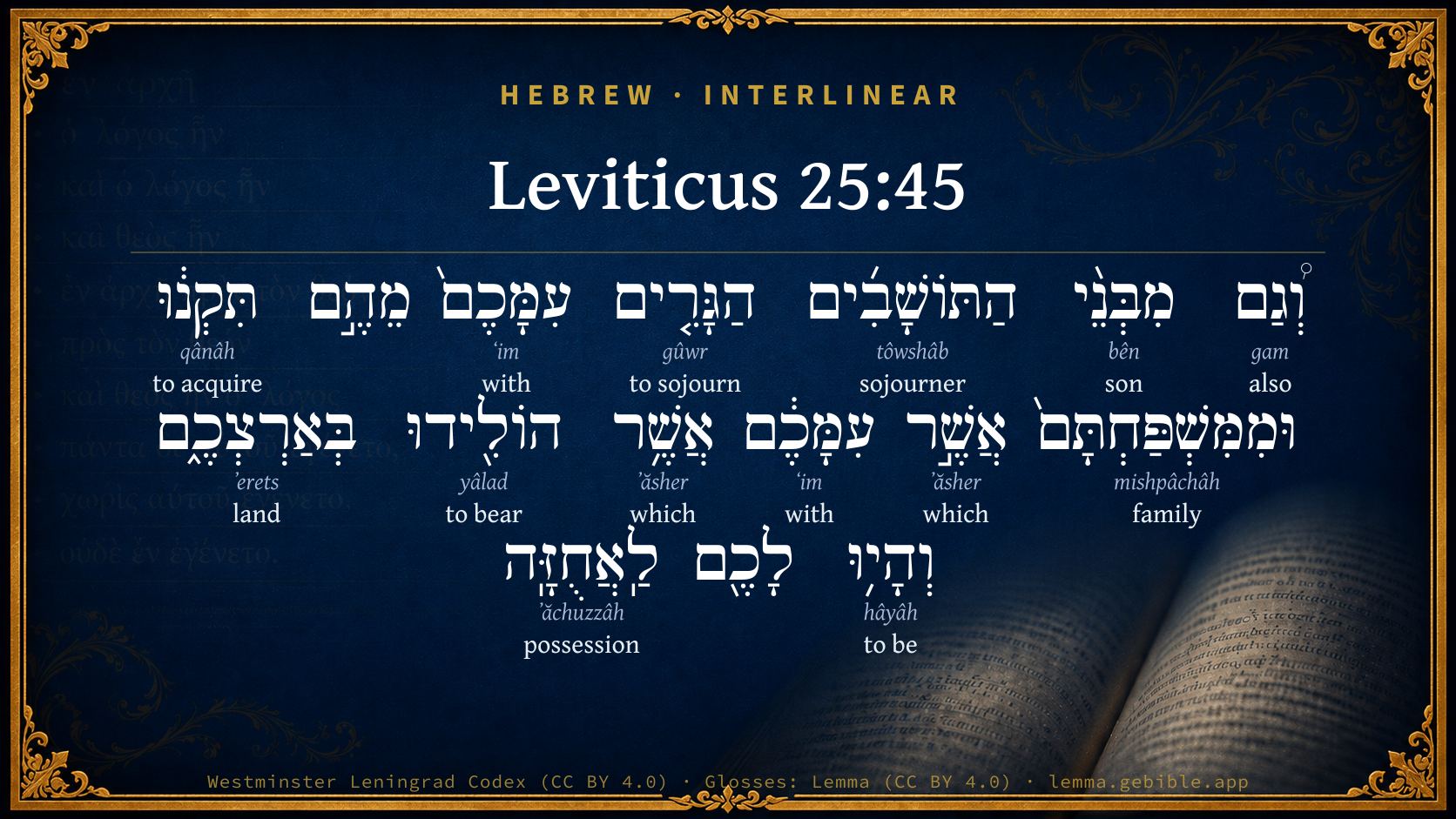
Leviticus 25:45

Hebrew (Westminster Leningrad Codex) Leviticus 25:45 appears in the Hebrew Old Testament. The text above is from the Westminster Leningrad Codex. Each word links to its Strong’s number, a concise gloss, and parsing drawn from the Open Scriptures Hebrew Bible morphology. Click any word for its full Brown-Driver-Briggs (BDB) entry.
Download image
Cite this verse

Leviticus 25:45 (World English Bible). Public Domain. Lemma interlinear Bible study tool, https://lemma.gebible.app/v/leviticus/25/45.

Show BibTeX & RIS
BibTeX
RIS
English Translation
Moreover of the children of the strangers who sojourn among you, of them you may buy, and of their families who are with you, which they have conceived in your land; and they will be your property.
World English Bible · Public Domain
Download a study sheet

One document with this verse’s original text, its word-by-word gloss line, the meaning frame, cross-references with their text, attributed commentary, and full source and license credits — printable, and it pastes into notes with its structure intact.

This verse Autodidact and up

Study sheet (.html) Plain text (.txt)

A passage Seminary Student

Up to 50 verses in one chapter. A passage sheet keeps up to 6 commentary sources and 12 cross-references per verse, in the order this page ranks them, and says so on the sheet whenever that leaves anything out. Ask for a single verse and you get the Autodidact verse sheet above.

Everything on this page stays free to read, with no account — the sheet is a download of what is already on screen, not access to it.

Want to remove ads? Support Godless Engineer
Compare translations 3

The same verse in 3 English versions, stacked beneath the original-language interlinear above. Click any original word for its lexicon entry.

Each is an independent rendering of the whole verse — the interlinear is not word-aligned to these translations.

Highlighted words mark where these versions differ — a whole-verse word diff, not a word-by-word alignment.

  • World English Bible Public Domain
    Moreover of the children of the strangers who sojourn among you, of them you may buy, and of their families who are with you, which they have conceived in your land; and they will be your property.
  • King James Version Public Domain
    Moreover of the children of the strangers that do sojourn among you, of them shall ye buy, and of their families that are with you, which they begat in your land: and they shall be your possession.
  • unfoldingWord Literal Text CC BY-SA 4.0
    And also from the sons of the temporary residents, the sojourners with you, from them you may buy, and from their clans who with you, whom they bore in your land, and they shall be to you for a possession.

unfoldingWord Literal Text — © unfoldingWord, licensed CC BY-SA 4.0. Word-aligned USFM3 via Door43 (git.door43.org/unfoldingWord/en_ult).

Versions to compare (up to 4)

3 of 4 selected

Show all 18 translations

Every available English version of this verse, each an independent rendering of the whole verse.

  • World English Bible Public Domain
    Moreover of the children of the strangers who sojourn among you, of them you may buy, and of their families who are with you, which they have conceived in your land; and they will be your property.
  • Berean Standard Bible Public Domain
    You may also purchase them from the foreigners residing among you or their clans living among you who are born in your land. These may become your property.
  • Majority Standard Bible Public Domain
    You may also purchase them from the foreigners residing among you or their clans living among you who are born in your land. These may become your property.
  • King James Version Public Domain
    Moreover of the children of the strangers that do sojourn among you, of them shall ye buy, and of their families that are with you, which they begat in your land: and they shall be your possession.
  • American Standard Version (1901) Public Domain
    Moreover of the children of the strangers that sojourn among you, of them shall ye buy, and of their families that are with you, which they have begotten in your land: and they shall be your possession.
  • Revised Version (1885) Public Domain
    Moreover of the children of the strangers that do sojourn among you, of them shall ye buy, and of their families that are with you, which they have begotten in your land: and they shall be your possession.
  • Geneva Bible (1599) Public Domain
    And moreouer of the children of the stragers, that are soiourners among you, of them shall ye bye, and of their families that are with you, which they begate in your lande: these shall be your possession.
  • Douay-Rheims (1899) Public Domain
    And of the strangers that sojourn among you, or that were born of them in your land, these you shall have for servants:
  • Young's Literal Translation Public Domain
    and also of the sons of the settlers who are sojourning with you, of them ye buy, and of their families who `are' with you, which they have begotten in your land, and they have been to you for a possession;
  • Literal Standard Version CC BY-SA 4.0
    and also from the sons of the settlers who are sojourning with you, you buy from them, and from their families who [are] with you, which they have begotten in your land, and they have been to you for a possession;
  • Unlocked Literal Bible CC BY-SA 4.0
    You may also buy slaves from the foreigners who are living among you, that is, from their families who are with you, children who have been born in your land. They may become your property.
  • unfoldingWord Literal Text CC BY-SA 4.0
    And also from the sons of the temporary residents, the sojourners with you, from them you may buy, and from their clans who with you, whom they bore in your land, and they shall be to you for a possession.
  • Darby Bible Public Domain
    Moreover of the children of them that dwell as sojourners with you, of them may ye buy, and of their family that is with you, which they beget in your land, and they shall be your possession.
  • World Messianic Bible Public Domain
    Moreover, of the children of the aliens who live among you, of them you may buy, and of their families who are with you, which they have conceived in your land; and they will be your property.
  • Webster's Bible Public Domain
    Moreover of the children of the strangers that sojourn among you, of them shall ye buy, and of their families that are with you, which they begat in your land: and they shall be your possession.
  • Free Bible Version CC BY-SA 4.0
    You can also buy them from foreigners who have come to live among you, or from their descendants born in your land. You can treat them as your property.
  • Bible in Basic English Public Domain
    And in addition, you may get, for money, servants from among the children of other nations who are living with you, and from their families which have come to birth in your land; and these will be your property.
  • JPS Tanakh (1917) Public Domain
    Moreover of the children of the strangers that do sojourn among you, of them may ye buy, and of their families that are with you, which they have begotten in your land; and they may be your possession.

Literal Standard Version (2020), Covenant Press — licensed CC BY-SA 4.0. Text via the HelloAO Bible API (eBible.org). Unlocked Literal Bible (unfoldingWord) — licensed CC BY-SA 4.0. Text via the HelloAO Bible API (eBible.org). unfoldingWord Literal Text — © unfoldingWord, licensed CC BY-SA 4.0. Word-aligned USFM3 via Door43 (git.door43.org/unfoldingWord/en_ult). Free Bible Version, Dr. Jonathan Gallagher — licensed CC BY-SA 4.0. Text via the HelloAO Bible API (eBible.org).

Word by word

More ways to search: Search by grammar → Find every occurrence → Compare this word →

Practice this passage: Drill this verse → Learn its vocabulary →

הַתּוֹשָׁבִ֜ים
tôwshâb
H8453
“the · sojourners”
Particle, Definite Article + Noun, Common, Masculine, Plural, Absolute
Part of Speech
Particle + Noun
Type
Common
Gender
Masculine
Number
Plural
State
Absolute
Full BDB Definition

Origin: from H3427

TWOT: 922d

sojourner, stranger
  1. וְ֠גַם gam H1571 “and · also” Conjunction + Particle, Accusative
  2. מִבְּנֵ֨י bên H1121 “from · sons of” Preposition + Noun, Common, Masculine, Plural, Construct
  3. הַגָּרִ֤ים gûwr H1481 “the · sojourning” Particle, Definite Article + Verb, Qal, Participle Active, Masculine, Plural, Absolute
  4. עִמָּכֶם֙ ʻim H5973 “with · you” Preposition + Suffix, Personal, 2nd Person, Masculine, Plural
  5. תִּקְנ֔וּ qânâh H7069 “to acquire” Verb, Qal, Imperfect, 2nd Person, Masculine, Plural
  6. וּמִמִּשְׁפַּחְתָּם֙ mishpâchâh H4940 “and · from · family · their” Conjunction + Preposition + Noun, Common, Feminine, Singular, Construct + Suffix, Personal, 3rd Person, Masculine, Plural
  7. אֲשֶׁ֣ר ʼăsher H834 “which” Particle, Relative
  8. עִמָּכֶ֔ם ʻim H5973 “with · you” Preposition + Suffix, Personal, 2nd Person, Masculine, Plural
  9. אֲשֶׁ֥ר ʼăsher H834 “which” Particle, Relative
  10. הוֹלִ֖ידוּ yâlad H3205 “to bear” Verb, Hiphil, Perfect, 3rd Person, Common, Plural
  11. בְּאַרְצְכֶ֑ם ʼerets H776 “in/at · land · your” Preposition + Noun, Common, Both, Singular, Construct + Suffix, Personal, 2nd Person, Masculine, Plural
  12. וְהָי֥וּ hâyâh H1961 “and · to be” Conjunction + Verb, Qal, Sequential Perfect, 3rd Person, Common, Plural
  13. לַֽאֲחֻזָּֽה ʼăchuzzâh H272 “to/for · possession” Preposition + Noun, Common, Feminine, Singular, Absolute

About this verse

These counts appear in no published source. They are computed here, from the morphology-tagged text and Lemma’s own curated glosses. What Lemma adds →

16
words
12
distinct lemmas
Pentateuch
section

Notable vocabulary

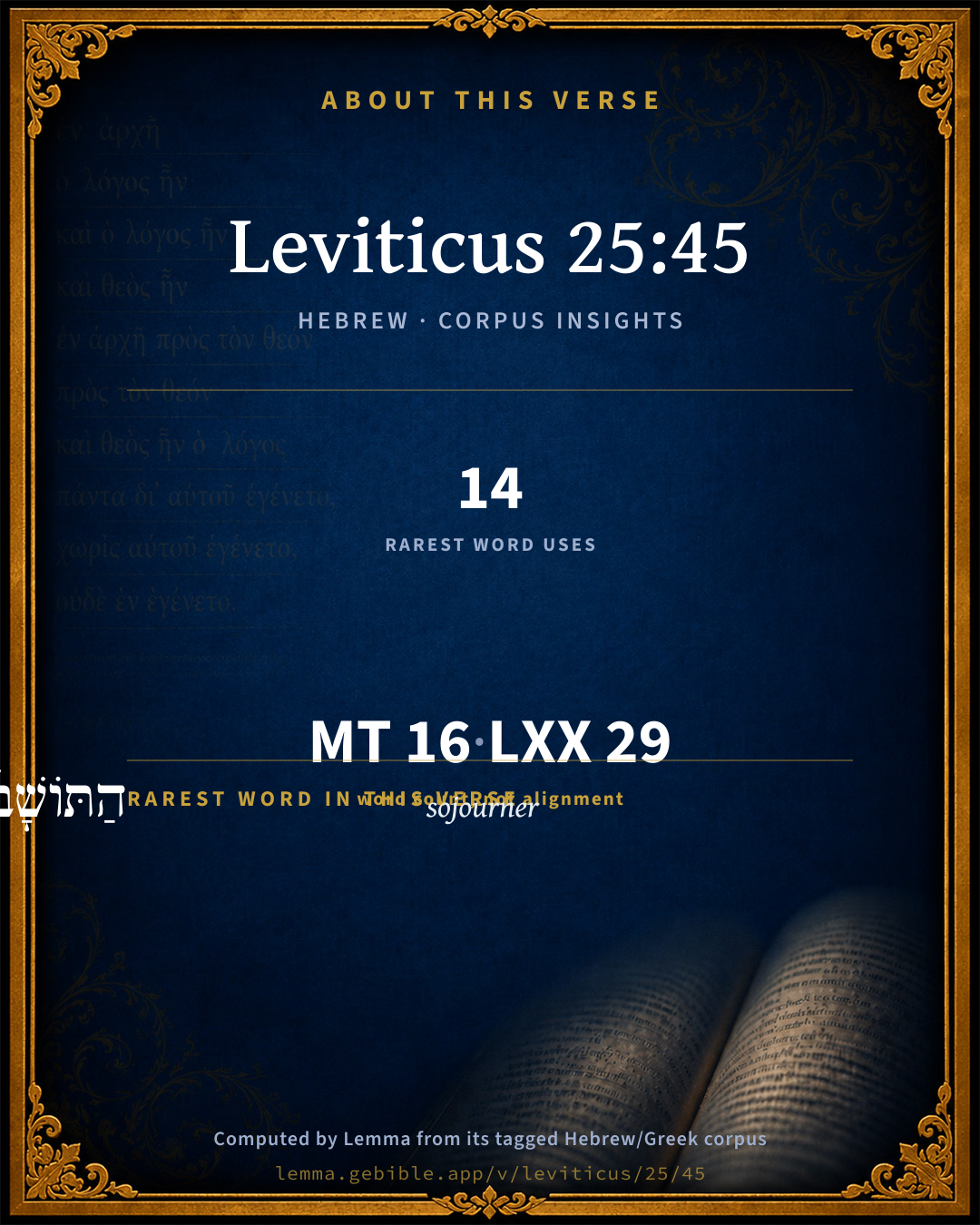
The rarest word here is הַתּוֹשָׁבִ֜ים sojourner H8453 — appearing just 14 times in the whole Hebrew Bible.

Shared distinctive vocabulary

הַתּוֹשָׁבִ֜ים sojourner H8453 occurs in 13 verses of the Hebrew Bible. Also found in:

Grammatical profile

  • 4 verbs
  • 5 nouns
  • 4 prepositions
  • 3 particles

Verb forms

  • הַגָּרִ֤ים Qal · Participle Active
  • תִּקְנ֔וּ Qal · Imperfect
  • הוֹלִ֖ידוּ Hiphil · Perfect
  • וְהָי֥וּ Qal · Sequential Perfect

Repetition

Words recur within this verse — often emphatic in Hebrew:

  • עִמָּכֶם֙ with H5973 ×2
  • אֲשֶׁ֣ר which H834 ×2

Hebrew & Septuagint length

In English translation the verse runs 37 words from the Hebrew and 35 from the Septuagint (LXX English) — closely comparable.

A rough comparison of the two English renderings, which tokenize alike — not a word-level alignment.

Word counts can differ between the Hebrew and the Greek without any difference in meaning — e.g. the Hebrew direct-object marker אֵת has no separate Greek word, and Greek often adds the article ὁ.

In the original languages it is 16 Hebrew tokens and 29 Greek tokens — but the two are counted differently (Hebrew bundles its prefixes and suffixes into one token; the Greek is in lemma form), so that isn’t a like-for-like length.

Cross-references

1

Topical passages linked to Leviticus 25:45 in the Treasury of Scripture Knowledge — connected by theme and wording, ordered by reader-vote popularity; previews shown in the World English Bible.

  • Isaiah 56:3–6 Neither let the foreigner, who has joined himself to Yahweh, speak, saying, Yahweh will surely separate me from his people; neither let the eunuch say, Behold, I am a dry tree.

Cross-references courtesy of OpenBible.info (CC BY 4.0).

Hebrew and Greek witnesses Masoretic Hebrew ↔ Greek Septuagint

The same verse in the two great witnesses to the Old Testament, shown verse-for-verse.

These are two independent witnesses, not word-aligned to each other, and the Septuagint is shown in lemma (dictionary) form.

Hebrew Leviticus 25:45 Masoretic · Westminster Leningrad Codex

וְ֠גַם מִבְּנֵ֨י הַתּוֹשָׁבִ֜ים הַגָּרִ֤ים עִמָּכֶם֙ מֵהֶ֣ם תִּקְנ֔וּ וּמִמִּשְׁפַּחְתָּם֙ אֲשֶׁ֣ר עִמָּכֶ֔ם אֲשֶׁ֥ר הוֹלִ֖ידוּ בְּאַרְצְכֶ֑ם וְהָי֥וּ לָכֶ֖ם לַֽאֲחֻזָּֽה

Moreover of the children of the strangers who sojourn among you, of them you may buy, and of their families who are with you, which they have conceived in your land; and they will be your property.

World English Bible · Public Domain

Greek LXX Leviticus 25:45 Septuagint · lemma form

καί ἀπό ὁ υἱός ὁ πάροικος ὁ εἰμί ἐν σύ ἀπό οὗτος κτάομαι καί ἀπό ὁ συγγενής αὐτός ὅσος ἄν γίγνομαι ἐν ὁ γῆ σύ εἰμί σύ εἰς κατάσχεσις

And of the sons of the sojourners that are among you, of these you⌃ shall buy and of their relations, all that shall be in your lands; let them be to you for a possession.

LXX2012 (modern English Septuagint) · Public Domain

Hebrew: Westminster Leningrad Codex (CC BY 4.0). Greek: Septuagint (public domain); English from LXX2012 (modern English Septuagint) (Public Domain). How the Septuagint differs from the Hebrew →

Targum (Aramaic paraphrase)

2

The Targum is the ancient Jewish Aramaic paraphrase of the Hebrew Scriptures — an interpretive translation, not the Hebrew text itself. Onkelos (literal) and Pseudo-Jonathan (expansive) render the Torah, and Jonathan the Prophets. Coverage is partial: where no permissively-licensed English translation exists for a verse, only the Aramaic is shown. This is verse-level text, not a word-by-word alignment to the Hebrew.

  1. Targum Onkelos Torah (Genesis–Deuteronomy)
    וְאַף מִבְּנֵי תוֹתָבַיָא עָרְלַיָא דְדָיְרִין עִמְכוֹן מִנְהוֹן תִּקְנוּן וּמִזַרְעִיתְהוֹן דְעִמְכוֹן דִי אִתְיְלִידוּ בְּאַרְעֲכוֹן וִיהוֹן לְכוֹן לְאַחֲסָנָא

    (no public-domain English translation for this verse)

    Targum Onkelos — Aramaic: “Onkelos Genesis” (public domain); “Onkelos Exodus” (public domain); “Onkelos Leviticus” (public domain); “Onkelos Numbers” (public domain); “Onkelos Deuteronomy” (public domain). English: “Sefaria Community Translation” (CC0 1.0 (public-domain dedication)); “J.W. Etheridge. The Targums of Onkelos and Jonathan Ben Uzziel on the Pentateuch. London: Longmans, Green, 1862” (public domain). Text via Sefaria.

  2. Targum Pseudo-Jonathan Torah (Genesis–Deuteronomy)
    וְאוּף מִבְּנֵי תּוּתְבַיָא עֲרֵלַיָא דְדַיְירִין עִמְכוֹן מִנְהוֹן תְּזַבְּנוּן וּמִן יִחוּסֵיהוֹן דְעִמְכוֹן דְאִתְיְלִידוּ בְּאַרְעֲכוֹן וְלָא מִן כְּנַעֲנָאֵי וִיהוֹן לְכוֹן לְאַחֲסָנָא

    Moreover, of the children of the uncircumcised strangers who sojourn among you, of them you may buy, and of their families that are with you, which they have begotten in your land; but not from the Kenaanaee; and they shall be yours for possession.

    Targum Pseudo-Jonathan — Aramaic: “Targum Jonathan on Genesis” (public domain); “Targum Jonathan on Exodus” (public domain); “Targum Jonathan on Leviticus” (public domain); “Targum Jonathan on Numbers” (public domain); “Targum Jonathan on Deuteronomy” (public domain). English: “The Targum of Jonathan ben Uzziel, trans. J. W. Etheridge, London, 1862” (public domain). Text via Sefaria.

Commentary

Notes on Leviticus 25:45 from classic Christian and Jewish commentators (each source and its license shown beneath its notes). The classic Christian expositions comment on the surrounding passage and are grouped to its opening verse, so a note may address several verses; the Jewish commentaries on the Tanakh (Rashi and others) are per-verse, so they appear only where the commentator wrote on this verse.

Lemma curates 59 commentaries, every one of them public domain or Creative Commons licensed, each selected and text-cleaned for this edition rather than reprinted as found. About our sources →

Geneva Bible (1599)

Geneva Bible translators

For they shall not be bought out at the Jubilee.

Geneva Bible (1599) marginal notes — public domain. Text via Bolls.life.

Ellicott's Commentary for English Readers

(45) Moreover of the children of the strangers.—Besides the surrounding nations, the Hebrews are also permitted to obtain their slaves from those strangers who have taken up their abode in the Holy Land. By these strangers the ancient authorities understand those who have been permitted to settle down among the Jews on condition that they submit to the seven commandments given to Noah, but have not embraced Judaism. Hence the Chaldee Version translates this phrase, “the children of uncircumcised strangers.”

And they shall be your possession.—These, but not the Hebrews, the masters may hold as their absolute property.

A Bible Commentary for English Readers, edited by Charles John Ellicott (1878–1897) — public domain. Text from a community e-Sword module.

John Gill's Exposition

Moreover, of the children of the strangers, that do sojourn among you,.... The uncircumcised sojourners as they are called in the Targums of Onkelos and Jonathan, proselytes of the gate, such of the nations round about who came and sojourned among them, being subject to the precepts given to the sons of Noah respecting idolatry, &c. but were not circumcised, and did not embrace the Jewish religion:

of them shall ye buy; for bondmen and bondmaids:

and of their families that are with you, which they begat in your land; but, as the Targum of Jonathan adds, are not of the Canaanites; though the Jewish writers (x) say, that one of the nations that lies with a Canaanitish woman, and begets a son of her, he may be bought for a servant; and so if a Canaanitish man lies with one of the nations, and begets a son of her, he may also be bought for a servant:

and they shall be your possession; as servants, as bondmen and bondmaids, and be so for ever to them and their heirs, as follows.

(x) Torat Cohanim apud Yalkut, par. 1. fol. 195. 1.

John Gill's Exposition of the Whole Bible (1746–1763) — public domain (CC PDM 1.0). Text via the HelloAO Bible API.

Haydock's Catholic Bible Commentary

Servants, or slaves, whom you may treat with greater severity than the Hebrews, and keep for ever, even though they may have embraced the true faith. But still you must remember that they are your brethren.

George Leo Haydock (1774–1849), Haydock's Catholic Family Bible and Commentary, 1859 edition — public domain. Excludes Psalms (Douay-Rheims chapter numbering differs from Protestant) and Deuterocanonical books (Catholic canon only).

Whedon's Commentary on the Bible

Daniel D. Whedon

45. Children of the strangers… shall ye buy — It is very natural that the institution which originated in war, should be perpetuated in peace, and that the offspring of the first captives should follow the status of their parents, and that the system should embrace the children of foreigners who should offer them for sale. This often prevented the crime of infanticide, widely prevalent among the heathen. Thus was formed in the Hebrew state a sort of helot-class, mentioned especially under David (2Ch_2:17, compare with 2Sa_20:24, note, and Solomon, 1Ki_9:20; 2Ch_8:7.) This class, which was employed on the public works, is estimated at one hundred and fifty-three thousand six hundred persons. As the Old Testament never mentions the importation of slaves as chattels, nor alludes to slave-markets, it is to be supposed that no slaves proper were bought in foreign lands. The Hebrews came in contact with the Phoenician slave-trade only as sufferers. Joe_3:4-6; Amo_1:9. Among the Jews the number of servants was comparatively much smaller than the number of slaves among other nations of antiquity. In Athens the proportion of slaves to citizens at one time was as high as four to one; but among the Israelites immediately after the Babylonian captivity the servants were to the masters as one to six. Ezr_2:64-65; Neh_7:66-67. We have reason to believe that the number subsequently decreased, the influential sect of the Pharisees in particular being opposed to the system.

Daniel D. Whedon (gen. ed.), Commentary on the Old and New Testaments (1874–1909) — public domain. Text from a community e-Sword module.

unfoldingWord translationNotes

Door43 World Missions Community

translationWords

alien

family

children

inherit

brother

people group

Israel

unfoldingWord translationNotes — © Distant Shores Media and the Door43 World Missions Community, licensed CC BY-SA 4.0. Source: git.door43.org/Door43/en_tn.

Rashi

Rabbi Shlomo Yitzchaki (Rashi)

‎ וגם מבני התושבים MORE-OVER FROM AMONGST THE TOLERATED STRANGERS who came from the lands round about you in order to marry Canaanite women in your land and these bear them children; then the child follows the father in respect of nationality, and thus, not being regarded as a Canaanite, is not included in this command, “Thou shalt not keep alive any soul”, but you may purchase him as a servant (cf. Sifra, Behar, Section 6 4; Kiddushin 67b).

מהם תקנו means THEM MAY YE BUY.

Rashi on the Tanakh — English translations: “The Judaica Press complete Tanach with Rashi, translated by A. J. Rosenberg” (CC BY 4.0); “Pentateuch with Rashi's commentary by M. Rosenbaum and A.M. Silbermann, 1929-1934” (public domain); “The Metsudah Tanach series, Lakewood, N.J” (CC BY 4.0); and “The Book of Joshua, Metsudah Publications, 1997” (CC BY 4.0). Text via Sefaria.

Lesson kit

Teaching starters — assembled from the data on this page, not authored interpretation. Every prompt links to the verse data it draws on. Edit before teaching.

Leviticus, in the Pentateuch, opens this verse with 16 words (12 distinct Hebrew lemmas). Its most distinctive word is tôwshâb (“sojourner”). A historical commentator’s framing appears above. Read the whole chapter for the surrounding context.

Discussion questions

  1. The word tôwshâb carries the sense “sojourner.” How does it shape the verse?
  2. Genesis 23:4 shares the word «sojourner» with this verse. How do the two illuminate each other?
  3. “with” occurs 2× in this one verse. What is the effect of the repetition?
  4. The translations on this page render this verse differently — a whole-verse word diff, not a word-by-word alignment. What might account for the different wordings?
  5. The verb «הַגָּרִ֤ים» is Qal Participle Active. How does its form color the action?
  6. Reading how Geneva Bible (1599) and Ellicott's Commentary for English Readers read this verse, where do the two commentators agree and where do they part?

Things to notice

Reading settings

Reading text

Shown beneath each verse's original-language words.

Old Testament
Old Testament edition

Read the OT as the Masoretic Hebrew (MT) or the Greek Septuagint (LXX).

English shown for the Greek Septuagint (in the Hebrew ↔ Greek comparison).

Comparing translations? Open the Compare panel on any verse page to stack up to four side by side.