1 Chronicles 4:14

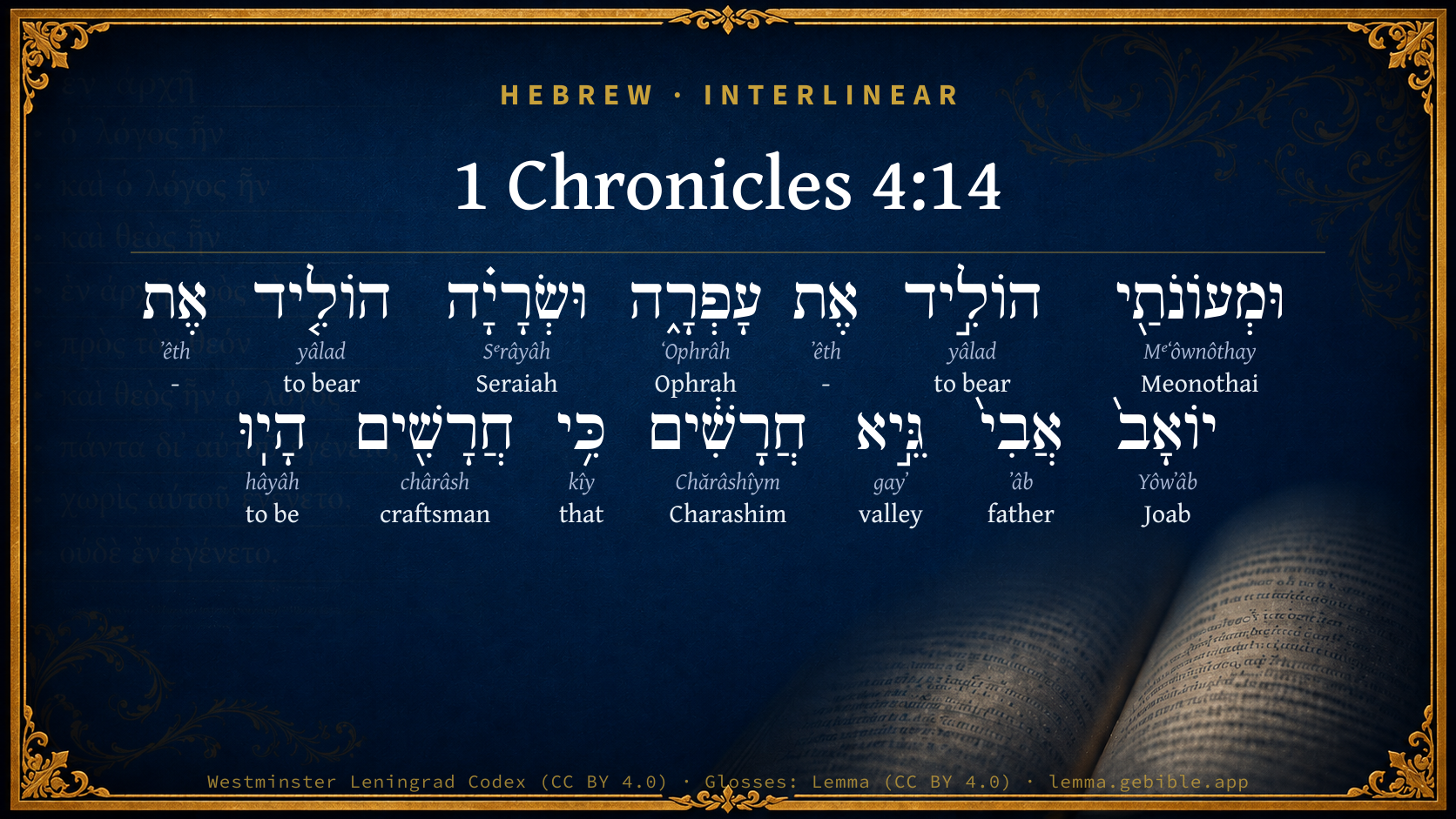
Hebrew (Westminster Leningrad Codex) 1 Chronicles 4:14 appears in the Hebrew Old Testament. The text above is from the Westminster Leningrad Codex. Each word links to its Strong’s number, a concise gloss, and parsing drawn from the Open Scriptures Hebrew Bible morphology. Click any word for its full Brown-Driver-Briggs (BDB) entry.
Download image
Cite this verse

1 Chronicles 4:14 (World English Bible). Public Domain. Lemma interlinear Bible study tool, https://lemma.gebible.app/v/1-chronicles/4/14.

Show BibTeX & RIS
BibTeX
RIS
English Translation
Meonothai became the father of Ophrah: and Seraiah became the father of Joab the father of Ge Harashim; for they were craftsmen.
World English Bible · Public Domain
Highlights
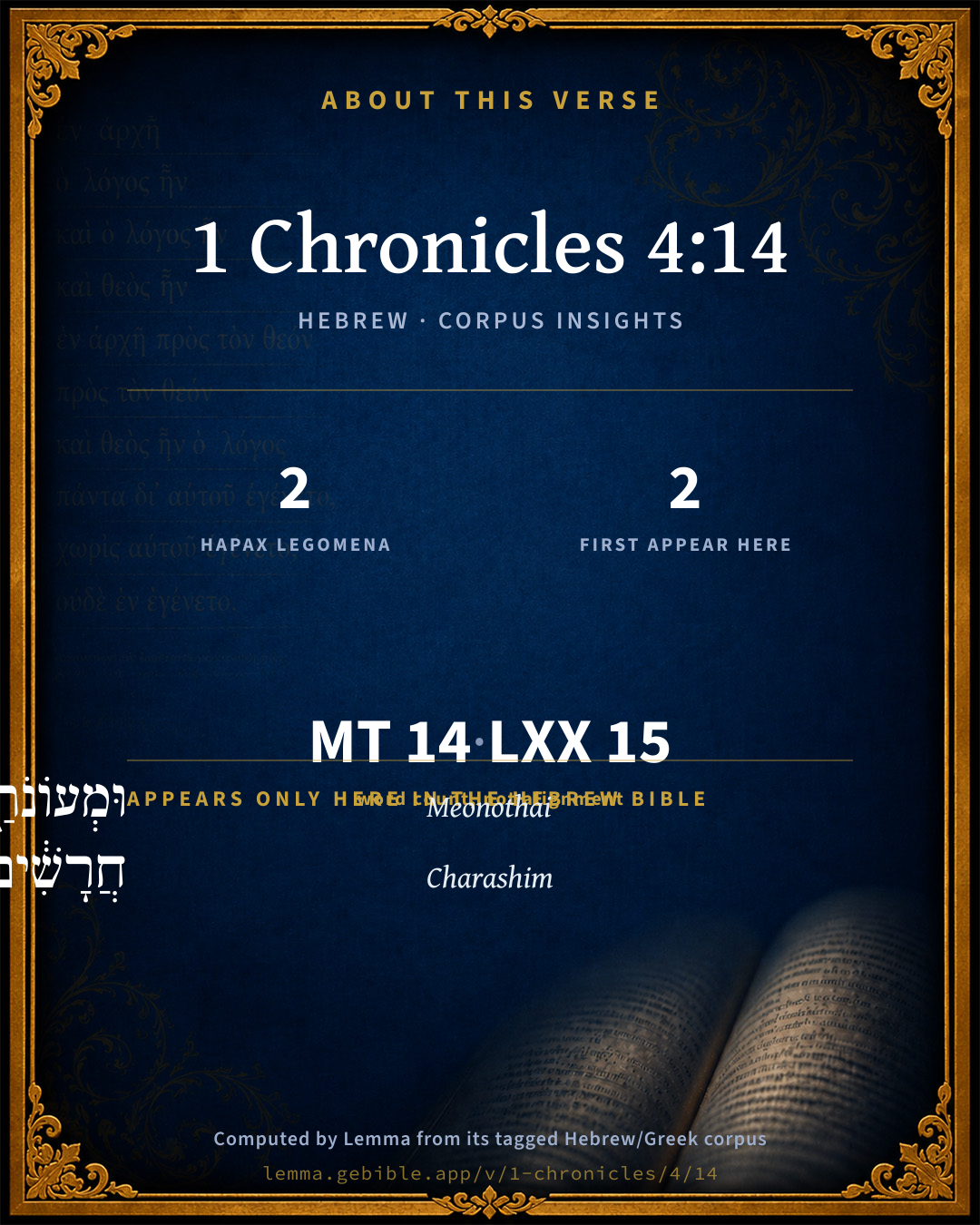
  • 2 hapax legomena — only here in the Hebrew Bible
  • 2 first appearances in the Hebrew Bible
Full analysis ↓
Download a study sheet

One document with this verse’s original text, its word-by-word gloss line, the meaning frame, cross-references with their text, attributed commentary, and full source and license credits — printable, and it pastes into notes with its structure intact.

This verse Autodidact and up

Study sheet (.html) Plain text (.txt)

A passage Seminary Student

Up to 50 verses in one chapter. A passage sheet keeps up to 6 commentary sources and 12 cross-references per verse, in the order this page ranks them, and says so on the sheet whenever that leaves anything out. Ask for a single verse and you get the Autodidact verse sheet above.

Everything on this page stays free to read, with no account — the sheet is a download of what is already on screen, not access to it.

Want to remove ads? Support Godless Engineer
Compare translations 3

The same verse in 3 English versions, stacked beneath the original-language interlinear above. Click any original word for its lexicon entry.

Each is an independent rendering of the whole verse — the interlinear is not word-aligned to these translations.

Highlighted words mark where these versions differ — a whole-verse word diff, not a word-by-word alignment.

  • World English Bible Public Domain
    Meonothai became the father of Ophrah: and Seraiah became the father of Joab the father of Ge Harashim; for they were craftsmen.
  • King James Version Public Domain
    And Meonothai begat Ophrah: and Seraiah begat Joab, the father of the valley of Charashim; for they were craftsmen.
  • unfoldingWord Literal Text CC BY-SA 4.0
    And Meonothai fathered Ophrah, and Seraiah fathered Joab, the father of Ge Harashim, for they were craftsmen.

unfoldingWord Literal Text — © unfoldingWord, licensed CC BY-SA 4.0. Word-aligned USFM3 via Door43 (git.door43.org/unfoldingWord/en_ult).

Versions to compare (up to 4)

3 of 4 selected

Show all 18 translations

Every available English version of this verse, each an independent rendering of the whole verse.

  • World English Bible Public Domain
    Meonothai became the father of Ophrah: and Seraiah became the father of Joab the father of Ge Harashim; for they were craftsmen.
  • Berean Standard Bible Public Domain
    Meonothai was the father of Ophrah, and Seraiah was the father of Joab, the father of those living in Ge-harashim, which was given this name because its people were craftsmen.
  • Majority Standard Bible Public Domain
    Meonothai was the father of Ophrah, and Seraiah was the father of Joab, the father of those living in Ge-harashim, which was given this name because its people were craftsmen.
  • King James Version Public Domain
    And Meonothai begat Ophrah: and Seraiah begat Joab, the father of the valley of Charashim; for they were craftsmen.
  • American Standard Version (1901) Public Domain
    And Meonothai begat Ophrah: and Seraiah begat Joab the father of Ge-harashim; for they were craftsmen.
  • Revised Version (1885) Public Domain
    And Meonothai begat Ophrah: and Seraiah begat Joab the father of Ge-harashim; for they were craftsmen.
  • Geneva Bible (1599) Public Domain
    And Meonothai begate Ophrah. And Seraiah begate Ioab the father of the valley of craftesmen: for they were craftesmen.
  • Douay-Rheims (1899) Public Domain
    Maonathi beget Ophra, and Saraia begot Joab the father of the Valley of artificers: for artificers were there.
  • Young's Literal Translation Public Domain
    And Meonothai begat Ophrah, and Seraiah begat Joab father of the valley of artificers, for they were artificers.
  • Literal Standard Version CC BY-SA 4.0
    And Meonothai begot Ophrah, and Seraiah begot Joab father of the Valley of the Craftsmen, for they were craftsmen.
  • Unlocked Literal Bible CC BY-SA 4.0
    Meonothai became the father of Ophrah, and Seraiah became the father of Joab, the originator of Ge-Harashim, whose people were craftsmen.
  • unfoldingWord Literal Text CC BY-SA 4.0
    And Meonothai fathered Ophrah, and Seraiah fathered Joab, the father of Ge Harashim, for they were craftsmen.
  • Darby Bible Public Domain
    And Meonothai begot Ophrah: and Seraiah begot Joab, the father of the valley of craftsmen; for they were craftsmen.
  • World Messianic Bible Public Domain
    Meonothai became the father of Ophrah: and Seraiah became the father of Joab the father of Ge Harashim, for they were craftsmen.
  • Webster's Bible Public Domain
    And Meonothai begat Ophrah: and Seraiah begat Joab, the father of the valley of Charashim; for they were artificers.
  • Free Bible Version CC BY-SA 4.0
    Meonothai was the father of Ophrah. Seraiah was the father of Joab, the father of Ge Harashim, so called because craftsmen lived there.
  • Bible in Basic English Public Domain
    And Meonothai was the father of Ophrah; and Seraiah was the father of Joab, the father of Ge-harashim; they were expert workmen.
  • JPS Tanakh (1917) Public Domain
    And Meonothai begot Ophrah; and Seraiah begot Joab the father of Ge-harashim; for they were craftsmen.

Literal Standard Version (2020), Covenant Press — licensed CC BY-SA 4.0. Text via the HelloAO Bible API (eBible.org). Unlocked Literal Bible (unfoldingWord) — licensed CC BY-SA 4.0. Text via the HelloAO Bible API (eBible.org). unfoldingWord Literal Text — © unfoldingWord, licensed CC BY-SA 4.0. Word-aligned USFM3 via Door43 (git.door43.org/unfoldingWord/en_ult). Free Bible Version, Dr. Jonathan Gallagher — licensed CC BY-SA 4.0. Text via the HelloAO Bible API (eBible.org).

Word by word

More ways to search: Search by grammar → Find every occurrence → Compare this word →

Practice this passage: Drill this verse → Learn its vocabulary →

וּמְעוֹנֹתַ֖י
Mᵉʻôwnôthay
H4587
“and · Meonothai”
Conjunction + Noun, Proper
Part of Speech
Conjunction + Noun
Type
Proper
Full BDB Definition

Origin: from H4585

TWOT: None

Meonothai = "my habitations" - a son of Othniel, the younger brother of Caleb
  1. הוֹלִ֣יד yâlad H3205 “to bear” Verb, Hiphil, Perfect, 3rd Person, Masculine, Singular
  2. אֶת ʼêth H853 “-” Particle, Direct Object
  3. עָפְרָ֑ה ʻOphrâh H6084 “Ophrah” Noun, Proper
  4. וּשְׂרָיָ֗ה Sᵉrâyâh H8304 “and · Seraiah” Conjunction + Noun, Proper
  5. הוֹלִ֤יד yâlad H3205 “to bear” Verb, Hiphil, Perfect, 3rd Person, Masculine, Singular
  6. אֶת ʼêth H853 “-” Particle, Direct Object
  7. יוֹאָב֙ Yôwʼâb H3097 “Joab” Noun, Proper
  8. אֲבִי֙ ʼâb H1 “father of” Noun, Common, Masculine, Singular, Construct
  9. גֵּ֣יא gayʼ H1516 “valley of” Noun, Common, Both, Singular, Construct
  10. חֲרָשִׁ֔ים Chărâshîym H2798 “Charashim” Noun, Proper
  11. כִּ֥י kîy H3588 “that” Conjunction
  12. חֲרָשִׁ֖ים chârâsh H2796 “craftsmen” Noun, Common, Masculine, Plural, Absolute
  13. הָיֽוּ hâyâh H1961 “to be” Verb, Qal, Perfect, 3rd Person, Common, Plural

About this verse

These counts appear in no published source. They are computed here, from the morphology-tagged text and Lemma’s own curated glosses. What Lemma adds →

14
words
12
distinct lemmas
Historical
section

Notable vocabulary

2 hapax legomena — words that appear only here in the entire Hebrew Bible:

  • וּמְעוֹנֹתַ֖י Meonothai H4587
  • חֲרָשִׁ֔ים Charashim H2798

First appearance in Scripture

These words make their first canonical appearance in the Hebrew Bible here:

  • וּמְעוֹנֹתַ֖י Meonothai H4587
  • חֲרָשִׁ֔ים Charashim H2798

Shared distinctive vocabulary

עָפְרָ֑ה Ophrah H6084 occurs in 8 verses of the Hebrew Bible. Also found in:

Grammatical profile

  • 3 verbs
  • 8 nouns
  • 1 conjunction
  • 2 particles

Verb forms

  • הוֹלִ֣יד Hiphil · Perfect
  • הוֹלִ֤יד Hiphil · Perfect
  • הָיֽוּ Qal · Perfect

Repetition

A word recurs within this verse — often emphatic in Hebrew:

  • הוֹלִ֣יד to bear H3205 ×2

Hebrew & Septuagint length

In English translation the verse runs 22 words from the Hebrew and 16 from the Septuagint (LXX English) — closely comparable.

A rough comparison of the two English renderings, which tokenize alike — not a word-level alignment.

Word counts can differ between the Hebrew and the Greek without any difference in meaning — e.g. the Hebrew direct-object marker אֵת has no separate Greek word, and Greek often adds the article ὁ.

In the original languages it is 14 Hebrew tokens and 15 Greek tokens — but the two are counted differently (Hebrew bundles its prefixes and suffixes into one token; the Greek is in lemma form), so that isn’t a like-for-like length.

Cross-references

2

Topical passages linked to 1 Chronicles 4:14 in the Treasury of Scripture Knowledge — connected by theme and wording, ordered by reader-vote popularity; previews shown in the World English Bible.

  • 2 Kings 24:14 He carried away all Jerusalem, and all the princes, and all the mighty men of valor, even ten thousand captives, and all the craftsmen and the smiths; none remained, save the poorest sort of the people of the land.
  • Nehemiah 11:35 Lod, and Ono, the valley of craftsmen.

Cross-references courtesy of OpenBible.info (CC BY 4.0).

Hebrew and Greek witnesses Masoretic Hebrew ↔ Greek Septuagint

The same verse in the two great witnesses to the Old Testament, shown verse-for-verse.

These are two independent witnesses, not word-aligned to each other, and the Septuagint is shown in lemma (dictionary) form.

Hebrew 1 Chronicles 4:14 Masoretic · Westminster Leningrad Codex

וּמְעוֹנֹתַ֖י הוֹלִ֣יד אֶת עָפְרָ֑ה וּשְׂרָיָ֗ה הוֹלִ֤יד אֶת יוֹאָב֙ אֲבִי֙ גֵּ֣יא חֲרָשִׁ֔ים כִּ֥י חֲרָשִׁ֖ים הָיֽוּ

Meonothai became the father of Ophrah: and Seraiah became the father of Joab the father of Ge Harashim; for they were craftsmen.

World English Bible · Public Domain

Greek LXX 1 Chronicles 4:14 Septuagint · lemma form

καί μαναθι γεννάω ὁ γοφερα καί σαραια γεννάω ὁ ιωαβ πατήρ αγεαδδαϊρ ὅτι τέκτων εἰμί

And Manathi begot Gophera: and Saraia begot Jobab, the father of Ageaddair, for they were artificers.

LXX2012 (modern English Septuagint) · Public Domain

Hebrew: Westminster Leningrad Codex (CC BY 4.0). Greek: Septuagint (public domain); English from LXX2012 (modern English Septuagint) (Public Domain). How the Septuagint differs from the Hebrew →

Commentary

Notes on 1 Chronicles 4:14 from classic Christian and Jewish commentators (each source and its license shown beneath its notes). The classic Christian expositions comment on the surrounding passage and are grouped to its opening verse, so a note may address several verses; the Jewish commentaries on the Tanakh (Rashi and others) are per-verse, so they appear only where the commentator wrote on this verse.

Lemma curates 59 commentaries, every one of them public domain or Creative Commons licensed, each selected and text-cleaned for this edition rather than reprinted as found. About our sources →

Trapp's Complete Commentary

John Trapp

1Ch 4:14 And Meonothai begat Ophrah: and Seraiah begat Joab, the father of the valley of Charashim; for they were craftsmen.

Ver. 14. For they were craftsmen.] Opifices Deo curae sunt. God takes notice of, and care for poor handicraftsmen, who live by their hard labour, who get it and eat it. Yea, the apostle Peter showeth that a poor servant, when he suffereth hard words and ill usage from his master, doth herein find acceptance with God. {1Pe 2:19-20}

John Trapp, A Commentary or Exposition upon All the Books of the Old and New Testament (1647–1656) — public domain. Text from a community e-Sword module.

Albert Barnes' Notes on the Bible

The words “and Meonothai” should he added to the end of 1Ch 4:13; but they should be retained also at the commencement of 1Ch 4:14. Or, see the marginal note.

Albert Barnes' Notes on the Bible (1834–1885) — public domain. Text from a community e-Sword/MySword module.

Geneva Bible (1599)

Geneva Bible translators

The Lord of that valley where the artificers did work.

Geneva Bible (1599) marginal notes — public domain. Text via Bolls.life.

Jamieson, Fausset & Brown

Robert Jamieson, A. R. Fausset & David Brown

Joab, the father of the valley of Carashim--literally, "the father of the inhabitants of the valley"--"the valley of craftsmen," as the word denotes. They dwelt together, according to a custom which, independently of any law, extensively prevails in Eastern countries for persons of the same trade to inhabit the same street or the same quarter, and to follow the same occupation from father to son, through many generations. Their occupation was probably that of carpenters, and the valley where they lived seems to have been in the neighborhood of Jerusalem (Neh 11:35).

Jamieson, Fausset & Brown — Commentary Critical and Explanatory on the Whole Bible (1871) — public domain (CC PDM 1.0). Text via the HelloAO Bible API.

The Cambridge Bible for Schools and Colleges

gen. ed. J. J. S. Perowne

14. Meonothai] perhaps a son of Othniel.

the valley of Charashim] R.V. marg. the valley of craftsmen. It is mentioned Neh_11:35 along with Lod (the Lydda of Act_9:32) and therefore was probably near Lydda.

The Cambridge Bible for Schools and Colleges (gen. ed. J. J. S. Perowne; Cambridge University Press, 1878–1918) — public domain. Text from a community e-Sword module.

John Gill's Exposition

And Meonothai,.... Another son of Othniel:

begat Ophrah; and Seraiah, the brother of Othniel, begat Joab; not David's general, but another of the same name, who lived long before him, see Ch1 2:54.

the father of the valley of Charashim: of the inhabitants of the valley, or the prince of them, called the valley of craftsmen, Neh 11:35 the reason of which is here given:

for they were craftsmen; that dwelt in it, carpenters and smiths, both which the word signifies, men that wrought in stone, wood, and iron.

John Gill's Exposition of the Whole Bible (1746–1763) — public domain (CC PDM 1.0). Text via the HelloAO Bible API.

Haydock's Catholic Bible Commentary

Artificers. Hebrew Charashim, which means various sorts of "workmen," (Calmet) or "father (prince.; Menochius) of Ge-Harasim, for," &c. (Calmet) --- Under this lord the artificers dwelt who built the temple. (Worthington)

George Leo Haydock (1774–1849), Haydock's Catholic Family Bible and Commentary, 1859 edition — public domain. Excludes Psalms (Douay-Rheims chapter numbering differs from Protestant) and Deuterocanonical books (Catholic canon only).

Matthew Poole's English Annotations

The father of the valley, i.e. of the inhabitants of the valley.

Matthew Poole's English Annotations on the Holy Bible (1683–1685) — public domain. Text from a community e-Sword/MySword module.

Whedon's Commentary on the Bible

Daniel D. Whedon

14. The father of the valley of Charashim — That is, father of those who dwelt there, and founder, so to speak, of the institution which gave the place its name. The inhabitants of this valley were craftsmen, and were descended from Joab, the son of Seraiah; so the business of engraving and working in wood and metals was the institution of the place. The location of this valley is unknown, but Neh_11:35, and the Talmud, would seem to place it in the vicinity of Lod, or Lydda.

Daniel D. Whedon (gen. ed.), Commentary on the Old and New Testaments (1874–1909) — public domain. Text from a community e-Sword module.

John Wesley's Explanatory Notes

Father - Of the inhabitants of the valley.

John Wesley, Explanatory Notes Upon the Whole Bible (1754–1765) — public domain. Text via the GEBible commentary corpus.

Keil & Delitzsch

C. F. Keil & F. Delitzsch

And Meonothai,.... Another son of Othniel:

begat Ophrah; and Seraiah, the brother of Othniel, begat Joab; not David's general, but another of the same name, who lived long before him, see Ch1 2:54.

the father of the valley of Charashim: of the inhabitants of the valley, or the prince of them, called the valley of craftsmen, Neh 11:35 the reason of which is here given:

for they were craftsmen; that dwelt in it, carpenters and smiths, both which the word signifies, men that wrought in stone, wood, and iron.

Keil & Delitzsch — Biblical Commentary on the Old Testament (1861–1891) — public domain (CC PDM 1.0). Text via the HelloAO Bible API. (Old Testament only.)

Rashi

Rabbi Shlomo Yitzchaki (Rashi)

And Seraiah begot Joab, the leader of Gei Harashim Joab was the leader of a valley in which there were craftsmen. Now why do I call it the Valley of Craftsmen? Because they were craftsmen; i. e., those who dwelt in the Valley of the Craftsmen were craftsmen, and the valley was named after them.

Rashi on the Tanakh — English translations: “The Judaica Press complete Tanach with Rashi, translated by A. J. Rosenberg” (CC BY 4.0); “Pentateuch with Rashi's commentary by M. Rosenbaum and A.M. Silbermann, 1929-1934” (public domain); “The Metsudah Tanach series, Lakewood, N.J” (CC BY 4.0); and “The Book of Joshua, Metsudah Publications, 1997” (CC BY 4.0). Text via Sefaria.

Lesson kit

Teaching starters — assembled from the data on this page, not authored interpretation. Every prompt links to the verse data it draws on. Edit before teaching.

1 Chronicles, in the Historical, opens this verse with 14 words (12 distinct Hebrew lemmas). Its most distinctive word is Mᵉʻôwnôthay (“Meonothai”). A historical commentator’s framing appears above. Read the whole chapter for the surrounding context.

Discussion questions

  1. The word Mᵉʻôwnôthay carries the sense “Meonothai.” How does it shape the verse?
  2. This verse holds 2 words here found nowhere else in the Hebrew Bible. What might the rare words draw attention to?
  3. 2 words here appear for the first time in Scripture. What is being introduced at this debut?
  4. Joshua 18:23 shares the word «Ophrah» with this verse. How do the two illuminate each other?
  5. “to bear” occurs 2× in this one verse. What is the effect of the repetition?
  6. The translations on this page render this verse differently — a whole-verse word diff, not a word-by-word alignment. What might account for the different wordings?
  7. The verb «הוֹלִ֣יד» is Hiphil Perfect. How does its form color the action?
  8. Reading how Trapp's Complete Commentary and Albert Barnes' Notes on the Bible read this verse, where do the two commentators agree and where do they part?

Things to notice

  • 2 words in this verse appear nowhere else in the Hebrew Bible.
  • 2 words make their first canonical appearance in Scripture here.
  • This verse counts 14 Hebrew ↔ 15 Greek words.
  • These translations choose different wording for 7 words in this verse.
  • “to bear” occurs 2× in this single verse.

Reading settings

Reading text

Shown beneath each verse's original-language words.

Old Testament
Old Testament edition

Read the OT as the Masoretic Hebrew (MT) or the Greek Septuagint (LXX).

English shown for the Greek Septuagint (in the Hebrew ↔ Greek comparison).

Comparing translations? Open the Compare panel on any verse page to stack up to four side by side.