
Job 15:7

Hebrew (Westminster Leningrad Codex) Job 15:7 appears in the Hebrew Old Testament. The text above is from the Westminster Leningrad Codex. Each word links to its Strong’s number, a concise gloss, and parsing drawn from the Open Scriptures Hebrew Bible morphology. Click any word for its full Brown-Driver-Briggs (BDB) entry.
Download image
Cite this verse

Job 15:7 (World English Bible). Public Domain. Lemma interlinear Bible study tool, https://lemma.gebible.app/v/job/15/7.

Show BibTeX & RIS
BibTeX
RIS
English Translation
"Are you the first man who was born? Or were you brought forth before the hills?
World English Bible · Public Domain
Download a study sheet

One document with this verse’s original text, its word-by-word gloss line, the meaning frame, cross-references with their text, attributed commentary, and full source and license credits — printable, and it pastes into notes with its structure intact.

This verse Autodidact and up

Study sheet (.html) Plain text (.txt)

A passage Seminary Student

Up to 50 verses in one chapter. A passage sheet keeps up to 6 commentary sources and 12 cross-references per verse, in the order this page ranks them, and says so on the sheet whenever that leaves anything out. Ask for a single verse and you get the Autodidact verse sheet above.

Everything on this page stays free to read, with no account — the sheet is a download of what is already on screen, not access to it.

Want to remove ads? Support Godless Engineer
Compare translations 3

The same verse in 3 English versions, stacked beneath the original-language interlinear above. Click any original word for its lexicon entry.

Each is an independent rendering of the whole verse — the interlinear is not word-aligned to these translations.

Highlighted words mark where these versions differ — a whole-verse word diff, not a word-by-word alignment.

  • World English Bible Public Domain
    "Are you the first man who was born? Or were you brought forth before the hills?
  • King James Version Public Domain
    Art thou the first man that was born? or wast thou made before the hills?
  • unfoldingWord Literal Text CC BY-SA 4.0
    Were you born the first man, and to the face of the hills were you formed?

unfoldingWord Literal Text — © unfoldingWord, licensed CC BY-SA 4.0. Word-aligned USFM3 via Door43 (git.door43.org/unfoldingWord/en_ult).

Versions to compare (up to 4)

3 of 4 selected

Show all 18 translations

Every available English version of this verse, each an independent rendering of the whole verse.

  • World English Bible Public Domain
    "Are you the first man who was born? Or were you brought forth before the hills?
  • Berean Standard Bible Public Domain
    Were you the first man ever born? Were you brought forth before the hills?
  • Majority Standard Bible Public Domain
    Were you the first man ever born? Were you brought forth before the hills?
  • King James Version Public Domain
    Art thou the first man that was born? or wast thou made before the hills?
  • American Standard Version (1901) Public Domain
    Art thou the first man that was born? Or wast thou brought forth before the hills?
  • Revised Version (1885) Public Domain
    Art thou the first man that was born? or wast thou brought forth before the hills?
  • Geneva Bible (1599) Public Domain
    Art thou the first man, that was borne? and wast thou made before the hils?
  • Douay-Rheims (1899) Public Domain
    Art thou the first man that was born, or wast thou made before the hills?
  • Young's Literal Translation Public Domain
    The first man art thou born? And before the heights wast thou formed?
  • Literal Standard Version CC BY-SA 4.0
    Are you the first man born? And were you formed before the heights?
  • Unlocked Literal Bible CC BY-SA 4.0
    Are you the first man that was born? Were you brought into existence before the hills?
  • unfoldingWord Literal Text CC BY-SA 4.0
    Were you born the first man, and to the face of the hills were you formed?
  • Darby Bible Public Domain
    Art thou the first man that was born? and wast thou brought forth before the hills?
  • World Messianic Bible Public Domain
    “Are you the first man who was born? Or were you brought out before the hills?
  • Webster's Bible Public Domain
    Art thou the first man that was born? or wast thou made before the hills?
  • Free Bible Version CC BY-SA 4.0
    Were you the very first person to be born? Were you born before the hills were created?
  • Bible in Basic English Public Domain
    Were you the first man to come into the world? or did you come into being before the hills?
  • JPS Tanakh (1917) Public Domain
    Art thou the first man that was born? Or wast thou brought forth before the hills?

Literal Standard Version (2020), Covenant Press — licensed CC BY-SA 4.0. Text via the HelloAO Bible API (eBible.org). Unlocked Literal Bible (unfoldingWord) — licensed CC BY-SA 4.0. Text via the HelloAO Bible API (eBible.org). unfoldingWord Literal Text — © unfoldingWord, licensed CC BY-SA 4.0. Word-aligned USFM3 via Door43 (git.door43.org/unfoldingWord/en_ult). Free Bible Version, Dr. Jonathan Gallagher — licensed CC BY-SA 4.0. Text via the HelloAO Bible API (eBible.org).

Word by word

More ways to search: Search by grammar → Find every occurrence → Compare this word →

Practice this passage: Drill this verse → Learn its vocabulary →

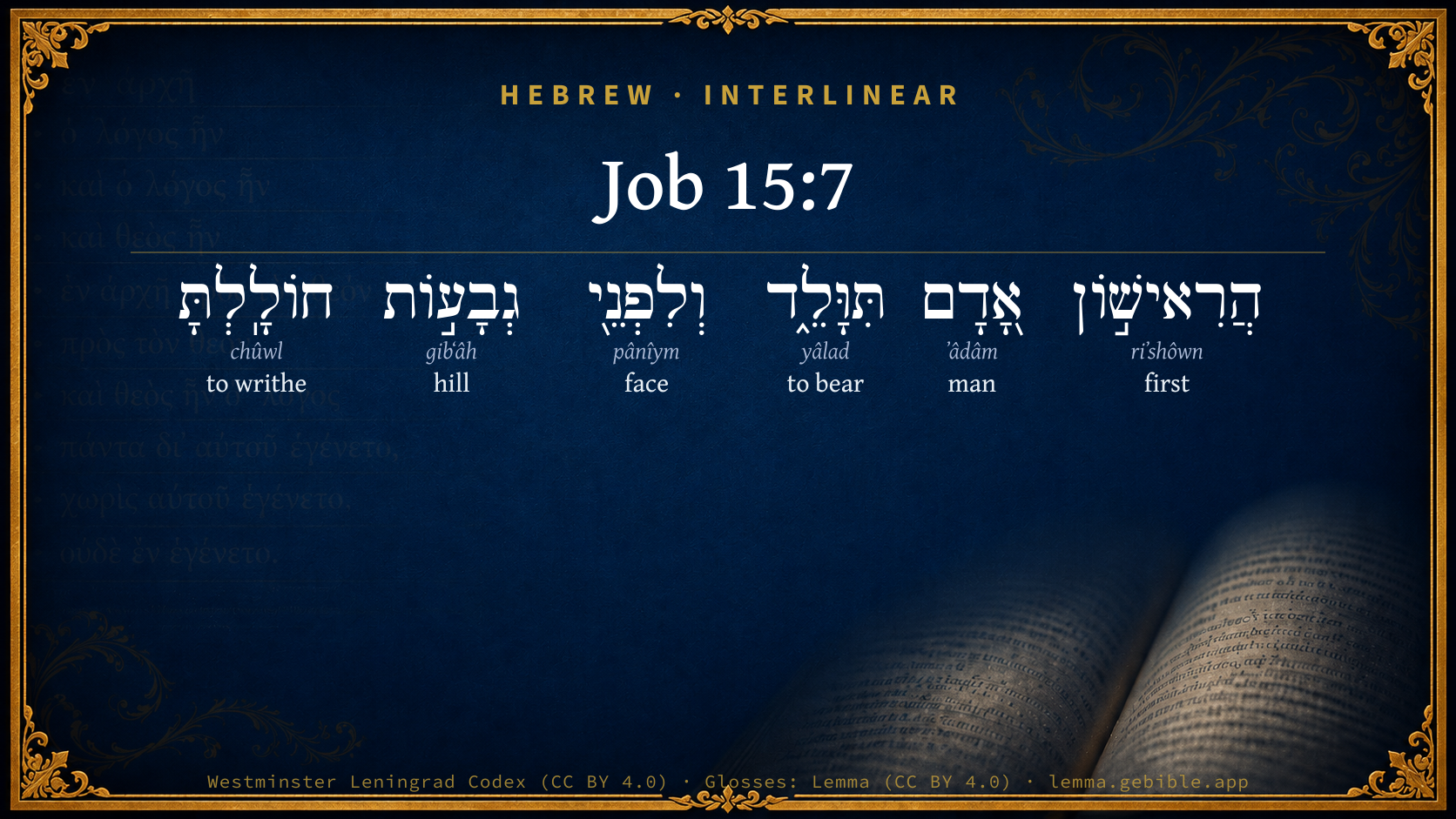
חוֹלָֽלְתָּ
chûwl
H2342
“to writhe”
Verb, Polal, Perfect, 2nd Person, Masculine, Singular
Part of Speech
Verb
Stem
Polal
Form
Perfect
Person
2nd Person
Gender
Masculine
Number
Singular
Full BDB Definition

Origin: a primitive root

TWOT: 623

to twist, whirl, dance, writhe, fear, tremble, travail, be in anguish, be pained - (Qal) - to dance - to twist, writhe - to whirl, whirl about - (Polel) - to dance - to writhe (in travail with), bear, bring forth - to wait anxiously - (Pulal) - to be made to writhe, be made to bear - to be brought forth - (Hophal) to be born - (Hithpolel) - whirling (participle) - writhing, suffering torture (participle) - to wait longingly - (Hithpalpel) to be distressed
  1. הֲרִאישׁ֣וֹן riʼshôwn H7223 “first” Particle, Interrogative + Adjective, Adjective, Masculine, Singular, Absolute
  2. אָ֭דָם ʼâdâm H120 “man” Noun, Common, Masculine, Singular, Absolute
  3. תִּוָּלֵ֑ד yâlad H3205 “to bear” Verb, Niphal, Imperfect, 2nd Person, Masculine, Singular
  4. וְלִפְנֵ֖י pânîym H6440 “and · to/for · face(s) of” Conjunction + Preposition + Noun, Common, Both, Plural, Construct
  5. גְבָע֣וֹת gibʻâh H1389 “hills” Noun, Common, Feminine, Plural, Absolute

About this verse

These counts appear in no published source. They are computed here, from the morphology-tagged text and Lemma’s own curated glosses. What Lemma adds →

6
words
6
distinct lemmas
Wisdom
section

Grammatical profile

  • 2 verbs
  • 3 nouns
  • 1 adjective

Verb forms

  • תִּוָּלֵ֑ד Niphal · Imperfect
  • חוֹלָֽלְתָּ Polal · Perfect

Hebrew & Septuagint length

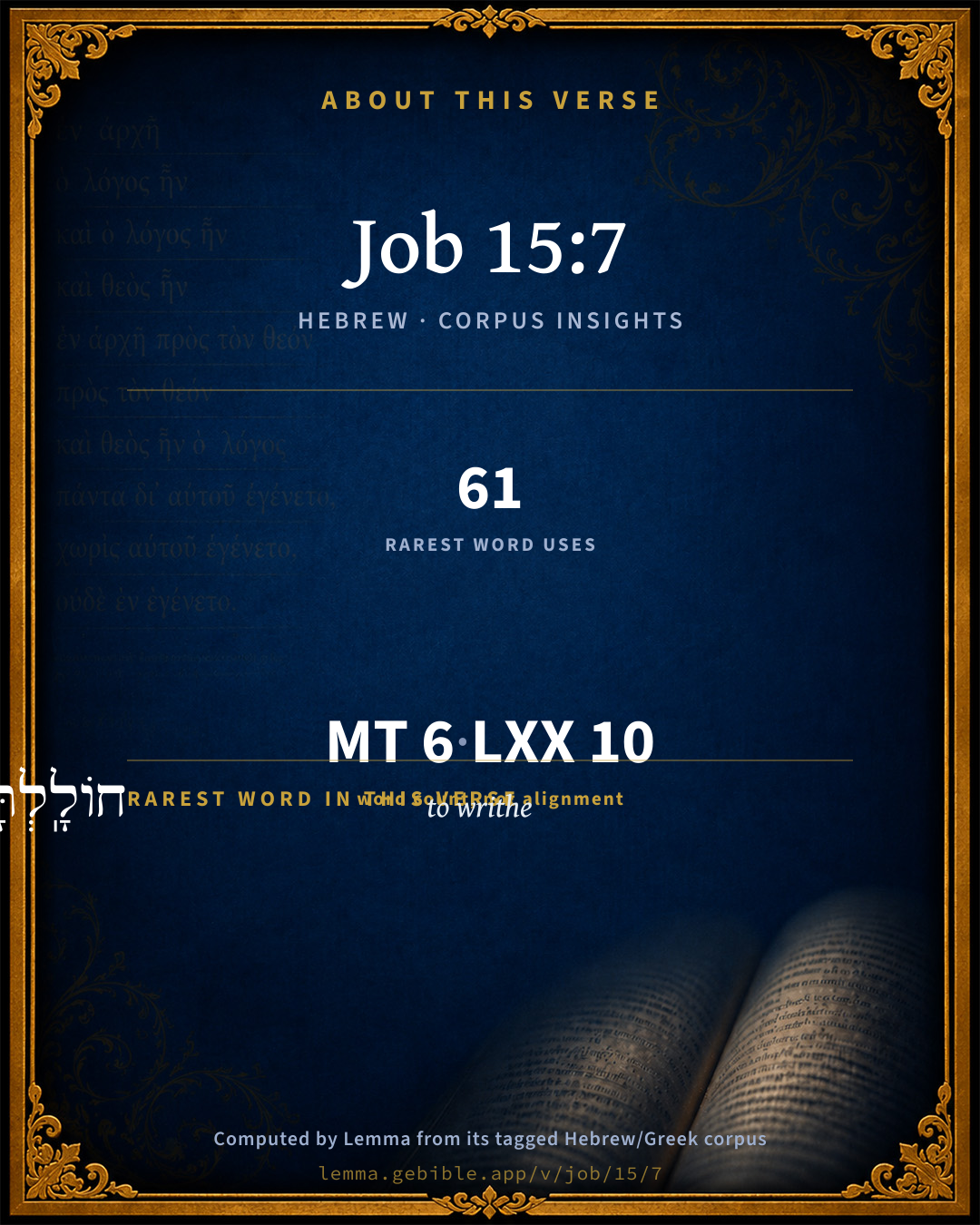
In English translation the verse runs 16 words from the Hebrew and 16 from the Septuagint (LXX English) — the same length.

A rough comparison of the two English renderings, which tokenize alike — not a word-level alignment.

Word counts can differ between the Hebrew and the Greek without any difference in meaning — e.g. the Hebrew direct-object marker אֵת has no separate Greek word, and Greek often adds the article ὁ.

In the original languages it is 6 Hebrew tokens and 10 Greek tokens — but the two are counted differently (Hebrew bundles its prefixes and suffixes into one token; the Greek is in lemma form), so that isn’t a like-for-like length.

Cross-references

6

Topical passages linked to Job 15:7 in the Treasury of Scripture Knowledge — connected by theme and wording, ordered by reader-vote popularity; previews shown in the World English Bible.

  • Psalms 90:2 Before the mountains were brought forth, Or ever you had formed the earth and the world, Even from everlasting to everlasting, you are God.
  • Job 12:12 With aged men is wisdom, In length of days understanding.
  • Job 38:4–41 "Where were you when I laid the foundations of the earth? Declare, if you have understanding.
  • Proverbs 8:22–25 "Yahweh possessed me in the beginning of his work, Before his deeds of old.
  • Genesis 4:1 The man knew Eve his wife. She conceived, and gave birth to Cain, and said, "I have gotten a man with Yahweh's help."
  • Job 15:10 With us are both the gray-headed and the very aged men, Much elder than your father.

Cross-references courtesy of OpenBible.info (CC BY 4.0).

Hebrew and Greek witnesses Masoretic Hebrew ↔ Greek Septuagint

The same verse in the two great witnesses to the Old Testament, shown verse-for-verse.

These are two independent witnesses, not word-aligned to each other, and the Septuagint is shown in lemma (dictionary) form.

Hebrew Job 15:7 Masoretic · Westminster Leningrad Codex

הֲרִאישׁ֣וֹן אָ֭דָם תִּוָּלֵ֑ד וְלִפְנֵ֖י גְבָע֣וֹת חוֹלָֽלְתָּ

"Are you the first man who was born? Or were you brought forth before the hills?

World English Bible · Public Domain

Greek LXX Job 15:7 Septuagint · lemma form

τίς γάρ μή πρῶτος ἄνθρωπος γίγνομαι ἤ πρό θίς πήγνυμι

What! are you the first man that was born? or were you established before the hills?

LXX2012 (modern English Septuagint) · Public Domain

Hebrew: Westminster Leningrad Codex (CC BY 4.0). Greek: Septuagint (public domain); English from LXX2012 (modern English Septuagint) (Public Domain). How the Septuagint differs from the Hebrew →

Commentary

Notes on Job 15:7 from classic Christian and Jewish commentators (each source and its license shown beneath its notes). The classic Christian expositions comment on the surrounding passage and are grouped to its opening verse, so a note may address several verses; the Jewish commentaries on the Tanakh (Rashi and others) are per-verse, so they appear only where the commentator wrote on this verse.

Lemma curates 59 commentaries, every one of them public domain or Creative Commons licensed, each selected and text-cleaned for this edition rather than reprinted as found. About our sources →

Trapp's Complete Commentary

John Trapp

Job 15:7 [Art] thou the first man [that] was born? or wast thou made before the hills?

Ver. 7. Art thou the first man that was born?] Or, Wast thou made before Adam? Ut vox Rishon non significet primus, sed prius (Lavat., Bucholc.). Out of the mouth of Adam, as from a fountain, flowed whatsoever profitable learning, skill, or wisdom, is found in the world, saith the divine chronologer. Job had taxed Zophar for a young puny and a novice. Job 12:9-12 This Eliphaz kindleth at, and taketh upon him to answer in Zophar’s behalf. As indeed these three speakers, Eliphaz, Zophar, and Bildad, stood to one another, as much as any one of them did for himself, as if they had all entered bond, and given security for reciprocal assistance. Here then Eliphaz asketh, Art thou the first man born? that is, Art thou the wisest man alive? and must we all be taught by thee, as Adam’s nephews were by him, in things divine and human.

Or wast thou made before the hills?] i.e. Before the angels, as some sense it. But take it literally for the mountains, called, for their antiquity, the everlasting hills, Gen 49:26 Hab 3:6, because they were from the beginning, and shall continue to the end. These appeared first at the separation of the waters, Gen 1:9-10. And Christ, to set forth his eternity, saith, Pro 8:25, "Before the mountains were settled, before the hills, was I brought forth." So Psa 90:2.

John Trapp, A Commentary or Exposition upon All the Books of the Old and New Testament (1647–1656) — public domain. Text from a community e-Sword module.

Joseph Benson's Commentary

Job 15:7-10. Art thou the first man that was born? — Hast thou lived ever since the creation of the world, and treasured up the experiences of all ages in thy own breast, that thou speakest so arrogantly and magisterially, and with such contempt of other men? Art thou the most ancient and the wisest of all mortal men? Whom dost thou make thyself? S. Jarchi’s comment is, “What, wast thou born before Adam? Wast thou made before the hills? — As wisdom herself was, Pro 8:23. Didst thou exist before the earth was created, and distinguished into mountains and valleys? Hast thou heard the secret of God? — Hath God acquainted thee with all his secret counsels, whereby he governs the world, that thou dost pass so bold a censure upon his designs and actions? Dost thou restrain wisdom to thyself? — Art thou the only wise man in the world, and we and all others but fools? What knowest thou that we know not? — He retorts upon Job his own expressions, Job 12:3; Job 13:2. With us are both the gray- headed, &c. — That is, among us; meaning either some of them, or some others with whom they had conversed, and who were of their opinion in this matter. And this they oppose to what Job had expressed, Job 12:12. Very aged men, much elder than thy father — Perhaps all these three friends of Job were elder than he, and therefore they thought he was bound to acknowledge them to be wiser. And many think themselves wiser than others for a similar reason, and are confident they know more, because they have lived more years!

Joseph Benson's Commentary on the Old and New Testaments (1811–1818) — public domain. Text from a community e-Sword module.

Whedon's Commentary on the Bible

Daniel D. Whedon

Second strophe — Ironical questioning as to the possible modes by which Job had attained to such superior wisdom and self-sufficiency that he could discard divine consolations imparted through his friends, Job_15:7-11.

7. Art thou the first man — Literally, Wast thou born the first man? Art thou an Adam still alive, having gathered all the treasures of wisdom — the experience of many centuries? In India, Mr. Roberts tells us, a pertinacious opposer is asked, “What! were you born before all others?” “Yes, yes, he is the first man: no wonder he has so much wisdom.”

Daniel D. Whedon (gen. ed.), Commentary on the Old and New Testaments (1874–1909) — public domain. Text from a community e-Sword module.

Keil & Delitzsch

C. F. Keil & F. Delitzsch

7 Wast thou as the first one born as a man,

And hast thou been brought forth before the hills?

8 Hast thou attended to the counsel of Eloah,

And hast thou kept wisdom to thyself?

9 What dost thou know that we have not known?

Doest thou understand what we have not been acquainted with?

10 Both grey-haired and aged are among us,

Older in days than thy father.

The question in Job 15:7 assumes that the first created man, because coming direct from the hand of God, had the most direct and profoundest insight into the mysteries of the world which came into existence at the same time as himself. Schlottman calls to mind an ironical proverbial expression of the Hindus: "Yea, indeed, he is the first man; no wonder that he is so wise" (Roberts, Orient. Illustr. p. 276). It is not to be translated: wast thou born as the first man, which is as inadmissible as the translation of אחת מעט, Hag 2:6, by "a little" (vid., Khler in loc.); rather ראישׁון (i.e., ראישׁון, as Jos 21:10, formed from ראשׁ, like the Arabic raı̂s, from ras, if it is not perhaps a mere incorrect amalgamation of the forms ראשׁון and רשׁון, Job 8:8) is in apposition with the subject, and אדם is to be regarded as predicate, according to Ges. 139, 2. Raschi's translation is also impossible: wast thou born before Adam? for this Greek form of expression, πρῶτος μον, Joh 1:15, Joh 1:30; Joh 15:18 (comp. Odyss. xi. 481f., σεῖο μακάρτατος), is strange to the Hebrew. In the parallel question, Job 15:7, Umbr., Schlottm., and Renan (following Ewald) see a play upon Pro 8:24.: art thou the demiurgic Wisdom itself? But the introductory proverbs (Prov 1-9) are more recent than the book of Job (vid., supra, p. 24), and indeed probably, as we shall show elsewhere, belong to the time of Jehoshaphat. Consequently the more probable relation is that the writer of Pro 8:24. has adopted words from the book of Job in describing the pre-existence of the Chokma. Was Job, a higher spirit-nature, brought forth, i.e., as it were amidst the pangs of travail (חוללת, Pulal from חול, חיל), before the hills? for the angels, according to Scripture, were created before man, and even before the visible universe (vid., Job 38:4.). Hirz., Ew., Schlottm., and others erroneously translate the futt. in the questions, Job 15:8, as praes. All the verbs in Job 15:7, Job 15:8, are under the control of the retrospective character which is given to the verses by ראישׁון; comp. Job 10:10., where זכר־נא has the same influence, and also Job 3:3, where the historical sense of אוּלד depends not upon the syntax, but upon logical necessity. Translate therefore: didst thou attend in the secret council (סוד, like Jer 23:18, comp. Psa 89:8) of Eloah (according to the correct form of writing in Codd. and in Kimchi, Michlol 54a, הבסוד, like Job 15:11 המעט and Job 22:13 הבעד, with Beth raph. and without Gaja),

(Note: As a rule, the interrogative He, when pointed with Pathach, has Gaja against the Pathach Sa2 7:5; this, however, falls away (among other instances) when the syllable immediately following the He has the tone, as in the two examples given above (comp. also האל, Job 8:3; הלאל, Job 13:7), or the usual Gaja (Metheg) which stands in the antepenultima (Br, Metheg-Setzung, 23)

and didst then acquire for thyself (גרע, here attrahere, like the Arabic, sorbere, to suck in) wisdom? by which one is reminded of Prometheus' fire stolen from heaven. Nay, Job can boast of no extraordinary wisdom. The friends - as Eliphaz, Job 15:9, says in their name - are his contemporaries; and if he desires to appeal to the teaching of his father, and of his ancestors generally, let them know that there are hoary-headed men among themselves, whose discernment is deeper by reason of their more advanced age. גּם is inverted, like Job 2:10 (which see); and at the same time, since it is sued twice, it is correlative: etiam inter nos et cani et senes. Most modern expositors think that Eliphaz, "in modestly concealed language" (Ewald), refers to himself. But the reference would be obvious enough; and wherefore this modest concealing, which is so little suited to the character of Eliphaz? Moreover, Job 15:10 does not sound as if speaking merely of one, and in Job 15:10 Eliphaz would make himself older than he appears to be, for it is nowhere implied that Job is a young man in comparison with him. We therefore with Umbreit explain בּנוּ: in our generation. Thus it sounds more like the Arabic, both in words (kebı̂r Arab., usual in the signif. grandaevus) and in substance. Eliphaz appeals to the source of reliable tradition, since they have even among their races and districts mature old men, and since, indeed, according to Job's own admission (Job 12:12), there is "wisdom among the ancient ones."

Keil & Delitzsch — Biblical Commentary on the Old Testament (1861–1891) — public domain (CC PDM 1.0). Text via the HelloAO Bible API. (Old Testament only.)

Tyndale Open Study Notes

Tyndale Open Resources

15:7-8 When the Lord himself later issued a similar challenge, Job found it convicting (38:1-11).

Tyndale Open Study Notes — © Tyndale Open Resources, licensed CC BY-SA 4.0. Text via the HelloAO Bible API.

Geneva Bible (1599)

Geneva Bible translators

That is, the most ancient, and so by reason the most wise?

Geneva Bible (1599) marginal notes — public domain. Text via Bolls.life.

Jamieson, Fausset & Brown

Robert Jamieson, A. R. Fausset & David Brown

That is, Art thou wisdom personified? Wisdom existed before the hills; that is, the eternal Son of God (Pro 8:25; Psa 90:2). Wast thou in existence before Adam? The farther back one existed, the nearer he was to the Eternal Wisdom.

Jamieson, Fausset & Brown — Commentary Critical and Explanatory on the Whole Bible (1871) — public domain (CC PDM 1.0). Text via the HelloAO Bible API.

Adam Clarke's Commentary

Verse 7. Art thou the first man that was born?] Literally, "Wert thou born before Adam?" Art thou in the pristine state of purity and innocence? Or art thou like Adam in his first state? It does not become the fallen descendant of a fallen parent to talk as thou dost.

Made before the hills?] Did God create thee the beginning of his ways? or wert thou the first intelligent creature which his hands have formed?

Adam Clarke's Commentary on the Bible (1810–1826) — public domain. Text from a community e-Sword/MySword module.

Ellicott's Commentary for English Readers

(7) Art thou the first man that was born?—This is a retort upon Job_12:2; Job_12:7; Job_12:9, where Job had claimed equal knowledge for the inanimate creation.

A Bible Commentary for English Readers, edited by Charles John Ellicott (1878–1897) — public domain. Text from a community e-Sword module.

The Cambridge Bible for Schools and Colleges

gen. ed. J. J. S. Perowne

7. Art thou the first man] lit. wast thou born a man first? The first man that came from God’s hand would naturally be endowed with preeminent wisdom and other attributes. Schlottmann (p. 303) quotes an ironical proverb current in India, “Yes, yes, he is the first man, no wonder that he is so wise.” The second clause, of the verse, however, as well as Job_15:8, seems to express the conception of a Being formed before the earth, either the Wisdom of Pro_8:22 seq., or a Being similar, cf. especially Pro_8:25; and the query of Eliphaz is, Art thou the very Wisdom of God? or, Art thou such a Being as the wisdom of God?

7–11. But coming back to Job’s assumption of superior wisdom, Eliphaz must ask on what it rests?

The Cambridge Bible for Schools and Colleges (gen. ed. J. J. S. Perowne; Cambridge University Press, 1878–1918) — public domain. Text from a community e-Sword module.

John Gill's Exposition

Art thou the first man that was born?.... The first Adam, who was created in wisdom and knowledge, and had a large share of understanding in things natural, civil, and moral; knew much of God and his perfections, of the works of nature, and of the wisdom and power of God displayed in them; one instance of which is his giving names to the creatures; dost thou think thou art that selfsame individual person, the father of all mankind, who had such a stock and fund of knowledge, until, by seeking after more, and that unlawful, he lost much of what he had? dost thou imagine that thou hast lived ever since, and seen or known everything that was done in all ages from the beginning, and hast gathered a large share of knowledge from long experience, and by making strict observations on men and things in such a length of time? or, as the Targum,

"wast thou born with the first man, without father and mother?''

and hast thou existed ever since? or, "wast thou born before Adam?" before the first man (z)? Art thou the wisdom and son of God, who was before Abraham, before Adam, before any creature whatever, was in the beginning with God, and was God? What dost thou make thyself to be, Job? thou, a mere man, dost thou make thyself to be the eternal God? for to be before the first man, or to be the firstborn of every creature, or to be born before every creature, is expressive of eternity, as is the following phrase:

or wast thou made before the hills? or existed before they did? as is said of the son of God, Pro 8:25; what is before the hills and mountains is eternal; the eternal God and his eternity are thus described, Psa 90:2.

(z) So Mercerus, and some in Vatablus, Schmidt, Jarchi, & Bar Tzemach.

John Gill's Exposition of the Whole Bible (1746–1763) — public domain (CC PDM 1.0). Text via the HelloAO Bible API.

Albert Barnes' Notes on the Bible

Art thou the first man that was born? - Hast thou lived ever since the creation, and treasured up all the wisdom of past times, that thou dost now speak so arrogantly and confidently? This question was asked, because, in the estimation of Eliphaz and his friends, wisdom was supposed to be connected with long life, and with an opportunity for extended and varied observation; see Job 15:10. Job they regarded as comparatively a young man.

Wast thou made before the hills - The mountains and the hills are often represented as being the oldest of created objects, probably because they are the most ancient things that appear on earth. Springs dry up, and waters change their beds; cities are built and decay; kingdoms rise and fall, and all the monuments of human skill and art perish; but the hills and mountains remain the same from age to age. Thus, in Psa 90:2 :

Before the mountains were brought forth,

Or ever thou hadst formed the earth and the world,

Even from everlasting to everlasting thou art God.

So in Pro 8:25, in the description of wisdom:

Before the mountains were settled,

Before the hills was I brought forth.

So the hills are called “everlasting” Gen 49:26, in allusion to their great antiquity and permanence. And so we, in common parlance, have a similar expression when we say of anything that “it is as old as the hills.” The question which Eliphaz intends to ask here of Job is, whether he had lived from the creation, and had observed everything?

Albert Barnes' Notes on the Bible (1834–1885) — public domain. Text from a community e-Sword/MySword module.

Haydock's Catholic Bible Commentary

First. Is thy experience so great, (Menochius) or art thou the most excellent of men? To hear thee we are but novices, chap. xiii. 5. (Calmet)

George Leo Haydock (1774–1849), Haydock's Catholic Family Bible and Commentary, 1859 edition — public domain. Excludes Psalms (Douay-Rheims chapter numbering differs from Protestant) and Deuterocanonical books (Catholic canon only).

Matthew Poole's English Annotations

Hast thou lived ever since the creation of the world, and treasured up the experiences of all ages in thy own breast, that thou speakest so arrogantly and magisterially, and with such contempt of other men? Art thou the most ancient and the wisest of all mortal men? Whom dost thou make thyself? Before the hills; before the earth was made and distinguished into mountains and valleys.

Matthew Poole's English Annotations on the Holy Bible (1683–1685) — public domain. Text from a community e-Sword/MySword module.

The Pulpit Commentary

Art thou the first man that was born? That is, "Dost thou claim to have the wisdom of that first human intelligence, which, proceeding direct from God, (Gen_1:27) was without fault or flaw a perfect intelligence, which judged all things aright?" It is not clear that Eliphaz had ever heard of Adam; but he evidently believed in a "first man," from whom all others were descended, and he attributed to this first man a mind and intellect surpassing those of all other men. His question is, of course, rather a scoff than an inquiry. He knows that Job makes no such foolish pretence; but he throws it in his teeth that, from what he has said, men might suppose he took some such view of himself. Or wast thou made before the hills? This is a taunt of the same kind as the previous one, but intensified. Wisdom is the result of experience. Art thou older than all the rest of us older than the earth itself, than "the everlasting hills"? There were Greeks who claimed to be ethnically proselhnoi , "older than the moon," but no inhabitant of earth was ever so foolish as to imagine himself individually more ancient than the earth on which he lived.

The Pulpit Commentary (1880–1919), ed. H.D.M. Spence-Jones & Joseph S. Exell — public domain. Text from a community e-Sword module.

unfoldingWord translationNotes

Door43 World Missions Community

General Information:

Each verse is a parallelism that contains two rhetorical questions. (See: Parallelism and Rhetorical Question)

Are you the first man that was born?

The implicit answer here is "no." This rhetorical question can be written as a statement. AT: "You are not the first man that was born." (See: Rhetorical Question)

Were you brought into existence before the hills?

The implicit answer here is "no." This rhetorical question can be written as a statement. AT: "You were not brought into existence before the hills." or "God did not bring you into existence before he brought the hills into existence." (See: Rhetorical Question)

Were you brought

This can be stated in active form. AT: "Did God bring you" (See: Active or Passive)

Have you heard the secret knowledge of God?

The implicit answer here is "no." This rhetorical question can be written as a statement. AT: "You have not heard the secret knowledge of God." (See: Rhetorical Question)

Do you limit wisdom to yourself?

This rhetorical question emphasizes that he cannot limit wisdom to himself. This can be written as a statement. AT: "You cannot limit wisdom to yourself." or "You are not the only wise person." (See: Rhetorical Question)

What do you know that we do not know?

The implicit answer here is "nothing." This question can be written as a statement. AT: "There is nothing that you know that we do not know." or "Everything you know, we also know." (See: Rhetorical Question)

What do you understand that is not also in us?

This speaks of the men having understanding as if it were something "inside" them. AT: "Everything you understand, we also understand." or "We understand everything that you understand." (See: Rhetorical Question)

translationWords

know

God

wise

understand

unfoldingWord translationNotes — © Distant Shores Media and the Door43 World Missions Community, licensed CC BY-SA 4.0. Source: git.door43.org/Door43/en_tn.

Rashi

Rabbi Shlomo Yitzchaki (Rashi)

Were you born before Adam Heb. הראישון. Were you born before Adam? This “hey” serves as the interrogative expression. Therefore, it is vowelized with a “hattaf pattah” and its meaning is: Were you born the first one, before Adam who was formed from the earth, so that you knew to fulfill all the wisdom of the commandments of the Creator?

Rashi on the Tanakh — English translations: “The Judaica Press complete Tanach with Rashi, translated by A. J. Rosenberg” (CC BY 4.0); “Pentateuch with Rashi's commentary by M. Rosenbaum and A.M. Silbermann, 1929-1934” (public domain); “The Metsudah Tanach series, Lakewood, N.J” (CC BY 4.0); and “The Book of Joshua, Metsudah Publications, 1997” (CC BY 4.0). Text via Sefaria.

Lesson kit

Teaching starters — assembled from the data on this page, not authored interpretation. Every prompt links to the verse data it draws on. Edit before teaching.

Job, in the Wisdom, opens this verse with 6 words (6 distinct Hebrew lemmas). Its most distinctive word is chûwl (“to writhe”). A historical commentator’s framing appears above. Read the whole chapter for the surrounding context.

Discussion questions

  1. The word chûwl carries the sense “to writhe.” How does it shape the verse?
  2. Psalms 90:2 shares this passage’s theme. How do the two illuminate each other?
  3. These translations render this verse differently; the difference is in the English rendering, not the original. What questions does that raise?
  4. The verb «תִּוָּלֵ֑ד» is Niphal Imperfect. How does its form color the action?
  5. Reading how Trapp's Complete Commentary and Joseph Benson's Commentary read this verse, where do the two commentators agree and where do they part?

Things to notice

Reading settings

Reading text

Shown beneath each verse's original-language words.

Old Testament
Old Testament edition

Read the OT as the Masoretic Hebrew (MT) or the Greek Septuagint (LXX).

English shown for the Greek Septuagint (in the Hebrew ↔ Greek comparison).

Comparing translations? Open the Compare panel on any verse page to stack up to four side by side.