
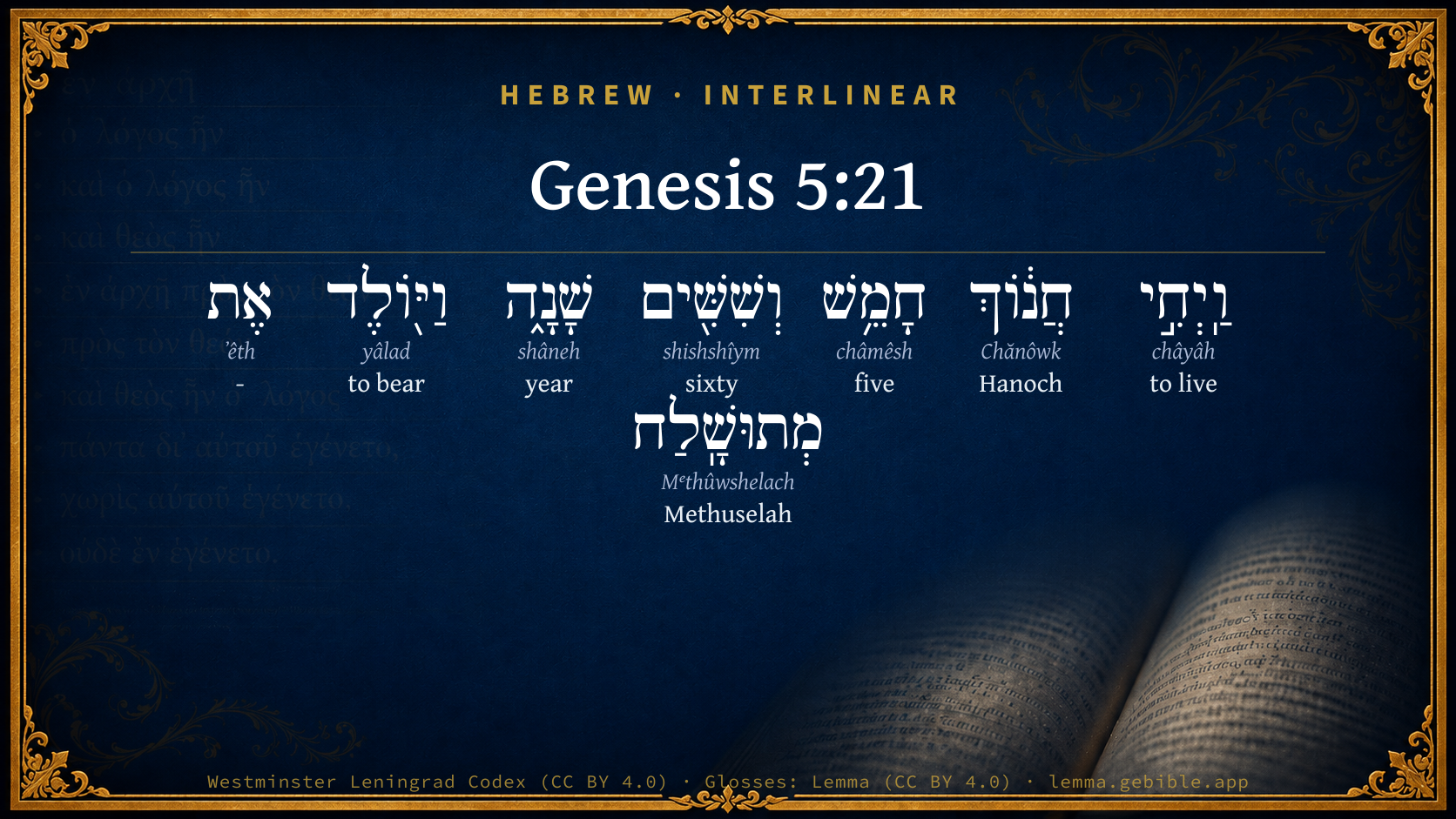
Genesis 5:21

Hebrew (Westminster Leningrad Codex) Genesis 5:21 appears in the Hebrew Old Testament. The text above is from the Westminster Leningrad Codex. Each word links to its Strong’s number, a concise gloss, and parsing drawn from the Open Scriptures Hebrew Bible morphology. Click any word for its full Brown-Driver-Briggs (BDB) entry.
Download image
Cite this verse

Genesis 5:21 (World English Bible). Public Domain. Lemma interlinear Bible study tool, https://lemma.gebible.app/v/genesis/5/21.

Show BibTeX & RIS
BibTeX
RIS
English Translation
Enoch lived sixty-five years, and became the father of Methuselah.
World English Bible · Public Domain
Highlights Full analysis ↓
Download a study sheet

One document with this verse’s original text, its word-by-word gloss line, the meaning frame, cross-references with their text, attributed commentary, and full source and license credits — printable, and it pastes into notes with its structure intact.

This verse Autodidact and up

Study sheet (.html) Plain text (.txt)

A passage Seminary Student

Up to 50 verses in one chapter. A passage sheet keeps up to 6 commentary sources and 12 cross-references per verse, in the order this page ranks them, and says so on the sheet whenever that leaves anything out. Ask for a single verse and you get the Autodidact verse sheet above.

Everything on this page stays free to read, with no account — the sheet is a download of what is already on screen, not access to it.

Want to remove ads? Support Godless Engineer
Compare translations 3

The same verse in 3 English versions, stacked beneath the original-language interlinear above. Click any original word for its lexicon entry.

Each is an independent rendering of the whole verse — the interlinear is not word-aligned to these translations.

Highlighted words mark where these versions differ — a whole-verse word diff, not a word-by-word alignment.

  • World English Bible Public Domain
    Enoch lived sixty-five years, and became the father of Methuselah.
  • King James Version Public Domain
    And Enoch lived sixty and five years, and begat Methuselah:
  • unfoldingWord Literal Text CC BY-SA 4.0
    And Enoch lived sixty-five years, then he fathered Methuselah.

unfoldingWord Literal Text — © unfoldingWord, licensed CC BY-SA 4.0. Word-aligned USFM3 via Door43 (git.door43.org/unfoldingWord/en_ult).

Versions to compare (up to 4)

3 of 4 selected

Show all 18 translations

Every available English version of this verse, each an independent rendering of the whole verse.

  • World English Bible Public Domain
    Enoch lived sixty-five years, and became the father of Methuselah.
  • Berean Standard Bible Public Domain
    When Enoch was 65 years old, he became the father of Methuselah.
  • Majority Standard Bible Public Domain
    When Enoch was 65 years old, he became the father of Methuselah.
  • King James Version Public Domain
    And Enoch lived sixty and five years, and begat Methuselah:
  • American Standard Version (1901) Public Domain
    And Enoch lived sixty and five years, and begat Methuselah:
  • Revised Version (1885) Public Domain
    And Enoch lived sixty and five years, and begat Methuselah:
  • Geneva Bible (1599) Public Domain
    Also Henoch liued sixtie and fiue yeeres, and begate Methushelah.
  • Douay-Rheims (1899) Public Domain
    And Henoch lived sixty-five years, and begot Mathusala.
  • Young's Literal Translation Public Domain
    And Enoch liveth five and sixty years, and begetteth Methuselah.
  • Literal Standard Version CC BY-SA 4.0
    And Enoch lives sixty-five years [[or one hundred and sixty-five years]], and begets Methuselah.
  • Unlocked Literal Bible CC BY-SA 4.0
    When Enoch had lived sixty-five years, he became the father of Methuselah.
  • unfoldingWord Literal Text CC BY-SA 4.0
    And Enoch lived sixty-five years, then he fathered Methuselah.
  • Darby Bible Public Domain
    And Enoch lived sixty-five years, and begot Methushelah.
  • World Messianic Bible Public Domain
    Enoch lived sixty-five years, then became the father of Methuselah.
  • Webster's Bible Public Domain
    And Enoch lived sixty and five years, and begat Methuselah:
  • Free Bible Version CC BY-SA 4.0
    When Enoch was 65, he had Methuselah.
  • Bible in Basic English Public Domain
    And Enoch was sixty-five years old when he became the father of Methuselah:
  • JPS Tanakh (1917) Public Domain
    And Enoch lived sixty and five years, and begot Methuselah.

Literal Standard Version (2020), Covenant Press — licensed CC BY-SA 4.0. Text via the HelloAO Bible API (eBible.org). Unlocked Literal Bible (unfoldingWord) — licensed CC BY-SA 4.0. Text via the HelloAO Bible API (eBible.org). unfoldingWord Literal Text — © unfoldingWord, licensed CC BY-SA 4.0. Word-aligned USFM3 via Door43 (git.door43.org/unfoldingWord/en_ult). Free Bible Version, Dr. Jonathan Gallagher — licensed CC BY-SA 4.0. Text via the HelloAO Bible API (eBible.org).

Word by word

More ways to search: Search by grammar → Find every occurrence → Compare this word →

Practice this passage: Drill this verse → Learn its vocabulary →

About this verse

These counts appear in no published source. They are computed here, from the morphology-tagged text and Lemma’s own curated glosses. What Lemma adds →

8
words
8
distinct lemmas
Pentateuch
section

Notable vocabulary

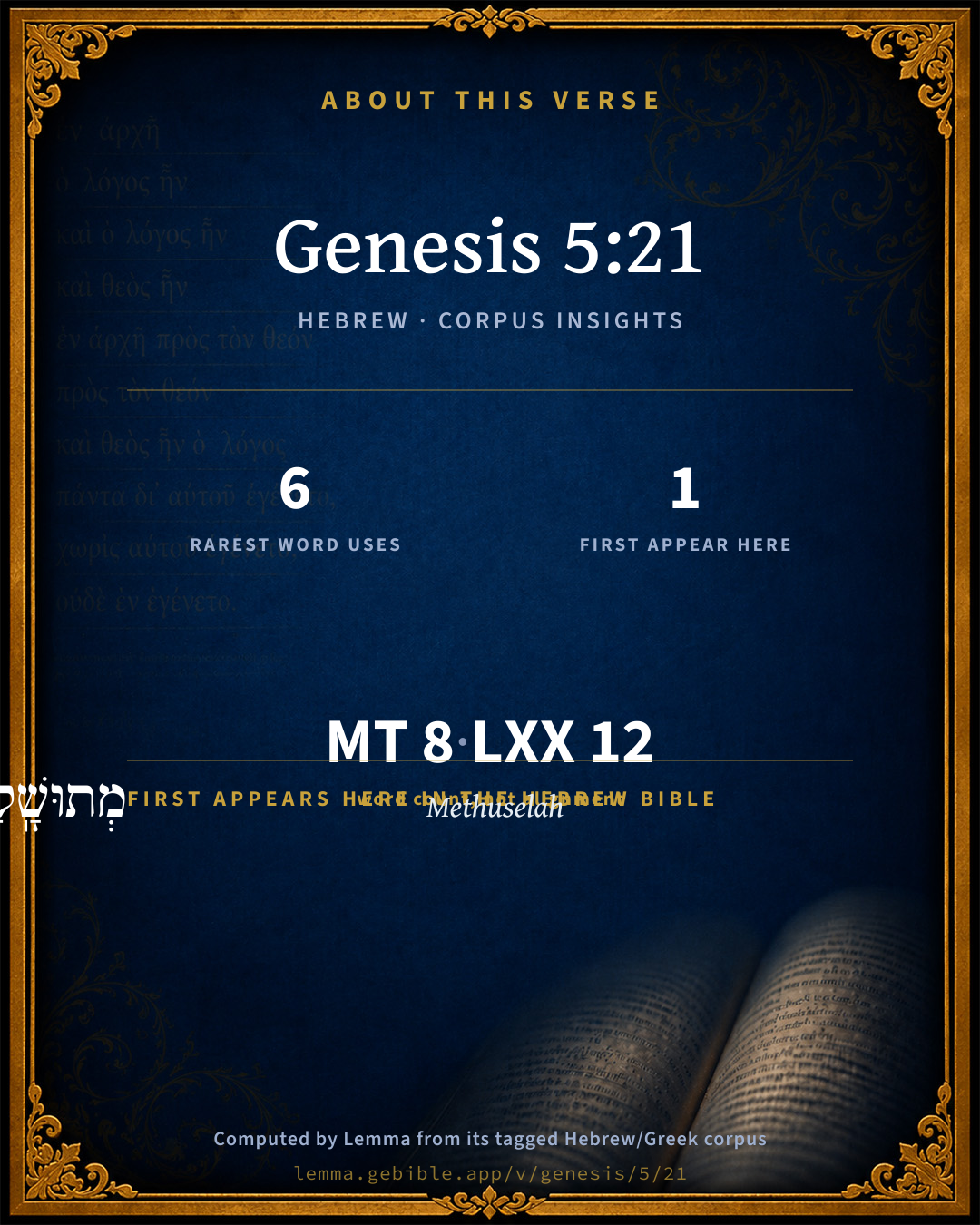
The rarest word here is מְתוּשָֽׁלַח Methuselah H4968 — appearing just 6 times in the whole Hebrew Bible.

First appearance in Scripture

This word makes its first canonical appearance in the Hebrew Bible here:

  • מְתוּשָֽׁלַח Methuselah H4968

Shared distinctive vocabulary

מְתוּשָֽׁלַח Methuselah H4968 occurs in 6 verses of the Hebrew Bible. Also found in:

Grammatical profile

  • 2 verbs
  • 3 nouns
  • 2 adjectives
  • 1 particle

Verb forms

  • וַֽיְחִ֣י Qal · Sequential Imperfect
  • וַיּ֖וֹלֶד Hiphil · Sequential Imperfect

Hebrew & Septuagint length

In English translation the verse runs 10 words from the Hebrew and 16 from the Septuagint (LXX English) — the Septuagint runs noticeably longer here. See the side-by-side →

A rough comparison of the two English renderings, which tokenize alike — not a word-level alignment.

Word counts can differ between the Hebrew and the Greek without any difference in meaning — e.g. the Hebrew direct-object marker אֵת has no separate Greek word, and Greek often adds the article ὁ.

In the original languages it is 8 Hebrew tokens and 12 Greek tokens — but the two are counted differently (Hebrew bundles its prefixes and suffixes into one token; the Greek is in lemma form), so that isn’t a like-for-like length.

Cross-references

1

Topical passages linked to Genesis 5:21 in the Treasury of Scripture Knowledge — connected by theme and wording, ordered by reader-vote popularity; previews shown in the World English Bible.

  • Luke 3:37 the son of Methuselah, the son of Enoch, the son of Jared, the son of Mahalaleel, the son of Cainan,

Cross-references courtesy of OpenBible.info (CC BY 4.0).

Hebrew and Greek witnesses Masoretic Hebrew ↔ Greek Septuagint

The same verse in the two great witnesses to the Old Testament, shown verse-for-verse.

Here the Septuagint runs noticeably longer than the Hebrew — LXX2012 (modern English Septuagint) 16 words vs World English Bible 10. A rough length comparison of the two English translations, not a word-level alignment — read both below.

These are two independent witnesses, not word-aligned to each other, and the Septuagint is shown in lemma (dictionary) form.

Hebrew Genesis 5:21 Masoretic · Westminster Leningrad Codex

וַֽיְחִ֣י חֲנ֔וֹךְ חָמֵ֥שׁ וְשִׁשִּׁ֖ים שָׁנָ֑ה וַיּ֖וֹלֶד אֶת מְתוּשָֽׁלַח

Enoch lived sixty-five years, and became the father of Methuselah.

World English Bible · Public Domain

Greek LXX Genesis 5:21 Septuagint · lemma form

καί ζάω ενωχ ἑκατόν καί ἑξήκοντα πέντε ἔτος καί γεννάω ὁ μαθουσαλα

And Enoch lived one hundred and sixty and five years, and became the father of Mathusala.

LXX2012 (modern English Septuagint) · Public Domain

On this verse, Matthew Henry's Commentary discusses the Septuagint’s reading. Read the note in Commentary ↓

Hebrew: Westminster Leningrad Codex (CC BY 4.0). Greek: Septuagint (public domain); English from LXX2012 (modern English Septuagint) (Public Domain). How the Septuagint differs from the Hebrew →

Targum (Aramaic paraphrase)

2

The Targum is the ancient Jewish Aramaic paraphrase of the Hebrew Scriptures — an interpretive translation, not the Hebrew text itself. Onkelos (literal) and Pseudo-Jonathan (expansive) render the Torah, and Jonathan the Prophets. Coverage is partial: where no permissively-licensed English translation exists for a verse, only the Aramaic is shown. This is verse-level text, not a word-by-word alignment to the Hebrew.

  1. Targum Onkelos Torah (Genesis–Deuteronomy)
    וַחֲיָא חֲנוֹךְ שִׁתִּין וַחֲמֵשׁ שְׁנִין וְאוֹלִיד יָת מְתוּשָׁלַח

    (no public-domain English translation for this verse)

    Targum Onkelos — Aramaic: “Onkelos Genesis” (public domain); “Onkelos Exodus” (public domain); “Onkelos Leviticus” (public domain); “Onkelos Numbers” (public domain); “Onkelos Deuteronomy” (public domain). English: “Sefaria Community Translation” (CC0 1.0 (public-domain dedication)); “J.W. Etheridge. The Targums of Onkelos and Jonathan Ben Uzziel on the Pentateuch. London: Longmans, Green, 1862” (public domain). Text via Sefaria.

  2. Targum Pseudo-Jonathan Torah (Genesis–Deuteronomy)
    וַחֲיָא חֲנוֹךְ שִׁיתִּין וַחֲמֵשׁ שְׁנִין וְאוֹלִיד יַת מְתוּשָׁלַח

    And Hanok lived sixty-five years, and begat Methushelach.

    Targum Pseudo-Jonathan — Aramaic: “Targum Jonathan on Genesis” (public domain); “Targum Jonathan on Exodus” (public domain); “Targum Jonathan on Leviticus” (public domain); “Targum Jonathan on Numbers” (public domain); “Targum Jonathan on Deuteronomy” (public domain). English: “The Targum of Jonathan ben Uzziel, trans. J. W. Etheridge, London, 1862” (public domain). Text via Sefaria.

Commentary

Notes on Genesis 5:21 from classic Christian and Jewish commentators (each source and its license shown beneath its notes). The classic Christian expositions comment on the surrounding passage and are grouped to its opening verse, so a note may address several verses; the Jewish commentaries on the Tanakh (Rashi and others) are per-verse, so they appear only where the commentator wrote on this verse.

Lemma curates 59 commentaries, every one of them public domain or Creative Commons licensed, each selected and text-cleaned for this edition rather than reprinted as found. About our sources →

Matthew Henry's Commentary

The accounts here run on for several generations without any thing remarkable, or any variation but of the names and numbers; but at length there comes in one that must not be passed over so, of whom special notice must be taken, and that is Enoch, the seventh from Adam: the rest, we may suppose, did virtuously, but he excelled them all, and was the brightest star of the patriarchal age. It is but little that is recorded concerning him; but this little is enough to make his name great, greater than the name of the other Enoch, who had a city called by his name. Here are two things concerning him: -

I. His gracious conversation in this world, which is twice spoken of: Enoch walked with God after he begat Methuselah (Gen 5:22), and again, Enoch walked with God, Gen 5:24. Observe,

1. The nature of his religion and the scope and tenour of his conversation: he walked with God, which denotes, (1.) True religion; what is godliness, but walking with God? The ungodly and profane are without God in the world, they walk contrary to him: but the godly walk with God, which presupposes reconciliation to God, for two cannot walk together except they be agreed (Amo 3:3), and includes all the parts and instances of a godly, righteous, and sober life. To walk with God is to set God always before us, and to act as those that are always under his eye. It is to live a life of communion with God both in ordinances and providences. It is to make God's word our rule and his glory our end in all our actions. It is to make it our constant care and endeavour in every thing to please God, and nothing to offend him. It is to comply with his will, to concur with his designs, and to be workers together with him. It is to be followers of him as dear children. (2.) Eminent religion. He was entirely dead to this world, and did not only walk after God, as all good men do, but he walked with God, as if he were in heaven already. He lived above the rate, not only of other men, but of other saints: not only good in bad times, but the best in good times. (3.) Activity in promoting religion among others. Executing the priest's office is called walking before God, Sa1 2:30, Sa1 2:35, and see Zac 3:7. Enoch, it should seem, was a priest of the most high God, and like Noah, who is likewise said to walk with God, he was a preacher of righteousness, and prophesied of Christ's second coming. Jde 1:14, Behold, the Lord cometh with his holy myriads. Now the Holy Spirit, instead of saying, Enoch lived, says, Enoch walked with God; for it is the life of a good man to walk with God. This was, [1.] The business of Enoch's life, his constant care and work; while others lived to themselves and the world, he lived to God. [2.] It was the joy and support of his life. Communion with God was to him better than life itself. To me to live is Christ, Phi 1:21.

2. The date of his religion. It is said (Gen 5:21), he lived sixty-five years, and begat Methuselah; but (Gen 5:22) he walked with God after he begat Methuselah, which intimates that he did not begin to be eminent for piety till about that time; at first he walked but as other men. Great saints arrive at their eminence by degrees.

3. The continuance of his religion: he walked with God three hundred years, as long as he continued in this world. The hypocrite will not pray always; but the real saint that acts from a principle, and makes religion his choice, will persevere to the end, and walk with God while he lives, as one that hopes to live for ever with him, Psa 104:33.

II. His glorious removal to a better world. As he did not live like the rest, so he did not die like the rest (Gen 5:24): He was not, for God took him; that is, as it is explained (Heb 11:5), He was translated that he should not see death, and was not found, because God had translated him. Observe,

1. When he was thus translated. (1.) What time of his life. It was when he had lived but three hundred and sixty-five years (a year of years), which, as men's ages went then, was in the midst of his days; for there was none of the patriarchs before the flood that did not more than double that age. But why did God take him so soon? Surely, because the world, which had now grown corrupt, was not worthy of him, or because he was so much above the world, and so weary of it, as to desire a speedy removal out of it, or because his work was done, and done the sooner for his minding it so closely. Note, God often takes those soonest whom he loves best, and the time they lose on earth is gained in heaven, to their unspeakable advantage. (2.) What time of the world. It was when all the patriarchs mentioned in this chapter were living, except Adam, who died fifty-seven years before, and Noah, who was born sixty-nine years after; those two had sensible confirmations to their faith other ways, but to all the rest, who were or might have been witnesses of Enoch's translation, it was a sensible encouragement to their faith and hope concerning a future state.

2. How his removal is expressed: He was not, for God took him. (1.) He was not any longer in this world; it was not the period of his being, but of his being here: he was not found, so the apostle explains it from the Septuagint; not found by his friends, who sought him as the sons of the prophets sought Elijah (Kg2 2:17); not found by his enemies, who, some think, were in quest of him, to put him to death in their rage against him for his eminent piety. It appears by his prophecy that there were then many ungodly sinners, who spoke hard speeches, and probably did hard things too, against God's people (Jde 1:15), but God hid Enoch from them, not under heaven, but in heaven. (2.) God took him body and soul to himself in the heavenly paradise, by the ministry of angels, as afterwards he took Elijah. He was changed, as those saints will be that shall be found alive at Christ's second coming. Whenever a good man dies God takes him, fetches him hence, and receives him to himself. The apostle adds concerning Enoch that, before his translation, he had this testimony, that he pleased God, and this was the good report he obtained. Note, [1.] Walking with God pleases God. [2.] We cannot walk with God so as to please him, but by faith. [3.] God himself will put an honour upon those that by faith walk with him so as to please him. He will own them now, and witness for them before angels and men at the great day. Those that have not this testimony before the translation, yet shall have it afterwards. [4.] Those whose conversation in the world is truly holy shall find their removal out of it truly happy. Enoch's translation was not only an evidence to faith of the reality of a future state, and of the possibility of the body's existing in glory in that state; but it was an encouragement to the hope of all that walk with God that they shall be for ever with him: signal piety shall be crowned with signal honours.

Matthew Henry's Commentary on the Whole Bible (1708–1710) — public domain (CC PDM 1.0). Text via the HelloAO Bible API.

John Gill's Exposition

And all the days of Methuselah were nine hundred and sixty nine years, and he died,.... This was the oldest man that ever lived, no man ever lived to a thousand years: the Jews give this as a reason for it, because a thousand years is God's day, according to Psa 90:4 and no man is suffered to arrive to that. His name carried in it a prediction of the time of the flood, which was to be quickly after his death, as has been observed; see Gill on Gen 5:21. Some say he died in the year of the flood; others, fourteen years after, and was in the garden of Eden with his father, in the days of the flood, and then returned to the world (a); but the eastern writers are unanimous that he died before the flood: the Arabic writers (b) are very particular as to the time in which he died; they say he died in the six hundredth year of Noah, on a Friday, about noon, on the twenty first day of Elul, which is Thout; and Noah and Shem buried him, embalmed in spices, in the double cave, and mourned for him forty days: and some of the Jewish writers say he died but seven days before the flood came, which they gather from Gen 7:10 "after seven days"; that is, as they interpret it, after seven days of mourning for Methuselah (c): he died A. M. 1656, the same year the flood came, according to Bishop Usher.

(a) Shalshalet Hakabala, fol. 74. 2. (b) Apud Hottinger, p. 244. (c) Bereshit Rabba, sect. 32. fol. 27. 3. Juchasin, fol. 6. 1. Baal Habturim in Gen. vii. 10.

John Gill's Exposition of the Whole Bible (1746–1763) — public domain (CC PDM 1.0). Text via the HelloAO Bible API.

Trapp's Complete Commentary

John Trapp

Gen 5:21 And Enoch lived sixty and five years, and begat Methuselah:

Ver. 21. And begat Methuselah,] that is, Death’s dart, or piercing death (death is a skilful archer, that never misseth the mark it shoots at); or, He once dead, in comes the dart, i.e., the deluge: and so it did, even in the very year of his death: though the Septuagint miscounts, and make him to live fourteen years after the flood.

John Trapp, A Commentary or Exposition upon All the Books of the Old and New Testament (1647–1656) — public domain. Text from a community e-Sword module.

Jamieson, Fausset & Brown

Robert Jamieson, A. R. Fausset & David Brown

Enoch . . . begat Methuselah--This name signifies, "He dieth, and the sending forth," so that Enoch gave it as prophetical of the flood. It is computed that Methuselah died in the year of that catastrophe.

Jamieson, Fausset & Brown — Commentary Critical and Explanatory on the Whole Bible (1871) — public domain (CC PDM 1.0). Text via the HelloAO Bible API.

The Cambridge Bible for Schools and Colleges

gen. ed. J. J. S. Perowne

21. Methuselah] Possibly = “the man of Shelah”; and, if so, Shelah may indicate the name of a deity; cf. Methushael (Gen_4:18) = “the man of God.”

The Cambridge Bible for Schools and Colleges (gen. ed. J. J. S. Perowne; Cambridge University Press, 1878–1918) — public domain. Text from a community e-Sword module.

Matthew Poole's English Annotations

Whose name is thought by some learned men to contain a prophecy of the flood, which was to come a thousand years after; for it signifies: He dies, and the dart or arrow of God’s vengeance comes; or, He dies, and the sending forth of the waters comes.

Matthew Poole's English Annotations on the Holy Bible (1683–1685) — public domain. Text from a community e-Sword/MySword module.

The Pulpit Commentary

The dedicated and initiated child grew up, like an Old Testament Timothy let us hope, to possess, illustrate, and proclaim the piety which was the distinguishing characteristic of the holy line. At the comparatively early age of sixty-five he begat ("forbidding to marry" being unknown then) Methuselah. Man of a dart (Gesenius), man of military arms (Furst), man of the missile (Murphy), man of the sending forth sc. of water (Wordsworth), man of growth (Delitzsch). And Enoch walked with God (Elohim). The phrase, used also of Noah,, (Gen_6:9) and by Micah (Gen_6:8. Cf. the similar expressions, "to walk before Gen_17:1; Psa_116:9, and "to walk after God," Deu_13:4; Eph_5:1) portrays a life of singularly elevated piety; not merely a constant realization of the Divine presence, or even a perpetual effort at holy obedience, but also "a maintenance of the most confidential intercourse with the personal God (Keil). It implies a situation of nearness to God, if not in place at least in spirit; a character of likeness to God, (Amo_3:3) and a life of converse with God. Following the LXX (eujhresthse de jEnwc tw qew), the writer to the Hebrews describes it as a life that was "pleasing to God," as springing from the root of faith. (Heb_11:5) Yet though pre-eminently spiritual and contemplative, Jude tells us (vers. 14, 15) the patriarch s life had its active and aggressive outlook towards the evil times in which he lived. After he begat Methuselah. "Which intimates that he did not begin to be eminent for piety till about that time; at first he walked as other men" (Henry). Procopius Gazeus goes beyond this, and thinks that before his son"s birth Enoch was "a wicked liver," but then repented. The historian"s language, however, does not necessarily imply that his piety was so late in commencing and it is more pleasing to think that from his youth upwards he was "as a shining star for virtue and holiness (Willet). Three hundred years. As his piety began early, so likewise did it continue long; it was not intermittent and fluctuating, but steadfast and persevering (cf. Job_17:9; Pro_4:18; 1Co_15:58) And begat sons and daughters. "Hence it is undeniably evident that the stats and use of matrimony doth very well agree with the severest course of holiness, and with the office of a prophet or preacher" (Peele). And all the days of Enoch were three hundred and sixty-five years. "A year of years" (Henry); "the same period as that of the revolution of the earth round the sun. After he had finished his course, revolving round him who is the true light, which is God, in the orbit of duty, he was approved by God, and taken to him" (Wordsworth). Modern critics have discovered in the age of Enoch traces of a mythical origin. They conclude the entire list of names to be not older than the time of the Babylonian Nabonassar, and believe it to be not improbable that "the Babylonians regulated the calendar with the assistance of an Indian astrologer or ganaka (arithmetician) of the town of Chanoge" (Von Bohlen). But "it would be strange indeed if just in the life of Enoch, which represents the purest and sublimest unity with God, a heathen and astrological element were intentionally introduced;" and, besides, "it is almost generally admitted that our list contains no astronomical numbers that the years which it specifies refer to the lives of individuals, not to periods of the world; and that none of all these figures is in any way reducible "to a chronological, system" (Kalisch). And Enoch walked with God. Non otiosa tautologia," but an emphatic repetition, indicative of the ground of what follows. And he was not. Literally, and not he. (cf. Gen_12:3-6; Jer_31:15; kaisketo LXX) "Not absolutely he was not, but relatively he was not extant in the sphere of sense." Non amplius inter mortales apparuit" (Rosenm "If this phrase does not denote annihilation, much less does the phrase "and he died." The one denotes absence from the world of sense, and the other indicates the ordinary way in which the soul departs from this world" (Murphy). For God (Elohim) took him. (Cf. 2Ki_2:3, 2Ki_2:5, 2Ki_2:9, 2Ki_2:10, where the same word jql; is used of Elijah"s translation; oJti meteqhken aujtoov, LXX) Though the writer to the Hebrews (Gen_11:5) adopts the paraphrase of the LXX, yet his language must be accepted as conveying the exact sense of the words of Moses. Analyzed, it teaches

(1) that the patriarch Enoch did not see death, as did all the other worthies in the catalogue; and

(2) that in some mysterious way "he was taken up from this temporal life and transfigured into life eternal, as those of the faithful will be who shall be alive at the coming of Christ to judgment" (Keil). The case of Elijah, who was also taken up, and who afterwards appeared in glory on the mount of transfiguration, (Mt 17 Mr 9 Lu 9) appears to determine the locality into which Enoch was translated (which Kaliseh willingly leaves to antiquaries to decide) to be neither the terrestrial Eden (certain Popish writers) nor the heavenly paradise where the pious dead are now assembled sheol (Delitzsch and Lange), but the realm of celestial glory (Keil). That the departure of the good man was witnessed by his contemporaries we may infer from what occurred in the case of Elijah; and, indeed, unless it had been so it is difficult to see how it could have served the end for which apparently it was designed, which was not solely to reward Enoch"s piety, but to demonstrate the certainty and to stimulate the hope of immortality. That the memory of an event so remarkable should have survived not merely in Jewish (Ecc 44:16) and Christian tradition (Jud_1:15), but also in heathen fable, is nothing marvelous. The Book of Enoch, compiled probably by a Jew in the days of Herod the Great, describes the patriarch as exhorting, his son Methuselah and all his contemporaries to reform their evil ways; as penetrating with his prophetic eye into the remote future, and exploring all mysteries in earth and heaven; as passing a retired life after the birth of his eldest son in intercourse with the angels and in meditation on Divine matters; and as at length being translated to heaven in order to reappear in the time of the Messiah, leaving behind him a number, of writings on religion and morality. The Book of Jubilees relates that he was carried into paradise, where he writes down the judgment of all men, their wickedness and eternal punishment" (Kalisch). Arabic legend declares him to have been the inventor of writing and arithmetic. The Phrygian sagsAnnacus (jAnakov: "nomen detortum ab Chanoch") is said by Stephanus Byzantinus, and Suidas, who corrupts the name into Nannacus, to have lived before the flood of Deucalion, to have attained an age of more than 300 years, to have foreseen the flood, gathered all the people into a temple and made supplication to God, and finally to have been translated into heaven. "Classical writers also mention such translations into heaven; they assign this distinction among others to Hercules, to Ganymede, and to Romutus (54:1:16: "nec deinde in terris fuit"). But it was awarded to them either for their valor or their physical beauty, and not, as the translation of Enoch, for "a pious and religious life." Nor is the idea of a translation to heaven limited to the old world; it was familiar to the tribes of Central America; the chronicles of Guatemala record four progenitors of mankind who were suddenly raised to heaven; and the documents add that those first men came to Guatemala from the other side of the sea, from the East" (cf. Rosenm and Kalisch, in loco ).

The Pulpit Commentary (1880–1919), ed. H.D.M. Spence-Jones & Joseph S. Exell — public domain. Text from a community e-Sword module.

Kretzmann's Popular Commentary

Paul E. Kretzmann

From Enoch to Shem, Ham, and Japheth

v. 21. And Enoch lived sixty and five years, and begat Methuselah.

v. 22. And Enoch walked with God, after he begat Methuselah, three hundred years, and begat sons and daughters.

v. 23. And all the days of Enoch were three hundred sixty and five years.

v. 24. And Enoch walked with God; and he was not; for God took him. Here we have the short account of Enoch and the praise in which the New Testament joins, Heb 11:5-6. He walked with God: he was in the most intimate intercourse, in the most confidential relation with God. He clung to the invisible God and walked before Him at all times as though He were present and saw every act, heard every word. To such a degree of perfection did he attain in the course of the three centuries after the birth of Methuselah that God chose to take him from this world with its manifold misery. Without seeing death, he was translated into heaven, according to both body and soul. Although a ripe old age, also in our days, may be considered a gift of God, and is to be accepted with all thanksgiving, yet it is also a great kindness on the parts of God if He takes some of His children home in the bloom of their youth or in the fullness of their strength and usefulness. He always knows the best time.

v. 25. And Methuselah lived an hundred eighty and seven years, and begat Lamech.

v. 26. And Methuselah lived, after he begat Lamech, seven hundred eighty and two years, and begat sons and daughters.

v. 27. And all the days of Methuselah were nine hundred sixty and nine years; and he died. Methuselah thus enjoys the distinction of having reached the greatest age recorded for any human being.

v. 28. And Lamech lived an hundred eighty and two years, and begat a son.

v. 29. And he called his name Noah, saying, This same shall comfort us concerning our work and toil of our hands, because of the ground which the Lord hath cursed. It is seen here that even the patriarchs felt the misery of this earthly life in all its burdensomeness. But incidentally Lamech, in explaining the name Noah which he gave to his son, showed that the Messianic hope was alive in him and in his family. Like Eve, he thought that this son of his was the promised Savior, he that would bring rest. Thus the faith and the hope of the fathers before the Flood were directed toward Christ, and herein they agree with the believers of all times.

v. 30. And Lamech lived, after he begat Noah, five hundred ninety and five years, and begat sons and daughters.

v. 31. And all the days of Lamech were seven hundred seventy and seven years; and he died.

v. 32. And Noah was five hundred years old; and Noah begat Shem, Ham, and Japheth. With Noah the genealogical table closes; he was the last patriarch before the Flood. His three sons are mentioned because each of them became the ancestor of a separate branch of the human family after the Flood.

The following list will aid in giving a correct idea of the time of the patriarchs before the Flood.

Adam

created

1,

died

930

Seth

born

130,

died

1042

Enos

born

235,

died

1140

Cainan

born

325,

died

1235

Mahalaleel

born

395,

died

1290

Jared

born

460,

died

1422

Enoch

born

622,

taken away

987

Methuselah

born

687,

died

1656

Lamech

born

874,

died

1651

Noah

born

1056,

died

2006

Paul E. Kretzmann, Popular Commentary of the Bible (1921–1924) — public domain. Text from a community e-Sword module.

unfoldingWord translationNotes

Door43 World Missions Community

he became the father of Methuselah

"he had his son Methuselah"

Methuselah

This is the name of a man. (See: How to Translate Names)

Enoch walked with God

To walk with someone is a metaphor for being in a close relationship with him. AT: "Enoch had a close relationship with God" or "Enoch lived in union with God" (See: Metaphor)

He became the father of more sons and daughters

"He had more sons and daughters"

Enoch lived 365 years

"Enoch lived three hundred and sixty-five years." Enoch lived a total of 365 years. (See: Numbers)

then he was gone

The word "he" refers to Enoch. He was no longer on earth.

for God took him

This means that God took Enoch to be with himself (God).

translationWords

Enoch

ancestor

unfoldingWord translationNotes — © Distant Shores Media and the Door43 World Missions Community, licensed CC BY-SA 4.0. Source: git.door43.org/Door43/en_tn.

Lesson kit

Teaching starters — assembled from the data on this page, not authored interpretation. Every prompt links to the verse data it draws on. Edit before teaching.

Genesis, in the Pentateuch, opens this verse with 8 words (8 distinct Hebrew lemmas). Its most distinctive word is Mᵉthûwshelach (“Methuselah”). The Greek Septuagint runs longer here. A historical commentator’s framing appears above. Read the whole chapter for the surrounding context.

Discussion questions

  1. What does “Methuselah” (Mᵉthûwshelach) contribute to the verse as a whole?
  2. The word “Methuselah” first appears here in Scripture. What is being introduced at this debut?
  3. Genesis 5:22 shares the word «Methuselah» with this verse. How do the two illuminate each other?
  4. Compared with the Hebrew, the Septuagint runs longer here. What questions does that raise?
  5. The translations on this page render this verse differently — a whole-verse word diff, not a word-by-word alignment. What might account for the different wordings?
  6. The verb «וַֽיְחִ֣י» is Qal Sequential Imperfect. How does its form color the action?
  7. Reading how Matthew Henry's Commentary and John Gill's Exposition read this verse, where do the two commentators agree and where do they part?

Things to notice

Reading settings

Reading text

Shown beneath each verse's original-language words.

Old Testament
Old Testament edition

Read the OT as the Masoretic Hebrew (MT) or the Greek Septuagint (LXX).

English shown for the Greek Septuagint (in the Hebrew ↔ Greek comparison).

Comparing translations? Open the Compare panel on any verse page to stack up to four side by side.