
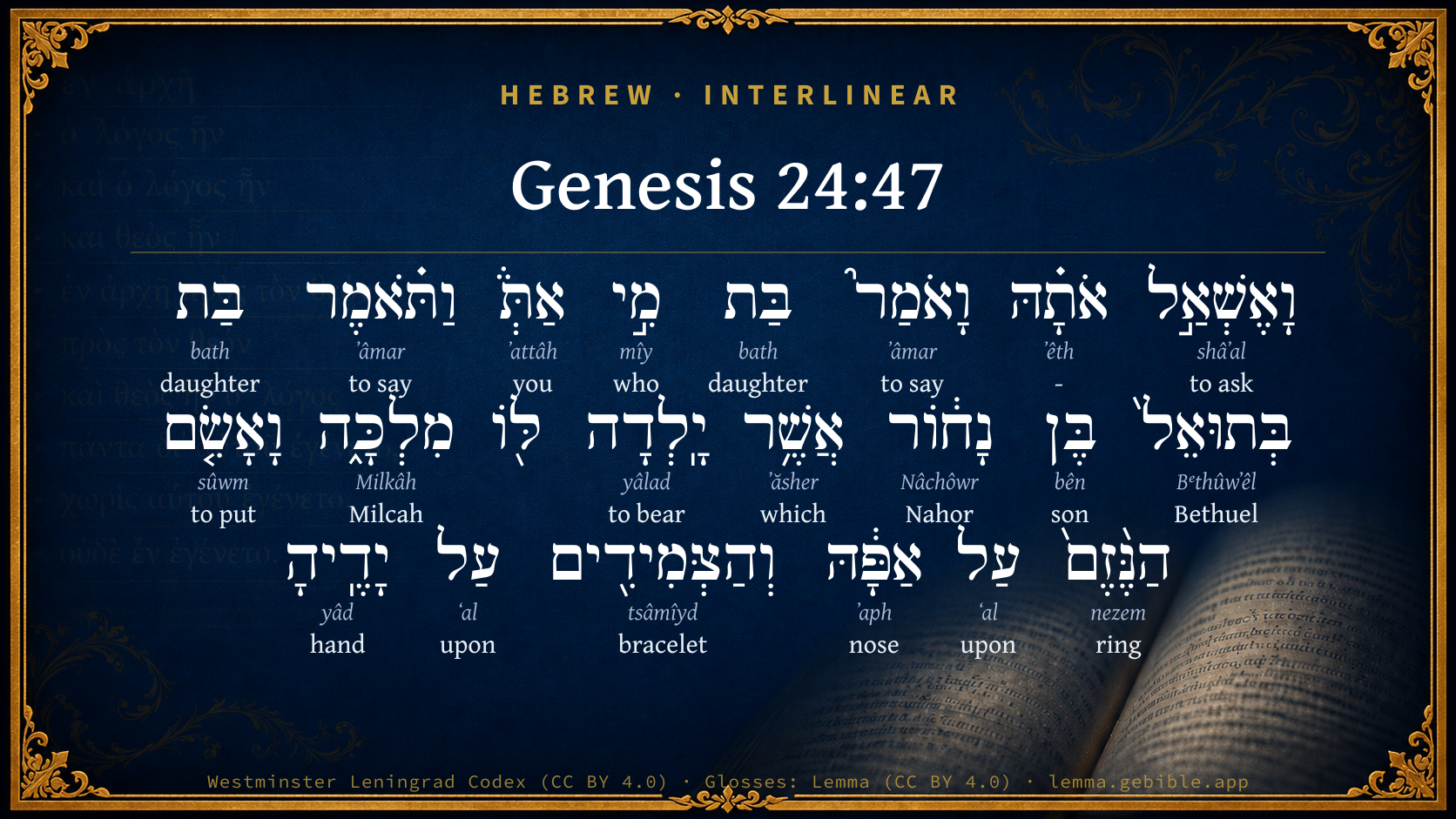
Genesis 24:47

Hebrew (Westminster Leningrad Codex) Genesis 24:47 appears in the Hebrew Old Testament. The text above is from the Westminster Leningrad Codex. Each word links to its Strong’s number, a concise gloss, and parsing drawn from the Open Scriptures Hebrew Bible morphology. Click any word for its full Brown-Driver-Briggs (BDB) entry.
Download image
Cite this verse

Genesis 24:47 (World English Bible). Public Domain. Lemma interlinear Bible study tool, https://lemma.gebible.app/v/genesis/24/47.

Show BibTeX & RIS
BibTeX
RIS
English Translation
I asked her, and said, 'Whose daughter are you?' She said, 'The daughter of Bethuel, Nahor's son, whom Milcah bare to him.' I put the ring on her nose, and the bracelets on her hands.
World English Bible · Public Domain
Highlights
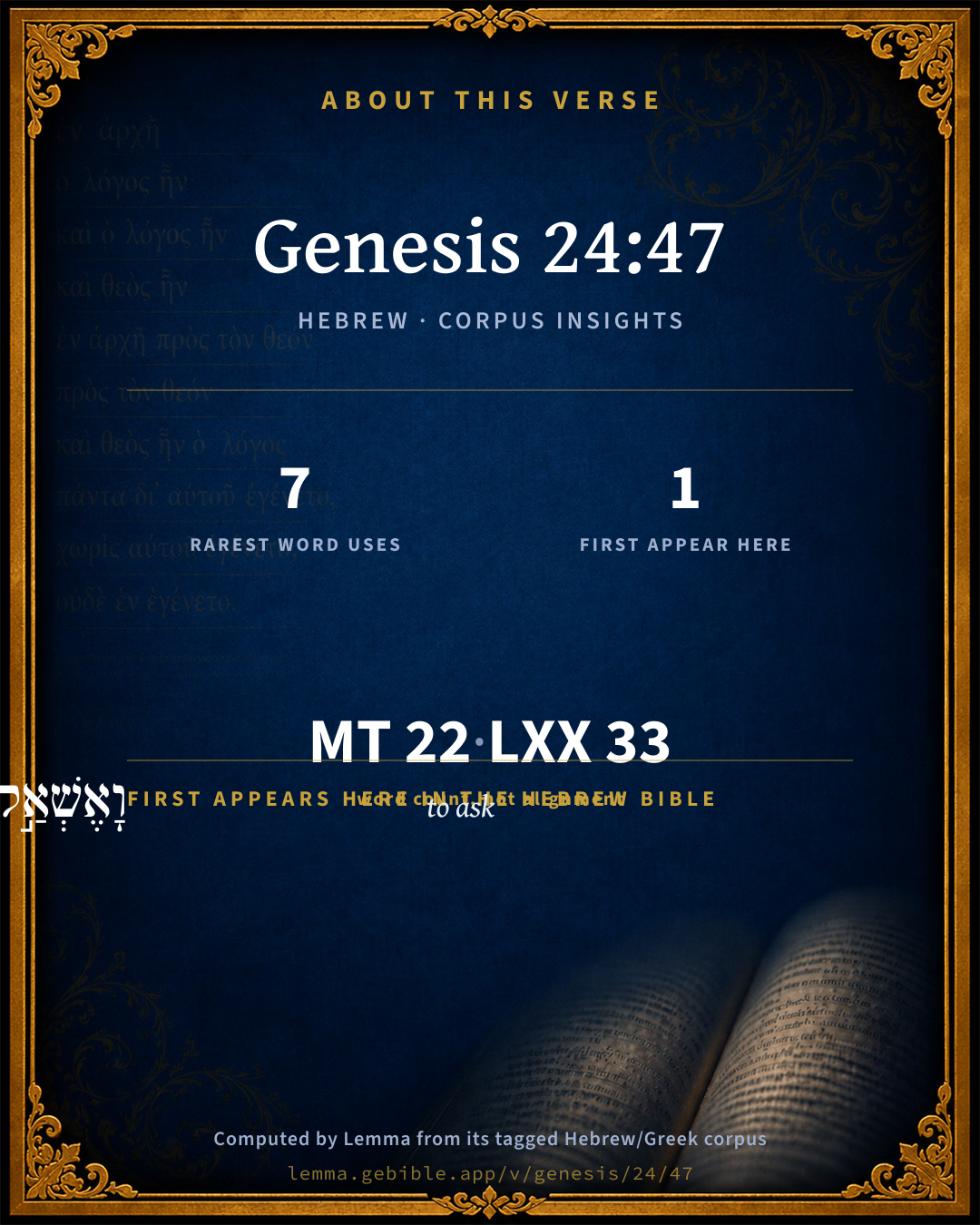
  • 1 first appearance in the Hebrew Bible
Full analysis ↓
Download a study sheet

One document with this verse’s original text, its word-by-word gloss line, the meaning frame, cross-references with their text, attributed commentary, and full source and license credits — printable, and it pastes into notes with its structure intact.

This verse Autodidact and up

Study sheet (.html) Plain text (.txt)

A passage Seminary Student

Up to 50 verses in one chapter. A passage sheet keeps up to 6 commentary sources and 12 cross-references per verse, in the order this page ranks them, and says so on the sheet whenever that leaves anything out. Ask for a single verse and you get the Autodidact verse sheet above.

Everything on this page stays free to read, with no account — the sheet is a download of what is already on screen, not access to it.

Want to remove ads? Support Godless Engineer
Compare translations 3

The same verse in 3 English versions, stacked beneath the original-language interlinear above. Click any original word for its lexicon entry.

Each is an independent rendering of the whole verse — the interlinear is not word-aligned to these translations.

Highlighted words mark where these versions differ — a whole-verse word diff, not a word-by-word alignment.

  • World English Bible Public Domain
    I asked her, and said, 'Whose daughter are you?' She said, 'The daughter of Bethuel, Nahor's son, whom Milcah bare to him.' I put the ring on her nose, and the bracelets on her hands.
  • King James Version Public Domain
    And I asked her, and said, Whose daughter art thou? And she said, the daughter of Bethuel, Nahor's son, whom Milcah bare unto him: and I put the earring upon her face, and the bracelets upon her hands.
  • unfoldingWord Literal Text CC BY-SA 4.0
    Then I asked her and said, ‘Whose daughter you?’ And she said, ‘The daughter of Bethuel, a son of Nahor whom Milcah bore for him.’ Then I put the ring on her nose and the bracelets on her arms.

unfoldingWord Literal Text — © unfoldingWord, licensed CC BY-SA 4.0. Word-aligned USFM3 via Door43 (git.door43.org/unfoldingWord/en_ult).

Versions to compare (up to 4)

3 of 4 selected

Show all 18 translations

Every available English version of this verse, each an independent rendering of the whole verse.

  • World English Bible Public Domain
    I asked her, and said, 'Whose daughter are you?' She said, 'The daughter of Bethuel, Nahor's son, whom Milcah bare to him.' I put the ring on her nose, and the bracelets on her hands.
  • Berean Standard Bible Public Domain
    Then I asked her, ‘Whose daughter are you?’ She replied, ‘The daughter of Bethuel son of Nahor, whom Milcah bore to him.’ So I put the ring on her nose and the bracelets on her wrists.
  • Majority Standard Bible Public Domain
    Then I asked her, ‘Whose daughter are you?’ She replied, ‘The daughter of Bethuel son of Nahor, whom Milcah bore to him.’ So I put the ring on her nose and the bracelets on her wrists.
  • King James Version Public Domain
    And I asked her, and said, Whose daughter art thou? And she said, the daughter of Bethuel, Nahor's son, whom Milcah bare unto him: and I put the earring upon her face, and the bracelets upon her hands.
  • American Standard Version (1901) Public Domain
    And I asked her, and said, Whose daughter art thou? And she said, The daughter of Bethuel, Nahor's son, whom Milcah bare unto him. And I put the ring upon her nose, and the bracelets upon her hands.
  • Revised Version (1885) Public Domain
    And I asked her, and said, Whose daughter art thou? And she said, The daughter of Bethuel, Nahor’s son, whom Milcah bare unto him: and I put the ring upon her nose, and the bracelets upon her hands.
  • Geneva Bible (1599) Public Domain
    Then I asked her, and said, Whose daughter art thou? And she answered, The daughter of Bethuel Nahors sonne, whom Milcah bare vnto him. Then I put the abillement vpon her face, and the bracelets vpon her hands:
  • Douay-Rheims (1899) Public Domain
    And I asked her, and said: Whose daughter art thou? And she answered: I am the daughter of Bathuel, the son of Nachor, whom Melcha bore to him. So I put earrings on her to adorn her face, and I put bracelets on her hands.
  • Young's Literal Translation Public Domain
    `And I ask her, and say, Whose daughter `art' thou? and she saith, Daughter of Bethuel, son of Nahor, whom Milcah hath borne to him, and I put the ring on her nose, and the bracelets on her hands,
  • Literal Standard Version CC BY-SA 4.0
    And I ask her, and say, Whose daughter [are] you? And she says, Daughter of Bethuel, son of Nahor, whom Milcah has borne to him, and I put the ring on her nose, and the bracelets on her hands,
  • Unlocked Literal Bible CC BY-SA 4.0
    I asked her and said, 'Whose daughter are you?' She said, 'The daughter of Bethuel, Nahor's son, whom Milkah bore to him.' Then I put the ring in her nose and the bracelets on her arms.
  • unfoldingWord Literal Text CC BY-SA 4.0
    Then I asked her and said, ‘Whose daughter you?’ And she said, ‘The daughter of Bethuel, a son of Nahor whom Milcah bore for him.’ Then I put the ring on her nose and the bracelets on her arms.
  • Darby Bible Public Domain
    And I asked her, and said, Whose daughter art thou? And she said, The daughter of Bethuel, Nahor's son, whom Milcah bore to him. And I put the ring on her nose, and the bracelets on her hands.
  • World Messianic Bible Public Domain
    I asked her, and said, ‘Whose daughter are you?’ She said, ‘The daughter of Bethuel, Nahor’s son, whom Milcah bore to him.’ I put the ring on her nose, and the bracelets on her hands.
  • Webster's Bible Public Domain
    And I asked her, and said, Whose daughter art thou? And she said, The daughter of Bethuel, Nahor's son, whom Milcah bore to him: and I put the ear-ring upon her face, and the bracelets upon her hands.
  • Free Bible Version CC BY-SA 4.0
    I asked her, ‘Whose daughter are you?’ She replied, ‘I'm the daughter of Bethuel, the son of Milcah and Nahor.’ So I put the ring in her nose, and the bracelets on her wrists.
  • Bible in Basic English Public Domain
    And questioning her, I said, Whose daughter are you? And she said, The daughter of Bethuel, the son of Nahor, and Milcah his wife. Then I put the ring on her nose and the ornaments on her hands.
  • JPS Tanakh (1917) Public Domain
    And I asked her, and said: Whose daughter art thou? And she said: The daughter of Bethuel, Nahor's son, whom Milcah bore unto him. And I put the ring upon her nose, and the bracelets upon her hands.

Literal Standard Version (2020), Covenant Press — licensed CC BY-SA 4.0. Text via the HelloAO Bible API (eBible.org). Unlocked Literal Bible (unfoldingWord) — licensed CC BY-SA 4.0. Text via the HelloAO Bible API (eBible.org). unfoldingWord Literal Text — © unfoldingWord, licensed CC BY-SA 4.0. Word-aligned USFM3 via Door43 (git.door43.org/unfoldingWord/en_ult). Free Bible Version, Dr. Jonathan Gallagher — licensed CC BY-SA 4.0. Text via the HelloAO Bible API (eBible.org).

Word by word

More ways to search: Search by grammar → Find every occurrence → Compare this word →

Practice this passage: Drill this verse → Learn its vocabulary →

וְהַצְּמִידִ֖ים
tsâmîyd
H6781
“and · the · bracelets”
Conjunction + Particle, Definite Article + Noun, Common, Masculine, Plural, Absolute
Part of Speech
Conjunction + Particle + Noun
Type
Common
Gender
Masculine
Number
Plural
State
Absolute
Full BDB Definition

Origin: from H6775

TWOT: 1927b , 1927c

bracelet - cover (of vessel)
  1. וָאֶשְׁאַ֣ל shâʼal H7592 “and · to ask” Conjunction + Verb, Qal, Sequential Imperfect, 1st Person, Common, Singular
  2. אֹתָ֗הּ ʼêth H853 “- · her” Particle, Direct Object + Suffix, Personal, 3rd Person, Feminine, Singular
  3. וָאֹמַר֮ ʼâmar H559 “and · to say” Conjunction + Verb, Qal, Sequential Imperfect, 1st Person, Common, Singular
  4. בַּת bath H1323 “daughter of” Noun, Common, Feminine, Singular, Construct
  5. מִ֣י mîy H4310 “who” Particle, Interrogative
  6. אַתְּ֒ ʼattâh H859 “you” Pronoun, Personal, 2nd Person, Feminine, Singular
  7. וַתֹּ֗אמֶר ʼâmar H559 “and · to say” Conjunction + Verb, Qal, Sequential Imperfect, 3rd Person, Feminine, Singular
  8. בַּת bath H1323 “daughter of” Noun, Common, Feminine, Singular, Construct
  9. בְּתוּאֵל֙ Bᵉthûwʼêl H1328 “Bethuel” Noun, Proper
  10. בֶּן bên H1121 “son of” Noun, Common, Masculine, Singular, Construct
  11. נָח֔וֹר Nâchôwr H5152 “Nahor” Noun, Proper
  12. אֲשֶׁ֥ר ʼăsher H834 “which” Particle, Relative
  13. יָֽלְדָה yâlad H3205 “to bear” Verb, Qal, Perfect, 3rd Person, Feminine, Singular
  14. מִלְכָּ֑ה Milkâh H4435 “Milcah” Noun, Proper
  15. וָאָשִׂ֤ם sûwm H7760 “and · to put” Conjunction + Verb, Qal, Sequential Imperfect, 1st Person, Common, Singular
  16. הַנֶּ֨זֶם֙ nezem H5141 “the · ring” Particle, Definite Article + Noun, Common, Masculine, Singular, Absolute
  17. עַל ʻal H5921 “upon” Preposition
  18. אַפָּ֔הּ ʼaph H639 “nose · her” Noun, Common, Masculine, Singular, Construct + Suffix, Personal, 3rd Person, Feminine, Singular
  19. עַל ʻal H5921 “upon” Preposition
  20. יָדֶֽיהָ yâd H3027 “hands · her” Noun, Common, Both, Dual, Construct + Suffix, Personal, 3rd Person, Feminine, Singular

About this verse

These counts appear in no published source. They are computed here, from the morphology-tagged text and Lemma’s own curated glosses. What Lemma adds →

22
words
18
distinct lemmas
Pentateuch
section

Notable vocabulary

The rarest word here is וְהַצְּמִידִ֖ים bracelet H6781 — appearing just 7 times in the whole Hebrew Bible.

First appearance in Scripture

This word makes its first canonical appearance in the Hebrew Bible here:

  • וָאֶשְׁאַ֣ל to ask H7592

Shared distinctive vocabulary

וְהַצְּמִידִ֖ים bracelet H6781 occurs in 7 verses of the Hebrew Bible. Also found in:

Grammatical profile

  • 5 verbs
  • 10 nouns
  • 1 pronoun
  • 3 prepositions
  • 3 particles

Verb forms

  • וָאֶשְׁאַ֣ל Qal · Sequential Imperfect
  • וָאֹמַר֮ Qal · Sequential Imperfect
  • וַתֹּ֗אמֶר Qal · Sequential Imperfect
  • יָֽלְדָה Qal · Perfect
  • וָאָשִׂ֤ם Qal · Sequential Imperfect

Repetition

Words recur within this verse — often emphatic in Hebrew:

  • וָאֹמַר֮ to say H559 ×2
  • בַּת daughter H1323 ×2
  • עַל upon H5921 ×2

Hebrew & Septuagint length

In English translation the verse runs 35 words from the Hebrew and 42 from the Septuagint (LXX English) — closely comparable.

A rough comparison of the two English renderings, which tokenize alike — not a word-level alignment.

Word counts can differ between the Hebrew and the Greek without any difference in meaning — e.g. the Hebrew direct-object marker אֵת has no separate Greek word, and Greek often adds the article ὁ.

In the original languages it is 22 Hebrew tokens and 33 Greek tokens — but the two are counted differently (Hebrew bundles its prefixes and suffixes into one token; the Greek is in lemma form), so that isn’t a like-for-like length.

Cross-references

7

Topical passages linked to Genesis 24:47 in the Treasury of Scripture Knowledge — connected by theme and wording, ordered by reader-vote popularity; previews shown in the World English Bible.

  • Genesis 24:22–24 It happened, as the camels had done drinking, that the man took a golden ring of half a shekel weight, and two bracelets for her hands of ten shekels weight of gold,
  • Genesis 24:53 The servant brought forth jewels of silver, and jewels of gold, and clothing, and gave them to Rebekah. He gave also to her brother and to her mother precious things.
  • Psalms 45:13–14 The princess inside is all glorious. Her clothing is interwoven with gold.
  • Isaiah 62:3–5 You shall also be a crown of beauty in the hand of Yahweh, and a royal diadem in the hand of your God.
  • Ezekiel 16:10–13 I clothed you also with embroidered work, and shod you with sealskin, and I girded you about with fine linen, and covered you with silk.
  • Psalms 45:9 Kings' daughters are among your honorable women. At your right hand the queen stands in gold of Ophir.
  • Ephesians 5:26–27 that he might sanctify it, having cleansed it by the washing of water with the word,

Cross-references courtesy of OpenBible.info (CC BY 4.0).

Hebrew and Greek witnesses Masoretic Hebrew ↔ Greek Septuagint

The same verse in the two great witnesses to the Old Testament, shown verse-for-verse.

These are two independent witnesses, not word-aligned to each other, and the Septuagint is shown in lemma (dictionary) form.

Hebrew Genesis 24:47 Masoretic · Westminster Leningrad Codex

וָאֶשְׁאַ֣ל אֹתָ֗הּ וָאֹמַר֮ בַּת מִ֣י אַתְּ֒ וַתֹּ֗אמֶר בַּת בְּתוּאֵל֙ בֶּן נָח֔וֹר אֲשֶׁ֥ר יָֽלְדָה לּ֖וֹ מִלְכָּ֑ה וָאָשִׂ֤ם הַנֶּ֨זֶם֙ עַל אַפָּ֔הּ וְהַצְּמִידִ֖ים עַל יָדֶֽיהָ

I asked her, and said, 'Whose daughter are you?' She said, 'The daughter of Bethuel, Nahor's son, whom Milcah bare to him.' I put the ring on her nose, and the bracelets on her hands.

World English Bible · Public Domain

Greek LXX Genesis 24:47 Septuagint · lemma form

καί ἐρωτάω αὐτός καί εἶπον τίς εἰμί θυγάτηρ ὁ δέ φημί θυγάτηρ βαθουηλ εἰμί ὁ υἱός ναχωρ ὅς τίκτω αὐτός μελχα καί περιτίθημι αὐτός ὁ ἐνώτιον καί ὁ ψέλιον περί ὁ χείρ αὐτός

And I asked her, and said, Whose daughter are you? tell me; and she said, I am daughter of Bathuel the son of Nachor, whom Melcha bore to him; and I put on her the ear-rings, and the bracelets on her hands.

LXX2012 (modern English Septuagint) · Public Domain

Hebrew: Westminster Leningrad Codex (CC BY 4.0). Greek: Septuagint (public domain); English from LXX2012 (modern English Septuagint) (Public Domain). How the Septuagint differs from the Hebrew →

Targum (Aramaic paraphrase)

2

The Targum is the ancient Jewish Aramaic paraphrase of the Hebrew Scriptures — an interpretive translation, not the Hebrew text itself. Onkelos (literal) and Pseudo-Jonathan (expansive) render the Torah, and Jonathan the Prophets. Coverage is partial: where no permissively-licensed English translation exists for a verse, only the Aramaic is shown. This is verse-level text, not a word-by-word alignment to the Hebrew.

  1. Targum Onkelos Torah (Genesis–Deuteronomy)
    וּשְׁאֵילִית יָתַהּ וַאֲמָרִית בַּת מָן אַתְּ וַאֲמֶרֶת בַּת בְּתוּאֵל בַּר נָחוֹר דִּילֵידַת לֵהּ מִלְכָּה וְשַׁוֵּיתִי קָדָשָׁא עַל אַפַּהּ וְשִׁירַיָּא עַל יְדָהָא

    (no public-domain English translation for this verse)

    Targum Onkelos — Aramaic: “Onkelos Genesis” (public domain); “Onkelos Exodus” (public domain); “Onkelos Leviticus” (public domain); “Onkelos Numbers” (public domain); “Onkelos Deuteronomy” (public domain). English: “Sefaria Community Translation” (CC0 1.0 (public-domain dedication)); “J.W. Etheridge. The Targums of Onkelos and Jonathan Ben Uzziel on the Pentateuch. London: Longmans, Green, 1862” (public domain). Text via Sefaria.

  2. Targum Pseudo-Jonathan Torah (Genesis–Deuteronomy)
    וּשְׁאִילַת יָתָהּ וַאֲמָרִית בְּרַתְּ מָאן אַנְתְּ וַאֲמַרַת בְּרַת בְּתוּאֵל בַּר נָחוֹר דִלֵידַת לֵיהּ מִלְכָּה וְשַׁוִיַת קָדָשָׁא עַל אַפָּהּ וְשִׁירַיָא עַל יָדָהָא

    And I asked her, and said, Whose daughter art thou? And she said, The daughter of Bethuel, the son of Nachor, whom Milcha bare to him. And I set the jewel upon her brow, and the bracelets on her hand,

    Targum Pseudo-Jonathan — Aramaic: “Targum Jonathan on Genesis” (public domain); “Targum Jonathan on Exodus” (public domain); “Targum Jonathan on Leviticus” (public domain); “Targum Jonathan on Numbers” (public domain); “Targum Jonathan on Deuteronomy” (public domain). English: “The Targum of Jonathan ben Uzziel, trans. J. W. Etheridge, London, 1862” (public domain). Text via Sefaria.

Commentary

Notes on Genesis 24:47 from classic Christian and Jewish commentators (each source and its license shown beneath its notes). The classic Christian expositions comment on the surrounding passage and are grouped to its opening verse, so a note may address several verses; the Jewish commentaries on the Tanakh (Rashi and others) are per-verse, so they appear only where the commentator wrote on this verse.

Lemma curates 59 commentaries, every one of them public domain or Creative Commons licensed, each selected and text-cleaned for this edition rather than reprinted as found. About our sources →

Trapp's Complete Commentary

John Trapp

Gen 24:47 And I asked her, and said, Whose daughter [art] thou? And she said, The daughter of Bethuel, Nahor’s son, whom Milcah bare unto him: and I put the earring upon her face, and the bracelets upon her hands.

Ver. 47. And I put the earring upon her face.] So did Christ put upon his spouse his own comeliness, {a} which was as a jewel on her forehead, an earring in her ear, and a beautiful crown upon her head; {Eze 16:12-14} - whence she is called Callah, of the perfection of her beauty and bravery; and {Jer 2:32} Hephzibah, {Isa 62:4} of his delight in her; since he hath purified her, as Esther; sanctified her; {Eph 5:26} and so beautified her, that now he "rejoiceth over her as a bridegroom doth over his bride". {Isa 62:5} Yea, he "resteth in his love," and will seek no further; he "joyeth over her with singing," as well paid for his choice. {Zep 3:17}

{a} "Uxor splendet radiis mariti." A maxim in the civil law.

John Trapp, A Commentary or Exposition upon All the Books of the Old and New Testament (1647–1656) — public domain. Text from a community e-Sword module.

Ellicott's Commentary for English Readers

(47) Upon her face.—Heb., upon her nose. This mistranslation explains the strange rendering jewel for the forehead in the margin of Gen_24:22.

A Bible Commentary for English Readers, edited by Charles John Ellicott (1878–1897) — public domain. Text from a community e-Sword module.

John Gill's Exposition

And it came to pass, that when Abraham's servant heard these words,.... That Laban and Bethuel said; and no doubt but the mother of Rebekah, and she herself consented that she should be the wife of Isaac, believing it was agreeable to the will of God:

he worshipped the Lord, bowing himself to the earth; in the most humble manner he prostrated himself before the Lord, acknowledging his kindness, and goodness, his faithfulness and truth, his power and his providence in this affair.

John Gill's Exposition of the Whole Bible (1746–1763) — public domain (CC PDM 1.0). Text via the HelloAO Bible API.

Matthew Poole's English Annotations

First he asks who she was, then he gives the gifts to her; which is the right order, and is here observed in the repetition; which was inverted in the first relation, Gen 24:22,23.

Matthew Poole's English Annotations on the Holy Bible (1683–1685) — public domain. Text from a community e-Sword/MySword module.

unfoldingWord translationNotes

Door43 World Missions Community

General Information:

Abraham's servant continues speaking to Rebekah's family.

The daughter of Bethuel, Nahor's son, whom Milkah bore to him

"My father is Bethuel. His parents are Nahor and Milkah"

ring ... bracelets

In this story, all of these items were made of gold. See how you translated these in Genesis 24:22.

I bowed down

This is a sign of humility before God. (See: Symbolic Action)

led me by the right way

"brought me here"

who had led me

The connecting word "because" can be used to show this is why the servant worshiped God. AT: "because Yahweh led me" (See: Connecting Words)

my master's relative

This refers to Bethuel, the son of Abraham's brother Nahor.

translationWords

bow

worship

Yahweh

bless

God

lord

unfoldingWord translationNotes — © Distant Shores Media and the Door43 World Missions Community, licensed CC BY-SA 4.0. Source: git.door43.org/Door43/en_tn.

Rashi

Rabbi Shlomo Yitzchaki (Rashi)

ואשאל...ואשם AND I ASKED HER... AND I PUT THE RING —He changed the order of proceedings for in fact he had first given the presents and afterwards questioned her. But he did this in order that they should not catch him by his own words and say, "How could you give her anything when you did not yet know who she was!"

Rashi on the Tanakh — English translations: “The Judaica Press complete Tanach with Rashi, translated by A. J. Rosenberg” (CC BY 4.0); “Pentateuch with Rashi's commentary by M. Rosenbaum and A.M. Silbermann, 1929-1934” (public domain); “The Metsudah Tanach series, Lakewood, N.J” (CC BY 4.0); and “The Book of Joshua, Metsudah Publications, 1997” (CC BY 4.0). Text via Sefaria.

Lesson kit

Teaching starters — assembled from the data on this page, not authored interpretation. Every prompt links to the verse data it draws on. Edit before teaching.

Genesis, in the Pentateuch, opens this verse with 22 words (18 distinct Hebrew lemmas). Its most distinctive word is tsâmîyd (“bracelet”). A historical commentator’s framing appears above. Read the whole chapter for the surrounding context.

Discussion questions

  1. What does “bracelet” (tsâmîyd) contribute to the verse as a whole?
  2. This is the first place “to ask” appears in Scripture (first appears here). What does its debut here establish?
  3. How does Genesis 24:22, which shares the word «bracelet», read alongside this verse?
  4. What does the repetition of “to say” (2× in this one verse) do in this verse?
  5. The translations on this page render this verse differently — a whole-verse word diff, not a word-by-word alignment. What might account for the different wordings?
  6. «וָאֶשְׁאַ֣ל» is a Qal Sequential Imperfect verb. How does that grammatical form shape the action described?
  7. Compare how Trapp's Complete Commentary and Ellicott's Commentary for English Readers read this verse. Where do they agree or differ?

Things to notice

Reading settings

Reading text

Shown beneath each verse's original-language words.

Old Testament
Old Testament edition

Read the OT as the Masoretic Hebrew (MT) or the Greek Septuagint (LXX).

English shown for the Greek Septuagint (in the Hebrew ↔ Greek comparison).

Comparing translations? Open the Compare panel on any verse page to stack up to four side by side.