
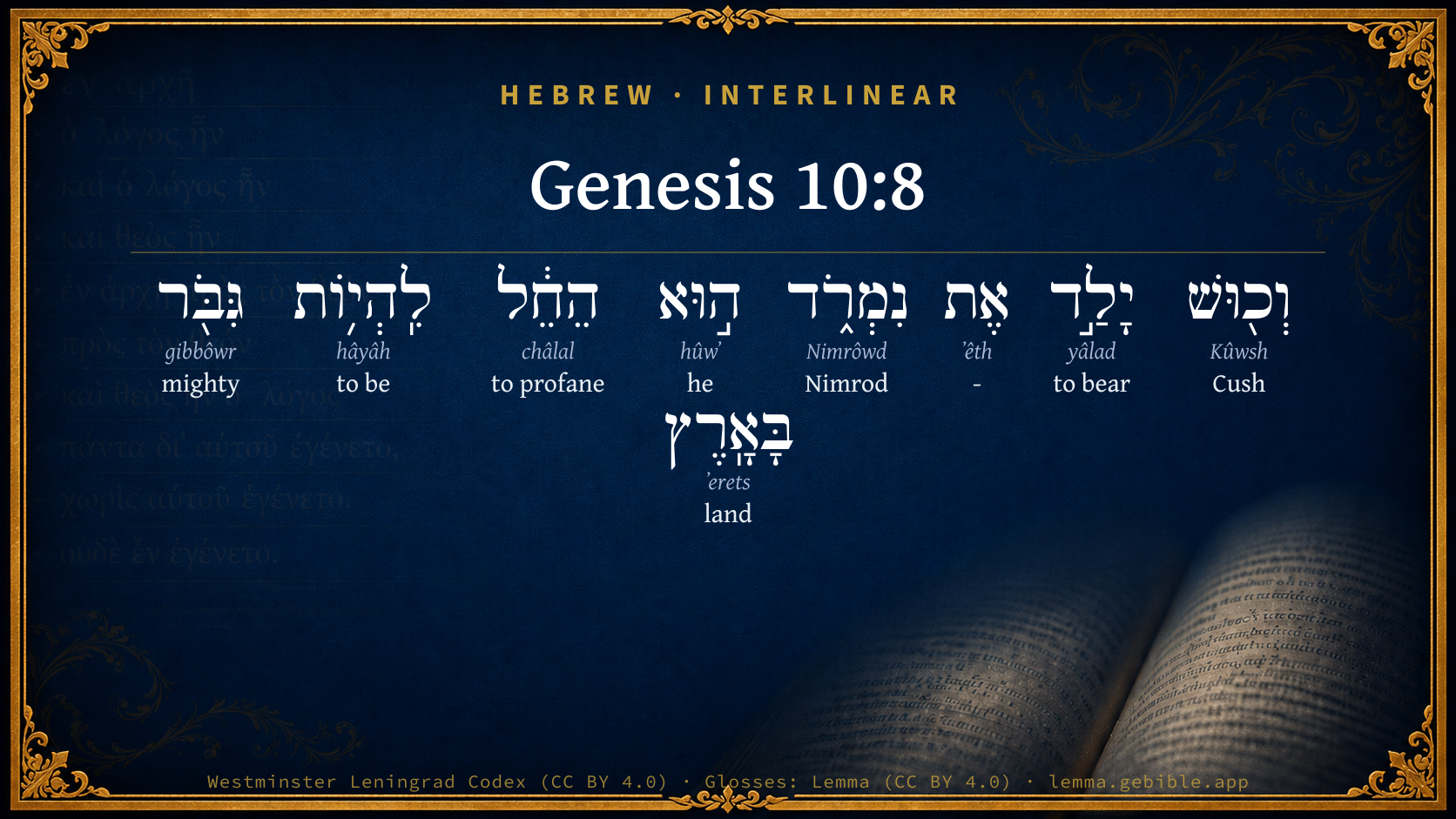
Genesis 10:8

Hebrew (Westminster Leningrad Codex) Genesis 10:8 appears in the Hebrew Old Testament. The text above is from the Westminster Leningrad Codex. Each word links to its Strong’s number, a concise gloss, and parsing drawn from the Open Scriptures Hebrew Bible morphology. Click any word for its full Brown-Driver-Briggs (BDB) entry.
Download image
Cite this verse

Genesis 10:8 (World English Bible). Public Domain. Lemma interlinear Bible study tool, https://lemma.gebible.app/v/genesis/10/8.

Show BibTeX & RIS
BibTeX
RIS
English Translation
Cush became the father of Nimrod: he began to be a mighty one in the earth.
World English Bible · Public Domain
Highlights
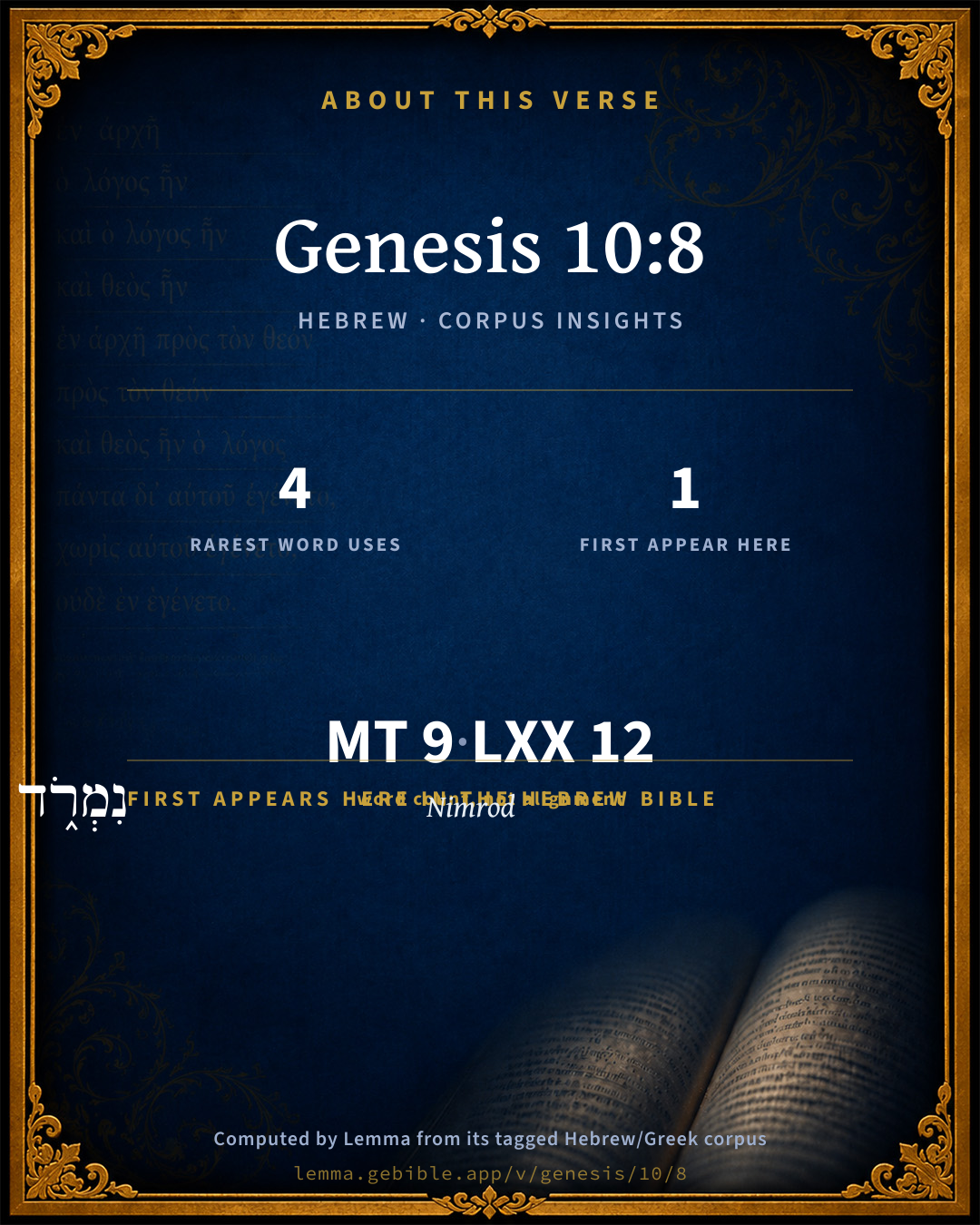
  • 1 first appearance in the Hebrew Bible
Full analysis ↓
Download a study sheet

One document with this verse’s original text, its word-by-word gloss line, the meaning frame, cross-references with their text, attributed commentary, and full source and license credits — printable, and it pastes into notes with its structure intact.

This verse Autodidact and up

Study sheet (.html) Plain text (.txt)

A passage Seminary Student

Up to 50 verses in one chapter. A passage sheet keeps up to 6 commentary sources and 12 cross-references per verse, in the order this page ranks them, and says so on the sheet whenever that leaves anything out. Ask for a single verse and you get the Autodidact verse sheet above.

Everything on this page stays free to read, with no account — the sheet is a download of what is already on screen, not access to it.

Want to remove ads? Support Godless Engineer
Compare translations 3

The same verse in 3 English versions, stacked beneath the original-language interlinear above. Click any original word for its lexicon entry.

Each is an independent rendering of the whole verse — the interlinear is not word-aligned to these translations.

Highlighted words mark where these versions differ — a whole-verse word diff, not a word-by-word alignment.

  • World English Bible Public Domain
    Cush became the father of Nimrod: he began to be a mighty one in the earth.
  • King James Version Public Domain
    And Cush begat Nimrod: he began to be a mighty one in the earth.
  • unfoldingWord Literal Text CC BY-SA 4.0
    Cush also fathered Nimrod, who began to be mighty on the earth.

unfoldingWord Literal Text — © unfoldingWord, licensed CC BY-SA 4.0. Word-aligned USFM3 via Door43 (git.door43.org/unfoldingWord/en_ult).

Versions to compare (up to 4)

3 of 4 selected

Show all 18 translations

Every available English version of this verse, each an independent rendering of the whole verse.

  • World English Bible Public Domain
    Cush became the father of Nimrod: he began to be a mighty one in the earth.
  • Berean Standard Bible Public Domain
    Cush was the father of Nimrod, who began to be a mighty one on the earth.
  • Majority Standard Bible Public Domain
    Cush was the father of Nimrod, who began to be a mighty one on the earth.
  • King James Version Public Domain
    And Cush begat Nimrod: he began to be a mighty one in the earth.
  • American Standard Version (1901) Public Domain
    And Cush begat Nimrod: he began to be a mighty one in the earth.
  • Revised Version (1885) Public Domain
    And Cush begat Nimrod: he began to be a mighty one in the earth.
  • Geneva Bible (1599) Public Domain
    And Cush begate Nimrod, who began to be mightie in the earth.
  • Douay-Rheims (1899) Public Domain
    Now Chus begot Nemrod: he began to be mighty on earth.
  • Young's Literal Translation Public Domain
    And Cush hath begotten Nimrod;
  • Literal Standard Version CC BY-SA 4.0
    And Cush has begotten Nimrod;
  • Unlocked Literal Bible CC BY-SA 4.0
    Cush became the father of Nimrod, who was the first conqueror on the earth.
  • unfoldingWord Literal Text CC BY-SA 4.0
    Cush also fathered Nimrod, who began to be mighty on the earth.
  • Darby Bible Public Domain
    And Cush begot Nimrod: he began to be mighty on the earth.
  • World Messianic Bible Public Domain
    Cush became the father of Nimrod. He began to be a mighty one in the earth.
  • Webster's Bible Public Domain
    And Cush begat Nimrod: he began to be a mighty one in the earth.
  • Free Bible Version CC BY-SA 4.0
    Cush was also the father of Nimrod, who set himself up as the first tyrant on earth.
  • Bible in Basic English Public Domain
    And Cush was the father of Nimrod, who was the first of the great men of the earth.
  • JPS Tanakh (1917) Public Domain
    And Cush begot Nimrod; he began to be a mighty one in the earth.

Literal Standard Version (2020), Covenant Press — licensed CC BY-SA 4.0. Text via the HelloAO Bible API (eBible.org). Unlocked Literal Bible (unfoldingWord) — licensed CC BY-SA 4.0. Text via the HelloAO Bible API (eBible.org). unfoldingWord Literal Text — © unfoldingWord, licensed CC BY-SA 4.0. Word-aligned USFM3 via Door43 (git.door43.org/unfoldingWord/en_ult). Free Bible Version, Dr. Jonathan Gallagher — licensed CC BY-SA 4.0. Text via the HelloAO Bible API (eBible.org).

Word by word

More ways to search: Search by grammar → Find every occurrence → Compare this word →

Practice this passage: Drill this verse → Learn its vocabulary →

About this verse

These counts appear in no published source. They are computed here, from the morphology-tagged text and Lemma’s own curated glosses. What Lemma adds →

9
words
9
distinct lemmas
Pentateuch
section

Notable vocabulary

The rarest word here is נִמְרֹ֑ד Nimrod H5248 — appearing just 4 times in the whole Hebrew Bible.

First appearance in Scripture

This word makes its first canonical appearance in the Hebrew Bible here:

  • נִמְרֹ֑ד Nimrod H5248

Shared distinctive vocabulary

נִמְרֹ֑ד Nimrod H5248 occurs in 4 verses of the Hebrew Bible. Also found in:

Grammatical profile

  • 3 verbs
  • 3 nouns
  • 1 adjective
  • 1 pronoun
  • 1 particle

Verb forms

  • יָלַ֣ד Qal · Perfect
  • הֵחֵ֔ל Hiphil · Perfect
  • לִֽהְי֥וֹת Qal · Infinitive Construct

Hebrew & Septuagint length

In English translation the verse runs 16 words from the Hebrew and 13 from the Septuagint (LXX English) — closely comparable.

A rough comparison of the two English renderings, which tokenize alike — not a word-level alignment.

Word counts can differ between the Hebrew and the Greek without any difference in meaning — e.g. the Hebrew direct-object marker אֵת has no separate Greek word, and Greek often adds the article ὁ.

In the original languages it is 9 Hebrew tokens and 12 Greek tokens — but the two are counted differently (Hebrew bundles its prefixes and suffixes into one token; the Greek is in lemma form), so that isn’t a like-for-like length.

Cross-references

1

Topical passages linked to Genesis 10:8 in the Treasury of Scripture Knowledge — connected by theme and wording, ordered by reader-vote popularity; previews shown in the World English Bible.

  • Micah 5:6 They will rule the land of Assyria with the sword, And the land of Nimrod in its gates. He will deliver us from the Assyrian, When he invades our land, And when he marches within our border.

Cross-references courtesy of OpenBible.info (CC BY 4.0).

Hebrew and Greek witnesses Masoretic Hebrew ↔ Greek Septuagint

The same verse in the two great witnesses to the Old Testament, shown verse-for-verse.

These are two independent witnesses, not word-aligned to each other, and the Septuagint is shown in lemma (dictionary) form.

Hebrew Genesis 10:8 Masoretic · Westminster Leningrad Codex

וְכ֖וּשׁ יָלַ֣ד אֶת נִמְרֹ֑ד ה֣וּא הֵחֵ֔ל לִֽהְי֥וֹת גִּבֹּ֖ר בָּאָֽרֶץ

Cush became the father of Nimrod: he began to be a mighty one in the earth.

World English Bible · Public Domain

Greek LXX Genesis 10:8 Septuagint · lemma form

χους δέ γεννάω ὁ νεβρωδ οὗτος ἄρχω εἰμί γίγας ἐπί ὁ γῆ

And Chus begot Nebrod: he began to be a giant upon the earth.

LXX2012 (modern English Septuagint) · Public Domain

On this verse, Ellicott's Commentary for English Readers discusses the Septuagint’s reading. Read the note in Commentary ↓

Hebrew: Westminster Leningrad Codex (CC BY 4.0). Greek: Septuagint (public domain); English from LXX2012 (modern English Septuagint) (Public Domain). How the Septuagint differs from the Hebrew →

Targum (Aramaic paraphrase)

2

The Targum is the ancient Jewish Aramaic paraphrase of the Hebrew Scriptures — an interpretive translation, not the Hebrew text itself. Onkelos (literal) and Pseudo-Jonathan (expansive) render the Torah, and Jonathan the Prophets. Coverage is partial: where no permissively-licensed English translation exists for a verse, only the Aramaic is shown. This is verse-level text, not a word-by-word alignment to the Hebrew.

  1. Targum Onkelos Torah (Genesis–Deuteronomy)
    וְכוּשׁ אוֹלִיד יָת נִמְרֹד הוּא שָׁרֵי לְמֵהֲוֵי גִבַּר תַּקִּיף בְּאַרְעָא

    And Kush begat Nimrod: he began to be a powerful man in the earth.

    Targum Onkelos — Aramaic: “Onkelos Genesis” (public domain); “Onkelos Exodus” (public domain); “Onkelos Leviticus” (public domain); “Onkelos Numbers” (public domain); “Onkelos Deuteronomy” (public domain). English: “Sefaria Community Translation” (CC0 1.0 (public-domain dedication)); “J.W. Etheridge. The Targums of Onkelos and Jonathan Ben Uzziel on the Pentateuch. London: Longmans, Green, 1862” (public domain). Text via Sefaria.

  2. Targum Pseudo-Jonathan Torah (Genesis–Deuteronomy)
    וְכוּשׁ אוֹלִיד יַת נִמְרוֹד הוּא שָׁרֵי לְמֶהֱוֵי גִבַר בְּחֶטְאָה וּלְמֵרְדָא קֳדָם יְיָ בְּאַרְעָא

    And Kush begat Nimrod: he began to be mighty in sin, and to rebel before the Lord in the earth.

    Targum Pseudo-Jonathan — Aramaic: “Targum Jonathan on Genesis” (public domain); “Targum Jonathan on Exodus” (public domain); “Targum Jonathan on Leviticus” (public domain); “Targum Jonathan on Numbers” (public domain); “Targum Jonathan on Deuteronomy” (public domain). English: “The Targum of Jonathan ben Uzziel, trans. J. W. Etheridge, London, 1862” (public domain). Text via Sefaria.

Commentary

Notes on Genesis 10:8 from classic Christian and Jewish commentators (each source and its license shown beneath its notes). The classic Christian expositions comment on the surrounding passage and are grouped to its opening verse, so a note may address several verses; the Jewish commentaries on the Tanakh (Rashi and others) are per-verse, so they appear only where the commentator wrote on this verse.

Lemma curates 59 commentaries, every one of them public domain or Creative Commons licensed, each selected and text-cleaned for this edition rather than reprinted as found. About our sources →

Trapp's Complete Commentary

John Trapp

Gen 10:8 And Cush begat Nimrod: he began to be a mighty one in the earth.

Ver. 8. Nimrod, he began to be a mighty one.] His name signifies a rebel: he was the chief Babel builder, and there began to be a mighty one. A giant, saith the Greek, - such another as Goliath was in his generation, {1Sa 17:51} where the same word is used, - a magnifico, a grandio; such a one as sought to make himself great, even to a proverb. {Gen 10:9} But there is a double greatness; first, genuine; secondly, brutal. This latter is no such commendation; a beast in this may, and doth exceed us; as in the former, we exceed ourselves and others.

John Trapp, A Commentary or Exposition upon All the Books of the Old and New Testament (1647–1656) — public domain. Text from a community e-Sword module.

Tyndale Open Study Notes

Tyndale Open Resources

10:8-12 Special attention is given to the early history of Babylonia and Assyria, the Mesopotamian empires that would conquer and exile Israel and Judah.

Tyndale Open Study Notes — © Tyndale Open Resources, licensed CC BY-SA 4.0. Text via the HelloAO Bible API.

Geneva Bible (1599)

Geneva Bible translators

Meaning, a cruel oppressor and tyrant.

Geneva Bible (1599) marginal notes — public domain. Text via Bolls.life.

Jamieson, Fausset & Brown

Robert Jamieson, A. R. Fausset & David Brown

Nimrod--mentioned as eclipsing all his family in renown. He early distinguished himself by his daring and successful prowess in hunting wild beasts. By those useful services he earned a title to public gratitude; and, having established a permanent ascendancy over the people, he founded the first kingdom in the world [Gen 10:10].

Jamieson, Fausset & Brown — Commentary Critical and Explanatory on the Whole Bible (1871) — public domain (CC PDM 1.0). Text via the HelloAO Bible API.

Adam Clarke's Commentary

Verse 8. Nimrod] Of this person little is known, as he is not mentioned except here and and in 1Ch 1:10, which is evidently a copy of the text in Genesis. He is called a mighty hunter before the Lord; and from Ge 10:10, we learn that he founded a kingdom which included the cities Babel, Erech, Accad, and Calneh, in the land of Shinar. Though the words are not definite, it is very likely he was a very bad man. His name Nimrod comes from מרד, marad, he rebelled; and the Targum, on 1Ch 1:10, says: Nimrod began to be a mighty man in sin, a murderer of innocent men, and a rebel before the Lord. The Jerusalem Targum says: "He was mighty in hunting (or in prey) and in sin before God, for he was a hunter of the children of men in their languages; and he said unto them, Depart from the religion of Shem, and cleave to the institutes of Nimrod." The Targum of Jonathan ben Uzziel says: "From the foundation of the world none was ever found like Nimrod, powerful in hunting, and in rebellions against the Lord." The Syriac calls him a warlike giant. The word ציד tsayid, which we render hunter, signifies prey; and is applied in the Scriptures to the hunting of men by persecution, oppression, and tyranny. Hence it is likely that Nimrod, having acquired power, used it in tyranny and oppression; and by rapine and violence founded that domination which was the first distinguished by the name of a kingdom on the face of the earth. How many kingdoms have been founded in the same way, in various ages and nations from that time to the present! From the Nimrods of the earth, God deliver the world!

Mr. Bryant, in his Mythology, considers Nimrod as the principal instrument of the idolatry that afterwards prevailed in the family of Cush, and treats him as an arch rebel and apostate. Mr. Richardson, who was the determined foe of Mr. Bryant's whole system, asks, Dissertation, p. 405, "Where is the authority for these aspersions? They are nowhere to be discovered in the originals, in the versions, nor in the paraphrases of the sacred writings." If they are not to be found either in versions or paraphrases of the sacred writings, the above quotations are all false.

Adam Clarke's Commentary on the Bible (1810–1826) — public domain. Text from a community e-Sword/MySword module.

John Calvin's Commentaries

8. And Cush begat Nimrod. It is certain that Cush was the prince of the Ethiopians. Moses relates the singular history of his son Nimrod, because he began to be eminent in an unusual degree. Moreover, I thus interpret the passage, that the condition of men was at that time moderate; so that if some excelled others, they yet did not on that account domineer, nor assume to themselves royal power; but being content with a degree of dignity, governed others by civil laws and had more of authority than power. For Justin, from Trogus Pompeius, declares this to have been the most ancient condition of the world. Now Moses says, that Nimrod, as if forgetting that he was a man, took possession of a higher post of honor. Noah was at that time yet living, and was certainly great and venerable in the eyes of all. There were also other excellent men; but such was their moderation, that they cultivated equality with their inferiors, who yielded them a spontaneous rather than a forced reverence. The ambition of Nimrod disturbed and broke through the boundaries of this reverence. Moreover, since it sufficiently appears that, in this sentence of Moses, the tyrant is branded with an eternal mark of infamy, we may hence conclude, how highly pleasing to God is a mild administration of affairs among men. And truly, whosoever remembers that he is a man, will gladly cultivate the society of others. With respect to the meaning of the terms, ציד (tsaid,) properly signifies hunting, as the Hebrew grammarians state; yet it is often taken for food But whether Moses says that he was robust in hunting, or in violently seizing upon prey; he metaphorically intimates that he was a furious man, and approximated to beasts rather than to men. The expression, “Before the Lord,” seems to me to declare that Nimrod attempted to raise himself above the order of men; just as proud men become transported by a vain self-confidence, that they may look down as from the clouds upon others.

Wherefore it is said Since the verb is in the future tense, it may be thus explained, Nimrod was so mighty and imperious that it would be proper to say of any powerful tyrant, that he is another Nimrod. Yet the version of Jerome is satisfactory, that thence it became a proverb concerning the powerful and the violent, that they were like Nimrod. Nor do I doubt that God intended the first author of tyranny to be transmitted to odium by every tongue.

John Calvin's Commentaries (1540-1563) — public domain. Text from the Calvin Translation Society English edition (1840s-50s) via the Christian Classics Ethereal Library (ccel.org). Calvin's coverage is partial (roughly two-thirds of the Bible); uncommented books and verses are honest gaps, never fabricated. The 19th-century editor's footnotes and remarks are omitted so the notes are faithfully Calvin's own voice.

Ellicott's Commentary for English Readers

(8) Cush begat Nimrod.—This does not mean that Nimrod was the son of Cush, but only that Cush was his ancestor. In the days of Nimrod population had become numerous, and whereas each tribe and family had hitherto lived in independence, subject only to the authority of the natural head, he was able, by his personal vigour, to reduce several tribes to obedience, to prevail upon them to build and inhabit cities, and to consolidate them into one body politic.

He began to be a mighty one.—Heb., gibbor= warrior. (See Note on Gen_6:4.) The LXX. translate giant, whence in fable Nimrod is identified with the Orion of the Greeks, in Hebrew Chesil, and in Arabic Jabbar; but this identification is entirely fanciful, as is probably the idea that he is the Izdubar of the Chaldean legends (Chald. Genesis, p. 321). Following the unscholarlike method of explaining Hamite names by Hebrew roots, commentators interpret Nimrod as meaning rebel; but the Biblical narrative speaks rather in his commendation, and the foolish traditions which blacken his reputation date only from the time of Josephus. Mr. Sayce connects his name with the Accadian town Amarda (Chald. Gen., p. 191).

A Bible Commentary for English Readers, edited by Charles John Ellicott (1878–1897) — public domain. Text from a community e-Sword module.

The Cambridge Bible for Schools and Colleges

gen. ed. J. J. S. Perowne

8–19 (J). Nimrod, Assyria and Babylon: Canaan and Egypt

8–12 (J). Nimrod

8. Cush begat Nimrod] In connexion with the “sons of Cush” we have here an Israelite tradition that the foundation of the Assyrian and Babylonian empires was due to “a son of Cush,” named Nimrod. What, if any, was deemed to be the connexion between Cush, and the origin of Babylon and Nineveh, is not related. At least, the explanation which has been hazarded, that some prehistoric Ethiopian monarch, having invaded and conquered Western Asia, founded the great cities of the Euphrates Valley, has not hitherto received confirmation.

Modern scholars call attention to the prominence of a people designated as the Cossaeans, Κοσσαῖοι, Assyr. Kashu, in Babylonian history. They were predominant in Babylonia between 1800 and 1200 b.c. It is suggested that the early Israelite tradition identified the name of this people with the similarly sounding name of the African Cush, and that, in the halo of romance and legend encircling the name of Nimrod, the Ethiopian origin of the founder of Babylon presented no serious difficulty.

Nimrod] Mentioned elsewhere in 1Ch_1:10, Mic_5:6. Here he is described under two aspects: (1) as a mighty hunter, (2) as king of Babylonia, and founder of the chief cities in Assyria.

Assyriologists have been inclined to identify Nimrod with the mythical Babylonian hero, Gilgames, the hunter and lion-slayer, represented in Babylonian art as throttling, or gripping, a wild animal. No similarity in the name has yet been ascertained. Jeremias suggests that Nimrod is the Hebrew pronunciation of Nâmir-Uddu = “shining light.” Another conjecture would identify him with the Cassite, or Cossaean, king Nazi-maruttash (circ. 1350 b.c.): but, if so, Israelite tradition seems to have transferred the name of a comparatively recent king (more recent than the patriarchs) into the ages of legendary obscurity.

began to be a mighty one] A strange expression. The word “began” should be connected with “the beginning of his kingdom” in Gen_10:10. “He was the first great monarch.” Compare “began to be an husbandman” (Gen_9:20).

The Cambridge Bible for Schools and Colleges (gen. ed. J. J. S. Perowne; Cambridge University Press, 1878–1918) — public domain. Text from a community e-Sword module.

John Gill's Exposition

And Cush begat Nimrod,.... Besides the other five sons before mentioned; and probably this was his youngest son, being mentioned last; or however he is reserved to this place, because more was to be spoken of him than of any of the rest. Sir Walter Raleigh (i) thinks that Nimrod was begotten by Cush after his other children were become fathers, and of a later time than some of his grandchildren and nephews: and indeed the sons of Raamah, the fourth son of Cush, are taken notice of before him: however, the Arabic writers (k) must be wrong, who make him to be the son of Canaan, whereas it is so clear and express from hence that he was the son of Cush. In the Greek version he is called Nebrod, and by Josephus, Nebrodes, which is a name of Bacchus; and indeed Nimrod is the same with the Bacchus of the Heathens, for Bacchus is no other than Barchus, the son of Cush; and Jacchus, which is another of his names in Jah of Cush, or the god the son of Cush; and it is with respect to his original name Nebrod, or Nebrodes, that Bacchus is represented as clothed with the skin of "nebris", or a young hind, as were also his priests; and so in his name Nimrod there may be an allusion to "Nimra", which, in the Chaldee language, signifies a tiger, and which kind of creatures, with others, he might hunt; tigers drew in the chariot of Bacchus, and he was sometimes clothed with the skin of one; though the name of Nimrod is usually derived from "to rebel", because he was a rebel against God, as is generally said; and because, as Jarchi observes, he caused all the world to rebel against God, by the advice he gave to the generation of the division, or confusion of languages, the builders of Babel: he seems to be the same with Belus, the founder of Babel and of the Babylonian empire, whom Diodorus Siculus (l) confounds with Ninus his son:

he began to be a mighty man in the earth: that is, he was the first that formed a plan of government, and brought men into subjection to it; and so the Jews (m) make him to be the first king after God; for of the ten kings they speak of in the world, God is the first, and Nimrod the second; and so the Arabic writers (n) say, he was the first of the kings that were in the land of Babylon; and that, seeing the figure of a crown in the heaven, he got a golden one made like it, and put it on his head; hence it was commonly reported, that the crown descended to him from heaven; for this refers not to his gigantic stature, as if he was a giant, as the Septuagint render it; or a strong robust man, as Onkelos; nor to his moral character, as the Targum of Jonathan, which is,"he began to be mighty in sin, and to rebel before the Lord in the earth;''but to his civil character, as a ruler and governor: he was the first that reduced bodies of people and various cities into one form of government, and became the head of them; either by force and usurpation, or it may be with the consent of the people, through his persuasion of them, and on account of the mighty and heroic actions done by him.

(i) History of the World, B. 1. ch. 10. sect. 1. p. 109. (k) Elmacinus, p. 29. apud Hottinger. Smegma, p. 270. See the Universal History, vol. 1. p. 276. (l) Bibliothec. l. 2. p. 90. (m) Pirke Eliezer, c. 11. (n) Elmacinus, p. 29. Patricides, p. 16. apud Hottinger. Smegma, p. 271, 272. Abulpharag. Hist. Dynast. p. 18.

John Gill's Exposition of the Whole Bible (1746–1763) — public domain (CC PDM 1.0). Text via the HelloAO Bible API.

Matthew Poole's English Annotations

Whom he placeth last of all his sons, because he was to say more of him.

Matthew Poole's English Annotations on the Holy Bible (1683–1685) — public domain. Text from a community e-Sword/MySword module.

Whedon's Commentary on the Bible

Daniel D. Whedon

8. Nimrod — If this is a Hebrew or Shemitic word, it is probably related to the verb מרד, to rebel, and means, let us rebel; but it may be an Hamitic name. The author here naturally turns aside to notice the foundation of the first great monarchies of the earth, Babylon and Nineveh. Brief digressions of this kind are not uncommon with the Hebrew chroniclers. Comp. 1Ch_2:4. Nimrod is clearly a person, and appears to be separately introduced as such, but he may have been removed several generations from Cush; for the Hebrew usage allows the dropping out of intermediate names in order to introduce an important personage.

A mighty one — Mighty in personal prowess; warlike.

Daniel D. Whedon (gen. ed.), Commentary on the Old and New Testaments (1874–1909) — public domain. Text from a community e-Sword module.

The Pulpit Commentary

And Cush begat not necessarily as immediate progenitor, any ancestor being in Hebrew styled a fatherNimrod; the rebel, from maradh, to rebel; the name of a person, not of a people; Namuret in ancient Egyptian. Though not one of the great ethnic heads, he is introduced into the register of nations as the founder of imperialism. Under him society passed from the patriarchal condition, in which each separate clan or tribe owns the sway of its natural head, into that (more abject or more civilized according as it is viewed) in which many different clans or tribes recognize the sway of one who is not their natural head, but has acquired his ascendancy and dominion by conquest. This is the principle of monarchism. Eastern tradition has painted Nimrod as a gigantic oppressor of the people"s liberties and an impious rebel-against the Divine authority. Josephus credits him with having instigated the building of the tower of Babel. He has been identified with the Orion of the Greeks. Scripture may seem to convey a bad impression of Nimrod, but it does not sanction the absurdities of Oriental legend. He began to be a mighty oneGibbor; (Gen_6:4) what he had been previously being expressed in ver. 5in the earth. Not ejpi thv ghv (LXX), as if pointing to his gigantic stature, but either among men generally, with reference to his widespread fame, or perhaps better "in the land where he dwelt, which was not Babel, but Arabia (vide ver. 6).

HOMILIES BY W. ROBERTS Ver. 8.

Nimrod.

1. His ancestral pedigree a Cushite.

2. His early occupation a hunter of wild beasts, a pioneer of civilization.

3. His rising ambition he began to be a "Gibber," or mighty one.

4. His regal authority the beginning of his kingdom was Babel.

5. His extending empire out of that land went he forth into Asshur.

6. His posthumous renown: "Wherefore it is said, Even as Nimrod. W.

The Pulpit Commentary (1880–1919), ed. H.D.M. Spence-Jones & Joseph S. Exell — public domain. Text from a community e-Sword module.

John Wesley's Explanatory Notes

Began to be mighty on the earth - That is, whereas those that went before him were content to stand upon the same level with their neighbours, Nimrod could not rest in this parity, but he would top his neighbours, and Lord over them. The same spirit that the giants before the flood were acted by, chap. vi, 4, now revived in him; so soon was that tremendous judgment, which the pride and tyranny of those mighty men brought upon the world, forgotten.

John Wesley, Explanatory Notes Upon the Whole Bible (1754–1765) — public domain. Text via the GEBible commentary corpus.

unfoldingWord translationNotes

Door43 World Missions Community

conqueror

Possible meanings are 1) "mighty warrior" or 2) "mighty man" or 3) "powerful ruler."

before Yahweh

Possible meanings are 1) "in Yahweh's sight" or 2) "with Yahweh's help"

That is why it is said

This introduces a proverb. Your language may introduce proverbs and sayings in a different way. AT: "This is the reason people say" (See: Proverbs)

The first centers

Possible meanings are 1) the first centers he developed or 2) the important cities.

translationWords

Babel

Shinar

unfoldingWord translationNotes — © Distant Shores Media and the Door43 World Missions Community, licensed CC BY-SA 4.0. Source: git.door43.org/Door43/en_tn.

Rashi

Rabbi Shlomo Yitzchaki (Rashi)

להיות גבור TO BE A MIGHTY ONE — Mighty in causing the whole world to rebel against the Holy One, blessed be He, by the plan he devised for the generation that witnessed the separation of the races (דור הפלגה) to build the Tower of Babel (Genesis Rabbah 23:7).

Rashi on the Tanakh — English translations: “The Judaica Press complete Tanach with Rashi, translated by A. J. Rosenberg” (CC BY 4.0); “Pentateuch with Rashi's commentary by M. Rosenbaum and A.M. Silbermann, 1929-1934” (public domain); “The Metsudah Tanach series, Lakewood, N.J” (CC BY 4.0); and “The Book of Joshua, Metsudah Publications, 1997” (CC BY 4.0). Text via Sefaria.

Ramban (Nachmanides)

Rabbi Moshe ben Nachman (Ramban / Nachmanides)

HE BEGAN TO BE A MIGHTY ONE IN THE EARTH. Rashi wrote, “Mighty in causing the entire world to rebel against the Holy One, blessed by He, by the plan he devised for the generation that witnessed the dispersion of the races.” But if so, he began means that he began after the flood [for it could not mean that he was the first ever to begin to rebel against G-d] since in the days of the generation of Enosh, such rebellion had already begun. It is possible that we should say that rebellion against G-d began in the generation of the dispersion while in the days of Enosh, people were not yet among those that rebel against the light; rather, they also worshipped other gods.

Ramban (Nachmanides) on the Tanakh — English translation: “Commentary on the Torah by Ramban (Nachmanides). Translated and annotated by Charles B. Chavel. New York, Shilo Pub. House, 1971-1976” (CC BY 4.0). Text via Sefaria.

Radak

Rabbi David Kimhi (Radak)

וכוש ילד את נמרד, he was accorded prominence, i.e. separate mention, seeing that Nimrod developed into such a historic personality. הוא החל להיות גבור בארץ, this does not mean that there had not been warriors, brave heroes, before his time. Clearly, amongst the antediluvian giants, נפילים, there had been such men. Besides, the expression החל is never used to describe that some phenomenon occurred for the fist time. The word החל describes an act that was performed for the first time, not the existence of something or someone for the first time. Nimrod displayed his power and bravery either vis a vis one nation, or even vis a vis numerous nations by conquering them and being appointed or appointing himself as their ruler, their king. Until the time of Nimrod no one had possessed the effrontery to lord it wholesale over his fellow man. Nimrod invented the concept of “dictator.” These developments were a by-product of mankind having dispersed over different areas of the globe after the collapse of their attempt to “conquer” heaven.

Radak on the Tanakh — English translations: “Sefaria Community Translation” (CC0 1.0 (public-domain dedication)); “Eliyahu Munk, HaChut Hameshulash” (CC BY 4.0); “Rabbi Mike Feuer, Jerusalem Anthology” (CC BY 4.0); and “R. David Kimhi on the first book of Psalms, Translated by R.G. Finch, London, 1919” (public domain). Text via Sefaria.

Lesson kit

Teaching starters — assembled from the data on this page, not authored interpretation. Every prompt links to the verse data it draws on. Edit before teaching.

Genesis, in the Pentateuch, opens this verse with 9 words (9 distinct Hebrew lemmas). Its most distinctive word is Nimrôwd (“Nimrod”). A historical commentator’s framing appears above. Read the whole chapter for the surrounding context.

Discussion questions

  1. The word Nimrôwd carries the sense “Nimrod.” How does it shape the verse?
  2. This is the first place “Nimrod” appears in Scripture (first appears here). What does its debut here establish?
  3. How does Genesis 10:9, which shares the word «Nimrod», read alongside this verse?
  4. These translations render this verse differently; the difference is in the English rendering, not the original. What questions does that raise?
  5. «יָלַ֣ד» is a Qal Perfect verb. How does that grammatical form shape the action described?
  6. Compare how Trapp's Complete Commentary and Tyndale Open Study Notes read this verse. Where do they agree or differ?

Things to notice

Reading settings

Reading text

Shown beneath each verse's original-language words.

Old Testament
Old Testament edition

Read the OT as the Masoretic Hebrew (MT) or the Greek Septuagint (LXX).

English shown for the Greek Septuagint (in the Hebrew ↔ Greek comparison).

Comparing translations? Open the Compare panel on any verse page to stack up to four side by side.