
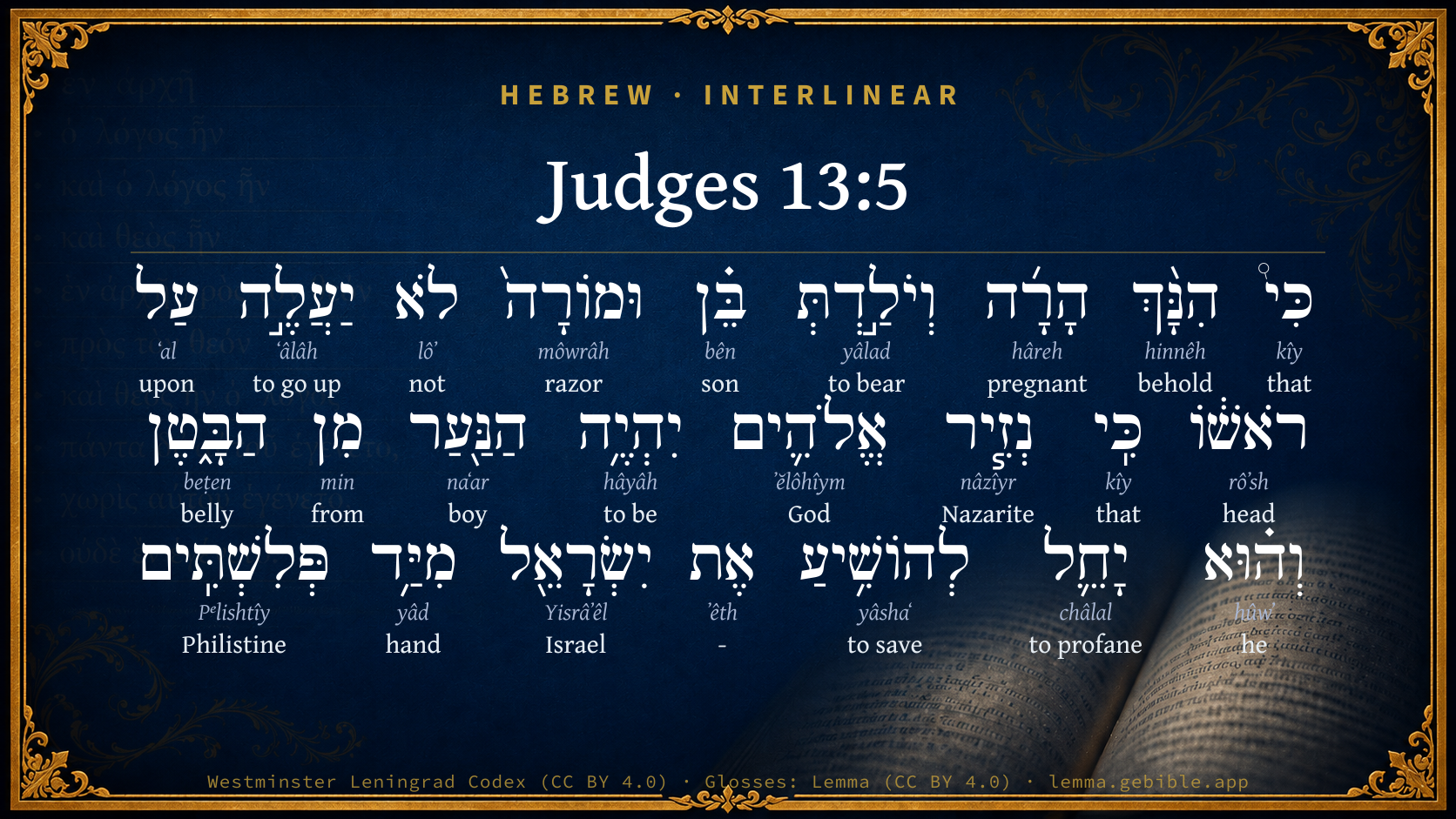
Judges 13:5

Hebrew (Westminster Leningrad Codex) Judges 13:5 appears in the Hebrew Old Testament. The text above is from the Westminster Leningrad Codex. Each word links to its Strong’s number, a concise gloss, and parsing drawn from the Open Scriptures Hebrew Bible morphology. Click any word for its full Brown-Driver-Briggs (BDB) entry.
Download image
Cite this verse

Judges 13:5 (World English Bible). Public Domain. Lemma interlinear Bible study tool, https://lemma.gebible.app/v/judges/13/5.

Show BibTeX & RIS
BibTeX
RIS
English Translation
for, behold, you shall conceive, and bear a son; and no razor shall come on his head; for the child shall be a Nazirite to God from the womb: and he shall begin to save Israel out of the hand of the Philistines.
World English Bible · Public Domain
Highlights
  • 1 first appearance in the Hebrew Bible
Full analysis ↓
Download a study sheet

One document with this verse’s original text, its word-by-word gloss line, the meaning frame, cross-references with their text, attributed commentary, and full source and license credits — printable, and it pastes into notes with its structure intact.

This verse Autodidact and up

Study sheet (.html) Plain text (.txt)

A passage Seminary Student

Up to 50 verses in one chapter. A passage sheet keeps up to 6 commentary sources and 12 cross-references per verse, in the order this page ranks them, and says so on the sheet whenever that leaves anything out. Ask for a single verse and you get the Autodidact verse sheet above.

Everything on this page stays free to read, with no account — the sheet is a download of what is already on screen, not access to it.

Want to remove ads? Support Godless Engineer
Compare translations 3

The same verse in 3 English versions, stacked beneath the original-language interlinear above. Click any original word for its lexicon entry.

Each is an independent rendering of the whole verse — the interlinear is not word-aligned to these translations.

Highlighted words mark where these versions differ — a whole-verse word diff, not a word-by-word alignment.

  • World English Bible Public Domain
    for, behold, you shall conceive, and bear a son; and no razor shall come on his head; for the child shall be a Nazirite to God from the womb: and he shall begin to save Israel out of the hand of the Philistines.
  • King James Version Public Domain
    For, lo, thou shalt conceive, and bear a son; and no razor shall come on his head: for the child shall be a Nazarite unto God from the womb: and he shall begin to deliver Israel out of the hand of the Philistines.
  • unfoldingWord Literal Text CC BY-SA 4.0
    For behold, you will conceive and bear a son. And a razor will not go up on his head, for the boy will be a Nazirite of God from the womb. And he will begin to save Israel from the hand of the Philistines.”

unfoldingWord Literal Text — © unfoldingWord, licensed CC BY-SA 4.0. Word-aligned USFM3 via Door43 (git.door43.org/unfoldingWord/en_ult).

Versions to compare (up to 4)

3 of 4 selected

Show all 18 translations

Every available English version of this verse, each an independent rendering of the whole verse.

  • World English Bible Public Domain
    for, behold, you shall conceive, and bear a son; and no razor shall come on his head; for the child shall be a Nazirite to God from the womb: and he shall begin to save Israel out of the hand of the Philistines.
  • Berean Standard Bible Public Domain
    For behold, you will conceive and give birth to a son. And no razor shall come over his head, because the boy will be a Nazirite to God from the womb, and he will begin the deliverance of Israel from the hand of the Philistines.”
  • Majority Standard Bible Public Domain
    For behold, you will conceive and give birth to a son. And no razor shall touch his head, because the boy will be a Nazirite to God from the womb, and he will begin the deliverance of Israel from the hand of the Philistines.”
  • King James Version Public Domain
    For, lo, thou shalt conceive, and bear a son; and no razor shall come on his head: for the child shall be a Nazarite unto God from the womb: and he shall begin to deliver Israel out of the hand of the Philistines.
  • American Standard Version (1901) Public Domain
    for, lo, thou shalt conceive, and bear a son; and no razor shall come upon his head; for the child shall be a Nazirite unto God from the womb: and he shall begin to save Israel out of the hand of the Philistines.
  • Revised Version (1885) Public Domain
    for, lo, thou shalt conceive, and bear a son; and no razor shall come upon his head: for the child shall be a Nazirite unto God from the womb: and he shall begin to save Israel out of the hand of the Philistines.
  • Geneva Bible (1599) Public Domain
    For loe, thou shalt conceiue and beare a sonne, and no rasor shall come on his head: for the childe shall be a Nazarite vnto God from his birth: and he shall begin to saue Israel out of the handes of the Philistims.
  • Douay-Rheims (1899) Public Domain
    Because thou shalt conceive and bear a son, and no razor shall touch his head: for he shall be a Nazarite of God, from his infancy, and from his mother's womb, and he shall begin to deliver Israel from the hands of the Philistines.
  • Young's Literal Translation Public Domain
    for, lo, thou art conceiving and bearing a son, and a razor doth not go up on his head, for a Nazarite to God is the youth from the womb, and he doth begin to save Israel out of the hand of the Philistines.'
  • Literal Standard Version CC BY-SA 4.0
    for behold, you are conceiving and bearing a son, and a razor does not go up on his head, for the youth is a Nazarite to God from the womb, and he begins to save Israel out of the hand of the Philistines.”
  • Unlocked Literal Bible CC BY-SA 4.0
    Look, you will become pregnant and give birth to a son. No razor will be used upon his head, for the child will be a Nazirite to God from the womb, and he will begin to deliver Israel from the hand of the Philistines.”
  • unfoldingWord Literal Text CC BY-SA 4.0
    For behold, you will conceive and bear a son. And a razor will not go up on his head, for the boy will be a Nazirite of God from the womb. And he will begin to save Israel from the hand of the Philistines.”
  • Darby Bible Public Domain
    for lo, you shall conceive and bear a son. No razor shall come upon his head, for the boy shall be a Nazirite to God from birth; and he shall begin to deliver Israel from the hand of the Philistines."
  • World Messianic Bible Public Domain
    for, behold, you shall conceive and give birth to a son. No razor shall come on his head, for the child shall be a Nazirite to God from the womb. He shall begin to save Israel out of the hand of the Philistines.”
  • Webster's Bible Public Domain
    For lo, thou shalt conceive, and bear a son; and no razor shall come on his head: for the child shall be a Nazarite to God from his birth: and he shall begin to deliver Israel from the hand of the Philistines.
  • Free Bible Version CC BY-SA 4.0
    You're going to become pregnant and have a son whose head a razor must never touch, because the boy is to be a Nazirite, dedicated to God from birth. He will start the process of saving Israel from the Philistines.”
  • Bible in Basic English Public Domain
    For you are with child and will give birth to a son; his hair is never to be cut, for the child is to be separate to God from his birth; and he will take up the work of freeing Israel from the hands of the Philistines.
  • JPS Tanakh (1917) Public Domain
    For, lo, thou shalt conceive, and bear a son; and no razor shall come upon his head; for the child shall be a Nazirite unto God from the womb; and he shall begin to save Israel out of the hand of the Philistines.'

Literal Standard Version (2020), Covenant Press — licensed CC BY-SA 4.0. Text via the HelloAO Bible API (eBible.org). Unlocked Literal Bible (unfoldingWord) — licensed CC BY-SA 4.0. Text via the HelloAO Bible API (eBible.org). unfoldingWord Literal Text — © unfoldingWord, licensed CC BY-SA 4.0. Word-aligned USFM3 via Door43 (git.door43.org/unfoldingWord/en_ult). Free Bible Version, Dr. Jonathan Gallagher — licensed CC BY-SA 4.0. Text via the HelloAO Bible API (eBible.org).

Word by word

More ways to search: Search by grammar → Find every occurrence → Compare this word →

Practice this passage: Drill this verse → Learn its vocabulary →

וּמוֹרָה֙
môwrâh
H4177
“and · razor”
Conjunction + Noun, Common, Masculine, Singular, Absolute
Part of Speech
Conjunction + Noun
Type
Common
Gender
Masculine
Number
Singular
State
Absolute
Full BDB Definition

Origin: from H4171 in the sense of shearing

TWOT: 1166

razor
  1. כִּי֩ kîy H3588 “that” Conjunction
  2. הִנָּ֨ךְ hinnêh H2009 “behold · you” Particle, Demonstrative + Suffix, Personal, 2nd Person, Feminine, Singular
  3. הָרָ֜ה hâreh H2030 “pregnant” Adjective, Adjective, Feminine, Singular, Absolute
  4. וְיֹלַ֣דְתְּ yâlad H3205 “and · to bear” Conjunction + Verb, Qal, Sequential Perfect, 2nd Person, Feminine, Singular
  5. בֵּ֗ן bên H1121 “son” Noun, Common, Masculine, Singular, Absolute
  6. לֹא lôʼ H3808 “not” Particle, Negative
  7. יַעֲלֶ֣ה ʻâlâh H5927 “to go up” Verb, Qal, Imperfect, 3rd Person, Masculine, Singular
  8. עַל ʻal H5921 “upon” Preposition
  9. רֹאשׁ֔וֹ rôʼsh H7218 “head · his” Noun, Common, Masculine, Singular, Construct + Suffix, Personal, 3rd Person, Masculine, Singular
  10. כִּֽי kîy H3588 “that” Conjunction
  11. נְזִ֧יר nâzîyr H5139 “Nazarite of” Noun, Common, Masculine, Singular, Construct
  12. אֱלֹהִ֛ים ʼĕlôhîym H430 “God(s)” Noun, Common, Masculine, Plural, Absolute
  13. יִהְיֶ֥ה hâyâh H1961 “to be” Verb, Qal, Imperfect, 3rd Person, Masculine, Singular
  14. הַנַּ֖עַר naʻar H5288 “the · boy” Particle, Definite Article + Noun, Common, Masculine, Singular, Absolute
  15. מִן min H4480 “from” Preposition
  16. הַבָּ֑טֶן beṭen H990 “the · belly” Particle, Definite Article + Noun, Common, Feminine, Singular, Absolute
  17. וְה֗וּא hûwʼ H1931 “and · he” Conjunction + Pronoun, Personal, 3rd Person, Masculine, Singular
  18. יָחֵ֛ל châlal H2490 “to profane” Verb, Hiphil, Imperfect, 3rd Person, Masculine, Singular
  19. לְהוֹשִׁ֥יעַ yâshaʻ H3467 “to save” Preposition + Verb, Hiphil, Infinitive Construct
  20. אֶת ʼêth H853 “-” Particle, Direct Object
  21. יִשְׂרָאֵ֖ל Yisrâʼêl H3478 “Israel” Noun, Proper
  22. מִיַּ֥ד yâd H3027 “from · hand of” Preposition + Noun, Common, Both, Singular, Construct
  23. פְּלִשְׁתִּֽים Pᵉlishtîy H6430 “Philistines” Noun, Gentilic, Masculine, Plural, Absolute

About this verse

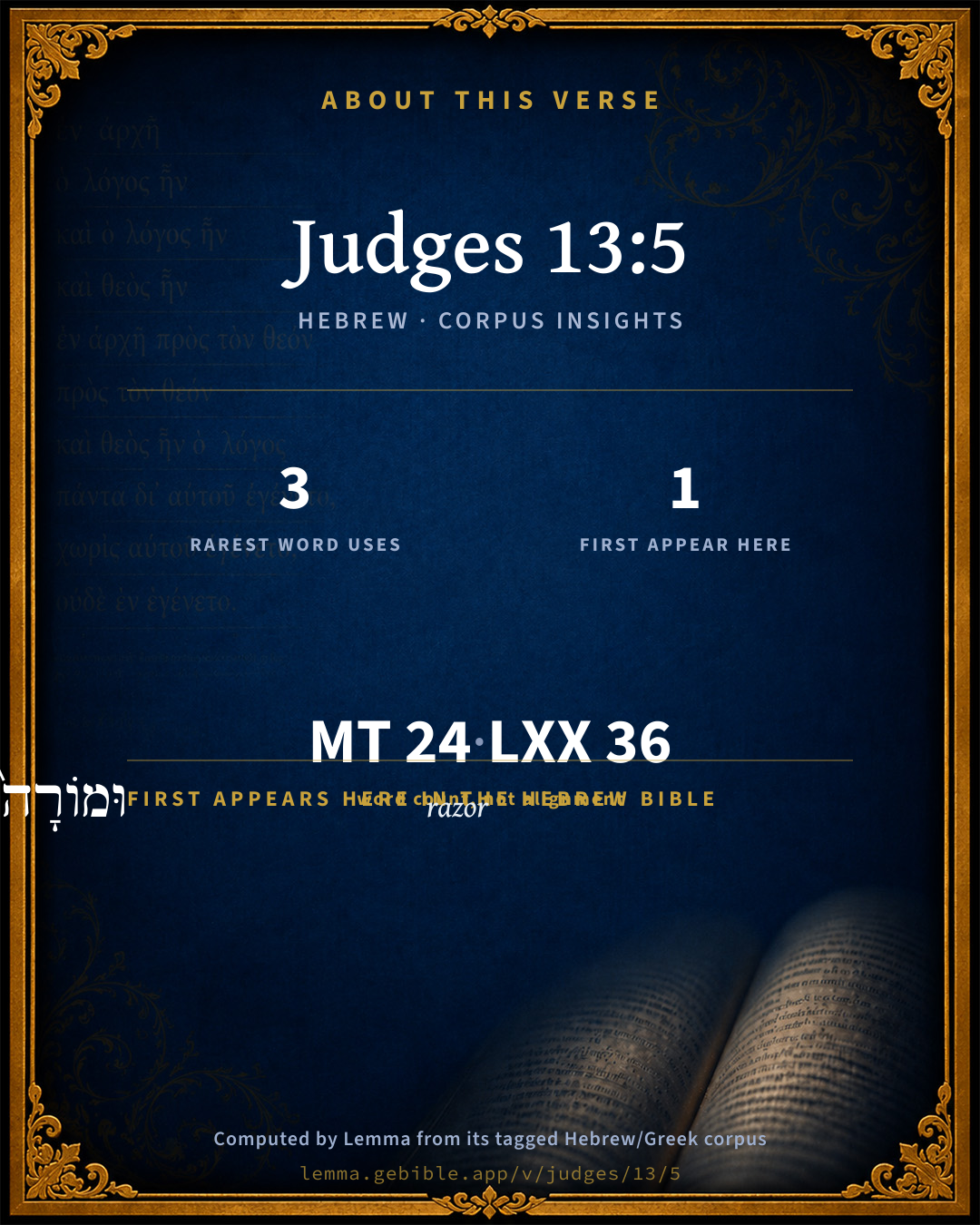
These counts appear in no published source. They are computed here, from the morphology-tagged text and Lemma’s own curated glosses. What Lemma adds →

24
words
23
distinct lemmas
Historical
section

Notable vocabulary

The rarest word here is וּמוֹרָה֙ razor H4177 — appearing just 3 times in the whole Hebrew Bible.

First appearance in Scripture

This word makes its first canonical appearance in the Hebrew Bible here:

  • וּמוֹרָה֙ razor H4177

Shared distinctive vocabulary

וּמוֹרָה֙ razor H4177 occurs in 3 verses of the Hebrew Bible. Also found in:

Grammatical profile

  • 5 verbs
  • 10 nouns
  • 1 adjective
  • 1 pronoun
  • 2 prepositions
  • 2 conjunctions
  • 3 particles

Verb forms

  • וְיֹלַ֣דְתְּ Qal · Sequential Perfect
  • יַעֲלֶ֣ה Qal · Imperfect
  • יִהְיֶ֥ה Qal · Imperfect
  • יָחֵ֛ל Hiphil · Imperfect
  • לְהוֹשִׁ֥יעַ Hiphil · Infinitive Construct

Repetition

A word recurs within this verse — often emphatic in Hebrew:

  • כִּי֩ that H3588 ×2

Hebrew & Septuagint length

In English translation the verse runs 43 words from the Hebrew and 46 from the Septuagint (LXX English) — closely comparable.

A rough comparison of the two English renderings, which tokenize alike — not a word-level alignment.

Word counts can differ between the Hebrew and the Greek without any difference in meaning — e.g. the Hebrew direct-object marker אֵת has no separate Greek word, and Greek often adds the article ὁ.

In the original languages it is 24 Hebrew tokens and 36 Greek tokens — but the two are counted differently (Hebrew bundles its prefixes and suffixes into one token; the Greek is in lemma form), so that isn’t a like-for-like length.

Cross-references

6

Topical passages linked to Judges 13:5 in the Treasury of Scripture Knowledge — connected by theme and wording, ordered by reader-vote popularity; previews shown in the World English Bible.

  • Numbers 6:5 "All the days of his vow of separation there shall no razor come on his head, until the days are fulfilled, in which he separates himself to Yahweh. He shall be holy. He shall let the locks of the hair of his head grow long.
  • 1 Samuel 1:11 She vowed a vow, and said, Yahweh of hosts, if you will indeed look on the affliction of your handmaid, and remember me, and not forget your handmaid, but will give to your handmaid a man-child, then I will give him to Yahweh all the days of his life, and there shall no razor come on his head.
  • Numbers 6:2–3 "Speak to the children of Israel, and tell them: When either man or woman shall make a special vow, the vow of a Nazirite, to separate himself to Yahweh,
  • 1 Chronicles 18:1 After this it happened, that David struck the Philistines, and subdued them, and took Gath and its towns out of the hand of the Philistines.
  • 1 Samuel 7:13 So the Philistines were subdued, and they came no more within the border of Israel: and the hand of Yahweh was against the Philistines all the days of Samuel.
  • 2 Samuel 8:1 After this it happened that David struck the Philistines, and subdued them: and David took the bridle of the mother city out of the hand of the Philistines.

Cross-references courtesy of OpenBible.info (CC BY 4.0).

Hebrew and Greek witnesses Masoretic Hebrew ↔ Greek Septuagint

The same verse in the two great witnesses to the Old Testament, shown verse-for-verse.

These are two independent witnesses, not word-aligned to each other, and the Septuagint is shown in lemma (dictionary) form.

Hebrew Judges 13:5 Masoretic · Westminster Leningrad Codex

כִּי֩ הִנָּ֨ךְ הָרָ֜ה וְיֹלַ֣דְתְּ בֵּ֗ן וּמוֹרָה֙ לֹא יַעֲלֶ֣ה עַל רֹאשׁ֔וֹ כִּֽי נְזִ֧יר אֱלֹהִ֛ים יִהְיֶ֥ה הַנַּ֖עַר מִן הַבָּ֑טֶן וְה֗וּא יָחֵ֛ל לְהוֹשִׁ֥יעַ אֶת יִשְׂרָאֵ֖ל מִיַּ֥ד פְּלִשְׁתִּֽים

for, behold, you shall conceive, and bear a son; and no razor shall come on his head; for the child shall be a Nazirite to God from the womb: and he shall begin to save Israel out of the hand of the Philistines.

World English Bible · Public Domain

Greek LXX Judges 13:5 Septuagint · lemma form

ὅτι ἰδού σύ ἐν γαστήρ ἔχω καί τίκτω υἱός καί σίδηρος οὐ ἀναβαίνω ἐπί ὁ κεφαλή αὐτός ὅτι ναζιρ θεός εἰμί ὁ παιδάριον ἀπό ὁ κοιλία καί αὐτός ἄρχω ὁ σώζω ὁ ἰσραήλ ἐκ χείρ φυλιστιιμ

for behold, you are with child, and shall bring forth a son; and there shall come no razor upon his head, for the child shall be a Nazarite to God from the womb; and he shall begin to save Israel from the hand of the Phylistines.

LXX2012 (modern English Septuagint) · Public Domain

Hebrew: Westminster Leningrad Codex (CC BY 4.0). Greek: Septuagint (public domain); English from LXX2012 (modern English Septuagint) (Public Domain). How the Septuagint differs from the Hebrew →

Targum (Aramaic paraphrase)

1

The Targum is the ancient Jewish Aramaic paraphrase of the Hebrew Scriptures — an interpretive translation, not the Hebrew text itself. Onkelos (literal) and Pseudo-Jonathan (expansive) render the Torah, and Jonathan the Prophets. Coverage is partial: where no permissively-licensed English translation exists for a verse, only the Aramaic is shown. This is verse-level text, not a word-by-word alignment to the Hebrew.

  1. Targum Jonathan Prophets (Joshua–Malachi)
    אֲרֵי הָא אַתְּ מְעַדְיָא וְתֵלְדִין בַּר וּמִסְפַּר לָא יֶעְבַר עַל רֵישֵׁיהּ אֲרֵי נְזִירָא דַייָ יְהֵי רַבְיָא מִן בִּטְנָא וְהוּא יִשְׁרֵי לְמִפְרַק יַת יִשְׂרָאֵל מִידָא דִפְלִשְׁתָּאֵי:

    (no public-domain English translation for this verse)

    Targum Jonathan — Aramaic: “Mikraot Gedolot” (public domain). English: “Sefaria Community Translation” (CC0 1.0 (public-domain dedication)); “London "Chaldee Paraphrase," 1871” (public domain). Text via Sefaria.

Commentary

Notes on Judges 13:5 from classic Christian and Jewish commentators (each source and its license shown beneath its notes). The classic Christian expositions comment on the surrounding passage and are grouped to its opening verse, so a note may address several verses; the Jewish commentaries on the Tanakh (Rashi and others) are per-verse, so they appear only where the commentator wrote on this verse.

Lemma curates 59 commentaries, every one of them public domain or Creative Commons licensed, each selected and text-cleaned for this edition rather than reprinted as found. About our sources →

Trapp's Complete Commentary

John Trapp

Jdg 13:5 For, lo, thou shalt conceive, and bear a son; and no razor shall come on his head: for the child shall be a Nazarite unto God from the womb: and he shall begin to deliver Israel out of the hand of the Philistines.

Ver. 5. For the child shall be a Nazarite unto God.] And so a type of Christ, the great votary.

And he shall begin to deliver Israel.] He shall be doing at it, but David shall perfect this deliverance. Christ is both author and finisher of his people’s salvation.

John Trapp, A Commentary or Exposition upon All the Books of the Old and New Testament (1647–1656) — public domain. Text from a community e-Sword module.

Joseph Benson's Commentary

Jdg 13:5. The child shall be a Nazarite — Consecrated to God’s service in a peculiar manner. He shall begin to deliver Israel — He did not complete the deliverance of the Israelites from the servile yoke of the Philistines; but the work was carried on and perfected by others, namely, by Eli, Samuel, and Saul, and especially by David. Samson galled them severely, but they still continued to oppress Israel, as they did when he was born, and the oppression continued, more or less, till the memorable victory of Ebenezer, recorded 1Sa 7:13, when they were subdued, and their tyranny of forty years ended. Thus God chooses to carry on his work gradually, and by several hands. One lays the foundation of a good work, another builds, and perhaps a third brings forth the top-stone.

Joseph Benson's Commentary on the Old and New Testaments (1811–1818) — public domain. Text from a community e-Sword module.

Geneva Bible (1599)

Geneva Bible translators

Meaning, he should be separate from the world, and dedicated to God.

Geneva Bible (1599) marginal notes — public domain. Text via Bolls.life.

Jamieson, Fausset & Brown

Robert Jamieson, A. R. Fausset & David Brown

thou shalt conceive, and bear a son--This predicted child was to be a Nazarite. The mother was, therefore, for the sake of her promised offspring, required to practice the rigid abstinence of the Nazarite law (see on Num 6:2).

he shall begin to deliver Israel out of the hand of the Philistines--a prophecy encouraging to a patriotic man; the terms of it, however, indicated that the period of deliverance was still to be distant.

Jamieson, Fausset & Brown — Commentary Critical and Explanatory on the Whole Bible (1871) — public domain (CC PDM 1.0). Text via the HelloAO Bible API.

Adam Clarke's Commentary

Verse 5. He shall begin to deliver Israel] Samson only began this deliverance, for it was not till the days of David that the Israelites were completely redeemed from the power of the Philistines.

Adam Clarke's Commentary on the Bible (1810–1826) — public domain. Text from a community e-Sword/MySword module.

Ellicott's Commentary for English Readers

(5) No razor shall come on his head.—The law of the Nazarite is laid down in Numbers 6, and when that chapter is read as the Parashah (or first lesson) in the synagogue-worship, this account of the birth of Samson, the first recorded Nazarite, is read as the Haphtarah (or second lesson).

Shall begin to deliver.—The weaknesses of Samson’s own character rendered him unfit to achieve that complete deliverance which was carried out by Samuel. In the cases of Jephthah and Samson the Israelites learnt the power which rests in individual vows to display the occult and mysterious heroism of the human spirit, and to save people from sinking into the lowest depths (Ewald, 2:397). The vow became a new force of the age. In Jephthah’s case it had been an isolated vow, but in Samson’s it was the devotion of a life, and developed an indomitable energy and power.

A Bible Commentary for English Readers, edited by Charles John Ellicott (1878–1897) — public domain. Text from a community e-Sword module.

The Cambridge Bible for Schools and Colleges

gen. ed. J. J. S. Perowne

5. thou shalt conceive] The present in Gen_16:11 RV. and Isa_7:14 RVm.; the future is more suitable here.

a Nazirite unto God] lit. one separated unto God; this, the full term, came to be abbreviated nâzîr, i.e. separated, devoted, a Nazirite. It is to be noticed that (1) the consecration took effect from birth; it was not voluntary, but due to the call of God, in this respect resembling the case of the prophets, Jer_1:5, Isa_44:2; (2) it was life-long and not temporary; (3) the special sign of consecration was the unshorn hair, no razor shall come upon his head, cf. Jdg_16:17, 1Sa_1:11; this seems to have been the one essential characteristic; and (4) the object or task of the person thus devoted was to wage war and effect a deliverance. The connexion between (3) and (4) is illustrated by the custom of Arab warriors to wear the hair long when they vowed inveterate war, probably too by the long hair of the chiefs in Deborah’s Song (see on Jdg_5:2). In old Israel the Nazirite was no doubt a familiar figure; but besides Samson, the only other and not quite certain example is Samuel (1Sa_1:11), though he is not called a Nazirite till Sir_46:13 (in the Hebr., not in the Gk. text), and in Talmudic tradition (Nazir 66 a ‘Samuel was a Nazirite according to the teaching of R. Naharaï’). There was nothing ascetic about a Nazirite in the early days, as the story of Samson proves (Jdg_14:10); abstinence from wine did not become a mark of this type of devotee till a later time (Amo_2:12), and then probably as a protest against Canaanite habits (cf. the Rechabites, Jer_35:9 ff.). What was probably a later development still appears in the detailed law of the Nazirite in Numbers 6; there abstinence from wine has become the principal feature; the hair is treated as a hair-offering; instead of preserving it unshorn, the Nazirite is to shave when the period of the vow is over; the vow itself is not life-long but temporary and voluntary; and contact with a dead body is strictly forbidden, a prohibition which cannot have existed in the early days (Jdg_14:19; Jdg_15:8; Jdg_15:15; 1Sa_15:33). The obvious differences between Nazirites of Samson’s type and those of the type laid down in the law formed a topic of discussion among the Rabbis (Talmud B. Nazir 4 a, b). After the Exile temporary Nazirites were numerous down to the fall of Jerusalem (1Ma_3:49; Jos., Ant. xix. 6, 1, Wars ii. 15, 1; Act_21:23 ff.).

The treatment of the hair, whether preserved unshorn or offered as a sacrifice, is based upon a widely spread and primitive belief that the hair is a part of a man’s self; if it is never shorn, his strength is undiminished, he is intact; if it is shorn and offered at the sanctuary, it is in a measure an offering of oneself1[51].

[51] See Gray, Journ. of Theol. Studies i. 201–211 (1900) and Numbers 57 ff. (1903) Frazer, Golden Bough i. 193–207; Rob. Smith, Rel. of Sem., 314 f., 462 ff.

begin to save Israel … the Philistines] In chs. 14–16, however, we find not a work of national deliverance, but intermittent feats of private revenge or daring. The view of Samson’s history indicated by this remark shews that ch. 13 must be somewhat later than 14–16. It is doubtful whether begin implies that Samson was regarded as the forerunner of Samuel and Saul in the struggle against the Philistines (Wellhausen, Composition d. Hex., p. 231; S. A. Cook, Notes on O.T. Hist., p. 34); the word probably means no more than ‘shall be the first to,’ as in Jdg_10:18.

The Cambridge Bible for Schools and Colleges (gen. ed. J. J. S. Perowne; Cambridge University Press, 1878–1918) — public domain. Text from a community e-Sword module.

John Gill's Exposition

For, lo, thou shalt conceive and bear a son,.... Which is not only repeated for the confirmation of it, but that she might take notice that he was to be a Nazarite, and therefore must conform to everything agreeable to the law of the Nazarites, and take care that it was observed in him:

and no razor shall come on his head; to cut off the hair of it, not from the time of his birth to his death; for he was to be a perpetual Nazarite: other Nazarites during the time of their Nazariteship were not to suffer a razor to come upon them, but afterwards might; but for such an one as Samson, it was not lawful ever to suffer his hair to be cut off; see Num 6:5.

for the child shall be a Nazarite unto God from the womb; in which he was a type of Christ, who was sanctified by the Lord, separated from sinners, and called a "Nazarene": was born of a virgin, as Samson was of a barren woman, and his birth foretold by an angel as this:

and he shall begin to deliver Israel out of the hand of the Philistines; for the salvation he wrought for Israel was not complete and perfect; it was only begun by him, and carried on in the times of Eli, Samuel, and Saul, and perfected by David. In this his antitype exceeds him, who is the author of the complete salvation of his people out of the hands of all their enemies, sin, Satan, and the world; though in this there is a great resemblance between Samson and our Lord Jesus, in that what he did he did himself alone; not at the head of an army, and with forces under him, as other judges; so Christ with his own arm, and of himself, and without others, wrought salvation for his people; see Isa 63:5.

John Gill's Exposition of the Whole Bible (1746–1763) — public domain (CC PDM 1.0). Text via the HelloAO Bible API.

Albert Barnes' Notes on the Bible

A Nazarite - See the marginal reference. and note. The common Nazarite vow was for a limited time, like Paul’s Act 18:18; Act 21:23-26. Others, like Samuel 1Sa 1:11, were Nazarites for life.

Albert Barnes' Notes on the Bible (1834–1885) — public domain. Text from a community e-Sword/MySword module.

Matthew Poole's English Annotations

A Nazarite; a person separated from others, and consecrated to God’s service.

He shall begin to deliver Israel; and the deliverance shall be carried on and perfected by others, as it was in part by Eli, and Samuel, and Saul; but especially by David.

Matthew Poole's English Annotations on the Holy Bible (1683–1685) — public domain. Text from a community e-Sword/MySword module.

Whedon's Commentary on the Bible

Daniel D. Whedon

5. A Nazarite unto God from the womb — For the law concerning Nazarites, see Num_6:1-21. The key to the divine side of Samson’s history is to be found in this Nazarite condition. Unless we keep this earnest and solemn background of his life-consecration to Jehovah in view, his buffoonery and lewdness, and even his mere feats of strength, would seem strange and inexplicable when detailed with such elaborate fulness. From the theocratic standpoint Samson was a sacred character, a great national hero; and his consecration as a Nazarite from the womb, together with his agency in delivering Israel from the Philistine yoke, is the great redeeming fact and feature of his romantic life. See note at end of chap. 16.

He shall begin to deliver Israel — But he was not to complete that deliverance. His giant feats of valour were but to weaken the Philistines’ power over Israel, and prepare the way for that more pure and spotless Nazarite, Samuel, who should complete that work of national salvation. 1Sa_7:13.

Daniel D. Whedon (gen. ed.), Commentary on the Old and New Testaments (1874–1909) — public domain. Text from a community e-Sword module.

The Pulpit Commentary

The child shall be a Nazarite, etc. So it was said, though not in the same words, concerning Samuel (1Sa_1:11) and concerning John the Baptist. (Luk_1:15) A Nazarite (or, more correctly, a Nazirite) means one separated, and specially dedicated to God. The law of the Nazarites is contained in Numbers 6, where, however, only Nazarites of days, i.e. Nazarites for a definite time, arc spoken of. Samson, Samuel, and John the Baptist were perpetual Nazarites, Nazarites of for ever, as the Mishna classifies them. Abstinence from strong drink, and from anything made of the grape; letting the locks of the head grow unchecked by the razor; and keeping quite clear of any pollution from a dead body, even in case of the death of his nearest relations, were the chief articles of a Nazarite"s vow. St. Paul took the vow of a Nazarite of days, and offered the prescribed sacrifices, together with "the hair of the head of his separation," as we read in Act_18:18 Act_21:23-26. He shall begin, etc. This is an exact description of what Samson did. He did not "deliver Israel" as the other judges did; but he began to shake the Philistine power, and prepared the way for the deliverance of Israel in the time of his worthier successor Samuel.

The difficulty of salvation.

"And he shall begin to deliver Israel." There is a parsimony of expression here that is highly expressive. It is not said, "he shall deliver," as of a complete work, but only "he shall begin" to do so. How many reasons were there for this! Do they not also hold good for the grander work of human salvation?

I HINDRANCES TO THE COMPLETE SALVATION OF ISRAEL.

1. It was a work which required to be, in the first place, and mainly, spiritual in order to its being thorough

2. In order to this the penalty of past transgression had in greater measure to be felt. The transgression had been great, repeated, and habitual. A stern lesson had to be read to the guilty. It was an evil inflicted in order to induce repentance. The moral depths of human nature were being sounded and discovered to itself, that in the fulness of time a Divine Saviour might be sought.

3. Meanwhile the nature and character of the deliverer did not admit of such a work being completed. He was but a man: his consecration was merely or chiefly external; the faults of his character were glaring, His deeds, accordingly, are those of physical heroism and strength. Only once or twice do any hints of more than human wisdom occur.

II CONSOLATIONS ATTACHED TO THIS INCOMPLETE SALVATION.

1. It was actually begun.

2. God had undertaken it, and provided the instrument.

3. As being a professedly partial undertaking, it showed a far-reaching and thorough scheme.

4. The conditions of its ultimate accomplishment were with themselves. M.

HOMILIES BY W.F. ADENEY Ver. 5. Samson the Nazarite.

I THERE ARE MEN WHOM GOD CALLS TO HIS SERVICE FROM THEIR BIRTH. This is seen in the fact that the earliest events of their lives are made to train them for their subsequent mission in the world. Parents should consecrate their children to God in infancy, and not wait for later years before using those means which will fit them for the work of life in God"s service. Manoah. and his wife are taught these lessons with special reference to the condition of a Nazarite. Other vocations may require external varieties of training, but the essential characteristics which fit us for the service of God are the same in all cases, so that it is not necessary to know the exact form of service to which God will call a child, in order to lay the foundations of his character in the main principles which devotion to God"s service in any form involves.

II ABSTEMIOUSNESS IS FAVOURABLE TO THE DEVELOPMENT OF VIGOUR. Self-indulgence is enervating. Self-restraint both husbands and enlarges strength. That which is apparently most helpful to us may prove in reality to be a hindrance. Appetite and desire are neither to be regarded as masters nor as enemies, but as servants. As wine excites rather than strengthens, so there are influences of a mental character which add nothing to our power for work, although they appear to do so by rousing excitement. The soul will not grow strong on the heating, but not nourishing, diet of religious sensationalism.

III DEVOTION TO GOD REQUIRES PURITY OF LIFE. The Nazarite was to touch no unclean thing. Unhappily Samson was satisfied with this ceremonial purity, and did not cultivate purity of soul, as the spirit of the Nazarite"s vow plainly required him to do; hence his moral weakness and failure to attain perfect success. Samson "began to deliver Israel," he was not able to finish. Only the spotless One could say, "It is finished." In proportion to our holiness will be our spiritual strength. Religious devotion without moral purity cannot be accepted by God. (Isa_1:11-15)

IV FULNESS OF LIFE BELONGS TO THOSE WHO LIVE TO GOD. No razor, no iron (the symbol of death), was to come upon the Nazarite. Consecration to God involves self-denial, but it brings a deeper joy and a fuller life than a self-seeking course will secure.

1. Religion does not require the destruction of any part of our true human nature, not even to the injuring of one hair of the head.

2. Religion requires the consecration of our whole being unmaimed, even to the not severing of one hair of the head from the perfect sacrifice.

V CONSECRATION TO GOD IS A SOURCE OF USEFULNESS TO MEN. Samson was a Nazarite; he was also a deliverer of his people. God calls us not to the hermit"s life of useless devotion, but to the servant"s life of devotion practised in active good works. The religiousness which forbids useful work in commerce, in politics, in literature is a false sentiment. The Christian can best serve God by labouring for the good of his fellow-men. A.

The Pulpit Commentary (1880–1919), ed. H.D.M. Spence-Jones & Joseph S. Exell — public domain. Text from a community e-Sword module.

John Wesley's Explanatory Notes

A Nazarite - A person consecrated to God's service. Begin to deliver - And the deliverance shall be carried on and perfected by others, as it was by Eli, Samuel, and Saul; but especially by David. God chuses to carry on his work gradually and by several hands. One lays the foundation of a good work, another builds, and perhaps a third brings forth the top stone.

John Wesley, Explanatory Notes Upon the Whole Bible (1754–1765) — public domain. Text via the GEBible commentary corpus.

Rashi

Rabbi Shlomo Yitzchaki (Rashi)

The razor [lit. flinger]. The razor, as it flings off and casts away the hair.

Rashi on the Tanakh — English translations: “The Judaica Press complete Tanach with Rashi, translated by A. J. Rosenberg” (CC BY 4.0); “Pentateuch with Rashi's commentary by M. Rosenbaum and A.M. Silbermann, 1929-1934” (public domain); “The Metsudah Tanach series, Lakewood, N.J” (CC BY 4.0); and “The Book of Joshua, Metsudah Publications, 1997” (CC BY 4.0). Text via Sefaria.

Lesson kit

Teaching starters — assembled from the data on this page, not authored interpretation. Every prompt links to the verse data it draws on. Edit before teaching.

Judges, in the Historical, opens this verse with 24 words (23 distinct Hebrew lemmas). Its most distinctive word is môwrâh (“razor”). A historical commentator’s framing appears above. Read the whole chapter for the surrounding context.

Discussion questions

  1. The word môwrâh carries the sense “razor.” How does it shape the verse?
  2. This is the first place “razor” appears in Scripture (first appears here). What does its debut here establish?
  3. How does Judges 16:17, which shares the word «razor», read alongside this verse?
  4. What does the repetition of “that” (2× in this one verse) do in this verse?
  5. The translations on this page render this verse differently — a whole-verse word diff, not a word-by-word alignment. What might account for the different wordings?
  6. «וְיֹלַ֣דְתְּ» is a Qal Sequential Perfect verb. How does that grammatical form shape the action described?
  7. Compare how Trapp's Complete Commentary and Joseph Benson's Commentary read this verse. Where do they agree or differ?

Things to notice

Reading settings

Reading text

Shown beneath each verse's original-language words.

Old Testament
Old Testament edition

Read the OT as the Masoretic Hebrew (MT) or the Greek Septuagint (LXX).

English shown for the Greek Septuagint (in the Hebrew ↔ Greek comparison).

Comparing translations? Open the Compare panel on any verse page to stack up to four side by side.