Genesis 11:27

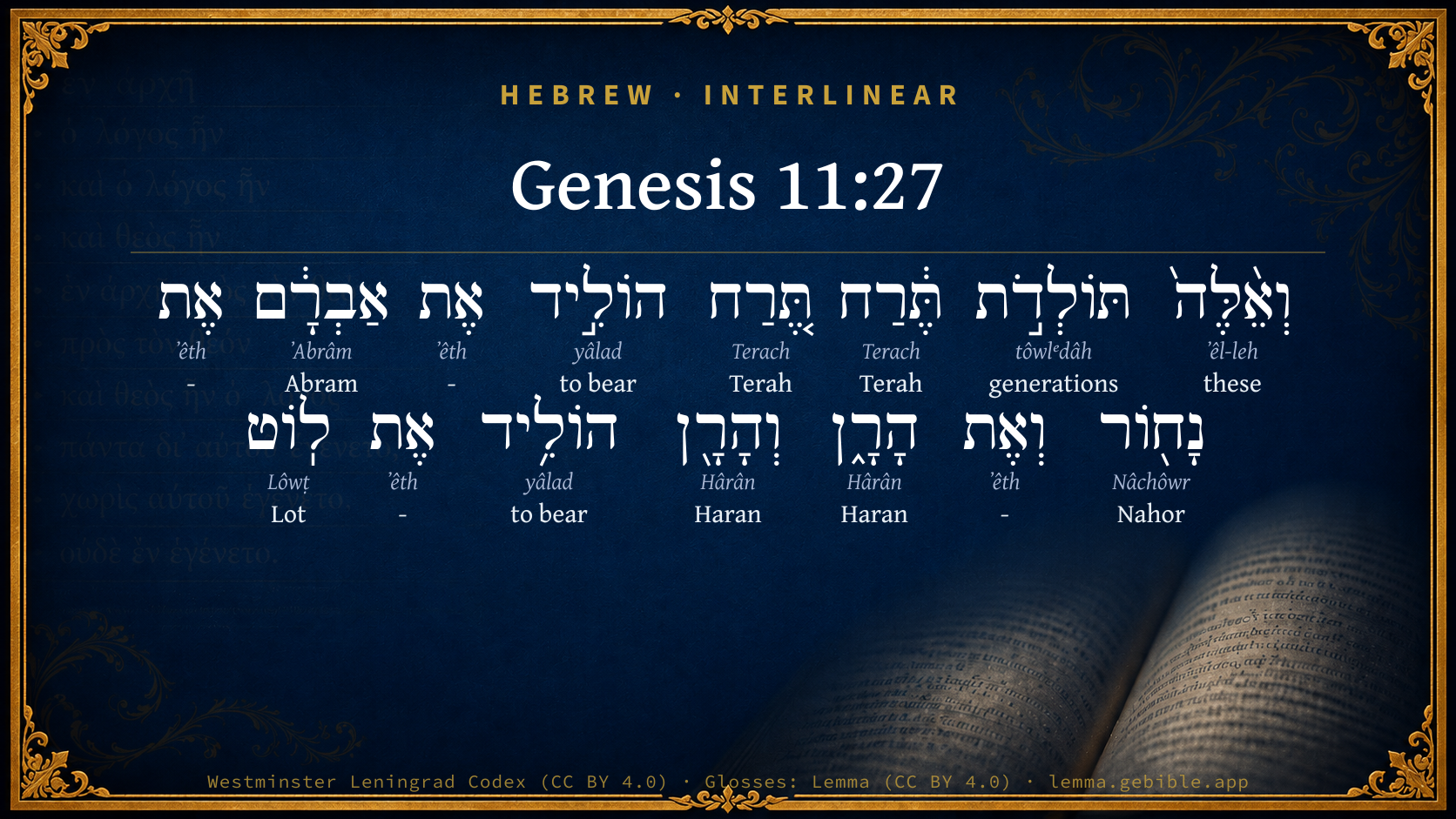
Hebrew (Westminster Leningrad Codex) Genesis 11:27 appears in the Hebrew Old Testament. The text above is from the Westminster Leningrad Codex. Each word links to its Strong’s number, a concise gloss, and parsing drawn from the Open Scriptures Hebrew Bible morphology. Click any word for its full Brown-Driver-Briggs (BDB) entry.
Download image
Cite this verse

Genesis 11:27 (World English Bible). Public Domain. Lemma interlinear Bible study tool, https://lemma.gebible.app/v/genesis/11/27.

Show BibTeX & RIS
BibTeX
RIS
English Translation
Now this is the history of the generations of Terah. Terah became the father of Abram, Nahor, and Haran. Haran became the father of Lot.
World English Bible · Public Domain
Highlights
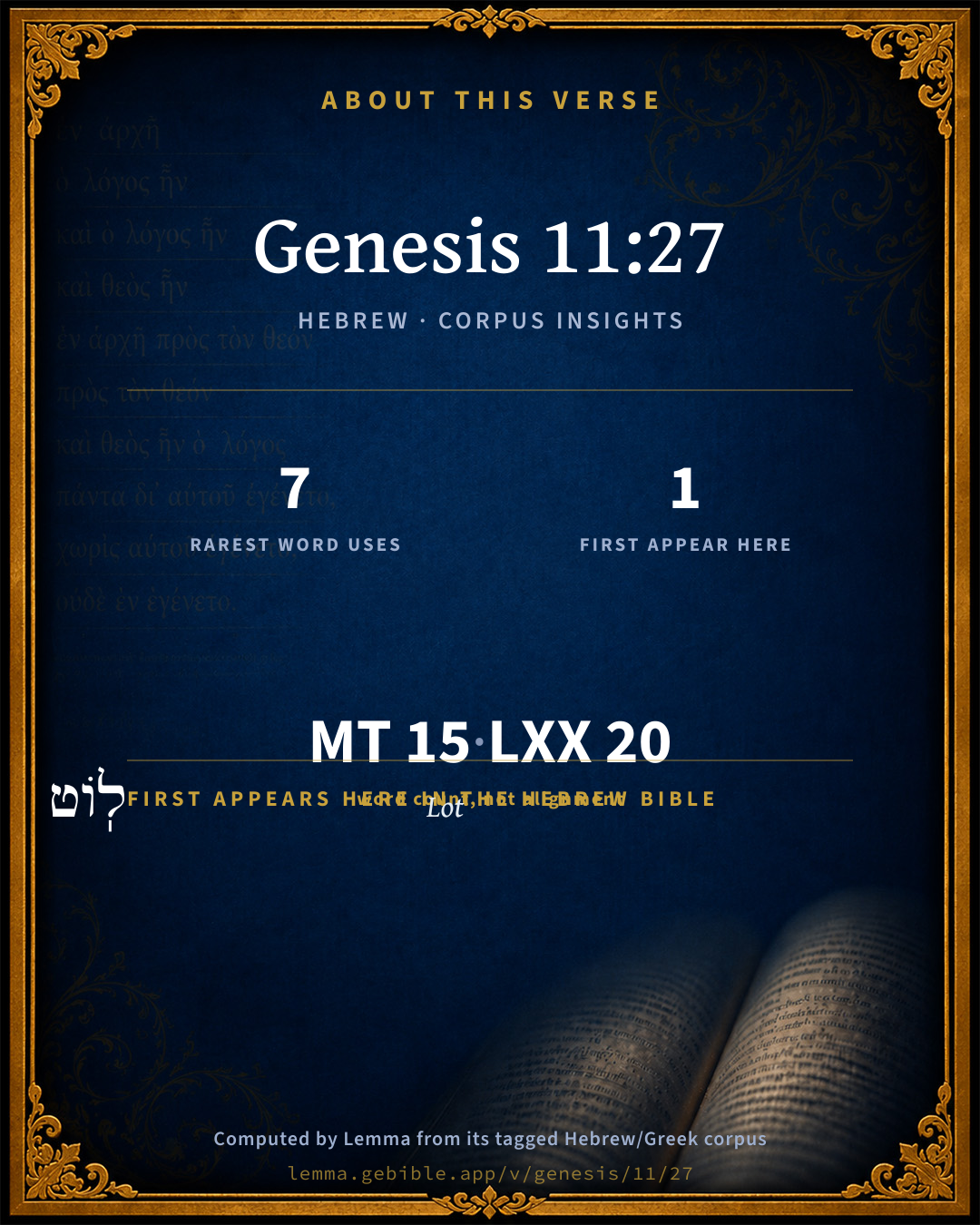
  • 1 first appearance in the Hebrew Bible
Full analysis ↓
Download a study sheet

One document with this verse’s original text, its word-by-word gloss line, the meaning frame, cross-references with their text, attributed commentary, and full source and license credits — printable, and it pastes into notes with its structure intact.

This verse Autodidact and up

Study sheet (.html) Plain text (.txt)

A passage Seminary Student

Up to 50 verses in one chapter. A passage sheet keeps up to 6 commentary sources and 12 cross-references per verse, in the order this page ranks them, and says so on the sheet whenever that leaves anything out. Ask for a single verse and you get the Autodidact verse sheet above.

Everything on this page stays free to read, with no account — the sheet is a download of what is already on screen, not access to it.

Want to remove ads? Support Godless Engineer
Compare translations 3

The same verse in 3 English versions, stacked beneath the original-language interlinear above. Click any original word for its lexicon entry.

Each is an independent rendering of the whole verse — the interlinear is not word-aligned to these translations.

Highlighted words mark where these versions differ — a whole-verse word diff, not a word-by-word alignment.

  • World English Bible Public Domain
    Now this is the history of the generations of Terah. Terah became the father of Abram, Nahor, and Haran. Haran became the father of Lot.
  • King James Version Public Domain
    Now these are the generations of Terah: Terah begat Abram, Nahor, and Haran; and Haran begat Lot.
  • unfoldingWord Literal Text CC BY-SA 4.0
    Now these the generations of Terah: Terah fathered Abram, Nahor, and Haran; and Haran fathered Lot.

unfoldingWord Literal Text — © unfoldingWord, licensed CC BY-SA 4.0. Word-aligned USFM3 via Door43 (git.door43.org/unfoldingWord/en_ult).

Versions to compare (up to 4)

3 of 4 selected

Show all 18 translations

Every available English version of this verse, each an independent rendering of the whole verse.

  • World English Bible Public Domain
    Now this is the history of the generations of Terah. Terah became the father of Abram, Nahor, and Haran. Haran became the father of Lot.
  • Berean Standard Bible Public Domain
    This is the account of Terah. Terah became the father of Abram, Nahor, and Haran. And Haran became the father of Lot.
  • Majority Standard Bible Public Domain
    This is the account of Terah. Terah became the father of Abram, Nahor, and Haran. And Haran became the father of Lot.
  • King James Version Public Domain
    Now these are the generations of Terah: Terah begat Abram, Nahor, and Haran; and Haran begat Lot.
  • American Standard Version (1901) Public Domain
    Now these are the generations of Terah. Terah begat Abram, Nahor, and Haran. And Haran begat Lot.
  • Revised Version (1885) Public Domain
    Now these are the generations of Terah. Terah begat Abram, Nahor, and Haran; and Haran begat Lot.
  • Geneva Bible (1599) Public Domain
    Nowe these are the generations of Terah: Terah begate Abram, Nahor, and Haran: and Haran begate Lot.
  • Douay-Rheims (1899) Public Domain
    And these are the generations of Thare: Thare begot Abram, Nachor, and Aran. And Aran begot Lot.
  • Young's Literal Translation Public Domain
    And these `are' births of Terah: Terah hath begotten Abram, Nahor, and Haran; and Haran hath begotten Lot;
  • Literal Standard Version CC BY-SA 4.0
    And these [are] the generations of Terah: Terah has begotten Abram, Nahor, and Haran; and Haran has begotten Lot;
  • Unlocked Literal Bible CC BY-SA 4.0
    Now these were the descendants of Terah. Terah became the father of Abram, Nahor, and Haran, and Haran became the father of Lot.
  • unfoldingWord Literal Text CC BY-SA 4.0
    Now these the generations of Terah: Terah fathered Abram, Nahor, and Haran; and Haran fathered Lot.
  • Darby Bible Public Domain
    And these are the generations of Terah: Terah begot Abram, Nahor, and Haran; and Haran begot Lot.
  • World Messianic Bible Public Domain
    Now this is the history of the generations of Terah. Terah became the father of Abram, Nahor, and Haran. Haran became the father of Lot.
  • Webster's Bible Public Domain
    Now these are the generations of Terah: Terah begat Abram, Nahor, and Haran: and Haran begat Lot.
  • Free Bible Version CC BY-SA 4.0
    The following is the genealogy of Terah. Terah was the father of Abram, Nahor, and Haran. Haran was the father of Lot.
  • Bible in Basic English Public Domain
    These are the generations of Terah: Terah was the father of Abram, Nahor, and Haran; and Haran was the father of Lot.
  • JPS Tanakh (1917) Public Domain
    Now these are the generations of Terah. Terah begot Abram, Nahor, and Haran; and Haran begot Lot.

Literal Standard Version (2020), Covenant Press — licensed CC BY-SA 4.0. Text via the HelloAO Bible API (eBible.org). Unlocked Literal Bible (unfoldingWord) — licensed CC BY-SA 4.0. Text via the HelloAO Bible API (eBible.org). unfoldingWord Literal Text — © unfoldingWord, licensed CC BY-SA 4.0. Word-aligned USFM3 via Door43 (git.door43.org/unfoldingWord/en_ult). Free Bible Version, Dr. Jonathan Gallagher — licensed CC BY-SA 4.0. Text via the HelloAO Bible API (eBible.org).

Word by word

More ways to search: Search by grammar → Find every occurrence → Compare this word →

Practice this passage: Drill this verse → Learn its vocabulary →

הָרָ֑ן
Hârân
H2039
“Haran”
Noun, Proper
Part of Speech
Noun
Type
Proper
Full BDB Definition

Origin: perhaps from H2022

TWOT: None

Haran = "mountaineer" - youngest son of Terah, brother of Abraham, father of Lot, Milcah, and Iscah; born and died in Ur of the Chaldees (noun proper masculine) - a Gershonite Levite in the time of David, one of the family of Shimei (noun proper masculine) - a son of Caleb by the concubine Ephah (noun proper masculine) - name of the place to which Abraham migrated from Ur of the Chaldees and where the descendants of his brother Nahor established themselves; probably located in Mesopotamia, in Padanaram, the cultivated district at the foot of the hills between the Khabour and the Euphrates below Mount Masius (noun proper locative)
  1. וְאֵ֨לֶּה֙ ʼêl-leh H428 “and · these” Conjunction + Pronoun, Demonstrative, Common, Plural
  2. תּוֹלְדֹ֣ת tôwlᵉdâh H8435 “generations of” Noun, Common, Feminine, Plural, Construct
  3. תֶּ֔רַח Terach H8646 “Terah” Noun, Proper
  4. תֶּ֚רַח Terach H8646 “Terah” Noun, Proper
  5. הוֹלִ֣יד yâlad H3205 “to bear” Verb, Hiphil, Perfect, 3rd Person, Masculine, Singular
  6. אֶת ʼêth H853 “-” Particle, Direct Object
  7. אַבְרָ֔ם ʼAbrâm H87 “Abram” Noun, Proper
  8. אֶת ʼêth H853 “-” Particle, Direct Object
  9. נָח֖וֹר Nâchôwr H5152 “Nahor” Noun, Proper
  10. וְאֶת ʼêth H853 “and · -” Conjunction + Particle, Direct Object
  11. וְהָרָ֖ן Hârân H2039 “and · Haran” Conjunction + Noun, Proper
  12. הוֹלִ֥יד yâlad H3205 “to bear” Verb, Hiphil, Perfect, 3rd Person, Masculine, Singular
  13. אֶת ʼêth H853 “-” Particle, Direct Object
  14. לֽוֹט Lôwṭ H3876 “Lot” Noun, Proper

About this verse

These counts appear in no published source. They are computed here, from the morphology-tagged text and Lemma’s own curated glosses. What Lemma adds →

15
words
9
distinct lemmas
Pentateuch
section

Notable vocabulary

The rarest word here is הָרָ֑ן Haran H2039 — appearing just 7 times in the whole Hebrew Bible.

First appearance in Scripture

This word makes its first canonical appearance in the Hebrew Bible here:

Shared distinctive vocabulary

הָרָ֑ן Haran H2039 occurs in 6 verses of the Hebrew Bible. Also found in:

Grammatical profile

  • 2 verbs
  • 8 nouns
  • 1 pronoun
  • 4 particles

Verb forms

  • הוֹלִ֣יד Hiphil · Perfect
  • הוֹלִ֥יד Hiphil · Perfect

Repetition

Words recur within this verse — often emphatic in Hebrew:

  • תֶּ֔רַח Terah H8646 ×2
  • הוֹלִ֣יד to bear H3205 ×2
  • הָרָ֑ן Haran H2039 ×2

Hebrew & Septuagint length

In English translation the verse runs 25 words from the Hebrew and 18 from the Septuagint (LXX English) — closely comparable.

A rough comparison of the two English renderings, which tokenize alike — not a word-level alignment.

Word counts can differ between the Hebrew and the Greek without any difference in meaning — e.g. the Hebrew direct-object marker אֵת has no separate Greek word, and Greek often adds the article ὁ.

In the original languages it is 15 Hebrew tokens and 20 Greek tokens — but the two are counted differently (Hebrew bundles its prefixes and suffixes into one token; the Greek is in lemma form), so that isn’t a like-for-like length.

Cross-references

6

Topical passages linked to Genesis 11:27 in the Treasury of Scripture Knowledge — connected by theme and wording, ordered by reader-vote popularity; previews shown in the World English Bible.

  • Genesis 11:31 Terah took Abram his son, Lot the son of Haran, his son's son, and Sarai his daughter-in-law, his son Abram's wife. They went forth from Ur of the Chaldees, to go into the land of Canaan. They came to Haran, and lived there.
  • Genesis 12:4 So Abram went, as Yahweh had spoken to him. Lot went with him. Abram was seventy-five years old when he departed out of Haran.
  • Genesis 14:12 They took Lot, Abram's brother's son, who lived in Sodom, and his goods, and departed.
  • 2 Peter 2:7 and delivered righteous Lot, who was very distressed by the lustful life of the wicked
  • Genesis 13:1–11 Abram went up out of Egypt: he, his wife, all that he had, and Lot with him, into the South.
  • Genesis 19:1–29 The two angels came to Sodom at evening. Lot sat in the gate of Sodom. Lot saw them, and rose up to meet them. He bowed himself with his face to the earth,

Cross-references courtesy of OpenBible.info (CC BY 4.0).

Hebrew and Greek witnesses Masoretic Hebrew ↔ Greek Septuagint

The same verse in the two great witnesses to the Old Testament, shown verse-for-verse.

These are two independent witnesses, not word-aligned to each other, and the Septuagint is shown in lemma (dictionary) form.

Hebrew Genesis 11:27 Masoretic · Westminster Leningrad Codex

וְאֵ֨לֶּה֙ תּוֹלְדֹ֣ת תֶּ֔רַח תֶּ֚רַח הוֹלִ֣יד אֶת אַבְרָ֔ם אֶת נָח֖וֹר וְאֶת הָרָ֑ן וְהָרָ֖ן הוֹלִ֥יד אֶת לֽוֹט

Now this is the history of the generations of Terah. Terah became the father of Abram, Nahor, and Haran. Haran became the father of Lot.

World English Bible · Public Domain

Greek LXX Genesis 11:27 Septuagint · lemma form

οὗτος δέ ὁ γένεσις θαρα θαρα γεννάω ὁ αβραμ καί ὁ ναχωρ καί ὁ αρραν καί αρραν γεννάω ὁ λωτ

And these are the generations of Tharrha. Tharrha begot Abram and Nachor, and Arrhan; and Arrhan begot Lot.

LXX2012 (modern English Septuagint) · Public Domain

On this verse, Keil & Delitzsch discusses the Septuagint’s reading. Read the note in Commentary ↓

Hebrew: Westminster Leningrad Codex (CC BY 4.0). Greek: Septuagint (public domain); English from LXX2012 (modern English Septuagint) (Public Domain). How the Septuagint differs from the Hebrew →

Targum (Aramaic paraphrase)

2

The Targum is the ancient Jewish Aramaic paraphrase of the Hebrew Scriptures — an interpretive translation, not the Hebrew text itself. Onkelos (literal) and Pseudo-Jonathan (expansive) render the Torah, and Jonathan the Prophets. Coverage is partial: where no permissively-licensed English translation exists for a verse, only the Aramaic is shown. This is verse-level text, not a word-by-word alignment to the Hebrew.

  1. Targum Onkelos Torah (Genesis–Deuteronomy)
    וְאִלֵּין תּוּלְדַת תֶּרַח תֶּרַח אוֹלִיד יָת אַבְרָם יָת נָחוֹר וְיָת הָרָן וְהָרָן אוֹלִיד יָת לוֹטּ

    And these are the generations of Terach. Terach begat Abram, Nachor, and Haran; and Haran begat Lot.

    Targum Onkelos — Aramaic: “Onkelos Genesis” (public domain); “Onkelos Exodus” (public domain); “Onkelos Leviticus” (public domain); “Onkelos Numbers” (public domain); “Onkelos Deuteronomy” (public domain). English: “Sefaria Community Translation” (CC0 1.0 (public-domain dedication)); “J.W. Etheridge. The Targums of Onkelos and Jonathan Ben Uzziel on the Pentateuch. London: Longmans, Green, 1862” (public domain). Text via Sefaria.

  2. Targum Pseudo-Jonathan Torah (Genesis–Deuteronomy)
    וְאִילֵן גְנִיסַת תֶּרַח תֶּרַח אוֹלִיד יַת אַבְרָם יַת נָחוֹר וְיַת הָרָן וְהָרָן אוֹלִיד יַת לוֹט

    These are the generations of Terah. Terah begat Abram, Nahor, and Haran; and Haran begat Lot.

    Targum Pseudo-Jonathan — Aramaic: “Targum Jonathan on Genesis” (public domain); “Targum Jonathan on Exodus” (public domain); “Targum Jonathan on Leviticus” (public domain); “Targum Jonathan on Numbers” (public domain); “Targum Jonathan on Deuteronomy” (public domain). English: “The Targum of Jonathan ben Uzziel, trans. J. W. Etheridge, London, 1862” (public domain). Text via Sefaria.

Commentary

Notes on Genesis 11:27 from classic Christian and Jewish commentators (each source and its license shown beneath its notes). The classic Christian expositions comment on the surrounding passage and are grouped to its opening verse, so a note may address several verses; the Jewish commentaries on the Tanakh (Rashi and others) are per-verse, so they appear only where the commentator wrote on this verse.

Lemma curates 59 commentaries, every one of them public domain or Creative Commons licensed, each selected and text-cleaned for this edition rather than reprinted as found. About our sources →

Trapp's Complete Commentary

John Trapp

Gen 11:27 Now these [are] the generations of Terah: Terah begat Abram, Nahor, and Haran; and Haran begat Lot.

Ver. 27. Terah begat Abram.] Who whether he were Terah’s firstborn, is a great question; but, being an important man, he is first mentioned. (Abram was not Terah’s first born. Gen 11:32; Gen 12:4 This means that Terah was 130 years old when he begot Abram. Editor.)

John Trapp, A Commentary or Exposition upon All the Books of the Old and New Testament (1647–1656) — public domain. Text from a community e-Sword module.

The Biblical Illustrator

Joseph S. Exell

Gen_11:27-32

Now these are the generations of Terah: Terah begat Abram, Nahor, and Haran

The dawn of Abrams history

Here we have the commencement of the sixth document, indicated by the usual preface, These are the generations.

This portion is intended to bring Abram before us, and therefore goes to the roots of his history, showing us from what a source so eminent an example of righteousness sprang. The history is brief, but it may be considered as a condensed outline of Abrahams life. Here we find him--

I. POSSESSED OF GREAT MORAL COURAGE. Terah, the father of Abram, was an idolator (Jos_24:2). Both himself and his children were ignorant of the true object of worship, or if they had any knowledge of this, they did not retain that knowledge, but suffered themselves to be led away by the impiety around them. Such is the hole of the pit from whence this sublime character was digged.

II. UNDER THE SHADOW OF FUTURE TRIAL (Gen_11:30). (T. H. Leale.)

Children dying before their parents

I. THAT HUMAN HAPPINESS IS NOT TO BE FOUND IN THE DEAREST OBJECTS OF NATURAL AFFECTION.

II. THAT THE NATURAL OBJECTS OF HUMAN CONFIDENCE ARE NOT SUFFICIENT TO SUSTAIN US.

III. THAT CHILDREN SHOULD BE EDUCATED FOR THE SAKE OF THEIR NATURES RATHER THAN WITH A VIEW TO THEIR CALLING IN LIFE.

IV. THAT PREPARATION FOR ETERNITY IS AS URGENT FOR THE YOUNG AS FOR THE OLD. (Homilist.)

Death in the prime of life

I. DIVINE PROVIDENCE SO ORDERS DEATH THAT HUMAN CALCULATION CANNOT BE A FACTOR IN LIFE.

1. Youth is no security.

2. Health is no protection.

3. The order of nature is set at defiance.

4. No reliance can be placed on the distinctions of society--on the law of heredity, on favourable conditions.

II. GODS DESIGN IN ALL THIS IS TO TEACH MANKIND, from the cradle to the grave, THE UNCERTAINTY OF LIFE. Death is ever in our path. (The Homiletic Review.)

Death in the prime of life

I. FACTS.

1. Death is no respecter of persons.

2. No respecter of age.

3. No respecter of condition.

4. No respecter of character.

II. LESSONS:

1. To fully understand and accept these facts, and shape life by them.

2. To make our salvation the first and main duty of life.

3. In whatever state, condition, or period of life we are, to risk nothing on the contingent of living. (The Homiletic Review.)

Third age--patriarchal era

I. God trained him by separation; by a series of separations. This is the key thought of Abrahams life. We are accustomed to consider faith as the key to Abrahams life. Certainly it is; but did not his faith manifest itself in just this, that he was willing to separate himself from all for the Lords sake?

1. You find, him first called of God to leave his country and his fathers house.

2. The second separation is from his father Terah.

3. The next separation is from Canaan itself as a home.

4. Fourthly, separation from Egypt.

5. The next thing we read of is his separation from Lot.

6. After separation from Lot, comes separation from Ishmael.

7. Passing over what may be called Abrahams separation from himself, in the twentieth chapter, we come to his separation from Isaac.

8. The next thing we learn of Abraham is his separation from Sarah. And it came to pass after all these things that Sarah died.

9. Then, finally, we find Abraham separated from all.

In Gen_25:5, we are told that Abraham gave all that he had unto Isaac. Abraham had been a rich man, but his heart had not been set on his riches, as was evident whenever questions of property came up.

II. This leads us to the second great subject: the gospel unto which Abraham was separated--the blessing of Abraham--the Abrahamie covenant of theology. It is, as already remarked, the same old covenant of grace, plus the idea of separation and consequent restriction. And here, as we are entering upon this period of restriction, this narrowing of the channel of blessing to the line of a single family first, and a single nation afterward, it is important for us to remember three things: In the first place this policy of restriction was not adopted until the offer of mercy had been thrice made to all mankind, and thrice rejected. In the second place, this restriction of the blessings of grace to a single family and a single nation was for the sake of all. It was the only way by which the blessing could be secured finally to all. Abraham was called, not for his own sake, nor for his descendants sake only, but for the worlds sake--In thee shall all the families of the earth be blessed (Gen_12:3); and again (Gen_22:18): In thy seed shall all the nations of the earth be blessed. There is no real narrowing. It is still, God so loved the world. In the third place, even though in the meantime the channel must be narrowed to a single family and nation, whosoever will may come. The door is open all the while. The sons of the stranger have simply to leave their country and their family, and come and join themselves to the family of Abraham, and to the nation of the Jew, and they are made welcome. (J. M.Gibson, D. D.)

Setting out, but stopping short of the promised land

How many are there who set out on the way to Canaan, but never reach that land of promise--who run well for a time, but are afterwards hindered! In the present life they obtain rest, in peace with God, in the exercise of the grace He ministers, and in a conscious sense of His approbation; and these first fruits of the Spirit are the earnest of the rich, everlasting harvest. Those only who enter by faith into the land of promise here shall be admitted into the Canaan above. But how many are there who seem to set out well, and even to make some progress, and yet die before they gain that happy reversion!

I. We ask, HOW FAR MEN MAY GO IN THE WAY TO CANAAN, AND YET, LIKE TERAH, DIE IN HARAN? in other words, How far they may proceed in the ways of religion, yet fall short of the kingdom of grace and glory?

1. We may be visited with many convictions, and even with great terrors, and yet fall short of a state of grace. Does conscience admonish you that you have been neglecting your duty to your God and your Saviour--your highest duties, your first interests, even the interests of your immortal souls? Does the fear of futurity sometimes visit you, urging you to say, What must I do? It may be well--it shall be well, if those alarms impel you to the Saviour. But rest not in convictions; for if these be the whole extent of your experience, you are still in Haran, separated by a wide boundary from the land of promise, the spiritual Canaan: and if you die in your present state, you are excluded from the Canaan that is above.

2. We may be conscious of tender religious emotions--sorrow, desire, joy--and yet fall short of real grace. Not only may the conscience beconvinced, but the heart may be in some measure softened, and yet remain unconverted; for it is deceitful above all things.

3. We may form many good resolutions, and yet be dwelling in Haran. Who is there that has not often formed these? In a season of conviction, in an hour of compunction, in a day of trial and adversity, we resolve to apply to the things that belong to our peace, to attend to the warnings of the word and providence of God, and to seek after that portion that is satisfying and abiding. But alas! the conviction wears off, the trial passes by, the danger is averted; and we forget all our purposes and resolutions. Or perhaps we set about fulfilling them, and adhere to them for a time; but, trusting in our own strength, we are overcome and brought again under the power of the enemy. What avail an army of good resolutions, unaccompanied by prayer, and unsupported by grace, against the subtlety and power of the enemy of souls? The way to hell, it has been emphatically said, is paved with good resolutions.

4. We may actually enter on the work of reformation, and proceed a certain length in it, and yet fall short. Herod not only feared John, but did many things. Thus are men often induced to abstain from particular transgressions, to exercise some degree of self-denial, to address themselves to various duties--things in themselves, no doubt, promising and right, but being done only from temporary impulse, or from selfish and slavish motives, consistent still with an unregenerate state, are usually as transient in their duration as defective in their principle. These facts are affecting, and even alarming. You are ready to say, If all the attainments you have mentioned are ineffective, what is there that will avail? My brethren, nothing will avail without a change of heart--a new heart must be given us, a new spirit put within us.

II. We proceed to ask, WHAT ARE THE OBSTACLES THAT INTERRUPT THE PROGRESS OF THOSE WHO SEEM TO SET OUT IN THE WAY TO CANAAN?

1. Here the analogy of a journey leads us to mention, first, sloth, spiritual sloth. Like a paralysis extending over our whole frame, it completely unfits us for prosecuting our journey.

2. We mention, as a second obstacle, the love of the world; a principle that entangles and enchains--that perverts the heart, and turns the feet out of the right path.

3. In fine, the grand obstacle is, an inward aversion to the ways of God, a dislike of serious religion.

III. We inquire, WHAT IS THE STATE AND PROSPECT OF THOSE WHO STOP SHORT OF THE KINGDOM OF GOD? Surely it may well awaken both sorrow and fear. Do you not lament the fate of a promising youth who, in the near prospect of succeeding to a large estate, is cut off by the hand of death? Do you not mourn when any object, exceedingly desirable, seems just ready to be attained, and is then unexpectedly snatched from us and lost forever? How deplorable! to have gone so far in the way to Canaan and yet to come short, to have approached so near the promised land, yet never to enter; to come to the gate of heaven, and to be cast down into hell!

1. Consider; those who stop short of the kingdom lose the benefit of all they have felt and done in the things of religion.

2. Nay, further, all that they have felt and done in religion will really serve to aggravate their guilt and imbitter their disappointment.

3. Once more; the conduct of such persons brings peculiar reproach upon religion. For they convey to others an injurious conception of it; they represent it as a system of restraints, of difficulties, and of dangers, without adequate reward. And now, in concluding, I address, first, those who have not yet set out on the way to Canaan--I intend careless sinners, who continue to this day, without fear or concern, in the broad way that leads to destruction. Has God no claims upon you? Has Christ no right to your regard? Has eternity no demands on your attention? Even in you there is a conscience that will speak if you will give it a hearing, and if not here, yet assuredly hereafter. Be persuaded to avert its overwhelming reproaches, yea, the more overwhelming frown of Him who is greater than conscience, by now making peace with Him through Jesus Christ. Secondly, I address those who have professedly set out on the way to Canaan--I mean those who profess that they have given themselves to Christ, to be saved and to be governed by Him. Remember, my beloved friends, you must endure to the end, if you would be saved. If a man enter the army, and follow his regiment a few marches, and then desert to the enemy, is he not accounted a traitor and a rebel? Such will your character be, if, having professed to give yourselves to Christ, you forsake Him and return to the world. (H. Gray, D. D.)

Stopping short

The simple fact, Terah died in Harsh, stands in the Scriptures as a monument, like the pillar of salt which uttered its warning to every passer by, Remember Lots wife. It exhibits an old man, after his many years spent in idolatry and ignorance, attempting in a late obedience to Divine commands to remove from his native condition and home, to the land of promise; but wasting in procrastination the time for his journey, and indolently staying upon the road over which he was required to pass to gain the end placed before his view; and finding all his efforts and plans to accomplish his purpose, to prove unavailing for his good. He never attained the inheritance for which he set out so late, and which he pursued so carelessly. Has this fact then no practical connection with ourselves? Does it not exhibit a striking illustration of the folly and danger of postponing until old age, our own commanded journey to the land of promise?

I. Let us consider THE WORK WHICH GOD REQUIRES SINFUL MAN TO UNDERTAKE. The call of Abraham from his country and home is frequently employed to illustrate the great duty which is required of every sinful man. Like him, everyone is commanded in the gospel to attain and exercise a simple controlling faith in the Divine promises; to follow in this spirit of faith the peculiar commands of God the Saviour; to go out, in its reliance upon Him, from a state of selfishness and idolatry, mans natural condition, to seek the better and heavenly country which is revealed in the gospel, and offered in Christ Jesus, to every believing soul. Such an exercise of faith developing itself in full and permanent obedience to the Divine commands, is the work which God requires of all who hear the gospel. But when is this great work to be undertaken? When shall man begin to subdue his rebellious heart into reconciliation to the will of God? May he select his own time for the work? Surely not. The Scriptures never intimate a moment beyond the time in which the command is actually given, as the time for mans obedience. The morrow is not given to man. Now, today, are the Divine designations of the proper time for mans submission. Whenever God speaks, it is that His will may be done at once. He who rejects and disobeys the commands of God in his youth, is exceedingly unlikely to find the opportunity or the disposition to obey in his subsequent years.

II. Let us consider THE COURSE WHICH MEN GENERALLY PURSUE IN REFERENCE TO THIS IMPORTANT MATTER. Do they, or do they not, generally obey at once? Do they, with Abraham, arise and go? or do they more commonly with Terah, procrastinate the enterprise until it is too late to accomplish it at all? Some few accept with gratitude the blessed invitations of the Saviour, and unite themselves unto Him, in a perpetual covenant, never to be forgotten. But what is the course pursued by the great majority of mankind? Do they not altogether drive away the convictions of this early period? They refuse to yield their hearts and characters, to be thus subjected by the Holy Spirit to the service of God. They bargain with their consciences, in order to silence their awakened demands, that at some future period they will attend to the duty required of them. Thus most frequently, they live and die in their chosen idolatry and guilt; always hearing the command, arise and go, and always determining that they will obey it; but never putting their resolution into effect. Like Torah, they die in Haran; they perish amidst unfulfilled vows and attempts of obedience to God, and under the guilt and burden of actual rebellion against Him.

III. Let us trace THE USUAL RESULT OF THIS COURSE OF PROCRASTINATION. It will be but tracing the history and experience of the great proportion of mankind. Twenty years of the sinners life go by. They are the most important, and in most cases the deciding period of his existence, in reference to his eternal welfare. But their close finds him still unrenewed in his character, and hardening his mind and conscience against the power of truth. In the wonderful forbearance of God, twenty years more are added to these, all of them crowned with privileges, and with invitations to a better land. But the lingering sinner still refuses to arise and go. By this time, he has seen and felt much of the folly of things temporal, and of the emptiness of the heart which depends upon them. But he is hardened through the deceitfulness of sin; and he is unwilling to make the decided and violent rupture which seems necessary if he would now effect his escape from an impending ruin. With more light in his conscience, he has more dulness and obduracy in his affections; and the work of true piety grows more and more difficult. If twenty years more bring him to the verge of feebleness and death, he is still found more deeply anxious to obtain the hope which he does not possess, and which he finds it more and more impossible to get. By this time, he is mourning over nearly all his joys as departed forever. Almost every monument of his life seems to be a tomb. Here lie the remains, is the inscription which he reads upon pleasures, and possessions, and hopes which are gone. And now, old age is looked for to effect that which youth and maturity have failed to accomplish. But here another disappointment comes. Old age also is very different in its character from its anticipated appearance. Man then awakes to the sorrowful conviction that he has been deluded through the whole of his course in life. He sees nothing of that spontaneous preparation for eternity, which he hoped to find in the later years of life. It is now harder, vastly harder, than it has ever been before, to lay hold of any adequate and abiding hope for a world to come. Lingering Terah sits down to measure up, in the sad calculation of his own experience, the folly by which he has been so long deceived. The love of the world and the pride of self have grown upon his heart.

IV. What now becomes THE RESULT OF THIS PROCRASTINATION? Generally one of two things. Either total, hardened, self-defending negligence; or a partial, constrained, and unsatisfying attention to the duties of religion. That is, Terah either positively refuses to obey the Divine command, and remains to die as he has lived, in Chaldea; or else, he unwillingly sets cut under the lashes of an awakened conscience, and goes as far as Haran, and dies there, in a new condition indeed, but with the same character. (S. H.Tyng, D. D.)

Lessons

1. God may make known His mind by the child unto the father; and call it before him (Act_7:2).

2. By revelation to a son, God may make parents willing to obey His call.

3. The Spirit giveth honour to parents, as leaders, when they follow the call of grace.

4. God points out by name such as He separates for His Church.

5. Faith puts all believers upon motion, when God calls them even from their native country.

6. Faith in God makes haste to depart from polluted places.

7. Faith intends to go as far as God calleth the soul. (G. Hughes, B. D.)

Sarai was barren; she had no child

Sarais barrenness

1. The subject spoken of, Sarai; she that was to be the mother of the Church, of whom, purposely, the Spirit writeth this which followeth to show forth the power of God.

2. The condition spoken of her--under two expressions.

(1) She was barren, i.e., naturally she was so, and that from her youth and first marriage--the fitter object for God to work upon by His power.

(2) To her was no child. That is, hitherto she had no child, when she was now taking her journey with her husband and grandfather. God records the trials of His saints, not for their reproach bat for His own glory. (G. Hughes, B. D.)

.

The Biblical Illustrator, edited by Joseph S. Exell (c. 1880s–1900s) — public domain. Text from a community e-Sword module.

Joseph Benson's Commentary

Gen 11:27. Here begins the story of Abram. We have here, 1st, His country: Ur of the Chaldees — An idolatrous country, where even the children of Eber themselves degenerated. 2d, His relations, mentioned for his sake, and because of their interest in the following story. His father was Terah, of whom it is said, Jos 24:2, that he served other gods on the other side the flood; so early did idolatry gain footing in the world. His brethren were, Nahor, out of whose family both Isaac and Jacob had their wives; and Haran, the father of Lot, of whom it is here said, Gen 11:28, that he died before his father Terah. It is likewise said that he died in Ur of the Chaldees, before that happy removal of the family out of that idolatrous country. His wife was Sarai, who, some think, was the same with Iscah, the daughter of Haran. Abram himself saith, she was the daughter of his father, but not the daughter of his mother, Gen 20:12. She was ten years younger than Abram. 3d, His departure out of Ur of the Chaldees, with his father Terah, and his nephew Lot, and the rest of his family, in obedience to the call of God. This chapter leaves them in Haran or Charran, a place about the midway between Ur and Canaan, where they dwelt till Terah’s head was laid; probably because the old man was unable, through the infirmities of age, to proceed in his journey.

Joseph Benson's Commentary on the Old and New Testaments (1811–1818) — public domain. Text from a community e-Sword module.

The Pulpit Commentary

PART III THE PATRIARCHAL AGE OF THE WORLD. CH. 11:27-25:11).

Now (literally, and, intimating the close connection of the present with the preceding section) these are the generations the commencement of a new subdivision of the history (Keil), and neither the winding-up of the foregoing genealogy ("Speaker"s Commentary") nor the heading only of the brief paragraph in vers. 27-32 (Lange; vide Gen_2:4) of Terah. Not of Abram; partly because mainly occupied with the career not of Abram"s son, in which case "the generations of Abram" would have been appropriate, but of Abram himself, Terah"s son; and partly owing to the subsidiary design to indicate Nahor"s connection, through Rebekah, with the promised seed (cf. Quarry, p. 415). Terah begat Abram, "Father of Elevation," who is mentioned first not because he happened to be Terah"s eldest son (Keil), which he was not (vide, Gen_11:26) or because Moses was indifferent to the order in which the sons of Terah were introduced (Calvin), but because of his spiritual preeminence as the head of the theocratic line (Wordsworth). Nahor, "Panting," not to be confounded with his grandfather of the same name (ver. 25). Haran, "Tarrying," the eldest son of Terah (ver. 26), and, along with Abram and Nahor, reintroduced into the narrative on account of his relationship to Lot and Milcah. That Terah had other sons (Calvin) does not appear probable, And Haran begat Lot. fwOl of uncertain etymology, but may be = fWl, a concealed, i.e. obscure, low one, or perhaps a dark-colored one (Furst).

The Pulpit Commentary (1880–1919), ed. H.D.M. Spence-Jones & Joseph S. Exell — public domain. Text from a community e-Sword module.

The Preacher's Complete Homiletical Commentary

Joseph S. Exell (gen. ed.)

CRITICAL NOTES.—

Gen_11:28. Ur of the Chaldees] “Ur in Heb. means light, and was probably so called from the Persian idolatry of fire worship, prevalent among this people. Abram was called by God out of this region of idolaters, to be a follower of the true God” (Jacobus).—

Gen_11:29. The father of Iscah] This name is nowhere else mentioned. Jewish traditions consider it as identical with Sarai, one name having been borne before she left Chaldea, the other afterwards. Alford thinks that this view is inconsistent with what is stated in Gen_17:17, and remarks that “Marriage with near relatives was the practice of Terah’s family” (Gen_24:3-4; Gen_28:1-2).—

Gen_11:30. But Sarai was barren] Inserted as bearing upon the following history.—

Gen_11:31. And Terah took Abraham his son] “Terah was an idolater (Jos_24:2), so that this, his journey, can hardly be supposed to have been an obedience on his part to that Divine intimation which we learn from the subsequent Jehovist account, was made to his son” (Alford).—They came unto Haran] The Greek has Charran (Act_7:2). Terah intended to go to Canaan, but stopped here, probably on account of increasing age and infirmity.

MAIN HOMILETICS OF THE PARAGRAPH.—Gen_11:27-32

THE DAWN OF ABRAM’S HISTORY

Here we have the commencement of the sixth document, indicated by the usual preface, “These are the generations.” This portion is intended to bring Abram before us, and therefore goes to the roots of his history, showing us from what a source so eminent an example of righteousness sprung. The history is brief, but it may be considered as a condensed outline of Abraham’s life. Here we find him—

I. Possessed of great moral courage. Terah, the father of Abram, was an idolator (Jos_24:2). Both himself and his children were ignorant of the true object of worship, or if they had any knowledge of this, they did not retain that knowledge, but suffered themselves to be led away by the impiety around them. Such is the hole of the pit from whence this sublime character was digged. Abram is the next great name in the sacred record to Noah, and their moral histories are very similar. Noah passed through the flood, and through an age of extraordinary wickedness to the victory of faith; and Abram passed through heathenism to become the chief example, in those early times, of belief in God. Abram had the moral courage to leave these idolatrous associations. In Gen_11:31 Terah, his father, is represented as the leader of the migration to Canaan. But it is probable that the history in Genesis 12 is anticipated, and that Abram listening to the Divine call, persuaded his father also to obey. The courage of the father of the faithful influenced all his family, and they were ready to follow the leading of the Providence of God to better things. The great moral revolutions of the world have been brought about by the influence of men to whom God had spoken. By obeying the early suggestions of the Divine Spirit, men have been led on to glorious results, of which at the first they had no suspicion. Here also we find Abram—

II. Under the shadow of a future trial. (Gen_11:30.) Sarai’s barrenness was, no doubt, a great trial to him, in that early age when men naturally desired a numerous offspring. But in his subsequent history this circumstance was not only a natural cause of regret, but it raised a difficulty in the way of his faith. This fact stood in his way, and for long years he had to endure the conflict of hoping against hope. The shadow of a coming trial now rested upon Abraham in order that his faith might prove itself strong by encountering difficulties.

SUGGESTIVE COMMENTS ON THE VERSES

Gen_11:27. The present paragraph is of special interest for the coming history. Its opening word and (A. V. now), intimates its close connection with the preceding document; and, accordingly, we observe that the one is merely introductory to the other. The various characters brought forward are all of moment. Terah is the patriarch and leader of the migration for part of the way. Abram is the subject of the following narrative. Nahor is the grandfather of Rebekah. Haran is the father of Lot, the companion of Abram, of Milcah, the wife of Nahor, and grandmother of Rebekah, and of Iskah. Iskah alone seems to have no connection with the subsequent narrative.—(Murphy.)

Small hath the line of the Church been from the beginning, in comparison with the line of the world.—(Hughes.)

If we seek for the origin of some of the greatest religious and social revolutions which the world has known, we often find it in a small group of men.

Gen_11:28. Properly, in his presence, so that he must have seen it; it does not, therefore, mean simply in his life-time. The first case of a natural death of a son before the death of his father, is a new sign of increasing mortality.—(Lange.)

Death is described as the land “without any order,” and truly without any order does he snatch away the sons of men. He strikes down the children before the face of their parents.

Providence ordaineth the land of the nativity of some to be the place of their expiring.—(Hughes.)

Gen_11:29. Sarai was, according to Gen_20:12, the daughter of Terah by another wife than Abram’s mother, and was ten years younger than her husband (Gen_17:17).—(Alford.)

Gen_11:30.

1. The subject spoken of, Sarai; she that was to be the mother of the Church, of whom, purposely, the Spirit writeth this which followeth to show forth the power of God.

2. The condition spoken of her—under two expressions.

(1) She was barren, i.e., naturally she was so, and that from her youth and first marriage—the fitter object for God to work upon by His power.

(2) To her was no child. That is, hitherto she had no child, when she was now taking her journey with her husband and grandfather. God records the trials of His saints, not for their reproach but for His own glory.—(Hughes.)

Long and silent trials are often the portion of the greatest saints.

Gen_11:31. It is evident from Gen_12:1, that this expedition was undertaken in consequence of the Divine call to Abraham to come out from a land of idolaters; but from the deference paid to the head of a family, Terah is here represented as chief in the movement, though really acting in obedience to the monitions of his son. Nahor and his wife Milcah, it would appear, were unwilling to go, at least at present; yet as we find them in the course of the history settled at Haran, and Abraham and Isaac sending to them for wives, we may conclude that they afterwards “repented and went.” Thus the whole of Terah’s family, though they did not go to Canaan, yet were probably preserved from Chaldean idolatry, and fixing themselves in Haran, maintained for a considerable time the worship of the true God. The narrative suggests to us, that while the most exemplary marks of respect are due from children to parents, yet parents themselves may sometimes be called to follow their children as leaders, when they have obtained clearer light as to the path of duty, and go forth at the evident call of God. But even in such cases a proper spirit of filial reverence will give as much precedency as possible to parental actions.—(Bush.)

A godly man in the performance of the highest duties will consider the claims of natural propriety. St. Paul does not scruple to refer the Corinthians to the teaching of nature, and to urge them to have regard to what is seemly.

Religious duty can be performed so as not to interfere with the claims of natural relationship.

Terah’s migration to Canaan—

(1) Its spirited beginning;

(2) its failure to go on. Abraham and his kinsmen—

(1) He was probably the author of the movement;

(2) they, probably, the cause of his tarrying in Haran.—(Lange.)

St. Paul tells us that Abraham went forth “not knowing whither he went.” Here it is stated that the “land of Canaan” was the object and purpose of this migration. So it was in the Divine destination, but not as a definite resolve of their own. The historian evidently writes from the standpoint of subsequent facts. They went forth under the leading of Providence, having just light enough for each successive portion of the journey—the end not yet revealed. Faith asks not to see the whole of its course spread before it, but only light enough to take the next step. He who gives that faith will take care of the whole course, and secure the success of the end.

They came to Haran, and dwelt there. Broken down with fatigue, he halts for a season at Haran to recruit his wasted powers. Filial piety, no doubt, kept Abram watching over the last days of his venerable parent, who, probably, still clung to the fond hope of reaching the land of his adoption. Hence, they all abode in Haran for the remainder of the five years from the date of Abram’s call to leave his native land.—(Murphy.)

Gen_11:32. Time and place are appointed to die as to be born in. It is good to be ready in every place.—(Hughes.)

Terah was two hundred and five years old. If Abram, therefore, was seventy-five years old when he migrated from Mesopotamia, and Terah was seventy-five years old at his birth, then must Abraham have set forth sixty years before the death of Terah. And this is very important. The migration had a religious motive which would not allow him to wait till the death of his father. As Delitzsch remarks, the manner of representation in Genesis disposes of the history of the less important personages before relating the main history. The Samaritan text has set the age of Terah at one hundred and forty-five, under the idea that Abraham did not set out on his migration until after the death of Haran. The representation of Stephen (Act_7:4) connects itself with the general course of the narration.—(Lange.)

Terah, like Moses, failed to enter the Land of Promise. God had provided for him a better country, where the purposes so incompletely fulfilled here will reach completion. There are no broken and rudimentary structures in the city of God.

We are forcibly reminded of our pilgrim state by the fact that many of God’s people have died on journeys. However imperfectly we may have realised our ideal of life, it is well to be prepared for that last solemn journey which we must take alone, and where no help can avail but the rod and staff of God.

The history here given of the post-diluvians has a striking resemblance in structure to that of the ante-diluvians. The preservation of Noah from the waters of the flood is the counterpart of the creation of Adam, after the land had risen out of the roaring deep. The intoxication of Noah by the fruit of a tree corresponds with the fall of Adam by eating the fruit of a forbidden tree. The worldly policy of Nimrod and his builders is parallel with the city-building and many inventions of the Cainites. The pedigree of Abram, the tenth from Shem, stands over against the pedigree of Noah, the tenth from Adam. And the paragraph now before us bears some resemblance to that which precedes the personal history of Noah. All this tends to strengthen the impression made by some other phenomena already noticed, that the book of Genesis is the work of one author, and not a mere pile of documents by different writers.—(Murphy.)

The Preacher's Complete Homiletical Commentary (gen. ed. Joseph S. Exell; Funk & Wagnalls, c. 1892) — public domain (pre-1929). A full-Bible homiletical/sermon-outline anthology covering 65 of 66 books (2 John is absent from the source module). Text from a community e-Sword module.

Keil & Delitzsch

C. F. Keil & F. Delitzsch

The genealogical data in Gen 11:27-32 prepare the way for the history of the patriarchs. The heading, "These are the generations of Terah," belongs not merely to Gen 11:27-32, but to the whole of the following account of Abram, since it corresponds to "the generations" of Ishmael and of Isaac in Gen 25:12 and Gen 25:19. Of the three sons of Terah, who are mentioned again in Gen 11:27 to complete the plan of the different Toledoth, such genealogical notices are given as are of importance to the history of Abram and his family. According to the regular plan of Genesis, the fact that Haran the youngest son of Terah begat Lot, is mentioned first of all, because the latter went with Abram to Canaan; and then the fact that he died before his father Terah, because the link which would have connected Lot with his native land was broken in consequence. "Before his father," פּני על lit., upon the face of his father, so that he saw and survived his death. Ur of the Chaldees is to be sought either in the "Ur nomine persicum castellum" of Ammian (25, 8), between Hatra and Nisibis, near Arrapachitis, or in Orhoi, Armenian Urrhai, the old name for Edessa, the modern Urfa. - Gen 11:29. Abram and Nahor took wives from their kindred. Abram married Sarai, his half-sister (Gen 20:12), of whom it is already related, in anticipation of what follows, that she was barren. Nahor married Milcah, the daughter of his brother Haran, who bore to him Bethuel, the father of Rebekah (Gen 22:22-23). The reason why Iscah is mentioned is doubtful. For the rabbinical notion, that Iscah is another name for Sarai, is irreconcilable with Gen 20:12, where Abram calls Sarai his sister, daughter of his father, though not of his mother; on the other hand, the circumstance that Sarai is introduced in Gen 11:31 merely as the daughter-in-law of Terah, may be explained on the ground that she left Ur, not as his daughter, but as the wife of his son Abram. A better hypothesis is that of Ewald, that Iscah is mentioned because she was the wife of Lot; but this is pure conjecture. According to Gen 11:31, Terah already prepared to leave Ur of the Chaldees with Abram and Lot, and to remove to Canaan. In the phrase "they went forth with them," the subject cannot be the unmentioned members of the family, such as Nahor and his children; though Nahor must also have gone to Haran, since it is called in Gen 24:10 the city of Nahor. For if he accompanied them at this time, there is no perceptible reason why he should not have been mentioned along with the rest. The nominative to the verb must be Lot and Sarai, who went with Terah and Abram; so that although Terah is placed at the head, Abram must have taken an active part in the removal, or the resolution to remove. This does not, however, necessitate the conclusion, that he had already been called by God in Ur. Nor does Gen 15:7 require any such assumption. For it is not stated there that God called Abram in Ur, but only that He brought him out. But the simple fact of removing from Ur might also be called a leading out, as a work of divine superintendence and guidance, without a special call from God. It was in Haran that Abram first received the divine call to go to Canaan (Gen 12:1-4), when he left not only his country and kindred, but also his father's house. Terah did not carry out his intention to proceed to Canaan, but remained in Haran, in his native country Mesopotamia, probably because he found there what he was going to look for in the land of Canaan. Haran, more properly Charan, חרן, is a place in north-western Mesopotamia, the ruins of which may still be seen, a full day's journey to the south of Edessa (Gr. Κάῤῥαι, Lat. Carrae), where Crassus fell when defeated by the Parthians. It was a leading settlement of the Ssabians, who had a temple there dedicated to the moon, which they traced back to Abraham. There Terah died at the age of 205, or sixty years after the departure of Abram for Canaan; for, according to Gen 11:26, Terah was seventy years old when Abram was born, and Abram was seventy-five years old when he arrived in Canaan. When Stephen, therefore, placed the removal of Abram from Haran to Canaan after the death of his father, he merely inferred this from the fact, that the call of Abram (Gen 12) was not mentioned till after the death of Terah had been noticed, taking the order of the narrative as the order of events; whereas, according to the plan of Genesis, the death of Terah is introduced here, because Abram never met with his father again after leaving Haran, and there was consequently nothing more to be related concerning him.

Character of the Patriarchal History

The dispersion of the descendants of the sons of Noah, who had now grown into numerous families, was necessarily followed on the one hand by the rise of a variety of nations, differing in language, manners, and customs, and more and more estranged from one another; and on the other by the expansion of the germs of idolatry, contained in the different attitudes of these nations towards God, into the polytheistic religions of heathenism, in which the glory of the immortal God was changed into an image made like to mortal man, and to birds, and four-footed beasts, and creeping things (Rom 1:23 cf. Wis. 13-15). If God therefore would fulfil His promise, no more to smite the earth with the curse of the destruction of every living thing because of the sin of man (Gen 8:21-22), and yet would prevent the moral corruption which worketh death from sweeping all before it; it was necessary that by the side of these self-formed nations He should form a nation for Himself, to be the recipient and preserver of His salvation, and that in opposition to the rising kingdoms of the world He should establish a kingdom for the living, saving fellowship of man with Himself. The foundation for this was laid by God in the call and separation of Abram from his people and his country, to make him, by special guidance, the father of a nation from which the salvation of the world should come. With the choice of Abram and revelation of God to man assumed a select character, inasmuch as God manifested Himself henceforth to Abram and his posterity alone as the author of salvation and the guide to true life; whilst other nations were left to follow their own course according to the powers conferred upon them, in order that they might learn that in their way, and without fellowship with the living God, it was impossible to find peace to the soul, and the true blessedness of life (cf. Act 17:27). But this exclusiveness contained from the very first the germ of universalism. Abram was called, that through him all the families of the earth might be blessed (Gen 12:1-3). Hence the new form which the divine guidance of the human race assumed in the call of Abram was connected with the general development of the world, - in the one hand, by the fact that Abram belonged to the family of Shem, which Jehovah had blessed, and on the other, by his not being called alone, but as a married man with his wife. But whilst, regarded in this light, the continuity of the divine revelation was guaranteed, as well as the plan of human development established in the creation itself, the call of Abram introduced so far the commencement of a new period, that to carry out the designs of God their very foundations required to be renewed. Although, for example, the knowledge and worship of the true God had been preserved in the families of Shem in a purer form than among the remaining descendants of Noah, even in the house of Terah and worship of God was corrupted by idolatry (Jos 24:2-3); and although Abram was to become the father of the nation which God was about to form, yet his wife was barren, and therefore, in the way of nature, a new family could not be expected to spring from him.

As a perfectly new beginning, therefore, the patriarchal history assumed the form of a family history, in which the grace of God prepared the ground for the coming Israel. For the nation was to grow out of the family, and in the lives of the patriarchs its character was to be determined and its development foreshadowed. The early history consists of three stages, which are indicated by the three patriarchs, peculiarly so called, Abraham, Isaac, and Jacob; and in the sons of Jacob the unity of the chosen family was expanded into the twelve immediate fathers of the nation. In the triple number of the patriarchs, the divine election of the nation on the one hand, and the entire formation of the character and guidance of the life of Israel on the other, were to attain to their fullest typical manifestation. These two were the pivots, upon which all the divine revelations made to the patriarchs, and all the guidance they received, were made to turn. The revelations consisted almost exclusively of promises; and so far as these promises were fulfilled in the lives of the patriarchs, the fulfilments themselves were predictions and pledges of the ultimate and complete fulfilment, reserved for a distant, or for the most remote futurity. And the guidance vouchsafed had for its object the calling forth of faith in response to the promise, which should maintain itself amidst all the changes of this earthly life. "A faith, which laid hold of the word of promise, and on the strength of that word gave up the visible and present for the invisible and future, was the fundamental characteristic of the patriarchs" (Delitzsch). This faith Abram manifested and sustained by great sacrifices, by enduring patience, and by self-denying by great sacrifices, by enduring patience, and by self-denying obedience of such a kind, that he thereby became the father of believers (πατὴρ πάντων τῶν πιστευόντων, Rom 4:11). Isaac also was strong in patience and hope; and Jacob wrestled in faith amidst painful circumstances of various kinds, until he had secured the blessing of the promise. "Abraham was a man of faith that works; Isaac, of faith that endures; Jacob, of faith that wrestles" (Baumgarten). - Thus, walking in faith, the patriarchs were types of faith for all the families that should spring from them, and be blessed through them, and ancestors of a nation which God had resolved to form according to the election of His grace. For the election of God was not restricted to the separation of Abram from the family of Shem, to be the father of the nation which was destined to be the vehicle of salvation; it was also manifest in the exclusion of Ishmael, whom Abram had begotten by the will of man, through Hagar the handmaid of his wife, for the purpose of securing the promised seed, and in the new life imparted to the womb of the barren Sarai, and her consequent conception and birth of Isaac, the son of promise. And lastly, it appeared still more manifestly in the twin sons born by Rebekah to Isaac, of whom the first-born, Esau, was rejected, and the younger, Jacob, chosen to be the heir of the promise; and this choice, which was announced before their birth, was maintained in spite of Isaac's plans, or that Jacob, and not Esau, received the blessing of the promise. - All this occurred as a type for the future, that Israel might know and lay to heart the fact, that bodily descent from Abraham did not make a man a child of God, but that they alone were children of God who laid hold of the divine promise in faith, and walked in the steps of their forefather's faith (cf. Rom 9:6-13).

If we fix our eyes upon the method of the divine revelation, we find a new beginning in this respect, that as soon as Abram is called, we read of the appearing of God. It is true that from the very beginning God had manifested Himself visibly to men; but in the olden time we read nothing of appearances, because before the flood God had not withdrawn His presence from the earth. Even to Noah He revealed Himself before the flood as one who was present on the earth. But when He had established a covenant with him after the flood, and thereby had assured the continuance of the earth and of the human race, the direct manifestations ceased, for God withdrew His visible presence from the world; so that it was from heaven that the judgment fell upon the tower of Babel, and even the call to Abram in his home in Haran was issued through His word, that is to say, no doubt, through an inward monition. But as soon as Abram had gone to Canaan, in obedience to the call of God, Jehovah appeared to him there (Gen 12:7). These appearances, which were constantly repeated from that time forward, must have taken place from heaven; for we read that Jehovah, after speaking with Abram and the other patriarchs, "went away" (Gen 18:33), or "went up" (Gen 17:22; Gen 35:13); and the patriarchs saw them, sometimes while in a waking condition, in a form discernible to the bodily senses, sometimes in visions, in a state of mental ecstasy, and at other times in the form of a dream (Gen 28:12.). On the form in which God appeared, in most instances, nothing is related. But in Gen 18:1. it is stated that three men came to Abram, one of whom is introduced as Jehovah, whilst the other two are called angels (Gen 19:1). Beside this, we frequently read of appearances of the "angel of Jehovah" (Gen 16:7; Gen 22:11, etc.), or of "Elohim," and the "angel of Elohim" (Gen 21:17; Gen 31:11, etc.), which were repeated throughout the whole of the Old Testament, and even occurred, though only in vision, in the case of the prophet Zechariah. The appearances of the angel of Jehovah (or Elohim) cannot have been essentially different from those of Jehovah (or Elohim) Himself; for Jacob describes the appearances of Jehovah at Bethel (Gen 28:13.) as an appearance of "the angel of Elohim," and of "the God of Bethel" (Gen 31:11, Gen 31:13); and in his blessing on the sons of Joseph (Gen 48:15-16), "The God (Elohim) before whom my fathers Abraham and Isaac did walk, the God (Elohim) which fed me all my life long unto this day, the angel which redeemed me from all evil, bless the lads," he places the angel of God on a perfect equality with God, not only regarding Him as the Being to whom he has been indebted for protection all his life long, but entreating from Him a blessing upon his descendants.

The question arises, therefore, whether the angel of Jehovah, or of God, was God Himself in one particular phase of His self-manifestation, or a created angel of whom God made use as the organ of His self-revelation.

(Note: In the old Jewish synagogue the Angel of Jehovah was regarded as the Shechinah, the indwelling of God in the world, i.e., the only Mediator between God and the world, who bears in the Jewish theology the name Metatron. The early Church regarded Him as the Logos, the second person of the Deity; and only a few of the fathers, such as Augustine and Jerome, thought of a created angel (vid., Hengstenberg, Christol. vol. 3, app.). This view was adopted by many Romish theologians, by the Socinians, Arminians, and others, and has been defended recently by Hoffmann, whom Delitzsch, Kurtz, and others follow. But the opinion of the early Church has been vindicated most thoroughly by Hengstenberg in his Christology.)

The former appears to us to be the only scriptural view. For the essential unity of the Angel of Jehovah with Jehovah Himself follows indisputably from the following facts. In the first place, the Angel of God identifies Himself with Jehovah and Elohim, by attributing to Himself divine attributes and performing divine works: e.g., Gen 22:12, "Now I know that thou fearest God, seeing thou hast not withheld thy son, thine only son, from me" (i.e., hast been willing to offer him up as a burnt sacrifice to God); again (to Hagar) Gen 16:10, "I will multiply thy seed exceedingly, that it shall not be numbered for multitude;" Gen 21, "I will make him a great nation,"-the very words used by Elohim in Gen 17:20 with reference to Ishmael, and by Jehovah in Gen 13:16; Gen 15:4-5, with regard to Isaac; also Exo 3:6., "I am the God of thy father, the God of Abraham, the God of Isaac, and the God of Jacob: I have surely seen the affliction of My people which are in Egypt, and have heard their cry, and I am come down to deliver them" (cf. Jdg 2:1). In addition to this, He performs miracles, consuming with fire the offering placed before Him by Gideon, and the sacrifice prepared by Manoah, and ascending to haven in the flame of the burnt-offering (Jdg 6:21; Jdg 13:19-20).

Secondly, the Angel of God was recognised as God by those to whom He appeared, on the one hand by their addressing Him as Adonai (i.e., the Lord God; Jdg 6:15), declaring that they had seen God, and fearing that they should die (Gen 16:13; Exo 3:6; Jdg 6:22-23; Jdg 13:22), and on the other hand by their paying Him divine honour, offering sacrifices which He accepted, and worshipping Him (Jdg 6:20; Jdg 13:19-20, cf. Gen 2:5). The force of these facts has been met by the assertion, that the ambassador perfectly represents the person of the sender; and evidence of this is adduced not only from Grecian literature, but from the Old Testament also, where the addresses of the prophets often glide imperceptibly into the words of Jehovah, whose instrument they are. But even if the address in Gen 22:16, where the oath of the Angel of Jehovah is accompanied by the words, "saith the Lord," and the words and deeds of the Angel of God in certain other cases, might be explained in this way, a created angel sent by God could never say, "I am the God of Abraham, Isaac, and Jacob," or by the acceptance of sacrifices and adoration, encourage the presentation of divine honours to himself. How utterly irreconcilable this fact is with the opinion that the Angel of Jehovah was a created angel, is conclusively proved by Rev 22:9, which is generally regarded as perfectly corresponding to the account of the "Angel of Jehovah" of the Old Testament. The angel of God, who shows the sacred seer the heavenly Jerusalem, and who is supposed to say, "Behold, I come quickly" (Rev 22:7), and "I am Alpha and Omega" (Rev 22:13), refuses in the most decided way the worship which John is about to present, and exclaims, "See I am thy fellow-servant: worship God."

Thirdly, the Angel of Jehovah is also identified with Jehovah by the sacred writers themselves, who call the Angel Jehovah without the least reserve (cf. Exo 3:2 and Exo 3:4, Jdg 6:12 and Jdg 6:14-16, but especially Exo 14:19, where the Angel of Jehovah goes before the host of the Israelites, just as Jehovah is said to do in Exo 13:21). - On the other hand, the objection is raised, that ἄγγελος κυρίου in the New Testament, which is confessedly the Greek rendering of יהוה מלאך, is always a created angel, and for that reason cannot be the uncreated Logos or Son of God, since the latter could not possibly have announced His own birth to the shepherds at Bethlehem. But this important difference has been overlooked, that according to Greek usage, ἄγγελος κυρίου denotes an (any) angel of the Lord, whereas according to the rules of the Hebrew language יהוה מלאך means the angel of the Lord; that in the New Testament the angel who appears is always described as ἄγγελος κυρίου without the article, and the definite article is only introduced in the further course of the narrative to denote the angel whose appearance has been already mentioned, whereas in the Old Testament it is always "the Angel of Jehovah" who appears, and whenever the appearance of a created angel is referred to, he is introduced first of all as "an angel" (vid., Kg1 19:5 and Kg1 19:7).

(Note: The force of this difference cannot be set aside by the objection that the New Testament writers follow the usage of the Septuagint, where יהוה מלאך is rendered ἄγγελος κυρίου. For neither in the New Testament nor in the Alex. version of the Old is ἄγγελος κυρίου used as a proper name; it is a simple appellative, as is apparent from the fact that in every instance, in which further reference is made to an angel who has appeared, he is called ὀ ἄγγελος, with or without κυρίου. All that the Septuagint rendering proves, is that the translators supposed "the angel of the Lord" to be a created angel; but it by no means follows that their supposition is correct.)

At the same time, it does not follow from this use of the expression Maleach Jehovah, that the (particular) angel of Jehovah was essentially one with God, or that Maleach Jehovah always has the same signification; for in Mal 2:7 the priest is called Maleach Jehovah, i.e., the messenger of the Lord. Who the messenger or angel of Jehovah was, must be determined in each particular instance from the connection of the passage; and where the context furnishes no criterion, it must remain undecided. Consequently such passages as Psa 34:7; Psa 35:5-6, etc., where the angel of Jehovah is not more particularly described, or Num 20:16, where the general term angel is intentionally employed, or Act 7:30; Gal 3:19, and Heb 2:2, where the words are general and indefinite, furnish no evidence that the Angel of Jehovah, who proclaimed Himself in His appearances as one with God, was not in reality equal with God, unless we are to adopt as the rule for interpreting Scripture the inverted principle, that clear and definite statements are to be explained by those that are indefinite and obscure.

In attempting now to determine the connection between the appearance of the Angel of Jehovah (or Elohim) and the appearance of Jehovah or Elohim Himself, and to fix the precise meaning of the expression Maleach Jehovah, we cannot make use, as recent opponents of the old Church view have done, of the manifestation of God in Gen 18 and 19, and the allusion to the great prince Michael in Dan 10:13, Dan 10:21; Dan 12:1; just because neither the appearance of Jehovah in the former instance, nor that of the archangel Michael in the latter, is represented as an appearance of the Angel of Jehovah. We must confine ourselves to the passages in which "the Angel of Jehovah" is actually referred to. We will examine these, first of all, for the purpose of obtaining a clear conception of the form in which the Angel of Jehovah appeared. Gen 16, where He is mentioned for the first time, contains no distinct statement as to His shape, but produces on the whole the impression that He appeared to Hagar in a human form, or one resembling that of man; since it was not till after His departure that she drew the inference from His words, that Jehovah had spoken with her. He came in the same form to Gideon, and sat under the terebinth at Ophrah with a staff in His hand (Jdg 6:11 and Jdg 6:21); also to Manoah's wife, for she took Him to be a man of God, i.e., a prophet, whose appearance was like that of the Angel of Jehovah (Jdg 13:6); and lastly, to Manoah himself, who did not recognise Him at first, but discovered afterwards, from the miracle which He wrought before his eyes, and from His miraculous ascent in the flame of the altar, that He was the Angel of Jehovah (Jdg 13:9-20). In other cases He revealed Himself merely by calling and speaking from heaven, without those who heard His voice perceiving any form at all; e.g., to Hagar, in Gen 21:17., and to Abraham, Gen 22:11. On the other hand, He appeared to Moses (Exo 3:2) in a flame of fire, speaking to him from the burning bush, and to the people of Israel in a pillar of cloud and fire (Exo 14:19, cf. Exo 13:21.), without any angelic form being visible in either case. Balaam He met in a human or angelic form, with a drawn sword in His hand (Num 22:22-23). David saw Him by the threshing-floor of Araunah, standing between heaven and earth, with the sword drawn in His hand and stretched out over Jerusalem (Ch1 21:16); and He appeared to Zechariah in a vision as a rider upon a red horse (Zac 1:9.). - From these varying forms of appearance it is evident that the opinion that the Angel of the Lord was a real angel, a divine manifestation, "not in the disguise of angel, but through the actual appearance of an angel," is not in harmony with all the statements of the Bible. The form of the Angel of Jehovah, which was discernible by the senses, varied according to the purpose of the appearance; and, apart from Gen 21:17 and Gen 22:11, we have a sufficient proof that it was not a real angelic appearance, or the appearance of a created angel, in the fact that in two instances it was not really an angel at all, but a flame of fire and a shining cloud which formed the earthly substratum of the revelation of God in the Angel of Jehovah (Exo 3:2; Exo 14:19), unless indeed we are to regard natural phenomena as angels, without any scriptural warrant for doing so.

(Note: The only passage that could be adduced in support of this, viz., Psa 104:4, does not prove that God makes natural objects, winds and flaming fire, into forms in which heavenly spirits appear, or that He creates spirits out of them. Even if we render this passage, with Delitzsch, "making His messengers of winds, His servants of flaming fire," the allusion, as Delitzsch himself observes, is not to the creation of angels; nor can the meaning be, that God gives wind and fire to His angels as the material of their appearance, and as it were of their self-incorporation. For עה, constructed with two accusatives, the second of which expresses the materia ex qua, is never met with in this sense, not even in Ch2 4:18-22. For the greater part of the temple furniture summed up in this passage, of which it is stated that Solomon made them of gold, was composed of pure gold; and if some of the things were merely covered with gold, the writer might easily apply the same expression to this, because he had already given a more minute account of their construction (e.g., Gen 3:7). But we neither regard this rendering of the psalm as in harmony with the context, nor assent to the assertion that עשׂה with a double accusative, in the sense of making into anything, is ungrammatical.)

These earthly substrata of the manifestation of the "Angel of Jehovah" perfectly suffice to establish the conclusion, that the Angel of Jehovah was only a peculiar form in which Jehovah Himself appeared, and which differed from the manifestations of God described as appearances of Jehovah simply in this, that in "the Angel of Jehovah," God or Jehovah revealed Himself in a mode which was more easily discernible by human senses, and exhibited in a guise of symbolical significance the design of each particular manifestation. In the appearances of Jehovah no reference is made to any form visible to the bodily eye, unless they were through the medium of a vision or a dream, excepting in one instance (Gen 18), where Jehovah and two angels come to Abraham in the form of three men, and are entertained by him-a form of appearance perfectly resembling the appearances of the Angel of Jehovah, but which is not so described by the author, because in this case Jehovah does not appear alone, but in the company of two angels, that "the Angel of Jehovah" might not be regarded as a created angel.

But although there was no essential difference, but only a formal one, between the appearing of Jehovah and the appearing of the Angel of Jehovah, the distinction between Jehovah and the Angel of Jehovah points to a distinction in the divine nature, to which even the Old Testament contains several obvious allusions. The very name indicates such a difference. יהוה מלאך (from לאך to work, from which come מלאכה the work, opus, and מלאך, lit., he through whom a work is executed, but in ordinary usage restricted to the idea of a messenger) denotes the person through whom God works and appears. Beside these passages which represent "the Angel of Jehovah" as one with Jehovah, there are others in which the Angel distinguishes Himself from Jehovah; e.g., when He gives emphasis to the oath by Himself as an oath by Jehovah, by adding "said Jehovah" (Gen 22:16); when He greets Gideon with the words, "Jehovah with thee, thou brave hero" (Jdg 6:12); when He says to Manoah, "Though thou constrainedst me, I would not eat of thy food; but if thou wilt offer a burnt-offering to Jehovah, thou mayest offer it" (Jdg 13:16); for when He prays, in Zac 1:12, "Jehovah Sabaoth, how long wilt Thou not have mercy on Jerusalem?" (Compare also Gen 19:24, where Jehovah is distinguished from Jehovah.) Just as in these passages the Angel of Jehovah distinguishes Himself personally from Jehovah, there are others in which a distinction is drawn between a self-revealing side of the divine nature, visible to men, and a hidden side, invisible to men, i.e., between the self-revealing and the hidden God. Thus, for example, not only does Jehovah say of the Angel, whom He sends before Israel in the pillar of cloud and fire, "My name is in Him," i.e., he reveals My nature (Exo 23:21), but He also calls Him פּני, "My face" (Exo 33:14); and in reply to Moses' request to see His glory, He says "Thou canst not see My face, for there shall no man see Me and live," and then causes His glory to pass by Moses in such a way that he only sees His back, but not His face (Exo 33:18-23). On the strength of these expression, He in whom Jehovah manifested Himself to His people as a Saviour is called in Isa 63:9, "the Angel of His face," and all the guidance and protection of Israel are ascribed to Him. In accordance with this, Malachi, the last prophet of the Old Testament, proclaims to the people waiting for the manifestation of Jehovah, that is to say, for the appearance of the Messiah predicted by former prophets, that the Lord (האדון, i.e., God), the Angel of the covenant, will come to His temple (Gen 3:1). This "Angel of the covenant," or "Angel of the face," has appeared in Christ. The Angel of Jehovah, therefore, was no other than the Logos, which not only "was with God," but "was God," and in Jesus Christ "was made flesh" and "came unto His own" (Joh 1:1-2, Joh 1:11); the only-begotten Son of God, who was sent by the Father into the world, who, though one with the Father, prayed to the Father (John 17), and who is even called "the Apostle," ὀ ἀπόστολος, in Heb 3:1. From all this it is sufficiently obvious, that neither the title Angel or Messenger of Jehovah, nor the fact that the Angel of Jehovah prayed to Jehovah Sabaoth, furnishes any evidence against His essential unity with Jehovah. That which is unfolded in perfect clearness in the New Testament through the incarnation of the Son of God, was still veiled in the Old Testament according to the wisdom apparent in the divine training. The difference between Jehovah and the Angel of Jehovah is generally hidden behind the unity of the two, and for the most part Jehovah is referred to as He who chose Israel as His nation and kingdom, and who would reveal Himself at some future time to His people in all His glory; so that in the New Testament nearly all the manifestations of Jehovah under the Old Covenant are referred to Christ, and regarded as fulfilled through Him.

(Note: This is not a mere accommodation of Scripture, but the correct interpretation of the obscure hints of the Old Testament by the light of the fulfilment of the New. For not only is the Maleach Jehovah the revealer of God, but Jehovah Himself is the revealed God and Saviour. Just as in the history of the Old Testament there are not only revelations of the Maleach Jehovah, but revelations of Jehovah also; so in the prophecies the announcement of the Messiah, the sprout of David and servant of Jehovah, is intermingled with the announcement of the coming of Jehovah to glorify His people and perfect His kingdom.)

Keil & Delitzsch — Biblical Commentary on the Old Testament (1861–1891) — public domain (CC PDM 1.0). Text via the HelloAO Bible API. (Old Testament only.)

The Expositor's Bible

THE CALL OF ABRAHAM

Gen_11:27-32; Gen_12:1-5

WITH Abraham there opens a new chapter in the history of the race; a chapter of the profoundest significance. The consequences of Abrahams movements and beliefs have been limitless and enduring. All succeeding time has been influenced by him. And yet there is in his life a remarkable simplicity, and an entire absence of such events as impress contemporaries. Among all the forgotten millions of his own time he stands alone a recognisable and memorable figure. But around his figure there gathers no throng of armed followers; with his name, no vast territorial dominion, no new legislation, not even any work of literature or art is associated. The significance of his life was not military, nor legislative, nor literary, but religious. To him must be carried back the belief in one God. We find him born and brought up among idolaters; and although it is certain there were others besides himself who here and there upon earth had dimly arrived at the same belief as he, yet it is certainly from him the Monotheistic belief has been diffused. Since his day the world has never been without its explicit advocacy. It is his belief in the true God, in a God who manifested His existence and His nature by responding to this belief, it is this belief and the place he gave it as the regulating principle of all his movements and thoughts, that have given him his everlasting influence.

With Abraham there is also introduced the first step in a new method adopted by God in the training of men. The dispersion of men and the divergence of their languages are now seen to have been the necessary preliminary to this new step in the education of the world-the fencing round of one people till they should learn to know God and understand and exemplify His government. It is true, God reveals Himself to all men and governs all; but by selecting one race with special adaptations, and by giving to it a special training, God might more securely and more rapidly reveal Himself to all. Each nation has certain characteristics, a national character which grows by seclusion from the influences which are forming other races. There is a certain mental and moral individuality stamped upon every separate people. Nothing is more certainly retained; nothing more certainly handed down from generation to generation. It would therefore be a good practical means of conserving and deepening the knowledge of God, if it were made the national interest of a people to preserve it, and if it were closely identified with the national characteristics. This was the method adopted by God. He meant to combine allegiance to Himself with national advantages, and spiritual with national character, and separation in belief with a distinctly outlined and defensible territory.

This method, in common with all Divine methods, was in strict keeping with the natural evolution of history. The migration of Abraham occurred in the epoch of migrations. But although for centuries before Abraham new nations had been forming, none of them had belief in God as its formative principle. Wave upon wave of warriors, shepherds, colonists have left the prolific plains of Mesopotamia. Swarm after swarm has left that busy hive, pushing one another further and further west and east, but all have been urged by natural impulses, by hunger, commerce, love of adventure and conquest. By natural likings and dislikings, by policy, and by dint of force the multitudinous tribes of men were finding their places in the world, the weaker being driven to the hills, and being schooled there by hard living till their descendants came down and conquered their conquerors. All this went on without regard to any very high motives. As it was with the Goths who invaded Italy for her wealth, as it is now with those who people America and Africa because there is land or room enough, so it was then. But at last God selects one man and says, "I will make of thee a great nation." The origin of this nation is not facile love of change nor lust of territory, but belief in God. Without this belief this people had not been. No other account can be given of its origin. Abraham is himself already the member of a tribe, well-off and likely to be well-off; he has no large family to provide for, but he is separated from his kindred and country, and led out to be himself a new beginning, and this because, as he himself throughout his life said, he heard Gods call and responded to it.

The city which claims the distinction of being Abrahams birthplace, or at least of giving its name to the district where he was born, is now represented by a few mounds of ruins rising out of the flat marshy ground on the western bank of the Euphrates, not far above the point where it joins its waters to those of the Tigris and glides on to the Persian gulf. In the time of Abraham, Ur was the capital city which gave its name to one of the most populous and fertile regions of the earth. The whole land of Accad, which ran up from the sea-coast to Upper Mesopotamia (or Shinar), seems to have been known as Ur-ma, the land of Ur. This land was of no great extent, being little if at all larger than Scotland, but it was the richest of Asia. The high civilisation which this land enjoyed even in the time of Abraham has been disclosed in the abundant and multifarious Babylonian remains which have recently been brought to light.

What induced Terah to abandon so prosperous a land can only be conjectured. It is possible that the idolatrous customs of the inhabitants may have had something to do with his movements. For while the ancient Babylonian records reveal a civilisation surprisingly advanced, and a social order in some respects admirable, they also make disclosures regarding the worship of the gods which must shock even those who are familiar with the immoralities frequently fostered by heathen religions. The city of Ur was not only the capital, it was the holy city of the Chaldeans. In its northern quarter rose high above the surrounding buildings the successive stages of the temple of the moon-god, culminating in a platform on which the priests could both accurately observe the motions of the stars and hold their night-watches in honour of their god. In the courts of this temple might be heard breaking the silence of midnight one of those magnificent hymns, still preserved, in which idolatry is seen in its most attractive dress, and in which the Lord of Ur is invoked in terms not unworthy of the living God. But in these same temple-courts Abraham may have seen the firstborn led to the altar, the fruit of the body sacrificed to atone for the sin of the soul; and here too he must have seen other sights even more shocking and repulsive. Here he was no doubt taught that strangely mixed religion which clung for generations to some members of his family. Certainly he was taught in common with the whole community to rest on the seventh day; as he was trained to look to the stars with reverence and to the moon as something more than the light which was set to rule the night.

Possibly then Terah may have been induced to move northwards by a desire to shake himself free from customs he disapproved. The Hebrews themselves seem always to have considered that his migration had a religious motive. "This people," says one of their old writings, "is descended from the Chaldeans, and they sojourned heretofore in Mesopotamia because they would not follow the gods of their fathers which were in the land of Chaldea. For they left the way of their ancestors and worshipped the God of heaven, the God whom they knew; so they cast them out from the face of their gods, and they fled into Mesopotamia and sojourned there many days. Then their God commanded them to depart from the place where they sojourned and to go into the land of Canaan." But if this is a true account of the origin of the movement northwards, it must have been Abraham rather than his father who was the moving spirit of it; for it is certainly Abraham and not Terah who stands as the significant figure inaugurating the new era.

If doubt rests on the moving cause of the migration from Ur, none rests on that which prompted Abraham to leave Charran and journey towards Canaan. He did so in obedience to what he believed to be a Divine command, and in faith on what he understood to be a Divine promise. How he became aware that a Divine command thus lay upon him we do not know. Nothing could persuade him that he was not commanded. Day by day he heard in his soul what he recognised as a Divine voice, saying: "Get thee out of thy country and from thy kindred and from thy fathers house, unto a land that I will show thee!" This was Gods first revelation of Himself to Abraham. Up to this time Abraham to all appearance had no knowledge of any God but the deities worshipped by his fathers in Chaldea. Now, he finds within himself impulses which he cannot resist and which he is conscious he ought not to resist. He believes it to be his duty to adopt a course which may look foolish and which he can justify only by saying that his conscience bids him. He recognises, apparently for the first time, that through his conscience there speaks to him a God Who is supreme. In dependence on this God he gathered his possessions together and departed.

So far, one may be tempted to say, no very unusual faith was required. Many a poor girl has followed a weakly brother or a dissipated father to Australia or the wild west of America; many a lad has gone to the deadly west coast of Africa with no such prospects as Abraham. For Abraham had the double prospect which makes migration desirable. Assure the colonist that he will find land and have strong sons to till and hold and leave it to, and you give him all the motive he requires. These were the promises made to Abraham-a land and a seed. Neither was there at this period much difficulty in believing that both promises would be fulfilled. The land he no doubt expected to find in some unoccupied territory. And as regards the children, he had not yet faced the condition that only through Sarah was this part of the promise to be fulfilled.

But the peculiarity in Abrahams abandonment of present certainties for the sake of a future and unseen good is, that it was prompted not by family affection or greed or an adventurous disposition, but by faith in a God Whom no one but himself recognised. It was the first step in a life-long adherence to an Invisible, Spiritual Supreme. It was that first step which committed him to life-long dependence upon and intercourse with One Who had authority to regulate his movements and power to bless him. From this time forth all that he sought in life was the fulfilment of Gods promise. He staked his future upon Gods existence and faithfulness. Had Abraham abandoned Charran at the command of a widely ruling monarch who promised him ample compensation, no record would have been made of so ordinary a transaction. But this was an entirely new thing and well worth recording, that a man should leave country and kindred and seek an unknown land under the impression that thus he was obeying the command of the unseen God. While others worshipped sun, moon, and stars, and recognised the Divine in their brilliance and power, in their exaltation above earth and control of earth and its life, Abraham saw that there was something greater than the order of nature and more worthy of worship, even the still small voice that spoke within his own conscience of right and wrong in human conduct, and that told him how his own life must be ordered. While all around him were bowing down to the heavenly host and sacrificing to them the highest things in human nature, he heard a voice falling from these shining ministers of Gods will, which said to him, "See thou do it not, for we are thy fellow-servants; worship thou God!" This was the triumph of the spiritual over the material; the acknowledgment that in God there is something greater than can be found in nature; that man finds his true affinity not in the things that are seen but in the unseen Spirit that is over all. It is this that gives to the figure of Abraham its simple grandeur and its permanent significance.

Under the simple statement "The Lord said unto Abram, Get thee out of thy country," there are probably hidden years of questioning and meditation. Gods revelation of Himself to Abram in all probability did not take the determinate form of articulate command without having passed through many preliminary stages of surmise and doubt and mental conflict. But once assured that God is calling him, Abraham responds quickly and resolutely. The revelation has come to a mind in which it will not be lost. As one of the few theologians who have paid attention to the method of revelation has said: "A Divine revelation does not dispense with a certain character and certain qualities of mind in the person who is the instrument of it. A man who throws off the chains of authority and association must be a man of extraordinary independence and strength of mind, although he does so in obedience to a Divine revelation; because no miracle, no sign or wonder which accompanies a revelation can by its simple stroke force human nature from the innate hold of custom and the adhesion to and fear of established opinion: can enable it to confront the frowns of men, and take up truth opposed to general prejudice, except there is in the man himself, who is the recipient of the revelation, a certain strength of mind and independence which concurs with the Divine intention."

That Abrahams faith triumphed over exceptional difficulties and enabled him to do what no other motive would have been strong enough to accomplish, there is therefore no call to assert. During his after-life his faith was severely tried, but the mere abandonment of his country in the hope of gaining a better was the ordinary motive of his day. It was the ground of this hope, the belief in God, which made Abrahams conduct original and fruitful. That sufficient inducement was presented to him is only to say that God is reasonable. There is always sufficient inducement to obey God; because life is reasonable. No man was ever commanded or required to do anything which it was not for his advantage to do. Sin is a mistake. But so weak are we, so liable to be moved by the things present to us and by the desire for immediate gratification, that it never ceases to be wonderful and admirable when a sense of duty enables a man to forego present advantage and to believe that present loss is the needful preliminary of eternal gain.

Abrahams faith is chosen by the author of the Epistle to the Hebrews as an apt illustration of his definition of Faith, that it is "the substance of things hoped for, the evidence of things not seen." One property of faith is that it gives to things future, and which are as yet only hoped for, all the reality of actual present existence. Future things may be said to have no existence for those who do not believe in them. They are not taken into account. Men do not shape their conduct with any reference to them. But when a man believes in certain events that are to be, this faith of his lends to these future things the reality, the "substance" which things actually existing in the present have. They have the same weight with him, the same influence upon his conduct.

Without some power to realise the future and to take account of what is to be as well as of what already is, we could not carry on the common affairs of life. And success in life very greatly depends on foresight, or the power to see clearly what is to be and give it due weight. The man who has no foresight makes his plans, but being unable to apprehend the future his plans are disconcerted. Indeed it is one of the most valuable gifts a man can have, to be able to say with tolerable accuracy what is to happen and what is not; to be able to sift rumours, common talk, popular impressions, probabilities, chances, and to be able to feel sure what the future will really be; to be able to weigh the character and commercial prospects of the men he deals with, so as to see what must be the issue of their operations and whom he may trust. Many of our most serious mistakes in life arise from our inability to imagine the consequences of our actions and to forefeel how these consequences will affect us.

Now faith largely supplies the want of this imaginative foresight. It lends substance to things future. It believes the account given of the future by a trustworthy authority. In many ordinary matters all men are dependent on the testimony of others for their knowledge of the result of certain operations. The astronomer, the physiologist, the navigator, each has his department within which his predictions are accepted as authoritative. But for what is beyond the ken of science no faith in our fellow-men avails. Feeling that if there is a life beyond the grave, it must have important bearings on the present, we have yet no data by which to calculate what will then be, or only data so difficult to use that our calculations are but guesswork. But faith accepts the testimony of God as unhesitatingly as that of man and gives reality to the future He describes and promises. It believes that the life God calls us to is a better life, and it enters upon it. It believes that there is a world to come in which all things are new and all things eternal; and, so believing, it cannot but feel less anxious to cling to this worlds goods. That which embitters all loss and deepens sorrow is the feeling that this world is all; but faith makes eternity as real as time and gives substantial existence to that new and limitless future in which we shall have time to forget the sorrows and live past the losses of this present world.

The radical elements of greatness are identical from age to age, and the primal duties which no good man can evade do not vary as the world grows older. What we admire in Abraham we feel to be incumbent on ourselves. Indeed the uniform call of Christ to all His followers is even in form almost identical with that which stirred Abraham, and made him the father of the faithful. "Follow Me," says our Lord, "and every one that forsaketh houses, or brethren, or sisters, or father, or mother, or wife, or children, or lands, for My names sake, shall receive a hundredfold, and shall inherit everlasting life." And there is something perennially edifying in the spectacle of a man who believes that God has a place and a use for him in the world, and who puts himself at Gods disposal; who enters upon life refusing to be bound by the circumstances of his upbringing, by the expectations of his friends, by prevailing customs, by prospect of gain and advancement among men; and resolved to listen to the highest voice of all, to discover what God has for him to do upon earth and where he is likely to find most of God; who virtually and with deepest sincerity says, Let God choose my destination: I have good land here, but if God wishes me elsewhere, elsewhere I go: who, in one word, believes in the call of God to himself, who admits it into the springs of his conduct, and recognises that for him also the highest life his conscience can suggest is the only life he can live, no matter how cumbrous and troublesome and expensive be the changes involved in entering it. Let the spectacle take hold of your imagination-the spectacle of a man believing that there is something more akin to himself and higher than the material life and the great laws that govern it, and going calmly and hopefully forward into the unknown, because he knows that God is with him, that in God is our true life, that man liveth not by bread only, but by every word that cometh out of the mouth of God.

Even thus then may we bring our faith to a true and reliable test. All men who have a confident expectation of future good make sacrifices or run risks to obtain it. Mercantile life proceeds on the understanding that such ventures are reasonable and will always be made. Men might if they liked spend their money on present pleasure, but they rarely do so. They prefer to put it into concerns or transactions from which they expect to reap large returns. They have faith, and as a necessary consequence they make ventures. So did these Hebrews-they ran a great risk, they gave up the sole means of livelihood they had any experience of and entered what they knew to be a bare desert, because they believed in the land that lay beyond and in Gods promise. What then has your faith done? What have you ventured that you would not have ventured but for Gods promise. Suppose Christs promise failed, in what would you be the losers? Of course you would lose what you call your hope of heaven-but what would you find you had lost in this world? When a merchants ships are wrecked or when his investment turns out bad, he loses not only the gain he hoped for, but the means he risked. Suppose then Christ were declared bankrupt, unable to fulfil your expectations, would you really find that you had ventured so much upon His promise that you are deeply involved in His bankruptcy, and are much worse off in this world and now than you would otherwise have been? Or may I not use the words of one of the most cautious and charitable of men, and say, "I really fear, when we come to examine, it will be found that there is nothing we resolve, nothing we do, nothing we do not do, nothing we avoid, nothing we choose, nothing we give up, nothing we pursue, which we should not resolve, and do, and not do, and avoid, and choose, and give up, and pursue, if Christ had not died and heaven were not promised us." If this be the case-if you would be neither much better nor much worse though Christianity were a fable-if you have in nothing become poorer in this world that your reward in heaven may be greater, if you have made no investments and run no risks, then really the natural inference is that your faith in the future inheritance is small. Barnabas sold his Cyprus property because he believed heaven was his, and his bit of land suddenly became a small consideration; useful only in so far as he could with the mammon of unrighteousness make himself a mansion in heaven. Paul gave up his prospects of advancement in the nation, of which he would of course as certainly have become the leader and first man as he took that position in the Church, and plainly tells us that having made so large a venture on Christs word, he would if his word failed be a great loser, of all men most miserable because he had risked his all in this life on it. People sometimes take offence at Pauls plain way of speaking of the sacrifices he had made, and of Peters plain way of saying "we have left all and followed Thee, what shall we have therefore?" but when people have made sacrifices they know it and can specify them, and a faith that makes no sacrifices is no good either in this worlds affairs or in religion. Self-consciousness may not be a very good thing: but self-deception is a worse.

Here as elsewhere a clear hope sprang from faith. Recognising God, Abraham knew that there was for men a great future. He looked forward to a time when all men should believe as he did, and in him all families of the earth be blessed. No doubt in these early days, when all men were on the move and striving to make a name and a place for themselves, an onward look might be common. But the far-reaching extent, the certainty, and the definiteness of Abrahams view of the future were unexampled. There far back in the hazy dawn he stood while the morning mists hid the horizon from every other eye, and he alone discerns what is to be. One clear voice and one only rings out in unfaltering tones and from amidst the babel of voices that utter either amazing follies or misdirected yearnings, gives the one true forecast and direction-the one living word which has separated itself from and survived all the prognostications of Chaldean soothsayers and priests of Ur, because it has never ceased to give life to men. It has created for itself a channel and you can trace it through the centuries by the living green of its banks and the life it gives as it goes. For this hope of Abraham has been fulfilled; the creed and its accompanying blessing which that day lived in the heart of one man only has brought blessing to all the families of the earth.

William Robertson Nicoll, ed., The Expositor's Bible (London: Hodder & Stoughton, 1887–1910) — public domain. 65 of 66 books (1 Corinthians is not separately keyed, as that volume carries no machine-parseable verse references); section-level commentary keyed to the opening verse. Introductory and overview sections not keyed to a specific passage are excluded.

Tyndale Open Study Notes

Tyndale Open Resources

11:27–25:11 This is the account (Hebrew toledoth; see study note on 2:4) of Terah’s family: What follows in 11:28–25:11 are the particulars about the family descended from Terah, notably about Abraham and God’s covenant with him, and about Isaac, the child of promise, who carried forward the line and the blessing to the next generation.

11:27-32 This brief section provides a complete summary of Terah’s life and accounts for his other sons and their marriages; it also introduces Lot, Abram’s nephew, who later played a prominent role. The ancestors, including Terah and his family, were idolatrous, worshiping other gods in Mesopotamia (Josh 24:2).

11:27 Nahor was the grandfather of Laban, whose daughters later became Jacob’s wives (chs 29–31). • Lot: See “Lot” Profile.

Tyndale Open Study Notes — © Tyndale Open Resources, licensed CC BY-SA 4.0. Text via the HelloAO Bible API.

unfoldingWord translationNotes

Door43 World Missions Community

Now these were the descendants of Terah

This sentence introduces the account of Terah's descendants. Genesis 11:27-25:11 tells about Terah's descendants, particularly his son Abraham. AT: "This is the account of Terah's descendants" (See: How to Translate Names)

Haran died in the presence of his father Terah

This means that Haran died while his father was still living. AT: "Haran died while his father, Terah, was with him" (See: How to Translate Names)

translationWords

Abraham

Lot

Ur

Chaldea

unfoldingWord translationNotes — © Distant Shores Media and the Door43 World Missions Community, licensed CC BY-SA 4.0. Source: git.door43.org/Door43/en_tn.

Geneva Bible (1599)

Geneva Bible translators

He maketh mention first of Abram, not because he was the firstborn, but for the history which properly appertaineth unto him. Also Abram at the confusion of tongues, was 48 years old, for in the destruction of Sodom he was 99. And it was destroyed 52 years after the confusion of tongues.

Geneva Bible (1599) marginal notes — public domain. Text via Bolls.life.

Matthew Henry's Commentary

Here begins the story of Abram, whose name is famous, henceforward, in both Testaments. We have here,

I. His country: Ur of the Chaldees. This was the land of his nativity, an idolatrous country, where even the children of Eber themselves had degenerated. Note, Those who are, through grace, heirs of the land of promise, ought to remember what was the land of their nativity, what was their corrupt and sinful state by nature, the rock out of which they were hewn.

II. His relations, mentioned for his sake, and because of their interest in the following story. 1. His father was Terah, of whom it is said (Jos 24:2) that he served other gods, on the other side of the flood, so early did idolatry gain footing in the world, and so hard is it even for those that have some good principles to swim against the stream. Though it is said (Gen 11:26) that when Terah was seventy years old he begat Abram, Nahor, and Haran (which seems to tell us that Abram was the eldest son of Terah, and was born in his seventieth year), yet, by comparing Gen 11:32, which makes Terah to die in his 205th year, with Act 7:4 (where it is said that he was but seventy-five years old when he removed from Haran), it appears that he was born in the 130th year of Terah, and probably was his youngest son; for, in God's choices, the last are often first and the first last. We have, 2. Some account of his brethren. (1.) Nahor, out of whose family both Isaac and Jacob had their wives. (2.) Haran, the father of Lot, of whom it is here said (Gen 11:28) that he died before his father Terah. Note, Children cannot be sure that they shall survive their parents; for death does not go by seniority, taking the eldest first. The shadow of death is without any order, Job 10:22. It is likewise said that he died in Ur of the Chaldees, before the happy removal of the family out of that idolatrous country. Note, It concerns us to hasten out of our natural state, lest death surprise us in it. 3. His wife was Sarai, who some think, was the same with Iscah, the daughter of Haran. Abram himself says of her that she was the daughter of his father, but not the daughter of his mother, Gen 20:12. She was ten years younger than Abram.

III. His departure out of Ur of the Chaldees, with his father Terah, his nephew Lot, and the rest of his family, in obedience to the call of God, of which we shall read more, Gen 12:1, etc. This chapter leaves them in Haran, or Charran, a place about mid-way between Ur and Canaan, where they dwelt till Terah's head was laid, probably because the old man was unable, through the infirmities of age, to proceed in his journey. Many reach to Charran, and yet fall short of Canaan; they are not far from the kingdom of God, and yet never come thither.

Matthew Henry's Commentary on the Whole Bible (1708–1710) — public domain (CC PDM 1.0). Text via the HelloAO Bible API.

John Calvin's Commentaries

27. Terah begat Abram. Here also Abram is placed first among his brethren, not (as I suppose) because he was the firstborn; but because Moses, intent on the scope of his history, was not very careful in the arrangement of the sons of Terah. It is also possible that he had other sons. For, the reason why Moses speaks especially of them is obvious; namely, on account of Lot, and of the wives of Isaac and Jacob. I will now briefly state why I think Abram was not the first born. Moses shortly afterwards says, that Haran died in his own country, before his father left Chaldea, and went to Charran. But Abram was seventy-five years old when he departed from Charran to dwell in the land of Canaan. And this number of seventy-five years is expressly given after the death of Terah. Now, if we suppose that Abram was born in his father’s seventieth year, we must also allow that we have lost sixty years of Terah’s age; which is most absurd. The conjecture of Luther, that God buried that time in oblivion, in order to hide from us the end of the world, in the first place is frivolous, and in the next, may be refuted by solid and convincing arguments. Others violently wrest the words to apply them to a former egress; and think that he lived together with his father at Charran for sixty years; which is most improbable. For to what end should they have protracted their stay so long in the midst of their journey? But there is no need of labourious discussion. Moses is silent respecting the age of Abraham when he left his own country; but says, that in the seventy-fifth year of his age, he came into the land of Canaan, when his father, having reached the two hundredth and fifth year of his life, had died. Who will not hence infer that he was born when his father had attained his one hundredth and thirtieth year? But he is named first among those sons whom Terah is said to have begotten, when he himself was seventy years old. I grant it; but this order of recital does nothing towards proving the order of birth, as we have already said. Nor, indeed, does Moses declare in what year of his life Terah begat sons; but only that he had passed the above age before he begat the three sons here mentioned. Therefore, the age of Abraham is to be ascertained by another mode of computation, namely, from the fact that Moses assigns to him the age of seventy-five when his father died, whose life had reached to two hundred and five years. A firm and valid argument is also deduced from the age of Sarai. It appears that she was not more than ten years younger than Abraham. If she was the daughter of his younger brother, she would necessarily have equalled her own father in age. They who raise an objection, to the effect that she was the daughter-in-law, or only the adopted daughter of Nahor, produce nothing beyond a sheer cavil.

John Calvin's Commentaries (1540-1563) — public domain. Text from the Calvin Translation Society English edition (1840s-50s) via the Christian Classics Ethereal Library (ccel.org). Calvin's coverage is partial (roughly two-thirds of the Bible); uncommented books and verses are honest gaps, never fabricated. The 19th-century editor's footnotes and remarks are omitted so the notes are faithfully Calvin's own voice.

Ellicott's Commentary for English Readers

THE TÔLDÔTH TERAH.

(27) Now these are the generations.—This tôldôth, which extends to Gen_25:11, is one of the most interesting in the Book of Genesis, as it gives us the history of the patriarch Abraham, in whom God was pleased to lay the foundation of the interme diate dispensation and of the Jewish Church, by whose institutions and psalmists and prophets the light of true religion was to be maintained, and the way prepared for the coming of Christ. But though Abraham is the central figure, yet the narrative is called the Tôldôth Terah, just as the history of Joseph is called the Tôldôth Jacob (Gen_37:2). The explanation of this is, not that we have in it the history of Lot, and of Moab and Ammon, which are mere subsidiary matters; but that it connects Abraham with the past, and shows that, through Terah and the tôldôth which ended in him, he was the representative of Shem.

Terah begat Abram.—Commentators, in their endeavour to make St. Stephen’s assertion in Act_7:4 agree with the numbers of the Hebrew text, have supposed that Abram was not the eldest son, and that the first place was given him because of his spiritual preeminence. But this is contrary to the rules of the Hebrew language, and the failure of the attempt to deprive Shem of his birthright by a mistranslation of Gen_10:21 confirms Abram’s claim to the same prerogative.

A Bible Commentary for English Readers, edited by Charles John Ellicott (1878–1897) — public domain. Text from a community e-Sword module.

The Cambridge Bible for Schools and Colleges

gen. ed. J. J. S. Perowne

27–32. The Sons of Terah. (J and P.)

27. Now these are, &c.] The story of Abram commences here with the heading of a section from P. Cf. Gen_25:19, “And these are the generations of Isaac.”

Haran begat Lot] Lot the nephew of Abram, and the traditional ancestor of the peoples east of the Dead Sea. It is natural to suppose that the name has some affinity with that of “Lotan,” a Horite family or tribe (Gen_36:20; Gen_36:29).

The Cambridge Bible for Schools and Colleges (gen. ed. J. J. S. Perowne; Cambridge University Press, 1878–1918) — public domain. Text from a community e-Sword module.

Albert Barnes' Notes on the Bible

- Section X - Abraham

- XXXVI. The Father of Abram

27. לוט lôṭ, Lot, “veil;” verb: “cover.”

28. אוּר 'ûr, Ur, “light, flame.” כשׂדים kaśdı̂ym, Kasdim, Cardi, Kurds, Χαλδαῖοι Kaldaioi. כסד kesed, “gain?” Arabic. Ur Kasdim has been identified with Hur, now called Mugheir (the bitumened), a heap of ruins lying south of the Euphrates, nearly opposite its jucnction with the Shat el-Hie. Others place it at Edessa, now Orfa, a short way north of Carrhae.

29. שׂרי sāray, Sarai, “strife;” שׂרה śārâh “strive, rule.” מלכה mı̂lkâh Milkah, “counsel, queen;” verb: “counsel, reign.” יסכה yı̂sekâh, Jiskah, “one who spies, looks out.”

31. הרן hārān, Haran, “burnt place.” Χαῤῥαι Charran, Κάῤῥαι Karrai, a town on the Bilichus (Bililk), a tributary of the Frat, still called Harran. This has been identified by some with Harae, on the other side of the Frat, not far from Tadmor or Palmyra.

This passage forms the commencement of the sixth document, as is indicated by the customary phrase, “These are the generations.” The sense also clearly accords with this distinction; and it accounts for the repetition of the statement, “Terah begat Abram, Nahor, and Haran.” Yet the scribe who finally arranged the text makes no account of this division; as he inserts neither the Hebrew letter פ (p) nor even the Hebrew letter ס (s) at its commencement, while he places the threefold פ (p), marking the end of a Sabbath lesson, at its close. We learn from this that the Jewish rabbis did not regard the opening phrase as a decided mark of a new beginning, or any indication of a new author. Nevertheless, this passage and the preceding one form the meet prelude to the history of Abram - the one tracing his genealogy from Shem and Heber, and the other detailing his relations with the family out of which he was called.

God has not forsaken the fallen race. On the contrary, he has once and again held out to them a general invitation to return, with a promise of pardon and acceptance. Many of the descendants of Noah have already forsaken him, and he foresees that all, if left to themselves, will sink into ungodliness. Notwithstanding all this, he calmly and resolutely proceeds with his purpose of mercy. In the accomplishment of this eternal purpose he moves with all the solemn grandeur of longsuffering patience. One day is with him as a thousand years, and a thousand years as one day. Out of Adam’s three sons he selects one to be the progenitor of the seed of the woman; out of Noah’s three sons he again selects one; and now out of Terah’s three is one to be selected. Among the children of this one he will choose a second one, and among his a third one before he reaches the holy family. Doubtless this gradual mode of proceeding is in keeping with the hereditary training of the holy nation, and the due adjustment of all the divine measures for at length bringing the fullness of the Gentiles into the covenant of everlasting peace.

The history here given of the postdiluvians has a striking resemblance in structure to that of the antediluvians. The preservation of Noah from the waters of the flood, is the counterpart of the creation of Adam after the land had risen out of the roaring deep. The intoxication of Noah by the fruit of a tree corresponds with the fall of Adam by eating the fruit of a forbidden tree. The worldly policy of Nimrod and his builders is parallel with the city-building and many inventions of the Cainites. The pedigree of Abram the tenth from Shem, stands over against the pedigree of Noah the tenth from Adam; and the paragraph now before us bears some resemblance to what precedes the personal history of Noah. All this tends to strengthen the impression made by some other phenomena, already noticed, that the book of Genesis is the work of one author, and not a mere file of documents by different writers.

The present paragraph is of special interest for the coming history. Its opening word and intimates its close connection with the preceding document; and accordingly we observe that the one is merely introductory to the other. The various characters brought forward are all of moment. Terah is the patriarch and leader of the migration for part of the way. Abram is the subject of the following narrative. Nahor is the grandfathcr of Rebekah. Haran is the father of Lot the companion of Abram, of Milcah the wife of Nahor and grandmother of Rebekah, and of Iskah. Iskah alone seems to have no connection with the subsequent narrative. Josephus says Sarai and Milkah were the daughters of Haran, taking no notice of Iskah. He seems, therefore, to identify Sarai and Iskah. Jerome, after his Jewish teachers, does the same. Abram says of Sarai, “She is the daughter of my father, but not the daughter of my mother” Gen 20:12.

In Hebrew phrase the granddaughter is termed a daughter; and therefore this statement might be satisfied by her being the daughter of Haran. Lot is called the brother’s son and the brother of Abram Gen 14:12, Gen 14:16. If Sarai be Haran’s daughter, Lot is Abram’s brother-in-law. This identification would also explain the introduction of Iskah into the present passage. Still it must be admitted, on the other hand, that persons are sometimes incidentally introduced in a history of facts, without any express connection with the course of the narrative, as Naamah in the history of the Cainites. The studied silence of the sacred writer in regard to the parentage of Sarai, in the present connection, tells rather in favor of her being the actual daughter of Terah by another wife, and so strictly the half-sister of Abram. For the Mosaic law afterward expressly prohibited marriage with “the daughter of a father” Lev 18:9. And, lastly, the text does not state of Iskah, “This is Sarai,” which would accord with the manner of the sacred writer, and is actually done in the Targum of Pseudo-Jonathan.

Gen 11:28

And Haran died in the presence of his father Terah. - There is reason to believe that Haran was the oldest son of Terah. Though mentioned in the third place, like Japheth the oldest son of Noah, yet, like Japheth, also, his descendants are recounted first. He is the father of Lot, Milkah, and Iskah. His brother Nahor marries his daughter Milkah. If Iskah be the same as Sarai, Haran her father must have been some years older than Abram, as Abram was only ten years older than Sarai; and hence her father, if younger than Abram, must have been only eight or nine when she was born, which is impossible. Hence, those who take Iskah to be Sarai, must regard Abram as younger than Haran.

In the land of his birth. - The migration of Terah, therefore, did not take place until after the death of Haran. At all events, his three grandchildren, Lot, Milkah, and Iskah, were born before he commenced his journey. Still further, Milkah was married to Nahor for some time before that event. Hence, allowing thirty years for a generation, we have a period of sixty years and upwards from the birth of Haran to the marriage of his daughter. But if we take seventy years for a generation, which is far below the average of the Samaritan or the Septuagint, we have one hundred and forty years, which will carry us beyond the death of Terah, whether we reckon his age at one hundred and forty-five with the Samaritan, or at two hundred and five with the other texts. This gives another presumption in favor of the Hebrew average for a generation.

In Ur of the Kasdim. - The Kasdim, Cardi, Kurds, or Chaldees are not to be found in the table of nations. They have been generally supposed to be Shemites. This is favored by the residence of Abram among them, by the name Kesed, being a family name among his kindred Gen 22:22, and by the language commonly called Chaldee, which is a species of Aramaic. But among the settlers of the country, the descendants of Ham probably prevailed in early times. Nimrod, the founder of the Babylonian Empire, was a Kushite. The ancient Babylonish language, Rawlinson (Chaldaea) finds to be a special dialect, having affinities with the Shemitic, Arian, Turanian, and Hamitic tongues. The Chaldees were spread over a great extent of surface; but their most celebrated seat was Chaldaea proper, or the land of Shinar. The inhabitants of this country seem to have been of mixed descent, being bound together by political rather than family ties.

Nimrod, their center of union, was a despot rather than a patriarch. The tongue of the Kaldees, whether pure or mixed, and whether Shemitic or not, is possibly distinct from the Aramaic, in which they addressed Nebuchadnezzar in the time of Daniel Dan 1:4; Dan 2:4. The Kaldin at length lost their nationality, and merged into the caste or class of learned men or astrologers, into which a man might be admitted, not merely by being a Kaldai by birth, but by acquiring the language and learning of the Kasdim Dan 1:4; Dan 5:11. The seats of Chaldee learning were Borsippa (Birs Nimrud), Ur, Babylon, and Sepharvaim (Sippara, Mosaib). Ur or Hur has been found by antiquarian research (see Rawlinson’s Ancient Monarchies) in the heap of ruins called Mugheir, “the bitumened.” This site lies now on the right side of the Frat; but the territory to which it belongs is mainly on the left. And Abram coming from it would naturally cross into Mesopotamia on his way to Haran. Orfa, the other supposed site of Ur, seems to be too near Haran. It is not above twenty or twenty-five miles distant, which would not be more than one day’s journey.

Gen 11:29, Gen 11:30

But Sarai was barren. - From this statement it is evident that Abram had been married for some time before the migration took place. It is also probable that Milkah had begun to have a family; a circumstance which would render the barrenness of Sarai the more remarkable.

Gen 11:31, Gen 11:32

And Terah took Abram. - Terah takes the lead in this emigration, as the patriarch of the family. In the Samaritan Pentateuch Milkah is mentioned among the emigrants; and it is not improbable that Nahor and his family accompanied Terah, as we find them afterward at Haran, or the city of Nahor Gen 24:10. “And they went forth with them.” Terah and Abram went forth with Lot and the other companions of their journey. “To go into the land of Kenaan. It was the design of Terah himself to settle in the land of Kenaan. The boundaries of this land are given in the table of nations Gen 10:19. The Kenaanites were therefore in possession of it when the table of nations was drawn up. It is certain, however, that there were other inhabitants, some of them Shemites probably, anterior to Kenaan, and subjected by his invading race. The prime motive to this change of abode was the call to Abram recorded in the next chapter. Moved by the call of God, Abram “obeyed; and he went out not knowing whither he went” Heb 11:8.

But Terah was influenced by other motives to put himself at the head of this movement. The death of Haran, his oldest son, loosened his attachment to the land of his birth. Besides, Abram and Sarai were no doubt especially dear to him, and he did not wish to lose their society. The inhabitants also of Ur had fallen into polytheism, or, if we may so speak, allotheism, the worship of other gods. Terah had himself been betrayed into compliance with this form of impiety. It is probable that the revelation Abram had received from heaven was the means of removing this cloud from his mind, and restoring in him the knowledge and worship of the true God. Hence, his desire to keep up his connection with Abram, who was called of God. Prayerful conversation with the true and living God, also, while it was fast waning in the land of the Kasdim, seems to have been still maintained in its ancient purity in some parts of the land of Kenaan and the adjacent countries. In the land of Uz, a Shemite, perhaps even at a later period, lived Job; and in the neighboring districts of Arabia were his several friends, all of whom acknowledged the true God. And in the land of Kenaan was Melkizedec, the king of Salem, and the priest of the Most High God. A priest implies a considerable body of true worshippers scattered over the country. Accordingly, the name of the true God was known and revered, at least in outward form, wherever Abram went, throughout the land. The report of this comparatively favorable state of things in the land of Kenaan would be an additional incentive to the newly enlightened family of Terah to accompany Abram in obedience to the divine call.

Terah set out on his journey, no doubt, as soon after the call of Abram as the preparatory arrangements could be made. Now the promise to Abram was four hundred and thirty years before the exodus of the children of Israel out of Egypt Exo 12:40. Of this long period his seed was to be a stranger in a land that was not theirs for four hundred years Gen 15:13. Hence, it follows that Isaac, his seed, was born thirty years after the call of Abram. Now Abram was one hundred years old when Isaac was born, and consequently the call was given when he was seventy years of age - about five years before he entered the land of Kenaan Gen 12:4. This whole calculation exactly agrees with the incidental statement of Paul to the Galatians Gal 3:17 that the law was four hundred and thirty years after the covenant of promise. Terah was accordingly two hundred years old when he undertook the long journey to the land of Kenaan; for he died at two hundred and five, when Abram was seventy-five. Though proceeding by easy stages, the aged patriarch seems to have been exhausted by the length and the difficulty of the way. “They came to Haran and dwelt there.” Broken down with fatigue, he halts for a season at Haran to recruit his wasted powers. Filial piety, no doubt, kept Abram watching over the last days of his venerable parents, who probably still cling to the fond hope of reaching the land of his adoption. Hence, they all abode in Haran for the remainder of the five years from the date of Abram’s call to leave his native land. “And Terah died in Haran.” This intimates that he would have proceeded with the others to the land of Kenaan if his life had been prolonged, and likewise that they did not leave Haran until his death.

We have already seen that Abram was seventy-five years of age at the death of Terah. It follows that he was born when Terah was one hundred and thirty years old, and consequently sixty years after Haran. This is the reason why we have placed one hundred and thirty (seventy and sixty), in the genealogical table opposite Terah, because the line of descent is not traced through Haran, who was born when he was seventy, but through Abram, who by plain inference was born when he was one hundred and thirty years old. It will be observed, also, that we have set down seventy opposite Abram as the date of his call, from which is counted the definite period of four hundred and thirty years to the exodus. And as all our texts agree in the numbers here involved, it is obvious that the same adjustment of years has in this case to be made, whatever system of chronology is adopted. Hence, Abram is placed first in the list of Terah’s sons, simply on account of his personal pre-eminence as the father of the faithful and the ancestor of the promised seed; he and his brother Nahor are both much younger than Haran, are married only after his death, and one of them to his grown-up daughter Milkah; and he and his nephew Lot are meet companions in age as well as in spirit.

Hence, also, Abram lingers in Haran, waiting to take his father with him to the land of promise, if he should revive so far as to be fit for the journey. But it was not the lot of Terah to enter the land, where he would only have been a stranger. He is removed to the better country, and by his departure contributes no doubt to deepen the faith of his son Abram, of his grandson Lot, and of his daughter-in-law Sarai. This explanation of the order of events is confirmed by the statement of Stephen: “The God of glory appeared unto our father Abraham when he was in Mesopotamia, before he dwelt in Charran. Then came he out of the land of the Chaldeans and dwelt in Charran; and from thence, when his father was dead, he removed him into this land, wherein ye now dwell” Act 7:2-4.

Albert Barnes' Notes on the Bible (1834–1885) — public domain. Text from a community e-Sword/MySword module.

Haydock's Catholic Bible Commentary

Abram, the youngest of the three, being born only in the 130th year of Thare, ver. 32, and chap. xii. 4. He is placed first, on account of his superior dignity in the church of God, in like manner as Sem, Moses, &c. In his youth, he is supposed to have followed the idolatrous worship of his fathers. (St. Augustine, City of God x. chap. ultra[last chap.]; Genebrard, A.M. 1949 [in the year of the world 1949].) (Calmet) --- But being soon enlightened by God, he becomes a glorious witness of the truth, and, according to many, is preserved miraculously, when thrown into the fire by the Chaldees, ver. 31. (Haydock)

George Leo Haydock (1774–1849), Haydock's Catholic Family Bible and Commentary, 1859 edition — public domain. Excludes Psalms (Douay-Rheims chapter numbering differs from Protestant) and Deuterocanonical books (Catholic canon only).

Whedon's Commentary on the Bible

Daniel D. Whedon

Generations of Terah,

27. This heading is properly the beginning of the history of Abraham, which gives account also of the peoples most intimately related to the covenant people. The following plan shows the genealogy of the fathers and mothers of these patriarchal nations, or tribes, as far as it is given in the sacred record:

89504e470d0a1a0a0000000d4948445200000380000002500803000000e8a3fafe00000300504c5445000000fffffffefefefafafaf7f7f7fdfdfdf9f9f9fbfbfbf8f8f8eaeaead0d0d0f0f0f0dbdbdba8a8a8e0e0e0f6f6f6fcfcfcecececebebebc2c2c2e4e4e4f2f2f2cfcfcfe9e9e9e6e6e6a9a9a95f5f5f4c4c4c5050505454545b5b5b797979b5b5b5a1a1a15c5c5c5757575d5d5d5858584e4e4e9b9b9bc3c3c3828282616161606060646464878787e1e1e1afafaf8181814545454444447c7c7c4949494141415e5e5eaaaaaaedededf4f4f45a5a5a0b0b0b3434340909090101012f2f2fa2a2a22727270505058d8d8d6a6a6a1515153c3c3c8a8a8a0404040c0c0c3a3a3a3838380f0f0f2c2c2cbbbbbb7474741919191313134d4d4d4a4a4ad7d7d7464646cccccc2a2a2a8c8c8cf5f5f5838383101010e5e5e5b2b2b28b8b8b535353c5c5c5c1c1c1cacacaf3f3f37272727d7d7d1c1c1c020202787878757575d6d6d6565656484848c6c6c68888882b2b2b1414147e7e7e0a0a0a525252bebebe3f3f3f404040b9b9b9dadada6969692222229c9c9c919191121212030303323232d2d2d2656565eeeeeee3e3e3e8e8e81616163b3b3b212121e2e2e24b4b4b0d0d0dbdbdbdefefef8686861b1b1b2929290e0e0e707070666666dededecbcbcbdcdcdcc7c7c74343433636369a9a9a2e2e2ea5a5a59e9e9e5151511a1a1a7b7b7b9292923e3e3e181818989898d9d9d9959595a6a6a6acacac424242bcbcbc333333898989e7e7e76e6e6eb8b8b8a4a4a4b1b1b1cdcdcd9090909f9f9f070707d3d3d3a3a3a3c4c4c47777773d3d3d6f6f6faeaeae717171858585c8c8c8a0a0a0686868303030d4d4d42d2d2d555555ababab676767dfdfdfddddddc9c9c9d1d1d1d5d5d5cecece9d9d9dc0c0c0b4b4b4b6b6b6b7b7b76b6b6b8080807a7a7af1f1f1b3b3b3babababfbfbfadadada7a7a79494949696968e8e8e9393938f8f8f979797999999d8d8d8b0b0b07373736c6c6c7f7f7f6363635959594f4f4f4747473939393737373535353131312828282424242626262323232525252020201f1f1f1d1d1d1e1e1e1717176262621111110808080606067676768484846d6d6d6c6e6e4c00000001624b47440088051d48000000097048597300000ec400000ec401952b0e1b0000200049444154789cec9d093c54ebffc7bd66cc629db1af2129294b2921862885902d12a21425224ba4ec5b0d3165270a5972b528a552b264298a164b68a3a454f67554ff33baf7fe7ff75ec9dc3b6673decccc99739ef33cdf79cef99c677f1e0608080808c560a0b4012020f319508020201404142008080501050802424148274028c97c02019937904e808c3092790502325f00b3a0202014041420080805010508024241400182805010508020201404142008080599270284c11194360104641ae68b0091603f01106a649e08100203bb09805023f345802020540928c07fc0c4cc42691340e60da000ff012b1b3ba54d0099378002fc072826464a9b00326f000508024241a84a800834a52d0001212fff23c09f56d4c33838c9d28c0de5e2061b0b40e617ff2f4034e2a7773f0f0b599226042f1f28c07f4278f8a1c18e3c740a356541d1fca8f925409880a090f0021151b185e28b24162f11975c2ab56cf93269196624e1a8ac1c1c02e15cb1527e91e8aad50a6b1495286d2ec81c40550244cdb3e7bcf25a15558c9a3a46619d86a6eafa0d5a1b372968ebe86ed6d33700a4075da06d0081306d3154333236d166d05e6b4a697341e6006a12e0bc03b566ab99b99ee936638bed96a256d63b6c6c776edcbacb6eb7de1e0e08c4d4de610be08673afe53e46c7fd0e4ece606f567a04142005411c58c8efe2cac729a97cd0cd7dfb5a330fd9a59e87bcbc0ffb1cb183c08efafaf903b94e8e83bebbb90302315b98286d2dc85c000a9092b02082cc8d822130e5550e3a4636215084ad42a84958f87a4078c7361e77c54640209127b4a3562b186a1d057b07d025a000294b50b411375018dc835b7bf2544c6c5c7c4262d2bee4146504e474686a9ae6191884e72c6ef591f5e91999f3ac7c3c5f00054851a0e77cf41cd110967da1597147b2c5739c73579b9df7dfca16c0299e70d2583b8f1d12f99bd64144fe05dc41a5f955433c5f00054851ccf6596aee8b415c7452599473c253fdd26973ffcb052bdd7cf65cb117e5bf5ae8b68af3daeac205a606096a9baf7350da589039604e048880824feb59015b97ea74dca688f186ee4d79f7e3e9b78a6fdf34be532273c8e9ae606229576959de8272afe48a7b95322ed1c9550194b616640e9813014291a00067074b750cfb314674cdfd8007cc01b5fc4a0166757b1e56f3b22a3b7215f017193c2a57ceaf6f28912d97cb791c6047696341e600300b4a65443e79ca49691b40c80728402a83f3946808a56d00211fa000a90ccec01bf994b601847c8002a432f8a457f151da0610f2010a90ca600a7c066641ff1b345503080a90cae008dc6245691b40c80728402a83e3d45eb00c388f00054865286db84385236fd13fba56a009d326005b681802c988442251282414ce68c18842292b452ab14436f204f159e5f3e5b3cbca56c7545b71ca3ac69a05949bd595d7ed622e0f30bb5f50575274dfac28de39bec4f67c93b58747b39747cbe3266b39b6e74dad29297295a7af0b540ac8a5dc7d783725b32de97a6b4a52567bdb8b4d2fd6bfcc7ad196b5edac6452dbaba3999259ed67db4eb766bec86a3b7af445d2c294a4d72fb6bd78b17efd8bb3475fde55cc79f3b26de175c9858a7229ad9529c5978be5e41e8b5d6e68686e6eca297eec65fdc899abe87ecb65eb8be7e0948ed79f0990b413b92394f8adacf2998278782c787890709485722413472453f0312bbe7c264e4e4e26a6a0460efe7c0ece485464487ebe9515f73176d6384747d68e73e74c1d1de382b9adac4c5983bdafb11fab31bde6c86ec5cd5ec3ca7acdacb6238eb5833936367e577cbcedce8896f8fb660f0aaeb176c4b70057da796749411df3fdf8d85dbbeaeaea76999915102e3c57f3a3fb1ed65e4b8b4ae2b96cefd7d539b7b4ec6c68786cd06060e01cf1bce9f163b18bce455cf7e3239a1f47d499313f88b58d7fe41551dff9b85ecccbabb92982cba339a2a828e2d1d288088fa6faca1c458194ecd6ec56c5e29ca616dbf3118f2e363dee6cba58d954d9e9d5fcb8fe62c3f99696fbcc254b5b8a98cdea4c6b6b638ee5f33105052929452a2bdbb144f22050ca8c7004c24e19c5c303872010080884b36ac58f76403414b8b1ed1a791a7ffcb3f044320104b1700051c6941fc2a4141212921f62c55acd2d1b5773cc2a3846d6fbc1aed88e1a5353c70eef989a1a5666b312debaf8ba73015c453befb770dd2ff2d8e95c5e7b1fb0aee5bc5cb6c073e0aff272bd5c73f1dd4b972e2dbcae582cb0701d5b76cac2ccccd36fdab33293cebe7cfdfaca6f3b0eecd9f374d5db77a25d7bda5eefbdf156f4e95ea9ed5b44779f0aac2aad9296aebab0e1d4fbc040e965dd22dde2e26b04d72ef8e07e2f75b5c9f1d51f9d3e2c3e7e332faf67635e625862dea78dba9ffd5555fdcbfcf3cabe7cf9e25f5611dd5b91acef929cec12ddabd1d71f3d3030a03138e43338d8a731103e1c3e30623fea3330306a3f626f38666818656f686f9f11353c6a6f9836326c6f1f653fd43762681f959666381a3e303a62986148202a2d2a7cb07f34ca3edc67387c506360607040a3574343c3dcbcd7dc5c5f3fba5fc3dca537f98b7a997f726fafcbfb07a4bccdff1d641060a38c50faa74f9bd39ddc6dd6dad82c5b26debde0b8c24a21859e445dcf8d0af22b572ae49aa46ed5dd289f6b2c72fce6c6b09e9ecd9f12f3f2be7cc9f3cff307ae95eaa7cd3d3d5ffc37e795256efefca5eccbe7cd3d89aa797965c965808b2fea1515fa15fafa2ee6bdd1fa15c9eac965fefefad115c06535d74f4e56078e55005f92096f152e802b8d68fde83ee02ae8eb032fc2c58f36efefefefed072e47efc0607fffa0868b8b79857eaf467f2f70ba3a704eb446ef605fff603f7019077bcd816f2e2ebdd1e6bdbdd183833e3e3ee14343e143e13e033e83d12ec03ec05ddf60bfcfa04f9f8606e0577f6f74b4bebabe79b48b7a72f297b232d5cf9f743d3f6e95975fedee9e6ae224fc7eb1fb5af1f7ef8553f71b1b4b54bd1f977eb76f8379f2f20b1776efbe553abe487c51aab1b0f1079b25c6c242c7854d3c0f79dedc2a94909e7b28bda767e3d630ddb0cd61ba79aa899ff3f212377f524df407e2e20b106fc0ed0dc48fbf7a32f003f593fdd5cd815f146daeef126dee525656015817dd3b30143e00fcf9f40137e8c0e8f0f0f0e8b00f70db0f033f67382a6a04b8b1813b3e2d2aca30742cd4d7d7c8570f3b61e49b163561a9376134e1eaaa37a1a7a2a2a2a303bce17454dc800f373c068fc160dcf085938585939a00dada93784d07060635c28bf001bc4d8bda1f07082e19181cfef8c6e040f065128f9fc4e3547078151d153da3b4345f3720103c1ea785c5e30b35f10426350bf1c0610c1eab8755c1468d610af13ab8a9c39a6e7a581c4e6f4245c7574f65527312ab52e8e60618ef86731d722933ec7f4ef9212664c882067fd6f42bc4e9e1308585f842200230381d374d6d4d3f35073f07353f3f6d6d3f3fcd496d35b549b7428ca683da147fbf446a53179141edaf570cb85a9a6a938593dac03571c36180ab5588c16255302a6e93da1343930e844baaa6897760f073d3c1ea6026427d555480cb35a982c359e226428127661af0d01cf39d709dd032d49a9818d39ab0c44e688d8df95ae2dcb0be7a183f0786c94907073fe09ec2005e60312aaebe96131358c095a58a0a063fe9a0a9ed3039a95da88273f59dd0d3d3d1c160817bd34d67420fa35908840984879930c25aeaa9106e61acb65ea856a8abd158dae8f0d0c0d01020e001e02153e692bc1178ca7ccafb5c5691e8ef6be92f9fd8dba7113e0ae800b02e43cb0838013034c3c828d408f862a96784331a33d20350c1abe0f4dc309618e0ee9e8a1435bcca2483da24165ba8e28bd3c15a1a69b966e030800b4bac6f1a909464a445a585f7fb00e222a42151439f579b6cac88aed0d0d7ffa2ebb939ec63987a997a3f90d8f87ccacdd337eff329735a706f49aabb4db74477aa8dfb12930463778965fb3f9808754b8888b8af3cbec069c99ac0654b3c17df737f7ff246d57b91e3b94222e3a5a7a44fbd9778bfa67bd93241896555d281ef059703c9e4b8c4f2db7bf6de7a7bf294a078d5ee7d7bf79ef9baa5eb84ccd9b377b69f903a73e3c4cbcc137ba576bcde7160bd54d78157675fb5ddbdb4eef42501811401b99c4e819ce2e79d4d06e79b2a152b05d8043a1b8ad9d852d6b10900642f6c65030e2b0a1477ca3d2f8ef0aacc662bbe2ca728d07afdbae265b9cecb979b9e17d75b17a7a4b0c93d17c8c9b1aeefacbcfc98abae4862e82e72ee6fff5f400601460a6bf6b41a3c6ace49b974e92e90ad6f6d6aeacc6e3fbafeecbaeb49575ebcd8b663fdaba36f1e2649665fbefb1ac8d3b767669d7df532294932292933abad1dc8f3bf7e7df4d5abaca3402e5f66fdfaf5475fb7bd6a6b3bfba6ad5df2e19175ad57d972d82ec935155b37cb655faacc91f36a16936bba2c901d11507937e9eac2f6d7d9c57793d635357835747ac416d55b3f57cc4eb136688e30f0d8c5cb1c10c05cf720766744914709f3ae472db1f11e118f3deec79a714534778a159defbcbe2e894d71e1d575028aad399d4d8f019f9d7746ecdc79f1fc638f086bebe795d90f2fad934c49592770f97111574bb3414353e7450f2febcea6f3178b5314eb2fd65bd73f977b54d470de402ca279a7f3c5ab1e056666ce45050fcaaf953bd6d6d696973bc601b9696fd6ea981820d758e3ddc15a62235dc21ee7585e7bedc1b5070fea987715c403d9c70701bc7566f1b6bb9ce3b9963e3a6f7bdeb6aee4bc478b87582790c96db07e647d7de1d5bbed2f938ebc967b5c794452b1d9eb79439181d8630fdbfbce75069dd69d1e115e4b9903ea0a78991f04d49e337d50c71b70ed9a63407975309081f58e3bc7ca5ac32ecb2e1bcc1e5753d301e4e34dab8f55c7799b02d97f7ea0f860c59f1f926fc56fc5cd7d8cdb2a848fb0914f282b0473f3077387f0f159c9e6f35bf1712831f1e5032e805c36131f135f085f483e1f904d0e61e2e3033ef9a6de3922953838389842f299389482a6f2e22c8d76762c00414a2c76ca2c4a2c3cca40869b509ab4e3b14331a22c80a22623f082138a9c7038140a474eed804381774614612f12f8f8f189241c4440a78ec309fb51c01e389cb00dbc00f784e3841dc0e90898ecb28c4c8bb9bffd7f011904a87c0abb1b09946f8028988a4b2421162d2c942d800854fe81050a45882c460b0228c231d41484afc0510b8213823bbb29c7c0e129578003c6a9ba00463814b83604ff09310b256c221190a90b636101788b628402c011303474eac2c01150c09e1ff96c18048640a01168c2070c8d008ec060c027e0091a01072c245ceea9cb0b277801ec4410dc00e74f5d5714e12698ba1fd068c26ee854f8536f84df4930058e40437f9c8286324e798e9e2983cffffedbff54c200d6c16088a913a64e44034c990bec25180227780d27184af8a9408401372610933fcc870241c2d03082a5802b34c18b3f429eb98c41530d69ff1ad6fd1992284a1b410e01f274eb1d9cfb50e885b8c52ba8b016941ee9b0313c4df9793ec820c0c6e3a000678fa9fb1e70340459704c1d6aa5fc4c73e410a031eed9dc87422fec5a7906142059f0bee753392f6a41ed0227becd7d28f442fca12d605f50b2e07d6f9ea480a883a00067cfceb0dd605734b250fe61e412e5bbc290a316547ae2c4dc87422f1479ae02675f220bb11f87d8e82e059cae02bbd1c477136943a167e273bbc05a50b2b0d493fe0438ed2a5a8d261332240d85ae293ab42288d236cc0fe21346b3e92d0b3a6dfb2e284062f0e8391844691be6073b6fce934a984613cb15731f0abdd09c089601c94383ffe073caaf894e16011aad9ffb50e80583c4bde03a4864c120b16f7e083048de356bee43a117ce7f12051be2c9c245d5a8abf3a22b1a4702d80c317b0c12f780b5a064a1be2c747e8c8660215d1674c67104f4c1f94f604f18f2d0e09f76775ea480f9baa15749e3130c41ff026c4e7c0bf684210bd6c9e102f3a216d4743474e1dc87422f14b91f65a1b40df383e7d1fdd694b6812c0264afd0929cfb50e8053e8f0eca77d19f172cfd78888bd23690a72fe8816ee7b90f0504843882c4e4a8a0b44d0601c2f8cb95e73e141010228153c33296e0c4bc2020140414200808050105484dc029df2e05425e400152149e7866597e08daf11a2b1fa13cc2dcf5b5fd620ce5678b05211ba000298ad9d6febc9b5798d6f47dba43a8a88abb35a295366e4a69ab40c807e90508ad116bbae85c1761fd383e046cd1fa05166649e993138abc1f06b90873f02238cf5d57ed71fe116db2801091fc1c68b81d858d049943482f40be67582ceed382412c4e6f6f10c97da73760f0768c5a6e64a534bcface92ef05104887b1e1a1ad2f3820ca321a632739767d095b2b2c2c47f95133207304e905c8e8bcc672b49d7dbba1ce775e2884f0f486318229e1cfb9149a81bf5d2f19725b2fb1c7a9005220afb639ddb092e7162ef52b5edc34d5c1cfcfcf3886d246d203b03a3e204b9193e441558fb3b928038a252b14a153060f75c0962e703968c1d89e2c7f6af12b26e793c7db95203bdfde5878614b0755450245b14e109b985cb99ee946d472e1a1d3906bab87bc72fa9e7ad9fb9aa2d38d1ef08ed9779bbf03c7c89300e7be2d16108bbdda9b09edef303421cb0f8141a7d6cc40c02084d541a014b82be7408050c90cfb9347c47d3fd42c1d1c5aed270315f361d0c64497264f64f8dc6564eb5573d5c00b83b7d41f1c59893ce1a7b32f68c758efd0e836a60021f902b68115ad19bdb2b06ecb8b3b8d56e7b383237449c1094b1f2b0824a8a7c2b925186e75b93336c29969a7e8ad9c2058c1cbcbcca7d9582f1ebc4efe7ef0732040e4d90937fd952e1827d6ecd0e825da0b202c2727759f06de3254b5713d6ca52c8891e255f7ad257db834095469cfa06cc8469d0bf11a656f164d84dd613b14c67537fcf6a3fe8c02be68fb079754b682a3934882dd3dcca4350cc262a223bfc0a6a124019f98672e1c1efd25ed8d7284869bcd33adcfa5fb8792c89e06ce8500afe8a5ef44286a28746467a8b831b82b29ed733d004144246254d4c6bd51ef2dc53836eb5d237db83489a3b8966620dfa3fe2d45fd691bed5574b6a66a659c74f7dd7cffadaf7caae58d807486a82b602d28292850b774d88f84b01c8fea64d63d7e6e077ecd2641a7b1db7bd2b628c1a535d7050d0e97b484da907d3602920b106dc179c24dd73abf3dbcc7a31beff9c9417f77c9c9b197e8903313c9650e0a0b4dd7e28a7745bb1551413f586aa03675e3c7f16a46eb9d4aaf85c74f944a1f7d92fb51d0c6249099bbd43c7a0bc7fde8be4429707c2029d896a6a56d1e0c083099a963ebe74749e1477998d8120fe5614e9ee34dc6d4047dfec2e41ce54ef6a211c905c8d1d995ab8d950f54c5630ef54f8e0ee3d4c2bf455baee18f13c40c6bb8618cf746fb1d96c0aa558103247e601764f1e35944a802402320483b1474aa9b3eaa96150261e4758e033bc69002cee3b9a51a9a59681627976ac7848d456de1afa0c1e36907037dd3df558e621c8fa987718b192ee223b75d2417a077d5f0e8e850b47a72857eee5ba7843d4f5445b3dcef1dbec6732957775c5c7e9be8a11ea774ff1ef75852070c02f25360e77e1b59613a3ed9cbcbb132e3dbf59e7d2522184156d66ed7e337c7543eedcac3ae6b1d2e53dca7e5d94c6ecb482e40e5fba79392ee5e8cb7e57ae40d970d86f114d821947982e01065d3721ea61abba0738e718e66a666cf491d309d30f3e2d120ff0ee8b6cfd1a75edba8e7fdc6b9f7c3cad4dd1dcee21fdf95a08ad7084badb2490aba5395c376e7a5d7916f59b1e48e7e4af505458355ebd302ebd8990f4a90e4a0cd8a3b973e68b9c8750e61c56eeb1102b1e066676284403943e0483e284499876296819db1a90bf8959b6c60a16f1e010a90ba403db5fc06d67ace2340015217767b7cb74752da0810f2010a90ba88dce7ba8972051210b2030a90ba68dc1bf5126c229d478002a42e386ed967a2286d0408f9987b01c294af517e0d1a9a217859da437066a67f099a0617ef21830063b79ea6bd78a114718bc61e8229e0bf04418303bfc92040ae4261b0656bb69cb331a48235b36815a21ef44a66ac945f1c891c65c0025f411a7c3251889aee213638a58d9817a02437bf3b476923c824c0b554f0a4a1118e099a3781d3759083c6bd9afee7296d0459b2a04b315bc152cd6c895ba47f91d236cc0f00019a3750da08b208b0b950082cd5cc9698c53e8a607e811c343e9bcc8ba0b411e410205aacd01d2cd5cc969a6efb756095153968149dfcdc426923c8530b8a11012b61664b877bff65b00c480e000152436e9f0c023c8f5f00a680b3a5c39d1a0a26f3014080f3230b0a7be4760a6c889f2dde0b86c03220596814d5ec99176bc4c3766145e73c10baa1c37db815cc2ffc0a523cd095ef606f1691c09fff08399a21544ece7920744387bb4613985f98196810296ad5e15919b925bf7636d7ebc89341800d2ab7e73c10bac13435ba1e14e0cc20f349316212b5de4821fed7ceb8e7b8098d0ccd10392a6fe73c10ba21c0d8850aaae6e603cadfb0b34901e77ac1163208f0aecede390f846eb82f5f41f6a929e727400aa8ea416923c82140c40b957d731e08dd5092000a903c204e0fcf8fbea0d06dd8a7731e08ddb0341d142079402f1c2a33a0b4116449015fe14ecc792074437c2e2840f2805e183e4f04d88e959af340e806e6e3a000c903e2c8e8fc68884724e176cc79207483a3302840f280dae69b382f3a63237ed33b3be781d00da6a9a000c983f21dec97f9510923050a70f69cb30105481e2c0e58e6cd8f6688977a47e73c10ba216e518517a56d981f20cf86ce932ce81b4b30059c35358bc014903c201e8e6e9c179db1d177c12ce8ec01b3a0644351637501a56d204b0a9865f972ce03a11b3adc410192894e97250f286d03592a6164c01470f68002241b72e61f02286d03590478c23765ce03a11b4c53c1d11064a2493df51aa56d208b000f84ee9cf340e886f20fd4d0459f1ca009337541e17028504a813332a2e076284694058af0c66367d7d818c4c4cfcf2f5b9d9fcf5e7dccd19437a0dccc8cb964a919733c57fcae782ee79d11064df55e111e1e06e7c59a3a8b3b8bad1f3764bfbc9279f4ec9bd38a398ac53939720bdfc89c91da76b4edcaa62baf33ef2a168b15675e174879ae586c6ddd74dea3659346cf9bf34d8a8acf9f5f4a5977f7c8ebf66fa27b45f7ee7e2bfaeccc335151d11bb7bf7f053e0e767d6b5b98d45a2cb0f0aa4053fd632f2f20cc47452d1eb6a6c78299223939958258829838782c2c00d351705463f0352ba2a2617a01c2829491ca3c412c917c1c7676ca48049285935b56963dc6db9b9dbddad43ba69abdc694b53aa6bac69bb59a1dd8c55ee3f82000d80a0e96656797e50e61520ae2510662d20e6501814a698911bc4440ed38382decf8b865f999b865633a6abc6363bdeabdb88ab88ae2b99a1bac2b15af6e4b92cc6e6dcf6a6bcb3abb7efd8ba367dbdadb5f5f0722acc9ebbc62abc0e976c9a437979a521e9e966c4b6a6d1510389d72f7f5cbd7599257567cbb72566adbcb2bafdad699d1f84a4c31a7aabc296dc37f26a83cc2faeaa5ab49af93ae3fcf29ce3e7d35ebe5ab1d2fb2da93da5f5eb972f4c09eaeed4f456f8c2fdbbda15462ff5af153a56b16b90b7f586b2cec6e2c24f441584868b5898993d34a85f4f474dd1e4f4fddcdbac965d12ec983fde603c3fdd13ea33e7de1a3e1c323235151f62304a2a2d200a2eced335c5db580ff50c33443c29e312d5fbd09235757235f572dad31c3b4a834ad0cc30ce0585454d4c8c868e824266324ca10709a91313616aaa535a187c3e1b0583d001c614b07a787d3b3b49c701d23f8383666080408009c3a3c3a3254f1a9e790fca15c79f9ad09e90a5b9d5603469b2c10ca558deee62326aea61520faa5c2479304cf9e9b611579b9b91f8d6d8c3d5535804047eced4747eca308368c44d98f0e0f8d4ed903600fc401f031448897d10173f5bccf37133eae943fb4326191a0c6e466c1b56b6d8c8514bea82778eafb8c68a80f8c127c31340c0d0dcd0030cc007ebfab2b105dbe46ae13042c2d815f6e49d80222504b2b74cc15383ce10b7cd532f2f5053e5d093b8c8c260037be96389ca5256eea04a38fcea4b9872805943d98e6e7648a3b150edcfb46bebf5f3de0824d5dcf1fd715d8c262819b5b0783517173c31716e231c0fbe4e4247ef24f34a7d006f0f323bcfc1c1cd4d4807f353506e09f8181f09a09353f87dfb71c005f1c18001f260b318578bc1b0683c163306e3a3a3a7a46966e3a13c02d87339ad00bd51a8eeef719d632f4194df319ce48d3d71f36f40977ed1bc8b0771dd371c3e0f158d7093d374d0c46d34f53fb47f00e04db08100cfd61b16661a16f869b6125319135bd0037b8698f4519f90237b4251643f0d9cf411b83c3fa612627757434f5542655303a383f203634557470bebe7a3aae512346ae1951f6ae80848c42a300b18e8e0e0f0c8f840ff984eba8e106fa7c86fb864687864787878781f7d1b4b10c2dd7a831d750574b4be001154a5019e02101bf5fc4ee9fb1fcc7462106af323166381ceea23aa29d6e4b9a9b08e4df23e6afe63b10ae6509a424584d3cd6574b4b2b2d2ac370d4ded54dcfc828636860386a343c2a2d6a6478d827dcbeb7a26fa0577f30395d55dd49a16ce50791d42526ee12c226b9878cbb6db69ab82f31fe6053fa4470ad78e08653bbbfeefe7ee1e4bbaad2936f2f5cd87be3fb860bb7bfee7d76e38cd48ddbcff63c3dd37547e66566e6cb7595f5c56c575b15ef66ae1368686a2abe942357dfecb1b465e7a3a500c05b91b3ad738959c952dbfbb125f7e3cd76c5d715d4b27a3b969bf13a5e63ae2dafe38d89b9c6eb581bdbe158f7c0aca00838a7c51670b5f362cb4e83fa662f814bad576e9cc8ce6ecd5e7775c7b76daf4f9f3eb28ead35e552b662049759c1025f4962226bfa2c6893defe60be73a6e58e1dd778e3239ac53a2fd63f2e2a886d2e7ab473d72e8f82929d25b6f1660d9d17c5224aee1738d6f2deefb00aa93d57cd1dc25a5eeb681a97cfc1c9c4c9a114c4c1a1a414c4f46ce27464501047901207e10fd8c5c1c1145c53edddc11de7d8515bc77baddcd1dbb1b6d6f17e3d1bdba585d79b2a05805fc3c6969272fdaae491d39947ae26c9c89cf8edce2651e9677bf7bc5c28d99e95f5262587edb962b664d642c5143683168fa505a6defc7c9191afc6e47791e21622030846f834491de29f1320a02d682d49ecacf0db1b13526bb66b57acb3414b096f6dedb59aea8e73c1b2e53b6399eafb599500002000494441541f74e42bf157073355c7c4c85a59f1e5c7e4b32811ca512cca3c2c280b160ba00c882214045116163fca8404904846002423f2077f7cfe008e84c381f71f40011008341a41606a8bb04d7887cdc894e1840fd88f0fc81f9bff0be0c70fff1050241cf123083821bc3f001c58dcf37d484c644d2f40db09d28d2042bcb2ffafb5bd7f8fa89f814e4a9bcd341f5481ed9acdba8bd6041e8dfb63d670bb07ecb6e29fc697fe4d6ecad72b0e05bea826bb7dff01ae1ebf134194368252a0f6fb1e21c6fdf402f4b0dc42126b0840b7a7f192ccb39941641a2ad08a00f99abb06d57a9dd206721010041c0641c71f3fbd4bd047edbb15120d41c3a1400a497802239503cef8fbe5d154d3448cb1da2a4e4a1b412990ef263289713fbd001f59be23893504a07bc76631fb1b6982cacc48a79d4a1898a865164fbbaf08ca4ee06c89f283d48953e576ed5a6127bb76313a5f39ad7872c73908b2e04e7b3ec2c365334d354df0dff3db43d7029ca95000dd66b98d18bfa617a0b55e205116cd04fc6d462cc93c9b198b1d469eb42340e55bb815e55d5a071acf8cae5138dde9ea37fc4cf6aea16686e5a2ba277a7e1a690ea7a0cdd1033d12ecb1e99f69aa770cb7bb037d0b10314349082e839321c6afe905d88a25dd4466f0db19e4eaf3caf2548f865240be351897ad693ebb2e176ee45d1256279176220871d75efd7ad5672ed3439695d65877d93cbd836da35245ba9fa960f292d9c36d43e729e04cc0571137f8677a01e6e05690c41a02f00d644b01ed4ef8d24c1910b0f63bf654cef691059e0e194ebd9baddf0fb6f270248d09c63c536f46ec57af8eb5ec8e50d3d6f86ce8ae98476b5950cded4a94368252c0bb26da8871ffb32ce81992584300c8823293ccb39989ecd2a3995a508445e36ebd2c9ee041cc90c3c6bb0bf774a6f6251934248d5de0fe3a926d6763cf75da2d950b871196f93e9e9d97485329a0d502ed151c94368252202f9042808ab86f24b186007c8b21b9fabc86dcc6d04c0a187cb9ed50e19acbbff97c10c5e6b6e454192c335c267a6537564852486795ed216d911e6d8d47c77107bd367c58df37ba2d92d2f61241b0bbf6c1799b0565ac22453344258e7443f8e06f0dc995025a3d99a49914d0f4db47f341ffe3265fcbf90507f24cae2a651a6688bc72f7ffe8be316fd133cf5e9744758dbb4dbda32e03c60a9a0e0a5430767bd61c13d69ebf59506429291ae253b04425a333027f12d54132cf664676dc21f73e99c2faafa095cc142fb55ad7290337ecd52b067018fbb7b71e56451166752d1eb6f71b2ae58a2e66b332a6bc7b7ff48d7b82b128150c1d9d35dceeda52f3360bca58354154e235bd008fe8906e0c2db274a486649ecd8cd506cd8f66640a8be4c01895a7d9abcc0353360d8889a4a575e3cfad767bc542692328056395e51562dc4f2f40499d76925843007edb3e8e649ecd0ce75e95e3e4ea7503f2534a6e62dfd851da084a010890a879a8a717e02b953724b186007c4b14b904c821aa635247a6b0407ecaa3cdf817f336054456e1885a8b687a01cab8bd26893504e0bba3c835c434ff562135ccb3f35fe06b614651da86ff4ac317ed3bf3b61286710d760f31eea717e0330c511d4a67047e2bea1cc93c9b19ee0d9ac25430cfce7fc1e0c3aa604adbf05f692a2bdc444bcd262405758fb826bce905b8057f9a24d610000448ae1430b8545b88c6cb808afddde47a5ccd196265d8d7a458c59d26615c4b8aced86ff1440dab9f11f805b255c2f07f2fa49901b93fa152e39e23a56df8af58abeb494e57a33b2f6014d423890049b74001fc42142bc93c9b198ebd6e5bc9d5ef748e60eb1727576ccd199793b1afe76d2d28ca86b879a8a717e02d7c0449ac21007daa2e4b32cf66c66e93fd3b72853547b0f5ef37a5b40dff95cbc996a7697c72ba7f0f4f02297ac21cd0205d4104c6ba9391649ecd0cba43ee1a9c4c61cd11cfa3a961bae6ff4693fad8731abf0cff1e257fa385c4b8ff5380d0ff8d32f6474892590481217eed86442090b4d463641a10777d84c8d57376ce30504db326df35a7322c522d5f10e3fe77012a3fff207c6a5ffd1f45e73f3583da79309b8918ffa0355cb5f9760419fc6cd8309a91c4224177705dacdcf9bf0d4fe70ac895e6921abedb789ae9cdfa53eacbc62a49f800a72d18a5b1ffa6211e75f1b821a6e2f43f8ace1602e63d0dc4f8d728a9dfabbaf54c47e3cbfd8bd7352edd73dfe2e595ffad0495ddb6dfe98923499f8f1c3da1aebefaffd36e62279247ab1519c8d723c634de95002803566414cfdb2c2863b7de6fc4b8ff5d8030a87729fe4623843ff618f0ece27bc001ec9275b480c0620207db4c43669e0df07f81713aff66ae3dba7069bae6707be30bad172c8726fe777a0baba465698547485a44b790c963d05ac14dd88c7c64cd0dc93f61e870aa88d626d3fc9d9ce8b534df0e783939aa7ede66415136b813c4b8ffb30c687541eb05c243e2906e956396b1cca916e55bfafda7f221b255935103261144e41a612c5d93857b5e0eaaed0d895ca7b013dda0f30e020fc8945382f05fb6ce8720e0bb279e1e6922651e91673b43f854326d1ae88ab957f2ce528d41bb379f84019011b6fe45345f0bea9537d23cfb47369dc1b85cefdf75c6ae7e9ff1d2ee7b5ee6b26463a3a75c461b774c0a5e71dd01912dc595be883e4ccc8a2fe875c36af2c2699327824a143057d11e46eb2365b4302a229542beaef24b61905546be19da5d244ca150520c43d680f23bc455c4bb7aef95463168745da4cd3c1034334a8256b3cf7fd2a43e7291c62bc3fe3d1636be578971ffa700cfad4d7b8dead2d30aef35c235d7957dbd8497b7c1dd82056ff822c6755382a8be2c1ed2d1f8fe8daedf8220977d5f2304b06d4d130957c646c37cc5bf8e7ee341ecf52d6d314f266167414080400ac8e235aef5b9995528ead25a4ca0693c6d56c340dfd82f23d7e8c939a3b362c46bfe0ad0e45f3643788b8c1c41ca240fba4eaa619e23b9e30ee08c8575d694c7481f8a3d9f284d4cf336c25a46a430f5c2701707c4c0f521ba55e7c5dbb1b60e897b072b5c12f59e2ac144871f73e89a93b0bb3cea1b43f86358492e03436efc3177dcf5409dc327ed6b49e73f3911e85f4ef302cc31b77f3c6f05a8ec64749718f77f08d0e2fccad0df58d7f45c3da03f8239c3ba7481ab4a7be964df29b1e3890d0bfb165c9b759e1e8de2687fb6d7f049a9ab1427a4582b057d4465c733c3245870ebfbe1eeeff65575414f2a02b893f58388b172e6106b6e334425d5edc64e62a2dfb4e6251b6cc03a8565d066490a963d48fb027cee328f534065937f2540c4a304fba884acf1a89536bb2fdbf4b9a71f589ce6d2a33122243ddc5bba664cfdfaac07a931e53cf5d43d159d985cf8b125649fdb53ce458512c5e1e30fb2732726de5719d92fbfeb6928509c614fbad62e25212315df6875dfb104f1e1b4b1b44d1cafc30b35f7d3e68850786614ed0bb0d86564fea6808c6bff9500d1ac92475ae5789db35f1e8941d71c917a0e65973cc2ec2159723e699d4153fba58e59d799c47dcd1b1a5cb440bfafafffc0f38dfda5117d7d1f77ed1efcacfbfd5999fab8bbf9c9536583abb746fb1c24593d19cbfb8fa776ef3bb33dab843b6981f17a6e08ffdeb2f447b4590fcef82a94f60578b922aa8136a39f04308e1bfdbb4a185201b36316c82967b77dfcf8bcac15974707a775bd2dca4a72552b676451333ffb5276e68b5ecd060697cb491724fcff079fc11909bab62b3947a337003c2b8d0e04983c8fb3a08cdd964789714f72015214b81d6db63efc095d08d07a5e0b50508ff88678340f94a964698715cb34d942e50e5e7e426c5a7953ff5c25b06ba76369b407ccef30bed0a27d0116ebcf6301a2c4894f019145d9b5bf09756fd8523f4d17da98674e99843eda97373450bd02a1491a2b687b3212c6f5aeb42fc094fe795c066cf4247a5226e8ce7b5dad834e97a447bff170f25eb383208e391eab3e8740f39757c321217b70dd3bcd3821758b8c4ba83d75811f0d7d4bd4d80daac34e0a4bfb0214e84d9bbf7d411b4d5c571153bf0808905b64ab69a5e1718fd60f6dbcdf5217dc0de25cb1e8fdf2b5d61eb7deefee6484c9f9687cf8f0320412517692da6f6ec46bc3ddd46ee3ccd83dd5a17d015e4e9ec75dd110d6cf889a15850182f01a9582c527eae9baaf95db34b4baa2a784e3c4845ab2ce716357e90427477471b84fa082e752084fb78b199577b185b6676c20a6d72af54117953095e64306547ea7cc2130e20a410c10c63ba10b21e5121b937dfbaeec8bb2510dcd41b2fbf8e688aeb7b15cf639da0b9633b4ff816845271a261a9a42e5c32ce16d63a5b43dab2634d39ef60598add1e7317f0548240c1065e9d0eb688f25eb1bf6e82b080dd8e44d64b2330daadb311debd65aa63f70355f71e81d53577f361cf2d4b78dcaa7dab193f1bdc04f6923fe13cadb71b42fc01c731f62c6afcd6f1820a8831307906c4312ccce42385f8d0b9ff1c73779a5f5cb426c0d07d7f75a3ac91c085d5e726ae24c08e27b462795b7b27188e2b6d0761990e5ab26ed0bb0d27c1e3743100b03046debf221a4356368ab90ae88a7615882d6d83e7137cc7a58419f656e99deb0f84acd6491e849f772dbcdc271549eb160daa2b38fc605b84f539a9dd246fc578e8483029c350c1008cfd1def66bed47de06269d6bc9ca767ed8ce7cba6b550344b953ea7544d69122c9aeb64b575e18d8de4beea4f63176dc87f1342fc0c9aa639436e23f02bb92663f7f6b4189051020cc6a9b0c877735bf6c230ccec308b3e34137727202a53da4120f9ac70ed1c8d168c112c9b4e74b1bd5af78c3be4cf32bad0b50f37d35a58df88f200f4e0cb650795e897a20f4844107f15bc4cc5c7bc8c86960c049f591cabe5c9bf6052848eb6540c61b3a0a343fb729d9f8635634f8ccbd5c60084628d5eb0f223b4e0729e0b2184a1bf11f41bf322c5b0a664167095d8d86e02e2da4f932a066208daf6e0181c8e96b0950798b31f54057020c39a942fb021ca7f52c28a4b322548edabb0d530d742540a6b774d00c41fbed80a77dbec453da069a81ae0428fb7e92f6cb80b42f40b6deadd7286dc3dca28c20549bfc5ece85fda81c81a161846d626b4ae84a80d58274500b4afb026c522fa3eb14105dbf2c0461dbad2a4f6898e33bfbf10233f4fc8eae351f45b64b051e7ed23e4377313bde98bf0b94ae04c8be9cd66b411bcf60c669bd16142257e1b294d236cc2130af21218bc75a9343bd46ef42e029f67ebe2f191f7afaa8a8b97edd3bc6a0738311480c7f38242489901f2fc23e34ac7a99f183bfd50fd39500b94f15d2b8002d4e584ad37a433ca4d2bc9f9e1be26b3c8d0c42ca348d1d9913d23639df9b34ccb586a1836296eb547140def9dd43c338cb63839110285fc08360c702263b56b36a0b48637ccb395b539e9c5e9bbfadbf4a57020c5aa547e3953088a4d15bb43d9e03429896d0bf84d236cc1de8a71327791efaa5314350ebf003e9937e7a22539aba61b99637ee94762984bb74e3212103c4fd35eaaae9fdae7bd6278e969d467a69e1062dd363ab9759ee55fe8b77742540ceaf581a1720a4327a0b1fa56df8af74561ca2e39e30215b551aa0a27e158c10c4453d9f2affb127ce8449a0a1df71a14e2b471caad01e63a72447dee59fb1dcf230af304ddcdce5e0583247c83235fc58da019e579a4e7f5d3481ae0448fb0df1104517510e4adbf05fc9d63029a7b40d7347814b9a33faab9fbe050459e9b6b179837ef1d46ed83e3d4fc994950ea5b0f28df7f60c9f549289ce8a15bef966d7a2058f07f2f8a017b53fbd94ae87afc37bfe35774057029c9bbea0e8480e25a5c8c8a020252525606b0a0e4e4e0e80a95d53db41414c4c1cc036f0cfc119c2c411141914c9a21414a914c4c3124470a4a4d4c859add4c863a7c4c2c312c963c712d468c1c3021c432120161c4a9184132259ecd6e977315928db354e9d43f09f4329888393892fff584c07bb550c3b775c87a9e9b98e5ac773d53171ecd5dee58ee7d8f399f8429898ac82f9f9acb8b9f9016380ef567c4c7c7c7cf956fcfcdcf9c027b0cdc7c917c217c2cdcd7dcc8a8f9333841f70901f62651542fae9932487526973658e5951d23bb614913439dc01633a88117910a8913d55de4505aa9c0c42bfd50e442d542f3d63788af74ac5ea40938576ece382c5e11a95de170b9fa059101649850abbfee21d28c05f5227d3b542eab703df4eac58b1e229f09202feba561d7c0af04d0ad8d575704fd7d33b77ce9c79baa2eba914b077cf8d335ddf0e7c93d92175e737a9136777dc91dafe14f0e2c59ee552475f66496d6bdb71a0adfdc58957a7dbd6afbfb36261d379c9a752322736ddf96dc78ed7d269ee495725db8f9ed84ef0e9db8aed5ddbbf751d3c23baaf74cd07e99382e3efba539718bb7f703a6eb35c62edf8729bad26eee36fcfdcd8f7ecd9adc3276f5c78f2eef69ea75dcf44f7dd127d26ba77efdb0bbb4fbedb7243748b28c09e1b3744f7bd7bf7eed485bd07f7ecbbbd17f074df850b5da4aff37933bcc491e49e520db57993d791717993a506922e3eaf9b6fba3ee16282c06baf276aca8b5dbce990de2ce4baeffd4474aa278e01fbf1125ff680f44b43bc7afdd54971a070cff7cc6125ef5fbca32b01ce4d3be0136d353f076d3f3507063535350606c2eb0f1cfedcf6f3038e30fc784d1dd176f0d354f3034e759bf4fb715ea11a83839b0a4e735265525b078bf7c34fa81416fa3118f9b84ca8a9f9f94dfa694e4e62f16a9313be965837bfa9608020198070a750d3766020196a806f7e932a38acda8817c9234c319a9e53c0c64095b5ec90e281c2c128adefcca21378dfadcd30a5678319a303dde95a4619cbba120f8d4b241a6fc41bba0caa5f37f89898b039344acc063b7004065dea39b9fcaf6b37d39900356f905e800bfcc2f6bba7a60a0b19a7a6a67e58e2fec124377de327ddf44faa9b55bfa8272797e595e9bbe8f70ef72703db65c979fe84cf3c7f55dd9b1b3dc3f2362a7cf657fd04ec56edb9795335af6ce57e5d7fff2ffe6515c9fefe653d9b37277c5e2bbdc8244cb70c40fd4be2cd4387741355f33e7f564d544dfee2efdf13b6f1a66e426e7abaeed6455bfd556f86dd040edd94d7cd2304a2bb310f089fb0e55fd6abd1df1fdddb676f38d0dbd7a7e1d367aeef121d6d6e9e6c5e56e69fd8f349dd7f63baaee756a78f264226ab9d84dc6d162fd82ff8ee6de9c4f04e9247d8e564f70e927b4a3d7894194935428fe846ab6ee988547c272db88a1966c1b6e5ceeba4ceb3db579ce80cf18808666f69fa60b47ffd139fedfc62478b3d4e5c31dd7e21b015c6bddbadefe15f5b68e84a80eccb279f7192dcd771fcf563b2ececd5acacececec3135ec351d05f145113be323bc5abceaad3b3beb2f363d7f5ecc7624bbf372677dfde5c70d9d9d9d4d8f1f7b71d91695703db68d3568f08a68ea7cecf5c8d9f9e2e3faba18ae86c7f50df572971b1a9a1eb578d419702b59d52eddd904605d6fe0bceb3e9781d7e366838be72f76d637343c5a5ae4bcb3ae203e9e8b57b6aec1cb76a97373b3972defce8b4020f53b6d1f03e113826b6862cb4e495164bbfefaec42b6ebd7b3af5eaf7cfe5c4051b1b2b3b2bea9e1fca308ebc745f13b4b026acb4dbd4d1d6bbdd965b9658fe5073506a469f0fe3a068844aec2a683e49e520ff0a3a32e71102497400390a78446f285d8c1080b044d753f8722ff28525bc9842d107dbfa8616a1609602f6324131c66ab3ff2f56f036fe94b80826e4f8348eeab885b33c9fda4166a75a2037eed8a48e42af67b93dc532a826353d7af9b8ad0dcc5af8e5eb5e5f9cbbedaafaf58ffe68ece0488bd43fa853917632e93dc4f6a21404583f44d76972b16fffd36a32f1a8366d3d1679a41ee700ebbbfefa22f012ed73bd048725fd7e05b49ee279500ab739b0301569ad3b90049095d0930e4b6e18b7f3c62fe338bf00b49ee279580b6d68c7e40725f53fa4101ce1aba1260e3d3e8aba41f8aed8e9724b99f5402e2ae4319e9473f81292011504880884825248a078564546684231919192d58789048600b8544221991704694050fa792328a8707c568d7c891cfa264c5cdc9a2c4a41414c4d2c812c997cfc7a30c3885030e512828e28f111e8d5dbd2940ee1c8d86a0114838140185a09108080289844291503414f01b8a4643959588ebfce15ed846fa08a00e10d7fd3693bedaf8723228c0594319018674892f5ab64664f9fbf135ef03df8fbf7fbf7cadc4a9aad2aa40e953870f07561d3e25fd5e70f1daf781cb97079e5ab6a6db467c6dea874512ddfbbb454424d64888ef77bfb7ecbdf4a9aa0d1baaa4a5032fecdeb247eac4fab36d599b56eadd7b797493e8be3d6f6f1f7e726bf749a91b876f3f7b5b7aeaddf7d2ef374e5655555db871e3bbe05a51a23aebbb17be9aab78a034d024bf749e5f3b23924e7aaf8421259411a0b7ba5ba1912b16ebe68671537103c0e0312a2a3a2a2a6e2a3a3a3f36dcf078c221600b832fc4e02727f1c0271e33456161217000704770ac82d5d3f375d5ca304c4bcbd051c3a619864e58faeae174b0383d9caba50e6e424f47058bd5c15ae2086e2d2db1187cda7a628c752f7c3157f14069e03bb40f29ffda19917426d377330449a18c002d84dd9e595b572ab6b6a664b766afcbccca6ccb3cbb7dd51ea97d55d282128bd72c5f262e2d619c9bfeb94c77a593ee66e3c51ffd3ff9a7e786e9ea7e7151cfeb1d1af219762953ef1fb1cf301c4aebd77551571f8e8a1ad0081f1a72c9fba4a010f659b7272c3d71e592d5ab4ddcf7efdfbf5c3a104858376c78527ab874f781037dbe9dc418eb5ef8db5cc503a58166fa850591dc57397d5080b3863202448bf83ac3e14842e90f00a5acac6ca76cc70214f09498f84242f8434242f2f942b88fc9c6d4b01f0b66afe6e60faea9ae913dc6cece5ee35d5373aeb6dcb11cf834bd766d576cf9035376efb89af207cc8e1d8eb5b5de31d5b2b2ecd5804bd9ea63dcc1c1c156fcfcfc217c7c4c4cc03f018e46a5d55166c4189b8a3f3257f140698032e04dd2b7db549a83029c359412a01e69660d217a122a0054c23051bd3f16e0afff631f9d4cfc0c7d331765c0e64fa7687e85a75f8366377854c03ab56226d22a2ef2dfde119412a0db798a044cc0c233d49618f782f8d37fdf15694bfae6464a803c381702e4d91547e50b499282fcdc8909a3c4a94e529d6169df677ee45c2bf6f8c95ce1941220de80220113b0f0d42a22c67d20fed2df777136d0fcbc115340db353fa248ef2d1dcfc8f4fff0a56a3118bde5266c2ecdf53b34639f76c43b1ddf94e90fcdcb14903801bec5fca3ce066deb48fa81e41400b6cbcd84da177da45a1ab7390c16331db1f9f0e4fc09adb195ee922cd5ed2beacf5e61b6fda66807b1d8f5b0931f78121d6b6d3f8780c8564cfea42d8b4202142f14a348c0040001129505bda1f2f81ffb42f8e8a214883e5ff8893ed2720aa0fc52ad2fe5fa5874197eef8e218711dc44448a2b43e19866c6a84aa80ccbe901df8caa18c8fdd54323c90650f84dcc4fee398a09b081220113b048379ca11614cdc3d2c8c3f8a7bc601628b9cd05e4308b12a02f16aa7253da085a45f90a83bfc1768cae7bdfa6f6bede8bab8c7670766b0f16256344ae627377490f3ebb179ea3f43eed8898cf714e257f95bae97da19400279b281230010bcf8c5d3f3fcafa5530f0c2a53f9305ce13dbaed1476a372dbc6eaa343f0d29a5503eabf699972da31063f8b23dfcdeb93baeb782be165659e4bab2f16aa59bddb1ffe233c2e6bd12a390eaa310a2f4054b6d02a4dc183b0b792de79f1e843d388e75181225b46321507018e45c85dae1dfe716a7c3aa05747d610fa9161eff73b192798272c72a0697cb327a893683555bd2f6d79dd4bb952fa17d87433d54acc435c16b91c65ad5b4ab711ffc16648bd92283bee8fd64d817650488583b495467149262a130b6ebe7471166c66eb71b81fb89836b9d583e1af61a936056900f41c6dc8fe54333067770cb9acad2cdea937099c27ba46a31b008f8c7c223740c2ce6a1fc28c3c4ea8d9a0a0713122b26fbbfe76926dc7571307ee86a29f50a9377c0bc6279b2ceb292a7f6ef978620829fa7b9654edfe381320284766b5250809ef633d519c789e83c83422041affcfbc3ef28412eabe036aebc55eeb5d83fac2b5876d5c665cbd217dda7bde527a74f9dd0621a84911e7f4ddc672923280a0a61642fe0e523b86709608ef36a8243434ce33839a6eb5daa1cf7c08a2075f8d40c2ab48fb238ce6f6c68c47e64247c687555fae0606f7f5ff4477d7373d5c1e4fd362ec6591b34f28c7bf41fd66ea95078ad744243cfd265faaa774a354350320bea19f593fcf814ac8b75f62221c8471b87be46f706409eab4c5c793121af3ab1c4c9e579e4b6284b9b432a7b7e3284876a73a98c05e79defdf7fc0fd47d2cdcfebf843079c6faa21c89a47b141ffef56c9962b60166d2ca8a5cf8f29372d4ffc22ea88864033372776b1f0401df7088f3f95b93f4d34304b7fde4ea8ee617dba8ef493865080c674cda103eb925e1f399272a98eb344aed3cbba388239a2e511975cc4b900ae7216f686f810e7ec0e34a758d6631eb12d6fb7fc36fd04ac14ca824a50b41266a62c2884b59b20c05d4fa2c63e8ca6c5c2d8dce421c1510c0cbea95bc31f42ce6f4eb73d3224786cfa53d1d42ac060f9be0affcd2627bd7e244ee837f2422d7f663df3f7f47eb4fe7fb76289d1f2bf9edbd1a2d9c4ddccaba777ad93af44353ac007abd7130c61591f75fc42d940368225aeda02860ee1b663e444c278d8f9e1906bcb71424b39192105f21a29a4ef7d4a7e600d1fb693241f44a114704d212505183ad37840ef6edc4104e7573db570c1a18c948e1df8c5b080500686311bd5e11dfc0d9f44ce2df4791f3cfda9d4aa3f488860b25fc63289e8953b21d07c473ef8257f4da9738435289031d570a66f5169ebf94d591bd17cdec150c8e3cf9a9aa6bf2a18c24a8406b3ce8da7bd60aa59847df140c42fbcec991d24f889e1d3b8d71feaabdb964b0bf0f09cb890797d55276b5be00d0346587d99cbe167f58dc8e71afad6f4d08901161344127f2824c0713ce504c87868a63260d0ba4f189186032e6a0c9ff7f5617477bc9fcc7396c158faf5edc9d5cb7df54affc3a3ed860baed158851f8cfba14a4f70f593b1f516f1ab04651c592ee06e7e7fca0b51ba34fe2447e9da12c3e5fbf6af912b792afeae85d1ee8dd1a454d6c590193de4f94d4fc45baccc93190229767512e8f373f90e3cd494b6a5e9df68db5674a2efe6701e33cb0695317f4dff2de19f3e7fe0859cff8477e95b190b417dc52ea68f8e1e89ce920000200049444154b4a4816c024470c7b203cf55e88f36ee7522e5640b98f16f0953817ce90c0b10790b8eba8efa0f879af7461f3aee127d55d47c34217aa3e8cd8cbcbcb4316321a3e4dbb97abdeb483f8a756e818aa90c262d5c9c9853be3cef89bb68cc499cfdb2321bf6abfdbae289d9a6a93ad12378fddf0e1b8dba2e60872c75551bedf3cf9a3199aa596eb9039934b4260602b1cde8a991d25cec6d018452326e3e3620723970e8ed661d2fe883f0c21bab7353430f2fe8bb0e314874c9faea938380388f845b91eb67d3006413e0b1ed1fabd61d0bca91918c07ee5e969a3f32398df19d0573793ba3038efc6da182943b334d98a0549fb5fee999ae2b396c473a0b9e2bf2d509b4073e8b503aff6dbd6296ccd56d6f5764ca3c7bfa680e7a30cf29a8577e462661e60742ae0f6fce1419b47e875b6b7ac36d7b0f5e7087d6e2bae393e1d126d95c1f3497a8db3f42d463f13736148accf8131f7cf049811c195a1b0781788cc9a3c4269f10f6b2e43c5db8dd69787c4ddf027dac58be55b4614741f33e5c7adec8a6fcc79f84031e0eb241212523b838f2fc689a806c027cb0a4b03099ad4008979c15f4bffb65bf5604927e66bcff27727d741b1a028323fe2ca1c5c5c060ca5008230f61875d88320c02574633feff325d08240a8582ff7f890e91cf037c01f64051508b483b24cace82c672a040b9f780c397cac0e157dc5f27ed5385fd9fbfc3fd662789a9c068868deb4a946c55c31b7605f19dd2314fc3bfe213c326f35fc504ce9802762c1eba04b9f845dd000a7965f915fe5cf33d61afd5db30b1a0e64386a3bddfc2dcf666060c0f05436a3686ae396464dcf6f0f33dc7ccbe5628a438d4681e8c169c356413a052a593037e4b923ec3d6a570e803816616088cfffc792b48e3d55ef5abb5dc733680cc7b0106c8719a1eddd42979253e3ef33a073a694bdb9bddaf3abb7637a060b577969f296159b865d32a896d74dc270bc624e590d77203bff1b6bf5af22bc5e5d687b1b7380e1626fabaedf63ababb489741adf0e3cefbc7a35cb00e3da773743e208ee025661c2511b46aa2ab31644bdaa2bb99aa5f769d9370287b0d94abad6ea9e4caec39b4394d2b35b97074f13e1ddc59e483506ccf60a1659e9396cb6e13dcbb60c80ecb305275bea14a88eca541be4a98a0a79a6afe09460c6b6210394b8cddcf04b19ebaa970320ec2bc7a22fd83f4f939cad4a15b5cdc80a27fddfe117593e495eef72a32e1fb744615120c756f9a2f7810b3bb2c75e382a215695ad1fd869be6c6026a80e769999a51e01615bce5e0c068e9131b837195f0ae0adf85a5931f5e8ebfbd62c8c0c080bd276d1feaa2a3a619d65d989c33eee73263432d5acefc90073460997dffa0712563b36ec566112fe021db66b2587eeb2aaf154ecb5f490b3f94ce955fc118b2fb5342954d98c43d5d858f377b4e5607e46a4ad1f308a88013c4e5e7c827409e1d6e0c856e7e0ce231b187bee464a6bdb8ea2b241d750556f7d152e496cb9a395ad23168bd4f7f781294674794fee935962297fb13ec78c3f5d627a9e8b29596755eea5b53b2a977d37dffc9f54730377f920a3746ce8d6964c4ee59f898e1ea87c246c93b8efa8f6eccb2dabb51a34f7d134bf94adfde45c5e35a69f65ab832892f9850434d4cafaf1ade25d4c1f5ce8cf96cab837d55de08c7d7a2afcc1821562d1e4bef334120d063ccb58fb88e41f979bd1b6bca83027699c5c110b2b6b1d5e5f1a60fe24b6c8b9c4d1d45741279a9b6b9e6bf03fb162543d409e413a0f2d909078642153f8998a3a187238f0d1daa1f907fa2f3046d269f77b9c573486e4eca5530e6745c06fe543e64ddc078cc41a3975661e64a2c79c3cc0669e37cdfcc174ae164181b92bfb3a787d6d6e8a94e9f79403d93a2b922dfdf41c75c646b8db08a5d78918fc36b610b07fadafd8bebb8942068b3b624e620aeeb399d97de345dbbbce348abd48ee2af8bdf8b3e95699b79de1c34ebb71be5c04565e2214e4d7522364df49c00c224f027893a817c02845eada8b0dc2c142a582d63b4a5917d34f9ec90f1051df19a16cf84d87805958773d2bf52394943f4d9e02167c8c3e12df9078d4e876cee6762f932e4d89cf124486af0c801ec3396568d1bfce93eb2317a9fa7d7594c86fa0cad16b4021a894440d028e8ef0d413008e2870cec2c080d3570284a190a41b258203922e12171ec7c1c418dbf10169a8ffddf545ef37478d35a0d3251c0c4f1df893a816c028cf45a33623e7153c855d72b7bb4c7f900e6d0663d69e1c9fec32f7acc53b25d46e7220544b36fcb1bc8bc5a66f4446e2dc6e9ba105e54d250e571cb84efcb5b850a47e4f5f63effe4f97ad1105b81be5ee709bc9edcb49e74605ce8408020e4017672720d51158a6413e02e799c76a19f0ace0fb33aa27b6230b442accc410be7a01926635ea85f51f8612e9a22945f856ae287c255dcd4d76e1c55381c567178c1a846fb2b8dcdbb9dfab78a97a99fa9b91e36bcf995f7b334c37dba9619aba6f5a4c32d8fd69add4128066cdfe47ea29278b20930664fea6289e512126bdebf0e295f5cb1a8c8e2a56aeec127e62b6c6fe51a62748b2de6204c68c1ebd747ae6726153bb33297981eabede0375d1aa0c477ad269f955796fd5a47085439b693998731a0bee5583cf09ad61353377fb0eb14c82c81dd285c4654618a7c5dd11a39948208445aa0d14ac14a0888b215138f52350f3c32d8c3da7b6e0ae608148a118942c1d110d854c1070243c07eb4b0fffe0141c309cb29411153af69319b549d8b8703085d02db8dbf40d40954b13e209a9abbc77369aad275b50108298189536d2d28ad125b9807a680bfc04eae3da581178c26408082f8c34435cc8002fc158e6019f097b4b8faa9618c4d7fed90ee817d2da4d25a509ae5fe249805fd158df1c285c2b2089e90201402ce64d50814b81999f20995c750a58280f9147db0c0c9b544f5060505f82b3cc032e0af41de51f90e3b77c153f8d9d2d30a656bee4339b6ddfcfc9d1d82ec4c18707946c7dddcff0e7affa404980292140fcdcfa0007f05f20e66b9d28b910b8237a5723f2d1fd810cc36f4f1abce5e746c5af2fa8ab49794368f7c208ee39f80654092b214cc82fe1ae40abc38e74ba3cfc7abae2f902f1d34ae8df824f255c7067e426595ec71f5244a9b473ea05bf1bb893a0114e0af90d40653c05f82ba81df1fd950663e1cf6ad3b716b86f023eb5ca77b9805a68bb0af2c0c32cb296d1ef9401863f611750228c05f21a39d080af01740cba52785ca7ff34cda54a182957e3a90febeacb0eb376c9ef882894059de3beb286d1ff9400861b610750228c05ff10a14e02f894fcdf01b38299eb668af8dc2489942744698cda8aa82be4e748ef148e09a95945b8c95ec405782022431296016f497acb01ff2ffb8e5ec860db704625f7dbd9bf2f6f5fd4d7b9f5fde701a1efb44a8aa936ed6d2f835d08fa000494c0a580bfa4bb8da24cf7728c3ed5084d18568a048f8630a2c42bcd9c9d2c344d8b306ba15f396a8134001fe8aab60161464d630e652eb805c9a454033611e65a140fe1b8dbaf85b449d000af0579c9f5c4bc79308819096c84f60330489299a1ca7b4092034436422e62b51278002fc15959afb697e56341072c191e7f68ca8134001fe8a36ed54508020b384a9cc6d0551278002fc153bb4178002049925f92e2a57883a0114e0af78a3b975ce16ae00a1378e0d628f10750228c05f21a0290f0a106496e49b830224312fb46dc02c28c82c69dcfc93f99d7f0628c05ff14dbb1b6c070499258dc97ac42dbe0e0af057bcd43c4c69134068858ef6214b2fa2ce98870244a3ff9aa2216008389411f84440e1ca3c700b3ba445240ffccfa94a1f6a4e756f47c3917094058a87c7821178e35166895452520a02fe9494f8f239398eb173cb7a1fe3e35052e2e73fc6c1c1c7c411c27dcc2a84af9187e082004b240b997f2808d9b9fcde72c283a833e68900e12da255e3dd0b44d62e7f72efb8d092fda936e2cb373c290d141494b0715ae294bb325df8d4ead55b137af212c2120f6d4c4e4c3011be27f8fdc9937d6f7b1c5c4abb17ed3f9eab907053372c4f352c3dfdb3eae7cdfae61abdbdbd1ad11a1a1a837dfdfd3ee103e123e183c0b781019ffefec1c1fe3e6057dfe017ffde7e80c1bebee8de8ab5f5948e0790b9c5e25cb27a355167cc1301d699f869ff8edfeffccf1707003feda90f871fef848ddf1d39a839fce1e67f5173500398da98fafae3cb3ff8ff13fd1cd454b6513a1e40e61ac799d755fc07f34480662b339ecab165b74aae5bf8eacebe3b525f45bf7e3d28f554545a4462b988f102698935ef2f2c12bae7de1df86e5c786582bc7c426e42aea7e78765c2a9ddb99fe45727e4caaf345eb6acbb5b447c9189fc4a27f98404619b4337b7764b8befffbe65cbedd27141915337648e1eb823d376e0e59bf66d27aeb4bfce7c9df4f0e1c3bb29adadad398f1f9b896a2f036b73e60bb3bed2f34480d5fb2b2266ef1a068301054534f4c73237f046d85fcb8db02917bf2f75397b2e6912b76c0708ad60111cf917c1c1651f983de09bdd8227f34480c1dd5f5a286d83a4b634a54d2013f32ca1577e93f88d09f8041ed23f7e799c704694e1fed8df0fcf1c1bf34480ecfb3f2da5b40dd7b557cf8fa1f516e5b273b2de38b5b24b9ee166090ce1bd33b6daec183c48f658b058d295b0fe375641080453b5ec358e9924384f04e868ac4e5cedf01c70c94f7e7e2cb56bbbb22a86d2369011f4ffb17726f050ad7d00f63bb3dac74eb497a5855444b6281a6bc8d28412455191227151b24496296b8a226549a12c2911926cd122b447bb7d17ca77e87e77f1dd2fea8e39c6bccfaf983933f39eff31e739ef7ade77ae2f438c0096cf7640575337b17aa7d4c64d9e5098b489cfd61d9936979bd4945d7fb46c149d0818ba3cf8e7fa4727814ae24cfac81824b45b2c908e818a70ee925324ee60b4fcd6afa835e0a04d6c6d8e7185ca85d4239bfb676feed152b77ef4a30e603a115034a7bd0ae99a8908f10bd2215087b4a8f603f471a42360ead4dc898a2b0f43c79adcb7be9df569486da3c30c52a6bec67181b6dd8b837483149efda8e043270226355bd5233da47a0d7101d2215087b4a8de83f471a410064d627fa9dbd3e6df5b8fe7f6717fc66cba6bb0ad87e8517c3f519237d5d7f0b11d0383fb269e1fa4402702ea340725207d4e9c27ce433a04ea6016d5534b1f478a49613d95b05a6bf5ae2eeb0ff78b95ad1f7986e9caddd66070977ae3d1717e6dcc821d9d0cee8af3f97e90049d08581b89bc805789eb108e804ad426f7e8d047111475d0ceadd33ea3c0c99e212e426990c1cea85c8f58e4e24f3414b193538beddd71d74491e8fe90e30749d089805321077c4d7c87700454a2aeb98f4e72405ce91121290f794727b58895fb2372962f2ee7999db3ffdb5d4111f3dbfb232256186dd1d45692acfbd10ddd74226092660ce202ee253e4438022a91244f377540bc697c5ef515f33d5ca5652ca55ca1dc388891cb80c496ce5c131f5f6ac1011954dd342bfd61ef2f9d08a8d3dc9d8674a96807bd0868ae412f45500a402702d64646fdc458d0c9418c5e8aa0154e7db540c0094227021e6c49b4403a867dc4134887401d6c0c83aae9a408faefa113017522857ff23e2dcaf3ba6f2ed2215087127def62b09ecd0499be02e230d8803f7a40c36ebde4a7eace4bcc4bcb8f31a2ffba2d6c9517775a15f79f1b421a9f984ec7a29a69b4ae047d0cbaa300d356c0039773d7cd9c1778effb33540adfe82991e22a92478dd211f7e2d6e4e658c3ed7bfe722212f0f8176d91a7fe781ef0d52ef8fd8fba886815d3e8183320e00499ae0262ae767aab0f918598feba1185cb6aeb6de2a4c2ee4dd7292bfaae3be9e19784c378727e3f1b7110ae5a7be0bda7170e822c2b2a642ddf340fee3e468560a80dcbca983913bb1b15306d0584f8f3d2961363cb4970ce53f2e400234448294c4111d21767a8335261ef2816b1c10529e527c9dfd8ce4be66ce6c640a56fbf9ce3e15b3dd81a61781a5bb2afd5e32c4b8058bf10f7f869d11ce61a74d30ff8ef99b60242189ea6216138ef41ddd7f78dba6e7346b22de2290f76155965f8d1b9c93fed3d9765e8875f540bbe78ba35b9a5f72a739e5ad7eafe7d7cd18ae4ae81e8b2b5babb3734adf7fc2de688d7a447427d1eb4020127ccf415102ae9261ab243908dadee8d4751b69a83f2312d99d04db2a2928beebe496ffb4859a2a8dee3ad7c8127b56be34cfb4329ab155e9cb6760999e1205dad193b573fc33157697ff9a5febb3f1aa74babd426030127cc3416f05e4fc66a54c09acf7283913e0e9d7dea1a71bd7998627250fadbc12f93de46c07882a8f1667edf297ca3c7809eca91ea3607def2d5af64eeba0596f9686ed1505488b1923658dfff763a36c23c5102024e98692c204f1b793d643aecce30d024ac26654cf6f577136176555f8d7f24f7738b98fe0ab2224342dcae269fb71b3b2cb9a315d53a387400c71c9872476f7d8547e42b498543e54f2fb1bc8a5b4dd5ce112a915604049c30d35640027fb8efe02ce7842606c5563346b17ec5a887edeededfcef97f41e73ae44e7611d432f5b375b2d9a9a0a10c6b6b5f3d6bc58e055a8e02f3da57e866347db11f582ded20ffb079f12abf0cf2e69a498e0401d2a282402be84499b602beee73606020ba295ac71529f84659f5fa670c0d59bbb745117bdf2b5bf73d9b6403435a54dc8722bfad7468954eee3bf42158cc74d864d0edbcb182c2e0e0a0826df51d0585e6d7922a2a195d2c931b0812a445593d0039e00499b602563b7a7bab7aeb0545ee35bfed622776e046c7ca5c79a9f9410326265aeadedb2759409e8b0b365e36e334b818ce2e5e82461f6587d89ffe568a2b3de37aeeeacb54034c437e6a3c67eaa1bbb79efc68c62c1a252daaf70a1070824c5b0121cb8af0ec70d1327e02442a49c1413c2ccc50480a1fd79584c6ac4bafee4dfefee9f7140402fe04d35740005234d2cd9c3014000808a0340976dde086dc89020404501ad63650049d30404000a5293606024e182020fd40ad62a18436e8889f304040fa016b499dbbf41a8b4023cc840102d20f68461eaa648269515d75a01166820001e907021a4d25013be96871967f0910104069400ef81300010194262d2a6a0fd231d00c404000a5492b2a08473a069a010808a03469512da148c7403300010194262d2ab914e9186806202080d2542929813ae044010202284d95523328824e14202080d2a445690201270a101040691a8ba498c67f176014202080d2dcd49e198f740c340310104069d2a2840c908e8166000202284d5a94b00dd231d00c40c071c0b1231d01cdd15874071441270a10701c503ce3bf07f037248a164ec3d94e270920200d83659f92371da40101270e109086c110a6a680519413905433cd27b9070202284dbd1de504b4a90ea054525313202080d2dcd4a69c80b25e784a253535010202284d23058ba0d31e202080d25c49dc35f96b804f178080004a239e1a3acdcb8d14040808f849d0298ca36baa1198196509f0af00991a59e63f263cc43186f0fd39fd282a245ee68f27042c5f4321e7c88ca17cd37161e05f03080898383867360c5fd6f6eb17424910a6ecc5ce376c04e8dea51d4b2f6cd97be5f7d5ee39ce2cd9dcf0c707bcdecd7af6c74806d9947c69a1d3f053c2dab760b0e8ef0001011386234bfa82acab6f5c53ab7e9a2cdf757bf79e9b7828cf508b68b8a0b5f5391ac2879593382e7404ade219c9036b0ad9a0145b871c6e942c3b0a42c962497cd73407bf72c2020e0f2e3645fa60a6084040c08479de5b74ba4c236845dd5a63c10722da2a194557b050c08144ebd7f752f5344bd8eb4e7e4c653cb6c0e4e4d27c7142fca599274509f7ad7cccde2c7d5d712f5fec5a182140ac7fab6b7d0826d3907c098df4d14c0d80808089c2571497e575952c7c1462bbdd7777a64346fb8aa323dbbf1037559ceed91896b735e2c8fe2ceedb19051f732ef1edec5e949868e01cacf9bec35e98759fbc8747a01774de4a7765cbe51a484755a901e1a399220001011365cee027b4cc47722e0692bd10f7716d6b8c98c1686be71162c4a2e4cfc7bdb6f41f11899d17baceff84c5629fd422d5157ec4a5f78aa256147c4c3b6e287fbb68232f7421a8294b50f728c411a55a8ff4e14c0d8080808972492517e2d0276fc740d8b97d378c6606eb7cdf7e8878e379e74ad3946139c7875b77853f8cb9887bd4b7dbc43e5ac8f8bab8875681e61594f3a2b6952e397ba0e7561b3876b989439e9103cf903d98a90210103051f6aaec803cbf28cc938538f775ffe66cdb71f0fbf693c46219c19857c51b4d966c333b73ffb6fd19f4f61849adcefa3dfa1b8e6a0f68077df3cc76fc3c5bc9e71adbd5a0a5ccc37ae2108787db29640f66aa0004044c9407831f20761175e33536f99182d94f34ddb687922088fdbe8ff55bb613c42ec3794111cf5688857f5011144b5e2eb0dcfef6e53eb157feded1839d8f77909b6659c524eedca83e734df3d00b528db6fd2aa40f676a0004044c14e64f7d2198900f195d1a1df2ab2a16ab5bf7bf2b8120e78dfe83edf94ffaf4be84ef486e9a51c57f6bbf706cb41973ade340d05da30576cd0f7d0ae6bf8fe858b9505ee89dbc558ba09dc7433e830d0b2a903e9ca901101030617823bf88e3986605e97eceaaf11259b7f3dc811a089249787d86b581f9ca4d6754ca9e3a1b4bacb873619e0109c2879e2f3e86cf0ccf73662a2d17e7d5490f0b2f73be7f856b4f9d51bcd7a2d23030d5c7284040c08421701daa835021c775e2792042003f230f16034118b42c098f815058f80d98bfde208c91c5ffb90943187d48c0c1ffe162ab000712f14f458080808983e21f195786fbf737a993c01af2bf0304040010040808a0341cf5a5609cd944010202284d69c49212a463a0198080004ac3a569eb8c740c3403101040696a93c19c3013060808a034554a40c009030404501a3033f64f000404509ab4a8596148c7403300017f1d59ce693e6dfa2f72d043fa1ed231d00c40c05f27940b8ce7f82780803f0110f0d711e7443a82a9495ad117d00f38518080801f43f8e972765a542e98f773a20001013f0443fae9fb86cc9476f24d4628d3122020e08760b0d89ffd8859d46c20e044010202284d63d18614a463a0198080004a23517403cc7b3d518080004a536c0cea8013060808a034f5766232e3bf0b300a1010406924b4377b4efa4e642d31e3bf89060002d23218c2543c0b138c77fc6088020e1dc0c9c9c8c8cf56182a9a1ec2298b65f70cb0646727c9d630cbf0906a0248cc1c9e321c9e9e1c9c9c5ea65e9cf07b9d2b2af28e1b95b0856e336232ca0eaf286c8877e67ab4d98b7a4734890001699ac911b0fcd4d5172fce9f3af5fcead5df5e9ebb0aff3c77c175cdaa5517cd4e5f5c95d0987abab1fa4aed952755d569379f34a6493ca83e78b0aa31cdccac31ede6aad36b5ca5ed7757a6d5afbab8664dd6cdfad453af2f9c3f77f5dcd567cf9fbdbcfaf2f996c737e67ffaa42fec6718dbd4a221b9f5c8db75b61f97ac7b78e8e48c59fb67dc969e7f7756f4fc3bd1b6b6d19f3e096ed4ff2424242ce5e3d3ecd12469d824dfa4a6d1d2ec13ebe82425afda6331152f3e3f0d10103016f492be185ddddebebede989898a0a098919f563d2e5d5d9dc19ded5d1d6d9d9d6dc676da76c1c1c66dcac16d6dca76f033f877f0c8e3ae4e979e01777227fca8ddc5c54559b9b3afd7aa37282628c6aad70afed51b37e0af623d8222038c22d1414b5d65c8415d5dce6130c37d506e50452ec35d85e8aea2e23efa2e6b77776b8651141519fec660c2b458071b0808180b5b8c629c7c7b4f47ab8666b25254945d9447645353649436ac1a4c9b4b5c8c6e6f705b475b91717757546bb3863cfc5fc327365643cd2922d131d6f1b3616c4e8ee16efd444343a71c8d9c88443527298d9cd8d808a91c38f752536b717170572466a8f7b9f833f82b2bf7b66bdb15b5c2296bb7b9b4456a145959f9ba74f6f4b42b074745cadbf5b40717452ac9cb2b25cbe7180a7f768c8dd82d3c335a32c85dee261010302d69d01a12b331af0b3f1cdf50c854c164c49469101f6fc05461516a0463217a30a9b62ed422cf82d7882b9c09ae9095c3ffe39d5958e0ff61612c2c2cf7eeb1383bdfbb571236f220de392cecfb6b2c61f06616f8bf0d97c0eb73ae4feb0f88666dcecf0b3f6e5e91ce9b6964945e91275a6a105f713c894b34bbeebe799e059341a1519db905af015379395361b9f3bd927b702af74ac4d99ca5e57c1a401114302d89d71a348308b8eff75a61a0ff9ee798df21a050281c66a4fd0743f8b5fbb17068594b121a8f23b0339308f08ee0444753278c54693138140ede881b7d023f2360fe4134d25db9dce9712f0a1010301667adc16aa46318076ea18c4066a483a0084040c0580cb406e7201dc3381c6e529c3d3d3afb818080b1e439c045d0a90d6fa462600dd24150042020602c99ea834f908e611c7823ad37f1201d0445000202c680b1d0a2010115411d10303d21e890076f221dc438c039e0054ba483a0084040c05842e554be4df1f9de6001af822228607a62ee60ade68974103f863792619f27d24150042020602ce172c4453f3d110c75296b527cc888741014010808188b855cc679a46318874c35eb45e07624c0f4a4d07fcaf70332352bde063920607ae2ac35f800e918c681a999e132180b0a989ed0c058500329f7b71c48074111808080b1c045d0a92e20dfc2c1132007044c4ff206111f8c8dc162093f9a6f4366f5e04af1bf6e407387f0f3998655e45570102094cd1c0b5a59390e08088021a0fef2a424c2b802b1484641efd9bbe954e5b35337b964fe5942c67745b38efde5396ecfbb79b76fdc9ee5b7dcef2609babf50e993275502fdf700010110866dee6fc5a20db2ff7d9afdf4bf0f994be7f02230e2a446c4a327a643b3a53527e99f3b24d1a51216ecfce6460448560683c142d8b466ada121072b5522432033744655d17b444ff80588c481463392a0947083a9d9b50904044084eae438e3d8dcf23f37fcf741c33b8f2508e486d8788105729257b77f8a499565b331ad8138329d6b20824c090749bce4f78b0346f490d3f23dfc2bde3d9bbbbe14635a7575a582fc8ae822b94b325c5b72ac638e41a4032fb61c3efaeceea3cd77b7dc3c2135df684a964a818000087378bb36d164d731523a2f097eca6d243e5222953dc60cf1eded8b62f542533f24d917f64baeedca3a99307781df3c91c28786c2811cdc8fa3775ef8385fe0bb81e62be51818163d3119b46a8f5bc70161489bf456aeb5dda176fe628476b76290292955b35ff7c693e543037a193bf679290000200049444154bada260c192fa6e4e86d20200082f0252b4cba2fb2ad5deeb82c84707061cefe4785d8bcedc2ebd298ebd4dc1cef3c2aa77ae6c173c9c44549729bcd1527b5db7d514264b5a6ae55215b8794d619abdc3d36d23cc3b7d8c130374697f58bca609fa253185c0dbcaa17676c9756dde8a4ba42df3ac6d4a0c5ee91a0f2fa9d0303cb8d157316e8327cf5a4f6414c042020000627d2dfc9fabcc3b8ddea0d87ad429090f78724c98e25fbd56e1aed76cf99a9fd90ea4b4e336f56578d53cb4e59d3aebca0cb2787b85550eb117b424764c257e2acb0d03c4b28db7828eba8edd06f495a2e2fa2bf32c3c5d64d0364fb3e9df423649f92035abadcf96e9739f2dd66bdec74649d91b1e24901c3f5006a1fc4440002026030d7e2ba0436db3b452aec0a69b5deb7d6bae38bd6ea926bde4beeefef393fa7d93b81daa550cba526d2976e1f1433547570735813dae5d3a4b542265ba929fb59c687b0cd8fb8a1dace8ce3b8772ab7f24c0a58e2d9460ee1aa9bd4de85374ff45bfb798a7bc770af18d84c7862e228d636cff97ddf19f35686935372ec1a1010800939f7e6b7766dd6cd715d2e4397cd62181a33ef5eff38b00353e52d7971abbc0e9393f566eace8084618fcff53fc2e57aa34381e8b457f2f59ca24a5b879567453a351f2c5359507864d13da842dbfdd5368f8cfad72aed75700199fd9ed12eb2e6d3dfee765b3374885e1854cd7ca6b0daf91679de2bdf4f57ee7aaf7fdac6d09785405d765c808000fc69dd36c91ef9bdbb1dbe2c7768911f62a8c4969d5c22374fe60c59a851bf2b615bb3fb4beaf645902eb6a85aeb0577ba11191874b737cbfb2ad8f55b930d2522bda58215db2fecbdc007b16fb18fe91c3a221ac43024650141bcb33abcdd1d7c7b06dced3a1dda751587a42b724cb4e3a2d6ec1bb237b677efec1c64b0de2c3bee8ea90f1010c0fe9c61482b63dec558c5de01eb218508159f371be50f46584927f7be323754518b18585e41dd3be4b1e13b1fee3af1e1cba213dba5225ce49f2f53b37d651b55797487aaba89cac0b71266d34a51af171a2d4bf91b661ab7ec826ba829e7172616b5474946af16685c281f21b870b365f83ae145c59c66c3dfce5d3ff4e8c482f92779a7623f04101080aab663506caaf53c97a3b6ddd6e37ac8073937ed2cf63a0db2f1de9490c0f92d31425cd45e86015bc35cc3ece9e9c95c93c2d7c04db2e4e320718690089c5cd5e6c5d5fc18c822c7565c963f45b6662ddf316e66f8ea4020c9f01d0b39cac82183c6cbf03372caf040b8004e4f348466b624d504f030cbc8044c45ff808080917125628ff25010da8b8354636a097124543b632194b8a80d3b4460e7b9c7e435654e5d028e80c26120a8a225d266e4393e7dca84f68b000101108441a1fe187329cb572675e1fb56c4e219973c0ff9efe376a6708c13030808f83be2afbe12b5d9918e621c24945b6c908e612260f0e3e5d04040c0dfc1f00b592b4dc93eebbf20a12c5f3efebba600e32e610c04048ce52dd178aa4f78546d9c9c89740c9401080818cb5ea23237d2318cc3f122da28828e0f101030964062303fd2318cc33625202060bab289a86c8a740ce3b0a715080898aeec2506a7201dc33864030101d3967d44e563e3bf0b51aa8c818080e9ca7b62c751a46318879b34d20f383e4040c0586e110ba6faf2cfd52007044c5b68a015f48a1d1010305d0924c6a5231dc338d42bb7d0c6489871010202c61248d4aa433a86719863dc5a46f3e3b047010202c61248943b88740ce360de5a940e04044c4f0289eab548c7300ed9ad51bc48c74019808080b10412c907908e611ceaa28a2a400e08989e6c26fa27211dc338541b2b811c10304dd949d4457875a471a9d56e2d433a06ca0004048ce52cb16faab7f16f5372b94febb3c17c07080818cb2d625c28d2318c4395b1950e6afcb7d1004040c0580289ba53bd82b5c6c5ce82ba53954e164040c05802893d0d48c7300e55604a0ac0b42590d83bd5eb80d9ad343229d3b8000101630924c630211dc338d445815650c0742590d8ed8c740ce300e684014c5f02897d53fdec060202a62f9b89aae148c7300e5c054a53bd943c41808080b17c9bfa8d30701df030d23150062020602cdf885653fdec4e6b8b0283b101d3945b44aba9dec936c7b880090808989e6c26daef413a8671482a02dd1080e9ca66a2c354bf239eab4009144101d39440a2c215a4631887f49602d00a0a98a6ec25ca4df529292a5a824b410e08989ebc9afa021ac95b2581db9100d393ab2a53be0ec8db325849423a088a0004048c651995eb809e6165bc0d2121254739081044f02a17ffa77bdd51f161588ca5ccefcf8edd55bec0f3cfa9719832cbc209e0383869c2502020602cbbdc07aba9b83b7ce34961bf3bab172f59f4360f8278d6469ff8877138189b8f77cb64ab5efdbe6e1a8a69d5612c9afb1feec965397b72c5230902a6e1edf69721931b3845000202c67283ba026245bf7df051d7fbb02e91bc14826af606755f843342121eb60e8581e0cc8c6009676807e57ad20ca4350ea0204c0d33bc112f8b16cfc3417802812f84037e9d84833023cd32dba4e4c81d6b719842a98122b37fdee1df2b8f98bffc44002020602c6fdd07e750737fa88092d7be114667aa7c761274c4b607f75d83189fee7a24eaf944ec42eaadcac3e7dfbaca92560c76bb6e88b18f5e73ece0dbcbc532d9df36acd8604ec01e175ff365ff6367ee3767cfb05e15658720be3951d6871a305e07cef6f73d0d31abe5baf65c94ffa04868e9e96c7e09913208629610cbf2c2f0379e09e7c1ee79937ff3e5352f0ca9f6d59aecff53a49d64808080b15c27aa1fa7f22e253a1c9f5ee57c93faa03956d0bffb22e76f051e1ebb0596b5f746d92947d879fb569136907bb77c52f48f5d5bf9597fa6d4abf92e523d7aa938146f96719453e78639cb4d3adb62eeb2c049b14baa9c46852c96d490f34d15894a9c27dffbf0c9bc6e43a70eb5bb4add77d0ec6b9582b45f343c2e7211bc22beaea753dbaaf334fa758b6e7b6202958ff93b4040c05836b89b6ca3f22e57759a687fbee765fa594be0899defd3034aad6796762d6ed45731dce2a278fb08f10bd648aa37f5d4a0c69cfb0b62beee556ee9b68feed4aa2640fc89f6af8fdb46cddd12e3d61a3473a4f228bb5ce138e1bdd6fb15032e8d3a3ec14b3704cddcb6d3de213a52c1df9a61409ca96be5ab168d65be516a6eefd9d6f6287a683aece2d7b412f427bfa2f2317f07080818cb59a203b547c20874f67d54becf93a56525ce37af73cd3905dba349cd2d73ee3a2c635173a85b951149f25cd8d778455dd07c67bf43b3b0bc6dac56bf7a8f0d0465ca29db70ecd37d515ba4999f75a5060ae3e59074e0922db2bfe7bcbcf3e0d1e1c8da39c91fd824ec7accce0e303030c815ae1d147a11d5abdf27348f9ccb77cf4fabb2be7bf86854ff2755d52a2a1ff377808080b188517f71968476a1d04d06cf9be562d852f6b70bbc19fc9872503e56f49dffdc00292d962b833e040efd9e275714a45e4632c4ed30175891dcbeb25b7d150eca54f735e27fd8734a47db8f49160d412f5ff219aaa7937afbf9f81dbb444d2f6bdebfd2faceeb40f2f2f2b5f6b080fe850f8734367cf830acdc2aaf7eb990ed8eafb979e73b9959192643e41d88745b000101630924ea9953737f294fcf1d516d6abcb2b9a739516ed933bdfe4b079a83979d54bd7c70a5ca4ed62e7791eb2a31f72f06d9df1270086a8a6cf6be2d7063b1aff75269874a1ce4399f7cd9b54030f4559c762a2c1026afee8952c69a1a29f56257ff6e33d3cb4aab2ef4db9627d8d986dd7283051cd2392b372c1efad6c778f365f2cc2d0f84a242453b2f332e57d8ad4494e2a4e641ff172020602c8144751d6aee8ff7630cd97dd0aad34dfda185935b9cfa9060266b8b5bcc9de397ba063efbb9c4f869abbbad8b768bfbf824d1bd67e9153fefeef9d762eddb83363a63208245a4565cfba9a72eee4311f7e1b4b0ef953314636ea50e04c53128d836acd5eae8728f5bb45ca1e772111116d0face9c7697edf337e60cc416b8eb7dbcdee67f6ba7bd5a6390f5a7688775888c6d0302d21004ea4c067d8b48dd6e087c49dafac02d574fa52671e3c22ab31eb8de6767e7cdaa3e86e72fe58a0f31282c09adbe5f52189e77cf32f4b58417367e95c43d66f36c816b25237f0e6ce896f555014c9766af48e5869f622ece14f4f39b6b9925b86476f40e2f96f7b6b7671d12d9eef7eed2a2193b2fbd3b7481b951527338bcf873ec3be9d6bd626ddd27fd7c05eb95c90e03771aa879cc7f0004a42130d4e92e0e242a3ca0ca8efe00c54e6267c7634786a0c13ff1f06f0c76243ffafd8a83411120ccc863021af5fb4b380216fffdb3047676148423c9cae247df8c660e08084043f8001ed9004b0c86c4cc53c383e6819fd5d4c8b2f3f0b043580e6e1e029e939f8733c49391a99043bc8c0fbd2d9b759517327df14040c0585e10ddb2918ee1c7a098b1944908f3fd3f0183436aad252020602c8144ef52a463f83104f4f4589b0c020202fe97a544721dd231d00d4040c0581e11bd2d908e816e000202c6f2cedd77aaaf0d317d000202c6b2cebdf31ed231d00d4040c05876118353908e816e000202c6729d6887c8a82cba0408081803eea37b9b29d241d00d4040c018304bdcdb4b900e826e000202c6b28e680cea80d402080818034ac81d34c2500d2020600cb885d6a01b826a0001016379e81e34d517e89c3e0001016339023ae2a907101030065cb4752b327364d2234040c0185042eec934b1acc2b400080818cb12f76476a463a01b808080b1bc252ad5201d03dd0004048c650351190c45a3164040c058beb8771c433a06ba01080818cb0c30189b7a00010163c0afb4560a403a08ba010808180376a3b53ce886a0164040c01870d1eef2a01b825a00010163906db20602520d2020600cf8cf4040ea0104048c815d0a08483d8080803160375ab70001a905101030962feeb1145afb04302e4040c05886891f9159aa8b1e010202c6329bb808e910e887a9202095167ea557483ffbe75d465c322981fc7f3028148e80c261d1783c16cf8ec5a1e00768f4c89a9d68763c0e8f664763f1783c3b3bfbc81be07761615078f8c9c84bf04f128987c7527604123bc9d292046f1cf938fce1917f682c0a7e3b0e87c2fdbe1ce0e82e317f2c774a18d93efa121cc768c2f067bf431add270a3ffa844776121645435e408cd7f1241bee143e46be14be00591e1e14ba8687c73320c02b8591c39387d2eb76133018028e4020e05058bc25bc2376f8fb245992b078b42cfce726c1df32da52c6b3868466676626913c99d1ec2459345a9607fe4ab028f88b9195c5e2e06f1f7e2bbb2c070f49b6a6861d8b96650e803f82e7b1c462f128021e6d89c5932cf1a8d17389007ff1f89113098b834f1cd47fbf427833fc0f8766c7610804d4e8498247a346021b81307276c0ffe1f78cac0dfb8f0542ccef67cedf371208a3a72a7ae414858360c7116ab2cae064e073a886434686cf8b2f859fdfd4949f9f3ba4849bfbd8316e53d3a321f161f742c44d4db9f9e197f8f93c1fa92cf04ce1162f1137e53ec6265e12161212c6525edec0c25258789829d3c6f99e4d6643c3c8867b256c61612c2c064cf06bf1f1f10d0df10d85e5ce85870f1f2ecc2ce32dcbaca828330a0db528cd2bb5b030aaa8483732324ae70d354aaf084db7c883815f08b5b0b028dda393566ff620ed49c2b5a7a759b32a59abeaf32f9ececfaf744d65bd5699657631bf724d715656ea1957d7fca74f8b8be766151717b3d65f9cfbf469d6dc33732f3ecd3a75feb7ab2f9f3f837973eacdcb73a7ceacc99a9b2f7226ff5a567ee5c535d78aeb5957d59bcd69343b905d2a5ac7b5ed7e78f8b6e3c78fd7858773dddf13beadba2a892bbceefe1ef33a9d3409d60489a7d7ae559e11390533f2a372eec5fa356fde9c723df54a248cf24573e40544b1da757c1ade357bc5ec5d8f2fbd39f7dbaafcab2f5feebdb4fefa86b3cb6e3d2baecbde136a116e7498a9ac8ce97066a18d8133fc4d9797db146666c68795c1bf0cd8b8ef15da84dc83cf00785b6161593a6f5959a1c16123a38a914f641e663232e235ca160d37df131a9af4e44175dacdb4278d12024fb39ebf7af9ec0cebc57c910ba74e9fce7f7ded9a8848d6e96b6b5edf0abc2a927fe6c50b1191a59be65e3b753e3fffcdb3fcca4a01813573f35f9fbf58ff9455e0da29d76baf379f137973f55525ebdcf36b2fed7d2592f5ec02ebd35481c6d4b9cf2f669d7a9d2ac09a75ed627d637d82c0e954d6b9679ed6af397d5aa03e49f43e57b86852dacd9b12f5f5096bcedcbc02c7727a6e3e6bf1e9fc628927f07698270faa0e261dacaeba2971332de9ca9383070e843231319531f1c2a77679265368f6b63dc70f26253d91b8926d6e9e17ca9499c964511a2e9a1efec0cc8c352b2beb0c7ca23e654d3df5fc9a44dab3a059f56937e1d45f897ddb3cfbfaec0db9b9374ee4e65e5efc6178f8d0ede11b37de2db69d25bde8ee8d1b977373734fe4ce5ebadb3d2a70d7f0c92fb76f5cbebde4ee87798b16cf5b2d2cbc75f5ea8d7e86112b3f2d94feb47beb1d7dfd3baba5bf2c99376bf5eae8883bab57dbdadeb9b3d5f68e9ff07cc1cf9f3f0bae9474925c191b2ba9a1a91999ec211f19a9111baba6d1d4a4e6a4a9a116db9c13e9e1d1ea21ef21df1c191929afd419e31dd3131364afa0453651cf18b0f256209315148654fc4d1432d463c80a2a0e7aeaeaea432a2a0a265af6f60eea7af6f603de5a725a26ea0e830ef04fa2bbb5a2b5bbf5c80f77f897caa09cba8383caa08282ba4206595d41cf7bc0de3ba6372ea64b3bd94ed938b8ada020b8abab4bb9a0c03858a920b8d7aad3584959394a5bb953376ec03e4e6b707028833892d2c80f1507b2b796839cbadc90758f00e5cb6ac80bc8b397c800a368adc860ad604256d7b5571ff9eb2bc04f5532c84151c9cd8eb11a11822bfdfc560a0a476fb59df7f1e3c2fdfb670a090b7f94f69bf949d8f6e4bb199f662e5afcf1e34778dba768bf88cf7e7ed1b6825289867e1b058585f5574a257e9692f7d06869969232ee69efec8be9f3edb58aeb57d58277e4d6ef6d3f401ef0f6d6d3d2d31b70837fdb6b6564a80fd8ebc9c90d0c0c3ad8eb0d98d8db9b90eddddce2e2ecededb54cbc63fae374f50606f4b486c80326eaea6efdf6260ef0573da04a26f7f7abc65979db6b79ab0e68a9c24ff4bc63ac6274e3bc55fbedddfa6354bdbde382825b8b5a9b9283fb62e0576274edddacbaacace2bcededfb75bded75ad7ae0ed30dd9dbe1dc1ca9ddd315641bdc15d3d1d76458e1b57aef45bb95b50f0d37ee18d52f24a9ac61dc1c1be565dc9912d3e4e1b858537c6aa35252f6feaece9e957555575b3ef87f11ed0d2ebed75b31e8ce98b8153571fca18b25654641807eb0c22fc7f9c3729c2273b83e2c8f99ea10e9fad19ea641337b701d520f8a8fa7a4671e972e96c2f8a0a3636d62ef2508a4ad6f0f189954a8c3421b6f9e4a839254ac5fae4383a394939e638c10f355a5a9a935b9a7d72349d229b342235347c629d1c731cd5d472345ad4725a342323e10ff96868aaf93469b678141579b4241714b4cab7343737172815b4b66836b77a346b6a382626263ae5347b14b5ca7b14d9752879b47505478d98aea4945cd09a1c25afd65a047f463eb9a8a835cad8d8d8ce2ed82e595ed3474d4dada9c527c727c769241c27a7c488c4e5bb0d253faf944c948a4894dcbdff48eef613ebd4061db3a7630e58b37e9061e45426c3a893e514fcc9ea7272728343ee4415f7f14e96298cfb107188a838a4e0a0eea0009f9ef081b90d0c98c0dabaa9065905f504a9aa7aebfa2a9315073b7b074c4618397ef8a7ba9c83c2a0038cc2a04a867b8682350563b2262a8eb8e33ea83034a420a7a030a800efd1c43b6e404fd7aad74a57b7d7a5b7b7a72bc8dbbbdf2aa6b7bdad2d58dbd85809cebd9a351ca5729c1225f5fd966bc296e4384a0a7d9c1fedb7ffcec719d277df1e5a72f7f6f6af67dfbfdf11f8ecead5e76f444e89c045b76b59d7f2b31acd561517df9478f024ed2097b979693aeff1e541afcdf3f618f1a6979a875bc025528bbcf48ad26c2e9da4ba2b3a75e6e1f78d8e6f133d9e9d0dbfd722cf62cf9e3c2e9d3d79497079313b7c4f76365c4ae4baaf532d2151ad73e5495575adce810375739ecca9d6b97fa0fac181fb5c16bcbcbc4679071e48cca9ad96a83ffda49a354ba0f1c183ea6a33b32b55d507d36af7cc69843f537b50a2718e195c8c4da817a83f587bdf7ccf9e3ddb74ccf3ccf3d22dc2d3d3e162325cd46828cf34882fe44d2f63ca6c385a03d7222d2fc49d3c4af9d31f7901b1d7ecd53f3fba14b86cdfbe6567f77dcdddb1eff1ae5d5f6fdc85cb370b6c676edd2ff4e993e0c68d1b2372a4129b8a8cb50b94ecb43d5a95ece00b98715bbb8b7247474f67774f57478772b071b09d766bb2b6717070b05d8b6641947cb3667372b3879247247cc9f3d06c8e2c68538e723234dc6d28b51cbef82e774c2e68d68ccc89756cd24c4cdc2deca4099f617e2b85855746183ac1f9548b635381a664446c6c6b704747db08c16dc64a45051eda5df0ceb40b8a3cb43de00b7172917694b67caca4a0f0eedd2b0d058584fd0485a285a217dc5d7ce8cbc2db27363cdebefdf1fb5bcbbee65edabb37f0d2966f975ebc7e73bef2fcab17bf5dc867d557683d750a7e61e9d25bcb96ed7b1478ebfde3eb1b722fbfddb0617beee50feba41fe62e1412fa2434736bf4567d49f85aec272819eb13aba61d5c505010e918d16467673c1a594767579b5d709b72579b52ab76301c295cce32b653d250cb694efc9ce3e42704170e84843e2eba23b4df76f58c77b977efe6ee3a91fb2e17de63e06f2ff76eb90057769e3d13990b57794ebfbefaeadc9bd722590270c5a9b838ed4aad0eac466976b8454543b9d1f1a46dd9a27bd29d8fb1b1d884b11df54ae160e6e0e4e460e691259164b1e3b7a71df2c8a4ca593509e45b1d9984fb94911710f34439e839fb482b013b5a96bdc69344b26466aee14811e736150f63716e30282f3f0c57804ab9f6841f68ac6fac7a72b3b17a8ed9cdfafa9bf5c517535709089c399d7f8655406055427dc24d89390fe04a574282c4c1a4aab42b49c7931ee8549b55d73e486bac4ed2a9ad2a5e95661e1a5a11baa7d4dc7c8f45f6832749c775b844b30f1c0f0f4f2f373f1e9a5956c65b58c85b6a643ea771cec1ece3554916a5a2a2731204048a474828be699656552dc10aefacb1aab1bab1fa4155159cb699c415d1d0c38515e9bc46876d0acb0e1bc088a71cf5e20e499109b0f4f4b444a3d0359edf9b5750b8efe7e8f746b86f030b98a1d18617141e4d42e350ec9635cc329c0101019e9e9ca67ce28c32f76c0c46eabd0df199a1e1a11565874345eb44b73526543da9d2c9ce3b0ed71747231348652d9648285ec55afc640efc1bbeb62714d74b981dd8c6a59397ce655e666053586e60137294c5a021ace418a3674a8a27b38c0ca327bc47d4485bcfdfbf11cca47503a20ed9eda1d1366f4265d08c10ca278bbc80904e416ffebff9c647da0929160c9559eaf685aee63f92fdd05b4de9866d2a81738df9184ff964a784802ea9f43af262f3c03c66a463a0263533ec57e1910ee2d7409dd2d567a27cb25340c0fb914a6648c78014ef4d6ed3d524d4b21f6856409c6b90a405e5939d020266abb556211dc39f60f898a8782bc0e6815d96d4db1bf270ced72ba651010967acfc2a289fec141050a7557915d231fc09a1f0a927f5f616e87699ae7240ce3bf63769f44e0b5840a14958340a790131129dbe6ba64e1d10c3634ac55682403769ba6a84f1fce846b3396065d0d642ca273b05044cebe8bb46b3cd98ff925b6ef455074c89263f45231dc4af010be8c74bf96491179090e0dbf3afba21689940375bba9a823324c28d668ba073fba6671d9050dcd349b7dd104bdd6219918e819a94377b3fa0d17e40c29a1ec350ca278bbc80d09ce02e56a463408aa56e4d7c137ef3e40d50a11a992d19a9b45a043d13e4b887f2c94e0101ab8d236b918e012996ba694c5cc06940bcdad05c5a15b03228d69cf2c9222f20a6b133f901d24120c5253dfa12d05430ae8a56eb80a9be1179944f167901a10776ad73908e0129e82d073415ecada5d13a20d4a8ed382d7340d45cd5661da483408a403a1330ccb1efc0244cac420d30025d39d9944f167901b16fd4a526a1724b1bcc8dfb894698698081a64b36adf6f90a74a989523e55e405443f73709a842b0b6d30a7b7d90be918a88941b32aadde8e44c8ea5c6941f964911790744edda70ee92090e24a77ced4cc01f15e9332624cdccf458746058498763de3a47caac80b4878d07c67124618d006dc1fc5a6e4dd10840ab17b93912e2eed1ac764a44b15509371e9405e4088ff691a5ddd94fa379c39a764ef3af6e05eba1aa1831c534040c0d403c3332533e669081010004010202000802040400000418080000082000101000401020200bf00818f2de0cffb3ad8d3cdb9657fe97e4da4041cedd3fca780098c347abf18602cf8efdf2f4ea666e4019a91db2b2585870071e0214bbebf757fa2f22444991847c7884e8d81a235f752464f50e65203f827ea281353a8681edbdfeea392dd32f3cbd53f166b31dd2139ff44fa81a73f3fc316f50464f79285c4d352af1cc3c17fe62b3b9e7941d803eb13e6a4d586fd6d783cfeec75d6aac2914728cbe9a4e2cf9f5984c2e2f29ffa007acaf4e9f39b62a1c273b9fbb2e18baccca925b3c3e1afffc9ed3bb31648ef64cb7ef794e5c497b37f1de916f0b8a5494acc137e542a86f0dd4aec61c72094e8ce598be6cac05a3d8edd781882bc764a4949ea7f5ecdeaf99737e2cd0ef5b71efffe9880b1bc7f56d9ffd553f95b3f7dca524d40cf331f1e782ed56e57da5acc03f1e6b8599dc5a14f77071769170c3b43104726ffef1a121ec72917cd2f811fb1ad7fd440ade8269363f124a8e1e5cef723f75ce16c2ad78441a6a7976e7ab5f6d5e9c378a8c1d586312b8bc560e9abe37f2a8a7ff0f23427c4be6a4be5c4b595e54b2f2340244fcac7fff3181dcaaaa9156c4f6cd32cc6a057750ef4061220af5cf582f95d8352062f7517944639148d9ca984d13c8540c0739d3ae41d11c60841376334d2908c1cfd60c336ecc1fdb3ae3e6cdae2093dd375d385c3f13c1febee24b0d423e720c459f7846de4442d4f8a47db7c0c123b25e005e1426fada865f6dae916786f51df4f4fae422d0151b5c9daabc223dc362e894a4ec2aed5525494f7c4886f695251883dc30db15f705c581c005f0af9d9a112d785c4ee5a38f7f35ae1bb6e1256c3a0360591a51d00002000494441544c1fce1e2d9b6f651557741382b8ef741b07a242029777c5c444452d4f903dad2d96d9dcb581abc56ac99f977ecf197d9d5c381c7776cbeb09df3e2eeb55960261025226e5187e0e9645ad55ce7e6ecb4a135ca2cab377cb294514c3b9c992ced75951aa17d85e29bde77c6d1d757cfda6b967678742c7aee55e6ac0b273d9b51dbae38a35bd91b1917ba2fba1fc1c3918a65997f9cb167e9ec31cb230b85a42deddde900dbe4278fda6f0055526d47d316c67a4f182720cf65ac4d64f55ccfb32ba940a5ea2f36c35a576cfc18ac4acb5b4e8d6fcd9117cd412d03457f7abc1e6b80f46c7f295176625bb2b32bcc3c3e74b7572bf18330e8abfe3aed0753ec07c9ec60c7348968bacf549ffd1515cd92cab17343f6dadf8ed8e375e97edd7cda9cf893aecb5d95fafe03581fd58fa4eefdd095bdaa5d225f63f65bea87287e3b983be4d3a075cfb280bf584b069450e0f423820cf251da726ba1f0c8a1d3e1f715360be07fca6be0da6bfc5f9dd83f00f07771c92cb503e3252c6d9f9a5f683d6a1906d92aa1bd085197e6fdafb5d94a3ee54bdefebefbd1c02851b0f6a6574a743ce91bad726ba231cc56fed0d589b7c1a2fd27b19be8cbd8ad9f9caca7dde99913f287aae83cfd587f277332f742f5e68755eb62a789e6b865ac8fb8c9517e4f7f38af5bf7d2dff21c435e8822c5e50e1672777a0968016f21ae116bb3b5871d0bd58df5dbed6ea8ea377c187f9599d837f2535fb2f888eac5f40d6d56b76c694f9bb7b07b73fc7a052bbe6db5029bec98290df7e24ec789446190efb3463f65c6feb7edbd1b9ed2afbde99d62945b9ee975f833aaa708250a7de2329bf999365b647d1e506c872bfbf704eb40d267e7701eddd2a197227f8015f74c63ef8da799a2868e6d1ffa8102e6f6233b7bd8fd99d8793b9e4b69824ae70577c8775d7b537515b0d8316f9b85461b6b5c95d3ea4900559de55f832d18b08e57340e7ad6a161c5fb596ca425056cf079b8deabca3b709a0531d8ca58b96dfc7e66bdb46c8e5722ecaa82ab3da2dbec3fe56a6f0f284852ac64dfd9fcbdec46cb2c47c24aefdc95d524940d219fb059c492db1f0e9c4bf7160ee66f24296d12550ee7d8a790541364b4cac562cf19ee791b1c463e819a64ccf6dc79adebb6848d43199d627abe0ffd0f7141ba83a0bbea63698c85b6cf5ff504e8237135cadda3eaaf55e607baf7a08cdedb00b77c0c1f7ac6d73d5f920fdf9dd6b0348b6831a8fddb643f8b972eb686e2677a3e5917b520c897b2d21a89e68cb3faba7785414d41a63ed34924e4aadee0c58c061eccd413fe670b5085b55a520bd55846d6d91e5c5ea4b21d2f5a1682a2e8e3336f464a94ce6b36ecbe0da507e5f2ec70285f4d1cd5856f5592167dbafa5bcd4de68a825ada33174001dcee5b939eeb786fd92f5f333f4dfbc7c64f02646ac86604b7cf993bba49280014bf566a38f376b1e80cb6489fe66abec8f7cbfcc85ecef7b0de1d79a28aac4f47847e728f4f9335c871a7a3bb9927a97a021a3953d0253a35dfa97d923a5b6077a3c701bae1a6492a338f6da6f1a3d1b09a7ac5ade2eecd99562e67d127dd4e121ee80dceeb0cdc14f53db121dd56f9892b63a9c61ec10820875264e13ae124d15d297b78a62b79377c199c7ba8cbd1c8b7c1b47b6e2259addf6ca582c4f3aa8fb85e4a5b00e35c7419f3dbcc958b34fd0d87bd9fd5abbe5a6f5ea9b20d2868cfdc8357ef336391dc624d86d348208d7bd59d1d243df570d62bfe6b004f74ceef3e24eb74db74d9a673a0e3d26c8ec94d83d702355bba57e99c982bac71fc24f6849c6f368cafdecec2a5412907d8dee65cbc268dd3328685557b3c11b9319df2fec0d4e56cf205e7d4506175716310f7ff2f560ebddebd3fb8c6d0edadfc641e64ec14fa813dfa49197e8b307fa4d7724074c505940da62ffe2fbf633bddb8ff16d34c92b56bd8e4f713849d8e6bf95f985b64096b287bcdc8d10cb99e43ac6aecf285cadbada242c8b3cb934085a35e274da3d4209e503ca362c9fe32e8590204c520e7179f5037dad3411fbe49003c48fd807837612aef065b76957b282cbcc0ffd2da29714fc8e591ef1ff8adc35f7d86d3b0988fb88d6bcd41dbe4b8eceed558cda710c82989f2b291664bdb01a72705089f326aab42414f97f545bf070c8da418bd873aa74a59c9ef1dc17be8a43af9e9257fe6c259c4a02620ec609b26153db344f5dd4907b53b6714879533904c9bc8acd7088c86d51b1b61e387155be5f455dd8818168bf5fc55b6cb6b5530594a09c184e9df8260dee793d699830a9a0043cb3a09b68cd09939dcc1808e519bf536f615968a49e51a5de3a34cbe07c9c8edc7e994b3d5fa55d961e5197ba5e3ed35f94af3d5916d538b4d213e943f859d0dfbc9771e0770d740af5ea99794a1315d597ef81d0971418c8fd64a2fa3c5f6b77e12006d5e3758383bd7d42af9ddc07fac8c4ae0145777b0545952c96f620046b1dd804972f7c90b9e1a08296743c6e5f54abb6a40104a52ccee8d7deb0edb1f64389ab67eb4f2d5a65c93bafe05d48ded913b79e2d7bde4028bff456c7d2fcfdbb478bfbd57fbaca4ead4698727d973310e757b28a8ad663aff371eec4a1400832d026babbaba8a80c2cb8a52197b1b54a98ec20e53b24d9a522a7ea4d2eca779636d92743a5f8260beca6de4bcc9084affa46259335f8672aee031f0b794494d589d6446f72cca5ac76a2ff0a4d45b9683b6b7ba73e6b13fb212d0777f7d61941d6d1b619c404f6a5e4d953a6777dc214eeee48c3f29f74cb80abfc78b365b74e25794218a365b31fbf7dbc36a16efd96ac5ab11d6b0c96120b2a1ff0a34bcf2534245cbbb274dde3c78b765e28dfa83003c9e117fc6fe336d7406c8d73f3e01a2c811d8f1f696825f097dee32140f81af448bb0f868019e9c184b369f81166b421084318fd81331c7cf6d3b937b5044467d9c31540ee370fcf5ee18118b32524b261b5706c66af2fea541d2caf8152c243e1ed15857896da1a16ae7403039b632567c94265540a6ff268d8ef518b23b83a762daf8570e12f5d59cd3df115cf36d8ce7a37fb1c2fdee8eadebdaf57aff45b38ebe3fce8589f23efa3f7bb06ce7cbda0a7b7dda5b7c0ec7067e724cc053be9e8386ef284f021613f684d41cd511ff2fddf3e1657754764bb7ed9362f13ffe50fdfff858567a83612a66438eaeacf35e8352c913c487b97ffffa1367685177cc24da0690f831a191632f2a8c6399e93d3993925c77e054d4e635b9232de994868d8b7fd42e6ff6c3e7c6d52e682fa29a87bce516f2ca8e53d8e9f3b342c1fad973f47c138dbc8fee2471b9a76d0ef74557402b81d690a434899062500c00f01020200080204040010040808002008101000981058960612e55305020200132265dfce12caa73a110131933b380f6d49937d5d805fa0a6a284561747824a0db716523ed58908889bd4bf19c1e29c118ddff200982875f367d3ea7a8884d32e4df7299fec4404244c6a0e853d6ff5886732773095612b2ea7abecffb5954703d231fc22389118e32aca278b7c1d507693c27000d2412045566b2ecd4fbaf1335cb02aa0d5390e7095411e9370a306f2027a3e92fbfaab63b5689e403749da5db0f217786ed54aab02a25c83b47f76c2970980bc805e1b147622370901c204ba6df5443a066af2dccac300e9187e11ec9b98de8b946facf8a180382c15c622729e75d845b7ab4106ba7da0ab22282d0b785ed7b798f23efc48400c9e870a020688a9d3b380b7e9aa018a86054489c474495057c0496efefc1dbeaf0ad7276184016d0072409a0125125454fdcf2fe1ff454f36f27540f1bb19f45c077c4b57b9ff85209a159050691574fa9feb800d3afcbf9c2cf202b21d51dd44b3a323fe2db7dc56d0550b302d0b98d5adf5e69f4fd41afe5fcf419017b06449f719a463408c1d5af425e0cb189aed8827ccedf37ffd7f728a7f5135445ec0b0c5aa2fe836077c34f08daeeabfaf74e51b908ee117219cb152bf40f9a5379017d0799eeecf4fe6364dc0bc25dfa22b01d7f72737201dc32f82730d92bb4af9c68a890888264d666f84f3ace0559398fc9486b43523909e04c46e27b7348cd986c1d2c6e517571924f71be5e72c9d8880350193f927725edd263089c94f69d8e7675ca2270109cbecff2707c4a06863383a5c0475d844f90afb542882b6a7221d0352e0dea9d3571174af37cd1641610115f6527ed4c45410d0ae1ee9189002b5448ede0474427ee6dd5f6324077c41f92f6b2a08a87d13e9189002bf4081be047ca12b4573ab3dfd0e4a24c67f5ab682c67f342e463a06a490fd34445f026ee9979c847955a802ea548cc3a6699903aea6df22a8e54615ba1210f348ef23cd2d38fa3b7011d43df7d7879cfd3f9017307e565123d23120055c045d4a4f02e287fde799221dc42f82aa0c52bc7d8ce2c94e6c4e9849e80724fc374d035bfa1510fdd1e10d92cbe1511bf45db9e8a34807f18bc0455086c5946f419a888058f4240888fa6fdf626134fd0a28ab2f57454fc3f0d087d4f7d3aa80b8ca208679ce144f7642f3824ec640983f122dd3a75f014942e403b4d10d4d19b027c80b285f8da20e701d90413a8ce2c9225f07acf84cbf02f2486aeda18d81589401b5c1c490565b41719556eeef28df82f42b02523643ac30a45f016b1cfdebe84940fcb0bf3cb24b50ff3a700e98f1de93e2c9222f60ba6491044513a4212c37ca3da1a73a2069b1022d0f451b3acb49f164912f82862626ff9fa936a63f96827255f45407b45c3844cb022a1e42a61b627209956a3a80740c48c1ece4f0809e0424cd1894a2b9b1a0bf3717125c63ac77f1513c75e4054c5fee33096b5ed006cc6a2aa7293fbc70ea82be2b274cf94c649221e0477f611a9b7cd2f0144f1d79012d1c7344918e01296aa4dc5d29ff9d4e5dd8172b6ca5b9a168ff5d9dcf2b49d493f2a9232fe09e26a93ca463408a9a44f74a7a1290243df8915687a2fd65f01625415ec06d1e89a548c78014ccb1d6afe969281afb12872f29480731b5405ec03d4d4ee148c78014cc39d67435185b567af02ee5db31681ae4050cf97a8256efd1fcd7d434299ea1a72228cf7ea234c801ff06f202a218bd68a7259ec2b500d4b7852c5458ff66ca409a97319fe61a61462185953714daf0fdcf99ca6ec3f40f133511f89826da658fbc80b4044f0985d7f2b5f4a4a7916810e165f273845783c2f15e7dbf6593abd1fff9bb634a2f4b6731ffefe65af9a0eededee6cd6c63ae97a5892dabfef712cab7cf77c504a7100502fe0cec9ef4d464f2cb1c336b2c24fda55cc399b5e102cbe823d25159f87465bcdaf07dfb03d6a7bf49c8503536fc69355d8501fdffdbf55cb2c17bc9ff765562c47f8b7417be1aa17e970daa31c54138349a1030722e58484656ff7e6f9dac2c0663095fa4e16bf4b125e40d240ed39a92f10b77ff4240f6cc523e12164dfa9f6b094fc9ff5f761997975fe7750ce5b5c67c42fb4085bf5ab669ed5cd3b1fbc0b1944cd90e6c7c383b8a91f9fffce509296529232f61d9c7be013b6d06853209c90df5474b32fd913314fa11c97fcd11660f1e19fd9dae3134a4e2b286ba850002e3a3c1996c98a3a71e1d2741a6175d4b8fe22c2fcc3b8d7eb35a4ce2c4be78a8b8d371f339a6b15f068673a7dc7a9c88efcac2271b5b67b0ad6d72fc542498e4f9a6b92b9a97eff9e76833d9f04f3e27b746ee4a958f7d4262ed569e5bac19e5d8e7513f5e1bdbbf1030e5ba6e575193b09f70fedfcb65f8e756b13affa766c3feb27b88dcb69c2dcb5f134f20fcb54ef5cf1f60ce35212a2aaabc185dc3eb2ff7259a25fb264cd5135682d8d26cd5e9b87dce3f540370d9c643ba39c3db2a350bf46bff7600e5fab162a3b7ca5986877d775386c9e6d5a910fce1ac6cda6a28f51c9633fea0a9302480c586358c343131733db653c9fd7319b69a0e456d53085393772561fd4965f5dbab0e7042848a2dd76b659f0d6f9ffdee9538e5873cff15cb73fe0fd98d848235db97191cf1d5f65e9439d3bf556b45ae8aa2b7939dfe6101176b7b72cbb6b15705afb719c257058b566d5312320b9eb9ca85c1fea4ae5a7ced07636dd715318eedc675999f8714fb061886dae49ae38b7bad363d6d53b4d2264b328d13cdbf109070f4c9c97edd57497ef6952488c4c98cc5f0d490489e96f8da26ef379e236b16b27bd61020528d2589e7bf25b7cccf1d57d7762a656615ed637efaf4185b1ea3a781015c2b40b364b3612182258b3809e22f34656462196d1cc4e0b8e7cc1bd09b1d0f2786f2ba5fcb8c6566aee1a9b1440bd8b9a54ed52c303c7140818138a0e57d2305c25bcaa230105e164db21c0d97e0bc5928482543da35d1a1a80a2e3dc047496047e3d8d1189b95eecda258029ce7275e37c540282ca1b2e38482ff596e69060fda1a2b9b2ea9f546967b71ff0399eddd410b1aa063c3fdaa7a191bfe6cabe07553943b08056c76eb6f0a4c3fa4a832e426e6753c5961306e3d599181814175fda496f3313c9bc8c30d4b7cafddfbe8b14c536aee27e961ffe5e13ede1597fd8799dff8fe7653b935eb44ef9ab131842d766fdbed5270fa90c99dd7ca83878f0c3d4ef9dc9e04f16d887a33dc766ba66a2a5ac24af5e0b0bb61d8f2be6dfc277a4e716ed05a7a3cc7e5e0388d6cffae0eb8cd4753147dcaea9d8ce90aa94f6bc417af7cbcc5f16476ca3b2d29db23e6d892474e334b5162fb8f6cf8b8c56be4d051848ae5edf9dcd7e75f686edbc4e530945ca0ebb7a4b3fd968ce7cbcf1a89f5961547b48d9705ec722b4a8c2bfa6384c84b2bb5915bc87066cdbaba6b1f18c67e5a147de8d9652bb5a9db798866da65ed61516b18f4c234ffcbbb3935ecd76eafdf202df07b190c5517cb107cf1fec64099f273bb5c4d31364b2fcd097c1182bbdfd5b6f469054fd2cc81a6535e2109d7cc9daf88e7cae5da6c55d49cba87fa0fa09ef7aa5e64ae29d9557edaa15b78f02ecf6b158f65f2197f2e448a792fe730b41373d4d0eadd6e8da78714db365aa9550b0dc59e546f7da8ce604d247efeff35987f0d46a6ece84bffdb0793d5b23d37746f48cc88d3beee411c30ee6c2913b312c03eed59312752ba64adf645769e9abf658206f315c4645983e354ddbb3f7d342c9ba1b026c5b0ab0e32bdd19af0b2c3a783bc97fb4acf728ea52a8f02fc7ab239cffa5692bed9ad0acf691b6f9cf3bf13f0b866f7d2d3fb8b5631bf1d5cb1cfc56c38a3edd5cab84b1cb3d5bb671408717dd09aafe161f485683dd01ff40c7eb765ba33e330d94dcd6f73f8ba41fd146906b7451bada33644aadd2f8eba712547d2ecb3b2c8119553a5f2434d5fdd0cff3b77c85a5d2767389f280deac8ca31167124762c50f6d8b19a6c573b81f67b1c326d26a835438201ecd7c87edf3ab4b4e48fa7ec1f6250d752ddf6fbab369fdc55f445beac6ab0d5325178ebc96acf40ee8fb115af28c8b00acab978424ed12476cd7e37fbee2a0cee8dfaa17d03c44f34d5722fbb6cc06193eb8af7c37b9764e4ac231684e46a7de5d8e1b0fd0f014d5b1c54ad0bbcf84eaa6b276f7c70526503d7e7c8f5450c3eb3fcdd8eb759f734072dfedf56488a413ad1f56185dca22bcd05696c77db976d342ef0d6b672df7fa5ee51c57bfb408ed7568fe6344b876de9595bf86da7f35f0c2485cf1fbcce36d7cebecbe14ea6cda7043f8533063eddc5d8928776c33991e7840795363cb3fa2cfe48e5564862ef95a397adae86bcf33d53dddc29314e6be8bf13b0da43a1d92ece5596374665cb3293f561c6cd2c8dda9798bfd9df30bd1ee7d76f22b03d636743afffe337aa47e012888c082bcf1b9f4eef2143966d26fa8455c41cf11d5a1b58a40b5277baf9e57a14ed1e585163aa95431af6662d6b8f65f97d1f2f4604c4e6adb6964afdec5b2cda159bff50047ba0c963db0f23fb0e01997a2256c4bde918ee814b9786dbc7f93df9e8844e9593c30efb7e7fb56c63a79dbf9dcf450163973baa7d2c01f315f5b2c4ec2f9516588989e93e4a927218b6581f13f9d63f028dbaa03efcda4551231491a3f84550e762e4d66ff6c860e896942312ad3bf23febbee2d9e2ff5696879b07036165b1c503bd1d44b7249ee73171038e0247fcf7961a6aee6a67b00f8e6ab528c85892bea67c12a30bf050d45222dfb059d23fe351c17e111fa7e2e1d63b7a86b5175666ee23266fdaaaf9fac680cfb359ea42cb3a1445fe748770c030cebd73795bff1291c8fe3b521bcf0e387c7aa4a53573ce739fb6d5513d39c10eee3d4572fd6bd554a2deaaeaedbcd224f769433771eb0c6f45c7ec1f3784fe3b016b239505e6da2df3aad4b2f6f1f3bbe6acdd5278ad7dbde5a5beb5967088eec4d666df65b21d71165c311f3d65c5bdcacbcb172cb8784e7370ee4db220a171683fc763ddab2c0b224f5f564fbc2ef648526e8b25a39e4bcd706f196f7b6c3c3b37c7c82568adae633c54289fc160b5556866edb123f62d3742a02b2d6aa5d8149929da898675556c2d4135f668ceea4b548b7bc9936dd7995965f2054318cd05ca573f3cdfa11894753cb23f4a8e6c81dfee9ec85eebf6b136b8399cb533d0f3a48908efe63ebb950abe29a467ea5f1937307824217d403f8540f0e0cb00095fc5d98ec4412deb8102ab8175e68b87be88af5a70ba86b9fa7cbd9082d8eb0187afd9778c736746edbb33784340a3e86c94f5823ad7d5bcc183bb26b79f10bf428bc13daa1895b45bd5adb9d85cb8e753f4b20afd4e63b5d39c8714c9c64e2f057c3abb9295da0df3972b9cffb3f18b9014d1e2b4527fc6fa4274e5279f938595bb67ce5e2ba41fd1ed6fdd7a7eadf0a22dd28e7785a404570846ecbfe328bca352dec3cf2fb8e8d3ee36e53be13fce04fe8d80b89a9bf2c60ff20ada9f2d26ab9cbe77cdd5a0282aed84de63afc020b163c36e6dfe2a879eec6ce4ee89d923a1a77fecf8824036c8c24939abe491deb737fe8e21cf86f433d7d9efd459193cf79ccb302fd78bb37d4bca1be5be880b05d51d0cd2342a5df71b1ff668e1f080c681c3ef14fcadf5c3d2cfd692f24d7a9f11508dad4da216bbd6a74cc9612428cbe7d6ad2c8cebed176fe8f269cb3862a16397237e536b3581d7950dfe2ecb57df65d93710e3fabad3ee3fed9d793c94db1fc7e7f5ccca8431194b964a2a5b6e649bec4a96a86c59a38c2d7b22b20cd997c1a022f7a6d2e65aba1145293442b4aac155f652d9c968b2d48feafebaf7d6bd75edd5f3fec36bcc3ccfcc79669ecf39dff33ddfeff7886b6b6ecd29221ae2ae8c48df1fec722ea63dc8121db138a043ced053886d74b0d0b467b58184e5ccf715fd2716f1bbaf3f533262f7a893a821a769377499b62d3d0dd2dbf064d4d1c023802867a7d8a5a5aaa81b961a25fec2a8f31584d6a32b276ca95d5a94ae1f396a37db058298dff67a36110094d5daa55e04e61b17fd1a38aa2c9bb9f2a15e4a1a46ead5288e5fdb97456fa9adaae4d6f9f3d8c552e1cd897bbf748463450208dc8438f1410dfe1085e70e480202608d8051b37048560e1642081545cdaf32af586c157cc863cb976ed1e908107bc692aebdf5d7131aa1914ea37a45dd2e11966a27fac72217c7d0f78d27f7b43829f06dd0bff0384a73ffb3bcd21d573568ab9156fbf27a45bafad479e452974ae8960a85a58a6f741d1412dc5ff88ccfe2d67e4ab984a7952f6df0614168a92fd3b09433ab1f772c91fe424a218fbf74e8ad8065207c7b92c44da0f2499acfc537dbfcef2cc420b6ea86e5bc8ab4460bcf4d997a2f2f4b68f4675f0d1ffce9815c2187b0ae1fd2bbbdb15467f532bdd4c667ee019e511a66cb9f105f2dcf1e898f311b5c2a42e63bfc8ccc9ba20ae12e53c8d33dfe4c41e49a8862cfb9af1a1530b805621030e944b9c9998532fd96acc3272a5f53ad9eac14d0c3e7d532c4eb70abc6334029a33b4c3ea0bb3b75db606f42828f4fdf405cefee1b2f8668866ffa626d9536cc72eb48d702df79063e2e6a3dd66e41022c1d74b7c18e8f4667e2d656ea97de0aee209db1e2def4a639d311a0d83825a38b7fe79a9ecdf7ab5ea8f41489b1dce5165f95feba4ea6c4514aef22c9eb684a46f622694a8a565829cff923a16453d822eb15faa59b8f5f8a5fb932e6eac34cdf3531a76f5be4d613bc8fec591e0224ae11b63f88917990a97c5bc8b8bebe4bdccae4ac806740ef2689ce9581f7571a0ad7c381a09f4f9300ab72a94865df7e05af8528c0c69723443b62947fd705f68db12a01c3a1abf469a1fa19b13a8c09eef184e501f43c6dfdba9f797e6ba2e81ac569a7dcba6c374ad1e129ee1993730b554b1917a18f0e97fa6bbeec1ba53bea12693caf20e4c8655f739d308319592f9c7e15d88835fa49bc0531a760f5b51cd87a368070ad6e977305c982b63b0ba01ad4d72d3e18b8f3ce41ab4663e51d116dc5c53798ae784440b7fb1ec96765f27b74436c262ee23fd1487e020590d7324d37d47f5cdac250bfe23b47540a264eb3d79b8e005181ed5b9cafe343965d82018c0dd1a489674e3924561dc2a319c472bc61131d44ed165660fb8e5a41c17b37d1b58303179188c408837b8204006dce0985ff6521efddcf8e62fdf81ca27d9f0d16c030307a9db36a3bc40607b2164d66b2c06113c301c13bd01beb3ba4757d219aa0378f6f7cbe57f268fc0e3c6ce7da8e864799f76f345a341d6fbec8b03aea0dd4a075ebfe870dc1acd7c4827f113a2b637f96935b51fb6d6b4ec531d1ec63426b2c1e1adb4837df3d76e00257c9d535854e2f24c5c50b258e7c4d2f8bcc9a91c40adcf4d757d1de0ec19f54530fb258b9e52f97312bf59ea7422e397bfe823ae62c16147a8f7bed7f2a0702db75fa5ff5453d66d830f33b064f562098f68d81cfaa30607ed7360ce64f79d4c83d2726538f5104d41f9f34719540958a9bd196c91e97648284c3118bd8a80c28804085032494ecceea4483aa2ae7c5735947853a4b010ec8e0ca051ad1735cfb471020c6fcda7f2b4a0e47fcfb221ee2d6e1597198214d66cbae452efb9cc9cc99dbfcf3dc9b5d201f39ae5df40308f09b01839a635fc6ac941a01f97a9ab4ad4101fe2be01d0a328bf8fd1026e827c06e31568610fee9550c558cf9d0a944d977a93be77da3bd3f3a18e0a44af69cb94d2203f99ed9f0ed3961e09ce7db3d72423eda6ad453891fe6ee70b13337feb4055ca5b2f26de5cf1643c62e151158d1f14f1542d0ca7a3c65dcfa99936f05f57d26a9bfebffc320ca4b3a3da901cc8c0599219ab5f9e7af30cfd404885c7cc235408feba308980cf56adf3f820b4aca177f74a4395bf6f7afdafeb9f7805d3bdfac93e2fc0f9f90f5448d7f7facd93a0e008686b2dd1255f045b300182c271e17823668f254e81073a8c0392c8e40b2391f0efce9ce57e6ff83807c4a93b6c4fcf967a73a023675db49464ca6c600000c63494441546e47200104e19d63cfc3296f7c42970c7800e0108aadd959f5471441d03d05cd5634de59508c64c27eee601652ecac72f5843e51d157d861cc65f46c97e20880b038d3261a5fd1fc40595dfdc368196253b6b3c0ed3923f2a069c1110ec058d3b0e4ed4d87bd7b1f35762e7508da3362d328bed76f556911b62023a0bb4f4b7926be0b901f9326ed4dff38159a75a638078433678fd6b0bb64b737f30931038bd6bcd5235ac3bd0b78e3af0198069a4aa7c4c9a00f47620743ad70ad656fa59b7f2eafd15bdb2e2ca155160827ed117f20de68fe6c544bb8a711ff735777217774e5ba7e5a385de8bda989f3a8e5ead33a07bdbe7e0993807a908566ca6d09436747b31219cfd276444cda06a6d2118ba766121c0d6a76c97ca391b398c102f29d735c5b7efe6e9fa93a61b01d724f03b363ad7303faefb08ad0f903ece271252fe333f656626e84975a383a597d3810af155b2d66d8d9f2bcbcc4d3affcedd3e1f2d7b62df8c7db3a04c75cab0ea809dddffc1abddad671dc489da15a47a7457ff9fbd3302682e27d47d01c4269fa423ae1ec6b340b822efb9fb99bba9bd3268e09654af3c5f2e9ee60548964a5968ecadc74cff8e6b6fc005930189333be3d019232c96f59cfa6d8338fab44eff0f1acf61daba10aa8ece957aa87ffdecf67b04efedc07a7098b676abeb95ed4a0d6d5876e4394077e717d03794268e9b11dd80357cd85c3af6c3f211d914b53a19819a39929ebcd83ffb05d130fd08b38728492c728c2227c6d2e9ac5481bcd35ce341b0e7b9533a837f4e354e1d43b8c2ff706210274b3f235c382a00c335c3110e44721935cf88d99a0502bfbd52efe1ba9f7e53b7042e1b5cd6a07a8e69a4fa94fdd225594ea819fe2b686d8f4d67e7091c29dd4d819ac9392dd24ca0b0bd3e425861378c925beabc61ae01c9716bd56a93f58b8a4a137f98da45bd1b540d7922000086c9d4c00cfb2d7dd6bc0704c4adced7515f3ba536fe4d6417747f9d5d39f06f20cf962d4fd1bd1d2fe171ae949584efac8c133635a625c276c4005824c050b72d8d70b70a6a334a62440861a77a52523a2a465bdf1cce5da677db7ad20e58c961c760bb8d8458b3f19339c5db9fb956f8550cc642118d266edf3d55a02979ed25c9d96c5bc52250b27ab0e0758cb2555073dce1e747b6aa3dbbd9f36b82f358f6e683932780e8a7454cb9d98029e761f93ca5ca926f5587c585ad2c9fba1bb5a7c788a43755cea895162bab2b0eaf3ea0eb5d811bb31fe480dbb97b1906d4fd6130bbfa9d229200b06d3a87d5fed053df456e0d68c862a4e4980d82208d9c7bf0376d050e5284d518fab576d43ba9d91b19c429fa61db93fd62e6e659c86e8ddcdfef71180730fd16e20be94de65c82f1edab5ef6dc2305d5f296a7fa5bd4fd7ce10eb6e437e51c3f5b931127a91745d1ea9ee741914504bb70700c21989f448fd744975e65da29b9e0b22763daaa148df82535b95285df2923caf5475ee1f4e1a1dd50ee7d573dd64d8a524d06e3cbaf987dd6610645a08452d79b76e86103bf5c56399cb3da3270e8661672a647d4a02440af6124757310230e51e9abc6be7f6fb3de454dbfec7b9270eb41fdb7aeec88396df2f9c6fc32f0fa8830215313636cd1e377f6d9631bf7e69476d16becd80607e9d0060220c50009200c3609018381c86a0de3c48c553111313c7bbb677273e028e82212798f81f039bec71e018d2e4e00f9525118260ac56826d7820b82adf20180ae52020f15824a7b57b02181df363036541b38684503f44b5c0718b383f55098699f98311099dbcd990118978e046e9d9ca735bda9041ea91bf2ffe524d52187ee27c1381c1b219dae5696a4e18a843eb6f15930fd05894c9c405636f454470fc2d6613569030a520ff938fa712fa99cfb3e4fa543e0de4bba1cd5a2b20ce6730e0a8d53b89e1d690e34c3f8970114cede77affe85d3a22b436cc54161a827aaea038145d290eb1eb8afefbdd87f978f4fb3f0804dc640551731762464cd1d98b0565a9f79ec3083ba8ec170b08807cdf70191121513e9a7690562a0b8ac0c2c23568d7c9864601a8c9cad02c70187a7233072bbaae2f3e844a90459b3024b22201b1f5bfe1274416280dd1de50e70f71bd6182e7082120e1a4448690362c1230c9afbbce026082f2ab12b35819adae8798585918e7438307460b5c2ece44fdd26f221b0204e4cb886d5081942df7f419b53e6d5c1c6f1c82361e1b5cb9928bf5ac7476ccfedcfc563ecb161ca6255ca9eab4d6ebdd49cf639e1b896cc720ae93de0d79c720a32f3aec541d652b1f146ad9b7913a7aa50a5f4a6e4736bd1ae93b8d092e88a36c7ef28432f072e9915e8a51cf768ca1a29cbfd9c3190848060508f2bd902f0931dca89519d6ad0951b57513e53ca390b7cd4c5ea6d1565195e8af65663bac79175114f5ea0e938f9dcf097705251505d3ffaf5c1d5355d5edd7d0ac913da9ab934cdf80f5f5215af2cb1571f6b98b9a9506ff1aaac43b98d4dbcb4bf32c355b67affd3aab674cb49198e13dfd46cf8b00ff699287e26058885596162648149826f957183b2172ee8382d1bbd289b1e71dd59499dc29279fd173cd13547be507fae48445e5b6224952f47ab62523e3751946b78f91b3cdff38773cdc56517370c49e745c572b5daee410b344dae11d6a2bb07a237ae4819ce858324d45d449414d5b6544c3a7cf563cd095fcab87aace0c544c9e6b01c2d972b61f3c7cf83a7ad29373ea6f73e4ede3bbab174869bd850fae72a16e0f355f547542dc52fbebce1ddc3f968050977bca1525d9b634f631be40ce66b1e091972946aa470d6493e8829c07862e1c0e73626f527bca46aac0bdebc78aa4785529026e4b651b87e37cec3a7f71de97dc26e3e6c82e95fa7ce4d591dc30da502a8ffe7038d92c8f68e92b54109c92e6c0458c5b3cfd3e70ae058854e60ea0946ed66f3a0460232d99fffa22970e31860066167d1db04ff74bfec1611787482e2db58cdbfd5cd51edf219750ac19595df4ea246e5c730d1597edcfc73daac2e3b129d4cbc072a8b5b634a9ce54972fb0585a063f7157b61ddd742c2f4c588eaf5d72db924e0d33ca3885526f6c16f6c42e63691439bdd7f6e8d6525b5a7a8d0e7d9bc201ae92b5cbd2c857f920fe0fa7ef8699f31190b1c553414be8b28e08a781d1e6451587f3ab04bd51806c4e7d150e1ef430cab1f8f67570100499029cad3a904d991944c8316e0d25196eb5f8f544d763fba29e35e8a95ab23b9c18eb4c5118cd2b1f8e2a7a44a30bbfd5ed17de97d7dbc0ef7e540c0064f947a202dcfdd388a9bc49fe839450f7b8cd6969f64e6eb68efdb15a524301966a2a9de265c9fddd9478977db497868b6b0628bd2ac3a9fa0ed36ef53ccc019bd38a6461e3aaeab94a966c27bb569585895a615b3bbb78647040b16ea8ce364bb046d834f9312787ed3daa8aba19afb4d35a0a89aaa53ac27e2fd37c28032a86965a014e774332f7653cb34c9170cc48b6b4e0137ef07045b94d09ef65c13d6a92150010b49f478fefc0fabdbc7c3117445ffb99963fb6b01e57761977f15076b9c278e48ca0e9938db70f2abfd9bdc19b507ffc3423b2fe4ced0ea6c7cd57a6bff6350f026c8d4d6000eee76d36563172383b38c22b60bb76b178aa44ac9301b05c37f67898dcf9b96f13c84c30afc287ef14968a2c2fd85d607c2e4ed1fdf272e68823cdab9994cf4447d77a5de2c4909cbdb216b533e6d44557a119b0782a872c4b907910a289b267d28c0c6263c6a2b1596c1c3004832cd22408013581014816f8876b82a360782480c1a03eb1faa77dc9f320c093b17b39812da3f2e62b861c0ee9f5ddb83b20ecc14b4b8a75bd39310296b11c70ff65eedb043203cc4049e3e9006bb372c0c24cf098dfc3d57af2bfee1c64dda3aaf9f565cd830037a439b1018ff344f122c3d712cb52ce45f7f25fd1a344c6c6adaebcadbb11b544a169eedb0432132c10d397ddcff8de57d66c8643e7447efff2c5ccbd0049d6663d1e5e85a975954e6a2d97a4066eff36905442f3e4b3d5ed8929d73cb1a350c369e79c370a64c640cebf0f0d317f45ce3e0bf4938d323e32e7026439a9a46a26d193e282730955102fd1751349d07615a0a41975fb8f2cf51c95cb202bfaabcf75a340660eb0d0f72720ff257769ce058837ed4a965a157f971579b1646bf3c9f8f18b321d8f76fd92bdc12b539d51669db5907d8dfa67cb18fe68c0e77f2401997de65c8098458297ac023927ba4974441695ca99650293c561706c6878100983c06651b1c1605ec3247030d0e547000cc65eb080a6dc77c6673744840070c22c6d08070202f2273e3b3b9e10201eb4757e68c091763e81803f0008c8fc01ce014140e61150802020f30828c09906092634827c3da000671acec4f96e01c837c4ff0064a29bb8f58bcba40000000049454e44ae426082

Thus from Terah sprang not only the Israelitish nation, but also the peoples with whom their history is most intimately blended in the patriarchal times: the Moabites, Ammonites, Edomites, and Ishmaelitish Arabs.

Daniel D. Whedon (gen. ed.), Commentary on the Old and New Testaments (1874–1909) — public domain. Text from a community e-Sword module.

John Wesley's Explanatory Notes

Here begins the story of Abram. We have here,

1. His country: Ur of the Chaldee's - An idolatrous country, where even the children of Eber themselves degenerated.

2. His relations, mentioned for his sake, and because of their interest in he following story.

1. His father was Terah, of whom it is said, Josh. xxiv, 2, that he served other gods on the other side the flood; so early did idolatry gain footing in the world. Enough it is said, ver. 26, that when Terah was seventy years old he begat Abram, Nabor and Haran, which seems to tell us that Abram was the eldest son of Terah, and born in the 70th year; yet by comparing ver. 32, which makes Terah to die in his 205th year, with Acts vii, 4, where it is said that Abram removed from Haran when his father was dead, and chap. xii, 4, where it is said that he was but 75 years old when he removed from Haran, it appears that he was born in the 130th year of Terah, and probably was his youngest son. We have,

2. Some account of his brethren (1.) Nahor, out of whole family both Isaac and Jacob had their wives. (2.) Haran, the father of Lot, of whom it is here said, ver. 28, that he died before his father Terah. 'Tis likewise said that he died in Ur of the Chaldees, before that happy remove of the family out of that idolatrous country. (3.) His wife was Sarai, who, tho' some think was the same with Iscah the daughter of Haran. Abram himself saith, she was the daughter of his father, but not the daughter of his mother, chap. xx, 12. She was ten years younger than Abram.

3. His departure out of Ur of the Chaldees, with his father Terah, and his nephew Lot, and the rest of his family, in obedience to the call of God. This chapter leaves them in Haran or Charran, a place about the mid-way between Ur and Canaan, where they dwelt 'till Terah's head was laid; probably because the old man was unable, through the infirmities of age, to proceed in his journey.

John Wesley, Explanatory Notes Upon the Whole Bible (1754–1765) — public domain. Text via the GEBible commentary corpus.

Kretzmann's Popular Commentary

Paul E. Kretzmann

The Generations of Terah

v. 27. Now these are the generations of Terah: Terah begat Abram, Nahor, and Haran; and Haran begat Lot. Haran may have been the oldest son, and his son Lot was nearer to Abraham’s age.

v. 28. And Haran died before, that is, during the lifetime of, his father Terah in the land of his nativity, in Ur of the Chaldees. This, then, was the ancestral home of this family of the descendants of Shem.

v. 29. And Abram and Nahor took them wives; the name of Abram’s wife was Sarai, and the name of Nahor’s wife, Milcah, the daughter of Haran, the father of Milcah, and the father of Iscah. Marriages of comparatively close relatives were still the rule at that time, for Nahor married his niece, and Abram his half-sister, Gen 20:12.

v. 30. But Sarai was barren; she had no child, a fact which was, among the Jews, considered a great calamity, almost a curse, just as the fruitfulness of the mother was considered a great blessing.

v. 31. And Terah took Abram, his son, and Lot, the son of Haran, his son’s son, and Sarai, his daughter-in-law, his son Abram’s wife; and they went forth with them from Ur of the Chaldees to go into the land of Canaan; and they came unto Haran and dwelt there. These all went forth together, or with one another, under the leadership of Terah and Abram. In the case of Abram, he had, even now, received God’s command to journey forth, Act 7:3, while in the case of Terah the migration was a part of God’s dispensation, the first step of the journey which would bring Abram to the land of his inheritance.

v. 32. And the days of Terah were two hundred and five years; and Terah died in Haran. This notice rounds out the story of Terah, for he evidently died after Abram had gone forth to Canaan. Thus the less important personage is disposed of before the main history proceeds. It is the story of Abraham which now follows, for it was his generation and people that the Lord chose for His own; and from the seed of Abraham, in the fullness of time, the salvation which had been promised to the patriarchs before the Flood was to come upon the whole world.

Paul E. Kretzmann, Popular Commentary of the Bible (1921–1924) — public domain. Text from a community e-Sword module.

Radak

Rabbi David Kimhi (Radak)

ואלה תולדות תרח, these were mentioned already in the previous verse, only Lot being added here. By adding the word תולדות, the Torah makes plain that grandsons, etc., are also called “offspring, תולדה of the older generation, not only their immediate fathers and mothers. This was especially so, seeing Haran died while his father Terach was still alive.

ויחי תרח..והרן הוליד את לוט. The offspring of Nachor is not mentioned, as Nachor did not beget any offspring until after the binding of Yitzchok on the altar in Genesis 22,20. Haran’s son Lot had to be mentioned as his son, seeing that Lot joined Avraham in his migration to the land of Canaan.

Radak on the Tanakh — English translations: “Sefaria Community Translation” (CC0 1.0 (public-domain dedication)); “Eliyahu Munk, HaChut Hameshulash” (CC BY 4.0); “Rabbi Mike Feuer, Jerusalem Anthology” (CC BY 4.0); and “R. David Kimhi on the first book of Psalms, Translated by R.G. Finch, London, 1919” (public domain). Text via Sefaria.

Lesson kit

Teaching starters — assembled from the data on this page, not authored interpretation. Every prompt links to the verse data it draws on. Edit before teaching.

Genesis, in the Pentateuch, opens this verse with 15 words (9 distinct Hebrew lemmas). Its most distinctive word is Hârân (“Haran”). A historical commentator’s framing appears above. Read the whole chapter for the surrounding context.

Discussion questions

  1. What does “Haran” (Hârân) contribute to the verse as a whole?
  2. This is the first place “Lot” appears in Scripture (first appears here). What does its debut here establish?
  3. How does Genesis 11:26, which shares the word «Haran», read alongside this verse?
  4. What does the repetition of “Terah” (2× in this one verse) do in this verse?
  5. These translations render this verse differently; the difference is in the English rendering, not the original. What questions does that raise?
  6. «הוֹלִ֣יד» is a Hiphil Perfect verb. How does that grammatical form shape the action described?
  7. Compare how Trapp's Complete Commentary and The Biblical Illustrator read this verse. Where do they agree or differ?

Things to notice

Reading settings

Reading text

Shown beneath each verse's original-language words.

Old Testament
Old Testament edition

Read the OT as the Masoretic Hebrew (MT) or the Greek Septuagint (LXX).

English shown for the Greek Septuagint (in the Hebrew ↔ Greek comparison).

Comparing translations? Open the Compare panel on any verse page to stack up to four side by side.