Exodus 1:18

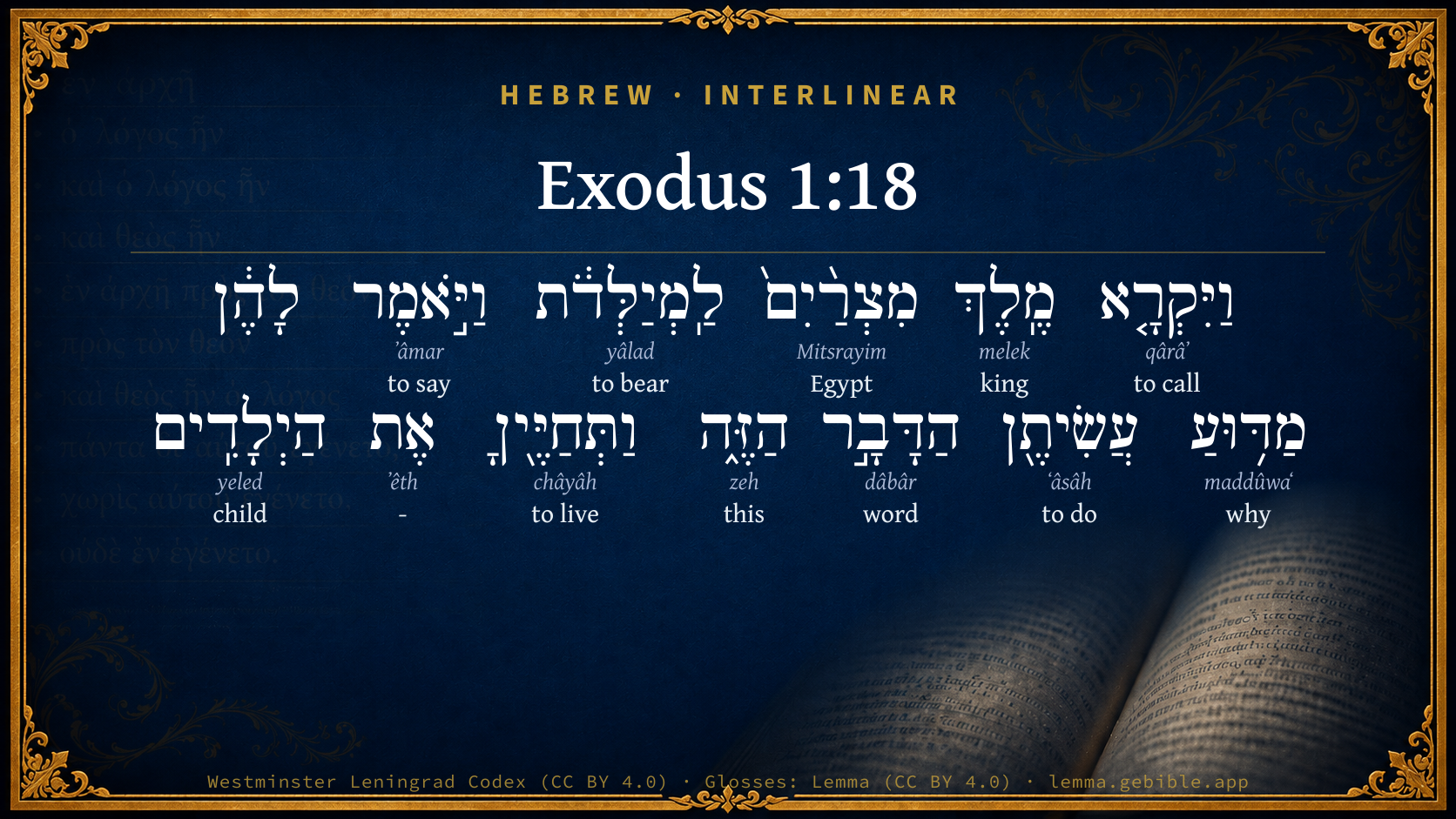
Hebrew (Westminster Leningrad Codex) Exodus 1:18 appears in the Hebrew Old Testament. The text above is from the Westminster Leningrad Codex. Each word links to its Strong’s number, a concise gloss, and parsing drawn from the Open Scriptures Hebrew Bible morphology. Click any word for its full Brown-Driver-Briggs (BDB) entry.
Download image
Cite this verse

Exodus 1:18 (World English Bible). Public Domain. Lemma interlinear Bible study tool, https://lemma.gebible.app/v/exodus/1/18.

Show BibTeX & RIS
BibTeX
RIS
English Translation
The king of Egypt called for the midwives, and said to them, "Why have you done this thing, and have saved the men-children alive?"
World English Bible · Public Domain
Download a study sheet

One document with this verse’s original text, its word-by-word gloss line, the meaning frame, cross-references with their text, attributed commentary, and full source and license credits — printable, and it pastes into notes with its structure intact.

This verse Autodidact and up

Study sheet (.html) Plain text (.txt)

A passage Seminary Student

Up to 50 verses in one chapter. A passage sheet keeps up to 6 commentary sources and 12 cross-references per verse, in the order this page ranks them, and says so on the sheet whenever that leaves anything out. Ask for a single verse and you get the Autodidact verse sheet above.

Everything on this page stays free to read, with no account — the sheet is a download of what is already on screen, not access to it.

Want to remove ads? Support Godless Engineer
Compare translations 3

The same verse in 3 English versions, stacked beneath the original-language interlinear above. Click any original word for its lexicon entry.

Each is an independent rendering of the whole verse — the interlinear is not word-aligned to these translations.

Highlighted words mark where these versions differ — a whole-verse word diff, not a word-by-word alignment.

  • World English Bible Public Domain
    The king of Egypt called for the midwives, and said to them, "Why have you done this thing, and have saved the men-children alive?"
  • King James Version Public Domain
    And the king of Egypt called for the midwives, and said unto them, Why have ye done this thing, and have saved the men children alive?
  • unfoldingWord Literal Text CC BY-SA 4.0
    And the king of Egypt called out to the midwives, and he said to them, “Why have you done this thing, and let the sons live?”

unfoldingWord Literal Text — © unfoldingWord, licensed CC BY-SA 4.0. Word-aligned USFM3 via Door43 (git.door43.org/unfoldingWord/en_ult).

Versions to compare (up to 4)

3 of 4 selected

Show all 18 translations

Every available English version of this verse, each an independent rendering of the whole verse.

  • World English Bible Public Domain
    The king of Egypt called for the midwives, and said to them, "Why have you done this thing, and have saved the men-children alive?"
  • Berean Standard Bible Public Domain
    So the king of Egypt summoned the midwives and asked them, “Why have you done this? Why have you let the boys live?”
  • Majority Standard Bible Public Domain
    So the king of Egypt summoned the midwives and asked them, “Why have you done this? Why have you let the boys live?”
  • King James Version Public Domain
    And the king of Egypt called for the midwives, and said unto them, Why have ye done this thing, and have saved the men children alive?
  • American Standard Version (1901) Public Domain
    And the king of Egypt called for the midwives, and said unto them, Why have ye done this thing, and have saved the men-children alive?
  • Revised Version (1885) Public Domain
    And the king of Egypt called for the midwives, and said unto them, Why have ye done this thing, and have saved the men children alive?
  • Geneva Bible (1599) Public Domain
    Then the King of Egypt called for the midwiues, and sayde vnto them, Why haue yee done thus, and haue preserued aliue the men children?
  • Douay-Rheims (1899) Public Domain
    And the king called for them and said: What is that you meant to do, that you would save the men children?
  • Young's Literal Translation Public Domain
    and the king of Egypt calleth for the midwives, and saith to them, `Wherefore have ye done this thing, and keep the lads alive?'
  • Literal Standard Version CC BY-SA 4.0
    and the king of Egypt calls for the midwives and says to them, “Why have you done this thing, and keep the boys alive?”
  • Unlocked Literal Bible CC BY-SA 4.0
    The king of Egypt summoned the midwives and said to them, “Why have you done this, and let the baby boys live?”
  • unfoldingWord Literal Text CC BY-SA 4.0
    And the king of Egypt called out to the midwives, and he said to them, “Why have you done this thing, and let the sons live?”
  • Darby Bible Public Domain
    And the king of Egypt called the midwives and said to them, Why have ye done this, and saved the male children alive?
  • World Messianic Bible Public Domain
    The king of Egypt called for the midwives, and said to them, “Why have you done this thing and saved the boys alive?”
  • Webster's Bible Public Domain
    And the king of Egypt called for the midwives, and said to them, Why have ye done this thing, and have saved the male-children alive?
  • Free Bible Version CC BY-SA 4.0
    The king of Egypt called the midwives in and demanded to know, “Why have you done this— letting the male children live?”
  • Bible in Basic English Public Domain
    And the king of Egypt sent for the women, and said to them, Why have you done this, and let the male children go on living?
  • JPS Tanakh (1917) Public Domain
    And the king of Egypt called for the midwives, and said unto them: 'Why have ye done this thing, and have saved the men-children alive?'

Literal Standard Version (2020), Covenant Press — licensed CC BY-SA 4.0. Text via the HelloAO Bible API (eBible.org). Unlocked Literal Bible (unfoldingWord) — licensed CC BY-SA 4.0. Text via the HelloAO Bible API (eBible.org). unfoldingWord Literal Text — © unfoldingWord, licensed CC BY-SA 4.0. Word-aligned USFM3 via Door43 (git.door43.org/unfoldingWord/en_ult). Free Bible Version, Dr. Jonathan Gallagher — licensed CC BY-SA 4.0. Text via the HelloAO Bible API (eBible.org).

Word by word

More ways to search: Search by grammar → Find every occurrence → Compare this word →

Practice this passage: Drill this verse → Learn its vocabulary →

מַדּ֥וּעַ
maddûwaʻ
H4069
“why”
Particle, Interrogative
Part of Speech
Particle
Type
Interrogative
Full BDB Definition

Origin: from H4100 and the pass. participle of H3045

TWOT: 848h

why?, on what account?, wherefore?
  1. וַיִּקְרָ֤א qârâʼ H7121 “and · to call” Conjunction + Verb, Qal, Sequential Imperfect, 3rd Person, Masculine, Singular
  2. מֶֽלֶךְ melek H4428 “king of” Noun, Common, Masculine, Singular, Construct
  3. מִצְרַ֨יִם֙ Mitsrayim H4714 “Egypt” Noun, Proper
  4. לַֽמְיַלְּדֹ֔ת yâlad H3205 “to/for the · bearing” Preposition, Determined + Verb, Piel, Participle Active, Feminine, Plural, Absolute
  5. וַיֹּ֣אמֶר ʼâmar H559 “and · to say” Conjunction + Verb, Qal, Sequential Imperfect, 3rd Person, Masculine, Singular
  6. עֲשִׂיתֶ֖ן ʻâsâh H6213 “to do” Verb, Qal, Perfect, 2nd Person, Feminine, Plural
  7. הַדָּבָ֣ר dâbâr H1697 “the · word” Particle, Definite Article + Noun, Common, Masculine, Singular, Absolute
  8. הַזֶּ֑ה zeh H2088 “the · this” Particle, Definite Article + Pronoun, Demonstrative, Masculine, Singular
  9. וַתְּחַיֶּ֖יןָ châyâh H2421 “and · to live” Conjunction + Verb, Piel, Sequential Imperfect, 2nd Person, Feminine, Plural
  10. אֶת ʼêth H853 “-” Particle, Direct Object
  11. הַיְלָדִֽים yeled H3206 “the · children” Particle, Definite Article + Noun, Common, Masculine, Plural, Absolute

About this verse

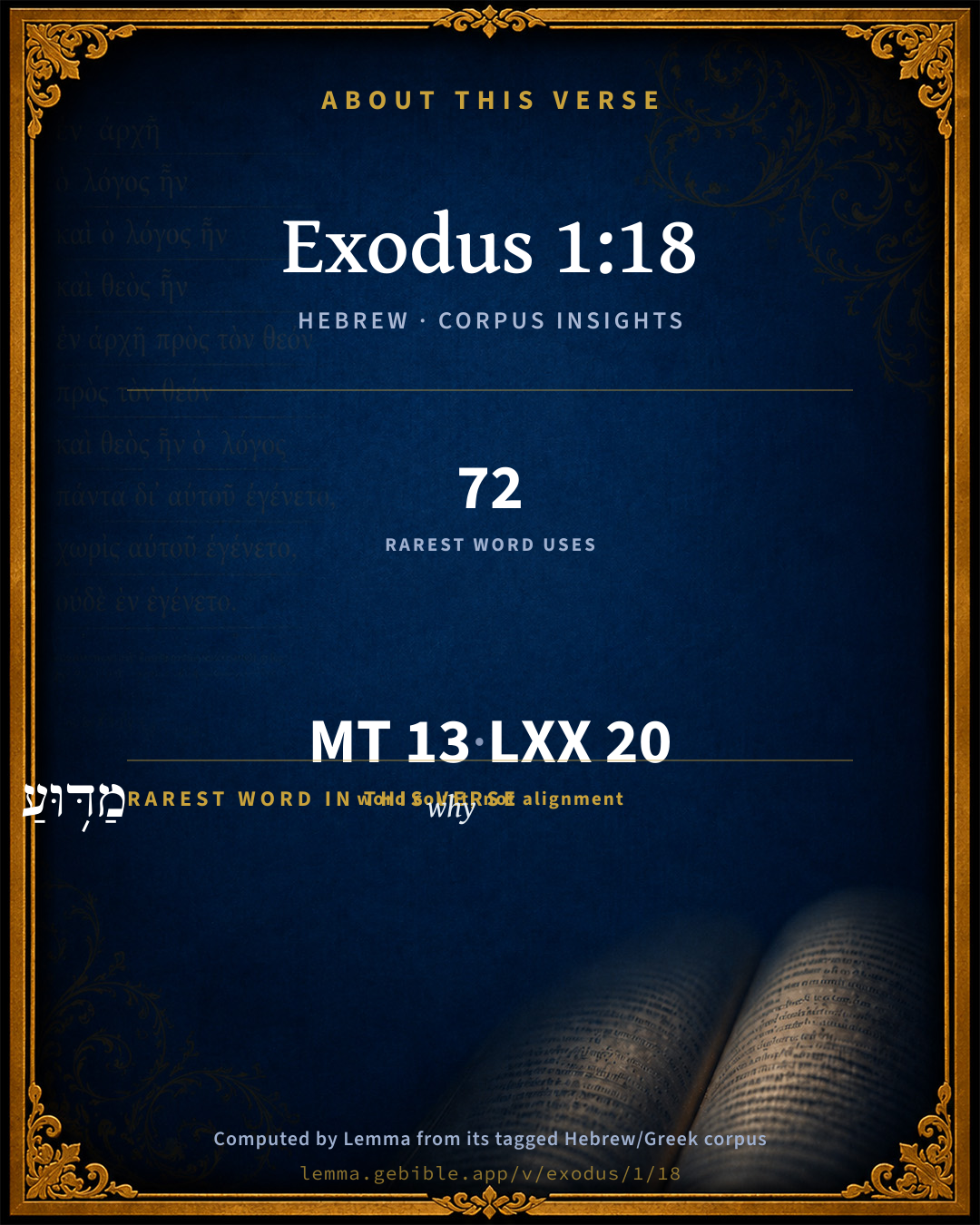
These counts appear in no published source. They are computed here, from the morphology-tagged text and Lemma’s own curated glosses. What Lemma adds →

13
words
12
distinct lemmas
Pentateuch
section

Grammatical profile

  • 5 verbs
  • 4 nouns
  • 1 pronoun
  • 1 preposition
  • 2 particles

Verb forms

  • וַיִּקְרָ֤א Qal · Sequential Imperfect
  • לַֽמְיַלְּדֹ֔ת Piel · Participle Active
  • וַיֹּ֣אמֶר Qal · Sequential Imperfect
  • עֲשִׂיתֶ֖ן Qal · Perfect
  • וַתְּחַיֶּ֖יןָ Piel · Sequential Imperfect

Hebrew & Septuagint length

In English translation the verse runs 24 words from the Hebrew and 27 from the Septuagint (LXX English) — closely comparable.

A rough comparison of the two English renderings, which tokenize alike — not a word-level alignment.

Word counts can differ between the Hebrew and the Greek without any difference in meaning — e.g. the Hebrew direct-object marker אֵת has no separate Greek word, and Greek often adds the article ὁ.

In the original languages it is 13 Hebrew tokens and 20 Greek tokens — but the two are counted differently (Hebrew bundles its prefixes and suffixes into one token; the Greek is in lemma form), so that isn’t a like-for-like length.

Cross-references

2

Topical passages linked to Exodus 1:18 in the Treasury of Scripture Knowledge — connected by theme and wording, ordered by reader-vote popularity; previews shown in the World English Bible.

  • Ecclesiastes 8:4 for the king's word is supreme. Who can say to him, "What are you doing?"
  • 2 Samuel 13:28 Absalom commanded his servants, saying, Mark you now, when Amnon's heart is merry with wine; and when I tell you, Smite Amnon, then kill him; don't be afraid; haven't I commanded you? be courageous, and be valiant.

Cross-references courtesy of OpenBible.info (CC BY 4.0).

Hebrew and Greek witnesses Masoretic Hebrew ↔ Greek Septuagint

The same verse in the two great witnesses to the Old Testament, shown verse-for-verse.

These are two independent witnesses, not word-aligned to each other, and the Septuagint is shown in lemma (dictionary) form.

Hebrew Exodus 1:18 Masoretic · Westminster Leningrad Codex

וַיִּקְרָ֤א מֶֽלֶךְ מִצְרַ֨יִם֙ לַֽמְיַלְּדֹ֔ת וַיֹּ֣אמֶר לָהֶ֔ן מַדּ֥וּעַ עֲשִׂיתֶ֖ן הַדָּבָ֣ר הַזֶּ֑ה וַתְּחַיֶּ֖יןָ אֶת הַיְלָדִֽים

The king of Egypt called for the midwives, and said to them, "Why have you done this thing, and have saved the men-children alive?"

World English Bible · Public Domain

Greek LXX Exodus 1:18 Septuagint · lemma form

καλέω δέ ὁ βασιλεύς αἴγυπτος ὁ μαῖα καί εἶπον αὐτός τίς ὅτι ποιέω ὁ πρᾶγμα οὗτος καί ζωογονέω ὁ ἄρσην

And the king of Egypt called the midwives, and said to them, Why is it that you⌃ have done this thing, and saved the male children alive?

LXX2012 (modern English Septuagint) · Public Domain

Hebrew: Westminster Leningrad Codex (CC BY 4.0). Greek: Septuagint (public domain); English from LXX2012 (modern English Septuagint) (Public Domain). How the Septuagint differs from the Hebrew →

Targum (Aramaic paraphrase)

2

The Targum is the ancient Jewish Aramaic paraphrase of the Hebrew Scriptures — an interpretive translation, not the Hebrew text itself. Onkelos (literal) and Pseudo-Jonathan (expansive) render the Torah, and Jonathan the Prophets. Coverage is partial: where no permissively-licensed English translation exists for a verse, only the Aramaic is shown. This is verse-level text, not a word-by-word alignment to the Hebrew.

  1. Targum Onkelos Torah (Genesis–Deuteronomy)
    וּקְרָא מַלְכָּא דְמִצְרַיִם לְחַיָתָא וַאֲמַר לְהֶן מָה דֵין עֲבַדְתּוּן יָת פִּתְגָמָא הָדֵין וְקַיֵמְתּוּן יָת בְּנַיָא:

    (no public-domain English translation for this verse)

    Targum Onkelos — Aramaic: “Onkelos Genesis” (public domain); “Onkelos Exodus” (public domain); “Onkelos Leviticus” (public domain); “Onkelos Numbers” (public domain); “Onkelos Deuteronomy” (public domain). English: “Sefaria Community Translation” (CC0 1.0 (public-domain dedication)); “J.W. Etheridge. The Targums of Onkelos and Jonathan Ben Uzziel on the Pentateuch. London: Longmans, Green, 1862” (public domain). Text via Sefaria.

  2. Targum Pseudo-Jonathan Torah (Genesis–Deuteronomy)
    וּקְרָא מַלְכָּא דְמִצְרַיִם לְחַיָיתָא וַאֲמַר לְהוֹן לְמָה דֵין עֲבַדְתּוּן יַת פִּתְגָמָא הָדֵין וּקְיַימְתּוּן יַת בְּנַיָא

    And the king of Mizraim called the midwives, and said to them, Why have you done this thing, and have saved the children?

    Targum Pseudo-Jonathan — Aramaic: “Targum Jonathan on Genesis” (public domain); “Targum Jonathan on Exodus” (public domain); “Targum Jonathan on Leviticus” (public domain); “Targum Jonathan on Numbers” (public domain); “Targum Jonathan on Deuteronomy” (public domain). English: “The Targum of Jonathan ben Uzziel, trans. J. W. Etheridge, London, 1862” (public domain). Text via Sefaria.

Commentary

Notes on Exodus 1:18 from classic Christian and Jewish commentators (each source and its license shown beneath its notes). The classic Christian expositions comment on the surrounding passage and are grouped to its opening verse, so a note may address several verses; the Jewish commentaries on the Tanakh (Rashi and others) are per-verse, so they appear only where the commentator wrote on this verse.

Lemma curates 59 commentaries, every one of them public domain or Creative Commons licensed, each selected and text-cleaned for this edition rather than reprinted as found. About our sources →

Trapp's Complete Commentary

John Trapp

Exo 1:18 And the king of Egypt called for the midwives, and said unto them, Why have ye done this thing, and have saved the men children alive?

Ver. 18. Why have ye done this thing?] They might well have answered, as she did in Euripides, Obediemus Atridis honesta mandantibus: Sin vero inhonesta mandabut, non obediemus. If you command things honest we will obey you; not else. Or as that brave woman upon the rack, Non ideo negare vole, ne peream: sed ideo mentiri nolo, ne peccem. {a}

{a} Jerome.

John Trapp, A Commentary or Exposition upon All the Books of the Old and New Testament (1647–1656) — public domain. Text from a community e-Sword module.

John Gill's Exposition

And the king called for the midwives,.... Perceiving, by the increase of the Israelites, that they did not obey his commands:

and said unto them, why have ye done this thing, and have saved the men children alive? not only did not kill them, but did everything for them that was necessary for their future preservation and health; see Eze 16:4.

John Gill's Exposition of the Whole Bible (1746–1763) — public domain (CC PDM 1.0). Text via the HelloAO Bible API.

The Pulpit Commentary

Vers. 18-21. God"s acceptance of an imperfect obedience.

The midwives had not the courage of their convictions. They did not speak out boldly, like Daniel, and the "Three Children," and the Apostles. They did not say, "Be it known unto thee, O king, that we fear God, and will not do this thing." They cast about for an excuse, which should absolve them of the crime of disobedience, and so perhaps save them from punishment, and they found one which was no doubt partially true, but which by a suppressio veri was a suggestio falsi. Some have exonerated them from all blame under the circumstances; but though the circumstances may extenuate, they do not justify their conduct. It was a fault, but (especially if they were heathens) a venial fault. And it was perhaps repented of. At any rate God condoned it. He was not "extreme to mark what was done amiss." He accepted their good deeds and their reverent fear of him, though it was not accompanied by high courage and a heroic love of truth; that is to say, he, accepted an imperfect obedience. And this is what he does in all cases. No man but One has rendered an obedience that was perfect. "All we, the rest, offend in many things; and if we say that we have no sin, deceive ourselves and the truth is not in us." Well for us that God, for his Son"s sake, and through his atonement on the cross, can condone our offences, and despite our many misdeeds reward our acts of faithfulness! (see Mat_6:4 Mat_10:42 Mat_16:27; Luk_6:35; 1Co_3:14; etc.)

The Pulpit Commentary (1880–1919), ed. H.D.M. Spence-Jones & Joseph S. Exell — public domain. Text from a community e-Sword module.

Keil & Delitzsch

C. F. Keil & F. Delitzsch

When questioned upon the matter, the explanation which they gave was, that the Hebrew women were not like the delicate women of Egypt, but were חיות "vigorous" (had much vital energy: Abenezra), so that they gave birth to their children before the midwives arrived. They succeeded in deceiving the king with this reply, as childbirth is remarkably rapid and easy in the case of Arabian women (see Burckhardt, Beduinen, p. 78; Tischendorf, Reise i. p. 108).

Keil & Delitzsch — Biblical Commentary on the Old Testament (1861–1891) — public domain (CC PDM 1.0). Text via the HelloAO Bible API. (Old Testament only.)

unfoldingWord translationNotes

Door43 World Missions Community

midwives

These were women who helped a woman give birth to a baby. See how you translated this in Exodus 1:16.

Why have you done this, and let the baby boys live?

Pharaoh asked this question to rebuke the midwives for allowing the male children to live. This rhetorical question can be translated as a statement. AT: "You have disobeyed my order by not killing the male babies!" (See: Rhetorical Question)

The Hebrew women are not like the Egyptian women

The midwives answered wisely to appease Pharaoh's anger.

translationWords

Egypt

Pharaoh

unfoldingWord translationNotes — © Distant Shores Media and the Door43 World Missions Community, licensed CC BY-SA 4.0. Source: git.door43.org/Door43/en_tn.

Lesson kit

Teaching starters — assembled from the data on this page, not authored interpretation. Every prompt links to the verse data it draws on. Edit before teaching.

Exodus, in the Pentateuch, opens this verse with 13 words (12 distinct Hebrew lemmas). Its most distinctive word is maddûwaʻ (“why”). A historical commentator’s framing appears above. Read the whole chapter for the surrounding context.

Discussion questions

  1. How does “why” (maddûwaʻ) shape what this verse is saying?
  2. Ecclesiastes 8:4 shares this passage’s theme. How do the two illuminate each other?
  3. These translations render this verse differently. What is at stake in choosing one wording over another?
  4. The verb «וַיִּקְרָ֤א» is Qal Sequential Imperfect. How does its form color the action?
  5. Reading how Trapp's Complete Commentary and John Gill's Exposition read this verse, where do the two commentators agree and where do they part?

Things to notice

Reading settings

Reading text

Shown beneath each verse's original-language words.

Old Testament
Old Testament edition

Read the OT as the Masoretic Hebrew (MT) or the Greek Septuagint (LXX).

English shown for the Greek Septuagint (in the Hebrew ↔ Greek comparison).

Comparing translations? Open the Compare panel on any verse page to stack up to four side by side.