
Psalms 7:15

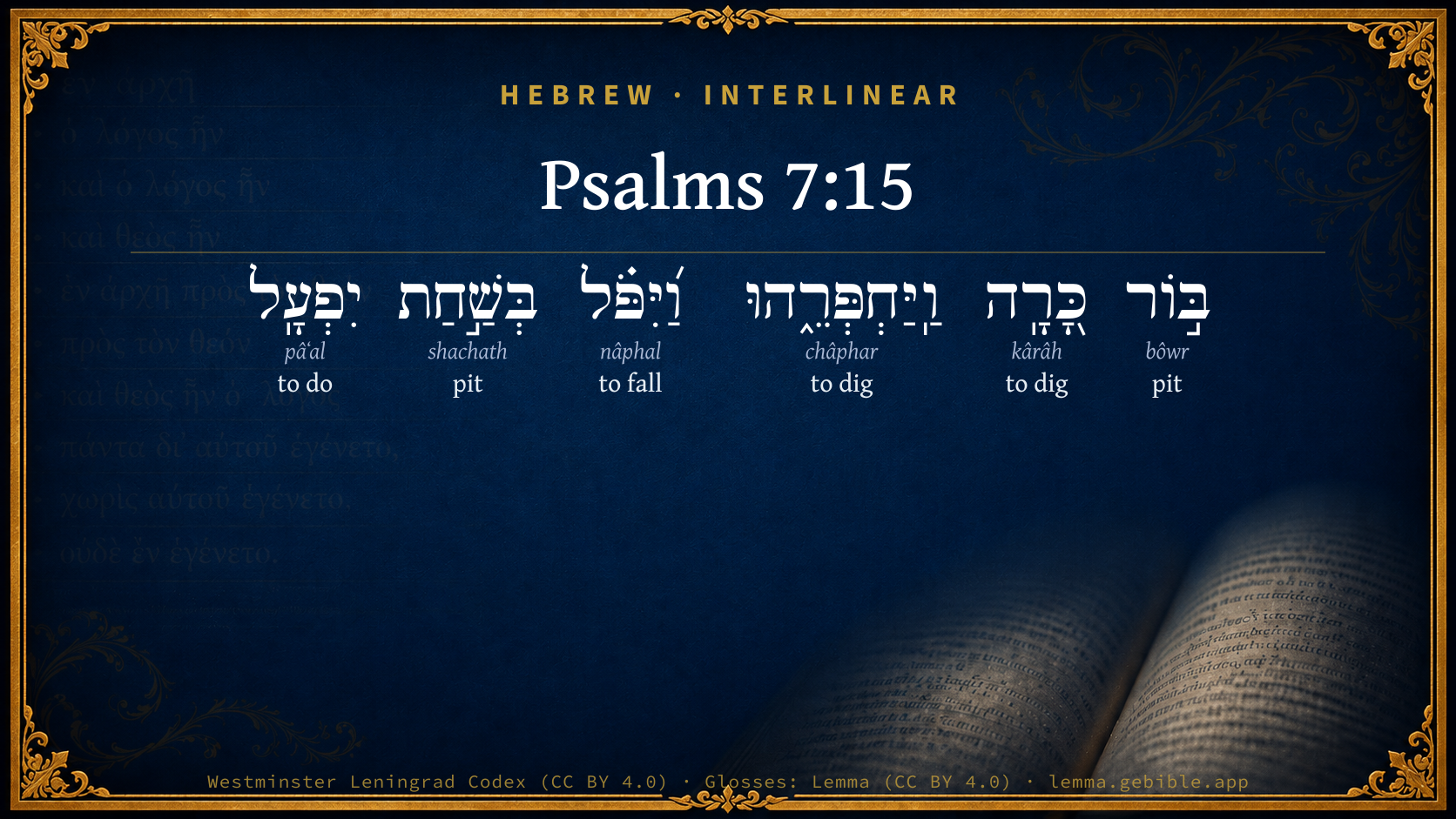
Hebrew (Westminster Leningrad Codex) Psalms 7:15 appears in the Hebrew Old Testament. The text above is from the Westminster Leningrad Codex. Each word links to its Strong’s number, a concise gloss, and parsing drawn from the Open Scriptures Hebrew Bible morphology. Click any word for its full Brown-Driver-Briggs (BDB) entry.
Download image
Cite this verse

Psalms 7:15 (World English Bible). Public Domain. Lemma interlinear Bible study tool, https://lemma.gebible.app/v/psalms/7/15.

Show BibTeX & RIS
BibTeX
RIS
English Translation
He has dug a hole, And has fallen into the pit which he made.
World English Bible · Public Domain
Download a study sheet

One document with this verse’s original text, its word-by-word gloss line, the meaning frame, cross-references with their text, attributed commentary, and full source and license credits — printable, and it pastes into notes with its structure intact.

This verse Autodidact and up

Study sheet (.html) Plain text (.txt)

A passage Seminary Student

Up to 50 verses in one chapter. A passage sheet keeps up to 6 commentary sources and 12 cross-references per verse, in the order this page ranks them, and says so on the sheet whenever that leaves anything out. Ask for a single verse and you get the Autodidact verse sheet above.

Everything on this page stays free to read, with no account — the sheet is a download of what is already on screen, not access to it.

Want to remove ads? Support Godless Engineer
Compare translations 3

The same verse in 3 English versions, stacked beneath the original-language interlinear above. Click any original word for its lexicon entry.

Each is an independent rendering of the whole verse — the interlinear is not word-aligned to these translations.

Highlighted words mark where these versions differ — a whole-verse word diff, not a word-by-word alignment.

  • World English Bible Public Domain
    He has dug a hole, And has fallen into the pit which he made.
  • King James Version Public Domain
    He made a pit, and digged it, and is fallen into the ditch which he made.
  • unfoldingWord Literal Text CC BY-SA 4.0
    He digs a pit and hollows it out and falls into the hole he has made.

unfoldingWord Literal Text — © unfoldingWord, licensed CC BY-SA 4.0. Word-aligned USFM3 via Door43 (git.door43.org/unfoldingWord/en_ult).

Versions to compare (up to 4)

3 of 4 selected

Show all 18 translations

Every available English version of this verse, each an independent rendering of the whole verse.

  • World English Bible Public Domain
    He has dug a hole, And has fallen into the pit which he made.
  • Berean Standard Bible Public Domain
    He has dug a hole and hollowed it out; he has fallen into a pit of his own making.
  • Majority Standard Bible Public Domain
    He has dug a hole and hollowed it out; he has fallen into a pit of his own making.
  • King James Version Public Domain
    He made a pit, and digged it, and is fallen into the ditch which he made.
  • American Standard Version (1901) Public Domain
    He hath made a pit, and digged it, And is fallen into the ditch which he made.
  • Revised Version (1885) Public Domain
    He hath made a pit, and digged it, and is fallen into the ditch which he made.
  • Geneva Bible (1599) Public Domain
    Hee hath made a pitte and digged it, and is fallen into the pit that he made.
  • Douay-Rheims (1899) Public Domain
    Behold he hath been in labour with injustice; he hath conceived sorrow, and brought forth iniquity.
  • Young's Literal Translation Public Domain
    A pit he hath prepared, and he diggeth it, And he falleth into a ditch he maketh.
  • Literal Standard Version CC BY-SA 4.0
    He has prepared a pit, and he digs it, || And he falls into a ditch he makes.
  • Unlocked Literal Bible CC BY-SA 4.0
    He digs a pit and hollows it out and then falls into the hole he has made.
  • unfoldingWord Literal Text CC BY-SA 4.0
    He digs a pit and hollows it out and falls into the hole he has made.
  • Darby Bible Public Domain
    He digged a pit, and hollowed it out, and is fallen into the hole that he made.
  • World Messianic Bible Public Domain
    He has dug a hole, and has fallen into the pit which he made.
  • Webster's Bible Public Domain
    \\7:14\\Behold, he travaileth with iniquity, and hath conceived mischief, and brought forth falsehood.
  • Free Bible Version CC BY-SA 4.0
    They dig a deep hole to catch people, but then fall into it themselves.
  • Bible in Basic English Public Domain
    He has made a hole deep in the earth, and is falling into the hole which he has made
  • JPS Tanakh (1917) Public Domain
    (7-16) He hath digged a pit, and hollowed it, and is fallen into the ditch which he made.

Literal Standard Version (2020), Covenant Press — licensed CC BY-SA 4.0. Text via the HelloAO Bible API (eBible.org). Unlocked Literal Bible (unfoldingWord) — licensed CC BY-SA 4.0. Text via the HelloAO Bible API (eBible.org). unfoldingWord Literal Text — © unfoldingWord, licensed CC BY-SA 4.0. Word-aligned USFM3 via Door43 (git.door43.org/unfoldingWord/en_ult). Free Bible Version, Dr. Jonathan Gallagher — licensed CC BY-SA 4.0. Text via the HelloAO Bible API (eBible.org).

Word by word

More ways to search: Search by grammar → Find every occurrence → Compare this word →

Practice this passage: Drill this verse → Learn its vocabulary →

About this verse

These counts appear in no published source. They are computed here, from the morphology-tagged text and Lemma’s own curated glosses. What Lemma adds →

6
words
6
distinct lemmas
Wisdom
section

Notable vocabulary

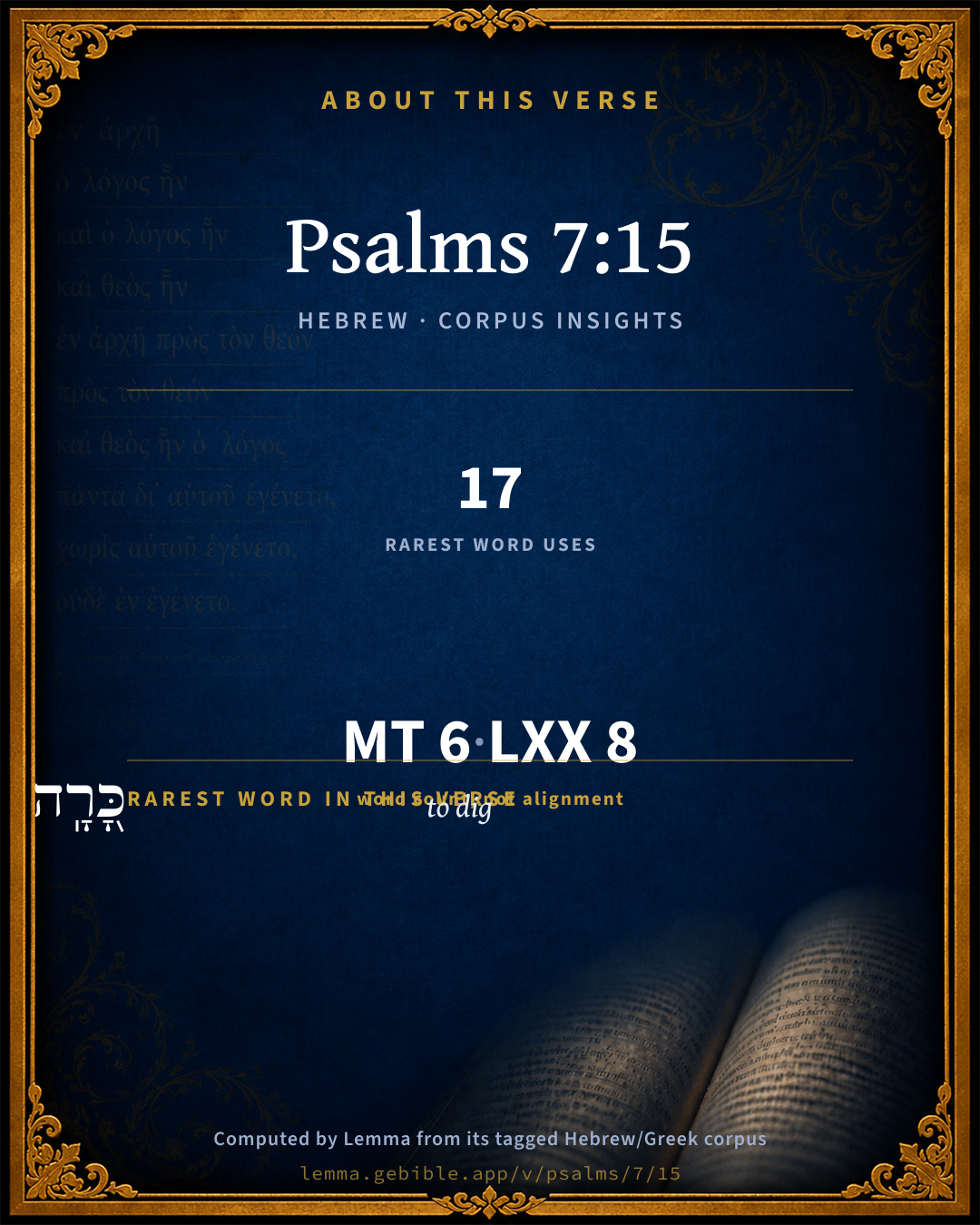
The rarest word here is כָּ֭רָֽה to dig H3738 — appearing just 17 times in the whole Hebrew Bible.

Shared distinctive vocabulary

כָּ֭רָֽה to dig H3738 occurs in 17 verses of the Hebrew Bible. Also found in:

Grammatical profile

  • 4 verbs
  • 2 nouns

Verb forms

  • כָּ֭רָֽה Qal · Perfect
  • וַֽיַּחְפְּרֵ֑הוּ Qal · Sequential Imperfect
  • וַ֝יִּפֹּ֗ל Qal · Sequential Imperfect
  • יִפְעָֽל Qal · Imperfect

Hebrew & Septuagint length

In English translation the verse runs 14 words from the Hebrew and 20 from the Septuagint (LXX English) — closely comparable.

A rough comparison of the two English renderings, which tokenize alike — not a word-level alignment.

Word counts can differ between the Hebrew and the Greek without any difference in meaning — e.g. the Hebrew direct-object marker אֵת has no separate Greek word, and Greek often adds the article ὁ.

In the original languages it is 6 Hebrew tokens and 8 Greek tokens — but the two are counted differently (Hebrew bundles its prefixes and suffixes into one token; the Greek is in lemma form), so that isn’t a like-for-like length.

Cross-references

15

Topical passages linked to Psalms 7:15 in the Treasury of Scripture Knowledge — connected by theme and wording, ordered by reader-vote popularity; previews shown in the World English Bible.

  • Job 4:8 According to what I have seen, those who plow iniquity, And sow trouble, Reap the same.
  • Psalms 141:10 Let the wicked fall together into their own nets, While I pass by.
  • Proverbs 26:27 Whoever digs a pit shall fall into it. Whoever rolls a stone, it will come back on him.
  • Psalms 10:2 In arrogance, the wicked hunt down the weak; They are caught in the schemes that they devise.
  • Psalms 35:7–8 For without cause they have hidden their net in a pit for me. Without cause they have dug a pit for my soul.
  • Ecclesiastes 10:8–9 He who digs a pit may fall into it; and whoever breaks through a wall may be bitten by a snake.
  • Psalms 9:15–16 The nations have sunk down in the pit that they made; In the net which they hid, their own foot is taken.
  • Psalms 57:6 They have prepared a net for my steps. My soul is bowed down. They dig a pit before me. They fall into the midst of it themselves. Selah.
  • Esther 7:10 So they hanged Haman on the gallows that he had prepared for Mordecai. Then was the king's wrath pacified.
  • Psalms 140:9–10 As for the head of those who surround me, Let the mischief of their own lips cover them.
  • Proverbs 5:22 The evil deeds of the wicked ensnare him. The cords of his sin hold him firmly.
  • Jeremiah 18:20 Shall evil be recompensed for good? for they have dug a pit for my soul. Remember how I stood before you to speak good for them, to turn away your wrath from them.
  • Psalms 94:13 That you may give him rest from the days of adversity, Until the pit is dug for the wicked.
  • Psalms 119:85 The proud have dug pits for me, Contrary to your law.
  • Job 6:27 Yes, you would even cast lots for the fatherless, And make merchandise of your friend.

Cross-references courtesy of OpenBible.info (CC BY 4.0).

Hebrew and Greek witnesses Masoretic Hebrew ↔ Greek Septuagint

The same verse in the two great witnesses to the Old Testament, shown verse-for-verse.

You’re reading Greek Psalm 7 (Hebrew Psalm 7). The Septuagint counts the superscription, so verse numbers can differ from the Hebrew — chapter-level alignment, not verse-by-verse. Numbering follows Rahlfs.

These are two independent witnesses, not word-aligned to each other, and the Septuagint is shown in lemma (dictionary) form.

Hebrew Psalms 7:15 Masoretic · Westminster Leningrad Codex

בּ֣וֹר כָּ֭רָֽה וַֽיַּחְפְּרֵ֑הוּ וַ֝יִּפֹּ֗ל בְּשַׁ֣חַת יִפְעָֽל

He has dug a hole, And has fallen into the pit which he made.

World English Bible · Public Domain

Greek LXX Greek Psalm 7:15 Septuagint · lemma form

ἰδού ὠδίνω ἀδικία συνλαμβάνω πόνος καί τίκτω ἀνομία

He has opened a pit, and dug it up, and he shall fall into the ditch which he has made.

LXX2012 (modern English Septuagint) · Public Domain

Hebrew: Westminster Leningrad Codex (CC BY 4.0). Greek: Septuagint (public domain); English from LXX2012 (modern English Septuagint) (Public Domain). How the Septuagint differs from the Hebrew →

Commentary

Notes on Psalms 7:15 from classic Christian and Jewish commentators (each source and its license shown beneath its notes). The classic Christian expositions comment on the surrounding passage and are grouped to its opening verse, so a note may address several verses; the Jewish commentaries on the Tanakh (Rashi and others) are per-verse, so they appear only where the commentator wrote on this verse.

Lemma curates 59 commentaries, every one of them public domain or Creative Commons licensed, each selected and text-cleaned for this edition rather than reprinted as found. About our sources →

Jamieson, Fausset & Brown

Robert Jamieson, A. R. Fausset & David Brown

psa 7:15Sa1 18:17; Sa1 31:2 illustrate the statement whether alluded to or not. These verses are expository of Psa 7:14, showing how the devices of the wicked end in disappointment, falsifying their expectations.

Jamieson, Fausset & Brown — Commentary Critical and Explanatory on the Whole Bible (1871) — public domain (CC PDM 1.0). Text via the HelloAO Bible API.

Ellicott's Commentary for English Readers

(15) He hath made.—Better, he digged a pit, and hollowed it out. Milton: “He digged a pit, and delved it deep.”

(15) Pate.—A word retained from Coverdale’s translation, and common in the Elizabethan age. In Shakespeare it is frequent—

“My invention

Comes from my pate,

As bird-lime does from frieze.”

For the moral, comp. 1Sa_25:29.

Psa_7:15-16 are quoted by Eusebius of the overthrow of Maxentius by Constantine, with special reference to the fact that in preparing a bridge of boats he had prepared the means for his own destruction.

A Bible Commentary for English Readers, edited by Charles John Ellicott (1878–1897) — public domain. Text from a community e-Sword module.

Trapp's Complete Commentary

John Trapp

Psa 7:15 He made a pit, and digged it, and is fallen into the ditch [which] he made.

Ver. 15. He made a pit, and digged it, &c.] This simile shows, that the wicked shall not only be frustrated, but undone by their own doing; as was Absalom, Haman, our gunpowder Papists, Pope Alexander VI, and his son Caesar Borgia (Bucholcer); who, by a mistake of the attendants at table, drank up the poisoned wine which they had prepared and set ready for some princes of Italy whom they had invited, and for whose dominions they thirsted. Hic aut Caesar ut nullus, saith Pontanus, who relateth the history.

John Trapp, A Commentary or Exposition upon All the Books of the Old and New Testament (1647–1656) — public domain. Text from a community e-Sword module.

The Biblical Illustrator

Joseph S. Exell

Psa_7:15

He made a pit, and digged it, and is fallen into the ditch which he made.

Social sappers

There is much among men of the particular sin rebuked in this text.

I. How this pit digging may be done. It may be done by attempting to lower a mans reputation. We are often guilty of talking in such a way that we lower people. The society papers live on this sort of thing. Scandal is a most, prominent form of the pit-digging business. It may be done by sapping a mans business. We have a general idea of what is fair and unfair within the world of trade. Now, some men steadily set themselves to ruin their neighbours business, thinking this essential to their own aggrandisement. You may do it by your capital, by your tongue, by your influence. Men sometimes seek to entice their neighbours into plausible and ruinous speculations. It may be done by endangering a mans character. Men will knowingly and designingly ruin their brother; they let them in to some sin or other. They will do this for the sake of gain, for a companionship in guilt, and sometimes out of a mere delight in iniquity. Sometimes we dig a pit for others when we do not think of all that we are doing. We have no right to lay snares, nor to put an occasion of stumbling in our brothers way. If our brother shows a tendency to slide we must not grease his path.

II. Characterise this work of pit digging.

1. It is dark work; it has to be done secretly, under cover of night: to be done softly, to be wrapped up. Let us decline all that kind of work in which we should be ashamed for society to see us. The great motto of Positivism is, Live without concealment. So live that you would not care if your house were glass. Let us decline all that work we should shrink from bringing under the eye of God.

2. It is dirty work, ignoble, base, disgraceful. Whatever aims to lower men is of this character. Such conduct involves only base qualities. Sometimes it is prompted by covetousness. Or it springs from envy or from revenge; or from mere levity. Pit diggers may be well dressed, but their work is of a far dirtier kind than that of the delver in the earth.

3. It is dismal work. All the true work of life has a joy in it, but there is no brightness or blessing in letting people down. It is a joyless thing to be a gravedigger among living men: to dig graves for mens reputations. Lighthouse building is better than pit sinking. Let our life be devoted to the uplifting of men.

4. It is degrading work. As soon as you begin to dig you stoop, and whatever progress you make you sink with your work. All true work resembles the work of the builder. If in conversation we talk down others, if that is our habit and pleasure, we talk ourselves down at the same time, whether we know it or not. As George Sand says, Insults, harsh words, detractive utterances, kill morally those who give expression to them. You narrow and debase your own thought and feeling, you wrong your own soul. If the spirit of our life is sympathy, and if we find readily and praise readily whatever is good, beautiful, clever, successful in the work of our fellows, we are really nourishing and promoting our intellect in an eminent degree. And so in our business life. It was said to me concerning one of the richest men in Bradford, He has made more gentlemen than any man in Bradford. That is the way, so to rise that you lift others up with you. The whole idea of the New Testament is, that a noble life is devoted to raising ones fellow men. This was the grand task of the Master. He was constantly raising what was fallen. (W. L. Watkinson.)

The self-avenging power of sin

The man that travaileth with iniquity, who is big with thoughts and purposes of evil, shall experience, as the issue of his birth throes, nothing but mischief and falsehood, misery and disappointment. Sin is a thing that recoils upon its perpetrator, and inflicts its heaviest blows upon the soul conceiving it, intending it, and giving it life and form. It was in accordance with this self-avenging power of sin that Saul was slain by the Philistines (1Sa_31:2-4), whom he had designed to be slayers of David (1Sa_18:21; 1Sa_18:25); that Haman was hanged upon the gallows he had erected for another (Est_7:10); and that the Jews themselves were destroyed by the Romans, whose aid they had invoked and received to crucify their Messiah. This recoiling, self-avenging power of sin is conclusive proof that a holy, just, and living God is moving everywhere in nature, and in the affairs of men, to paralyse the arm of the evil-doer, and to make man feel in every blow that he inflicts upon truth and right, upon innocence and virtue, a counter blow of overwhelming force. It is the conviction of this great truth, as a principle permeating the government of God, that makes David speak of the discomfiture of his enemies as a thing already accomplished. He sees every blow aimed at him recoiling upon themselves; every machination concocted for his overthrow, rendering their own still more inevitable. A fearful thought this, to the wicked, that his own evil shall slay him; and yet, to others, a thought full of hope, that God has so ordered things in His universe that evil must destroy itself. (David Caldwell, A. M.)

Retribution

The story of Phalariss bull, invented for the torment of others, and serving afterwards for himself, is notorious in heathen story It was a voluntary judgment which Archbishop Cranmer inflicted on himself when he thrust that very hand into the fire, and burnt it, with which he had signed to the popish articles, crying out, Oh, my unworthy right hand! but who will deny that the hand of the Almighty was also concerned in it? (William Turner.)

.

Psa_8:1-9

The Biblical Illustrator, edited by Joseph S. Exell (c. 1880s–1900s) — public domain. Text from a community e-Sword module.

Joseph Benson's Commentary

Psa 7:15-16. He made a pit, &c. — This is a proverbial manner of speech often used in Scripture. It is taken from pits which are digged, and then covered with the leaves of trees, or some such unstable materials, either to make men fall into them, or else wild beasts, which are hunted into them. And is fallen into the ditch which he made — He hath brought that evil upon himself which he intended against others. His mischief shall return upon his own head — “All the world agrees to acknowledge the equity of that sentence which inflicts upon the guilty the punishment intended by them for the innocent. No one pities the fate of a man buried in that pit which he had dug to receive his neighbour; or of him who owes his death wound to the return of an arrow shot against heaven. Saul was overthrown by those Philistines whom he would have made the instruments of cutting off David. Haman was hanged on his own gallows. The Jews, who excited the Romans to crucify Christ, were themselves, by the Romans, crucified in crowds. Striking instances these of the vengeance to be one day executed on all tempters and persecutors of others; when men and angels shall lift up their voices and cry out together, ‘Righteous art thou, O Lord, and just are thy judgments.’“

Joseph Benson's Commentary on the Old and New Testaments (1811–1818) — public domain. Text from a community e-Sword module.

J. A. Alexander on Psalms

Joseph Addison Alexander

16. (Psa 7:15) The same idea is then expressed by other figures, borrowed perhaps from certain ancient modes of hunting. A well he has digged, i. e. a pitfall for his enemy, and hollowed it, or made it deep, and fallen into the pit he is making, or about to make. The change from the past tense to the future seems to place the catastrophe between the inception and completion of the plan. The translation of the last verb as a simple preterite is entirely ungrammatical.

Joseph Addison Alexander, The Psalms Translated and Explained (1850) — public domain. Text from a community e-Sword module.

Adam Clarke's Commentary

Verse 15. He made a pit] He determined the destruction of David. He laid his plans with much artifice; he executed them with zeal and diligence; and when he had, as he supposed, the grave of David digged, he fell into it himself! The metaphor is taken from pits dug in the earth, and slightly covered over with reeds, c., so as not to be discerned from the solid ground but the animal steps on them, the surface breaks, and he falls into the pit and is taken. "All the world agrees to acknowledge the equity of that sentence, which inflicts upon the guilty the punishment intended by them for the innocent." - Horne.

Adam Clarke's Commentary on the Bible (1810–1826) — public domain. Text from a community e-Sword/MySword module.

John Calvin's Commentaries

Here David says not only that their wicked devices were without success, but that, by the wonderful providence of God, the result was the very opposite of what had been contemplated. He sets this forth in the first place metaphorically, by employing the figure of a pit and a ditch; and then he expresses the same thing in simple terms without figure, declaring, that the mischief intended for others returned upon the head of him who had devised it There is no doubt that it was a common proverb among the Jews, He who hath digged a pit falleth into it; which they quoted when they meant to say, that wicked and crafty men are caught in the snares and traps which they have set for others, or that the contrivers of the ruin of others perish by their own devices. “Tomboyent au mal qu’ils avoyent brasse.”—Fr. “Fall into the destruction which they had contrived.”

John Calvin's Commentaries (1540-1563) — public domain. Text from the Calvin Translation Society English edition (1840s-50s) via the Christian Classics Ethereal Library (ccel.org). Calvin's coverage is partial (roughly two-thirds of the Bible); uncommented books and verses are honest gaps, never fabricated. The 19th-century editor's footnotes and remarks are omitted so the notes are faithfully Calvin's own voice.

The Cambridge Bible for Schools and Colleges

gen. ed. J. J. S. Perowne

15. More exactly:

He hath dug a pit and delved it deep,

And is fallen into the ditch he was making.

Another picture of the destruction of the wicked. He ‘is snared in the work of his own hands’ (Psa_9:16). The figure is taken from the pitfalls used by hunters. See Eze_19:4; and cp. Psa_57:6; Ecc_10:8. Observe the graphic force of the tense in the last line. His schemes for the destruction of others prove his own ruin even before he has completed them.

The Cambridge Bible for Schools and Colleges (gen. ed. J. J. S. Perowne; Cambridge University Press, 1878–1918) — public domain. Text from a community e-Sword module.

John Gill's Exposition

He made a pit and digged it,.... That is, he digged a pit, and made it very large and capacious, to answer his purposes;

and is fallen into the ditch which he made; so it is said of the Heathen, Psa 9:15; and is exemplified in the case of Haman, who was hanged upon the gallows he had built for Mordecai. Kimchi explains this of Saul's falling upon his own sword, and dying by it, which he drew against David; phrase is proverbial, Pro 26:27; the sense of this and the above figurative expressions is literally and properly given in Psa 7:16.

John Gill's Exposition of the Whole Bible (1746–1763) — public domain (CC PDM 1.0). Text via the HelloAO Bible API.

Albert Barnes' Notes on the Bible

He made a pit - The allusion here is undoubtedly to a method of hunting wild beasts which was common in ancient times. It consists in digging a pit-fall, and covering it over with brush and grass so as to deceive the animals, and then enclosing them and driving them into it. See the notes at Isa 24:17.

And digged it - And hollowed it out so as to be large enough to contain his prey, and so deep that he could not escape if he fell into it. The idea is, that the enemy here referred to had laid a secret and artful plan to destroy others. He meant that they should not be aware of his plan until the mischief came suddenly upon them. He was preparing to ruin them, and supposed that he was certain of his prey.

And is fallen into the ditch which he made - Into the pit-fall which he had constructed for others; as if a man who had made a pit-fall for wild beasts had himself fallen into it, and could not extricate himself. That is, he had been snared in his own devices; his cunning had recoiled on himself, and instead of bringing ruin on others he had only managed to bring it on himself. See this sentiment illustrated in the notes at Job 5:13. A remarkable instance of the kind may be found in Esther (Est. 5–7), in the case of Haman. Indeed, such things are not uncommon in the world, where the cunning and the crafty are involved in the consequences of their own plans, and are taken in meshes from which they cannot free themselves. A straightforward course is easy, and men are safe in it; but it requires more skill than most men are endowed with to manage a crooked and crafty policy safely, or so as to be safe themselves in pursuing such a course. A spider will weave a web for flies with no danger to himself, for he is made for that, and acts as if he understood all the intricacies of his own web, and may move safely over it in every direction; but man was made to accomplish his purposes in an open and upright way, not by fraud and deceit; hence, when he undertakes a tortuous and crooked course - a plan of secret and scheming policy - in order to ruin others, it often becomes unmanageable by his own skill, or is suddenly sprung upon himself. No one can overvalue a straightforward course in its influence on our ultimate happiness; no one can overestimate the guilt and danger of a crooked and secret policy in devising plans of evil.

Albert Barnes' Notes on the Bible (1834–1885) — public domain. Text from a community e-Sword/MySword module.

Matthew Poole's English Annotations

Hath brought that evil upon himself which he intended against me; which may be understood either of Saul, who whilst he plotted against David’s life ran into apparent hazard of losing his own, 1Sa 24; 1Sa 26; or of some courtier or courtiers of Saul, in whom this was evidently verified, although the history and memory of it be now lost.

Matthew Poole's English Annotations on the Holy Bible (1683–1685) — public domain. Text from a community e-Sword/MySword module.

The Treasury of David

Charles H. Spurgeon

Ver. 15. He made a pit, and digged it. He was cunning in his plans, and industrious in his labours. He stooped to the dirty work of digging. He did not fear to soil his own hands, he was willing to work in a ditch if others might fall therein. What mean things men will do to wreak revenge on the godly. They hunt for good men, as if they were brute beasts; nay, they will not give them the fair chase afforded to the hare or the fox, but must secretly entrap them, because they can neither run them down nor shoot them down. Our enemies will not meet us to the face, for they fear us as much as they pretend to despise us. But let us look on to the end of the scene. The verse says, he

is fallen into the ditch which he made. Ah! there he is, let us laugh at his disappointment. Lo! he is himself the beast, he has hunted his own soul, and the chase has brought him a goodly victim. Aha, aha, so should it ever be. Come hither and make merry with this entrapped hunter, this biter who has bitten himself. Give him no pity, for it will be wasted on such a wretch. He is but rightly and richly rewarded by being paid in his own coin. He cast forth evil from his mouth, and it has fallen into his bosom. He has set his own house on fire with the torch which he lit to burn a neighbour. He sent forth a foul bird, and it has come back to its nest.

Ver. 14-15. They have digged a pit for usand that low, unto hell and are fallen into it themselves.

"No juster law can be devised or made, Than that sin's agents fall by their own trade."

The order of hell proceeds with the same degrees; though it give a greater portion, yet still a just proportion, of torment. These wretched guests were too busy with the waters of sin; behold, now they are in the depth of a pit, "where no water is." Dives, that wasted so many tuns of wine, cannot now procure water, not a pot of water, not a handful of water, not a drop of water, to cool his tongue. Desideravit guttam, qui non dedit micam. (Augustine Hom. 7) A just recompense! He would not give a crumb; he shall not have a drop. Bread hath no smaller fragment than a crumb, water no less fraction than a drop. As he denied the least comfort to Lazarus living, so Lazarus shall not bring him the least comfort dead. Thus the pain for sin answers the pleasure of sin ... Thus damnable sins shall have semblable punishments; and as Augustine of the tongue, so we may say of any member ... If it will not serve God in action, it shall serve him in passion. Thomas Adams.

Ver. 15. He made a pit, and digged it. The practice of making pitfalls was anciently not only employed for ensnaring wild beasts, but was also a stratagem used against men by the enemy, in time of war. The idea, therefore, refers to a man who, having made such a pit, whether for man or beast, and covered it over so as completely to disguise the danger, did himself inadvertently tread on his own trap, and fall into the pit he had prepared for another. Pictorial Bible.

Ver. 14-16. Illustrate by three figures the devices and defeat of persecutors.

Charles H. Spurgeon's The Treasury of David (1869–1885) — public domain. Psalms only. Text from a community e-Sword/MySword module.

The Pulpit Commentary

He made a pit, and digged it, and is fallen into the ditch which he made. (comp. Psa_9:15, 16 35:8 57:6 Pro_26:27 Pro_28:10, etc.) There are several illustrations of this law of God"s providence in Scripture, the most striking being that of Haman. Its existence as a law was noticed by some of the classical writers, as Ovid, who says"Nec lex justior ulla est, Quam necis artifices arte petite sua.

The Pulpit Commentary (1880–1919), ed. H.D.M. Spence-Jones & Joseph S. Exell — public domain. Text from a community e-Sword module.

Rashi

Rabbi Shlomo Yitzchaki (Rashi)

Behold, he travails Heb. יחבל an expression of conception and birth, as (in Song 8:5): “there your mother was in travail with you (חבלתך).”

he conceives mischief, and gives birth to lies Whatever he begets and toils, everything betrays him. The adage says: Whatever lies beget, diminution takes.

Rashi on the Tanakh — English translations: “The Judaica Press complete Tanach with Rashi, translated by A. J. Rosenberg” (CC BY 4.0); “Pentateuch with Rashi's commentary by M. Rosenbaum and A.M. Silbermann, 1929-1934” (public domain); “The Metsudah Tanach series, Lakewood, N.J” (CC BY 4.0); and “The Book of Joshua, Metsudah Publications, 1997” (CC BY 4.0). Text via Sefaria.

Radak

Rabbi David Kimhi (Radak)

Behold, he travaileth with iniquity; Yea, he hath conceived mischief, and brought forth falsehood. – He compares the thoughts of the heart with conception, and says their issuing in speech or conduct is like the pangs of a woman at childbirth. If so, the comparison is between speech and birth-pains, and (between) conduct and childbearing. And he says that he speaks evil, because he has conceived it in his heart and brought it forth in his mouth for execution. And iniquity and mischief and. falsehood have all one meaning, though the words are different.

Radak on the Tanakh — English translations: “Sefaria Community Translation” (CC0 1.0 (public-domain dedication)); “Eliyahu Munk, HaChut Hameshulash” (CC BY 4.0); “Rabbi Mike Feuer, Jerusalem Anthology” (CC BY 4.0); and “R. David Kimhi on the first book of Psalms, Translated by R.G. Finch, London, 1919” (public domain). Text via Sefaria.

Lesson kit

Teaching starters — assembled from the data on this page, not authored interpretation. Every prompt links to the verse data it draws on. Edit before teaching.

Psalms, in the Wisdom, opens this verse with 6 words (6 distinct Hebrew lemmas). Its most distinctive word is kârâh (“to dig”). A historical commentator’s framing appears above. Read the whole chapter for the surrounding context.

Discussion questions

  1. The word kârâh carries the sense “to dig.” How does it shape the verse?
  2. How does Genesis 26:25, which shares the word «to dig», read alongside this verse?
  3. The translations on this page render this verse differently — a whole-verse word diff, not a word-by-word alignment. What might account for the different wordings?
  4. «כָּ֭רָֽה» is a Qal Perfect verb. How does that grammatical form shape the action described?
  5. Compare how Jamieson, Fausset & Brown and Ellicott's Commentary for English Readers read this verse. Where do they agree or differ?

Things to notice

Reading settings

Reading text

Shown beneath each verse's original-language words.

Old Testament
Old Testament edition

Read the OT as the Masoretic Hebrew (MT) or the Greek Septuagint (LXX).

English shown for the Greek Septuagint (in the Hebrew ↔ Greek comparison).

Comparing translations? Open the Compare panel on any verse page to stack up to four side by side.