Genesis 48:6

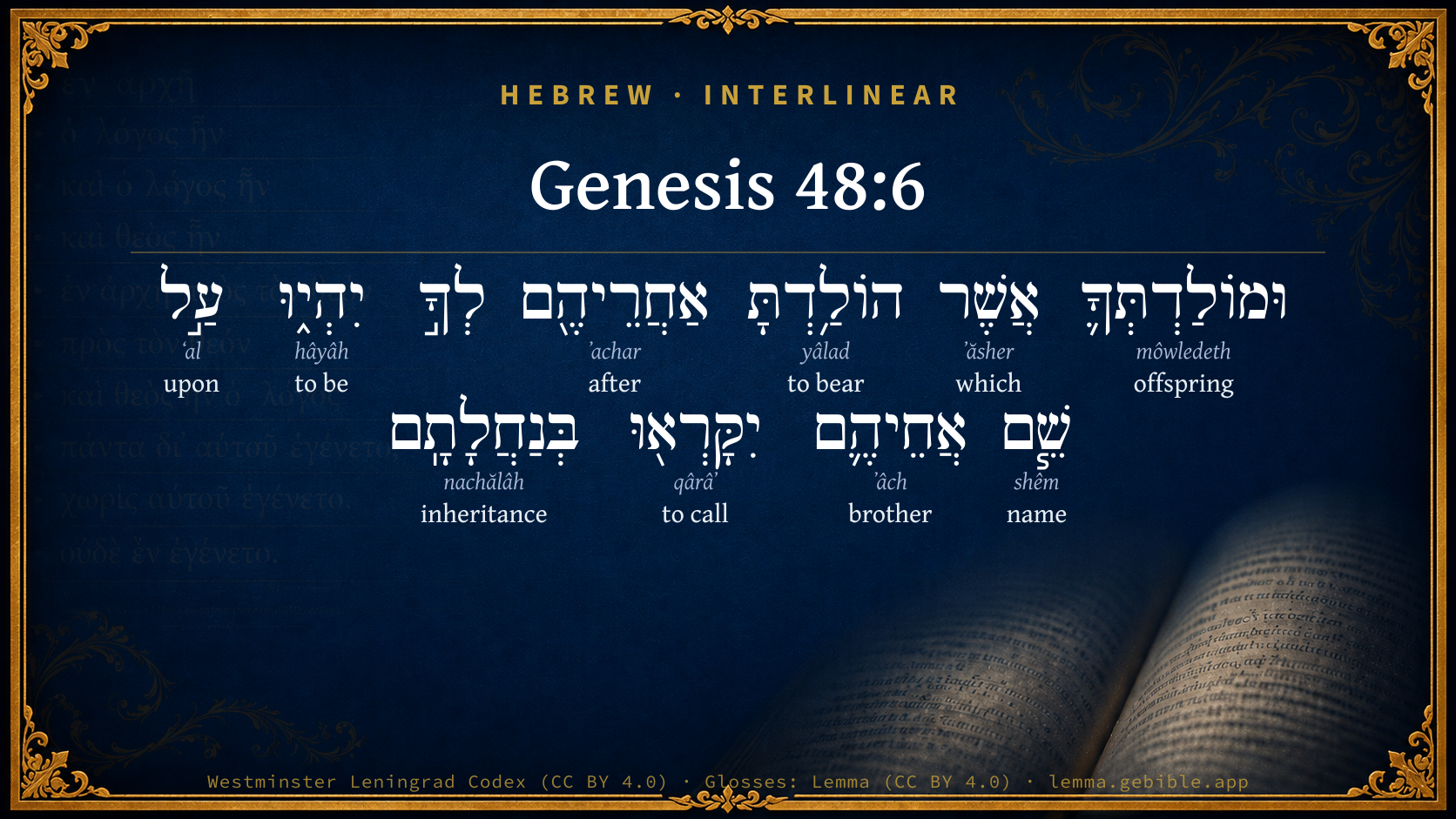
Hebrew (Westminster Leningrad Codex) Genesis 48:6 appears in the Hebrew Old Testament. The text above is from the Westminster Leningrad Codex. Each word links to its Strong’s number, a concise gloss, and parsing drawn from the Open Scriptures Hebrew Bible morphology. Click any word for its full Brown-Driver-Briggs (BDB) entry.
Download image
Cite this verse

Genesis 48:6 (World English Bible). Public Domain. Lemma interlinear Bible study tool, https://lemma.gebible.app/v/genesis/48/6.

Show BibTeX & RIS
BibTeX
RIS
English Translation
Your issue, who you become the father of after them, will be yours. They will be called after the name of their brothers in their inheritance.
World English Bible · Public Domain
Download a study sheet

One document with this verse’s original text, its word-by-word gloss line, the meaning frame, cross-references with their text, attributed commentary, and full source and license credits — printable, and it pastes into notes with its structure intact.

This verse Autodidact and up

Study sheet (.html) Plain text (.txt)

A passage Seminary Student

Up to 50 verses in one chapter. A passage sheet keeps up to 6 commentary sources and 12 cross-references per verse, in the order this page ranks them, and says so on the sheet whenever that leaves anything out. Ask for a single verse and you get the Autodidact verse sheet above.

Everything on this page stays free to read, with no account — the sheet is a download of what is already on screen, not access to it.

Want to remove ads? Support Godless Engineer
Compare translations 3

The same verse in 3 English versions, stacked beneath the original-language interlinear above. Click any original word for its lexicon entry.

Each is an independent rendering of the whole verse — the interlinear is not word-aligned to these translations.

Highlighted words mark where these versions differ — a whole-verse word diff, not a word-by-word alignment.

  • World English Bible Public Domain
    Your issue, who you become the father of after them, will be yours. They will be called after the name of their brothers in their inheritance.
  • King James Version Public Domain
    And thy issue, which thou begettest after them, shall be thine, and shall be called after the name of their brethren in their inheritance.
  • unfoldingWord Literal Text CC BY-SA 4.0
    But your children whom you father after them will be yours. They will be called by the name of their brothers in their inheritance.

unfoldingWord Literal Text — © unfoldingWord, licensed CC BY-SA 4.0. Word-aligned USFM3 via Door43 (git.door43.org/unfoldingWord/en_ult).

Versions to compare (up to 4)

3 of 4 selected

Show all 18 translations

Every available English version of this verse, each an independent rendering of the whole verse.

  • World English Bible Public Domain
    Your issue, who you become the father of after them, will be yours. They will be called after the name of their brothers in their inheritance.
  • Berean Standard Bible Public Domain
    Any children born to you after them shall be yours, and they shall be called by the names of their brothers in the territory they inherit.
  • Majority Standard Bible Public Domain
    Any children born to you after them shall be yours, and they shall be called by the names of their brothers in the territory they inherit.
  • King James Version Public Domain
    And thy issue, which thou begettest after them, shall be thine, and shall be called after the name of their brethren in their inheritance.
  • American Standard Version (1901) Public Domain
    And thy issue, that thou begettest after them, shall be thine; they shall be called after the name of their brethren in their inheritance.
  • Revised Version (1885) Public Domain
    And thy issue, which thou begettest after them, shall be thine; they shall be called after the name of their brethren in their inheritance.
  • Geneva Bible (1599) Public Domain
    But the linage, which thou hast begotten after them, shalbe thine: they shall be called after the names of their brethren in their inheritance.
  • Douay-Rheims (1899) Public Domain
    But the rest whom thou shalt have after them, shall be thine, and shall be called by the name of their brethren in their possessions.
  • Young's Literal Translation Public Domain
    and thy family which thou hast begotten after them are thine; by the name of their brethren they are called in their inheritance.
  • Literal Standard Version CC BY-SA 4.0
    and your family which you have begotten after them are yours; by the name of their brothers they are called in their inheritance.
  • Unlocked Literal Bible CC BY-SA 4.0
    The children you have after them will be yours; they will be listed under the names of their brothers in their inheritance.
  • unfoldingWord Literal Text CC BY-SA 4.0
    But your children whom you father after them will be yours. They will be called by the name of their brothers in their inheritance.
  • Darby Bible Public Domain
    And thy family which thou hast begotten after them shall be thine: they shall be called after the name of their brethren in their inheritance.
  • World Messianic Bible Public Domain
    Your offspring, whom you become the father of after them, will be yours. They will be called after the name of their brothers in their inheritance.
  • Webster's Bible Public Domain
    And thy issue, which thou begettest after them, shall be thine, and shall be called after the name of their brethren in their inheritance.
  • Free Bible Version CC BY-SA 4.0
    Any other children you have after them will be yours, and will share their inheritance within the land of their older brothers.
  • Bible in Basic English Public Domain
    And any other offspring which you have after them, will be yours, and will be named after their brothers in their heritage.
  • JPS Tanakh (1917) Public Domain
    And thy issue, that thou begettest after them, shall be thine; they shall be called after the name of their brethren in their inheritance.

Literal Standard Version (2020), Covenant Press — licensed CC BY-SA 4.0. Text via the HelloAO Bible API (eBible.org). Unlocked Literal Bible (unfoldingWord) — licensed CC BY-SA 4.0. Text via the HelloAO Bible API (eBible.org). unfoldingWord Literal Text — © unfoldingWord, licensed CC BY-SA 4.0. Word-aligned USFM3 via Door43 (git.door43.org/unfoldingWord/en_ult). Free Bible Version, Dr. Jonathan Gallagher — licensed CC BY-SA 4.0. Text via the HelloAO Bible API (eBible.org).

Word by word

More ways to search: Search by grammar → Find every occurrence → Compare this word →

Practice this passage: Drill this verse → Learn its vocabulary →

וּמוֹלַדְתְּךָ֛
môwledeth
H4138
“and · offspring · your”
Conjunction + Noun, Common, Feminine, Singular, Construct + Suffix, Personal, 2nd Person, Masculine, Singular
Part of Speech
Conjunction + Noun
Type
Common
Gender
Feminine
Number
Singular
State
Construct
Full BDB Definition

Origin: from H3205

TWOT: 867f

kindred, birth, offspring, relatives - kindred - birth, circumstances of birth - one born, begotten, issue, offspring, female offspring
  1. אֲשֶׁר ʼăsher H834 “which” Particle, Relative
  2. הוֹלַ֥דְתָּ yâlad H3205 “to bear” Verb, Hiphil, Perfect, 2nd Person, Masculine, Singular
  3. אַחֲרֵיהֶ֖ם ʼachar H310 “after · them” Preposition + Suffix, Personal, 3rd Person, Masculine, Plural
  4. יִהְי֑וּ hâyâh H1961 “to be” Verb, Qal, Imperfect, 3rd Person, Masculine, Plural
  5. עַ֣ל ʻal H5921 “upon” Preposition
  6. שֵׁ֧ם shêm H8034 “name of” Noun, Common, Masculine, Singular, Construct
  7. אֲחֵיהֶ֛ם ʼâch H251 “brothers · their” Noun, Common, Masculine, Plural, Construct + Suffix, Personal, 3rd Person, Masculine, Plural
  8. יִקָּרְא֖וּ qârâʼ H7121 “to call” Verb, Niphal, Imperfect, 3rd Person, Masculine, Plural
  9. בְּנַחֲלָתָֽם nachălâh H5159 “in/at · inheritance · their” Preposition + Noun, Common, Feminine, Singular, Construct + Suffix, Personal, 3rd Person, Masculine, Plural

About this verse

These counts appear in no published source. They are computed here, from the morphology-tagged text and Lemma’s own curated glosses. What Lemma adds →

11
words
10
distinct lemmas
Pentateuch
section

Notable vocabulary

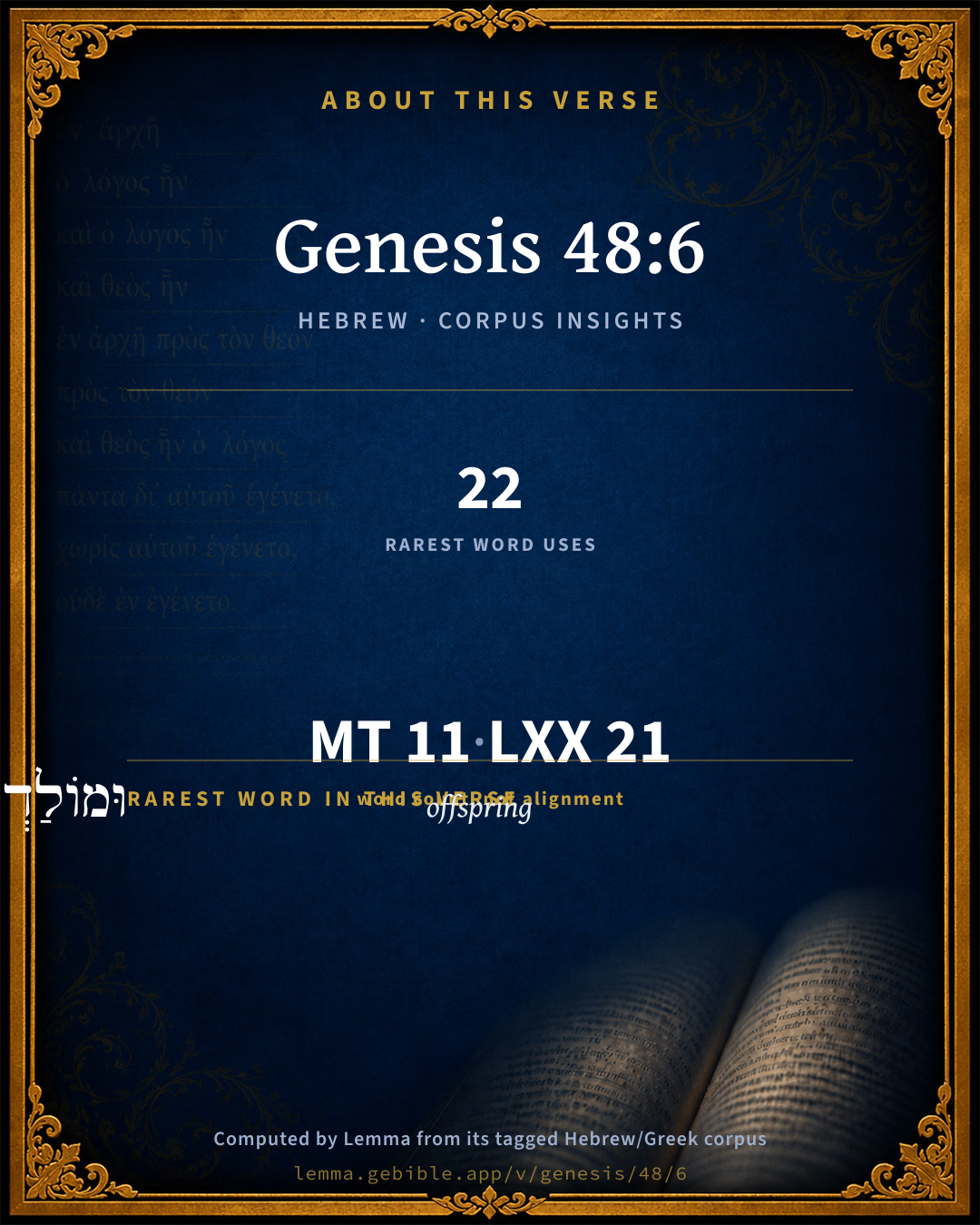
The rarest word here is וּמוֹלַדְתְּךָ֛ offspring H4138 — appearing just 22 times in the whole Hebrew Bible.

Shared distinctive vocabulary

וּמוֹלַדְתְּךָ֛ offspring H4138 occurs in 21 verses of the Hebrew Bible. Also found in:

Grammatical profile

  • 3 verbs
  • 4 nouns
  • 3 prepositions
  • 1 particle

Verb forms

  • הוֹלַ֥דְתָּ Hiphil · Perfect
  • יִהְי֑וּ Qal · Imperfect
  • יִקָּרְא֖וּ Niphal · Imperfect

Hebrew & Septuagint length

In English translation the verse runs 26 words from the Hebrew and 23 from the Septuagint (LXX English) — closely comparable.

A rough comparison of the two English renderings, which tokenize alike — not a word-level alignment.

Word counts can differ between the Hebrew and the Greek without any difference in meaning — e.g. the Hebrew direct-object marker אֵת has no separate Greek word, and Greek often adds the article ὁ.

In the original languages it is 11 Hebrew tokens and 21 Greek tokens — but the two are counted differently (Hebrew bundles its prefixes and suffixes into one token; the Greek is in lemma form), so that isn’t a like-for-like length.

Cross-references

1

Topical passages linked to Genesis 48:6 in the Treasury of Scripture Knowledge — connected by theme and wording, ordered by reader-vote popularity; previews shown in the World English Bible.

  • Joshua 14:4 For the children of Joseph were two tribes, Manasseh and Ephraim: and they gave no portion to the Levites in the land, save cities to dwell in, with the suburbs of it for their cattle and for their substance.

Cross-references courtesy of OpenBible.info (CC BY 4.0).

Hebrew and Greek witnesses Masoretic Hebrew ↔ Greek Septuagint

The same verse in the two great witnesses to the Old Testament, shown verse-for-verse.

These are two independent witnesses, not word-aligned to each other, and the Septuagint is shown in lemma (dictionary) form.

Hebrew Genesis 48:6 Masoretic · Westminster Leningrad Codex

וּמוֹלַדְתְּךָ֛ אֲשֶׁר הוֹלַ֥דְתָּ אַחֲרֵיהֶ֖ם לְךָ֣ יִהְי֑וּ עַ֣ל שֵׁ֧ם אֲחֵיהֶ֛ם יִקָּרְא֖וּ בְּנַחֲלָתָֽם

Your issue, who you become the father of after them, will be yours. They will be called after the name of their brothers in their inheritance.

World English Bible · Public Domain

Greek LXX Genesis 48:6 Septuagint · lemma form

ὁ δέ ἔκγονος ὅς ἐάν γεννάω μετά οὗτος σύ εἰμί ἐπί ὁ ὄνομα ὁ ἀδελφός αὐτός καλέω ἐν ὁ ἐκεῖνος κλῆρος

And the children which you shall beget hereafter, shall be in the name of their brethren; they shall be named after their inheritances.

LXX2012 (modern English Septuagint) · Public Domain

Hebrew: Westminster Leningrad Codex (CC BY 4.0). Greek: Septuagint (public domain); English from LXX2012 (modern English Septuagint) (Public Domain). How the Septuagint differs from the Hebrew →

Targum (Aramaic paraphrase)

2

The Targum is the ancient Jewish Aramaic paraphrase of the Hebrew Scriptures — an interpretive translation, not the Hebrew text itself. Onkelos (literal) and Pseudo-Jonathan (expansive) render the Torah, and Jonathan the Prophets. Coverage is partial: where no permissively-licensed English translation exists for a verse, only the Aramaic is shown. This is verse-level text, not a word-by-word alignment to the Hebrew.

  1. Targum Onkelos Torah (Genesis–Deuteronomy)
    וּבְנָיךְ דִּי תוֹלִיד בַּתְרֵיהוֹן דִּילָךְ יְהוֹן עַל שׁוּם אֲחוּהוֹן יִתְקְרוּן בְּאַחֲסַנְתְּהוֹן

    (no public-domain English translation for this verse)

    Targum Onkelos — Aramaic: “Onkelos Genesis” (public domain); “Onkelos Exodus” (public domain); “Onkelos Leviticus” (public domain); “Onkelos Numbers” (public domain); “Onkelos Deuteronomy” (public domain). English: “Sefaria Community Translation” (CC0 1.0 (public-domain dedication)); “J.W. Etheridge. The Targums of Onkelos and Jonathan Ben Uzziel on the Pentateuch. London: Longmans, Green, 1862” (public domain). Text via Sefaria.

  2. Targum Pseudo-Jonathan Torah (Genesis–Deuteronomy)
    וּבְנָךְ דִי תוֹלִיד בַּתְרֵיהוֹן דִילָךְ יְהוֹן עַל שׁוּם אֲחֵיהוֹן יִתְקְרוּן בְּאַחְסַנְתְּהוֹן

    And thy children whom thou mayest beget after them shall be thine; by the name of their brethren shall they be called in their inheritance.

    Targum Pseudo-Jonathan — Aramaic: “Targum Jonathan on Genesis” (public domain); “Targum Jonathan on Exodus” (public domain); “Targum Jonathan on Leviticus” (public domain); “Targum Jonathan on Numbers” (public domain); “Targum Jonathan on Deuteronomy” (public domain). English: “The Targum of Jonathan ben Uzziel, trans. J. W. Etheridge, London, 1862” (public domain). Text via Sefaria.

Commentary

Notes on Genesis 48:6 from classic Christian and Jewish commentators (each source and its license shown beneath its notes). The classic Christian expositions comment on the surrounding passage and are grouped to its opening verse, so a note may address several verses; the Jewish commentaries on the Tanakh (Rashi and others) are per-verse, so they appear only where the commentator wrote on this verse.

Lemma curates 59 commentaries, every one of them public domain or Creative Commons licensed, each selected and text-cleaned for this edition rather than reprinted as found. About our sources →

Trapp's Complete Commentary

John Trapp

Gen 48:6 And thy issue, which thou begettest after them, shall be thine, [and] shall be called after the name of their brethren in their inheritance.

Ver. 6. After the name of their brethren.] That is, of Ephraim and Manasseh; as if they were not their brethren, but their sons. Thus Jacob transfers the birthright from Reuben to Joseph. {1Ch 5:1-2}

John Trapp, A Commentary or Exposition upon All the Books of the Old and New Testament (1647–1656) — public domain. Text from a community e-Sword module.

Joseph Benson's Commentary

Gen 48:6. Thy issue after them — The Scriptures nowhere mention, nor does it appear that Joseph had any more children than these. But Jacob speaks this on supposition that he might, and in case he should have any more. Shall be thine — Shall be reputed as thy children and my grand- children, and shall not have any distinct share of my present and future inheritance, but shall have a part of their brethren’s lot in such manner and proportion as thou shalt think fit.

Joseph Benson's Commentary on the Old and New Testaments (1811–1818) — public domain. Text from a community e-Sword module.

Ellicott's Commentary for English Readers

(6) Thy issue, which thou begettest after them.—We gather from Gen_1:23 that Joseph probably had no other sons. But if such were born to him, they were not to count as heads of tribes, but be regarded as the children of Ephraim and Manasseh, and take rank only as heads of families.

A Bible Commentary for English Readers, edited by Charles John Ellicott (1878–1897) — public domain. Text from a community e-Sword module.

The Cambridge Bible for Schools and Colleges

gen. ed. J. J. S. Perowne

6. begettest] Better, as R.V. marg., hast begotten.

they shall be called] The meaning is that any other children of Joseph, and their descendants, shall be attached to the tribes of Ephraim and Manasseh, and shall be called Ephraimites or Manassites.

The Cambridge Bible for Schools and Colleges (gen. ed. J. J. S. Perowne; Cambridge University Press, 1878–1918) — public domain. Text from a community e-Sword module.

John Gill's Exposition

And thy issue, which thou begettest after them, shall be thine,.... The children of Joseph, that either were, or would be begotten after Ephraim and Manasseh; though whether ever any were is not certain; and this is only mentioned by way of supposition, as Jarchi interprets it, "if thou shouldest beget", &c. these should be reckoned his own, and not as Jacob's sons, but be considered as other grandchildren of Jacob's were, and not as Ephraim and Manasseh:

and shall be called after the name of their brethren in their inheritance; they should not have distinct names, or make distinct tribes, or have a distinct inheritance; but should be called either the children of Ephraim, or the children of Manasseh, and should be reckoned as belonging either to the one tribe, or the other, and have their inheritance in them, and with them, and not separate.

John Gill's Exposition of the Whole Bible (1746–1763) — public domain (CC PDM 1.0). Text via the HelloAO Bible API.

Haydock's Catholic Bible Commentary

Thine. They shall not claim the same prerogative: they shall live among their brethren, Ephraim and Manasses. We read not that Joseph had any other children besides these two. (Calmet) --- The double portion, or the birth-right, was thus transferred from Ruben to Joseph. (Du Hamel)

George Leo Haydock (1774–1849), Haydock's Catholic Family Bible and Commentary, 1859 edition — public domain. Excludes Psalms (Douay-Rheims chapter numbering differs from Protestant) and Deuterocanonical books (Catholic canon only).

Matthew Poole's English Annotations

Shall be reputed as thy children, and my grandchildren, and shall not have any distinct share in my present or future inheritance, but shall have a part of their brethren’s lot, in such manner and proportion as thou shalt think fit, or as their succeeding parents or governors shall determine. But it doth not appear, nor doth Scripture any where mention, that Joseph had any other sons but these, and therefore it is probable he had no more; only Jacob speaks this upon supposition, in case he should have any other.

Shall be called after the name of their brethren; either Ephraimites or Manassites.

Matthew Poole's English Annotations on the Holy Bible (1683–1685) — public domain. Text from a community e-Sword/MySword module.

Whedon's Commentary on the Bible

Daniel D. Whedon

6. Which thou begettest after them — “It is probable that Joseph had other children, and that their descendants are reckoned with those of Ephraim and Manasseh, (Num_26:23-37,) the natural being undistinguished from the adopted sons.” — Newhall.

Daniel D. Whedon (gen. ed.), Commentary on the Old and New Testaments (1874–1909) — public domain. Text from a community e-Sword module.

Rashi

Rabbi Shlomo Yitzchaki (Rashi)

Although the Land was divided according to the number of heads — as it is written, (Numbers 26:54) “To the more numerous thou shalt give a larger inheritance” — and each person had an equal share except those who were first-born sons (and these received a double share), yet only these of Joseph’s sons bore the name of “tribe” when it became a matter of casting lots for the partition of the land according to the number of the tribes (cf. Numbers 26:55), and of appointing princes to the various tribes and of assigning banners to each of them.

Rashi on the Tanakh — English translations: “The Judaica Press complete Tanach with Rashi, translated by A. J. Rosenberg” (CC BY 4.0); “Pentateuch with Rashi's commentary by M. Rosenbaum and A.M. Silbermann, 1929-1934” (public domain); “The Metsudah Tanach series, Lakewood, N.J” (CC BY 4.0); and “The Book of Joshua, Metsudah Publications, 1997” (CC BY 4.0). Text via Sefaria.

Ramban (Nachmanides)

Rabbi Moshe ben Nachman (Ramban / Nachmanides)

AND THE CHILDREN THAT WERE BORN TO YOU AFTER THEM. “If you beget any more children, they will not be numbered among my sons, but they will rather be included among the tribes of Ephraim and Menasheh. Nor shall they have a name amongst the tribes as far as inheritance in the Land of Israel is concerned.” Now even though the Land of Israel was divided according to the number of persons, as it is written, To the more thou shalt give the more inheritance, and each person received an equal share except for the first-born, who received a double share, nevertheless only these sons were designated as “tribes.” This is the language of Rashi.Now this is not correct, for if so, then Jacob’s granting of the birthright to Joseph was just nominal, its only effect being that Joseph’s sons would be called “tribes,” whereas the verse states, in their inheritance. This indicates that the two sons of Joseph were to be given the extra right of the firstborn in the matter of inheritance. In the Gemara, the Sages have said: “I have likened Ephraim and Menasheh to Reuben and Simeon with respect to the matter of inheritance, but not with respect to other matters,” even though they did not constitute an actual majority of the entire population. In that case Ephraim and Menasheh are considered part of the tribe of Joseph. as is stated in Tractate Horayoth. Our Rabbis have mentioned in many places that Joseph was the first-born as far as inheritance was concerned, and that he received a double share in the Land, as is the rule of every first-born, but not that his being first-born consisted merely of his sons being called “tribes,” as the Rabbi [Rashi] would have it.From this we further learn that the Land was not divided among all the tribes of Israel according to their populations for if so, what was the significance of this primogeniture with respect to inheritance? If we would say it meant that each and every individual offspring of Joseph was given double that of each person of all other tribes, this is not mentioned at all in Scripture, and we do not find Jacob giving the birthright to Joseph except by what he said here, As Reuben and Simeon shall they be to me, and based upon this, Scripture states, His [Reuben’s] birthright was given to the sons of Joseph the son of Israel. If so, then Ephraim and Menasheh were fully considered as two tribes, and it was this which constituted Joseph’s birthright, and the words of the Sages indeed corroborate this everywhere.Thus the matter is not at all as the Rabbi stated it. Instead, the Land of Israel was divided according to tribes. They made twelve equal parts of it, with Simeon, the least populous of the tribes, taking a share equal to that of Judah, the most populous of the tribes, and thus, Ephraim and Menasheh took exactly the same amount of land as Reuben and Simeon. This is the conclusion of the Gemara in the chapter, Yesh Nochalin. (“There are some that inherit,”) the eighth chapter of that tractate, deals with all problems of personal inheritance, as well as with the whole range of problems connected with the original division of the Land by Joshua. Scripture also states, Ye shall divide the land for inheritance according to the twelve tribes of Israel, Joseph receiving two portions. So too does Onkelos say, “Two tribes shall come forth from his sons. They shall receive chulka ve’achsanta (portion and inheritance),” which means that they shall be equal to the other tribes with respect to inheritance received. Now chulka (portion) refers to the extra share of the first-born, and achsanta (inheritance) refers to ordinary inheritance. In the verse stating, To the more thou shalt give the more inheritance, and to the fewer thou shalt give the less inheritance, Scripture refers to the paternal families mentioned there in the chapter., Verses 8-50. Scripture is stating that the tribe divides its share of the land among the paternal families that left Egypt by giving a larger portion to a more populous family and a smaller portion to a less populous family, with the dead becoming heirs of the living, as is explained in the Sifre and is mentioned by Rashi in the Parshah of Pinchas. Thus the general principle with respect to Joseph was that he was the first-born as regards inheritance, and if, as mentioned in the Gemara, (“There are some that inherit,”) the eighth chapter of that tractate, deals with all problems of personal inheritance, as well as with the whole range of problems connected with the original division of the Land by Joshua. the land was divided according to the number of tribes, they gave the children of Joseph portions equal to those of Reuben and Simeon.And even if we were to say that the land was divided according to the number of persons, as is apparent from the verse, etc. (Numbers 26:54.) then we would say that they gave them double portions commensurate with their numbers — an ordinary share as large as all the other people, and a second portion for the birthright. In that case, the meaning of Jacob’s words, As Reuben and Simeon shall they be to me, is that they should receive as many shares as twice their number of people. But that Joseph should be as the other tribes with respect to inheritance, with the birthright consisting of his two sons being called “tribes,” as the Rabbi stated, this is impossible under any circumstance.

Ramban (Nachmanides) on the Tanakh — English translation: “Commentary on the Torah by Ramban (Nachmanides). Translated and annotated by Charles B. Chavel. New York, Shilo Pub. House, 1971-1976” (CC BY 4.0). Text via Sefaria.

Radak

Rabbi David Kimhi (Radak)

ומולדתך אשר הולדת, perhaps Joseph had sired other sons during the years that Yaakov had resided in Egypt even though the Torah did not see fit to mention this explicitly. The reason that Joseph did not bring them with him to his father’s bedside may have been that they were too young to travel.Even if you were to understand the word ומולדתך as does Onkelos, and other commentators, i.e. תוליד, as if Yaakov had meant: “whom you will sire,” we also do not find any mention of children born to Joseph after Menashe and Ephrayim.

Radak on the Tanakh — English translations: “Sefaria Community Translation” (CC0 1.0 (public-domain dedication)); “Eliyahu Munk, HaChut Hameshulash” (CC BY 4.0); “Rabbi Mike Feuer, Jerusalem Anthology” (CC BY 4.0); and “R. David Kimhi on the first book of Psalms, Translated by R.G. Finch, London, 1919” (public domain). Text via Sefaria.

Lesson kit

Teaching starters — assembled from the data on this page, not authored interpretation. Every prompt links to the verse data it draws on. Edit before teaching.

Genesis, in the Pentateuch, opens this verse with 11 words (10 distinct Hebrew lemmas). Its most distinctive word is môwledeth (“offspring”). A historical commentator’s framing appears above. Read the whole chapter for the surrounding context.

Discussion questions

  1. How does “offspring” (môwledeth) shape what this verse is saying?
  2. Genesis 11:28 shares the word «offspring» with this verse. How do the two illuminate each other?
  3. These translations render this verse differently; the difference is in the English rendering, not the original. What questions does that raise?
  4. The verb «הוֹלַ֥דְתָּ» is Hiphil Perfect. How does its form color the action?
  5. Reading how Trapp's Complete Commentary and Joseph Benson's Commentary read this verse, where do the two commentators agree and where do they part?

Things to notice

Reading settings

Reading text

Shown beneath each verse's original-language words.

Old Testament
Old Testament edition

Read the OT as the Masoretic Hebrew (MT) or the Greek Septuagint (LXX).

English shown for the Greek Septuagint (in the Hebrew ↔ Greek comparison).

Comparing translations? Open the Compare panel on any verse page to stack up to four side by side.