
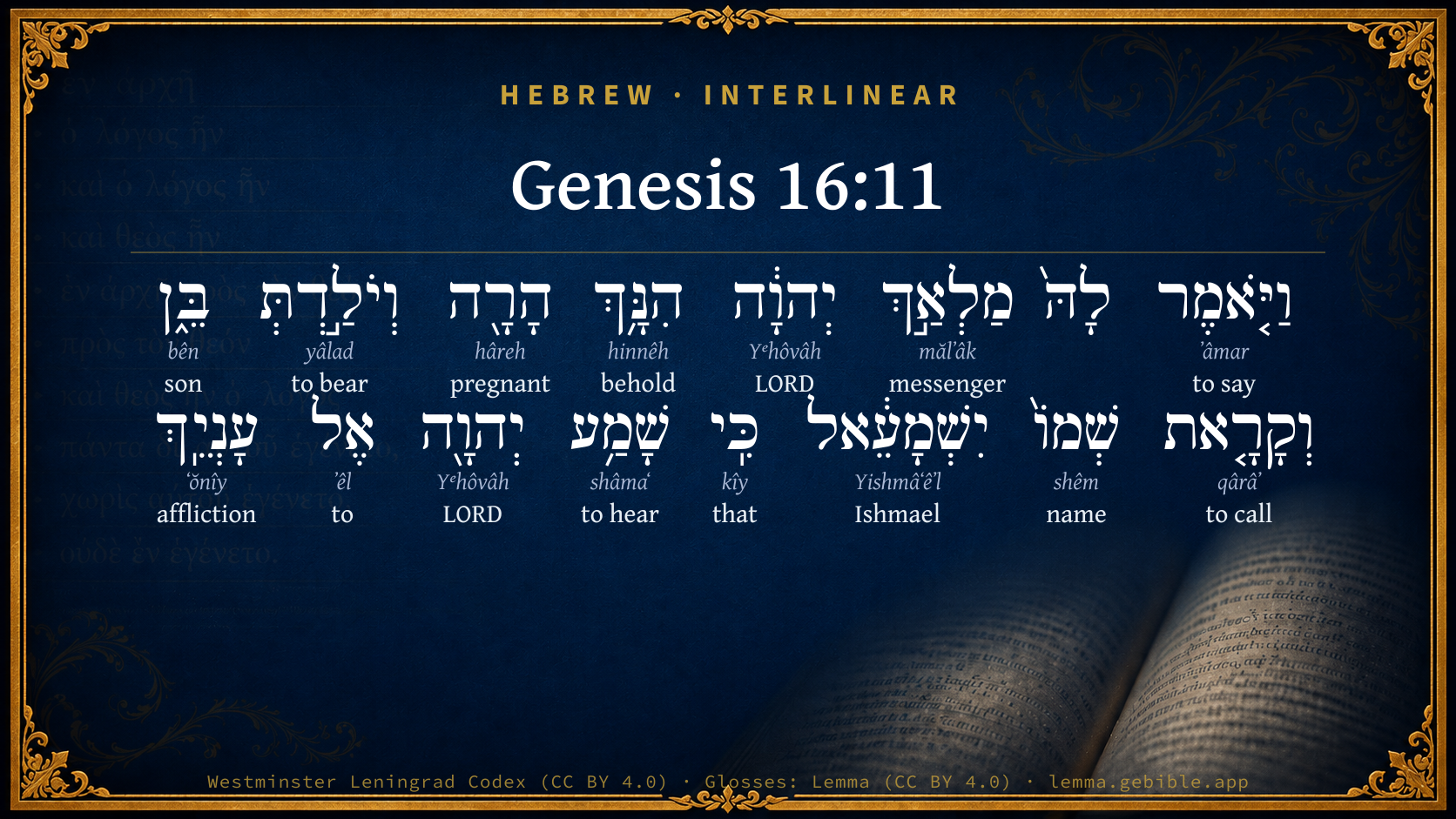
Genesis 16:11

Hebrew (Westminster Leningrad Codex) Genesis 16:11 appears in the Hebrew Old Testament. The text above is from the Westminster Leningrad Codex. Each word links to its Strong’s number, a concise gloss, and parsing drawn from the Open Scriptures Hebrew Bible morphology. Click any word for its full Brown-Driver-Briggs (BDB) entry.
Download image
Cite this verse

Genesis 16:11 (World English Bible). Public Domain. Lemma interlinear Bible study tool, https://lemma.gebible.app/v/genesis/16/11.

Show BibTeX & RIS
BibTeX
RIS
English Translation
The angel of Yahweh said to her, "Behold, you are with child, and will bear a son. You shall call his name Ishmael, because Yahweh has heard your affliction.
World English Bible · Public Domain
Highlights
  • 3 first appearances in the Hebrew Bible
Full analysis ↓
Download a study sheet

One document with this verse’s original text, its word-by-word gloss line, the meaning frame, cross-references with their text, attributed commentary, and full source and license credits — printable, and it pastes into notes with its structure intact.

This verse Autodidact and up

Study sheet (.html) Plain text (.txt)

A passage Seminary Student

Up to 50 verses in one chapter. A passage sheet keeps up to 6 commentary sources and 12 cross-references per verse, in the order this page ranks them, and says so on the sheet whenever that leaves anything out. Ask for a single verse and you get the Autodidact verse sheet above.

Everything on this page stays free to read, with no account — the sheet is a download of what is already on screen, not access to it.

Want to remove ads? Support Godless Engineer
Compare translations 3

The same verse in 3 English versions, stacked beneath the original-language interlinear above. Click any original word for its lexicon entry.

Each is an independent rendering of the whole verse — the interlinear is not word-aligned to these translations.

Highlighted words mark where these versions differ — a whole-verse word diff, not a word-by-word alignment.

  • World English Bible Public Domain
    The angel of Yahweh said to her, "Behold, you are with child, and will bear a son. You shall call his name Ishmael, because Yahweh has heard your affliction.
  • King James Version Public Domain
    And the angel of the LORD said unto her, Behold, thou art with child and shalt bear a son, and shalt call his name Ishmael; because the LORD hath heard thy affliction.
  • unfoldingWord Literal Text CC BY-SA 4.0
    Then the angel of Yahweh said to her, “Behold, pregnant, and you will bear a son, and you will call his name Ishmael, because Yahweh has listened to your misery.

unfoldingWord Literal Text — © unfoldingWord, licensed CC BY-SA 4.0. Word-aligned USFM3 via Door43 (git.door43.org/unfoldingWord/en_ult).

Versions to compare (up to 4)

3 of 4 selected

Show all 18 translations

Every available English version of this verse, each an independent rendering of the whole verse.

  • World English Bible Public Domain
    The angel of Yahweh said to her, "Behold, you are with child, and will bear a son. You shall call his name Ishmael, because Yahweh has heard your affliction.
  • Berean Standard Bible Public Domain
    The angel of the LORD proceeded: “Behold, you have conceived and will bear a son. And you shall name him Ishmael, for the LORD has heard your cry of affliction.
  • Majority Standard Bible Public Domain
    The angel of the LORD proceeded: “Behold, you have conceived and will bear a son. And you shall name him Ishmael, for the LORD has heard your cry of affliction.
  • King James Version Public Domain
    And the angel of the LORD said unto her, Behold, thou art with child and shalt bear a son, and shalt call his name Ishmael; because the LORD hath heard thy affliction.
  • American Standard Version (1901) Public Domain
    And the angel of Jehovah said unto her, Behold, thou art with child, and shalt bear a son; and thou shalt call his name Ishmael, because Jehovah hath heard thy affliction.
  • Revised Version (1885) Public Domain
    And the angel of the LORD said unto her, Behold, thou art with child, and shalt bear a son; and thou shalt call his name Ishmael, because the LORD hath heard thy affliction.
  • Geneva Bible (1599) Public Domain
    Also the Angel of the Lord said vnto her, See, thou art with childe, and shalt beare a sonne, and shalt call his name Ishmael: for the Lord hath heard thy tribulation.
  • Douay-Rheims (1899) Public Domain
    And again: Behold, said he, thou art with child, and thou shalt bring forth a son: and thou shalt call his name Ismael, because the Lord hath heard thy affliction.
  • Young's Literal Translation Public Domain
    and the messenger of Jehovah saith to her, `Behold thou `art' conceiving, and bearing a son, and hast called his name Ishmael, for Jehovah hath hearkened unto thine affliction;
  • Literal Standard Version CC BY-SA 4.0
    and the Messenger of YHWH says to her, “Behold you [are] conceiving, and bearing a son, and have called his name Ishmael, for YHWH has listened to your affliction;
  • Unlocked Literal Bible CC BY-SA 4.0
    The angel of Yahweh also said to her, “Behold, you are pregnant and will bear a son, and you will call his name Ishmael, because Yahweh has heard your affliction.
  • unfoldingWord Literal Text CC BY-SA 4.0
    Then the angel of Yahweh said to her, “Behold, pregnant, and you will bear a son, and you will call his name Ishmael, because Yahweh has listened to your misery.
  • Darby Bible Public Domain
    And the Angel of Jehovah said to her, Behold, thou art with child, and shalt bear a son, and shalt call his name Ishmael, because Jehovah hath hearkened to thy affliction.
  • World Messianic Bible Public Domain
    The LORD’s angel said to her, “Behold, you are with child, and will bear a son. You shall call his name Ishmael, because the LORD has heard your affliction.
  • Webster's Bible Public Domain
    And the angel of the LORD said to her, Behold, thou art with child, and shalt bear a son, and shalt call his name Ishmael; because the LORD hath heard thy affliction.
  • Free Bible Version CC BY-SA 4.0
    The angel of the Lord went on to tell her: “Listen! You're pregnant, and you will have a son. You are to name him Ishmael, for the Lord has heard how you've suffered.
  • Bible in Basic English Public Domain
    And the angel of the Lord said, See, you are with child and will give birth to a son, to whom you will give the name Ishmael, because the ears of the Lord were open to your sorrow.
  • JPS Tanakh (1917) Public Domain
    And the angel of the LORD said unto her: 'Behold, thou art with child, and shalt bear a son; and thou shalt call his name Ishmael, because the LORD hath heard thy affliction.

Literal Standard Version (2020), Covenant Press — licensed CC BY-SA 4.0. Text via the HelloAO Bible API (eBible.org). Unlocked Literal Bible (unfoldingWord) — licensed CC BY-SA 4.0. Text via the HelloAO Bible API (eBible.org). unfoldingWord Literal Text — © unfoldingWord, licensed CC BY-SA 4.0. Word-aligned USFM3 via Door43 (git.door43.org/unfoldingWord/en_ult). Free Bible Version, Dr. Jonathan Gallagher — licensed CC BY-SA 4.0. Text via the HelloAO Bible API (eBible.org).

Word by word

More ways to search: Search by grammar → Find every occurrence → Compare this word →

Practice this passage: Drill this verse → Learn its vocabulary →

הָרָ֖ה
hâreh
H2030
“pregnant”
Adjective, Adjective, Feminine, Singular, Absolute
Part of Speech
Adjective
Type
Adjective
Gender
Feminine
Number
Singular
State
Absolute
Full BDB Definition

Origin: from H2029

TWOT: 515a

pregnant
  1. וַיֹּ֤אמֶר ʼâmar H559 “and · to say” Conjunction + Verb, Qal, Sequential Imperfect, 3rd Person, Masculine, Singular
  2. מַלְאַ֣ךְ mălʼâk H4397 “messenger of” Noun, Common, Masculine, Singular, Construct
  3. יְהוָ֔ה Yᵉhôvâh H3068 “LORD” Noun, Proper
  4. הִנָּ֥ךְ hinnêh H2009 “behold · you” Particle, Demonstrative + Suffix, Personal, 2nd Person, Feminine, Singular
  5. וְיֹלַ֣דְתְּ yâlad H3205 “and · bearing” Conjunction + Verb, Qal, Participle Active, Feminine, Singular, Absolute
  6. בֵּ֑ן bên H1121 “son” Noun, Common, Masculine, Singular, Absolute
  7. וְקָרָ֤את qârâʼ H7121 “and · to call” Conjunction + Verb, Qal, Sequential Perfect, 2nd Person, Feminine, Singular
  8. שְׁמוֹ֙ shêm H8034 “name · his” Noun, Common, Masculine, Singular, Construct + Suffix, Personal, 3rd Person, Masculine, Singular
  9. יִשְׁמָעֵ֔אל Yishmâʻêʼl H3458 “Ishmael” Noun, Proper
  10. כִּֽי kîy H3588 “that” Conjunction
  11. שָׁמַ֥ע shâmaʻ H8085 “to hear” Verb, Qal, Perfect, 3rd Person, Masculine, Singular
  12. יְהוָ֖ה Yᵉhôvâh H3068 “LORD” Noun, Proper
  13. אֶל ʼêl H413 “to” Preposition
  14. עָנְיֵֽךְ ʻŏnîy H6040 “affliction · your” Noun, Common, Masculine, Singular, Construct + Suffix, Personal, 2nd Person, Feminine, Singular

About this verse

These counts appear in no published source. They are computed here, from the morphology-tagged text and Lemma’s own curated glosses. What Lemma adds →

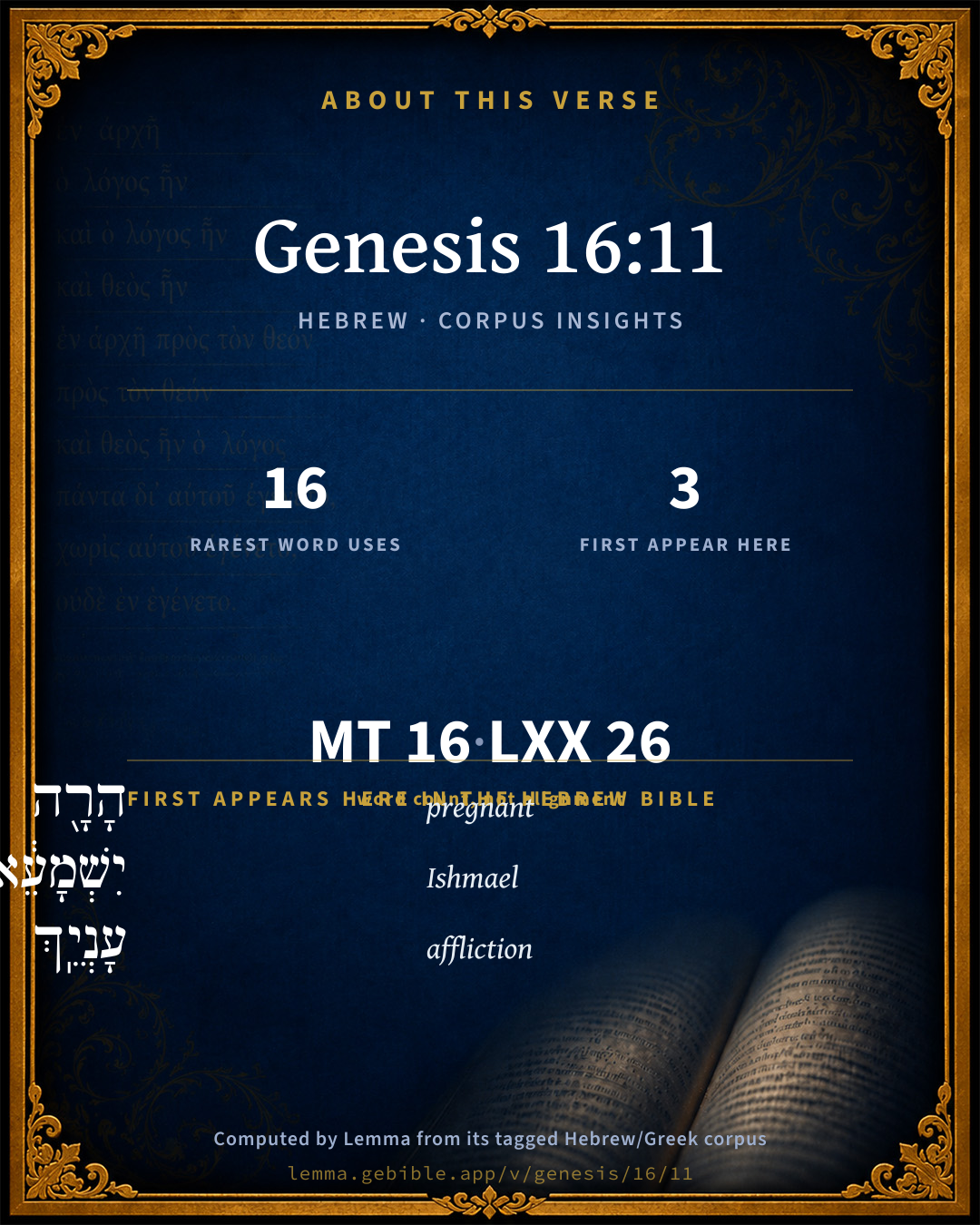
16
words
14
distinct lemmas
Pentateuch
section

Notable vocabulary

The rarest word here is הָרָ֖ה pregnant H2030 — appearing just 16 times in the whole Hebrew Bible.

First appearance in Scripture

These words make their first canonical appearance in the Hebrew Bible here:

  • הָרָ֖ה pregnant H2030
  • יִשְׁמָעֵ֔אל Ishmael H3458
  • עָנְיֵֽךְ affliction H6040

Shared distinctive vocabulary

הָרָ֖ה pregnant H2030 occurs in 16 verses of the Hebrew Bible. Also found in:

Grammatical profile

  • 4 verbs
  • 7 nouns
  • 1 adjective
  • 2 prepositions
  • 1 conjunction
  • 1 particle

Verb forms

  • וַיֹּ֤אמֶר Qal · Sequential Imperfect
  • וְיֹלַ֣דְתְּ Qal · Participle Active
  • וְקָרָ֤את Qal · Sequential Perfect
  • שָׁמַ֥ע Qal · Perfect

Repetition

A word recurs within this verse — often emphatic in Hebrew:

  • יְהוָ֔ה LORD H3068 ×2

Hebrew & Septuagint length

In English translation the verse runs 29 words from the Hebrew and 33 from the Septuagint (LXX English) — closely comparable.

A rough comparison of the two English renderings, which tokenize alike — not a word-level alignment.

Word counts can differ between the Hebrew and the Greek without any difference in meaning — e.g. the Hebrew direct-object marker אֵת has no separate Greek word, and Greek often adds the article ὁ.

In the original languages it is 16 Hebrew tokens and 26 Greek tokens — but the two are counted differently (Hebrew bundles its prefixes and suffixes into one token; the Greek is in lemma form), so that isn’t a like-for-like length.

Cross-references

14

Topical passages linked to Genesis 16:11 in the Treasury of Scripture Knowledge — connected by theme and wording, ordered by reader-vote popularity; previews shown in the World English Bible.

  • Exodus 2:23–24 It happened in the course of those many days, that the king of Egypt died, and the children of Israel sighed because of the bondage, and they cried, and their cry came up to God because of the bondage.
  • Exodus 3:7 Yahweh said, "I have surely seen the affliction of my people who are in Egypt, and have heard their cry because of their taskmasters, for I know their sorrows.
  • Isaiah 7:14 Therefore the Lord himself will give you a sign. Behold, the virgin will conceive, and bear a son, and shall call his name Immanuel.
  • Genesis 17:19 God said, "No, but Sarah, your wife, will bear you a son. You shall call his name Isaac. I will establish my covenant with him for an everlasting covenant for his seed after him.
  • Genesis 41:51–52 Joseph called the name of the firstborn Manasseh, "For," he said, "God has made me forget all my toil, and all my father's house."
  • 1 Samuel 1:20 It happened, when the time was come about, that Hannah conceived, and bore a son; and she named him Samuel, [saying], Because I have asked him of Yahweh.
  • Exodus 3:9 Now, behold, the cry of the children of Israel has come to me. Moreover I have seen the oppression with which the Egyptians oppress them.
  • Job 38:41 Who provides for the raven his prey, When his young ones cry to God, And wander for lack of food?
  • Matthew 1:21–23 She shall bring forth a son. You shall call his name Jesus, for it is he who shall save his people from their sins."
  • Luke 1:13 But the angel said to him, "Don't be afraid, Zacharias, because your request has been heard, and your wife, Elizabeth, will bear you a son, and you shall call his name John.
  • Luke 1:31 Behold, you will conceive in your womb, and bring forth a son, and will call his name 'Jesus.'
  • Luke 1:63 He asked for a writing tablet, and wrote, "His name is John." They all marveled.
  • Genesis 29:32–35 Leah conceived, and bore a son, and she named him Reuben. For she said, "Because Yahweh has looked at my affliction. For now my husband will love me."
  • Psalms 22:24 For he has not despised nor abhorred the affliction of the afflicted, Neither has he hidden his face from him; But when he cried to him, he heard.

Cross-references courtesy of OpenBible.info (CC BY 4.0).

Hebrew and Greek witnesses Masoretic Hebrew ↔ Greek Septuagint

The same verse in the two great witnesses to the Old Testament, shown verse-for-verse.

These are two independent witnesses, not word-aligned to each other, and the Septuagint is shown in lemma (dictionary) form.

Hebrew Genesis 16:11 Masoretic · Westminster Leningrad Codex

וַיֹּ֤אמֶר לָהּ֙ מַלְאַ֣ךְ יְהוָ֔ה הִנָּ֥ךְ הָרָ֖ה וְיֹלַ֣דְתְּ בֵּ֑ן וְקָרָ֤את שְׁמוֹ֙ יִשְׁמָעֵ֔אל כִּֽי שָׁמַ֥ע יְהוָ֖ה אֶל עָנְיֵֽךְ

The angel of Yahweh said to her, "Behold, you are with child, and will bear a son. You shall call his name Ishmael, because Yahweh has heard your affliction.

World English Bible · Public Domain

Greek LXX Genesis 16:11 Septuagint · lemma form

καί εἶπον αὐτός ὁ ἄγγελος κύριος ἰδού σύ ἐν γαστήρ ἔχω καί τίκτω υἱός καί καλέω ὁ ὄνομα αὐτός ισμαηλ ὅτι ἐπιἀκούω κύριος ὁ ταπείνωσις σύ

And the angel of the Lord said to her, Behold you are with child, and shall bear a son, and shall call his name Ismael, for the Lord has listened to your humiliation.

LXX2012 (modern English Septuagint) · Public Domain

On this verse, The Pulpit Commentary discusses the Septuagint’s reading. Read the note in Commentary ↓

Hebrew: Westminster Leningrad Codex (CC BY 4.0). Greek: Septuagint (public domain); English from LXX2012 (modern English Septuagint) (Public Domain). How the Septuagint differs from the Hebrew →

Targum (Aramaic paraphrase)

2

The Targum is the ancient Jewish Aramaic paraphrase of the Hebrew Scriptures — an interpretive translation, not the Hebrew text itself. Onkelos (literal) and Pseudo-Jonathan (expansive) render the Torah, and Jonathan the Prophets. Coverage is partial: where no permissively-licensed English translation exists for a verse, only the Aramaic is shown. This is verse-level text, not a word-by-word alignment to the Hebrew.

  1. Targum Onkelos Torah (Genesis–Deuteronomy)
    וַאֲמַר לַהּ מַלְאֲכָא דַיְיָ הָא אַתְּ מְעַדְיָא וְתֵלְדִין בַּר וְתִקְרִין שְׁמֵהּ יִשְׁמָעֵאל אֲרֵי קַבִּיל יְיָ צְלוֹתִיךְ

    (no public-domain English translation for this verse)

    Targum Onkelos — Aramaic: “Onkelos Genesis” (public domain); “Onkelos Exodus” (public domain); “Onkelos Leviticus” (public domain); “Onkelos Numbers” (public domain); “Onkelos Deuteronomy” (public domain). English: “Sefaria Community Translation” (CC0 1.0 (public-domain dedication)); “J.W. Etheridge. The Targums of Onkelos and Jonathan Ben Uzziel on the Pentateuch. London: Longmans, Green, 1862” (public domain). Text via Sefaria.

  2. Targum Pseudo-Jonathan Torah (Genesis–Deuteronomy)
    וַאֲמַר לָהּ מַלְאָכָא דַיְיָ הָא אַנְתְּ מְעָבְּרָא וְתֵלְדִין בַּר וְתַקְרִין יַת שְׁמֵיהּ יִשְׁמָעֵאל אֲרוּם גְלֵי קָדָם יְיָ סִיגוּפַיִךְ

    And the Angel of the Lord said to her, Behold, thou art with child, and thou wilt bear a son, and thou shalt call his name Ishmael, because thy affliction is revealed before the Lord.

    Targum Pseudo-Jonathan — Aramaic: “Targum Jonathan on Genesis” (public domain); “Targum Jonathan on Exodus” (public domain); “Targum Jonathan on Leviticus” (public domain); “Targum Jonathan on Numbers” (public domain); “Targum Jonathan on Deuteronomy” (public domain). English: “The Targum of Jonathan ben Uzziel, trans. J. W. Etheridge, London, 1862” (public domain). Text via Sefaria.

Commentary

Notes on Genesis 16:11 from classic Christian and Jewish commentators (each source and its license shown beneath its notes). The classic Christian expositions comment on the surrounding passage and are grouped to its opening verse, so a note may address several verses; the Jewish commentaries on the Tanakh (Rashi and others) are per-verse, so they appear only where the commentator wrote on this verse.

Lemma curates 59 commentaries, every one of them public domain or Creative Commons licensed, each selected and text-cleaned for this edition rather than reprinted as found. About our sources →

Trapp's Complete Commentary

John Trapp

Gen 16:11 And the angel of the LORD said unto her, Behold, thou [art] with child, and shalt bear a son, and shalt call his name Ishmael; because the LORD hath heard thy affliction.

Ver. 11. Thou art with child.] Lyra rendereth it (but not well), Thou shalt conceive. Burgensis saith, Lyra hic delirat ; and Matthias Doring (his Hyperaspistes, but an illiterate dunce) {a} saith as good as nothing in his defence; indignus sane qui nominetur , saith Steuchus of him, ob universam U. T. Scripturam foedissima barbarie conspurcatam :he is not fit to be once named for the sorry notes he hath set upon the whole Old Testament.

{a} Steuch. ad Gen. xxxvii.

John Trapp, A Commentary or Exposition upon All the Books of the Old and New Testament (1647–1656) — public domain. Text from a community e-Sword module.

Joseph Benson's Commentary

Gen 16:11. Ishmael — That is, God will hear; and the reason is, because the Lord hath heard — He hath, and therefore he will. The experience we have had of God’s seasonable kindness in distress should encourage us to hope for the like help in the like exigencies. Even there where there is little cry of devotion, the God of pity hears the cry of affliction: tears speak as well as prayers.

Joseph Benson's Commentary on the Old and New Testaments (1811–1818) — public domain. Text from a community e-Sword module.

Tyndale Open Study Notes

Tyndale Open Resources

16:11 Names in Genesis often capture the message of a passage and aid the remembrance of the events and their significance in the history of the faith. The name Ishmael, which means “God hears,” commemorates that the Lord . . . heard Hagar’s cry of distress (see also study note on 16:14-15). This name would have greatly comforted Hagar; God listened to her prayers and acknowledged her complaint.

Tyndale Open Study Notes — © Tyndale Open Resources, licensed CC BY-SA 4.0. Text via the HelloAO Bible API.

Jamieson, Fausset & Brown

Robert Jamieson, A. R. Fausset & David Brown

Ishmael--Like other Hebrew names, this had a signification, and it is made up of two words--"God hears." The reason is explained.

Jamieson, Fausset & Brown — Commentary Critical and Explanatory on the Whole Bible (1871) — public domain (CC PDM 1.0). Text via the HelloAO Bible API.

Adam Clarke's Commentary

Verse 11. And shalt call his name Ishmael] ישמאעל Yishmael, from שמע shama, he heard, and אל El, God; for, says the Angel, THE LORD HATH HEARD thy affliction. Thus the name of the child must ever keep the mother in remembrance of God's merciful interposition in her behalf, and remind the child and the man that he was an object of God's gracious and providential goodness. Afflictions and distresses have a voice in the ears of God, even when prayer is restrained; but how much more powerfully do they speak when endured in meekness of spirit, with confidence in and supplication to the Lord!

Adam Clarke's Commentary on the Bible (1810–1826) — public domain. Text from a community e-Sword/MySword module.

John Calvin's Commentaries

11. And shalt bear a son. The angel explains what he had briefly said respecting her seed; namely, that it should not be capable of being numbered on account of its multitude; and he commences with Ishmael, who was to be its head and origin. Although we shall afterwards see that he was a reprobate, yet an honorable name is granted to him, to mark the temporal benefit of which Ishmael became a partakers as being a son of Abram. For I thus explain the passage, God intended that a monument of the paternal kindness, with which he embraced the whole house of Abram, should endure to posterity. For although the covenant of eternal life did not belong to Ishmael; yet, that he might not be entirely without favor, God constituted him the father of a great and famous people. And thus we see that, with respect to this present life, the goodness of God extended itself to the seed of Abram according to the flesh. But if God intended the name of Ishmael (which signifies God will hear) to be a perpetual memorial of his temporal benefits; he will by no means bear with our ingratitude, if we do not celebrate his celestial and everlasting mercies, even unto death.

The Lord has heard thy affliction. We do not read that Hagar, in her difficulties, had recourse to prayer; and we are rather left to conjecture, from the words of Moses, that when she was stupefied by her sufferings, the angel came of his own accord. It is therefore to be observed, that there are two ways in which God looks down upon men, for the purpose of helping them; either when they, as suppliants, implore his aid; or when he, even unasked, succours them in their afflictions. He is indeed especially said to hearken to them who, by prayers, invoke him as their Deliverer. Yet, sometimes, when men lie mute, and because of their stupor, do not direct their wishes to him, he is said to listen to their miseries. That this latter mode of hearing was fulfilled towards Hagar, is probable, because God freely met her wandering through the desert. Moreover, because God frequently deprives unbelievers of his help, until they are worn away with slow disease, or else suffers them to be suddenly destroyed; let none of us give indulgence to our own sloth; but being admonished by the sense of our evils, let us seek him without delay. In the meantime, however, it is of no small avail to the confirmation of our faith, that our prayers will never be despised by the Lord, seeing that he anticipates even the slothful and the stupid, with his help; and if he is present to those who seek him not, much more will he be propitious to the pious desires of his own people.

John Calvin's Commentaries (1540-1563) — public domain. Text from the Calvin Translation Society English edition (1840s-50s) via the Christian Classics Ethereal Library (ccel.org). Calvin's coverage is partial (roughly two-thirds of the Bible); uncommented books and verses are honest gaps, never fabricated. The 19th-century editor's footnotes and remarks are omitted so the notes are faithfully Calvin's own voice.

Ellicott's Commentary for English Readers

(11) Ishmael.—That is, God heareth. Like Samuel, Ishmael received his name from the events of his mother’s life, and not from anything in his own. There was, however, no rule in this matter, and the naming of children in the Book of Genesis is very diversified.

A Bible Commentary for English Readers, edited by Charles John Ellicott (1878–1897) — public domain. Text from a community e-Sword module.

The Cambridge Bible for Schools and Colleges

gen. ed. J. J. S. Perowne

11. thou shalt call his name Ishmael] That is, God heareth. The name is to be given by the mother. Cf. note on Gen_4:1; Gen_4:25. The name “Ishmael” may mean either “God hears,” or “may God hear.” See also Gen_21:17. The reason for the name is explained by the words, “because the Lord hath heard (shâma‘) thy affliction.”

heard thy affliction] See note on Gen_16:6. The expression means that Jehovah has either heard of the persecution Hagar has received, or, more probably, has heard the prayer uttered by her in her affliction (Gen_16:6). Cf. Exo_2:24; Exo_4:31.

The Cambridge Bible for Schools and Colleges (gen. ed. J. J. S. Perowne; Cambridge University Press, 1878–1918) — public domain. Text from a community e-Sword module.

John Gill's Exposition

And the angel of the Lord said unto her,.... Continued his discourse with her, informing her she should have a son, and what his name should be, and what his character, and the place of his habitation:

behold, thou art with child; this she knew, and it is said, not for her information, as to this respect, but to lead on to something else he had to acquaint her with, she did not know. Jarchi indeed would have the sense to be, "thou shall conceive" or "be with child", as was said to Manoah's wife, Jdg 13:5; for it is a fancy of his, that Hagar had miscarried, and he, supposes the angel to promise her, that if she would return, or when she should return, she should conceive again; but this is said and supposed without any foundation:

and shalt bear a son; this was what she hoped for, but was not certain of; but the angel assures her of it, that the child she went with was a son, which none could foretell but God, that is omniscient:

and shall call his name Ishmael; the Jews (s) observe, there were six persons who had their names given them before they were born, and Ishmael is one of them; the six were Isaac, Gen 17:19; Ishmael, here; Moses, Exo 2:10; Solomon, Sa2 12:24; Josiah, Kg1 13:2; and the Messiah, Isa 7:14, the reason of his name follows:

because the Lord hath heard thy affliction: heard of it, had took notice of it, and observed, and fully understood the nature and cause of it; he had heard her groans and sighs under it, and her prayer and cries for deliverance from it; and so the Targum of Onkelos,"for the Lord hath received thy prayer,''which she had put up in her affliction, both when in the service of her mistress, and since her flight from her.

(s) Pirke Eliezer, c. 32. Shalshalet Hakabala, fol. 2. 1.

John Gill's Exposition of the Whole Bible (1746–1763) — public domain (CC PDM 1.0). Text via the HelloAO Bible API.

Haydock's Catholic Bible Commentary

Ismael, means "God hath heard" the groans and distress of Agar. (Calmet)

George Leo Haydock (1774–1849), Haydock's Catholic Family Bible and Commentary, 1859 edition — public domain. Excludes Psalms (Douay-Rheims chapter numbering differs from Protestant) and Deuterocanonical books (Catholic canon only).

Matthew Poole's English Annotations

Hath heard thy cry in thy affliction.

Matthew Poole's English Annotations on the Holy Bible (1683–1685) — public domain. Text from a community e-Sword/MySword module.

Whedon's Commentary on the Bible

Daniel D. Whedon

11. Ishmael — The name means God will hear, and would ever remind Hagar how Jehovah heard her affliction. Compare 1Sa_1:20, note. “Misery sighs; the sighs ascend to God; hence misery itself, if not sent as a curse, is a voiceless prayer to God. But this is true especially of the misery of Hagar, who had learned to pray in the house of Abram.” — Lange.

Daniel D. Whedon (gen. ed.), Commentary on the Old and New Testaments (1874–1909) — public domain. Text from a community e-Sword module.

The Pulpit Commentary

And the angel of the Lord said unto her, Behold, thou art with child, and thou shalt bear a son, and shalt call his name Ishmael. "God shall hear," or, "Whom God hears," the first instance of the naming of a child before its birth (cf. afterwards Gen_17:19; 1Ch_22:9; Mat_1:21; Luk_1:13) Because the Lord hath heard thy affliction. Th tapeinwsei (LXX), "thy prayer" (Chaldee), of which there is no mention, though men"s miseries are said to cry when men themselves are mute (Calvin; cf. Exo_3:7)

The Pulpit Commentary (1880–1919), ed. H.D.M. Spence-Jones & Joseph S. Exell — public domain. Text from a community e-Sword module.

John Wesley's Explanatory Notes

Ishmael, that is, God will hear; and the reason is, because the Lord hath heard: he hath, and therefore he will. The experience we have had of God's seasonable kindness in distress should encourage us to hope for the like help in the like exigencies. Even there, where there is little cry of devotion, the God of pity hears the cry of affliction: tears speak as well as prayers.

John Wesley, Explanatory Notes Upon the Whole Bible (1754–1765) — public domain. Text via the GEBible commentary corpus.

Scofield Reference Notes

C. I. Scofield

angel (See Scofield "Heb 1:4")

Ishmael i.e. God shall hear.

The Scofield Reference Bible (1917 edition), notes by C. I. Scofield — public domain. Text from a community e-Sword module.

unfoldingWord translationNotes

Door43 World Missions Community

The angel of Yahweh

See the note about this phrase in Genesis 16:7.

Behold

"Look" or "Listen" or "Pay attention"

bear a son

"give birth to a son"

you will call his name

"you will name him." The word "you" refers to Hagar.

Ishmael, because Yahweh has heard

Translators may add a footnote that says "The name 'Ishmael' means 'God has heard.'"

affliction

She has been afflicted by distress and suffering.

He will be a wild donkey of a man

This was not an insult. It may mean that Ishmael would be independent and strong like a wild donkey. AT: "He will be like a wild donkey among men" (See: Metaphor)

He will be hostile against every man

"He will be every man's enemy"

every man will be hostile to him

"everyone will be his enemy"

he will live apart from

This can also mean "he will live in hostility with."

his brothers

"his relatives" or "the other members of his family"

translationWords

angel

Ishmael

afflicted

donkey

brother

unfoldingWord translationNotes — © Distant Shores Media and the Door43 World Missions Community, licensed CC BY-SA 4.0. Source: git.door43.org/Door43/en_tn.

Rashi

Rabbi Shlomo Yitzchaki (Rashi)

הנך הרה BEHOLD THOU WILT BE WITH CHILD — when you return you will conceive, just as the same phrase הנך הרה (Judges 13:7) spoken of the wife of Manoah (where it certainly appears to be thou wilt conceive in the future).

וְיֹלַדְתְּ בן AND THOU SHALT BEAR A SON — The word appears to be grammatically a combination of the perfect tense וְיָלַדְתְּ and the participle וְיֹלֶדֶת but it is similar in sense to וְיֹלֶדֶת (the participle); so, also, (Jeremiah 22:23) “O thou that dwellest יֹשַׁבְתְּ) in Lebanon, and art nestled (מְקֻנַּנְתְּ) in the cedars.”

וקראת שמו AND THOU SHALT CALL — This is a command, just as one would say to a man (וְקָרָאתָ), as (Genesis 17:19) “And thou shalt call his name Isaac”.

Rashi on the Tanakh — English translations: “The Judaica Press complete Tanach with Rashi, translated by A. J. Rosenberg” (CC BY 4.0); “Pentateuch with Rashi's commentary by M. Rosenbaum and A.M. Silbermann, 1929-1934” (public domain); “The Metsudah Tanach series, Lakewood, N.J” (CC BY 4.0); and “The Book of Joshua, Metsudah Publications, 1997” (CC BY 4.0). Text via Sefaria.

Ramban (Nachmanides)

Rabbi Moshe ben Nachman (Ramban / Nachmanides)

AND THOU SHALT CALL HIS NAME ISHMAEL. The angel informed Hagar that his name will be Ishmael — just as in the verse, Behold, a son shall be born unto the house of David Josiah by name — and he told her that she should so call him, and thus remember that G-d heard her affliction. (G-d heareth) is, as the angel explained to Hagar, “because the Eternal hath heard thy affliction.” (Verse 11.) Now Abraham either called him by this name on his own,. with the intent that G-d hear him and answer him, or the Holy Spirit rested upon him, as Rashi has it, and he called him Ishmael because G-d had heard his mother’s affliction, as the angel had said.The correct interpretation appears to me to be that the angel commanded Hagar that she call him so, but she, being a concubine, was afraid to give a name to her master’s son, so she revealed the matter to him, and Abram fulfilled the word of G-d. Scripture, however, did not need to delve at length into this matter.

Ramban (Nachmanides) on the Tanakh — English translation: “Commentary on the Torah by Ramban (Nachmanides). Translated and annotated by Charles B. Chavel. New York, Shilo Pub. House, 1971-1976” (CC BY 4.0). Text via Sefaria.

Radak

Rabbi David Kimhi (Radak)

ויאמר... הנך הרה, the angel used these words as an introduction, seeing he was well aware that Hagar knew that she was pregnant as the Torah had reported in verse 4, as well as Hagar's reaction. The message that angel had come to deliver was וילדת בן, "you will give birth to a son." The word יולדת is a composite composed from the word וילדת, which is a verb in the past tense converted into the future tense by the letter ו at the front, the other component being the word ויולדת, the same root as a present participle. The meaning of the combined composite is that seeing that the birth was something that had not yet occurred, the verb must contain an allusion to the future, whereas seeing that Hagar knew that she was pregnant, i.e. that the process which would result in a birth had already begun, the formulation of the verb had to reflect this fact also. The angel's message was: "just as you are aware that you are pregnant you should be equally aware that you will bear a son as a result of this pregnancy." There are some grammarians who believe that the root of the word here is similar to a four-lettered verb.

וקראת שמו, the letter ת at the end is a feminine ending future tense, i.e. "you will call." On the other hand, in Deut. 31,29 the same word וקראת אתכם refers to a third person feminine construction where the letter ת substitutes for the letter ה, the expression meaning: "it will befall you." The reference is to the רעה, evil, a noun that is feminine which follows immediately after the word אתכם.

אל עניך, "to your outcry [complaint instead of prayer, Ed.] concerning your plight." We are forced to explain the angel's words in this fashion, seeing he spoke of G'd having "heard," שמע, instead of ראה, "G'd has seen." It is also possible to explain the angel's words as does Onkelos, i.e. as צלותיך, "your prayer." There are precedents for the word ענה meaning a response to something, to wit Job 3,2 and Isaiah 13,22 as well as Deuteronomy 26,5 וענית ואמרת, and similar examples.

Radak on the Tanakh — English translations: “Sefaria Community Translation” (CC0 1.0 (public-domain dedication)); “Eliyahu Munk, HaChut Hameshulash” (CC BY 4.0); “Rabbi Mike Feuer, Jerusalem Anthology” (CC BY 4.0); and “R. David Kimhi on the first book of Psalms, Translated by R.G. Finch, London, 1919” (public domain). Text via Sefaria.

Lesson kit

Teaching starters — assembled from the data on this page, not authored interpretation. Every prompt links to the verse data it draws on. Edit before teaching.

Genesis, in the Pentateuch, opens this verse with 16 words (14 distinct Hebrew lemmas). Its most distinctive word is hâreh (“pregnant”). A historical commentator’s framing appears above. Read the whole chapter for the surrounding context.

Discussion questions

  1. The word hâreh carries the sense “pregnant.” How does it shape the verse?
  2. 3 words make their first appearance in Scripture here. What does this debut establish?
  3. How does Genesis 38:24, which shares the word «pregnant», read alongside this verse?
  4. What does the repetition of “LORD” (2× in this one verse) do in this verse?
  5. These translations render this verse differently; the difference is in the English rendering, not the original. What questions does that raise?
  6. «וַיֹּ֤אמֶר» is a Qal Sequential Imperfect verb. How does that grammatical form shape the action described?
  7. Compare how Trapp's Complete Commentary and Joseph Benson's Commentary read this verse. Where do they agree or differ?

Things to notice

Reading settings

Reading text

Shown beneath each verse's original-language words.

Old Testament
Old Testament edition

Read the OT as the Masoretic Hebrew (MT) or the Greek Septuagint (LXX).

English shown for the Greek Septuagint (in the Hebrew ↔ Greek comparison).

Comparing translations? Open the Compare panel on any verse page to stack up to four side by side.