
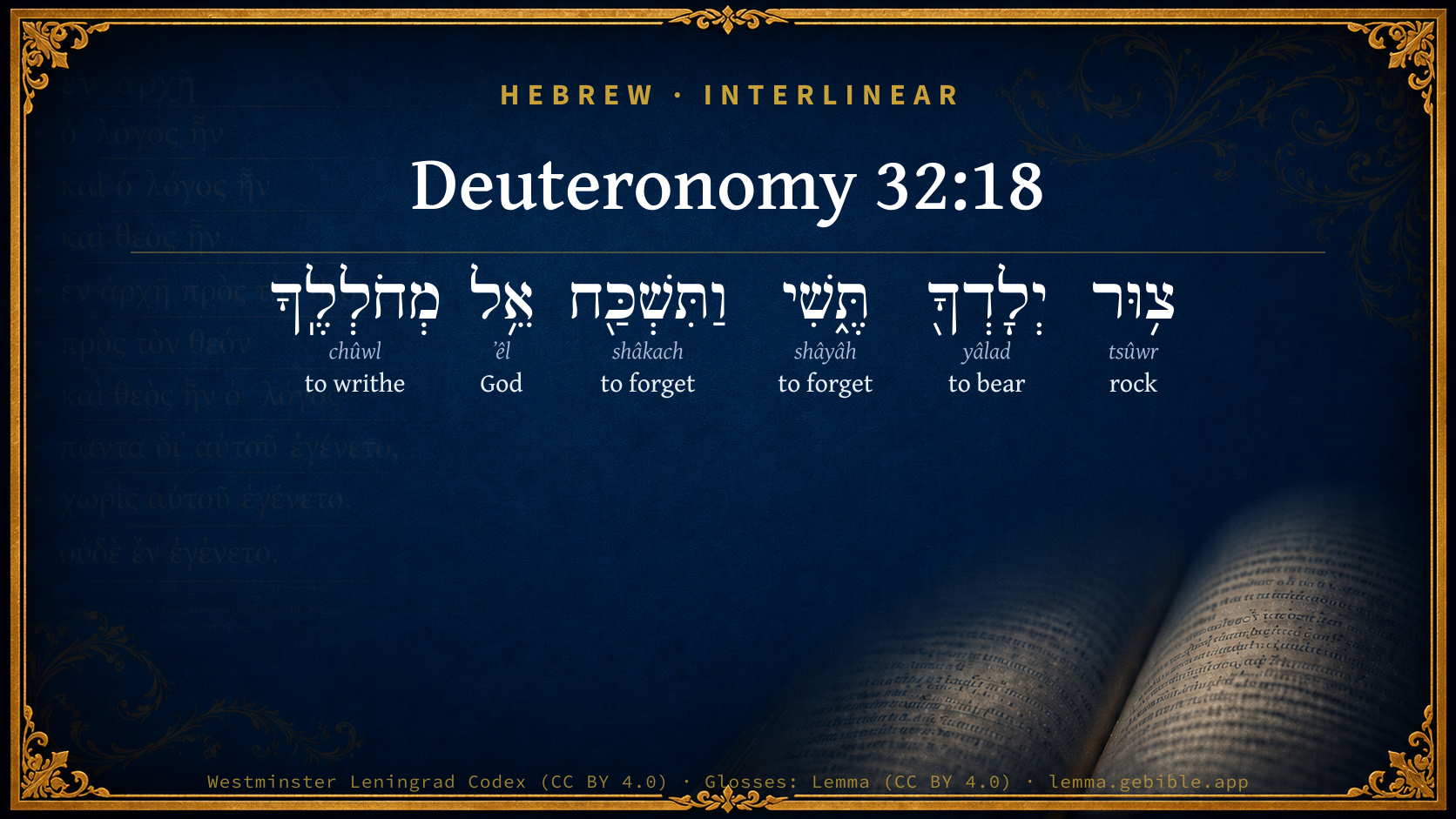
Deuteronomy 32:18

Hebrew (Westminster Leningrad Codex) Deuteronomy 32:18 appears in the Hebrew Old Testament. The text above is from the Westminster Leningrad Codex. Each word links to its Strong’s number, a concise gloss, and parsing drawn from the Open Scriptures Hebrew Bible morphology. Click any word for its full Brown-Driver-Briggs (BDB) entry.
Download image
Cite this verse

Deuteronomy 32:18 (World English Bible). Public Domain. Lemma interlinear Bible study tool, https://lemma.gebible.app/v/deuteronomy/32/18.

Show BibTeX & RIS
BibTeX
RIS
English Translation
Of the Rock that became your father, you are unmindful, Have forgotten God who gave you birth.
World English Bible · Public Domain
Highlights
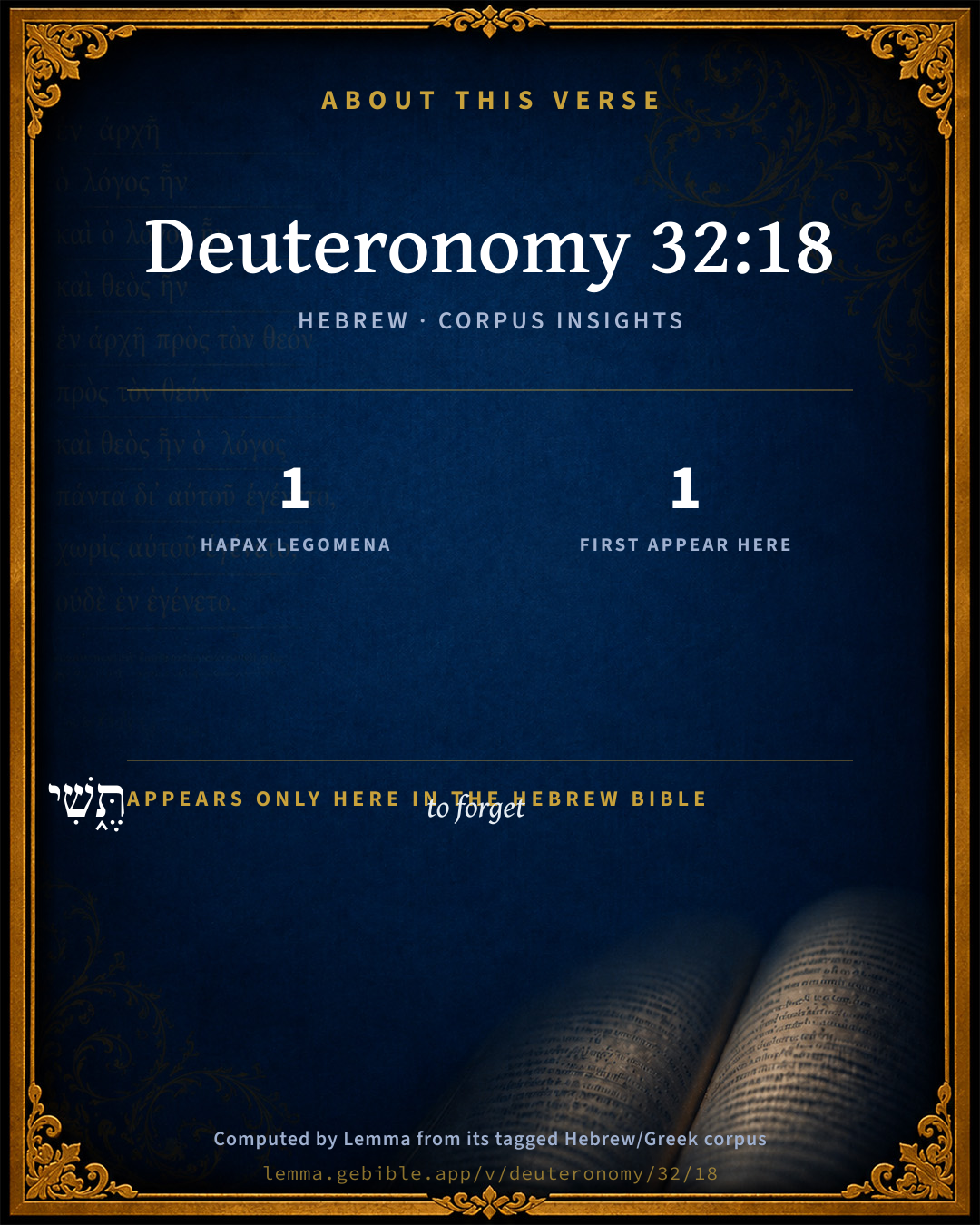
  • 1 hapax legomenon — only here in the Hebrew Bible
  • 1 first appearance in the Hebrew Bible
Full analysis ↓
Download a study sheet

One document with this verse’s original text, its word-by-word gloss line, the meaning frame, cross-references with their text, attributed commentary, and full source and license credits — printable, and it pastes into notes with its structure intact.

This verse Autodidact and up

Study sheet (.html) Plain text (.txt)

A passage Seminary Student

Up to 50 verses in one chapter. A passage sheet keeps up to 6 commentary sources and 12 cross-references per verse, in the order this page ranks them, and says so on the sheet whenever that leaves anything out. Ask for a single verse and you get the Autodidact verse sheet above.

Everything on this page stays free to read, with no account — the sheet is a download of what is already on screen, not access to it.

Want to remove ads? Support Godless Engineer
Compare translations 3

The same verse in 3 English versions, stacked beneath the original-language interlinear above. Click any original word for its lexicon entry.

Each is an independent rendering of the whole verse — the interlinear is not word-aligned to these translations.

Highlighted words mark where these versions differ — a whole-verse word diff, not a word-by-word alignment.

  • World English Bible Public Domain
    Of the Rock that became your father, you are unmindful, Have forgotten God who gave you birth.
  • King James Version Public Domain
    Of the Rock that begat thee thou art unmindful, and hast forgotten God that formed thee.
  • unfoldingWord Literal Text CC BY-SA 4.0
    The Rock, your bearer, you neglected and you forgot the God gave you birth. ts\*

unfoldingWord Literal Text — © unfoldingWord, licensed CC BY-SA 4.0. Word-aligned USFM3 via Door43 (git.door43.org/unfoldingWord/en_ult).

Versions to compare (up to 4)

3 of 4 selected

Show all 18 translations

Every available English version of this verse, each an independent rendering of the whole verse.

  • World English Bible Public Domain
    Of the Rock that became your father, you are unmindful, Have forgotten God who gave you birth.
  • Berean Standard Bible Public Domain
    You ignored the Rock who brought you forth; you forgot the God who gave you birth.
  • Majority Standard Bible Public Domain
    You ignored the Rock who brought you forth; you forgot the God who gave you birth.
  • King James Version Public Domain
    Of the Rock that begat thee thou art unmindful, and hast forgotten God that formed thee.
  • American Standard Version (1901) Public Domain
    Of the Rock that begat thee thou art unmindful, And hast forgotten God that gave thee birth.
  • Revised Version (1885) Public Domain
    Of the Rock that begat thee thou art unmindful, And hast forgotten God that gave thee birth.
  • Geneva Bible (1599) Public Domain
    Thou hast forgotten the mightie God that begate thee, and hast forgotten God that formed thee.
  • Douay-Rheims (1899) Public Domain
    Thou hast forsaken the God that beget thee, and hast forgotten the Lord that created thee.
  • Young's Literal Translation Public Domain
    The Rock that begat thee thou forgettest, And neglectest God who formeth thee.
  • Literal Standard Version CC BY-SA 4.0
    You forget the Rock that begot you, || And neglect God who forms you.
  • Unlocked Literal Bible CC BY-SA 4.0
    You have deserted the Rock, who became your father, and you forgot the God who gave you birth.
  • unfoldingWord Literal Text CC BY-SA 4.0
    The Rock, your bearer, you neglected and you forgot the God gave you birth. ts\*
  • Darby Bible Public Domain
    Of the Rock that begot thee wast thou unmindful, And thou hast forgotten ùGod who brought thee forth.
  • World Messianic Bible Public Domain
    Of the Rock who became your father, you are unmindful, and have forgotten God who gave you birth.
  • Webster's Bible Public Domain
    Of the Rock that begat thee thou art unmindful, and hast forgotten God that formed thee.
  • Free Bible Version CC BY-SA 4.0
    You dismissed the Rock who fathered you; you forgot the God who gave birth to you.
  • Bible in Basic English Public Domain
    You have no thought for the Rock, your father, you have no memory of the God who gave you birth.
  • JPS Tanakh (1917) Public Domain
    Of the Rock that begot thee thou wast unmindful, and didst forget God that bore thee.

Literal Standard Version (2020), Covenant Press — licensed CC BY-SA 4.0. Text via the HelloAO Bible API (eBible.org). Unlocked Literal Bible (unfoldingWord) — licensed CC BY-SA 4.0. Text via the HelloAO Bible API (eBible.org). unfoldingWord Literal Text — © unfoldingWord, licensed CC BY-SA 4.0. Word-aligned USFM3 via Door43 (git.door43.org/unfoldingWord/en_ult). Free Bible Version, Dr. Jonathan Gallagher — licensed CC BY-SA 4.0. Text via the HelloAO Bible API (eBible.org).

Word by word

More ways to search: Search by grammar → Find every occurrence → Compare this word →

Practice this passage: Drill this verse → Learn its vocabulary →

About this verse

These counts appear in no published source. They are computed here, from the morphology-tagged text and Lemma’s own curated glosses. What Lemma adds →

6
words
6
distinct lemmas
Pentateuch
section

Notable vocabulary

1 hapax legomenon — a word that appears only here in the entire Hebrew Bible:

  • תֶּ֑שִׁי to forget H7876

First appearance in Scripture

This word makes its first canonical appearance in the Hebrew Bible here:

  • תֶּ֑שִׁי to forget H7876

Grammatical profile

  • 4 verbs
  • 2 nouns

Verb forms

  • יְלָדְךָ֖ Qal · Perfect
  • תֶּ֑שִׁי Qal · Imperfect
  • וַתִּשְׁכַּ֖ח Qal · Sequential Imperfect
  • מְחֹלְלֶֽךָ Polel · Participle Active

Hebrew & Septuagint length

In English translation the verse runs 17 words from the Hebrew and 13 from the Septuagint (LXX English) — closely comparable.

A rough comparison of the two English renderings, which tokenize alike — not a word-level alignment.

Word counts can differ between the Hebrew and the Greek without any difference in meaning — e.g. the Hebrew direct-object marker אֵת has no separate Greek word, and Greek often adds the article ὁ.

Cross-references

14

Topical passages linked to Deuteronomy 32:18 in the Treasury of Scripture Knowledge — connected by theme and wording, ordered by reader-vote popularity; previews shown in the World English Bible.

  • Isaiah 17:10 For you have forgotten the God of your salvation, and have not been mindful of the rock of your strength; therefore you plant pleasant plants, and set it with strange slips.
  • Jeremiah 2:32 Can a virgin forget her ornaments, or a bride her attire? yet my people have forgotten me days without number.
  • Deuteronomy 32:4 The Rock, his work is perfect; For all his ways are justice: A God of faithfulness and without iniquity, Just and right is he.
  • Psalms 106:21 They forgot God, their Savior, Who had done great things in Egypt,
  • Deuteronomy 6:12 then beware lest you forget Yahweh, who brought you forth out of the land of Egypt, out of the house of bondage.
  • Deuteronomy 8:11 Beware lest you forget Yahweh your God, in not keeping his commandments, and his ordinances, and his statutes, which I command you this day:
  • Deuteronomy 8:14 then your heart be lifted up, and you forget Yahweh your God, who brought you forth out of the land of Egypt, out of the house of bondage;
  • Deuteronomy 8:19 It shall be, if you shall forget Yahweh your God, and walk after other gods, and serve them, and worship them, I testify against you this day that you shall surely perish.
  • Deuteronomy 32:15 But Jeshurun grew fat, and kicked: You have grown fat, you are grown thick, you are become sleek; Then he forsook God who made him, Lightly esteemed the Rock of his salvation.
  • Psalms 9:17 The wicked shall be turned back to Sheol, Even all the nations that forget God.
  • Psalms 44:20–22 If we have forgotten the name of our God, Or spread forth our hands to a strange god;
  • Isaiah 22:10–11 and you numbered the houses of Jerusalem, and you broke down the houses to fortify the wall;
  • Hosea 8:14 For Israel has forgotten his Maker and built palaces; And Judah has multiplied fortified cities; But I will send a fire on his cities, And it will devour its fortresses."
  • Jeremiah 3:21 A voice is heard on the bare heights, the weeping [and] the petitions of the children of Israel; because they have perverted their way, they have forgotten Yahweh their God.

Cross-references courtesy of OpenBible.info (CC BY 4.0).

Hebrew and Greek witnesses Masoretic Hebrew ↔ Greek Septuagint

The same verse in the two great witnesses to the Old Testament, shown verse-for-verse.

These are two independent witnesses, not word-aligned to each other, and the Septuagint is shown in lemma (dictionary) form.

Hebrew Deuteronomy 32:18 Masoretic · Westminster Leningrad Codex

צ֥וּר יְלָדְךָ֖ תֶּ֑שִׁי וַתִּשְׁכַּ֖ח אֵ֥ל מְחֹלְלֶֽךָ

Of the Rock that became your father, you are unmindful, Have forgotten God who gave you birth.

World English Bible · Public Domain

Greek LXX Deuteronomy 32:18 Septuagint · lemma form

θεός ὁ γεννάω σύ ἐν καταλείπω καί ἐπιλανθάνω θεός ὁ τρέφω σύ

You have forsaken God that begot you, and forgotten God who feeds you.

LXX2012 (modern English Septuagint) · Public Domain

On this verse, Haydock's Catholic Bible Commentary discusses the Septuagint’s reading. Read the note in Commentary ↓

Hebrew: Westminster Leningrad Codex (CC BY 4.0). Greek: Septuagint (public domain); English from LXX2012 (modern English Septuagint) (Public Domain). How the Septuagint differs from the Hebrew →

Targum (Aramaic paraphrase)

2

The Targum is the ancient Jewish Aramaic paraphrase of the Hebrew Scriptures — an interpretive translation, not the Hebrew text itself. Onkelos (literal) and Pseudo-Jonathan (expansive) render the Torah, and Jonathan the Prophets. Coverage is partial: where no permissively-licensed English translation exists for a verse, only the Aramaic is shown. This is verse-level text, not a word-by-word alignment to the Hebrew.

  1. Targum Onkelos Torah (Genesis–Deuteronomy)
    דַחֲלַת תַקִיפָא דִבְרָאָךְ אִתְנְשֵׁתָא שְׁבַקְתָּא פָלְחַן אֱלָהָא דְעָבְדָךְ

    (no public-domain English translation for this verse)

    Targum Onkelos — Aramaic: “Onkelos Genesis” (public domain); “Onkelos Exodus” (public domain); “Onkelos Leviticus” (public domain); “Onkelos Numbers” (public domain); “Onkelos Deuteronomy” (public domain). English: “Sefaria Community Translation” (CC0 1.0 (public-domain dedication)); “J.W. Etheridge. The Targums of Onkelos and Jonathan Ben Uzziel on the Pentateuch. London: Longmans, Green, 1862” (public domain). Text via Sefaria.

  2. Targum Pseudo-Jonathan Torah (Genesis–Deuteronomy)
    דַחֲלַת תַּקִיפָא דִבְרָא יַתְכוֹן אִתְנַשְׁתּוּן וְאַנְשֵׁיתוּן מֵימַר אֱלָהָא דְעָבַד יַתְכוֹן מְחִילִין מְחִילִין

    But the adorable Strong One who created you have you forgotten; of the word of Eloha who strengthened you so often have you been forgetful.

    Targum Pseudo-Jonathan — Aramaic: “Targum Jonathan on Genesis” (public domain); “Targum Jonathan on Exodus” (public domain); “Targum Jonathan on Leviticus” (public domain); “Targum Jonathan on Numbers” (public domain); “Targum Jonathan on Deuteronomy” (public domain). English: “The Targum of Jonathan ben Uzziel, trans. J. W. Etheridge, London, 1862” (public domain). Text via Sefaria.

Commentary

Notes on Deuteronomy 32:18 from classic Christian and Jewish commentators (each source and its license shown beneath its notes). The classic Christian expositions comment on the surrounding passage and are grouped to its opening verse, so a note may address several verses; the Jewish commentaries on the Tanakh (Rashi and others) are per-verse, so they appear only where the commentator wrote on this verse.

Lemma curates 59 commentaries, every one of them public domain or Creative Commons licensed, each selected and text-cleaned for this edition rather than reprinted as found. About our sources →

Trapp's Complete Commentary

John Trapp

Deu 32:18 Of the Rock [that] begat thee thou art unmindful, and hast forgotten God that formed thee.

Ver. 18. And hast forgotten God that formed thee.] Or, That brought thee forth. Here God is compared to a mother, as in the former clause to a father. So Jas 1:18, "Of his own will begat he us," - απεκυησε, He brought us forth, and did the office of a mother to us; which doth notably set forth his love and the work of his grace.

John Trapp, A Commentary or Exposition upon All the Books of the Old and New Testament (1647–1656) — public domain. Text from a community e-Sword module.

The Biblical Illustrator

Joseph S. Exell

Deu_32:18

Of the Rock that begat thee thou art unmindful.

Forgetful of the Rock

How is it that men soon forget the solid, the real, the substantial? What is it that delights men in spluttering rockets, in coloured fountains, in lamps swinging upon trees that are offended by their presence? See the great seething crowd waiting for the coloured fountains to spring up, and for all the little electric lamps confined in tinted globes to shine among swaying branches! What exclamations of idiotic delight! How stunned is modern intelligence at the marvellous display of colour! Who heeds the quiet moon that looks on with unutterable amazement, and that in her motherly heart is saying, Oh, that they were wise, that they were less given to toy worship and playfulness of that kind! Here I have been shining ages upon ages--who heeds me? Which of all the sweltering, overfed throng turns a bleared eye to my course to watch me in my gentle sovereignty? And the stars, too, look down upon the coloured fountains without being moved to envy by their momentary blush and by their unheard splash! We forget the Rock so soon; we prefer the toy; we want something light, something that can be spoken trippingly on the tongue--an easy fluent nothing. We do not care to bow down the head to study, to criticism, to the examination and estimation of evidence, and commit ourselves to the acceptance of sound conclusions. Can we go anywhere to see a coloured fountain? Men who do not travel half a mile to the greatest pulpit in the world, or the greatest altar ever built to the God of heaven, would put themselves and their families to any amount of inconvenience and expense to gaze with the admiration of idiocy upon a coloured fountain! Blessed are they who love the permanent stars, the lamps of heaven, and who set their feet broadly and squarely on Gods everlasting Rock. Let us turn to the real, to the substantial, to the very revelation of Gods truth, and abide there; Ore coloured fountain can only come now and again, but the eternal heavens are always full of light or rich with beauty. (J. Parker, D. D.)

The Biblical Illustrator, edited by Joseph S. Exell (c. 1880s–1900s) — public domain. Text from a community e-Sword module.

Joseph Benson's Commentary

Deu 32:18-19. Of the Rock that begat thee — Of God, one of whose titles this is; or of Christ, the rock that is said to have followed the Israelites in the wilderness, (1Co 10:4,) of which they drank, and whom they tempted. Moses still speaks in the prophetic style, representing what appeared present to his prophetic view as if it had already happened. The provoking of his sons and daughters — Such they were by calling and profession. Daughters are here expressly named, because the women were notoriously guilty of provoking God by idolatry. Thus we read, (Jer 7:18,) “The women knead dough to make cakes to the queen of heaven, and to pour out drink-offerings to other gods, that they may provoke me to anger.” And again, (Jer 44:15,) “The women burned incense to other gods.” And in Eze 8:14, “The women sat weeping for Tammuz.”

Joseph Benson's Commentary on the Old and New Testaments (1811–1818) — public domain. Text from a community e-Sword module.

Tyndale Open Study Notes

Tyndale Open Resources

32:18 the Rock: This expression draws attention to God’s reliability as Father (see 32:4, 9).

Tyndale Open Study Notes — © Tyndale Open Resources, licensed CC BY-SA 4.0. Text via the HelloAO Bible API.

Adam Clarke's Commentary

Verse 18. Of the Rock that begat thee] צור tsur, the first cause, the fountain of thy being. See Clarke on De 32:4.

Adam Clarke's Commentary on the Bible (1810–1826) — public domain. Text from a community e-Sword/MySword module.

Ellicott's Commentary for English Readers

(18) Of the Rock that begat thee.—“The Rock hath begotten thee forgetful, and thou hast forgotten God that travailed with thee” is another possible translation of this verse. The expression in the second clause is found also in Psa_90:2 (a prayer of Moses), “Before the mountains were brought forth, while Thou wast yet in travail with earth and world, and from eternity unto eternity Thou art God!” The word which I have rendered “forgetful” is usually taken as a verb. But the verb is not found elsewhere (i.e., it is invented for the sake of this passage), and the word may not impossibly be an adjective.

A Bible Commentary for English Readers, edited by Charles John Ellicott (1878–1897) — public domain. Text from a community e-Sword module.

The Cambridge Bible for Schools and Colleges

gen. ed. J. J. S. Perowne

18. Rock] See on Deu_32:4; God, Heb. ’El. The predicates used of Him are generally interpreted as if attributing to Him the functions both of father and mother. But the first vb. is more usually in the O.T. of the mother, and is rightly rendered here by R.V. marg. bare; the second, gave thee birth, is rather was in travail with thee; cp. Num_11:12.

The Cambridge Bible for Schools and Colleges (gen. ed. J. J. S. Perowne; Cambridge University Press, 1878–1918) — public domain. Text from a community e-Sword module.

John Gill's Exposition

And when the Lord saw it,.... The disregard of the Jews to Christ, their forgetfulness of him, their disesteem and rejection of him; their continuance of sacrifices, when the great sacrifice was offered up; their setting up other messiahs and saviours, and the idol of their own righteousness, in opposition to the righteousness of Christ; all which not only as the omniscient God he saw, but took notice of, and considered, and did not at once pass judgment on them, at least did not immediately execute it, but waited some time to see how they would afterwards behave; for it was thirty years or more after the crucifixion of Christ that the utter destruction of the Jews came upon them:

he abhorred them; in his heart, despised them, and at last rejected them with contempt and abhorrence, very righteously and in just retaliation, see Zac 11:8; as for what before observed, so for what follows:

because of the provoking of his sons, and of his daughters; which is not to be understood of the Lord being provoked to wrath by the sins of those who called themselves or were called his sons and daughters; for these are such who were truly his sons and daughters, and different from those in Deu 32:20, said to be "children in whom is no faith": these are no other than the disciples and followers of Christ, that believed in him, both men and women, and so the children of God, his sons and his daughters by special grace; and the "provoking" of them is the wrath of the enemy against them, as the same word is used and rendered in Deu 32:27; and should be here, "because of wrath", or "indignation against his sons and his daughters" (m); meaning the affliction, distress, and persecution of them, through the wrath of the unbelieving Jews; for after the death of Christ they persecuted his apostles, they beat them and cast them into prison, and put some to death; a persecution was raised against the church at Jerusalem, in which Saul was concerned, who breathed out threatenings and slaughters against the disciples of the Lord, and haled men and women, the sons and daughters of God, and committed them to prison, and persecuted them to strange cities, and gave his voice to put them to death; and in the Gentile world, when the Gospel was carried there, the Jews stirred up the Gentiles everywhere against the followers of Christ, to harass and distress them; and this the Lord saw, and he abhorred them for it, and rejected them.

(m) "prae ira in filios suos", Pagninus; "propter iram in filios suos", Van Till; so Maimon. Moreh Nevochim, par. 1. c. 36.

John Gill's Exposition of the Whole Bible (1746–1763) — public domain (CC PDM 1.0). Text via the HelloAO Bible API.

Haydock's Catholic Bible Commentary

Created. Septuagint, "gave thee food." Hebrew, "of the rock that begat thee, thou art unmindful, and hast forgotten God that formed thee, (Haydock) or praises thee," the source of thy felicity. (Calmet) --- Calvin (Institutes i. 11. 9,) to insinuate that Catholics adore pictures, as the Israelites did the golden calf, pretends that they could not have forgotten that God delivered them out of Egypt. Thus he contradicts the Scriptures! (Worthington)

George Leo Haydock (1774–1849), Haydock's Catholic Family Bible and Commentary, 1859 edition — public domain. Excludes Psalms (Douay-Rheims chapter numbering differs from Protestant) and Deuterocanonical books (Catholic canon only).

Matthew Poole's English Annotations

Of the Rock, i.e. of God, one of whose titles this is, above, Deu 32:4; Isa 44:8; or of Christ, who is called the Rock, 1Co 10:4, whom the Israelites are said to have tempted, there, Deu 32:9.

That begat thee, i.e. who hath adopted you to be his people, and hath showed as much care and kindness to you as if he had begotten you.

Matthew Poole's English Annotations on the Holy Bible (1683–1685) — public domain. Text from a community e-Sword/MySword module.

Whedon's Commentary on the Bible

Daniel D. Whedon

18. Of the Rock that begat thee thou art unmindful, and hast forgotten God that formed thee — Moses emphasizes the ingratitude of the nation in that they forsake Him who has shown paternal and maternal love to them. Rock is put for the founder of the nation. Jehovah is Israel’s founder. “Look unto the rock whence ye are hewn.” Isa_51:1.

Daniel D. Whedon (gen. ed.), Commentary on the Old and New Testaments (1874–1909) — public domain. Text from a community e-Sword module.

The Pulpit Commentary

Moses here returns to the thought of ver. 15, for the purpose of expressing it with greater force, and also of leading on to the description he is about to give of the Lord"s acts towards the nation who had so revolted from him. Thou art unmindful; LXX, ejgkatelipev: Vulgate, dereliquisti. The Hebrew word hyv occurs only here, and the meaning is doubtful. From the rendering of the versions, it would seem to be allied to the Arabic, saha, oblitus est. That formed thee; literally, that brought thee forth or caused thee to be born; "qui te eduxit ex utero materno". (Jarchi. Cf. for the use of the verb, Psa_29:9) In the Samaritan Codex, llhm, "who hath glorified or praised thee," is the reading, instead of lljm; and this the Syriac also expresses. The other versions, however, support the Masoretic reading.

The Pulpit Commentary (1880–1919), ed. H.D.M. Spence-Jones & Joseph S. Exell — public domain. Text from a community e-Sword module.

John Wesley's Explanatory Notes

Of the rock - Of God, one of whose titles this is, or of Christ, who is called the rock, 1 Cor. x, 4, whom the Israelites tempted.

John Wesley, Explanatory Notes Upon the Whole Bible (1754–1765) — public domain. Text via the GEBible commentary corpus.

Rashi

Rabbi Shlomo Yitzchaki (Rashi)

תשי means THOU HAST FORGOTTEN. But our Rabbis explained it thus: whenever He was about to bestow good upon you, you provoked Him to anger and, as it were, weakened (תש) His power so that He could not do you good (Sifrei Devarim 319:3).

אל מחללך means, God Who has brought you forth out of the womb. It has the same meaning as in (Psalms 29:9) “[The voice of the Lord] makes hinds to bring forth (יחולל)”, and (Psalms 48:7) “travail (חיל) as that of a woman in childbirth”.

Rashi on the Tanakh — English translations: “The Judaica Press complete Tanach with Rashi, translated by A. J. Rosenberg” (CC BY 4.0); “Pentateuch with Rashi's commentary by M. Rosenbaum and A.M. Silbermann, 1929-1934” (public domain); “The Metsudah Tanach series, Lakewood, N.J” (CC BY 4.0); and “The Book of Joshua, Metsudah Publications, 1997” (CC BY 4.0). Text via Sefaria.

Lesson kit

Teaching starters — assembled from the data on this page, not authored interpretation. Every prompt links to the verse data it draws on. Edit before teaching.

Deuteronomy, in the Pentateuch, opens this verse with 6 words (6 distinct Hebrew lemmas). Its most distinctive word is shâyâh (“to forget”). A historical commentator’s framing appears above. Read the whole chapter for the surrounding context.

Discussion questions

  1. How does “to forget” (shâyâh) shape what this verse is saying?
  2. 1 word here appears nowhere else in the Hebrew Bible. Why might the author reach for such rare wording?
  3. This is the first place “to forget” appears in Scripture (first appears here). What does its debut here establish?
  4. How does Isaiah 17:10, which shares this passage’s theme, read alongside this verse?
  5. The translations on this page render this verse differently — a whole-verse word diff, not a word-by-word alignment. What might account for the different wordings?
  6. «יְלָדְךָ֖» is a Qal Perfect verb. How does that grammatical form shape the action described?
  7. Compare how Trapp's Complete Commentary and The Biblical Illustrator read this verse. Where do they agree or differ?

Things to notice

  • 1 word in this verse appears nowhere else in the Hebrew Bible.
  • 1 word makes its first canonical appearance in Scripture here.
  • These translations choose different wording for 15 words in this verse.
  • 6 distinct Hebrew lemmas span 6 words in this verse.

Reading settings

Reading text

Shown beneath each verse's original-language words.

Old Testament
Old Testament edition

Read the OT as the Masoretic Hebrew (MT) or the Greek Septuagint (LXX).

English shown for the Greek Septuagint (in the Hebrew ↔ Greek comparison).

Comparing translations? Open the Compare panel on any verse page to stack up to four side by side.