Genesis 11:25

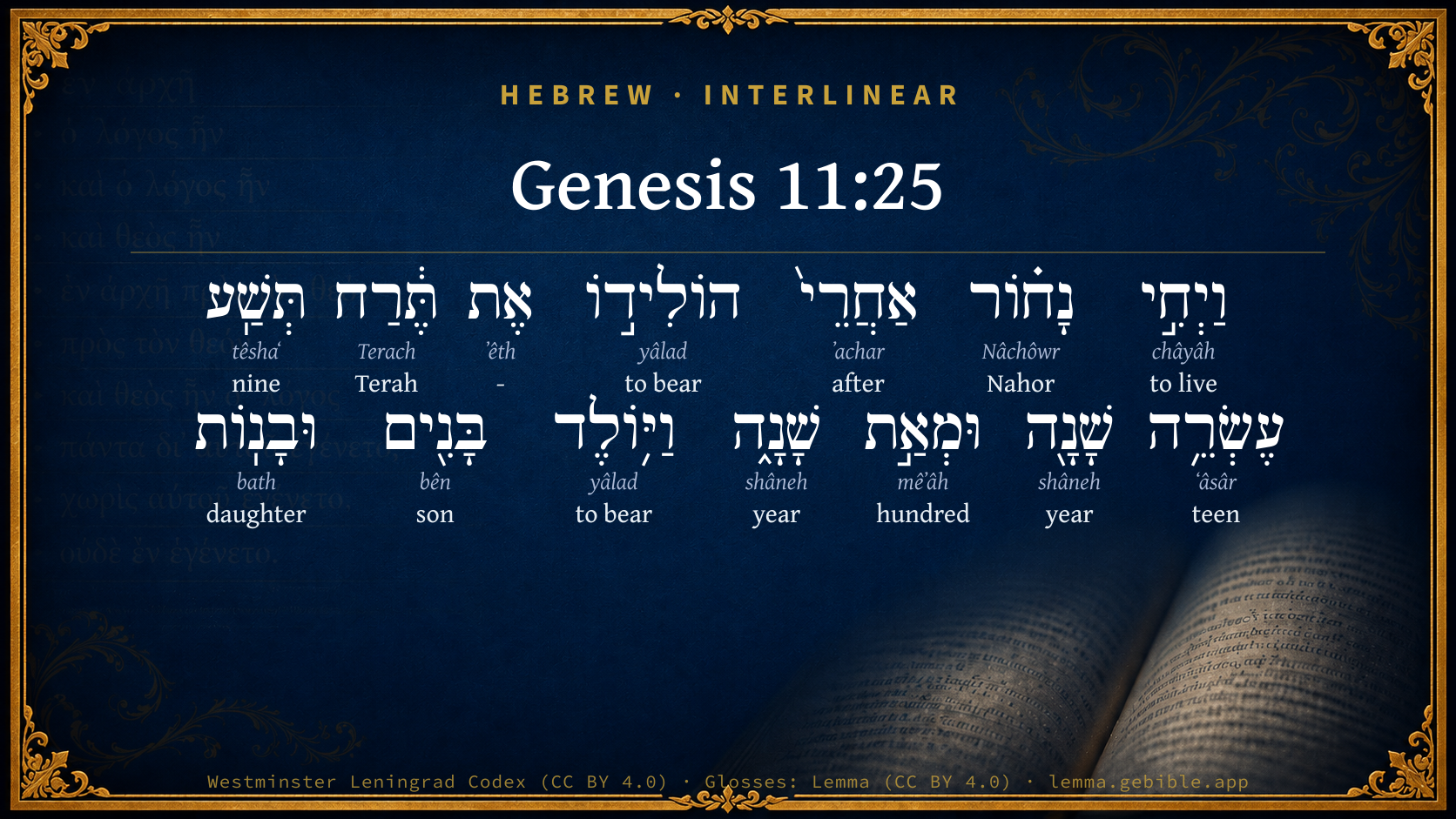
Hebrew (Westminster Leningrad Codex) Genesis 11:25 appears in the Hebrew Old Testament. The text above is from the Westminster Leningrad Codex. Each word links to its Strong’s number, a concise gloss, and parsing drawn from the Open Scriptures Hebrew Bible morphology. Click any word for its full Brown-Driver-Briggs (BDB) entry.
Download image
Cite this verse

Genesis 11:25 (World English Bible). Public Domain. Lemma interlinear Bible study tool, https://lemma.gebible.app/v/genesis/11/25.

Show BibTeX & RIS
BibTeX
RIS
English Translation
Nahor lived after he became the father of Terah one hundred nineteen years, and became the father of sons and daughters.
World English Bible · Public Domain
Download a study sheet

One document with this verse’s original text, its word-by-word gloss line, the meaning frame, cross-references with their text, attributed commentary, and full source and license credits — printable, and it pastes into notes with its structure intact.

This verse Autodidact and up

Study sheet (.html) Plain text (.txt)

A passage Seminary Student

Up to 50 verses in one chapter. A passage sheet keeps up to 6 commentary sources and 12 cross-references per verse, in the order this page ranks them, and says so on the sheet whenever that leaves anything out. Ask for a single verse and you get the Autodidact verse sheet above.

Everything on this page stays free to read, with no account — the sheet is a download of what is already on screen, not access to it.

Want to remove ads? Support Godless Engineer
Compare translations 3

The same verse in 3 English versions, stacked beneath the original-language interlinear above. Click any original word for its lexicon entry.

Each is an independent rendering of the whole verse — the interlinear is not word-aligned to these translations.

Highlighted words mark where these versions differ — a whole-verse word diff, not a word-by-word alignment.

  • World English Bible Public Domain
    Nahor lived after he became the father of Terah one hundred nineteen years, and became the father of sons and daughters.
  • King James Version Public Domain
    And Nahor lived after he begat Terah an hundred and nineteen years, and begat sons and daughters.
  • unfoldingWord Literal Text CC BY-SA 4.0
    Then after he fathered Terah, Nahor lived 119 years, and he fathered sons and daughters.

unfoldingWord Literal Text — © unfoldingWord, licensed CC BY-SA 4.0. Word-aligned USFM3 via Door43 (git.door43.org/unfoldingWord/en_ult).

Versions to compare (up to 4)

3 of 4 selected

Show all 18 translations

Every available English version of this verse, each an independent rendering of the whole verse.

  • World English Bible Public Domain
    Nahor lived after he became the father of Terah one hundred nineteen years, and became the father of sons and daughters.
  • Berean Standard Bible Public Domain
    And after he had become the father of Terah, Nahor lived 119 years and had other sons and daughters.
  • Majority Standard Bible Public Domain
    And after he had become the father of Terah, Nahor lived 119 years and had other sons and daughters.
  • King James Version Public Domain
    And Nahor lived after he begat Terah an hundred and nineteen years, and begat sons and daughters.
  • American Standard Version (1901) Public Domain
    and Nahor lived after he begat Terah a hundred and nineteen years, and begat sons and daughters.
  • Revised Version (1885) Public Domain
    and Nahor lived after he begat Terah an hundred and nineteen years, and begat sons and daughters.
  • Geneva Bible (1599) Public Domain
    So Nahor liued, after he begate Terah, an hundreth and nineteene yeeres, and begat sonnes and daughters.
  • Douay-Rheims (1899) Public Domain
    And Nachor lived after he begot Thare, a hundred and nineteen years: and begot sons and daughters.
  • Young's Literal Translation Public Domain
    And Nahor liveth after his begetting Terah an hundred and nineteen years, and begetteth sons and daughters.
  • Literal Standard Version CC BY-SA 4.0
    And Nahor lives after his begetting Terah one hundred and nineteen years [[or one hundred and twenty-nine years]], and begets sons and daughters.
  • Unlocked Literal Bible CC BY-SA 4.0
    Nahor lived 119 years after he became the father of Terah. He also became the father of other sons and daughters.
  • unfoldingWord Literal Text CC BY-SA 4.0
    Then after he fathered Terah, Nahor lived 119 years, and he fathered sons and daughters.
  • Darby Bible Public Domain
    And Nahor lived after he had begotten Terah a hundred and nineteen years, and begot sons and daughters.
  • World Messianic Bible Public Domain
    Nahor lived one hundred nineteen years after he became the father of Terah, and became the father of more sons and daughters.
  • Webster's Bible Public Domain
    And Nahor lived after he begat Terah a hundred and nineteen years, and begat sons and daughters.
  • Free Bible Version CC BY-SA 4.0
    Nahor lived another 119 years after Terah was born and had other sons and daughters.
  • Bible in Basic English Public Domain
    And after the birth of Terah, Nahor went on living for a hundred and nineteen years, and had sons and daughters:
  • JPS Tanakh (1917) Public Domain
    And Nahor lived after he begot Terah a hundred and nineteen years, and begot sons and daughters.

Literal Standard Version (2020), Covenant Press — licensed CC BY-SA 4.0. Text via the HelloAO Bible API (eBible.org). Unlocked Literal Bible (unfoldingWord) — licensed CC BY-SA 4.0. Text via the HelloAO Bible API (eBible.org). unfoldingWord Literal Text — © unfoldingWord, licensed CC BY-SA 4.0. Word-aligned USFM3 via Door43 (git.door43.org/unfoldingWord/en_ult). Free Bible Version, Dr. Jonathan Gallagher — licensed CC BY-SA 4.0. Text via the HelloAO Bible API (eBible.org).

Word by word

More ways to search: Search by grammar → Find every occurrence → Compare this word →

Practice this passage: Drill this verse → Learn its vocabulary →

תֶּ֔רַח
Terach
H8646
“Terah”
Noun, Proper
Part of Speech
Noun
Type
Proper
Full BDB Definition

Origin: of uncertain derivation

TWOT: None

Tarah = "delay" - the father of Abraham (noun proper masculine) - a station of Israel in the wilderness (noun proper locative)
  1. וַיְחִ֣י châyâh H2421 “and · to live” Conjunction + Verb, Qal, Sequential Imperfect, 3rd Person, Masculine, Singular
  2. נָח֗וֹר Nâchôwr H5152 “Nahor” Noun, Proper
  3. אַחֲרֵי֙ ʼachar H310 “after” Preposition
  4. הוֹלִיד֣וֹ yâlad H3205 “to bear · him” Verb, Hiphil, Infinitive Construct + Suffix, Personal, 3rd Person, Masculine, Singular
  5. אֶת ʼêth H853 “-” Particle, Direct Object
  6. תְּשַֽׁע têshaʻ H8672 “nine” Adjective, Cardinal number, Feminine, Singular, Absolute
  7. עֶשְׂרֵ֥ה ʻâsâr H6240 “teen” Adjective, Cardinal number, Feminine, Singular, Absolute
  8. שָׁנָ֖ה shâneh H8141 “year” Noun, Common, Feminine, Singular, Absolute
  9. וּמְאַ֣ת mêʼâh H3967 “and · hundred” Conjunction + Adjective, Cardinal number, Both, Singular, Construct
  10. שָׁנָ֑ה shâneh H8141 “year” Noun, Common, Feminine, Singular, Absolute
  11. וַיּ֥וֹלֶד yâlad H3205 “and · to bear” Conjunction + Verb, Hiphil, Sequential Imperfect, 3rd Person, Masculine, Singular
  12. בָּנִ֖ים bên H1121 “sons” Noun, Common, Masculine, Plural, Absolute
  13. וּבָנֽוֹת bath H1323 “and · daughters” Conjunction + Noun, Common, Feminine, Plural, Absolute

About this verse

These counts appear in no published source. They are computed here, from the morphology-tagged text and Lemma’s own curated glosses. What Lemma adds →

14
words
12
distinct lemmas
Pentateuch
section

Notable vocabulary

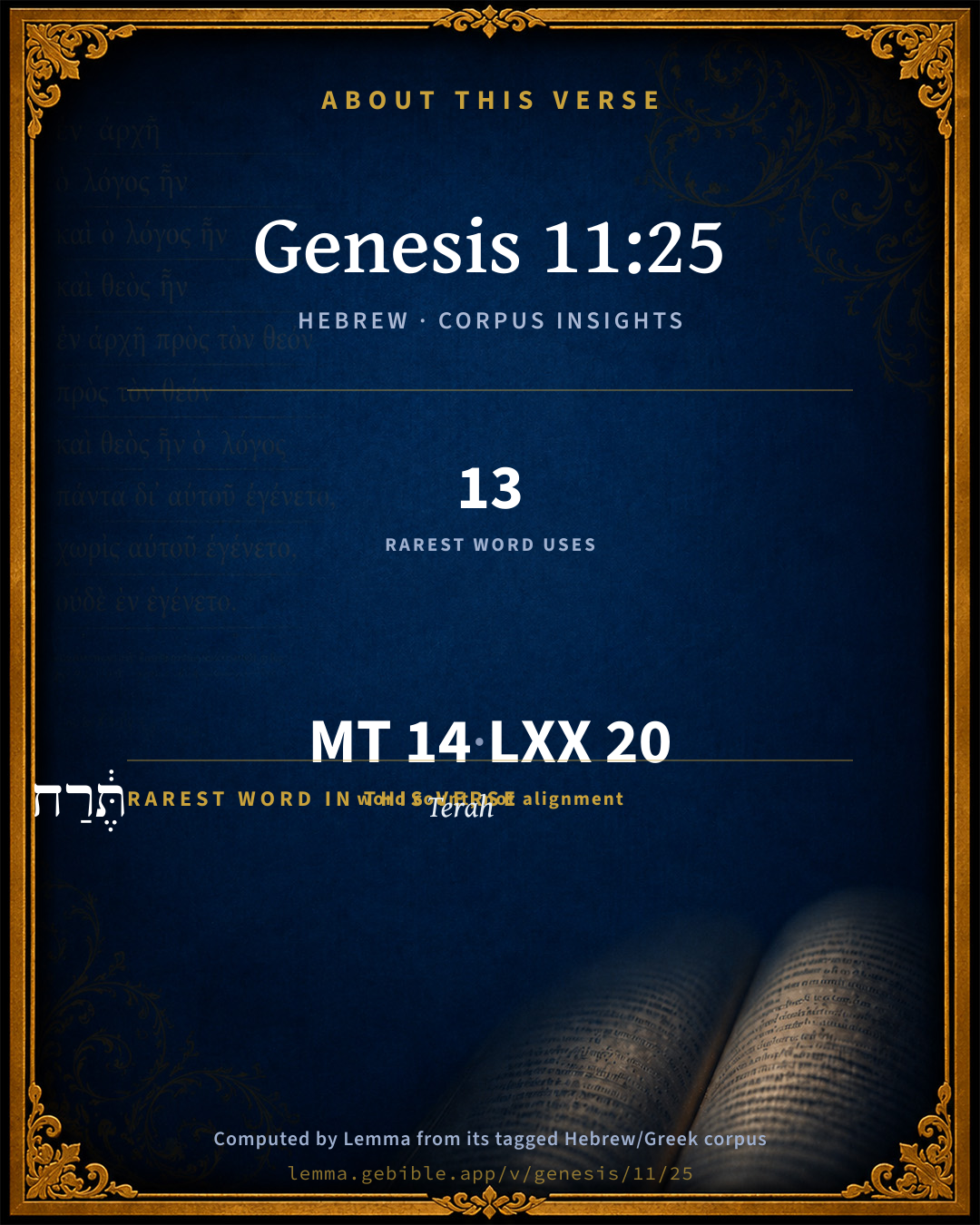
The rarest word here is תֶּ֔רַח Terah H8646 — appearing just 13 times in the whole Hebrew Bible.

Shared distinctive vocabulary

תֶּ֔רַח Terah H8646 occurs in 11 verses of the Hebrew Bible. Also found in:

Grammatical profile

  • 3 verbs
  • 6 nouns
  • 3 adjectives
  • 1 preposition
  • 1 particle

Verb forms

  • וַיְחִ֣י Qal · Sequential Imperfect
  • הוֹלִיד֣וֹ Hiphil · Infinitive Construct
  • וַיּ֥וֹלֶד Hiphil · Sequential Imperfect

Repetition

Words recur within this verse — often emphatic in Hebrew:

  • הוֹלִיד֣וֹ to bear H3205 ×2
  • שָׁנָ֖ה year H8141 ×2

Hebrew & Septuagint length

In English translation the verse runs 21 words from the Hebrew and 21 from the Septuagint (LXX English) — the same length.

A rough comparison of the two English renderings, which tokenize alike — not a word-level alignment.

Word counts can differ between the Hebrew and the Greek without any difference in meaning — e.g. the Hebrew direct-object marker אֵת has no separate Greek word, and Greek often adds the article ὁ.

In the original languages it is 14 Hebrew tokens and 20 Greek tokens — but the two are counted differently (Hebrew bundles its prefixes and suffixes into one token; the Greek is in lemma form), so that isn’t a like-for-like length.

Hebrew and Greek witnesses Masoretic Hebrew ↔ Greek Septuagint

The same verse in the two great witnesses to the Old Testament, shown verse-for-verse.

These are two independent witnesses, not word-aligned to each other, and the Septuagint is shown in lemma (dictionary) form.

Hebrew Genesis 11:25 Masoretic · Westminster Leningrad Codex

וַיְחִ֣י נָח֗וֹר אַחֲרֵי֙ הוֹלִיד֣וֹ אֶת תֶּ֔רַח תְּשַֽׁע עֶשְׂרֵ֥ה שָׁנָ֖ה וּמְאַ֣ת שָׁנָ֑ה וַיּ֥וֹלֶד בָּנִ֖ים וּבָנֽוֹת

Nahor lived after he became the father of Terah one hundred nineteen years, and became the father of sons and daughters.

World English Bible · Public Domain

Greek LXX Genesis 11:25 Septuagint · lemma form

καί ζάω ναχωρ μετά ὁ γεννάω αὐτός ὁ θαρα ἔτος ἑκατόν εἴκοσι ἐννέα καί γεννάω υἱός καί θυγάτηρ καί ἀποθνήσκω

And Nachor lived after he had begotten Tharrha, one hundred and twenty-five years, and begot sons and daughters, and he died.

LXX2012 (modern English Septuagint) · Public Domain

Hebrew: Westminster Leningrad Codex (CC BY 4.0). Greek: Septuagint (public domain); English from LXX2012 (modern English Septuagint) (Public Domain). How the Septuagint differs from the Hebrew →

Targum (Aramaic paraphrase)

2

The Targum is the ancient Jewish Aramaic paraphrase of the Hebrew Scriptures — an interpretive translation, not the Hebrew text itself. Onkelos (literal) and Pseudo-Jonathan (expansive) render the Torah, and Jonathan the Prophets. Coverage is partial: where no permissively-licensed English translation exists for a verse, only the Aramaic is shown. This is verse-level text, not a word-by-word alignment to the Hebrew.

  1. Targum Onkelos Torah (Genesis–Deuteronomy)
    וַחֲיָא נָחוֹר בָּתַר דְּאוֹלִיד יָת תֶּרַח מְאָה וּתְשַׁע עֲשַׂר שְׁנִין וְאוֹלִיד בְּנִין וּבְנָן

    And Nachor lived after he had begotten Terach a hundred and nineteen years, and begat sons and daughters.

    Targum Onkelos — Aramaic: “Onkelos Genesis” (public domain); “Onkelos Exodus” (public domain); “Onkelos Leviticus” (public domain); “Onkelos Numbers” (public domain); “Onkelos Deuteronomy” (public domain). English: “Sefaria Community Translation” (CC0 1.0 (public-domain dedication)); “J.W. Etheridge. The Targums of Onkelos and Jonathan Ben Uzziel on the Pentateuch. London: Longmans, Green, 1862” (public domain). Text via Sefaria.

  2. Targum Pseudo-Jonathan Torah (Genesis–Deuteronomy)
    וַחֲיָא נָחוֹר בָּתַר דְאוֹלִיד יַת תֶּרַח מְאָה וְתִּשְׁסְרֵי שְׁנִין וְאוֹלִיד בְּנִין וּבְנָן

    And Nahor lived after he had begotten Terah one hundred and nineteen years, and begat sons and daughters.

    Targum Pseudo-Jonathan — Aramaic: “Targum Jonathan on Genesis” (public domain); “Targum Jonathan on Exodus” (public domain); “Targum Jonathan on Leviticus” (public domain); “Targum Jonathan on Numbers” (public domain); “Targum Jonathan on Deuteronomy” (public domain). English: “The Targum of Jonathan ben Uzziel, trans. J. W. Etheridge, London, 1862” (public domain). Text via Sefaria.

Commentary

Notes on Genesis 11:25 from classic Christian and Jewish commentators (each source and its license shown beneath its notes). The classic Christian expositions comment on the surrounding passage and are grouped to its opening verse, so a note may address several verses; the Jewish commentaries on the Tanakh (Rashi and others) are per-verse, so they appear only where the commentator wrote on this verse.

Lemma curates 59 commentaries, every one of them public domain or Creative Commons licensed, each selected and text-cleaned for this edition rather than reprinted as found. About our sources →

John Gill's Exposition

But Sarai was barren; she had no child. Aben Ezra observes, there are some that say that Abraham was impotent, and not Sarai barren; the very reverse of the Scriptures; but as he rightly adds, his son Ishmael and his sons by Keturah show the contrary, see Gen 15:2.

.

Genesis 11:31

gen 11:31

gen 11:31

gen 11:31And Terah took Abram his son, and Lot the son of Haran, his son's son, and Sarai his daughter in law, his son Abram's wife,.... Many words are made use of in describing Lot and Sarai, and yet still we are left pretty much in the dark who Sarai was; for, as Aben Ezra observes, if she was the sister of Abram and daughter of Terah, the Scripture would have said, Terah took Abram his son and Sarai his daughter, and wife of Abram; and if she was the sister of Lot, it would have said, and Sarai the daughter of his son, as it does of Lot:

and they went forth with them from Ur of the Chaldees, to go into the land of Canaan; that is, as Jarchi interprets it, Terah and Abram went forth with Lot and Sarai, or "with them" may mean with Nahor and Milcah: for Josephus (h) says, that all went into Charan of Mesopotamia, the whole family of Terah; and the Arabic historian (i) is express for it,"Terah went out from Chorasan, and with him Abram, Nahor, Lot, his children, and their wives, and he went to Charan, where he dwelt:''and it is certain, if Nahor and his wife did not set out with them, they followed them afterwards, for Haran was the city of Nahor, where his family in later times dwelt, see Gen 14:10 what moved Terah to depart from Ur of the Chaldees seems to be the call of God to Abram, which, though after related, was previous to this; and he acquainting his father Terah with it, he listened to it, being now convinced of his idolatry and converted from it, and readily obeyed the divine will; and being the father of Abram, is represented as the head of the family, as he was, and their leader in this transaction; who encouraged their departure from the idolatrous country in which they were, and set out with them to seek another, where they might more freely and safely worship the true God. Though Josephus (j) represents it in this light, that Terah hating the country of Chaldea, because of the mourning of Haran, he and all his went out from thence:

and they came unto Haran, and dwelt there; which Josephus (k) calls Charan of Mesopotamia, and yet Stephen speaks of Abraham being in Mesopotamia before he dwelt in Charan; but then Mesopotamia is to be taken both in a more general and a more limited sense; in general, it took in Mesopotamia and Chaldea, and in the eastern part of it was Ur of the Chaldees, and when Abram came from thence to Haran, he came into Mesopotamia, strictly so called. Stephen calls it Charran it is by Herodian (l) called by Ptolemy (m) Carrae, by Pliny (n) Carra, a city famous in Lucan (o) for the slaughter of Crassus, by whom it is called an Assyrian city. Benjamin of Tudela (p) speaks of it as in being in his time, and as two days journey from the entrance into the land of Shinar or Mesopotamia; and says, that in that place where was the house of Abraham, there is no building on it, but the Ishmaelites (the Mahometans) honour the place, and come thither to pray. Rauwolff, who was in this town A. D. 1575, calls it Orpha; his account of it is this (q), that it is a costly city, with a castle situated on the hill very pleasantly; that the town is very pleasant, pretty big, with fortifications well provided; and that some say it was anciently called Haran and Charras: a later traveller (r) says, who also calls it Orpha,"the air of this city is very healthful, and the country fruitful; that it is built four square, the west part standing on the side of a rocky mountain, and the east part tendeth into a spacious valley, replenished with vineyards, orchards, and gardens: the walls are very strong, furnished with great store of artillery, and contain in circuit three English miles, and, for the gallantness of its sight, it was once reckoned the metropolitical seat of Mesopotamia.''What detained Terah and his family here, when they intended to go further, is not said. Aben Ezra suggests, that the agreeableness of the place to Terah caused him to continue there; but it is very probable he was seized with a disease which obliged them to stay here, and of which he died.

(h) Ut supra. (Antiqu. l. 1. c. 6. sect. 5.) (i) Elmacinus, p. 31. apud Hottinger. p. 282. (j) Ut supra. (Antiqu. l. 1. c. 6. sect. 5.) (k) Ibid. (l) Hist. l. 4. sect. 24. (m) Geograph. l. 5. c. 18. (n) Nat. Hist. l. 5. c. 24. (o) -----------Miserando funere Crassus, Assyrias latio maculavit sanguine Carrhas. Lucan. Pharsal. l. 1. v. 105. (p) Itinerarium, p. 60. (q) Travels, par. 2. ch. 10. sect. 176. by Ray. (r) Cartwright's Preacher's Travels, p. 14, 15.

John Gill's Exposition of the Whole Bible (1746–1763) — public domain (CC PDM 1.0). Text via the HelloAO Bible API.

Lesson kit

Teaching starters — assembled from the data on this page, not authored interpretation. Every prompt links to the verse data it draws on. Edit before teaching.

Genesis, in the Pentateuch, opens this verse with 14 words (12 distinct Hebrew lemmas). Its most distinctive word is Terach (“Terah”). A historical commentator’s framing appears above. Read the whole chapter for the surrounding context.

Discussion questions

  1. What does “Terah” (Terach) contribute to the verse as a whole?
  2. How does Genesis 11:24, which shares the word «Terah», read alongside this verse?
  3. What does the repetition of “to bear” (2× in this one verse) do in this verse?
  4. The translations on this page render this verse differently — a whole-verse word diff, not a word-by-word alignment. What might account for the different wordings?
  5. «וַיְחִ֣י» is a Qal Sequential Imperfect verb. How does that grammatical form shape the action described?

Things to notice

Reading settings

Reading text

Shown beneath each verse's original-language words.

Old Testament
Old Testament edition

Read the OT as the Masoretic Hebrew (MT) or the Greek Septuagint (LXX).

English shown for the Greek Septuagint (in the Hebrew ↔ Greek comparison).

Comparing translations? Open the Compare panel on any verse page to stack up to four side by side.