Judges 13:3

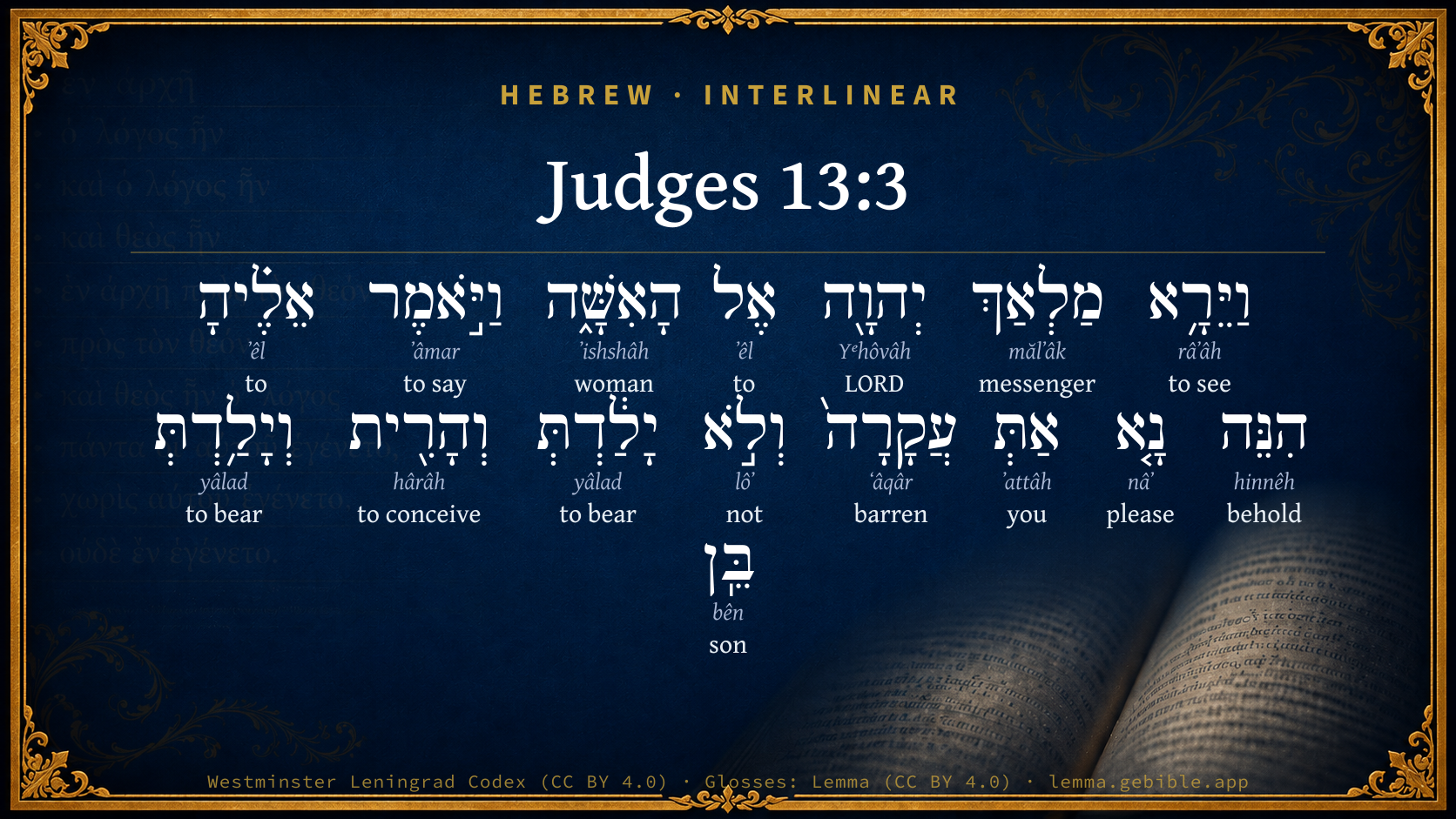
Hebrew (Westminster Leningrad Codex) Judges 13:3 appears in the Hebrew Old Testament. The text above is from the Westminster Leningrad Codex. Each word links to its Strong’s number, a concise gloss, and parsing drawn from the Open Scriptures Hebrew Bible morphology. Click any word for its full Brown-Driver-Briggs (BDB) entry.
Download image
Cite this verse

Judges 13:3 (World English Bible). Public Domain. Lemma interlinear Bible study tool, https://lemma.gebible.app/v/judges/13/3.

Show BibTeX & RIS
BibTeX
RIS
English Translation
The angel of Yahweh appeared to the woman, and said to her, See now, you are barren, and don't bear; but you shall conceive, and bear a son.
World English Bible · Public Domain
Download a study sheet

One document with this verse’s original text, its word-by-word gloss line, the meaning frame, cross-references with their text, attributed commentary, and full source and license credits — printable, and it pastes into notes with its structure intact.

This verse Autodidact and up

Study sheet (.html) Plain text (.txt)

A passage Seminary Student

Up to 50 verses in one chapter. A passage sheet keeps up to 6 commentary sources and 12 cross-references per verse, in the order this page ranks them, and says so on the sheet whenever that leaves anything out. Ask for a single verse and you get the Autodidact verse sheet above.

Everything on this page stays free to read, with no account — the sheet is a download of what is already on screen, not access to it.

Want to remove ads? Support Godless Engineer
Compare translations 3

The same verse in 3 English versions, stacked beneath the original-language interlinear above. Click any original word for its lexicon entry.

Each is an independent rendering of the whole verse — the interlinear is not word-aligned to these translations.

Highlighted words mark where these versions differ — a whole-verse word diff, not a word-by-word alignment.

  • World English Bible Public Domain
    The angel of Yahweh appeared to the woman, and said to her, See now, you are barren, and don't bear; but you shall conceive, and bear a son.
  • King James Version Public Domain
    And the angel of the LORD appeared unto the woman, and said unto her, Behold now, thou art barren, and bearest not: but thou shalt conceive, and bear a son.
  • unfoldingWord Literal Text CC BY-SA 4.0
    And the angel of Yahweh appeared to the woman and said to her, “Behold, please, you barren and have not given birth, but you will conceive and bear a son.

unfoldingWord Literal Text — © unfoldingWord, licensed CC BY-SA 4.0. Word-aligned USFM3 via Door43 (git.door43.org/unfoldingWord/en_ult).

Versions to compare (up to 4)

3 of 4 selected

Show all 18 translations

Every available English version of this verse, each an independent rendering of the whole verse.

  • World English Bible Public Domain
    The angel of Yahweh appeared to the woman, and said to her, See now, you are barren, and don't bear; but you shall conceive, and bear a son.
  • Berean Standard Bible Public Domain
    The angel of the LORD appeared to the woman and said to her, “It is true that you are barren and have no children; but you will conceive and give birth to a son.
  • Majority Standard Bible Public Domain
    The angel of the LORD appeared to the woman and said to her, “It is true that you are barren and have no children; but you will conceive and give birth to a son.
  • King James Version Public Domain
    And the angel of the LORD appeared unto the woman, and said unto her, Behold now, thou art barren, and bearest not: but thou shalt conceive, and bear a son.
  • American Standard Version (1901) Public Domain
    And the angel of Jehovah appeared unto the woman, and said unto her, Behold now, thou art barren, and bearest not; but thou shalt conceive, and bear a son.
  • Revised Version (1885) Public Domain
    And the angel of the LORD appeared unto the woman, and said unto her, Behold now, thou art barren, and bearest not: but thou shalt conceive, and bear a son.
  • Geneva Bible (1599) Public Domain
    And the Angel of the Lord appeared vnto the woman, and said vnto her, Beholde nowe, thou art baren, and bearest not: but thou shalt conceiue, and beare a sonne.
  • Douay-Rheims (1899) Public Domain
    And an angel of the Lord appeared to her, and said: Thou art barren and without children: but thou shalt conceive and bear a son.
  • Young's Literal Translation Public Domain
    and a messenger of Jehovah appeareth unto the woman, and saith unto her, `Lo, I pray thee, thou `art' barren, and hast not borne; when thou hast conceived, then thou hast borne a son.
  • Literal Standard Version CC BY-SA 4.0
    and the Messenger of YHWH appears to the woman and says to her, “Now behold, you [are] barren and have not borne; when you have conceived, then you have borne a son.
  • Unlocked Literal Bible CC BY-SA 4.0
    The angel of Yahweh appeared to the woman and said to her, “See now, you have been unable to become pregnant, and you have not given birth, but you will become pregnant and you will give birth to a son.
  • unfoldingWord Literal Text CC BY-SA 4.0
    And the angel of Yahweh appeared to the woman and said to her, “Behold, please, you barren and have not given birth, but you will conceive and bear a son.
  • Darby Bible Public Domain
    And the angel of the LORD appeared to the woman and said to her, "Behold, you are barren and have no children; but you shall conceive and bear a son.
  • World Messianic Bible Public Domain
    The LORD’s angel appeared to the woman, and said to her, “See now, you are barren and childless; but you shall conceive and bear a son.
  • Webster's Bible Public Domain
    And the angel of the LORD appeared to the woman, and said to her, Behold, now, thou art barren, and bearest not: but thou shalt conceive, and bear a son.
  • Free Bible Version CC BY-SA 4.0
    The Angel of the Lord appeared to her and told her, “It's true that you couldn't conceive, and have no children, but now you're going to become pregnant and give birth to a son.
  • Bible in Basic English Public Domain
    And the angel of the Lord came to the woman, and said to her, See now! though you have never given birth to children, you will be with child and give birth to a son.
  • JPS Tanakh (1917) Public Domain
    And the angel of the LORD appeared unto the woman, and said unto her: 'Behold now, thou art barren, and hast not borne; but thou shalt conceive, and bear a son.

Literal Standard Version (2020), Covenant Press — licensed CC BY-SA 4.0. Text via the HelloAO Bible API (eBible.org). Unlocked Literal Bible (unfoldingWord) — licensed CC BY-SA 4.0. Text via the HelloAO Bible API (eBible.org). unfoldingWord Literal Text — © unfoldingWord, licensed CC BY-SA 4.0. Word-aligned USFM3 via Door43 (git.door43.org/unfoldingWord/en_ult). Free Bible Version, Dr. Jonathan Gallagher — licensed CC BY-SA 4.0. Text via the HelloAO Bible API (eBible.org).

Word by word

More ways to search: Search by grammar → Find every occurrence → Compare this word →

Practice this passage: Drill this verse → Learn its vocabulary →

עֲקָרָה֙
ʻâqâr
H6135
“barren”
Adjective, Adjective, Feminine, Singular, Absolute
Part of Speech
Adjective
Type
Adjective
Gender
Feminine
Number
Singular
State
Absolute
Full BDB Definition

Origin: from H6131

TWOT: 1682a

barren, sterile
  1. וַיֵּרָ֥א râʼâh H7200 “and · to see” Conjunction + Verb, Niphal, Sequential Imperfect, 3rd Person, Masculine, Singular
  2. מַלְאַךְ mălʼâk H4397 “messenger of” Noun, Common, Masculine, Singular, Construct
  3. יְהוָ֖ה Yᵉhôvâh H3068 “LORD” Noun, Proper
  4. אֶל ʼêl H413 “to” Preposition
  5. הָאִשָּׁ֑ה ʼishshâh H802 “the · woman” Particle, Definite Article + Noun, Common, Feminine, Singular, Absolute
  6. וַיֹּ֣אמֶר ʼâmar H559 “and · to say” Conjunction + Verb, Qal, Sequential Imperfect, 3rd Person, Masculine, Singular
  7. אֵלֶ֗יהָ ʼêl H413 “to · her” Preposition + Suffix, Personal, 3rd Person, Feminine, Singular
  8. הִנֵּה hinnêh H2009 “behold” Particle, Demonstrative
  9. נָ֤א nâʼ H4994 “please” Particle, Exhortation
  10. אַתְּ ʼattâh H859 “you” Pronoun, Personal, 2nd Person, Feminine, Singular
  11. וְלֹ֣א lôʼ H3808 “and · not” Conjunction + Particle, Negative
  12. יָלַ֔דְתְּ yâlad H3205 “to bear” Verb, Qal, Perfect, 2nd Person, Feminine, Singular
  13. וְהָרִ֖ית hârâh H2029 “and · to conceive” Conjunction + Verb, Qal, Perfect, 2nd Person, Feminine, Singular
  14. וְיָלַ֥דְתְּ yâlad H3205 “and · to bear” Conjunction + Verb, Qal, Perfect, 2nd Person, Feminine, Singular
  15. בֵּֽן bên H1121 “son” Noun, Common, Masculine, Singular, Absolute

About this verse

These counts appear in no published source. They are computed here, from the morphology-tagged text and Lemma’s own curated glosses. What Lemma adds →

16
words
14
distinct lemmas
Historical
section

Notable vocabulary

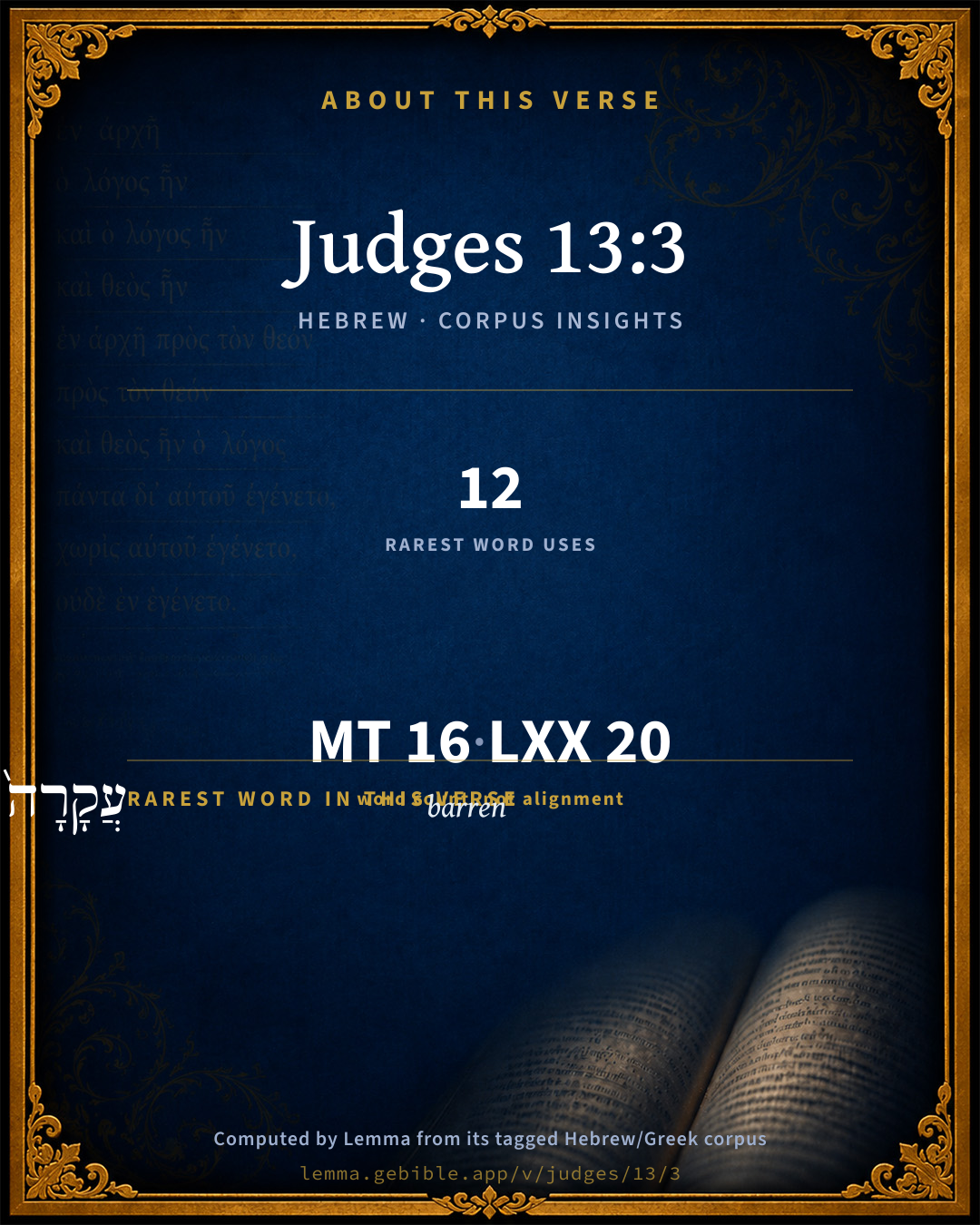
The rarest word here is עֲקָרָה֙ barren H6135 — appearing just 12 times in the whole Hebrew Bible.

Shared distinctive vocabulary

עֲקָרָה֙ barren H6135 occurs in 11 verses of the Hebrew Bible. Also found in:

Grammatical profile

  • 5 verbs
  • 4 nouns
  • 1 adjective
  • 1 pronoun
  • 2 prepositions
  • 3 particles

Verb forms

  • וַיֵּרָ֥א Niphal · Sequential Imperfect
  • וַיֹּ֣אמֶר Qal · Sequential Imperfect
  • יָלַ֔דְתְּ Qal · Perfect
  • וְהָרִ֖ית Qal · Perfect
  • וְיָלַ֥דְתְּ Qal · Perfect

Repetition

Words recur within this verse — often emphatic in Hebrew:

  • יָלַ֔דְתְּ to bear H3205 ×2
  • אֶל to H413 ×2

Hebrew & Septuagint length

In English translation the verse runs 28 words from the Hebrew and 28 from the Septuagint (LXX English) — the same length.

A rough comparison of the two English renderings, which tokenize alike — not a word-level alignment.

Word counts can differ between the Hebrew and the Greek without any difference in meaning — e.g. the Hebrew direct-object marker אֵת has no separate Greek word, and Greek often adds the article ὁ.

In the original languages it is 16 Hebrew tokens and 20 Greek tokens — but the two are counted differently (Hebrew bundles its prefixes and suffixes into one token; the Greek is in lemma form), so that isn’t a like-for-like length.

Cross-references

13

Topical passages linked to Judges 13:3 in the Treasury of Scripture Knowledge — connected by theme and wording, ordered by reader-vote popularity; previews shown in the World English Bible.

  • Luke 1:13 But the angel said to him, "Don't be afraid, Zacharias, because your request has been heard, and your wife, Elizabeth, will bear you a son, and you shall call his name John.
  • Genesis 18:10 He said, "I will certainly return to you when the season comes round. Behold, Sarah your wife will have a son." Sarah heard in the tent door, which was behind him.
  • Luke 1:11 An angel of the Lord appeared to him, standing on the right side of the altar of incense.
  • Judges 2:1 The angel of Yahweh came up from Gilgal to Bochim. He said, I made you to go up out of Egypt, and have brought you to the land which I swore to your fathers; and I said, I will never break my covenant with you:
  • Judges 6:11–12 The angel of Yahweh came, and sat under the oak which was in Ophrah, that pertained to Joash the Abiezrite: and his son Gideon was beating out wheat in the winepress, to hide it from the Midianites.
  • Judges 13:8 Then Manoah entreated Yahweh, and said, Oh, Lord, please let the man of God whom you did send come again to us, and teach us what we shall do to the child who shall be born.
  • 2 Kings 4:16 He said, At this season, when the time comes round, you shall embrace a son. She said, No, my lord, you man of God, do not lie to your handmaid.
  • Genesis 17:16 I will bless her, and moreover I will give you a son by her. Yes, I will bless her, and she will be a mother of nations. Kings of peoples will come from her."
  • 1 Samuel 1:20 It happened, when the time was come about, that Hannah conceived, and bore a son; and she named him Samuel, [saying], Because I have asked him of Yahweh.
  • Luke 1:28–38 Having come in, the angel said to her, "Rejoice, you highly favored one! The Lord is with you. Blessed are you among women!"
  • Judges 13:10 The woman made haste, and ran, and told her husband, and said to him, Behold, the man has appeared to me, who came to me the [other] day.
  • Genesis 16:7–13 The angel of Yahweh found her by a fountain of water in the wilderness, by the fountain in the way to Shur.
  • Judges 13:6 Then the woman came and told her husband, saying, A man of God came to me, and his face was like the face of the angel of God, very awesome; and I didn't ask him whence he was, neither did he tell me his name:

Cross-references courtesy of OpenBible.info (CC BY 4.0).

Hebrew and Greek witnesses Masoretic Hebrew ↔ Greek Septuagint

The same verse in the two great witnesses to the Old Testament, shown verse-for-verse.

These are two independent witnesses, not word-aligned to each other, and the Septuagint is shown in lemma (dictionary) form.

Hebrew Judges 13:3 Masoretic · Westminster Leningrad Codex

וַיֵּרָ֥א מַלְאַךְ יְהוָ֖ה אֶל הָאִשָּׁ֑ה וַיֹּ֣אמֶר אֵלֶ֗יהָ הִנֵּה נָ֤א אַתְּ עֲקָרָה֙ וְלֹ֣א יָלַ֔דְתְּ וְהָרִ֖ית וְיָלַ֥דְתְּ בֵּֽן

The angel of Yahweh appeared to the woman, and said to her, See now, you are barren, and don't bear; but you shall conceive, and bear a son.

World English Bible · Public Domain

Greek LXX Judges 13:3 Septuagint · lemma form

καί ὁράω ἄγγελος κύριος πρός ὁ γυνή καί εἶπον πρός αὐτός ἰδού σύ στεῖρα καί οὐ τίκτω καί συνλαμβάνω υἱός

And an angel of the Lord appeared to the woman, and said to her, Behold, you are barren and have not born; yet you shall conceive a son.

LXX2012 (modern English Septuagint) · Public Domain

Hebrew: Westminster Leningrad Codex (CC BY 4.0). Greek: Septuagint (public domain); English from LXX2012 (modern English Septuagint) (Public Domain). How the Septuagint differs from the Hebrew →

Targum (Aramaic paraphrase)

1

The Targum is the ancient Jewish Aramaic paraphrase of the Hebrew Scriptures — an interpretive translation, not the Hebrew text itself. Onkelos (literal) and Pseudo-Jonathan (expansive) render the Torah, and Jonathan the Prophets. Coverage is partial: where no permissively-licensed English translation exists for a verse, only the Aramaic is shown. This is verse-level text, not a word-by-word alignment to the Hebrew.

  1. Targum Jonathan Prophets (Joshua–Malachi)
    וְאִתְחֲזֵי מַלְאָכָא דַייָ לְאִתְּתָא וַאֲמַר לָהּ הָא כְעַן אַתְּ עֲקְרָא וְלֵית לִיךְ וְלָד וְתַעֲדִין וְתֵלְדִין בַּר:

    (no public-domain English translation for this verse)

    Targum Jonathan — Aramaic: “Mikraot Gedolot” (public domain). English: “Sefaria Community Translation” (CC0 1.0 (public-domain dedication)); “London "Chaldee Paraphrase," 1871” (public domain). Text via Sefaria.

Commentary

Notes on Judges 13:3 from classic Christian and Jewish commentators (each source and its license shown beneath its notes). The classic Christian expositions comment on the surrounding passage and are grouped to its opening verse, so a note may address several verses; the Jewish commentaries on the Tanakh (Rashi and others) are per-verse, so they appear only where the commentator wrote on this verse.

Lemma curates 59 commentaries, every one of them public domain or Creative Commons licensed, each selected and text-cleaned for this edition rather than reprinted as found. About our sources →

Trapp's Complete Commentary

John Trapp

Jdg 13:3 And the angel of the LORD appeared unto the woman, and said unto her, Behold now, thou [art] barren, and bearest not: but thou shalt conceive, and bear a son.

Ver. 3. And the angel of the Lord,] i.e., Christ the Angel of the Covenant, called afterwards by Manoah Elohim, and by his wife Jehovah, {Jdg 13:23} and by himself Wonderful. {Jdg 13:18 Isa 9:6}

Behold now, thou art barren.] See Jdg 13:2.

And bear a son.] A singular son, a Nazarite; such as should be "purer than snow, whiter than milk," {Lam 4:7} drained from the dregs, and sifted from the bran of the ordinary sort of people.

John Trapp, A Commentary or Exposition upon All the Books of the Old and New Testament (1647–1656) — public domain. Text from a community e-Sword module.

Jamieson, Fausset & Brown

Robert Jamieson, A. R. Fausset & David Brown

the angel of the Lord--The messenger of the covenant, the divine personage who made so many remarkable appearances of a similar kind already described.

Jamieson, Fausset & Brown — Commentary Critical and Explanatory on the Whole Bible (1871) — public domain (CC PDM 1.0). Text via the HelloAO Bible API.

Adam Clarke's Commentary

Verse 3. The angel of the Lord] Generally supposed to have been the same that appeared to Moses, Joshua, Gideon, &c., and no other than the second person of the ever-blessed Trinity.

Adam Clarke's Commentary on the Bible (1810–1826) — public domain. Text from a community e-Sword/MySword module.

Ellicott's Commentary for English Readers

(3) The angel of the Lord.—On this expression see Jdg_2:1. Rabbi Levi Ben Gershom says that this “messenger of the Lord” was Phinehas; but nothing can be clearer than that, as in Jdg_6:11, Gen_18:10, Luk_1:11-28, a supernatural being is meant.

A Bible Commentary for English Readers, edited by Charles John Ellicott (1878–1897) — public domain. Text from a community e-Sword module.

The Cambridge Bible for Schools and Colleges

gen. ed. J. J. S. Perowne

3. the angel of the Lord] i.e. Jehovah Himself in manifestation; see on Jdg_2:1. The appearance of the Angel betokens the announcement of a deliverer, as in Jdg_6:12; cf. Luk_1:11; Luk_1:15 ff., Luk_1:31 ff., Mat_1:20 f.

The Cambridge Bible for Schools and Colleges (gen. ed. J. J. S. Perowne; Cambridge University Press, 1878–1918) — public domain. Text from a community e-Sword module.

John Gill's Exposition

And the angel of the Lord appeared unto the woman,.... According to Josephus (k), it was in a plain without the city; and that he appeared in the form of a man is certain from Jdg 13:6 but was not a mere man, a prophet of the Lord, nor a created angel, but the uncreated one, the Angel of the covenant, the Son and Word of God, who often appeared in an human form; since his name is said to be "Wonderful", and he to do wonderful things, and is called "Jehovah", Jdg 13:18,

and said unto her, behold now, thou art barren, and bearest not; barren at that time, and so she had been ever since she was married to that time; and this is observed, that it might appear the more wonderful that she should after this have a child:

but thou shalt conceive, and bear a son; which to do, must be ascribed to divine power, that one in her circumstances should bear a son; as the prediction of it was owing to divine omniscience, and a proof of it.

(k) Antiqu. l. 5. c. 8. sect. 2.

John Gill's Exposition of the Whole Bible (1746–1763) — public domain (CC PDM 1.0). Text via the HelloAO Bible API.

Haydock's Catholic Bible Commentary

Angel, in human form. Some Protestants pretend that he was "the Son of God," and yet (ver. 16) they say, "he sought not his own honour, but God’s, whose messenger he was," (Bible, 1603) in which they plainly contradict themselves, or else teach Arianism, as if the Son were not true God, and equal to his Father. (Worthington) --- The title of God, (Jehova) which is given to this angel, (ver. 15, 21) is no proof that he was the Supreme Being, chap. vi. 11.

George Leo Haydock (1774–1849), Haydock's Catholic Family Bible and Commentary, 1859 edition — public domain. Excludes Psalms (Douay-Rheims chapter numbering differs from Protestant) and Deuterocanonical books (Catholic canon only).

Matthew Poole's English Annotations

The angel of the Lord; the Son of God, oft so called in the Old Testament, as may be gathered from Jdg 13:18, yet distinguished from the Lord, because he appeared here as it were in the form of a servant, as a messenger sent from God, and was really a distinct person from God the Father.

Matthew Poole's English Annotations on the Holy Bible (1683–1685) — public domain. Text from a community e-Sword/MySword module.

Whedon's Commentary on the Bible

Daniel D. Whedon

3. The angel of the Lord — See note on Jdg_6:11. This Angel of the covenant himself performed the mission, so like that which Gabriel afterwards was sent to fulfil, (Luk_1:26,) when the woman was Mary, and the child to be born was the Wonderful, (Isa_9:6,) even the incarnation of Him who now appeared as a mysterious theophany, 4. Drink not wine — The mother of the mighty Nazarite must herself be a Nazarite for the time.

Daniel D. Whedon (gen. ed.), Commentary on the Old and New Testaments (1874–1909) — public domain. Text from a community e-Sword module.

The Pulpit Commentary

Thou shalt... bear a son. It is obvious to compare the promise to Abraham and Sarah, (Gen_17:19 Gen_18:10, Gen_18:14) to Hannah, (1Sa_1:17) to Elizabeth, (Luk_1:13) and to the blessed Virgin. (Luk_1:31)

The Pulpit Commentary (1880–1919), ed. H.D.M. Spence-Jones & Joseph S. Exell — public domain. Text from a community e-Sword module.

John Wesley's Explanatory Notes

The angel - The Son of God, yet distinguished from the Lord, because he appeared here in the form of a servant, as a messenger sent from God. The great Redeemer did in a particular manner concern himself about this typical redeemer.

John Wesley, Explanatory Notes Upon the Whole Bible (1754–1765) — public domain. Text via the GEBible commentary corpus.

Scofield Reference Notes

C. I. Scofield

angel

(See Scofield "Heb 1:4").

The Scofield Reference Bible (1917 edition), notes by C. I. Scofield — public domain. Text from a community e-Sword module.

unfoldingWord translationNotes

Door43 World Missions Community

give birth to a son

This refers to childbirth. AT: "bear a son" or "have a baby boy" (See: Idiom)

anything unclean

Something that Yahweh has stated is unfit to eat is spoken of as if it were physically unclean. (See: Metaphor)

Look

"Pay attention" or "Listen"

No razor will be used upon his head

Here the word "head" refers to his hair. This can be stated in active form. AT: "No one should ever cut his hair" (See: Metonymy and Active or Passive)

razor

a sharp knife used to cut hair close to the skin

a Nazirite to God

This means that he will be devoted to God as a Nazirite. AT: "a Nazirite devoted to God" or "devoted to God as a Nazirite" (See: Assumed Knowledge and Implicit Information)

from the womb

Here the word "womb" refers to the time before the child is born. AT: "from before he is born" (See: Metonymy)

the hand of the Philistines

Here the word "hand" means control. AT: "the control of the Philistines" or "being under the Philistine's control" (See: Metonymy)

translationWords

angel

Yahweh

wine

strong drink

clean

Nazirite

womb

deliver

hand

Philistines

unfoldingWord translationNotes — © Distant Shores Media and the Door43 World Missions Community, licensed CC BY-SA 4.0. Source: git.door43.org/Door43/en_tn.

Lesson kit

Teaching starters — assembled from the data on this page, not authored interpretation. Every prompt links to the verse data it draws on. Edit before teaching.

Judges, in the Historical, opens this verse with 16 words (14 distinct Hebrew lemmas). Its most distinctive word is ʻâqâr (“barren”). A historical commentator’s framing appears above. Read the whole chapter for the surrounding context.

Discussion questions

  1. What does “barren” (ʻâqâr) contribute to the verse as a whole?
  2. How does Genesis 11:30, which shares the word «barren», read alongside this verse?
  3. What does the repetition of “to bear” (2× in this one verse) do in this verse?
  4. These translations render this verse differently. What is at stake in choosing one wording over another?
  5. «וַיֵּרָ֥א» is a Niphal Sequential Imperfect verb. How does that grammatical form shape the action described?
  6. Compare how Trapp's Complete Commentary and Jamieson, Fausset & Brown read this verse. Where do they agree or differ?

Things to notice

Reading settings

Reading text

Shown beneath each verse's original-language words.

Old Testament
Old Testament edition

Read the OT as the Masoretic Hebrew (MT) or the Greek Septuagint (LXX).

English shown for the Greek Septuagint (in the Hebrew ↔ Greek comparison).

Comparing translations? Open the Compare panel on any verse page to stack up to four side by side.