Genesis 17:21

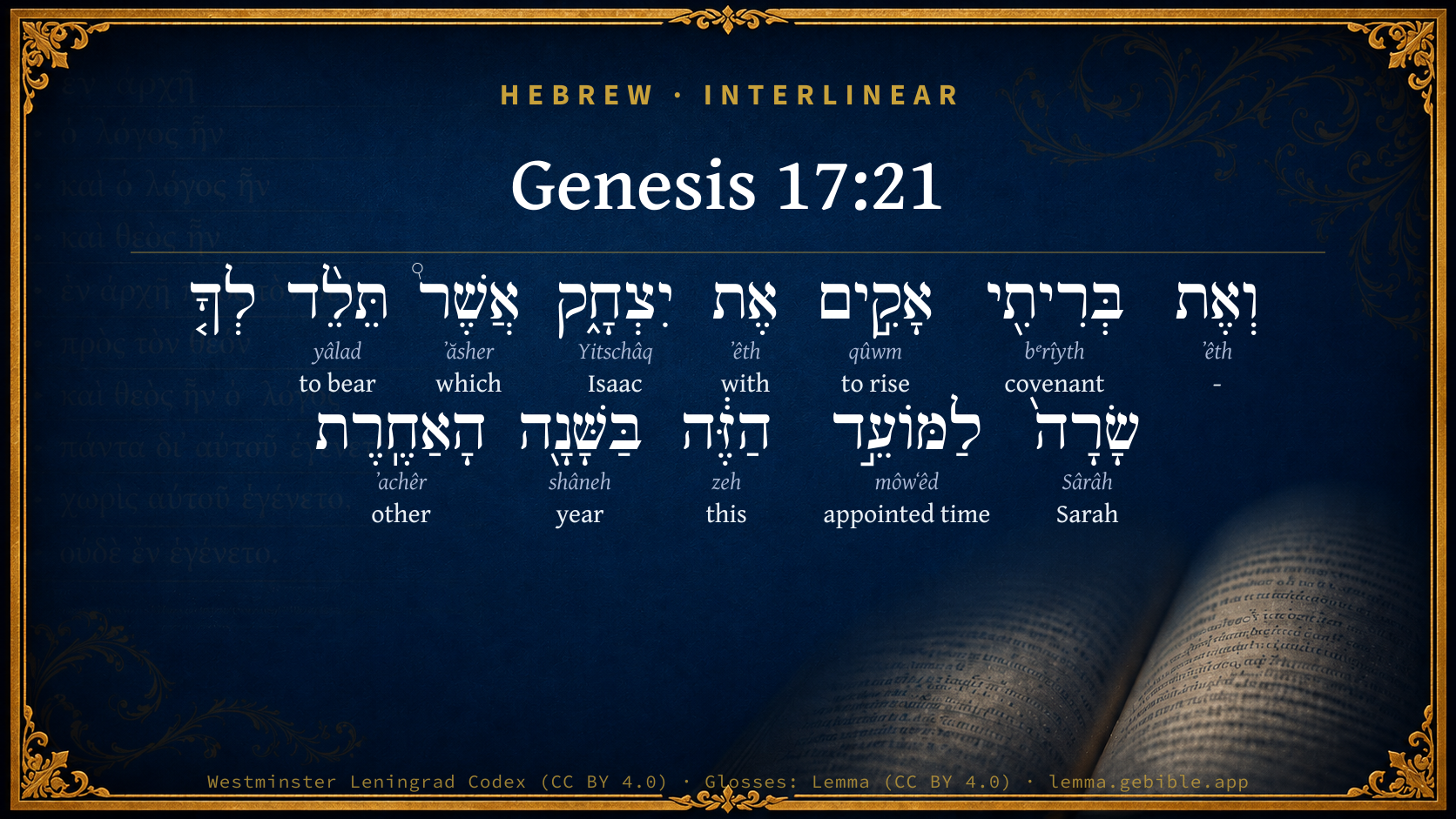
Hebrew (Westminster Leningrad Codex) Genesis 17:21 appears in the Hebrew Old Testament. The text above is from the Westminster Leningrad Codex. Each word links to its Strong’s number, a concise gloss, and parsing drawn from the Open Scriptures Hebrew Bible morphology. Click any word for its full Brown-Driver-Briggs (BDB) entry.
Download image
Cite this verse

Genesis 17:21 (World English Bible). Public Domain. Lemma interlinear Bible study tool, https://lemma.gebible.app/v/genesis/17/21.

Show BibTeX & RIS
BibTeX
RIS
English Translation
But my covenant I establish with Isaac, whom Sarah will bear to you at this set time in the next year."
World English Bible · Public Domain
Download a study sheet

One document with this verse’s original text, its word-by-word gloss line, the meaning frame, cross-references with their text, attributed commentary, and full source and license credits — printable, and it pastes into notes with its structure intact.

This verse Autodidact and up

Study sheet (.html) Plain text (.txt)

A passage Seminary Student

Up to 50 verses in one chapter. A passage sheet keeps up to 6 commentary sources and 12 cross-references per verse, in the order this page ranks them, and says so on the sheet whenever that leaves anything out. Ask for a single verse and you get the Autodidact verse sheet above.

Everything on this page stays free to read, with no account — the sheet is a download of what is already on screen, not access to it.

Want to remove ads? Support Godless Engineer
Compare translations 3

The same verse in 3 English versions, stacked beneath the original-language interlinear above. Click any original word for its lexicon entry.

Each is an independent rendering of the whole verse — the interlinear is not word-aligned to these translations.

Highlighted words mark where these versions differ — a whole-verse word diff, not a word-by-word alignment.

  • World English Bible Public Domain
    But my covenant I establish with Isaac, whom Sarah will bear to you at this set time in the next year."
  • King James Version Public Domain
    But my covenant will I establish with Isaac, which Sarah shall bear unto thee at this set time in the next year.
  • unfoldingWord Literal Text CC BY-SA 4.0
    However, my covenant I will establish with Isaac, whom Sarah will bear for you by this time in the next year.”

unfoldingWord Literal Text — © unfoldingWord, licensed CC BY-SA 4.0. Word-aligned USFM3 via Door43 (git.door43.org/unfoldingWord/en_ult).

Versions to compare (up to 4)

3 of 4 selected

Show all 18 translations

Every available English version of this verse, each an independent rendering of the whole verse.

  • World English Bible Public Domain
    But my covenant I establish with Isaac, whom Sarah will bear to you at this set time in the next year."
  • Berean Standard Bible Public Domain
    But I will establish My covenant with Isaac, whom Sarah will bear to you at this time next year.”
  • Majority Standard Bible Public Domain
    But I will establish My covenant with Isaac, whom Sarah will bear to you at this time next year.”
  • King James Version Public Domain
    But my covenant will I establish with Isaac, which Sarah shall bear unto thee at this set time in the next year.
  • American Standard Version (1901) Public Domain
    But my covenant will I establish with Isaac, whom Sarah shall bear unto thee at this set time in the next year.
  • Revised Version (1885) Public Domain
    But my covenant will I establish with Isaac, which Sarah shall bear unto thee at this set time in the next year.
  • Geneva Bible (1599) Public Domain
    But my couenant will I establish with Izhak, which Sarah shall beare vnto thee, the next yeere at this season.
  • Douay-Rheims (1899) Public Domain
    But my covenant I will establish with Isaac, whom Sara shall bring forth to thee at this time in the next year.
  • Young's Literal Translation Public Domain
    and My covenant I establish with Isaac, whom Sarah doth bear to thee at this appointed time in the next year;'
  • Literal Standard Version CC BY-SA 4.0
    and My covenant I establish with Isaac, whom Sarah does bear to you at this appointed time in the next year”;
  • Unlocked Literal Bible CC BY-SA 4.0
    But my covenant I will establish with Isaac, whom Sarah will bear to you at this time in the next year.”
  • unfoldingWord Literal Text CC BY-SA 4.0
    However, my covenant I will establish with Isaac, whom Sarah will bear for you by this time in the next year.”
  • Darby Bible Public Domain
    But my covenant will I establish with Isaac, whom Sarah shall bear to thee at this appointed time in the next year.
  • World Messianic Bible Public Domain
    But I will establish my covenant with Isaac, whom Sarah will bear to you at this set time next year.”
  • Webster's Bible Public Domain
    But my covenant will I establish with Isaac, whom Sarah shall bear to thee at this set time in the next year.
  • Free Bible Version CC BY-SA 4.0
    But it's with Isaac that I will keep my agreement, the son Sarah will give birth to about this time next year.”
  • Bible in Basic English Public Domain
    But my agreement will be with Isaac, to whom Sarah will give birth a year from this time.
  • JPS Tanakh (1917) Public Domain
    But My covenant will I establish with Isaac, whom Sarah shall bear unto thee at this set time in the next year.'

Literal Standard Version (2020), Covenant Press — licensed CC BY-SA 4.0. Text via the HelloAO Bible API (eBible.org). Unlocked Literal Bible (unfoldingWord) — licensed CC BY-SA 4.0. Text via the HelloAO Bible API (eBible.org). unfoldingWord Literal Text — © unfoldingWord, licensed CC BY-SA 4.0. Word-aligned USFM3 via Door43 (git.door43.org/unfoldingWord/en_ult). Free Bible Version, Dr. Jonathan Gallagher — licensed CC BY-SA 4.0. Text via the HelloAO Bible API (eBible.org).

Word by word

More ways to search: Search by grammar → Find every occurrence → Compare this word →

Practice this passage: Drill this verse → Learn its vocabulary →

שָׂרָה֙
Sârâh
H8283
“Sarah”
Noun, Proper
Part of Speech
Noun
Type
Proper
Full BDB Definition

Origin: the same as H8282

TWOT: None

Sarah = "noblewoman" - wife of Abraham and mother of Isaac
  1. וְאֶת ʼêth H853 “and · -” Conjunction + Particle, Direct Object
  2. בְּרִיתִ֖י bᵉrîyth H1285 “covenant · my” Noun, Common, Feminine, Singular, Construct + Suffix, Personal, 1st Person, Common, Singular
  3. אָקִ֣ים qûwm H6965 “to rise” Verb, Hiphil, Imperfect, 1st Person, Common, Singular
  4. אֶת ʼêth H854 “with” Preposition
  5. יִצְחָ֑ק Yitschâq H3327 “Isaac” Noun, Proper
  6. אֲשֶׁר֩ ʼăsher H834 “which” Particle, Relative
  7. תֵּלֵ֨ד yâlad H3205 “to bear” Verb, Qal, Imperfect, 3rd Person, Feminine, Singular
  8. לַמּוֹעֵ֣ד môwʻêd H4150 “to/for the · appointed time” Preposition, Determined + Noun, Common, Masculine, Singular, Absolute
  9. הַזֶּ֔ה zeh H2088 “the · this” Particle, Definite Article + Pronoun, Demonstrative, Masculine, Singular
  10. בַּשָּׁנָ֖ה shâneh H8141 “in/at the · year” Preposition, Determined + Noun, Common, Feminine, Singular, Absolute
  11. הָאַחֶֽרֶת ʼachêr H312 “the · other” Particle, Definite Article + Adjective, Adjective, Feminine, Singular, Absolute

About this verse

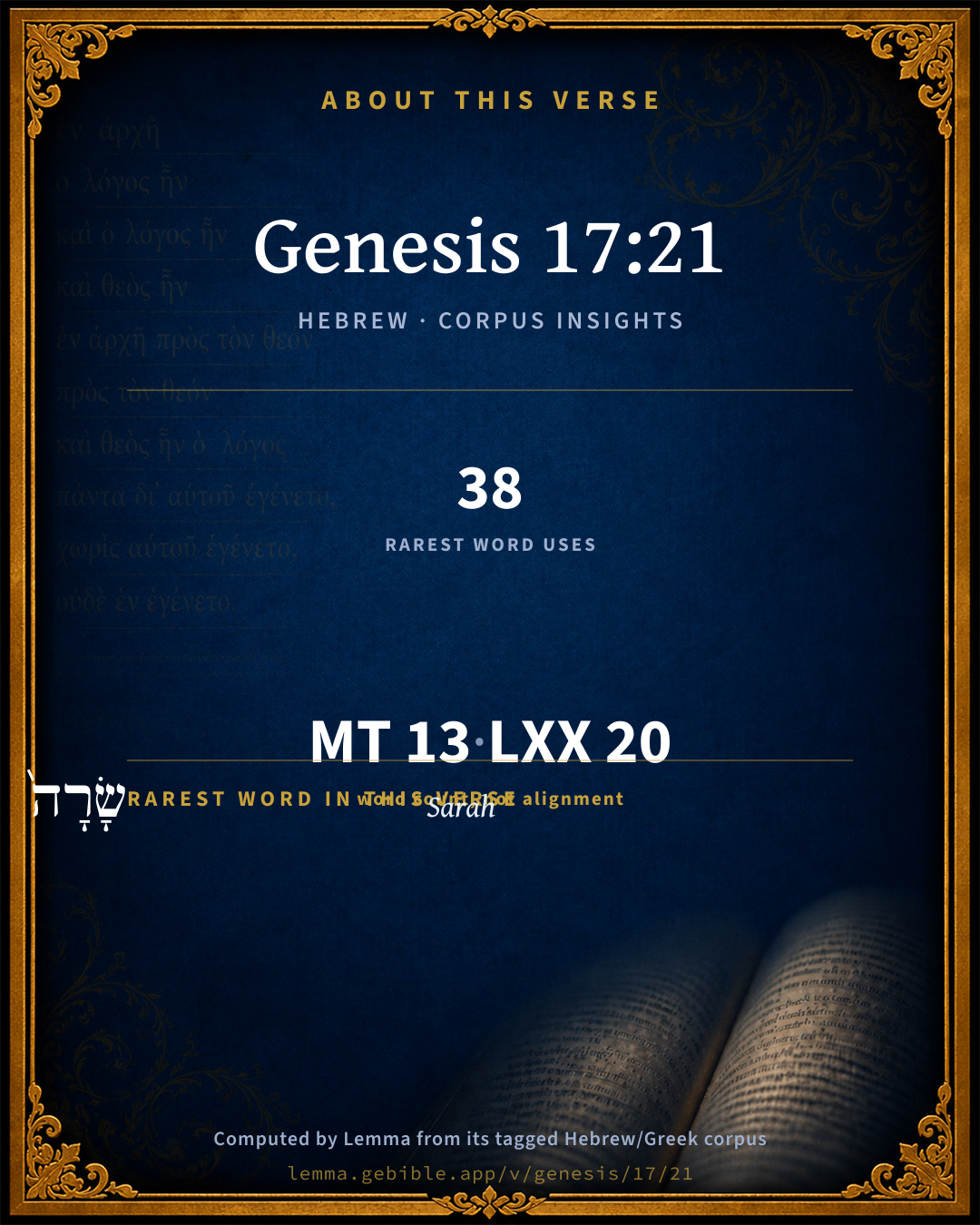
These counts appear in no published source. They are computed here, from the morphology-tagged text and Lemma’s own curated glosses. What Lemma adds →

13
words
12
distinct lemmas
Pentateuch
section

Shared distinctive vocabulary

שָׂרָה֙ Sarah H8283 occurs in 32 verses of the Hebrew Bible. Also found in:

Grammatical profile

  • 2 verbs
  • 5 nouns
  • 1 adjective
  • 1 pronoun
  • 2 prepositions
  • 2 particles

Verb forms

  • אָקִ֣ים Hiphil · Imperfect
  • תֵּלֵ֨ד Qal · Imperfect

Hebrew & Septuagint length

In English translation the verse runs 21 words from the Hebrew and 21 from the Septuagint (LXX English) — the same length.

A rough comparison of the two English renderings, which tokenize alike — not a word-level alignment.

Word counts can differ between the Hebrew and the Greek without any difference in meaning — e.g. the Hebrew direct-object marker אֵת has no separate Greek word, and Greek often adds the article ὁ.

In the original languages it is 13 Hebrew tokens and 20 Greek tokens — but the two are counted differently (Hebrew bundles its prefixes and suffixes into one token; the Greek is in lemma form), so that isn’t a like-for-like length.

Cross-references

16

Topical passages linked to Genesis 17:21 in the Treasury of Scripture Knowledge — connected by theme and wording, ordered by reader-vote popularity; previews shown in the World English Bible.

  • Genesis 21:2–3 Sarah conceived, and bore Abraham a son in his old age, at the set time of which God had spoken to him.
  • Genesis 26:2–5 Yahweh appeared to him, and said, "Don't go down into Egypt. Dwell in the land which I will tell you of.
  • Genesis 18:10 He said, "I will certainly return to you when the season comes round. Behold, Sarah your wife will have a son." Sarah heard in the tent door, which was behind him.
  • Romans 9:5–6 of whom are the fathers, and from whom is Christ as concerning the flesh, who is over all, God, blessed forever. Amen.
  • Romans 9:9 For this is a word of promise, "At the appointed time I will come, and Sarah will have a son."
  • Galatians 3:29 If you are Christ's, then you are Abraham's seed and heirs according to promise.
  • Genesis 21:10–12 Therefore she said to Abraham, "Cast out this handmaid and her son! For the son of this handmaid will not be heir with my son, even with Isaac."
  • Genesis 46:1 Israel traveled with all that he had, and came to Beersheba, and offered sacrifices to the God of his father, Isaac.
  • Exodus 2:24 God heard their groaning, and God remembered his covenant with Abraham, with Isaac, and with Jacob.
  • Exodus 3:6 Moreover he said, "I am the God of your father, the God of Abraham, the God of Isaac, and the God of Jacob." Moses hid his face; for he was afraid to look at God.
  • Job 14:13 "Oh that you would hide me in Sheol, That you would keep me secret, until your wrath is past, That you would appoint me a set time, and remember me!
  • Luke 1:55 As he spoke to our fathers, To Abraham and his seed forever."
  • Luke 1:72 To show mercy towards our fathers, To remember his holy covenant,
  • Acts 1:7 He said to them, "It isn't for you to know times or seasons which the Father has set within His own authority.
  • Hebrews 11:9 By faith, he lived as an alien in the land of promise, as in a land not his own, dwelling in tents, with Isaac and Jacob, the heirs with him of the same promise.
  • Genesis 48:15 He blessed Joseph, and said, "The God before whom my fathers Abraham and Isaac did walk, the God who has fed me all my life long to this day,

Cross-references courtesy of OpenBible.info (CC BY 4.0).

Hebrew and Greek witnesses Masoretic Hebrew ↔ Greek Septuagint

The same verse in the two great witnesses to the Old Testament, shown verse-for-verse.

These are two independent witnesses, not word-aligned to each other, and the Septuagint is shown in lemma (dictionary) form.

Hebrew Genesis 17:21 Masoretic · Westminster Leningrad Codex

וְאֶת בְּרִיתִ֖י אָקִ֣ים אֶת יִצְחָ֑ק אֲשֶׁר֩ תֵּלֵ֨ד לְךָ֤ שָׂרָה֙ לַמּוֹעֵ֣ד הַזֶּ֔ה בַּשָּׁנָ֖ה הָאַחֶֽרֶת

But my covenant I establish with Isaac, whom Sarah will bear to you at this set time in the next year."

World English Bible · Public Domain

Greek LXX Genesis 17:21 Septuagint · lemma form

ὁ δέ διαθήκη ἐγώ ἵστημι πρός ισαακ ὅς τίκτω σύ σαρρα εἰς ὁ καιρός οὗτος ἐν ὁ ἐνιαυτός ὁ ἕτερος

But I will establish my covenant with Isaac, whom Sarrha shall bear to you at this time, in the next year.

LXX2012 (modern English Septuagint) · Public Domain

Hebrew: Westminster Leningrad Codex (CC BY 4.0). Greek: Septuagint (public domain); English from LXX2012 (modern English Septuagint) (Public Domain). How the Septuagint differs from the Hebrew →

Targum (Aramaic paraphrase)

2

The Targum is the ancient Jewish Aramaic paraphrase of the Hebrew Scriptures — an interpretive translation, not the Hebrew text itself. Onkelos (literal) and Pseudo-Jonathan (expansive) render the Torah, and Jonathan the Prophets. Coverage is partial: where no permissively-licensed English translation exists for a verse, only the Aramaic is shown. This is verse-level text, not a word-by-word alignment to the Hebrew.

  1. Targum Onkelos Torah (Genesis–Deuteronomy)
    וְיָת קְיָמִי אָקִים עִם יִצְחָק דִי תְלִיד לָךְ שָׂרָה לְזִמְנָא הָדֵין בְּשַׁתָּא אָחֳרַנְתָּא

    (no public-domain English translation for this verse)

    Targum Onkelos — Aramaic: “Onkelos Genesis” (public domain); “Onkelos Exodus” (public domain); “Onkelos Leviticus” (public domain); “Onkelos Numbers” (public domain); “Onkelos Deuteronomy” (public domain). English: “Sefaria Community Translation” (CC0 1.0 (public-domain dedication)); “J.W. Etheridge. The Targums of Onkelos and Jonathan Ben Uzziel on the Pentateuch. London: Longmans, Green, 1862” (public domain). Text via Sefaria.

  2. Targum Pseudo-Jonathan Torah (Genesis–Deuteronomy)
    וְיַת קְיָימִי אֲקַיֵים עִם יִצְחָק דְתוֹלִיד לָךְ שָרָה בְזִמְנָא הָדֵין בְּשַׁתָּא אוֹחֲרַנְתָּא

    But My covenant will I establish with Izhak, whom Sarah shall bear to thee at this time in the year after.

    Targum Pseudo-Jonathan — Aramaic: “Targum Jonathan on Genesis” (public domain); “Targum Jonathan on Exodus” (public domain); “Targum Jonathan on Leviticus” (public domain); “Targum Jonathan on Numbers” (public domain); “Targum Jonathan on Deuteronomy” (public domain). English: “The Targum of Jonathan ben Uzziel, trans. J. W. Etheridge, London, 1862” (public domain). Text via Sefaria.

Commentary

Notes on Genesis 17:21 from classic Christian and Jewish commentators (each source and its license shown beneath its notes). The classic Christian expositions comment on the surrounding passage and are grouped to its opening verse, so a note may address several verses; the Jewish commentaries on the Tanakh (Rashi and others) are per-verse, so they appear only where the commentator wrote on this verse.

Lemma curates 59 commentaries, every one of them public domain or Creative Commons licensed, each selected and text-cleaned for this edition rather than reprinted as found. About our sources →

Trapp's Complete Commentary

John Trapp

Gen 17:21 But my covenant will I establish with Isaac, which Sarah shall bear unto thee at this set time in the next year.

Ver. 21. But my covenant.] This is the thirteenth time that the covenant is named in this chapter, saith an interpreter; and hereby is meant the promise of Christ and salvation by him. A subject so sweet to every sanctified soul, that St Paul cannot come off it. He names the Lord Jesus Christ ten times together in ten verses. {1Co 1:1-10} It was to him Mel in ore, melos in aure, iubilum in corde .{ a}

{a} Bernard.

John Trapp, A Commentary or Exposition upon All the Books of the Old and New Testament (1647–1656) — public domain. Text from a community e-Sword module.

The Biblical Illustrator

Joseph S. Exell

Gen_17:21

My covenant will I establish with Isaac

Isaac, a type of Christ

1.

He is born in a miraculous manner. He was the child given by promises, and came not in the ordinary course of nature. So Christ was long promised and miraculously born.

2. He was the son of the house, while all others were his servants. So the position of Christ in the heavenly household was made by His birth. No circumstances could alter His relationship to that household. He was there by a natural necessity. Others may come and go, but the Son abides.

3. He was the progenitor of a free race. Isaac was the son of the free woman, and the ancestor of a great and free people. Christ makes men free when they are born into the kingdom of God by His spirit, and thus belong to that holy nation whose children walk in perfect liberty.

4. He was the channel of blessing to all nations. Christ was the life and power which gave effect to that blessing. He was that blessing itself.

Isaac, a type of the regenerate man

1. He was born by a distinct act of the will of God. So the regenerate man becomes Gods child, not by the course of nature, but by a special grace. He is eminently born of God.

2. He was free born. So each child of God is made free from all bondage. He needs not the commands of law to compel him to obedience, for he obeys from love of his Father. Thus Isaac was the type of the evangelical dispensation, as Ishmael was that of the legal.

The Biblical Illustrator, edited by Joseph S. Exell (c. 1880s–1900s) — public domain. Text from a community e-Sword module.

Joseph Benson's Commentary

Gen 17:21. He names that child Isaac, that is, laughter, because Abraham rejoiced in spirit when this son was promised him.

Joseph Benson's Commentary on the Old and New Testaments (1811–1818) — public domain. Text from a community e-Sword module.

Adam Clarke's Commentary

Verse 21. My covenant will I establish with Isaac] All temporal good things are promised to Ishmael and his posterity, but the establishment of the Lord's covenant is to be with Isaac. Hence it is fully evident that this covenant referred chiefly to spiritual things-to the Messiah, and the salvation which should be brought to both Jews and Gentiles by his incarnation, death, and glorification.

Adam Clarke's Commentary on the Bible (1810–1826) — public domain. Text from a community e-Sword/MySword module.

John Gill's Exposition

But my covenant will one establish with Isaac,.... The covenant of circumcision; for though Ishmael was circumcised, and his posterity practised that rite, yet it was not enjoined them of God; nor was it to them, or served the same purpose as to the Israelites; and particularly the promise of the land of Canaan, made in that covenant, belonged only to the posterity of Isaac, and to those only in the line of Jacob, and especially that of the Messiah springing from him, which circumcision had a respect unto:

whom Sarah shall bear unto thee, at this set time, in the next year: that is, at the end of nine months, which is the set time a woman goes with child.

John Gill's Exposition of the Whole Bible (1746–1763) — public domain (CC PDM 1.0). Text via the HelloAO Bible API.

Matthew Poole's English Annotations

The covenant of the promised Seed to come out of his loins, and of life and salvation to accrue to himself and to his posterity by virtue of that Seed; in comparison whereof God speaks slightly of all the temporal blessings conferred upon Ishmael, though in themselves they were great and glorious. By which it may sufficiently appear that Abraham’s faith, whereby he is said to be justified, Rom 4:1-25, had a further reach in it than to his own immediate child, even to the Messias, whose day therefore Abraham is said to have seen, Joh 8:56.

Matthew Poole's English Annotations on the Holy Bible (1683–1685) — public domain. Text from a community e-Sword/MySword module.

The Pulpit Commentary

But my covenant will I establish with Isaac, whom Sarah shall bear unto thee at this set time in the next year (cf. Gen_21:2)

The Pulpit Commentary (1880–1919), ed. H.D.M. Spence-Jones & Joseph S. Exell — public domain. Text from a community e-Sword module.

John Wesley's Explanatory Notes

He names that child, Isaac - Laughter, because Abraham rejoiced in spirit when this son was promised him.

John Wesley, Explanatory Notes Upon the Whole Bible (1754–1765) — public domain. Text via the GEBible commentary corpus.

Radak

Rabbi David Kimhi (Radak)

למועד הזה "at this time." (anniversary). We do not know precisely on what date G'd had granted Avraham this prophetic vision.

בשנה האחרת. G'd informs Avraham that a year will elapse between the time he received this message and its realization. It is as if the Torah had written that Sarah would give birth at this time in the following year. He did not tell him when she would become pregnant, nor the length of time of her pregnancy. Our sages in Rosh Hashanah 10 assume that the birth occurred on Passover (the date on which Passover would occur in the future) seeing that Sarah became pregnant on Rosh Hashanah.

Radak on the Tanakh — English translations: “Sefaria Community Translation” (CC0 1.0 (public-domain dedication)); “Eliyahu Munk, HaChut Hameshulash” (CC BY 4.0); “Rabbi Mike Feuer, Jerusalem Anthology” (CC BY 4.0); and “R. David Kimhi on the first book of Psalms, Translated by R.G. Finch, London, 1919” (public domain). Text via Sefaria.

Lesson kit

Teaching starters — assembled from the data on this page, not authored interpretation. Every prompt links to the verse data it draws on. Edit before teaching.

Genesis, in the Pentateuch, opens this verse with 13 words (12 distinct Hebrew lemmas). Its most distinctive word is Sârâh (“Sarah”). A historical commentator’s framing appears above. Read the whole chapter for the surrounding context.

Discussion questions

  1. What does “Sarah” (Sârâh) contribute to the verse as a whole?
  2. How does Genesis 17:15, which shares the word «Sarah», read alongside this verse?
  3. These translations render this verse differently. What is at stake in choosing one wording over another?
  4. «אָקִ֣ים» is a Hiphil Imperfect verb. How does that grammatical form shape the action described?
  5. Compare how Trapp's Complete Commentary and The Biblical Illustrator read this verse. Where do they agree or differ?

Things to notice

Reading settings

Reading text

Shown beneath each verse's original-language words.

Old Testament
Old Testament edition

Read the OT as the Masoretic Hebrew (MT) or the Greek Septuagint (LXX).

English shown for the Greek Septuagint (in the Hebrew ↔ Greek comparison).

Comparing translations? Open the Compare panel on any verse page to stack up to four side by side.