
Genesis 22:24

Hebrew (Westminster Leningrad Codex) Genesis 22:24 appears in the Hebrew Old Testament. The text above is from the Westminster Leningrad Codex. Each word links to its Strong’s number, a concise gloss, and parsing drawn from the Open Scriptures Hebrew Bible morphology. Click any word for its full Brown-Driver-Briggs (BDB) entry.
Download image
Cite this verse

Genesis 22:24 (World English Bible). Public Domain. Lemma interlinear Bible study tool, https://lemma.gebible.app/v/genesis/22/24.

Show BibTeX & RIS
BibTeX
RIS
English Translation
His concubine, whose name was Reumah, also bare Tebah, Gaham, Tahash, and Maacah.
World English Bible · Public Domain
Highlights
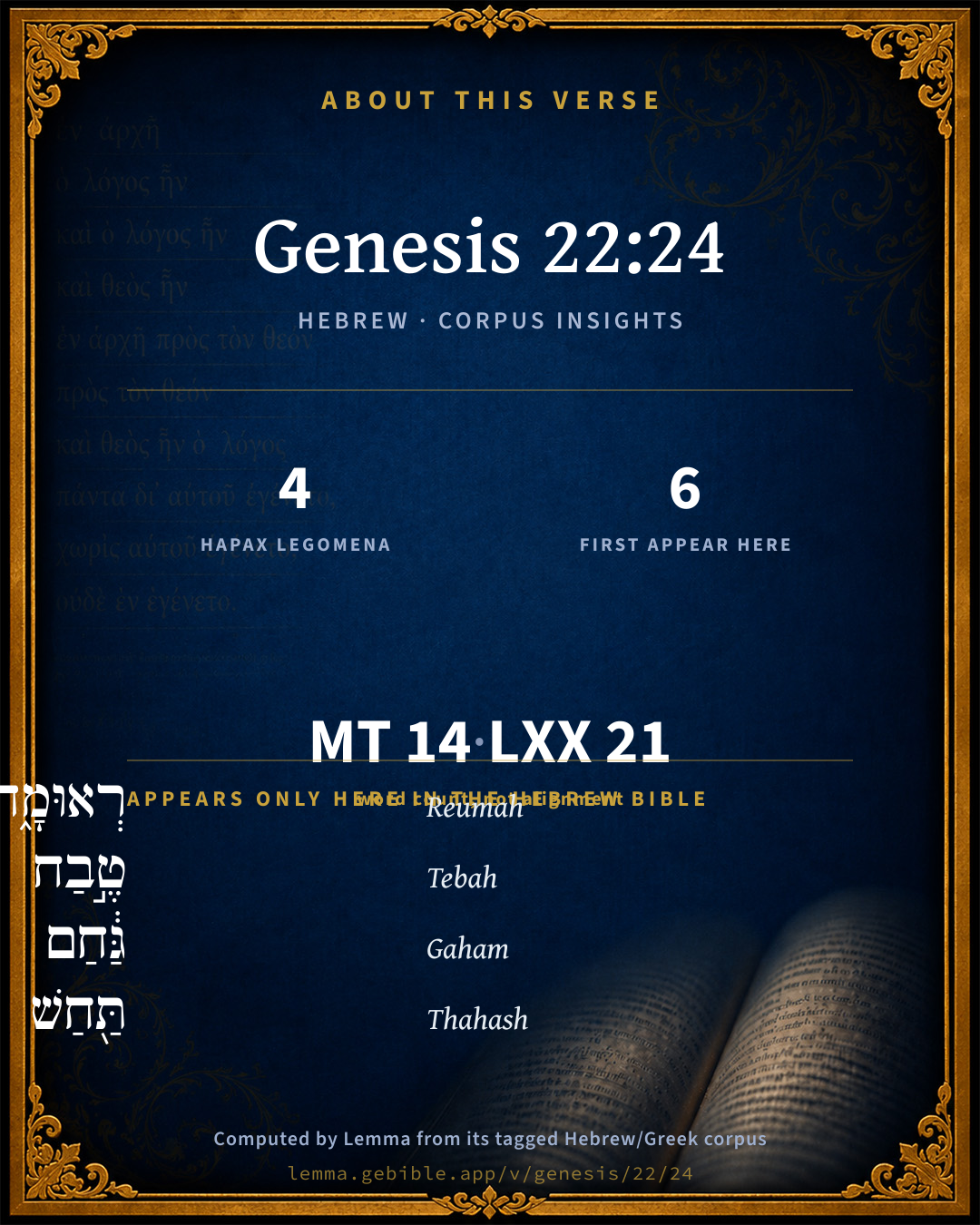
  • 4 hapax legomena — only here in the Hebrew Bible
  • 6 first appearances in the Hebrew Bible
Full analysis ↓
Download a study sheet

One document with this verse’s original text, its word-by-word gloss line, the meaning frame, cross-references with their text, attributed commentary, and full source and license credits — printable, and it pastes into notes with its structure intact.

This verse Autodidact and up

Study sheet (.html) Plain text (.txt)

A passage Seminary Student

Up to 50 verses in one chapter. A passage sheet keeps up to 6 commentary sources and 12 cross-references per verse, in the order this page ranks them, and says so on the sheet whenever that leaves anything out. Ask for a single verse and you get the Autodidact verse sheet above.

Everything on this page stays free to read, with no account — the sheet is a download of what is already on screen, not access to it.

Want to remove ads? Support Godless Engineer
Compare translations 3

The same verse in 3 English versions, stacked beneath the original-language interlinear above. Click any original word for its lexicon entry.

Each is an independent rendering of the whole verse — the interlinear is not word-aligned to these translations.

Highlighted words mark where these versions differ — a whole-verse word diff, not a word-by-word alignment.

  • World English Bible Public Domain
    His concubine, whose name was Reumah, also bare Tebah, Gaham, Tahash, and Maacah.
  • King James Version Public Domain
    And his concubine, whose name was Reumah, she bare also Tebah, and Gaham, and Thahash, and Maachah.
  • unfoldingWord Literal Text CC BY-SA 4.0
    And his concubine, and her name Reumah, and she also bore Tebah and Gaham and Tahash and Maacah.

unfoldingWord Literal Text — © unfoldingWord, licensed CC BY-SA 4.0. Word-aligned USFM3 via Door43 (git.door43.org/unfoldingWord/en_ult).

Versions to compare (up to 4)

3 of 4 selected

Show all 18 translations

Every available English version of this verse, each an independent rendering of the whole verse.

  • World English Bible Public Domain
    His concubine, whose name was Reumah, also bare Tebah, Gaham, Tahash, and Maacah.
  • Berean Standard Bible Public Domain
    Moreover, Nahor’s concubine, whose name was Reumah, bore Tebah, Gaham, Tahash, and Maacah.
  • Majority Standard Bible Public Domain
    Moreover, Nahor’s concubine, whose name was Reumah, bore Tebah, Gaham, Tahash, and Maacah.
  • King James Version Public Domain
    And his concubine, whose name was Reumah, she bare also Tebah, and Gaham, and Thahash, and Maachah.
  • American Standard Version (1901) Public Domain
    And his concubine, whose name was Reumah, she also bare Tebah, and Gaham, and Tahash, and Maacah.
  • Revised Version (1885) Public Domain
    And his concubine, whose name was Reumah, she also bare Tebah, and Gaham, and Tahash, and Maacah.
  • Geneva Bible (1599) Public Domain
    And his concubine called Reumah, she bare also Tebah, and Gahan, and Thahash and Maachah.
  • Douay-Rheims (1899) Public Domain
    And his concubine, named Roma, bore Tabee, and Gaham, and Tahas, and Maacha.
  • Young's Literal Translation Public Domain
    and his concubine, whose name `is' Reumah, she also hath borne Tebah, and Gaham, and Tahash, and Maachah.
  • Literal Standard Version CC BY-SA 4.0
    and his concubine, whose name [is] Reumah, she also has borne Tebah, and Gaham, and Tahash, and Maachah.
  • Unlocked Literal Bible CC BY-SA 4.0
    His concubine, whose name was Reumah, also bore Tebah, Gaham, Tahash, and Maacah.
  • unfoldingWord Literal Text CC BY-SA 4.0
    And his concubine, and her name Reumah, and she also bore Tebah and Gaham and Tahash and Maacah.
  • Darby Bible Public Domain
    And his concubine, named Reumah, she also bore Tebah, and Gaham, and Thahash, and Maacah.
  • World Messianic Bible Public Domain
    His concubine, whose name was Reumah, also bore Tebah, Gaham, Tahash, and Maacah.
  • Webster's Bible Public Domain
    And his concubine, whose name was Reumah, she bore also Tebah, and Gaham, and Thahash, and Maachah.
  • Free Bible Version CC BY-SA 4.0
    In addition, Reumah his concubine had Tebah, Gaham, Tahash, and Maacah.
  • Bible in Basic English Public Domain
    And his servant Reumah gave birth to Tebah and Gaham and Tahash and Maacah.
  • JPS Tanakh (1917) Public Domain
    And his concubine, whose name was Reumah, she also bore Tebah, and Gaham, and Tahash, and Maacah.

Literal Standard Version (2020), Covenant Press — licensed CC BY-SA 4.0. Text via the HelloAO Bible API (eBible.org). Unlocked Literal Bible (unfoldingWord) — licensed CC BY-SA 4.0. Text via the HelloAO Bible API (eBible.org). unfoldingWord Literal Text — © unfoldingWord, licensed CC BY-SA 4.0. Word-aligned USFM3 via Door43 (git.door43.org/unfoldingWord/en_ult). Free Bible Version, Dr. Jonathan Gallagher — licensed CC BY-SA 4.0. Text via the HelloAO Bible API (eBible.org).

Word by word

More ways to search: Search by grammar → Find every occurrence → Compare this word →

Practice this passage: Drill this verse → Learn its vocabulary →

רְאוּמָ֑ה
Rᵉʼûwmâh
H7208
“Reumah”
Noun, Proper
Part of Speech
Noun
Type
Proper
Full BDB Definition

Origin: pass part of H7213

TWOT: None

Reumah = "elevated" - the concubine of Nahor, the brother of Abraham
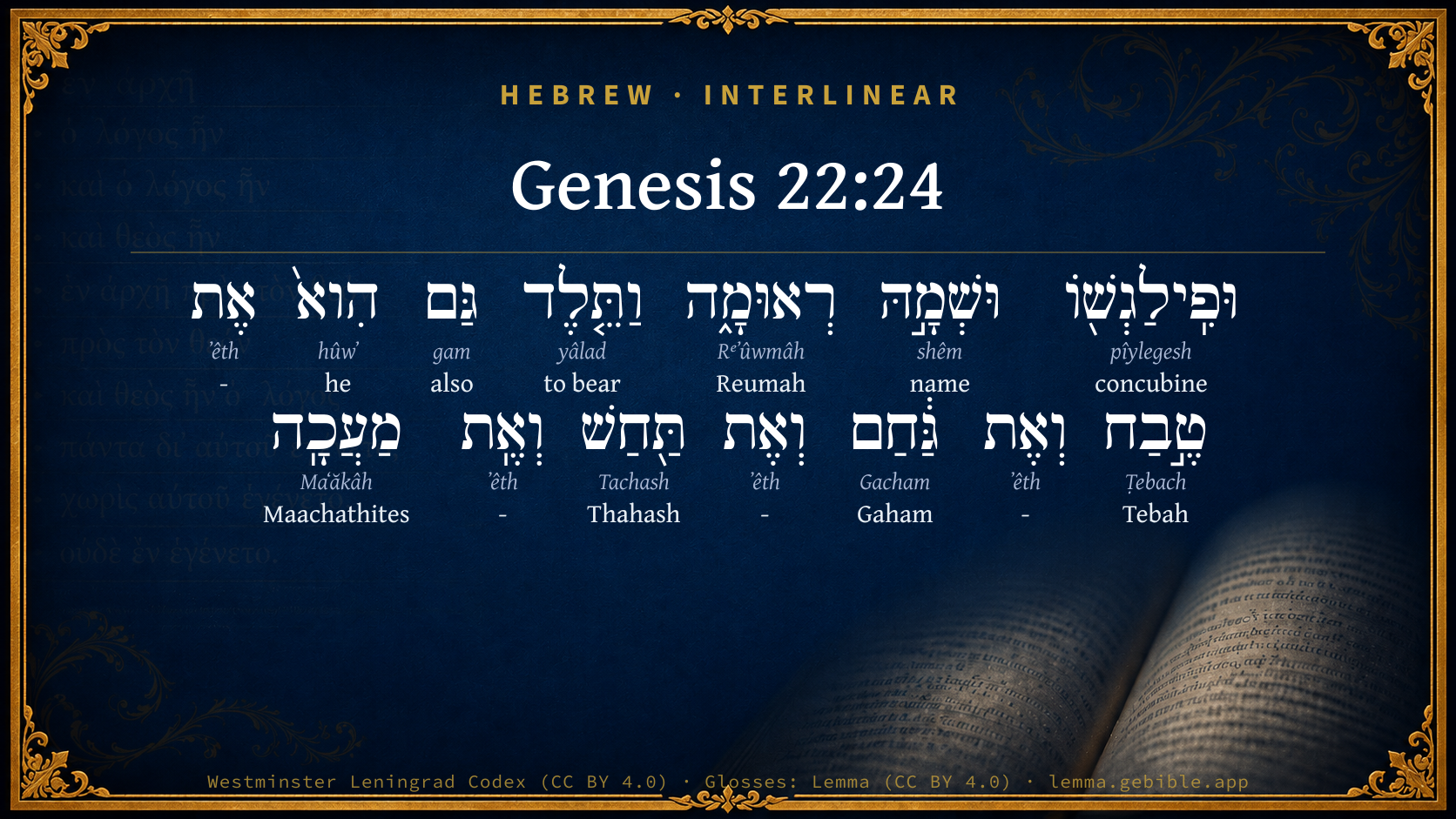
  1. וּפִֽילַגְשׁ֖וֹ pîylegesh H6370 “and · concubine · his” Conjunction + Noun, Common, Feminine, Singular, Construct + Suffix, Personal, 3rd Person, Masculine, Singular
  2. וּשְׁמָ֣הּ shêm H8034 “and · name · her” Conjunction + Noun, Common, Masculine, Singular, Construct + Suffix, Personal, 3rd Person, Feminine, Singular
  3. וַתֵּ֤לֶד yâlad H3205 “and · to bear” Conjunction + Verb, Qal, Sequential Imperfect, 3rd Person, Feminine, Singular
  4. גַּם gam H1571 “also” Particle, Accusative
  5. הִוא֙ hûwʼ H1931 “he” Pronoun, Personal, 3rd Person, Feminine, Singular
  6. אֶת ʼêth H853 “-” Particle, Direct Object
  7. טֶ֣בַח Ṭebach H2875 “Tebah” Noun, Proper
  8. וְאֶת ʼêth H853 “and · -” Conjunction + Particle, Direct Object
  9. גַּ֔חַם Gacham H1514 “Gaham” Noun, Proper
  10. וְאֶת ʼêth H853 “and · -” Conjunction + Particle, Direct Object
  11. תַּ֖חַשׁ Tachash H8477 “Thahash” Noun, Proper
  12. וְאֶֽת ʼêth H853 “and · -” Conjunction + Particle, Direct Object
  13. מַעֲכָֽה Maʻăkâh H4601 “Maachathites” Noun, Proper

About this verse

These counts appear in no published source. They are computed here, from the morphology-tagged text and Lemma’s own curated glosses. What Lemma adds →

14
words
11
distinct lemmas
Pentateuch
section

Notable vocabulary

4 hapax legomena — words that appear only here in the entire Hebrew Bible:

  • רְאוּמָ֑ה Reumah H7208
  • טֶ֣בַח Tebah H2875
  • גַּ֔חַם Gaham H1514
  • תַּ֖חַשׁ Thahash H8477

First appearance in Scripture

These words make their first canonical appearance in the Hebrew Bible here:

  • וּפִֽילַגְשׁ֖וֹ concubine H6370
  • רְאוּמָ֑ה Reumah H7208
  • טֶ֣בַח Tebah H2875
  • גַּ֔חַם Gaham H1514
  • תַּ֖חַשׁ Thahash H8477
  • מַעֲכָֽה Maachathites H4601

Shared distinctive vocabulary

מַעֲכָֽה Maachathites H4601 occurs in 23 verses of the Hebrew Bible. Also found in:

Grammatical profile

  • 1 verb
  • 7 nouns
  • 1 pronoun
  • 5 particles

Verb forms

  • וַתֵּ֤לֶד Qal · Sequential Imperfect

Hebrew & Septuagint length

In the original languages it is 14 Hebrew tokens and 21 Greek tokens — but the two are counted differently (Hebrew bundles its prefixes and suffixes into one token; the Greek is in lemma form), so that isn’t a like-for-like length.

Cross-references

3

Topical passages linked to Genesis 22:24 in the Treasury of Scripture Knowledge — connected by theme and wording, ordered by reader-vote popularity; previews shown in the World English Bible.

  • Genesis 16:3 Sarai, Abram's wife, took Hagar the Egyptian, her handmaid, after Abram had lived ten years in the land of Canaan, and gave her to Abram her husband to be his wife.
  • Genesis 25:6 but to the sons of the concubines who Abraham had, Abraham gave gifts. He sent them away from Isaac his son, while he yet lived, eastward, to the east country.
  • Proverbs 15:25 Yahweh will uproot the house of the proud, But he will keep the widow's borders intact.

Cross-references courtesy of OpenBible.info (CC BY 4.0).

Hebrew and Greek witnesses Masoretic Hebrew ↔ Greek Septuagint

The same verse in the two great witnesses to the Old Testament, shown verse-for-verse.

These are two independent witnesses, not word-aligned to each other, and the Septuagint is shown in lemma (dictionary) form.

Hebrew Genesis 22:24 Masoretic · Westminster Leningrad Codex

וּפִֽילַגְשׁ֖וֹ וּשְׁמָ֣הּ רְאוּמָ֑ה וַתֵּ֤לֶד גַּם הִוא֙ אֶת טֶ֣בַח וְאֶת גַּ֔חַם וְאֶת תַּ֖חַשׁ וְאֶֽת מַעֲכָֽה

His concubine, whose name was Reumah, also bare Tebah, Gaham, Tahash, and Maacah.

World English Bible · Public Domain

Greek LXX Genesis 22:24 Septuagint · lemma form

καί ὁ παλλακή αὐτός ὅς ὄνομα ρεημα τίκτω καί αὐτός ὁ ταβεκ καί ὁ γααμ καί ὁ τοχος καί ὁ μωχα

No English rendering of this Greek verse — the small residue in the structurally divergent books.

Hebrew: Westminster Leningrad Codex (CC BY 4.0). Greek: Septuagint (public domain); English from a public-domain English Septuagint. How the Septuagint differs from the Hebrew →

Targum (Aramaic paraphrase)

2

The Targum is the ancient Jewish Aramaic paraphrase of the Hebrew Scriptures — an interpretive translation, not the Hebrew text itself. Onkelos (literal) and Pseudo-Jonathan (expansive) render the Torah, and Jonathan the Prophets. Coverage is partial: where no permissively-licensed English translation exists for a verse, only the Aramaic is shown. This is verse-level text, not a word-by-word alignment to the Hebrew.

  1. Targum Onkelos Torah (Genesis–Deuteronomy)
    וּלְחֵנָתֵהּ וּשְׁמַהּ רְאוּמָה וִילֵידַת אַף הִיא יָת טֶבַח וְיָת גַּחַם וְיָת תַּחַשׁ וְיָת מַעֲכָה

    (no public-domain English translation for this verse)

    Targum Onkelos — Aramaic: “Onkelos Genesis” (public domain); “Onkelos Exodus” (public domain); “Onkelos Leviticus” (public domain); “Onkelos Numbers” (public domain); “Onkelos Deuteronomy” (public domain). English: “Sefaria Community Translation” (CC0 1.0 (public-domain dedication)); “J.W. Etheridge. The Targums of Onkelos and Jonathan Ben Uzziel on the Pentateuch. London: Longmans, Green, 1862” (public domain). Text via Sefaria.

  2. Targum Pseudo-Jonathan Torah (Genesis–Deuteronomy)
    וּפִלַקְתֵּיהּ וּשְׁמָהּ רְאוּמָה וִילֵידַת אוּף הִיא יַת טֶבַח וְיַת גַחַם וְיַת תַּחַשׁ וְיַת מַעֲכָה

    And his concubine, whose name was Rëuma, she also bare Tebach, and Gacham, and Tachash, and Maacha.

    Targum Pseudo-Jonathan — Aramaic: “Targum Jonathan on Genesis” (public domain); “Targum Jonathan on Exodus” (public domain); “Targum Jonathan on Leviticus” (public domain); “Targum Jonathan on Numbers” (public domain); “Targum Jonathan on Deuteronomy” (public domain). English: “The Targum of Jonathan ben Uzziel, trans. J. W. Etheridge, London, 1862” (public domain). Text via Sefaria.

Commentary

Notes on Genesis 22:24 from classic Christian and Jewish commentators (each source and its license shown beneath its notes). The classic Christian expositions comment on the surrounding passage and are grouped to its opening verse, so a note may address several verses; the Jewish commentaries on the Tanakh (Rashi and others) are per-verse, so they appear only where the commentator wrote on this verse.

Lemma curates 59 commentaries, every one of them public domain or Creative Commons licensed, each selected and text-cleaned for this edition rather than reprinted as found. About our sources →

Trapp's Complete Commentary

John Trapp

Gen 22:24 And his concubine, whose name [was] Reumah, she bare also Tebah, and Gaham, and Thahash, and Maachah.

Ver. 24. His concubine.] Or half-wife, as the word signifies; one that was between a servant and a wife.

John Trapp, A Commentary or Exposition upon All the Books of the Old and New Testament (1647–1656) — public domain. Text from a community e-Sword module.

Geneva Bible (1599)

Geneva Bible translators

Concubine is oftentimes taken in the good part for those women which were inferior to the wives.

Geneva Bible (1599) marginal notes — public domain. Text via Bolls.life.

Adam Clarke's Commentary

Verse 24. His concubine] We borrow this word from the Latin compound concubina, from con, together, and cubo, to lie, and apply it solely to a woman cohabiting with a man without being legally married. The Hebrew word is פילגש pilegesh, which is also a compound term, contracted, according to Parkhurst, from פלג palag, to divide or share, and נגש nagash, to approach; because the husband, in the delicate phrase of the Hebrew tongue, approaches the concubine, and shares the bed, c., of the real wife with her. The pilegesh or concubine, (from which comes the Greek παλλακη pallake, and also the Latin pellex,) in Scripture, is a kind of secondary wife, not unlawful in the patriarchal times though the progeny of such could not inherit. The word is not used in the Scriptures in that disagreeable sense in which we commonly understand it. Hagar was properly the concubine or pilegesh of Abraham, and this annuente Deo, and with his wife's consent. Keturah, his second wife, is called a concubine, Ge 26:15; 1Ch 1:32; and Pilhah and Zilhah were concubines to Jacob, Ge 35:22. After the patriarchal times many eminent men had concubines, viz., Caleb, 1Ch 2:46; 1Ch 2:48; Manasses, 1Ch 7:14; Gideon, Jdg 8:31; Saul, 2Sa 3:7; David, 2Sa 5:13; Solomon, 2Kg 11:3; and Rehoboam, 2Ch 11:21. The pilegesh, therefore, differed widely from a prostitute; and however unlawful under the New Testament, was not so under the Old.

FROM this chapter a pious mind may collect much useful instruction. From the trial of Abraham we again see,

1. That God may bring his followers into severe straits and difficulties, that they may have the better opportunity of both knowing and showing their own faith and obedience; and that he may seize on those occasions to show them the abundance of his mercy, and thus confirm them in righteousness all their days. There is a foolish saying among some religious people, which cannot be too severely reprobated: Untried grace is no grace. On the contrary, there may be much grace, though God, for good reasons, does not think proper for a time to put it to any severe trial or proof. But grace is certainly not fully known but in being called to trials of severe and painful obedience. But as all the gifts of God should be used, (and they are increased and strengthened by exercise,) it would be unjust to deny trials and exercises to grace, as this would be to preclude it from the opportunities of being strengthened and increased.

2. The offering up of Isaac is used by several religious people in a sort of metaphorical way, to signify their easily-besetting sins, beloved idols, c. But this is a most reprehensible abuse of the Scripture. It is both insolent and wicked to compare some abominable lust or unholy affection to the amiable and pious youth who, for his purity and excellence, was deemed worthy to prefigure the sacrifice of the Son of God. To call our vile passions and unlawful attachments by the name of our Isaac is unpardonable and to talk of sacrificing such to God is downright blasphemy. Such sayings as these appear to be legitimated by long use; but we should be deeply and scrupulously careful not to use any of the words of God in any sense in which he has not spoken them. If, in the course of God's providence, a parent is called to give up to death an amiable, only son, then there is a parallel in the case; and it may be justly said, if pious resignation fill the parent's mind, such a person, like Abraham, has been called to give his Isaac back to God.

Independently of the typical reference to this transaction, there are two points which seem to be recommended particularly to our notice. 1. The astonishing faith and prompt obedience of the father. 2. The innocence, filial respect, and passive submission of the son. Such a father and such a son were alone worthy of each other.

Adam Clarke's Commentary on the Bible (1810–1826) — public domain. Text from a community e-Sword/MySword module.

Ellicott's Commentary for English Readers

(24) Maachah.—This name appears as that of a small Aramaic people, in Deu_3:14; Jos_12:5; 2Sa_10:6.

A Bible Commentary for English Readers, edited by Charles John Ellicott (1878–1897) — public domain. Text from a community e-Sword module.

The Cambridge Bible for Schools and Colleges

gen. ed. J. J. S. Perowne

24. Reumah] The children of the concubine denote a less intimate tribal relationship than the children of the legal wife.

Maacah] See 2Sa_10:6. A region to the north of Mount Hermon; cf. the mention of the Maacathites in Jos_13:11; Jos_13:13.

The Cambridge Bible for Schools and Colleges (gen. ed. J. J. S. Perowne; Cambridge University Press, 1878–1918) — public domain. Text from a community e-Sword module.

Haydock's Catholic Bible Commentary

Concubine, or wife, secondary in privileges, love, and dignity. Though Nachor did not, perhaps imitate the faith and virtue of his brother Abraham, but mixed various superstitions with the knowledge of the true God; yet we need not condemn him, for having more wives than one. (Haydock)

George Leo Haydock (1774–1849), Haydock's Catholic Family Bible and Commentary, 1859 edition — public domain. Excludes Psalms (Douay-Rheims chapter numbering differs from Protestant) and Deuterocanonical books (Catholic canon only).

Matthew Poole's English Annotations

A concubine was an inferior kind of wife, taken according to the common practice of those times, subject to the authority of the principal wife, and whose children had no right of inheritance, but were endowed with gifts. See Gen 21:14; 25:6.

Maachah, a name common both to man, as 2Sa 10:6, and woman, as 1Ki 15:13.

Matthew Poole's English Annotations on the Holy Bible (1683–1685) — public domain. Text from a community e-Sword/MySword module.

The Pulpit Commentary

And his concubine, (vide on Gen_16:3) whose name was Reumah, raised, elevated (Gesenius); pearl or coral (Furst)she bare also Tebah, and Gaham, and Thahash, and Maachah whence probably the Maachathites. (Deu_3:14 Job_42:5) That three of Terah"s descendants (Nahor, Ishmael, and Jacob) should each have twelve sons has been pronounced "a contrived symmetry, the intentional character of which cannot be mistaken" (Bohlen); but what intention the narrator should have connected with it remains inconceivable, unless it was to state the fact as it was, or (on the supposition that some of them had more than twelve sons) to supply a round number easily retainable by the memory" (Havernick).

The Pulpit Commentary (1880–1919), ed. H.D.M. Spence-Jones & Joseph S. Exell — public domain. Text from a community e-Sword module.

Ramban (Nachmanides)

Rabbi Moshe ben Nachman (Ramban / Nachmanides)

AND HIS CONCUBINE, WHOSE NAME WAS REUMAH. Scripture tells the entire tiding which they related to Abraham concerning his brother’s children.It is possible that this was written in order to make known the entire genealogy of Nahor, to establish that all of them were worthy to marry the children of Abraham, and it was with reference to all of them that Abraham said to Eliezer: But thou shalt go unto my father’s house and to my family. Chayei Sarah

Ramban (Nachmanides) on the Tanakh — English translation: “Commentary on the Torah by Ramban (Nachmanides). Translated and annotated by Charles B. Chavel. New York, Shilo Pub. House, 1971-1976” (CC BY 4.0). Text via Sefaria.

Radak

Rabbi David Kimhi (Radak)

ופלגשו...ותלד גם היא, the words ותלד גם היא must be understood as ותלד לו גם היא, that his concubine also bore these children for Nachor. The letter ו at the beginning of the word ופלגשו made it unnecessary to add the word לו, “for him,” after the word ותלד.

Radak on the Tanakh — English translations: “Sefaria Community Translation” (CC0 1.0 (public-domain dedication)); “Eliyahu Munk, HaChut Hameshulash” (CC BY 4.0); “Rabbi Mike Feuer, Jerusalem Anthology” (CC BY 4.0); and “R. David Kimhi on the first book of Psalms, Translated by R.G. Finch, London, 1919” (public domain). Text via Sefaria.

Lesson kit

Teaching starters — assembled from the data on this page, not authored interpretation. Every prompt links to the verse data it draws on. Edit before teaching.

Genesis, in the Pentateuch, opens this verse with 14 words (11 distinct Hebrew lemmas). Its most distinctive word is Rᵉʼûwmâh (“Reumah”). A historical commentator’s framing appears above. Read the whole chapter for the surrounding context.

Discussion questions

  1. How does “Reumah” (Rᵉʼûwmâh) shape what this verse is saying?
  2. This verse holds 4 words here found nowhere else in the Hebrew Bible. What might the rare words draw attention to?
  3. 6 words here appear for the first time in Scripture. What is being introduced at this debut?
  4. Joshua 13:13 shares the word «Maachathites» with this verse. How do the two illuminate each other?
  5. These translations render this verse differently. What is at stake in choosing one wording over another?
  6. The verb «וַתֵּ֤לֶד» is Qal Sequential Imperfect. How does its form color the action?
  7. Reading how Trapp's Complete Commentary and Geneva Bible (1599) read this verse, where do the two commentators agree and where do they part?

Things to notice

Reading settings

Reading text

Shown beneath each verse's original-language words.

Old Testament
Old Testament edition

Read the OT as the Masoretic Hebrew (MT) or the Greek Septuagint (LXX).

English shown for the Greek Septuagint (in the Hebrew ↔ Greek comparison).

Comparing translations? Open the Compare panel on any verse page to stack up to four side by side.