
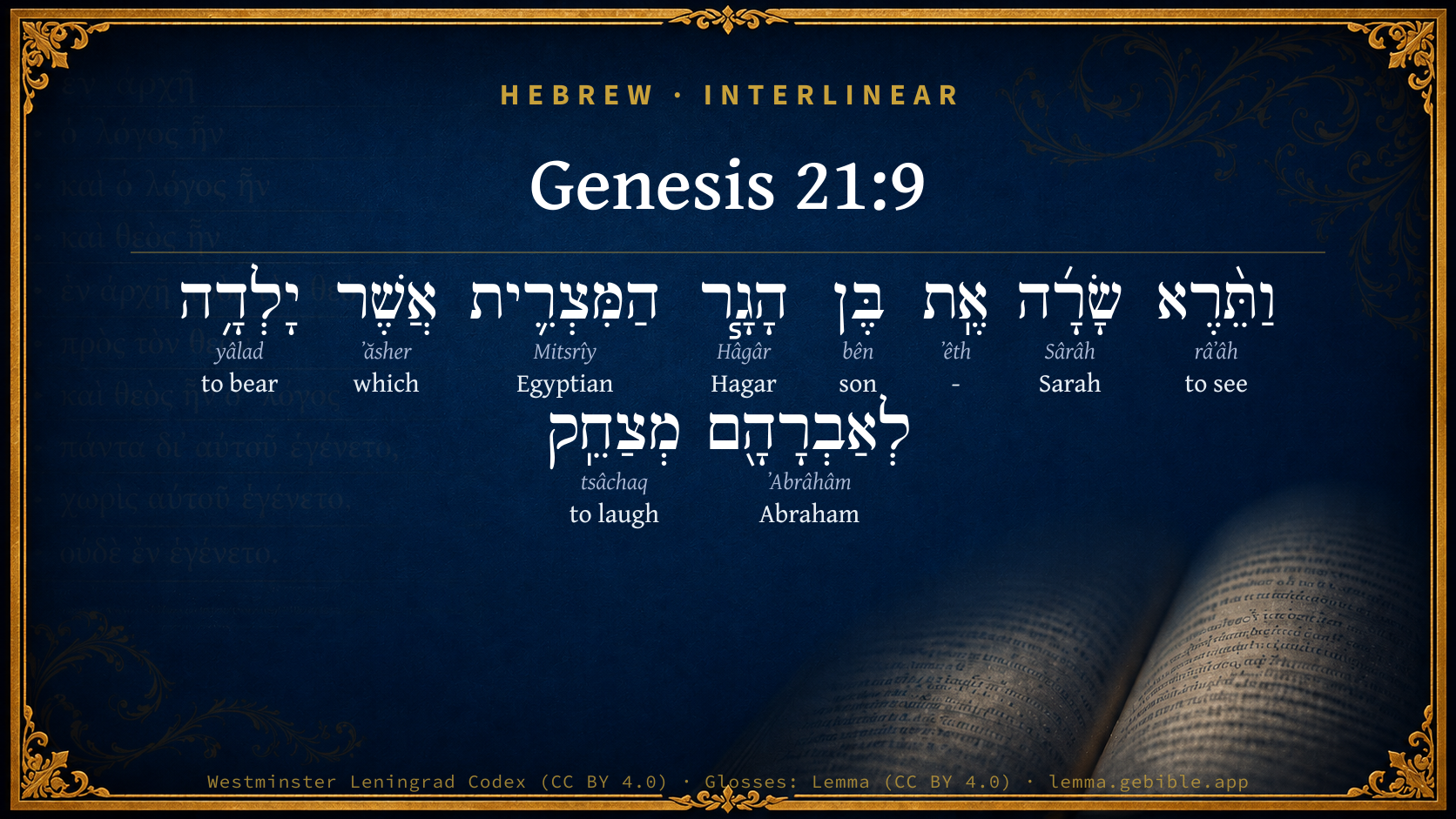
Genesis 21:9

Hebrew (Westminster Leningrad Codex) Genesis 21:9 appears in the Hebrew Old Testament. The text above is from the Westminster Leningrad Codex. Each word links to its Strong’s number, a concise gloss, and parsing drawn from the Open Scriptures Hebrew Bible morphology. Click any word for its full Brown-Driver-Briggs (BDB) entry.
Download image
Cite this verse

Genesis 21:9 (World English Bible). Public Domain. Lemma interlinear Bible study tool, https://lemma.gebible.app/v/genesis/21/9.

Show BibTeX & RIS
BibTeX
RIS
English Translation
Sarah saw the son of Hagar the Egyptian, whom she had borne to Abraham, mocking.
World English Bible · Public Domain
Download a study sheet

One document with this verse’s original text, its word-by-word gloss line, the meaning frame, cross-references with their text, attributed commentary, and full source and license credits — printable, and it pastes into notes with its structure intact.

This verse Autodidact and up

Study sheet (.html) Plain text (.txt)

A passage Seminary Student

Up to 50 verses in one chapter. A passage sheet keeps up to 6 commentary sources and 12 cross-references per verse, in the order this page ranks them, and says so on the sheet whenever that leaves anything out. Ask for a single verse and you get the Autodidact verse sheet above.

Everything on this page stays free to read, with no account — the sheet is a download of what is already on screen, not access to it.

Want to remove ads? Support Godless Engineer
Compare translations 3

The same verse in 3 English versions, stacked beneath the original-language interlinear above. Click any original word for its lexicon entry.

Each is an independent rendering of the whole verse — the interlinear is not word-aligned to these translations.

Highlighted words mark where these versions differ — a whole-verse word diff, not a word-by-word alignment.

  • World English Bible Public Domain
    Sarah saw the son of Hagar the Egyptian, whom she had borne to Abraham, mocking.
  • King James Version Public Domain
    And Sarah saw the son of Hagar the Egyptian, which she had born unto Abraham, mocking.
  • unfoldingWord Literal Text CC BY-SA 4.0
    And Sarah saw the son of Hagar the Egyptian, whom she had born for Abraham, was mocking.

unfoldingWord Literal Text — © unfoldingWord, licensed CC BY-SA 4.0. Word-aligned USFM3 via Door43 (git.door43.org/unfoldingWord/en_ult).

Versions to compare (up to 4)

3 of 4 selected

Show all 18 translations

Every available English version of this verse, each an independent rendering of the whole verse.

  • World English Bible Public Domain
    Sarah saw the son of Hagar the Egyptian, whom she had borne to Abraham, mocking.
  • Berean Standard Bible Public Domain
    But Sarah saw that the son whom Hagar the Egyptian had borne to Abraham was mocking her son,
  • Majority Standard Bible Public Domain
    But Sarah saw that the son whom Hagar the Egyptian had borne to Abraham was mocking her son,
  • King James Version Public Domain
    And Sarah saw the son of Hagar the Egyptian, which she had born unto Abraham, mocking.
  • American Standard Version (1901) Public Domain
    And Sarah saw the son of Hagar the Egyptian, whom she had borne unto Abraham, mocking.
  • Revised Version (1885) Public Domain
    And Sarah saw the son of Hagar the Egyptian, which she had borne unto Abraham, mocking.
  • Geneva Bible (1599) Public Domain
    And Sarah sawe the sonne of Hagar the Egyptian (which she had borne vnto Abraham) mocking.
  • Douay-Rheims (1899) Public Domain
    And when Sara had seen the son of Agar the Egyptian playing with Isaac her son, she said to Abraham:
  • Young's Literal Translation Public Domain
    and Sarah seeth the son of Hagar the Egyptian, whom she hath borne to Abraham, mocking,
  • Literal Standard Version CC BY-SA 4.0
    and Sarah sees the son of Hagar the Egyptian, whom she has borne to Abraham, mocking,
  • Unlocked Literal Bible CC BY-SA 4.0
    Sarah saw the son of Hagar the Egyptian, whom she had borne to Abraham, mocking.
  • unfoldingWord Literal Text CC BY-SA 4.0
    And Sarah saw the son of Hagar the Egyptian, whom she had born for Abraham, was mocking.
  • Darby Bible Public Domain
    And Sarah saw the son of Hagar the Egyptian, whom she had borne to Abraham, mocking.
  • World Messianic Bible Public Domain
    Sarah saw the son of Hagar the Egyptian, whom she had borne to Abraham, mocking.
  • Webster's Bible Public Domain
    And Sarah saw the son of Hagar the Egyptian, which she had borne to Abraham, mocking.
  • Free Bible Version CC BY-SA 4.0
    But Sarah noticed that Ishmael, Hagar the Egyptian's son she'd had for Abraham, was making fun of Isaac.
  • Bible in Basic English Public Domain
    And Sarah saw the son of Hagar the Egyptian playing with Isaac.
  • JPS Tanakh (1917) Public Domain
    And Sarah saw the son of Hagar the Egyptian, whom she had borne unto Abraham, making sport.

Literal Standard Version (2020), Covenant Press — licensed CC BY-SA 4.0. Text via the HelloAO Bible API (eBible.org). Unlocked Literal Bible (unfoldingWord) — licensed CC BY-SA 4.0. Text via the HelloAO Bible API (eBible.org). unfoldingWord Literal Text — © unfoldingWord, licensed CC BY-SA 4.0. Word-aligned USFM3 via Door43 (git.door43.org/unfoldingWord/en_ult). Free Bible Version, Dr. Jonathan Gallagher — licensed CC BY-SA 4.0. Text via the HelloAO Bible API (eBible.org).

Word by word

More ways to search: Search by grammar → Find every occurrence → Compare this word →

Practice this passage: Drill this verse → Learn its vocabulary →

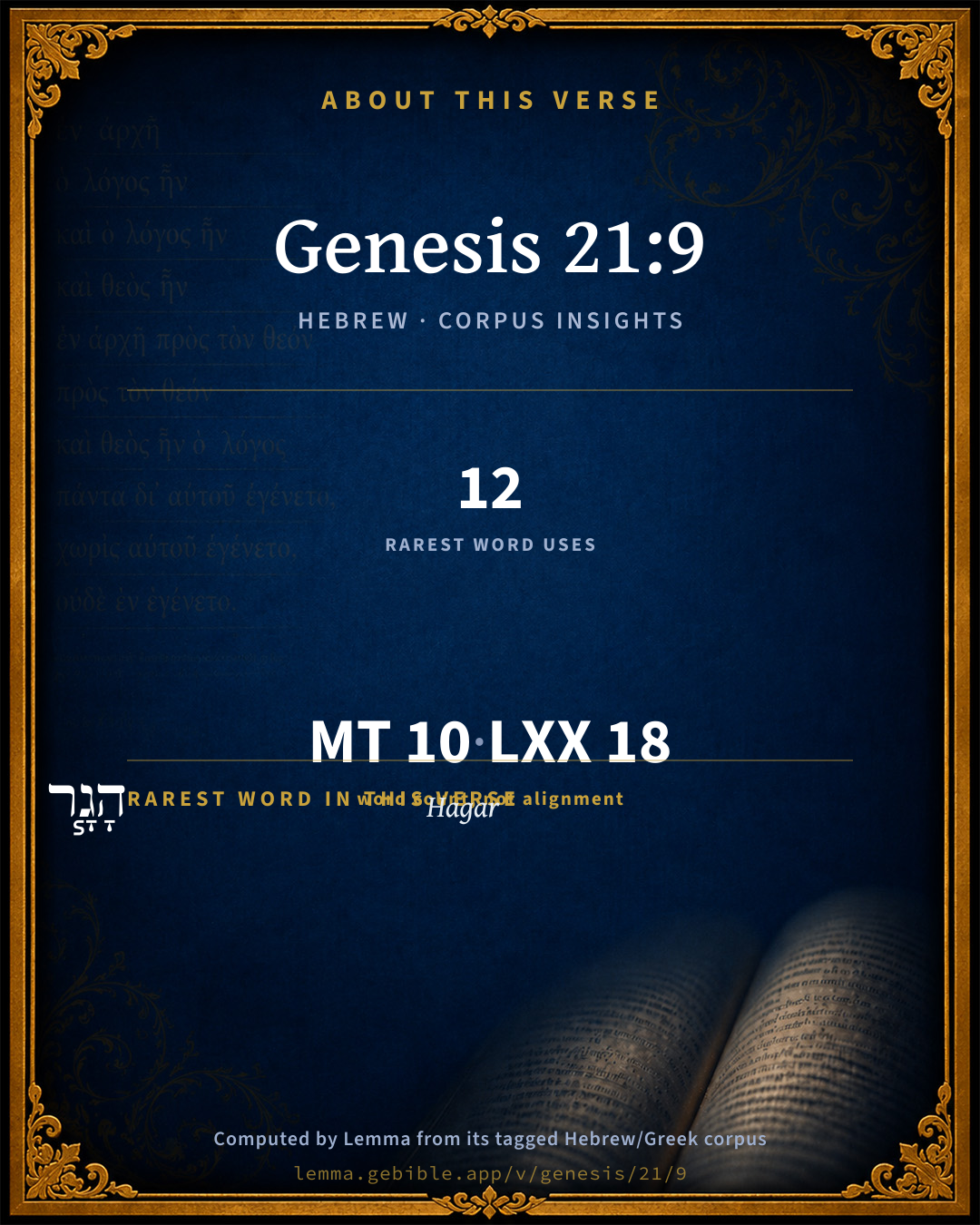
About this verse

These counts appear in no published source. They are computed here, from the morphology-tagged text and Lemma’s own curated glosses. What Lemma adds →

10
words
10
distinct lemmas
Pentateuch
section

Notable vocabulary

The rarest word here is הָגָ֧ר Hagar H1904 — appearing just 12 times in the whole Hebrew Bible.

Shared distinctive vocabulary

הָגָ֧ר Hagar H1904 occurs in 10 verses of the Hebrew Bible. Also found in:

Grammatical profile

  • 3 verbs
  • 5 nouns
  • 2 particles

Verb forms

  • וַתֵּ֨רֶא Qal · Sequential Imperfect
  • יָלְדָ֥ה Qal · Perfect
  • מְצַחֵֽק Piel · Participle Active

Hebrew & Septuagint length

In English translation the verse runs 15 words from the Hebrew and 20 from the Septuagint (LXX English) — closely comparable.

A rough comparison of the two English renderings, which tokenize alike — not a word-level alignment.

Word counts can differ between the Hebrew and the Greek without any difference in meaning — e.g. the Hebrew direct-object marker אֵת has no separate Greek word, and Greek often adds the article ὁ.

In the original languages it is 10 Hebrew tokens and 18 Greek tokens — but the two are counted differently (Hebrew bundles its prefixes and suffixes into one token; the Greek is in lemma form), so that isn’t a like-for-like length.

Cross-references

17

Topical passages linked to Genesis 21:9 in the Treasury of Scripture Knowledge — connected by theme and wording, ordered by reader-vote popularity; previews shown in the World English Bible.

  • Galatians 4:29 But as then, he who was born according to the flesh persecuted him who was born according to the Spirit, so also it is now.
  • Genesis 16:15 Hagar bore a son for Abram. Abram called the name of his son, whom Hagar bore, Ishmael.
  • Galatians 4:22 For it is written that Abraham had two sons, one by the handmaid, and one by the free woman.
  • Genesis 16:1 Now Sarai, Abram's wife, bore him no children. She had a handmaid, an Egyptian, whose name was Hagar.
  • 2 Chronicles 30:10 So the posts passed from city to city through the country of Ephraim and Manasseh, even to Zebulun: but they ridiculed them, and mocked them.
  • 2 Chronicles 36:16 but they mocked the messengers of God, and despised his words, and scoffed at his prophets, until the wrath of Yahweh arose against his people, until there was no remedy.
  • Psalms 22:6 But I am a worm, and no man; A reproach of men, and despised by the people.
  • Psalms 42:10 As with a sword in my bones, my adversaries reproach me, While they continually ask me, "Where is your God?"
  • Psalms 44:13–14 You make us a reproach to our neighbors, A scoffing and a derision to those who are around us.
  • Proverbs 20:11 Even a child makes himself known by his doings, Whether his work is pure, and whether it is right.
  • Lamentations 1:7 Jerusalem remembers in the days of her affliction and of her miseries all her pleasant things that were from the days of old: When her people fell into the hand of the adversary, and none did help her, The adversaries saw her, they did mock at her desolations.
  • Genesis 16:3–6 Sarai, Abram's wife, took Hagar the Egyptian, her handmaid, after Abram had lived ten years in the land of Canaan, and gave her to Abram her husband to be his wife.
  • Genesis 17:20 As for Ishmael, I have heard you. Behold, I have blessed him, and will make him fruitful, and will multiply him exceedingly. He will become the father of twelve princes, and I will make him a great nation.
  • 2 Kings 2:23–24 He went up from there to Bethel; and as he was going up by the way, there came forth young lads out of the city, and mocked him, and said to him, Go up, you baldy; go up, you baldhead.
  • Nehemiah 4:1–5 But it happened that when Sanballat heard that we were building the wall, he was angry, and took great indignation, and mocked the Jews.
  • Hebrews 11:36 Others were tried by mocking and scourging, yes, moreover by bonds and imprisonment.
  • Job 30:1 "But now those who are younger than I, have me in derision, Whose fathers I would have disdained to put with my sheep dogs.

Cross-references courtesy of OpenBible.info (CC BY 4.0).

Hebrew and Greek witnesses Masoretic Hebrew ↔ Greek Septuagint

The same verse in the two great witnesses to the Old Testament, shown verse-for-verse.

These are two independent witnesses, not word-aligned to each other, and the Septuagint is shown in lemma (dictionary) form.

Hebrew Genesis 21:9 Masoretic · Westminster Leningrad Codex

וַתֵּ֨רֶא שָׂרָ֜ה אֶֽת בֶּן הָגָ֧ר הַמִּצְרִ֛ית אֲשֶׁר יָלְדָ֥ה לְאַבְרָהָ֖ם מְצַחֵֽק

Sarah saw the son of Hagar the Egyptian, whom she had borne to Abraham, mocking.

World English Bible · Public Domain

Greek LXX Genesis 21:9 Septuagint · lemma form

ὁράω δέ σαρρα ὁ υἱός αγαρ ὁ αἰγυπτία ὅς γίγνομαι ὁ αβρααμ παίζω μετά ισαακ ὁ υἱός αὐτός

And Sarrha having seen the son of Agar the Egyptian who was born to Abraam, sporting with Isaac her son,

LXX2012 (modern English Septuagint) · Public Domain

On this verse, Matthew Henry's Commentary discusses the Septuagint’s reading. Read the note in Commentary ↓

Hebrew: Westminster Leningrad Codex (CC BY 4.0). Greek: Septuagint (public domain); English from LXX2012 (modern English Septuagint) (Public Domain). How the Septuagint differs from the Hebrew →

Targum (Aramaic paraphrase)

2

The Targum is the ancient Jewish Aramaic paraphrase of the Hebrew Scriptures — an interpretive translation, not the Hebrew text itself. Onkelos (literal) and Pseudo-Jonathan (expansive) render the Torah, and Jonathan the Prophets. Coverage is partial: where no permissively-licensed English translation exists for a verse, only the Aramaic is shown. This is verse-level text, not a word-by-word alignment to the Hebrew.

  1. Targum Onkelos Torah (Genesis–Deuteronomy)
    וַחֲזַת שָׂרָה יָת בַּר הָגָר מִצְרֵיתָא דִּילִידַת לְאַבְרָהָם מְחָיִיךְ

    (no public-domain English translation for this verse)

    Targum Onkelos — Aramaic: “Onkelos Genesis” (public domain); “Onkelos Exodus” (public domain); “Onkelos Leviticus” (public domain); “Onkelos Numbers” (public domain); “Onkelos Deuteronomy” (public domain). English: “Sefaria Community Translation” (CC0 1.0 (public-domain dedication)); “J.W. Etheridge. The Targums of Onkelos and Jonathan Ben Uzziel on the Pentateuch. London: Longmans, Green, 1862” (public domain). Text via Sefaria.

  2. Targum Pseudo-Jonathan Torah (Genesis–Deuteronomy)
    וַחֲמַת שָרָה יַת בְּרָא דְהָגָר מִצְרֵיתָא דִילֵידַת לְאַבְרָהָם מְגַחֵךְ לְפוּלְחָנָא נוּכְרָאָה וְגָחִין לַיְיָ

    And Sarah observed the son of Hagar the Mizreitha, whom she bare to Abraham, mocking with a strange worship, and bowing to the Lord.

    Targum Pseudo-Jonathan — Aramaic: “Targum Jonathan on Genesis” (public domain); “Targum Jonathan on Exodus” (public domain); “Targum Jonathan on Leviticus” (public domain); “Targum Jonathan on Numbers” (public domain); “Targum Jonathan on Deuteronomy” (public domain). English: “The Targum of Jonathan ben Uzziel, trans. J. W. Etheridge, London, 1862” (public domain). Text via Sefaria.

Commentary

Notes on Genesis 21:9 from classic Christian and Jewish commentators (each source and its license shown beneath its notes). The classic Christian expositions comment on the surrounding passage and are grouped to its opening verse, so a note may address several verses; the Jewish commentaries on the Tanakh (Rashi and others) are per-verse, so they appear only where the commentator wrote on this verse.

Lemma curates 59 commentaries, every one of them public domain or Creative Commons licensed, each selected and text-cleaned for this edition rather than reprinted as found. About our sources →

Matthew Henry's Commentary

The casting out of Ishmael is here considered of, and resolved on.

I. Ishmael himself gave the occasion by some affronts he gave to Isaac his little brother, some think on the day that Abraham made the feast for joy that Isaac was safely weaned, which the Jews say was not till he was three years old, others say five. Sarah herself was an eye-witness of the abuse: she saw the son of the Egyptian mocking (Gen 21:9), mocking Isaac, no doubt, for it is said, with reference to this (Gal 4:29), that he that was born after the flesh persecuted him that was born after the Spirit. Ishmael is here called the son of the Egyptian, because, as some think, the 400 years' affliction of the seed of Abraham by the Egyptians began now, and was to be dated hence, Gen 15:13. She saw him playing with Isaac, so the Septuagint, and, in play, mocking him. Ishmael was fourteen years older than Isaac; and, when children are together, the elder should be careful and tender of the younger: but it argued a very base and sordid disposition in Ishmael to be abusive to a child that was no way a match for him. Note, 1. God takes notice of what children say and do in their play, and will reckon with them if they say or do amiss, though their parents do not. 2. Mocking is a great sin, and very provoking to God. 3. There is a rooted remaining enmity in the seed of the serpent against the seed of the woman. The children of promise must expect to be mocked. This is persecution, which those that will live godly must count upon. 4. None are rejected and cast out from God but those who have first deserved it. Ishmael is continued in Abraham's family till he becomes a disturbance, grief, and scandal to it.

II. Sarah made the motion: Cast out this bond-woman, Gen 21:10. This seems to be spoken in some heat, yet it is quoted (Gal 4:30) as if it had been spoken by a spirit of prophecy; and it is the sentence passed on all hypocrites and carnal people, though they have a place and a name in the visible church. All that are born after the flesh and not born again, that rest in the law and reject the gospel promise, shall certainly be cast out. It is made to point particularly at the rejection of the unbelieving Jews, who, though they were the seed of Abraham, yet, because they submitted not to the gospel covenant, were unchurched and disfranchised: and that which, above any thing, provoked God to cast them off was their mocking and persecuting the gospel church, God's Isaac, in its infancy, Th1 2:16, Note, There are many who are familiarly conversant with the children of God in this world, and yet shall not partake with them in the inheritance of sons. Ishmael might be Isaac's play-fellow and school-fellow, yet not his fellow-heir.

III. Abraham was averse to it: The thing was very grievous in Abraham's sight, Gen 21:11. 1. It grieved him that Ishmael had given such a provocation. Note, Children ought to consider that the more their parents love them the more they are grieved at their misconduct, and particularly at their quarrels among themselves. 2. It grieved him that Sarah insisted upon such a punishment. "Might it not suffice to correct him? would nothing less serve than to expel him?" Note, Even the needful extremities which must be used with wicked and incorrigible children are very grievous to tender parents, who cannot thus afflict willingly.

IV. God determined it, Gen 21:12, Gen 21:13. We may well suppose Abraham to be greatly agitated about this matter, loth to displease Sarah, and yet loth to expel Ishmael; in this difficulty God tells him what his will is, and then he is satisfied. Note, A good man desires no more in doubtful cases than to know his duty, and what God would have him do; and, when he is clear in this, he is, or should be, easy. To make Abraham so, God sets this matter before him in a true light, and shows him, 1. That the casting out of Ishmael was necessary to the establishment of Isaac in the rights and privileges of the covenant: In Isaac shall thy seed be called. Both Christ and the church must descend from Abraham through the loins of Isaac; this is the entail of the promise upon Isaac, and is quoted by the apostle (Rom 9:7) to show that not all who come from Abraham's loins were the heirs of Abraham's covenant. Isaac, the promised son, must be the father of the promised seed; therefore, "Away with Ishmael, send him far enough, lest he corrupt the manners or attempt to invade the rights of Isaac." It will be his security to have his rival banished. The covenant seed of Abraham must be a peculiar people, a people by themselves, from the very first, distinguished, not mingled with those that were out of covenant; for this reason Ishmael must be separated. Abraham was called alone, and so must Isaac be. See Isa 51:2. It is probable that Sarah little thought of this (Joh 11:51), but God took what she said, and turned it into an oracle, as afterwards, Gen 27:10. 2. That the casting out of Ishmael should not be his ruin, Gen 21:13. He shall be a nation, because he is thy seed. We are not sure that it was his eternal ruin. It is presumption to say that all those who are left out of the external dispensation from all his mercies: those may be saved who are not thus honoured. However, we are sure it was not his temporal ruin. Though he was chased out of the church, he was not chased out of the world. I will make him a nation. Note, (1.) Nations are of God's making: he founds them, he forms them, he fixes them. (2.) Many are full of the blessings of God's providence that are strangers to the blessings of his covenant. (3.) The children of this world often fare the better, as to outward things, for their relation to the children of God.

Matthew Henry's Commentary on the Whole Bible (1708–1710) — public domain (CC PDM 1.0). Text via the HelloAO Bible API.

Trapp's Complete Commentary

John Trapp

Gen 21:9 And Sarah saw the son of Hagar the Egyptian, which she had born unto Abraham, mocking.

Ver. 9. And Sarah saw the son of Hagar mocking.] At that mystical name Isaac, as a gaud, or laughingstock. At the feast also, made upon such a frivolous occasion. As who should say, What care I, though this ado be made now about Isaac’s weaning? I am the firstborn, and beloved of my father, who will not deny me the inheritance. This Sarah had soon spied, or overheard. Liberorum curiosi sunt parentes . The mother especially observeth the wrong done to the child. And besides, dislike soon spies a fault. A fault it was no doubt, and a great one too. Otherwise, the apostle would not have called it "persecution": {Gal 4:29} nor God have punished it with ejection. Machiavel, that scoffing atheist, rotted in the prison at Florence. Jeering Julian had his payment from Heaven. Sir Thomas Moor ( qui sceptice et scabiose de Luthero et Religione Reformata loquebatur) lost his head. Another lost his wits for mocking at James Abbs, martyr, as a madman; for that, having no money, he gave his apparel to the poor; some to one, some to another, as he went to the stake {a} "What is truth?" {Joh 18:38} said Pilate to our Saviour, in a scornful profane manner. Not long after which, he became his own deathsman. Apion scoffed at circumcision, and had an ulcer at the same time, and in the same place. {b} Surely, God is the avenger of all such: he calls it blasphemy in the second table, and shows his wrath from heaven against it, as that which proceeds from the very superfluity of malice (as herein Ishmael) and tends to murder. The Hebrew word here used signifies that he not only mocked Isaac, but also made others to mock him.

{a} Act. and Mon., fol. 1904.

{b} Josephus.

John Trapp, A Commentary or Exposition upon All the Books of the Old and New Testament (1647–1656) — public domain. Text from a community e-Sword module.

Joseph Benson's Commentary

Gen 21:9. Sarah saw the son of the Egyptian, mocking — Mocking Isaac, no doubt, for it is said, with reference to this, Gal 4:29, that “he that was born after the flesh, persecuted him that was born after the spirit.”

Joseph Benson's Commentary on the Old and New Testaments (1811–1818) — public domain. Text from a community e-Sword module.

Whedon's Commentary on the Bible

Daniel D. Whedon

EXPULSION OF HAGAR AND ISHMAEL, Gen_21:9-21.

9. Sarah saw — With a mother’s careful eye.

Mocking — Some suppose he mocked at the feast held at Isaac’s weaning, and made derision of the contrast between the weak child and the great hopes entertained concerning him. But the Piel form of this word appears everywhere to carry with it the associations of some carnal and lascivious indulgence. Sarah saw Ishmael (מצחק) committing some lewd act, perhaps of self-pollution, and the sight filled her with an indignation and contempt towards him, which led her to insist on banishing from her household both him and his mother. She would not have her Isaac contaminated by such an associate. So, too, the word, as used in Gen_19:14, denotes that Lot’s son-in-law, to whom all things were impure, could not comprehend Lot’s words of warning, but regarded him as one of the lewd fellows who were out at night indulging in the common practices of Sodom. In Gen_26:8, it evidently means some carnal intercourse between Isaac and Rebekah, such as was proper only between husband and wife, and the same thought is equally noticeable in the language of Potiphar’s wife in Gen_39:14-17, and the lewd play of the Israelites at the feast of the golden calf. Exo_32:6. And we may well believe that the sport which Samson was brought out to make before the merry and perhaps half-drunken Philistines (Jdg_16:25) was some naked exposure and obscene abuse. These are all the places in which the Piel form of צחק occurs, and there is, therefore, no need of giving it a different sense in any one of these passages.

Daniel D. Whedon (gen. ed.), Commentary on the Old and New Testaments (1874–1909) — public domain. Text from a community e-Sword module.

The Pulpit Commentary

CHAPTER 21:9-14

And Sarah saw at the feast already mentioned (Knobel, Keil); probably also on different occasions since the birth of Isaacthe son of Hagar the Egyptian, which she had born unto Abraham, mocking. Paizonta meta Isaak tou uijou aujthv (LXX), ludentem cum Isaaco filio sue (Vulgate), playing like a child (Aben Ezra, Knobel, Tuch, Ilgen), playing and dancing gracefully (Gesenius); but the stronger sense of the word, implying mockery, scoffing, irritating and deriding laughter (Kimchi, Vatablus, Grotius, Calvin, Rosenm Keil, Kalisch, "Speaker"s Commentary," Murphy), besides being admissible (cf. Gen_19:14 Gen_26:8 Gen_39:14, Gen_39:17; Exo_32:6) seems involved in the Piel form of the participle qjexm (Kurtz), and is demanded by Gal_4:29. That Ishmael ridiculed the banquet on the occasion of Isaac"s weaning (Malvenda) quarreled with him about the heirship (Fagins, Piseator), and perhaps made sport of him as a father of nations (Hengstenberg), though plausible conjectures, are not stated in the text. Ainsworth dates from this event the 400 years of Israel"s oppression. (vide Gen_15:13)

Vers. 9-14.

The expulsion of Ishmael.

I THE CAUSE.

1. The persecution of Isaac. "Sarah saw the son of Hagar the Egyptian mocking." That this was no mere sportive pleasantry may be inferred from the deep feeling it aroused in Sarah, the summary chastisement it brought on Ishmael, and the" severe language in which it is characterized by Paul. The emphasis laid by Sarah on the heirship suggests the probability that Ishmael"s offence partook of the nature of wicked, irritating laughter at the position and prospects of Sarah"s son, springing partly from envy and partly from unbelief.

2. The apprehension of Sarah. That Sarah was actuated by personal dislike of Hagar"s boy, or inspired solely by maternal jealousy, is a gratuitous assumption. It is more satisfactory to ascribe her seemingly harsh counsel to the clearness with which she recognized that Isaac alone was the Heaven-appointed heir, and that nothing must be allowed to either damage his position or endanger his prospects.

3. The commandment of God. Considering the patriarch"s former experience of "hearkening to Sarah," his acquiescence in her counsel on this occasion would in all probability have been problematical,.had not God interposed to recommend its adoption. It would both secure the happiness of Isaac and remove temptation from the path of Ishmael; while it would serve to educate the patriarch himself for the coming sacrifice on Mount Moriah. To facilitate the patriarch"s compliance with the Divine injunction, the promise of future greatness to Ishmael is renewed, and in the end Hagar and her boy are dismissed.

II THE MANNER.

1. With pain to himself. "The thing was very grievous in Abraham"s sight because of his son." Parental affection must have urged him to retain his first-born son. Conjugal love must have interceded for her who had been to him as a wife. Self-interest may have represented the advisability of still clinging to Ishmael for the fulfillment of the promise, in case the line of Isaac should fail. Yet grace and faith triumphed. "All things are possible to him that believeth.

2. With tenderness towards the outcasts. Making provision for their immediate necessities, and either then or afterwards adding gifts, (Gen_25:6) he sends them away, doubtless with many prayers and tears. Nature and grace both enjoin tenderness in dealing with those whom God in his providence calls to suffer.

3. With submission to the will of God. The moment the mind of God was ascertained, internal controversy ceased and determined. The patriarch was never irresolute in following when God led. Obedience is the first duty of faith.

III THE TYPICAL SIGNIFICANCE.

1. Ishmael and Isaac representatives of Abraham"s natural descendants and Abraham"s spiritual posterity; Israel after the flesh and Israel after the spirit; souls in legal bondage and souls enjoying spiritual freedom.

2. Ishmaels mockery of Isaac foreshadowed the persecuting spirit of the unbelieving Jews, who adhered to the system of Moses, towards the disciples of the New Testament faith, who sought salvation through Christ; hence also the antagonism of the sinful principle in man to the renewed life of grace.

1. Ishmaels separation from Isaac prefigured the ultimate removal of unbelievers from believers, of the world from the Church, of those in a state of nature or of legal bondage from those who are children of the promise and of the heavenly Jerusalem. Learn

1. The wickedness and danger of mocking at sacred persons and things.

2. The superior spiritual insight not infrequently exhibited by woman.

3. The necessity of trying all human opinions by God"s revealed will.

4. The care God takes to guide sincere souls as to the path of duty.

5. The proper function of faith, which is to hear and obey.

6. The impossibility of any compromise existing between the world and the Church.

7. The final casting out of the wicked from the congregation of the righteous.

The Pulpit Commentary (1880–1919), ed. H.D.M. Spence-Jones & Joseph S. Exell — public domain. Text from a community e-Sword module.

Geneva Bible (1599)

Geneva Bible translators

He derided God’s promise made to Isaac, which the Apostle calleth persecution, Gal. 4:29.

Geneva Bible (1599) marginal notes — public domain. Text via Bolls.life.

Jamieson, Fausset & Brown

Robert Jamieson, A. R. Fausset & David Brown

Sarah saw the son of Hagar . . . mocking--Ishmael was aware of the great change in his prospects, and under the impulse of irritated or resentful feelings, in which he was probably joined by his mother, treated the young heir with derision and probably some violence (Gal 4:29).

Jamieson, Fausset & Brown — Commentary Critical and Explanatory on the Whole Bible (1871) — public domain (CC PDM 1.0). Text via the HelloAO Bible API.

Adam Clarke's Commentary

Verse 9. Mocking.] What was implied in this mocking is not known. St. Paul, Ga 4:29, calls it persecuting; but it is likely he meant no more than some species of ridicule used by Ishmael on the occasion, and probably with respect to the age of Sarah at Isaac's birth, and her previous barrenness. Jonathan ben Uzziel and the Jerusalem Targum represent Ishmael as performing some idolatrous rite on the occasion, and that this had given the offence to Sarah. Conjectures are as useless as they are endless. Whatever it was, it became the occasion of the expulsion of himself and mother. Several authors are of opinion that the Egyptian bondage of four hundred years, mentioned Ge 15:13, commenced with this persecution of the righteous seed by the son of an Egyptian woman.

Adam Clarke's Commentary on the Bible (1810–1826) — public domain. Text from a community e-Sword/MySword module.

John Calvin's Commentaries

9. And Sarah saw the son of Hagar. As the verb to laugh has a twofold signification among the Latins, so also the Hebrews use, both in a good and evil sense, the verb from which the participle מצחק (metsachaik) is derived. That it was not a childish and innoxious laughter, appears from the indignation of Sarah. It was, therefore a malignant expression of scorn, by which the forward youth manifested his contempt for his infant brother. And it is to be observed, that the epithet which is here applied to Ishmael, and the name Isaac, are both derived from the same root. Isaac was, to his father and others, the occasion of holy and lawful laughter; whence also, the name was divinely imposed upon him. Ishmael turns the blessing of God, from which such joy flowed, into ridicule. Therefore, as an impious mocker, he stands opposed to his brother Isaac. Both (so to speak) are the sons of laughter: but in a very different sense. Isaac brought laughter with him from his mother’s womb, since he bore, — engraven upon him, — the certain token of God’s grace. He therefore so exhilarates his father’s house, that joy breaks forth in thanksgiving; but Ishmael, with canine and profane laughter, attempts to destroy that holy joy of faith. And there is no doubt that his manifest impiety against God, betrayed itself under this ridicule. He had reached an age at which he could not, by any means be ignorant of the promised favor, on account of which his father Abraham was transported with so great joy: and yet — proudly confident in himself — he insults, in the person of his brother, both God and his word, as well as the faith of Abraham. Wherefore it was not without cause that Sarah was so vehemently angry with him, that she commanded him to be driven into exile. For nothing is more grievous to a holy mind, than to see the grace of God exposed to ridicule. And this is the reason why Paul calls his laughter persecution; saying,

‘He who was after the flesh persecuted the spiritual seed.’ (Galatians 4:29.)

Was it with sword or violence? Nay, but with the scorn of the virulent tongue, which does not injure the body, but pierces into the very soul. Moses might indeed have aggravated his crime by a multiplicity of words; but I think that he designedly spoke thus concisely, in order to render the petulance with which Ishmael ridicules the word of God the more detestable.

John Calvin's Commentaries (1540-1563) — public domain. Text from the Calvin Translation Society English edition (1840s-50s) via the Christian Classics Ethereal Library (ccel.org). Calvin's coverage is partial (roughly two-thirds of the Bible); uncommented books and verses are honest gaps, never fabricated. The 19th-century editor's footnotes and remarks are omitted so the notes are faithfully Calvin's own voice.

Ellicott's Commentary for English Readers

(9) Mocking.—The verb used here is the same as that rendered to laugh in Gen_21:6, but in an intensive conjugation. What exactly Ishmael was doing is not said, but we may dismiss all those interpretations which charge him with abominable wickedness; for had he been guilty of any such criminal conduct, the sending him away would not have been so “very grievous in Abraham’s sight” (Gen_21:11). On the other hand, we may feel sure that Sarah was not without good reason for her conduct; for St. Paul bears witness that Ishmael persecuted Isaac (Gal_4:29). The LXX. and Vulg. translate playing, sporting, and Gesenius thinks that he was “dancing gracefully; “but if this were all, Sarah’s jealousy would have been most unjust. When, however, we consider that Ishmael had been for fourteen years the heir, and that he now fell back into an inferior position, we cannot be surprised if at this banquet in his rival’s honour he gave way to spiteful feelings, and by word and gesture derided and ridiculed him. Hagar too had probably never regarded Sarah with much affection since her forced return, and now that her son was disinherited, her bitterness would grow more intense. These jealousies are the inevitable results of polygamy; and wherever it exists, the father’s life is made wretched by the intrigues of the women for their children.

A Bible Commentary for English Readers, edited by Charles John Ellicott (1878–1897) — public domain. Text from a community e-Sword module.

The Cambridge Bible for Schools and Colleges

gen. ed. J. J. S. Perowne

9. mocking] Better, as R.V. marg., playing. The original is the same verb, in the intensive mood, which is rendered “laugh,” e.g. in Gen_21:6. There is no need to introduce the meaning of “mockery,” which would require an object. The verb used absolutely, and rendered, as in the marg., gives a suitable sense. The LXX and Latin so render it, adding words of explanation: παίζοντα μετὰ Ἰσαὰκ τοῦ υἱοῦ αὐτῆς, ludentem cum Isaac filio suo, as if Sarah, watching Ishmael playing with her own child, had been seized with a sudden fit of passionate jealousy. Ishmael was the elder, but he was the son of her handmaid; and in Sarah’s eyes it was unfitting that Ishmael should even play with or near her own child.

The Rabbinic interpretations of this word were productive of strange speculations. St Paul refers to one of them, which understood the word to denote “teasing” and “persecution”; hence Gal_4:29. Other more fantastic attempts at exegesis connected this verse with Ishmael’s sins of idolatry, of impurity, and even of attempts to take his brother’s life.

The Cambridge Bible for Schools and Colleges (gen. ed. J. J. S. Perowne; Cambridge University Press, 1878–1918) — public domain. Text from a community e-Sword module.

John Gill's Exposition

Wherefore she said unto Abraham, cast out this bondwoman and her son,.... Hagar, Sarah's handmaid and bondservant, and her son Ishmael; by this it appears that Hagar was concerned in this affair, and set her son on to mock Isaac, at least she encouraged him in it, buoying: him up with his being the firstborn, and having a right to the inheritance; wherefore Sarah saw plainly that there would be no peace nor comfort for her and her son, unless Hagar and her son were turned out of doors, for which she moves Abraham; and this not merely in a passion, but by divine direction and influence, as is evident from God's approbation of it:

for the son of this bondwoman shall not be heir with my son, even with Isaac; which he would seem to be, if continued, and would think himself so, and there would be continual bickerings about it; wherefore, to put it out of all doubt who was heir, she desires that he and his mother both might be cast out of the house, which would be a clear determination of this matter. Sarah may seem to take upon her too much, to be so peremptory, as to declare who should, and who should not be heir, which more properly belonged to Abraham, whom she called her lord, Gen 18:12; but what will sufficiently free her from any charge of this kind is the revelation of the divine will, and the promise of God that so it should be; namely, that the covenant God had so often renewed with Abraham should be established with Isaac, and not with Ishmael, Gen 17:19. Now what was the design of God, in guiding Sarah to make such a motion as this to Abraham, is taught us by the Apostle Paul, who makes these two women to be types and figures of the two covenants, and their sons of those that are under them, see Gal 4:22.

John Gill's Exposition of the Whole Bible (1746–1763) — public domain (CC PDM 1.0). Text via the HelloAO Bible API.

Haydock's Catholic Bible Commentary

Playing, or persecuting, as St. Paul explains it, Galatians iv. 29. The play tended to pervert the morals of the young Isaac, whether we understand this term metsachak, as implying idolatry, or obscene actions, or fighting; in all which senses it is used in Scripture. See Exodus xxxii. 6; Genesis xxvi. 8; 2 Kings ii. 14.) (Menochius) --- Ismael was 13 years older than Isaac; and took occasion, perhaps, from the feast, and other signs of preference given by his parents to the latter, to hate and persecute him, which Sara soon perceiving, was forced to have recourse to the expedient apparently so harsh, of driving Ismael and his mother from the house, that they might have an establishment of their own, and not disturb Isaac in the inheritance after the death of Abraham. (Haydock) --- In this she was guided by a divine light; (Menochius) and not by any female antipathy, ver. 12. Many of the actions of worldlings, which at first sight may appear innocent, have a natural and fatal tendency to pervert the morals of the just; and therefore, we must keep as much as possible at a distance from their society. --- With Isaac her son. Hebrew has simply mocking, without mentioning what. But the sequel shews the true meaning; and this addition was found in some Bibles in the days of St. Jerome, as he testifies, and is expressed in the Septuagint. (Haydock) --- Ismael was a figure of the synagogue, which persecuted the Church of Christ in her birth. (Du Hamel)

George Leo Haydock (1774–1849), Haydock's Catholic Family Bible and Commentary, 1859 edition — public domain. Excludes Psalms (Douay-Rheims chapter numbering differs from Protestant) and Deuterocanonical books (Catholic canon only).

Matthew Poole's English Annotations

Signifying either by words or gestures his contempt of Isaac, and his derision of all that magnificence then showed towards his younger brother. And this carriage proceeding from a most envious and malicious disposition, and being a sufficient indication of further mischief intended to him, if ever he should have opportunity, it is no wonder it is called persecution, Gal 4:29, although the Hebrew word may be rendered beating him, as it is used 2Sa 2:14.

Matthew Poole's English Annotations on the Holy Bible (1683–1685) — public domain. Text from a community e-Sword/MySword module.

John Wesley's Explanatory Notes

Sarah saw the son of the Egyptian mocking - Mocking Isaac no doubt, for it is sad, with reference to this, Gal. iv, 29, that he that was born after the flesh, persecuted him that was born after the spirit. Ishmael is here called the son of the Egyptian, because (as some think) the four hundred years affliction of the seed of Abraham by the Egyptians began now, and was to be dated from hence.

John Wesley, Explanatory Notes Upon the Whole Bible (1754–1765) — public domain. Text via the GEBible commentary corpus.

Kretzmann's Popular Commentary

Paul E. Kretzmann

Hagar and Ishmael Cast Forth

v. 9. And Sarah saw the son of Hagar, the Egyptian, which she had born unto Abraham, mocking. It was a jeering laughter, a sneer, which Ishmael affected, perhaps as early as the festival of weaning. Unbelief, jealousy, and pride were aroused in Ishmael by the fact that Isaac was plainly the heir of the household. The mimicking, mocking, ridiculing on the part of Ishmael against Isaac could not long remain hidden from Sarah.

v. 10. Wherefore she said unto Abraham, Cast out this bondwoman and her son; for the son of this bondwoman shall not be heir with my son, even with Isaac. This was not a matter of petty jealousy, but was spoken in agreement with the promise of the Lord. Till now Hagar had been suffered in the house of Abraham, but Sarah’s demand was that the slave be driven forth, that Abraham renounce all connection with her and her son.

v. 11. And the thing was very grievous in Abraham’s sight because of his son. His personal affection for his own flesh and blood, and the fact that God had given him special promises concerning Ishmael, Gen 17:18-20, caused him to hesitate about taking such a step.

v. 12. And God said unto Abraham, Let it not be grievous in thy sight because of the lad and because of thy bondwoman; in all that Sarah hath said unto thee hearken unto her voice; for in Isaac shall thy seed be called. It was God who decided the matter, and in Sarah’s favor. Abraham was to set aside personal feelings and considerations, both as to Ishmael and as to Hagar, and heed the voice of his wife. For Isaac was to be the bearer of the Messianic promise; through his lineage the blessing of the Lord was to come upon the nations, in the person of the Messiah. Cf Rom 9:7-8; Heb 11:18. The words of Sarah have a special spiritual meaning, as St. Paul shows, Gal 4:29: "As then he that was born after the flesh persecuted him that was born after the Spirit, even so it is now. " Those that are spiritual-minded, the children of God, are derided and persecuted by the carnal-minded, by the children of the world. The will of the Lord is that His children should separate themselves in all spiritual matters from the children of the world, and avoid all the pitfalls which are placed for the unwary feet of such as seek the friendship of His enemies.

v. 13. And also of the son of the bondwoman will I make a nation because he is thy seed. For Abraham’s sake even the slave’s son should receive a large share of this world’s blessings.

v. 14. And Abraham rose up early in the morning, and took bread and a bottle of water, and gave it unto Hagar, putting it on her shoulder and the child, and sent her away. And she departed and wandered in the wilderness of Beersheba. Abraham, as usual, lost no time in performing his duty, unpleasant as it was. Early the next morning he gave Hagar a supply of bread and a skin filled with water, and thereupon called Ishmael, then a lad of almost seventeen years. When these two had been dismissed, they wandered forth toward the southwest, probably with the intention of reaching the main caravan route toward Egypt. Thus the separation, which had to come sooner or later, had been effected.

Paul E. Kretzmann, Popular Commentary of the Bible (1921–1924) — public domain. Text from a community e-Sword module.

Rashi

Rabbi Shlomo Yitzchaki (Rashi)

מצחק MAKING SPORT — This means worshipping idols, as it is said in reference of the Golden Calf, (Exodus 32:6) “And they rose up to make merry (לצחק).” Another explanation is that it refers to immoral conduct, just as you say in reference to Potiphar’s wife, (Genesis 39:17) “To mock (לצחק) at me.” Another explanation is that it refers to murder, as (2 Samuel 2:14) “Let the young men, I pray thee, arise and make sport (וישחקו) before us” (where they fought with and killed one another) From Sarah’s reply — “for the son of this bondwoman shall not be heir with my son״ — you may infer that he (Ishmael) was quarrelling with Isaac about the inheritance, saying, “I am the first-born and will, therefore, take a double portion”. They went into the field and he (Ishmael) took his bow and shot arrows at him (Isaac), just as you say (Proverbs 26:18-19) “As a madman who casteth firebrands, [arrows and death] and says: I am only מצחק mocking” (Genesis Rabbah 53:11).

Rashi on the Tanakh — English translations: “The Judaica Press complete Tanach with Rashi, translated by A. J. Rosenberg” (CC BY 4.0); “Pentateuch with Rashi's commentary by M. Rosenbaum and A.M. Silbermann, 1929-1934” (public domain); “The Metsudah Tanach series, Lakewood, N.J” (CC BY 4.0); and “The Book of Joshua, Metsudah Publications, 1997” (CC BY 4.0). Text via Sefaria.

Ramban (Nachmanides)

Rabbi Moshe ben Nachman (Ramban / Nachmanides)

‘METZACHEIK’ (MAKING SPORT). This refers to worshipping idols, murder and sexual immorality. He [Ishmael] quarrelled with Isaac about inheritance, saying, “I am the first-born and will take a double portion.” They then went into the field, and Ishmael took his bow and shot arrows at Isaac, just as you say, As a madman who casteth firebrands, arrows and death, so is the man who deceiveth his neighbor, and saith, Am I not in sport? It is from Sarah’s complaint to Abraham — for the son of this bondwoman shall not be heir, etc. — that you learn [that they were quarrelling about the inheritance]. All this is Rashi’s language.Here too, the Rabbi writes all the different opinions, [mentioned in the following]: “We have been taught: Rabbi Shimon the son of Eleazar said, ‘There are four interpretations of Rabbi Akiba which I interpret differently, and my interpretation seems more acceptable than his. Rabbi Akiba interpreted: “And Sarah saw the son of Hagar the Egyptian, whom she had borne unto Abraham, making sport. Making sport is but a designation for idolatry, etc.” But I say Heaven forbid that such be in the house of the righteous one! Is it possible that he, of whom it was written, For I have known him, to the end that he may command his children and his household, etc., will have in his household idolatry, sexual immorality, and murder? Making sport mentioned here is but a designation for the inheritance. When Isaac was born and everyone rejoiced, Ishmael said to them, “Fools, I am the first-born, and I take a double portion.” From the complaint of our mother Sarah to Abraham you learn [that making sport refers to the inheritance]. And my interpretation seems more acceptable than that of Rabbi Akiba.’”The expression of the Rabbi, “that Ishmael quarrelled with Isaac about the inheritance,” also does not appear correct for if so, this must have happened much later when Isaac was grown up, and Ishmael would then have been too big for his mother to carry him on her shoulder. Our Rabbis have also said that Ishmael was seventeen years old [at the time he left his father’s house]. If so, this happened at the time when Isaac was weaned, [and Isaac was thus too young for Ishmael to quarrel with him about the inheritance].Rabbi Abraham ibn Ezra said in line with the literal interpretation of Scripture that metzachek means “playing,” as is normal for every boy, and she was jealous of him because he was bigger than her son.The correct interpretation appears to me to be that this event took place on the day that Isaac was weaned, and Sarah saw Ishmael mocking Isaac or the great feast. It is for this reason that the verse says, And Sarah saw the son of Hagar the Egyptian — rather than Ishmael — making sport. Similarly, she said, Cast out this bondwoman and her son, for she said: “The slave who mocks his master is deserving of death or stripes, but I want only that you cast him out from before me, and that he should in no way inherit your belongings together with my son, who is the son of the mistress.” She also told Abraham to cast out his mother, as the boy was unable to leave her for he would die if he were to leave his mother.

Ramban (Nachmanides) on the Tanakh — English translation: “Commentary on the Torah by Ramban (Nachmanides). Translated and annotated by Charles B. Chavel. New York, Shilo Pub. House, 1971-1976” (CC BY 4.0). Text via Sefaria.

Radak

Rabbi David Kimhi (Radak)

ותרא...מצחק. Ishmael was belittling Yitzchok for having a father who was so much older than he.

Radak on the Tanakh — English translations: “Sefaria Community Translation” (CC0 1.0 (public-domain dedication)); “Eliyahu Munk, HaChut Hameshulash” (CC BY 4.0); “Rabbi Mike Feuer, Jerusalem Anthology” (CC BY 4.0); and “R. David Kimhi on the first book of Psalms, Translated by R.G. Finch, London, 1919” (public domain). Text via Sefaria.

Lesson kit

Teaching starters — assembled from the data on this page, not authored interpretation. Every prompt links to the verse data it draws on. Edit before teaching.

Genesis, in the Pentateuch, opens this verse with 10 words (10 distinct Hebrew lemmas). Its most distinctive word is Hâgâr (“Hagar”). A historical commentator’s framing appears above. Read the whole chapter for the surrounding context.

Discussion questions

  1. The word Hâgâr carries the sense “Hagar.” How does it shape the verse?
  2. Genesis 16:1 shares the word «Hagar» with this verse. How do the two illuminate each other?
  3. These translations render this verse differently; the difference is in the English rendering, not the original. What questions does that raise?
  4. The verb «וַתֵּ֨רֶא» is Qal Sequential Imperfect. How does its form color the action?
  5. Reading how Matthew Henry's Commentary and Trapp's Complete Commentary read this verse, where do the two commentators agree and where do they part?

Things to notice

Reading settings

Reading text

Shown beneath each verse's original-language words.

Old Testament
Old Testament edition

Read the OT as the Masoretic Hebrew (MT) or the Greek Septuagint (LXX).

English shown for the Greek Septuagint (in the Hebrew ↔ Greek comparison).

Comparing translations? Open the Compare panel on any verse page to stack up to four side by side.