
Ruth 4:22

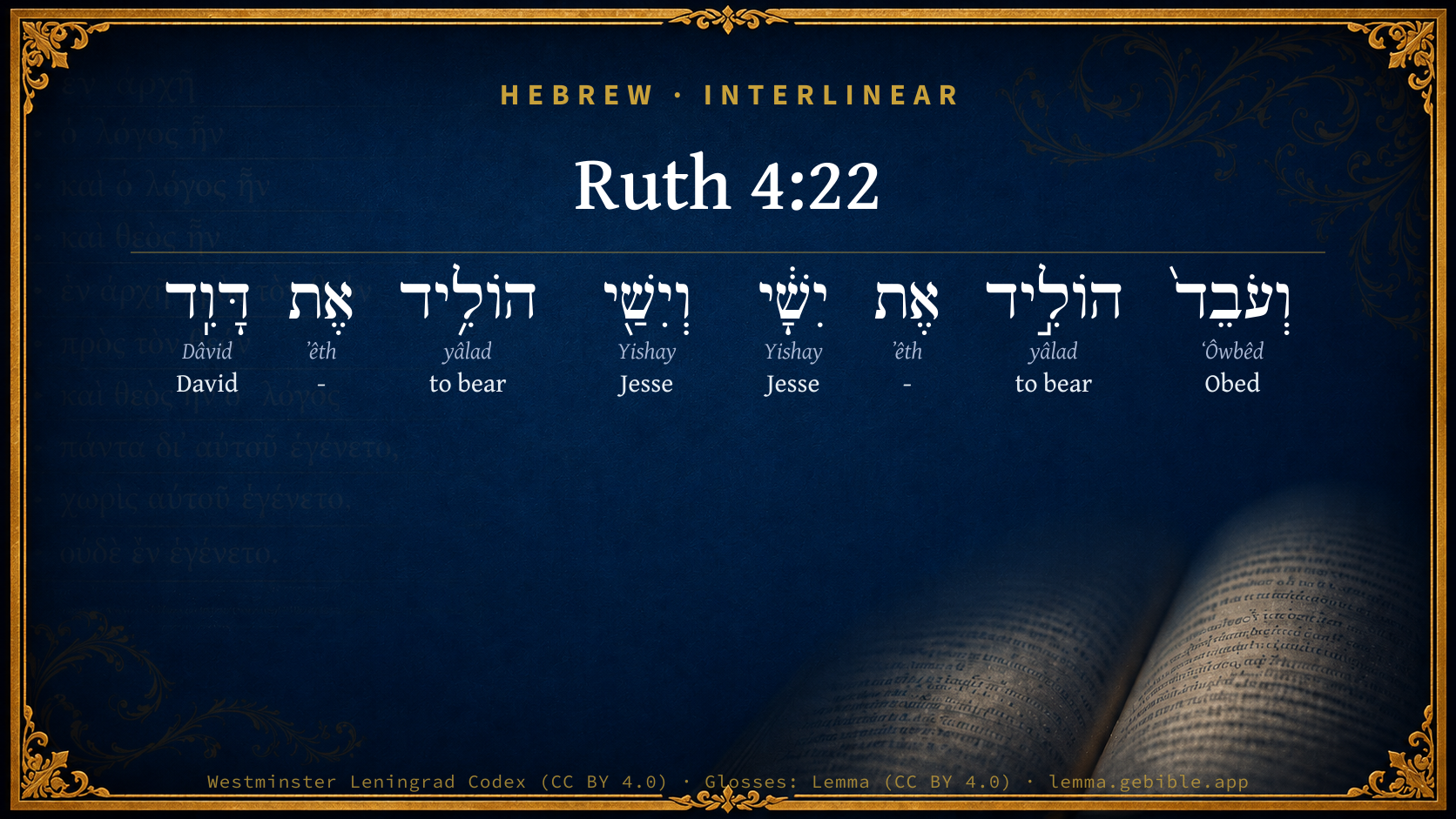
Hebrew (Westminster Leningrad Codex) Ruth 4:22 appears in the Hebrew Old Testament. The text above is from the Westminster Leningrad Codex. Each word links to its Strong’s number, a concise gloss, and parsing drawn from the Open Scriptures Hebrew Bible morphology. Click any word for its full Brown-Driver-Briggs (BDB) entry.
Download image
Cite this verse

Ruth 4:22 (World English Bible). Public Domain. Lemma interlinear Bible study tool, https://lemma.gebible.app/v/ruth/4/22.

Show BibTeX & RIS
BibTeX
RIS
English Translation
and Obed became the father of Jesse, and Jesse became the father of David.
World English Bible · Public Domain
Download a study sheet

One document with this verse’s original text, its word-by-word gloss line, the meaning frame, cross-references with their text, attributed commentary, and full source and license credits — printable, and it pastes into notes with its structure intact.

This verse Autodidact and up

Study sheet (.html) Plain text (.txt)

A passage Seminary Student

Up to 50 verses in one chapter. A passage sheet keeps up to 6 commentary sources and 12 cross-references per verse, in the order this page ranks them, and says so on the sheet whenever that leaves anything out. Ask for a single verse and you get the Autodidact verse sheet above.

Everything on this page stays free to read, with no account — the sheet is a download of what is already on screen, not access to it.

Want to remove ads? Support Godless Engineer
Compare translations 3

The same verse in 3 English versions, stacked beneath the original-language interlinear above. Click any original word for its lexicon entry.

Each is an independent rendering of the whole verse — the interlinear is not word-aligned to these translations.

Highlighted words mark where these versions differ — a whole-verse word diff, not a word-by-word alignment.

  • World English Bible Public Domain
    and Obed became the father of Jesse, and Jesse became the father of David.
  • King James Version Public Domain
    And Obed begat Jesse, and Jesse begat David.
  • unfoldingWord Literal Text CC BY-SA 4.0
    and Obed fathered Jesse; and Jesse fathered David.

unfoldingWord Literal Text — © unfoldingWord, licensed CC BY-SA 4.0. Word-aligned USFM3 via Door43 (git.door43.org/unfoldingWord/en_ult).

Versions to compare (up to 4)

3 of 4 selected

Show all 18 translations

Every available English version of this verse, each an independent rendering of the whole verse.

  • World English Bible Public Domain
    and Obed became the father of Jesse, and Jesse became the father of David.
  • Berean Standard Bible Public Domain
    Obed was the father of Jesse, and Jesse was the father of David.
  • Majority Standard Bible Public Domain
    Obed was the father of Jesse, and Jesse was the father of David.
  • King James Version Public Domain
    And Obed begat Jesse, and Jesse begat David.
  • American Standard Version (1901) Public Domain
    and Obed begat Jesse, and Jesse begat David.
  • Revised Version (1885) Public Domain
    and Obed begat Jesse, and Jesse begat David.
  • Geneva Bible (1599) Public Domain
    And Obed begate Ishai, and Ishai begate Dauid.
  • Douay-Rheims (1899) Public Domain
    Obed begot Isai, Isai begot David.
  • Young's Literal Translation Public Domain
    and Obed begat Jesse, and Jesse begat David.
  • Literal Standard Version CC BY-SA 4.0
    and Obed begot Jesse, and Jesse begot David.
  • Unlocked Literal Bible CC BY-SA 4.0
    Obed became the father of Jesse, and Jesse became the father of David.
  • unfoldingWord Literal Text CC BY-SA 4.0
    and Obed fathered Jesse; and Jesse fathered David.
  • Darby Bible Public Domain
    and Obed begot Jesse, and Jesse begot David.
  • World Messianic Bible Public Domain
    and Obed became the father of Jesse, and Jesse became the father of David.
  • Webster's Bible Public Domain
    And Obed begat Jesse, and Jesse begat David.
  • Free Bible Version CC BY-SA 4.0
    Obed was the father of Jesse. Jesse was the father of David.
  • Bible in Basic English Public Domain
    And Obed became the father of Jesse, and Jesse became the father of David.
  • JPS Tanakh (1917) Public Domain
    and Obed begot Jesse, and Jesse begot David.

Literal Standard Version (2020), Covenant Press — licensed CC BY-SA 4.0. Text via the HelloAO Bible API (eBible.org). Unlocked Literal Bible (unfoldingWord) — licensed CC BY-SA 4.0. Text via the HelloAO Bible API (eBible.org). unfoldingWord Literal Text — © unfoldingWord, licensed CC BY-SA 4.0. Word-aligned USFM3 via Door43 (git.door43.org/unfoldingWord/en_ult). Free Bible Version, Dr. Jonathan Gallagher — licensed CC BY-SA 4.0. Text via the HelloAO Bible API (eBible.org).

Word by word

More ways to search: Search by grammar → Find every occurrence → Compare this word →

Practice this passage: Drill this verse → Learn its vocabulary →

וְעֹבֵד֙
ʻÔwbêd
H5744
“and · Obed”
Conjunction + Noun, Proper
Part of Speech
Conjunction + Noun
Type
Proper
Full BDB Definition

Origin: act part of H5647

TWOT: None

Obed = "serving" - son of Boaz by Ruth and the grandfather of David - a Judaite, a descendant of Jarha, the Egyptian slave of Sheshan, in the line of Jerahmeel - a Judaite, father of Azariah, one of the captains of hundreds who joined with Jehoiada in the revolution by which Athaliah fell - one of David's mighty warriors - son of Shemaiah and a gatekeeper of the temple
  1. הוֹלִ֣יד yâlad H3205 “to bear” Verb, Hiphil, Perfect, 3rd Person, Masculine, Singular
  2. אֶת ʼêth H853 “-” Particle, Direct Object
  3. יִשָׁ֔י Yishay H3448 “Jesse” Noun, Proper
  4. וְיִשַׁ֖י Yishay H3448 “and · Jesse” Conjunction + Noun, Proper
  5. הוֹלִ֥יד yâlad H3205 “to bear” Verb, Hiphil, Perfect, 3rd Person, Masculine, Singular
  6. אֶת ʼêth H853 “-” Particle, Direct Object
  7. דָּוִֽד Dâvid H1732 “David” Noun, Proper

About this verse

These counts appear in no published source. They are computed here, from the morphology-tagged text and Lemma’s own curated glosses. What Lemma adds →

8
words
5
distinct lemmas
Historical
section

Notable vocabulary

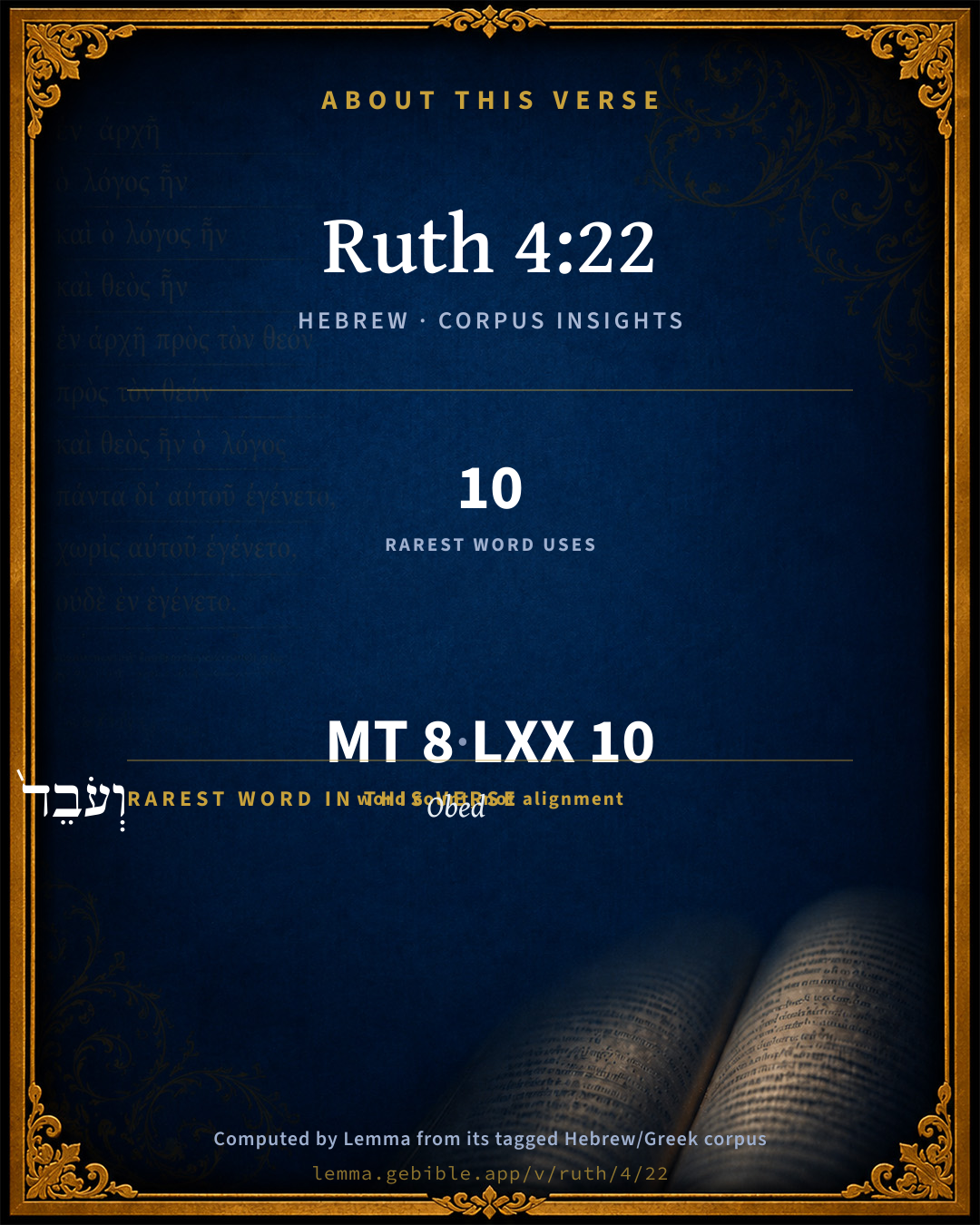
The rarest word here is וְעֹבֵד֙ Obed H5744 — appearing just 10 times in the whole Hebrew Bible.

Shared distinctive vocabulary

וְעֹבֵד֙ Obed H5744 occurs in 9 verses of the Hebrew Bible. Also found in:

Grammatical profile

  • 2 verbs
  • 4 nouns
  • 2 particles

Verb forms

  • הוֹלִ֣יד Hiphil · Perfect
  • הוֹלִ֥יד Hiphil · Perfect

Repetition

Words recur within this verse — often emphatic in Hebrew:

  • הוֹלִ֣יד to bear H3205 ×2
  • יִשָׁ֔י Jesse H3448 ×2

Hebrew & Septuagint length

In English translation the verse runs 14 words from the Hebrew and 8 from the Septuagint (LXX English) — the Septuagint runs noticeably shorter here. See the side-by-side →

A rough comparison of the two English renderings, which tokenize alike — not a word-level alignment.

Word counts can differ between the Hebrew and the Greek without any difference in meaning — e.g. the Hebrew direct-object marker אֵת has no separate Greek word, and Greek often adds the article ὁ.

In the original languages it is 8 Hebrew tokens and 10 Greek tokens — but the two are counted differently (Hebrew bundles its prefixes and suffixes into one token; the Greek is in lemma form), so that isn’t a like-for-like length.

Cross-references

5

Topical passages linked to Ruth 4:22 in the Treasury of Scripture Knowledge — connected by theme and wording, ordered by reader-vote popularity; previews shown in the World English Bible.

  • 1 Samuel 16:1 Yahweh said to Samuel, How long will you mourn for Saul, seeing I have rejected him from being king over Israel? fill your horn with oil, and go: I will send you to Jesse the Bethlehemite; for I have provided me a king among his sons.
  • 1 Chronicles 2:15 Ozem the sixth, David the seventh;
  • Isaiah 11:1 There shall come forth a shoot out of the stock of Jesse, and a branch out of his roots shall bear fruit.
  • Matthew 1:6 Jesse became the father of David the king. David became the father of Solomon by her who had been the wife of Uriah.
  • Luke 3:31 the son of Melea, the son of Menan, the son of Mattatha, the son of Nathan, the son of David,

Cross-references courtesy of OpenBible.info (CC BY 4.0).

Hebrew and Greek witnesses Masoretic Hebrew ↔ Greek Septuagint

The same verse in the two great witnesses to the Old Testament, shown verse-for-verse.

Here the Septuagint runs noticeably shorter than the Hebrew — LXX2012 (modern English Septuagint) 8 words vs World English Bible 14. A rough length comparison of the two English translations, not a word-level alignment — read both below.

These are two independent witnesses, not word-aligned to each other, and the Septuagint is shown in lemma (dictionary) form.

Hebrew Ruth 4:22 Masoretic · Westminster Leningrad Codex

וְעֹבֵד֙ הוֹלִ֣יד אֶת יִשָׁ֔י וְיִשַׁ֖י הוֹלִ֥יד אֶת דָּוִֽד

and Obed became the father of Jesse, and Jesse became the father of David.

World English Bible · Public Domain

Greek LXX Ruth 4:22 Septuagint · lemma form

καί ωβηδ γεννάω ὁ ιεσσαι καί ιεσσαι γεννάω ὁ δαυίδ

And Obed begot Jessae; and Jessae begot David.

LXX2012 (modern English Septuagint) · Public Domain

Hebrew: Westminster Leningrad Codex (CC BY 4.0). Greek: Septuagint (public domain); English from LXX2012 (modern English Septuagint) (Public Domain). How the Septuagint differs from the Hebrew →

Commentary

Notes on Ruth 4:22 from classic Christian and Jewish commentators (each source and its license shown beneath its notes). The classic Christian expositions comment on the surrounding passage and are grouped to its opening verse, so a note may address several verses; the Jewish commentaries on the Tanakh (Rashi and others) are per-verse, so they appear only where the commentator wrote on this verse.

Lemma curates 59 commentaries, every one of them public domain or Creative Commons licensed, each selected and text-cleaned for this edition rather than reprinted as found. About our sources →

Adam Clarke's Commentary

Verse 22. And Obed begat Jesse] "Who," says the Targum, "also is called Nachash, נחש because neither iniquity nor corruption was found in him, that he should be delivered into the hands of the angel of death, that he might take away his soul from him. And he lived many days until the counsel was remembered before the Lord, that the serpent gave to Eve the wife of Adam, that she should eat of the tree; by eating of the fruit of which they became wise, to distinguish between good and evil: and by that counsel all the inhabitants of the earth became guilty of death; and by this iniquity Jesse the Just died." Here is no mean or indistinct reference to the doctrine of original sin: and it shows us, at least, what the very ancient rabbins thought on the subject. I should observe that these additions are taken from the London Polyglot; they are not found in that of Antwerp; but they are the same that appear in the Targum of the great Bible printed by Bomberg, at Venice, in 1547-49.

And Jesse begat David] To this no comment is added by the Targumist, as the history of this king is found in the following book.

The ten persons whose genealogy is recorded in the five last verses, may be found, with a trifling change of name, in the genealogical list in Mt 1:3-6, as forming important links in the line of the Messiah. To introduce this appears to have been the principal object of the writer, as introductory to the following books, where the history of David, the regal progenitor and type of the Messiah, is so particularly detailed.

FOR the account of the birth of Pharez and his brother Zarah, the reader is requested to refer to Ge 38:12-30, and to the notes there; and for several particulars in the genealogy itself, to the notes on Mt 1:1-16 and Lu 3:23-38, where the wisdom, goodness, and providence of God, in the preservation of this line, are particularly noticed.

MASORETIC NOTES ON RUTH

Number of verses in Ruth is 85.

Middle verse is Ru 2:21.

We have already seen that Archbishop Usher places the event mentioned here in A.M. 2686, about one hundred years after the conquest of Canaan.

Adam Clarke's Commentary on the Bible (1810–1826) — public domain. Text from a community e-Sword/MySword module.

The Cambridge Bible for Schools and Colleges

gen. ed. J. J. S. Perowne

22. and Jesse begat David] The present genealogy was therefore designed to supply what 1 Sam. omitted, and to trace David’s descent from Perez.

Note on the genealogy in Rth_4:18-22. The following points are to be noticed: (1) The genealogy consists of ten members, of which the first five, from Perez to Nahshon, cover the period from the entry of the Hebrew tribes into Egypt (Perez, Gen_46:12) to the time of Moses (Nahshon, Num_1:7); while the last five belong to the period of the settlement in Canaan. It is obvious that the generations are not sufficient to cover this extent of time; the grandfather of Boaz cannot have been a contemporary of Moses. The genealogy, therefore, does not attempt to give a complete historical series; many links are omitted; it is artificially constructed out of traditional materials. (2) The object of the list is to connect David with the princely line of Judah. In spite of his Moabite great-grandmother, he could be shewn to come of the best Judaean stock. How this was done is explained by Wellhausen (De Gentibus et Familiis Judaeis, pp. 13–19) as follows: the ancestors of David were known as far as Boaz, but there memory failed; accordingly, as Beth-lehem was the native town of Jesse, it was natural to introduce Salma, ‘the father of Beth-lehem’ (1Ch_2:51; 1Ch_2:54); then David must be connected with the leading family of Judah which flourished in the time of Moses, and, through the marriage of Aaron, united itself with the priestly dignity (Exo_6:23). This accounts for Nahshon and Amminadab; these again are traced to Ram, son or grandson of Hezron, whose very name (Ram = ‘the high one’) suggests the founder of a princely line. (3) The date at which the genealogy was drawn up Wellhausen further shews to be post-exilic. For Salma is described in 1Ch_2:51 as a son of Caleb, and the Calebites in ancient times belonged to the S. of Judah (Jdg_1:20); it was not until after the exile, when they found the Edomites in possession of their original seats, that they moved northwards to Beth-lehem and its neighbourhood; so that it was not until after the exile that Salma could be called ‘the father of Beth-lehem.’ David, however, is never connected with the Calebite district in the S. of Judah, but with the older part of Israel settled in Northern Judah, near the border of Benjamin. (4) The genealogy cannot have been framed by the author of Ruth, because he recognizes Obed as legally the son of Mahlon (Rth_4:5; Rth_4:10); if he had drawn up the line himself he would have traced it through Mahlon and Elimelech. We may conclude, therefore, that the genealogy ‘forms no integral part of the Book, and may well have been added long after the Book itself was written in an age that was devoted to the study of pedigrees’ (Driver, Introd.8, pp. 455 f.). (5) The relation between this genealogy and the fuller one in 1Ch_2:10-17 cannot be determined with certainly; for, as sWellhausen has shewn (l.c.), 1Ch_2:10-24 is a secondary element, and the same source from which the Chronicler derived 1Ch_2:18-24 may have contained Rth_4:10-17, and it is quite possible that Rth_4:18-22 was also derived from it (Nowack). It is simplest to conclude, with Robertson Smith and Cheyne in Encycl. Bibl., that a later writer borrowed the genealogy from 1Ch_2:25 it stands.

The Cambridge Bible for Schools and Colleges (gen. ed. J. J. S. Perowne; Cambridge University Press, 1878–1918) — public domain. Text from a community e-Sword module.

Haydock's Catholic Bible Commentary

David, the king, whom Samuel crowned, though he did not live to see him in the full enjoyment of his power, (Haydock) as he died before Saul. (Calmet) --- Thus the greatest personages have people of mean condition among their ancestors, that none may be too much elated on account of their high birth. Ruth, notwithstanding her poverty, was a striking figure of the Christian Church. (Haydock) --- The Gentiles were strangers to Christ, on account of their errors, but related to him in as much as they were his creatures. Their miserable condition pleaded hard for them, that Jesus would receive them under his protection, espouse and give them rest and peace. Booz would, not marry Ruth till the nearer relation had refused, and thus brought dishonour on himself; (Deuteronomy xxv.) so Jesus was principally sent to the lost sheep of the house of Israel, and did not send his apostles to the Gentiles till the Jews had rejected their ministry. (Calmet) --- See St. Ambrose, de fide, iii. 5. (Du Hamel) --- Ruth was also a pattern of the most perfect virtues. See Louis de Puente. (Tirinus)

George Leo Haydock (1774–1849), Haydock's Catholic Family Bible and Commentary, 1859 edition — public domain. Excludes Psalms (Douay-Rheims chapter numbering differs from Protestant) and Deuterocanonical books (Catholic canon only).

Matthew Poole's English Annotations

How can this be a true genealogy, seeing by this means four persons take up three hundred and eighty years, which were between Salmon and David, and consequently every one of them must beget a son when he was very old?

Answ. 1. It is not certain that each of these was the immediate parent of him whom he is said to beget; for sometimes grandfathers are said in Scripture to beget their grandchildren, to wit, by the intervention of their immediate sons; whereof instances have been given. And sometimes in genealogies whole generations are omitted, as may appear by Ezr 7:2, compared with 1Ch 6:3 and by Mat 1:8, which might be done here for divers reasons now unknown.

2. There are many examples even in profane writers, both ancient and modern, of persons that have not only lived one hundred and twenty and one hundred and thirty years and upwards, but have been vigorous and have begotten children at above one hundred years old; and of women that have conceived and born children at the age of fifty, sixty, yea, seventy years. And therefore if it were so in these more ancient times, when men were longer lived, and under the law, when long life was expressly promised to the obedient, and in persons of strong constitutions and sober conversations, such as some of these are known to have been, and the others may justly be presumed to be such, it is not strange, nor in the least incredible.

Matthew Poole's English Annotations on the Holy Bible (1683–1685) — public domain. Text from a community e-Sword/MySword module.

Lesson kit

Teaching starters — assembled from the data on this page, not authored interpretation. Every prompt links to the verse data it draws on. Edit before teaching.

Ruth, in the Historical, opens this verse with 8 words (5 distinct Hebrew lemmas). Its most distinctive word is ʻÔwbêd (“Obed”). The Greek Septuagint runs shorter here. A historical commentator’s framing appears above. Read the whole chapter for the surrounding context.

Discussion questions

  1. The word ʻÔwbêd carries the sense “Obed.” How does it shape the verse?
  2. How does Ruth 4:17, which shares the word «Obed», read alongside this verse?
  3. What does the repetition of “to bear” (2× in this one verse) do in this verse?
  4. The Septuagint runs shorter here than the Hebrew. What might account for the difference?
  5. These translations render this verse differently. What is at stake in choosing one wording over another?
  6. «הוֹלִ֣יד» is a Hiphil Perfect verb. How does that grammatical form shape the action described?
  7. Compare how Adam Clarke's Commentary and The Cambridge Bible for Schools and Colleges read this verse. Where do they agree or differ?

Things to notice

Reading settings

Reading text

Shown beneath each verse's original-language words.

Old Testament
Old Testament edition

Read the OT as the Masoretic Hebrew (MT) or the Greek Septuagint (LXX).

English shown for the Greek Septuagint (in the Hebrew ↔ Greek comparison).

Comparing translations? Open the Compare panel on any verse page to stack up to four side by side.