Genesis 5:19

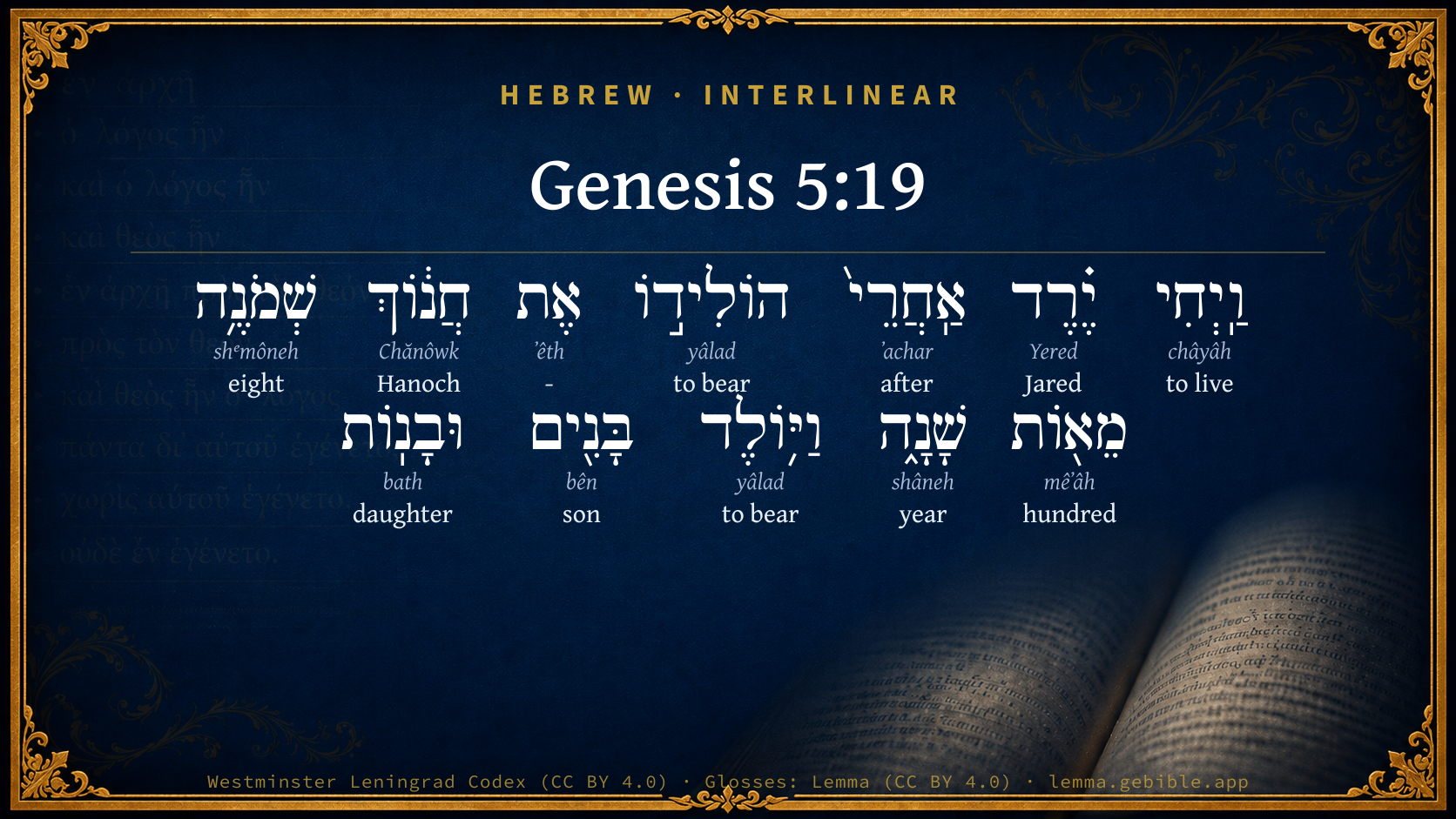
Hebrew (Westminster Leningrad Codex) Genesis 5:19 appears in the Hebrew Old Testament. The text above is from the Westminster Leningrad Codex. Each word links to its Strong’s number, a concise gloss, and parsing drawn from the Open Scriptures Hebrew Bible morphology. Click any word for its full Brown-Driver-Briggs (BDB) entry.
Download image
Cite this verse

Genesis 5:19 (World English Bible). Public Domain. Lemma interlinear Bible study tool, https://lemma.gebible.app/v/genesis/5/19.

Show BibTeX & RIS
BibTeX
RIS
English Translation
Jared lived after he became the father of Enoch eight hundred years, and became the father of sons and daughters.
World English Bible · Public Domain
Download a study sheet

One document with this verse’s original text, its word-by-word gloss line, the meaning frame, cross-references with their text, attributed commentary, and full source and license credits — printable, and it pastes into notes with its structure intact.

This verse Autodidact and up

Study sheet (.html) Plain text (.txt)

A passage Seminary Student

Up to 50 verses in one chapter. A passage sheet keeps up to 6 commentary sources and 12 cross-references per verse, in the order this page ranks them, and says so on the sheet whenever that leaves anything out. Ask for a single verse and you get the Autodidact verse sheet above.

Everything on this page stays free to read, with no account — the sheet is a download of what is already on screen, not access to it.

Want to remove ads? Support Godless Engineer
Compare translations 3

The same verse in 3 English versions, stacked beneath the original-language interlinear above. Click any original word for its lexicon entry.

Each is an independent rendering of the whole verse — the interlinear is not word-aligned to these translations.

Highlighted words mark where these versions differ — a whole-verse word diff, not a word-by-word alignment.

  • World English Bible Public Domain
    Jared lived after he became the father of Enoch eight hundred years, and became the father of sons and daughters.
  • King James Version Public Domain
    And Jared lived after he begat Enoch eight hundred years, and begat sons and daughters:
  • unfoldingWord Literal Text CC BY-SA 4.0
    Then after he fathered Enoch, Jared lived 800 years, and he fathered sons and daughters.

unfoldingWord Literal Text — © unfoldingWord, licensed CC BY-SA 4.0. Word-aligned USFM3 via Door43 (git.door43.org/unfoldingWord/en_ult).

Versions to compare (up to 4)

3 of 4 selected

Show all 18 translations

Every available English version of this verse, each an independent rendering of the whole verse.

  • World English Bible Public Domain
    Jared lived after he became the father of Enoch eight hundred years, and became the father of sons and daughters.
  • Berean Standard Bible Public Domain
    And after he had become the father of Enoch, Jared lived 800 years and had other sons and daughters.
  • Majority Standard Bible Public Domain
    And after he had become the father of Enoch, Jared lived 800 years and had other sons and daughters.
  • King James Version Public Domain
    And Jared lived after he begat Enoch eight hundred years, and begat sons and daughters:
  • American Standard Version (1901) Public Domain
    and Jared lived after he begat Enoch eight hundred years, and begat sons and daughters:
  • Revised Version (1885) Public Domain
    and Jared lived after he begat Enoch eight hundred years, and begat sons and daughters:
  • Geneva Bible (1599) Public Domain
    Then Iered liued, after he begate Henoch, eight hundreth yeeres, and begate sonnes and daughters.
  • Douay-Rheims (1899) Public Domain
    And Jared lived after he begot Henoch, eight hundred years, and begot sons and daughters.
  • Young's Literal Translation Public Domain
    And Jared liveth after his begetting Enoch eight hundred years, and begetteth sons and daughters.
  • Literal Standard Version CC BY-SA 4.0
    And Jared lives after his begetting Enoch eight hundred years, and begets sons and daughters.
  • Unlocked Literal Bible CC BY-SA 4.0
    After he became the father of Enoch, Jared lived eight hundred years. He became the father of more sons and daughters.
  • unfoldingWord Literal Text CC BY-SA 4.0
    Then after he fathered Enoch, Jared lived 800 years, and he fathered sons and daughters.
  • Darby Bible Public Domain
    And Jared lived after he had begotten Enoch eight hundred years, and begot sons and daughters.
  • World Messianic Bible Public Domain
    Jared lived after he became the father of Enoch eight hundred years, and became the father of other sons and daughters.
  • Webster's Bible Public Domain
    And Jared lived after he begat Enoch eight hundred years, and begat sons and daughters:
  • Free Bible Version CC BY-SA 4.0
    After Enoch was born, Jared lived 800 years and had other sons and daughters.
  • Bible in Basic English Public Domain
    And Jared went on living after the birth of Enoch for eight hundred years, and had sons and daughters:
  • JPS Tanakh (1917) Public Domain
    And Jared lived after he begot Enoch eight hundred years, and begot sons and daughters.

Literal Standard Version (2020), Covenant Press — licensed CC BY-SA 4.0. Text via the HelloAO Bible API (eBible.org). Unlocked Literal Bible (unfoldingWord) — licensed CC BY-SA 4.0. Text via the HelloAO Bible API (eBible.org). unfoldingWord Literal Text — © unfoldingWord, licensed CC BY-SA 4.0. Word-aligned USFM3 via Door43 (git.door43.org/unfoldingWord/en_ult). Free Bible Version, Dr. Jonathan Gallagher — licensed CC BY-SA 4.0. Text via the HelloAO Bible API (eBible.org).

Word by word

More ways to search: Search by grammar → Find every occurrence → Compare this word →

Practice this passage: Drill this verse → Learn its vocabulary →

יֶ֗רֶד
Yered
H3382
“Jared”
Noun, Proper
Part of Speech
Noun
Type
Proper
Full BDB Definition

Origin: from H3381

TWOT: None

Jered or Jared = "descent" - son of Mahalaleel and father of Enoch in the 4th generation from Seth - a descendant of Judah and father of Gedor
  1. וַֽיְחִי châyâh H2421 “and · to live” Conjunction + Verb, Qal, Sequential Imperfect, 3rd Person, Masculine, Singular
  2. אַֽחֲרֵי֙ ʼachar H310 “after” Preposition
  3. הוֹלִיד֣וֹ yâlad H3205 “to bear · him” Verb, Hiphil, Infinitive Construct + Suffix, Personal, 3rd Person, Masculine, Singular
  4. אֶת ʼêth H853 “-” Particle, Direct Object
  5. חֲנ֔וֹךְ Chănôwk H2585 “Hanoch” Noun, Proper
  6. שְׁמֹנֶ֥ה shᵉmôneh H8083 “eight” Adjective, Cardinal number, Feminine, Singular, Absolute
  7. מֵא֖וֹת mêʼâh H3967 “hundred” Adjective, Cardinal number, Both, Plural, Absolute
  8. שָׁנָ֑ה shâneh H8141 “year” Noun, Common, Feminine, Singular, Absolute
  9. וַיּ֥וֹלֶד yâlad H3205 “and · to bear” Conjunction + Verb, Hiphil, Sequential Imperfect, 3rd Person, Masculine, Singular
  10. בָּנִ֖ים bên H1121 “sons” Noun, Common, Masculine, Plural, Absolute
  11. וּבָנֽוֹת bath H1323 “and · daughters” Conjunction + Noun, Common, Feminine, Plural, Absolute

About this verse

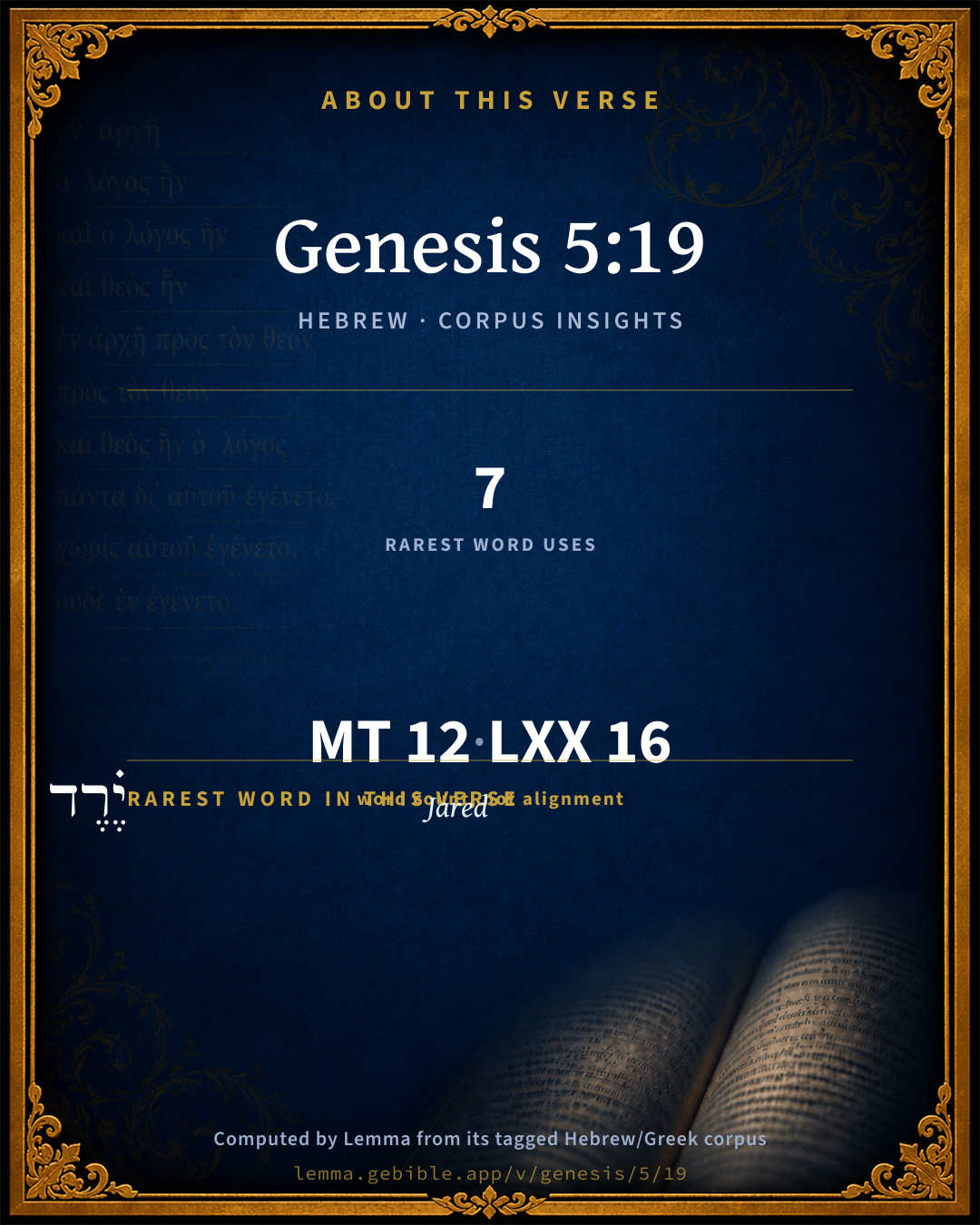
These counts appear in no published source. They are computed here, from the morphology-tagged text and Lemma’s own curated glosses. What Lemma adds →

12
words
11
distinct lemmas
Pentateuch
section

Notable vocabulary

The rarest word here is יֶ֗רֶד Jared H3382 — appearing just 7 times in the whole Hebrew Bible.

Shared distinctive vocabulary

יֶ֗רֶד Jared H3382 occurs in 7 verses of the Hebrew Bible. Also found in:

Grammatical profile

  • 3 verbs
  • 5 nouns
  • 2 adjectives
  • 1 preposition
  • 1 particle

Verb forms

  • וַֽיְחִי Qal · Sequential Imperfect
  • הוֹלִיד֣וֹ Hiphil · Infinitive Construct
  • וַיּ֥וֹלֶד Hiphil · Sequential Imperfect

Repetition

A word recurs within this verse — often emphatic in Hebrew:

  • הוֹלִיד֣וֹ to bear H3205 ×2

Hebrew & Septuagint length

In English translation the verse runs 20 words from the Hebrew and 16 from the Septuagint (LXX English) — closely comparable.

A rough comparison of the two English renderings, which tokenize alike — not a word-level alignment.

Word counts can differ between the Hebrew and the Greek without any difference in meaning — e.g. the Hebrew direct-object marker אֵת has no separate Greek word, and Greek often adds the article ὁ.

In the original languages it is 12 Hebrew tokens and 16 Greek tokens — but the two are counted differently (Hebrew bundles its prefixes and suffixes into one token; the Greek is in lemma form), so that isn’t a like-for-like length.

Hebrew and Greek witnesses Masoretic Hebrew ↔ Greek Septuagint

The same verse in the two great witnesses to the Old Testament, shown verse-for-verse.

These are two independent witnesses, not word-aligned to each other, and the Septuagint is shown in lemma (dictionary) form.

Hebrew Genesis 5:19 Masoretic · Westminster Leningrad Codex

וַֽיְחִי יֶ֗רֶד אַֽחֲרֵי֙ הוֹלִיד֣וֹ אֶת חֲנ֔וֹךְ שְׁמֹנֶ֥ה מֵא֖וֹת שָׁנָ֑ה וַיּ֥וֹלֶד בָּנִ֖ים וּבָנֽוֹת

Jared lived after he became the father of Enoch eight hundred years, and became the father of sons and daughters.

World English Bible · Public Domain

Greek LXX Genesis 5:19 Septuagint · lemma form

καί ζάω ιαρεδ μετά ὁ γεννάω αὐτός ὁ ενωχ ὀκτακόσιοι ἔτος καί γεννάω υἱός καί θυγάτηρ

and Jared lived after his begetting Enoch, eight hundred years, and he begot sons and daughters.

LXX2012 (modern English Septuagint) · Public Domain

Hebrew: Westminster Leningrad Codex (CC BY 4.0). Greek: Septuagint (public domain); English from LXX2012 (modern English Septuagint) (Public Domain). How the Septuagint differs from the Hebrew →

Targum (Aramaic paraphrase)

2

The Targum is the ancient Jewish Aramaic paraphrase of the Hebrew Scriptures — an interpretive translation, not the Hebrew text itself. Onkelos (literal) and Pseudo-Jonathan (expansive) render the Torah, and Jonathan the Prophets. Coverage is partial: where no permissively-licensed English translation exists for a verse, only the Aramaic is shown. This is verse-level text, not a word-by-word alignment to the Hebrew.

  1. Targum Onkelos Torah (Genesis–Deuteronomy)
    וַחֲיָא יֶרֶד בָּתַר דְּאוֹלִיד יָת חֲנוֹךְ תַּמְנֵי מְאָה שְׁנִין וְאוֹלִיד בְּנִין וּבְנָן

    (no public-domain English translation for this verse)

    Targum Onkelos — Aramaic: “Onkelos Genesis” (public domain); “Onkelos Exodus” (public domain); “Onkelos Leviticus” (public domain); “Onkelos Numbers” (public domain); “Onkelos Deuteronomy” (public domain). English: “Sefaria Community Translation” (CC0 1.0 (public-domain dedication)); “J.W. Etheridge. The Targums of Onkelos and Jonathan Ben Uzziel on the Pentateuch. London: Longmans, Green, 1862” (public domain). Text via Sefaria.

  2. Targum Pseudo-Jonathan Torah (Genesis–Deuteronomy)
    וַחֲיָא יֶרֶד בָּתַר דְאוֹלִיד יַת חֲנוֹךְ תְּמָנֵי מְאָה שְׁנִין וְאוֹלִיד בְּנִין וּבְנָן

    And Jared lived after he had begotten Hanok eight hundred years, and begat sons and daughters.

    Targum Pseudo-Jonathan — Aramaic: “Targum Jonathan on Genesis” (public domain); “Targum Jonathan on Exodus” (public domain); “Targum Jonathan on Leviticus” (public domain); “Targum Jonathan on Numbers” (public domain); “Targum Jonathan on Deuteronomy” (public domain). English: “The Targum of Jonathan ben Uzziel, trans. J. W. Etheridge, London, 1862” (public domain). Text via Sefaria.

Commentary

Notes on Genesis 5:19 from classic Christian and Jewish commentators (each source and its license shown beneath its notes). The classic Christian expositions comment on the surrounding passage and are grouped to its opening verse, so a note may address several verses; the Jewish commentaries on the Tanakh (Rashi and others) are per-verse, so they appear only where the commentator wrote on this verse.

Lemma curates 59 commentaries, every one of them public domain or Creative Commons licensed, each selected and text-cleaned for this edition rather than reprinted as found. About our sources →

Trapp's Complete Commentary

John Trapp

Gen 5:19 And Jared lived after he begat Enoch eight hundred years, and begat sons and daughters:

Ver. 19. And Jared lived after he begat Enoch.] He lived the longer, likely, for the great content he took in so good a son. Towardly and hopeful children do help to lengthen their parents’ days. God therefore lengtheneth theirs, according to that “first commandment with promise.” {Eph 6:2} Or, if he take from them this long lease, he gives them, as he did Enoch, a freehold of a better value.

John Trapp, A Commentary or Exposition upon All the Books of the Old and New Testament (1647–1656) — public domain. Text from a community e-Sword module.

John Gill's Exposition

And Enoch walked with God,.... Which is repeated both for the confirmation of it, and for the singularity of it in that corrupt age; and to cause attention to it, and stir up others to imitate him in it, as well as to express the well pleasedness of God therein; for so it is interpreted, "he had this testimony, that he pleased God", Heb 11:5.

and he was not; not that he was dead, or in the state of the dead, as Aben Ezra and Jarchi interpret the phrase following:

for God took him, out of the world by death, according to Kg1 19:4 "for he was translated, that he should not see death", Heb 11:5 nor was he annihilated, or reduced to nothing, "for God took him", and therefore he must exist somewhere: but the sense is, he was not in the land of the living, he was no longer in this world; or with the inhabitants of the earth, as the Targum of Jonathan paraphrases it; but the Lord took him to himself out of the world, in love to him, and removed him from earth to heaven, soul and body, as Elijah was taken; See Gill on Heb 11:5. The Arabic writers (u) call him Edris, and say he was skilled in astronomy and other sciences, whom the Grecians say is the same with Hermes Trismegistus; and the Jews call him Metatron, the great scribe, as in the Targum of Jonathan: they say (w), that Adam delivered to him the secret of the intercalation of the year, and he delivered it to Noah, and that he was the first that composed books of astronomy (x); and so Eupolemus (y) says he was the first inventor of astrology, and not the Egyptians; and is the same the Greeks call Atlas, to whom they ascribe the invention of it. The apostle Jude speaks of him as a prophet, Jde 1:14 and the Jews say (z), that he was in a higher degree of prophecy than Moses and Elias; but the fragments that go under his name are spurious: there was a book ascribed to him, which is often referred to in the book of Zohar, but cannot be thought to be genuine.

(u) Elmacinus, Patricides, apud Hottinger. p. 239. 240. Abulpharag. Hist. Dynast. p. 9. (w) Juchasin, fol. 5. 1. Pirke Eliezer, c. 8. (x) Shalshalet Hakabala, fol. 74. 2. (y) Ut supra. (Apud Euseb. Evangel. Praepar. l. 9. c. 17. p. 419.) (z) Shalshalet Hakabala, fol. 1, 2.

John Gill's Exposition of the Whole Bible (1746–1763) — public domain (CC PDM 1.0). Text via the HelloAO Bible API.

Lesson kit

Teaching starters — assembled from the data on this page, not authored interpretation. Every prompt links to the verse data it draws on. Edit before teaching.

Genesis, in the Pentateuch, opens this verse with 12 words (11 distinct Hebrew lemmas). Its most distinctive word is Yered (“Jared”). A historical commentator’s framing appears above. Read the whole chapter for the surrounding context.

Discussion questions

  1. What does “Jared” (Yered) contribute to the verse as a whole?
  2. How does Genesis 5:15, which shares the word «Jared», read alongside this verse?
  3. What does the repetition of “to bear” (2× in this one verse) do in this verse?
  4. These translations render this verse differently. What is at stake in choosing one wording over another?
  5. «וַֽיְחִי» is a Qal Sequential Imperfect verb. How does that grammatical form shape the action described?
  6. Compare how Trapp's Complete Commentary and John Gill's Exposition read this verse. Where do they agree or differ?

Things to notice

Reading settings

Reading text

Shown beneath each verse's original-language words.

Old Testament
Old Testament edition

Read the OT as the Masoretic Hebrew (MT) or the Greek Septuagint (LXX).

English shown for the Greek Septuagint (in the Hebrew ↔ Greek comparison).

Comparing translations? Open the Compare panel on any verse page to stack up to four side by side.