Deuteronomy 25:6

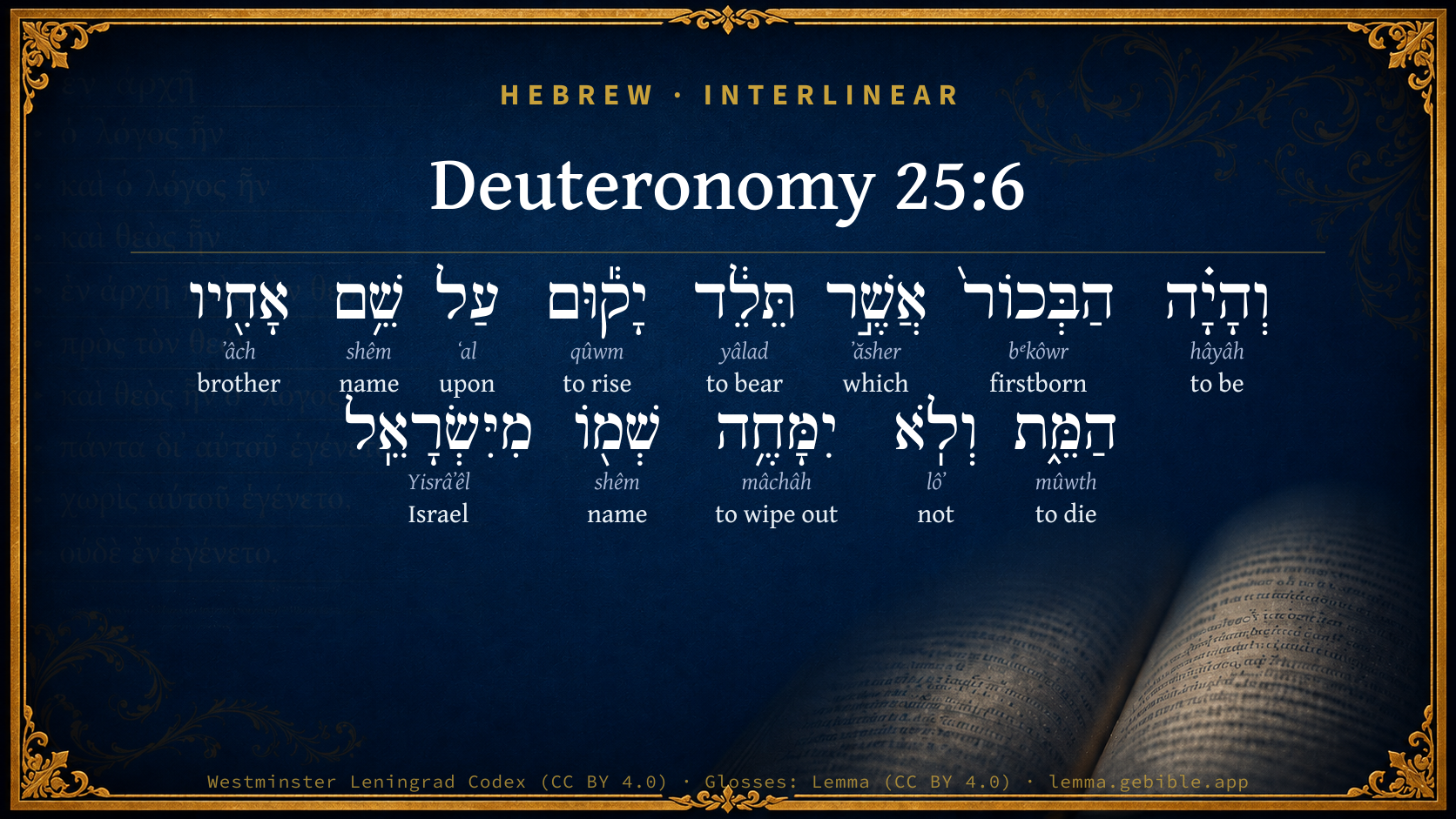
Hebrew (Westminster Leningrad Codex) Deuteronomy 25:6 appears in the Hebrew Old Testament. The text above is from the Westminster Leningrad Codex. Each word links to its Strong’s number, a concise gloss, and parsing drawn from the Open Scriptures Hebrew Bible morphology. Click any word for its full Brown-Driver-Briggs (BDB) entry.
Download image
Cite this verse

Deuteronomy 25:6 (World English Bible). Public Domain. Lemma interlinear Bible study tool, https://lemma.gebible.app/v/deuteronomy/25/6.

Show BibTeX & RIS
BibTeX
RIS
English Translation
It shall be, that the firstborn whom she bears shall succeed in the name of his brother who is dead, that his name not be blotted out of Israel.
World English Bible · Public Domain
Download a study sheet

One document with this verse’s original text, its word-by-word gloss line, the meaning frame, cross-references with their text, attributed commentary, and full source and license credits — printable, and it pastes into notes with its structure intact.

This verse Autodidact and up

Study sheet (.html) Plain text (.txt)

A passage Seminary Student

Up to 50 verses in one chapter. A passage sheet keeps up to 6 commentary sources and 12 cross-references per verse, in the order this page ranks them, and says so on the sheet whenever that leaves anything out. Ask for a single verse and you get the Autodidact verse sheet above.

Everything on this page stays free to read, with no account — the sheet is a download of what is already on screen, not access to it.

Want to remove ads? Support Godless Engineer
Compare translations 3

The same verse in 3 English versions, stacked beneath the original-language interlinear above. Click any original word for its lexicon entry.

Each is an independent rendering of the whole verse — the interlinear is not word-aligned to these translations.

Highlighted words mark where these versions differ — a whole-verse word diff, not a word-by-word alignment.

  • World English Bible Public Domain
    It shall be, that the firstborn whom she bears shall succeed in the name of his brother who is dead, that his name not be blotted out of Israel.
  • King James Version Public Domain
    And it shall be, that the firstborn which she beareth shall succeed in the name of his brother which is dead, that his name be not put out of Israel.
  • unfoldingWord Literal Text CC BY-SA 4.0
    And it will happen, the firstborn that she bears will rise up upon the name of his brother who died, and his name will not be wiped out from Israel.

unfoldingWord Literal Text — © unfoldingWord, licensed CC BY-SA 4.0. Word-aligned USFM3 via Door43 (git.door43.org/unfoldingWord/en_ult).

Versions to compare (up to 4)

3 of 4 selected

Show all 18 translations

Every available English version of this verse, each an independent rendering of the whole verse.

  • World English Bible Public Domain
    It shall be, that the firstborn whom she bears shall succeed in the name of his brother who is dead, that his name not be blotted out of Israel.
  • Berean Standard Bible Public Domain
    The first son she bears will carry on the name of the dead brother, so that his name will not be blotted out from Israel.
  • Majority Standard Bible Public Domain
    The first son she bears will carry on the name of the dead brother, so that his name will not be blotted out from Israel.
  • King James Version Public Domain
    And it shall be, that the firstborn which she beareth shall succeed in the name of his brother which is dead, that his name be not put out of Israel.
  • American Standard Version (1901) Public Domain
    And it shall be, that the first-born that she beareth shall succeed in the name of his brother that is dead, that his name be not blotted out of Israel.
  • Revised Version (1885) Public Domain
    And it shall be, that the firstborn which she beareth shall succeed in the name of his brother which is dead, that his name be not blotted out of Israel.
  • Geneva Bible (1599) Public Domain
    And the first borne which she beareth, shall succeede in the name of his brother which is dead, that his name be not put out of Israel.
  • Douay-Rheims (1899) Public Domain
    And the first son he shall have of her he shall call by his name, that his name be not abolished out of Israel.
  • Young's Literal Translation Public Domain
    and it hath been, the first-born which she beareth doth rise for the name of his dead brother, and his name is not wiped away out of Israel.
  • Literal Standard Version CC BY-SA 4.0
    and it has been, the firstborn which she bears rises for the name of his dead brother, and his name is not wiped away out of Israel.
  • Unlocked Literal Bible CC BY-SA 4.0
    This is so that the firstborn that she bears will succeed in the name of that man's dead brother, so that his name will not perish from Israel.
  • unfoldingWord Literal Text CC BY-SA 4.0
    And it will happen, the firstborn that she bears will rise up upon the name of his brother who died, and his name will not be wiped out from Israel.
  • Darby Bible Public Domain
    And it shall be, that the firstborn that she beareth shall stand in the name of his brother who is dead, that his name be not blotted out from Israel.
  • World Messianic Bible Public Domain
    It shall be that the firstborn whom she bears shall succeed in the name of his brother who is dead, that his name not be blotted out of Israel.
  • Webster's Bible Public Domain
    And it shall be, that the first-born which she beareth, shall succeed in the name of his brother who is dead, that his name may not become extinct in Israel.
  • Free Bible Version CC BY-SA 4.0
    The first son she has will be named after the dead brother, so that his name won't be forgotten in Israel.
  • Bible in Basic English Public Domain
    Then the first male child she has will take the rights of the brother who is dead, so that his name may not come to an end in Israel.
  • JPS Tanakh (1917) Public Domain
    And it shall be, that the first-born that she beareth shall succeed in the name of his brother that is dead, that his name be not blotted out of Israel.

Literal Standard Version (2020), Covenant Press — licensed CC BY-SA 4.0. Text via the HelloAO Bible API (eBible.org). Unlocked Literal Bible (unfoldingWord) — licensed CC BY-SA 4.0. Text via the HelloAO Bible API (eBible.org). unfoldingWord Literal Text — © unfoldingWord, licensed CC BY-SA 4.0. Word-aligned USFM3 via Door43 (git.door43.org/unfoldingWord/en_ult). Free Bible Version, Dr. Jonathan Gallagher — licensed CC BY-SA 4.0. Text via the HelloAO Bible API (eBible.org).

Word by word

More ways to search: Search by grammar → Find every occurrence → Compare this word →

Practice this passage: Drill this verse → Learn its vocabulary →

יִמָּחֶ֥ה
mâchâh
H4229
“to wipe out”
Verb, Niphal, Imperfect, 3rd Person, Masculine, Singular
Part of Speech
Verb
Stem
Niphal
Form
Imperfect
Person
3rd Person
Gender
Masculine
Number
Singular
Full BDB Definition

Origin: a primitive root

TWOT: 1178 , 1179 , 1181c

to wipe, wipe out - (Qal) - to wipe - to blot out, obliterate - to blot out, exterminate - (Niphal) - to be wiped out - to be blotted out - to be exterminated - (Hiphil) to blot out (from memory) - (Qal) to strike - (Pual) full of marrow (participle)
  1. וְהָיָ֗ה hâyâh H1961 “and · to be” Conjunction + Verb, Qal, Sequential Perfect, 3rd Person, Masculine, Singular
  2. הַבְּכוֹר֙ bᵉkôwr H1060 “the · firstborn” Particle, Definite Article + Noun, Common, Masculine, Singular, Absolute
  3. אֲשֶׁ֣ר ʼăsher H834 “which” Particle, Relative
  4. תֵּלֵ֔ד yâlad H3205 “to bear” Verb, Qal, Imperfect, 3rd Person, Feminine, Singular
  5. יָק֕וּם qûwm H6965 “to rise” Verb, Qal, Imperfect, 3rd Person, Masculine, Singular
  6. עַל ʻal H5921 “upon” Preposition
  7. שֵׁ֥ם shêm H8034 “name of” Noun, Common, Masculine, Singular, Construct
  8. אָחִ֖יו ʼâch H251 “brother · his” Noun, Common, Masculine, Singular, Construct + Suffix, Personal, 3rd Person, Masculine, Singular
  9. הַמֵּ֑ת mûwth H4191 “the · dying” Particle, Definite Article + Verb, Qal, Participle Active, Masculine, Singular, Absolute
  10. וְלֹֽא lôʼ H3808 “and · not” Conjunction + Particle, Negative
  11. שְׁמ֖וֹ shêm H8034 “name · his” Noun, Common, Masculine, Singular, Construct + Suffix, Personal, 3rd Person, Masculine, Singular
  12. מִיִּשְׂרָאֵֽל Yisrâʼêl H3478 “from · Israel” Preposition + Noun, Proper

About this verse

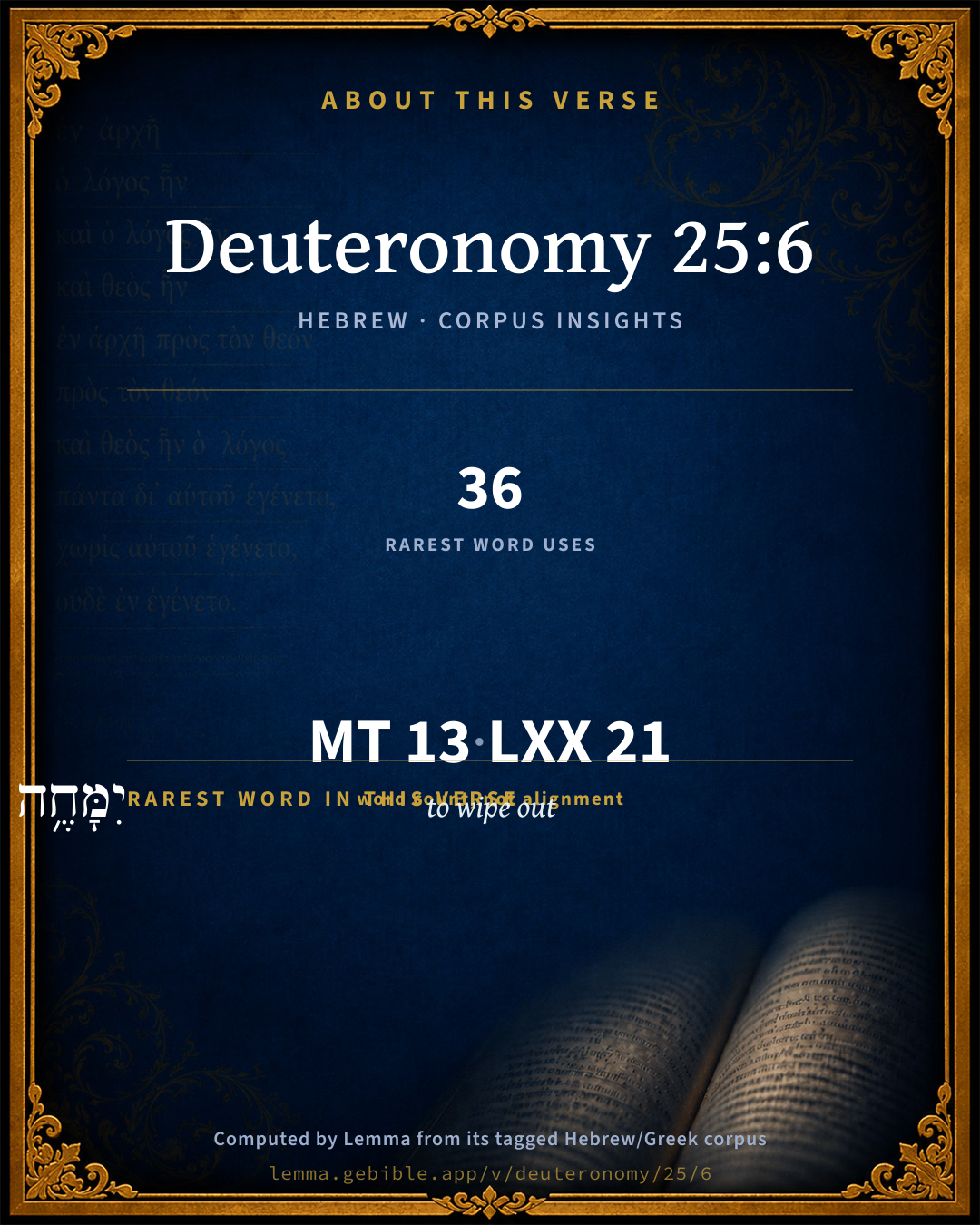
These counts appear in no published source. They are computed here, from the morphology-tagged text and Lemma’s own curated glosses. What Lemma adds →

13
words
12
distinct lemmas
Pentateuch
section

Shared distinctive vocabulary

יִמָּחֶ֥ה to wipe out H4229 occurs in 32 verses of the Hebrew Bible. Also found in:

Grammatical profile

  • 5 verbs
  • 5 nouns
  • 1 preposition
  • 2 particles

Verb forms

  • וְהָיָ֗ה Qal · Sequential Perfect
  • תֵּלֵ֔ד Qal · Imperfect
  • יָק֕וּם Qal · Imperfect
  • הַמֵּ֑ת Qal · Participle Active
  • יִמָּחֶ֥ה Niphal · Imperfect

Repetition

A word recurs within this verse — often emphatic in Hebrew:

  • שֵׁ֥ם name H8034 ×2

Hebrew & Septuagint length

In English translation the verse runs 29 words from the Hebrew and 32 from the Septuagint (LXX English) — closely comparable.

A rough comparison of the two English renderings, which tokenize alike — not a word-level alignment.

Word counts can differ between the Hebrew and the Greek without any difference in meaning — e.g. the Hebrew direct-object marker אֵת has no separate Greek word, and Greek often adds the article ὁ.

In the original languages it is 13 Hebrew tokens and 21 Greek tokens — but the two are counted differently (Hebrew bundles its prefixes and suffixes into one token; the Greek is in lemma form), so that isn’t a like-for-like length.

Cross-references

8

Topical passages linked to Deuteronomy 25:6 in the Treasury of Scripture Knowledge — connected by theme and wording, ordered by reader-vote popularity; previews shown in the World English Bible.

  • Deuteronomy 21:19 then shall his father and his mother lay hold on him, and bring him out to the elders of his city, and to the gate of his place;
  • Psalms 9:5 You have rebuked the nations. You have destroyed the wicked. You have blotted out their name forever and ever.
  • Psalms 109:13 Let his posterity be cut off. In the generation following let their name be blotted out.
  • Genesis 28:8–10 Esau saw that the daughters of Canaan didn't please Isaac, his father.
  • Deuteronomy 9:14 let me alone, that I may destroy them, and blot out their name from under the sky; and I will make of you a nation mightier and greater than they.
  • Deuteronomy 29:20 Yahweh will not pardon him, but then the anger of Yahweh and his jealousy will smoke against that man, and all the curse that is written in this book shall lie on him, and Yahweh will blot out his name from under the sky.
  • Ruth 4:1–7 Now Boaz went up to the gate, and sat him down there: and, behold, the near kinsman of whom Boaz spoke came by; to whom he said, Ho, such a one! turn aside, sit down here. He turned aside, and sat down.
  • Ruth 4:10–12 Moreover Ruth the Moabitess, the wife of Mahlon, have I purchased to be my wife, to raise up the name of the dead on his inheritance, that the name of the dead not be cut off from among his brothers, and from the gate of his place: you are witnesses this day.

Cross-references courtesy of OpenBible.info (CC BY 4.0).

Hebrew and Greek witnesses Masoretic Hebrew ↔ Greek Septuagint

The same verse in the two great witnesses to the Old Testament, shown verse-for-verse.

These are two independent witnesses, not word-aligned to each other, and the Septuagint is shown in lemma (dictionary) form.

Hebrew Deuteronomy 25:6 Masoretic · Westminster Leningrad Codex

וְהָיָ֗ה הַבְּכוֹר֙ אֲשֶׁ֣ר תֵּלֵ֔ד יָק֕וּם עַל שֵׁ֥ם אָחִ֖יו הַמֵּ֑ת וְלֹֽא יִמָּחֶ֥ה שְׁמ֖וֹ מִיִּשְׂרָאֵֽל

It shall be, that the firstborn whom she bears shall succeed in the name of his brother who is dead, that his name not be blotted out of Israel.

World English Bible · Public Domain

Greek LXX Deuteronomy 25:6 Septuagint · lemma form

καί εἰμί ὁ παιδίον ὅς ἐάν τίκτω καταἵστημι ἐκ ὁ ὄνομα ὁ τελευτάω καί οὐ ἐκἀλείφω ὁ ὄνομα αὐτός ἐκ ἰσραήλ

And it shall come to pass that the child which she shall bear, shall be named by the name of the deceased, and his name shall not be blotted out of Israel.

LXX2012 (modern English Septuagint) · Public Domain

On this verse, The Cambridge Bible for Schools and Colleges discusses the Septuagint’s reading. Read the note in Commentary ↓

Hebrew: Westminster Leningrad Codex (CC BY 4.0). Greek: Septuagint (public domain); English from LXX2012 (modern English Septuagint) (Public Domain). How the Septuagint differs from the Hebrew →

Targum (Aramaic paraphrase)

2

The Targum is the ancient Jewish Aramaic paraphrase of the Hebrew Scriptures — an interpretive translation, not the Hebrew text itself. Onkelos (literal) and Pseudo-Jonathan (expansive) render the Torah, and Jonathan the Prophets. Coverage is partial: where no permissively-licensed English translation exists for a verse, only the Aramaic is shown. This is verse-level text, not a word-by-word alignment to the Hebrew.

  1. Targum Onkelos Torah (Genesis–Deuteronomy)
    וִיהֵי בּוּכְרָא דִי תְלִיד יְקוּם עַל שְׁמָא דַאֲחוּהִי מֵתָנָא וְלָא יִתִּמְחֵי שְׁמֵהּ מִיִשְׂרָאֵל

    (no public-domain English translation for this verse)

    Targum Onkelos — Aramaic: “Onkelos Genesis” (public domain); “Onkelos Exodus” (public domain); “Onkelos Leviticus” (public domain); “Onkelos Numbers” (public domain); “Onkelos Deuteronomy” (public domain). English: “Sefaria Community Translation” (CC0 1.0 (public-domain dedication)); “J.W. Etheridge. The Targums of Onkelos and Jonathan Ben Uzziel on the Pentateuch. London: Longmans, Green, 1862” (public domain). Text via Sefaria.

  2. Targum Pseudo-Jonathan Torah (Genesis–Deuteronomy)
    וִיהֵי בּוּכְרָא דְתוֹלִיד יְקוּם בְּאַחְסַנְתָּא עַל שׁוּם אָחוֹי שְׁכִיבָא וְלָא יִתְמְחֵי שְׁמֵיהּ מִיִּשְרָאֵל

    And the first-born whom she beareth shall stand in the inheritance in the name of the deceased brother, that his name may not be blotted out from Israel.

    Targum Pseudo-Jonathan — Aramaic: “Targum Jonathan on Genesis” (public domain); “Targum Jonathan on Exodus” (public domain); “Targum Jonathan on Leviticus” (public domain); “Targum Jonathan on Numbers” (public domain); “Targum Jonathan on Deuteronomy” (public domain). English: “The Targum of Jonathan ben Uzziel, trans. J. W. Etheridge, London, 1862” (public domain). Text via Sefaria.

Commentary

Notes on Deuteronomy 25:6 from classic Christian and Jewish commentators (each source and its license shown beneath its notes). The classic Christian expositions comment on the surrounding passage and are grouped to its opening verse, so a note may address several verses; the Jewish commentaries on the Tanakh (Rashi and others) are per-verse, so they appear only where the commentator wrote on this verse.

Lemma curates 59 commentaries, every one of them public domain or Creative Commons licensed, each selected and text-cleaned for this edition rather than reprinted as found. About our sources →

Trapp's Complete Commentary

John Trapp

Deu 25:6 And it shall be, [that] the firstborn which she beareth shall succeed in the name of his brother [which is] dead, that his name be not put out of Israel.

Ver. 6. The first born.] Provided that he be a son; as appears by the reason here given, that his name be not put out of Israel. It signified the birthright of Christ that should never die. "He shall see his seed, he shall prolong his days." {Isa 53:10} Filiabitur nomen eius {Psa 72:17} The name of Christ shall endure for ever; it shall be begotten as one generation is begotten of another; there shall be a succession of Christ’s name.

John Trapp, A Commentary or Exposition upon All the Books of the Old and New Testament (1647–1656) — public domain. Text from a community e-Sword module.

The Cambridge Bible for Schools and Colleges

gen. ed. J. J. S. Perowne

6. firstborn son] So Sam, (as in Deu_21:15) in conformity with Deu_25:5. LXX, τὸ παιδίον, still adapts the law to that of P.

succeed in the name, etc.] Lit. stand up, take position, place or rank on the name of the dead.

that his name be not blotted, etc.] See Deu_9:14, Deu_29:10. Rth_4:5; Rth_4:10 : to raise up the name of the dead upon his inheritance. Cp. next v.

The Cambridge Bible for Schools and Colleges (gen. ed. J. J. S. Perowne; Cambridge University Press, 1878–1918) — public domain. Text from a community e-Sword module.

John Gill's Exposition

And it shall be that the firstborn that she beareth,.... To her husband's brother, now married to her:

shall succeed in the name of his brother which is dead; the meaning is, as the Targum of Jonathan,"he shall rise up in the inheritance in the name of his brother;''or, as Jarchi expresses it,"he shall take the inheritance of the deceased in the goods of his father;''that is, he shall have his part and share in the inheritance that the deceased brother would have had if he had lived, which would come to him by his father:

that his name be not put out of Israel; that the family be not lost in Israel, and the inheritance belonging to it pass to another. This law was designed to keep families distinct, and inheritances in them, until the Messiah came, and that it might appear from what family he came; as he did from one in whom, as it is generally thought, this law took place: and it might have still a more special respect to him, as Ainsworth suggests; for Christ in the mystical sense may be signified by the deceased brother; he stands in the relation of a brother to his people, and has all the love, friendship, compassion, and condescension of one; he and they are of one and the same father, of the same family, and of the same nature, and have the same inheritance they being co-heirs with him; nor is he ashamed to own the relation. This brother of theirs is deceased; his death was according to the will of God, what he himself agreed to, and was foretold by the prophets; for which purpose he came into the world, and did die as to the flesh, and that for the sins of his people. Now the Jewish church was his wife, by whom he had no children through the law; that church was espoused to him, he stood in the relation of an husband to her, and she in the relation of a wife to him. Very few children were brought forth by her to him, see, Isa 54:1; and none by the law, by which there is no regeneration, but by the Gospel; it is through that, and not the law, the Spirit and his graces come; or souls are born again to Christ, renewed and sanctified. The apostles that survived Christ, and the ministers of the Gospel, are his brethren, Joh 20:17; and who are instruments in begetting souls to Christ; and these are a seed raised up unto him, and are called not after the name of the apostles and ministers of the word, through whose ministry they are begotten, Co1 1:12; but after Christ; and have the name of Christians, or anointed ones, from him, and by which means his name is, and will be continued as long as the sun endures, Act 11:26.

John Gill's Exposition of the Whole Bible (1746–1763) — public domain (CC PDM 1.0). Text via the HelloAO Bible API.

Haydock's Catholic Bible Commentary

Name. Josephus ([Antiquities?] iv. 8) takes this literally, as St. Augustine once did, though afterwards he retracted that opinion, (B. ii. 12,) on considering that Booz called his son Obed, and not Mahalon, which was the name of the first husband of Ruth, Ruth iv. 17. (Calmet) --- Houbigant thinks some omissions have taken place in the very short genealogy of David, mentioned in that chapter, and instead of Obed, he would substitute Jachin, as the first-born of Ruth. He thinks that Solomon alluded to two of his ancestors, when he styled the two pillars before the temple Jachin and Booz. "In strength it shall stand or establish," 3 Kings vii. 21. Hebrew, "the first-born which she beareth shall arise (or succeed) in the name (or by the right and title) of his brother." See Numbers xxiv. 3. (Haydock) --- Name is sometimes put for succession, (Calmet) or instead of another. (Menochius)

George Leo Haydock (1774–1849), Haydock's Catholic Family Bible and Commentary, 1859 edition — public domain. Excludes Psalms (Douay-Rheims chapter numbering differs from Protestant) and Deuterocanonical books (Catholic canon only).

Matthew Poole's English Annotations

In the name of his brother; shall be called and reputed his son. See Rth 4:17.

That his name be not put out of Israel; that a family be not lost. So this was a provision that the number of their families might not be diminished.

Matthew Poole's English Annotations on the Holy Bible (1683–1685) — public domain. Text from a community e-Sword/MySword module.

The Pulpit Commentary

Shall succeed in the name of his brother which is dead; literally, shall rise up on the name of his deceased brother; i.e. shall be enrolled in the family register as heir of the deceased, and shall perpetuate his name.

The Pulpit Commentary (1880–1919), ed. H.D.M. Spence-Jones & Joseph S. Exell — public domain. Text from a community e-Sword module.

John Wesley's Explanatory Notes

That his name be not put out - That a family be not lost. So this was a provision that the number of their families might not be diminished.

John Wesley, Explanatory Notes Upon the Whole Bible (1754–1765) — public domain. Text via the GEBible commentary corpus.

Rashi

Rabbi Shlomo Yitzchaki (Rashi)

והיה הבכור AND IT SHALL BE THE FIRSTBORN … — It is the eldest brother who is to perform the duty of levirate marriage (Sifrei Devarim 289:1; Yevamot 24a).

אשר תלד WHOM SHE WILL BEAR — This excludes from the operation of this law a sterile woman, since she cannot bear children (Sifrei Devarim 289:2).

יקום על שם אחיו HE SHALL SUCCEED IN THE NAME OF HIS BROTHER — he who has married his (the deceased brother’s) wife shall receive the portion of the dead brother in his father’s property (Sifrei Devarim 289:3).

ולא ימחה שמו THAT HIS NAME BE NOT WIPED OUT [OF ISRAEL] — thus excluding from the levirate marriage the wife of a castrate, whose name is anyhow wiped out (Sifrei Devarim 289:5; Yevamot 24a).

Rashi on the Tanakh — English translations: “The Judaica Press complete Tanach with Rashi, translated by A. J. Rosenberg” (CC BY 4.0); “Pentateuch with Rashi's commentary by M. Rosenbaum and A.M. Silbermann, 1929-1934” (public domain); “The Metsudah Tanach series, Lakewood, N.J” (CC BY 4.0); and “The Book of Joshua, Metsudah Publications, 1997” (CC BY 4.0). Text via Sefaria.

Ramban (Nachmanides)

Rabbi Moshe ben Nachman (Ramban / Nachmanides)

AND IT SHALL BE THAT THE FIRSTBORN THAT SHE BEARETH SHALL SUCCEED IN THE NAME OF HIS BROTHER THAT IS DEAD. It [the true purport thereof] is not the simple meaning that they call the first son by the name of the dead, Reuben or Shimon as his name was, for in the case of Boaz it says thus, that the name of the dead be not cut off from among his brethren, and yet they did not call the child born [to Boaz and Ruth] Machlon. But this verse by way of the Truth, [the mystic teaching of the Cabala], is an assurance and thus it is to be understood in its simple sense. And our Rabbis found support in this verse for the following laws: that the eldest [surviving] brother contracts the levirate marriage, that a sterile woman may not be contracted for such marriage, nor the wife of a eunuch since his name was “blotted out” [when he was yet alive]. Now, all these are but Scriptural supports [for laws of levirate marriage], because the laws of the sterile widow and the widow of the eunuch are derived from the very essence of the Scriptural section [and are not derived from the Scriptural supports quoted].

Ramban (Nachmanides) on the Tanakh — English translation: “Commentary on the Torah by Ramban (Nachmanides). Translated and annotated by Charles B. Chavel. New York, Shilo Pub. House, 1971-1976” (CC BY 4.0). Text via Sefaria.

Lesson kit

Teaching starters — assembled from the data on this page, not authored interpretation. Every prompt links to the verse data it draws on. Edit before teaching.

Deuteronomy, in the Pentateuch, opens this verse with 13 words (12 distinct Hebrew lemmas). Its most distinctive word is mâchâh (“to wipe out”). A historical commentator’s framing appears above. Read the whole chapter for the surrounding context.

Discussion questions

  1. What does “to wipe out” (mâchâh) contribute to the verse as a whole?
  2. Genesis 6:7 shares the word «to wipe out» with this verse. How do the two illuminate each other?
  3. “name” occurs 2× in this one verse. What is the effect of the repetition?
  4. The translations on this page render this verse differently — a whole-verse word diff, not a word-by-word alignment. What might account for the different wordings?
  5. The verb «וְהָיָ֗ה» is Qal Sequential Perfect. How does its form color the action?
  6. Reading how Trapp's Complete Commentary and The Cambridge Bible for Schools and Colleges read this verse, where do the two commentators agree and where do they part?

Things to notice

Reading settings

Reading text

Shown beneath each verse's original-language words.

Old Testament
Old Testament edition

Read the OT as the Masoretic Hebrew (MT) or the Greek Septuagint (LXX).

English shown for the Greek Septuagint (in the Hebrew ↔ Greek comparison).

Comparing translations? Open the Compare panel on any verse page to stack up to four side by side.