
Ecclesiastes 4:14

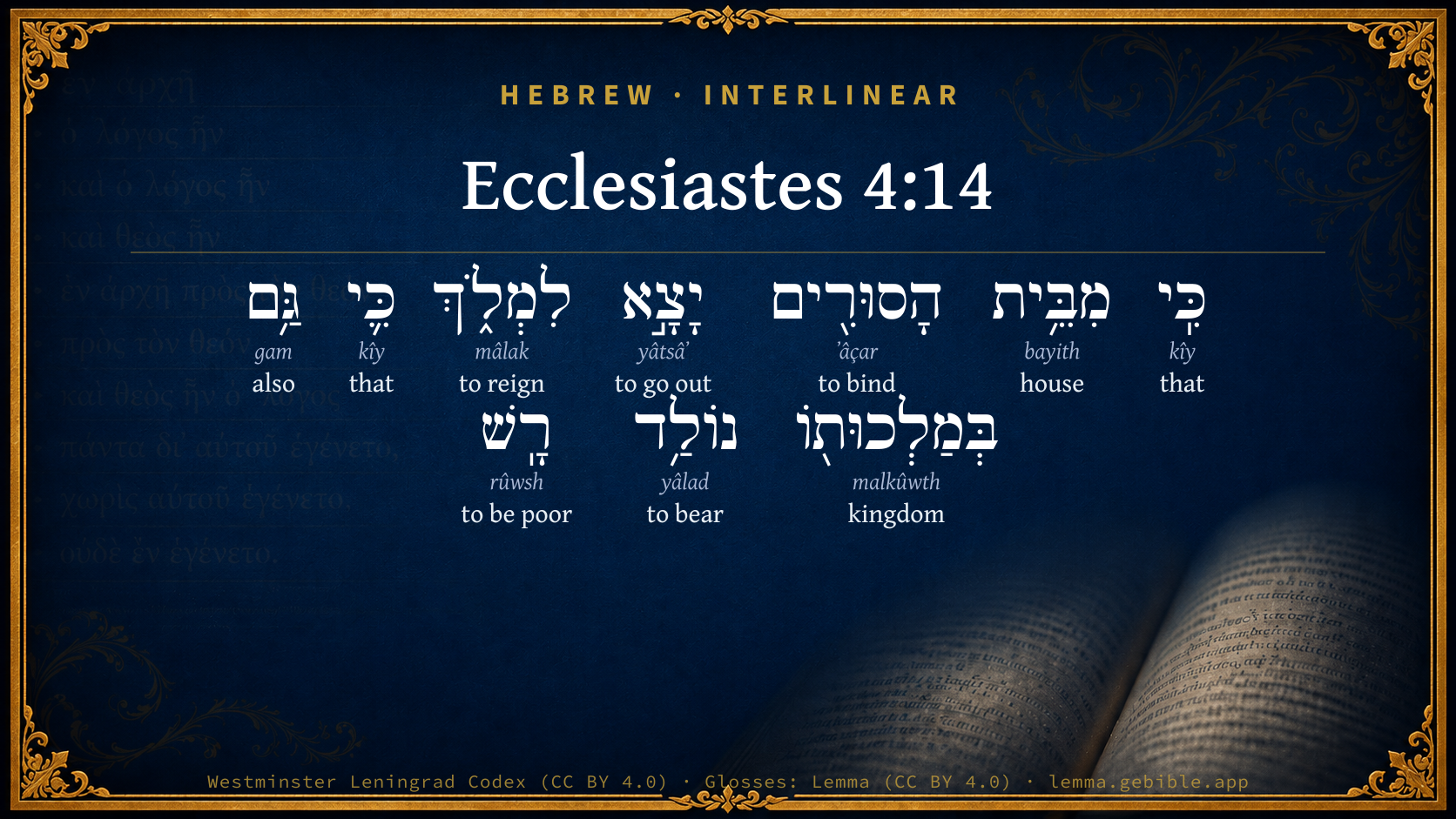
Hebrew (Westminster Leningrad Codex) Ecclesiastes 4:14 appears in the Hebrew Old Testament. The text above is from the Westminster Leningrad Codex. Each word links to its Strong’s number, a concise gloss, and parsing drawn from the Open Scriptures Hebrew Bible morphology. Click any word for its full Brown-Driver-Briggs (BDB) entry.
Download image
Cite this verse

Ecclesiastes 4:14 (World English Bible). Public Domain. Lemma interlinear Bible study tool, https://lemma.gebible.app/v/ecclesiastes/4/14.

Show BibTeX & RIS
BibTeX
RIS
English Translation
For out of prison he came forth to be king; yes, even in his kingdom he was born poor.
World English Bible · Public Domain
Download a study sheet

One document with this verse’s original text, its word-by-word gloss line, the meaning frame, cross-references with their text, attributed commentary, and full source and license credits — printable, and it pastes into notes with its structure intact.

This verse Autodidact and up

Study sheet (.html) Plain text (.txt)

A passage Seminary Student

Up to 50 verses in one chapter. A passage sheet keeps up to 6 commentary sources and 12 cross-references per verse, in the order this page ranks them, and says so on the sheet whenever that leaves anything out. Ask for a single verse and you get the Autodidact verse sheet above.

Everything on this page stays free to read, with no account — the sheet is a download of what is already on screen, not access to it.

Want to remove ads? Support Godless Engineer
Compare translations 3

The same verse in 3 English versions, stacked beneath the original-language interlinear above. Click any original word for its lexicon entry.

Each is an independent rendering of the whole verse — the interlinear is not word-aligned to these translations.

Highlighted words mark where these versions differ — a whole-verse word diff, not a word-by-word alignment.

  • World English Bible Public Domain
    For out of prison he came forth to be king; yes, even in his kingdom he was born poor.
  • King James Version Public Domain
    For out of prison he cometh to reign; whereas also he that is born in his kingdom becometh poor.
  • unfoldingWord Literal Text CC BY-SA 4.0
    For, from the house of those who are bound, he came forth to become king, yet even in his kingdom he was born poor.

unfoldingWord Literal Text — © unfoldingWord, licensed CC BY-SA 4.0. Word-aligned USFM3 via Door43 (git.door43.org/unfoldingWord/en_ult).

Versions to compare (up to 4)

3 of 4 selected

Show all 18 translations

Every available English version of this verse, each an independent rendering of the whole verse.

  • World English Bible Public Domain
    For out of prison he came forth to be king; yes, even in his kingdom he was born poor.
  • Berean Standard Bible Public Domain
    For the youth has come from the prison to the kingship, though he was born poor in his own kingdom.
  • Majority Standard Bible Public Domain
    For the youth has come from the prison to the kingship, though he was born poor in his own kingdom.
  • King James Version Public Domain
    For out of prison he cometh to reign; whereas also he that is born in his kingdom becometh poor.
  • American Standard Version (1901) Public Domain
    For out of prison he came forth to be king; yea, even in his kingdom he was born poor.
  • Revised Version (1885) Public Domain
    For out of prison he came forth to be king; yea, even in his kingdom he was born poor.
  • Geneva Bible (1599) Public Domain
    For out of the prison he commeth forth to reigne: when as he that is borne in his kingdome, is made poore.
  • Douay-Rheims (1899) Public Domain
    Because out of prison and chains sometimes a man cometh forth to a kingdom: and another born king is consumed with poverty.
  • Young's Literal Translation Public Domain
    For from a house of prisoners he hath come out to reign, for even in his own kingdom he hath been poor.
  • Literal Standard Version CC BY-SA 4.0
    For from a house of prisoners he has come out to reign, for even in his own kingdom he has been poor.
  • Unlocked Literal Bible CC BY-SA 4.0
    This is true even if the young man becomes king from prison, or even if he was born poor in his kingdom.
  • unfoldingWord Literal Text CC BY-SA 4.0
    For, from the house of those who are bound, he came forth to become king, yet even in his kingdom he was born poor.
  • Darby Bible Public Domain
    For out of the prison-house he came forth to reign, although he was born poor in his kingdom.
  • World Messianic Bible Public Domain
    For out of prison he came out to be king; yes, even in his kingdom he was born poor.
  • Webster's Bible Public Domain
    For out of prison he cometh to reign; whereas also he that is born in his kingdom becometh poor.
  • Free Bible Version CC BY-SA 4.0
    He may even come out of prison to reign over his kingdom, even though he was born poor.
  • Bible in Basic English Public Domain
    Because out of a prison the young man comes to be king, though by birth he was only a poor man in the kingdom.
  • JPS Tanakh (1917) Public Domain
    For out of prison he came forth to be king; although in his kingdom he was born poor.

Literal Standard Version (2020), Covenant Press — licensed CC BY-SA 4.0. Text via the HelloAO Bible API (eBible.org). Unlocked Literal Bible (unfoldingWord) — licensed CC BY-SA 4.0. Text via the HelloAO Bible API (eBible.org). unfoldingWord Literal Text — © unfoldingWord, licensed CC BY-SA 4.0. Word-aligned USFM3 via Door43 (git.door43.org/unfoldingWord/en_ult). Free Bible Version, Dr. Jonathan Gallagher — licensed CC BY-SA 4.0. Text via the HelloAO Bible API (eBible.org).

Word by word

More ways to search: Search by grammar → Find every occurrence → Compare this word →

Practice this passage: Drill this verse → Learn its vocabulary →

רָֽשׁ
rûwsh
H7326
“being poor”
Verb, Qal, Participle Active, Masculine, Singular, Absolute
Part of Speech
Verb
Stem
Qal
Form
Participle Active
Gender
Masculine
Number
Singular
State
Absolute
Full BDB Definition

Origin: a primitive root

TWOT: 2138

to be poor, be in want, lack - (Qal) - to be poor - to be in want or hunger - poor man (substantive) - (Hithpolel) one impoverishing himself (participle)
  1. כִּֽי kîy H3588 “that” Conjunction
  2. מִבֵּ֥ית bayith H1004 “from · house of” Preposition + Noun, Common, Masculine, Singular, Construct
  3. הָסוּרִ֖ים ʼâçar H631 “the · bound” Particle, Definite Article + Verb, Qal, Participle Passive, Masculine, Plural, Absolute
  4. יָצָ֣א yâtsâʼ H3318 “to go out” Verb, Qal, Perfect, 3rd Person, Masculine, Singular
  5. לִמְלֹ֑ךְ mâlak H4427 “to reign” Preposition + Verb, Qal, Infinitive Construct
  6. כִּ֛י kîy H3588 “that” Conjunction
  7. גַּ֥ם gam H1571 “also” Particle, Accusative
  8. בְּמַלְכוּת֖וֹ malkûwth H4438 “in/at · kingdom · his” Preposition + Noun, Common, Feminine, Singular, Construct + Suffix, Personal, 3rd Person, Masculine, Singular
  9. נוֹלַ֥ד yâlad H3205 “to bear” Verb, Niphal, Perfect, 3rd Person, Masculine, Singular

About this verse

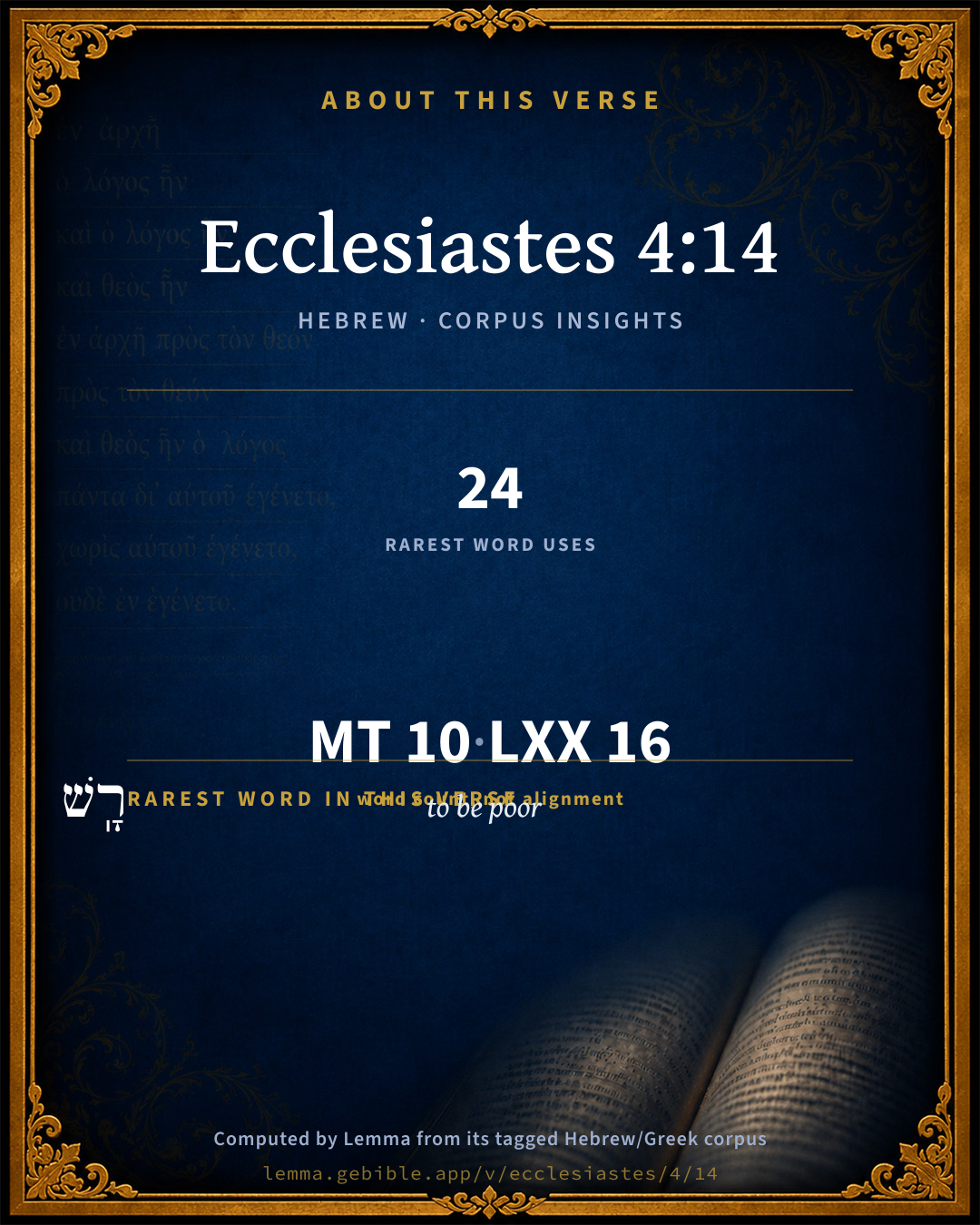
These counts appear in no published source. They are computed here, from the morphology-tagged text and Lemma’s own curated glosses. What Lemma adds →

10
words
9
distinct lemmas
Wisdom
section

Notable vocabulary

The rarest word here is רָֽשׁ to be poor H7326 — appearing just 24 times in the whole Hebrew Bible.

Shared distinctive vocabulary

רָֽשׁ to be poor H7326 occurs in 24 verses of the Hebrew Bible. Also found in:

Grammatical profile

  • 5 verbs
  • 2 nouns
  • 2 conjunctions
  • 1 particle

Verb forms

  • הָסוּרִ֖ים Qal · Participle Passive
  • יָצָ֣א Qal · Perfect
  • לִמְלֹ֑ךְ Qal · Infinitive Construct
  • נוֹלַ֥ד Niphal · Perfect
  • רָֽשׁ Qal · Participle Active

Repetition

A word recurs within this verse — often emphatic in Hebrew:

  • כִּֽי that H3588 ×2

Hebrew & Septuagint length

In English translation the verse runs 19 words from the Hebrew and 25 from the Septuagint (LXX English) — closely comparable.

A rough comparison of the two English renderings, which tokenize alike — not a word-level alignment.

Word counts can differ between the Hebrew and the Greek without any difference in meaning — e.g. the Hebrew direct-object marker אֵת has no separate Greek word, and Greek often adds the article ὁ.

In the original languages it is 10 Hebrew tokens and 16 Greek tokens — but the two are counted differently (Hebrew bundles its prefixes and suffixes into one token; the Greek is in lemma form), so that isn’t a like-for-like length.

Cross-references

13

Topical passages linked to Ecclesiastes 4:14 in the Treasury of Scripture Knowledge — connected by theme and wording, ordered by reader-vote popularity; previews shown in the World English Bible.

  • Genesis 41:14 Then Pharaoh sent and called Joseph, and they brought him hastily out of the dungeon. He shaved himself, changed his clothing, and came in to Pharaoh.
  • Psalms 113:7–8 He raises up the poor out of the dust. Lifts up the needy from the ash heap;
  • Job 5:11 So that he sets up on high those who are low, Those who mourn are exalted to safety.
  • Lamentations 4:20 The breath of our nostrils, the anointed of Yahweh, was taken in their pits; Of whom we said, Under his shadow we shall live among the nations.
  • Genesis 41:33–44 Now therefore let Pharaoh look for a discreet and wise man, and set him over the land of Egypt.
  • 2 Kings 24:6 So Jehoiakim slept with his fathers; and Jehoiachin his son reigned in his place.
  • 2 Kings 24:12 and Jehoiachin the king of Judah went out to the king of Babylon, he, and his mother, and his servants, and his princes, and his officers: and the king of Babylon took him in the eighth year of his reign.
  • 2 Kings 25:7 They killed the sons of Zedekiah before his eyes, and put out the eyes of Zedekiah, and bound him in fetters, and carried him to Babylon.
  • 2 Kings 25:27–30 It happened in the seven and thirtieth year of the captivity of Jehoiachin king of Judah, in the twelfth month, on the seven and twentieth day of the month, that Evilmerodach king of Babylon, in the year that he began to reign, did lift up the head of Jehoiachin king of Judah out of prison;
  • Daniel 4:31 While the word was in the king's mouth, there fell a voice from the sky, [saying], O king Nebuchadnezzar, to you it is spoken: The kingdom is departed from you:
  • 1 Kings 14:26–27 and he took away the treasures of the house of Yahweh, and the treasures of the king's house; he even took away all: and he took away all the shields of gold which Solomon had made.
  • 2 Kings 23:31–34 Jehoahaz was twenty-three years old when he began to reign; and he reigned three months in Jerusalem: and his mother's name was Hamutal the daughter of Jeremiah of Libnah.
  • 2 Kings 24:1–2 In his days Nebuchadnezzar king of Babylon came up, and Jehoiakim became his servant three years: then he turned and rebelled against him.

Cross-references courtesy of OpenBible.info (CC BY 4.0).

Hebrew and Greek witnesses Masoretic Hebrew ↔ Greek Septuagint

The same verse in the two great witnesses to the Old Testament, shown verse-for-verse.

These are two independent witnesses, not word-aligned to each other, and the Septuagint is shown in lemma (dictionary) form.

Hebrew Ecclesiastes 4:14 Masoretic · Westminster Leningrad Codex

כִּֽי מִבֵּ֥ית הָסוּרִ֖ים יָצָ֣א לִמְלֹ֑ךְ כִּ֛י גַּ֥ם בְּמַלְכוּת֖וֹ נוֹלַ֥ד רָֽשׁ

For out of prison he came forth to be king; yes, even in his kingdom he was born poor.

World English Bible · Public Domain

Greek LXX Ecclesiastes 4:14 Septuagint · lemma form

ὅτι ἐκ οἶκος ὁ δέσμιος ἐκἔρχομαι ὁ βασιλεύω ὅτι καί γέ ἐν βασιλεία αὐτός γεννάω πένης

For he shall come forth out of the house of the prisoners to reign, because he also that was in his kingdom has become poor.

LXX2012 (modern English Septuagint) · Public Domain

On this verse, The Pulpit Commentary discusses the Septuagint’s reading. Read the note in Commentary ↓

Hebrew: Westminster Leningrad Codex (CC BY 4.0). Greek: Septuagint (public domain); English from LXX2012 (modern English Septuagint) (Public Domain). How the Septuagint differs from the Hebrew →

Commentary

Notes on Ecclesiastes 4:14 from classic Christian and Jewish commentators (each source and its license shown beneath its notes). The classic Christian expositions comment on the surrounding passage and are grouped to its opening verse, so a note may address several verses; the Jewish commentaries on the Tanakh (Rashi and others) are per-verse, so they appear only where the commentator wrote on this verse.

Lemma curates 59 commentaries, every one of them public domain or Creative Commons licensed, each selected and text-cleaned for this edition rather than reprinted as found. About our sources →

Trapp's Complete Commentary

John Trapp

Ecc 4:14 For out of prison he cometh to reign; whereas also [he that is] born in his kingdom becometh poor.

Ver. 14. For out of prison he cometh to reign.] As Valentinian the emperor; Sultan Mustapha the great Turk, A.D. 1622; our Henry IV, who was crowned the very same day that, the year before, he had been banished the realm. {a} As, on the other side, Henry VI was sent again prisoner to the Tower the same day that he had been carried through the city, as it were, in triumph, and had heard the shouts of the commons in every street, crying, God save King Henry. Lo! he that had been the most potent monarch for dominions, saith the chronicler, {b} that ever England had, was not now the master of a molehill, nor owner of his own liberty. So that in him it appeared that mortality was but the stage of mutability, when a man born in his kingdom, yea, born to a kingdom, became thus miserably poor. Furthermore, Henry Holland, Duke of Exeter, grandchild to John of Gaunt, may serve as a fit instance and example to all how uncertain Adam’s sons are of any continuing greatness. For, saith Philip Commines, I once saw him run on foot bare legged after the Duke of Burgundy’s train, begging {c} his bread for God’s sake; but he uttered not his name, he being the nearest of the house of Lancaster, and brother-in-law unto King Edward IV, from whom he fled; and being known who he was, Burgundy gave him a small pension to maintain his estate. {d}

{a} Daniel’s Hist., fol. 480.

{b} Speed, 881.

{c} Date obolum Bellisario.

{d} Speed, 887.

John Trapp, A Commentary or Exposition upon All the Books of the Old and New Testament (1647–1656) — public domain. Text from a community e-Sword module.

Geneva Bible (1599)

Geneva Bible translators

That is, from a poor and base estate, or out of trouble and prison, as Joseph did, Gen. 41:14.

Meaning, that is born a King.

Geneva Bible (1599) marginal notes — public domain. Text via Bolls.life.

Jamieson, Fausset & Brown

Robert Jamieson, A. R. Fausset & David Brown

out of prison--Solomon uses this phrase of a supposed case; for example, Joseph raised from a dungeon to be lord of Egypt. His words are at the same time so framed by the Holy Ghost that they answer virtually to Jeroboam, who fled to escape a "prison" and death from Solomon, to Shishak of Egypt (Kg1 11:40). This unconscious presaging of his own doom, and that of Rehoboam, constitutes the irony. David's elevation from poverty and exile, under Saul (which may have been before Solomon's mind), had so far their counterpart in that of Jeroboam.

whereas . . . becometh poor--rather, "though he (the youth) was born poor in his kingdom" (in the land where afterwards he was to reign).

Jamieson, Fausset & Brown — Commentary Critical and Explanatory on the Whole Bible (1871) — public domain (CC PDM 1.0). Text via the HelloAO Bible API.

Adam Clarke's Commentary

Verse 14. For out of prison he cometh to reign] "Then Abraham left the country of the idolaters, where he had been imprisoned, and came and reigned over the land of Canaan; and Nimrod became poor in this world." This is the fact to which the ancient rabbins supposed Solomon to allude.

Adam Clarke's Commentary on the Bible (1810–1826) — public domain. Text from a community e-Sword/MySword module.

Ellicott's Commentary for English Readers

(14) Becometh.—Instead of this translation, it is better to render, in his kingdom he was even poor; but there is ambiguity in the Hebrew, as in the English, whether the antecedent of the “his” and the “he” is the old king or the new one.

A Bible Commentary for English Readers, edited by Charles John Ellicott (1878–1897) — public domain. Text from a community e-Sword module.

The Cambridge Bible for Schools and Colleges

gen. ed. J. J. S. Perowne

14. For out of prison he cometh to reign] The pronouns are ambiguous in the Hebrew as in English, and the clauses have consequently been taken in very different ways, as referring to one and the same person, or to the two who had been named in the preceding verse (1) “For one cometh out of prison to reign, though he (the young successor) was born poor in his kingdom” (that of the old king, or that which was afterwards to be his own); or (2) “For one cometh out of prison to reign, while a king becomes a beggar in his kingdom.” Here also a reference has been found to the history of Onias under Ptolemy Euergetes. Josephus describes him (Ant. xii. 4) as “of a little soul and a great lover of money” while his nephew Joseph “young in age” was “of great reputation for gravity, wisdom and justice,” and obtained from the king permission to farm the revenues of Cœlesyria, Phœnicia, Samaria and Judæa. It can scarcely be said however that the case thus narrated is parallel with what we find in the verse before us. There is no king old or young, coming out of prison, or reduced to poverty. On the whole, unless the words refer to some unrecorded incident, some vague reminiscence of Cyrus and Astyages seems more likely to have been before the writer’s mind. According to one version of that history Cyrus had been brought up in poverty (Herod. i. 112), and was so strictly guarded that Harpagus had recourse to stratagem to convey a letter into his hands (Herod. i. 123).

The Cambridge Bible for Schools and Colleges (gen. ed. J. J. S. Perowne; Cambridge University Press, 1878–1918) — public domain. Text from a community e-Sword module.

John Gill's Exposition

For out of prison he cometh to reign,.... That is, this is sometimes the case of a poor and wise child; he rises out of a low, mean, abject, obscure state and condition, to the highest dignity; from a prison house, or a place where servants are, to sit among princes, and even to have the supreme authority: so Joseph, to whose case Solomon is thought to have respect, and which is mentioned in the Midrash; who was but a young man, and poor and friendless, but wise; and was even laid in prison, though innocent and guiltless, from whence he was fetched, and became the second man in the kingdom of Egypt; so David, the youngest of Jesse's sons, was taken from the sheepfold, and set upon the throne of Israel: though Gussetius (e) interprets this of the old and foolish king, who comes out of the house or family, of degenerate persons, as he translates the word, with a degenerate genius to rule; the allusion being to a degenerate vine; which sense agrees with Ecc 4:13, and with what follows;

whereas also he that is born in his kingdom becometh poor; who is born of royal parents, born to a kingdom; is by birth heir to one, has it by inheritance, and has long possessed it; and yet, by his own misconduct, or by the rebellion of his subjects, he is dethroned and banished; or by a foreign power is taken and carried captive, and reduced to the utmost poverty, as Zedekiah, Nebuchadnezzar, and others: or if born poor, so Gussetius; with a poor genius, not capable of ruling, and so loses his kingdom, and comes to poverty. Or it may be rendered, "although in his kingdom he is born poor" (f); that is, though the poor and wise child is born poor in the kingdom of the old and foolish king; yet, out of this low estate, in which he is by birth, he comes and enjoys the kingdom in his room to such a strange turn of affairs are the highest honours subject: or, "for in his kingdom he is born poor" (g); even the person that is born heir to a crown is born a poor man; he comes as naked out of his mother's womb as the poorest man does; the conditions of both are equal as to birth; and therefore it need not seem strange that one out of prison should come to a kingdom. But the first sense seems best.

(e) Ebr. Comment. p. 553. (f) "quamvis etiam", Gejerus. (g) "Nam etiam", Tigurine version, Cocceius; "quia etiam", Pagninus, Montanus, Schmidt, Rambachius, so Aben Ezra.

John Gill's Exposition of the Whole Bible (1746–1763) — public domain (CC PDM 1.0). Text via the HelloAO Bible API.

Haydock's Catholic Bible Commentary

Prison. The exaltation of Joseph, Mardochai, and Daniel, was remarkable. (Calmet) --- Si fortuna volet, fies de Rhetore Consul. (Juvenal, Sat. vii.)

George Leo Haydock (1774–1849), Haydock's Catholic Family Bible and Commentary, 1859 edition — public domain. Excludes Psalms (Douay-Rheims chapter numbering differs from Protestant) and Deuterocanonical books (Catholic canon only).

Matthew Poole's English Annotations

Out of prison, into which he was cast for his poverty and debt, he, the poor and wise child,

cometh to reign; is ofttimes advanced by his wisdom to the highest power and dignity; which was the case of Joseph, and Mordecai, and many others.

He that is born in his kingdom, that old king, who was born of the royal race, and had possessed his kingdom for a long time,

becometh poor; is deprived of his kingdom, either by the rebellion of his subjects provoked by his folly, or by the power of some other and wiser prince.

Matthew Poole's English Annotations on the Holy Bible (1683–1685) — public domain. Text from a community e-Sword/MySword module.

Whedon's Commentary on the Bible

Daniel D. Whedon

14. Out of prison… reign — The possibilities of the “youth” are stated as a reason for the declaration of the preceding verse. He may go from prison to a throne, while a born king, managing foolishly, may become a poor outcast. The bright example of Joseph was ever recurring to Jewish writers. Also, that of Jeroboam the “industrious,” who, after the death of Solomon, returned from exile in Egypt and became king of Israel.

Daniel D. Whedon (gen. ed.), Commentary on the Old and New Testaments (1874–1909) — public domain. Text from a community e-Sword module.

The Pulpit Commentary

For out of prison he cometh to reign; whereas also he that is born in his kingdom becometh poor. The ambiguity of the pronouns has induced different interpretations of this verse. It is plain that the paragraph is intended to corroborate the statement of the previous verse, contrasting the fate of the poor, clever youth with that of the old, foolish king. The Authorized Version makes the pronoun in the first clause refer to the youth, and those in the second to the king, with the signification that rich and poor change places one is abased as the other is exalted. Vulgate, Quod de carcere catenisque interdum quis egrediatnr ad regnum; et alius natus in regno inopia consummatur. The Septuagint is somewhat ambiguous, Oti ejx oikou twn desmiwn elxeleusetai tou basileusai oti kai ge ejn basileia aujtou ejgenhqh penhv, "For from the house of prisoners he shall come forth to reign, because in his kingdom he who? was born or, "became" poor." It seems, however, most natural to make the leading pronouns in both clauses refer to the youth, and thus to render: "For out of the house of prisoners goeth he forth to reign, though even in his kingdom he was born poor." Beth hasurim is also rendered "house of fugitives," and Hitzig takes the expression as a description of Egypt, whither Jeroboam fled to escape the vengeance of Solomon. Others see here an allusion to Joseph, who was raised from prison, if not to be king, at least to an exalted position which might thus be designated. In this case the old and foolish king who could not look to the future is Pharaoh, who could not understand the dream which was sent for his admonition. Commentators have wearied themselves with endeavoring to find some other historical basis for the supposed allusion in the passage. But although many of these suggestions (e.g. Saul and David, Joash and Amaziah, Cyrus and Astyages, Herod and Alexander) meet a part of the case, none suit the whole passage (vers. 13-16). It is possible, indeed, that some particular allusion is intended to some circumstance or event with which we are not acquainted. At the same time, it seems to us that, without much straining of language, the reference to Joseph can be made good. If it is objected that it cannot be said that Joseph was born in the kingdom of Egypt, we may reply that the words may be taken to refer to his cruel position in his own country, when he was despoiled and sold, and may be said metaphorically to have become poor;" or the word nolad may be considered as equivalent to "came," "appeared," and need not be restricted to the sense of "born."

The Pulpit Commentary (1880–1919), ed. H.D.M. Spence-Jones & Joseph S. Exell — public domain. Text from a community e-Sword module.

John Wesley's Explanatory Notes

For he - The poor and wise child is often advanced to the highest dignity. Whereas - That old king is deprived of his kingdom.

John Wesley, Explanatory Notes Upon the Whole Bible (1754–1765) — public domain. Text via the GEBible commentary corpus.

Keil & Delitzsch

C. F. Keil & F. Delitzsch

"For out of the prison-house he goeth forth to reign as king, although he was born as a poor man in his kingdom." With כּי the properties of poverty and wisdom attributed to the young man are verified, - wisdom in this, that he knew how to find the way from a prison to a throne. As harammim, Ch2 22:5 = haarammim, Kg2 8:28, so hasurim = haasurim (cf. masoreth = maasoreth, Eze 20:37); beth haasirim (Kerı̂; haasurim), Jdg 16:21, Jdg 16:25, and beth haesur, Jer 38:15, designate the prison; cf. Mod katan, Ecc 3:1. The modern form of the language prefers this elision of the א, e.g., אפלּוּ = אף אלּוּ, אלתּר = אל־אתר, בּתר post = בּאתר contra, etc. The perf. יחא is also thought of as having reached the throne, and having pre-eminence assigned to him as such. He has come forth from the prison to become king, רשׁ ... כּי. Zckler translates: "Whereas also he that was born in his kingdom was poor," and adds the remark: "גם כי, after the כי of the preceding clause, does not so much introduce a verification of it, as much rather an intensification; by which is expressed, that the prisoner has not merely transitorily fallen into such misery, but that he was born in poor and lowly circumstances, and that in his own kingdom בּם, i.e., in the same land which he should afterwards rule as king." But גם כי is nowhere used by Koheleth in the sense of "ja auch" (= whereas also); and also where it is thus to be translated, as at Jer 14:18; Jer 23:11, it is used in the sense of "denn auch" (= for also), assigning proof. The fact is, that this group of particles, according as כי is thought of as demonst. or relat., means either "denn auch," Ecc 4:16; Ecc 7:22; Ecc 8:16, or "wenn auch" = ἐὰν καί, as here and at Ecc 8:12. In the latter case, it is related to כּי גּם (sometimes also merely גּם, Psa 95:9; Mal 3:15), as ἐὰν (εἰ) καί, although, notwithstanding, is to καὶ ἐάν (εἰ), even although.

(Note: That the accentuation separates the two words גם־ כי is to be judged from this, that it almost everywhere prefers אם־ כי (vid., under Comm. to Psa 1:2).)

Thus 14b, connecting itself with למלך, is to be translated: "although he was born (נולד,not נולד) in his kingdom as a poor man."

(Note: נולד רש cannot mean "to become poor." Grtz appeals to the Mishnic language; but no intelligent linguist will use נולד רשׁ of a man in any other sense than that he is originally poor.)

We cannot also concur with Zckler in the view that the suff. of :_b refers to the young upstart: in the kingdom which should afterwards become his; for this reason, that the suff. of תח, Ecc 4:16, refers to the old king, and thus also that this designation may be mediated, בם must refer to him. מלכות signifies kingdom, reign, realm; here, the realm, as at Neh 9:35, Dan 5:11; 6:29. Grtz thinks Ecc 4:13-16 ought to drive expositors to despair. But hitherto we have found no room for despair in obtaining a meaning from them. What follows also does not perplex us. The author describes how all the world hails the entrance of the new youthful king on his government, and gathers together under his sceptre.

Keil & Delitzsch — Biblical Commentary on the Old Testament (1861–1891) — public domain (CC PDM 1.0). Text via the HelloAO Bible API. (Old Testament only.)

Rashi

Rabbi Shlomo Yitzchaki (Rashi)

For out of the prison he has come to reign Heb. הָסוּרִים; from the place of filth and stench, as we translate: (Exod. 16:29) וַיִבְאַשּׁ, (and it became putrid) as וּסְרִי.

for even in his kingdom Since he reigned over man, the poor one was born; the poor one, who was better than he, and who came out of purity, not out of the filth of the womb. So did our Rabbis interpret it in the Midrash. [See Ecc. Rabbah.] Another explanation: [13] Better a poor and wise child, etc. according to its apparent meaning. who no longer knows to receive admonition for he has already aged in his wickedness and foolishness. [14] For out of the prison he has come to reign For the poor child—it will ultimately be said about him that he came to reign from the midst of his affliction and from the place of his imprisonment, for the “sammech” of הָסוּרִים is punctuated without a “dagesh,” which is equivalent to הָאֲסוּרִים. [Some editions: like (Isa. 13:20): “and no Arab shall pitch his tent (יַהֵל) there, like יֶאֶהַל], for so we found that Joseph reigned following his being freed from prison, and so David, (II Sam. 7:8): “I took you from the sheepcote, from following the sheep.”

for even in his kingdom he becomes humble For it is fitting and proper that he should reign, because even in his kingdom, he changed from the custom of the ruling class and he humbled himself to the sages, like the custom of the poor. And so (Job 11:12): “and [from] a wild donkey a man will be born (יִוָלֵד),” that he will be changed and converted from what he was, resembling a wild donkey, and he will become a man.

נוֹלַד means “becomes,” and it is in the present tense.

Rashi on the Tanakh — English translations: “The Judaica Press complete Tanach with Rashi, translated by A. J. Rosenberg” (CC BY 4.0); “Pentateuch with Rashi's commentary by M. Rosenbaum and A.M. Silbermann, 1929-1934” (public domain); “The Metsudah Tanach series, Lakewood, N.J” (CC BY 4.0); and “The Book of Joshua, Metsudah Publications, 1997” (CC BY 4.0). Text via Sefaria.

Lesson kit

Teaching starters — assembled from the data on this page, not authored interpretation. Every prompt links to the verse data it draws on. Edit before teaching.

Ecclesiastes, in the Wisdom, opens this verse with 10 words (9 distinct Hebrew lemmas). Its most distinctive word is rûwsh (“to be poor”). A historical commentator’s framing appears above. Read the whole chapter for the surrounding context.

Discussion questions

  1. How does “to be poor” (rûwsh) shape what this verse is saying?
  2. How does 1 Samuel 18:23, which shares the word «to be poor», read alongside this verse?
  3. What does the repetition of “that” (2× in this one verse) do in this verse?
  4. The translations on this page render this verse differently — a whole-verse word diff, not a word-by-word alignment. What might account for the different wordings?
  5. «הָסוּרִ֖ים» is a Qal Participle Passive verb. How does that grammatical form shape the action described?
  6. Compare how Trapp's Complete Commentary and Geneva Bible (1599) read this verse. Where do they agree or differ?

Things to notice

Reading settings

Reading text

Shown beneath each verse's original-language words.

Old Testament
Old Testament edition

Read the OT as the Masoretic Hebrew (MT) or the Greek Septuagint (LXX).

English shown for the Greek Septuagint (in the Hebrew ↔ Greek comparison).

Comparing translations? Open the Compare panel on any verse page to stack up to four side by side.