
Judges 8:31

Hebrew (Westminster Leningrad Codex) Judges 8:31 appears in the Hebrew Old Testament. The text above is from the Westminster Leningrad Codex. Each word links to its Strong’s number, a concise gloss, and parsing drawn from the Open Scriptures Hebrew Bible morphology. Click any word for its full Brown-Driver-Briggs (BDB) entry.
Download image
Cite this verse

Judges 8:31 (World English Bible). Public Domain. Lemma interlinear Bible study tool, https://lemma.gebible.app/v/judges/8/31.

Show BibTeX & RIS
BibTeX
RIS
English Translation
His concubine who was in Shechem, she also bore him a son, and he named him Abimelech.
World English Bible · Public Domain
Download a study sheet

One document with this verse’s original text, its word-by-word gloss line, the meaning frame, cross-references with their text, attributed commentary, and full source and license credits — printable, and it pastes into notes with its structure intact.

This verse Autodidact and up

Study sheet (.html) Plain text (.txt)

A passage Seminary Student

Up to 50 verses in one chapter. A passage sheet keeps up to 6 commentary sources and 12 cross-references per verse, in the order this page ranks them, and says so on the sheet whenever that leaves anything out. Ask for a single verse and you get the Autodidact verse sheet above.

Everything on this page stays free to read, with no account — the sheet is a download of what is already on screen, not access to it.

Want to remove ads? Support Godless Engineer
Compare translations 3

The same verse in 3 English versions, stacked beneath the original-language interlinear above. Click any original word for its lexicon entry.

Each is an independent rendering of the whole verse — the interlinear is not word-aligned to these translations.

Highlighted words mark where these versions differ — a whole-verse word diff, not a word-by-word alignment.

  • World English Bible Public Domain
    His concubine who was in Shechem, she also bore him a son, and he named him Abimelech.
  • King James Version Public Domain
    And his concubine that was in Shechem, she also bare him a son, whose name he called Abimelech.
  • unfoldingWord Literal Text CC BY-SA 4.0
    And his concubine, who in Shechem, bore to him, she too, a son, and he made his name Abimelech.

unfoldingWord Literal Text — © unfoldingWord, licensed CC BY-SA 4.0. Word-aligned USFM3 via Door43 (git.door43.org/unfoldingWord/en_ult).

Versions to compare (up to 4)

3 of 4 selected

Show all 18 translations

Every available English version of this verse, each an independent rendering of the whole verse.

  • World English Bible Public Domain
    His concubine who was in Shechem, she also bore him a son, and he named him Abimelech.
  • Berean Standard Bible Public Domain
    His concubine, who dwelt in Shechem, also bore him a son, and he named him Abimelech.
  • Majority Standard Bible Public Domain
    His concubine, who dwelt in Shechem, also bore him a son, and he named him Abimelech.
  • King James Version Public Domain
    And his concubine that was in Shechem, she also bare him a son, whose name he called Abimelech.
  • American Standard Version (1901) Public Domain
    And his concubine that was in Shechem, she also bare him a son, and he called his name Abimelech.
  • Revised Version (1885) Public Domain
    And his concubine that was in Shechem, she also bare him a son, and he called his name Abimelech.
  • Geneva Bible (1599) Public Domain
    And his concubine that was in Shechem, bare him a sonne also, whose name he called Abimelech.
  • Douay-Rheims (1899) Public Domain
    And his concubine, that he had in Sichem, bore him a son, whose name was Abimelech.
  • Young's Literal Translation Public Domain
    and his concubine, who `is' in Shechem, hath born to him -- even she -- a son, and he appointeth his name Abimelech.
  • Literal Standard Version CC BY-SA 4.0
    and his concubine, who [is] in Shechem, has borne to him—even she—a son, and he appoints his name Abimelech.
  • Unlocked Literal Bible CC BY-SA 4.0
    His concubine, who was in Shechem, also bore him a son, and Gideon gave him the name Abimelech.
  • unfoldingWord Literal Text CC BY-SA 4.0
    And his concubine, who in Shechem, bore to him, she too, a son, and he made his name Abimelech.
  • Darby Bible Public Domain
    And his concubine who was in Shechem also bore him a son, and he called his name Abim'elech.
  • World Messianic Bible Public Domain
    His concubine who was in Shechem also bore him a son, and he named him Abimelech.
  • Webster's Bible Public Domain
    And his concubine that was in Shechem, she also bore him a son, whose name he called Abimelech.
  • Free Bible Version CC BY-SA 4.0
    His concubine, who lived in Shechem, also had a son. He named him Abimelech.
  • Bible in Basic English Public Domain
    And the servant-wife he had in Shechem had a son by him, to whom he gave the name Abimelech.
  • JPS Tanakh (1917) Public Domain
    And his concubine that was in Shechem, she also bore him a son, and he called his name Abimelech.

Literal Standard Version (2020), Covenant Press — licensed CC BY-SA 4.0. Text via the HelloAO Bible API (eBible.org). Unlocked Literal Bible (unfoldingWord) — licensed CC BY-SA 4.0. Text via the HelloAO Bible API (eBible.org). unfoldingWord Literal Text — © unfoldingWord, licensed CC BY-SA 4.0. Word-aligned USFM3 via Door43 (git.door43.org/unfoldingWord/en_ult). Free Bible Version, Dr. Jonathan Gallagher — licensed CC BY-SA 4.0. Text via the HelloAO Bible API (eBible.org).

Word by word

More ways to search: Search by grammar → Find every occurrence → Compare this word →

Practice this passage: Drill this verse → Learn its vocabulary →

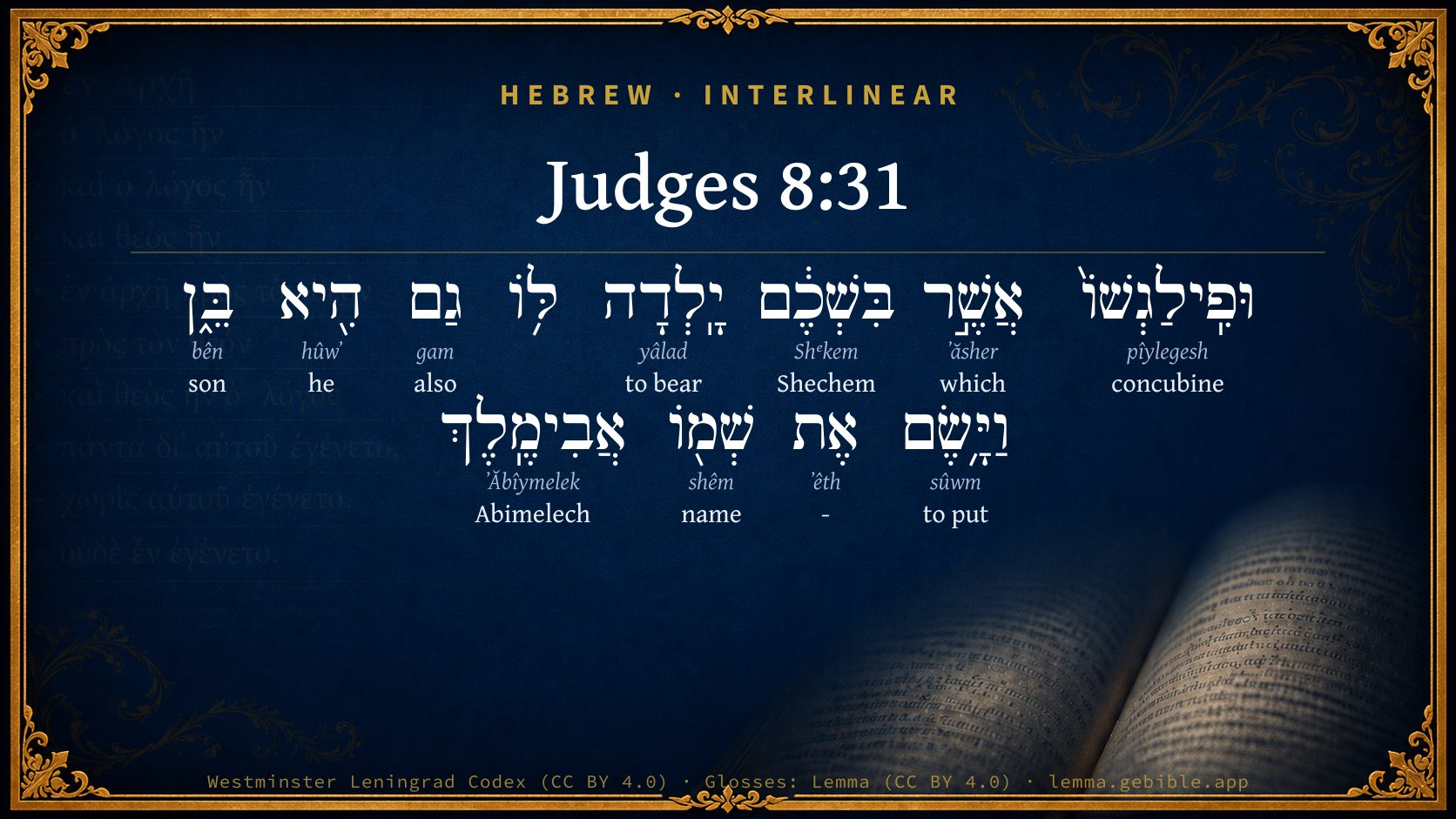
וּפִֽילַגְשׁוֹ֙
pîylegesh
H6370
“and · concubine · his”
Conjunction + Noun, Common, Feminine, Singular, Construct + Suffix, Personal, 3rd Person, Masculine, Singular
Part of Speech
Conjunction + Noun
Type
Common
Gender
Feminine
Number
Singular
State
Construct
Full BDB Definition

Origin: of uncertain derivation

TWOT: 1770

concubine, paramour - concubine - paramour
  1. אֲשֶׁ֣ר ʼăsher H834 “which” Particle, Relative
  2. בִּשְׁכֶ֔ם Shᵉkem H7927 “in/at · Shechem” Preposition + Noun, Proper
  3. יָֽלְדָה yâlad H3205 “to bear” Verb, Qal, Perfect, 3rd Person, Feminine, Singular
  4. גַם gam H1571 “also” Adverb
  5. הִ֖יא hûwʼ H1931 “he” Pronoun, Personal, 3rd Person, Feminine, Singular
  6. בֵּ֑ן bên H1121 “son” Noun, Common, Masculine, Singular, Absolute
  7. וַיָּ֥שֶׂם sûwm H7760 “and · to put” Conjunction + Verb, Qal, Sequential Imperfect, 3rd Person, Masculine, Singular
  8. אֶת ʼêth H853 “-” Particle, Direct Object
  9. שְׁמ֖וֹ shêm H8034 “name · his” Noun, Common, Masculine, Singular, Construct + Suffix, Personal, 3rd Person, Masculine, Singular
  10. אֲבִימֶֽלֶךְ ʼĂbîymelek H40 “Abimelech” Noun, Proper

About this verse

These counts appear in no published source. They are computed here, from the morphology-tagged text and Lemma’s own curated glosses. What Lemma adds →

12
words
11
distinct lemmas
Historical
section

Shared distinctive vocabulary

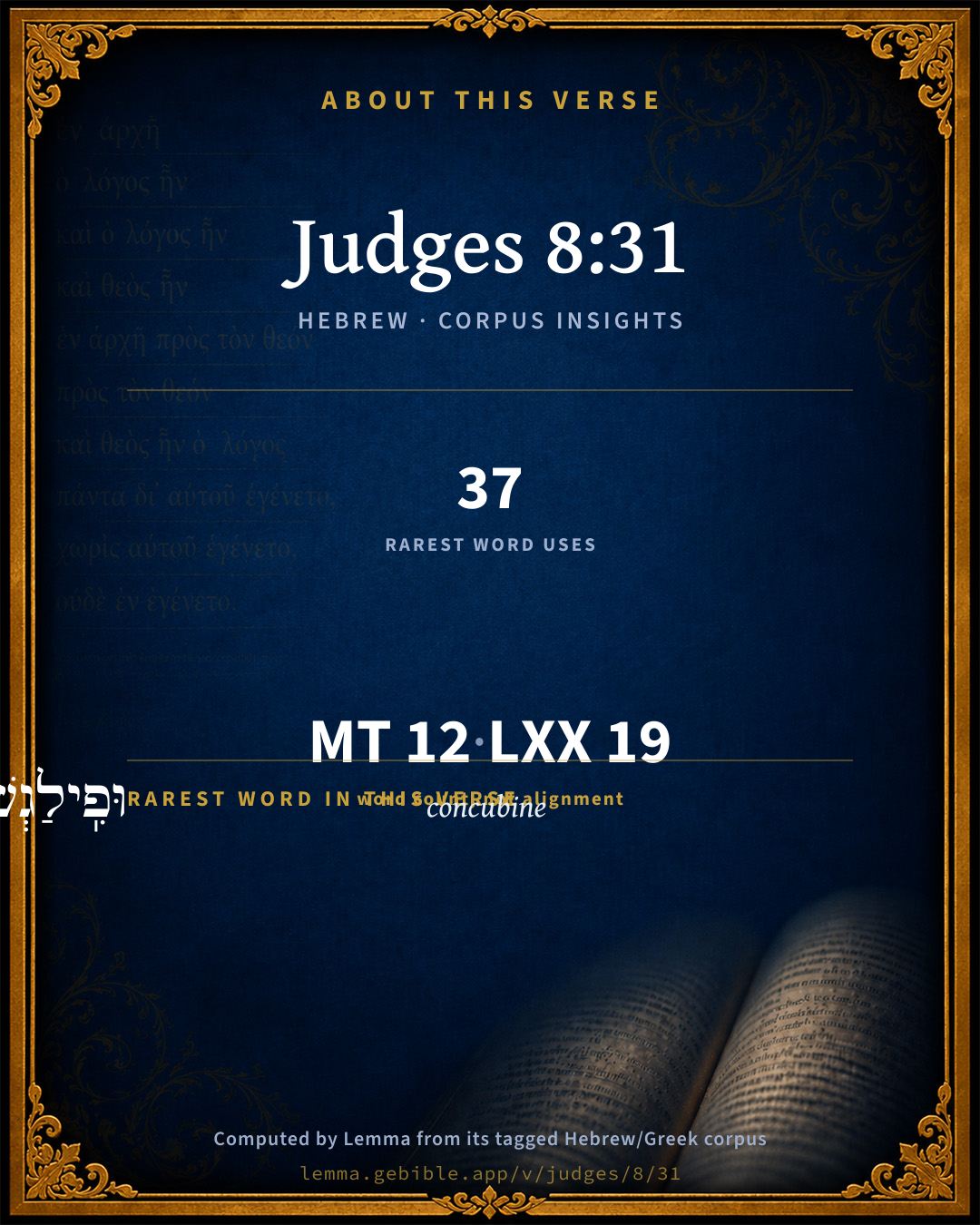
וּפִֽילַגְשׁוֹ֙ concubine H6370 occurs in 35 verses of the Hebrew Bible. Also found in:

Grammatical profile

  • 2 verbs
  • 5 nouns
  • 1 pronoun
  • 1 preposition
  • 1 adverb
  • 2 particles

Verb forms

  • יָֽלְדָה Qal · Perfect
  • וַיָּ֥שֶׂם Qal · Sequential Imperfect

Hebrew & Septuagint length

In English translation the verse runs 17 words from the Hebrew and 19 from the Septuagint (LXX English) — closely comparable.

A rough comparison of the two English renderings, which tokenize alike — not a word-level alignment.

Word counts can differ between the Hebrew and the Greek without any difference in meaning — e.g. the Hebrew direct-object marker אֵת has no separate Greek word, and Greek often adds the article ὁ.

In the original languages it is 12 Hebrew tokens and 19 Greek tokens — but the two are counted differently (Hebrew bundles its prefixes and suffixes into one token; the Greek is in lemma form), so that isn’t a like-for-like length.

Cross-references

5

Topical passages linked to Judges 8:31 in the Treasury of Scripture Knowledge — connected by theme and wording, ordered by reader-vote popularity; previews shown in the World English Bible.

  • Genesis 16:15 Hagar bore a son for Abram. Abram called the name of his son, whom Hagar bore, Ishmael.
  • Genesis 20:2 Abraham said about Sarah his wife, "She is my sister." Abimelech king of Gerar sent, and took Sarah.
  • Genesis 22:24 His concubine, whose name was Reumah, also bare Tebah, Gaham, Tahash, and Maacah.
  • Judges 9:1–5 Abimelech the son of Jerubbaal went to Shechem to his mother's brothers, and spoke with them, and with all the family of the house of his mother's father, saying,
  • Judges 9:18 and you are risen up against my father's house this day, and have slain his sons, seventy persons, on one stone, and have made Abimelech, the son of his maid-servant, king over the men of Shechem, because he is your brother);

Cross-references courtesy of OpenBible.info (CC BY 4.0).

Hebrew and Greek witnesses Masoretic Hebrew ↔ Greek Septuagint

The same verse in the two great witnesses to the Old Testament, shown verse-for-verse.

These are two independent witnesses, not word-aligned to each other, and the Septuagint is shown in lemma (dictionary) form.

Hebrew Judges 8:31 Masoretic · Westminster Leningrad Codex

וּפִֽילַגְשׁוֹ֙ אֲשֶׁ֣ר בִּשְׁכֶ֔ם יָֽלְדָה לּ֥וֹ גַם הִ֖יא בֵּ֑ן וַיָּ֥שֶׂם אֶת שְׁמ֖וֹ אֲבִימֶֽלֶךְ

His concubine who was in Shechem, she also bore him a son, and he named him Abimelech.

World English Bible · Public Domain

Greek LXX Judges 8:31 Septuagint · lemma form

καί παλλακή αὐτός εἰμί ἐν συχεμ καί τίκτω αὐτός καί γέ αὐτός υἱός καί τίθημι ὁ ὄνομα αὐτός αβιμελεχ

And his concubine was in Sychem, and she also bore him a son, and gave him the name Abimelech.

LXX2012 (modern English Septuagint) · Public Domain

Hebrew: Westminster Leningrad Codex (CC BY 4.0). Greek: Septuagint (public domain); English from LXX2012 (modern English Septuagint) (Public Domain). How the Septuagint differs from the Hebrew →

Targum (Aramaic paraphrase)

1

The Targum is the ancient Jewish Aramaic paraphrase of the Hebrew Scriptures — an interpretive translation, not the Hebrew text itself. Onkelos (literal) and Pseudo-Jonathan (expansive) render the Torah, and Jonathan the Prophets. Coverage is partial: where no permissively-licensed English translation exists for a verse, only the Aramaic is shown. This is verse-level text, not a word-by-word alignment to the Hebrew.

  1. Targum Jonathan Prophets (Joshua–Malachi)
    וּלְחֵנָתֵיהּ דִי בִשְׁכֶם יְלִידַת לֵיהּ אַף הִיא בַּר וְשַׁוִי יַת שְׁמֵיהּ אֲבִימֶלֶךְ:

    (no public-domain English translation for this verse)

    Targum Jonathan — Aramaic: “Mikraot Gedolot” (public domain). English: “Sefaria Community Translation” (CC0 1.0 (public-domain dedication)); “London "Chaldee Paraphrase," 1871” (public domain). Text via Sefaria.

Commentary

Notes on Judges 8:31 from classic Christian and Jewish commentators (each source and its license shown beneath its notes). The classic Christian expositions comment on the surrounding passage and are grouped to its opening verse, so a note may address several verses; the Jewish commentaries on the Tanakh (Rashi and others) are per-verse, so they appear only where the commentator wrote on this verse.

Lemma curates 59 commentaries, every one of them public domain or Creative Commons licensed, each selected and text-cleaned for this edition rather than reprinted as found. About our sources →

Trapp's Complete Commentary

John Trapp

Jdg 8:31 And his concubine that [was] in Shechem, she also bare him a son, whose name he called Abimelech.

Ver. 31. And his concubine,] i.e., His wife though in an inferior degree: {a} as having been before his maid servant. {Jdg 9:18}

Whose name he called Abimelech,] i.e., My father is king. This name, probably, he gave him at the motion of his concubine, who might say of her son as afterwards Nero’s mother did of him, Occidar, modo imperet; let him reign upon any terms: and possibly this name of his might stir him up to aspire to the kingdom, taking omen ex nomine, and being told that his father was offered the sovereign and supreme power for him and his posterity.

{a} Dio.

John Trapp, A Commentary or Exposition upon All the Books of the Old and New Testament (1647–1656) — public domain. Text from a community e-Sword module.

Joseph Benson's Commentary

Jdg 8:31-32. His concubine that was in Shechem — She dwelt there, and he often went thither, either to execute judgment, or upon other occasions. Abimelech — That is, my father the king; so he called him, probably to gratify his concubine, who desired it either out of pride, or design. Gideon died in a good old age — His long life being crowned with the continuance of honour, tranquillity, and happiness.

Joseph Benson's Commentary on the Old and New Testaments (1811–1818) — public domain. Text from a community e-Sword module.

Adam Clarke's Commentary

Verse 31. His concubine] A lawful but secondary wife, whose children could not inherit.

Whose name he called Abimelech.] That is, my father is king, or my father hath reigned. This name was doubtless given by the mother, and so it should be understood here; she wished to raise her son to the supreme government, and therefore gave him a name which might serve to stimulate him to seek that which she hoped he should enjoy in his father's right. See the following chapter (Jdg 9).

Adam Clarke's Commentary on the Bible (1810–1826) — public domain. Text from a community e-Sword/MySword module.

Ellicott's Commentary for English Readers

(31) His concubine that was in Shechem.—In Jdg_9:18 she is contemptuously called his “maid servant.” The sequel (Jdg_9:1-4) seems to show that she belonged to the Canaanite population of Shechem. If so, Gideon’s conduct in making her a concubine was as much against the Mosaic law as that of Solomon, though it may have had the same colour of worldly expediency. But it is probable that the requirements of the Mosaic law were much better known in the reign of Solomon, when the priests had once more become influential, than they were in this anarchical period. This concubine exercised an influence sufficiently important to cause the preservation of her name by tradition—Drumah (Jos. Antt. v. 7, § 1).

Whose name he called Abimelech.—For “called” the margin has set. The phrase is not the ordinary one, and perhaps implies that Abimelech (Father-king—“a king, my father”) was a surname given him by his father on observing his ambitious and boastful character. It seems more probable that the name was given by the Shechemites and his mother, and it may not have been without some influence for evil upon his ultimate career. The name has exactly the same significance as Padishah and Attalik, the title of the Khan of Bokhara (Gesenius). Being a well-understood dynastic title (Genesis 20; Psalms 34 title), it would be all the more significant. He was like a bad reproduction of Gideon, with the courage and energy of his father, but with none of his virtues.

A Bible Commentary for English Readers, edited by Charles John Ellicott (1878–1897) — public domain. Text from a community e-Sword module.

The Cambridge Bible for Schools and Colleges

gen. ed. J. J. S. Perowne

31. his concubine that was in Shechem] A connexion of this kind is illustrated by early Arabian custom: the woman, or ‘female friend’ (ṣadâḳa), did not leave her home, the union was of a temporary character (hence the term, mot‘a marriage) and required no consent from parents or guardians, the children remained with their mother and belonged to her tribe; cf. Jdg_9:1; Jdg_9:14. Robertson Smith, Kinship and Marriage in early Arabia, p. 69 ff. The narrative seems to imply that the woman was a Canaanite.

and he called his name Abimelech] lit. set, an idiom found only in late writings 2Ki_17:34, Neh_9:7, Dan_1:7. Abimelech does not mean ‘my father (Gideon) is king,’ but probably ‘Melech (i.e. the divine king) is father.’ See Gray, Hebr. Pr. Names, pp. 75–86.

The Cambridge Bible for Schools and Colleges (gen. ed. J. J. S. Perowne; Cambridge University Press, 1878–1918) — public domain. Text from a community e-Sword module.

John Gill's Exposition

And Gideon the son of Joash died in a good old age,.... Having lived it seems forty years after his war with Midian, blessed with a large family, much wealth and riches, great credit and esteem among his people, and in favour with God and men:

and was buried in the sepulchre of Joash his father, in Ophrah of the Abiezrites; a city which belonged to the family of the Abiezrites, who were of the tribe of Manasseh, in which Gideon lived, and his father before him; and where there was a family vault, in which he was interred. In the days of this judge it is supposed (m) was the famous expedition of the Argonauts to Colchis, to fetch from thence the golden fleece.

(m) Gerard. Voss Chronolog. Sacr. Dissert. 1. p. 4.

John Gill's Exposition of the Whole Bible (1746–1763) — public domain (CC PDM 1.0). Text via the HelloAO Bible API.

Albert Barnes' Notes on the Bible

Abimelech’s mother was not reckoned among the wives, being, probably, one of the Canaanite population in Shechem Jdg 9:28 : neither was Abimelech himself reckoned with the 70 other sons of Jerubbaal (Jdg 9:24. Compare Jdg 11:1-2).

Albert Barnes' Notes on the Bible (1834–1885) — public domain. Text from a community e-Sword/MySword module.

Haydock's Catholic Bible Commentary

His concubine. She was his servant, but not his harlot; and is called his concubine, as wives of an inferior degree are commonly called in the Old Testament, though otherwise lawfully married. (Challoner) --- They had not all the privileges of wives; (Genesis xxv. 6,) and their children could not claim the inheritance. (Calmet) --- Abimelech means, "my (Haydock) father king;" alluding to the dignity of Gedeon; or perhaps the mother imposed this name, hoping that her son would obtain the highest honours. Josephus calls her Druma. She dwelt at Sichem, to which place the judge of Israel often resorted, though his usual residence was at Ephra. This son of theirs is included among the 70.

George Leo Haydock (1774–1849), Haydock's Catholic Family Bible and Commentary, 1859 edition — public domain. Excludes Psalms (Douay-Rheims chapter numbering differs from Protestant) and Deuterocanonical books (Catholic canon only).

Matthew Poole's English Annotations

In Shechem; she dwelt there, and he oft came thither, either to execute judgment, or upon other occasions.

Abimelech, i.e. my father the king; so he called him, probably to gratify his concubine, who desired it either out of pride or design.

Matthew Poole's English Annotations on the Holy Bible (1683–1685) — public domain. Text from a community e-Sword/MySword module.

Whedon's Commentary on the Bible

Daniel D. Whedon

31. Whose name he called Abimelech — Literally, as margin, he set his name, from which expression Keil understands that Gideon gave his son this name, not at the time of his birth, but after he had grown up and shown such qualities as led to the expectation that he would be a king’s father.

The name and maternity of this son prepare us for the history contained in the next chapter.

Daniel D. Whedon (gen. ed.), Commentary on the Old and New Testaments (1874–1909) — public domain. Text from a community e-Sword module.

The Pulpit Commentary

Whose name he called. This is badly translated; it should he, he gave him the name of Abimelech literally, he set his name Abimelech. There are two phrases in Hebrew. The one, he called his name Seth, Noah, Ishmael, Isaac, Esau, Jacob, etc., as the case may be. And this is the phrase always, though not exclusively, (see, e.g. , Gen_35:10 Jud_1:6:32) used of the name given to a child at its birth or circumcision. The other is, he gave or set him the name, or, he gave or set his name so-and-so, and this phrase is only used of additional names, or surnames given later in life. The examples are Jud_1:13:3 2Ki_17:34 Neh_9:7 Dan_2:7 Dan_5:12. The inference is that the name of Abimelech, which means father of a king, and was the name of the royal family of Gerar, was given to Abimelech as a significant surname, and was perhaps one of the causes which induced him to seize the kingdom. A third phrase is found in 2Ki_23:34 2Ki_24:17 2Ch_36:4: he turned his name to Jehoiakim; changed his name to Zedekiah. The Hebrew is the same in all these passages.

The Pulpit Commentary (1880–1919), ed. H.D.M. Spence-Jones & Joseph S. Exell — public domain. Text from a community e-Sword module.

John Wesley's Explanatory Notes

Shechem - She dwelt there, and he often came thither, either to execute judgment, or upon other occasions. Abimelech - That is, my father the king; so he called him, probably, to gratify his concubine, who desired it either out of pride, or design.

John Wesley, Explanatory Notes Upon the Whole Bible (1754–1765) — public domain. Text via the GEBible commentary corpus.

Lesson kit

Teaching starters — assembled from the data on this page, not authored interpretation. Every prompt links to the verse data it draws on. Edit before teaching.

Judges, in the Historical, opens this verse with 12 words (11 distinct Hebrew lemmas). Its most distinctive word is pîylegesh (“concubine”). A historical commentator’s framing appears above. Read the whole chapter for the surrounding context.

Discussion questions

  1. What does “concubine” (pîylegesh) contribute to the verse as a whole?
  2. Genesis 22:24 shares the word «concubine» with this verse. How do the two illuminate each other?
  3. These translations render this verse differently; the difference is in the English rendering, not the original. What questions does that raise?
  4. The verb «יָֽלְדָה» is Qal Perfect. How does its form color the action?
  5. Reading how Trapp's Complete Commentary and Joseph Benson's Commentary read this verse, where do the two commentators agree and where do they part?

Things to notice

Reading settings

Reading text

Shown beneath each verse's original-language words.

Old Testament
Old Testament edition

Read the OT as the Masoretic Hebrew (MT) or the Greek Septuagint (LXX).

English shown for the Greek Septuagint (in the Hebrew ↔ Greek comparison).

Comparing translations? Open the Compare panel on any verse page to stack up to four side by side.