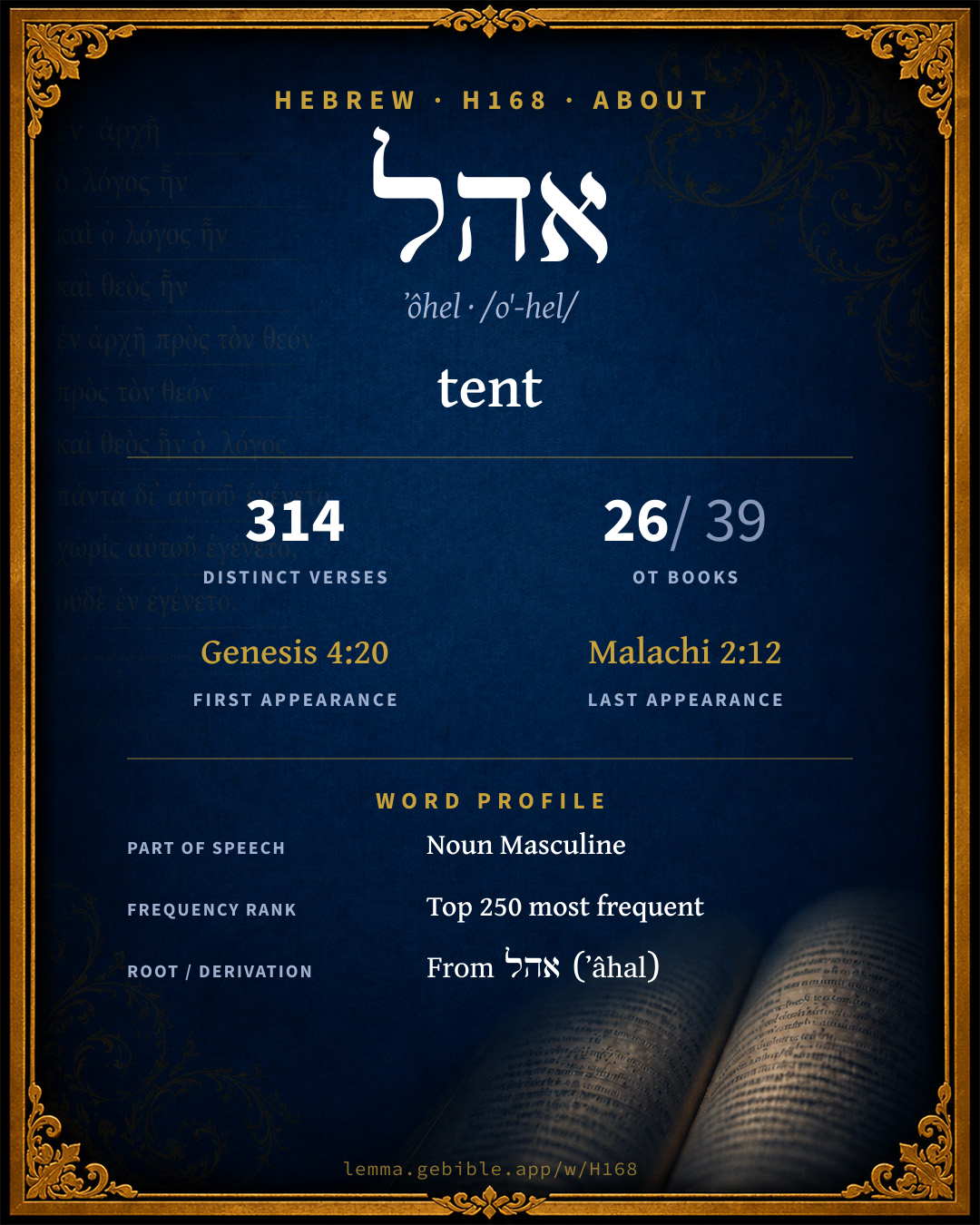
אֹ֫הֶל
tent
‘tent’ is one of 4 main senses fuller range ↓
Full lexicon entry — Brown-Driver-Briggs (BDB)
From Brown-Driver-Briggs (BDB)
Where this word appears
See every Construct-state word in the Hebrew Bible →
Grammar key — what these labels mean
Part of speech
- Noun
- A naming word — a person, place, thing, or idea.
Noun type
- Common
- A common noun — a general class of person, place, or thing (“king,” “city,” “water”), not a specific name.
State
- Construct
- A noun bound to a following noun in a possessive / “of” relationship (the construct chain).
- Absolute
- The independent form of a noun, not bound to a following word.
Gender
- Masculine
- Grammatically masculine.
Number
- Singular
- One.
- Plural
- More than one (in Hebrew, generally three or more).
Grammatical forms
- Noun, Common, Masculine, Singular, Construct 209 times (60%)
- Noun, Common, Masculine, Singular, Absolute 76 times (22%)
- Noun, Common, Masculine, Plural, Construct 54 times (16%)
- Noun, Common, Masculine, Plural, Absolute 9 times (3%)
Parsed forms decoded from the imported morphology (morphhb / Westminster Leningrad Codex — WLC text public domain, morphhb tagging CC BY 4.0), counted across 348 parsed occurrences — not distinct verses.
Page 1 of 2 — showing verses 1–200 of 314 distinct verses where H168 appears, across 26 books. Click any verse to open its interlinear word-by-word view. Verse text shown in the World English Bible for context — . Each verse’s Hebrew form is shown with its reference; the English is not keyword-highlighted, since the data carries no word-level English alignment. Use “Compare translations” on any verse to read it across multiple English versions. This concordance covers the Hebrew Bible; Septuagint (Greek Old Testament) occurrences are not indexed here.
Genesis 19 verses
- Genesis 4:20 אֹ֖הֶל n c ms Adah gave birth to Jabal, who was the father of those who dwell in tents and have cattle.
- Genesis 9:21 אָהֳלֹֽ/ה n c ms cs + sfx pers 3ms He drank of the wine, and got drunk. He was uncovered within his tent.
- Genesis 9:27 בְּ/אָֽהֳלֵי prep + n c mp cs God enlarge Japheth, Let him dwell in the tents of Shem; Let Canaan be his servant."
- Genesis 12:8 אָהֳלֹ֑/ה n c ms cs + sfx pers 3ms He left from there to the mountain on the east of Bethel, and pitched his tent, having Bethel on the west, and Ai on the east. There he built an altar to Yahweh, and called on the name of Yahweh.
- Genesis 13:3 אהל/ה אָֽהֳל/וֹ֙ n c ms cs + sfx pers 3ms n c ms cs + sfx pers 3ms He went on his journeys from the South even to Bethel, to the place where his tent had been at the beginning, between Bethel and Ai,
- Genesis 13:5 וְ/אֹהָלִֽים conj + n c mp Lot also, who went with Abram, had flocks, and herds, and tents.
- Genesis 18:1 הָ/אֹ֖הֶל ptcl def.art + n c ms Yahweh appeared to him by the oaks of Mamre, as he sat in the tent door in the heat of the day.
- Genesis 18:2 הָ/אֹ֔הֶל ptcl def.art + n c ms He lifted up his eyes and looked, and saw that three men stood opposite him. When he saw them, he ran to meet them from the tent door, and bowed himself to the earth,
- Genesis 18:6 הָ/אֹ֖הֱלָ/ה ptcl def.art + n c ms + sfx dem Abraham hurried into the tent to Sarah, and said, "Quickly make ready three measures of fine meal, knead it, and make cakes."
- Genesis 18:9 בָ/אֹֽהֶל prep det + n c ms They said to him, "Where is Sarah, your wife? He said, "See, in the tent."
- Genesis 18:10 הָ/אֹ֖הֶל ptcl def.art + n c ms He said, "I will certainly return to you when the season comes round. Behold, Sarah your wife will have a son." Sarah heard in the tent door, which was behind him.
- Genesis 24:67 הָ/אֹ֨הֱלָ/ה֙ ptcl def.art + n c ms + sfx dem Isaac brought her into his mother Sarah's tent, and took Rebekah, and she became his wife. He loved her. Isaac was comforted after his mother's death.
- Genesis 25:27 אֹהָלִֽים n c mp The boys grew. Esau was a skillful hunter, a man of the field. Jacob was a quiet man, living in tents.
- Genesis 26:25 אָהֳל֑/וֹ n c ms cs + sfx pers 3ms He built an altar there, and called on the name of Yahweh, and pitched his tent there. There Isaac's servants dug a well.
- Genesis 31:25 אָהֳל/וֹ֙ n c ms cs + sfx pers 3ms Laban caught up with Jacob. Now Jacob had pitched his tent in the mountain, and Laban with his relatives encamped in the mountain of Gilead.
- Genesis 31:33 בְּ/אֹ֥הֶל וּ/בְ/אֹ֣הֶל וּ/בְ/אֹ֛הֶל מֵ/אֹ֣הֶל בְּ/אֹ֥הֶל prep + n c ms cs conj + prep + n c ms cs conj + prep + n c ms cs prep + n c ms cs prep + n c ms cs Laban went into Jacob's tent, into Leah's tent, and into the tent of the two maid-servants; but he didn't find them. He went out of Leah's tent, and entered into Rachel's tent.
- Genesis 31:34 הָ/אֹ֖הֶל ptcl def.art + n c ms Now Rachel had taken the teraphim, put them in the camel's saddle, and sat on them. Laban felt about all the tent, but didn't find them.
- Genesis 33:19 אָהֳל֔/וֹ n c ms cs + sfx pers 3ms He bought the parcel of ground, where he had spread his tent, at the hand of the children of Hamor, Shechem's father, for one hundred pieces of money.
- Genesis 35:21 אָֽהֳלֹ֔/ה n c ms cs + sfx pers 3ms Israel traveled, and spread his tent beyond the tower of Eder.
Exodus 54 verses
- Exodus 16:16 בְּ/אָהֳל֖/וֹ prep + n c ms cs + sfx pers 3ms This is the thing which Yahweh has commanded: "Gather of it everyone according to his eating; an omer a head, according to the number of your persons, shall you take it, every man for those who are in his tent."
- Exodus 18:7 הָ/אֹֽהֱלָ/ה ptcl def.art + n c ms + sfx dem Moses went out to meet his father-in-law, and bowed and kissed him. They asked each other of their welfare, and they came into the tent.
- Exodus 26:7 לְ/אֹ֖הֶל prep + n c ms "You shall make curtains of goats' hair for a covering over the tent: eleven curtains shall you make them.
- Exodus 26:9 הָ/אֹֽהֶל ptcl def.art + n c ms You shall couple five curtains by themselves, and six curtains by themselves, and shall double over the sixth curtain in the forefront of the tent.
- Exodus 26:11 הָ/אֹ֖הֶל ptcl def.art + n c ms You shall make fifty clasps of brass, and put the clasps into the loops, and couple the tent together, that it may be one.
- Exodus 26:12 הָ/אֹ֑הֶל ptcl def.art + n c ms The overhanging part that remains of the curtains of the tent, the half curtain that remains, shall hang over the back of the tent.
- Exodus 26:13 הָ/אֹ֑הֶל ptcl def.art + n c ms The cubit on the one side, and the cubit on the other side, of that which remains in the length of the curtains of the tent, shall hang over the sides of the tent on this side and on that side, to cover it.
- Exodus 26:14 לָ/אֹ֔הֶל prep det + n c ms You shall make a covering for the tent of rams' skins dyed red, and a covering of sea cow hides above.
- Exodus 26:36 הָ/אֹ֔הֶל ptcl def.art + n c ms "You shall make a screen for the door of the Tent, of blue, and purple, and scarlet, and fine twined linen, the work of the embroiderer.
- Exodus 27:21 בְּ/אֹ֣הֶל prep + n c ms cs In the tent of meeting, outside the veil which is before the testimony, Aaron and his sons shall keep it in order from evening to morning before Yahweh: it shall be a statute forever throughout their generations on the behalf of the children of Israel.
- Exodus 28:43 אֹ֣הֶל n c ms cs They shall be on Aaron, and on his sons, when they go in to the tent of meeting, or when they come near to the altar to minister in the holy place; that they don't bear iniquity, and die: it shall be a statute forever to him and to his descendants after him.
- Exodus 29:4 אֹ֣הֶל n c ms cs You shall bring Aaron and his sons to the door of the tent of meeting, and shall wash them with water.
- Exodus 29:10 אֹ֣הֶל n c ms cs "You shall bring the bull before the tent of meeting: and Aaron and his sons shall lay their hands on the head of the bull.
- Exodus 29:11 אֹ֥הֶל n c ms cs You shall kill the bull before Yahweh, at the door of the tent of meeting.
- Exodus 29:30 אֹ֥הֶל n c ms cs Seven days shall the son who is priest in his place put them on, when he comes into the tent of meeting to minister in the holy place.
- Exodus 29:32 אֹ֥הֶל n c ms cs Aaron and his sons shall eat the flesh of the ram, and the bread that is in the basket, at the door of the tent of meeting.
- Exodus 29:42 אֹֽהֶל n c ms cs It shall be a continual burnt offering throughout your generations at the door of the tent of meeting before Yahweh, where I will meet with you, to speak there to you.
- Exodus 29:44 אֹ֥הֶל n c ms cs I will sanctify the tent of meeting and the altar: Aaron also and his sons I will sanctify, to minister to me in the priest's office.
- Exodus 30:16 אֹ֣הֶל n c ms cs You shall take the atonement money from the children of Israel, and shall appoint it for the service of the tent of meeting; that it may be a memorial for the children of Israel before Yahweh, to make atonement for your souls."
- Exodus 30:18 אֹ֤הֶל n c ms cs "You shall also make a basin of brass, and the base of it of brass, in which to wash. You shall put it between the tent of meeting and the altar, and you shall put water in it.
- Exodus 30:20 אֹ֧הֶל n c ms cs When they go into the tent of meeting, they shall wash with water, that they not die; or when they come near to the altar to minister, to burn an offering made by fire to Yahweh.
- Exodus 30:26 אֹ֣הֶל n c ms cs You shall use it to anoint the tent of meeting, the ark of the testimony,
- Exodus 30:36 בְּ/אֹ֣הֶל prep + n c ms cs and you shall beat some of it very small, and put some of it before the testimony in the tent of meeting, where I will meet with you. It shall be to you most holy.
- Exodus 31:7 אֹ֣הֶל הָ/אֹֽהֶל n c ms cs ptcl def.art + n c ms the tent of meeting, the ark of the testimony, the mercy seat that is on it, all the furniture of the Tent,
- Exodus 33:7 הָ/אֹ֜הֶל אֹ֣הֶל אֹ֣הֶל ptcl def.art + n c ms n c ms cs n c ms cs Now Moses used to take the tent and to pitch it outside the camp, far away from the camp, and he called it "The tent of meeting." It happened that everyone who sought Yahweh went out to the tent of meeting, which was outside the camp.
- Exodus 33:8 הָ/אֹ֔הֶל אָהֳל֑/וֹ הָ/אֹֽהֱלָ/ה ptcl def.art + n c ms n c ms cs + sfx pers 3ms ptcl def.art + n c ms + sfx dem It happened that when Moses went out to the Tent, that all the people rose up, and stood, everyone at their tent door, and watched Moses, until he had gone into the Tent.
- Exodus 33:9 הָ/אֹ֔הֱלָ/ה הָ/אֹ֑הֶל ptcl def.art + n c ms + sfx dem ptcl def.art + n c ms It happened, when Moses entered into the Tent, that the pillar of cloud descended, stood at the door of the Tent, and spoke with Moses.
- Exodus 33:10 הָ/אֹ֑הֶל אָהֳלֽ/וֹ ptcl def.art + n c ms n c ms cs + sfx pers 3ms All the people saw the pillar of cloud stand at the door of the Tent, and all the people rose up and worshiped, everyone at their tent door.
- Exodus 33:11 הָ/אֹֽהֶל ptcl def.art + n c ms Yahweh spoke to Moses face to face, as a man speaks to his friend. He turned again into the camp, but his servant Joshua, the son of Nun, a young man, didn't depart out of the Tent.
- Exodus 35:11 אָהֳל֖/וֹ n c ms cs + sfx pers 3ms the tent, its outer covering, its roof, its clasps, its boards, its bars, its pillars, and its sockets;
- Exodus 35:21 אֹ֤הֶל n c ms cs They came, everyone whose heart stirred him up, and everyone whom his spirit made willing, and brought Yahweh's offering, for the work of the tent of meeting, and for all of its service, and for the holy garments.
- Exodus 36:14 לְ/אֹ֖הֶל prep + n c ms He made curtains of goats' hair for a covering over the tent. He made them eleven curtains.
- Exodus 36:18 הָ/אֹ֖הֶל ptcl def.art + n c ms He made fifty clasps of brass to couple the tent together, that it might be a unit.
- Exodus 36:19 לָ/אֹ֔הֶל prep det + n c ms He made a covering for the tent of rams' skins dyed red, and a covering of sea cow hides above.
- Exodus 36:37 הָ/אֹ֔הֶל ptcl def.art + n c ms He made a screen for the door of the tent, of blue, purple, scarlet, and fine twined linen, the work of an embroiderer;
- Exodus 38:8 אֹ֥הֶל n c ms cs He made the basin of brass, and its base of brass, out of the mirrors of the ministering women who ministered at the door of the tent of meeting.
- Exodus 38:30 אֹ֣הֶל n c ms cs With this he made the sockets to the door of the tent of meeting, the brazen altar, the brazen grating for it, all the vessels of the altar,
- Exodus 39:32 אֹ֣הֶל n c ms cs Thus all the work of the tent of the tent of meeting was finished. The children of Israel did according to all that Yahweh commanded Moses; so they did.
- Exodus 39:33 הָ/אֹ֖הֶל ptcl def.art + n c ms They brought the tent to Moses, the tent, with all its furniture, its clasps, its boards, it bars, its pillars, its sockets,
- Exodus 39:38 הָ/אֹֽהֶל ptcl def.art + n c ms the golden altar, the anointing oil, the sweet incense, the screen for the door of the Tent,
- Exodus 39:40 לְ/אֹ֥הֶל prep + n c ms cs the hangings of the court, its pillars, its sockets, the screen for the gate of the court, its cords, its pins, all the instruments of the service of the tent, for the tent of meeting,
- Exodus 40:2 אֹ֥הֶל n c ms cs "On the first day of the first month you shall raise up the tent of the Tent of Meeting.
- Exodus 40:6 אֹֽהֶל n c ms cs You shall set the altar of burnt offering before the door of the tent of the tent of meeting.
- Exodus 40:7 אֹ֥הֶל n c ms cs You shall set the basin between the tent of meeting and the altar, and shall put water therein.
- Exodus 40:12 אֹ֣הֶל n c ms cs You shall bring Aaron and his sons to the door of the tent of meeting, and shall wash them with water.
- Exodus 40:19 הָ/אֹ֨הֶל֙ הָ/אֹ֛הֶל ptcl def.art + n c ms ptcl def.art + n c ms He spread the covering over the tent, and put the roof of the tent above on it, as Yahweh commanded Moses.
- Exodus 40:22 בְּ/אֹ֣הֶל prep + n c ms cs He put the table in the tent of meeting, on the side of the tent northward, outside of the veil.
- Exodus 40:24 בְּ/אֹ֣הֶל prep + n c ms cs He put the lampstand in the tent of meeting, opposite the table, on the side of the tent southward.
- Exodus 40:26 בְּ/אֹ֣הֶל prep + n c ms cs He put the golden altar in the tent of meeting before the veil;
- Exodus 40:29 אֹֽהֶל n c ms cs He set the altar of burnt offering at the door of the tent of the tent of meeting, and offered on it the burnt offering and the meal-offering, as Yahweh commanded Moses.
- Exodus 40:30 אֹ֥הֶל n c ms cs He set the basin between the tent of meeting and the altar, and put water therein, with which to wash.
- Exodus 40:32 אֹ֣הֶל n c ms cs When they went into the tent of meeting, and when they came near to the altar, they washed, as Yahweh commanded Moses.
- Exodus 40:34 אֹ֣הֶל n c ms cs Then the cloud covered the tent of meeting, and the glory of Yahweh filled the tent.
- Exodus 40:35 אֹ֣הֶל n c ms cs Moses wasn't able to enter into the tent of meeting, because the cloud stayed on it, and Yahweh's glory filled the tent.
Leviticus 42 verses
- Leviticus 1:1 מֵ/אֹ֥הֶל prep + n c ms cs Yahweh called to Moses, and spoke to him out of the Tent of Meeting, saying,
- Leviticus 1:3 אֹ֤הֶל n c ms cs "'If his offering is a burnt offering from the herd, he shall offer a male without blemish. He shall offer it at the door of the Tent of Meeting, that he may be accepted before Yahweh.
- Leviticus 1:5 אֹ֥הֶל n c ms cs He shall kill the bull before Yahweh. Aaron's sons, the priests, shall present the blood and sprinkle the blood around on the altar that is at the door of the Tent of Meeting.
- Leviticus 3:2 אֹ֣הֶל n c ms cs He shall lay his hand on the head of his offering, and kill it at the door of the tent of meeting: and Aaron's sons the priests shall sprinkle the blood on the altar round about.
- Leviticus 3:8 אֹ֣הֶל n c ms cs and he shall lay his hand on the head of his offering, and kill it before the tent of meeting: and Aaron's sons shall sprinkle its blood on the altar round about.
- Leviticus 3:13 אֹ֣הֶל n c ms cs and he shall lay his hand on its head, and kill it before the tent of meeting; and the sons of Aaron shall sprinkle its blood on the altar round about.
- Leviticus 4:4 אֹ֥הֶל n c ms cs He shall bring the bull to the door of the Tent of Meeting before Yahweh; and he shall lay his hand on the head of the bull, and kill the bull before Yahweh.
- Leviticus 4:5 אֹ֥הֶל n c ms cs The anointed priest shall take some of the blood of the bull, and bring it to the Tent of Meeting.
- Leviticus 4:7 בְּ/אֹ֣הֶל אֹ֥הֶל prep + n c ms cs n c ms cs The priest shall put some of the blood on the horns of the altar of sweet incense before Yahweh, which is in the tent of meeting; and he shall pour out all the blood of the bull out at the base of the altar of burnt offering, which is at the door of the Tent of Meeting.
- Leviticus 4:14 אֹ֥הֶל n c ms cs when the sin in which they have sinned is known, then the assembly shall offer a young bull for a sin offering, and bring it before the Tent of Meeting.
- Leviticus 4:16 אֹ֖הֶל n c ms cs The anointed priest shall bring of the blood of the bull to the Tent of Meeting:
- Leviticus 4:18 בְּ/אֹ֣הֶל אֹ֥הֶל prep + n c ms cs n c ms cs He shall put some of the blood on the horns of the altar which is before Yahweh, that is in the Tent of Meeting; and the rest of the blood he shall pour out at the base of the altar of burnt offering, which is at the door of the Tent of Meeting.
- Leviticus 6:16 אֹֽהֶל n c ms cs That which is left of it Aaron and his sons shall eat. It shall be eaten without yeast in a holy place. They shall eat it in the court of the Tent of Meeting
- Leviticus 6:26 אֹ֥הֶל n c ms cs The priest who offers it for sin shall eat it. It shall be eaten in a holy place, in the court of the Tent of Meeting.
- Leviticus 6:30 אֹ֧הֶל n c ms cs No sin offering, of which any of the blood is brought into the Tent of Meeting to make atonement in the Holy Place, shall be eaten: it shall be burned with fire.
- Leviticus 8:3 אֹ֥הֶל n c ms cs and assemble all the congregation at the door of the Tent of Meeting."
- Leviticus 8:4 אֹ֥הֶל n c ms cs Moses did as Yahweh commanded him; and the congregation was assembled at the door of the Tent of Meeting.
- Leviticus 8:31 אֹ֣הֶל n c ms cs Moses said to Aaron and to his sons, "Boil the flesh at the door of the Tent of Meeting, and there eat it and the bread that is in the basket of consecration, as I commanded, saying, 'Aaron and his sons shall eat it.'
- Leviticus 8:33 אֹ֨הֶל n c ms cs You shall not go out from the door of the Tent of Meeting seven days, until the days of your consecration are fulfilled: for he shall consecrate you seven days.
- Leviticus 8:35 אֹ֨הֶל n c ms cs At the door of the Tent of Meeting you shall stay day and night seven days, and keep the charge of Yahweh, that you don't die: for so I am commanded."
- Leviticus 9:5 אֹ֣הֶל n c ms cs They brought what Moses commanded before the Tent of Meeting: and all the congregation drew near and stood before Yahweh.
- Leviticus 9:23 אֹ֣הֶל n c ms cs Moses and Aaron went into the Tent of Meeting, and came out, and blessed the people: and the glory of Yahweh appeared to all the people.
- Leviticus 10:7 אֹ֨הֶל n c ms cs You shall not go out from the door of the Tent of Meeting, lest you die; for the anointing oil of Yahweh is on you." They did according to the word of Moses.
- Leviticus 10:9 אֹ֥הֶל n c ms cs "Drink no wine nor strong drink, you, nor your sons with you, when you go into the Tent of Meeting, that you don't die: it shall be a statute forever throughout your generations:
- Leviticus 12:6 אֹֽהֶל n c ms cs "'When the days of her purification are completed, for a son, or for a daughter, she shall bring to the priest at the door of the Tent of Meeting, a year old lamb for a burnt offering, and a young pigeon, or a turtledove, for a sin offering:
- Leviticus 14:8 לְ/אָהֳל֖/וֹ prep + n c ms cs + sfx pers 3ms "He who is to be cleansed shall wash his clothes, and shave off all his hair, and bathe himself in water; and he shall be clean. After that he shall come into the camp, but shall dwell outside his tent seven days.
- Leviticus 14:11 אֹ֥הֶל n c ms cs The priest who cleanses him shall set the man who is to be cleansed, and those things, before Yahweh, at the door of the Tent of Meeting.
- Leviticus 14:23 אֹֽהֶל n c ms cs "On the eighth day he shall bring them for his cleansing to the priest, to the door of the Tent of Meeting, before Yahweh.
- Leviticus 15:14 אֹ֣הֶל n c ms cs "'On the eighth day he shall take two turtledoves, or two young pigeons, and come before Yahweh to the door of the Tent of Meeting, and give them to the priest:
- Leviticus 15:29 אֹ֥הֶל n c ms cs On the eighth day she shall take two turtledoves, or two young pigeons, and bring them to the priest, to the door of the Tent of Meeting.
- Leviticus 16:7 אֹ֥הֶל n c ms cs He shall take the two goats, and set them before Yahweh at the door of the Tent of Meeting.
- Leviticus 16:16 לְ/אֹ֣הֶל prep + n c ms cs and he shall make atonement for the Holy Place, because of the uncleanness of the children of Israel, and because of their transgressions, even all their sins; and so he shall do for the Tent of Meeting, that dwells with them in the midst of their uncleanness.
- Leviticus 16:17 בְּ/אֹ֣הֶל prep + n c ms cs There shall be no one in the Tent of Meeting when he enters to make atonement in the Holy Place, until he comes out, and has made atonement for himself and for his household, and for all the assembly of Israel.
- Leviticus 16:20 אֹ֥הֶל n c ms cs "When he has made an end of atoning for the Holy Place, the Tent of Meeting, and the altar, he shall present the live goat.
- Leviticus 16:23 אֹ֣הֶל n c ms cs "Aaron shall come into the Tent of Meeting, and shall take off the linen garments, which he put on when he went into the Holy Place, and shall leave them there.
- Leviticus 16:33 אֹ֧הֶל n c ms cs Then he shall make atonement for the Holy Sanctuary; and he shall make atonement for the Tent of Meeting and for the altar; and he shall make atonement for the priests and for all the people of the assembly.
- Leviticus 17:4 אֹ֣הֶל n c ms cs and hasn't brought it to the door of the Tent of Meeting, to offer it as an offering to Yahweh before the tabernacle of Yahweh: blood shall be imputed to that man. He has shed blood; and that man shall be cut off from among his people.
- Leviticus 17:5 אֹ֥הֶל n c ms cs This is to the end that the children of Israel may bring their sacrifices, which they sacrifice in the open field, that they may bring them to Yahweh, to the door of the Tent of Meeting, to the priest, and sacrifice them for sacrifices of peace offerings to Yahweh.
- Leviticus 17:6 אֹ֣הֶל n c ms cs The priest shall sprinkle the blood on the altar of Yahweh at the door of the Tent of Meeting, and burn the fat for a sweet savor to Yahweh.
- Leviticus 17:9 אֹ֤הֶל n c ms cs and doesn't bring it to the door of the Tent of Meeting, to sacrifice it to Yahweh; that man shall be cut off from his people.
- Leviticus 19:21 אֹ֣הֶל n c ms cs He shall bring his trespass offering to Yahweh, to the door of the Tent of Meeting, even a ram for a trespass offering.
- Leviticus 24:3 בְּ/אֹ֣הֶל prep + n c ms cs Outside of the veil of the Testimony, in the Tent of Meeting, shall Aaron keep it in order from evening to morning before Yahweh continually: it shall be a statute forever throughout your generations.
Numbers 70 verses
- Numbers 1:1 בְּ/אֹ֣הֶל prep + n c ms cs Yahweh spoke to Moses in the wilderness of Sinai, in the Tent of Meeting, on the first day of the second month, in the second year after they had come out of the land of Egypt, saying,
- Numbers 2:2 לְ/אֹֽהֶל prep + n c ms cs "The children of Israel shall encamp every man by his own standard, with the ensigns of their fathers' houses: at a distance from the tent of meeting shall they encamp around it."
- Numbers 2:17 אֹֽהֶל n c ms cs "Then the tent of meeting shall set out, with the camp of the Levites in the midst of the camps. As they encamp, so shall they set out, every man in his place, by their standards.
- Numbers 3:7 אֹ֣הֶל n c ms cs They shall keep his charge, and the charge of the whole congregation before the Tent of Meeting, to do the service of the tabernacle.
- Numbers 3:8 אֹ֣הֶל n c ms cs They shall keep all the furnishings of the Tent of Meeting, and the obligations of the children of Israel, to do the service of the tabernacle.
- Numbers 3:25 בְּ/אֹ֣הֶל וְ/הָ/אֹ֑הֶל אֹ֥הֶל prep + n c ms cs conj + ptcl def.art + n c ms n c ms cs The charge of the sons of Gershon in the Tent of Meeting shall be the tabernacle, and the tent, its covering, and the screen for the door of the Tent of Meeting,
- Numbers 3:38 אֹֽהֶל n c ms cs Those who encamp before the tabernacle eastward, in front of the Tent of Meeting toward the sunrise, shall be Moses, and Aaron and his sons, keeping the charge of the sanctuary for the charge of the children of Israel. The stranger who comes near shall be put to death.
- Numbers 4:3 בְּ/אֹ֥הֶל prep + n c ms cs from thirty years old and upward even until fifty years old, all who enter into the service, to do the work in the Tent of Meeting.
- Numbers 4:4 בְּ/אֹ֣הֶל prep + n c ms cs This is the service of the sons of Kohath in the Tent of Meeting, the most holy things.
- Numbers 4:15 בְּ/אֹ֥הֶל prep + n c ms cs "When Aaron and his sons have finished covering the sanctuary, and all the furniture of the sanctuary, as the camp moves forward; after that, the sons of Kohath shall come to carry it: but they shall not touch the sanctuary, lest they die. These things are the burden of the sons of Kohath in the Tent of Meeting.
- Numbers 4:23 בְּ/אֹ֥הֶל prep + n c ms cs from thirty years old and upward until fifty years old shall you number them; all who enter in to wait on the service, to do the work in the Tent of Meeting.
- Numbers 4:25 אֹ֣הֶל אֹ֥הֶל n c ms cs n c ms cs they shall carry the curtains of the tabernacle, and the Tent of Meeting, its covering, and the covering of sealskin that is above on it, and the screen for the door of the Tent of Meeting,
- Numbers 4:28 בְּ/אֹ֣הֶל prep + n c ms cs This is the service of the families of the sons of the Gershonites in the Tent of Meeting: and their charge shall be under the hand of Ithamar the son of Aaron the priest.
- Numbers 4:30 אֹ֥הֶל n c ms cs from thirty years old and upward even to fifty years old shall you number them, everyone who enters on the service, to do the work of the Tent of Meeting.
- Numbers 4:31 בְּ/אֹ֣הֶל prep + n c ms cs This is the charge of their burden, according to all their service in the Tent of Meeting: the tabernacle's boards, its bars, its pillars, its sockets,
- Numbers 4:33 בְּ/אֹ֣הֶל prep + n c ms cs This is the service of the families of the sons of Merari, according to all their service, in the Tent of Meeting, under the hand of Ithamar the son of Aaron the priest."
- Numbers 4:35 בְּ/אֹ֥הֶל prep + n c ms cs from thirty years old and upward even to fifty years old, everyone who entered into the service, for work in the Tent of Meeting.
- Numbers 4:37 בְּ/אֹ֣הֶל prep + n c ms cs These are those who were numbered of the families of the Kohathites, all who served in the Tent of Meeting, whom Moses and Aaron numbered according to the commandment of Yahweh by Moses.
- Numbers 4:39 בְּ/אֹ֥הֶל prep + n c ms cs from thirty years old and upward even to fifty years old, everyone who entered into the service, for work in the Tent of Meeting,
- Numbers 4:41 בְּ/אֹ֣הֶל prep + n c ms cs These are those who were numbered of the families of the sons of Gershon, all who served in the Tent of Meeting, whom Moses and Aaron numbered according to the commandment of Yahweh.
- Numbers 4:43 בְּ/אֹ֥הֶל prep + n c ms cs from thirty years old and upward even to fifty years old, everyone who entered into the service, for work in the Tent of Meeting,
- Numbers 4:47 בְּ/אֹ֥הֶל prep + n c ms cs from thirty years old and upward even to fifty years old, everyone who entered in to do the work of service, and the work of bearing burdens in the Tent of Meeting,
- Numbers 6:10 אֹ֥הֶל n c ms cs On the eighth day he shall bring two turtledoves or two young pigeons to the priest, to the door of the Tent of Meeting.
- Numbers 6:13 אֹ֥הֶל n c ms cs "This is the law of the Nazirite: when the days of his separation are fulfilled, he shall be brought to the door of the Tent of Meeting,
- Numbers 6:18 אֹ֥הֶל n c ms cs The Nazirite shall shave the head of his separation at the door of the Tent of Meeting, and shall take the hair of the head of his separation, and put it on the fire which is under the sacrifice of peace offerings.
- Numbers 7:5 אֹ֣הֶל n c ms cs "Accept these from them, that they may be used in doing the service of the Tent of Meeting; and you shall give them to the Levites, to every man according to his service."
- Numbers 7:89 אֹ֣הֶל n c ms cs When Moses went into the Tent of Meeting to speak with Yahweh, he heard his voice speaking to him from above the mercy seat that was on the ark of the Testimony, from between the two cherubim: and he spoke to him.
- Numbers 8:9 אֹ֣הֶל n c ms cs You shall present the Levites before the Tent of Meeting. You shall assemble the whole congregation of the children of Israel.
- Numbers 8:15 אֹ֣הֶל n c ms cs "After that, the Levites shall go in to do the service of the Tent of Meeting: and you shall cleanse them, and offer them as a wave offering.
- Numbers 8:19 בְּ/אֹ֣הֶל prep + n c ms cs I have given the Levites as a gift to Aaron and to his sons from among the children of Israel, to do the service of the children of Israel in the Tent of Meeting, and to make atonement for the children of Israel; that there be no plague among the children of Israel, when the children of Israel come near to the sanctuary."
- Numbers 8:22 בְּ/אֹ֣הֶל prep + n c ms cs After that, the Levites went in to do their service in the Tent of Meeting before Aaron, and before his sons: as Yahweh had commanded Moses concerning the Levites, so they did to them.
- Numbers 8:24 אֹ֥הֶל n c ms cs "This is that which belongs to the Levites: from twenty-five years old and upward they shall go in to wait on the service in the work of the Tent of Meeting;
- Numbers 8:26 בְּ/אֹ֤הֶל prep + n c ms cs but shall minister with their brothers in the Tent of Meeting, to keep the charge, and shall do no service. Thus shall you do to the Levites concerning their duties."
- Numbers 9:15 לְ/אֹ֖הֶל prep + n c ms cs On the day that the tabernacle was raised up, the cloud covered the tabernacle, even the Tent of the Testimony: and at evening it was over the tabernacle as it were the appearance of fire, until morning.
- Numbers 9:17 הָ/אֹ֔הֶל ptcl def.art + n c ms Whenever the cloud was taken up from over the Tent, then after that the children of Israel traveled; and in the place where the cloud remained, there the children of Israel encamped.
- Numbers 10:3 אֹ֥הֶל n c ms cs When they shall blow them, all the congregation shall gather themselves to you at the door of the tent of meeting.
- Numbers 11:10 אָהֳל֑/וֹ n c ms cs + sfx pers 3ms Moses heard the people weeping throughout their families, every man at the door of his tent: and the anger of Yahweh was kindled greatly; and Moses was displeased.
- Numbers 11:16 אֹ֣הֶל n c ms cs Yahweh said to Moses, Gather to me seventy men of the elders of Israel, whom you know to be the elders of the people, and officers over them; and bring them to the tent of meeting, that they may stand there with you.
- Numbers 11:24 הָ/אֹֽהֶל ptcl def.art + n c ms Moses went out, and told the people the words of Yahweh: and he gathered seventy men of the elders of the people, and set them round about the Tent.
- Numbers 11:26 הָ/אֹ֑הֱלָ/ה ptcl def.art + n c ms + sfx dem But there remained two men in the camp, the name of the one was Eldad, and the name of the other Medad: and the Spirit rested on them; and they were of those who were written, but had not gone out to the Tent; and they prophesied in the camp.
- Numbers 12:4 אֹ֣הֶל n c ms cs Yahweh spoke suddenly to Moses, and to Aaron, and to Miriam, Come out you three to the tent of meeting. They three came out.
- Numbers 12:5 הָ/אֹ֑הֶל ptcl def.art + n c ms Yahweh came down in a pillar of cloud, and stood at the door of the Tent, and called Aaron and Miriam; and they both came forth.
- Numbers 12:10 הָ/אֹ֔הֶל ptcl def.art + n c ms The cloud removed from over the Tent; and, behold, Miriam was leprous, as [white as] snow: and Aaron looked at Miriam, and, behold, she was leprous.
- Numbers 14:10 בְּ/אֹ֣הֶל prep + n c ms cs But all the congregation bade stone them with stones. The glory of Yahweh appeared in the tent of meeting to all the children of Israel.
- Numbers 16:18 אֹ֥הֶל n c ms cs They took every man his censer, and put fire in them, and laid incense thereon, and stood at the door of the tent of meeting with Moses and Aaron.
- Numbers 16:19 אֹ֣הֶל n c ms cs Korah assembled all the congregation against them to the door of the tent of meeting: and the glory of Yahweh appeared to all the congregation.
- Numbers 16:26 אָהֳלֵ֨י n c mp cs He spoke to the congregation, saying, Depart, I pray you, from the tents of these wicked men, and touch nothing of theirs, lest you be consumed in all their sins.
- Numbers 16:27 אָֽהֳלֵי/הֶ֔ם n c mp cs + sfx pers 3mp So they got them up from the tent of Korah, Dathan, and Abiram, on every side: and Dathan and Abiram came out, and stood at the door of their tents, and their wives, and their sons, and their little ones.
- Numbers 16:42 אֹ֣הֶל n c ms cs It happened, when the congregation was assembled against Moses and against Aaron, that they looked toward the tent of meeting: and, behold, the cloud covered it, and the glory of Yahweh appeared.
- Numbers 16:43 אֹ֥הֶל n c ms cs Moses and Aaron came to the front of the tent of meeting.
- Numbers 16:50 אֹ֣הֶל n c ms cs Aaron returned to Moses to the door of the tent of meeting: and the plague was stayed.
- Numbers 17:4 בְּ/אֹ֣הֶל prep + n c ms cs You shall lay them up in the tent of meeting before the testimony, where I meet with you.
- Numbers 17:7 בְּ/אֹ֖הֶל prep + n c ms cs Moses laid up the rods before Yahweh in the tent of the testimony.
- Numbers 17:8 אֹ֣הֶל n c ms cs It happened on the next day, that Moses went into the tent of the testimony; and, behold, the rod of Aaron for the house of Levi was budded, and put forth buds, and produced blossoms, and bore ripe almonds.
- Numbers 18:2 אֹ֥הֶל n c ms cs Your brothers also, the tribe of Levi, the tribe of your father, bring you near with you, that they may be joined to you, and minister to you: but you and your sons with you shall be before the tent of the testimony.
- Numbers 18:3 הָ/אֹ֑הֶל ptcl def.art + n c ms They shall keep your charge, and the charge of all the Tent: only they shall not come near to the vessels of the sanctuary and to the altar, that they not die, neither they, nor you.
- Numbers 18:4 אֹ֣הֶל הָ/אֹ֑הֶל n c ms cs ptcl def.art + n c ms They shall be joined to you, and keep the charge of the tent of meeting, for all the service of the Tent: and a stranger shall not come near to you.
- Numbers 18:6 אֹ֥הֶל n c ms cs I, behold, I have taken your brothers the Levites from among the children of Israel: to you they are a gift, given to Yahweh, to do the service of the tent of meeting.
- Numbers 18:21 אֹ֥הֶל n c ms cs To the children of Levi, behold, I have given all the tithe in Israel for an inheritance, in return for their service which they serve, even the service of the tent of meeting.
- Numbers 18:22 אֹ֣הֶל n c ms cs Henceforth the children of Israel shall not come near the tent of meeting, lest they bear sin, and die.
- Numbers 18:23 אֹ֣הֶל n c ms cs But the Levites shall do the service of the tent of meeting, and they shall bear their iniquity: it shall be a statute forever throughout your generations; and among the children of Israel they shall have no inheritance.
- Numbers 18:31 בְּ/אֹ֥הֶל prep + n c ms cs You shall eat it in every place, you and your households: for it is your reward in return for your service in the tent of meeting.
- Numbers 19:4 אֹֽהֶל n c ms cs and Eleazar the priest shall take of her blood with his finger, and sprinkle her blood toward the front of the tent of meeting seven times.
- Numbers 19:14 בְּ/אֹ֑הֶל הָ/אֹ֨הֶל֙ בָּ/אֹ֔הֶל prep + n c ms ptcl def.art + n c ms prep det + n c ms This is the law when a man dies in a tent: everyone who comes into the tent, and everyone who is in the tent, shall be unclean seven days.
- Numbers 19:18 הָ/אֹ֨הֶל֙ ptcl def.art + n c ms and a clean person shall take hyssop, and dip it in the water, and sprinkle it on the tent, and on all the vessels, and on the persons who were there, and on him who touched the bone, or the slain, or the dead, or the grave:
- Numbers 20:6 אֹ֣הֶל n c ms Moses and Aaron went from the presence of the assembly to the door of the tent of meeting, and fell on their faces: and the glory of Yahweh appeared to them.
- Numbers 24:5 אֹהָלֶ֖י/ךָ n c mp cs + sfx pers 2ms How goodly are your tents, Jacob, Your tents, Israel!
- Numbers 25:6 אֹ֥הֶל n c ms cs Behold, one of the children of Israel came and brought to his brothers a Midianite woman in the sight of Moses, and in the sight of all the congregation of the children of Israel, while they were weeping at the door of the tent of meeting.
- Numbers 27:2 אֹֽהֶל n c ms cs They stood before Moses, and before Eleazar the priest, and before the princes and all the congregation, at the door of the tent of meeting, saying,
- Numbers 31:54 אֹ֣הֶל n c ms cs Moses and Eleazar the priest took the gold of the captains of thousands and of hundreds, and brought it into the tent of meeting, for a memorial for the children of Israel before Yahweh.
Deuteronomy 7 verses
- Deuteronomy 1:27 בְ/אָהֳלֵי/כֶם֙ prep + n c mp cs + sfx pers 2mp and you murmured in your tents, and said, Because Yahweh hated us, he has brought us forth out of the land of Egypt, to deliver us into the hand of the Amorites, to destroy us.
- Deuteronomy 5:30 לְ/אָהֳלֵי/כֶֽם prep + n c mp cs + sfx pers 2mp Go tell them, Return you to your tents.
- Deuteronomy 11:6 אָהֳלֵי/הֶ֑ם n c mp cs + sfx pers 3mp and what he did to Dathan and Abiram, the sons of Eliab, the son of Reuben; how the earth opened its mouth, and swallowed them up, and their households, and their tents, and every living thing that followed them, in the midst of all Israel:
- Deuteronomy 16:7 לְ/אֹהָלֶֽי/ךָ prep + n c mp cs + sfx pers 2ms You shall roast and eat it in the place which Yahweh your God shall choose: and you shall turn in the morning, and go to your tents.
- Deuteronomy 31:14 בְּ/אֹ֥הֶל בְּ/אֹ֥הֶל prep + n c ms cs prep + n c ms cs Yahweh said to Moses, Behold, your days approach that you must die: call Joshua, and present yourselves in the tent of meeting, that I may give him a charge. Moses and Joshua went, and presented themselves in the tent of meeting.
- Deuteronomy 31:15 בָּ/אֹ֖הֶל הָ/אֹֽהֶל prep det + n c ms ptcl def.art + n c ms Yahweh appeared in the Tent in a pillar of cloud: and the pillar of cloud stood over the door of the Tent.
- Deuteronomy 33:18 בְּ/אֹהָלֶֽי/ךָ prep + n c mp cs + sfx pers 2ms Of Zebulun he said, Rejoice, Zebulun, in your going out; Issachar, in your tents.
Joshua 11 verses
- Joshua 3:14 מֵ/אָ֣הֳלֵי/הֶ֔ם prep + n c mp cs + sfx pers 3mp It happened, when the people removed from their tents, to pass over the Jordan, the priests who bore the ark of the covenant being before the people;
- Joshua 7:21 הָ/אָֽהֳלִ֖/י ptcl def.art + n c ms cs + sfx pers 1cs when I saw among the spoil a goodly Babylonian mantle, and two hundred shekels of silver, and a wedge of gold of fifty shekels weight, then I coveted them, and took them; and, behold, they are hid in the earth in the midst of my tent, and the silver under it.
- Joshua 7:22 הָ/אֹ֑הֱלָ/ה בְּ/אָהֳל֖/וֹ ptcl def.art + n c ms + sfx dem prep + n c ms cs + sfx pers 3ms So Joshua sent messengers, and they ran to the tent; and, behold, it was hid in his tent, and the silver under it.
- Joshua 7:23 הָ/אֹ֔הֶל ptcl def.art + n c ms They took them from the midst of the tent, and brought them to Joshua, and to all the children of Israel; and they laid them down before Yahweh.
- Joshua 7:24 אָהֳל/וֹ֙ n c ms cs + sfx pers 3ms Joshua, and all Israel with him, took Achan the son of Zerah, and the silver, and the mantle, and the wedge of gold, and his sons, and his daughters, and his oxen, and his donkeys, and his sheep, and his tent, and all that he had: and they brought them up to the valley of Achor.
- Joshua 18:1 אֹ֣הֶל n c ms cs The whole congregation of the children of Israel assembled themselves together at Shiloh, and set up the tent of meeting there: and the land was subdued before them.
- Joshua 19:51 אֹ֣הֶל n c ms cs These are the inheritances, which Eleazar the priest, and Joshua the son of Nun, and the heads of the fathers' [houses] of the tribes of the children of Israel, distributed for inheritance by lot in Shiloh before Yahweh, at the door of the tent of meeting. So they made an end of dividing the land.
- Joshua 22:4 לְ/אָהֳלֵי/כֶ֗ם prep + n c mp cs + sfx pers 2mp Now Yahweh your God has given rest to your brothers, as he spoke to them: therefore now turn you, and get you to your tents, to the land of your possession, which Moses the servant of Yahweh gave you beyond the Jordan.
About this entry
At a glance — auto-summarized from this page’s data, not written by a person. Every figure links to its source below. This summary describes the numbers; it doesn’t interpret them.
“tent” is the headline sense of the Hebrew noun אהל (ʼôhel). Its English rendering has broadened — “tabernacle” classically, “tent of” (unfoldingWord Literal Text) in modern versions; see the renderings breakdown. The Hebrew Bible uses it across 314 verses — common. Its earliest occurrence is Genesis 4:20. Its meaning spans more than one sense — see its full sense range. See the sense tree, 314-verse concordance, and the renderings breakdown below.
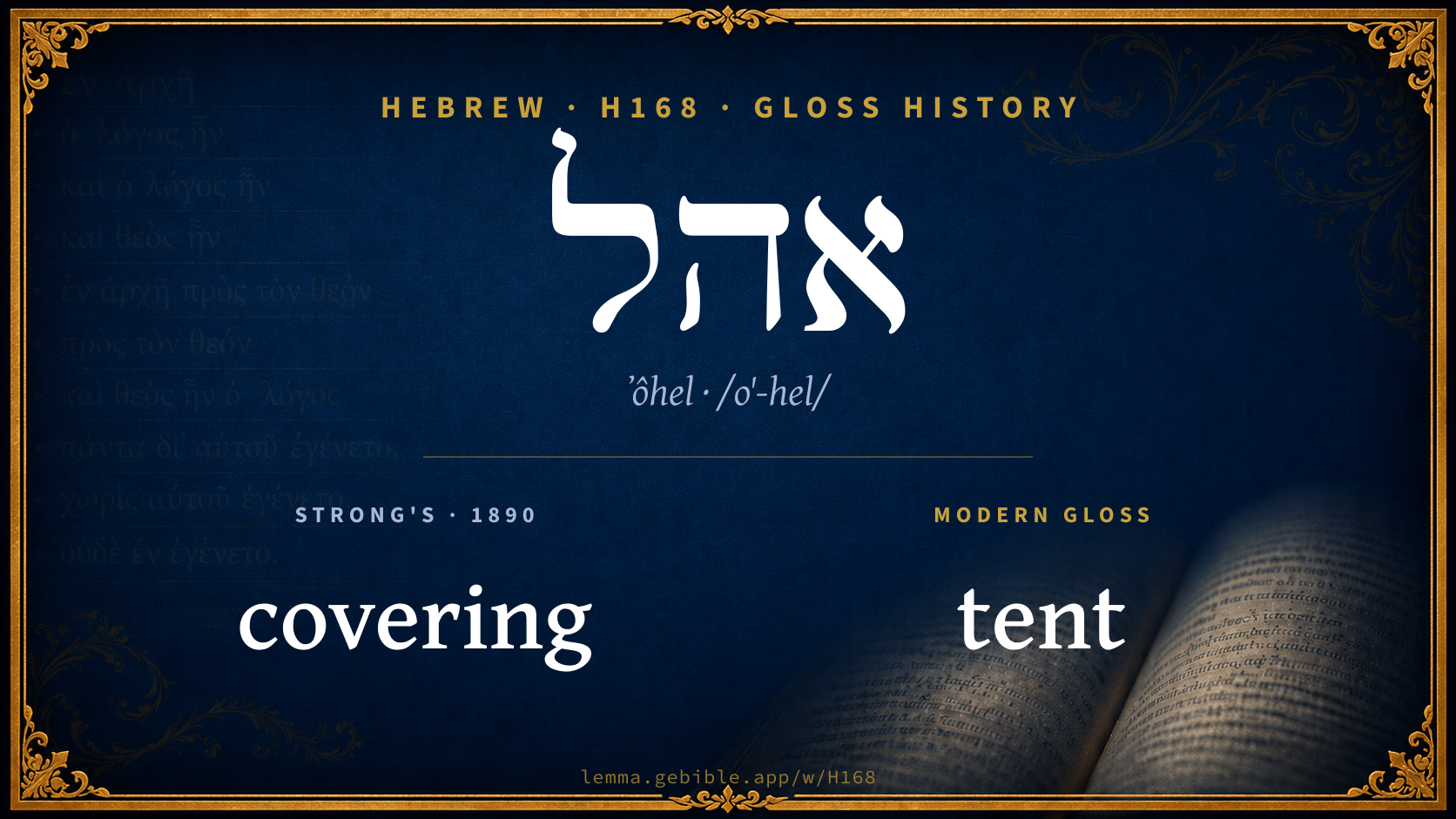
Gloss history
Strong's 1890 vs modern scholarship
About this word
Strong's H168 catalogs a Hebrew word from the Hebrew Old Testament.
These counts are not copied from any lexicon or concordance. They are computed here, from the morphology-tagged Hebrew Old Testament. What Lemma adds →
- 314
- distinct verses
- The word appears in 314 distinct verses.
- 26 / 39
- OT books
- The word appears in 26 of 39 Old Testament books.
- #141
- by frequency
- Top 250 most frequent Hebrew words (rank 141 of 8,640 Hebrew words by occurrence).
View all 314 occurrences in the concordance →
By section of the Old Testament
By traditional corpus
Conventional, traditional groupings — biblical authorship is debated, so this is a traditional corpus grouping, not an authorship claim. Each share is this word’s portion of its verses in that division of the Hebrew canon. Each figure is a share of the word’s 314 distinct verses.
- Torah (Pentateuch) 192 verses · 61%
- Prophets (Nevi'im) 66 verses · 21%
- Writings (Ketuvim) 56 verses · 18%
How translations render this word
Counts come from each version’s own published word-to-Strong’s tagging or interlinear alignment — an approximate guide to how each version renders this word, not a word-level alignment the data otherwise carries. Because each total is that version’s own tagged count, the per-version totals vary from one another and need not match the appearance or distinct-verse counts above. These counts may also differ from a printed concordance because Lemma counts each distinctly tagged rendering and does not collapse phrase taggings into a single head-word total. This is a fixed set of word-tagged versions (KJV, ASV, BSB, ULT) and does not change with the reading translation you choose elsewhere. Each version’s license is shown beside its name below (and on Sources).
- King James Version: Tabernacle 172×, Tent 83×, Tents 44×
- American Standard Version: Tent 229×, Tents 46×, Tabernacle 7×
- Berean Standard Bible: Tent 259×, Tents 46×, Home 8×
- unfoldingWord Literal Text: Tent of 135×, Tent 134×, Tents 44×
King James Version Public Domain
Renders H168 across 345 tagged occurrences — most commonly:
Plus 29 renderings that appear only once — usually multi-word phrases or single function words the recovered tagging swept in, not distinct renderings.
American Standard Version Public Domain
Renders H168 across 341 tagged occurrences — most commonly:
Plus 40 renderings that appear only once — usually multi-word phrases or single function words the recovered tagging swept in, not distinct renderings.
Berean Standard Bible Public Domain
Renders H168 across 338 tagged occurrences — most commonly:
Plus 13 renderings that appear only once — usually multi-word phrases or single function words the recovered tagging swept in, not distinct renderings. Not rendered by a distinct English word in 8 further occurrences.
unfoldingWord Literal Text CC BY-SA 4.0
Renders H168 across 348 tagged occurrences — most commonly:
Plus 14 renderings that appear only once — usually multi-word phrases or single function words the recovered tagging swept in, not distinct renderings.
Senses in the full BDB
What do BDB’s symbols mean?
BDB uses these scholarly abbreviations:
| Symbol | Meaning |
|---|---|
| 𝔊 | the Septuagint (the ancient Greek translation, LXX) |
| 𝔙 | the Vulgate (the Latin translation) |
| 𝔖 | the Syriac version (the Peshitta) |
| 𝔗 | the Targum (the Aramaic translation) |
| ψ | the Psalms |
| √ | root (the underlying root or stem) |
| ‖ | parallel passage (a synonymous or contrasted parallel) |
| † | the dagger: every passage where the word occurs is cited |
The 3 senses and sub-senses the full Brown-Driver-Briggs lexicon distinguishes for this word, in lexicon order (not ranked by frequency), with BDB’s own verbatim wording and sub-sense lettering. Shown in Hebrew script with BDB’s own scholarly abbreviations. The condensed entry is in the Lexicon Entry tab. See also the Forms in the corpus table below.
- 1. tent of nomad Ct 1:5 Je 6:3; 49:29; ישֵׁב א׳ dweller in tents Gn 4:20; 25:27 (J); אָהֳלֵי מִקְנֶה tents of cattle 2 Ch 14:14; of soldier 1 Sa 17:54 cf. Dr, Je 37:10; 1 K 12:16 ישׂראל לְאֹהָלֶיךָ, exclam., to thy tents, Israel!, cf. 1 K 8:66 2 Ch 10:16 2 S 20:1 (but cf. Dr, 1 S 17:54); of pleasure-tent on house-top 2 S 16:22 (= bridal-tent, bridal pavilion, cf. חֻפָּה ψ 19:5 Jo 2:16 v. RSKinship 168). e.g. Song of Solomon 1:5
- 2. dwelling, habitation; ψ 91:10 בְּאֹהֳלֶ֑ךָ home (lit. in thy tent), pl. לְאֹהָלֶֽךָ Ju 19:9; בֵּיתִי א׳ habitation of my house ψ 132:3 cf. Dn 11:45; א׳ דוד habitat. or palace of David where throne erected Is 16:5; א׳ בַת צִיּוֹן h. of daughter of Zion (= Jerusalem) La 2:4; אָהֳלֵי יַעֲקֹב Je 30:18 Mal 2:12 (‖ מִשְׁכָּן); א׳ יְהוּדָה Zc 12:7 (‖ בית דוד); א׳ רְשָׁעִים h. of wicked Jb 8:22, cf. א׳ רֶשַׁע ψ 84:11, א׳ יְשָׁרִים Pr 14:11; א׳ שֹׁחַד Jb 15:34; א׳ צַדִּיקִים ψ 118:15; א׳ אֱדוֹם = Edom itself, ψ 83:7 cf. א׳ קְדָר ψ 120:5 א׳ כוּשָׁן Hb 3:7; cf. Is 54:2 ψ 69:26. e.g. Psalms 91:10
- 3. the sacred tent in worship of God; הָאֹהֶל the tent; א׳ מוֹעֵד tent of meeting of God with his people (tent of congregation or assembly Ges MV al.) According to E Moses so called the tent which he used to pitch without the camp, afar off, into which he used to enter, & where God spake with him face to face, Ex 33:7–11 Nu 12:5, 10 Dt 31:14, 15; J seems to have same conception of an א׳ מ׳ outside the camp, Nu 11:24, 26; D has no allusion to such a tent; P mentions it 131 times as א׳ מ׳; 19 times as הָאֹהֶל (cf. Ez 41:1) & א׳ הָעֵדוּת, tent of the testimony Nu 9:15; 17:22, 23; 18:2 (as containing ark & tables of the testimony) cf. 2 Ch 24:6; this tent sometimes confounded with the מִשְׁכָּן but distinguished in מִשְׁכַּן א׳מ׳ Ex 39:32; 40:2, 6, 29, cf. 1 Ch 6:17; הַמִּשְׁכָּן וְהָאֹהֶל Nu 3:25; אֶת־הַמִּשְׁכָּן וְאֶת־אָהֳלוֹ Ex 35:11; tent was of three layers of skins, goatskins, ramskins, & tachash skins, each layer of eleven pieces stretched in form of a tent, covring & protecting the מִשְׁכָּן, wh. was in form of parallelopip. (Ex 26). An אֹהֶל מוֹעֵד was at Shilo 1 S 2:22 (om. 𝔊; v. Dr) cf. ψ 78:60, called א׳ יוֹסֵף v 67. The Mosaic א׳ מ׳ was later at Gibeon 2 Ch 1:3, 6, 13; courses of ministry arranged for service at א׳ מ׳ 1 Ch 6:17; 23:32 cf. 1 Ch 9:19 (הָא׳), v 21, 23 (בֵּית הָא׳); David erected an אֹהֶל for ark on Mt. Zion 2 S 6:17 1 Ch 15:1; 16:1; 2 Ch 1:4; Joab fled for refuge to א׳ יהוה 1 K 2:28–30; sacred oil brought from הָא׳ 1 K 1:39; the א׳ מוֹעֵד was taken up into temple 1 K 8:4 = 2 Ch 5:5; י׳ had not previously dwelt in a בַּיִת, but had gone מֵאֹהֶל אֶל־אֹהֶל from tent to tent, from one to another, 1 Ch 17:5, cf. 2 S 7:6; א׳ יהוה (‖ בַּיִת & הַר קֹדֶשׁ) is refuge & dwelling-place of righteous, ψ 15:1; 27:5, 6; 61:5 (cf. ψ 90:1). e.g. Exodus 33:7
Senses from the full Brown-Driver-Briggs lexicon (Brown, Driver, Briggs; Oxford 1906 — public domain), digitized via Sefaria, supplemented by the OpenScriptures HebrewLexicon (CC BY 4.0). Full attribution on Sources.
Word origin
n.m. Gn 13:3 tent (cf. Assyrian âlu, supr., Arabic أَهْلٌ, fellow-dwellers, family, Sab. אהל DHMZMG 1883, 341 al., also in n.pr. Sab. & Ph. v. אהליאב)—abs. א׳ Gn 4:20 +; cstr. id. Ex 28:43 +; אֹ֫הֱלָה (ה loc.) Gn 18:6 +; sf. אָהֳלִי Jb 29:4 +; אָֽהָלְךָ ψ 61:5; אָֽהֳלֹה Gn 9:21 + 3 times (v. DrSm xxxv); pl. אֹהָלִים Gn 13:5 + (Ges§ 23.3); בָֽאֳהָלִים Ju 8:11 +; cstr. אָהֳלֵי Nu 16:26 +; sf. אֹהָלַי Je 4:20; אֹהָלֶיךָ Nu 24:5 +; אָהֳלֵיכֶם Jos 22:8 +, etc.—
— Brown-Driver-Briggs (Oxford 1906, public domain), digitized via Sefaria, supplemented by the OpenScriptures HebrewLexicon (CC BY 4.0). See Sources.
Derived from אהל (ʼâhal) (H166) — to shine.
Jastrow Dictionary
A second Hebrew/Aramaic lexicon for comparison, covering Aramaic and post-biblical (Talmudic, Targumic, Midrashic) usage that the biblical-Hebrew BDB does not. Matched by lemma rather than by Strong’s number, so a lemma may carry more than one Jastrow headword (shown separately below), and the entries cover usage well beyond the Bible.
אָהַל
- (b. h.), Pi. אִיהֵל (deriv. of אֹהֶל) to spread tent-like, to cover, shade, bend over &c., usu. with refer. to levitical uncleanness arising from being under the same shelter with, or forming a shelter over, a corpse &c. Meïlah 17ᵃ אי׳ על מקצתו if he bent over a portion (of the blood). Sabb. 17ᵃ אי׳ צדו אחת וכ׳ he caused one side of his body to overshadow the grave.—[More freq.]
- same. Ohol. III, 1; 3 sq. הא׳ על המת he formed a tent, i.e. spread himself, or bent, over a corpse. Ib. הבית מַאֲחִיל עליו the house forms a cover over part of it. Y. Sot. IX, 23ᶜ top; a. fr.
אֹהֶל
- tent, shelter. Succ. 21ᵇ א׳ עראי a temporary dwelling. א׳ קבע a permanent dwelling.—Naz. 55ᵃ א׳ זרוק a movable cover, e.g. a person carried in a vehicle over a grave, v. foreg.—B. Bath. 27ᵇ, a. fr. א׳ הטומאה something spread over an unclean object, e.g. a tree shading a corpse; v. foreg. Naz. VII, 2, v. אָהִיל.—Pl. אוֹהֳלִים, (אָהֳולִין) אוֹהֳלִין. Y. Sabb. XX, beg. 17ᶜ נטע א׳ to spread sheets over poles &c. (Tosef. ib. XII (XIII), 14, a. e. עשה א׳). Y. Erub. I, 19ᵈ א׳ בשיירה tents in a caravan, א׳ שבמחנה in a camp. Tosef. Kil. V, 25 אהולין ed. Zuck.
אֳהָל
- (Syr. אחלא P. Sm. 125; הל, חל, v. הלל, חלל, cmp. מוהל, מוחל)
- 1. an alcalic plant, used as soap. Sabb. 90ᵃ; Nidd. 62ᵃ (counted among plants subject to the laws of the Sabbath year).
- 2. a mineral substance of the same use (in connection with נתר; v. however Maim. to Nidd. IX, 6). Nidd. l. c. והתניא הבורית והאהל; (Sabb. l. c. first time חול ed., Ms. M. אָהֵיל; sec. time אהלא ed., Ms. M. אהיל). M. Kat. 17ᵇ; a, e. [The biblical אהלים a. אהלות have no connection of meaning with our w.]
A Dictionary of the Targumim, the Talmud Babli and Yerushalmi, and the Midrashic Literature (Marcus Jastrow; London, Luzac, 1903) — Public Domain. Digitized via Sefaria. Digitized via Sefaria. Full attribution on Sources.
Forms in the corpus
The 129 distinct written forms H168 takes in the Hebrew Bible, most frequent first — each parse links to that state’s occurrences in the concordance. Hebrew forms include their vowel points and cantillation, so a single lemma takes many written forms.
The 60 most common forms are shown; 69 rarer forms follow in the full concordance.
Same root — word family
Other BDB entries built from the same root as H168, grouped by Strong’s listed origin. These share a root / origin per the lexicon — not necessarily a shared meaning. Each links to that word’s own entry.
Derives from
Derived from this word
Proper names from this root
People and places named from this root — a name, not an additional meaning of the word.
Compare all same-root words → Showing 4 of 6 — not the complete family. 3 of the same-root words are proper names (people or places). They share a root, not necessarily a meaning.
Septuagint verse parallels
This word appears in 293 verses that also exist in the Greek Old Testament (Septuagint), out of the 314 Hebrew verses it occurs in. You can read those verses in Greek by switching the Old Testament edition to the Septuagint.
Read these verses in the Septuagint
- Genesis 4:20
- Exodus 16:16
- Leviticus 1:1
- Numbers 1:1
- Deuteronomy 1:27
- Joshua 3:14
- Judges 4:11
- 1 Samuel 2:22
- 2 Samuel 6:17
- 1 Kings 1:39
- 2 Kings 7:7
- 1 Chronicles 4:41
This is a verse-level parallel only — the same verses exist in both the Hebrew and Greek Old Testaments. No word-level Hebrew↔Greek correspondence is claimed: the data carries no such alignment, so no Greek word is shown as this Hebrew word’s translation. Coverage is not total — the Septuagint omits the deuterocanon and renumbers the Psalms, so some Hebrew verses have no direct Greek parallel.