
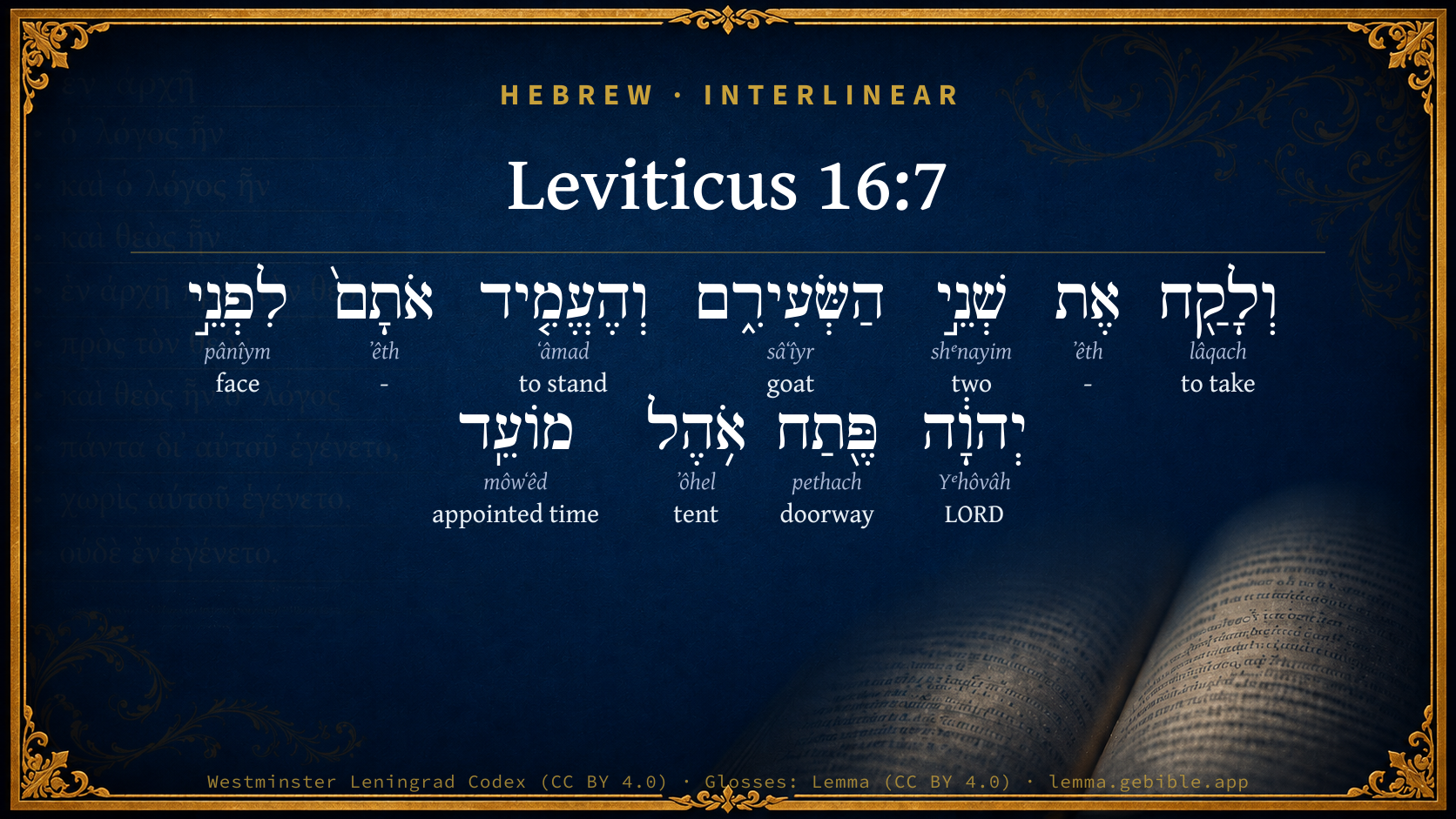
Leviticus 16:7

Hebrew (Westminster Leningrad Codex) Leviticus 16:7 appears in the Hebrew Old Testament. The text above is from the Westminster Leningrad Codex. Each word links to its Strong’s number, a concise gloss, and parsing drawn from the Open Scriptures Hebrew Bible morphology. Click any word for its full Brown-Driver-Briggs (BDB) entry.
Download image
Cite this verse

Leviticus 16:7 (World English Bible). Public Domain. Lemma interlinear Bible study tool, https://lemma.gebible.app/v/leviticus/16/7.

Show BibTeX & RIS
BibTeX
RIS
English Translation
He shall take the two goats, and set them before Yahweh at the door of the Tent of Meeting.
World English Bible · Public Domain
Download a study sheet

One document with this verse’s original text, its word-by-word gloss line, the meaning frame, cross-references with their text, attributed commentary, and full source and license credits — printable, and it pastes into notes with its structure intact.

This verse Autodidact and up

Study sheet (.html) Plain text (.txt)

A passage Seminary Student

Up to 50 verses in one chapter. A passage sheet keeps up to 6 commentary sources and 12 cross-references per verse, in the order this page ranks them, and says so on the sheet whenever that leaves anything out. Ask for a single verse and you get the Autodidact verse sheet above.

Everything on this page stays free to read, with no account — the sheet is a download of what is already on screen, not access to it.

Want to remove ads? Support Godless Engineer
Compare translations 3

The same verse in 3 English versions, stacked beneath the original-language interlinear above. Click any original word for its lexicon entry.

Each is an independent rendering of the whole verse — the interlinear is not word-aligned to these translations.

Highlighted words mark where these versions differ — a whole-verse word diff, not a word-by-word alignment.

  • World English Bible Public Domain
    He shall take the two goats, and set them before Yahweh at the door of the Tent of Meeting.
  • King James Version Public Domain
    And he shall take the two goats, and present them before the LORD at the door of the tabernacle of the congregation.
  • unfoldingWord Literal Text CC BY-SA 4.0
    And he shall take the two goats, and he shall make them stand to the face of Yahweh at the entrance of the tent of meeting.

unfoldingWord Literal Text — © unfoldingWord, licensed CC BY-SA 4.0. Word-aligned USFM3 via Door43 (git.door43.org/unfoldingWord/en_ult).

Versions to compare (up to 4)

3 of 4 selected

Show all 18 translations

Every available English version of this verse, each an independent rendering of the whole verse.

  • World English Bible Public Domain
    He shall take the two goats, and set them before Yahweh at the door of the Tent of Meeting.
  • Berean Standard Bible Public Domain
    Then he shall take the two goats and present them before the LORD at the entrance to the Tent of Meeting.
  • Majority Standard Bible Public Domain
    Then he shall take the two goats and present them before the LORD at the entrance to the Tent of Meeting.
  • King James Version Public Domain
    And he shall take the two goats, and present them before the LORD at the door of the tabernacle of the congregation.
  • American Standard Version (1901) Public Domain
    And he shall take the two goats, and set them before Jehovah at the door of the tent of meeting.
  • Revised Version (1885) Public Domain
    And he shall take the two goats, and set them before the LORD at the door of the tent of meeting.
  • Geneva Bible (1599) Public Domain
    And he shall take the two hee goates, and present them before the Lord at the doore of the Tabernacle of the Congregation.
  • Douay-Rheims (1899) Public Domain
    He shall make the two buck goats to stand before the Lord in the door of the tabernacle of the testimony:
  • Young's Literal Translation Public Domain
    and he hath taken the two goats, and hath caused them to stand before Jehovah, at the opening of the tent of meeting.
  • Literal Standard Version CC BY-SA 4.0
    and he has taken the two goats, and has caused them to stand before YHWH, at the opening of the Tent of Meeting.
  • Unlocked Literal Bible CC BY-SA 4.0
    Then he must take the two goats and set them before Yahweh at the entrance to the tent of meeting.
  • unfoldingWord Literal Text CC BY-SA 4.0
    And he shall take the two goats, and he shall make them stand to the face of Yahweh at the entrance of the tent of meeting.
  • Darby Bible Public Domain
    And he shall take the two goats, and set them before Jehovah, before the entrance of the tent of meeting.
  • World Messianic Bible Public Domain
    He shall take the two goats, and set them before the LORD at the door of the Tent of Meeting.
  • Webster's Bible Public Domain
    And he shall take the two goats, and present them before the LORD at the door of the tabernacle of the congregation.
  • Free Bible Version CC BY-SA 4.0
    Then he will bring the two goats and present them before the Lord at the entrance to the Tent of Meeting.
  • Bible in Basic English Public Domain
    And he is to take the two goats and put them before the Lord at the door of the Tent of meeting.
  • JPS Tanakh (1917) Public Domain
    And he shall take the two goats, and set them before the LORD at the door of the tent of meeting.

Literal Standard Version (2020), Covenant Press — licensed CC BY-SA 4.0. Text via the HelloAO Bible API (eBible.org). Unlocked Literal Bible (unfoldingWord) — licensed CC BY-SA 4.0. Text via the HelloAO Bible API (eBible.org). unfoldingWord Literal Text — © unfoldingWord, licensed CC BY-SA 4.0. Word-aligned USFM3 via Door43 (git.door43.org/unfoldingWord/en_ult). Free Bible Version, Dr. Jonathan Gallagher — licensed CC BY-SA 4.0. Text via the HelloAO Bible API (eBible.org).

Word by word

More ways to search: Search by grammar → Find every occurrence → Compare this word →

Practice this passage: Drill this verse → Learn its vocabulary →

הַשְּׂעִירִ֑ם
sâʻîyr
H8163
“the · goats”
Particle, Definite Article + Noun, Common, Masculine, Plural, Absolute
Part of Speech
Particle + Noun
Type
Common
Gender
Masculine
Number
Plural
State
Absolute
Full BDB Definition

Origin: from H8175

TWOT: 2274c , 2274e

hairy (adjective) - he-goat, buck (noun masculine) - as sacrificial animal - satyr, may refer to a demon possessed goat like the swine of Gadara ( Mat 8:30-32 )
  1. וְלָקַ֖ח lâqach H3947 “and · to take” Conjunction + Verb, Qal, Sequential Perfect, 3rd Person, Masculine, Singular
  2. אֶת ʼêth H853 “-” Particle, Direct Object
  3. שְׁנֵ֣י shᵉnayim H8147 “two” Adjective, Cardinal number, Masculine, Dual, Construct
  4. וְהֶעֱמִ֤יד ʻâmad H5975 “and · to stand” Conjunction + Verb, Hiphil, Sequential Perfect, 3rd Person, Masculine, Singular
  5. אֹתָם֙ ʼêth H853 “- · them” Particle, Direct Object + Suffix, Personal, 3rd Person, Masculine, Plural
  6. לִפְנֵ֣י pânîym H6440 “to/for · face(s) of” Preposition + Noun, Common, Both, Plural, Construct
  7. יְהוָ֔ה Yᵉhôvâh H3068 “LORD” Noun, Proper
  8. פֶּ֖תַח pethach H6607 “doorway of” Noun, Common, Masculine, Singular, Construct
  9. אֹ֥הֶל ʼôhel H168 “tent of” Noun, Common, Masculine, Singular, Construct
  10. מוֹעֵֽד môwʻêd H4150 “appointed time” Noun, Common, Masculine, Singular, Absolute

About this verse

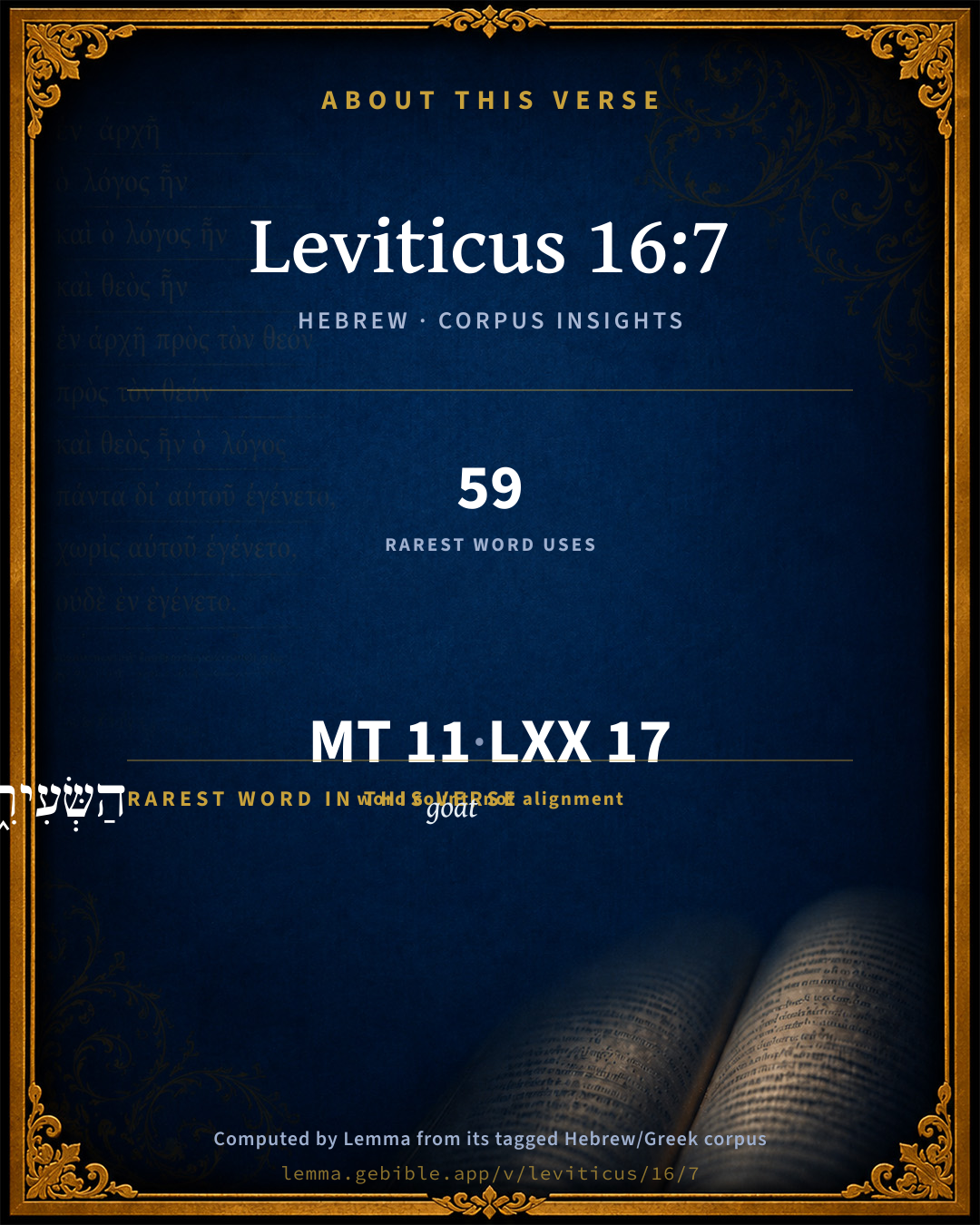
These counts appear in no published source. They are computed here, from the morphology-tagged text and Lemma’s own curated glosses. What Lemma adds →

11
words
10
distinct lemmas
Pentateuch
section

Shared distinctive vocabulary

הַשְּׂעִירִ֑ם goat H8163 occurs in 57 verses of the Hebrew Bible. Also found in:

Grammatical profile

  • 2 verbs
  • 6 nouns
  • 1 adjective
  • 2 particles

Verb forms

  • וְלָקַ֖ח Qal · Sequential Perfect
  • וְהֶעֱמִ֤יד Hiphil · Sequential Perfect

Hebrew & Septuagint length

In English translation the verse runs 19 words from the Hebrew and 21 from the Septuagint (LXX English) — closely comparable.

A rough comparison of the two English renderings, which tokenize alike — not a word-level alignment.

Word counts can differ between the Hebrew and the Greek without any difference in meaning — e.g. the Hebrew direct-object marker אֵת has no separate Greek word, and Greek often adds the article ὁ.

In the original languages it is 11 Hebrew tokens and 17 Greek tokens — but the two are counted differently (Hebrew bundles its prefixes and suffixes into one token; the Greek is in lemma form), so that isn’t a like-for-like length.

Cross-references

5

Topical passages linked to Leviticus 16:7 in the Treasury of Scripture Knowledge — connected by theme and wording, ordered by reader-vote popularity; previews shown in the World English Bible.

  • Romans 12:1 Therefore I urge you, brothers, by the mercies of God, to present your bodies a living sacrifice, holy, acceptable to God, which is your spiritual service.
  • Leviticus 1:3 "'If his offering is a burnt offering from the herd, he shall offer a male without blemish. He shall offer it at the door of the Tent of Meeting, that he may be accepted before Yahweh.
  • Leviticus 4:4 He shall bring the bull to the door of the Tent of Meeting before Yahweh; and he shall lay his hand on the head of the bull, and kill the bull before Yahweh.
  • Leviticus 12:6–7 "'When the days of her purification are completed, for a son, or for a daughter, she shall bring to the priest at the door of the Tent of Meeting, a year old lamb for a burnt offering, and a young pigeon, or a turtledove, for a sin offering:
  • Matthew 16:21 From that time, Jesus began to show his disciples that he must go to Jerusalem and suffer many things from the elders, chief priests, and scribes, and be killed, and the third day be raised up.

Cross-references courtesy of OpenBible.info (CC BY 4.0).

Hebrew and Greek witnesses Masoretic Hebrew ↔ Greek Septuagint

The same verse in the two great witnesses to the Old Testament, shown verse-for-verse.

These are two independent witnesses, not word-aligned to each other, and the Septuagint is shown in lemma (dictionary) form.

Hebrew Leviticus 16:7 Masoretic · Westminster Leningrad Codex

וְלָקַ֖ח אֶת שְׁנֵ֣י הַשְּׂעִירִ֑ם וְהֶעֱמִ֤יד אֹתָם֙ לִפְנֵ֣י יְהוָ֔ה פֶּ֖תַח אֹ֥הֶל מוֹעֵֽד

He shall take the two goats, and set them before Yahweh at the door of the Tent of Meeting.

World English Bible · Public Domain

Greek LXX Leviticus 16:7 Septuagint · lemma form

καί λαμβάνω ὁ δύο χίμαρος καί ἵστημι αὐτός ἔναντι κύριος παρά ὁ θύρα ὁ σκηνή ὁ μαρτύριον

And he shall take the two goats, and place them before the Lord by the door of the tabernacle of witness.

LXX2012 (modern English Septuagint) · Public Domain

On this verse, The Pulpit Commentary discusses the Septuagint’s reading. Read the note in Commentary ↓

Hebrew: Westminster Leningrad Codex (CC BY 4.0). Greek: Septuagint (public domain); English from LXX2012 (modern English Septuagint) (Public Domain). How the Septuagint differs from the Hebrew →

Targum (Aramaic paraphrase)

2

The Targum is the ancient Jewish Aramaic paraphrase of the Hebrew Scriptures — an interpretive translation, not the Hebrew text itself. Onkelos (literal) and Pseudo-Jonathan (expansive) render the Torah, and Jonathan the Prophets. Coverage is partial: where no permissively-licensed English translation exists for a verse, only the Aramaic is shown. This is verse-level text, not a word-by-word alignment to the Hebrew.

  1. Targum Onkelos Torah (Genesis–Deuteronomy)
    וְיִסַב יָת תְּרֵין צְפִירִין וִיקִים יָתְהוֹן קֳדָם יְיָ בִּתְרַע מַשְׁכַּן זִמְנָא

    (no public-domain English translation for this verse)

    Targum Onkelos — Aramaic: “Onkelos Genesis” (public domain); “Onkelos Exodus” (public domain); “Onkelos Leviticus” (public domain); “Onkelos Numbers” (public domain); “Onkelos Deuteronomy” (public domain). English: “Sefaria Community Translation” (CC0 1.0 (public-domain dedication)); “J.W. Etheridge. The Targums of Onkelos and Jonathan Ben Uzziel on the Pentateuch. London: Longmans, Green, 1862” (public domain). Text via Sefaria.

  2. Targum Pseudo-Jonathan Torah (Genesis–Deuteronomy)
    וְיִסַב יַת תְּרֵין צְפִירִין וִיקֵם יַתְהוֹן קֳדָם יְיָ בִּתְרַע מַשְׁכַּן זִמְנָא

    And he shall take the two goats, and cause them to stand before the Lord, at the door of the tabernacle of ordinance.

    Targum Pseudo-Jonathan — Aramaic: “Targum Jonathan on Genesis” (public domain); “Targum Jonathan on Exodus” (public domain); “Targum Jonathan on Leviticus” (public domain); “Targum Jonathan on Numbers” (public domain); “Targum Jonathan on Deuteronomy” (public domain). English: “The Targum of Jonathan ben Uzziel, trans. J. W. Etheridge, London, 1862” (public domain). Text via Sefaria.

Commentary

Notes on Leviticus 16:7 from classic Christian and Jewish commentators (each source and its license shown beneath its notes). The classic Christian expositions comment on the surrounding passage and are grouped to its opening verse, so a note may address several verses; the Jewish commentaries on the Tanakh (Rashi and others) are per-verse, so they appear only where the commentator wrote on this verse.

Lemma curates 59 commentaries, every one of them public domain or Creative Commons licensed, each selected and text-cleaned for this edition rather than reprinted as found. About our sources →

Trapp's Complete Commentary

John Trapp

Lev 16:7 And he shall take the two goats, and present them before the LORD [at] the door of the tabernacle of the congregation.

Ver. 7. The two goats.] See on Lev 16:5.

John Trapp, A Commentary or Exposition upon All the Books of the Old and New Testament (1647–1656) — public domain. Text from a community e-Sword module.

Joseph Benson's Commentary

Lev 16:7. He shall present them before the Lord — The scape-goat was presented at the door of the tabernacle before the Lord, as well as the other goat, to signify that they were both consecrated to him; indeed they both made but one sin-offering, Lev 16:5.

Joseph Benson's Commentary on the Old and New Testaments (1811–1818) — public domain. Text from a community e-Sword module.

Adam Clarke's Commentary

Verse 7. And he shall take the two goats] It is allowed on all hands that this ceremony, taken in all its parts, pointed out the Lord Jesus dying for our sins and rising again for our justification; being put to death in the flesh, but quickened by the Spirit. Two goats are brought, one to be slain as a sacrifice for sin, the other to have the transgressions of the people confessed over his head, and then to be sent away into the wilderness. The animal by this act was represented as bearing away or carrying off the sins of the people. The two goats made only one sacrifice, yet only one of them was slain. One animal could not point out both the Divine and human nature of Christ, nor show both his death and resurrection, for the goat that was killed could not be made alive. The Divine and human natures in Christ were essential to the grand expiation: yet the human nature alone suffered, for the Divine nature could not suffer; but its presence in the human nature, while agonizing unto death, stamped those agonies, and the consequent death, with infinite merit. The goat therefore that was slain prefigured his human nature and its death; the goat that escaped pointed out his resurrection. The one shows the atonement for sin, as the ground of justification; the other Christ's victory, and the total removal of sin in the sanctification of the soul. Concerning these ceremonies we shall see farther particulars as we proceed.

According to Maimonides fifteen beasts were offered on this day. "The daily, or morning and evening sacrifice, was offered as usual: besides a bullock, a ram, and seven lambs, all burnt-offerings; and a goat for a sin-offering, which was eaten in the evening. Then a bullock for a sin-offering, and this they burnt; and a ram for a burnt-offering: these both for the high priest. Then the ram for the consecration, (see Le 16:5) which is called the people's ram. They brought also for the congregation two he-goats; the one for a sin-offering, the other for a scape-goat. Thus all the beasts offered on this great solemn day were FIFTEEN: the two daily sacrifices, one bullock, two rams, and seven lambs: all of these burnt-offerings. Two goats for sin-offerings; one offered without and eaten on the evening, the other offered within and burnt; and one bullock for a sin-offering for the high priest. The service of all these fifteen beasts is performed on this day by the high priest only." See Maimonides and Ainsworth on the place.

Adam Clarke's Commentary on the Bible (1810–1826) — public domain. Text from a community e-Sword/MySword module.

Ellicott's Commentary for English Readers

(7) And he shall take the two goats.—Having presented his own sin-offering, the high priest, accompanied by the two chief priests, now came to the north of the altar. Here the one of his companions who was next in rank to the pontiff placed himself at his right side, whilst the other, who held the office of chief of the principal household (see 1Ch_24:6), stood at his left. It was here that the two goats were presented with their faces to the west, where the Holy of Holies was, and where the Divine majesty was especially revealed.

A Bible Commentary for English Readers, edited by Charles John Ellicott (1878–1897) — public domain. Text from a community e-Sword module.

John Gill's Exposition

And he shall take the two goats,.... The sin offering for the people, a proper emblem of Christ, this creature being clean and fit for food, denoting the purity of Christ, and his being suitable and wholesome food, as his flesh is to the faith of his people; and because comely in its going, as Christ was in his going from everlasting, and in his coming, into this world, travelling in the greatness of his strength; and even by reason of its having something in it unsavoury and offensive, and which made it the fitter emblem of Christ, as a surety of his people; for though he had no sin inherent in him and natural to him, yet he appeared in the likeness of sinful flesh, and had sin imputed to him, which rendered him obnoxious to divine justice: the number of these goats was two, typical either of the two natures in Christ; his divine nature, in which he is impassable, and lives for ever, which may be signified by the goat presented alive and let go; and his human nature, in which he suffered and died, and may be fitly represented by the goat that was slain; or else of the two estates of Christ before and after his resurrection, his being put to death in the flesh and quickened in the Spirit; or rather this may signify the twofold consideration of Christ as Mediator, one with respect to his divine Father, to whom he made satisfaction by his death; and the other with respect to Satan, with whom he conflicted in life, and to whose power he was so far delivered up, as not only to be tempted, and harassed by him, but through his instigation to be brought to the dust of death; See Gill on Lev 16:10; and these two goats, according to the Jewish writers (y), were to be alike in sight or colour, in stature and in value, and to be taken together: Christ, the antitype of them, is the same dying and rising; the same that died, rose again from the dead; the same that suffered, is glorified; and the same that went up to heaven, will come again in like manner:

and present them before the Lord, at the door of the tabernacle of the congregation; at the east of the court, and the north of the altar, as the Misnah (z); so that their faces were towards the west, where the holy of holies, the seat of the divine Majesty, was, and so said to be before the Lord, or over against where he dwelt: this presentation may have respect to the death of Christ, when he presented himself to God as an offering and a sacrifice; and which was done publicly in the sight of great multitudes, and on the behalf of the whole congregation of the Lord's people, and before him against whom sin is committed, and to whom satisfaction is given.

(y) Misn. Yoma, c. 6. sect. 1. (z) Ib. c. 3. sect. 8.

John Gill's Exposition of the Whole Bible (1746–1763) — public domain (CC PDM 1.0). Text via the HelloAO Bible API.

The Pulpit Commentary

Vers. 7, 8. It must be carefully noted that. as the two goats made one sin offering (verse 5), so they are both presented before the Lord at the door of the tabernacle of the congregation. By this solemn presentation they became the Lord"s, one as much as the other. After this, Aaron is to cast lots upon the two goats. The two goats, of the same size and appearance as far as possible, stood together near the entrance of the court. And by them was an urn containing two lots. These the high priest drew out at the same moment, placing one on the head of one goat, the other on the head of the other goat. According as the lot fell. one of the goats was taken and at once offered to the Lord, with a view to being shortly sacrificed; the other was appointed for a scapegoat, and reserved till the expiatory sacrifices had been made, when it too was offered to the Lord, and then sent away into the wilderness. After the lot had been chosen, the two goats were distinguished from each other by having a piece of scarlet cloth tied, the first round its neck, the second round its horn. One lot for the Lord, and the other lot for the scapegoat. The last word is in the original la-azazel, and being found only in this chapter, it has caused a great discrepancy of opinion among interpreters as to its meaning. It has been diversely regarded as a place, a person, a thing, and an abstraction. The first class of interpreters explain it as some district of the wilderness; the second understand by it an evil spirit; the third take it as a designation of the goat; the fourth translate it, "for removal." The first interpretation may be summarily rejected. If a localized spot were meant, that spot would have been left behind by a people constantly on the move. The second hypothesis that azazel was an evil spirit, or the evil spirit has been embraced by so considerable a number of modern expositors, that it is necessary to dwell upon it at some length. But, indeed, it has little to recommend it. It has been argued that azazel must be a proper name, because it has no article prefixed to it, la-azazel. This is a grammatical error. When a noun expresses an office or a function, and has the preposition le or la prefixed to it, it does not take an article in Hebrew any more than in French; e.g., in the verse, "Jehu... shalt thou anoint to be king (or for king) over Israel; and Elisha... shalt thou appoint to be prophet (or for prophet) in thy room", (1Ki_19:16) the Hebrew is le-melek and le-navi, without the article. The same idiom will be found in 1Sa_25:30 2Sa_7:14. With greater plausibility it is argued that verse 8 contrasts Jehovah and Azazel, and that if la-Yehovah be translated "for Jehovah," or "for the Lord," la-azazel must be translated "for Azazel." It may be allowed that there is a prima facie likelihood that, where words are thus contrasted, if one designates a person, the other would designate a person. But it is an incredibly rash assertion that this is always the case. All depends upon the idea which the speaker or writer has in his mind and desires to express. As part of the same argument, it is urged that the preposition, being the same in both clauses of the sentence, must be translated by the same word. This is certainly not the case. The natural meaning of le with a proper name is "for," and with a word expressing the performance of some function (technically called nomen agentis) it means "to be". (see the passage quoted above from 1Ki_19:16) Unless, therefore, azazel be a proper name (which has to be proved, not assumed) the preposition need not and ought not to be translated by "for" but by "to be." The word le is used with great latitude, and often in a different sense in the same sentence; e.g., Gen_11:9) Azalzel is an active participle or participial noun, derived ultimately from azal (connected with the Arabic word azala, and meaning removed), but immediately from the reduplicate form of that verb, azazal. The reduplication of the consonants of the root in Hebrew and Arabic gives the force of repetition, so that while azal means removed, azalzal means removed by a repetition of acts. Azalzel, or azazel, therefore, means one who removes by a series of acts. "In this sense the word azazel is strictly expressive of the function which is ascribed to the scapegoat in verses 21, 22; namely, that he "be sent away, bearing upon him all the iniquities of the children of Israel into the wilderness. It properly denotes one that removes or separates; yet a remover in such sort that the removal is not effected by a single act or at one moment, but by a series of minor acts tending to and issuing in a complete removal. No word could better express the movement of the goat before the eyes of the people, as it passed on, removing at each step, in a visible symbol, their sins further and further from them, until, by continued repetition of the movement, they were carried far away and removed utterly" (Sir W. Martin, "Semitic Languages"). That it is the goat that is designated by the word azazel is the exposition of the LXX, Josephus, Symmachus, Aquila, Theodotion, the Vulgate, the Authorized English Version, and Luther"s Version. The interpretation is founded on sound etymological grounds, it suits the context wherever the word occurs, it is consistent with the remaining ceremonial of the Day of Atonement, and it accords with the otherwise known religious beliefs and symbolical practices of the Israelites. The two goats were the single sin offering for the people; the one that was offered in sacrifice symbolized atonement or covering made by shedding of blood, the other symbolized the utter removal of the sins of the people, which were conveyed away and lost in the depths of the wilderness, whence there was no return. Cf. Psa_103:12, "As far as the east is from the west, so far hath he removed our transgressions from us;" and Mic_7:19, "He will turn again, he will have compassion upon us; he will subdue our iniquities; and thou wilt cast all their sins into the depths of the sea." The eighth verse should be translated as it stands in the Authorized Version, or, if we ask for still greater exactness, And Aaron shall east lots upon the two goats; one lot for the Lord, and one lot for a remover of sins.

Vers. 7-10, 15, 21, 22. Type and antitype the offering.

The most striking feature of the whole service on the great Day of Atonement was the action of the high priest in regard to the two goats brought to the tabernacle door (verse 7). They clearly point to that "Lamb of God" who came to "take away the sin of the world". (Joh_1:29) That there were two goats rather than one presents no difficulty at all; there might well have been more than one to typify the Sacrifice which they foreshadowed. We learn

I THAT GOD ADMITS VICARIOUS SUFFERING INTO HIS RIGHTEOUS REALM. The innocent goat would shed its blood, would pour out its life, that the guilty human souls might not die, but live. It was a Divine appointment, and shows clearly that the propitiatory element was allowed by the Holy One of Israel. The vicarious principle has a large place in the kingdom of God on earth. Involuntarily and also voluntarily we suffer for others and others for us. Man bears the penal consequences of his brother"s sin. He does so when he cannot avoid so doing; and he does so frequently with his own full consent; indeed, by going far out of his way on purpose to bear it. Vicarious suffering runs through the whole human economy. But there is only One who could possibly take on himself the penalty of the world"s sin only One on whom could possibly be "laid the iniquity of us all." That one is the spotless "Lamb of God," that Son of God who became sin for man; he, "for the suffering of death was made a little lower than the angels," and took on him a mortal form. "Surely he hath borne our griefs, and carried our sorrows; ... he was wounded for our transgressions, he was bruised for our iniquities," etc. (Isa_53:4, 5 1Pe_2:24)

II THAT THE SACRIFICE OF CHRIST AVAILS TO REMOVE COMPLETELY ALL CONDEMNATION. When the children of Israel saw the live goat, over whose head their sins had been confessed, being led away into the waste wilderness where it would never more be seen (verse 22), they had a very vivid assurance made through their senses to their soul that "their transgressions were forgiven, and their sins covered." No such dramatic assurance have we now, but we may have the utmost confidence that our sins are forgiven us "for his Name"s sake;" that "there is no condemnation to us who are in Christ Jesus," to us "who have redemption through his blood, even the forgiveness of sins". (Act_13:39 Rom_5:9) Trusting in the slain Lamb of God, we may see, by the eye of faith, all our guilt and all our condemnation borne away into the land of forgetfulness, where God will remember it no more for ever.

III THAT NO SACRIFICE WILL AVAIL ANYTHING WITHOUT ACTIVE PARTICIPATION ON OUR PART. Useless and unavailing altogether the slaying of the one goat and the sending away of the other without the act of confession and the imposition of hands by the high priest (verse 21); this part of the solemn ceremonial was essential; apart from that everything would have been vain. And without our personal spiritual participation the sacrifice of the Lamb of God will be all in vain.

1. There must be the confession of our sin; a confession of sin which springs from contrition for sin, and is attended by a determination to put all sin away (repentance).

2. Faith in the Divine Redeemer. "Our faith must lay its hand on that dear head of his.

3. And this must be the action of our own individual soul. Whatever guidance and encouragement we may gain from the ministers of Christ, we ourselves must repent and believe. C.

The Pulpit Commentary (1880–1919), ed. H.D.M. Spence-Jones & Joseph S. Exell — public domain. Text from a community e-Sword module.

Lesson kit

Teaching starters — assembled from the data on this page, not authored interpretation. Every prompt links to the verse data it draws on. Edit before teaching.

Leviticus, in the Pentateuch, opens this verse with 11 words (10 distinct Hebrew lemmas). Its most distinctive word is sâʻîyr (“goat”). A historical commentator’s framing appears above. Read the whole chapter for the surrounding context.

Discussion questions

  1. The word sâʻîyr carries the sense “goat.” How does it shape the verse?
  2. Genesis 27:11 shares the word «goat» with this verse. How do the two illuminate each other?
  3. The translations on this page render this verse differently — a whole-verse word diff, not a word-by-word alignment. What might account for the different wordings?
  4. The verb «וְלָקַ֖ח» is Qal Sequential Perfect. How does its form color the action?
  5. Reading how Trapp's Complete Commentary and Joseph Benson's Commentary read this verse, where do the two commentators agree and where do they part?

Things to notice

Reading settings

Reading text

Shown beneath each verse's original-language words.

Old Testament
Old Testament edition

Read the OT as the Masoretic Hebrew (MT) or the Greek Septuagint (LXX).

English shown for the Greek Septuagint (in the Hebrew ↔ Greek comparison).

Comparing translations? Open the Compare panel on any verse page to stack up to four side by side.