Numbers 18:4

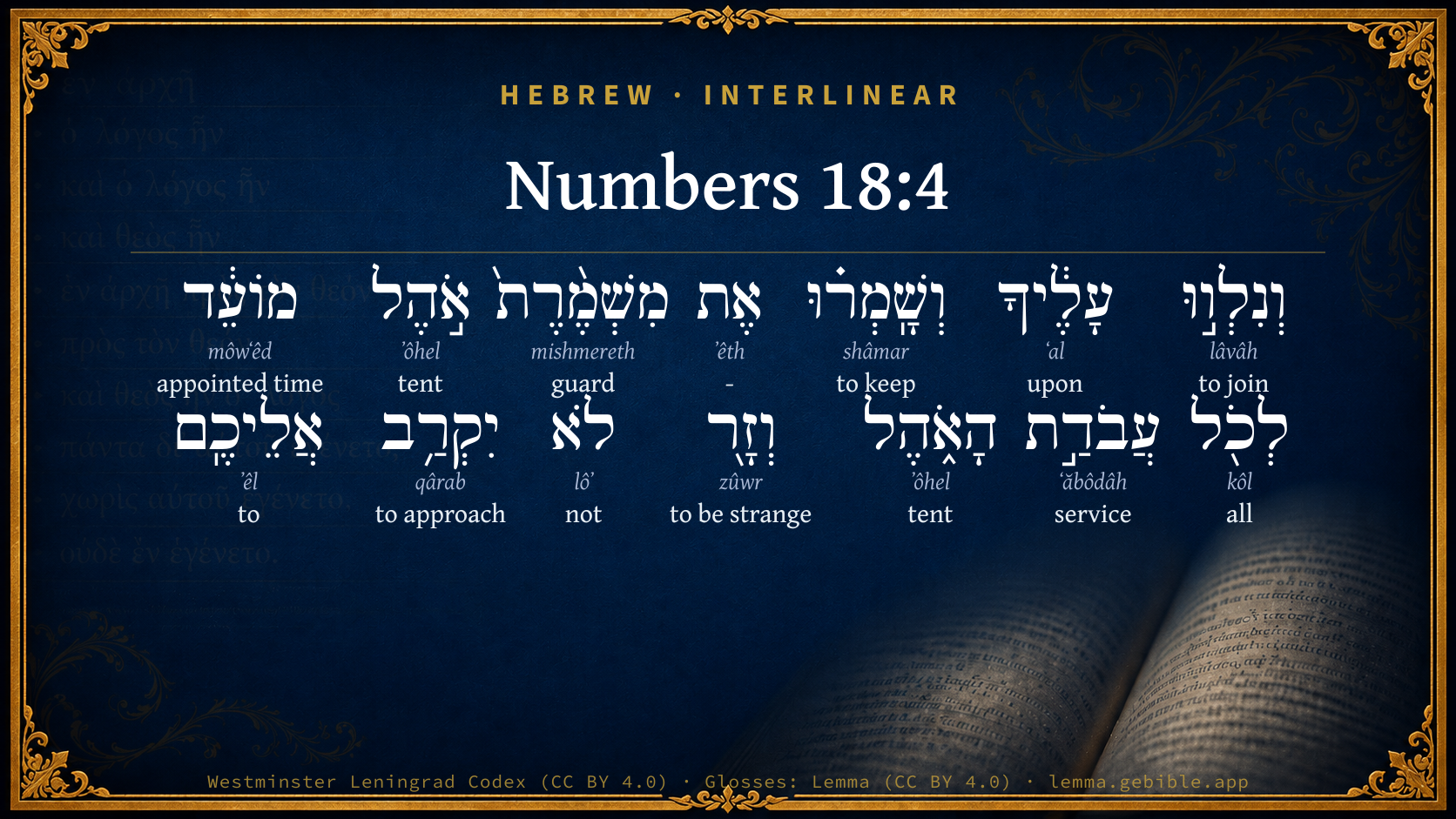
Hebrew (Westminster Leningrad Codex) Numbers 18:4 appears in the Hebrew Old Testament. The text above is from the Westminster Leningrad Codex. Each word links to its Strong’s number, a concise gloss, and parsing drawn from the Open Scriptures Hebrew Bible morphology. Click any word for its full Brown-Driver-Briggs (BDB) entry.
Download image
Cite this verse

Numbers 18:4 (World English Bible). Public Domain. Lemma interlinear Bible study tool, https://lemma.gebible.app/v/numbers/18/4.

Show BibTeX & RIS
BibTeX
RIS
English Translation
They shall be joined to you, and keep the charge of the tent of meeting, for all the service of the Tent: and a stranger shall not come near to you.
World English Bible · Public Domain
Download a study sheet

One document with this verse’s original text, its word-by-word gloss line, the meaning frame, cross-references with their text, attributed commentary, and full source and license credits — printable, and it pastes into notes with its structure intact.

This verse Autodidact and up

Study sheet (.html) Plain text (.txt)

A passage Seminary Student

Up to 50 verses in one chapter. A passage sheet keeps up to 6 commentary sources and 12 cross-references per verse, in the order this page ranks them, and says so on the sheet whenever that leaves anything out. Ask for a single verse and you get the Autodidact verse sheet above.

Everything on this page stays free to read, with no account — the sheet is a download of what is already on screen, not access to it.

Want to remove ads? Support Godless Engineer
Compare translations 3

The same verse in 3 English versions, stacked beneath the original-language interlinear above. Click any original word for its lexicon entry.

Each is an independent rendering of the whole verse — the interlinear is not word-aligned to these translations.

Highlighted words mark where these versions differ — a whole-verse word diff, not a word-by-word alignment.

  • World English Bible Public Domain
    They shall be joined to you, and keep the charge of the tent of meeting, for all the service of the Tent: and a stranger shall not come near to you.
  • King James Version Public Domain
    And they shall be joined unto thee, and keep the charge of the tabernacle of the congregation, for all the service of the tabernacle: and a stranger shall not come nigh unto you.
  • unfoldingWord Literal Text CC BY-SA 4.0
    And they shall be joined to you, and they shall keep the keeping of the tent of meeting for all the service of the tent. And a stranger shall not come near to you.

unfoldingWord Literal Text — © unfoldingWord, licensed CC BY-SA 4.0. Word-aligned USFM3 via Door43 (git.door43.org/unfoldingWord/en_ult).

Versions to compare (up to 4)

3 of 4 selected

Show all 18 translations

Every available English version of this verse, each an independent rendering of the whole verse.

  • World English Bible Public Domain
    They shall be joined to you, and keep the charge of the tent of meeting, for all the service of the Tent: and a stranger shall not come near to you.
  • Berean Standard Bible Public Domain
    They are to join you and attend to the duties of the Tent of Meeting, doing all the work at the Tent; but no outsider may come near you.
  • Majority Standard Bible Public Domain
    They are to join you and attend to the duties of the Tent of Meeting, doing all the work at the Tent; but no outsider may come near you.
  • King James Version Public Domain
    And they shall be joined unto thee, and keep the charge of the tabernacle of the congregation, for all the service of the tabernacle: and a stranger shall not come nigh unto you.
  • American Standard Version (1901) Public Domain
    And they shall be joined unto thee, and keep the charge of the tent of meeting, for all the service of the Tent: and a stranger shall not come nigh unto you.
  • Revised Version (1885) Public Domain
    And they shall be joined unto thee, and keep the charge of the tent of meeting, for all the service of the Tent: and a stranger shall not come nigh unto you.
  • Geneva Bible (1599) Public Domain
    And they shalbe ioyned with thee, and keepe the charge of the Tabernacle of the Congregation for all the seruice of the Tabernacle: and no stranger shall come neere vnto you:
  • Douay-Rheims (1899) Public Domain
    But let them be with thee, and watch in the charge of the tabernacle, and in all the ceremonies thereof. A stranger shall not join himself with you.
  • Young's Literal Translation Public Domain
    and they have been joined unto thee, and have kept the charge of the tent of meeting, for all the service of the tent; and a stranger doth not come near unto you;
  • Literal Standard Version CC BY-SA 4.0
    and they have been joined to you and have kept the charge of the Tent of Meeting for all the service of the tent; and a stranger does not come near to you;
  • Unlocked Literal Bible CC BY-SA 4.0
    They must join you and take care of the tent of meeting, for all the work connected with the tent. A foreigner must not come near you.
  • unfoldingWord Literal Text CC BY-SA 4.0
    And they shall be joined to you, and they shall keep the keeping of the tent of meeting for all the service of the tent. And a stranger shall not come near to you.
  • Darby Bible Public Domain
    And they shall unite with thee, and keep the charge of the tent of meeting, for all the service of the tent; and no stranger shall come near to you.
  • World Messianic Bible Public Domain
    They shall be joined to you and keep the responsibility of the Tent of Meeting, for all the service of the Tent. A stranger shall not come near to you.
  • Webster's Bible Public Domain
    And they shall be joined to thee, and keep the charge of the tabernacle of the congregation, for all the service of the tabernacle: and a stranger shall not come nigh to you.
  • Free Bible Version CC BY-SA 4.0
    They are to help you and take care of the responsibilities of the Tent of Meeting, doing all the work at the Tent, but they are not allowed to be with you during your priestly ministry.
  • Bible in Basic English Public Domain
    They are to be joined with you in the care of the Tent of meeting, doing whatever is needed for the Tent: and no one of any other family may come near you.
  • JPS Tanakh (1917) Public Domain
    And they shall be joined unto thee, and keep the charge of the tent of meeting, whatsoever the service of the Tent may be; but a common man shall not draw nigh unto you.

Literal Standard Version (2020), Covenant Press — licensed CC BY-SA 4.0. Text via the HelloAO Bible API (eBible.org). Unlocked Literal Bible (unfoldingWord) — licensed CC BY-SA 4.0. Text via the HelloAO Bible API (eBible.org). unfoldingWord Literal Text — © unfoldingWord, licensed CC BY-SA 4.0. Word-aligned USFM3 via Door43 (git.door43.org/unfoldingWord/en_ult). Free Bible Version, Dr. Jonathan Gallagher — licensed CC BY-SA 4.0. Text via the HelloAO Bible API (eBible.org).

Word by word

More ways to search: Search by grammar → Find every occurrence → Compare this word →

Practice this passage: Drill this verse → Learn its vocabulary →

וְנִלְו֣וּ
lâvâh
H3867
“and · to join”
Conjunction + Verb, Niphal, Sequential Perfect, 3rd Person, Common, Plural
Part of Speech
Conjunction + Verb
Stem
Niphal
Form
Sequential Perfect
Person
3rd Person
Gender
Common
Number
Plural
Full BDB Definition

Origin: a primitive root

TWOT: 1087 , 1088

to join, be joined - (Qal) to join, be joined, attend - (Niphal) to join oneself to, be joined unto - to borrow, lend - (Qal) to borrow - (Hiphil) to cause to borrow, lend to
  1. עָלֶ֔יךָ ʻal H5921 “upon · you” Preposition + Suffix, Personal, 2nd Person, Masculine, Singular
  2. וְשָֽׁמְר֗וּ shâmar H8104 “and · to keep” Conjunction + Verb, Qal, Sequential Perfect, 3rd Person, Common, Plural
  3. אֶת ʼêth H853 “-” Particle, Direct Object
  4. מִשְׁמֶ֨רֶת֙ mishmereth H4931 “guard of” Noun, Common, Feminine, Singular, Construct
  5. אֹ֣הֶל ʼôhel H168 “tent of” Noun, Common, Masculine, Singular, Construct
  6. מוֹעֵ֔ד môwʻêd H4150 “appointed time” Noun, Common, Masculine, Singular, Absolute
  7. לְכֹ֖ל kôl H3605 “to/for · all of” Preposition + Noun, Common, Masculine, Singular, Construct
  8. עֲבֹדַ֣ת ʻăbôdâh H5656 “service of” Noun, Common, Feminine, Singular, Construct
  9. הָאֹ֑הֶל ʼôhel H168 “the · tent” Particle, Definite Article + Noun, Common, Masculine, Singular, Absolute
  10. וְזָ֖ר zûwr H2114 “and · strange” Conjunction + Adjective, Adjective, Masculine, Singular, Absolute
  11. לֹא lôʼ H3808 “not” Particle, Negative
  12. יִקְרַ֥ב qârab H7126 “to approach” Verb, Qal, Imperfect, 3rd Person, Masculine, Singular
  13. אֲלֵיכֶֽם ʼêl H413 “to · you” Preposition + Suffix, Personal, 2nd Person, Masculine, Plural

About this verse

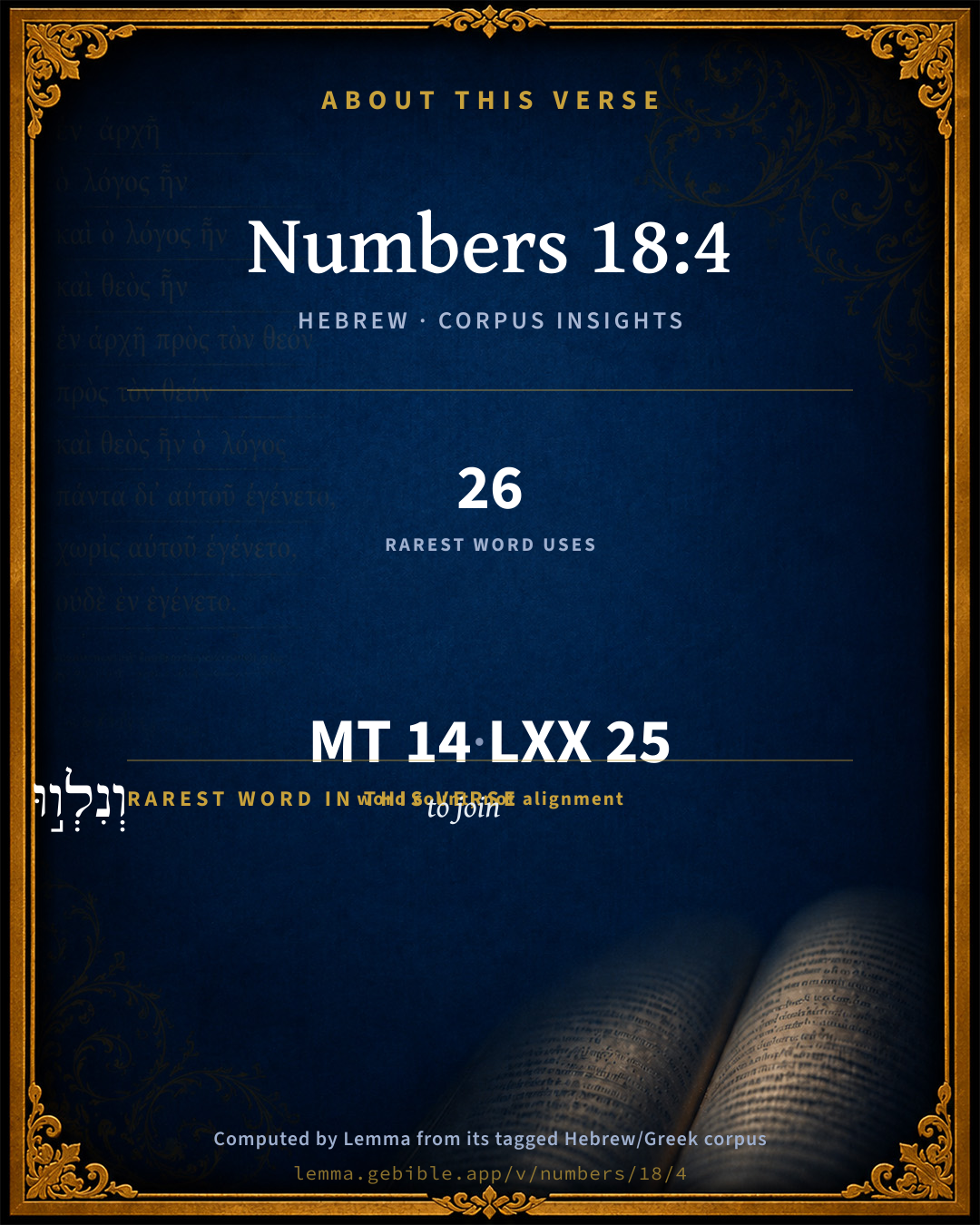
These counts appear in no published source. They are computed here, from the morphology-tagged text and Lemma’s own curated glosses. What Lemma adds →

14
words
13
distinct lemmas
Pentateuch
section

Shared distinctive vocabulary

וְנִלְו֣וּ to join H3867 occurs in 22 verses of the Hebrew Bible. Also found in:

Grammatical profile

  • 3 verbs
  • 6 nouns
  • 1 adjective
  • 2 prepositions
  • 2 particles

Verb forms

  • וְנִלְו֣וּ Niphal · Sequential Perfect
  • וְשָֽׁמְר֗וּ Qal · Sequential Perfect
  • יִקְרַ֥ב Qal · Imperfect

Repetition

A word recurs within this verse — often emphatic in Hebrew:

  • אֹ֣הֶל tent H168 ×2

Hebrew & Septuagint length

In English translation the verse runs 31 words from the Hebrew and 32 from the Septuagint (LXX English) — closely comparable.

A rough comparison of the two English renderings, which tokenize alike — not a word-level alignment.

Word counts can differ between the Hebrew and the Greek without any difference in meaning — e.g. the Hebrew direct-object marker אֵת has no separate Greek word, and Greek often adds the article ὁ.

In the original languages it is 14 Hebrew tokens and 25 Greek tokens — but the two are counted differently (Hebrew bundles its prefixes and suffixes into one token; the Greek is in lemma form), so that isn’t a like-for-like length.

Cross-references

4

Topical passages linked to Numbers 18:4 in the Treasury of Scripture Knowledge — connected by theme and wording, ordered by reader-vote popularity; previews shown in the World English Bible.

  • Numbers 1:51 When the tabernacle is to move, the Levites shall take it down; and when the tabernacle is to be set up, the Levites shall set it up. The stranger who comes near shall be put to death.
  • Numbers 3:10 You shall appoint Aaron and his sons, and they shall keep their priesthood. The stranger who comes near shall be put to death."
  • 1 Samuel 6:19 He struck of the men of Beth-shemesh, because they had looked into the ark of Yahweh, he struck of the people fifty thousand seventy men; and the people mourned, because Yahweh had struck the people with a great slaughter.
  • 2 Samuel 6:6–7 When they came to the threshing floor of Nacon, Uzzah put forth [his hand] to the ark of God, and took hold of it; for the oxen stumbled.

Cross-references courtesy of OpenBible.info (CC BY 4.0).

Hebrew and Greek witnesses Masoretic Hebrew ↔ Greek Septuagint

The same verse in the two great witnesses to the Old Testament, shown verse-for-verse.

These are two independent witnesses, not word-aligned to each other, and the Septuagint is shown in lemma (dictionary) form.

Hebrew Numbers 18:4 Masoretic · Westminster Leningrad Codex

וְנִלְו֣וּ עָלֶ֔יךָ וְשָֽׁמְר֗וּ אֶת מִשְׁמֶ֨רֶת֙ אֹ֣הֶל מוֹעֵ֔ד לְכֹ֖ל עֲבֹדַ֣ת הָאֹ֑הֶל וְזָ֖ר לֹא יִקְרַ֥ב אֲלֵיכֶֽם

They shall be joined to you, and keep the charge of the tent of meeting, for all the service of the Tent: and a stranger shall not come near to you.

World English Bible · Public Domain

Greek LXX Numbers 18:4 Septuagint · lemma form

καί προςτίθημι πρός σύ καί φυλάσσω ὁ φυλακή ὁ σκηνή ὁ μαρτύριον κατά πᾶς ὁ λειτουργία ὁ σκηνή καί ὁ ἀλλογενής οὐ προςἔρχομαι πρός σύ

And they shall be joined to you, and shall keep the charges of the tabernacle of witness, in all the services of the tabernacle; and a stranger shall not approach to you.

LXX2012 (modern English Septuagint) · Public Domain

Hebrew: Westminster Leningrad Codex (CC BY 4.0). Greek: Septuagint (public domain); English from LXX2012 (modern English Septuagint) (Public Domain). How the Septuagint differs from the Hebrew →

Targum (Aramaic paraphrase)

2

The Targum is the ancient Jewish Aramaic paraphrase of the Hebrew Scriptures — an interpretive translation, not the Hebrew text itself. Onkelos (literal) and Pseudo-Jonathan (expansive) render the Torah, and Jonathan the Prophets. Coverage is partial: where no permissively-licensed English translation exists for a verse, only the Aramaic is shown. This is verse-level text, not a word-by-word alignment to the Hebrew.

  1. Targum Onkelos Torah (Genesis–Deuteronomy)
    וְיִתּוֹסְפוּן עֲלָךְ וְיִטְרוּן יָת מַטְרַת מַשְׁכַּן זִמְנָא לְכָל פּוּלְחַן מַשְׁכְּנָא וְחִילוֹנֵי לָא יִקְרַב לְוָתְכוֹן

    (no public-domain English translation for this verse)

    Targum Onkelos — Aramaic: “Onkelos Genesis” (public domain); “Onkelos Exodus” (public domain); “Onkelos Leviticus” (public domain); “Onkelos Numbers” (public domain); “Onkelos Deuteronomy” (public domain). English: “Sefaria Community Translation” (CC0 1.0 (public-domain dedication)); “J.W. Etheridge. The Targums of Onkelos and Jonathan Ben Uzziel on the Pentateuch. London: Longmans, Green, 1862” (public domain). Text via Sefaria.

  2. Targum Pseudo-Jonathan Torah (Genesis–Deuteronomy)
    וְיִזְדַמְנוּן לְוָתָךְ מִלְבַּר וְיִטְרוּן יַת מַטְרַת מַשְׁכַּן זִמְנָא לְכָל פּוּלְחַן מַשְׁכְּנָא וְחִילוֹנֵי לָא יִקְרַב לְוַתְכוֹן

    And they shall have appointment from thee without, and keep charge of the tabernacle of ordinance for all its service; and a stranger shall not come near you.

    Targum Pseudo-Jonathan — Aramaic: “Targum Jonathan on Genesis” (public domain); “Targum Jonathan on Exodus” (public domain); “Targum Jonathan on Leviticus” (public domain); “Targum Jonathan on Numbers” (public domain); “Targum Jonathan on Deuteronomy” (public domain). English: “The Targum of Jonathan ben Uzziel, trans. J. W. Etheridge, London, 1862” (public domain). Text via Sefaria.

Commentary

Notes on Numbers 18:4 from classic Christian and Jewish commentators (each source and its license shown beneath its notes). The classic Christian expositions comment on the surrounding passage and are grouped to its opening verse, so a note may address several verses; the Jewish commentaries on the Tanakh (Rashi and others) are per-verse, so they appear only where the commentator wrote on this verse.

Lemma curates 59 commentaries, every one of them public domain or Creative Commons licensed, each selected and text-cleaned for this edition rather than reprinted as found. About our sources →

Geneva Bible (1599)

Geneva Bible translators

Which was not of the tribe of Levi.

Geneva Bible (1599) marginal notes — public domain. Text via Bolls.life.

Ellicott's Commentary for English Readers

(4) And keep the charge . . . —See Num_1:53; Num_3:7.

A Bible Commentary for English Readers, edited by Charles John Ellicott (1878–1897) — public domain. Text from a community e-Sword module.

The Cambridge Bible for Schools and Colleges

gen. ed. J. J. S. Perowne

4. a stranger] Heb. zâr; anyone who is not a priest. See on Num_1:51.

The Cambridge Bible for Schools and Colleges (gen. ed. J. J. S. Perowne; Cambridge University Press, 1878–1918) — public domain. Text from a community e-Sword module.

John Gill's Exposition

And they shall be joined unto thee,.... As assistants in the sacred service:

and keep the charge of tabernacle of the congregation, for all the service of the tabernacle; See Gill on Num 3:7 and See Gill on Num 3:8,

and a stranger shall not come nigh unto you; not any of the other tribes, only such as were of the tribe of Levi; they only were to be brought with them, and joined unto them, and assist them, and minister to them, as in Num 18:2; though the Jews (h) understand by a stranger anyone that was not a priest.

(h) Maimon. in Misn. Zebachim, c. 2. sect. 1.

John Gill's Exposition of the Whole Bible (1746–1763) — public domain (CC PDM 1.0). Text via the HelloAO Bible API.

Albert Barnes' Notes on the Bible

A stranger - i. e. every one not a Levite. So in Num 18:7, it denotes each one who was not a priest: compare Num 3:10; Num 16:40.

Albert Barnes' Notes on the Bible (1834–1885) — public domain. Text from a community e-Sword/MySword module.

Haydock's Catholic Bible Commentary

Stranger; even born of a woman of the tribe of Levi. (Maimonides)

George Leo Haydock (1774–1849), Haydock's Catholic Family Bible and Commentary, 1859 edition — public domain. Excludes Psalms (Douay-Rheims chapter numbering differs from Protestant) and Deuterocanonical books (Catholic canon only).

The Pulpit Commentary

A stranger. rw, i.e., one not a Levite, as in Num_1:51.

The Pulpit Commentary (1880–1919), ed. H.D.M. Spence-Jones & Joseph S. Exell — public domain. Text from a community e-Sword module.

Rashi

Rabbi Shlomo Yitzchaki (Rashi)

וזר לא יקרב אליכם AND A LAYMAN SHALL NOT APPROACH UNTO YOU — It is you whom I admonish concerning this.

Rashi on the Tanakh — English translations: “The Judaica Press complete Tanach with Rashi, translated by A. J. Rosenberg” (CC BY 4.0); “Pentateuch with Rashi's commentary by M. Rosenbaum and A.M. Silbermann, 1929-1934” (public domain); “The Metsudah Tanach series, Lakewood, N.J” (CC BY 4.0); and “The Book of Joshua, Metsudah Publications, 1997” (CC BY 4.0). Text via Sefaria.

Lesson kit

Teaching starters — assembled from the data on this page, not authored interpretation. Every prompt links to the verse data it draws on. Edit before teaching.

Numbers, in the Pentateuch, opens this verse with 14 words (13 distinct Hebrew lemmas). Its most distinctive word is lâvâh (“to join”). A historical commentator’s framing appears above. Read the whole chapter for the surrounding context.

Discussion questions

  1. The word lâvâh carries the sense “to join.” How does it shape the verse?
  2. How does Genesis 29:34, which shares the word «to join», read alongside this verse?
  3. What does the repetition of “tent” (2× in this one verse) do in this verse?
  4. These translations render this verse differently; the difference is in the English rendering, not the original. What questions does that raise?
  5. «וְנִלְו֣וּ» is a Niphal Sequential Perfect verb. How does that grammatical form shape the action described?
  6. Compare how Geneva Bible (1599) and Ellicott's Commentary for English Readers read this verse. Where do they agree or differ?

Things to notice

Reading settings

Reading text

Shown beneath each verse's original-language words.

Old Testament
Old Testament edition

Read the OT as the Masoretic Hebrew (MT) or the Greek Septuagint (LXX).

English shown for the Greek Septuagint (in the Hebrew ↔ Greek comparison).

Comparing translations? Open the Compare panel on any verse page to stack up to four side by side.