Numbers 12:10

Hebrew (Westminster Leningrad Codex) Numbers 12:10 appears in the Hebrew Old Testament. The text above is from the Westminster Leningrad Codex. Each word links to its Strong’s number, a concise gloss, and parsing drawn from the Open Scriptures Hebrew Bible morphology. Click any word for its full Brown-Driver-Briggs (BDB) entry.
Download image
Cite this verse

Numbers 12:10 (World English Bible). Public Domain. Lemma interlinear Bible study tool, https://lemma.gebible.app/v/numbers/12/10.

Show BibTeX & RIS
BibTeX
RIS
English Translation
The cloud removed from over the Tent; and, behold, Miriam was leprous, as [white as] snow: and Aaron looked at Miriam, and, behold, she was leprous.
World English Bible · Public Domain
Download a study sheet

One document with this verse’s original text, its word-by-word gloss line, the meaning frame, cross-references with their text, attributed commentary, and full source and license credits — printable, and it pastes into notes with its structure intact.

This verse Autodidact and up

Study sheet (.html) Plain text (.txt)

A passage Seminary Student

Up to 50 verses in one chapter. A passage sheet keeps up to 6 commentary sources and 12 cross-references per verse, in the order this page ranks them, and says so on the sheet whenever that leaves anything out. Ask for a single verse and you get the Autodidact verse sheet above.

Everything on this page stays free to read, with no account — the sheet is a download of what is already on screen, not access to it.

Want to remove ads? Support Godless Engineer
Compare translations 3

The same verse in 3 English versions, stacked beneath the original-language interlinear above. Click any original word for its lexicon entry.

Each is an independent rendering of the whole verse — the interlinear is not word-aligned to these translations.

Highlighted words mark where these versions differ — a whole-verse word diff, not a word-by-word alignment.

  • World English Bible Public Domain
    The cloud removed from over the Tent; and, behold, Miriam was leprous, as [white as] snow: and Aaron looked at Miriam, and, behold, she was leprous.
  • King James Version Public Domain
    And the cloud departed from off the tabernacle; and, behold, Miriam became leprous, white as snow: and Aaron looked upon Miriam, and, behold, she was leprous.
  • unfoldingWord Literal Text CC BY-SA 4.0
    and the cloud turned aside from upon the tent. And behold, Miriam was with a skin disease, like the snow, and Aaron turned to Miriam, and behold, she was with a skin disease,

unfoldingWord Literal Text — © unfoldingWord, licensed CC BY-SA 4.0. Word-aligned USFM3 via Door43 (git.door43.org/unfoldingWord/en_ult).

Versions to compare (up to 4)

3 of 4 selected

Show all 18 translations

Every available English version of this verse, each an independent rendering of the whole verse.

  • World English Bible Public Domain
    The cloud removed from over the Tent; and, behold, Miriam was leprous, as [white as] snow: and Aaron looked at Miriam, and, behold, she was leprous.
  • Berean Standard Bible Public Domain
    As the cloud lifted from above the Tent, suddenly Miriam became leprous, white as snow. Aaron turned toward her, saw that she was leprous,
  • Majority Standard Bible Public Domain
    As the cloud lifted from above the Tent, suddenly Miriam became leprous, white as snow. Aaron turned toward her, saw that she was leprous,
  • King James Version Public Domain
    And the cloud departed from off the tabernacle; and, behold, Miriam became leprous, white as snow: and Aaron looked upon Miriam, and, behold, she was leprous.
  • American Standard Version (1901) Public Domain
    And the cloud removed from over the Tent; and, behold, Miriam was leprous, as `white as' snow: and Aaron looked upon Miriam, and, behold, she was leprous.
  • Revised Version (1885) Public Domain
    And the cloud removed from over the Tent; and, behold, Miriam was leprous, as white as snow: and Aaron looked upon Miriam, and, behold, she was leprous.
  • Geneva Bible (1599) Public Domain
    Also the cloude departed from the Tabernacle: and beholde, Miriam was leprous like snowe: and Aaron looked vpon Miriam, and beholde, she was leprous.
  • Douay-Rheims (1899) Public Domain
    The cloud also that was over the tabernacle departed: and behold Mary appeared white as snow with a leprosy. And when Aaron had looked on her, and saw her all covered with leprosy,
  • Young's Literal Translation Public Domain
    and the cloud hath turned aside from off the tent, and lo, Miriam `is' leprous as snow; and Aaron turneth unto Miriam, and lo, leprous!
  • Literal Standard Version CC BY-SA 4.0
    and the cloud has turned aside from off the tent, and behold, Miriam [is] leprous as snow; and Aaron turns to Miriam, and behold, leprous!
  • Unlocked Literal Bible CC BY-SA 4.0
    The cloud rose from over the tent, and Miriam was suddenly leprous—she was as white as snow. When Aaron turned toward Miriam, he saw that she had leprosy.
  • unfoldingWord Literal Text CC BY-SA 4.0
    and the cloud turned aside from upon the tent. And behold, Miriam was with a skin disease, like the snow, and Aaron turned to Miriam, and behold, she was with a skin disease,
  • Darby Bible Public Domain
    and the cloud departed from off the tent. And behold, Miriam was leprous as snow; and Aaron turned toward Miriam, and behold, she was leprous.
  • World Messianic Bible Public Domain
    The cloud departed from over the Tent; and behold, Miriam was leprous, as white as snow. Aaron looked at Miriam, and behold, she was leprous.
  • Webster's Bible Public Domain
    And the cloud departed from off the tabernacle; and behold, Miriam became leprous, white as snow: and Aaron looked upon Miriam, and behold, she was leprous.
  • Free Bible Version CC BY-SA 4.0
    As the cloud rose above the Tent, Miriam's skin suddenly turned white with leprosy. Aaron turned to look and saw that she had leprosy.
  • Bible in Basic English Public Domain
    And the cloud was moved from over the Tent; and straight away Miriam became a leper, as white as snow: and Aaron, looking at Miriam, saw that she was a leper.
  • JPS Tanakh (1917) Public Domain
    And when the cloud was removed from over the Tent, behold, Miriam was leprous, as white as snow; and Aaron looked upon Miriam; and, behold, she was leprous.

Literal Standard Version (2020), Covenant Press — licensed CC BY-SA 4.0. Text via the HelloAO Bible API (eBible.org). Unlocked Literal Bible (unfoldingWord) — licensed CC BY-SA 4.0. Text via the HelloAO Bible API (eBible.org). unfoldingWord Literal Text — © unfoldingWord, licensed CC BY-SA 4.0. Word-aligned USFM3 via Door43 (git.door43.org/unfoldingWord/en_ult). Free Bible Version, Dr. Jonathan Gallagher — licensed CC BY-SA 4.0. Text via the HelloAO Bible API (eBible.org).

Word by word

More ways to search: Search by grammar → Find every occurrence → Compare this word →

Practice this passage: Drill this verse → Learn its vocabulary →

מִרְיָ֖ם
Miryâm
H4813
“Miriam”
Noun, Proper
Part of Speech
Noun
Type
Proper
Full BDB Definition

Origin: from H4805

TWOT: None

Miriam = "rebellion" - elder sister of Moses and Aaron - a woman of Judah
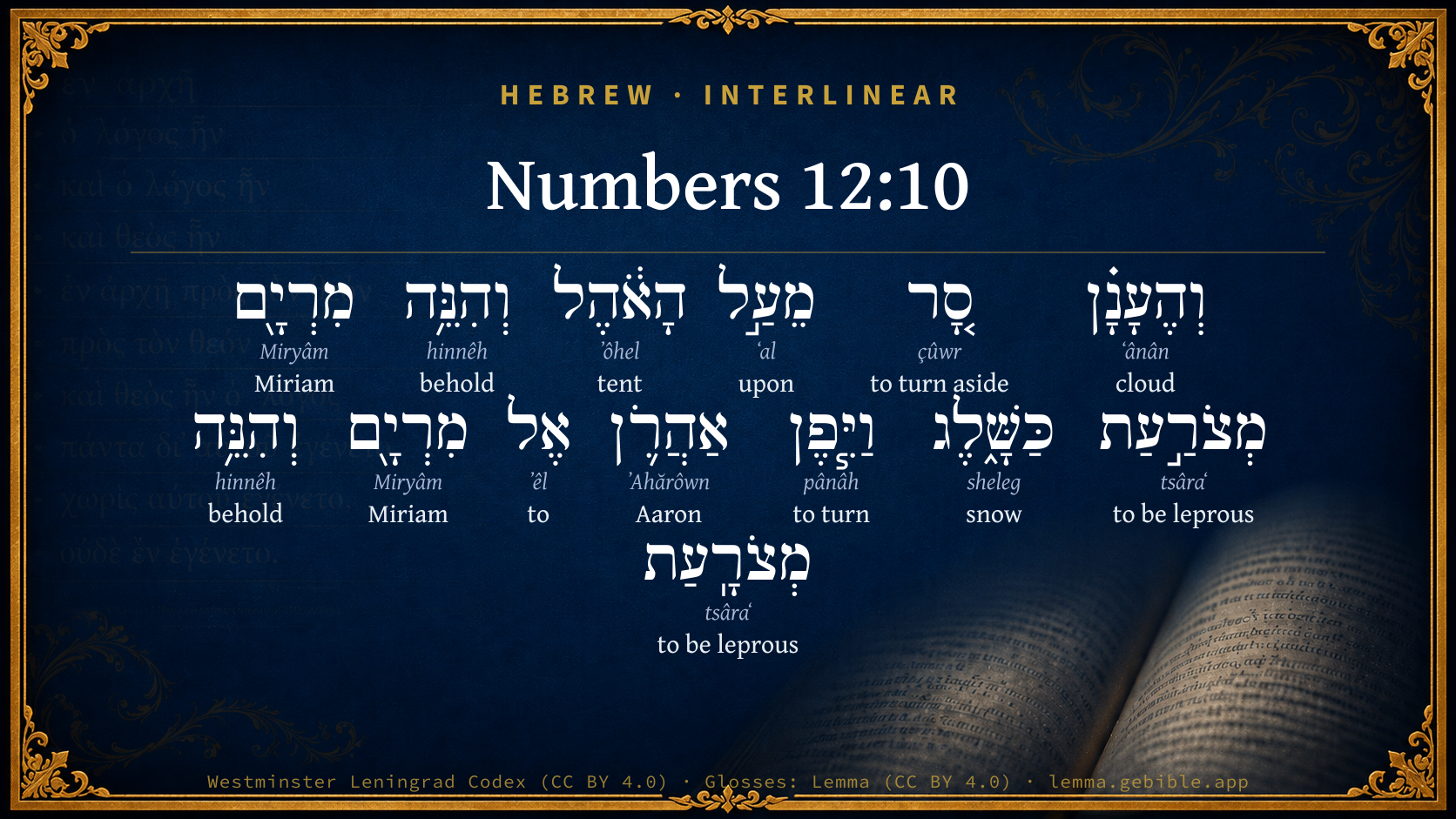
  1. וְהֶעָנָ֗ן ʻânân H6051 “and · the · cloud” Conjunction + Particle, Definite Article + Noun, Common, Masculine, Singular, Absolute
  2. סָ֚ר çûwr H5493 “to turn aside” Verb, Qal, Perfect, 3rd Person, Masculine, Singular
  3. מֵעַ֣ל ʻal H5921 “from · upon” Preposition + Preposition
  4. הָאֹ֔הֶל ʼôhel H168 “the · tent” Particle, Definite Article + Noun, Common, Masculine, Singular, Absolute
  5. וְהִנֵּ֥ה hinnêh H2009 “and · behold” Conjunction + Particle, Demonstrative
  6. מְצֹרַ֣עַת tsâraʻ H6879 “leprous” Verb, Pual, Participle Passive, Feminine, Singular, Absolute
  7. כַּשָּׁ֑לֶג sheleg H7950 “like/as the · snow” Preposition, Determined + Noun, Common, Masculine, Singular, Absolute
  8. וַיִּ֧פֶן pânâh H6437 “and · to turn” Conjunction + Verb, Qal, Sequential Imperfect, 3rd Person, Masculine, Singular
  9. אַהֲרֹ֛ן ʼAhărôwn H175 “Aaron” Noun, Proper
  10. אֶל ʼêl H413 “to” Preposition
  11. מִרְיָ֖ם Miryâm H4813 “Miriam” Noun, Proper
  12. וְהִנֵּ֥ה hinnêh H2009 “and · behold” Conjunction + Particle, Demonstrative
  13. מְצֹרָֽעַת tsâraʻ H6879 “leprous” Verb, Pual, Participle Passive, Feminine, Singular, Absolute

About this verse

These counts appear in no published source. They are computed here, from the morphology-tagged text and Lemma’s own curated glosses. What Lemma adds →

14
words
11
distinct lemmas
Pentateuch
section

Notable vocabulary

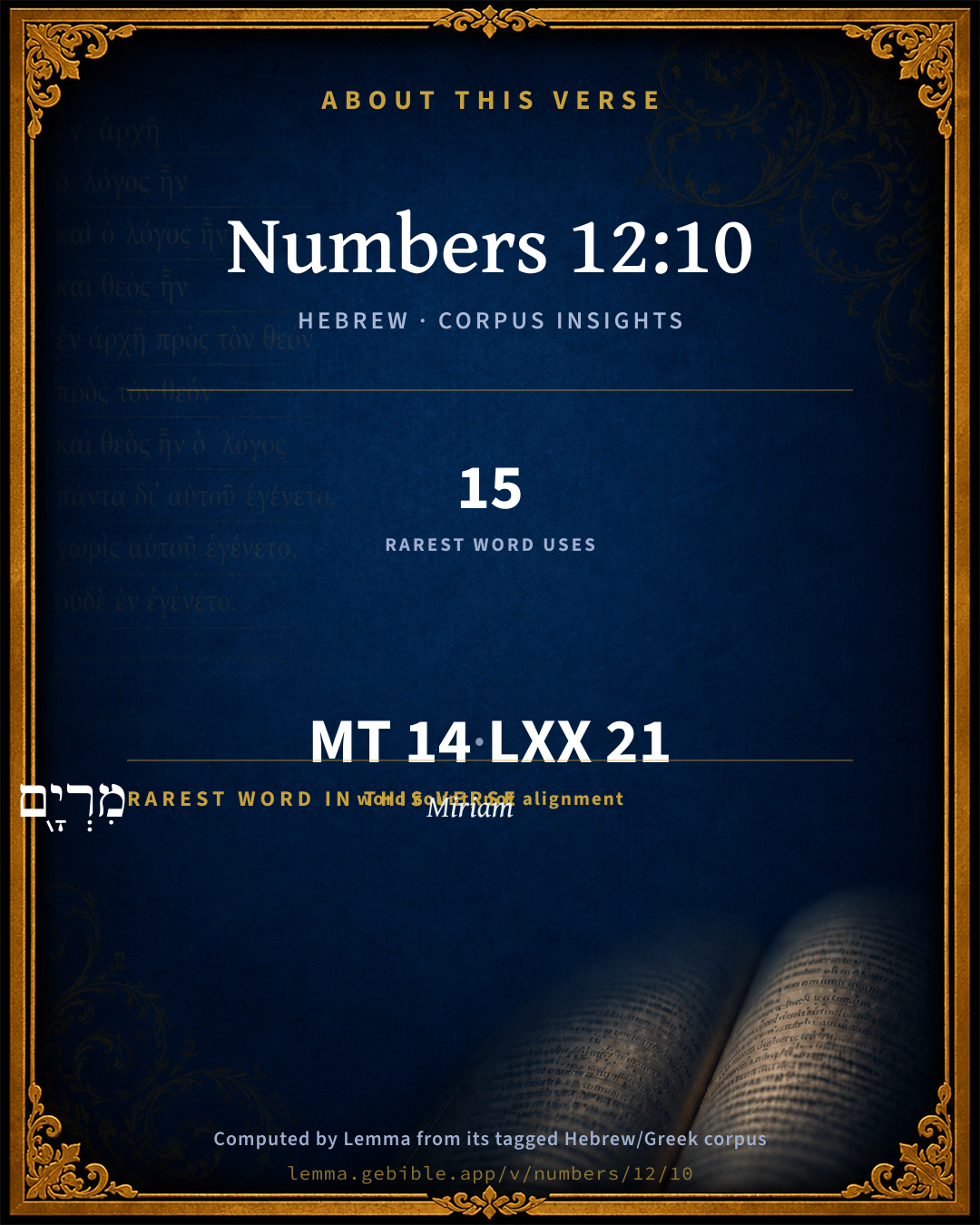
The rarest word here is מִרְיָ֖ם Miriam H4813 — appearing just 15 times in the whole Hebrew Bible.

Shared distinctive vocabulary

מִרְיָ֖ם Miriam H4813 occurs in 13 verses of the Hebrew Bible. Also found in:

Grammatical profile

  • 4 verbs
  • 6 nouns
  • 2 prepositions
  • 2 particles

Verb forms

  • סָ֚ר Qal · Perfect
  • מְצֹרַ֣עַת Pual · Participle Passive
  • וַיִּ֧פֶן Qal · Sequential Imperfect
  • מְצֹרָֽעַת Pual · Participle Passive

Repetition

Words recur within this verse — often emphatic in Hebrew:

  • וְהִנֵּ֥ה behold H2009 ×2
  • מִרְיָ֖ם Miriam H4813 ×2
  • מְצֹרַ֣עַת to be leprous H6879 ×2

Hebrew & Septuagint length

In English translation the verse runs 26 words from the Hebrew and 25 from the Septuagint (LXX English) — closely comparable.

A rough comparison of the two English renderings, which tokenize alike — not a word-level alignment.

Word counts can differ between the Hebrew and the Greek without any difference in meaning — e.g. the Hebrew direct-object marker אֵת has no separate Greek word, and Greek often adds the article ὁ.

In the original languages it is 14 Hebrew tokens and 21 Greek tokens — but the two are counted differently (Hebrew bundles its prefixes and suffixes into one token; the Greek is in lemma form), so that isn’t a like-for-like length.

Cross-references

11

Topical passages linked to Numbers 12:10 in the Treasury of Scripture Knowledge — connected by theme and wording, ordered by reader-vote popularity; previews shown in the World English Bible.

  • Deuteronomy 24:9 Remember what Yahweh your God did to Miriam, by the way as you came forth out of Egypt.
  • 2 Kings 5:27 The leprosy therefore of Naaman shall cleave to you, and to your seed forever. He went out from his presence a leper [as white] as snow.
  • Exodus 4:6 Yahweh said furthermore to him, "Now put your hand inside your cloak." He put his hand inside his cloak, and when he took it out, behold, his hand was leprous, as white as snow.
  • 2 Chronicles 26:19–21 Then Uzziah was angry; and he had a censer in his hand to burn incense; and while he was angry with the priests, the leprosy broke forth in his forehead before the priests in the house of Yahweh, beside the altar of incense.
  • 2 Kings 15:5 Yahweh struck the king, so that he was a leper to the day of his death, and lived in a separate house. Jotham the king's son was over the household, judging the people of the land.
  • Exodus 33:7–10 Now Moses used to take the tent and to pitch it outside the camp, far away from the camp, and he called it "The tent of meeting." It happened that everyone who sought Yahweh went out to the tent of meeting, which was outside the camp.
  • Leviticus 13:2–46 "When a man shall have a rising in his body's skin, or a scab, or a bright spot, and it becomes in the skin of his body the plague of leprosy, then he shall be brought to Aaron the priest, or to one of his sons the priests:
  • Ezekiel 10:4–5 The glory of Yahweh mounted up from the cherub, [and stood] over the threshold of the house; and the house was filled with the cloud, and the court was full of the brightness of Yahweh's glory.
  • Ezekiel 10:18–19 The glory of Yahweh went forth from over the threshold of the house, and stood over the cherubim.
  • Hosea 9:12 Though they bring up their children, Yet I will bereave them, so that not a man shall be left. Indeed, woe also to them when I depart from them!
  • Matthew 25:41 Then he will say also to those on the left hand, 'Depart from me, you cursed, into the eternal fire which is prepared for the devil and his angels;

Cross-references courtesy of OpenBible.info (CC BY 4.0).

Hebrew and Greek witnesses Masoretic Hebrew ↔ Greek Septuagint

The same verse in the two great witnesses to the Old Testament, shown verse-for-verse.

These are two independent witnesses, not word-aligned to each other, and the Septuagint is shown in lemma (dictionary) form.

Hebrew Numbers 12:10 Masoretic · Westminster Leningrad Codex

וְהֶעָנָ֗ן סָ֚ר מֵעַ֣ל הָאֹ֔הֶל וְהִנֵּ֥ה מִרְיָ֖ם מְצֹרַ֣עַת כַּשָּׁ֑לֶג וַיִּ֧פֶן אַהֲרֹ֛ן אֶל מִרְיָ֖ם וְהִנֵּ֥ה מְצֹרָֽעַת

The cloud removed from over the Tent; and, behold, Miriam was leprous, as [white as] snow: and Aaron looked at Miriam, and, behold, she was leprous.

World English Bible · Public Domain

Greek LXX Numbers 12:10 Septuagint · lemma form

καί ὁ νεφέλη ἀποἵστημι ἀπό ὁ σκηνή καί ἰδού μαριαμ λεπράω ὡσεί χιών καί ἐπιβλέπω ἀαρών ἐπί μαριαμ καί ἰδού λεπράω

And the cloud departed from the tabernacle; and, behold, Mariam was leprous, white as snow; and Aaron looked upon Mariam, and, behold, she was leprous.

LXX2012 (modern English Septuagint) · Public Domain

Hebrew: Westminster Leningrad Codex (CC BY 4.0). Greek: Septuagint (public domain); English from LXX2012 (modern English Septuagint) (Public Domain). How the Septuagint differs from the Hebrew →

Targum (Aramaic paraphrase)

2

The Targum is the ancient Jewish Aramaic paraphrase of the Hebrew Scriptures — an interpretive translation, not the Hebrew text itself. Onkelos (literal) and Pseudo-Jonathan (expansive) render the Torah, and Jonathan the Prophets. Coverage is partial: where no permissively-licensed English translation exists for a verse, only the Aramaic is shown. This is verse-level text, not a word-by-word alignment to the Hebrew.

  1. Targum Onkelos Torah (Genesis–Deuteronomy)
    וַעֲנָנָא אִסְתַּלַק מֵעִלָוֵי מַשְׁכְּנָא וְהָא מִרְיָם חַוְרָא כְּתַלְגָא וְאִתְפְּנֵי אַהֲרֹן לְוָת מִרְיָם וְהָא סְגִירָת

    (no public-domain English translation for this verse)

    Targum Onkelos — Aramaic: “Onkelos Genesis” (public domain); “Onkelos Exodus” (public domain); “Onkelos Leviticus” (public domain); “Onkelos Numbers” (public domain); “Onkelos Deuteronomy” (public domain). English: “Sefaria Community Translation” (CC0 1.0 (public-domain dedication)); “J.W. Etheridge. The Targums of Onkelos and Jonathan Ben Uzziel on the Pentateuch. London: Longmans, Green, 1862” (public domain). Text via Sefaria.

  2. Targum Pseudo-Jonathan Torah (Genesis–Deuteronomy)
    וַעֲנַן אִיקַר שְׁכִינְתָּא דַיְיָ אִסְתַּלֵק מֵעִילַוֵי מַשְׁכְּנָא וְהָא מִרְיָם לָקַת בְּצוּרְעָא וְאִסְתַּכֵּל אַהֲרן לְוַת מִרְיָם וְהָא לָקַת בְּצוּרְעָא

    And the glorious Cloud of the Lord's Shekinah went up from above the tabernacle; and, behold, Miriam was seized with the leprosy. And Aharon looked upon Miriam, and, behold, she had been smitten with leprosy.

    Targum Pseudo-Jonathan — Aramaic: “Targum Jonathan on Genesis” (public domain); “Targum Jonathan on Exodus” (public domain); “Targum Jonathan on Leviticus” (public domain); “Targum Jonathan on Numbers” (public domain); “Targum Jonathan on Deuteronomy” (public domain). English: “The Targum of Jonathan ben Uzziel, trans. J. W. Etheridge, London, 1862” (public domain). Text via Sefaria.

Commentary

Notes on Numbers 12:10 from classic Christian and Jewish commentators (each source and its license shown beneath its notes). The classic Christian expositions comment on the surrounding passage and are grouped to its opening verse, so a note may address several verses; the Jewish commentaries on the Tanakh (Rashi and others) are per-verse, so they appear only where the commentator wrote on this verse.

Lemma curates 59 commentaries, every one of them public domain or Creative Commons licensed, each selected and text-cleaned for this edition rather than reprinted as found. About our sources →

Matthew Henry's Commentary

Here is, I. God's judgment upon Miriam (Num 12:10): The cloud departed from off that part of the tabernacle, in token of God's displeasure, and presently Miriam became leprous; when God goes, evil comes; expect no good when God departs. The leprosy was a disease often inflicted by the immediate hand of God as the punishment of some particular sin, as on Gehazi for lying, on Uzziah for invading the priest's office, and here on Miriam for scolding and making mischief among relations. The plague of the leprosy, it is likely, appeared in her face, so that it appeared to all that saw her that she was struck with it, with the worst of it, she was leprous as snow; not only so white, but so soft, the solid flesh losing its consistency, as that which putrefies does. Her foul tongue (says bishop Hall) is justly punished with a foul face, and her folly in pretending to be a rival with Moses is made manifest to all men, for every one sees his face to be glorious, and hers to be leprous. While Moses needs a veil to hide his glory, Miriam needs one to hide her shame. Note, Those distempers which any way deform us ought to be construed as a rebuke to our pride, and improved for the cure of it, and under such humbling providences we ought to be very humble. It is a sign that the heart is hard indeed if the flesh be mortified, and yet the lusts of the flesh remain unmortified. It should seem that this plague upon Miriam was designed for an exposition of the law concerning the leprosy (Lev. 13), for it is referred to upon the rehearsal of that law, Deu 24:8, Deu 24:9. Miriam was struck with a leprosy, but not Aaron, because she was first in the transgression, and God would put a difference between those that mislead and those that are misled. Aaron's office, though it saved him not from God's displeasure, yet helped to secure him from this token of his displeasure, which would not only have suspended him for the present from officiating, when (there being no priests but himself and his two sons) he could ill be spared, but it would have rendered him and his office mean, and would have been a lasting blot upon his family. Aaron as priest was to be the judge of the leprosy, and his performing that part of his office upon this occasion, when he looked upon Miriam, and behold she was leprous, was a sufficient mortification to him. He was struck through her side, and could not pronounce her leprous without blushing and trembling, knowing himself to be equally obnoxious. This judgment upon Miriam is improvable by us as a warning to take heed of putting any affront upon our Lord Jesus. If she was thus chastised for speaking against Moses, what will become of those that sin against Christ?

II. Aaron's submission hereupon (Num 12:11, Num 12:12); he humbles himself to Moses, confesses his fault, and begs pardon. He that but just now joined with his sister in speaking against Moses is here forced for himself and his sister to make a penitent address to him, and in the highest degree to magnify him (as if he had the power of God to forgive and heal) whom he had so lately vilified. Note, Those that trample upon the saints and servants of God will one day be glad to make court to them; at furthest, in the other world, as the foolish virgins to the wise for a little oil, and the rich man to Lazarus for a little water; and perhaps in this world, as Job's friend to him for his prayers, and here Aaron to Moses. Rev 3:9. In his submission, 1. He confesses his own and his sister's sin, Num 12:11. He speaks respectfully to Moses, of whom he had spoken slightly, calls him his lord, and now turns the reproach upon himself, speaks as one ashamed of what he had said: We have sinned, we have done foolishly. Those sin, and do foolishly, who revile and speak evil of any, especially of good people or of those in authority. Repentance is the unsaying of that which we have said amiss, and it had better be unsaid than that we be undone by it. 2. He begs Moses's pardon: Lay not this sin upon us. Aaron was to bring his gift to the altar, but, knowing that his brother had something against him, he of all men was concerned to reconcile himself to his brother, that he might be qualified to offer his gift. Some think that this speedy submission which God saw him ready to make was that which prevented his being struck with a leprosy as his sister was. 3. He recommends the deplorable condition of his sister to Moses's compassionate consideration (Num 12:12): Let her not be as one dead, that is, "Let her not continue so separated from conversation, defiling all she touches, and even to putrefy above ground as one dead." He eloquently describes the misery of her case, to move his pity.

III. The intercession made for Miriam (Num 12:13): He cried unto the Lord with a loud voice, because the cloud, the symbol of his presence, was removed and stood at some distance, and to express his fervency in this request, Heal her now, O Lord, I beseech thee. By this he made it to appear that he did heartily forgive her the injury she had one him, that he had not accused her to God, nor called for justice against her; so far from this that, when God in tenderness to his honour had chastised her insolence, he was the first that moved for reversing the judgment. By this example we are taught to pray for those that despitefully use us; and not to take pleasure in the most righteous punishment inflicted either by God or man on those that have been injurious to us. Jeroboam's withered hand was restored at the special instance and request of the prophet against whom it had been stretched out, Kg1 13:6. So Miriam here was healed by the prayer of Moses, whom she had abused, and Abimelech by the prayer of Abraham, Gen 20:17. Moses might have stood off, and have said, "She is served well enough, let her govern her tongue better next time;" but, not content with being able to say that he had not prayed for the inflicting of the judgment, he prays earnestly for the removal of it. This pattern of Moses, and that of our Saviour, Father, forgive them, we must study to conform to.

IV. The accommodating of this matter so as that mercy and justice might meet together. 1. Mercy takes place so far as that Miriam shall be healed; Moses forgives her, and God will. See Co2 2:10. But, 2. Justice takes place so far as that Miriam shall be humbled (Num 12:14): Let her be shut out from the camp seven days, that she herself might be made more sensible of her fault and penitent for it, and that her punishment might be the more public, and all Israel might take notice of it and take warning by it not to mutiny. If Miriam the prophetess be put under such marks of humiliation for one hasty word spoken against Moses, what may we expect for our murmurings? If this be done in a green tree, what shall be done in the dry? See how people debase and diminish themselves by sin, stain their glory, and lay their honour in the dust. When Miriam praised God, we find her at the head of the congregation and one of the brightest ornaments of it, Exo 15:20. Now that she quarrelled with God we find her expelled as the filth and off-scouring of it. A reason is given for her being put out of the camp for seven days, because thus she ought to accept of the punishment of her iniquity. If her father, her earthly father, had but spit in her face, and so signified his displeasure against her, would she not be so troubled and concerned at it, and so sorry that she had deserved it, as to shut herself up for some time in her room, and not come into his presence, or show her face in the family, being ashamed of her own folly and unhappiness? If such reverence as this be owing to the fathers of our flesh, when they correct us, much more ought we to humble ourselves under the mighty hand of the Father of spirits, Heb 12:9. Note, When we are under the tokens of God's displeasure for sin, it becomes us to take shame to ourselves, and to lie down in that shame, owning that to us belongs confusion of face. If by our own fault and folly we expose ourselves to the reproach and contempt of men, the just censures of the church, or the rebukes of the divine Providence, we must confess that our Father justly spits in our face, and be ashamed.

V. The hindrance that this gave to the people's progress: The people journeyed not till Miriam was brought in again, Num 12:15. God did not remove the cloud, and therefore they did not remove their camp. This was intended, 1. As a rebuke to the people, who were conscious to themselves of having sinned after the similitude of Miriam's transgression, in speaking against Moses: thus far therefore they shall share in her punishment, that it shall retard their march forward towards Canaan. Many things oppose us, but nothing hinders us in the way to heaven as sin does. 2. As a mark of respect to Miriam. If the camp had removed during the days of her suspension, her trouble and shame had been the greater; therefore, in compassion to her, they shall stay till her excommunication be taken off, and she taken in again, it is probable with the usual ceremonies of the cleansing of lepers. Note, Those that are under censure and rebuke for sin ought to be treated with a great deal of tenderness, and not be over-loaded, no, not with the shame they have deserved, not counted as enemies (Th2 3:15), but forgiven and comforted, Co2 2:7. Sinners must be cast out with grief, and penitents taken in with joy. When Miriam was absolved and re-admitted, the people went forward into the wilderness of Paran, which joined up to the south border of Canaan, and thither their next remove would have been if they had not put a bar in their own way.

Matthew Henry's Commentary on the Whole Bible (1708–1710) — public domain (CC PDM 1.0). Text via the HelloAO Bible API.

Jamieson, Fausset & Brown

Robert Jamieson, A. R. Fausset & David Brown

MIRIAM'S LEPROSY. (Num 12:10-16)

the cloud departed from the tabernacle--that is, from the door to resume its permanent position over the mercy seat.

Miriam became leprous--This malady in its most malignant form (Exo 4:6; Kg2 5:27) as its color, combined with its sudden appearance, proved, was inflicted as a divine judgment; and she was made the victim, either because of her extreme violence or because the leprosy on Aaron would have interrupted or dishonored the holy service.

Jamieson, Fausset & Brown — Commentary Critical and Explanatory on the Whole Bible (1871) — public domain (CC PDM 1.0). Text via the HelloAO Bible API.

Trapp's Complete Commentary

John Trapp

Num 12:10 And the cloud departed from off the tabernacle; and, behold, Miriam [became] leprous, [white] as snow: and Aaron looked upon Miriam, and, behold, [she was] leprous.

Ver. 10. Miriam became leprous.] How escaped Aaron? for the dignity of the priesthood he was spared, saith Chrysostom. {a} Rather he met God by repentance, and so disarmed his indignation, and redeemed his own sorrow.

{a} Dιδ το της ιεποσυνης αξιωμα - Hom. 3, ad Coloss.

John Trapp, A Commentary or Exposition upon All the Books of the Old and New Testament (1647–1656) — public domain. Text from a community e-Sword module.

The Biblical Illustrator

Joseph S. Exell

Num_12:10-16

Miriam became leprous.

The punishment of Miriam and Aaron

I. The divine judgment because of the sin of Miriam and Aaron.

1. The punishment was inflicted by the Lord.

2. The punishment was appropriate to the sin.

3. The punishment fell most severely upon Miriam.

(1) She was the instigator of the sin.

(2) Aarons office of high priest also probably helped to shield him.

Had he been smitten with leprosy he would have been disgraced in the eyes of the people, and his holy office would probably have been brought into disesteem amongst them.

(3) Yet Aaron was not altogether exempted from punishment.

As priest he had to examine Miriam and pronounce her leprous. Again he had to examine her and pronounce her clean before she was readmitted to the camp. That he deeply realised his painful position is evident from the narrative (Num_12:10-12). Let us remember that there is judgment with God.

II. The divine judgment leading to personal humiliation.

1. Humble acknowledgment to Moses.

2. Confession of sin.

3. Entreaty for the removal of the judgment from Miriam.

III. The remarkable acknowledgment of the eminence of Moses the servant of the lord.

1. In the manner in which he was addressed by Aaron.

2. In the appeal which was made to him by Aaron. This appeal implies on the part of Aaron--

(1) Faith in the magnanimity of Moses--that he would not retaliate upon them for their attack upon him; that he was forgiving and generous.

(2) Faith in the influence which Moses had with God.

IV. The distinguished magnanimity and grace of Moses. And Moses cried unto the Lord, saying, Heal her now, O God, I beseech Thee. There was no resentment in his heart, but fullest forgiveness and sincerest pity. His prayer for Miriam is an anticipation of the precept of our Lord, Pray for them which despitefully use you, and persecute you (Mat_5:44).

V. The great power of the intercession of good men.

VI. The justice and mercy of god as manifested in his treatment of Miriam.

VII. The sin of one person checking the progress of an entire nation. (W. Jones.)

Miriam smitten with leprosy: transfiguration through transgression

I. This transfiguration was brought to pass on account of the jealousy of Miriam of Moses, and the jealousy of god for Moses.

II. The transformation was in keeping with the expressed jealousy of God and of Miriam (W. Jones.)

The punishment of wrong doers

I. That both God and man express their displeasure towards wrong doers on this earth.

1. God, in many ways.

(1) Providential afflictions.

(2) Moral remorses.

2. Man, also, in many ways.

(1) Sometimes in his personal, capacity, by denunciatory language and physical chastisement.

(2) Sometimes in his corporate capacity, as a member of the State, by pains and penalties.

II. That the wrong-doers are generally far more affected by the expression of mans displeasure than with that of Gods.

1. Most irrational.

2. Most impious.

3. Most perilous. (Homilist.)

The leprosy of Miriam

1. We should humbly submit to the will of Heaven.

2. We should remember that in the distribution of gifts, what is best for one may be destruction for another.

3. To covet the gift of a neighbour is a wrong to him and an offence to God.

4. Each mans duty is to develop the gift that is in him. (Homiletic Monthly.)

Miriam and Moses

Was this weakness, as some would say? Nay, verily, it was the exhibition of colossal spiritual strength. It is the weak man who gives blow for blow, who blurts out his wrath, who cannot control the passion of his spirit. It may be well to give some closing rules as to the attainment of this meek and quiet spirit, which in sight of God is of great price.

1. Let us claim the meekness of Christ. This, of course, was not possible for Moses in the direct way in which it is for us. And yet there was no doubt in his case also a constant appeal for heavenly grace. And in moments of provocation there is nothing better than to turn to Him and claim His calm, His sweet silence, His patience and meekness, saying, I claim all these, my Lord, for the bitter need of my spirit.

2. It is acquired, next, by cultivating the habit of silence. Express a thought, and you give it strength; repress it, and it will wither and die. You will often hear it said that the best way of getting rid of an importunate passion is to let it out and have done with it. It is, however, a very mistaken policy. Silence will kill it as ice kills fish when there are no ventholes by which they can come up to breathe. Learn to be still, to keep the door of the lips closed.

3. Next, by considering the harm done by the aggressors to themselves. The cloud removed from over the tent, as if it must leave the very spot where the culprits stood; and behold, Miriam was leprous, white as snow. There is a profound piece of instruction here; you cannot say unkind or bitter things about another without hurting yourself more than you hurt him. Like the boomerang of the savage, curses come back to the spot from which they start.

4. In allowing God to vindicate our cause. Moses let God vindicate him, and the Almighty God rode upon a cherub and did fly, and flew on the wings of the wind. This is the secret of rest, to cultivate the habit of handing all over to God, as Hezekiah did, when he spread out Sennacheribs letter in the house of the Lord. Commit yourself to Him that judgeth righteously.

5. Also in intercessory prayer. Moses cried unto the Lord, saying, Heal her, O God, I beseech Thee. When we pray for those who have despitefully used and persecuted us, it is marvellous how soon the soul gets calm and tender. And the Lord heard His servants prayer, and healed Miriam; but the whole host was delayed a week through her sin. We may be forgiven, but these outbreaks of sin always entail disaster and delay. Neither we nor others can be where we might have been had they not occurred. (F. B. Meyer, B. A.)

Miriams punishment humiliating

The punishment was as humiliating as it was public. Her tongue, so free upon her brothers conduct, is mute enough now, except to cry if any approached her, Unclean! Unclean! She who aspired to be Queen of Israel is cast forth as an unclean thing from the camp. When the dreadful punishment was finished, she came back to the camp humbled, and no doubt strengthened in her soul by the correction she had received. (S. Robinson, D. D.)

Shame for the envious

The lesson here has a very close application to all who engage as the Lords instruments and agents in the work of building up Christs kingdom. When those so engaged forget the nature of their calling, and fall into contentions and bickerings about their relative position as agents for Jehovah, the result must in the end be shame and humiliation for the envious and jealous, and damage to the cause of Christ, about which He will surely make inquisition. How much of the strifes and bickering between Christians of the same Church, and between different sects comes not from earnestly contending for the faith, but from the narrow jealousies and envyings wholly personal with those who indulge them! How often is it simply the Miriams and Aarons giving way to their petty jealousy under cover of scruples of conscience! (S. Robinson, D. D.)

Such as have the chief hand in sin, are principally subject to punishment

Aaron was accessory to this mutiny against Moses, but Miriam was chief in the sin, and therefore is also chief in the punishment. Simeon and Levi were not the only murderers of the Sichemites and invaders of the city, but they were the chief ringleaders, and therefore are only named (Gen_34:25), and punished (Gen_49:5). Whosoever practiseth any evil, whether he be principal or accessory, is guilty in the sight of God, and therefore such as are ministers of other mens evils are oftentimes punished, whether they be reasonable or unreasonable creatures (Gen_3:14; Lev_20:15; Exo_21:28-29; Exo_21:32; Jos_6:17; Isa_30:22). As God is just, so He punisheth the instruments of injustice. Notwithstanding, though the instruments do offend and not escape, the chief punishment is ever reserved for the chief offender.

1. For such as are chief in government ought to stay their inferiors from evil, as the head governeth the members. Eli is charged with the wickedness of his sons (1Sa_3:13). Such governors make themselves the tail and not the head, whereas they should order those of their house as the soul ruleth the body.

2. God will require the blood of those that perish at the hands of the governors; the magistrate is the watchman of the commonwealth; the minister is the watchman of the Church; the householder is the watchman of the family; all set as it were in their watch-tower, and all must give an account for such as are under them.

3. The sin of those that have the chiefest hand in it is greater than of others, so it deserveth the greater punishment; forasmuch as the sin and punishment shall be suitable one to the other.

Uses:

1. It belongeth to all, especially to such as are superiors, to consider this; they think themselves absolute, and that they ought of right to command what they list to their inferiors. But as they are superior in place, so they shall also be superior in punishment, if they command anything against God and His Word.

2. It is the duty of all householders to be careful to order their families aright, and to compel them to serve the Lord.

3. Lastly, there cometh a great blessing upon their heads that are the chief in any good work, that encourage others in the ways of godliness, for they shall have a principal reward. Happy and blessed therefore are they that govern their charges as becometh them (Gen_18:18). This is a notable commendation of Abraham, he was chief, and one that went before the rest in good things, and therefore he should chiefly be rewarded. This should stir us up, not only to do good, but to be chief in doing good, to go before others, to lead them the way, that so we may have the greater and better reward in that great day, (W. Attersoll.)

Miriams degradation

A striking spectacle was once Witnessed in the Four Courts of St. Louis. A young man was under arrest for some crime. Before being committed to prison, he was taken to the photographers rooms, and his picture taken to be sent to the various cities keeping rogues galleries, to be hung up on the walls with the faces of other criminals kept there. The description of the feeling manifested by the young man on this occasion is both touching and suggestive. Big tears formed in his eyes and fell down on his cheeks. He dropped his head on his breast and cried. He was so overcome with emotion that he could not speak until he was again placed in his cell in the gaol. After swallowing great lumps in his throat, he said he now felt he had dropped from the role of a gentleman to that of the lowest criminal; and the thought of his picture being placed in the rogues gallery was more than he could bear. How dreadful to be classed with the workers of iniquity, and to become the spectacle before man and angels of one who rejected light and truth, and basely sinned against a great and gracious God. (S. S. Chronicle.)

Heal her now, O God, I beseech Thee.

The prayer of Moses for Miriam

I. The prayer.

1. Explicit. Nothing vague.

2. Earnest.

3. Generous.

4. Well-timed.

II. The answer.

1. Most gracious.

2. Most wise.

3. Most speedy. (R. A. Griffin.)

Moses generosity

Miriam would have wounded Moses with her tongue; Moses would heal her with his: O Lord, heal her now. The wrong is the greater, because his sister did it. He doth not say, I sought not her shame, she sought mine; if God have revenged it, I have no reason to look on her as a sister, who looked on me as an adversary; but, as if her leprosy were his, he cries out for her cure. Oh, admirable meekness of Moses! His people, the Jews rebelled against him; God proffers revenge; he would rather die than they should perish. His sister rebelled against him; God worlds his revenge; he will not give God peace till she be re-cured. Behold a worthy and noble pattern for us to follow! (Bp. Hall.)

.

The Biblical Illustrator, edited by Joseph S. Exell (c. 1880s–1900s) — public domain. Text from a community e-Sword module.

Joseph Benson's Commentary

Num 12:10. From off the tabernacle — Probably not the whole tabernacle, but from that part to which it had come, to that part which was directly over the mercy-seat, where it constantly abode. Or, perhaps, it quite disappeared, or stood at a great distance till Miriam was removed from the tabernacle, and carried out of the camp. Miriam became leprous — The original expresses the fact here recorded with much more spirit and force. The cloud departed — and behold, Miriam became leprous — She, and not Aaron, either because she was chief in the transgression, or because God would not have his worship interrupted or dishonoured, which it must have been if Aaron had been leprous. White — This kind of leprosy was the most virulent and incurable of all. It is true, when the leprosy began in a particular part, and thence spread itself over all the flesh by degrees, and at last made it all white, that was an evidence of the cure of the leprosy, (Lev 13:12-13,) but it was otherwise when one was suddenly smitten with this universal whiteness.

Joseph Benson's Commentary on the Old and New Testaments (1811–1818) — public domain. Text from a community e-Sword module.

Geneva Bible (1599)

Geneva Bible translators

From the door of the Tabernacle.

Geneva Bible (1599) marginal notes — public domain. Text via Bolls.life.

Adam Clarke's Commentary

Verse 10. Miriam became leprous] It is likely Miriam was chief in this mutiny; and it is probable that it was on this ground she is mentioned first, (see Nu 12:1,) and punished here, while Aaron is spared. Had he been smitten with the leprosy, his sacred character must have greatly suffered, and perhaps the priesthood itself have fallen into contempt. How many priests and preachers who deserved to be exposed to reproach and infamy, have been spared for the sake of the holy character they bore, that the ministry might not be blamed! But the just God will visit their transgressions in some other way, if they do not deeply deplore them and find mercy through Christ. Nothing tends to discredit the work of God so much as the transgressions and miscarriages of those who minister in holy things.

Adam Clarke's Commentary on the Bible (1810–1826) — public domain. Text from a community e-Sword/MySword module.

Ellicott's Commentary for English Readers

(10) And the cloud departed . . . —The withdrawal of the cloud was the visible token of the Divine displeasure. The word sar, departed, which is here used, is an entirely different word from that which occurs in Num_9:17 : “When the cloud was taken up from the tabernacle.” The lifting up of the cloud was the signal for the breaking up of the camp and the resumption of the march; the withdrawal of the cloud was the token of the withdrawal of the Divine presence and direction.

Leprous, white as snow.—Better, was leprous as snow, as in Exo_4:6, where the same words occur; or, a leper (as white), as snow, as in 2Ki_5:27. In an ordinary case of leprosy, when the disease covered the whole body, and the whole of the flesh had turned white, the man was to be pronounced clean. It was otherwise in cases in which persons were smitten with leprosy by the immediate hand of God, as in the case of Moses and in that of Gehazi.

And Aaron looked upon Miriam . . . —Or, and Aaron turned towards Miriam—i.e., directed his attention to her, &c. This may have been the first case in which Aaron was required to carry into execution the laws laid down in Leviticus 13, 14, respecting the inspection of the leper; and the duties which devolved upon him must have been doubly painful from the fact that the leper stood in a near relationship to himself, and that he had been a participator in the sin which had called for so severe a punishment.

A Bible Commentary for English Readers, edited by Charles John Ellicott (1878–1897) — public domain. Text from a community e-Sword module.

The Cambridge Bible for Schools and Colleges

gen. ed. J. J. S. Perowne

10. the cloud removed] Jehovah shewed His anger by departing from Aaron and Miriam in the cloud, not previously to its removal.

leprous as snow] Cf. 2Ki_5:27, Exo_4:6 (J ). There were different kinds of leprosy—the White Leprosy (Lev_13:13) and two forms of elephantiasis. The former, which is the milder kind, is here thought of. (See Driver and White, Leviticus, p. 76.)

Aaron received no punishment, possibly because Miriam took the lead in the complaint against Moses. See Deu_24:9.

lay not … sin upon us] Do not bring upon us the consequences of our sin.

The Cambridge Bible for Schools and Colleges (gen. ed. J. J. S. Perowne; Cambridge University Press, 1878–1918) — public domain. Text from a community e-Sword module.

John Gill's Exposition

And the cloud departed from off the tabernacle,.... Not from off the door of the tabernacle, as Aben Ezra, for that is implied in the last clause of Num 12:9, but from off that part of the tabernacle, the most holy place, where it had used to abide; but now it went up higher in the air, or removed at some distance from thence, which was a further indication of the sore displeasure of God; that as he would not stay with Aaron and Miriam at the door of the tabernacle, so neither would he suffer the cloud to continue over it, as it was wont to do, so long as they were there:

and, behold, Miriam became leprous, white as snow; was smote immediately with a leprosy by the Lord, as the hand of Moses was in a miraculous way, Exo 4:6; and as Gehazi was, who was smitten of God in like manner, Kg2 5:27; in an ordinary and gradual leprosy, when it was all white, the man was clean, Lev 13:13; but in an extraordinary one, and which was immediately from God, and at once, in this case it was a sign it was incurable. Miriam only, and not Aaron, was smitten with a leprosy; though Chaskuni says, that some of their Rabbins were of opinion, that Aaron was; but this does not appear, nor is it likely that he should be thus defiled and dishonoured, being the priest of the Lord, and since he was not so deep in the transgression as Miriam, and was drawn into it by her, and also repented of it:

and Aaron looked upon Miriam, and, behold, she was leprous; he not only cast his eye upon her, as it were accidentally, and saw what was her case; but, as the priest of the Lord, looked upon her, as it was the business of his office to do, and perceived she was leprous, and was obliged to pronounce her so; and perhaps she was the first, after the law of the leprosy, that he was called to look upon, and pronounced her unclean, which must be a great mortification to him.

John Gill's Exposition of the Whole Bible (1746–1763) — public domain (CC PDM 1.0). Text via the HelloAO Bible API.

Haydock's Catholic Bible Commentary

Departed from the door to its former place, (Calmet) as if in abhorrence of Mary’s leprosy, (Hiscuni) and still more of the sin, which had brought upon her that punishment. (Calmet) --- Perhaps the cloud was raised higher in the air than usual, but did not proceed forward; (Menochius) otherwise the Israelites would have decamped. They remained at Haseroth till Mary was returned into the camp, ver. 15. (Haydock) --- Leprosy, of an incurable kind, like that of Gieze, 4 Kings v. 27. It covers the whole skin with a white scurf, Leviticus xiii. 10. Aaron is spared, either because he had sided with his sister only out of complaisance, without any formal malice against his brother; or because God, in consideration for his priestly character, would not render him contemptible in the eyes of the all people, intending to punish him in a more secret manner: for was are not always to judge of the grievousness of a fault, by its present punishment. Perhaps Aaron obtained pardon by his speedy repentance, ver. 11. (Calmet)

George Leo Haydock (1774–1849), Haydock's Catholic Family Bible and Commentary, 1859 edition — public domain. Excludes Psalms (Douay-Rheims chapter numbering differs from Protestant) and Deuterocanonical books (Catholic canon only).

Matthew Poole's English Annotations

From off the tabernacle; not from the whole tabernacle, for then they must have removed, but from that part of the tabernacle whither it was come, to that part which was directly over the mercy-seat, where it constantly abode.

Miriam became leprous; she, and not Aaron, either because she was first or chief in the transgression, or because God would not have his worship either interrupted or dishonoured, which it must have been if Aaron had been leprous.

White as snow: this kind of leprosy was the most virulent and incurable of all. See Exo 4:6; 2Ki 5:27. It is true, when the leprosy began in a particular part, and thence spread itself over all the flesh by degrees, and at last made it all white, that was an evidence. of the cure of the leprosy, Lev 13:12,13; but it was otherwise when one was suddenly and extraordinarily smitten with this universal whiteness, which showed the great corruption of the whole mass of blood, as it was here.

Matthew Poole's English Annotations on the Holy Bible (1683–1685) — public domain. Text from a community e-Sword/MySword module.

Whedon's Commentary on the Bible

Daniel D. Whedon

10. Leprous — See the symptoms of leprosy described in Leviticus xiii, and notes. Also, 2Ki_5:27. This disease developes itself so slowly that it requires a week or two for the priest to determine its character. See the rules laid down in Leviticus 13. Hence the suddenness of this leprosy of Miriam shows that it was a supernatural infliction.

Daniel D. Whedon (gen. ed.), Commentary on the Old and New Testaments (1874–1909) — public domain. Text from a community e-Sword module.

The Pulpit Commentary

The cloud departed from off the tabernacle. During this awful interview the cloud of the Presence had rested on the tabernacle, as if it were the Divine chariot waiting for the King of Israel while he tarried within. (cf. Psa_104:3 Isa_19:1 Rev_11:12) Now that his work is done he ascends his chariot again, and soars aloft above the host. Miriam became leprous. The Hebrews had become familiar with this terrible disease in Egypt. The Levitical legislation had made it more terrible by affixing to it the penalty of religious and social excommunication, and the stigma, as it were, of the Divine displeasure.

Before this legislation Moses himself had been made partially and temporarily leprous, and that solely for a sign, and without any sense of punishment. (Exo_4:6) In Miriam"s ease, however, as in all subsequent cases, the plague of leprosy was endued with moral as well as physical horror. (cf. 2Ki_5:27) As snow. This expression points to the perfect development of the disease, as contrasted with its earlier and less conspicuous stages. Aaron looked upon Miriam. If we ask why Aaron himself was not punished, the answer appears to be the same here as in the case of the golden calf.

1. He was not the leader in mischief, but only led into it through weakness.

2. He was, like many weak men, of an affectionate disposition (cf. Lev_10:19), and suffered his own punishment in witnessing that of others.

3. He was God"s high priest, and the office would have shared in the disgrace of the man.

The Pulpit Commentary (1880–1919), ed. H.D.M. Spence-Jones & Joseph S. Exell — public domain. Text from a community e-Sword module.

John Wesley's Explanatory Notes

From the tabernacle - Not from the whole tabernacle, but from that part, whither it was come, to that part which was directly over the mercy-seat, where it constantly abode. Leprous - She, and not Aaron, either because she was chief in the transgression or because God would not have his worship interrupted or dishonoured, which it must have been if Aaron had been leprous. White - This kind of leprosy was the most virulent and incurable of all. It is true, when the leprosy began in a particular part, and thence spread itself over all the flesh by degrees, and at last made it all white, that was an evidence of the cure of the leprosy, Lev. xiii, 12, 13. But it was otherwise when one was suddenly smitten with this universal whiteness.

John Wesley, Explanatory Notes Upon the Whole Bible (1754–1765) — public domain. Text via the GEBible commentary corpus.

Kretzmann's Popular Commentary

Paul E. Kretzmann

Miriam’s Leprosy Breaks out and is Healed

v. 10. And the cloud departed from off the Tabernacle, it mounted aloft, in token of the fact that the relations between God and His people were severed; and, behold, Miriam became leprous, white as snow; instead of being acknowledged by God as a leader of the people by the side of Moses, she was cursed with the plague, which would exclude her from the midst of the congregation as an unclean person, an outcast; and Aaron looked upon Miriam, and, behold, she was leprous; her whole body was seized with the terrible sickness in a moment of time.

v. 11. And Aaron said unto Moses, Alas, my lord, I beseech thee, this form of humble address showing that he had learned his lesson and was ready to acknowledge the authority of Moses without question, lay not the sin upon us wherein we have done foolishly, literally, "wherewith we have played the fool," acted without decent consideration, and wherein we have sinned.

v. 12. Let her not be as one dead, of whom the flesh is half consumed when he cometh out of his mother’s womb, a still-born child, half rotted. The loathsome picture gives some idea of the condition in which Miriam found herself in consequence of her folly.

v. 13. And Moses cried unto the Lord, saying, Heal her now, O God, I beseech Thee. Far from retaining a grudge and carrying any resentment to the point where he would have refused an intercession, Moses at once pleads with the Lord to heal the repentant sinner.

v. 14. And the Lord said unto Moses, If her father had but spit in her face, should she not be ashamed seven days? Let her be shut out from the camp seven days, and after that let her be received in again. To this humiliation Miriam had to submit, like any ordinary leper at the time of his cleansing, Leviticus 14.

v. 15. And Miriam was shut out from the camp seven days, pronounced clean indeed by Jehovah Himself, but bound to observe the full ceremony of cleansing, with the prescribed sacrifice; and the people journeyed not till Miriam was brought in again.

v. 16. And afterward the people removed from Hazeroth, and pitched in the Wilderness of Paran, on the south border of Canaan. As Miriam was healed from her external leprosy, when she proved her change of heart, so the Lord will heal us from the leprosy of sin, if we but confess our trespasses freely. He is the Lord that heals us.

Paul E. Kretzmann, Popular Commentary of the Bible (1921–1924) — public domain. Text from a community e-Sword module.

Rashi

Rabbi Shlomo Yitzchaki (Rashi)

והענן סר AND THE CLOUD DEPARTED, and only afterwards, ומרים מצרעת כשלג BEHOLD, MIRIAM BECAME LEPROUS, WHITE AS SNOW. A parable! This may be compared to a king who said to his son’s tutor, “Chastise my son, but do not do so until I go away from you, because I feel pity for him” (Sifrei Bamidbar 105).

Rashi on the Tanakh — English translations: “The Judaica Press complete Tanach with Rashi, translated by A. J. Rosenberg” (CC BY 4.0); “Pentateuch with Rashi's commentary by M. Rosenbaum and A.M. Silbermann, 1929-1934” (public domain); “The Metsudah Tanach series, Lakewood, N.J” (CC BY 4.0); and “The Book of Joshua, Metsudah Publications, 1997” (CC BY 4.0). Text via Sefaria.

Lesson kit

Teaching starters — assembled from the data on this page, not authored interpretation. Every prompt links to the verse data it draws on. Edit before teaching.

Numbers, in the Pentateuch, opens this verse with 14 words (11 distinct Hebrew lemmas). Its most distinctive word is Miryâm (“Miriam”). A historical commentator’s framing appears above. Read the whole chapter for the surrounding context.

Discussion questions

  1. How does “Miriam” (Miryâm) shape what this verse is saying?
  2. Exodus 15:20 shares the word «Miriam» with this verse. How do the two illuminate each other?
  3. “behold” occurs 2× in this one verse. What is the effect of the repetition?
  4. The translations on this page render this verse differently — a whole-verse word diff, not a word-by-word alignment. What might account for the different wordings?
  5. The verb «סָ֚ר» is Qal Perfect. How does its form color the action?
  6. Reading how Matthew Henry's Commentary and Jamieson, Fausset & Brown read this verse, where do the two commentators agree and where do they part?

Things to notice

Reading settings

Reading text

Shown beneath each verse's original-language words.

Old Testament
Old Testament edition

Read the OT as the Masoretic Hebrew (MT) or the Greek Septuagint (LXX).

English shown for the Greek Septuagint (in the Hebrew ↔ Greek comparison).

Comparing translations? Open the Compare panel on any verse page to stack up to four side by side.