2 Chronicles 1:6

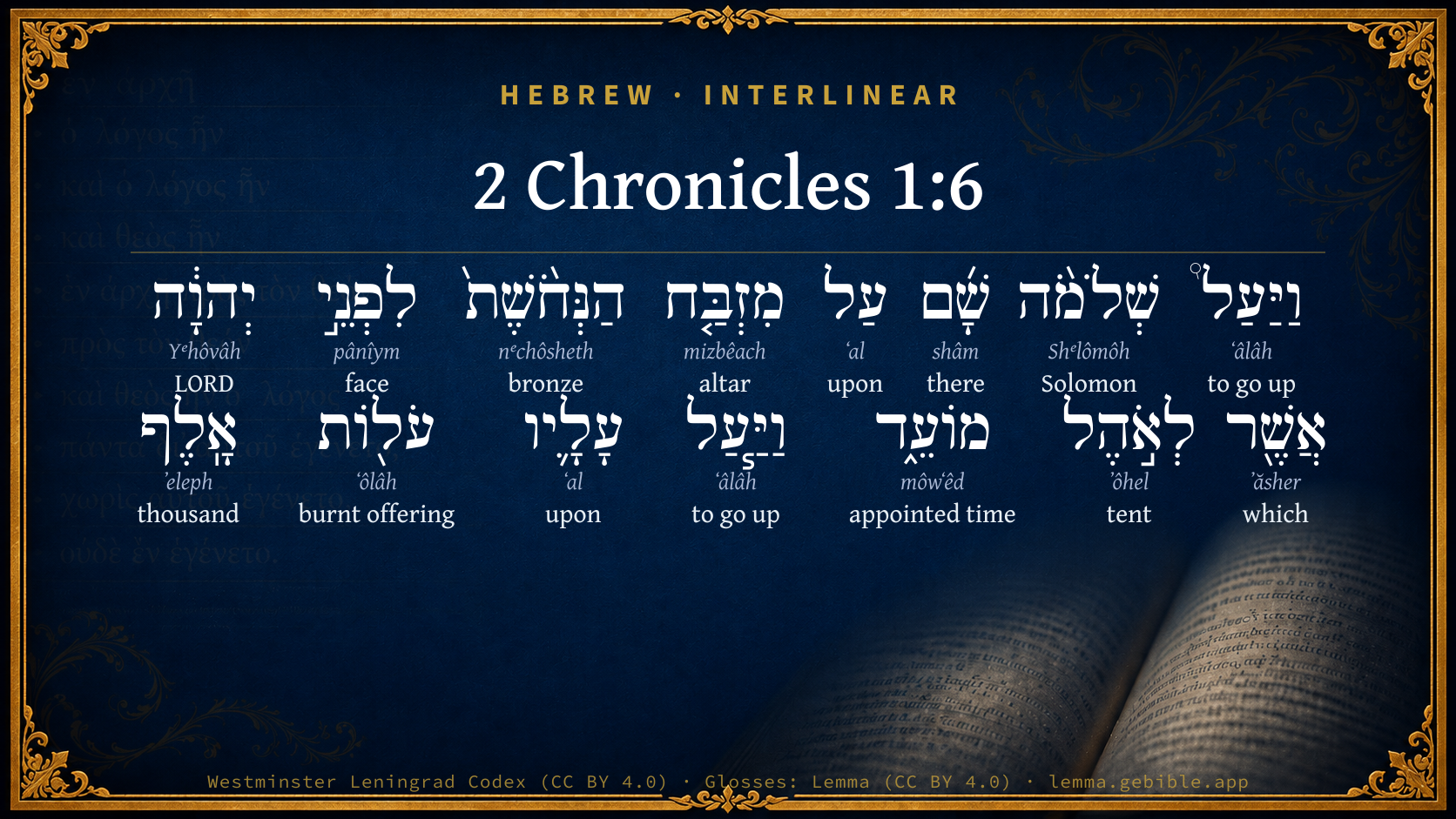
Hebrew (Westminster Leningrad Codex) 2 Chronicles 1:6 appears in the Hebrew Old Testament. The text above is from the Westminster Leningrad Codex. Each word links to its Strong’s number, a concise gloss, and parsing drawn from the Open Scriptures Hebrew Bible morphology. Click any word for its full Brown-Driver-Briggs (BDB) entry.
Download image
Cite this verse

2 Chronicles 1:6 (World English Bible). Public Domain. Lemma interlinear Bible study tool, https://lemma.gebible.app/v/2-chronicles/1/6.

Show BibTeX & RIS
BibTeX
RIS
English Translation
Solomon went up there to the brazen altar before Yahweh, which was at the tent of meeting, and offered one thousand burnt offerings on it.
World English Bible · Public Domain
Download a study sheet

One document with this verse’s original text, its word-by-word gloss line, the meaning frame, cross-references with their text, attributed commentary, and full source and license credits — printable, and it pastes into notes with its structure intact.

This verse Autodidact and up

Study sheet (.html) Plain text (.txt)

A passage Seminary Student

Up to 50 verses in one chapter. A passage sheet keeps up to 6 commentary sources and 12 cross-references per verse, in the order this page ranks them, and says so on the sheet whenever that leaves anything out. Ask for a single verse and you get the Autodidact verse sheet above.

Everything on this page stays free to read, with no account — the sheet is a download of what is already on screen, not access to it.

Want to remove ads? Support Godless Engineer
Compare translations 3

The same verse in 3 English versions, stacked beneath the original-language interlinear above. Click any original word for its lexicon entry.

Each is an independent rendering of the whole verse — the interlinear is not word-aligned to these translations.

Highlighted words mark where these versions differ — a whole-verse word diff, not a word-by-word alignment.

  • World English Bible Public Domain
    Solomon went up there to the brazen altar before Yahweh, which was at the tent of meeting, and offered one thousand burnt offerings on it.
  • King James Version Public Domain
    And Solomon went up thither to the brazen altar before the LORD, which was at the tabernacle of the congregation, and offered a thousand burnt offerings upon it.
  • unfoldingWord Literal Text CC BY-SA 4.0
    And Solomon went up there to the bronze altar before Yahweh, which was at the tent of meeting, and he brought up on it 1,000 burnt offerings.

unfoldingWord Literal Text — © unfoldingWord, licensed CC BY-SA 4.0. Word-aligned USFM3 via Door43 (git.door43.org/unfoldingWord/en_ult).

Versions to compare (up to 4)

3 of 4 selected

Show all 18 translations

Every available English version of this verse, each an independent rendering of the whole verse.

  • World English Bible Public Domain
    Solomon went up there to the brazen altar before Yahweh, which was at the tent of meeting, and offered one thousand burnt offerings on it.
  • Berean Standard Bible Public Domain
    Solomon offered sacrifices there before the LORD on the bronze altar in the Tent of Meeting, where he offered a thousand burnt offerings.
  • Majority Standard Bible Public Domain
    Solomon offered sacrifices there before the LORD on the bronze altar at the Tent of Meeting, where he offered a thousand burnt offerings.
  • King James Version Public Domain
    And Solomon went up thither to the brazen altar before the LORD, which was at the tabernacle of the congregation, and offered a thousand burnt offerings upon it.
  • American Standard Version (1901) Public Domain
    And Solomon went up thither to the brazen altar before Jehovah, which was at the tent of meeting, and offered a thousand burnt-offerings upon it.
  • Revised Version (1885) Public Domain
    And Solomon went up thither to the brasen altar before the LORD, which was at the tent of meeting, and offered a thousand burnt offerings upon it.
  • Geneva Bible (1599) Public Domain
    And Salomon offred there before the Lord vpon the brasen altar that was in the Tabernacle of the Congregation: euen a thousand burnt offrings offred he vpon it.
  • Douay-Rheims (1899) Public Domain
    And Solomon went up thither to the brazen altar, before the tabernacle of the covenant of the Lord, and offered up on it a thousand victims.
  • Young's Literal Translation Public Domain
    And Solomon goeth up thither, on the altar of brass, before Jehovah, that `is' at the tent of meeting, and causeth to ascend upon it a thousand burnt-offerings.
  • Literal Standard Version CC BY-SA 4.0
    And Solomon goes up there, on the altar of bronze, before YHWH, that [is] at the Tent of Meeting, and causes one thousand burnt-offerings to ascend on it.
  • Unlocked Literal Bible CC BY-SA 4.0
    Solomon went up there to the bronze altar before Yahweh, which was at the tent of meeting, and offered one thousand burnt offerings on it.
  • unfoldingWord Literal Text CC BY-SA 4.0
    And Solomon went up there to the bronze altar before Yahweh, which was at the tent of meeting, and he brought up on it 1,000 burnt offerings.
  • Darby Bible Public Domain
    And Solomon offered there upon the brazen altar before Jehovah which was at the tent of meeting; and he offered up a thousand burnt-offerings upon it.
  • World Messianic Bible Public Domain
    Solomon went up there to the bronze altar before the LORD, which was at the Tent of Meeting, and offered one thousand burnt offerings on it.
  • Webster's Bible Public Domain
    And Solomon went up thither to the brazen altar before the LORD, which was at the tabernacle of the congregation, and offered a thousand burnt-offerings upon it.
  • Free Bible Version CC BY-SA 4.0
    Solomon went up to the bronze altar before the Lord, in front of the Tent of Meeting. There he presented one thousand burnt offerings.
  • Bible in Basic English Public Domain
    And Solomon went up there to the brass altar before the Lord at the Tent of meeting, offering on it a thousand burned offerings.
  • JPS Tanakh (1917) Public Domain
    And Solomon offered there, upon the brazen altar before the LORD, which was at the tent of meeting, he offered a thousand burnt-offerings upon it.

Literal Standard Version (2020), Covenant Press — licensed CC BY-SA 4.0. Text via the HelloAO Bible API (eBible.org). Unlocked Literal Bible (unfoldingWord) — licensed CC BY-SA 4.0. Text via the HelloAO Bible API (eBible.org). unfoldingWord Literal Text — © unfoldingWord, licensed CC BY-SA 4.0. Word-aligned USFM3 via Door43 (git.door43.org/unfoldingWord/en_ult). Free Bible Version, Dr. Jonathan Gallagher — licensed CC BY-SA 4.0. Text via the HelloAO Bible API (eBible.org).

Word by word

More ways to search: Search by grammar → Find every occurrence → Compare this word →

Practice this passage: Drill this verse → Learn its vocabulary →

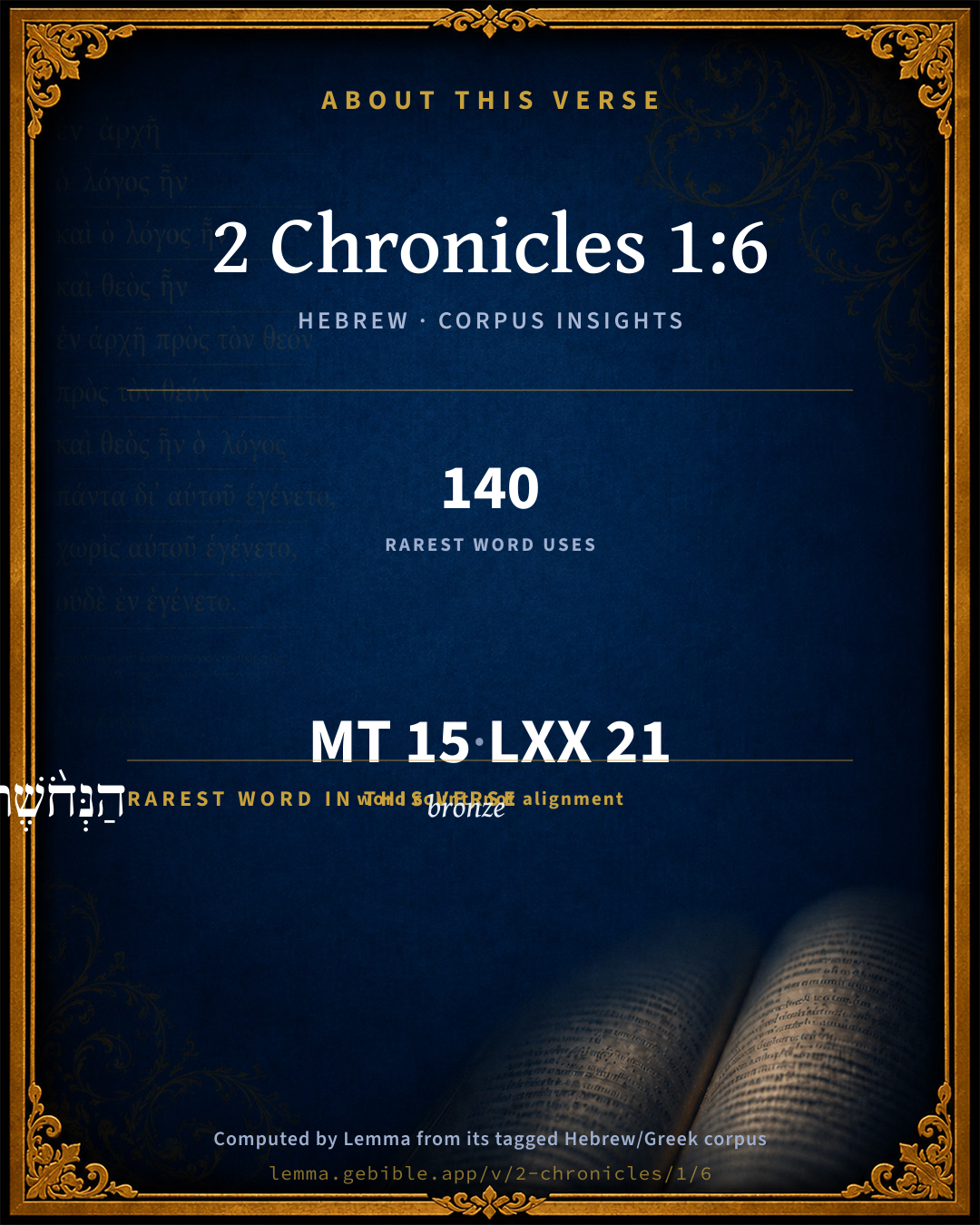
הַנְּחֹ֨שֶׁת֙
nᵉchôsheth
H5178
“the · bronze”
Particle, Definite Article + Noun, Common, Feminine, Singular, Absolute
Part of Speech
Particle + Noun
Type
Common
Gender
Feminine
Number
Singular
State
Absolute
Full BDB Definition

Origin: for H5154

TWOT: 1349a , 1350a

copper, bronze - copper (ore), bronze (as copper alloy) - fetters (of copper or bronze) - copper (as value) - lust, harlotry - meaning dubious
  1. וַיַּעַל֩ ʻâlâh H5927 “and · to go up” Conjunction + Verb, Hiphil, Sequential Imperfect, 3rd Person, Masculine, Singular
  2. שְׁלֹמֹ֨ה Shᵉlômôh H8010 “Solomon” Noun, Proper
  3. שָׁ֜ם shâm H8033 “there” Adverb
  4. עַל ʻal H5921 “upon” Preposition
  5. מִזְבַּ֤ח mizbêach H4196 “altar of” Noun, Common, Masculine, Singular, Construct
  6. לִפְנֵ֣י pânîym H6440 “to/for · face(s) of” Preposition + Noun, Common, Both, Plural, Construct
  7. יְהוָ֔ה Yᵉhôvâh H3068 “LORD” Noun, Proper
  8. אֲשֶׁ֖ר ʼăsher H834 “which” Particle, Relative
  9. לְאֹ֣הֶל ʼôhel H168 “to/for · tent of” Preposition + Noun, Common, Masculine, Singular, Construct
  10. מוֹעֵ֑ד môwʻêd H4150 “appointed time” Noun, Common, Masculine, Singular, Absolute
  11. וַיַּ֧עַל ʻâlâh H5927 “and · to go up” Conjunction + Verb, Hiphil, Sequential Imperfect, 3rd Person, Masculine, Singular
  12. עָלָ֛יו ʻal H5921 “upon · him” Preposition + Suffix, Personal, 3rd Person, Masculine, Singular
  13. עֹל֖וֹת ʻôlâh H5930 “burnt offerings” Noun, Common, Feminine, Plural, Absolute
  14. אָֽלֶף ʼeleph H505 “thousand” Adjective, Cardinal number, Both, Singular, Absolute

About this verse

These counts appear in no published source. They are computed here, from the morphology-tagged text and Lemma’s own curated glosses. What Lemma adds →

15
words
13
distinct lemmas
Historical
section

Grammatical profile

  • 2 verbs
  • 8 nouns
  • 1 adjective
  • 2 prepositions
  • 1 adverb
  • 1 particle

Verb forms

  • וַיַּעַל֩ Hiphil · Sequential Imperfect
  • וַיַּ֧עַל Hiphil · Sequential Imperfect

Repetition

Words recur within this verse — often emphatic in Hebrew:

  • וַיַּעַל֩ to go up H5927 ×2
  • עַל upon H5921 ×2

Hebrew & Septuagint length

In English translation the verse runs 25 words from the Hebrew and 26 from the Septuagint (LXX English) — closely comparable.

A rough comparison of the two English renderings, which tokenize alike — not a word-level alignment.

Word counts can differ between the Hebrew and the Greek without any difference in meaning — e.g. the Hebrew direct-object marker אֵת has no separate Greek word, and Greek often adds the article ὁ.

In the original languages it is 15 Hebrew tokens and 21 Greek tokens — but the two are counted differently (Hebrew bundles its prefixes and suffixes into one token; the Greek is in lemma form), so that isn’t a like-for-like length.

Cross-references

4

Topical passages linked to 2 Chronicles 1:6 in the Treasury of Scripture Knowledge — connected by theme and wording, ordered by reader-vote popularity; previews shown in the World English Bible.

  • 1 Kings 3:4 The king went to Gibeon to sacrifice there; for that was the great high place: a thousand burnt offerings did Solomon offer on that altar.
  • 1 Kings 8:63 Solomon offered for the sacrifice of peace-offerings, which he offered to Yahweh, two and twenty thousand oxen, and one hundred twenty thousand sheep. So the king and all the children of Israel dedicated the house of Yahweh.
  • 1 Chronicles 29:21 They sacrificed sacrifices to Yahweh, and offered burnt offerings to Yahweh, on the next day after that day, even one thousand bulls, one thousand rams, and one thousand lambs, with their drink-offerings, and sacrifices in abundance for all Israel,
  • Isaiah 40:16 Lebanon is not sufficient to burn, nor the animals of it sufficient for a burnt offering.

Cross-references courtesy of OpenBible.info (CC BY 4.0).

Hebrew and Greek witnesses Masoretic Hebrew ↔ Greek Septuagint

The same verse in the two great witnesses to the Old Testament, shown verse-for-verse.

These are two independent witnesses, not word-aligned to each other, and the Septuagint is shown in lemma (dictionary) form.

Hebrew 2 Chronicles 1:6 Masoretic · Westminster Leningrad Codex

וַיַּעַל֩ שְׁלֹמֹ֨ה שָׁ֜ם עַל מִזְבַּ֤ח הַנְּחֹ֨שֶׁת֙ לִפְנֵ֣י יְהוָ֔ה אֲשֶׁ֖ר לְאֹ֣הֶל מוֹעֵ֑ד וַיַּ֧עַל עָלָ֛יו עֹל֖וֹת אָֽלֶף

Solomon went up there to the brazen altar before Yahweh, which was at the tent of meeting, and offered one thousand burnt offerings on it.

World English Bible · Public Domain

Greek LXX 2 Chronicles 1:6 Septuagint · lemma form

καί ἀναφέρω ἐκεῖ σαλωμών ἐπί ὁ θυσιαστήριον ὁ χαλκοῦς ἐνώπιον κύριος ὁ ἐν ὁ σκηνή καί ἀναφέρω ἐπί αὐτός ὁλοκαύτωσις χίλιοι

And Solomon brought victims there to the brazen altar that was before the Lord in the tabernacle, and offered upon it a thousand whole burnt offerings.

LXX2012 (modern English Septuagint) · Public Domain

On this verse, Ellicott's Commentary for English Readers discusses the Septuagint’s reading. Read the note in Commentary ↓

Hebrew: Westminster Leningrad Codex (CC BY 4.0). Greek: Septuagint (public domain); English from LXX2012 (modern English Septuagint) (Public Domain). How the Septuagint differs from the Hebrew →

Commentary

Notes on 2 Chronicles 1:6 from classic Christian and Jewish commentators (each source and its license shown beneath its notes). The classic Christian expositions comment on the surrounding passage and are grouped to its opening verse, so a note may address several verses; the Jewish commentaries on the Tanakh (Rashi and others) are per-verse, so they appear only where the commentator wrote on this verse.

Lemma curates 59 commentaries, every one of them public domain or Creative Commons licensed, each selected and text-cleaned for this edition rather than reprinted as found. About our sources →

Trapp's Complete Commentary

John Trapp

2Ch 1:6 And Solomon went up thither to the brasen altar before the LORD, which [was] at the tabernacle of the congregation, and offered a thousand burnt offerings upon it.

Ver. 6. The tabernacle of the congregation.] Which was so called, because there the people met to serve God.

John Trapp, A Commentary or Exposition upon All the Books of the Old and New Testament (1647–1656) — public domain. Text from a community e-Sword module.

Joseph Benson's Commentary

2Ch 1:6. To the brazen altar before the Lord — It is said to be before the Lord, though the ark was not there, because God was pleased graciously to accept the sacrifices offered before the place, though wanting the token of his glorious presence. And offered a thousand burnt-offerings upon it — Namely, by the ministry of the priests, He probably offered as many peace- offerings, on which he and his company feasted before the Lord; unless, as Pellicanus thinks, burnt-offerings here signify peace-offerings, the general name being put for the special.

Joseph Benson's Commentary on the Old and New Testaments (1811–1818) — public domain. Text from a community e-Sword module.

Jamieson, Fausset & Brown

Robert Jamieson, A. R. Fausset & David Brown

offered a thousand burnt offerings--This holocaust he offered, of course, by the hands of the priests. The magnitude of the oblation became the rank of the offerer on this occasion of national solemnity.

Jamieson, Fausset & Brown — Commentary Critical and Explanatory on the Whole Bible (1871) — public domain (CC PDM 1.0). Text via the HelloAO Bible API.

Ellicott's Commentary for English Readers

(6) And Solomon went up thither to the “brasen altar.—So Vulg. incorrectly. Rather, And Solomon offered there on the brasen altar; so LXX. and Syriac.

Before the Lord.—The altar stood before the entry of the Lord’s dwellingplace (Exo_40:6). (Comp. Jdg_20:23; Jdg_20:26.)

Which was at the tabernacle of the congregation.—Which altar belonged to the tent of tryst. In 1Ki_6:22 the golden altar is said in like manner to belong to the Holy of holies, before which it stood. (The Vulg. seems to have read “the brasen altar, before the Lord’s tent of meeting”; comp. 2Ch_1:3.)

And offered.—He offered (I say). The verb is repeated before its object for clearness’ sake.

A Bible Commentary for English Readers, edited by Charles John Ellicott (1878–1897) — public domain. Text from a community e-Sword module.

The Cambridge Bible for Schools and Colleges

gen. ed. J. J. S. Perowne

6. went up thither] R.V. mg., offered there. It is to be noted that the Chronicler does not ignore the exercise of priestly functions by Solomon, though such exercise must have seemed wrong in his eyes, but follows his authority (1Ki_3:4) without adding any explanation.

The Cambridge Bible for Schools and Colleges (gen. ed. J. J. S. Perowne; Cambridge University Press, 1878–1918) — public domain. Text from a community e-Sword module.

John Gill's Exposition

And Solomon went up thither,.... To the high place at Gibeon:

to the brasen altar before the lord; where he used to be, and accept the sacrifices of his people, though the ark, the symbol of his presence, was not there:

which was at the tabernacle of the congregation; that is, which altar was there; or rather "who", that is, God, was there, as Osiander, hearing the prayers of his people, and accepting their offerings:

and offered a thousand offerings upon it; by the priests, see Kg1 3:4.

John Gill's Exposition of the Whole Bible (1746–1763) — public domain (CC PDM 1.0). Text via the HelloAO Bible API.

Haydock's Catholic Bible Commentary

Victims. Hebrew, "holocausts," either with his own hand, or by the ministry of the priests. See 1 Kings xiii. 12. (Calmet)

George Leo Haydock (1774–1849), Haydock's Catholic Family Bible and Commentary, 1859 edition — public domain. Excludes Psalms (Douay-Rheims chapter numbering differs from Protestant) and Deuterocanonical books (Catholic canon only).

Matthew Poole's English Annotations

i.e. Which altar. But that he had now said, 2Ch 1:5, and therefore would not unnecessarily repeat it. Or rather, who; and so these words are emphatical, and contain a reason why Solomon went thither, because the Lord was there graciously present to hear prayers and receive sacrifices.

Matthew Poole's English Annotations on the Holy Bible (1683–1685) — public domain. Text from a community e-Sword/MySword module.

The Pulpit Commentary

A thousand burnt offerings. The first instance of the burnt offering is Gen_8:20, and thereafter in the same book Gen_15:9, 17 22:2, 7, 13. It was manifestly the chiefest of the eucharistic kind of sacrifices, and for manifest reasons also was preceded by a "sin" offering (Exo_29:36-38; Lev_8:14, etc.) (For full details of the ceremonial, sac Lev 1:, Lev 6:, Lev 7:, Lev_7:8., passim) The extraordinary number of the burnt offerings on this and some similar occasions may well excite our wonder. (Num_7:3, 17 1Ki_8:64; 2Ch_4:1 compared with 2Ch_7:7. See also Herod., "Hist.," 7:43) The priests, of course, performed the sacrifices at the command of Solomon.

The Pulpit Commentary (1880–1919), ed. H.D.M. Spence-Jones & Joseph S. Exell — public domain. Text from a community e-Sword module.

unfoldingWord translationNotes

Door43 World Missions Community

went up there

"went up to the high place at Gibeon"

one thousand

"1,000" (See: Numbers)

Ask! What should I give you?

This can be translated as a statement. AT: "Ask for whatever you want from me."

translationWords

sacrifice

burnt offering

unfoldingWord translationNotes — © Distant Shores Media and the Door43 World Missions Community, licensed CC BY-SA 4.0. Source: git.door43.org/Door43/en_tn.

Lesson kit

Teaching starters — assembled from the data on this page, not authored interpretation. Every prompt links to the verse data it draws on. Edit before teaching.

2 Chronicles, in the Historical, opens this verse with 15 words (13 distinct Hebrew lemmas). Its most distinctive word is nᵉchôsheth (“bronze”). A historical commentator’s framing appears above. Read the whole chapter for the surrounding context.

Discussion questions

  1. The word nᵉchôsheth carries the sense “bronze.” How does it shape the verse?
  2. How does 1 Kings 3:4, which shares this passage’s theme, read alongside this verse?
  3. What does the repetition of “to go up” (2× in this one verse) do in this verse?
  4. These translations render this verse differently; the difference is in the English rendering, not the original. What questions does that raise?
  5. «וַיַּעַל֩» is a Hiphil Sequential Imperfect verb. How does that grammatical form shape the action described?
  6. Compare how Trapp's Complete Commentary and Joseph Benson's Commentary read this verse. Where do they agree or differ?

Things to notice

Reading settings

Reading text

Shown beneath each verse's original-language words.

Old Testament
Old Testament edition

Read the OT as the Masoretic Hebrew (MT) or the Greek Septuagint (LXX).

English shown for the Greek Septuagint (in the Hebrew ↔ Greek comparison).

Comparing translations? Open the Compare panel on any verse page to stack up to four side by side.