
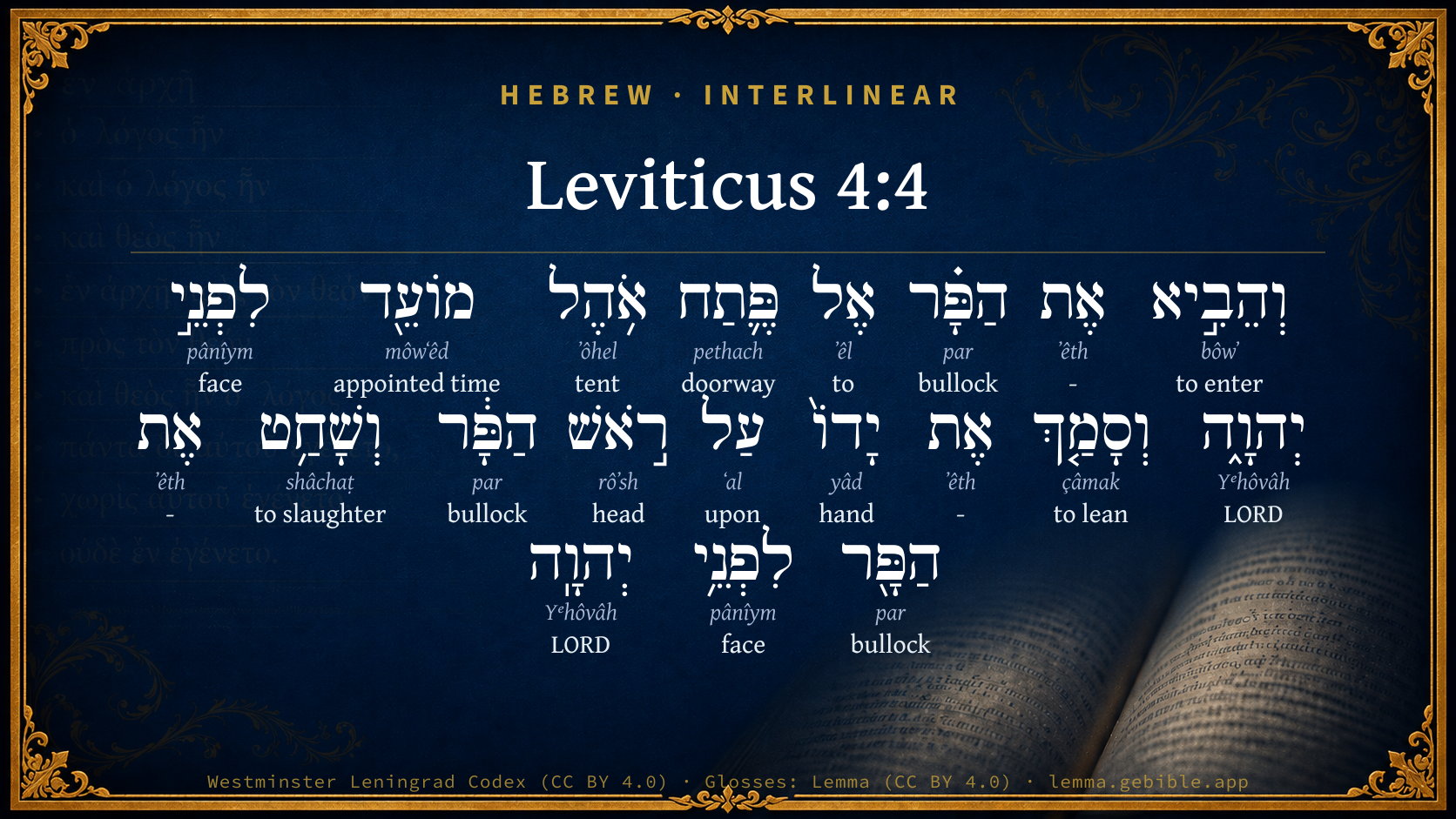
Leviticus 4:4

Hebrew (Westminster Leningrad Codex) Leviticus 4:4 appears in the Hebrew Old Testament. The text above is from the Westminster Leningrad Codex. Each word links to its Strong’s number, a concise gloss, and parsing drawn from the Open Scriptures Hebrew Bible morphology. Click any word for its full Brown-Driver-Briggs (BDB) entry.
Download image
Cite this verse

Leviticus 4:4 (World English Bible). Public Domain. Lemma interlinear Bible study tool, https://lemma.gebible.app/v/leviticus/4/4.

Show BibTeX & RIS
BibTeX
RIS
English Translation
He shall bring the bull to the door of the Tent of Meeting before Yahweh; and he shall lay his hand on the head of the bull, and kill the bull before Yahweh.
World English Bible · Public Domain
Download a study sheet

One document with this verse’s original text, its word-by-word gloss line, the meaning frame, cross-references with their text, attributed commentary, and full source and license credits — printable, and it pastes into notes with its structure intact.

This verse Autodidact and up

Study sheet (.html) Plain text (.txt)

A passage Seminary Student

Up to 50 verses in one chapter. A passage sheet keeps up to 6 commentary sources and 12 cross-references per verse, in the order this page ranks them, and says so on the sheet whenever that leaves anything out. Ask for a single verse and you get the Autodidact verse sheet above.

Everything on this page stays free to read, with no account — the sheet is a download of what is already on screen, not access to it.

Want to remove ads? Support Godless Engineer
Compare translations 3

The same verse in 3 English versions, stacked beneath the original-language interlinear above. Click any original word for its lexicon entry.

Each is an independent rendering of the whole verse — the interlinear is not word-aligned to these translations.

Highlighted words mark where these versions differ — a whole-verse word diff, not a word-by-word alignment.

  • World English Bible Public Domain
    He shall bring the bull to the door of the Tent of Meeting before Yahweh; and he shall lay his hand on the head of the bull, and kill the bull before Yahweh.
  • King James Version Public Domain
    And he shall bring the bullock unto the door of the tabernacle of the congregation before the LORD; and shall lay his hand upon the bullock's head, and kill the bullock before the LORD.
  • unfoldingWord Literal Text CC BY-SA 4.0
    And he shall bring the bull to the entrance of the tent of meeting to the face of Yahweh. And he shall lay his hand on the head of the bull and he shall slaughter the bull to the face of Yahweh.

unfoldingWord Literal Text — © unfoldingWord, licensed CC BY-SA 4.0. Word-aligned USFM3 via Door43 (git.door43.org/unfoldingWord/en_ult).

Versions to compare (up to 4)

3 of 4 selected

Show all 18 translations

Every available English version of this verse, each an independent rendering of the whole verse.

  • World English Bible Public Domain
    He shall bring the bull to the door of the Tent of Meeting before Yahweh; and he shall lay his hand on the head of the bull, and kill the bull before Yahweh.
  • Berean Standard Bible Public Domain
    He must bring the bull to the entrance to the Tent of Meeting before the LORD, lay his hand on the bull’s head, and slaughter it before the LORD.
  • Majority Standard Bible Public Domain
    He must bring the bull to the entrance to the Tent of Meeting before the LORD, lay his hand on the bull’s head, and slaughter it before the LORD.
  • King James Version Public Domain
    And he shall bring the bullock unto the door of the tabernacle of the congregation before the LORD; and shall lay his hand upon the bullock's head, and kill the bullock before the LORD.
  • American Standard Version (1901) Public Domain
    And he shall bring the bullock unto the door of the tent of meeting before Jehovah; and he shall lay his hand upon the head of the bullock, and kill the bullock before Jehovah.
  • Revised Version (1885) Public Domain
    And he shall bring the bullock unto the door of the tent of meeting before the LORD; and he shall lay his hand upon the head of the bullock, and kill the bullock before the LORD.
  • Geneva Bible (1599) Public Domain
    And hee shall bring the bullocke vnto the dore of the Tabernacle of the Congregation before the Lord, and shall put his hande vpon the bullocks head, and kill the bullocke before the Lord.
  • Douay-Rheims (1899) Public Domain
    And he shall bring it to the door of the testimony before the Lord, and shall put his hand upon the head thereof, and shall sacrifice it to the Lord.
  • Young's Literal Translation Public Domain
    and he hath brought in the bullock unto the opening of the tent of meeting before Jehovah, and hath laid his hand on the head of the bullock, and hath slaughtered the bullock before Jehovah.
  • Literal Standard Version CC BY-SA 4.0
    and he has brought in the bullock to the opening of the Tent of Meeting before YHWH, and has laid his hand on the head of the bullock, and has slaughtered the bullock before YHWH.
  • Unlocked Literal Bible CC BY-SA 4.0
    He must bring the bull to the entrance of the tent of meeting before Yahweh, lay his hand on its head, and kill the bull before Yahweh.
  • unfoldingWord Literal Text CC BY-SA 4.0
    And he shall bring the bull to the entrance of the tent of meeting to the face of Yahweh. And he shall lay his hand on the head of the bull and he shall slaughter the bull to the face of Yahweh.
  • Darby Bible Public Domain
    And he shall bring the bullock to the entrance of the tent of meeting before Jehovah; and shall lay his hand on the bullock's head, and slaughter the bullock before Jehovah.
  • World Messianic Bible Public Domain
    He shall bring the bull to the door of the Tent of Meeting before the LORD; and he shall lay his hand on the head of the bull, and kill the bull before the LORD.
  • Webster's Bible Public Domain
    And he shall bring the bullock to the door of the tabernacle of the congregation before the LORD; and shall lay his hand upon the bullock's head, and kill the bullock before the LORD.
  • Free Bible Version CC BY-SA 4.0
    He must take the bull to the entrance of the Tent of Meeting before the Lord, put his hand on its head and kill it before the Lord.
  • Bible in Basic English Public Domain
    And he is to take the ox to the door of the Tent of meeting before the Lord; and put his hand on its head and put it to death before the Lord.
  • JPS Tanakh (1917) Public Domain
    And he shall bring the bullock unto the door of the tent of meeting before the LORD; and he shall lay his hand upon the head of the bullock, and kill the bullock before the LORD.

Literal Standard Version (2020), Covenant Press — licensed CC BY-SA 4.0. Text via the HelloAO Bible API (eBible.org). Unlocked Literal Bible (unfoldingWord) — licensed CC BY-SA 4.0. Text via the HelloAO Bible API (eBible.org). unfoldingWord Literal Text — © unfoldingWord, licensed CC BY-SA 4.0. Word-aligned USFM3 via Door43 (git.door43.org/unfoldingWord/en_ult). Free Bible Version, Dr. Jonathan Gallagher — licensed CC BY-SA 4.0. Text via the HelloAO Bible API (eBible.org).

Word by word

More ways to search: Search by grammar → Find every occurrence → Compare this word →

Practice this passage: Drill this verse → Learn its vocabulary →

וְסָמַ֤ךְ
çâmak
H5564
“and · to lean”
Conjunction + Verb, Qal, Sequential Perfect, 3rd Person, Masculine, Singular
Part of Speech
Conjunction + Verb
Stem
Qal
Form
Sequential Perfect
Person
3rd Person
Gender
Masculine
Number
Singular
Full BDB Definition

Origin: a primitive root

TWOT: 1514

to lean, lay, rest, support, put, uphold, lean upon - (Qal) - to lean or lay upon, rest upon, lean against - to support, uphold, sustain - (Niphal) to support or brace oneself - (Piel) to sustain, refresh, revive
  1. וְהֵבִ֣יא bôwʼ H935 “and · to enter” Conjunction + Verb, Hiphil, Sequential Perfect, 3rd Person, Masculine, Singular
  2. אֶת ʼêth H853 “-” Particle, Direct Object
  3. הַפָּ֗ר par H6499 “the · bullock” Particle, Definite Article + Noun, Common, Masculine, Singular, Absolute
  4. אֶל ʼêl H413 “to” Preposition
  5. פֶּ֛תַח pethach H6607 “doorway of” Noun, Common, Masculine, Singular, Construct
  6. אֹ֥הֶל ʼôhel H168 “tent of” Noun, Common, Masculine, Singular, Construct
  7. מוֹעֵ֖ד môwʻêd H4150 “appointed time” Noun, Common, Masculine, Singular, Absolute
  8. לִפְנֵ֣י pânîym H6440 “to/for · face(s) of” Preposition + Noun, Common, Both, Plural, Construct
  9. יְהוָ֑ה Yᵉhôvâh H3068 “LORD” Noun, Proper
  10. אֶת ʼêth H853 “-” Particle, Direct Object
  11. יָדוֹ֙ yâd H3027 “hand · his” Noun, Common, Both, Singular, Construct + Suffix, Personal, 3rd Person, Masculine, Singular
  12. עַל ʻal H5921 “upon” Preposition
  13. רֹ֣אשׁ rôʼsh H7218 “head of” Noun, Common, Masculine, Singular, Construct
  14. הַפָּ֔ר par H6499 “the · bullock” Particle, Definite Article + Noun, Common, Masculine, Singular, Absolute
  15. וְשָׁחַ֥ט shâchaṭ H7819 “and · to slaughter” Conjunction + Verb, Qal, Sequential Perfect, 3rd Person, Masculine, Singular
  16. אֶת ʼêth H853 “-” Particle, Direct Object
  17. הַפָּ֖ר par H6499 “the · bullock” Particle, Definite Article + Noun, Common, Masculine, Singular, Absolute
  18. לִפְנֵ֥י pânîym H6440 “to/for · face(s) of” Preposition + Noun, Common, Both, Plural, Construct
  19. יְהוָֽה Yᵉhôvâh H3068 “LORD” Noun, Proper

About this verse

These counts appear in no published source. They are computed here, from the morphology-tagged text and Lemma’s own curated glosses. What Lemma adds →

20
words
14
distinct lemmas
Pentateuch
section

Shared distinctive vocabulary

וְסָמַ֤ךְ to lean H5564 occurs in 47 verses of the Hebrew Bible. Also found in:

Grammatical profile

  • 3 verbs
  • 12 nouns
  • 2 prepositions
  • 3 particles

Verb forms

  • וְהֵבִ֣יא Hiphil · Sequential Perfect
  • וְסָמַ֤ךְ Qal · Sequential Perfect
  • וְשָׁחַ֥ט Qal · Sequential Perfect

Repetition

Words recur within this verse — often emphatic in Hebrew:

  • הַפָּ֗ר bullock H6499 ×3
  • לִפְנֵ֣י face H6440 ×2
  • יְהוָ֑ה LORD H3068 ×2

Hebrew & Septuagint length

In English translation the verse runs 33 words from the Hebrew and 43 from the Septuagint (LXX English) — closely comparable.

A rough comparison of the two English renderings, which tokenize alike — not a word-level alignment.

Word counts can differ between the Hebrew and the Greek without any difference in meaning — e.g. the Hebrew direct-object marker אֵת has no separate Greek word, and Greek often adds the article ὁ.

In the original languages it is 20 Hebrew tokens and 31 Greek tokens — but the two are counted differently (Hebrew bundles its prefixes and suffixes into one token; the Greek is in lemma form), so that isn’t a like-for-like length.

Cross-references

6

Topical passages linked to Leviticus 4:4 in the Treasury of Scripture Knowledge — connected by theme and wording, ordered by reader-vote popularity; previews shown in the World English Bible.

  • Leviticus 1:3–4 "'If his offering is a burnt offering from the herd, he shall offer a male without blemish. He shall offer it at the door of the Tent of Meeting, that he may be accepted before Yahweh.
  • Exodus 29:10–11 "You shall bring the bull before the tent of meeting: and Aaron and his sons shall lay their hands on the head of the bull.
  • Leviticus 16:21 Aaron shall lay both his hands on the head of the live goat, and confess over him all the iniquities of the children of Israel, and all their transgressions, even all their sins; and he shall put them on the head of the goat, and shall send him away into the wilderness by the hand of a man who is in readiness.
  • Isaiah 53:6 All we like sheep have gone astray; everyone has turned to his own way; and Yahweh has laid on him the iniquity of us all.
  • Daniel 9:26 After the sixty-two weeks the Anointed One shall be cut off, and shall have nothing: and the people of the prince who shall come shall destroy the city and the sanctuary; and the end of it shall be with a flood, and even to the end shall be war; desolations are determined.
  • 1 Peter 3:18 Because Christ also suffered for sins once, the righteous for the unrighteous, that he might bring you to God; being put to death in the flesh, but made alive in the spirit;

Cross-references courtesy of OpenBible.info (CC BY 4.0).

Hebrew and Greek witnesses Masoretic Hebrew ↔ Greek Septuagint

The same verse in the two great witnesses to the Old Testament, shown verse-for-verse.

These are two independent witnesses, not word-aligned to each other, and the Septuagint is shown in lemma (dictionary) form.

Hebrew Leviticus 4:4 Masoretic · Westminster Leningrad Codex

וְהֵבִ֣יא אֶת הַפָּ֗ר אֶל פֶּ֛תַח אֹ֥הֶל מוֹעֵ֖ד לִפְנֵ֣י יְהוָ֑ה וְסָמַ֤ךְ אֶת יָדוֹ֙ עַל רֹ֣אשׁ הַפָּ֔ר וְשָׁחַ֥ט אֶת הַפָּ֖ר לִפְנֵ֥י יְהוָֽה

He shall bring the bull to the door of the Tent of Meeting before Yahweh; and he shall lay his hand on the head of the bull, and kill the bull before Yahweh.

World English Bible · Public Domain

Greek LXX Leviticus 4:4 Septuagint · lemma form

καί προςἄγω ὁ μόσχος παρά ὁ θύρα ὁ σκηνή ὁ μαρτύριον ἔναντι κύριος καί ἐπιτίθημι ὁ χείρ αὐτός ἐπί ὁ κεφαλή ὁ μόσχος ἔναντι κύριος καί σφάζω ὁ μόσχος ἐνώπιον κύριος

And he shall bring the calf to the door of the tabernacle of witness before the Lord, and he shall put his hand on the head of the calf before the Lord, and shall kill the calf in the presence of the Lord.

LXX2012 (modern English Septuagint) · Public Domain

Hebrew: Westminster Leningrad Codex (CC BY 4.0). Greek: Septuagint (public domain); English from LXX2012 (modern English Septuagint) (Public Domain). How the Septuagint differs from the Hebrew →

Targum (Aramaic paraphrase)

2

The Targum is the ancient Jewish Aramaic paraphrase of the Hebrew Scriptures — an interpretive translation, not the Hebrew text itself. Onkelos (literal) and Pseudo-Jonathan (expansive) render the Torah, and Jonathan the Prophets. Coverage is partial: where no permissively-licensed English translation exists for a verse, only the Aramaic is shown. This is verse-level text, not a word-by-word alignment to the Hebrew.

  1. Targum Onkelos Torah (Genesis–Deuteronomy)
    וְיַיְתִי יָת תּוֹרָא לִתְרַע מַשְׁכַּן זִמְנָא לָקֳדָם יְיָ וְיִסְמוֹךְ יָת יְדֵיהּ עַל רֵישׁ תּוֹרָא וְיִכּוֹס יָת תּוֹרָא קֳדָם יְיָ

    (no public-domain English translation for this verse)

    Targum Onkelos — Aramaic: “Onkelos Genesis” (public domain); “Onkelos Exodus” (public domain); “Onkelos Leviticus” (public domain); “Onkelos Numbers” (public domain); “Onkelos Deuteronomy” (public domain). English: “Sefaria Community Translation” (CC0 1.0 (public-domain dedication)); “J.W. Etheridge. The Targums of Onkelos and Jonathan Ben Uzziel on the Pentateuch. London: Longmans, Green, 1862” (public domain). Text via Sefaria.

  2. Targum Pseudo-Jonathan Torah (Genesis–Deuteronomy)
    וְיֵיעוֹל יַת תּוֹרָא לִתְרַע מַשְׁכַּן זִימְנָא לִקֳדָם יְיָ וְיִסְמוֹךְ יַד יְמִינֵיהּ עַל רֵישׁ תּוֹרָא וְיִכּוֹס טַבְּחָא יַת תּוֹרָא קֳדָם יְיָ

    He shall bring in the bullock to the gate of the tabernacle of ordinance, to the presence of the Lord, and lay his right hand upon the head of the bullock, and the slayer shall kill the bullock before the Lord.

    Targum Pseudo-Jonathan — Aramaic: “Targum Jonathan on Genesis” (public domain); “Targum Jonathan on Exodus” (public domain); “Targum Jonathan on Leviticus” (public domain); “Targum Jonathan on Numbers” (public domain); “Targum Jonathan on Deuteronomy” (public domain). English: “The Targum of Jonathan ben Uzziel, trans. J. W. Etheridge, London, 1862” (public domain). Text via Sefaria.

Commentary

Notes on Leviticus 4:4 from classic Christian and Jewish commentators (each source and its license shown beneath its notes). The classic Christian expositions comment on the surrounding passage and are grouped to its opening verse, so a note may address several verses; the Jewish commentaries on the Tanakh (Rashi and others) are per-verse, so they appear only where the commentator wrote on this verse.

Lemma curates 59 commentaries, every one of them public domain or Creative Commons licensed, each selected and text-cleaned for this edition rather than reprinted as found. About our sources →

Trapp's Complete Commentary

John Trapp

Lev 4:4 And he shall bring the bullock unto the door of the tabernacle of the congregation before the LORD; and shall lay his hand upon the bullock’s head, and kill the bullock before the LORD.

Ver. 4. Shall lay his hand.] Confessing his sin, {Lev 5:5} and professing his faith in Christ, the true sin offering. {2Co 5:21}

John Trapp, A Commentary or Exposition upon All the Books of the Old and New Testament (1647–1656) — public domain. Text from a community e-Sword module.

Joseph Benson's Commentary

Lev 4:4. On the head — To testify both his acknowledgment of his sin, and faith in God’s promise for the expiation of his sins through Christ, whom that sacrifice typified.

Joseph Benson's Commentary on the Old and New Testaments (1811–1818) — public domain. Text from a community e-Sword module.

The Expositor's Bible

THE RITUAL OF THE SIN OFFERING

Lev_4:4-35; Lev_5:1-13; Lev_6:24-30

ACCORDING to the Authorised Version, {Lev_5:6-7} it might seem that the section, Lev_5:1-13, referred not to the sin offering, but to the guilt offering, like the latter part of the chapter; but, as suggested in the margin of the Revised Version, in these verses we may properly read, instead of "guilt offering," "for his guilt." That the latter rendering is to be preferred is clear when we observe that in Lev_5:6, Lev_5:7, Lev_5:9 this offering is called a sin offering; that, everywhere else, the victim for the guilt offering is a ram; and, finally, that the estimation of a money value for the victim, which is the most characteristic feature of the guilt offering, is absent from all the offerings described in these verses. We may safely take it therefore as certain that the marginal reading should be adopted in Lev_5:6, so that it will read, "he shall bring for his guilt unto the Lord"; and understand the section to contain a further development of the law of the sin offering. In the law of the preceding chapter we have the direction for the sin offering as graded with reference to the rank and station of the offerer; in this section we have the law for the sin offering for the common people, as graded with reference to the ability of the offerer.

The specifications {Lev_5:1-5} indicate several cases under which one of the common people was required to bring a sin offering as the condition of forgiveness. As an exhaustive list would be impossible, those named are taken as illustrations. The instances selected are significant as extending the class of offences for which atonement could be made by a sin offering, beyond the limits of sins of inadvertence as given in the previous chapter. For however some cases come under this head, we cannot so reckon sins of rashness (Lev_5:4), and still less, the failure of the witness placed under oath to tell the whole truth as he knows it. And herein it is graciously intimated that it is in the heart of God to multiply His pardons; and, on condition of the presentation of a sin offering, to forgive also those sins in palliation of which no such excuse as inadvertence or ignorance can be pleaded. It is a faint foreshadowing, in the law concerning the type, of that which should afterward be declared concerning the great Antitype, {1Jn_1:7} "The blood of Jesus cleanseth from all sin."

When we look now at the various prescriptions regarding the ritual of the offering which are given in this and the foregoing chapter, it is plain that the numerous variations from the ritual of the other sacrifices were intended to withdraw the thought of the sinner from all other aspects in which sacrifice might be regarded, and centre his mind upon the one thought of sacrifice as expiating sin, through the substitution of an innocent life for the guilty. In many particulars, indeed, the ritual agrees with that of the sacrifices before prescribed. The victim must be brought by the guilty person to be offered to God by the priest; he must, as in other cases of bloody offerings, then lay his hand on the head of the victim, and then (a particular not mentioned in the other cases) he must confess the sin which he has committed, and then and thus entrust the victim to the priest, that he may apply its blood for him in atonement before God. The priest then slays the victim, and now comes that part of the ceremonial which by its variations from the law of other offerings is emphasised as the most central and significant in this sacrifice.

William Robertson Nicoll, ed., The Expositor's Bible (London: Hodder & Stoughton, 1887–1910) — public domain. 65 of 66 books (1 Corinthians is not separately keyed, as that volume carries no machine-parseable verse references); section-level commentary keyed to the opening verse. Introductory and overview sections not keyed to a specific passage are excluded.

Geneva Bible (1599)

Geneva Bible translators

Hereby confessing that he deserved the same punishment which the beast suffered.

Geneva Bible (1599) marginal notes — public domain. Text via Bolls.life.

Adam Clarke's Commentary

Verse 4. Lay his hand upon the bullock's head] See Clarke on Le 1:4.

Adam Clarke's Commentary on the Bible (1810–1826) — public domain. Text from a community e-Sword/MySword module.

Ellicott's Commentary for English Readers

(4) Unto the door of the Tabernacle of the Congregation.—Better, unto the entrance of the tent of meeting. (See Lev_1:3.) The regulations about the bringing of the sin offering up to the sprinkling of the blood are the same as those about the other sacrifices.

A Bible Commentary for English Readers, edited by Charles John Ellicott (1878–1897) — public domain. Text from a community e-Sword module.

The Cambridge Bible for Schools and Colleges

gen. ed. J. J. S. Perowne

4–7. Cp. Lev_4:14-18. The first part of the ceremonial is like that of the Burnt-Offering. The disposal of the blood is different: the priest dips his finger into the blood, which has been caught in a bowl, and sprinkles it seven times before the veil of the sanctuary, i.e. the veil between the Holy of Holies and the Holy Place. He then puts some of the blood on the horns of the altar of incense with the finger (for each sprinkling and each touching the horns of the altar, tradition prescribes a separate dipping of the finger into the bowl), and, going outside the tent of meeting and back again to the west side of the altar, pours the rest (all the blood, Lev_4:7; Lev_4:18) at the base of the altar of Burnt-Offering.

The sprinkling of the blood before the veil, here ordered, is a later development of the ritual of Exo_29:12, where it was merely to be put upon the horns of the altar. Thus we have here an example of ps[41]. Cp. expressions in next v. and see App. on P.

[41] (secondary enactments) combined with the earlier strata. See further, pp. 174 ff.

The Cambridge Bible for Schools and Colleges (gen. ed. J. J. S. Perowne; Cambridge University Press, 1878–1918) — public domain. Text from a community e-Sword module.

John Gill's Exposition

And the priest that is anointed shall take of the bullock's blood,.... Let out and received into a basin; this he did himself, and not another, for he offered for himself, and the blood was to make atonement for him:

and bring it to the tabernacle of the congregation; out of the court where the bullock was slain, into the holy place, where were the vail that divided between the holy of holies, and the altar of sweet incense, after mentioned.

John Gill's Exposition of the Whole Bible (1746–1763) — public domain (CC PDM 1.0). Text via the HelloAO Bible API.

Matthew Poole's English Annotations

He shall lay his hand upon the bullock’s head, to testify both his acknowledgment of his sin, and his faith in God’s promise for the expiation of his sins through Christ, whom that sacrifice typified.

And kill the bullock, to wit, by one of the priests, whom he shall cause to do it; for this priest is distinguished from the anointed priest, Lev 4:5.

Matthew Poole's English Annotations on the Holy Bible (1683–1685) — public domain. Text from a community e-Sword/MySword module.

Whedon's Commentary on the Bible

Daniel D. Whedon

4. Shall lay his hand… and kill — Since the priest is also the offerer these acts must be performed by him. For the significance of the laying on of the hand, see Lev_1:4. From later Jewish authorities we learn that there was added the following confession of sin, and prayer that the victim might be accepted as its expiation: “I have sinned, I have done iniquity, I have trespassed, and done thus and thus; and do return by repentance before thee, and with this I make atonement.” This confession, if it was not a part of the original ritual, was a pardonable addition; the proper — we may say necessary — expression of the penitent soul.

Daniel D. Whedon (gen. ed.), Commentary on the Old and New Testaments (1874–1909) — public domain. Text from a community e-Sword module.

The Pulpit Commentary

HOMILIES BY R.M. EDGAR Chapter 4Atonement for the penitent, as illustrated in the sin offering.

Lev_5:1-13; cf. Psa_19:12 Gal_6:1 1Ti_1:13, etc. The offerings already considered, viz. the burnt offering, the meat offering, and the peace offering, have respectively emphasized the ideas of personal consecration, consecrated life-work, and fellowship. Moreover, they are to be regarded as voluntary offerings, depending upon the impulse of the heart for their celebration. Special experience might impel an Israelite to express his consecration or his fellowship, and he would then bring the appointed sacrifice.

But here we come across an offering which is imperative. The moment an Israelite became convinced of sin, then he was bound to bring the offering prescribed. Besides, the sin offering is Mosaic in its origin; it had no existence, as such, before the promulgation of the covenant at Sinai; and consequently it is to be taken as the rule for penitents, whose consciences have been educated in a more thorough detection of sin through the Law.

"By the law is the knowledge of sin." We have at this stage, confrequently, a perceptible elevation of the moral standard.

I THE FIRST LESSON OF THE SIN OFFERING IS THAT SIN IS A NATURE. The superficial treatment of sin deals with outward and conscious acts, such as trespasses; what God declares by his Law is that, behind all conscious acts of the will, there are natural movements of which we are not conscious, and for which, nevertheless, we are responsible. This important principle is affirmed by all these minute regulations about sins of ignorance. The thoughtful Israelite would see from this that sin is a much wider and deeper thing than he at first suspected; that the motions of his personal being are more numerous and varied than he supposed; that deliberation, in fact, is not essential to every sin, and does not cover responsibility. In other words, he would look within and realize that sin is a nature, working on, sometimes consciously and sometimes unconsciously, and that for all its workings he will be held accountable.

No more important principle lies in the field of self-examination. Without it there can be no thorough treatment of sin. With it we stand abashed and humbled under a sense of the unknown sin as well as of the known. We cry with David, "Who can understand his errors? cleanse thou me from secret faults. Keep back thy servant also from presumptuous sins; let them not have dominion over me: then shall I be upright, and I shall be innocent from the great transgression" (Psa_19:12, Psa_19:13; cf. also Shedd"s "Discourses and Essays," No. VI).

II SIN VARIES IS ITS HEINOUSNESS. The Israelite not only recognized this whole category of sins of ignorance marshaled in the Law before him; he also saw a difference of treatment in the cases under review. A sin of ignorance on the part of the high priest was made more emphatic than one on the part of a prince or a private person. The high priest"s representative position and character modified the whole case. His sin of omission or neglect became much more serious than a private individual"s could be. He was consequently directed to bring a bullock, the same offering as for a sin on the part of the collective people; for his representative character made him, so to speak, a moral equivalent to them. While, therefore, it is well to recognize sin as a nature, we must also remember that God does not treat sin in the mass, but discriminates between the more or less guilty. In his morality there are the most delicate appreciations and adjustments. Penitence must likewise be discriminating as well as profound. Self-examination may be a most humiliating and disappointing process, but we should weigh the relations of our faults and sins when we discover them and deal faithfully with ourselves.

III YET ALL SINNERS ARE PLACED WITHIN REACH OF AN APPROPRIATE ATONEMENT. The high priest and the collective people, the prince and one of the common people, each and all had their prescribed offering and guaranteed atonement. And when people proved so poor that they could not offer turtle-doves or young pigeons, they were directed to bring an ephah of fine flour, with which the priest would make atonement. And as for this atonement, it is in all cases secured by the surrender of life. Even the ephah of flour conveyed this idea, for the germ is hopelessly sacrificed in its manufacture. The one idea binding the various sacrifices together is the surrender of life. That this idea is to be attributed to substances in the vegetable kingdom as well as the animal, is evident from Joh_12:24, "Verily, verily, I say unto you, Except a corn of wheat fall into the ground and die, it abideth alone: but if it die, it bringeth forth much fruit.

And it need scarcely be added that the atonement of which these sin offerings were types is that of the Lord Jesus, who "was once offered to bear the sins of many". (Heb_9:28; also verses 11-14) In the proclamation of the gospel, this most appropriate atonement is put within the reach of all. No sinner is excluded from the possibility of atonement except through his own self-will.

IV THE RECONCILIATION WITH the PENITENT, WHICH ATONEMENT SECURES, IS A MATTER OF DEEP DELIGHT TO GOD. For not only is the blood of the sacrifice accepted at the appropriate spot, whether vail and altar of incense, or the brazen altar only, according to the status of the penitent; but there is besides an acceptance of the best portions of the animal upon the altar, indicating that God is delighted with the accomplished atonement. It was, so far as God was concerned, as much a feast as the peace offering. It expressed, consequently, that God was delighted beyond all our conception with the reconciliation.

It is well to make this idea always emphatic. Our blinded souls are ready to imagine that we are more anxious for reconciliation, and would be more delighted with it when it came, than God can be. The truth, however, is all the other way. The reconciliation begins with God, the atonement is due to his wisdom and mercy, and over the actual consummation he rejoices with "joy unspeakable and full of glory.

V THE RECONCILIATION IS ALSO MEANT TO BE A FEAST OF DELIGHT TO ALL GOD"S SERVANTS WHO ARE INSTRUMENTAL IN BRINGING IT ABOUT. For we must notice that, in the cases where the priests are not penitents themselves, but mediators, they are allowed to make a feast of what is left after the best portions are dedicated to God. Of course, when they are penitents, as in the case of a personal or a congregational sin, the carcass is to be considered too holy for the priests to partake of it; hence it is disposed of in its entirety in a clean place beyond the comp. This was the solemn way of disposing of the whole carcass. But in the other cases the priests were directed to feast upon the remainder of the offering, as those bearing atonement. So far they enjoyed what was their lot in the peace offering. As a feast, and not a lugubrious fast, it surely was intended to indicate their personal joy and satisfaction in the reconciliation they were instrumental in bringing about.

Lu 15 presents the joy of the Godhead and of the angels over returning penitents. It is this spirit we should cultivate. It will require, of course, much personal dealing with souls, but it is worth all the trouble to be instrumental in leading them to peace with God, and to the joy that results therefrom. R.M.E.

The Pulpit Commentary (1880–1919), ed. H.D.M. Spence-Jones & Joseph S. Exell — public domain. Text from a community e-Sword module.

John Wesley's Explanatory Notes

On the head - To testify both his acknowledgment of his sin, and faith in God's promise for the expiation of his sins through Christ, whom that sacrifice typified. Kill the bullock - By one of the priests, whom he should cause to do it.

John Wesley, Explanatory Notes Upon the Whole Bible (1754–1765) — public domain. Text via the GEBible commentary corpus.

unfoldingWord translationNotes

Door43 World Missions Community

General Information:

Yahweh continues to tell Moses what the people must do.

He must bring the bull

"The high priest must bring the bull"

lay his hand on its head

This is a symbolic action that identifies the person with the animal he is offering. In this way the person is offering himself to Yahweh through the animal. See how you translated this in Leviticus 1:4. (See: Symbolic Action)

The anointed priest will take some of the blood

It is implied that the priest catches the blood in a bowl as it drains from the animal. (See: Assumed Knowledge and Implicit Information)

translationWords

cow

tent of meeting

Yahweh

anoint

priest

blood

unfoldingWord translationNotes — © Distant Shores Media and the Door43 World Missions Community, licensed CC BY-SA 4.0. Source: git.door43.org/Door43/en_tn.

Lesson kit

Teaching starters — assembled from the data on this page, not authored interpretation. Every prompt links to the verse data it draws on. Edit before teaching.

Leviticus, in the Pentateuch, opens this verse with 20 words (14 distinct Hebrew lemmas). Its most distinctive word is çâmak (“to lean”). A historical commentator’s framing appears above. Read the whole chapter for the surrounding context.

Discussion questions

  1. The word çâmak carries the sense “to lean.” How does it shape the verse?
  2. Genesis 27:37 shares the word «to lean» with this verse. How do the two illuminate each other?
  3. “bullock” occurs 3× in this one verse. What is the effect of the repetition?
  4. The translations on this page render this verse differently — a whole-verse word diff, not a word-by-word alignment. What might account for the different wordings?
  5. The verb «וְהֵבִ֣יא» is Hiphil Sequential Perfect. How does its form color the action?
  6. Reading how Trapp's Complete Commentary and Joseph Benson's Commentary read this verse, where do the two commentators agree and where do they part?

Things to notice

Reading settings

Reading text

Shown beneath each verse's original-language words.

Old Testament
Old Testament edition

Read the OT as the Masoretic Hebrew (MT) or the Greek Septuagint (LXX).

English shown for the Greek Septuagint (in the Hebrew ↔ Greek comparison).

Comparing translations? Open the Compare panel on any verse page to stack up to four side by side.